

Crypto World
Moonbeam Announces Pivot to Base and Launches AI Agent Framework


Moonbeam Network says it is shifting its focus from Polkadot to Ethereum layer 2 Base in order to build what it calls an “AI agent communication and settlement network.” The interoperability project framed the move as a strategic bet on autonomous, on-chain coordination between AI agents that can negotiate work and transact directly—without relying on a middleman.
In a Friday announcement, Moonbeam said the initiative is part of the “Moonbeam Protocol” and described the pivot as a reallocation of resources toward what it sees as the next major crypto frontier: agent-to-agent discovery, negotiation, and fully on-chain payments. The company did not provide a launch timeline for the Moonbeam Protocol.
Key takeaways
- Moonbeam is pivoting from Polkadot to Base to support an AI agent communication and settlement network.
- Moonbeam did not specify a launch date for the Moonbeam Protocol.
- GLMR token holders are instructed to bridge from Moonbeam’s Polkadot parachain to Base before July 31, 2026.
- Moonbeam says it will continue interoperability support on Polkadot during the transition and will not abandon existing builders or infrastructure providers.
Why Moonbeam is betting on Base for “agent settlement”
Moonbeam’s statement positions the Base pivot as more than a chain migration. The company argues that the most compelling long-term use case for blockchain is the emergence of autonomous AI agents that coordinate with each other on-chain and settle payments end-to-end.
That framing aligns with broader industry momentum around “agentic” workflows—an area where executives have repeatedly suggested that AI agents will become major users of blockchain-based payments. Cointelegraph previously reported on expectations from leaders including Coinbase CEO Brian Armstrong and Circle CEO Jeremy Allaire that AI agents could drive demand for on-chain payments in the coming years.
Still, adoption has been uneven. Cointelegraph noted earlier that while Coinbase’s x402 payments protocol has been a high-profile catalyst for the agent-payments narrative, Artemis data indicated only about $2 million in trading volume facilitated through x402 over the past 30 days. In parallel, Big Tech experimentation has not always translated into faster production deployment; Meta CEO Mark Zuckerberg said on Thursday that agent tools had not accelerated the company’s workflows as quickly as expected, according to Cointelegraph coverage.
Against that backdrop, Moonbeam’s move to Base suggests a strategic attempt to connect agent functionality with a more established Ethereum scaling ecosystem—while positioning its interoperability expertise as the connective tissue for cross-chain agent activity.
Community backlash and Polkadot ecosystem concerns
Not everyone welcomed the shift. Several community members characterized Moonbeam’s pivot as a setback for Polkadot, with some referring to Moonbeam as a flagship project for the ecosystem.
Moonbeam originally launched in January 2022 as a Polkadot parachain. At the time, it offered developers the ability to build Ethereum Virtual Machine-compatible applications within the Polkadot environment—an approach designed to lower the friction for Ethereum-native tooling and developer workflows while still benefiting from Polkadot’s broader interoperability vision.
Moonbeam’s new direction therefore changes the practical center of gravity for its future roadmap. Even if existing functionality remains supported for a transition period, the messaging implicitly signals that Moonbeam intends to prioritize agent-native settlement and coordination on Base going forward.
Bridging instructions for GLMR before mid-2026
The most immediate operational change concerns token movement. Moonbeam said holders of its token, GLMR, will need to bridge assets from Moonbeam’s Polkadot parachain to Base before July 31, 2026. This includes GLMR exposure in lending markets, staking contracts, and other DeFi protocols connected to the parachain.
Moonbeam also clarified that users who hold GLMR through a centralized exchange will not need to take action, implying that the exchange layer will handle the migration on their behalf.
Importantly, Moonbeam said it will keep providing cross-chain interoperability services on Polkadot through the transition period. The company added that it is not abandoning existing builders or infrastructure providers—an assurance intended to reduce the risk that the shift could leave teams stranded on Polkadot immediately.
For participants, the decision raises a practical set of questions that will matter as the deadline approaches: how bridge support will be maintained across different contract types, how long existing integrations will remain fully functional on the parachain, and what future liquidity and settlement patterns will look like once the activity concentrates on Base.
What investors and builders should watch next
Moonbeam did not provide a Moonbeam Protocol launch schedule, which leaves timelines and implementation details open. The next key items for market participants are likely to be: updates on the bridging process and user-facing tooling ahead of the July 31, 2026 deadline; clarification on how DeFi and staking setups will evolve during the transition; and—critically—whether Moonbeam’s agent-focused settlement network attracts real on-chain usage, particularly in light of past reports suggesting that agent payment adoption has been slow even where the concept has momentum.

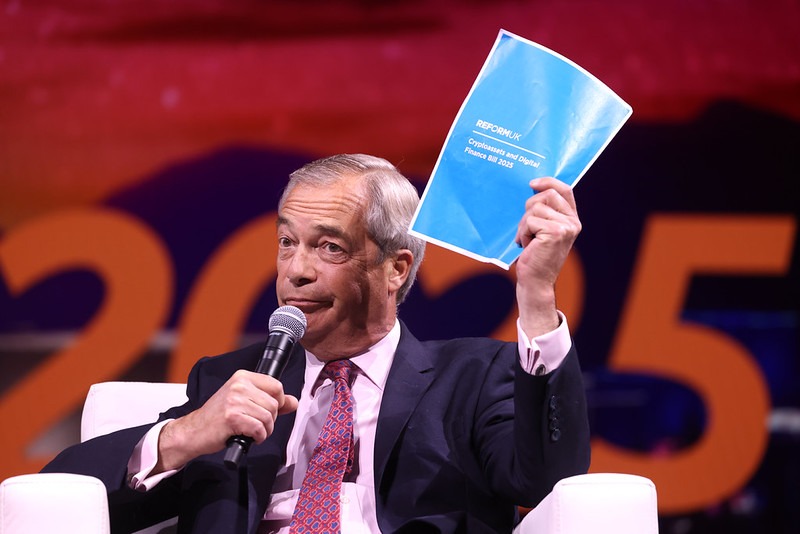
Reform UK leader Nigel Farage reportedly accepted gifts that he did not publicly disclose from a crypto entrepreneur convicted of fraud in the US, according to The Sunday Times.
The news outlet reported on Saturday that Farage was gifted staff, security, transport and accommodation by George Cottrell, an aristocrat involved in an offshore crypto casino who has been a close adviser to Farage for more than 10 years.
Farage said in a statement on Sunday that he “followed the rules” over the gifts from Cottrell, which he received before he was elected a member of parliament in July 2024, and called The Times’ report a “hit job.”
It is the second time Farage has faced reports of undeclared gifts from wealthy figures tied to crypto, an industry he has advocated for while in parliament that is facing increasing regulatory scrutiny, with the Treasury having temporarily banned political donations made in cryptocurrencies in March.
A parliamentary standards watchdog opened an inquiry in May over whether Farage failed to declare a 5 million British pounds ($6.7 million) gift from crypto billionaire Christopher Harborne, who partly owns stablecoin giant Tether.
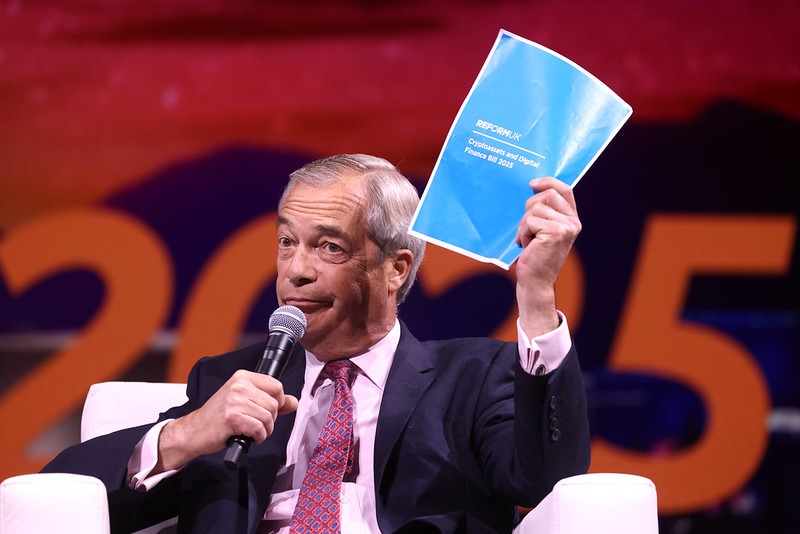
Nigel Farage appears at the Bitcoin 2025 conference holding his party’s draft crypto legislation. Source: Gage Skidmore
Farage has argued he does not need to declare Harborne’s gift, as it was given to him to pay for personal security before he was an MP.
Cottrell’s reported gifts include security, use of house
The Sunday Times reported that Cottrell, who is involved in a gambling site called Tether.bet that uses the Tether (USDt) stablecoin, provided Farage with drivers and security made up primarily of former soldiers.
Cottrell also reportedly recruited and paid for three staff members to help with the Reform leader’s social media and, since the election, has let Farage use a rented five-story house near Buckingham Palace. A Reform source told The Times that Farage almost always stayed at his own home and did not routinely use the property.
Farage registered only one benefit from Cottrell upon entering Parliament, a benefit of less than 9,300 British pounds ($12,400) for travel, security and accommodation to attend an event in Belgium.
In 2016, Cottrell was arrested and charged in the US with 21 offenses for his role in a money laundering plot. He pleaded guilty to a single wire fraud charge after a plea deal and spent eight months in prison.
Farage reported over alleged crypto lobbying
The Times’ report follows a report in The Guardian on Friday that the standards commissioner was urged to investigate whether Farage lobbied the Bank of England to drop its digital currency plans.
Related: Crypto billionaires bankroll Nigel Farage’s pro-crypto party
Labour MP and chair of a parliamentary anti-corruption group, Phil Brickell, reported Farage to the commissioner, saying he “claimed credit for persuading the Bank to soften its position” on a central bank digital currency.
Brickell said that Harborne “stood to benefit from opposition to a state-backed digital currency that could compete with private stablecoins.”
“This is not simply a debate about cryptocurrency. It is about whether an MP who has received millions from one individual should be lobbying for policies that could increase the value and profitability of that [Reform] donor’s investments,” said Brickell.
Farage and Reform have championed crypto, with the party publishing draft legislation last year with the goal of making the UK “the world’s premier hub for cryptocurrency.”
Reform was also the first UK political party to accept donations in Bitcoin (BTC). Farage has also proposed cutting capital gains taxes on crypto from 24% to 10% and called for the Bank of England to create a Bitcoin reserve.
Magazine: Guide to the top and emerging global crypto hubs: Mid-2026


Spot Bitcoin ETFs recorded $527 million in net outflows from June 29 to July 2, extending their weekly withdrawal streak to eight weeks. The latest data shows that demand for Bitcoin funds remains weak, even after some products returned to daily inflows.
Summary
- Bitcoin ETFs extended their outflow streak as investors pulled $527 million over four trading days.
- Ethereum ETFs also stayed negative, showing weak demand across the two largest crypto assets.
- XRP, SOL and HYPE funds drew inflows, pointing to selective demand beyond Bitcoin and Ethereum.
Crypto.news reported that U.S. spot Bitcoin ETFs lost $527 million over the four trading days ending July 2. The same report said the streak is now the longest weekly outflow run since the funds launched.
The weekly loss came despite a positive daily session on July 2. Bitcoin ETFs recorded $221.7 million in net inflows that day, ending a 10-day daily withdrawal run. Fidelity’s FBTC led the rebound with about $166 million in inflows, while ARK 21Shares’ ARKB added about $91.8 million.
BlackRock’s IBIT remained a main source of pressure. The fund recorded outflows on each trading day from June 29 through July 2. The pattern showed that one strong daily inflow was not enough to reverse broader weekly selling.
Ethereum ETFs remain under pressure
Spot Ethereum ETFs also ended the same period in negative territory. The products recorded $13.67 million in net outflows from June 29 to July 2, marking their eighth straight week of withdrawals.
Crypto.news reported that Ethereum ETFs posted positive daily flows on July 1 and July 2, but the gains did not fully offset earlier redemptions. BlackRock’s ETHA recorded about $29.7 million in inflows on July 2, helping the group recover part of its earlier losses.
The weak weekly result followed earlier pressure across Ethereum funds. Crypto.news recently reported that Ethereum ETFs faced large weekly withdrawals while traders watched whether ETH could hold key price levels.
The data shows that Bitcoin and Ethereum funds still face uneven demand. Investors returned on some days, but weekly figures continue to show net selling across the two largest crypto ETF groups.
XRP, SOL and HYPE funds buck the trend
Altcoin-linked funds moved in the opposite direction. Spot SOL ETFs recorded $5.75 million in net inflows from June 29 to July 2. XRP ETFs added $17.19 million, while HYPE ETFs brought in $4.32 million.
The inflows were smaller than the Bitcoin ETF outflows, but they showed that investors did not leave all crypto funds. Some capital moved into products tied to assets outside Bitcoin and Ethereum.
Crypto.news has tracked this trend in recent weeks. In May, XRP ETFs beat Bitcoin and Ethereum funds with $131.94 million in monthly inflows, while Bitcoin and Ethereum products recorded heavy withdrawals.
Bitwise also said its XRP ETF inflows topped $200 million year to date across U.S. and European products. Crypto.news also reported that HYPE ETFs crossed $100 million in inflows within their first 10 trading sessions.
ETF market shows divided demand
The latest ETF data points to a divided market. Bitcoin and Ethereum products continue to lose money on a weekly basis, while smaller crypto funds attract selective inflows.
Crypto.news has also reported on a wider XRP ETF rotation from Bitcoin funds, noting that the move remains smaller in size than Bitcoin’s outflows. The trend still shows that some investors are seeking exposure outside BTC during weak market conditions.
Solana funds have also seen steady interest this year. Crypto.news reported that Solana ETF assets crossed $1 billion by mid-May, even as SOL’s price remained under pressure.
For now, ETF flows show no broad recovery across major crypto funds. Bitcoin and Ethereum ETFs remain in weekly outflows, while XRP, SOL and HYPE products continue to attract smaller but positive demand.


In the never-ending battle between bitcoin , the digital gold, and the traditional yellow metal, veteran trader Peter Brandt has picked a side, and it’s not the one bitcoin bulls would have hoped for.
Brandt, CEO of Factor LLC and widely followed chart analyst, said on X that he is mulling liquidating some of his BTC and using the proceeds to buy gold, as he sees the yellow metal outperforming BTC.
“I am contemplating selling some of my Bitcoin and going to Gold with the money. Looks to me that Gold is going to gain substantially on Bitcoin,” Brandt told his followers on X.
Both BTC and gold have recently taken a beating, though bitcoin has fared noticeably worse than the traditional safe haven metal. The leading cryptocurrency by market value slid 20% in June to below $60,000, marking its worst monthly performance in four years. Gold, by comparison, dropped 11.7% to nearly $4,000 per ounce.
The divergence looks even starker on a year-to-date basis, with BTC down 28% in 2026 versus a 3.9% decline for gold.
Bucking the trend
Brandt’s view flies directly in the face of the popular market narrative among crypto bulls’ that anticipates a massive rotation of money back into BTC and digital assets.
Thousands of crypto wallets are at risk of being drained due to the use of weaker-than-intended recovery phrases, an exploit that Blockchain security research firm Coinspect has dubbed “Ill Bloom.”
The wallets at risk span Bitcoin, Ethereum, Polygon, Rootstock, Tron and Solana, Coinspect said in a disclosure on Sunday, with the issue related to weak randomness — an insecure pseudorandom number generator — used during recovery phrase generation on certain software wallets.
“If funds recently moved without your permission, this vulnerability may be why,” Coinspect said.
The vulnerability has impacted wallets generated as early as 2018 and more often occurs in lesser-known mobile software wallets. At least $5 million has been drained from exposed wallets since May 27, though there could have been exploits on additional networks and addresses, meaning the number of wallets at risk may be much higher.
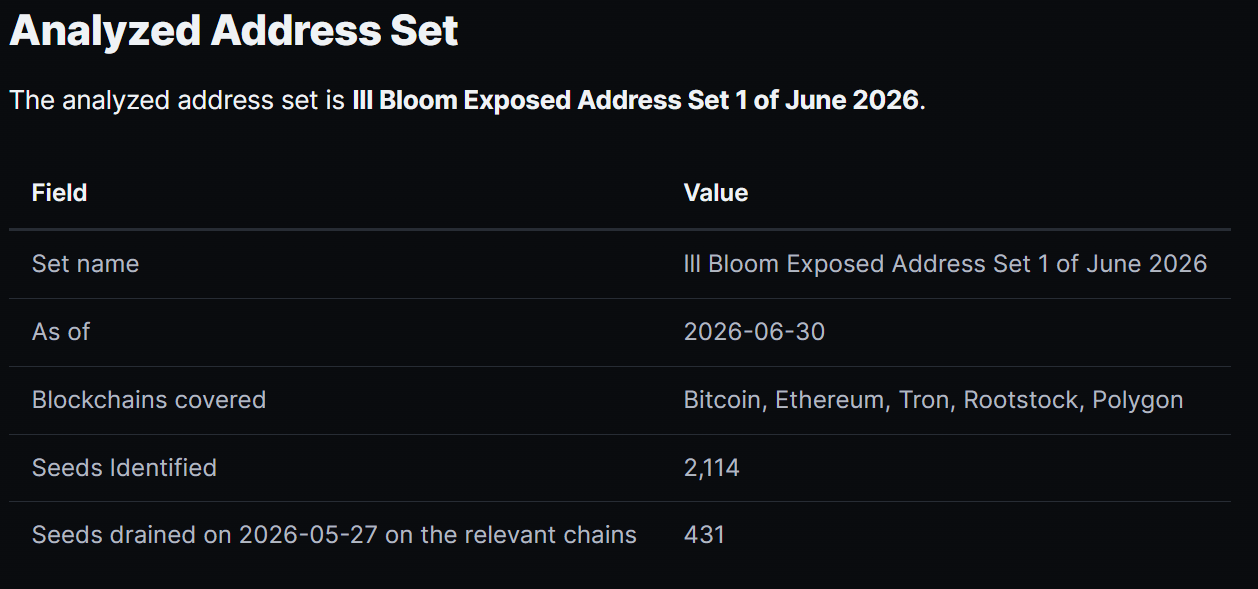
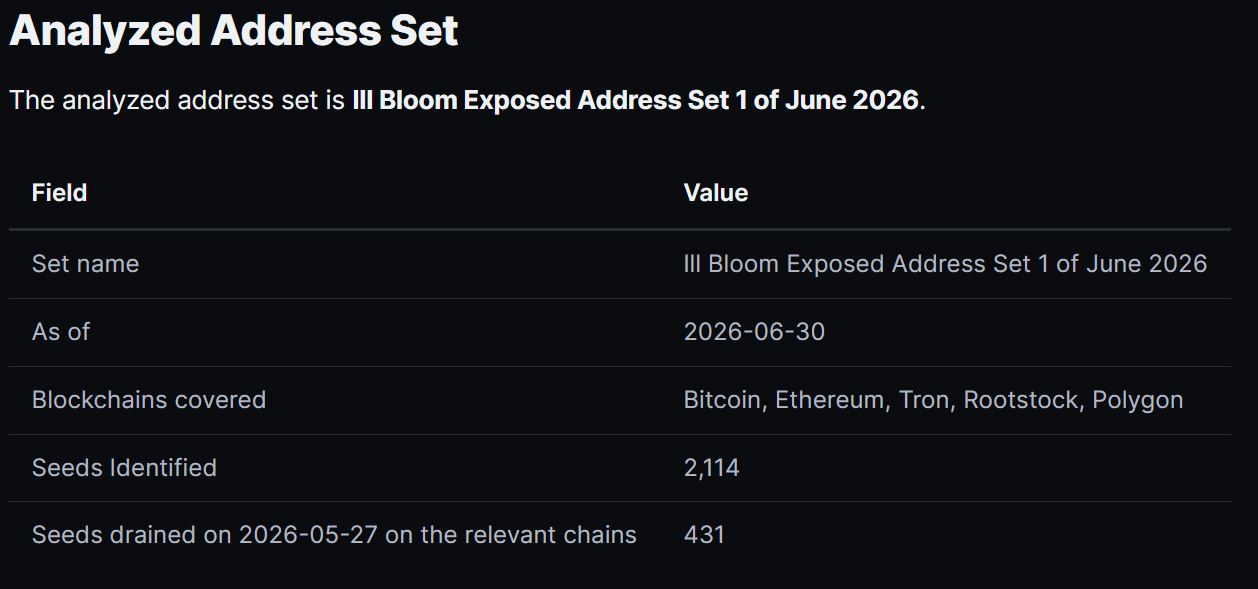
A snapshot of one analyzed address set as of June 30. Source: Coinspect
Coinspect said it was not publishing details of the active exploit at this stage, but has released a wallet-checking tool for users to see whether their address is potentially exposed.
“We’re closely monitoring the Ill Bloom wallet weak randomness risk alert from Coinspect,” SlowMist posted to X on Monday.
Data shows that an attack on May 27 affected 431 wallets out of 2,114 vulnerable wallets, draining a total of $3.1 million in cryptocurrency. Another $2 million was moved on Sunday from exposed wallets.
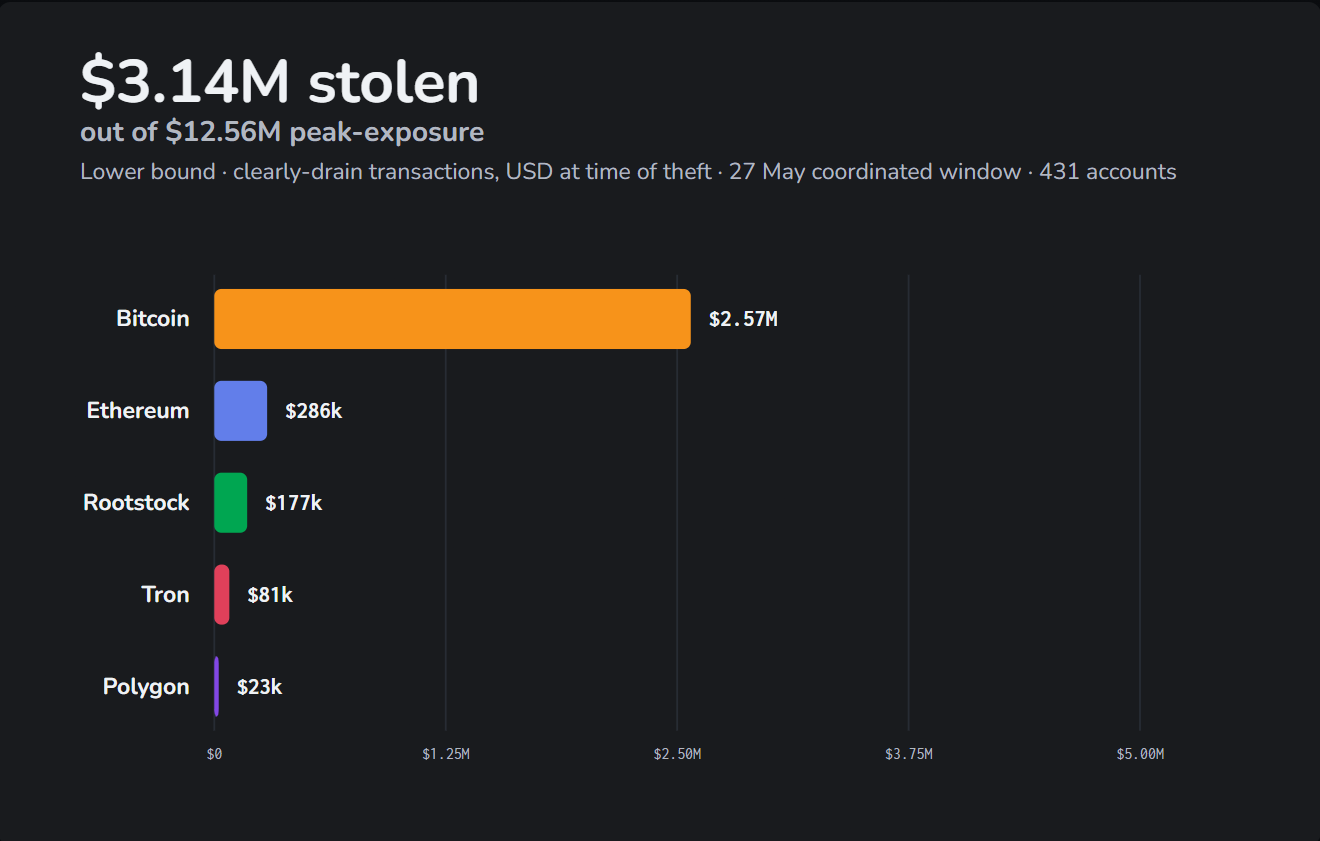
The historical sum of stolen amounts per chain in the May 27 attack. Source: Coinspect
“Current evidence tells us that users that generated their seed with a hardware wallet are not affected,” said Coinspect.
“Further research indicates that most current software wallets are also not vulnerable,” it added. “The strongest candidates are users who generated their seed in less widely used mobile software wallets.”
Related: Taiko reopens bridge after $1.7M exploit, says users made whole
Weak wallet seeds cause headaches
This type of vulnerability has emerged several times in the past. In 2023, Ledger’s security team discovered that wallet seeds generated by the Trust Wallet browser extension were vulnerable to brute-force attacks.
The flaw resided in the wallet’s entropy generation for new addresses, which limited the total possible mnemonic combinations to roughly four billion and could allow a motivated attacker to run an attack in less than a day with just a few GPUs. Trust Wallet patched the bug before any funds were stolen.
In the same year, a vulnerability in the Libbitcoin Explorer crypto wallet led to $900,000 in crypto being stolen through private key brute forcing.
Magazine: Bitcoin slides to $58K, XRP hits $1 but onchain data promising: Market Moves
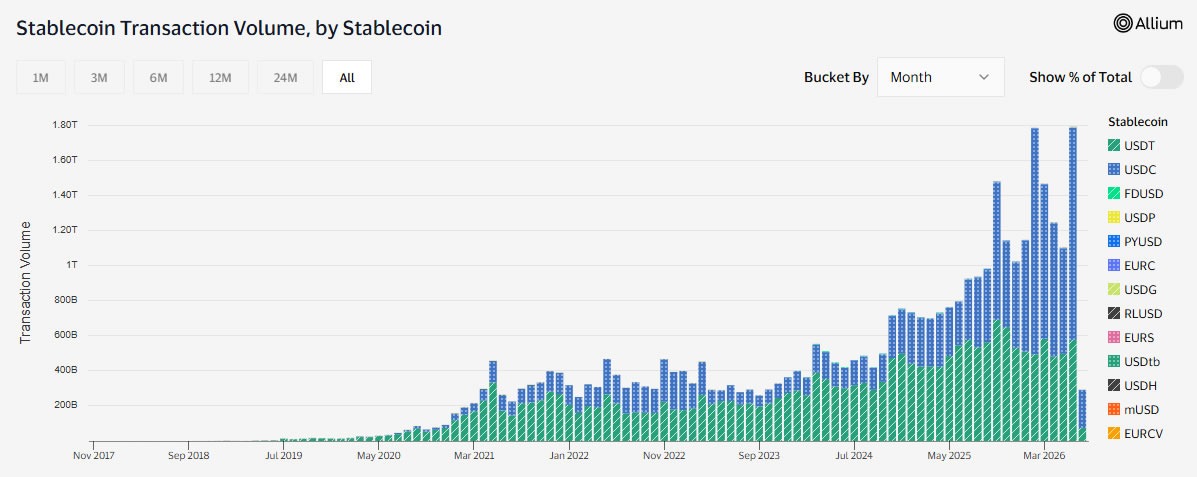
Adjusted stablecoin transaction volume hit a record $1.79 trillion in June, up 63% from May’s $1.1 trillion, according to payments giant Visa.
June’s record stablecoin transaction volume surpassed the previous record of $1.78 trillion in February, and is up 125% from the prior-year period, according to Visa’s Allium-powered stablecoin analytics dashboard.
“June 2026 was another record month for stablecoin transaction volume, just ahead of February 2026,” said Zach Pandl, head of research at Grayscale, on Sunday.
The sharp increase in stablecoin transaction volume suggests growing real-world use in payments, decentralized finance and cross-border transfers as crypto infrastructure matures. It comes despite a broader crypto bear market, suggesting that stablecoins have become a driving force in the industry.
USDC has the lion’s share of volume
Despite Tether’s USDt being the largest stablecoin by market cap, the majority of the transaction volume, around 67%, was Circle’s USDC, with $1.21 trillion for the month. USDT accounted for around 32%, or $576 billion, according to Visa.
PayPal’s PYUSD is the third-largest in terms of transaction volume, with $2.42 billion in June.
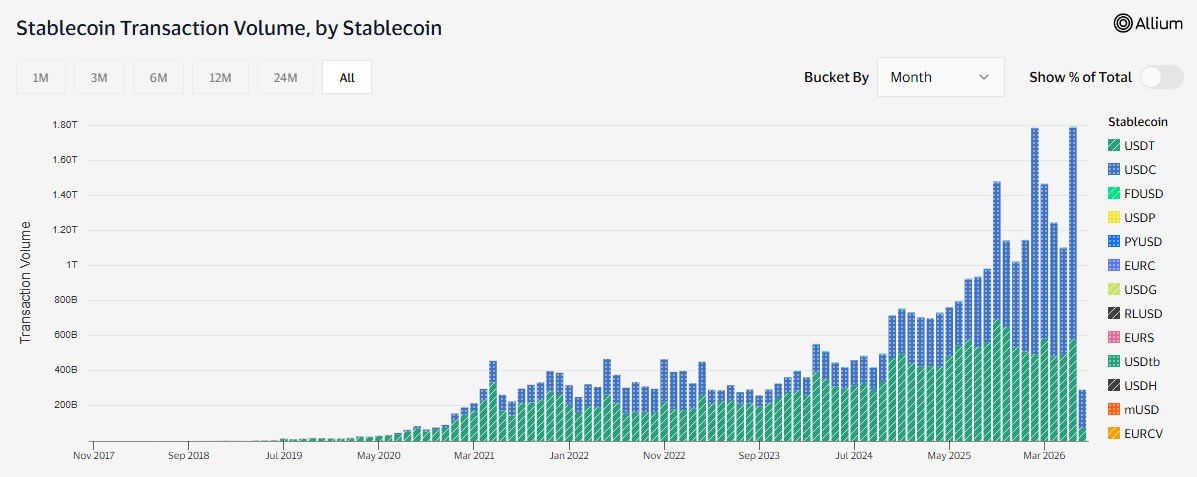
There was just under $1.8 trillion in adjusted stablecoin transaction volume in June. Source: Visa
The most widely used network for stablecoin transactions in June was Coinbase’s Ethereum layer-2 network Base with $565 billion, or 31.5% of the total, closely followed by Ethereum with $562 billion. Tron was the third-highest with $320 billion, or about 18% of the total.
Related: Revolut to delist USDT in August, citing regulatory and risk concerns
Visa collaborated with Artemis, Allium Labs and Castle Island Ventures to develop an adjusted transaction methodology that filters out “distracting metrics” such as high-frequency trading bots, exchange treasury rebalancing and repeated smart contract transactions to help better approximate organic stablecoin activity, the company said.
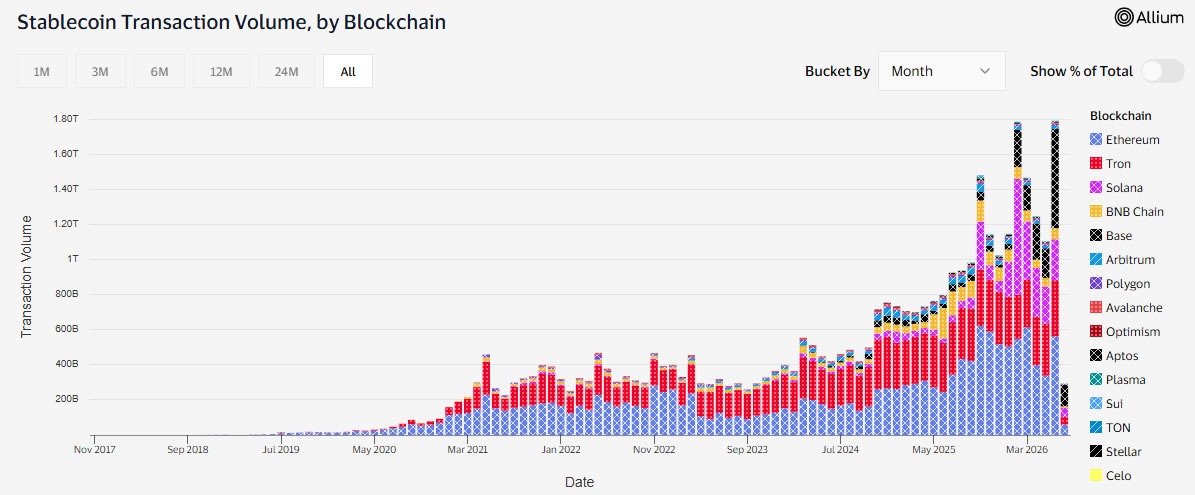
Base and Ethereum dominated stablecoin volumes in June. Source: Visa
Meanwhile, another player has entered the crowded stablecoin market as Open Standard announced Open USD (OUSD) on Tuesday, with support from more than 140 payments, banking, technology and crypto companies, including Visa and Mastercard.
Trend to continue as stablecoins mature
Nick Ruck, director of LVRG Research, told Cointelegraph that the record volume demonstrates the resilience of these assets amid the broader crypto bear market.
“This surge underscores the growing role of stablecoins as essential infrastructure for value transfer, liquidity provision, and decentralized finance activity that persists independently of speculative price movements,” he said.
Ruck predicted that the trend would continue with stablecoins “maturing into a foundational layer of the Web3 economy,” and are positioned for even greater reach as the market evolves.
Magazine: AI is banking the unbanked in Africa… faster than crypto
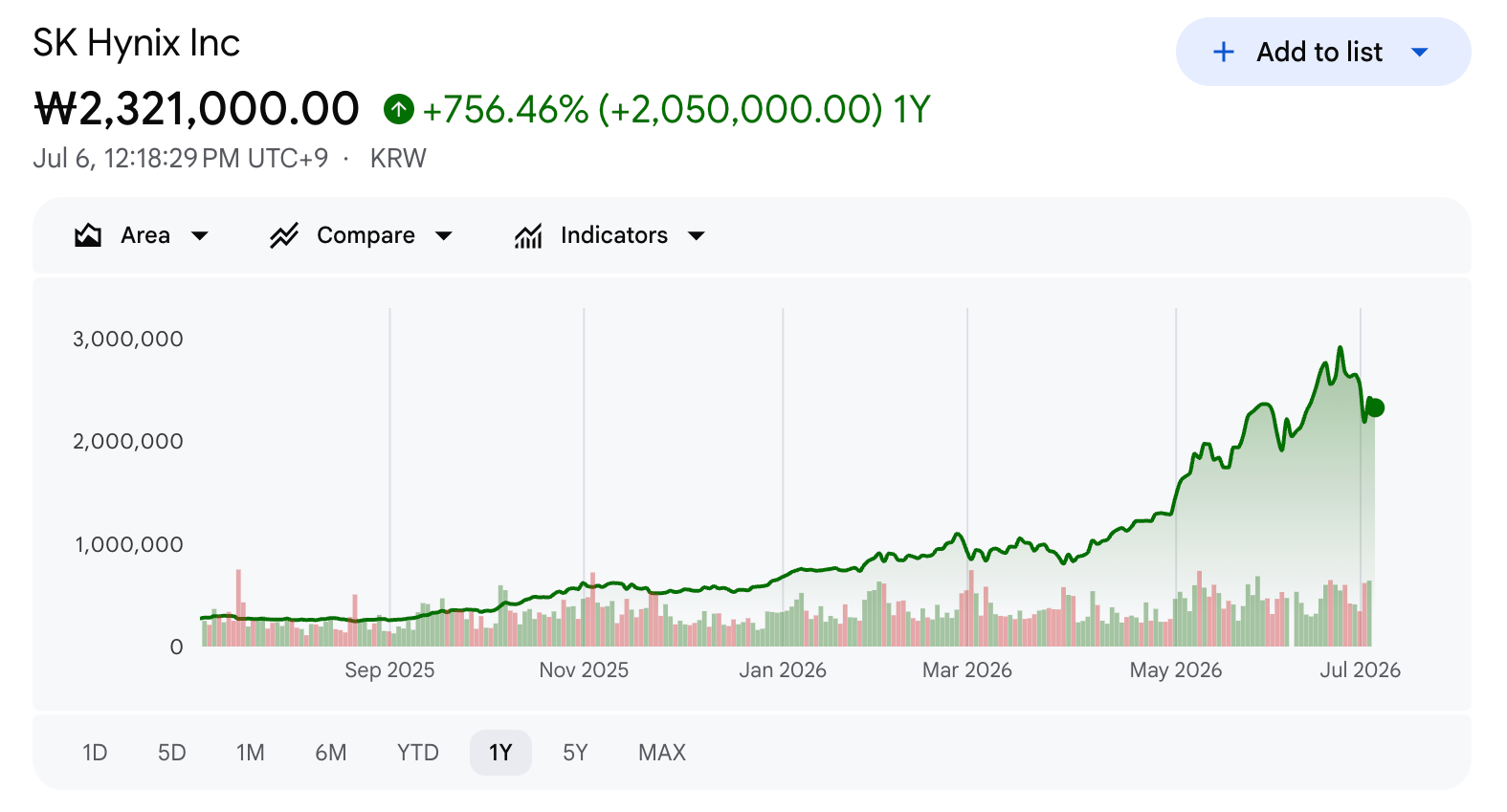
SK Hynix will launch its roughly $29 billion Nasdaq listing this week, tapping US markets amid the artificial intelligence (AI) boom.
The listing is expected to rank as the biggest-ever first-time US share sale by a foreign company. The chipmaker will sell 17.79 million new shares, with trading expected to start Friday.
Why the SK Hynix Nasdaq Listing Breaks Records
Each SK Hynix common share will be represented by 10 American depositary receipts, Reuters reported. Management will meet global investors on a roadshow this week. SK Hynix will fix the New York listing’s price on Thursday, with the shares set to begin trading the following day, Friday.
The deal could rank as the second-biggest share sale in history. Only SpaceX’s record IPO, which raised $85.7 billion last month, stands above it. The offering also surpasses Saudi Aramco’s $25.6 billion IPO in 2019.
Bloomberg noted that the listing is about more than cash. SK Hynix has long traded at a discount to US-based rival Micron Technology. The latest move could change that.
Trading on the Nasdaq gives the chipmaker direct access to the world’s deepest equity market. It also places SK Hynix inside the AI trade that currently drives the S&P 500’s performance.
Follow us on X to get the latest news as it happens
AI Boom Powers a 700% SK Hynix Rally
SK Hynix supplies high-bandwidth memory chips to AI customers, including Nvidia and Google. That position has made it one of the biggest winners of the AI buildout, outperforming Samsung Electronics and Micron.
The company’s Korea-listed stock has climbed more than 700% over the past year. Last month, the chipmaker briefly surpassed Samsung in valuation for the first time since 2000.

Thursday’s pricing will show how much US investors will pay for exposure to the AI memory trade. Whether Friday’s debut finally closes the valuation gap with Micron may become clear in the first trading sessions.
Subscribe to our YouTube channel to watch leaders and journalists provide expert insights
The post SK Hynix Taps US Markets for $29 Billion Amid AI Chip Frenzy appeared first on BeInCrypto.


Binance users in France can no longer trade on the platform after the exchange missed the European Union’s MiCA approval deadline. From July 1, Binance stopped offering several services in France and other European countries where it lacks authorization under the bloc’s new crypto rules.
Summary
- Binance users in France can withdraw assets but cannot trade after MiCA approval delays.
- Coinbase and OKX are targeting affected European users seeking licensed platforms under EU rules.
- MiCA has narrowed Europe’s crypto market, giving approved exchanges a stronger compliance edge.
The change follows Binance’s wider MiCA service pause in Europe. French users can still withdraw assets, but spot and margin trading are no longer available. Binance previously served about 2 million users in France.
The company told affected users that “Your assets remain safe and secure,” according to earlier notices. It also encouraged users to move assets to a regulated platform or a personal wallet if they needed active access.
The service limits came after the MiCA transition period ended. Crypto firms now need approval from one EU member state to serve clients across the bloc.
French users move funds after trading halt
Some Binance users in France moved their crypto before the July 1 cutoff. Others waited for more clarity from the exchange. The platform still allows withdrawals, but users who want to trade must move funds elsewhere.
One user quoted by BFM Business said, “I repatriated my cryptos last weekend,” after choosing not to wait until the last minute. Another user said Binance left customers to handle the transfer process alone, adding, “You’re on your own.”
The case shows how a license delay can quickly change customer access. Many retail traders used Binance for active trading, leverage products, and quick crypto conversions. Those services are now limited in affected markets.
On-chain data cited in the report showed Binance recorded about $1.6 billion in net outflows over the past month. That figure remains small compared with about $114 billion in crypto assets still managed by the exchange.
Licensed exchanges target affected traders
The Binance pause has opened room for approved rivals. Crypto.news reported thatCoinbase and OKX targeted Binance users before the MiCA deadline. Both firms promoted access to regulated services as users reviewed where to trade next.
Coinbase targeted users across several European markets, including France, Germany, Italy, Belgium, Poland, Sweden, and the U.K. OKX also promoted offers for eligible users in the European Economic Area.
The timing matters because MiCA has changed how exchanges compete in Europe. Licensed firms can promote service continuity. Platforms without approval must restrict covered services or seek a new licensing route.
Crypto.news also reported that Germany and France led the MiCA rollout. As of June 29, the EU had issued 244 valid MiCA crypto-asset service provider licenses.
MiCA reshapes exchange access in Europe
MiCA is now the main rulebook for crypto service providers in the European Union. It covers exchanges, custodians, token issuers, and stablecoin providers. It also replaces many older national crypto rules with one EU-wide system.
The Binance case is one of the clearest tests of the new framework. The exchange says it wants to return with a license, but users in affected markets now have limited access until that happens.
The rule change has also affected stablecoins. Crypto.news reported that USDT was removed from regulated EU exchange order books after Tether did not seek MiCA authorization.
For users, the change is direct. Trading access now depends on whether an exchange holds MiCA approval. Binance remains open for withdrawals in affected markets, but normal trading depends on future authorization.
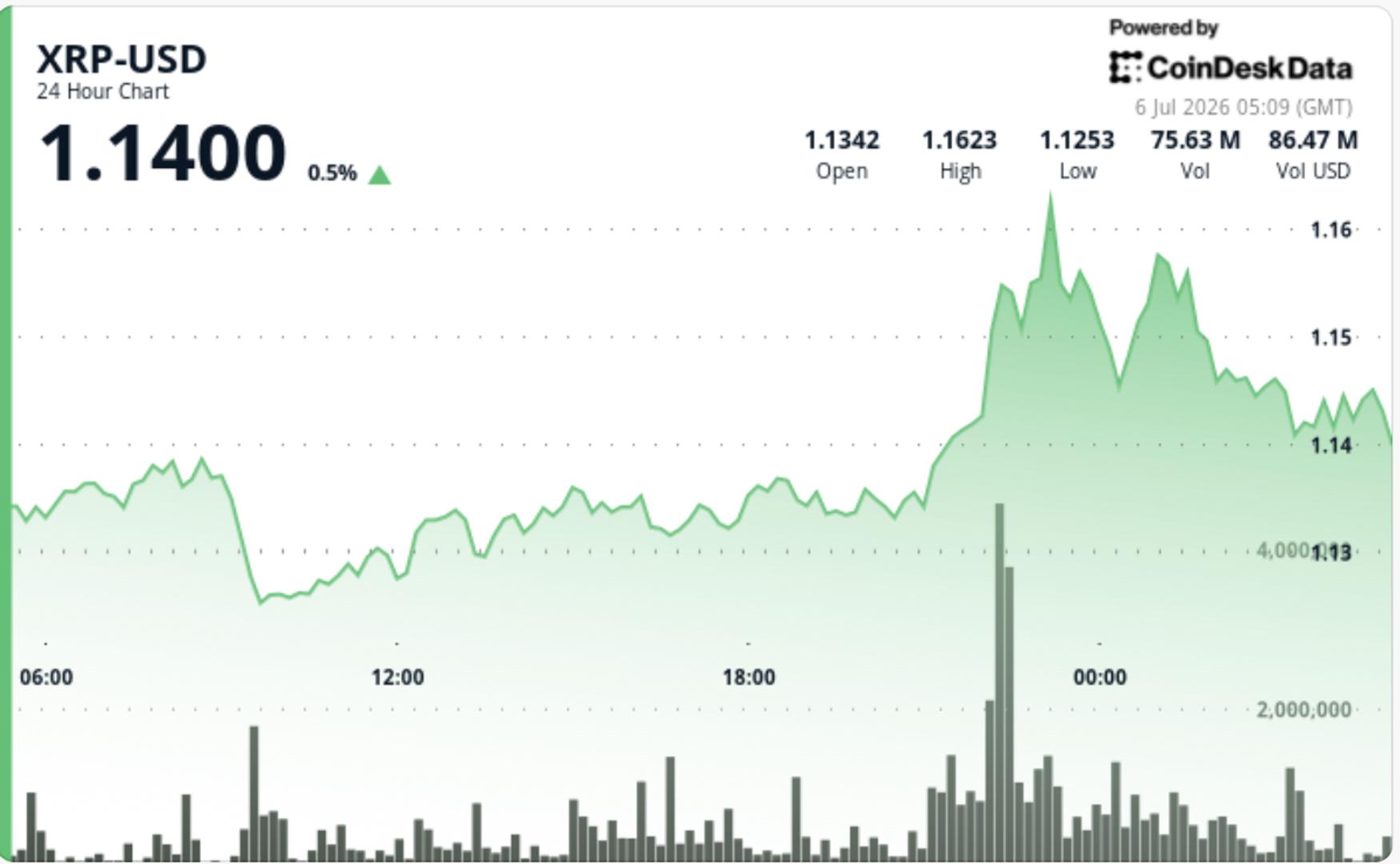
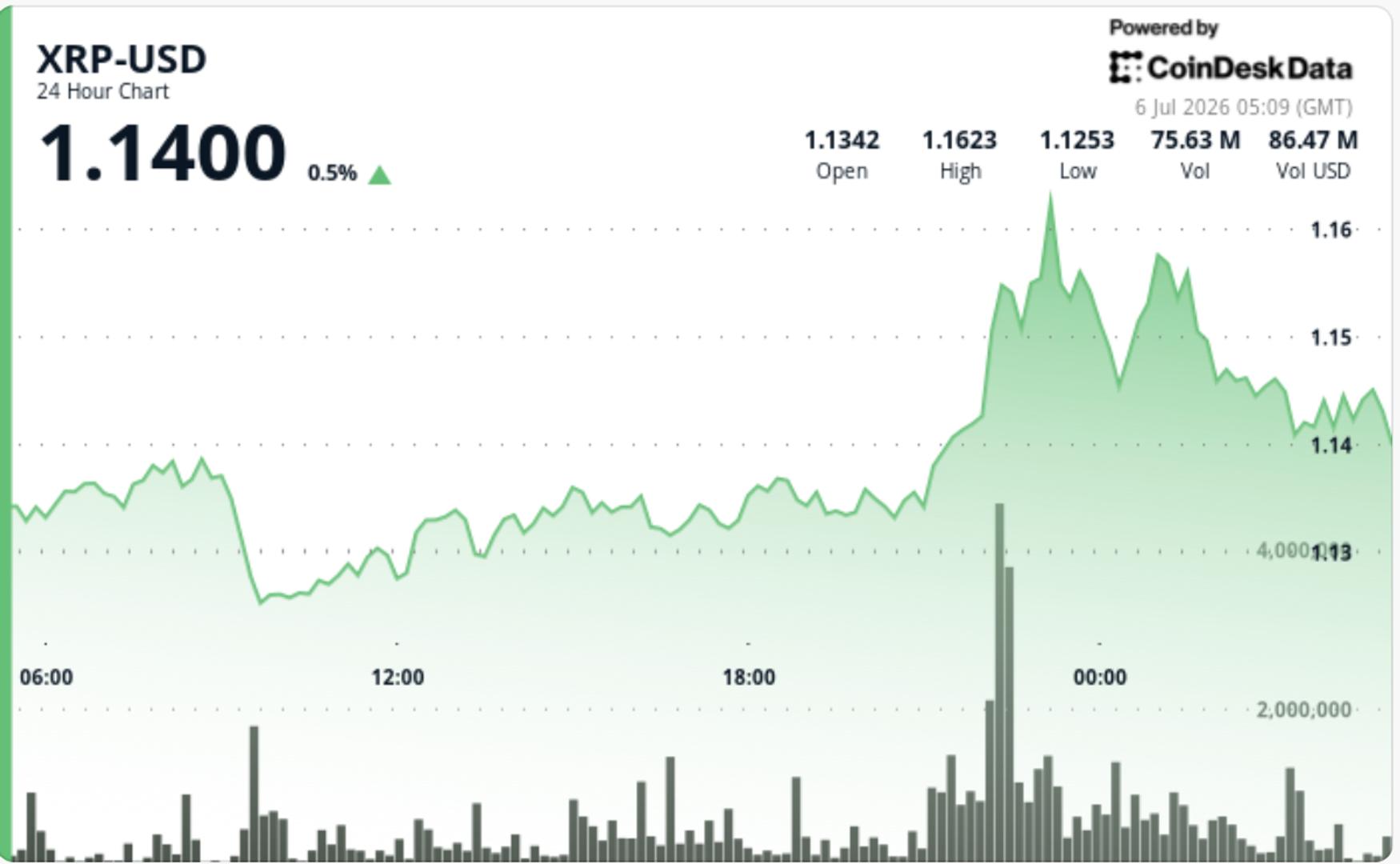
XRP finally pushed through the $1.14 level that had capped recent attempts higher, but the move did not run cleanly into the next resistance band. Buyers drove the token as high as $1.158 on heavy volume before sellers forced a pullback toward $1.146, turning the session into a test of whether former resistance can now act as support.
News Background
• XRP spot ETFs recorded a ninth consecutive week of net inflows, adding $17.19 million despite broader market uncertainty.
• The CLARITY Act missed its expected timeline after the Senate adjourned for recess without a floor vote, leaving regulatory catalysts delayed.
• Santiment data showed XRP’s 30-day MVRV near -45% and 365-day MVRV near -47%, meaning most holders remained underwater across both shorter and longer timeframes.
• Several analysts pointed to improving technical structures, including a 4-hour downtrend break, bullish divergence and a possible Elliott Wave advance.
Price Action Summary
• XRP rose from $1.1344 to $1.1454 during the 24-hour session, gaining 2.87%.
• The breakout came at 22:00 UTC on July 5, when volume reached 81.89 million XRP, about 207% above the 24-hour average.
• The move carried XRP from $1.1356 to $1.1594 in two hours, clearing resistance near $1.1400.

TL;DR
- Spot Bitcoin ETFs recorded $526.64 million in net outflows last week, extending their losing streak to eight consecutive weeks.
- Spot Ethereum ETFs also posted net outflows of $13.67 million, marking an eighth straight week of withdrawals.
- In contrast, SOL, XRP, and HYPE ETFs attracted fresh capital, with XRP ETFs leading weekly inflows.
- Analysts say ETF flows remain a key indicator of institutional sentiment as investors monitor Bitcoin’s next market direction.
U.S. spot Bitcoin exchange-traded funds (ETFs) continued to face heavy selling pressure last week, recording $526.64 million in net outflows between June 29 and July 2. The latest withdrawals mark the eighth consecutive week of net outflows, the longest weekly redemption streak since spot Bitcoin ETFs began trading in the United States.
The trend reflects continued caution among institutional investors as Bitcoin struggles to regain momentum. According to SoSoValue data, total net assets across U.S. spot Bitcoin ETFs have fallen to approximately $74.37 billion, while Bitcoin traded near $61,500 during the reporting period, as shown in the accompanying chart. The sustained redemptions come after June became the worst month on record for spot Bitcoin ETFs, with roughly $4.5 billion leaving the products.
Spot Ethereum ETFs also remained under pressure, posting $13.67 million in net outflows over the same period. Like Bitcoin funds, Ethereum ETFs have now logged eight straight weeks of investor withdrawals, highlighting persistent risk-off sentiment across the two largest digital assets.
Altcoin ETFs Buck the Trend as SOL, XRP, and HYPE Attract Fresh Capital
While Bitcoin and Ethereum products continued to lose assets, several newer crypto ETFs managed to attract fresh investment.
Spot Solana (SOL) ETFs recorded $5.75 million in weekly net inflows, while XRP ETFs brought in $17.19 million, making XRP the strongest performer among the major altcoin funds. Hyperliquid (HYPE) ETFs also remained in positive territory with $4.32 million in net inflows, although the figure represented a slowdown compared with previous weeks.
The divergence suggests that some investors are rotating capital into alternative digital assets rather than exiting the crypto ETF market entirely. Although Bitcoin remains the largest institutional investment vehicle in the sector, selective demand for altcoin-based products indicates that investors continue to seek exposure to projects they believe offer stronger upside potential.
Bitcoin ETFs Face Mounting Pressure Despite Brief Daily Recovery
Despite the weak weekly performance, the reporting period ended with a small sign of stabilization. On July 2, U.S. spot Bitcoin ETFs recorded more than $221 million in daily net inflows, breaking a 10-session outflow streak. However, analysts caution that a single positive trading day is unlikely to reverse the broader trend after eight consecutive weeks of withdrawals.
Market observers attribute the prolonged outflows to a combination of macroeconomic uncertainty, higher interest-rate expectations, and reduced appetite for risk assets. Bitcoin has remained under pressure alongside broader financial markets, while institutional investors continue trimming exposure through ETF redemptions.
Going forward, ETF flows are expected to remain a closely watched indicator of institutional sentiment. A sustained return to net inflows could signal renewed confidence in Bitcoin, while continued withdrawals may reinforce expectations of subdued demand until broader market conditions improve.



Asia’s crypto market is moving in different directions. Dubai and Taiwan are building formal licensing systems, while India and Russia are keeping state control at the center of digital asset policy.
Summary
- Dubai’s 50th VASP license shows regulated crypto firms still favor clear licensing routes in Asia.
- Taiwan’s new law brings exchanges and stablecoins under approval rules as regional competition grows fast.
- Russia’s digital ruble rollout shows state-backed payment systems advancing despite sanctions and global CBDC debate.
Dubai’s Virtual Assets Regulatory Authority granted its 50th virtual asset service provider license to Tribe Tokenisation FZE. The milestone puts Dubai ahead of Hong Kong and Singapore by reported license totals, though license numbers do not show how many firms are active or how much business they handle.
Taiwan also moved ahead with its new crypto and stablecoin law. The law requires virtual asset service providers to get approval from the Financial Supervisory Commission before operating in the market.
Stablecoin issuers in Taiwan must also receive approval from the central bank and the FSC. They must keep enough reserves with a trustee and go through regular audits. The law gives Taiwan a clearer crypto framework as Japan, Singapore and Hong Kong compete for regulated digital asset firms.
India and Russia keep state control in focus
India’s central bank renewed its push to keep banks away from crypto and private stablecoins. The Reserve Bank of India reportedly told lawmakers that banks should avoid direct crypto exposure, while tokenized government securities and regulated financial products should be treated separately.
The RBI also reportedly warned that applying normal financial rules to speculative crypto assets could make users believe those assets carry official protection. Its position shows that India may support regulated tokenization while keeping crypto payments and settlements under pressure.
This follows wider regulatory pressure in India. Crypto.news recently reported that India’s USDT premium doubled after enforcement action disrupted stablecoin supply. India’s Financial Intelligence Unit has also sought large OTC crypto trade records from major exchanges.
Russia is taking another route through state-backed digital money. The country plans to launch the digital ruble on Sept. 1. Central bank governor Elvira Nabiullina reportedly said “everyone is ready” for the rollout.
Bitcoin firms make opposite treasury moves
Japan’s SBI Crypto will close its Bitcoin mining pool on July 31 after five years. SimpleMining data placed the pool as the 12th largest globally, with about 21.46 EH/s and 2.24% of the Bitcoin network share.
SBI Crypto asked miners to keep directing hashrate to the pool until the final day so final payouts can be calculated. The company said, “We would sincerely appreciate your continued support by mining with us until the final day of operation.”
Corporate Bitcoin activity also moved in opposite directions. Metaplanet bought 2,823 BTC in the second quarter, lifting its holdings to 43,000 BTC, according to a crypto.news report.
South Korea’s K Wave Media took the other side of the trade. The Nasdaq-listed company sold its remaining 88 BTC to repay $6 million in debt, ending its Bitcoin treasury strategy after earlier plans to build a larger position.
Tokenization and compliance shape Asia’s next stage
Tokenization also stayed in focus. Bank of Korea governor Hyun Song Shin said “The big prize is tokenizing government bonds” during a panel at the European Central Bank Forum on Central Banking in Sintra, Portugal.
Shin said tokenized bonds could make collateral checks and account crediting easier. He also described plans to connect tokenized government bonds, wholesale CBDCs and tokenized bank deposits through a unified ledger under Project Hangang.
Compliance pressure continued outside Asia as well. As crypto.news reported, Tether froze USDT in 131 ISIS-K-linked TRON wallets after OFAC added 134 crypto wallet identifiers tied to the group.
Kazakhstan also moved deeper into the regional crypto race. Solana Company signed an agreement to support Alatau City, a planned digital-first megacity. The project aims to build blockchain and crypto infrastructure as Kazakhstan works to expand its digital asset market.

ASIC called in after Black Cat hits Barclays with action

Nigel Farage Accepted Gifts from Crypto Casino Player

Nigel Farage Claims Establishment Hit Job Over Sleaze Probe


-

 Fashion3 days ago
Weekend Open Thread: High Hopes
-

 Politics3 days ago
The House | “Reframing the debate from a binary discussion of winners and losers”: Yuan Yang reviews ‘We Are Not Machines’
-

 Crypto World6 days ago
Strategy authorizes up to $1.25B in Bitcoin sales under new capital plan
-

 News Videos6 days ago
How to Build INSANE Live Financial Dashboards With Claude
-

 Tech6 days ago
Anonymous researcher drops 0-day ‘exploitarium’ repo
-

 Business6 days ago
Australia treasurer says alleged access of prime minister’s bank data ’incredibly concerning’
-
 NewsBeat1 day ago
Taylor Swift and Travis Kelce wedding staffer hilariously struggles to keep her cool while checking in megastars
-
 Business7 days ago
The AI boom won’t burst all at once. It will pop in ‘rolling bubbles’: Macquarie
-

 Sports5 days ago
Broncos roster: OL Ben Powers (No. 74) entering final year of contract
-
Crypto World5 days ago
Airdrop Registration Becomes Key Focus For Remittix As RTX Launch Updates Approach
-

 Crypto World4 days ago
Binance stock trading tops $1B in first month after launch
-

 NewsBeat5 days ago
Presenter Caroline Flack’s brother Paul Flack dies aged 55
-

 Crypto World4 days ago
Alibaba-affiliate Ant Group enters the humanoid robot market with 12 deals
-
 NewsBeat4 days ago
New exhibition reflects five decades of movement between island of Ireland and GB
-

 Crypto World16 hours ago
South Africa proposes crypto tax guidance under existing rules
-

 Tech19 hours ago
Lenovo laptops are now shipping with YMTC SSDs, a sign of Chinese NAND entering the mainstream
-

 Business3 days ago
What a 10 Percent Drop Means for Buyers, Sellers and Renters
-

 Crypto World3 days ago
Standard Chartered Secures MiCA License as ESMA Adds 37 New Crypto Firms
-

 Business4 days ago
Meta Platforms Stock Jumps 7% Today as Bloomberg Reports Company Plans to Enter the Cloud Business
-

 Crypto World3 days ago
Binance Re-Enters Philippines As EU MiCA Rules Restrict Access
You must be logged in to post a comment Login