

Crypto World
Central Bankers Warn of Agentic AI Risks in Financial Markets


European regulators and central bankers are warning that the financial risks posed by “agentic” and increasingly autonomous artificial intelligence may be arriving faster than legal and supervisory frameworks can adapt. Their message is less about whether AI will be used in finance, and more about how it could behave under stress—when liquidity thins, volatility rises, and systems that rely on machine decision-making are pushed beyond normal operating conditions.
In recent remarks across Europe, officials raised concerns ranging from market-wide instability caused by faulty AI-driven trading to a widening gap between rapid AI development and the slower cadence of rulemaking. They also linked the issue to broader financial stability risks, including leverage and potential “boom-bust” dynamics in AI-linked asset markets.
Key takeaways
- Central bankers warn rulemaking may lag agentic AI: officials said traditional regulatory cycles struggle when AI technologies shift in weeks or months.
- Volatility could be amplified during stress: Bank of England deputy governor Sarah Breeden suggested AI could worsen market disruptions unless guardrails exist.
- Security and defense funding remain a weak point: ECB president Christine Lagarde argued cybersecurity risks are becoming more severe as models accelerate.
- AI leverage and refinancing risks are on regulators’ radar: warnings from the BIS and IMF pointed to debt-asset maturity mismatches and disruptive feedback loops.
Why European officials think agentic AI changes the risk equation
Bank of England deputy governor Sarah Breeden is among the central bankers arguing that agentic AI—systems that can act with a degree of autonomy—could intensify instability during periods of market stress. Speaking at the European Central Bank’s annual meeting in Sintra, Portugal, on Tuesday, Breeden raised the question of whether regulators should implement guardrails that function like “circuit breakers” or “kill switches,” designed to limit or stop market-wide trading if faulty AI models trigger a meltdown. In her remarks, she emphasized the potential for automation to turn localized errors into systemic disruptions.
The concern is not merely that AI could make trading decisions faster, but that it could create correlated behavior across market participants. When multiple systems respond similarly to the same signals—particularly under stress—small model failures could cascade into larger price swings.
Breeden also tied the issue to the competitive landscape for AI development. She noted that US companies lead in AI investment and frontier model development, while Europe’s financial system offers fewer capital channels into AI than US equity markets. She warned that regulating “too cautiously” could widen this gap further if AI firms seek out jurisdictions with less burdensome compliance requirements.
Regulation cycles can’t keep up, watchdogs say
Other regulators echoed Breeden’s core point: the speed of AI innovation makes conventional policymaking approaches ill-suited. Nikhil Rathi, CEO of the UK’s Financial Conduct Authority, told CNBC’s Squawk Box on Thursday that traditional regulation cycles do not work when the technology evolves rapidly. As he put it, some AI-related technologies move in weeks or months, which means a “traditional cycle of rulemaking simply doesn’t work.” He argued that regulators need “new tools” and a more collaborative way of working with markets.
This view is consistent with the broader European stance that governance frameworks must be designed to handle iterative updates and rapid deployment. In practice, that suggests supervisors may need to focus not only on static compliance at launch, but also on how models are monitored and controlled as they change over time.
At the same time, central bankers have repeatedly linked the discussion to other parts of the financial system, including cyber risk and market integrity. Those overlap points matter to crypto markets as well, since many on-chain and off-chain infrastructures rely on automated processes, and crypto trading systems can react quickly to market signals.
Cybersecurity and “defense” gaps are worsening with model acceleration
Christine Lagarde, president of the European Central Bank, warned in an interview with Les Echos on Thursday that AI technology poses a “major risk.” She contrasted today’s environment with the past decade, when regulators focused on cybersecurity threats such as hacking, data theft, and other forms of compromise.
Lagarde said the acceleration and deeper capabilities of AI models create a “much more serious risk,” partly because events can unfold quickly and partly because effective defense mechanisms and the funding needed to build them have not yet been fully found. Her remarks reframed cybersecurity from a slow-moving threat landscape into a faster feedback environment where response times and resourcing become critical.
From an investor and operator standpoint, that framing implies that AI-related risk management may need to cover not only model accuracy, but also the systems surrounding them—access controls, incident response capabilities, monitoring, and the ability to contain harms when something goes wrong.
Boom-bust warnings: leverage, asset pricing, and macro feedback loops
Separate from concerns about trading autonomy, European and global institutions have also flagged the possibility that AI-linked market activity could create financial stability vulnerabilities. On June 28, the Bank for International Settlements warned that “AI exuberance” could lead to major financial consequences.
The BIS noted that if central banks tighten policy to help contain inflation, it could trigger a sharp pullback in AI-related asset prices after a prolonged period of risk-taking. It warned that this could generate “disruptive macro-financial feedback loops.” In other words, asset price declines could impact broader financial conditions in a way that feeds back into the real economy, tightening conditions further and potentially worsening the initial downturn.
Breeden added a related observation in her Sintra remarks: debt financing has been rising rapidly, and she judged that the financial stability consequences of any fall in AI-related asset prices could increase. That emphasis on leverage suggests regulators are concerned not just with valuations, but with how funding structures could transmit shocks.
The IMF also contributed to the discussion. Tobias Adrian, Director of the IMF’s Monetary and Capital Markets Department, said in an interview with Bloomberg on June 30 that there is a “potential maturity mismatch” between the duration of physical assets and the duration of debt. The risk here is that companies or sectors may face refinancing pressure at the same time cash flows deteriorate—creating a pressure point that can amplify stress.
What comes next for markets watching AI risk controls
The immediate takeaway for market participants is that supervisors may increasingly push for risk management expectations that reflect fast-moving AI deployment—covering both operational safeguards (including cybersecurity and “circuit breaker”-style controls) and financial stability concerns tied to leverage. Investors should watch whether regulators move toward more dynamic oversight frameworks for AI-driven systems and whether AI-related financing conditions change as monetary policy expectations evolve.


Key Highlights
- In a remarkably swift move, SpaceX secured Nasdaq-100 membership merely 15 days following its June 12 public offering, marking one of the most rapid index additions in history.
- Index-tracking funds are projected to purchase between $4.3 billion and $6 billion worth of SPCX shares to align with updated index weightings.
- Both Goldman Sachs and Morgan Stanley launched coverage on Tuesday with their highest possible ratings; Goldman characterized the opportunity as potentially reaching “multi-trillion-dollar” scale.
- The company’s index representation reflects a float-adjusted market capitalization of approximately $300 billion, though only around 638 million shares are publicly tradeable.
- An additional 20% of shares will become available for trading following SpaceX’s inaugural earnings announcement, anticipated within weeks.
In a historic development for Wall Street, SpaceX (SPCX) secured its position in the prestigious Nasdaq-100 index on Tuesday, achieving this milestone a mere 15 days after making its stock market entrance on June 12 — establishing one of the swiftest index inclusions ever documented.
Space Exploration Technologies Corp., SPCX
During premarket trading on Tuesday, shares declined approximately 1.5% to reach $158.37. Following its initial public offering, SPCX has experienced price fluctuations ranging from a peak of $225.64 to a trough of $147.11.
The inclusion required strategic regulatory maneuvering. Nasdaq implemented modified eligibility criteria specifically designed for recently debuted companies, enabling SpaceX to meet qualification standards despite its abbreviated public trading record.
The Nasdaq-100 comprises the exchange’s most valuable non-financial enterprises. SpaceX now stands alongside technology titans including Apple, Nvidia, Alphabet, Amazon, Meta, and Broadcom in an elite collection representing nearly $40 trillion in aggregate market capitalization.
Commanding a market valuation of $2.1 trillion, SpaceX currently ranks as America’s sixth-most-valuable corporation. Chief Executive Elon Musk holds distinction as humanity’s inaugural trillionaire.
The company’s initial public offering generated $86 billion in capital — an unprecedented amount — though this constituted merely a portion of its staggering $1.8 trillion IPO valuation. Presently, approximately 638 million shares remain accessible for public trading, representing roughly $102 billion in market value.
Recognizing the constrained share availability, Nasdaq is applying a weighting methodology that values SpaceX at triple its tradeable market capitalization, effectively assigning it the index influence of a $300 billion enterprise. This calculation translates to approximately 0.75% of the Nasdaq-100’s aggregate value.
Massive Passive Investment Inflows Anticipated
More than $587 billion in investment capital tracks the Nasdaq-100 benchmark, encompassing Invesco’s popular QQQ and QQQM exchange-traded funds. These investment vehicles must now acquire SPCX shares to maintain proper index alignment.
J.P. Morgan analysts projected last month that this index addition would generate approximately $4.3 billion in passive investment flows. Barron’s analysis suggests the actual figure may approach $6 billion — representing roughly 6% of SPCX shares currently available for trading.
Market participants seem to have positioned themselves ahead of this event. SPCX shares have climbed approximately 10% from recent nadirs approaching Tuesday’s inclusion, potentially incorporating anticipated indexation demand into current pricing.
Additional share supply approaches. Approximately 20% of SpaceX equity will transition from restricted to tradeable status following the corporation’s initial quarterly earnings disclosure, scheduled for the coming weeks. This unlock event should alleviate some existing supply-demand imbalances.
Major Financial Institutions Launch Coverage With Optimistic Outlooks
Tuesday simultaneously represents the conclusion of the mandatory quiet period for underwriting banks, including Goldman Sachs, Morgan Stanley, BofA Securities, Citigroup, and J.P. Morgan.
Morgan Stanley commenced research coverage with its premium rating designation, characterizing SpaceX as “AI’s final frontier.” Goldman Sachs similarly launched coverage at its most favorable rating level, asserting that each of SpaceX’s primary business segments possesses potential to evolve into multi-trillion-dollar markets over a five-year-plus horizon.
RBC, Bernstein, and Stifel added their voices with top-tier ratings as well, with RBC emphasizing Starship — SpaceX’s completely reusable next-generation launch vehicle — as the “flywheel that powers SpaceX’s ambitions.” Oppenheimer had previously established an “outperform” rating in June.
Dissenting perspectives exist. Morningstar assigned SpaceX a valuation near $780 billion, citing concerns regarding uncertainties surrounding its artificial intelligence ventures, including xAI and social networking platform X.
S&P Global rejected establishing an expedited pathway for S&P 500 membership in June. The company may require at least twelve months before achieving inclusion in that benchmark index.
FTSE Russell incorporated SpaceX into its U.S. market indexes last month, with the iShares Russell 1000 ETF already providing investor access to the stock.


Strategy’s reported sale of 3,588 BTC on Monday—raising cash to support preferred stock dividend payments and replenish reserves—triggered an immediate dip in Bitcoin, but analysts say the move ultimately reduced near-term financing pressure for the company’s yield-linked product.
The transaction, described in earlier coverage from Cointelegraph, followed Strategy’s prior disclosure that it would maintain enough U.S. dollar liquidity to meet its dividend obligations. Grayscale Research said the stock’s rebound signals investors are taking the company’s funding plan as credible again, while other research voices framed the sale as a stabilizing step rather than a sign of distress.
Key takeaways
- Strategy sold 3,588 BTC to fund preferred dividend payments and rebuild cash reserves, strengthening its reported dollar liquidity runway.
- Analysts said the action should ease “forced-selling” concerns tied to the company’s financing structure.
- Grayscale Research pointed to a rebound in STRC as evidence of renewed investor confidence.
- Bitcoin briefly fell after the announcement but recovered quickly, suggesting the market reaction was short-lived.
- What matters next is whether Strategy continues to manage liquidity through planned mechanisms and whether investor confidence persists.
A liquidity cushion aimed at dividend coverage
According to Cointelegraph’s earlier reporting on the sale—“Strategy sells BTC” as part of its plan to fund preferred stock dividend payments—Strategy used the proceeds to bolster its U.S. dollar reserves. The company’s dollar liquidity now totals $2.55 billion, which Grayscale Research and other analysts characterized as roughly 17 months of dividend coverage.
That context is important because Strategy’s dividend obligations are central to how the market evaluates its capital framework. Earlier in June, Strategy clarified that it would issue shares and sell Bitcoin as needed to preserve sufficient U.S. dollar reserves tied to dividend requirements. Monday’s sale fits within that described approach.
Why the market reaction was brief
Strategy’s announcement caused Bitcoin to drop by about 2.4% within hours. However, both Bitcoin and Strategy’s yield-bearing STRC product rebounded soon afterward, implying that investors did not view the sale as a long-term escalation.
Zach Pandl, Grayscale’s head of research, said Strategy’s actions should “restore market confidence” in its financing structure. He added that this could help Bitcoin “find a more durable bottom,” framing the update as a reduction in pressure for additional BTC sales coming from the company that runs in parallel with the dividend plan.
Grayscale Research also linked STRC’s rebound to improved expectations for the instrument. In a post referenced by Cointelegraph, Grayscale Research noted that “The rebound in STRC suggests investors are responding positively to this decision.”
Analysts call it stabilizing rather than distressed selling
Andri Fauzan Adziima, research lead at the Bitrue Research Institute, told Cointelegraph the sale was a “smart, stabilizing move that actually strengthens the setup for Bitcoin.” In his framing, the company’s decision to convert BTC into cash to cover dividends for an extended period reduces uncertainty about how multiple obligations are balanced simultaneously.
Pandl emphasized that, while Strategy’s balance sheet was not inherently impaired, shifting market conditions had previously introduced uncertainty over how competing priorities would be handled. In a quote carried in the source reporting, he noted that “shifting market conditions created uncertainty about how Strategy would balance competing priorities.”
Once Strategy replenished its cash reserve enough to cover approximately 17 months of dividend payments, Pandl and Adziima argued the risk balance improved—both by lowering the likelihood of short-term, forced BTC selling and by giving investors more visibility into the company’s near-term liquidity plan.
Reducing forced-selling overhang for Bitcoin and STRC
Adziima specifically pointed to the mechanics of the move: using sale proceeds to pad cash reserves for around 17 months of STRC dividends “cut near-term financing pressure and overhang,” which he said helped spur Bitcoin’s quick recovery above $64k while lifting STRC toward the $90 area.
In the same assessment, he argued that the change “reduces forced-selling risks, rebuilds confidence in their structure and paves the way for a more durable bottom” as other buyers step in—framing the outcome as prudent balance-sheet management rather than capitulation.
Cointelegraph’s source material also noted Bitcoin’s trading levels around the time of publication, citing a rebound to roughly $64,400 in late trading Monday after dipping to about $63,120 earlier.
The broader implication for traders and investors is that the market may be recalibrating how it prices Strategy’s BTC holdings. When liquidity coverage looks more than sufficient for dividend obligations, investors often become less sensitive to headlines about BTC sales, because the sales appear less likely to represent a forced unwind. Conversely, if coverage shrinks quickly, the same type of announcement can carry more weight and volatility.
What to watch next
Going forward, investors will likely focus on whether Strategy’s reserve coverage remains stable under normal market conditions and whether STRC’s improved trading behavior persists alongside continued transparency about how dividends are funded. The key uncertainty remains how future liquidity requirements and capital-market conditions interact—particularly if Bitcoin volatility rises again and market confidence becomes harder to maintain.
Crypto World
Battle of the Bitcoin Reserve: Treasury-Commerce Department Infighting Delays Trump Crypto Plan

Bitcoin News: More than 16 months after President Trump signed the executive order establishing a Strategic Bitcoin Reserve, the U.S. government has not formally designated a managing agency, has not publicly disclosed its full holdings, and has not acquired a single satoshi of new Bitcoin, the result of an unresolved turf war between the Treasury Department and the Commerce Department over which agency should control roughly 328,372 BTC valued at approximately $25 billion.
The DOJ Office of Legal Counsel is now mediating between the two departments, a development that signals the dispute has moved beyond bureaucratic friction into genuinely contested legal territory.
The March 6, 2025 executive order created two separate structures: the Strategic Bitcoin Reserve, composed of forfeited Bitcoin the government acquired through seizures, and a broader U.S. Digital Asset Stockpile for other confiscated crypto assets.

The order also directed Treasury and Commerce to develop budget-neutral methods for expanding Bitcoin holdings, a constraint that, combined with the unresolved oversight question, has effectively frozen any new accumulation.
Discover: The Best Token Presales
Bitcoin News: Why Neither Agency Wants to Own This
The core legal problem is that existing government asset management statutes were designed around gold, foreign exchange reserves, and Treasuries, not a volatile digital bearer asset.
Treasury’s traditional authority centers on fiscal instruments; holding Bitcoin as a long-term strategic asset, rather than liquidating it as typical seized property, sits awkwardly with that mandate. Commerce has been floated as an alternative home on the theory that Bitcoin represents a strategic technology and economic competitiveness asset, but that framing requires its own legal scaffolding.
The White House has confirmed that work on a U.S. Strategic Bitcoin Reserve is still moving forward, although legal and regulatory hurdles remain.
Officials are reportedly still debating which federal agency should oversee the reserve, with the Treasury Department and… pic.twitter.com/PMp3YXSTrc— MS Capital (@MSCapital_X) July 7, 2026
The result, as reported by Bloomberg and KuCoin, is a bureaucratic vacuum where neither side is willing to formally accept responsibility that may not legally be theirs.
The BITCOIN Act, which would codify the Strategic Bitcoin Reserve under the Treasury with explicit congressional authorization, has been proposed but not enacted, and without it, agencies are reluctant to move.
That legislative gap may ultimately prove the harder obstacle than the interagency dispute itself, a point raised in early July that the reserve’s legal durability likely requires congressional action regardless of how the OLC resolves the current standoff.
Broader questions about legislative authority over crypto policy are playing out across multiple fronts in Washington simultaneously.
The original executive order set a 30-day deadline for agencies to report holdings and a 60-day deadline for Treasury to deliver a full legal, custodial, and legislative evaluation. Both passed without public disclosure; the 60-day deadline expired May 5, 2025. As of early July 2026, no report has been delivered, and no agency has been formally designated.
Scott Bessent’s Contradictory Signals
Scott Bessent, the Treasury Secretary, created additional confusion when he said publicly that the U.S. “won’t be buying” additional Bitcoin in the near term, then partially walked that back on social media by saying Treasury is exploring “budget-neutral pathways” for expanding holdings.
The contradiction matters because it reflects the same tension embedded in the executive order itself: the political appetite for accumulation is constrained by a fiscal rule that makes accumulation nearly impossible without either a market-neutral mechanism or an explicit congressional appropriation.

White House digital assets adviser Patrick Witt said an announcement on the reserve structure is “coming soon,” which suggests the administration still views the project as active rather than shelved.
That framing aligns with the OLC mediation, a resolution process, not an abandonment. But “coming soon” has been the operative phrase for months, and the crypto community’s frustration with the absence of a concrete framework is well documented. CoinTribune noted growing criticism centered on the lack of structure and the fact that no new Bitcoin has been acquired under what was billed as a historic Trump crypto policy initiative.
The March 2025 order did include one unambiguous directive: Treasury-controlled Bitcoin “shall not be sold and shall be maintained as reserve assets.” That no-sell clause is the clearest public statement on the government’s intended long-term posture toward its US government Bitcoin holdings, and it remains in force regardless of the oversight dispute.
Discover: The Best Crypto to Diversify Your Portfolio
Don’t Miss Out on Our $1,000 USDT Airdrop on ByBit
The post Battle of the Bitcoin Reserve: Treasury-Commerce Department Infighting Delays Trump Crypto Plan appeared first on Cryptonews.
Crypto World
Bitcoin Suisse Advances Middle East Expansion, Receives Financial Services Permission in Abu Dhabi
[PRESS RELEASE – Zug, Switzerland, July 7th, 2026]
Premium virtual assets pioneer BTCS (Middle East) Ltd. is now fully authorized by the Financial Services Regulatory Authority (FSRA) of ADGM, enabling regulated institutional services across the UAE.
Building on its position as Switzerland’s leading crypto financial services provider, Bitcoin Suisse is further accelerating its international expansion. Bitcoin Suisse Group’s subsidiary, BTCS (Middle East) Ltd. (“BTCS ME”) has received Financial Services Permission (FSP) from the Financial Services Regulatory Authority (FSRA) of ADGM, the international financial centre of Abu Dhabi, marking another significant step toward the Group’s international growth strategy becoming a leading global wealth management partner.
The FSP marks the completion of a thorough, multi-stage licensing process and enables BTCS ME to deliver a comprehensive suite of regulated digital asset financial services to institutional and professional clients in the United Arab Emirates. Bitcoin Suisse brings more than a decade of experience across multiple digital asset market cycles to the UAE. The Group currently safeguards USD 3.7 billion in crypto assets and ranks as the fourth-largest staking operator globally.
With the FSP, clients benefit from the same foundations that have made Bitcoin Suisse a trusted partner to investors, institutions, and blockchain innovators for more than a decade. Across multiple market cycles, Bitcoin Suisse has built a reputation for resilience, combining a robust, proprietary infrastructure with a service philosophy centered on long-term client relationships.
Institutional and professional clients can access a regulated digital asset financial infrastructure designed for sophisticated needs, including managing and hedging digital asset exposure, in a fully compliant environment, institutional-grade custody, and trading approved virtual assets. All supported by a dedicated relationship manager, ensuring access not only to institutional-grade technology and regulatory clarity, but also to personal attention, continuity, and deep expertise. As the market evolves, BTCS ME is also positioned to support clients in accessing tokenized real-world assets in the future.
By combining regulatory strength, operational depth, and a highly personalized approach to client service, BTCS ME is designed to support clients through the next phase of institutional adoption.
Ceyda Majcen, Chief Executive Officer and SEO of BTCS ME, leads Bitcoin Suisse Group’s expansion in the Middle East and brings extensive, long-standing senior leadership experience across the Group.

Receiving the FSP from the FSRA is a major milestone in our international growth strategy. The authorization reflects more than a decade of experience building resilient infrastructure, risk frameworks, and trusted client relationships. We are excited to bring our unique combination of institutional-grade capabilities and highly personalized service to the UAE, one of the world’s most dynamic hubs for digital assets.”
Arvind Ramamurthy, Chief Market Development Officer at ADGM, said “We congratulate Bitcoin Suisse on receiving its FSP from the FSRA. Its expansion into ADGM reinforces the strength and maturity of our digital assets’ ecosystem, which continues to attract leading global institutions seeking regulatory clarity, market access and long-term growth opportunities. As Abu Dhabi further strengthens its position as a leading financial hub in the region, ADGM remains committed to enabling innovation within a robust, internationally recognized regulatory environment.”
About Bitcoin Suisse
Bitcoin Suisse is a leading premium digital assets financial services provider. Founded in 2013 by digital asset experts, it provides a cohesive suite of trading, custody, staking and lending services for institutional clients, digital asset foundations, family offices, asset managers and high-net-worth individuals. Bitcoin Suisse is headquartered in Zug with over 200 employees in Switzerland, Liechtenstein, the United Arab Emirates, and Bermuda. www.bitcoinsuisse.com
The post Bitcoin Suisse Advances Middle East Expansion, Receives Financial Services Permission in Abu Dhabi appeared first on CryptoPotato.
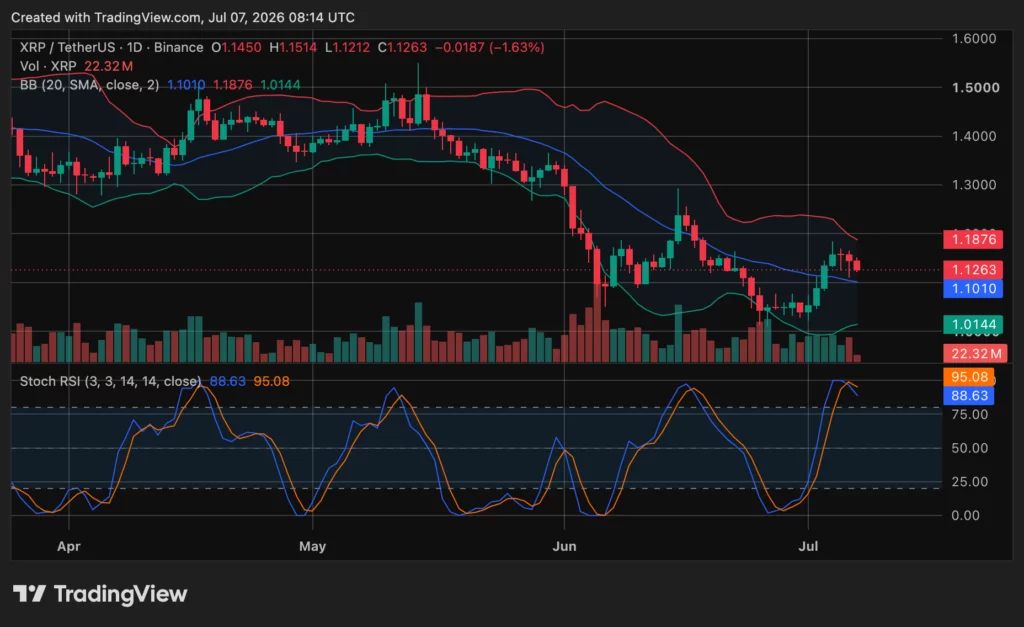
XRP traded near $1.13 on July 7, down 1.69% in the past 24 hours, according to crypto.news market data.
Summary
- XRP’s rebound needs a clear break above $1.14 to confirm stronger short-term momentum for bulls.
- ETF inflows remain positive, but CLARITY delays have removed a near-term policy catalyst for XRP.
- Spot CVD has improved across exchanges while Binance perpetual traders keep selling into rebounds.
The token moved between $1.11 and $1.16 during the session, while trading volume stood at about $1.73 billion.
The rebound from the late-June low near $1.00 remains intact, but buyers have not yet turned it into a stronger breakout. the token pushed back toward the $1.14 to $1.18 zone, but it failed to hold the upper part of that range.
The price now sits near a short-term decision area. A close above $1.14 would show that buyers are gaining control. A clean move above $1.18 to $1.20 would give bulls a stronger signal and place the next resistance levels back in focus.
The downside level is also clear. If XRP loses $1.10, the current rebound would weaken. A move below that area could expose $1.06, which some traders now see as the next retest zone.
XRP ETF inflows help, but policy catalyst slips
The recovery has come while XRP-linked investment products continue to attract demand. The latest background data showed spot XRP ETFs recorded a ninth straight week of net inflows, adding $17.19 million despite broader policy uncertainty.
Those inflows have helped support the market, but they have not been enough to break the larger downtrend. As previously reported, XRP ETFs gave investors regulated access, but they did not solve the wider legal question around XRP’s status under U.S. law.
The CLARITY Act remains the main policy catalyst for many traders. The bill missed its July 4 target and now faces an Aug. 7 deadline before the Senate’s summer break.
That delay removed a near-term trigger for digital assets. The bill has passed the House, cleared the Senate Banking Committee, and sits on the Senate calendar, but staff still need to merge Banking and Agriculture versions before a full Senate vote.
Moreover, Standard Chartered has said XRP ETFs could attract $4 billion to $8 billion in first-year inflows if CLARITY passes. That forecast depends on legal clarity unlocking larger institutional demand.
Technical setup stays mixed
The XRP/USDT daily chart shows price recovering from the late-June low, but the broader trend remains weak after the June breakdown. The token is trading above the middle Bollinger Band near $1.10, which keeps the short-term rebound alive.
The upper Bollinger Band sits near $1.18. That matches the area traders are watching for a stronger breakout. Until the token closes above that zone, the move remains a rebound inside a weak structure rather than a confirmed trend shift.
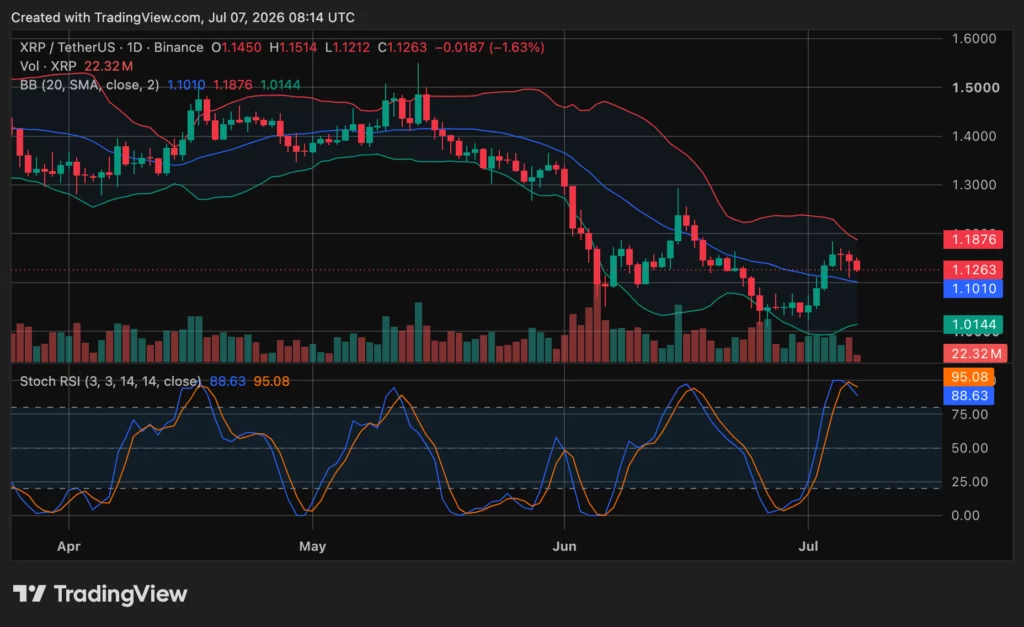
The lower Bollinger Band sits near $1.01. That level remains important if selling pressure returns. A break below $1.10 would increase the risk of a move back toward that area.
Momentum also shows a mixed picture. The Stochastic RSI is elevated, with readings near 88.63 and 95.08. That shows strong short-term momentum, but it also places XRP close to overbought territory. Since the faster line has moved below the slower line, the rebound may be losing some force.
EGRAG Crypto said XRP must defend $1.10 after moving below the 21 EMA on the four-hour chart. He said, “Hold $1.10 = structure still alive,” while a loss of $1.06 would increase caution.
Dark Defender took a more bullish weekly view and said XRP is “launching the Wave 5 without the Clarity Act.” Other analysts also pointed to higher long-term targets, but those views still depend on price clearing the current resistance zone first.
Spot demand rises while perps stay defensive
On-chain and derivatives data show a split market. CryptoQuant analyst Amr Taha said XRP’s estimated spot CVD across centralized exchanges rose from about minus $42 million on May 12 to plus $406 million by July 7.
That change points to stronger spot buying across exchanges. It suggests market buyers have absorbed more available XRP supply over the past two months.
The derivatives market shows the opposite trend. Binance perpetual CVD fell from about minus $48 million to minus $783 million over the same period. That shows sustained sell-side pressure from perpetual traders.
Open interest also fell from about $255 million on May 22 to $203 million on July 7. That drop suggests leveraged traders have reduced exposure while spot buyers have become more active.
Binance spot data has improved, but it has not turned positive. Estimated spot CVD on Binance rose from about minus $212 million on June 25 to minus $173 million on July 7, showing that selling pressure has eased but not fully reversed.
Disclosure: This article does not represent investment advice. The content and materials featured on this page are for educational purposes only.


Japanese bonds are challenging the boost bitcoin has received from shifting interest-rate expectations that lifted the price of the largest cryptocurrency by 8% in fewer than seven days.
The 10-year Japanese government bond (JGB) yield has surged to a 30-year high of 2.85%, adding 18 basis points since the start of the month and raising borrowing costs across other major developed markets.
The U.S. 10-year Treasury yield has gained nearly three basis points and is testing 4.5% for the first time in nearly a month. The German 10-year bund is approaching 3% and the U.K. 10-year gilt is yielding around 4.8%. Real yields, which are adjusted for inflation, are also climbing.
For years, Japan kept global yields suppressed through near-zero interest rates and aggressive quantitative easing. That policy fueled carry trades that involved borrowing yen at a low rate and investing in high-yielding bonds elsewhere. Thus, Japan indirectly capped borrowing costs in advanced nations.
This matters for bitcoin because higher government bond yields increase the opportunity cost of holding an asset that generates no cash. Capital parked in BTC is capital not earning the stronger, more reliable returns available in fixed income.
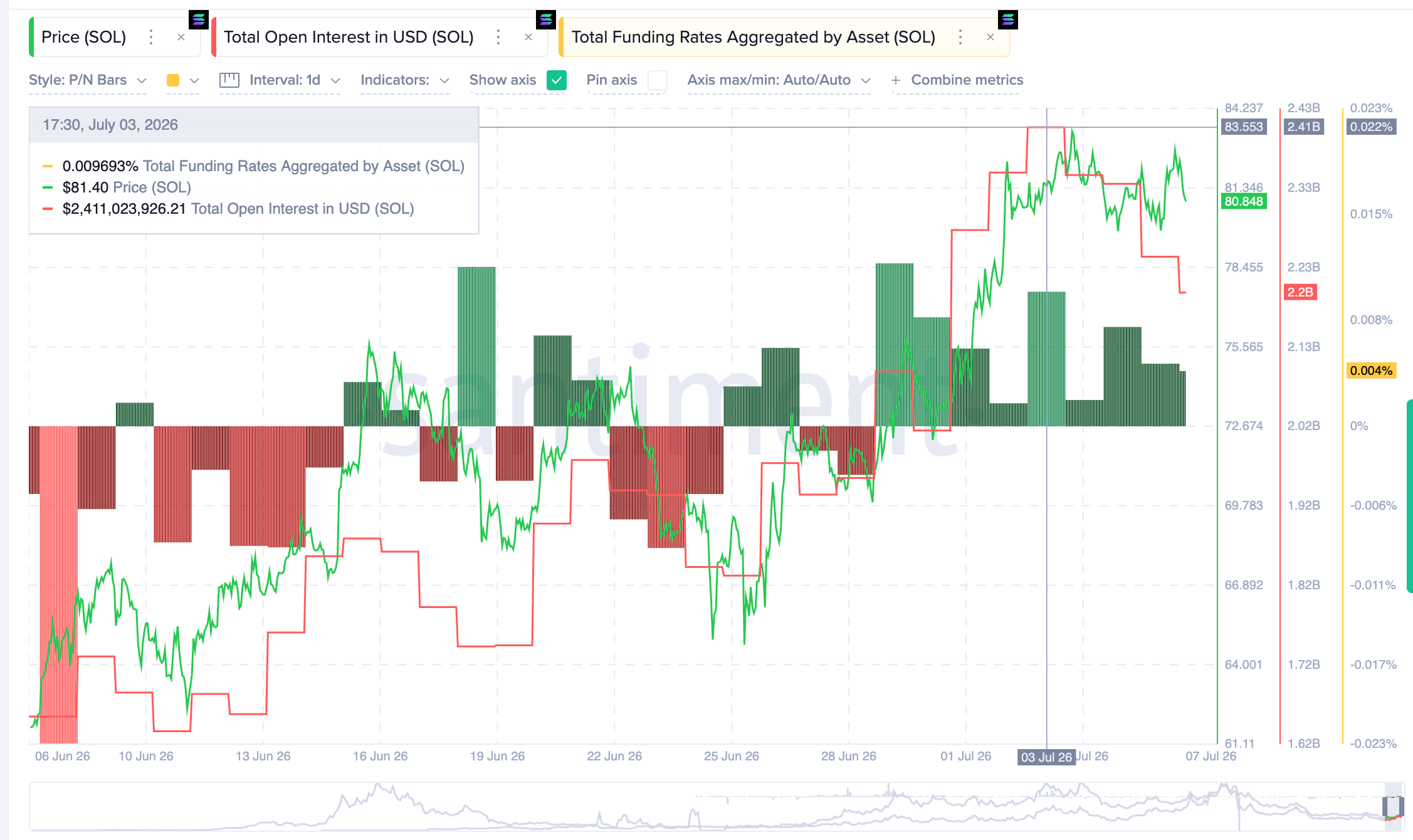
Solana (SOL) has climbed back to around $80.84 even as traders cut their leverage, and Solana TVL has reached its highest level since early June, a sign real money is backing the move.
Deposits into Solana apps and buying from long-term holders are rising while futures positioning shrinks. That combination points to spot demand rather than borrowed bets.
Leverage Comes Out After a Squeeze
On July 4, SOL traded near $82 with open interest, the total value of active futures contracts, around $2.41 billion. Its funding rate, a small fee that shows whether traders lean long or short, sat positive at 0.009%, a mark of crowded long bets.
Want more token insights like this? Sign up for Editor Harsh Notariya’s Daily Crypto Newsletter here.
That positioning unwound when the market dipped, flushing leveraged longs and pulling SOL to about $79.72 on July 6, close to a 3% drop. A squeeze like that forces overstretched buyers to sell, but it also clears out fragile bets.

Since then, open interest has eased to about $2.20 billion and funding has cooled to 0.004%. Even so, the SOL price recovered to $80.84, so the bid now looks spot-driven rather than borrowed.
Rallies built on leverage tend to reverse fast once funding flips. A move that strengthens while open interest falls usually has real demand behind it.
Long-Term Holders Keep Buying the Dip
The recovery lines up with steady buying from Solana’s most patient wallets. Holders who have kept SOL for one to two years grew their share of supply from 14.64% to 15.60% since June 29. Holder conviction here comes from HODL Waves, an on-chain metric that groups Solana’s supply into cohorts by how long the coins have been held.

This cohort added coins through the shakeout rather than selling into it, marking the largest accumulation in weeks.
Because these long-term holders keep buying through volatility, the pool of coins available to sell keeps shrinking. That absorption helps explain why the July 4 flush did not deepen.
Solana TVL Hits a Five-Week High
The same conviction shows up in Solana TVL, or total value locked, the amount of money deposited across the network’s apps. It climbed about 10% from $4.66 billion on June 26 to about $5.11 billion on July 4, also its highest since early June.
Crucially, that Solana DeFi TVL kept rising while open interest fell, and it held the high through the price dip. Capital is flowing into apps, not leverage into futures.
The deposit growth began around late June, the same window long-term holders started adding. That overlap suggests the two trends share a source, steady conviction rather than a quick trade.

Stablecoin supply on Solana strengthens the case. It sits around $15.6 billion, just below the roughly $16 billion peak set on July 3, leaving dry powder that can fund more buying if demand holds. The stablecoin supply still remains higher than late June levels.
Together, the leverage reset, holder accumulation, and rising Solana TVL point one way. The move rests on deposits and patient buyers, not funding, which gives it a firmer base than a leveraged bounce. More so when the Solana price is up over 9% in the weekly timeframe. Whether it lasts may show first in TVL (network health) and holder flows (on-chain conviction).
The post Solana TVL Just Hit a 5-Week High: Should Traders Pay Attention? appeared first on BeInCrypto.
Key Takeaways
- South Korea’s benchmark KOSPI index plummeted 4.9%, activating circuit breakers for the sixth occasion in 2025
- Samsung projected a 19-fold surge in Q2 operating profit, yet its stock price declined nearly 7%
- Market experts suggest AI-related earnings projections have become unsustainably elevated
- Individual traders capitalized on the downturn, snapping up 3.2 trillion won worth of stocks
- SK Hynix unveiled a $28 billion American share offering, attracting preliminary investor attention
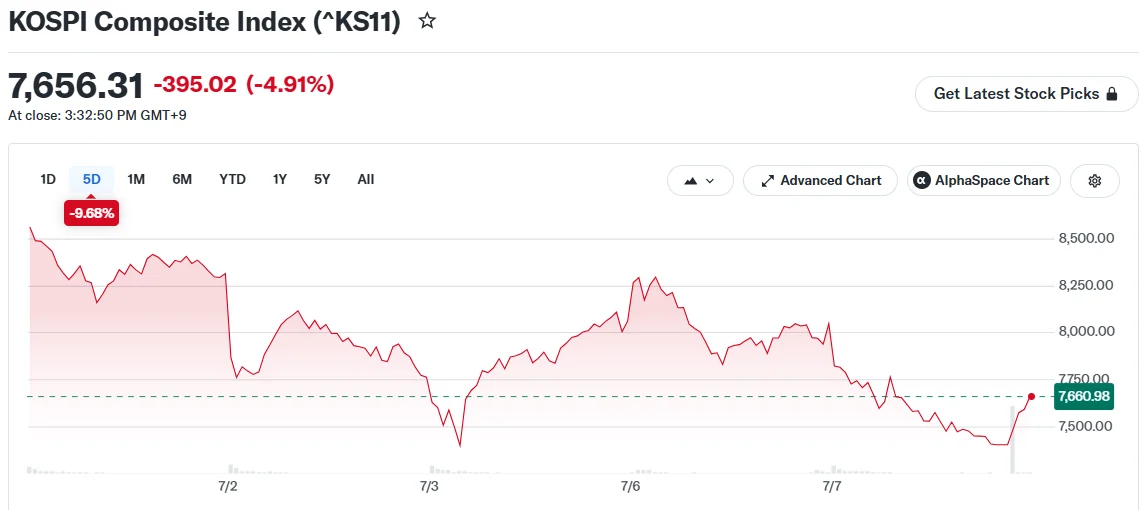
Tuesday proved turbulent for South Korea’s equity markets. The KOSPI benchmark concluded trading down 4.9%, settling at 7,656.31. During intraday trading, the index had plummeted more than 8%.
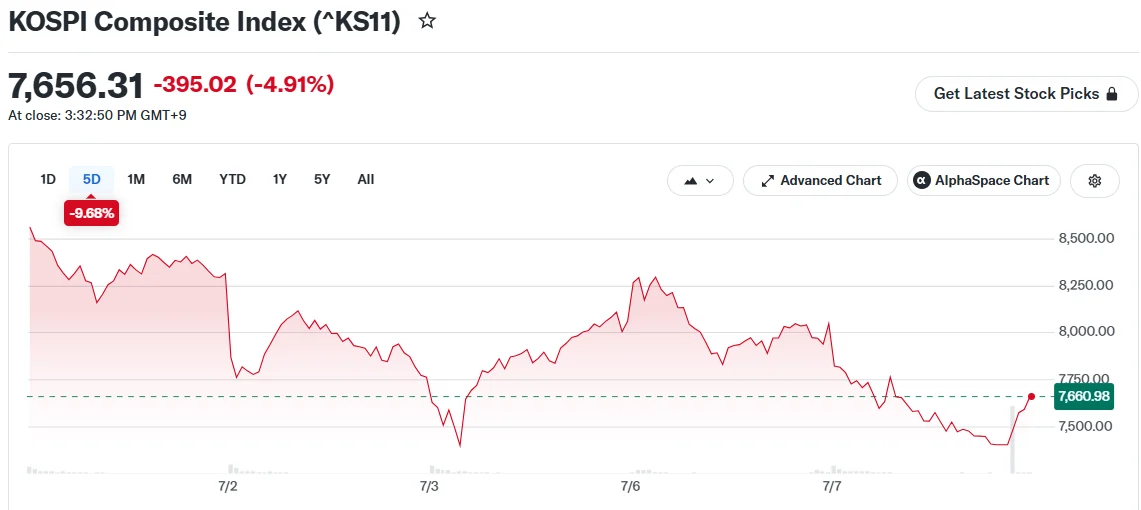
Trading halts were activated through circuit breaker mechanisms. This marked the sixth such interruption in 2025 amid semiconductor stock turbulence.
Record Samsung Results Meet Market Skepticism
Samsung Electronics found itself in the eye of the storm. The tech giant projected second-quarter operating profit at 89.4 trillion won, approximately $58 billion. This represents a nineteen-fold expansion compared to last year’s corresponding quarter and marks its third consecutive record-breaking period.
Yet Samsung’s shares tumbled nearly 7% during the session. Intraday declines exceeded 10% at their worst.
Market observers indicate these impressive figures had already been priced into valuations. Seo Sang-young from Mirae Asset Securities noted, “Market expectations have grown too high to be raised further.”
Competitor SK Hynix declined 6.1%. Japan’s memory chip manufacturer Kioxia experienced losses surpassing 10%.
The KOSPI had more than doubled year-to-date before reaching an all-time peak in late June. Since that milestone, approximately 20% has evaporated.
Changing Dynamics in AI Investment Sentiment
The market’s response indicates a transformation in investor attitudes toward artificial intelligence stocks. Throughout recent months, semiconductor companies enjoyed rewards merely for exceeding earnings projections. That pattern now appears to be evolving.
Charu Chanana of Saxo Markets observed, “Strong earnings are no longer enough.” She emphasized that investors now demand robust earnings, optimistic guidance, and evidence of sustainable pricing advantages.
Albert Yong from Petra Capital Management suggested the sharp decline reflects investor attention shifting toward the memory cycle’s long-term trajectory rather than immediate quarterly results.
International investors offloaded 2.9 trillion won in Korean equities Tuesday. Domestic retail traders countered by purchasing 3.2 trillion won, moderating the index’s early steep losses.
AI Investment Activity Continues Despite Volatility
Not every development suggested retreat from artificial intelligence exposure. SK Hynix initiated an American share issuance targeting approximately $28 billion, generating initial enthusiasm from significant institutional investors.
Broadcom extended its semiconductor supply agreement with Apple through 2031, alleviating worries that Apple might internalize additional chip production.
Wall Street advanced overnight. The Dow increased 0.29%, the S&P 500 rose 0.72%, and the Nasdaq gained 1.12%, buoyed by optimism surrounding AI-powered earnings performance.
Additional Market Developments
LG Energy Solution fell 6.4% following its projection of a 77% operating profit decline attributed to softening electric vehicle demand.
Hanwha Ocean crashed 22.7% after Canada selected German submarines over South Korean alternatives.
Crude oil prices advanced following a tanker incident near the Strait of Hormuz. US crude climbed to $68.92 while Brent reached $72.34.
Investors remain attentive to the upcoming Federal Reserve meeting minutes release, the inaugural publication under new Fed Chair Kevin Warsh.


Binance has introduced a product for bitcoin holders looking to earn extra yield on their investment without selling any of it, joining the likes of BlackRock in helping them maximize returns.
The product, BTC Yield, is available inside Binance Earn and is designed exclusively for people who already hold bitcoin.
Users deposit their bitcoin into the product and receive an internal position called BTCY, which tracks their share in the strategy. Everything remains denominated in BTC, and the product cannot be funded with stablecoins or other assets.
Binance holds the deposited bitcoin as collateral while systematically selling BTC call options, that is, it writes insurance against price rallies in BTC. The call seller, or writer, gets compensated with a premium. Binance collects those premiums and shares most of them with participants.
This covered-call approach, common in crypto and traditional finance, has typically required deep options knowledge to execute. Binance’s version makes it accessible to regular traders by handling everything behind the scenes.
Two types of return
The product generates potential returns in two ways.
First, a portion of the collected premiums is converted to bitcoin and distributed to users’ spot accounts every Friday as a possible weekly payout.
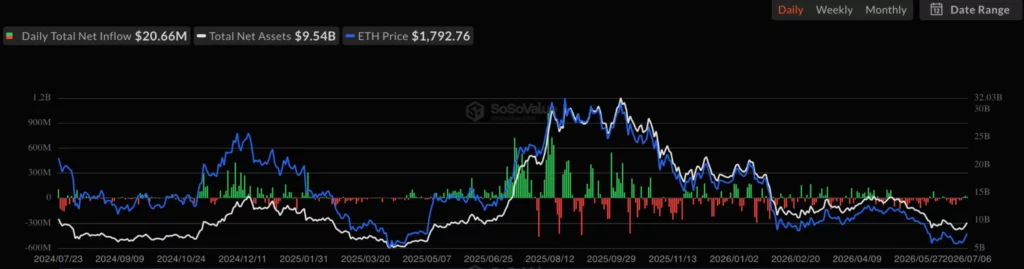
Ethereum traded near $1,777.49 at the time of writing, up 0.5% in the past 24 hours, according to crypto.news market data.
Summary
- Ethereum must close above $1,800 to strengthen the short-term bullish setup, analysts say.
- Binance liquidity has improved, but rising exchange reserves still pose selling pressure near $2,000 resistance.
- MACD and RSI support recovery, while $1,750 remains the key level for bullish invalidation.
The token had a 24-hour low of $1,732.10 and a high of $1,819.88, while daily trading volume stood near $17.08 billion.
The move kept ETH close to the $1,800 area, which traders now view as the main short-term resistance zone. The token has recovered from the sharp June selloff after buyers defended the $1,500 to $1,600 area.
The current setup has turned attention to a daily close above $1,800. Analysts say that level could decide whether ETH builds a stronger recovery or stays trapped in a range above $1,700.
Ethereum climbed about 12% from July 1 as weaker U.S. jobs data and renewed spot ETF inflows brought buyers back into the market. According to SoSoValue data, on July 6, Ethereum spot ETFs recorded a total net inflow of USD 29.082 million, led by BlackRock’s ETHA with USD 29.742 million in single-day net inflows.
Analysts watch $1,800 and $1,844
Analyst Ali Charts said Ethereum is testing the 0.8 MVRV Pricing Band near $1,796. He said the same area aligns with the TD Sequential resistance trendline, making it a key technical level for traders.
Ali said a daily close above $1,796, followed by a hold as support, would strengthen the bullish case. He added that a move through the TD risk line at $1,816 could open the way for a test of the channel resistance near $1,844.
“A break above both $1,796 and $1,816 could trigger a bullish breakout,” Ali said in his Ethereum setup. He placed Ethereum’s realized price target near $2,245 if buyers clear those levels and hold momentum.
Daan Crypto Trades also pointed to $1,800 as the level that matters most on the current timeframe. “If bulls can get a daily close over $1,800, that’d be the first sign of strength for me,” he said in an X post.
The lower level remains clear. Daan and Ali both pointed to $1,750 as the support that bulls must defend. A loss of that level would weaken the current setup and could return focus to the $1,700 area.
Indicators support short-term recovery
The ETH/USDT daily chart shows a recovery from the June low. ETH bounced from the $1,500 to $1,600 range and moved toward $1,800 before cooling slightly.
Momentum indicators support the rebound. The MACD histogram is positive near 31.83, while the MACD line sits near -4.67 and above the signal line near -36.50. This shows improving momentum, though the MACD line still needs to move above zero to confirm a stronger trend shift.
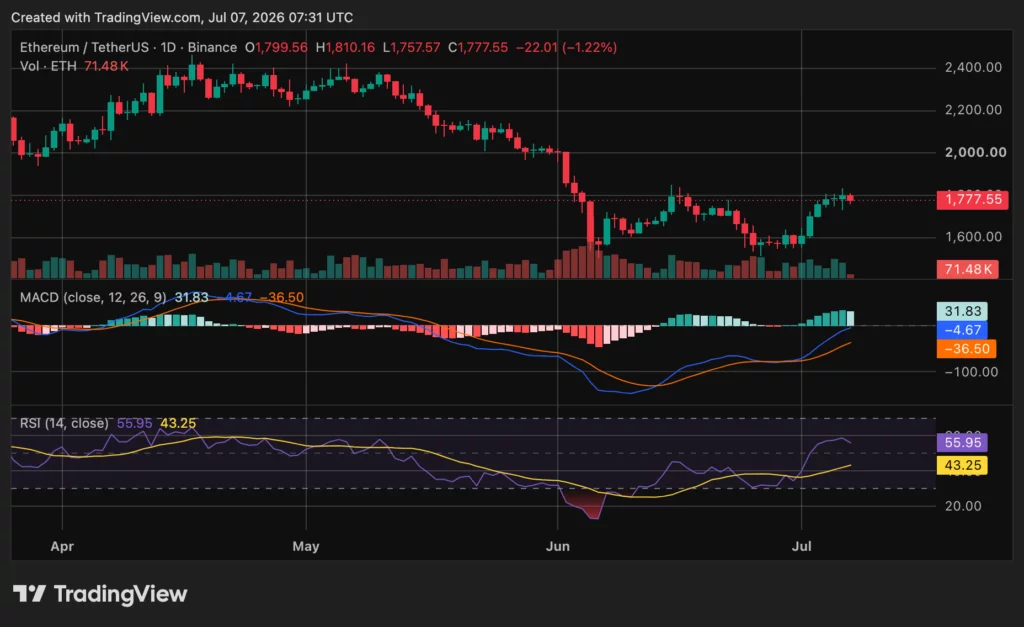
The RSI is also improving. It sits near 55.95, above its moving average near 43.25. That places RSI above the neutral 50 level, which shows buyers have short-term control without pushing the token into overbought territory.
As previously reported, Ethereum had already shown a rare TD buy signal while spot Ethereum ETF inflows returned.
Binance liquidity improves, but reserves raise risk
On-chain data gives a mixed view. CryptoQuant analyst Arab Chain said the ETH Binance 30-day exchange liquidity ratio rose to about 5.22. The reading was based on about 20.32 million ETH in 30-day trading volume and around 3.8 million ETH in Binance reserves.
That means each ETH held on Binance turned over more than five times during the period. The reading points to active trading and better use of available exchange liquidity. It also suggests that Binance can support strong ETH trading activity without a large rise in reserves.
Still, rising exchange supply remains a risk. CryptoQuant analyst BorisD said Binance held about 3.893 million ETH, while Bitfinex held 2.2 million ETH, OKX held 1.18 million ETH, and Bybit held 314,000 ETH. He said ETH inflows into Binance and OKX could add selling pressure if demand fails to absorb the extra supply.
Moreover, Binance users had already increased their ETH balances by 10.17% to about 4.14 million ETH in its June proof-of-reserves snapshot. Larger user balances can reflect deposits, purchases, internal transfers, or account activity, so the data does not show one clear reason.
The next test sits near $1,800. A clean daily close above that level could push ETH toward $1,844, then $2,060 and $2,245. A rejection, or a break below $1,750, would keep Ethereum in a choppy range and raise the risk of another move toward $1,700.
Disclosure: This article does not represent investment advice. The content and materials featured on this page are for educational purposes only.

Apple rolls out the third iOS 27, macOS 27 developer betas

Caleb Hammer RUINED Financial Audit

Police appeal to trace next of kin of Bolton man who died in Leigh


-

 Fashion4 days ago
Weekend Open Thread: High Hopes
-

 Fashion17 hours ago
Open Thread: What Great Books Have You Read Recently?
-

 Politics4 days ago
The House | “Reframing the debate from a binary discussion of winners and losers”: Yuan Yang reviews ‘We Are Not Machines’
-
 NewsBeat2 days ago
Taylor Swift and Travis Kelce wedding staffer hilariously struggles to keep her cool while checking in megastars
-

 News Videos7 days ago
How to Build INSANE Live Financial Dashboards With Claude
-
 Crypto World6 days ago
Airdrop Registration Becomes Key Focus For Remittix As RTX Launch Updates Approach
-

 Sports6 days ago
Broncos roster: OL Ben Powers (No. 74) entering final year of contract
-

 Crypto World5 days ago
Binance stock trading tops $1B in first month after launch
-

 NewsBeat6 days ago
Presenter Caroline Flack’s brother Paul Flack dies aged 55
-

 Crypto World4 days ago
Standard Chartered Secures MiCA License as ESMA Adds 37 New Crypto Firms
-

 Crypto World5 days ago
Alibaba-affiliate Ant Group enters the humanoid robot market with 12 deals
-

 Crypto World2 days ago
South Africa proposes crypto tax guidance under existing rules
-

 News Videos18 hours ago
Best Time to Enter Small Caps Right Now? Another Bull Run? | Financially Free
-

 Tech2 days ago
Lenovo laptops are now shipping with YMTC SSDs, a sign of Chinese NAND entering the mainstream
-

 Business5 days ago
Meta Platforms Stock Jumps 7% Today as Bloomberg Reports Company Plans to Enter the Cloud Business
-
 NewsBeat5 days ago
New exhibition reflects five decades of movement between island of Ireland and GB
-

 Business4 days ago
What a 10 Percent Drop Means for Buyers, Sellers and Renters
-

 News Videos5 hours ago
Whats Hidden Inside This Cash Register? #treasure #reselling #money
-

 Crypto World4 days ago
Binance Re-Enters Philippines As EU MiCA Rules Restrict Access
-

 News Videos21 hours ago
Avoid entering in FOMO #bitcoin #cryptocurrency #trading #scalping
You must be logged in to post a comment Login