

Crypto World
Trader Peter Brandt wants to dump bitcoin for gold. Here’s why



In the never-ending battle between bitcoin , the digital gold, and the traditional yellow metal, veteran trader Peter Brandt has picked a side, and it’s not the one bitcoin bulls would have hoped for.
Brandt, CEO of Factor LLC and widely followed chart analyst, said on X that he is mulling liquidating some of his BTC and using the proceeds to buy gold, as he sees the yellow metal outperforming BTC.
“I am contemplating selling some of my Bitcoin and going to Gold with the money. Looks to me that Gold is going to gain substantially on Bitcoin,” Brandt told his followers on X.
Both BTC and gold have recently taken a beating, though bitcoin has fared noticeably worse than the traditional safe haven metal. The leading cryptocurrency by market value slid 20% in June to below $60,000, marking its worst monthly performance in four years. Gold, by comparison, dropped 11.7% to nearly $4,000 per ounce.
The divergence looks even starker on a year-to-date basis, with BTC down 28% in 2026 versus a 3.9% decline for gold.
Bucking the trend
Brandt’s view flies directly in the face of the popular market narrative among crypto bulls’ that anticipates a massive rotation of money back into BTC and digital assets.

Summer.fi has reportedly been exploited, with roughly $6 million drained so far. Blockaid flagged the exploit in a post on X on Monday.
The security firm published the attacker’s address, the exploit contract, and the affected Lazy Summer contracts.
DeFi Protocol Summer.fi Reportedly Loses $6 Million in Active Exploit
Blockaid said its detection system surfaced the incident on Monday morning, estimating about $6 million in losses at that stage. The firm highlighted the on-chain addresses associated with the attack.
- Exploiter address: 0x7BF716167B48CF527725722C6d79494b45B3BDCa
- Exploit contract: 0x0514F827C129C16418a0933E03C99A6AF982FC61
- Affected Summer.fi / Lazy Summer contracts:
- 0x98C49e13bf99D7CAd8069faa2A370933EC9EcF17
- 0xA9ca4909700505585B1aD2a1579dA3b670FFA9c4
- 0xE9cDA459bED6dcfb8AC61CD8cE08E2D52370cB06
Security firm PeckShield identified the main affected vault as LazyVault_LowerRisk_USDC (LVUSDC), which Block Analitica risk-manages. The firm said that the vault’s displayed APY briefly spiked to about 2.08 million %.
“The largest current holder is 0x8741e8f…4130, which appears to be associated with Torben Jorgensen (UDHC), and has deposited ~8.6M USDC into this vault,” the post read.
Follow us on X to get the latest news as it happens
Summer.fi, formerly Oasis.app, is the front-end for the Lazy Summer Protocol, an onchain vault system that automatically routes deposits across DeFi yield sources like Aave and Morpho.
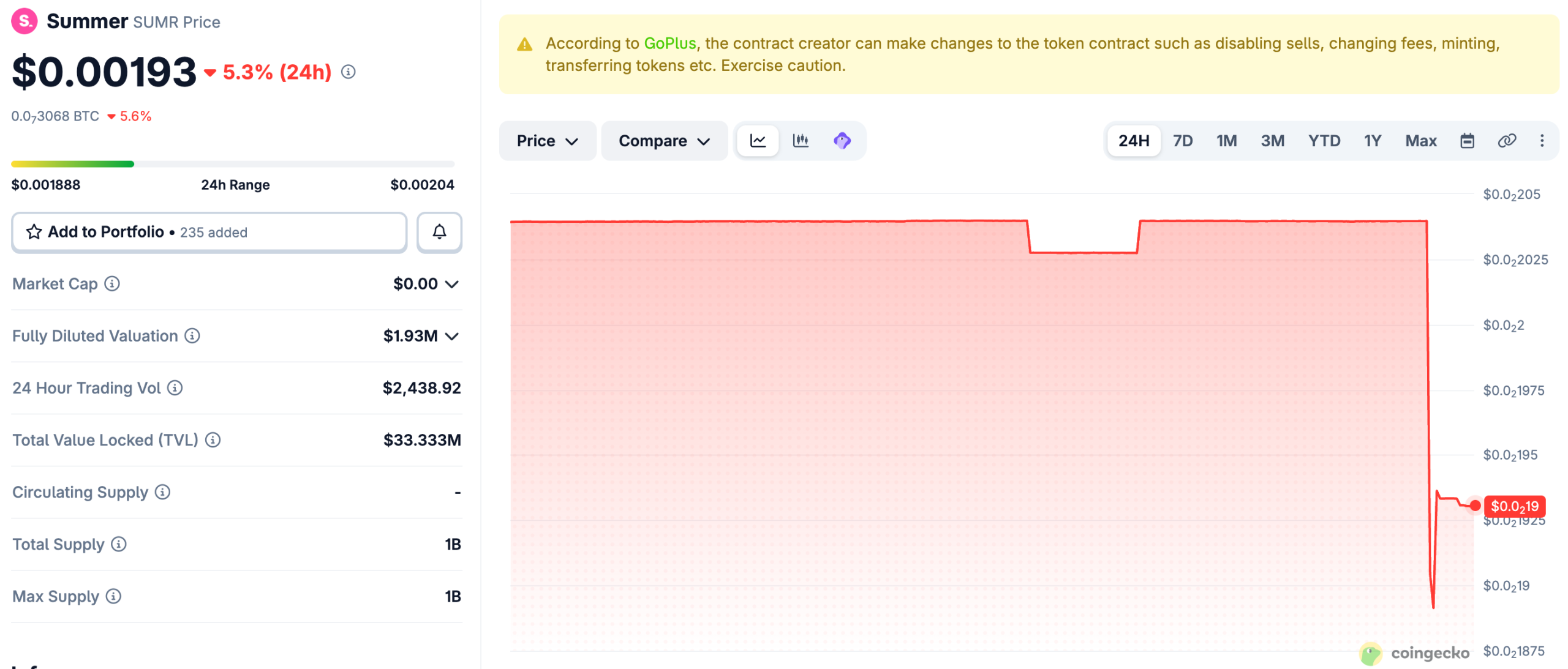
The network’s native token SUMR traded near $0.00193, down 5.3% over 24 hours. The move diverged from the broader market, which rose more than 1% on the day.

The incident marked the second crypto exploit recorded in July, according to DeFiLlama. It follows a series of attacks in June, when crypto platforms lost $75.87 million across 40 hacks, with the Humanity Protocol breach accounting for the largest loss.
BeInCrypto has reached out to Summer.fi for comment. This is a developing story.
Subscribe to our YouTube channel to watch leaders and journalists provide expert insights
The post Hackers Reportedly Drain $6 Million From DeFi Protocol Summer.fi appeared first on BeInCrypto.

Key Highlights
- American spot Bitcoin ETFs experienced outflows of $527 million across four trading sessions, continuing an unprecedented eighth consecutive negative week
- A single-day inflow of $221.7 million on Thursday interrupted a 10-day withdrawal pattern but failed to reverse the weekly trend
- BlackRock’s IBIT fund continues its decline for an 11th consecutive trading day, losing approximately $2.2 billion
- Ethereum ETFs similarly recorded negative weekly performance, though showing positive movement during the final two trading days
- Hyperliquid ETFs registered $4.3 million in inflows — maintaining positivity but significantly lower than the previous week’s $111 million milestone
American spot Bitcoin exchange-traded funds have established an unprecedented benchmark, documenting eight consecutive weeks of net capital withdrawals — the longest such period since these investment vehicles debuted. Throughout the four trading sessions concluding July 2, these funds experienced approximately $527 million in outflows, based on information from SoSoValue.
Prior to this current downturn beginning in mid-May, these financial products had never experienced more than five consecutive negative weeks.
June emerged as the most challenging month for these investment products since receiving regulatory authorization. During June exclusively, Bitcoin ETFs witnessed over $4 billion in departures. Calculating from the beginning of the year through present, the funds have accumulated a net deficit of $5.53 billion.
Brief Respite on Thursday Ends 10-Day Withdrawal Pattern
The trading week concluded with a momentary improvement. On July 2, Bitcoin ETFs registered $221.7 million in net capital inflows, terminating a 10-session withdrawal pattern that had eliminated nearly $2.7 billion from these investment vehicles.
Fidelity’s Bitcoin product spearheaded the turnaround, attracting $166 million in fresh capital. ARK 21Shares contributed an additional $91.8 million. VanEck secured $4.4 million in inflows.
Despite this positive development, a single favorable day proved insufficient to salvage the overall weekly performance. Substantial outflows during earlier sessions had already guaranteed another negative weekly outcome.
BlackRock’s Flagship Fund Continues Downward Trajectory
BlackRock’s investment product remained the sole fund experiencing withdrawals on Thursday. The fund recorded a $40.4 million outflow that session, extending its consecutive losing period to 11 trading days.
Throughout this duration, the fund has experienced approximately $2.2 billion in withdrawals. Currently, it maintains $44.91 billion in net assets compared to $59.99 billion in total inflows accumulated since its inception.
The typical investor holding shares in this fund faces losses approaching 40%, according to earlier analysis.
Given its position as the largest Bitcoin ETF measured by assets under management and daily trading activity, persistent outflows from this particular fund create downward pressure across the entire sector, even when smaller competitors experience positive flows.
Bitcoin Valuation Shows Recovery
Bitcoin’s price dropped beneath $58,000 during the early portion of the week, reaching a 21-month minimum. The cryptocurrency subsequently rallied to approximately $63,150 by Saturday.
Disappointing U.S. employment statistics contributed to the price recovery. Market participants interpreted the economic data as diminishing the probability of a Federal Reserve interest rate hike.
CryptoQuant research professionals warned that increasing exchange deposits might signal additional price volatility in upcoming sessions.
Ethereum and Hyperliquid Investment Products
Spot Ethereum exchange-traded funds similarly concluded the week with negative results, marking their eighth consecutive weekly outflow. Nevertheless, these products demonstrated positive daily performance on both July 1 and July 2. BlackRock’s Ethereum investment vehicle attracted $29.7 million on July 2.
Hyperliquid ETFs maintained weekly positivity with $4.3 million in net inflows. This figure represented a substantial decline from the preceding week’s exceptional $111 million, suggesting diminishing appetite for alternative cryptocurrency ETF offerings.
Concurrently, major blockchain Bitcoin holders pursued strategies contrary to ETF participants. Substantial Bitcoin wallets accumulated approximately 270,000 BTC throughout June while exchange-traded funds experienced historic withdrawals.

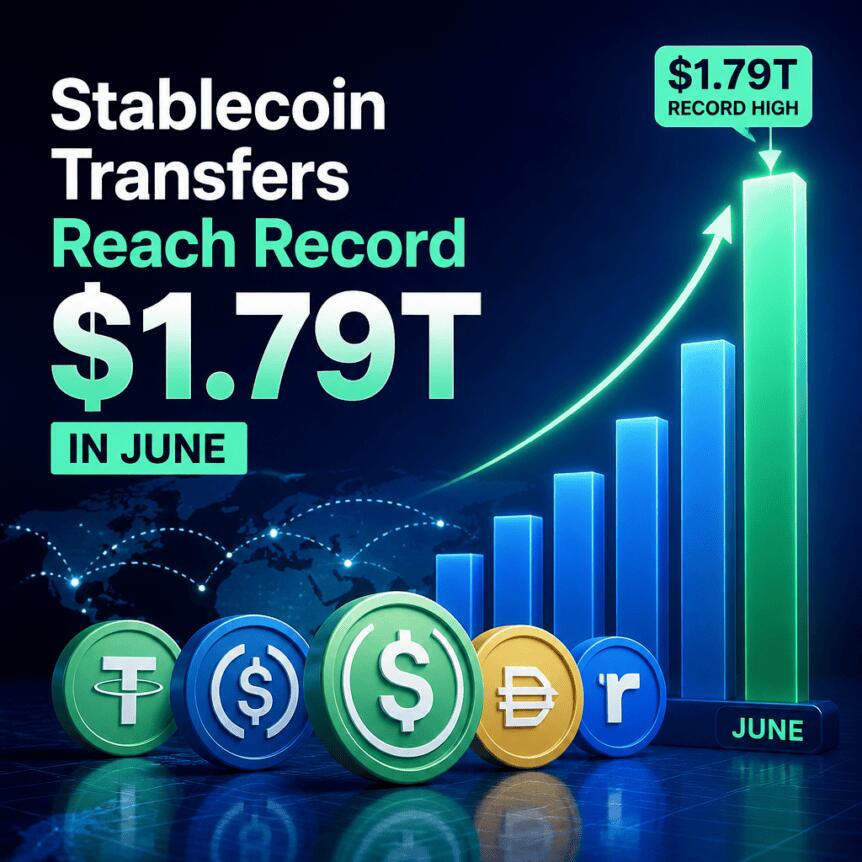
Stablecoin usage hit a new milestone in June, with adjusted stablecoin transaction volume reaching $1.79 trillion, according to payments analytics from Visa. The figure represents a sharp step up from May’s $1.1 trillion and breaks the prior record of $1.78 trillion set in February.
The jump, Visa says, comes from its Allium-powered dashboard tracking “adjusted” on-chain activity—designed to better reflect organic value transfer rather than short-term technical noise. For market participants, the broader implication is straightforward: even when crypto markets struggle, stablecoin rails can keep growing as on-chain payments, DeFi liquidity, and cross-border settlement continue to mature.
Key takeaways
- $1.79 trillion in adjusted stablecoin transaction volume was recorded in June, up 63% from May’s $1.1 trillion.
- USDC led by volume: Circle’s USDC accounted for roughly 67% of transactions (about $1.21 trillion), despite Tether’s USDt still being the largest stablecoin by market cap.
- Base and Ethereum dominated networks, together responsible for roughly $1.13 trillion of June stablecoin activity, with Tron third at about $320 billion.
- Visa’s methodology adjustment filters out high-frequency bots and certain repeated contract patterns to approximate more meaningful stablecoin usage.
June’s record and why Visa’s “adjusted” lens matters
Visa reported that June 2026 delivered another record month for stablecoin transaction volume, overtaking the previous high from February. The update comes through Visa’s Allium-powered stablecoin analytics dashboard, which tracks adjusted figures—intended to exclude metrics that can inflate results without representing genuine economic activity.
Visa collaborated with partners including Artemis, Allium Labs, and Castle Island Ventures to build the adjusted transaction methodology. Visa said the approach filters out “distracting metrics” such as high-frequency trading bot activity, exchange treasury rebalancing, and repeated smart contract transactions, all of which can otherwise distort the picture of organic stablecoin use.
That matters for investors and operators because it changes what “volume” is measuring. Instead of treating every on-chain movement as equal, the adjusted view is meant to better approximate how stablecoins are actually being used for transferring value and supporting payment or DeFi flows.
USDC takes most of the transaction share
While Tether’s USDt remains the largest stablecoin by market capitalization, Visa data indicates that the majority of June transaction volume belonged to USDC. According to Visa, USDC accounted for around 67% of adjusted stablecoin transaction volume, totaling approximately $1.21 trillion for the month.
USDT contributed about 32% of June volume, or roughly $576 billion, based on Visa’s figures. Visa also identified PayPal’s PYUSD as the third-largest stablecoin by transaction volume in June, with $2.42 billion.
The gap between market cap leadership and transaction share is an important nuance for readers tracking stablecoin adoption. Market cap can reflect a stablecoin’s overall supply, while transaction volume can reflect which assets are being used most frequently across on-chain rails—especially on networks where specific ecosystems and user behaviors concentrate activity.
Base and Ethereum lead; Tron remains a top alternative
Visa’s network breakdown shows that stablecoin activity in June was heavily concentrated. The most widely used network was Coinbase’s Ethereum layer-2 network Base, which recorded about $565 billion in adjusted stablecoin transaction volume—approximately 31.5% of the total. Ethereum followed closely with about $562 billion.
Tron ranked third with about $320 billion, representing roughly 18% of the adjusted total. Together, these results suggest that June’s growth was not confined to a single ecosystem, but that it remains anchored in the networks where stablecoin liquidity and on-chain usage are already dense.
Visa also highlighted that Base and Ethereum dominated stablecoin volumes in June, aligning with the broader trend that stablecoins often follow where payments and DeFi activity cluster—particularly when users want efficient settlement on widely supported chains.
What the record could signal for stablecoin resilience
Industry analysts framed June’s record as evidence that stablecoins are increasingly behaving like infrastructure, not just a speculative sidecar to wider crypto price cycles. Commenting on the figures, Zach Pandl, head of research at Grayscale, said the month was “another record month for stablecoin transaction volume,” describing it as arriving “just ahead of February 2026.”
Nick Ruck, director of LVRG Research, told Cointelegraph that the record volume demonstrates resilience during a broader crypto bear market. He argued that stablecoins’ rising role reflects persistent demand for value transfer, liquidity provisioning, and decentralized finance activity that continues independently of speculative price movements.
Ruck predicted stablecoins will continue to mature, framing them as a “foundational layer” for the Web3 economy. The key takeaway for readers is that the direction of stablecoin adoption may be less tied to market sentiment than it is to real-world settlement needs—especially as on-chain infrastructure improves and more payment workflows incorporate stablecoin settlement.
Open USD adds competitive pressure in payments
Alongside the volume milestone, the stablecoin market continues to attract new entrants. Open Standard announced Open USD (OUSD), supported by more than 140 payments, banking, technology, and crypto companies, including Visa and Mastercard, according to earlier coverage from Cointelegraph.
Even if OUSD does not yet meaningfully shift transaction shares at the scale Visa is measuring, announcements like this underscore that issuers and payments groups see continued room for growth in stablecoin rails—particularly where interoperability and compliance expectations are evolving.
Going forward, the biggest question for traders, builders, and compliance-minded users is whether record volumes are sustained and broadened across more networks and products—or whether growth remains concentrated in a handful of ecosystems. Visa’s “adjusted” methodology should help clarify that trend, but the market will still need time to confirm whether June’s surge signals durable, economy-wide adoption.
Key Takeaways
- Senator Lummis characterizes the CLARITY Act as establishing the groundwork for modern financial infrastructure
- Despite House approval and Banking Committee clearance, the legislation awaits a complete Senate floor vote
- The critical date is August 7 — failure to vote before congressional recess could postpone the bill until 2027
- Democratic lawmakers insist on ethics provisions preventing presidential and congressional officials from cryptocurrency profiteering
- President Trump’s 2025 financial filings revealed approximately $1.4 billion in cryptocurrency-related earnings, intensifying ethics concerns
Senator Cynthia Lummis is calling on her colleagues to expedite action on the CLARITY Act, legislation designed to establish comprehensive regulatory guidelines for digital assets across America. She described it as a defining moment for financial policy and emphasized the urgency of completing the legislative process.
The legislation has successfully navigated the House of Representatives and obtained Senate Banking Committee approval. The remaining obstacle is securing a vote on the Senate floor. As of now, no voting session has been officially scheduled.
Time is rapidly running out. The Senate’s final session day before entering summer recess falls on August 7. Should voting fail to occur by that deadline, the earliest opportunity for reconsideration would be 2027.
Core Provisions of the Legislation
The CLARITY Act proposes dividing cryptocurrency regulatory authority between two federal agencies. The Securities and Exchange Commission would maintain jurisdiction over investment contract assets. Meanwhile, the Commodity Futures Trading Commission would gain expanded authority over spot markets for digital commodities.
Additionally, the legislation mandates that cryptocurrency platforms and brokerages maintain segregated accounts for client assets, keeping them separate from operational funds. This requirement directly addresses concerns stemming from previous exchange failures.
The bill allocates $150 million toward investigating cryptocurrency fraud and extends Bank Secrecy Act compliance requirements to certain digital asset businesses. Advocates argue this approach replaces ad-hoc enforcement with systematic regulation. Opponents counter that the legislation lacks sufficient consumer safeguards and fails to adequately address decentralized finance concerns.
Political Conflict Centers on Ethics Provisions
The primary obstacle currently isn’t regulatory complexity — it’s political disagreement. Democratic senators demand inclusion of ethics stipulations that would prohibit the president, vice president, high-ranking government officials, and congressional members from financially benefiting from cryptocurrency ventures.
This demand intensified following President Trump‘s submission of his 2025 financial disclosure documents. These filings revealed approximately $1.4 billion in cryptocurrency earnings during the previous year. Revenue sources included licensing fees from his memecoin venture, token transactions through World Liberty Financial, and asset sales to entities in Abu Dhabi.
Senator Elizabeth Warren advocated forcefully for robust ethics language, asserting the legislation “must prevent the president” and other officials from cryptocurrency profiteering. Senator Ruben Gallego, despite supporting the bill’s committee advancement, pledged to pursue measures to “crack down on corrupt crypto dealings” while withholding commitment on his eventual floor vote.
Negotiators must reach consensus on ethics language, and any agreement requires presidential approval.
The Path Forward
Behind closed doors, Senate staff members from both the Agriculture and Banking committees continue working to harmonize competing versions of the legislation. Individuals familiar with these discussions express measured optimism while recognizing the compressed timeline.
Following text finalization, Senate floor proceedings could advance rapidly — potentially achieving the necessary 60-vote supermajority within days.
The bill’s success may ultimately hinge on House dynamics. Publications including Politico and Punchbowl News have characterized the House as experiencing operational challenges, potentially complicating final passage even with Senate approval.
All eyes remain on August 7.
Key Takeaways
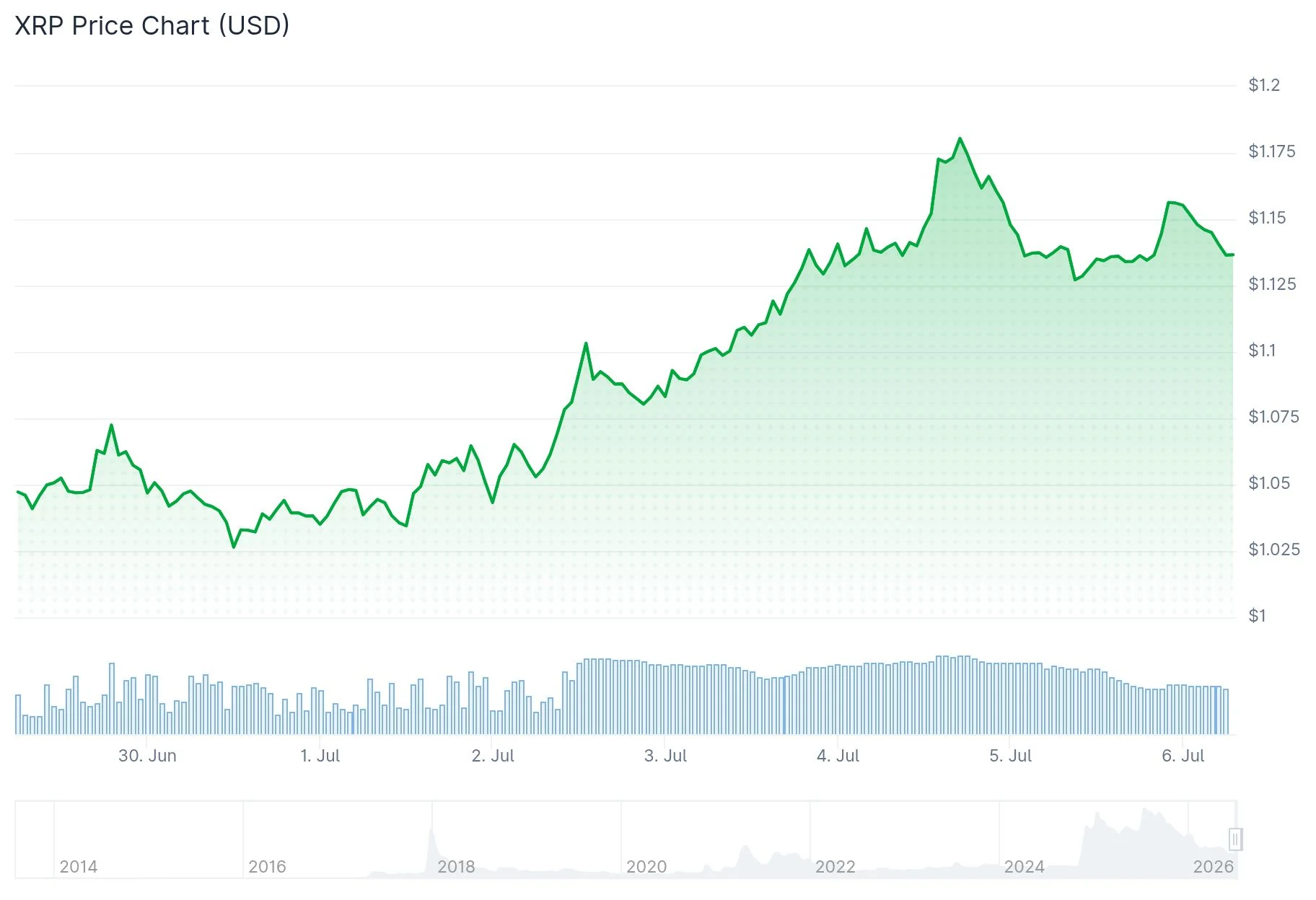
- XRP currently sits at $1.13, reflecting a 3.21% decline over 24 hours, while daily trading activity fell 43.3% to $1.14 billion.
- Crypto analyst Egrag Crypto observes the Super Guppy technical indicator entering compression mode, indicating weakening price momentum.
- Critical support lies between $0.80 and $1.10; losing this zone could undermine XRP’s long-term technical formation.
- Technical analyst ChartNerd identifies a potential death cross developing between the 20-week EMA and 200-week SMA around $1.20.
- A symmetrical triangle consolidation pattern is reaching its final stage, with bulls eyeing a potential move back toward $2.
As of July 5, 2026, XRP is changing hands at $1.13, marking a 3.21% decline in the last 24-hour period. Market data from CoinMarketCap reveals trading volume has contracted to $1.14 billion, representing a 43.3% decrease. However, the token has managed to post an 8.75% gain across the previous seven days.
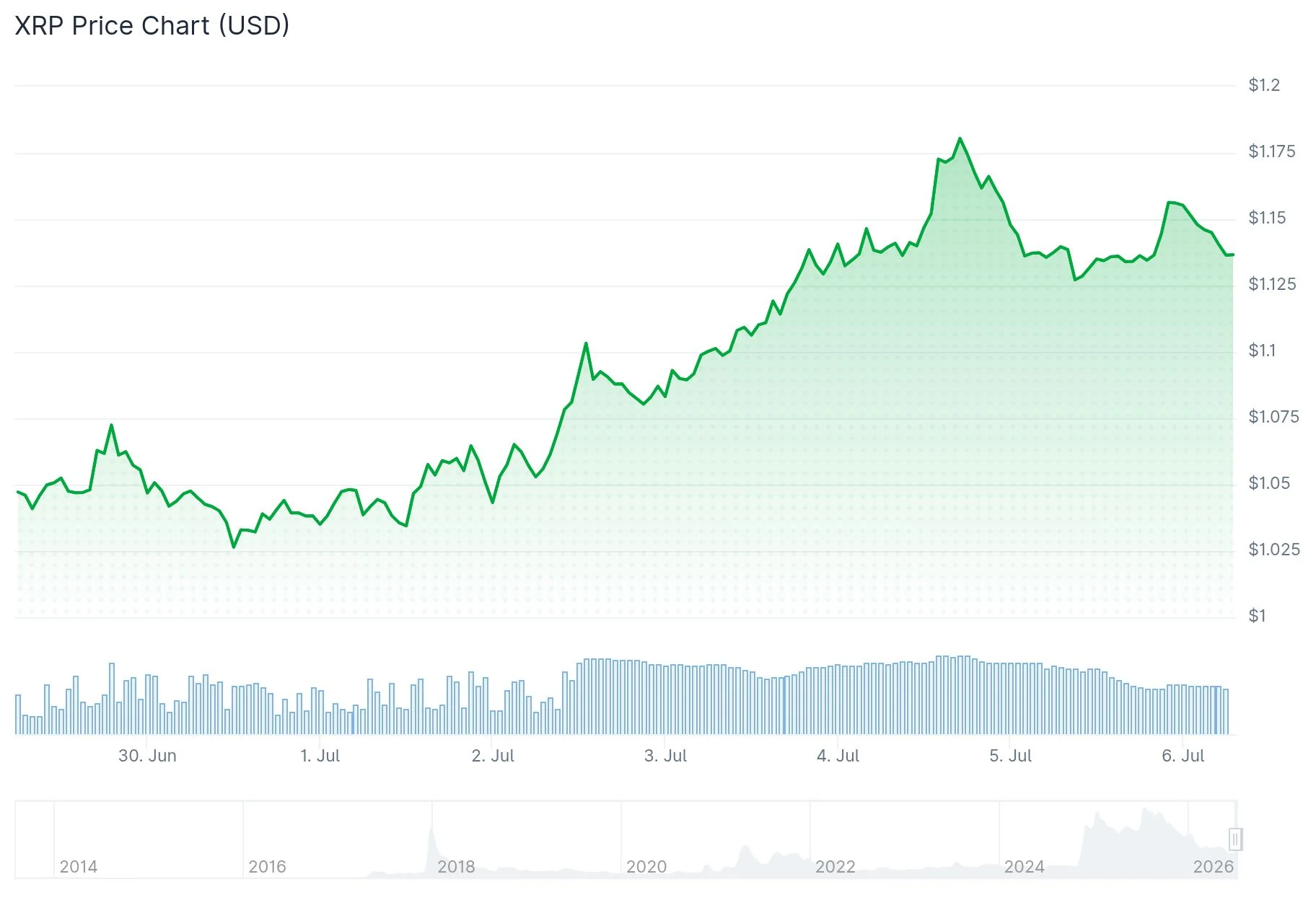
The recent price decline coincides with technical analysts identifying two significant chart patterns. The first suggests declining momentum in the market, while the second raises concerns about a potential bearish indicator appearing on the weekly timeframe.
Market analyst Cryptollica shared insights on X, noting that XRP has reached its most oversold condition in its entire 13-year trading history. Their commentary stated: “This is not where the crowd gets excited. This is where most gives up before the real move begins.” According to Cryptollica, the RSI reading has plunged deeper than during any previous major XRP correction throughout its existence, with price now challenging multi-year structural levels — not following a euphoric rally, but after extended periods of resistance and skepticism.
Well-known crypto analyst Egrag Crypto drew attention to the Super Guppy technical indicator on XRP’s weekly timeframe. His analysis reveals the indicator has transitioned from robust green expansion phase into a mixture of grey and compression coloring. This transformation indicates that upward momentum is beginning to fade.
Egrag characterizes this development as a “macro retest” or “cooldown pattern.” According to his analysis, the $0.80 to $1.10 price corridor represents the critical support area that must hold. Maintaining price action within this band is essential for preserving the larger bullish market structure.
Potential Upside Targets if Super Guppy Turns Green Again
Should XRP successfully defend its support levels, recapture the red moving average zone, and drive the Guppy indicator back into green territory, Egrag has outlined multiple price objectives. These projections include $3.59 as an initial target, followed by a range between $6.73 and $9.17, then $16.36, with an extended cycle target reaching as high as $53.86.
These represent extended timeframe projections. The immediate outlook remains more measured and defensive.
Technical analyst ChartNerd issued a cautionary note that XRP is approaching a death cross formation on its weekly chart. This occurs when the 20-week exponential moving average crosses beneath the 200-week simple moving average. The 200-week SMA currently resides around the $1.20 price level.
ChartNerd highlighted that comparable patterns emerged during previous bear market cycles. During 2022, XRP established a local bottom just one week following the death cross signal. In the more protracted 2018–2020 bear market, the ultimate bottom materialized six months after the crossover.
Drawing from these two historical precedents, ChartNerd projects a possible cycle bottom occurring between June and December 2026, with downside targets of $0.90 or potentially $0.70.
Symmetrical Triangle Pattern Approaches Critical Resolution Point
Independently, blockchain data analytics provider XRP Update has identified a symmetrical triangle consolidation developing on XRP’s price chart. The asset has been trading within converging trendlines — a downward-sloping resistance boundary and an upward-sloping support line — over recent months.
This triangle formation is now reaching its apex point, indicating that the consolidation phase is nearing completion.
A decisive break above the triangle’s upper resistance line, accompanied by substantial volume, would represent the bullish confirmation traders are monitoring.
XRP has simultaneously displayed hidden bullish divergence patterns while RSI readings have formed higher lows. Certain technical analysts interpret this combination as evidence that accumulation is occurring quietly below current price levels.
The RSI divergence combined with the triangle compression pattern collectively suggest a potential advance toward the $2 threshold. Several market observers believe sustained momentum beyond that level could propel prices into the $3 territory.
As of July 5, 2026, XRP continues trading at $1.13, with the $1.20 level — corresponding to the 200-week SMA position — representing the immediate resistance barrier to monitor closely.


Tether CEO Paolo Ardoino has warned that Big Tech’s artificial intelligence spending boom may be built on weak economics, as concerns over an AI market bubble spread across global markets.
In a July 4 post on X, Ardoino said the AI infrastructure race contains four major “structural mismatches”. These are gaps between costs, revenues, investment timelines, and competition.
His warning comes as the world’s largest technology companies pour hundreds of billions of dollars into data centres, chips, and power capacity. The central question for investors is whether AI can generate enough revenue to justify that spending.
Businesses are Paying Too Less for AI
Ardoino argued that companies are charging too little for AI computing compared with the real cost of providing it. In simple terms, some AI services may look cheap because companies are subsidising usage to win customers.
That makes growth look stronger than the underlying business model. If companies later raise prices, users may spend less. If they keep prices low, margins may remain under pressure.
AI Profits Could Take Longer to Realize
Big Tech companies are spending heavily now, while the profits from AI may take much longer to arrive. Data centres, GPUs, and power contracts require huge upfront investment.
This creates a gap between capital spending today and commercial returns in the future. The bigger that gap becomes, the more pressure companies face to prove that AI can become a durable source of revenue.
AI is Outdating Itself Fast
AI chips can become outdated within 3 to 5 years. Yet the debt and equity used to finance AI infrastructure often assume a much longer payback period.
That matters because companies may need to replace expensive hardware before it has fully paid for itself. If demand slows or pricing falls, the economics become harder to defend.
The Industry Faces Intense Competition
Open-source AI models are improving quickly and could weaken the pricing power of commercial AI providers. If cheaper or free alternatives become good enough, customers may resist paying premium prices.
That would make it harder for companies to recover the money they are spending on infrastructure. It could also reduce the revenue expectations that have supported high AI valuations.
Ardoino’s warning is part of a wider debate now moving through markets.
Chinese hedge funds including Wealspring Asset and Shanghai Banxia Investment Management Center have warned that AI stocks may be in bubble territory. Wealspring reportedly called global AI stocks a “super bubble”, while Banxia said a possible trigger for a correction may already have appeared.
The concern is simple. AI has become a major driver of stock market performance, especially for large technology companies. If investors begin to doubt the return on AI spending, the impact could spread beyond the tech sector.
AI Spending Could Hit Trillions
JPMorgan has projected that global AI-related spending could reach $5.5 trillion by 2030. At the same time, Alphabet, Amazon, Meta, and Microsoft are expected to spend up to $720 billion this year.
That level of spending gives AI a central role in corporate earnings, energy demand, chip demand, and credit markets.
The Bank of England warned in October 2025 that AI-related valuations had moved close to levels seen during the dot-com bubble. It also said AI infrastructure may require trillions of dollars, with a meaningful share financed by debt.
Some investors take a less negative view. They argue that today’s AI trade differs from the dot-com era because the largest companies funding the boom already have strong earnings and established businesses.
Morgan Stanley has also estimated that nearly $3 trillion in AI infrastructure investment could move through the economy by 2028.
Still, Ardoino’s point is that the risk sits inside the economics of AI infrastructure itself. If pricing, profits, hardware lifespans, and competition do not line up, the market may be underestimating how hard it will be to turn AI demand into lasting returns.
The post Tether CEO Warns of Four Cracks in Big Tech’s AI Boom appeared first on BeInCrypto.

Reform UK leader Nigel Farage has denied wrongdoing after The Sunday Times alleged that he accepted undisclosed gifts from a US-convicted fraudster tied to the offshore crypto gambling world. The report says the gifts included staff support, security, and travel and accommodation provided by George Cottrell, an adviser to Farage for more than a decade.
Farage said in a statement that he “followed the rules,” adding that the story amounts to a “hit job.” The controversy arrives as UK crypto policy faces rising scrutiny, including tighter controls on political donations involving digital assets.
Key takeaways
- The Sunday Times reports Farage received additional undeclared support from George Cottrell, an associate connected to an offshore crypto casino.
- Farage denies he broke disclosure rules, with the gifts reportedly dating back to before he became an MP in July 2024.
- The allegations add to a pattern of scrutiny around Farage’s links to wealthy crypto-linked figures and political finance.
- UK crypto regulation pressure is intensifying, including a ban on cryptocurrency donations announced earlier this year.
- Ongoing complaints and inquiries show the debate is not just about crypto markets, but also about political integrity and conflicts of interest.
New allegations center on George Cottrell
In its Saturday report, The Sunday Times said Farage was gifted services that were not publicly disclosed. The gifts were attributed to George Cottrell, described as an aristocrat and a close adviser to Farage for more than 10 years.
According to the outlet, Cottrell provided access to security and drivers, including personnel described as former soldiers. The report also alleges Cottrell recruited and paid staff members to assist with the Reform leader’s social media. It further claims that, following Farage’s election, he was allowed to use a rented five-story house near Buckingham Palace, although a Reform source told The Times that Farage primarily stayed at his own home and did not routinely use that property.
The story also says Farage registered only a single benefit from Cottrell when he entered Parliament—described as less than £9,300 (about $12,400) for travel, security and accommodation related to an event in Belgium.
Farage’s response, published Sunday, disputed the implication that he failed to follow requirements. As reported by The Guardian, he said he “followed the rules” over the gifts from Cottrell.
Criminal case in the US links Cottrell to fraud allegations
The credibility of the allegations rests heavily on Cottrell’s prior legal history. The Sunday Times report states that in 2016 Cottrell was arrested and charged in the United States with 21 offenses connected to a money-laundering plot. The report adds that he pleaded guilty to a single wire fraud charge after a plea deal and served eight months in prison.
The article also ties Cottrell to an offshore gambling site, Tether.bet, which uses Tether’s USDT stablecoin. While the specific operational details of that venture are not addressed in the provided coverage, the overall framing connects his crypto involvement to the controversy over political support and disclosure.
Broader scrutiny: donations, lobbying claims, and prior watchdog action
This latest development follows a separate set of concerns around Farage and crypto-linked donors. A parliamentary standards watchdog opened an inquiry in May into whether Farage failed to declare a £5 million gift from crypto billionaire Christopher Harborne, a figure reported to have stakes in Tether. Farage has previously argued that some gifts did not require disclosure because they were provided for security arrangements before he became an MP, according to earlier reporting referenced in the original coverage.
The Sunday Times claim also comes after The Guardian reported earlier this week that Farage was accused of lobbying the Bank of England regarding its digital currency plans. In that report, Phil Brickell, a Labour MP and chair of a parliamentary anti-corruption group, was quoted describing a complaint to the standards commissioner.
Brickell’s allegation, as relayed in the cited coverage, was that Farage claimed credit for influencing the Bank’s stance on a central bank digital currency. Brickell also argued that Harborne would benefit if a state-backed digital currency were softened—particularly because it could compete with private stablecoins.
For investors and users, the significance goes beyond personal politics. It highlights how governance choices—such as how central bank digital currencies may be structured—can affect the competitive position of stablecoins and the broader crypto market ecosystem. When political figures are linked to substantial crypto-related wealth, regulators and watchdogs typically treat transparency and conflict-of-interest rules as central, not peripheral.
UK policy pressure on crypto political financing continues
The episode unfolds against a backdrop of tightening UK scrutiny of crypto-related political activity. The original coverage notes that the UK Treasury temporarily banned political donations made in cryptocurrencies in March, a step aimed at reducing the influence of opaque funding channels.
Reform’s own agenda has positioned the party as one of the more pro-crypto forces in UK politics. The coverage states that Reform published draft legislation last year intended to make the UK “the world’s premier hub for cryptocurrency.” It also notes that Reform was the first UK political party to accept donations in Bitcoin. Farage has supported proposals including cutting capital gains tax on crypto and calling for a Bank of England Bitcoin reserve.
In that context, repeated disclosures and investigations around how crypto-linked individuals fund political activities take on added weight. The central question for regulators and voters is whether existing rules are being followed—and whether policy advocacy can be separated from the financial interests of large backers.
Readers should watch whether the standards investigations advance toward formal findings, and whether new disclosure obligations—especially those affecting crypto-related political donations—continue to expand. Another open point is how any alleged lobbying over central bank digital currency plans will be evaluated in light of the relationships and benefits described in the reporting.

Ripple’s cross-border token has gained over 9% in the past week and now sits near $1.15 after bottoming (for now, at least) at $1.01 a few weeks ago.
Such a notable resurgence in a relatively short timeframe has given wings to the perma-XRP-bulls, as new predictions of bigger rallies and peaks emerged over the weekend.
XRP to $4 or $5?
Crypto trader Nehal outlined the 1-week trading chart for the token, which clearly demonstrates the downhill price action that began a year ago when it peaked at $3.65. However, XRP is now testing the upper boundary, located at around $1.12-$1.15. A successful breakout could be the necessary push to start a new run.
The trader believes a major 250% rally could follow, sending the altcoin to a new all-time high of over $4.
Fellow analyst Mikybull Crypto shared a similar opinion, indicating that “something massive is coming for XRP.” Although they focused on XRP’s performance against BTC, which shows an identical declining move, their target against the greenback was even more bullish – $5.
Seeing this chart, it gives you a clue that something massive is coming for XRP
$5 will be the minimum conservative target for what is coming pic.twitter.com/G3jHwhau52
— MikybullCrypto (@MikybullCrypto) July 6, 2026
It’s worth noting that such major price predictions of $4 or ‘at least’ $5 sound quite unreasonable at the moment, given the current market conditions and sentiment. However, XRP has proven in the past that it’s capable of similar moves, such as the one in late 2024 and early 2025, in which it rocketed from $0.50-$0.60 to $3.40 in just a few months.
Major Moment Arrives
Celal Kucuker also observed XRP’s price moves against the market leader, suggesting that the altcoin has reached a major moment. They explained that the red descending channel (seen in the tweet below) is close to breaking, which has been able to withstand all of XRP’s breakout attempts in the past few months.
They were significantly more bullish on Ripple’s altcoin, indicating that such a move would allow XRP to “outperform Bitcoin by 10x.” Their ultimate price target for the cross-border token is $12, which would coincide with the time “BTC is printing new ATH.”
The XRP/BTC chart is approaching a major moment.
The red descending channel is close to breaking.
When that breakout happens, I expect Ripple to outperform Bitcoin by 10x from here.
By the time $BTC is printing new ATH, $XRP will likely already be trading above $12
Save this… pic.twitter.com/OIzLaM0w0C
— Celal Kucuker (@CelalKucuker) July 5, 2026
SUNCOAST joined the other analysts above in predicting that XRP is at “a massive decision point.” Its multi-month falling wedge is “compressed to the absolute max,” which would mean a massive move ahead. However, they didn’t provide a precise price target, but noted that the “expansion will be violent” once the breakout is confirmed.
The post XRP Reaches Major Decision Point as Analysts Expect a Huge Move: Here Are the Targets appeared first on CryptoPotato.


The CLARITY Act did not become law by July 4, despite earlier hopes from White House crypto adviser Patrick Witt. Attention has now moved to Aug. 7, the Senate’s final session day before its summer break and the campaign season.
Summary
- July 4 passed without enactment, leaving Senate negotiators under pressure before the Aug. 7 break.
- Staff still need to merge Banking and Agriculture versions before any full Senate floor vote.
- Backers gained law enforcement support, but ethics, AML and vote math remain open Senate issues.
The bill remains one of the most watched U.S. crypto market structure proposals. Crypto.news reported that the CLARITY Act has passed the House, cleared the Senate Banking Committee, and sits on the Senate calendar. It still needs a full Senate vote before it can move closer to the president’s desk
Staff work continues on Senate text
Senate staff are still working to reconcile the Agriculture and Banking Committee versions. That step matters because both committees have jurisdiction over parts of digital asset policy. A single Senate text must be ready before floor action can move cleanly.
Recent crypto.news coverage said Senator Bill Hagerty revived hopes after outlining a new Senate roadmap for the CLARITY Act. The report said the Senate could release final text before lawmakers return from recess, while Bloomberg Intelligence placed the bill’s chance of passing this month near 60%.
Senator Cynthia Lummis has also pushed lawmakers to keep the bill moving. Crypto.news reported that Lummis said the bill would “lay the foundation for the financial services of the 21st century.” She also said, “The Clarity Act is this generation’s contribution to that legacy. Let’s finish the job.”
Vote math and policy disputes remain
The bill still faces a hard Senate vote count. Crypto.news has reported that the CLARITY Act likely needs 60 votes on the floor, meaning Republicans must secure Democratic support to overcome Senate rules. That requirement keeps negotiations active.
TD Cowen warned that the bill’s timeline remains uncertain before the November midterm election. Crypto.news reported that the firm pointed to ethics rules, anti-money laundering concerns, and questions over political support as issues that could slow a vote.
The bill would divide digital asset oversight between the SEC and the CFTC. Crypto.news also reported that the CLARITY Act would add exchange safeguards, customer fund rules, and funding for crypto fraud investigations.
Law enforcement language has been one of the most debated areas. Critics have focused on Section 604, which covers some non-custodial developers and software providers. Supporters say it protects builders who do not control customer funds.
Law enforcement shift gives backers room
Backers gained some room after the Major County Sheriffs of America moved to a neutral stance on the bill’s decentralized finance section. Crypto.news reported that the group withdrew its objection to the CLARITY Act’s DeFi provision while asking for more state and local law enforcement input.
The National Organization of Black Law Enforcement Executives also endorsed the bill. Crypto.news reported that NOBLE said the measure “contains several provisions” that could help law enforcement while keeping current criminal powers in place.
The next test is scheduling. If the Senate does not move before Aug. 7, the bill could face a much harder path after lawmakers return to campaign work. For now, supporters remain active, but the calendar has become the main barrier.
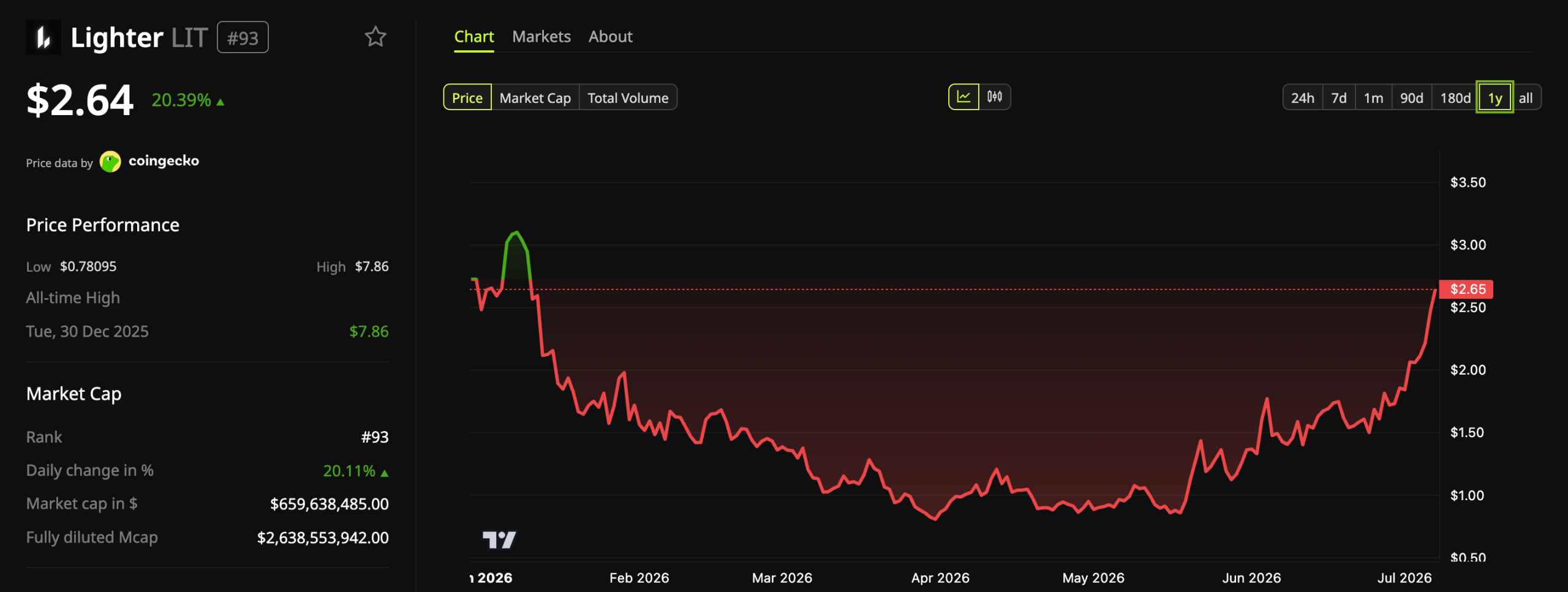
Lighter (LIT) surged more than 20% on Monday to $2.6, its highest level since January, after the perpetuals exchange unveiled a tokenomics overhaul that adds permanent burns and a revamped staking model.
The move made LIT the top gainer among the 100 largest cryptocurrencies. It extended a rally that has lifted the token roughly 40% over the past week, far outpacing the broader market.

Follow us on X to get the latest news as it happens
Lighter Introduces Tokenomics Update
Lighter has bought back LIT with exchange revenue after its token launch. The exchange said it has repurchased about 15.5 million LIT, or roughly 6.3% of the circulating supply. Lighter said it plans to use the buybacks to permanently reduce the LIT supply through burns.
The burns will run by sending LIT to a burn address on the Ethereum (ETH) mainnet. Lighter plans its first burn in the weeks after the second quarter closes. It noted it may burn undistributed LIT rather than the exact repurchased tokens.
“This is economically equivalent for LIT holders and allows Lighter to manage treasury operations efficiently and avoid unnecessary costs,” the exchange said.
Staking Rewards Shift to Reserve
Lighter also changed how it funds staking rewards. Since launching its staking program in January, it has distributed about 3.72 million LIT using pre-TGE revenue, including roughly 170,000 LIT through its fee credits program.
That approach is ending. The exchange will now fund staking rewards using its remaining ecosystem tokens, which total 250 million LIT.
The protocol is targeting a 6% annualized staking yield. With about 125 million LIT currently staked, that would distribute roughly 7.5 million LIT per year.
LIT still trades well below its $7.86 record set in December. Whether the new model sustains demand may hinge on trading revenue holding up in the months ahead.
Subscribe to our YouTube channel to watch leaders and journalists provide expert insights
The post Lighter Jumps 20% to Seven Month High After Tokenomics Overhaul appeared first on BeInCrypto.

Andy Rooney’s Financial Advice

Nigel Farage says ‘no wrongdoing’ after benefits from ally not declared

Mbappe, Messi and Haaland All Tied Atop the World Cup 2026 Golden Boot Race Now With Seven Goals Each


-

 Fashion3 days ago
Weekend Open Thread: High Hopes
-

 Politics3 days ago
The House | “Reframing the debate from a binary discussion of winners and losers”: Yuan Yang reviews ‘We Are Not Machines’
-

 Crypto World6 days ago
Strategy authorizes up to $1.25B in Bitcoin sales under new capital plan
-

 News Videos6 days ago
How to Build INSANE Live Financial Dashboards With Claude
-

 Tech6 days ago
Anonymous researcher drops 0-day ‘exploitarium’ repo
-

 Business6 days ago
Australia treasurer says alleged access of prime minister’s bank data ’incredibly concerning’
-
 NewsBeat1 day ago
Taylor Swift and Travis Kelce wedding staffer hilariously struggles to keep her cool while checking in megastars
-

 Sports5 days ago
Broncos roster: OL Ben Powers (No. 74) entering final year of contract
-
 Business7 days ago
The AI boom won’t burst all at once. It will pop in ‘rolling bubbles’: Macquarie
-
Crypto World5 days ago
Airdrop Registration Becomes Key Focus For Remittix As RTX Launch Updates Approach
-

 Crypto World4 days ago
Binance stock trading tops $1B in first month after launch
-

 NewsBeat5 days ago
Presenter Caroline Flack’s brother Paul Flack dies aged 55
-

 Crypto World4 days ago
Alibaba-affiliate Ant Group enters the humanoid robot market with 12 deals
-
 NewsBeat4 days ago
New exhibition reflects five decades of movement between island of Ireland and GB
-

 Crypto World18 hours ago
South Africa proposes crypto tax guidance under existing rules
-

 Tech21 hours ago
Lenovo laptops are now shipping with YMTC SSDs, a sign of Chinese NAND entering the mainstream
-

 Business4 days ago
Meta Platforms Stock Jumps 7% Today as Bloomberg Reports Company Plans to Enter the Cloud Business
-

 Business3 days ago
What a 10 Percent Drop Means for Buyers, Sellers and Renters
-

 Crypto World3 days ago
Standard Chartered Secures MiCA License as ESMA Adds 37 New Crypto Firms
-

 Crypto World3 days ago
Binance Re-Enters Philippines As EU MiCA Rules Restrict Access
You must be logged in to post a comment Login