


Scots deserve clarity on the SNP’s currency plans now if the party is serious about an IndyRef2, says Chris McCall
Cash may no longer be king in the age of banking apps on smartphones, but coins and banknotes still grip the imagination when it comes to the debate over Scottish independence.
Last year, it was reported Kate Forbes had told SNP members not to talk about the party’s currency policy.
The then deputy first minister’s comments were found in minutes of a summer meeting of the SNP’s Skye branch, leaked by a party activist, in which she was recorded as saying “we must avoid publicly talking about currency”.
So why the reluctance?
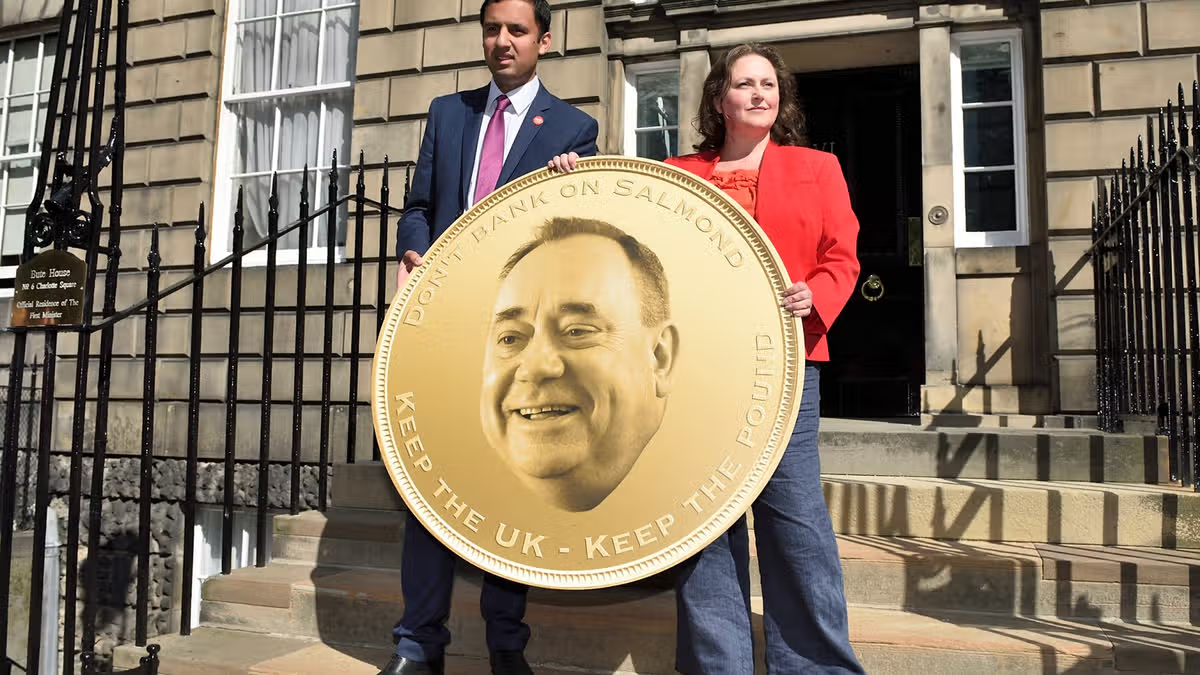
You may recall that during the run-up to the 2014 referendum, Anas Sarwar stood outside Bute House with a large mock-up of a pound coin with Alex Salmond’s face emblazoned on it.
The not-so-subtle point was the Yes campaign was perceived to be struggling to convince voters on what currency would be used in the event of independence.
Salmond, the then first minister, had called for Scotland to enter into a formal currency union with the remainder of the UK. This would mean Scots would continue to use the pound sterling, with Holyrood having a say on monetary policy set by the Bank of England.
He told MSPs at the time: “It’s Scotland’s pound and we are keeping it.”
But George Osborne, the then Tory Chancellor, effectively told Salmond to take a hike. The UK Government would not agree to a currency union, under any circumstance, he said. Osborne insisted independence would mean Scotland “walking out of the UK pound”.
It wasn’t the most memorable line of the campaign, but enough voters understood the gist. And they didn’t like the sound of it.
Salmond then floated the idea of sterlingisation. This means Scotland would carry on using the pound regardless, in the same way many smaller nations use the US dollar as their official currency.
Other prominent independence campaigners were openly hostile to the idea, Jim Sillars among them. He argued forcefully that an independent Scotland should launch its own curency.
He said in 2014: “We have a viable alternative, and it’s a Scottish currency with our own central bank, printing Scottish notes which we will peg one-to-one with Sterling, so there’s no difference whatsoever.”
But that was then. So what’s the position now?
In one of its many white papers on independence, the Scottish Government explained in 2022: “We propose that, on independence, Scotland would continue to use the pound sterling for a period before moving to our policy of adopting a Scottish pound.
“The change would take place as soon as practicable through a careful, managed and responsible transition, guided by criteria and economic conditions rather than a fixed timetable.
“While Scotland is still using sterling, many aspects of monetary policy would continue to be set by the Bank of England.”
How long is “a period”? It’s one of several unanswered questions. Another might be, is Scotland really achieving independence if the Bank of England is still calling the shots, potentially for years?
Steringisation would also present other issues, many of them complex but worth repeating. The Economics Observatory has a detailed run-down of the currency options available to an independent Scotland.
It noted: “The continued use of sterling post-independence – either under a monetary union or sterlingisation – would require a strict macroeconomic regime be put in place. This would demand short-term adjustments to Scotland’s fiscal and balance of payments position. If not, retaining sterling would be a poor anchor for an independent Scotland.”
It also warned: “A second challenge with sterlingisation is that any balance of payments deficit would see sterling reserves draining out of the system, along with the deflationary consequences of this.
“But with limited – and finite – inherited reserves, an independent Scottish central bank under sterlingisation would be constrained in how much leeway it would have to combat this.”
A core foundation of the SNP’s independence plan is Scotland being admitted to the European Union as quickly as possible. But it’s a well-known condition of EU membership that member states commit themselves to joining the Euro.
Sweden joined the EU in 1995 – four years before the Eurozone was launched – and is legally committed to joining the single currency. But in reality, it has no plans to do so.
Independence supporters believe this sets a precedent which Scotland could follow. But the reality might be different.
Alyn Smith, a former SNP MEP and now MSP, said as much in an interview with BBC Scotland today. He said: “There is a commitment to participate in economic and monetary union, yes, but there is no timescale attached to that.”
Smith also suggested a referendum would be required on whether Scots wanted to join the Euro at all.
So that’s three currency options already – the pound, controlled by the Bank of England; a new Scottish pound, which could be pegged to sterling; or the Euro, which may require a referendum.
If the SNP is serious about staging an IndyRef2 in the coming years, it must offer a clear answer on what it considers the best way forward and the costs involved.




















































You must be logged in to post a comment Login