

Crypto World
Ripple executive says crypto is no fringe issue in Washington



Ripple legal chief and National Cryptocurrency Association President Stuart Alderoty said Washington should stop treating crypto users as a small political group.
Summary
- Alderoty says 67 million U.S. crypto holders make digital assets a major voting bloc.
- Polling shows mixed views, with many Americans still worried about crypto risk and influence.
- The CLARITY Act remains under Senate pressure as lawmakers weigh rules, ethics, and oversight.
In a July 7 post on X, he said U.S. crypto holders now represent one of the country’s largest public groups.
Alderoty pointed to National Cryptocurrency Association data showing that 67 million American adults own crypto. He said, “For starters, it means more people have crypto than have dogs.” He added that crypto users are “by any reasonable standard” a large national group.
His comments came after a Politico poll showed limited public support for the CLARITY Act. Alderoty argued that weak support for one bill does not mean crypto users are irrelevant. He said the 27% support figure is close to the share of adults who already hold crypto.
Crypto ownership broadens across the U.S.
The 2026 State of Crypto Holders Report said one in four U.S. adults now owns crypto, or more than 67 million people. The report also said the country added 12 million holders over the past year.
Alderoty said the data challenges old images of crypto holders as wealthy male tech workers or short-term speculators. The report said women made up 42% of new holders in 2025 and 2026, compared with 34% among earlier holders.
The same report said nearly a quarter of holders earn $75,000 or less per year. It also said construction and manufacturing workers now make up more than 21% of the holder base. Alderoty used those figures to argue that crypto ownership now reaches working and middle-class households.
CLARITY Act debate enters tighter window
The remarks come as Congress continues to debate the CLARITY Act, a bill meant to set federal rules for crypto markets. As previously reported, the bill missed its July 4 target and now faces an Aug. 7 deadline before the Senate summer break.
The bill has already cleared key steps, but it still needs a full Senate vote. Senate staff also need to merge versions from the Banking and Agriculture committees before lawmakers can move cleanly toward final passage.
As previously reported, the Senate Banking Committee advanced the bill in a 15 to 9 vote in May. The bill still needs 60 Senate votes, while ethics language, anti-money laundering rules, and agency oversight remain points of debate.
Polling and lobbying shape the fight
Public polling gives lawmakers a mixed picture. A Politico and Public First survey found that crypto ranked low among voter priorities, with only 4% saying a candidate’s crypto stance would shape their vote.
Other polling shows voters want stronger rules. Americans for Financial Reform said voters across parties worry about crypto industry influence in Washington and want crypto firms to follow bank-like rules.
The industry has also increased political spending. Reuters reported that crypto firms have spent $189 million so far on the 2026 U.S. election cycle, more than their 2024 total. The report named Ripple Labs, Coinbase, Andreessen Horowitz, and Foris DAX among the top contributors to corporate policy-focused political action committees.
Alderoty’s message places crypto ownership at the center of the Washington debate. His argument is that lawmakers do not need to endorse a specific token to pass basic rules. They must decide whether 67 million holders are a niche group or a public market that needs clear guardrails.


Ethereum co-founder Vitalik Buterin has confirmed that AI-assisted analysis by Co-Invest CEO Franklyn Wang correctly pinpointed his anonymous authorship of a rewrite of EIP-7503. The result follows Buterin’s own public challenge earlier this month, where he asked whether today’s AI tools could reliably undo online anonymity.
Wang says the identification succeeded not because of the document’s surface-level wording, but because of the underlying reasoning patterns used to explain mathematical and technical ideas—suggesting that even deliberate obfuscation, such as translating content from another language, may not fully protect anonymous technical contributions.
Key takeaways
- Buterin confirmed Wang’s system identified him as the author behind an anonymous EIP-7503 rewrite.
- Wang’s explanation emphasizes reasoning and the structure of explanations, not just writing style.
- The test was prompted by Buterin’s skepticism about whether AI could realistically deanonymize authors.
- Prior research Wang referenced claims large language models can perform deanonymization at scale from unstructured text.
A high-profile test of deanonymization
Buterin’s June 22 post was unusual for the crypto community: rather than defending his privacy, he deliberately offered a puzzle about his own past anonymity. He said he had published a document—described as “medium importance” to Ethereum—under a different name and challenged the public to find it.
The premise was rooted in a broader debate inside tech: whether large language models can infer identity from writing. While anonymity remains common in open-source and technical ecosystems, some analysts argue that as AI models improve at extracting patterns from text, pseudonymous participation could become harder to sustain.
That question was sharpened by a February paper from researchers at ETH Zurich and Anthropic. The study argued that large language models can make online deanonymization practical at scale by identifying identity-related information in unstructured text, generating candidate matches, and then reasoning over the most likely authors. It also claimed to outperform traditional deanonymization techniques.
How Wang’s analysis reportedly worked
Two weeks after Buterin’s challenge, Wang posted on X that his submission correctly identified the anonymous EIP-7503 rewrite. He said the document’s author had hidden the work by writing it in Chinese and machine-translating it. Yet, according to Wang, the system found a “tell” that did not come from the author’s choice of words.
“The doc was an anonymous EIP-7503 rewrite he’d hidden by writing it in Chinese and machine-translating it,” Wang wrote in a Monday X post after Buterin confirmed the result. “The tell wasn’t his words, it was his reasoning.”
Wang further stated that Co-Invest ranked Buterin as the most likely author of the anonymous December 2024 rewrite of EIP-7503, with roughly 20% confidence—about 10 times higher than the next candidate—based on an analysis of 27 documents.
Buterin’s obfuscation and why it didn’t hold
After Wang’s identification, Buterin revealed additional details about how he attempted to disguise authorship. He said he had written the anonymous rewrite in Chinese, translated it into English using Qwen 2.5, and then manually corrected the translation with the intent to make his prose harder to attribute.
Buterin’s follow-up explanation suggested that the approach targeted the wrong surface layer. He wrote that “stylistic hints” the AI picked up on were tied to intellectual habits—specifically the style of mathematical and algorithm explanations—rather than the prose itself. In other words, while translating and editing prose may change diction and phrasing, it may not eliminate deeper patterns in how a writer structures explanations and arrives at technical descriptions.
He added that those reasoning-level signals “bypass[ed]” his obfuscation strategy, which he characterized as covering prose only.
Limits and lessons from earlier attempts
The deanonymization debate is not new, but this case adds a real-world datapoint because it ties back to a question Buterin publicly raised. The episode also intersects with earlier work within the crypto AI space.
Lighter CEO Vladimir Novakovski said on Monday that he worked with Wang in 2023 on a project using GPT-4 to try to identify Bitcoin creator Satoshi Nakamoto by matching writing style in cryptography research. Novakovski said that effort failed to produce a high-confidence result.
According to Novakovski, Wang later applied a similar approach to Buterin’s anonymity challenge—yet in this instance the identification reached confirmation from the person targeted by the test.
That distinction matters: it implies that while AI-based author inference can be unreliable in some contexts, it may become more accurate when the text and task conditions allow models to capture consistent explanation patterns. It also highlights that “deanonymization” isn’t a single technique; performance may vary depending on language, document type, candidate set size, and how much of the author’s reasoning becomes visible in the writing.
Why this matters for crypto builders and contributors
In open-source and standards work—where proposals, research notes, and technical explanations often circulate publicly—pseudonymous authorship can protect individuals from harassment, reduce reputational pressure, and encourage candid experimentation. But if AI systems can attribute authorship by tracing reasoning patterns, then anonymity could become more fragile than many contributors assume.
At the same time, the episode doesn’t prove that every anonymous contribution is doomed. The earlier Nakamoto-attribution attempt reportedly failed to achieve high confidence, and in practice, the effectiveness of deanonymization likely depends on how easily models can extract stable, identity-linked signals from the text.
For investors, traders, and ecosystem participants, the broader takeaway is that AI capabilities are increasingly reaching beyond generating content into analyzing provenance—especially in technical domains where reasoning needs to be explicit. That shift may affect how communities think about privacy, attribution, and risk in public documentation.
Readers should watch whether similar challenges—especially those involving different document formats, languages, or candidate sets—continue to confirm or contradict Wang’s approach, and whether communities adjust norms around anonymity in Ethereum standards and other technical workflows.


Nasdaq-listed Coinbase (COIN) has secured U.K. regulatory approval to offer equities and derivatives alongside crypto, expanding its product suite in one of its largest international markets.
The new license enables institutional and advanced traders to access crypto, equity and commodity perpetual futures, Coinbase said in a blog post. Retail customers in the U.K. will also be able to trade equities on Coinbase for the first time.
The authorization sits alongside Coinbase’s U.K. e-money license and crypto registration. The company received FCA cryptoasset registration in February last year, allowing it to provide crypto and fiat services in the country.
U.K. users are getting access to products Coinbase has started rolling out overseas. U.S. users already have access to stock and exchange-traded fund trading, while eligible non-U.S. customers can trade USDC-settled stock perpetual futures on large-cap names including Apple, Microsoft and Tesla.
Coinbase has also said it plans to offer tokenized stocks backed one-for-one by U.S. equities to eligible non-U.S. users. Those products are meant to give investors ownership of the underlying shares, including dividends.

Key Highlights
- Cloud infrastructure expenditure worldwide surged to $129B in Q1 2026, marking a 35% annual increase
- Microsoft’s Azure platform posted 40% revenue growth YOY during Q3 FY2026, capturing approximately 21% of global cloud market
- Jefferies maintains Buy recommendation with $675 target price on MSFT; Citizens reaffirms Market Outperform with $550 objective
- Shares have declined roughly 20% year-to-date, currently valued at 20.25x forward earnings versus sector mean of 24.61x
- Wall Street consensus from 50 analysts shows Strong Buy, with mean price target at $552.27 suggesting approximately 43% potential gain
Shares of Microsoft (MSFT) have retreated approximately 20% during 2026, currently hovering near $386.74. This downturn has compressed the forward price-to-earnings ratio to 20.25x — substantially beneath the technology sector’s 24.61x average. Despite the stock’s weakness, the company’s core operations continue demonstrating robust expansion, capturing significant attention from financial analysts.
Jefferies maintains its Buy recommendation on MSFT with an ambitious $675 price objective. The investment firm emphasized Microsoft as a premier opportunity within the ongoing cloud computing expansion cycle, specifically citing Azure’s accelerating market penetration as justification for their optimistic stance.
Worldwide cloud infrastructure investments totaled $129 billion during Q1 2026, representing a 35% year-over-year surge. Major technology companies have substantially increased their capital spending blueprints for 2026 from approximately $600 billion to roughly $750 billion — a remarkable 67% escalation — while early 2027 forecasts already approach the $1 trillion threshold.
Azure stands positioned as a primary beneficiary of this trend. During Microsoft’s third fiscal quarter of 2026, Azure revenues expanded 40% compared to the prior year, exceeding Wall Street projections. The platform now commands approximately 21% of worldwide cloud infrastructure services, ranking second only to Amazon Web Services. Management indicates current customer demand consistently surpasses available infrastructure capacity.
The company’s Q3 FY2026 performance demonstrated strength throughout all segments. Consolidated revenues advanced 18% reaching $82.9 billion. Operating profits increased 20% to $38.4 billion, while net earnings surged 23% to $31.8 billion — translating to $4.27 per diluted share.
Microsoft Cloud revenues totaled $54.5 billion, reflecting 29% growth. Commercial remaining performance obligations nearly doubled with a 99% increase to $627 billion — signaling substantial future revenues already contracted.
The Intelligent Cloud division generated 30% growth reaching $34.7 billion. Productivity and Business Processes revenue expanded 17% to $35.0 billion. The More Personal Computing segment declined 1% to $13.2 billion.
Wall Street Perspectives
Citizens reaffirmed its Market Outperform rating alongside a $550 price objective on July 7. The firm highlighted CEO Satya Nadella’s artificial intelligence sovereignty initiatives and anticipates revenue acceleration to 17% during FY2026 from 15% in FY2025. Operating margins are forecast to widen from 46% to 47%.
Benchmark analyst Yi Fu Lee launched coverage during April 2026 with a Buy rating, characterizing Microsoft as a “pivotal force in AI” possessing data advantages competitors cannot easily duplicate — referencing 1 billion Windows installations, 300 million Office subscriptions, plus LinkedIn, GitHub, and Azure’s extensive enterprise presence.
Wedbush analyst Dan Ives maintains an Outperform designation with a $575 target, asserting Wall Street consistently underappreciates Azure’s expansion momentum.
Among 50 analysts providing coverage, the prevailing consensus registers as Strong Buy. The average price objective of $552.27 suggests approximately 43% appreciation potential from present trading levels.
Growth Catalysts and Initiatives
Microsoft executed a two-decade power supply agreement with Chevron’s Energy Forge One division to construct Project Kilby throughout West Texas — an infrastructure project anticipated to generate approximately 2.67 gigawatts supporting Microsoft’s data center operations.
The technology giant collaborates with Mayo Clinic developing an artificial intelligence platform for healthcare applications utilizing de-identified patient information, concentrating on enhanced early detection capabilities and personalized treatment protocols.
Microsoft’s next quarterly report arrives July 29. Wall Street anticipates Q4 FY2026 earnings per share of $4.21, compared with $3.65 during the comparable period — representing 15.3% expansion. Full-year FY2026 consensus estimates stand at $16.76 per share, advancing from $13.64 in FY2025.
Italy’s competition authority recently launched an inquiry examining Microsoft regarding potentially anticompetitive conduct connected to Microsoft 365 pricing adjustments associated with Copilot and Designer feature integration.



Key takeaways
- Bitcoin (BTC) dropped below $64,000 despite improving derivatives data.
- Analysts at QCP note that July has historically been one of Bitcoin’s strongest months, averaging gains of around 7.5%.
- Glassnode says Bitcoin is showing signs of structural stabilization, with spot selling pressure easing significantly.
Bitcoin (BTC) started July on firmer footing, recovering above the $63,000 level as improving derivatives positioning and easing selling pressure helped stabilize the cryptocurrency market.
The rebound follows several weeks of volatility and comes as analysts point to historically favorable seasonal trends, strengthening technical conditions, and improving institutional flows as factors supporting Bitcoin’s recovery.
At the time of writing, Bitcoin was trading near $63,190, up approximately 0.6% over the past 24 hours.
July seasonality favors Bitcoin bulls
Analysts at crypto trading firm QCP noted that Bitcoin’s early-July recovery aligns with historical market patterns.
According to the firm, July has traditionally been one of Bitcoin’s strongest-performing months, delivering average returns of roughly 7.5%.
QCP added that lighter trading volumes during the U.S. Independence Day holiday helped preserve the bullish momentum that emerged after softer-than-expected U.S. labor market data eased pressure on risk assets.
The firm also observed that stress across Bitcoin’s derivatives market has begun to ease.
Recent derivatives data suggests traders are becoming less defensive. QCP highlighted several encouraging developments:
- Implied volatility continues to trend lower.
- Near-term put option skew has moderated after rising sharply during the recent market decline.
- Traders have shown notable interest in $70,000 call options expiring at the end of July, indicating expectations for additional upside.
However, optimism remains measured.
The firm also pointed to ongoing demand for $58,000 put options expiring later this year, reflecting concerns among some investors that Bitcoin’s current rebound could resemble the temporary recovery seen during the 2022 bear market before prices resumed their decline.
Bitcoin price forecast: BTC could drop below $63,000
The BTC/USD 4-hour chart remains bullish and efficient following last week’s rally. The momentum indicators suggest that the market is currently consolidating.
The RSI of 55 means that neither the buyers nor the sellers are in control. The MACD lines are also in the neutral zone, reinforcing the current bias.

If the bearish trend resumes, BTC could slip below the $63,000 level and test the 4-hour TLQ at $61,365.
However, if the bulls regain control, Bitcoin could surge past the $64,000 barrier and retest the June 15 high of $67,125.


For six years, one rule anchored the most influential trade in crypto: Strategy buys Bitcoin and never sells it. On July 6 the company disclosed it sold 3,588 coins at a loss to pay dividends on the securities it issued to buy them. The amount is a rounding error. The direction changes everything, for Strategy and for the dozens of companies built in its image.
Summary
- Strategy’s Bitcoin sale ended the market’s assumption that its holdings only move one way.
- The sale was small relative to Strategy’s total BTC stack, but it changed the regime around the company’s treasury model.
- Preferred dividends have turned Bitcoin from a permanent reserve asset into a potential funding source.
- The BTC Monetization Program formalizes future sales as credit management rather than emergency action.
- Treasury companies built on the same never-sell story now face higher scrutiny around financing costs and forced selling risk.
The disclosure arrived the way Strategy’s most important announcements always have, in a Michael Saylor post and a securities filing, but this one inverted six years of them. Between June 29 and July 5, the company sold 3,588 Bitcoin for approximately $216 million, and used the proceeds to pay the quarterly dividends on four of its preferred stock series and the June dividend on a fifth. Strategy, the company that turned never sell into a corporate identity, a marketing engine, and the template for an entire sector, is now a Bitcoin seller.
The numbers make the point sharper than any commentary. The coins went out the door in two tranches at average prices near $59,256 and $60,773, against an average purchase cost of $75,476. The company did not sell into strength to rebalance; it sold at a roughly 20 percent loss because dividends come due on a calendar, not on a market cycle. It was the third disposal since a small tax-loss sale in 2022, and roughly one hundred times larger than the 32-coin transaction in late May that the market had debated for a week and mostly dismissed as housekeeping.
Strategy still holds 843,775 BTC, about 4.2 percent of all the Bitcoin that will ever exist, and the sale barely dents it. The company insists the long-term thesis is untouched, and mechanically that is true. But markets do not price mechanics; they price regimes, and a regime just ended. The most reliable bid in Bitcoin’s institutional era has disclosed the conditions under which it becomes an ask, and every treasury company, preferred shareholder, and Bitcoin allocator now has to model what that means.
This is the anatomy of the turn: why the dividends forced it, what the new monetization framework really institutionalizes, how the market absorbed the news, what it means for the treasury-company sector Strategy spawned, and what actually breaks or holds from here.
Six years of the taboo
Understanding what ended this week requires understanding what was built, because never sell was never merely a slogan. It was the load-bearing wall of a capital structure.
The position began in August 2020 as a treasury decision: a software company parking cash in Bitcoin as an inflation hedge. It became something else within a year, as the company discovered that markets would fund the trade. First came convertible bonds, zero and near-zero coupon paper that investors bought for the embedded equity option; then at-the-market equity sales into every rally; and finally, in the current era, the preferred complex, which replaced the convertibles’ patience with hard cash dividends. Each financing generation raised the stakes of the pledge. A company that never sells is a compelling story when its obligations are optional; it is a high-wire act when they are ten and eleven percent coupons payable in dollars.
The pledge itself was performed as much as stated. Saylor’s laser eyes, the orange-dot charts posted before each purchase announcement, the conference keynotes built around the phrase, all of it constructed what amounted to a public covenant, and the covenant had measurable value: for most of five years the equity traded at a large premium to the coins, a premium analysts explicitly attributed to the one-way-valve belief and to leverage on future purchases. Competitors noticed. The pledge was copied, cited in dozens of treasury-company prospectuses, and became the sector’s default liturgy.
The record shows exactly one prior breach before this year, and its context is instructive: a small December 2022 sale executed for tax-loss harvesting, promptly rebought, and universally accepted as accounting rather than apostasy. The May 2026 sale of 32 coins was the first ambiguous crack, debated precisely because everyone understood what a real breach would signify. The July disclosure removed the ambiguity. Covenants of this kind do not degrade linearly; they hold completely until they hold conditionally, and conditionally is a different product. The premium’s collapse toward net asset value over the first half of 2026 can be read, in hindsight, as the market pricing the covenant’s expiry before the company confirmed it.
The arithmetic that forced the turn
Strategy’s model was never just buying Bitcoin. It was funding Bitcoin purchases by selling securities against the story, at a premium, and the securities are where the obligation lives.
Over the past two years the company built out a complex of preferred instruments, STRF, STRE, STRK, STRD, and the retail-oriented STRC, marketed to income investors as high-yield exposure adjacent to Bitcoin. The senior tier pays a fixed 10 percent; STRC’s variable rate has run near 11.5 percent. Grayscale’s head of research has estimated the annual dividend load across the complex near $1.5 billion. Strategy’s software business generates only a fraction of that, which means the dividends must be paid from one of three sources: cash reserves, new securities issuance, or the coins.
For as long as capital markets stayed open at tolerable prices, issuance covered everything, and the machine compounded: sell paper, buy coins, watch the premium reinforce the story, repeat. The 2026 drawdown closed the loop’s easy path. With Bitcoin grinding to 21-month lows near $57,750 in June, record ETF outflows draining the demand side, and the company’s equity trading at, and briefly below, the value of its coins, issuing new securities meant selling dollar claims cheaply against a discounted asset. The company disclosed an $8.32 billion loss on its digital assets for the second quarter, almost all unrealized, took a full valuation allowance against the associated tax asset, and faced its dividend calendar with the least attractive issuance window since the strategy began.
The response came in two steps. On June 29, Strategy adopted what it calls a Digital Credit Capital Framework, formalizing a $2.55 billion dollar reserve for dividends and debt service and authorizing a BTC Monetization Program permitting up to $1.25 billion in Bitcoin sales for those purposes. A week later came the disclosure that it had already been selling: 1,363 coins in the final days of June, 2,225 more in early July, proceeds routed directly to the dividend bill, with the filing noting that the full $1.25 billion program capacity remains untouched by this particular sale.
Read together, the framework and the sale say something simple: the company examined its options for paying $1.5 billion a year in a closed issuance window and concluded that coins are now a funding source. Not the last resort. A source.
The mantra, annotated
No company in crypto invested more in a slogan. Never sell your Bitcoin was Saylor’s speech title, his social media signature, and the emotional core of the investment case: Strategy was the vehicle through which Bitcoin left the market forever, a one-way valve, and the premium investors paid over the coins reflected, in part, faith in the valve.
The walk-back was carefully staged, which is itself revealing. At a Bitcoin conference in June, addressing the 32-coin May sale, Saylor drew a distinction that had never featured in the marketing: never sell your Bitcoin was advice for individuals, he said, not a description of corporate policy. Weeks earlier, discussing the quarter’s paper losses, he had already conceded the company would probably sell some Bitcoin. By the time the July disclosure landed, accompanied by a Saylor post about Bitcoin evolving by changing less at the protocol layer and mattering more everywhere else, the taboo had been pre-softened in three stages: hypothetical, trivial, material.
The choreography worked, in the narrow sense. There was no panic, no run on the preferreds, no death spiral. Bitcoin dipped below $62,000 on the headline and recovered above $63,000 within a day, holding a streak of gains; MSTR slipped about 2 percent in the premarket, snapping a five-day rally rather than starting a rout. The market had been given months to price the possibility, prediction markets had traded odds on exactly this event after a $30 million transfer to an exchange caught attention, and the actual number, 0.4 percent of holdings, landed closer to relief than to shock.
But absorbing a headline is not the same as forgetting it. The premium Strategy commanded for years rested on a story in which this disclosure could not exist. The story now has an asterisk, permanently, and asterisks compound. Every future dividend date arrives with a question attached that did not exist in May: paid how, exactly?
The calm itself deserves a second look, because two readings of it point in opposite directions. The benign reading is maturation: the market now values Strategy as a credit structure, credit analysts expected collateral to be used as collateral, and the orderly absorption proves the company can normalize without a crisis, which is the soft landing every leveraged holder of a volatile asset hopes for. The less benign reading is that the calm measures how much premium was already gone. A market that shrugs at the breach of a six-year covenant is a market that stopped paying for the covenant some time ago, and the muted reaction is not forgiveness but indifference, the response of investors who already migrated their Bitcoin exposure to the spot ETFs that do the same job without a dividend bill attached. Both readings will be tested by the same future data: what happens to the stock, and to the preferreds, the next time a dividend date arrives in a closed market.
What the monetization program really is
The instinct is to read the $1.25 billion authorization as an emergency measure. The more accurate reading is that Strategy is institutionalizing something the sector has avoided naming: a leveraged Bitcoin position has carrying costs, and carrying costs are ultimately paid in Bitcoin unless someone else keeps funding them.
The framework converts an unspoken dependency into a managed one. By pre-authorizing sales up to a stated ceiling, earmarked for the dollar reserve and dividends, the company transforms future disposals from narrative crises into program activity, the way a corporation’s standing buyback authorization turns each repurchase into routine. It is, in the language Strategy prefers, credit management: the preferreds are recast as a deliberate credit structure, the coins as collateral that can be partially liquefied to service it, and the whole arrangement as ordinary finance rather than broken faith.
The recasting is honest, and that is precisely its cost. Ordinary finance is what the premium was not. A closed-end fund that holds Bitcoin, pays double-digit preferred dividends, and sells assets to cover them when markets are closed is a comprehensible, analyzable, and entirely unmagical structure, and the market has spent 2026 pricing Strategy progressively closer to exactly that, with the closely watched mNAV ratio touching 0.99 in the June lows. The feud over whether the whole model was ever more than financial engineering erupted at those lows for a reason: the question stopped being rhetorical.
There is also a quieter arithmetic problem. Selling coins at $60,000 to pay dividends on paper issued to buy coins at $75,476 locks in the worst version of the trade, converting temporary drawdown into permanent capital loss at a pace set by the dividend calendar. At current prices, covering the full annual load from coins alone would consume roughly 24,000 BTC a year. Nobody expects that scenario while the reserve and the program exist; the point is that it now has a disclosed mechanism instead of an unthinkable one.
The disclosure machine, and how the market caught it
The mechanics of how this sale surfaced are worth recording, because they are the template for how every future one will be read.
Strategy discloses through overlapping channels: SEC filings, Saylor’s posts, and a public dashboard whose Bitcoin acquisition line updates with each period’s net change. The July revelation began as an anomaly hunt. On-chain watchers had flagged a transfer of a few hundred coins toward an exchange days earlier, and speculation built around a possible sale in the hundreds of BTC; prediction markets had been trading odds on whether Saylor would sell at all since a $30 million movement caught attention weeks before. The dashboard then printed the truth in two dry entries, negative 1,363 and negative 2,225, and the Form 8-K supplied the accounting: proceeds, prices, purposes, and the note that the monetization program’s capacity remained untouched because this sale was routed directly to dividends.
Notice what that sequence implies. The market’s early-warning system for the most watched balance sheet in crypto is now a combination of blockchain forensics, betting markets, and a corporate dashboard, each faster than the filing that confirms them. Anyone modeling treasury-company risk from here should internalize the cadence: coins move on-chain first, odds move second, dashboards print third, filings explain last. The gap between the first signal and the final explanation is measured in days, and in those days the story is written by whoever reads the mempool.
It also means the era of stealth is over in both directions. Strategy cannot quietly sell, but neither can it quietly not sell: every dividend date without a corresponding dashboard decrement is now itself a disclosure, proof the bill was paid from cash or paper instead. The company that made an art of announcing purchases has acquired, involuntarily, the same transparency on the way out, and the orange-dot ritual that once meant only accumulation now has a shadow calendar that everyone knows how to check.
The sector built on the taboo
Strategy was never just a company; it was a template. Dozens of digital asset treasury companies now exist across Bitcoin, Ether, Solana, and smaller tokens, all running versions of the same play: issue securities, buy the asset, trade at a premium justified by permanence and leverage. The original’s premium was the sector’s anchor, and the original’s taboo was the sector’s creed.
Both are now gone at the source, and the copies have no better argument than the original. Treasury-company premiums across the class have compressed toward and below net asset value through the drawdown, the capital markets window that funded accumulation has narrowed with every mNAV that touches 1.0, and the demonstration that the flagship pays its bills in coins when paper will not sell reprices every balance sheet in the category. The record forced selling by miners earlier this year showed what happens when an industry’s structural holders become structural sellers; the treasury sector now carries a live version of the same question.
The divergences within the class are becoming the story. In the same week Strategy disclosed its sale, Japan’s Metaplanet raised $137 million in fresh capital to keep accumulating, and BitMine added more than 42,000 ETH to a stack now worth over $10 billion, evidence that the model still functions where local capital markets remain open or where the asset’s story retains a premium. The lesson is not that treasury companies die in bear markets. It is that they stratify: those that can still issue paper keep buying, those that cannot start selling, and the market learns to price which is which with brutal speed.
For Bitcoin itself, the structural meaning is modest but real. Roughly a million coins sit on corporate balance sheets funded by instruments with cash obligations. In every prior stress, the question was whether those coins were truly off the market. The honest answer, as of July 6, is: mostly, conditionally, and no longer axiomatically. Flow watchers who track ETF creations and redemptions as the demand-side signal now have a supply-side counterpart worth the same attention: treasury-company disclosure dates.
The second-order effect may land on the financing side before the coins ever move. Treasury companies do not just hold Bitcoin; they hold it against a pyramid of convertibles, preferreds, and structured paper sold to investors who priced permanence into the collateral. Every one of those instruments now reprices against a world where the collateral is spendable by policy, and the repricing shows up as wider yields demanded on the next issuance, tighter covenants, and, for the weakest names, no next issuance at all. The sector’s accumulation era was funded by cheap paper sold against an unbreakable story; the story’s amendment raises the sector’s cost of capital in a way no single sale ever could, and cost of capital, not sentiment, is what ultimately decides how many of the copies survive the cycle.
What would actually break, and what holds
It is worth being precise about what the sale did and did not change, because both the doom reading and the nothing-happened reading are wrong.
What holds: the balance sheet. A company holding 843,775 BTC against a $1.5 billion annual dividend bill, with $2.55 billion in cash and $1.25 billion in authorized sales capacity, has years of runway even in a market that stays closed, and any meaningful Bitcoin recovery reopens the issuance machine and makes this week a footnote. The coins-to-obligations ratio remains overwhelming; this was a liquidity event, not a solvency one. Holders of the preferreds arguably got the best news of anyone: the company has now proven it will liquidate collateral to pay them, which is what a credit investor actually wants to know.
What broke: the reflexivity. The old machine ran on a premium that fed issuance that fed buying that fed the premium. That loop required the market to believe the coins only moved in one direction, and the belief is not recoverable in its original form. The new equilibrium is a company managed like a credit structure, valued near its assets, whose equity is a leveraged Bitcoin tracker with a management team, which is a viable business and a diminished myth.
The watch list from here is short. First, the pace: whether future dividends are paid from the reserve, from reopened issuance, or from more coins, disclosed sale by sale. Second, the program: any draw against the $1.25 billion authorization, and above all any increase to it, which would signal the window staying shut longer than the buffers. Third, the stack: the line that matters psychologically is not any single sale but the first quarter in which holdings visibly decline and keep declining, the point at which the market stops asking whether Strategy sells and starts asking what it holds at the end. And fourth, the whale and institutional bid on the other side, because structural sellers only matter in markets that stop absorbing them.
The era that actually ended
The temptation is to write this as a fall, and the record does not quite support it. Strategy has not failed; it has normalized. The company that spent six years insisting it was a new kind of institution spent the first week of July behaving like a familiar one: facing a cash bill in a closed market, it sold assets, disclosed the sale, published a framework, and moved on. Credit analysts would call that discipline. It is only a scandal measured against the company’s own mythology, which is another way of saying the scandal was priced into the mythology all along, waiting for a dividend date and a closed window to collect.
But mythologies are load-bearing in this sector, and this one carried more than Strategy’s stock. Never sell was the retail investor’s shorthand for why corporate Bitcoin adoption mattered: the coins were leaving forever, supply was ratcheting away, and every balance-sheet announcement was a small halving. That story now requires a footnote about dividend calendars and issuance windows, which is to say it stops being a story and becomes a spreadsheet.
Saylor’s own framing this week, that Bitcoin will evolve by changing less at the protocol layer and mattering more everywhere else, reads as an attempt to relocate the narrative from his balance sheet to the asset itself. It may even be right. The never-sell era produced the largest corporate Bitcoin position in history and proved the accumulation trade at scale; the era that replaces it will test the less romantic proposition that the position can be financed through a full cycle. The first data point of that era printed on July 6, at $60,201 a coin, and the most honest summary is the one no press release will use: the machine still works, and it now runs in both directions. The market’s job, from here, is to price a two-way machine honestly, and history suggests it will overdo that too, in both directions, before it gets it right.
Disclaimer: This article is for informational purposes only and does not constitute investment advice. Digital asset markets are volatile and you can lose your entire investment. Always do your own research. Information current as of July 7, 2026.


Key takeaways
- Stellar (XLM) is trading lower as bullish momentum fades.
- Derivatives data shows bearish positioning, with long-to-short ratios below 1
- Positive funding rates indicate traders are still willing to maintain long positions despite the pullback.
Stellar (XLM) remains under pressure on Tuesday as the coin extends its recent pullbacks.
Although prices have weakened, derivatives and on-chain metrics suggest investor sentiment has not turned decisively bearish.
Instead, market participants appear cautiously optimistic, with traders balancing expectations for a potential recovery against continued short-term weakness.
Derivatives data shows mixed sentiment
Recent derivatives metrics present conflicting signals for the digital asset. According to CoinGlass, XLM’s long-to-short ratio stands at 0.84, also near a one-month low.
A ratio below 1 indicates that short positions outnumber long positions, suggesting traders are increasingly betting on further downside.
However, funding rates tell a different story. XLM’s funding rates read 0.0058%, indicating that the bulls are still paying the bears.
Positive funding rates mean traders holding long positions are paying those holding shorts, indicating that bullish positioning still outweighs bearish conviction among leveraged participants.
The divergence between positioning and funding suggests many investors remain cautiously optimistic despite the recent correction.
Stellar technical outlook: XLM holds above key support
Stellar continues to trade above its short-term moving averages, preserving a modest bullish bias despite recent weakness.
XLM is currently trading near $0.193, holding above the 50-day EMA at $0.1922 and the 100-day EMA at $0.1872
However, the token remains capped below the 200-day EMA at $0.1985 and the 61.8% Fibonacci retracement at $0.2001
These levels represent immediate resistance for the current recovery attempt. Technical indicators continue to lean slightly positive. The RSI remains near 48, reflecting bearish momentum, while the MACD stays above the zero line, suggesting underlying bullish momentum has not yet faded completely.
If the bulls regain control, XLM could rally towards the $0.1985 (200-day EMA) and $0.2001 (61.8% Fibonacci retracement).
A daily candle close above these levels would allow XLM to extend its rally towards the $0.2188, $0.2376, and $0.2607 resistance zones.
However, if the bearish trend persists, XLM could drop below $0.1922 (50-day EMA) and $0.1872 (100-day EMA) in the near term.

A decisive close below these levels would expose lower demand zones at $0.1774, $0.1735 (78.6% Fibonacci retracement), and $0.1421 (major structural support)
Holding above the 50-day EMA would help preserve XLM’s near-term recovery, while a break below $0.1872 could shift momentum back in favor of sellers.

TLDR
- Tesla exceeded Wall Street expectations by producing 451758 vehicles during the second quarter.
- Tesla shares declined after the production update as investors remained concerned about profitability.
- Investors shifted their attention from production growth to vehicle margins and overall financial performance.
- Elon Musk’s long-term strategy around robotaxis, artificial intelligence, and autonomous driving remains central to Tesla’s valuation.
- The upcoming earnings report is expected to provide clearer insight into Tesla’s margins, cash flow, and future growth outlook.
Tesla (TSLA)reported stronger-than-expected second-quarter production, yet its shares declined after the update. The mixed reaction highlighted persistent concerns about profitability despite improving vehicle output. Investors now await the company’s earnings report for clearer evidence of financial strength.
Strong Production Eases Demand Concerns
Tesla produced 451,758 vehicles during the second quarter, beating most Wall Street expectations. The result suggested customer demand remained stronger than many analysts anticipated. The production update also eased concerns after a weaker first quarter.
The stronger figure supported the view that Tesla regained production momentum during the quarter. However, the market quickly shifted attention beyond headline production numbers. Investors focused on whether higher output would improve financial performance.
Production growth alone did not convince the market about Tesla’s long-term outlook. Instead, investors questioned whether discounts reduced profitability across vehicle sales. That concern limited enthusiasm despite the better-than-expected production result.
Tesla Stock Falls Despite Production Surprise
Tesla shares fell after the production announcement despite the positive surprise. The market reaction showed investors wanted stronger evidence than higher vehicle production. Many analysts believe revenue quality remains more important than delivery volume.
The company can deliver more vehicles while generating weaker profits through aggressive price reductions. That possibility remains a major concern for shareholders. Strong production therefore failed to remove questions about operating margins.
Tesla continues to trade at a premium compared with traditional automakers. That valuation creates higher expectations for earnings growth and future expansion. Investors therefore expect exceptional financial performance rather than ordinary automotive results.
Future Growth Remains the Central Focus
Chief Executive Officer Elon Musk continues to promote autonomous driving, robotaxis, artificial intelligence, energy storage, and humanoid robots. Those businesses remain central to the long-term investment case for Tesla. Supporters believe those technologies justify the company’s premium valuation.
Bullish investors argue the latest production figures prove Tesla recovered from earlier weakness. They believe the first quarter represented a temporary slowdown instead of lasting demand problems. The stronger production data strengthened that argument.
Bearish investors maintain Tesla must prove those vehicles generated healthy profits. They expect upcoming earnings to reveal margin trends and cash flow performance. Management commentary on pricing, robotaxis, and autonomous driving could also influence future sentiment.
The upcoming earnings report now represents the next major catalyst for Tesla shares. Investors expect updates on gross margins, operating income, and free cash flow. Those results will determine whether Tesla can support its premium valuation after the stronger quarter.
AI memory stocks have been the loudest trade of 2026, as the scramble for the chips behind every AI server pushed prices and profits to records. But the three names below share the same strange split. The business has never looked stronger, yet the money flows are quietly turning cautious.
Each pairs a blockbuster fundamental; a record profit, elite margins, or a monster rally with clear signs that big investors are stepping back. That gap between great numbers and nervous positioning is exactly what makes these 3 AI memory stocks worth watching through July 2026.
Samsung Electronics (KOSPI: 005930)
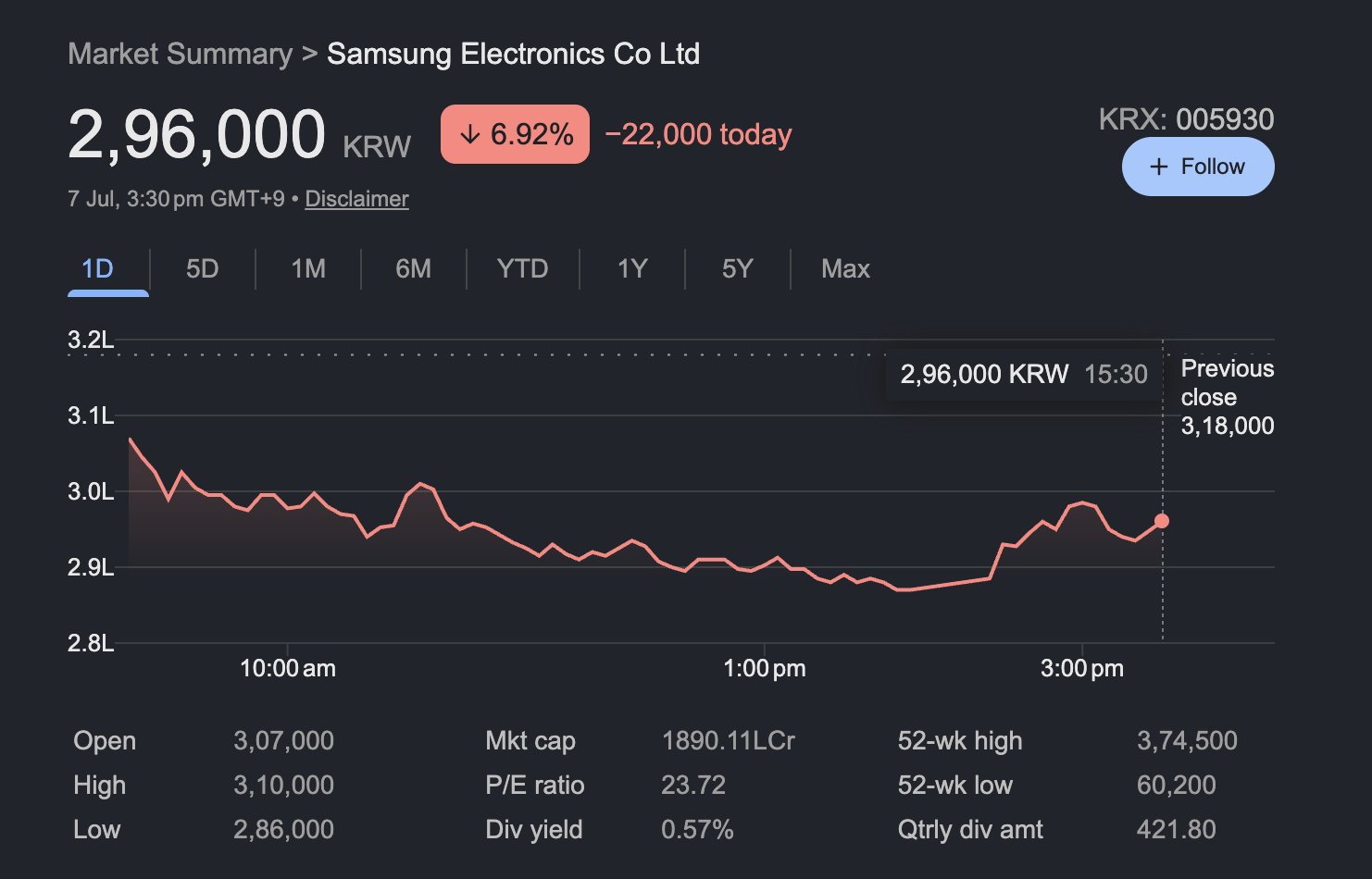
Samsung, one of the biggest AI memory stocks, sent a mixed signal on July 7. Its preliminary second-quarter guidance showed a record 89.4 trillion won ($58.4 billion) in operating profit, about 19 times higher than a year ago, as demand booms for the chips that power AI servers.
The good news is that business is booming. The bad news is that the stock fell anyway, dropping almost 7% to 296,000 won (about $194) even as profit jumped and nearly 10% at the low near 286,000 won ($187).

The reason is that big money is leaving. Foreign investors sold Samsung for six straight sessions, about 26 million shares, led by JPMorgan, Morgan Stanley, and UBS.

The flow data agrees. Chaikin Money Flow, a proxy for institutional money, is negative at -0.07, confirming that same big-money selling. The Money Flow Index, which leans more toward retail, is a weak 42, below the 50 buy/sell line, so smaller investors are not stepping in either. The overall flow score sits at -0.48 but seems to be improving.

It is not cheap either, near 24 times earnings, meaning investors pay 24 won for every 1 won of annual profit. That already assumes strong future growth, so even a small miss can trigger sharp selling.

The record profit proves the boom is real, but it was already priced in. Institutions are selling into the good news, and retail is not stepping in to catch it. That standoff makes Samsung an interesting stock to watch, with full results on July 30 the next test.
SK Hynix (KOSPI: 000660)
SK Hynix is the purest of the AI memory stocks, the top supplier of the high-bandwidth memory (HBM) that Nvidia’s AI chips depend on, reportedly winning about 70% of Nvidia’s next-generation HBM4 orders.
Want more insights like this? Sign up for Editor Harsh Notariya’s Daily Newsletter here.
That has made it one of the AI boom’s biggest winners, and its Q2 earnings land on July 29. Yet, it is down over 6%, day-on-day.

The good news is that no memory maker is more profitable. SK Hynix earns a 61% return on equity, roughly triple Samsung’s.
The bad news is that money is pulling back hardest right here. The stock fell 6.06% to 2,201,000 won (about $1,438), touching 2,080,000 won ($1,359) at the low, and foreign investors sold it for six straight sessions, roughly 3.3 million shares. Its flow data, from earlier, is the weakest of the group.

Chaikin Money Flow, is deeply negative at -0.139, and the Money Flow is just 36, below the 50 buy/sell line. Its flow score of -1.65, highlighted earlier, is the worst of the three.
The ratios explain the nerves. SK Hynix trades near 21 times earnings (P/E, the price paid for each won of profit) and nine times book value (price-to-book, what its assets are worth), versus four times for Samsung, so a boom that cools even slightly leaves it the furthest to fall.
Overall, SK Hynix has the best business but the shakiest tape. Big money is trimming the most-crowded HBM trade before the July 29 report, the next test to watch.
SanDisk (NASDAQ: SNDK)
SanDisk is the storage side of the AI memory stocks trade. It makes NAND flash chips that AI data centers stockpile. It has been on one of 2026’s wildest runs, up more than 500% year to date. However, it has cracked about 16% in the past five days. It now trades around $1,744 and slipped another 3% after hours to about $1,690.

The good news is that Wall Street still likes the story. Both Goldman Sachs and Bank of America reiterated buy ratings and lifted their targets in early July, betting the AI-driven memory shortage keeps NAND demand high.

The bad news is that the tape is cooling. Options traders have turned cautious, with the put-call ratio above 1 on both volume (1.18) and open interest (1.43), meaning more bets on the stock falling than rising. Additionally, CMF dropped below zero on July 1 and keeps sliding, while sell volume has dominated since June 26.

History offers a hint. The last time the CMF gauge went negative the stock rose about 14%.Yet, that bounce ran on steady retail buying, which is missing now.

SanDisk had the biggest run and now faces the biggest test. Without fresh retail demand, the year-to-date rally stalls.
The post 3 AI Memory Stocks to Watch in July 2026 appeared first on BeInCrypto.
Non-custodial multichain cryptocurrency wallet Ctrl Wallet will shut down its services, weeks after a security exploit, and told users on Tuesday to withdraw their assets within the next month.
Ctrl Wallet reported a security issue on June 23 effecting some Cardano wallets on the platform and said it entered a temporary “maintenance mode” to protect user assets until its engineering team restores full functionality.
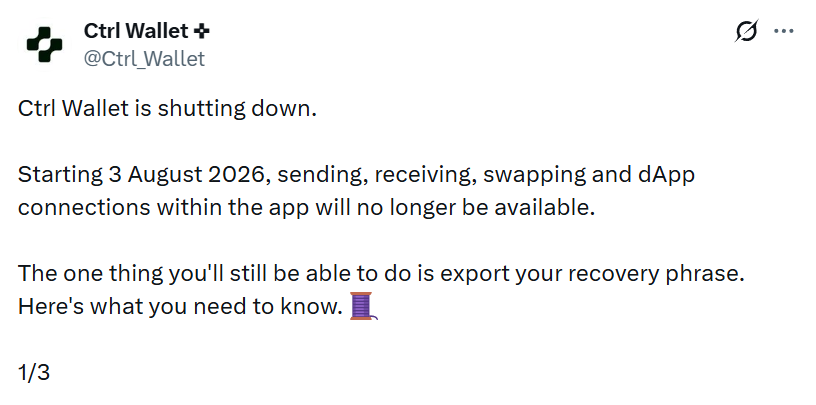
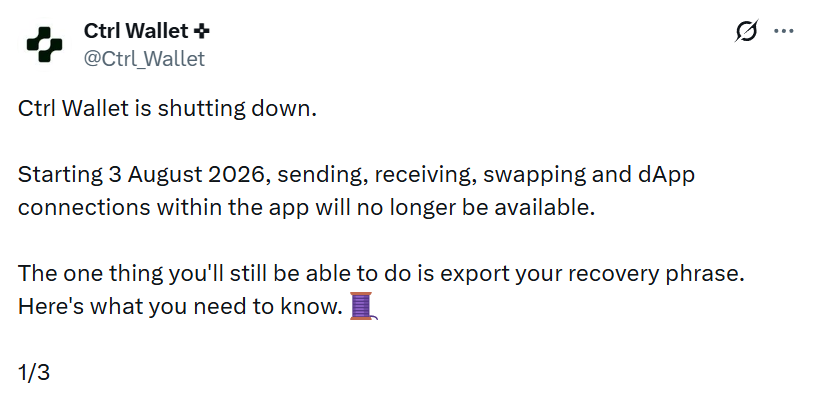
Earlier today, the wallet’s operators announced that starting Aug. 3, 2026, sending, receiving, swapping funds and all other actions within the app will be unavailable, except for exporting users’ recovery phrases.
The app will be removed from both app and browser extension stores, while downloads will be halted immediately, Ctrl Wallet said in a blog post.
Ahead of the Aug. 3 deadline, users can transfer their assets from Ctrl Wallet to another exchange or crypto wallet. After that, users will only be able to import their recovery phrase into another compatible wallet provider. Ctrl Wallet “strongly” recommended that users export their assets before Aug. 3.
Source: Ctrl Wallet
Ctrl Wallet said that users can export their 12-word or 24-word recovery phrase into compatible wallets, including MetaMask, Trust Wallet and Phantom.
The wallet provider said there will not be a migration token or an airdrop event and urged users to exercise caution when encountering fake social media posts or websites promising similar incentives.
Ctrl Wallet, formerly XDEFI Wallet, lists between 11 and 50 employees and over 650,000 monthly users on its LinkedIn page. The wallet supported over 2,500 blockchain networks, including Cardano and Midnight.
Related: Dormant $1.9M Bitcoin tied to New York lawsuit moves after nearly 15 years
Ctrl Wallet transitions under the Emurgo umbrella before SecondFi exploit
On April 29, Ctrl Wallet announced its transition under the Emurgo umbrella and said that its multichain architecture will continue inside the SecondFi wallet.
SecondFi is a self-custodial platform built on Cardano that rebranded from the Yoroi wallet in April 2026 and was developed by Emurgo, the “for-profit arm of Cardano.”
On June 24, a vulnerability in SecondFi enabled attackers to drain user funds, resulting in an estimated loss of around 16 million ADA, then worth about $2.4 million.
Days later, SecondFi revealed a recovery path to repay affected users across the 374 impacted wallet addresses. It also said it secured about 129 million ADA through emergency measures and transferred the funds to an independent third-party custodian, where they will remain until the verification and recovery process is complete.
Magazine: SBF will never get a pardon, Trump peace deal boosts Bitcoin: Hodlers Digest June 14-21


The treasury of Solana-based memecoin project, BONK, has been drained of over $21 million, via a malicious governance proposal.
A single address, accounting for 882 billion BONK, voted in favor — just enough to reach quorum.
Apparent disinterest from other holders led to just six other voters, and the proposal passed with 99.9% of votes in favor.
The proposal, BIP 76, was submitted on June 30 and ostensibly aimed to implement a new “Sowellian” governance model.
However, the camouflage was somewhat lacking in sophistication, with just two proposed actions: “Add Metadata,” and “Send 4.426.104.450.305 Bonk to 9bxWkN…”.
Blockchain forensics firm Chainalysis traced the “days-long BONK spree” which saw one wallet acquire $8 million worth of tokens “on mainstream exchange[s] and borrowed via DeFi.”
By Monday, the address had enough tokens to pass the proposal and made its move on the final day of the voting period. The 4.4 trillion BONK tokens were transferred once voting ended.
Chainalysis explains the majority of funds were transferred to a multisig, which appears to be a new BONK 2.0 DAO. The tokens acquired for voting are being liquidated.
Read more: DeFi platform Summer Finance loses $6M in vault exploit
Governance ‘attack’ or voter apathy?
Draining a DAO treasury of $20 million may sound a lot like an attack but, with such a straightforward and poorly-disguised proposal sitting in an open governance voting forum for a week, the incident also clearly demonstrates a lack of interest from token holders.
Crypto security expert Taylor Monahan examined the “pretty subjective and loosely defined” definition of a governance attack. The community’s “gut reaction” suggests so, she believes, but whether or not it would constitute wire fraud is another question.
Conversely, a pseudonymous advisor to World Liberty Financial, Ogle, simply asked “isn’t this just a functioning DAO?”
Read more: WLFI token falls 18% as governance vote branded a ‘scam’
Perhaps expecting rigorous governance oversight from a community of dog-themed memecoin holders is asking too much.
Despite once being seen as DeFi’s answer to hierarchical corporate governance, the wider DAO governance dream has been struggling lately.
In recent months, turbulence has come for some of the sector’s most well-established examples, including the Ethereum Name Service, Aave, Gnosis and more.
Got a tip? Send us an email securely via Protos Leaks. For more informed news and investigations, follow us on X, Bluesky, and Google News, or subscribe to our YouTube channel.

Vitalik Buterin Says AI Tools Tracked His Anonymous Ethereum Work

Construction firms seek an edge

Nats, facing Astros, keep waiting for pitching to catch up with hitting

No Jackpot Winner as $257 Million Prize Rolls Over to $269 Million Monday Draw

Renter of Home in Anne Heche Crash Denies Settlement With Son

Weekend Open Thread: Staud – Corporette.com

OnlyFans Tax Hike: Creator Financial Future At Risk! #shorts

DAS GAB ES SEIT 3 MONATEN NICHT: Startet jetzt das Bitcoin-Comeback?!

Amazon goes for the quick commerce pie | India’s financial rules are evolving | The Daily Brief #500
-

 Fashion4 days ago
Weekend Open Thread: High Hopes
-

 Fashion19 hours ago
Open Thread: What Great Books Have You Read Recently?
-

 Politics4 days ago
The House | “Reframing the debate from a binary discussion of winners and losers”: Yuan Yang reviews ‘We Are Not Machines’
-
 NewsBeat2 days ago
Taylor Swift and Travis Kelce wedding staffer hilariously struggles to keep her cool while checking in megastars
-
 Crypto World6 days ago
Airdrop Registration Becomes Key Focus For Remittix As RTX Launch Updates Approach
-

 Sports6 days ago
Broncos roster: OL Ben Powers (No. 74) entering final year of contract
-

 Crypto World5 days ago
Binance stock trading tops $1B in first month after launch
-

 Crypto World4 days ago
Standard Chartered Secures MiCA License as ESMA Adds 37 New Crypto Firms
-

 NewsBeat7 days ago
Presenter Caroline Flack’s brother Paul Flack dies aged 55
-

 Crypto World5 days ago
Alibaba-affiliate Ant Group enters the humanoid robot market with 12 deals
-

 Business17 hours ago
AXT Shares Jump Nearly 14% as Semiconductor Materials Maker Rebounds on AI-Linked Indium Phosphide Demand
-

 News Videos21 hours ago
Best Time to Enter Small Caps Right Now? Another Bull Run? | Financially Free
-

 Crypto World2 days ago
South Africa proposes crypto tax guidance under existing rules
-
Crypto World17 hours ago
SK hynix (000660.KS) Stock Dips as $28B Nasdaq ADR Offering Drives AI Memory Expansion
-

 Tech2 days ago
Lenovo laptops are now shipping with YMTC SSDs, a sign of Chinese NAND entering the mainstream
-

 Business6 days ago
Meta Platforms Stock Jumps 7% Today as Bloomberg Reports Company Plans to Enter the Cloud Business
-
 NewsBeat5 days ago
New exhibition reflects five decades of movement between island of Ireland and GB
-

 News Videos8 hours ago
Whats Hidden Inside This Cash Register? #treasure #reselling #money
-

 Business4 days ago
What a 10 Percent Drop Means for Buyers, Sellers and Renters
-

 Crypto World5 days ago
Binance Re-Enters Philippines As EU MiCA Rules Restrict Access
You must be logged in to post a comment Login