

Crypto World
XRP Moves Further Away From Key Support, BTC Recovers From Strategy-Driven Drop: Market Watch

Bitcoin’s price faced a real rollercoaster in the past 24 hours after Strategy announced another sale, this time a lot bigger than the previous. However, it managed to recover most of the losses and even spiked somewhat surprisingly.
Most altcoins have remained relatively sluggish on a daily scale. XRP has dipped further away from a critical support line after failing at $1.15 earlier.
BTC Rebounds After Strategy Drop
Bitcoin dipped below $58,000 on July 1 for the first time in nearly two years but reacted well and started to recover some of the losses almost immediately. It surged past $60,000 and kept climbing in the following days, even during the past weekend.
Its gradual rebound pushed the asset to over $63,500 on Sunday, where it faced resistance and slipped to under $63,000. Another leg up followed on Monday morning, with the bulls driving BTC to $64,000 for the first time in about two weeks.
However, then came the big news from Strategy. The largest corporate holder of BTC disposed of over 3,500 units, which led to an immediate price drop to $61,200. As the FUD kept spreading, though, the cryptocurrency rebounded instantly and surged past $64,500 by the end of the day to mark another local peak.
It couldn’t keep climbing and has returned to $63,000 as of now, the level it stood at yesterday before Strategy’s announcement. Its market cap remains above $1.260 trillion, while its dominance over the alts is still at 56.6% on CG.

XRP, DOGE in the Red
Most larger-cap alts have managed to defend their levels after yesterday’s volatility. Ethereum is still stuck between $1,750 and $1,800, while BNB remains below $580. XRP has dropped further away from the key support at $1.15 following a 1.3% daily decline to $1.1275.
Even more painful drops are evident from DOGE, ADA, XLM, and CC. While the first couple are down by 2-3%, the last has dumped by over 5% daily. In contrast, SOL, HYPE, RAIN, and ZEC have posted minor gains, while WLFI, AAVE, MORPHO, and DEXE have gained up to 8%.
The total crypto market cap continues to sit in a familiar range, currently at $2.240 trillion.

The post XRP Moves Further Away From Key Support, BTC Recovers From Strategy-Driven Drop: Market Watch appeared first on CryptoPotato.

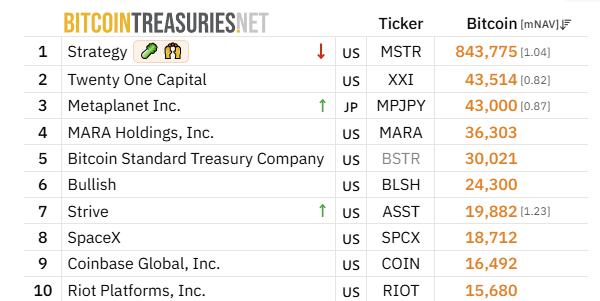
Three of the largest crypto treasury stocks are testing their most important long-term support levels at the same time. Strategy (MSTR) trades near $100, Metaplanet hovers just above ¥200, and Coinbase (COIN) defends $150.
Strategy leads all corporate Bitcoin (BTC) holders with 843,775 BTC, according to BitcoinTreasuries.net data from July 8. Metaplanet ranks third with 43,000 BTC, while Coinbase sits ninth with 16,492 BTC.

MSTR Returns to the $100 Zone That Started the 2024 Rally
MSTR traded near $97 on July 8, with premarket quotes as low as $93. The stock has therefore returned to the $100 zone it broke out from in February 2024.
Historically, this area acted as resistance in February 2021 and November 2021. After the breakout, it flipped into support in April 2024, August 2024, and February 2026.
However, the current test looks like the weakest one yet. MSTR has printed lower highs since its $543 all-time high from November 2024, leaving the stock down roughly 82%.

A weekly close below $100 would mark the first confirmed breakdown since the 2024 breakout. BeInCrypto’s July outlook for MSTR also flagged fading volume behind the recent bounce. The stock even shrugged off reports of a partial Bitcoin sale.
If bulls defend the zone, the nearest resistance sits at $170, followed by a much higher barrier at $400.
Metaplanet Defends ¥200 After a Textbook Bubble Unwind
Metaplanet shows a slightly healthier picture, at least for now. The stock climbed 5.61% this week to ¥226, holding above the key ¥200 zone. That area capped rallies in July 2024 and November 2024 before flipping into support.
The bigger structure still resembles a textbook bubble. The stock rallied around 20 times from its mid-2024 lows to a ¥1,930 all-time high in June 2025. It then collapsed by roughly 88%.

Sellers rejected the January and February 2026 recovery near ¥600, confirming that zone as the key resistance. Meanwhile, the company keeps accumulating and reached a 43,000 BTC milestone on July 2.
Holding ¥200 remains essential for the bulls. In contrast, a breakdown could send the price to the ¥100 area, erasing the entire treasury premium.
COIN Holds $150 and Leads the Crypto Treasury Stocks
Coinbase looks the strongest of the three crypto treasury stocks. COIN traded at $163.51 on July 8, defending the $150 zone for the fourth time since September 2024.
Buyers previously protected this area in April 2025 and March 2026. In contrast to MSTR, the price still holds above its support rather than below it.

COIN trades about 64% below its $444.65 all-time high from July 2025. That drawdown is the smallest in the group, even as the broader crypto stock downturn deepens.
Still, the stock has printed lower highs since the peak. Bulls must reclaim $200 to improve the outlook, while $260 marks the next major barrier. Losing $150 could trigger a decline into the early 2024 range near $120.
Three Levels Will Decide the Next Move
| Stock | Drawdown from ATH | Key support | Nearest resistance |
|---|---|---|---|
| Strategy (MSTR) | ~82% | $100 | $170 |
| Metaplanet | ~88% | ¥200 | ¥600 |
| Coinbase (COIN) | ~64% | $150 | $200 |
COIN currently shows the most strength, Metaplanet holds its line, and MSTR sits in the most fragile position. Whether $100, ¥200, and $150 hold may decide if the Bitcoin treasury trade stabilizes or unwinds further this quarter.
The post Top 3 Crypto Treasury Stocks to Watch Near Key Support Levels appeared first on BeInCrypto.
Bull Bitcoin has asked France’s top administrative court, the Conseil d’État, to overturn the French rules implementing the EU’s DAC8 crypto tax reporting framework. The exchange argues that the system could create a large, centralized database linking people’s legal identities and addresses to their crypto transactions—an outcome it says could heighten physical safety risks for crypto holders.
DAC8, which started applying on January 1, 2026, requires qualifying crypto service providers to collect customer identity and transaction details and then report them to French tax authorities. Those authorities would automatically share the information with counterparts across EU member states under the directive’s information-exchange model.
Key takeaways
- Bull Bitcoin has filed a petition with the Conseil d’État to challenge France’s DAC8 implementation, arguing it could enable a “mass database” of identity and address-linked transaction data.
- France implemented DAC8 through Decree No. 2025-1276, signed December 19, 2025, with the rules in effect from January 1, 2026.
- Under DAC8, the first reports covering the 2026 calendar year are due by September 30, 2027, after which EU authorities plan to exchange the data automatically.
- Bull Bitcoin said it filed a summary petition on February 24 before submitting a substantive brief, and it wants the effects of DAC8—and the OECD’s global CARF framework—to be suspended, delayed, annulled, or amended.
- The exchange’s appeal highlights concerns about data-security incidents and criminal targeting of crypto holders, including “wrench attacks.”
Why Bull Bitcoin is challenging DAC8 in France
In its petition announcement, Bull Bitcoin framed its legal action as a response to what it views as an avoidable concentration of sensitive information. According to the exchange, DAC8 could effectively connect legal identity and home addresses with crypto transaction histories, including transfers that may have no direct relevance to tax obligations.
Bull Bitcoin also linked its challenge to a broader security and safety concern. In its statement, the exchange warned that the creation of such a dataset would be dangerous for crypto holders’ physical safety, especially given the industry’s history of data-related incidents and the rise in kidnappings targeting people believed to hold crypto assets.
Legally, Bull Bitcoin said it first filed a summary petition on February 24, then followed with a substantive legal brief laying out its arguments. The exchange said it plans to pursue “every legitimate avenue” to seek court intervention—specifically asking for the ability to suspend, delay, annul, or amend the effects of DAC8 in France and its global counterpart, the OECD’s CARF.
DAC8 reporting timeline and the mechanics of data exchange
The exchange’s case sits inside a specific implementation schedule. Under DAC8, crypto service providers must submit initial reports that cover the 2026 calendar year by September 30, 2027. After that initial filing, tax authorities within EU member states would exchange the reported information automatically.
France’s role in this system matters because it already has an enacted implementation measure: Decree No. 2025-1276, signed on December 19, 2025. With DAC8 in force since January 1, 2026, the reporting pipeline is moving from planning to operational data collection—meaning the exchange’s challenge arrives as compliance steps are likely becoming concrete.
Bull Bitcoin’s argument emphasizes not only how the reporting is structured, but also what the information exchange could mean in practice. If identity-linked transaction records are compiled and shared across borders, the potential harm from any data exposure—intentional or accidental—could scale beyond a single service provider or jurisdiction.
CARF alignment and OECD’s role in globalizing reporting
Bull Bitcoin’s petition also explicitly references CARF, the “Crypto-Asset Reporting Framework” developed by the Organisation for Economic Co-operation and Development (OECD). While DAC8 is EU-specific, CARF is intended to provide a common reporting standard so jurisdictions can collect and exchange information on crypto-related activity in a similar way.
That connection is central to Bull Bitcoin’s stated objective. The exchange indicated it is not only targeting the immediate effects of DAC8 but also challenging what it described as its “global counterpart” under CARF. For investors and users, the practical implication is that a French legal fight may carry relevance for how other countries interpret or apply similar reporting expectations—especially if CARF-based systems are adopted broadly.
Linking regulatory data flows to wrench attacks and breach risks
Bull Bitcoin’s warning draws a line between compliance reporting and heightened criminal pressure on crypto holders. The exchange pointed out that France has been among the countries most affected by “wrench attacks,” in which victims are threatened or assaulted to force them to transfer digital assets.
Earlier reporting referenced in the underlying coverage notes that French police counted 41 crypto-related kidnappings since the start of 2026, according to RTL. The broader trend is also supported by cybersecurity analysis cited in the same context: CertiK reported wrench attacks increased by 75% in 2025 to 72 verified global cases. In that dataset, France had the most incidents during 2025 with 19 confirmed cases, and Europe accounted for roughly 40% of worldwide incidents.
Bull Bitcoin’s concerns are also tied to the industry’s exposure to customer data breaches. In May 2025, Coinbase stated that less than 1% of its transacting monthly users were affected in an attack that may cost the exchange up to $400 million in reimbursement expenses—an example used to underscore the potential consequences of any large-scale accumulation of sensitive records.
The tension at the heart of Bull Bitcoin’s argument is straightforward: tax transparency measures require identifying details and transaction information, but the exchange contends that the same capabilities can be repurposed by criminals if data protection fails—or if the mere existence of identity-linked reporting makes targeting more efficient.
With Bull Bitcoin’s case now before the Conseil d’État, the key question for market participants is how the court weighs tax enforcement goals against privacy, security, and proportionality concerns. Until the court decision—and any potential interim measures—readers should watch closely for developments in how quickly compliant reporting processes ramp up in France and whether similar challenges emerge elsewhere in the EU as DAC8 enforcement continues.


Polymarket, which began its return to the U.S. after a four-year ban with the acquisition of QCEX a year ago and the introduction of a mobile trading app in December, has started a campaign to persuade policymakers, regulators and potential users that it is trustworthy, Associated Press reported on Wednesday.
According to AP, Polymarket is working with social media influencers to produce viral marketing on TikTok and other platforms and has signed partnership agreements with major sports teams and Major League Baseball as well as news outlets including CNBC and CNN.
The steps Polymarket is taking in the U.S. will help legitimize it despite the issues it has faced in the past, Dan Lee, head of U.S. operations, said in an interview with AP on Wednesday.
“I think having the international business being the bulk of the volume, it often sort of masks the progress we are making here in the U.S. to broaden Polymarket’s acceptance,” Lee said.
The company’s X account now has 1.7 million followers and posts about current events several times a day. Rival platform Kalshi, which has been operating under the supervision of the Commodity Futures Trading Commission (CFTC) since 2020, has 431,400.
Ethereum (ETH) trades near $1,730, a level last seen in March 2023, after losing 65% from its August 2025 all-time high. Meanwhile, its biggest upgrade since The Merge is approaching with almost no market attention.
On-chain activity remains at bull market levels, yet social interest has collapsed. The technical structure, however, keeps pointing lower as a nine-month downtrend presses the Ethereum price against its last major support.
Glamsterdam Becomes the Catalyst Nobody Is Watching
The Glamsterdam upgrade will be Ethereum’s first major base-layer throughput overhaul since 2022, changing how the network assembles blocks. Crypto analyst Ted Pillows called it the biggest Ethereum upgrade since The Merge.
According to his estimates, the gas limit will rise from about 60 million to 200 million, roughly three times higher. He also projects throughput of up to 10,000 transactions per second and gas fees up to 78% lower.
Devnet-5 and Devnet-6 are already running. Pillows points to an internal mainnet target in late August, while Q3 2026 remains the realistic launch window after the ePBS delay.
“Feels like a fundamental H2 catalyst that’s still flying under the radar while ETH is trading near the lows,” Pillows wrote.
The upgrade also arrives alongside Vitalik Buterin’s Lean Ethereum roadmap, which targets over 10x lower fees but has drawn pushback on its timeline.
Some traders are already positioning aggressively for a rebound. One wallet just opened a $19.9 million ETH long with 20x leverage, with a liquidation price sitting only $50 below its entry. Analysts recently warned that unliquidated longs already dominate major assets, making such bets exceptionally fragile.
On-Chain Data Shows Real Usage Without the Hype
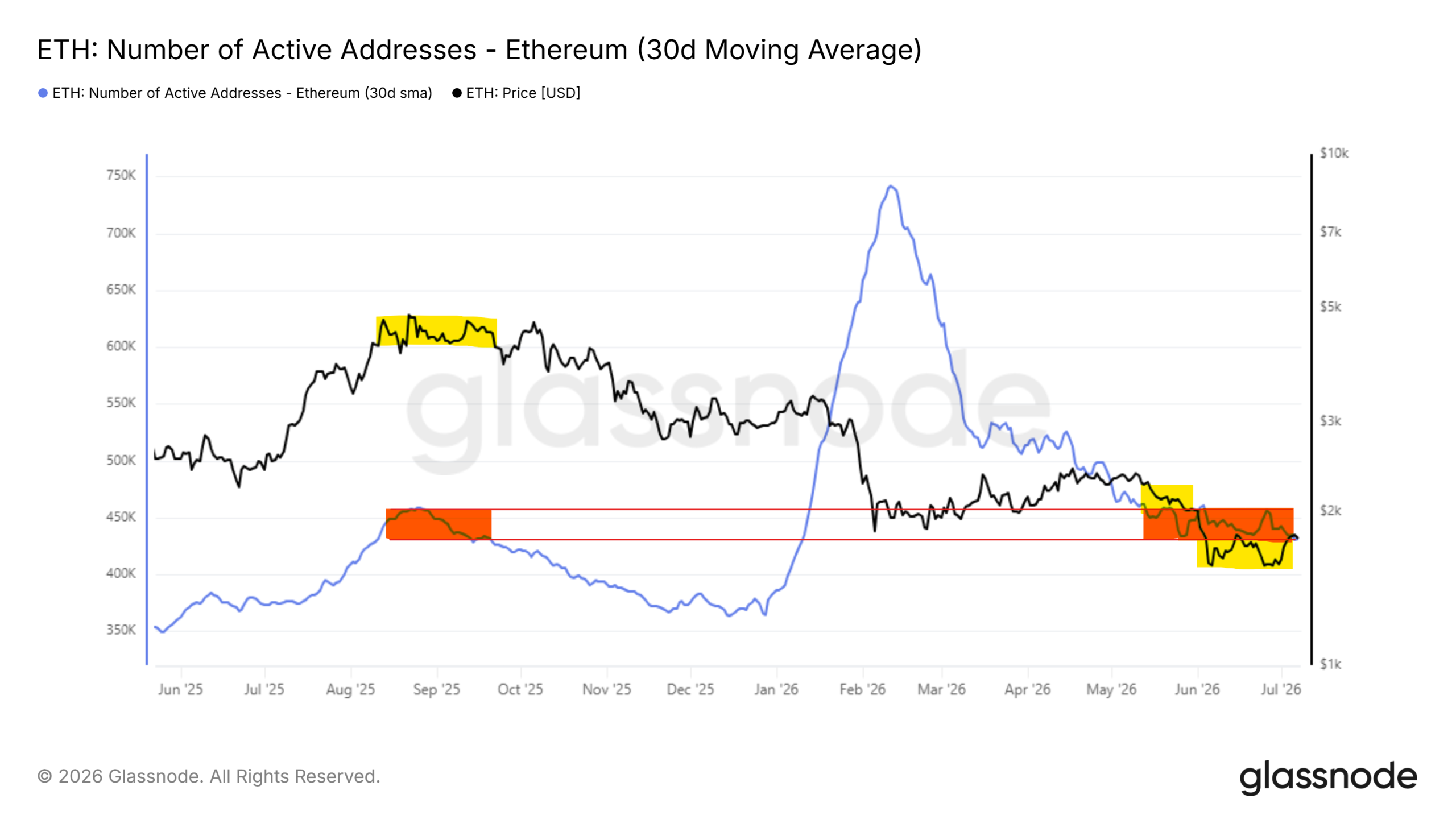
Glassnode data reveals a striking divergence. The 30-day moving average of active addresses holds near 450,000, the same band recorded in August and September 2025, when the Ethereum price traded above $4,500 at cycle highs.
Network usage has therefore decoupled from price. Activity peaked near 740,000 addresses in February 2026, and current readings remain historically elevated even with ETH down roughly 65% from the top.

Sentiment tells the opposite story. Santiment shows ETH social dominance at just 0.587%, among its lowest readings in over a year.
There is no hype and no capitulation chatter either, only apathy. Historically, such disinterest has often accompanied late-stage bear phases rather than market tops.

ETH Price Prediction: $1,754 Is the Line in the Sand
The weekly chart shows the Ethereum price at $1,730, an area that ETH broke out from in March 2023.
The 0.786 Fibonacci retracement at $1,753.66 acts as long-term support, and buyers have defended this zone five times in the past.
Weekly RSI sits near 38, a low reading that has not yet reached bearish extremes. The nearest resistance stands at the 0.618 Fibonacci level of $2,438, about 41% above the current price. A confirmed breakdown would expose the full retracement at $881.56, roughly 49% lower, near the previous cycle bottom.

The daily chart strengthens the bearish case. A descending trendline from the August 2025 all-time high has capped every recovery attempt, most recently rejecting the price from the 0.618 level in May.
That trendline now presses ETH directly against the 0.786 support zone. The squeeze suggests the level may not hold, which could send the price deeper in late summer or early autumn. ETH appeared in far stronger setups as recently as May, before this structure broke down.

Daily RSI confirms the pressure. Its own descending trendline has rejected momentum three times since January, and a fourth rejection now pushes the indicator back to a neutral 51.

If buyers defend $1,754 into the Glamsterdam launch window, ETH could attempt a recovery toward $2,438. A weekly close below the zone, however, would likely confirm the breakdown and shift the target toward $881.
The post ETH at $1,730: Down 65% With Its Biggest Upgrade Weeks Away appeared first on BeInCrypto.


Bitcoin has dropped below the $62,000 mark after U.S. President Donald Trump has threatened another round of military strikes against Iran, raising concerns that the conflict could intensify further.
Summary
- Donald Trump said the U.S. could launch fresh strikes on Iran after accusing Tehran of violating their agreement.
- Bitcoin fell below $62,000 as renewed geopolitical tensions weighed on investor sentiment.
- Oil prices climbed more than 5% to around $74 as markets priced in potential supply disruptions.
According to President Trump, speaking at the NATO Summit in Ankara, the United States is likely to launch more strikes on Iran later tonight after carrying out military operations the previous evening. The comments came shortly after he declared that the memorandum of understanding between Washington and Tehran was effectively over, accusing Iran of violating the agreement.
Trump argued that Iran had repeatedly failed to honor commitments made during negotiations. He claimed Iranian officials often agreed to proposals behind closed doors before publicly denying those discussions had taken place.
Reiterating his long-standing position on Tehran’s nuclear program, the president stated that Iran could not be allowed to obtain a nuclear weapon and described the country as a long-term destabilizing force in the Middle East.
Bitcoin weakens as geopolitical tensions return
Crypto markets reacted as investors reassessed geopolitical risk. Bitcoin fell below the psychological $62,000 level after trading above $63,000 earlier in the day, leaving the world’s largest cryptocurrency down more than 2% from its intraday high.
The decline came as traders weighed the possibility of a broader military confrontation after Trump’s latest remarks. While no direct link between the price move and military action has been officially confirmed, the selloff followed renewed uncertainty surrounding the U.S.-Iran conflict.
Elsewhere in the digital asset market, investors also watched traditional safe-haven assets and energy markets for clues about broader risk sentiment. The renewed tensions have added another source of volatility alongside existing macroeconomic concerns.
Oil market faces fresh supply concerns
Alongside his warning of further military action, Trump suggested that the United States could target higher-level Iranian assets if the conflict escalates. He also said Washington could consider taking control of Kharg Island, Iran’s main oil export terminal, while adding that the U.S. may restore a naval blockade at the Strait of Hormuz that would apply only to Iranian vessels.
The president linked the latest escalation to Iran’s reported attacks on oil tankers operating near the Strait of Hormuz, one of the world’s busiest energy shipping routes.
Meanwhile, Iranian officials have continued to reject U.S. pressure over the waterway. According to the report, Tehran has maintained that it will not surrender control over the Strait of Hormuz and intends to continue imposing tolls on ships passing through the passage despite U.S. objections.
Energy markets responded quickly to the developments. TradingView data showed West Texas Intermediate crude oil futures climbing more than 5% on the day to around $74 a barrel as traders priced in the possibility of supply disruptions if tensions continue to rise around the Gulf.
Although Trump acknowledged that discussions with Iran had taken place in recent months, he expressed skepticism about reaching a lasting agreement to end the conflict, which the report said began in February this year.
His latest remarks suggest Washington is preparing for additional military action rather than an immediate return to negotiations, leaving financial markets focused on further developments from the region.


Tokenization specialist Dinari and broker-dealer tZERO are working together to offer broker-dealers a turnkey platform for tokenized U.S. equities, as competition intensifies over how public stocks should move onto blockchain networks.
The companies said Wednesday they will combine Dinari’s tokenized stock platform with tZERO’s brokerage, custody, clearing and settlement infrastructure, allowing financial firms to launch blockchain-based equity offerings without assembling the underlying market infrastructure themselves.
“Tokenized equities won’t reach mainstream adoption until broker-dealers can offer them as naturally as they offer traditional securities,” Dinari CEO Gabriel Otte said in a statement.
The move comes as tokenized equities emerge as the next battleground in real-world assets. After U.S. Treasury funds became the first institutional trend for tokenization, firms are increasingly turning to public stocks, betting blockchain can modernize trading, settlement and shareholder recordkeeping.
Some firms, such as Robinhood and Kraken’s xStocks initiative, focus on creating blockchain-based representations of publicly traded shares via offshore structures, often called synthetic tokens, offered to non-U.S. investors.

Long-standing digital publisher launches comprehensive casino journalism initiative and player comparison tools, emphasizing transparency and responsible gaming practices
AlienWP, a digital publishing platform operating since 2013, has revealed its strategic entry into the iGaming sector through the introduction of comprehensive online casino journalism, operator reviews, regulatory updates, and responsible gaming resources. This expansion represents a significant milestone for the organization as it widens its editorial scope to address both gambling enthusiasts and industry stakeholders with objective, journalism-focused material.
Core Initiative
The platform will now deliver consistent editorial content encompassing online gambling operators, sector developments, operator evaluations, promotional offerings, regulatory frameworks, and player security. The organization’s mission centers on providing audiences with transparent, evidence-based insights into the digital gambling landscape, avoiding hyperbolic marketing language or misleading assertions.
This strategic pivot into iGaming journalism leverages AlienWP’s established reputation as a veteran digital publishing entity. According to company representatives, this transition addresses increasing consumer appetite for credible, unbiased intelligence regarding online gambling platforms, especially concerning regulatory compliance, financial transaction security, and responsible gaming frameworks.
Platform Development
Complementing its editorial operations, AlienWP is concurrently building a distinct consumer-facing platform branded as Alien Wise Play. This web application functions as an interactive dashboard enabling users to evaluate online gambling operators, bookmark preferred platforms, monitor promotional offers, and examine regulatory credentials prior to engagement.
Alien Wise Play maintains a strictly informational role—it neither operates gaming services, handles financial transactions, nor dispenses gambling recommendations. The platform serves as a comparison and educational resource, sustained through affiliate commercial arrangements while diverging from conventional affiliate website models. According to AlienWP, transparency and consumer safeguarding form the foundational principles guiding platform development.

Central to Alien Wise Play’s functionality is the Wise Play Score, a proprietary evaluation framework that judges gambling operators across multiple dimensions including regulatory authorization, trustworthiness, financial transaction dependability, operational transparency, customer service quality, and consumer protection infrastructure. AlienWP has disclosed plans to integrate crowdsourced user assessments and artificial intelligence-powered analytics into subsequent iterations of the evaluation methodology, while preserving editorial autonomy.
Additional details about the platform can be found at Alien Wise Play.
Official Statement
Oliver Dale, company representative for AlienWP, commented: “Consumers investigating online gambling platforms frequently encounter difficulty locating transparent, unbiased intelligence. Our objective through this strategic expansion involves delivering accessible casino journalism and operator assessments, while simultaneously constructing Alien Wise Play as an instrument empowering consumers to reach educated conclusions, with responsible gaming principles and operational transparency anchoring our entire approach.”
Roadmap and Development
AlienWP intends to progressively broaden its iGaming journalism and review operations throughout upcoming quarters, concurrent with ongoing enhancement of Alien Wise Play and refinement of the Wise Play Score methodology. Development priorities include integration of community feedback mechanisms and machine learning-enhanced analytical capabilities into evolved versions of the assessment framework, while preserving editorial separation from evaluated gambling operators.
Company Background
Established in 2013, AlienWP operates as a publishing entity specializing in online gambling operators, iGaming sector journalism, operator evaluations, regulatory frameworks, promotional offerings, responsible gaming advocacy, and industry analysis. The organization is simultaneously constructing Alien Wise Play, a consumer-oriented dashboard facilitating operator comparison, promotional tracking, and accessible regulatory and safety intelligence. Additional information can be accessed at alienwp.com.
Press Inquiries
Oliver Dale
AlienWP
Website: https://alienwp.com


Eli Ben-Sasson, Zcash founder and and CEO of StarkWare, the company behind Ethereum Layer 2 scaling solution Starknet, publicly argued that Bitcoin 21 million supply cap “doesn’t make sense.” He is also proposing instead that the network adopt a hard ceiling on the annual issuance rate.
Ben-Sasson’s core argument centers on key loss. Because private keys are permanently lost over time, the coins attached to those keys remain on the ledger but fall out of practical circulation, making the usable supply unknowable and trending downward. His proposed fix: replace the fixed total-coin ceiling with a fixed inflation rate ceiling. His specific figure was 4% per year, which he described as “a reasonable upper bound on human population expansion.”
The shift is from capping the stock of coins to capping the annual flow of new issuance, a distinction that sounds technical but carries enormous structural implications for every holder who priced Bitcoin’s scarcity into their position.
Discover: The Best Token Presales
Zcash Co-Founder Right about Bitcoin?
Alongside the lost-key argument, the Zcash co-founder, Ben-Sasson, flagged Bitcoin miner security as a compounding concern. The block reward currently stands at 3.125 BTC following the April 2024 halving, and it will continue to decline on schedule, eventually reaching zero around 2140. As the subsidy shrinks, miners depend increasingly on transaction fee revenue to stay economically viable, and a network that cannot sustain miner participation becomes progressively more vulnerable to attack. Ben-Sasson described this risk as “looming large on the horizon.”

Don’t Miss Out on Our $1,000 USDT Airdrop on ByBit
This part of the argument has genuine traction among protocol researchers, independent of whether one accepts the rest of Ben-Sasson’s thesis. Bitcoin’s long-run security model is a real open question – the assumption that fee revenue will fully compensate for the disappearing block reward is unproven at scale. Raising that issue does not require agreeing that the supply cap should change.
The lost-coin case is harder to quantify precisely. We estimated the effective circulating cap at roughly 18.5 million BTC once permanently inaccessible coins are excluded, with Ledger placing lost supply as high as 4 million BTC as of late 2024. Approximately 19.9 million BTC have already been mined, or around 95% of the eventual total, leaving only about 1.1 million BTC remaining to be issued over the next century-plus. The attrition from key loss is real.
Discover: The Best Crypto to Diversify Your Portfolio
This Won’t Go Nowhere
The governance math is unambiguous. Changing Bitcoin’s supply cap would require a Bitcoin Improvement Proposal, new client software, and adoption by miners, nodes, and users. Approximately 97% of Bitcoin nodes currently enforce the existing supply schedule. A cap change is not technically impossible, but a fork that dilutes scarcity would split the chain and likely destroy much of the value it was ostensibly trying to preserve. The debate around Bitcoin’s role as a strategic reserve asset makes any hint of supply flexibility even more politically toxic in the current environment.
The community’s divisibility counterargument is also worth understanding precisely. Bitcoin’s 21 million coins subdivide into 2.1 quadrillion satoshis, providing more than enough unit granularity to accommodate adoption at any realistic price level. Ben-Sasson’s rebuttal, that “satoshis would also trend toward zero in absolute terms if key loss continues indefinitely,” is technically correct but operates on a timescale measured in centuries, not trading horizons.
What makes Ben-Sasson’s intervention notable is not its probability of success. It has none. What matters is who is raising the argument and why: a prominent ZK-proof technologist with credibility in the Ethereum ecosystem, citing miner security degradation as the mechanism that could eventually force the conversation.
Don’t Miss Out on Our $1,000 USDT Airdrop on ByBit
The post Bitcoin 21M Cap Under Fire From Zcash Founder appeared first on Cryptonews.

India’s tax authorities have reportedly identified major gaps in how crypto gains are being declared, underscoring a growing enforcement challenge that is emerging alongside the country’s long-running debate over crypto regulation. According to documents reviewed by Reuters, less than a quarter of people who reported making crypto transactions were actually declaring them on tax returns for the year ending in March 2023.
The same set of government documents reportedly estimates that India had roughly 39 million crypto traders holding assets worth more than $2.1 billion by the end of May. With offshore venues, private wallets, and peer-to-peer (P2P) activity increasingly common, the findings point to why tax authorities may struggle to track transactions and recover revenue—even if policy shifts are already being discussed at the central bank level.
Key takeaways
- Reuters reports India’s crypto tax reporting gaps: fewer than 25% of 645,000 individuals who transacted in the year ending March 2023 declared those trades.
- Government documents cited by Reuters estimate about 39 million crypto traders in India holding over $2.1 billion in crypto as of end-May.
- The tax issue adds a new dimension to India’s policy debate, shifting attention from only financial-stability concerns to offshore trading and tax compliance.
- India is not alone: a separate disclosure effort in Israel also underperformed against expectations, according to local reporting.
India’s reporting gap highlights a tracking problem
Reuters, citing government documents, says the tax department found that crypto activity is not being reflected consistently in tax filings. The Reuters report frames this as a practical enforcement issue: when trading happens on offshore exchanges, through private wallets, or via P2P arrangements, linking transactions to taxable income becomes harder.
The scale of the issue—reported involvement by 645,000 individuals in the year ending March 2023—makes it more than a niche compliance problem. If fewer than a quarter reported their activity, tax leakage could remain substantial, particularly as retail participation appears to be large. Reuters’ cited estimate of around 39 million crypto traders and more than $2.1 billion in holdings at end-May suggests that the affected population may continue to expand.
India’s standing in adoption metrics adds context. The Reuters report notes India was ranked first in Chainalysis’ 2025 Global Crypto Adoption Index, which implies widespread on-the-ground usage. When adoption rises faster than tax compliance, authorities often face a widening gap between real-world activity and reported taxable events.
Central bank containment guidance meets tax enforcement reality
The Reuters findings land during a period when India’s central bank has signaled strong constraints on crypto usage in the financial system. Earlier coverage referenced that the Reserve Bank of India (RBI) backed a “containment” approach, arguing for keeping banks and financial institutions insulated from cryptocurrencies and privately issued stablecoins.
On July 3, the RBI reportedly urged lawmakers to preserve that containment stance. Reuters’ summary indicates the central bank reiterated that prohibition remained an available policy option, while also recommending steps aimed at preventing digital asset use in payments and settlements. In other words, the RBI’s primary focus has been on limiting crypto’s reach into mainstream financial plumbing.
But the new tax documentation shifts emphasis. Even with banking and payment rails constrained, crypto trading can continue through offshore platforms and decentralized or private channels. That creates a different policy challenge: authorities may still need tools to identify taxable transactions and enforce reporting obligations, regardless of whether the regulated banking sector is deeply exposed.
Cointelegraph attempted to obtain a comment from India’s Central Board of Direct Taxes but reported it had not received a response by the time of publication.
Israel’s disclosure program also fell short
India’s compliance struggle echoes a broader pattern seen in other jurisdictions. In Israel, a voluntary disclosure program aimed at bringing previously undisclosed crypto profits into the tax net reportedly did not meet expectations, according to a June 3 report by Globes.
Globes reported that the Israel Tax Authority (ITA) expected the program to raise between 2 billion and 3 billion Israeli shekels (roughly $650 million to $986 million). The scheme offered criminal immunity to taxpayers who disclosed hidden capital. However, local reporting says only 289 disclosure requests were submitted after the program started in August 2025.
Globes further reported reported capital of 676.5 million shekels and an estimated tax due of 40.9 million shekels—far below the initial expectations and also below what was characterized as the size of the crypto tax gap.
Tax experts cited by Globes pointed to a key design issue: the lack of an anonymous disclosure track. If taxpayers believe they will be identifiable, the incentive to come forward may weaken, especially when enforcement risk and reputational concerns are perceived as high.
What investors and builders should watch next
For market participants, the practical question behind the headlines is whether governments can close the compliance gap without simply chasing an ever-shifting set of on/off-ramps. India’s reported figures suggest that enforcement is becoming a major pillar of policy—one that depends on data visibility across offshore trading, P2P activity, and private custody.
Investors and crypto users should watch for the next steps from tax authorities and regulators: whether India moves toward tighter reporting requirements, improved information-sharing, or more targeted compliance measures aimed specifically at harder-to-trace trading routes. Until then, the tension between widespread adoption and incomplete tax reporting is likely to remain a defining risk for the sector.


Ripple has secured a five-year sponsorship with the University of Kansas that will place the XRP logo on Jayhawks athletics uniforms, creating the first crypto jersey sponsorship for a major NCAA Division I athletics program.
Summary
- Ripple has signed a five-year deal with the University of Kansas, placing the XRP logo on Jayhawks team jerseys.
- The partnership includes blockchain and financial education programs alongside Ripple’s existing ties to the university.
- The announcement follows Ripple’s MiCA license approval in Europe as XRP ETFs post eight straight weeks of inflows.
According to Ripple and Kansas Athletics, the agreement takes effect immediately, with XRP branding appearing on football, basketball, and other Jayhawks uniforms. The partnership also includes financial literacy and technology education programs funded by Ripple for student-athletes and members of the campus community.
The announcement comes days after Ripple strengthened its regulatory position in Europe. As previously reported by crypto.news, the company received a Crypto-Asset Service Provider license from Luxembourg’s Commission de Surveillance du Secteur Financier under the European Union’s Markets in Crypto-Assets framework.
According to Ripple, the approval allows it to provide regulated crypto services across all 27 European Economic Area member states.
Partnership extends beyond jersey branding
Kansas Athletics described the agreement as a landmark partnership that brings the XRP brand to one of the country’s best-known college sports programs. The university said the arrangement is built on a shared focus on innovation and excellence while giving Ripple access to millions of college sports fans through the Jayhawks.
In a statement released by Kansas Athletics, Director of Athletics Travis Goff said Ripple selected Kansas Athletics as a platform to introduce XRP to a national audience. He added that displaying the XRP logo on Jayhawks uniforms demonstrates a shared commitment to innovation and excellence between the two organizations.
Ripple said the agreement goes beyond marketing through uniform sponsorships. According to the company, it will also support educational initiatives covering financial technology and digital assets for both student-athletes and the broader university community.
The relationship between Ripple and the university predates the sponsorship. The University of Kansas operates an official XRP Ledger validator through its engineering school with support from Ripple’s University Blockchain Research Initiative, which has provided the institution with a multimillion-dollar grant for blockchain research and education.
Brad Garlinghouse highlights personal connection as XRP ecosystem expands
Ripple Chief Executive Officer Brad Garlinghouse called the announcement a rare moment where his professional and personal worlds come together. Writing on social media, Garlinghouse noted that XRP has become the first cryptocurrency to appear on the jersey of a major college athletics program before adding, “XRP Family, meet the Jayhawks.”
Garlinghouse’s comments carry added significance because the University of Kansas is his alma mater. His remarks accompanied Ripple’s announcement as the company continues expanding its ties with the university through athletics, education, and blockchain research.
Elsewhere in the XRP ecosystem, developers and validators continue preparing for the XRPL 3.2.0 upgrade, which supporters expect will improve tokenization capabilities and decentralized finance scalability on the network.
The sponsorship news arrives as XRP trades in a volatile market. XRP changed hands at about $1.08 after moving between $1.08 and $1.13 over the previous 24 hours. Meanwhile, XRP futures activity is picking up, with open interest rising by more than 1% over the past four hours, including gains of 0.33% on CME and 0.75% on Binance.
Despite recent price weakness, crypto.news previously reported that spot XRP exchange-traded funds have recorded inflows for nine consecutive weeks.

He’s done it again! Brit sensation Arthur Fery becomes first wildcard to reach Wimbledon semi-final in 25 years with straight-sets win over No9 seed Flavio Cobolli

Major housing site could be marketed for business use

Top 3 Crypto Treasury Stocks to Watch Near Key Support Levels


-

 Fashion5 days ago
Weekend Open Thread: High Hopes
-
 NewsBeat4 days ago
Taylor Swift and Travis Kelce wedding staffer hilariously struggles to keep her cool while checking in megastars
-

 Fashion2 days ago
Open Thread: What Great Books Have You Read Recently?
-

 Politics5 days ago
The House | “Reframing the debate from a binary discussion of winners and losers”: Yuan Yang reviews ‘We Are Not Machines’
-

 Crypto World5 days ago
Standard Chartered Secures MiCA License as ESMA Adds 37 New Crypto Firms
-
 Tech1 day ago
Anthropic’s new “J-lens” reveals a silent workspace inside Claude that mirrors a leading theory of consciousness
-

 Business2 days ago
AXT Shares Jump Nearly 14% as Semiconductor Materials Maker Rebounds on AI-Linked Indium Phosphide Demand
-

 Crypto World6 days ago
Binance stock trading tops $1B in first month after launch
-

 News Videos2 days ago
Whats Hidden Inside This Cash Register? #treasure #reselling #money
-

 Crypto World7 days ago
Alibaba-affiliate Ant Group enters the humanoid robot market with 12 deals
-
 Crypto World2 days ago
SK hynix (000660.KS) Stock Dips as $28B Nasdaq ADR Offering Drives AI Memory Expansion
-

 Crypto World3 days ago
South Africa proposes crypto tax guidance under existing rules
-

 News Videos2 days ago
Best Time to Enter Small Caps Right Now? Another Bull Run? | Financially Free
-

 Tech3 days ago
Lenovo laptops are now shipping with YMTC SSDs, a sign of Chinese NAND entering the mainstream
-

 Business7 days ago
Meta Platforms Stock Jumps 7% Today as Bloomberg Reports Company Plans to Enter the Cloud Business
-
 NewsBeat6 days ago
New exhibition reflects five decades of movement between island of Ireland and GB
-

 Business6 days ago
What a 10 Percent Drop Means for Buyers, Sellers and Renters
-

 Crypto World6 days ago
Binance Re-Enters Philippines As EU MiCA Rules Restrict Access
-
Crypto World5 days ago
ESMA Expands Crypto Register by 37 Firms Following MiCA Transition Period
-

 News Videos2 days ago
Avoid entering in FOMO #bitcoin #cryptocurrency #trading #scalping
You must be logged in to post a comment Login