

Crypto World
Israel Arrests Two Over Polymarket Trades on Iran Strikes

Israeli authorities have arrested and indicted two people for allegedly using secret information to place bets on the predictions market Polymarket related to Israel striking Iran.
In a joint statement on Thursday, Israel’s Defense Ministry, its internal security service Shin Bet, and police said a military reservist and a civilian were arrested after an investigation found that the reservist obtained classified information to place the bets.
The prosecutor’s office will pursue criminal charges for security-related offenses, bribery, and obstruction of justice. Authorities said the reservist was working for Shin Bet.
Prediction markets have seen major insider trading scandals this year after a Polymarket user won a bet that Nicolás Maduro would be ousted as Venezuelan president hours before he was captured by US forces, profiting around $400,000.
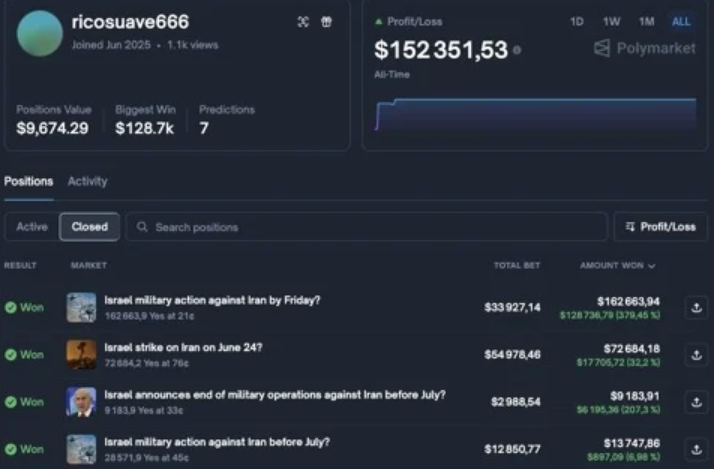
The Israeli state-owned news outlet Kan reported last month that the Polymarket user “ricosuave666” placed several bets related to Israel’s military operations in Iran in June 2025, but it’s unknown if those arrested are behind the account.
The account had reportedly wagered tens of thousands of dollars and had profited over $152,300, betting on markets such as “Israel strike on Iran on June 24” and “Israel military action against Iran by Friday,” with the latter of the two bets winning them over $128,700.

Related: Crypto PACs secure massive war chests ahead of US midterms
Prediction markets lead to real security risks when misused
Lawmakers worldwide have raised concerns that insider knowledge could be exploited in prediction markets, undermining market integrity and eroding public trust.
Israel’s Ministry of Defense said bets based on secret information pose a “real security risk for Israel Defense Forces activity and national activity,” adding that Israel’s military, security and police units will continue to pursue action against anyone who uses classified information illegally.
A lawyer representing the reservist told Bloomberg that the indictment is “flawed,” while noting that the charge of harm to national security has been dropped.
Magazine: The critical reason you should never ask ChatGPT for legal advice



Bitwise Asset Management has announced a $233,000 donation to Bitcoin open-source developers, marking the firm’s second annual contribution tied to the success of its spot Bitcoin exchange-traded fund.
Summary
- Bitwise Asset Management donated $233,000 to Bitcoin development groups as part of its commitment to allocate 10% of gross profits from its Bitcoin ETF.
- The donation will be distributed through Brink, OpenSats, and the Human Rights Foundation Bitcoin Development Fund.
- The contribution follows continued growth of the Bitwise Bitcoin ETF since its launch.
The funds come from profits generated by the Bitwise Bitcoin ETF, which launched with a commitment from Bitwise to allocate 10% of the ETF’s gross profits each year toward supporting the development and security of the Bitcoin network.
According to the firm, the latest contribution reflects strong growth in the ETF during the past year, allowing the company to expand its support for the developers maintaining Bitcoin’s underlying infrastructure.
The donation will be distributed among three nonprofit organizations focused on sustaining the Bitcoin ecosystem: Brink, OpenSats, and the Human Rights Foundation Bitcoin Development Fund.
These groups provide funding, fellowships, and grants to developers working on critical Bitcoin software, security research, and infrastructure upgrades. Their mission centers on supporting the open-source contributors responsible for maintaining and improving the decentralized network.
Bitwise described the developers as “unsung heroes” who help secure and evolve Bitcoin’s technology stack, noting that the contribution represents a reinvestment into the ecosystem that supports the firm’s investment products.
The asset manager also credited investors in the ETF for enabling the donation, stating that the contribution would not be possible without the support of those who chose to invest in the fund.
Bitwise added that its donations are expected to grow alongside the ETF’s expansion, reinforcing its pledge to continue directing a portion of profits toward the broader Bitcoin development community.
The initiative reflects a broader trend among crypto firms and investment products that are increasingly channeling funds toward open-source development as institutional interest in Bitcoin continues to rise.

Disclosure: This article does not represent investment advice. The content and materials featured on this page are for educational purposes only.
While market headlines focus on short-term price swings, the real signal shaping America’s crypto future in 2026 lies beneath the surface. Institutional infrastructure, regulatory developments, and a shift toward long-term investor strategy are quietly redefining how digital assets integrate into the U.S. financial system.
The conversation about digital assets in the United States is becoming increasingly complex as the market enters a new stage of development. Many readers who follow blockchain trends begin their research by exploring the coinspot website, where ongoing discussions about cryptocurrency innovation and market dynamics continue to evolve.
What makes the current situation particularly interesting is that the most important signals shaping the future of crypto in America are not always the ones dominating headlines. While price movements attract attention, deeper structural changes within technology, finance, and regulation are gradually redefining the ecosystem, mentioned on https://coinspot.io/en/

Institutional Strategy Is Quietly Expanding
Financial institutions across the United States are playing a growing role in the evolution of digital assets. What once appeared to be cautious experimentation has gradually transformed into structured long-term strategies.
Investment firms, fintech companies, and payment platforms are building services designed to support cryptocurrency adoption at scale. These initiatives include digital asset custody, blockchain settlement systems, and tokenized financial instruments that connect traditional finance with decentralized technology.
Blockchain Innovation Is Driving Long-Term Growth
Technological development remains one of the strongest forces behind the transformation of the crypto market. Developers continue to improve blockchain networks by increasing scalability, enhancing security protocols, and optimizing transaction performance.
These improvements are enabling the creation of new decentralized applications. From digital ownership systems to decentralized finance platforms, blockchain technology is expanding its role within the global digital economy.
Investor Attention Is Slowly Shifting
Another notable trend involves the changing mindset of market participants. Earlier cycles of the cryptocurrency industry were often dominated by speculation and rapid trading activity.
Today many investors appear more interested in research, technological fundamentals, and long-term strategic positioning. This shift toward a more analytical approach may contribute to a more stable phase of development for digital assets.
Regulation May Shape The Next Phase
Government policy continues to influence how cryptocurrency evolves within the United States. For several years uncertainty surrounding legal frameworks created obstacles for some blockchain initiatives.
However, policymakers are increasingly exploring ways to establish clearer rules for digital assets. A more defined regulatory environment could encourage additional investment and provide greater confidence for companies operating in the crypto sector.
The Signal Many Investors May Overlook
The future of cryptocurrency in America may not depend on a single dramatic breakthrough. Instead, it is being shaped by the gradual convergence of multiple forces including institutional adoption, technological innovation, and evolving investor behavior.
These developments may appear subtle in the short term, yet their long-term implications could be profound. As the crypto ecosystem continues to mature, the signals investors overlook today may ultimately define the direction of the market tomorrow.
Disclosure: This content is provided by a third party. Neither crypto.news nor the author of this article endorses any product mentioned on this page. Users should conduct their own research before taking any action related to the company.
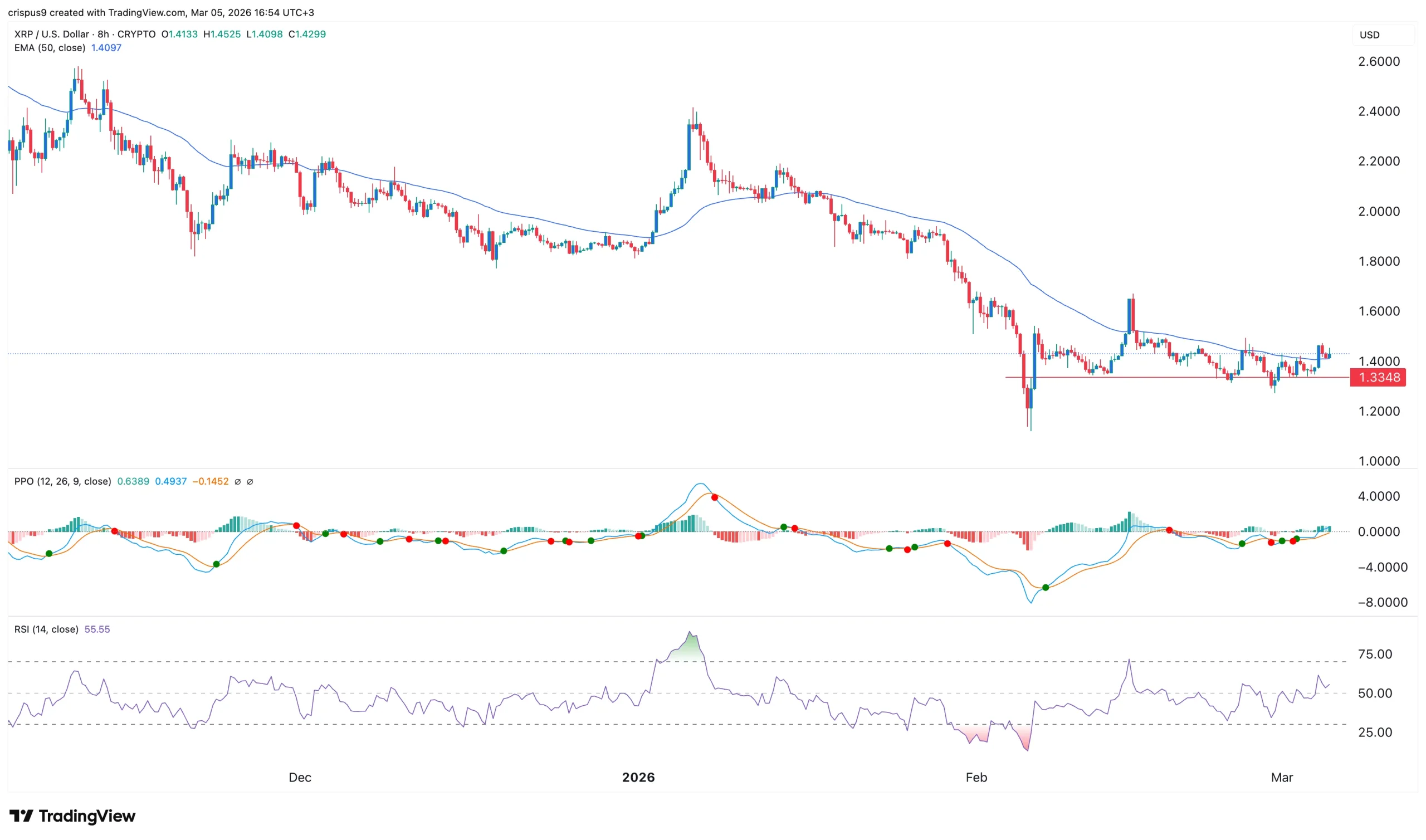
XRP’s price remained flat today, March, continuing the consolidation phase that began in February. However, ongoing inflows into exchange-traded funds and declining exchange supply suggest that a rebound may be on the horizon.
Summary
- XRP price has formed a double-bottom pattern pointing to a strong rebound.
- The supply of XRP tokens on exchanges has dropped to the lowest level in years.
- Data shows that spot XRP ETF inflows have continued rising this month.
Ripple (XRP), one of the top cryptocurrencies, was trading at $1.4282 on Thursday, inside a range it has been in the past few weeks. This price is 28% above the year-to-date low of $1.1137.
American investors are still buying XRP ETFs, a sign that they expect it to rebound in the coming weeks. SoSoValue data shows that spot XRP ETFs added $4.2 million in inflows on Wednesday as the crypto market rally restarted. It was the seventh consecutive day of inflows, with the cumulative total rising to $1.26 billion.
Increased buying by American institutional investors in a time when the price is stuck in a tight range is a sign of accumulation, which often leads to a strong rebound.
Another sign of accumulation is that XRP outflows from exchanges are increasing. Data compiled by CryptoQuant shows that over 7 billion XRP tokens exited exchanges in February. The total amount of XRP tokens in exchanges has dropped to the lowest level in years.
A possible reason why investors are accumulating XRP tokens is its strong fundamentals, including the ongoing Ripple USD growth. The stablecoin has accumulated over $1.5 billion in assets, with its daily volume soaring to over $1.5 billion.
RLUSD is benefiting from the rising demand from both retail and institutional investors, a trend that may continue after its integration on Ripple Prime.
XRP price forecast: Technical analysis
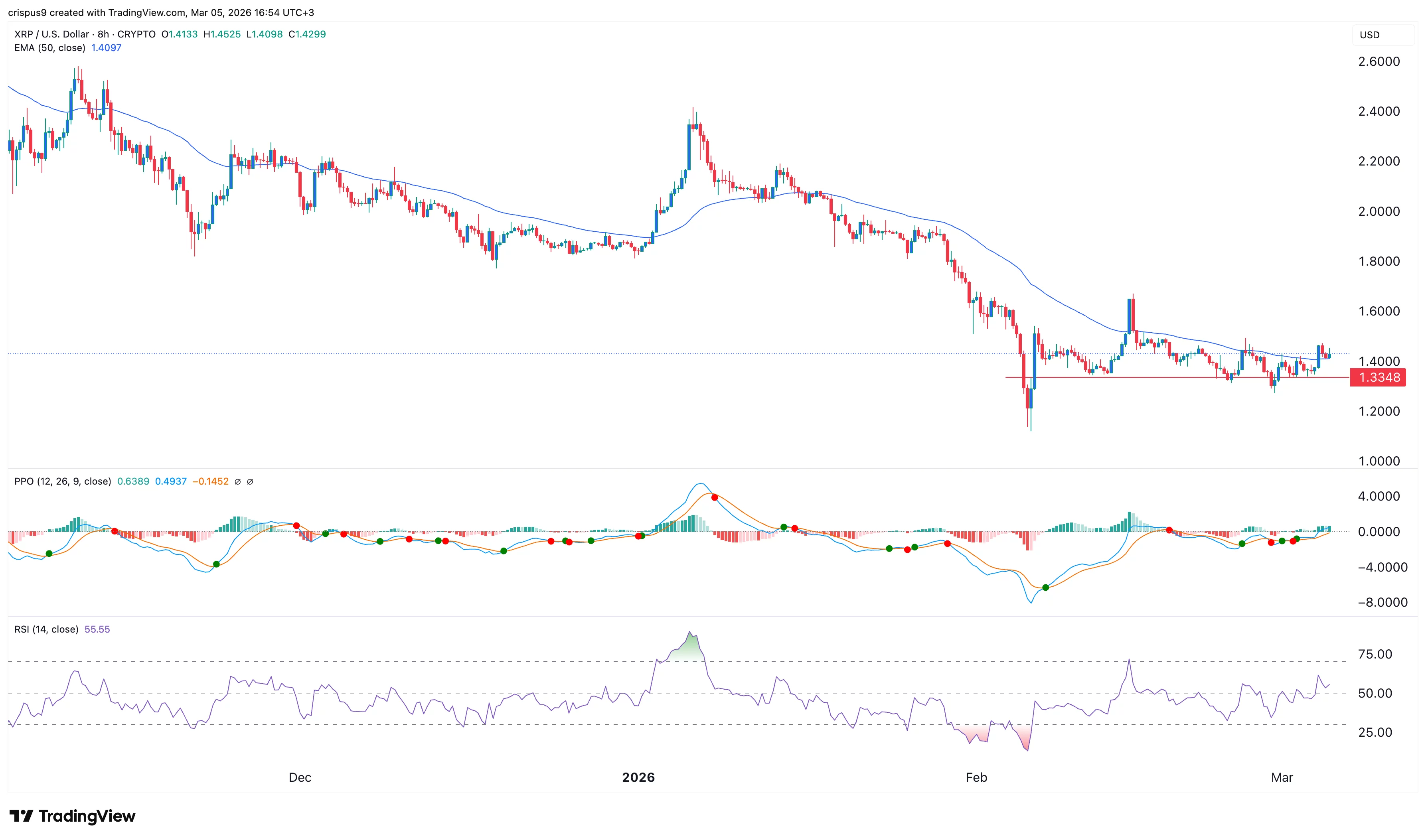
The eight-hour chart shows that the XRP price has remained in a narrow range in the past few weeks.
A closer look shows that it formed a double-bottom pattern at $1.3350 and a neckline at $1.6745. This pattern normally means that short-sellers are largely uncomfortable placing short trades below that level.
The coin has moved slightly above the 50-day Exponential Moving Average. Also, the Percentage Price Oscillator has crossed the zero line, while the Relative Strength Index has jumped above 50.
Therefore, the most likely XRP price forecast is bullish, with the next key target being the neckline at $1.6638. The bullish view will become invalid if it drops below the key support level at $1.3350.
Senator Chris Murphy says it’s likely people close to Donald Trump with “inside information” made bets on prediction markets on when the US would strike Iran.
US Democratic lawmakers are working on a bill to police prediction markets after raising insider trading concerns over bets made on the timing of Israeli and US strikes on Iran.
Democrat Senator Chris Murphy said in a video posted to X on Wednesday that what he claimed were White House insiders made a “very specific bet” on Friday that the US would go to war with Iran on Saturday.
“Obviously, there are people close to Donald Trump who, on Friday, knew what was happening on Saturday, and it is very likely — probable even — that the people that placed those bets were people with inside information,” he said.
Murphy added that allowing bets on war to continue could see those close to the president “pushing us into war because they can cash in.”
A number of bets on Polymarket were widely circulated on Saturday, where six newly-created accounts reportedly earned around $1 million betting on the timing of US strikes on Iran.
In several cases, bets were made just hours before explosions were first reported in Tehran.
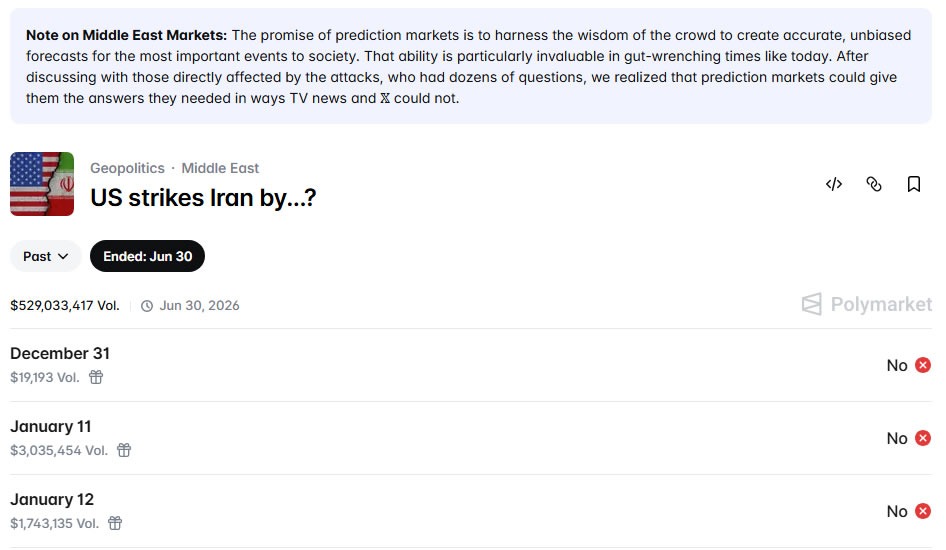
Bets on US strikes in Iran have so far generated $529 million in volume on Polymarket. Last month, a Polymarket trader made about $400,000 from a well-timed wager on the capture of Venezuelan President Nicolás Maduro.

Bill to target prediction market insider trading
Reuters reported on Thursday that Murphy and Democratic House Representative Mike Levin are working on the bill, intensifying pressure on prediction markets such as Polymarket and Kalshi.
Related: Polymarket user gains $400K betting on ZachXBT investigation
“It’s unbelievably clear to me that if anyone is using prior knowledge of military action for financial gain, that should be absolutely illegal,” Levin said.
He added that commodity laws ban event contracts tied to war, terrorism, or other events “contrary to the public interest,” but the rules give prediction markets too much freedom.
Magazine: Would Bitcoin really be at $200K if not for Jane Street? Trade Secrets
OKB token price jumped sharply after Intercontinental Exchange, the parent company of the New York Stock Exchange, announced a strategic investment in OKB issuer OKX.
Summary
- OKB climbed from about $77 to an intraday high near $117 after ICE invested in OKX.
- The deal values OKX at $25B and includes board representation for ICE.
- Price broke out of the $75–$80 range, with $95 now key support and $115–$120 the next resistance zone.
OKB (OKB) surged from about $77.29 to an intraday high of $117.60 following the announcement. At the time of writing, the token was trading at $107.79, still up roughly 40% over the past 24 hours.
The move pushed OKB among the day’s top-performing altcoins. Over the past year, the token has gained around 149%, while monthly gains stand near 32%.
Derivatives data from CoinGlass also shows a sharp increase in market activity. Trading volume jumped more than 3,500% to about $407 billion, while open interest rose 184% to roughly $48 million as traders rushed to position around the breakout.
ICE investment strengthens ties between Wall Street and crypto
The surge followed reports that Intercontinental Exchange has taken a minority stake in OKX, valuing the exchange at approximately $25 billion.
The investment will give ICE a seat on OKX’s board of directors, although the size of the stake has not been publicly disclosed. The deal signals a deeper push by ICE into blockchain infrastructure and digital asset markets.
Under the partnership, ICE will license real-time crypto spot pricing data from OKX. At the same time, OKX plans to provide its global user base, reported to exceed 120 million, with access to ICE’s U.S. futures products and tokenized equities tied to NYSE-listed stocks.
Tokenized stock trading on the platform could go live in the second half of 2026, though the rollout still depends on regulatory approval.
The partnership also highlights how more traditional finance institutions are beginning to experiment with blockchain infrastructure. ICE has already shown interest in this space before, including investments in platforms such as prediction market operator Polymarket.
OKB price technical analysis
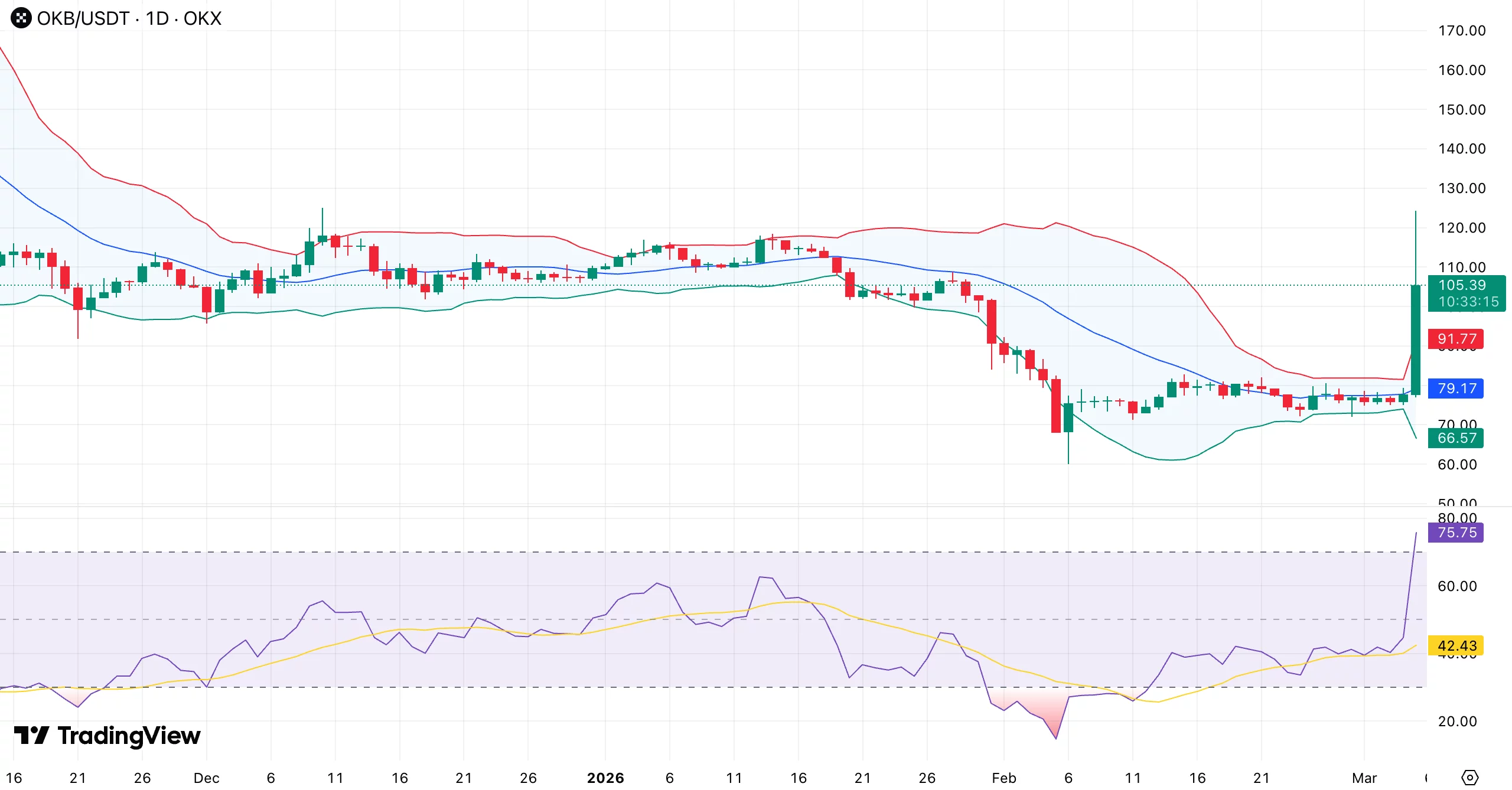
Market signals suggest the latest price surge could be the beginning of a new trend, though in the short term the market appears somewhat overheated. On the daily chart, OKB produced a strong breakout candle that drove the price out of the $75–$80 range and lifted it above $100.
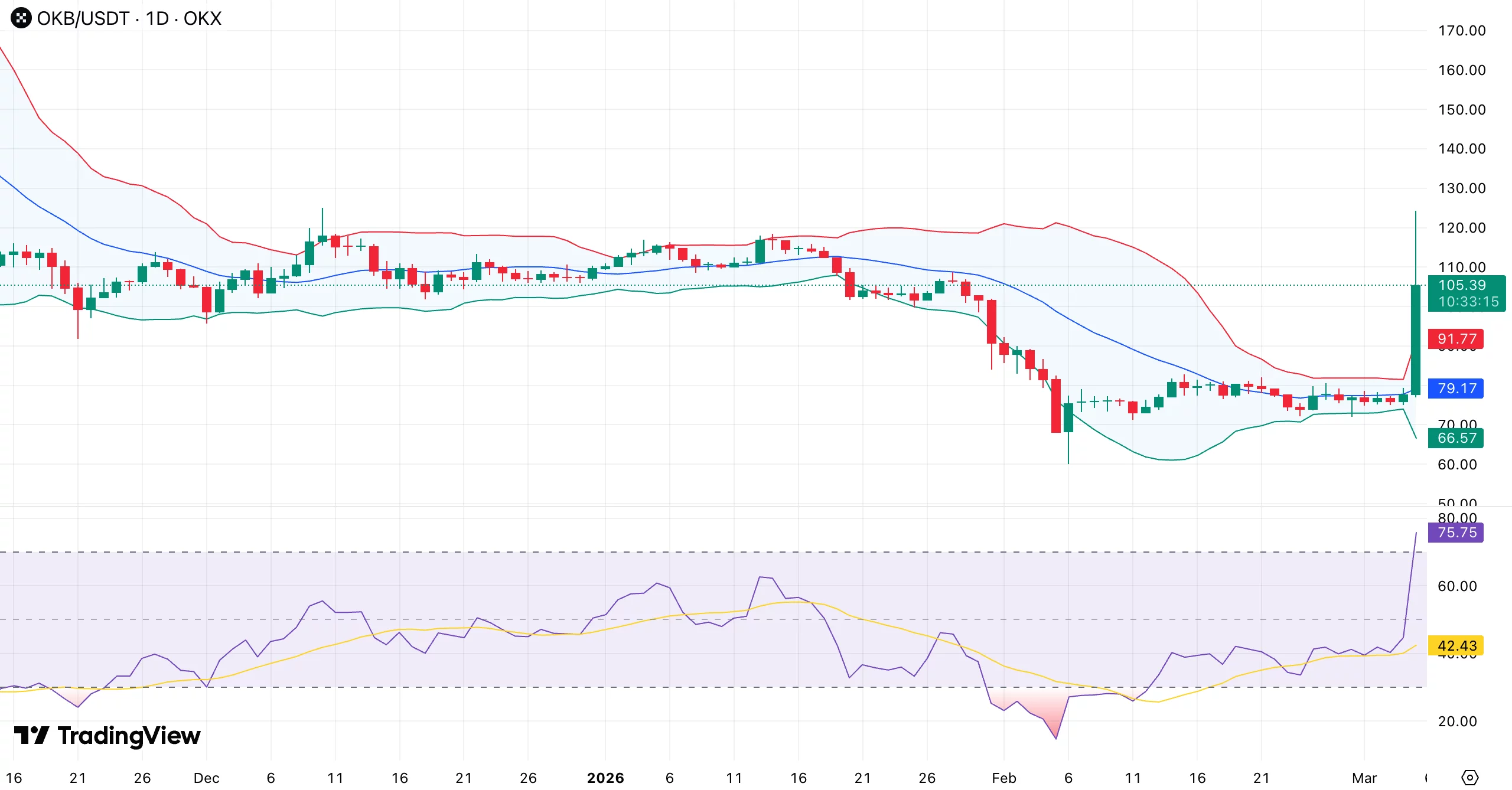
During that move, the token also pushed beyond the upper Bollinger Band. Such movements can indicate that the price has risen too quickly and may pause, but they also often indicate strong buying momentum.
Following a few sessions of relatively tight trading, volatility has clearly increased. The Bollinger Bands spread out sharply following the breakout, which is commonly seen when a market shifts from a quiet phase into a more directional move.
Momentum indicators also lean positive. The relative strength index has risen to around 75, clearly above the 70 level that typically marks overbought conditions. This shows buyers have been in control, although it can sometimes lead to a short pause or a small dip before the next move.
OKB has now moved back above several important moving averages, including the 20-day moving average near $79. In many breakout setups, prices sometimes revisit earlier resistance levels before attempting another climb.
If the current structure remains intact, analysts see the $110–$115 area as the next barrier, with a larger resistance zone near $120. On the downside, $95 is now viewed as the main support level, while $90 could provide an additional cushion if selling pressure appears.
Should the price dip toward that region and attract fresh buying interest, it would support the possibility of another upward move, with $120 and potentially $135 as targets in the coming sessions.

US spot crypto ETFs saw broad-based inflows across Bitcoin, Ethereum and Solana products.
Summary
- Ten US spot Bitcoin ETFs added 5,187 BTC, worth about $376m, in a single day.
- Nine Ethereum ETFs took in 43,282 ETH, totaling roughly $9.18m in new exposure.
- A Solana ETF absorbed 205,711 SOL, adding about $18.72m as majors rallied.
US-listed spot crypto ETFs recorded another strong session of net inflows, with products tied to Bitcoin (BTC), Ethereum (ETH) and Solana (SOL) all attracting fresh capital. According to ChainCatcher data, ten spot Bitcoin ETFs collectively added 5,187 BTC, equivalent to around $376m at prevailing prices, extending a run of sessions in which new money has outweighed redemptions. The flows signal that institutional allocators and wealth platforms continue to use regulated ETF wrappers to increase or rebalance exposure, even as market volatility and macro uncertainty remain elevated.
Nine Ethereum funds also saw net buying, pulling in 43,282 ETH, or roughly $9.18m, and reinforcing the notion that demand is broadening beyond the largest asset. A spot Solana vehicle added 205,711 SOL, worth about $18.72m, underlining investor appetite for higher-beta alternatives as part of diversified crypto portfolios. The multi-asset inflows came against a backdrop of rising spot volumes and a rebound in majors, with BTC reclaiming key resistance zones and dragging correlated assets higher.
ETF flows and market structure
The latest data points to an environment where ETF products are increasingly central to price discovery and liquidity, rather than acting solely as passive wrappers. Heavy buying on strong days and more modest outflows during drawdowns suggest that long-only and advisory channels are using ETFs as entry and exit points, impacting underlying spot markets via authorized participants. This dynamic has been particularly visible around BTC where large creations and redemptions have coincided with sharp moves through key technical levels.
For issuers and exchanges, sustained inflows across multiple products strengthen the business case for expanding lineups and deepening secondary-market liquidity. Platforms such as Coinbase have already positioned themselves as core infrastructure for ETF market makers and custodians, while traditional payment networks that resemble Visa are exploring stablecoin and settlement integrations that could sit alongside ETF-based strategies. As regulatory regimes like MiCA advance and more jurisdictions consider spot listings, the US experience with Bitcoin, Ethereum and Solana ETFs will remain a critical reference point for how regulated vehicles can channel institutional demand into the crypto market.


Western Union is moving deeper into blockchain payments with a new stablecoin initiative tied to the Solana network.
Summary
- Western Union partnered with Crossmint to support the USDPT stablecoin on Solana.
- The stablecoin will connect on-chain transfers with 360,000+ Western Union cash pickup points across 200+ countries.
- Anchorage Digital Bank will issue USDPT to support compliance and institutional access.
The company has partnered with Crossmint to support the rollout of USDPT, a U.S. dollar-denominated stablecoin that will operate on the Solana (SOL) ecosystem.
The collaboration was announced on March 4 by Crossmint and will connect the stablecoin to Western Union’s newly introduced Digital Asset Network, which links on-chain dollars to real-world cash access across its global payout infrastructure.
Stablecoin connected to Western Union’s payout network
USDPT was first revealed in October 2025, with a launch expected in the first half of 2026. The stablecoin will be issued by Anchorage Digital Bank.
Western Union’s Digital Asset Network links blockchain transfers with its global cash distribution system. Through the network, users can convert digital dollars into local currency using more than 360,000 collection points worldwide, spanning over 200 countries and territories.
Malcolm Clarke, Western Union’s vice president of digital assets, said the network connects digital wallets and platforms directly to the company’s payout infrastructure. Partners such as Crossmint provide the technology layer that allows these integrations to work across blockchain systems and traditional payment rails.
This setup allows stablecoin transactions to move on-chain while still connecting to familiar cash pickup services used in many remittance corridors.
Crossmint infrastructure supports wallets and fintech apps
Crossmint will integrate USDPT into its wallet infrastructure and payment APIs, allowing fintech platforms and developers to access the stablecoin through its existing tools.
Rodrigo Fernández Touza, co-founder of Crossmint, said the collaboration links digital dollar transfers with Western Union’s global payout network.
Developers using Crossmint’s APIs can build applications that send funds on Solana while offering recipients the option to collect cash through Western Union locations where available.
The system allows fintech apps to hold value in digital dollars, transfer funds instantly on-chain, and connect to Western Union’s payout network when users need local currency.
Solana’s fast settlement speeds and low transaction costs have made it a common choice for payment-focused blockchain applications, including stablecoin transfers and cross-border transactions.


A sharp volatility spike wiped out $471m in crypto derivatives positions in one day.
Summary
- Total crypto liquidations over 24 hours reached about $471m across major exchanges.
- Shorts absorbed the bulk of the damage, with $348m rekt versus $123m in long liquidations.
- Bitcoin, Ethereum and other majors saw funding reset as overleveraged bearish bets were squeezed.
Crypto derivatives traders endured another brutal reset as roughly $471m in futures positions were liquidated over a 24-hour window, according to data.
Unlike many prior stress events, this wave hit short-sellers hardest, with about $348m in short liquidations compared to $123m from longs, suggesting that bears were caught leaning too aggressively into downside bets as prices rebounded. The skew was particularly pronounced in flagship contracts tied to Bitcoin (BTC) and Ethereum (ETH), where a swift move higher forced exchanges’ risk engines to close underwater positions into rising markets.
The liquidation pattern reflects a market where sentiment flipped from cautious to overly pessimistic before the latest rally. In the lead-up to the move, open interest had rebuilt as traders added fresh short exposure on the assumption that recent gains would fade. When spot prices broke higher instead, those trades were rapidly unwound, amplifying the upside through a classic short squeeze dynamic. The episode underscores how quickly positioning can turn and how reliance on high leverage—regardless of direction—exposes traders to abrupt, forced exits when liquidity thins and volatility spikes.
Leverage squeeze and positioning reset
In the aftermath of the $471m flush, derivatives metrics suggest that some of the froth on the short side has now been cleared, with funding rates normalizing and open interest stabilizing at slightly lower levels. For BTC and other large-cap assets, that reset may provide a cleaner backdrop for spot-led moves, reducing the immediate risk of another squeeze in either direction. However, the frequency of large liquidation events in recent weeks indicates that many market participants continue to run elevated leverage, quickly rebuilding directional bets once prices show a trend.
Exchanges are likely to face renewed scrutiny over headline leverage limits, margin policies and transparency around liquidation algorithms, particularly as institutional interest in derivatives grows alongside ETF and structured-product flows. Platforms like Coinbase, which emphasize regulated derivatives offerings, and policymakers advancing frameworks similar to MiCA will watch closely how these episodes impact market integrity. Until leverage metrics show a more durable decline, professional desks may keep gross exposure in check, use options to hedge tail risks, and monitor liquidation dashboards to avoid positioning where cascading forced selling or buying can quickly overwhelm order books.
BTC is currently trading near $72,000, extending its rebound from last week’s pullback and reclaiming key resistance after testing lower support levels. The move toward $72,000 comes alongside a broader recovery in crypto majors, with renewed inflows into spot BTC products and higher derivatives activity signaling improving risk appetite. Market outlook for BTC remains cautiously bullish at these levels: trend structures have turned constructive again, but elevated volatility around $72,000 leaves room for sharp swings if macro or geopolitical sentiment deteriorates.
Bitcoin price held steady on Thursday as investors focused on the upcoming US non-farm payrolls data scheduled for Friday this week.
Summary
- Bitcoin price moved to a local bull market after rising by 20% from the year-to-date low.
- The rally happened amid hopes of talks between the US and Iran on ending the war.
- The US will publish the latest non-farm payrolls data on Friday.
Bitcoin (BTC) token was trading at $72,450, up by 20% from its lowest level this year, meaning it has moved into a local bull market.
The recent rebound started on Wednesday after reports that Iran had reached out to the Americans to end the war. Still, the odds of a ceasefire happening in the near term are slim as the three sides commit to fighting. This explains why Brent and West Texas Intermediate jumped to $84.15 and $78.
Bitcoin price will next react to the upcoming US non-farm payrolls data, which will come out on Friday. Economists polls by Reuters expect the upcoming report to show that the labor market softened in February.
The average estimate is that the economy created 70k jobs, much lower than the 110k it created in January. They also expect the report to reveal that the unemployment rate remained unchanged at 4.3%.
These numbers are important as the Federal Open Market Committee will meet on March 17 and 18. Economists believe that the bank will leave rates unchanged between 3.50% and 3.75%.
A weak NFP report may push some Fed officials to support a rate cut. In a statement on Wednesday, Stephen Miran maintained that the bank should slash rates, citing the jobs market.Fed officials are concerned about inflation, which may accelerate because of the ongoing war in the Middle East.
Bitcoin and other cryptocurrencies experience more demand when the Fed is cutting interest rates.
Bitcoin price forecast: Technical analysis
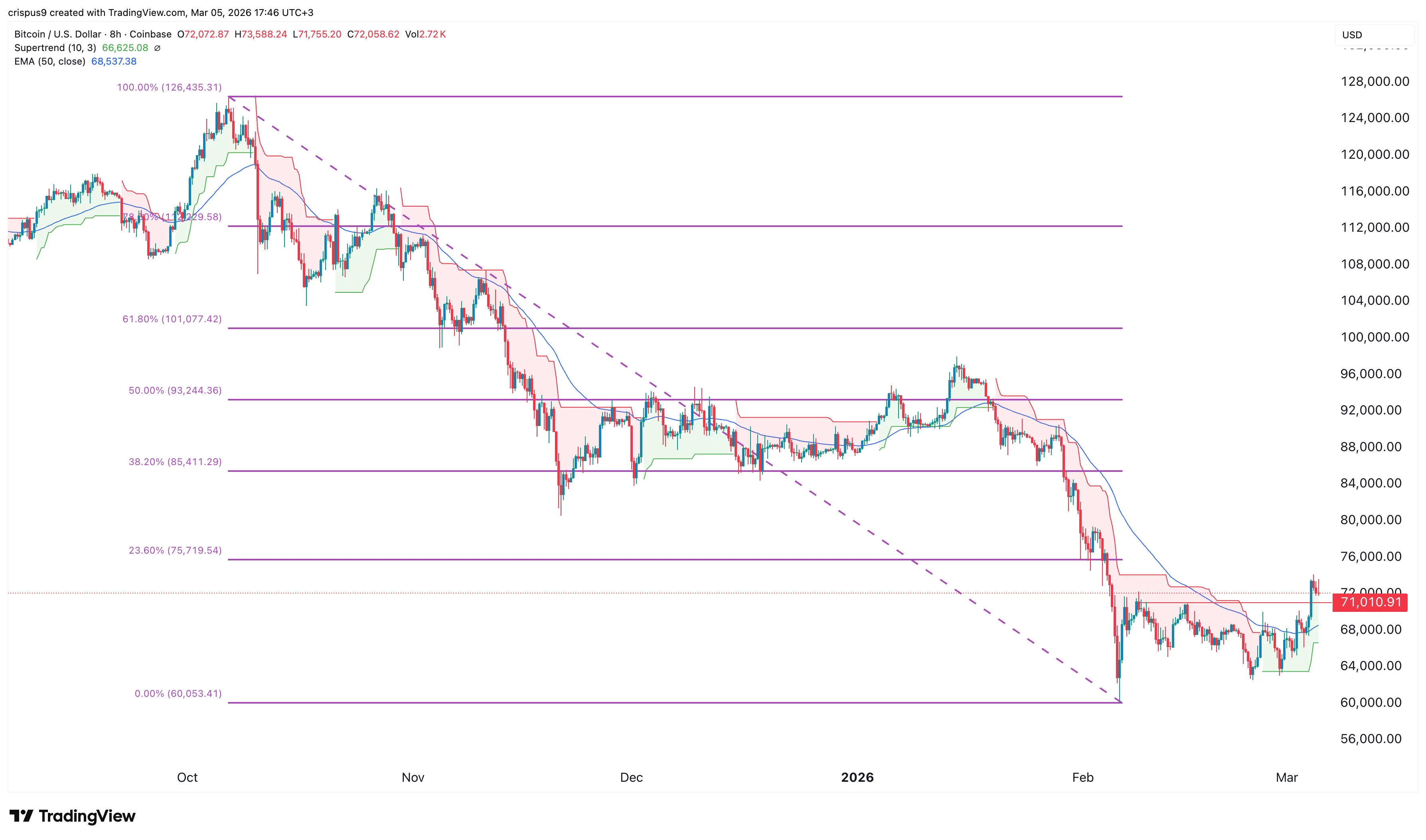
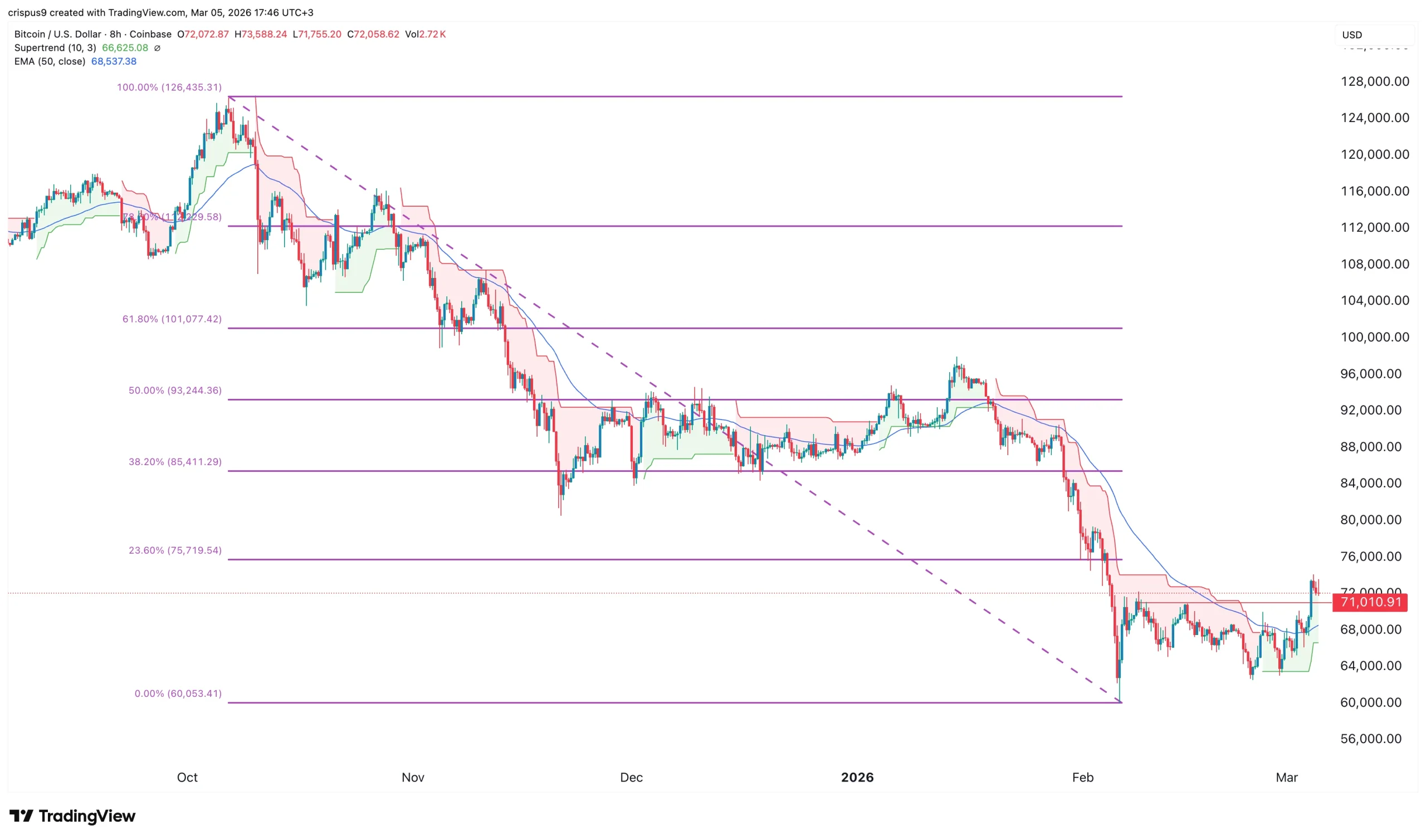
BTC price has staged a comeback recently, moving from the year-to-date low of $60,000 to $72,700. It has moved above the crucial resistance level at $71,000, its highest level on February 15. This price was also the neckline of the inverted head-and-shoulders pattern.
The coin has already flipped the Supertrend indicator from red to green and moved above the 50-day Exponential Moving Average.
It is also hovering near the 23.6% Fibonacci Retracement level, which is drawn by connecting the all-time high and the lowest level this year.
The most likely Bitcoin price prediction is bullish, with the key target being the psychological level at $80,000. On the flip side, a drop below the key support level at $70,000 will cancel the bullish outlook.


CleanSpark increased its Bitcoin holdings despite selling most of February’s mined coins.
Summary
- CleanSpark mined 568 BTC in February, bringing its year-to-date total to 1,141 BTC.
- The miner sold 553.02 BTC at an average price of $66,279, booking cash while retaining some production.
- Total treasury holdings rose to 13,363 BTC, signaling a balance between monetization and long-term accumulation.
Bitcoin (BTC) miner CleanSpark reported a solid production update for February, underscoring how listed miners are navigating a higher price environment by both monetizing output and building balance-sheet exposure.
The company mined 568 BTC during the month, lifting its year-to-date tally to 1,141 BTC, according to figures highlighted by ChainCatcher. At the same time, CleanSpark sold 553.02 BTC at an average price of $66,279, using the rally to raise cash while still modestly increasing net holdings. By month-end, the firm’s treasury had grown to 13,363 BTC, reflecting a strategy that combines operational funding needs with a long-term bullish stance on the asset.
The approach illustrates how miners are adjusting after previous cycles where many either dumped most production to cover costs or, conversely, hoarded coins through deep drawdowns. With BTC trading near cycle highs and hash rate competition intense, CleanSpark’s blend of opportunistic selling and ongoing accumulation aims to keep leverage and dilution in check while preserving upside participation. Investors closely watch such treasury decisions, as they can influence both balance-sheet resilience and sensitivity to future price swings. Miners that sell too aggressively may underperform in bull phases, while those that over-accumulate risk liquidity stress if conditions deteriorate.
Miner treasuries and market signaling
CleanSpark’s latest update feeds into the broader discussion about how miner balance sheets impact market structure and supply dynamics. When miners sell into strength but maintain or increase core holdings, they effectively drip-feed liquidity to the market without completely removing their potential to become forced sellers during downturns. In aggregate, miner flows can influence short-term supply-demand imbalances, particularly around key events such as halvings, regulatory shifts or large ETF-driven inflows. Watching how firms manage inventories offers clues about industry confidence in current prices and future trajectories.
For institutional investors and analysts, miner treasury strategies are increasingly assessed alongside metrics like production cost per coin, energy contracts, and diversification into adjacent businesses such as high-performance computing or AI infrastructure. Some miners have partnered with platforms like Coinbase for custody or financing solutions, while others look to strike structured deals with energy providers and financial institutions akin to Visa’s partnerships in the payments world. As regulatory clarity, including regimes like MiCA, expands, miners that can demonstrate disciplined capital allocation and robust governance around their BTC holdings may enjoy better access to traditional financing and a valuation premium over less transparent peers.

‘Love Story’ Turns JFK Jr. and Carolyn Bessette’s Happiest Episode Into a 2-Scene Gut Punch

Videos show terrifying moments during Texas mass shooting

Mark My Words March 6 2026


-

 Politics3 days ago
Alan Cumming Brands Baftas Ceremony A ‘Triggering S**tshow’
-

 Fashion6 days ago
Weekend Open Thread: Iris Top
-

 Tech5 days ago
Unihertz’s Titan 2 Elite Arrives Just as Physical Keyboards Refuse to Fade Away
-

 NewsBeat5 days ago
Abusive parents will now be treated like sex offenders and placed on a ‘child cruelty register’ | News UK
-
 NewsBeat5 days ago
Dubai flights cancelled as Brit told airspace closed ’10 minutes after boarding’
-
Sports6 days ago
The Vikings Need a Duck
-
 NewsBeat6 days ago
The empty pub on busy Cambridge road that has been boarded up for years
-

 NewsBeat5 days ago
‘Significant’ damage to boarded-up Horden house after fire
-

 Tech21 hours ago
Bitwarden adds support for passkey login on Windows 11
-

 Entertainment4 days ago
Baby Gear Guide: Strollers, Car Seats
-
 Sports10 hours ago
499 runs and 34 sixes later, India beat England to enter T20 World Cup final | Cricket News
-
 Tech7 days ago
NASA Reveals Identity of Astronaut Who Suffered Medical Incident Aboard ISS
-
Politics5 days ago
FIFA hypocrisy after Israel murder over 400 Palestinian footballers
-
 NewsBeat5 days ago
Emirates confirms when flights will resume amid Dubai airport chaos
-

 NewsBeat4 days ago
Is it acceptable to comment on the appearance of strangers in public? Readers discuss
-

 Tech5 days ago
Viral ad shows aged Musk, Altman, and Bezos using jobless humans to power AI
-

 Video4 days ago
How to Build Finance Dashboards With AI in Minutes
-

 Business2 days ago
Guthrie Disappearance Enters Fifth Week as Family Visits Memorial
-
 Crypto World5 days ago
US Judge Lets Binance Unregistered Token Class Action Proceed
-
 NewsBeat4 days ago
Ukraine-Russia war latest: Belgium releases video showing forces boarding Russian shadow fleet oil tanker