



Connect with us
DAPA Banner
DAPA Coin
DAPA
COIN PAYMENT ASSET
PRIVACY · BLOCKDAG · HOMOMORPHIC ENCRYPTION · RUST
ElGamal Encrypted MINE DAPA
🚫 GENESIS SOLD OUT
DAPAPAY COMING

Business

High-spending online gamblers to face financial risk checks

Published

on

Swingers

Gamblers who spend more than £1,000 online in a 24-hour window will have to undergo a financial risk assessment, the industry regulator has announced.

The Gambling Commission said this would also apply to anyone spending over £3,000 in a rolling 90-day period. Under-25s will have lower thresholds.

The assessments will be based on data held by credit reference agencies, but the commission has insisted they are not “affordability checks”.

Operators will use the information to help them identify gamblers at risk of financial harm or in financial difficulty.

Advertisement

The commission has not set a timeline for the changes saying they will be introduced in a “very careful, staged way”.

The checks will start with over-25s who gamble more than £5,000 in a rolling 24-hour period. The watchdog says this will affect less than 0.5% of customers. It will begin following engagement companies and other stakeholders over the summer.

The threshold will eventually be lowered to £1,000 in 24 hours.

In 2023, a white paper on gambling recommended enhanced checks on customers experiencing very high losses.

Advertisement

On Tuesday, the commission said high-spending gamblers were between two and four times more likely to have a debt management plan, and between two and five times more likely to have a default in the previous 12 months than consumers in the wider population.

The commission has been looking into whether gambling companies can use credit reference data to spot customers at risk of financial harm.

The acting chief executive of the Gambling Commission, Sarah Gardner, said the vast majority of customers would “never, ever” require an assessment.

Those who do would have a frictionless, document-free assessment provided by credit reference agencies, with no impact on their credit score.

Advertisement

The commission has insisted that the assessments are not the same as affordability checks, which Gardner said were “deeply unpopular” with gamblers.

She added that stakeholders had expressed concerns that more regulation could push problem gamblers onto the black market.

Continue Reading
Click to comment

You must be logged in to post a comment Login

Leave a Reply

Business

Credo: Q3 Won't Be As Kind

Published

on

Credo: Q3 Won't Be As Kind

Credo: Q3 Won't Be As Kind

Continue Reading

Business

Lynas inks $50m deal for Malaysian magnet factory

Published

on

Lynas inks $50m deal for Malaysian magnet factory

Lynas Rare Earths has struck a $50 million deal with South Korean manufacturer JS Link for the development of a rare earth magnet factory near its Malaysian processing hub.

Continue Reading

Business

Thailand Update: Major Highlights in Politics, Economy, Tourism, and Society

Published

on

Essential Updates on Politics, Economy, Tourism, and Society

Thailand News Roundup: Business, Culture, and Society

Economic Developments and Business Growth

Investment and Infrastructure

Thailand’s economic landscape shows significant momentum in strategic investment and infrastructure development. The country has reportedly locked in $4.1 billion in EV supply chain investment, reflecting a broader pivot in its automotive sector. Hyundai has launched local assembly of the Ioniq 5, while Fulltech’s Thailand plant is targeting AI and satellite component demand. Meanwhile, Central Pattana and Mitsubishi Estate announced a $330 million mixed-use development, and JERA and EGAT are partnering on a hydrogen value chain project. Thailand is also reviving a $30 billion coast-to-coast corridor intended to rival the Malacca Strait, positioning itself as a competitive logistics hub in the region. For ongoing coverage of these developments, Thailand Business News provides detailed analysis of the country’s evolving investment climate.

Financial and Regulatory Shifts

On the financial front, Siam Commercial Bank (SCB) has introduced 24/7 USD clearing services in partnership with Citi Token Services, signaling a modernization of the country’s banking infrastructure. Thailand also plans to sell $240 million in government savings bonds by September, while a draft AI regulatory bill blends EU-inspired frameworks with domestic policy approaches. However, not all financial news is positive: a so-called “Ghost Investor” continues to trouble Thailand’s Securities and Exchange Commission, raising questions about regulatory oversight. Additionally, authorities are pursuing a fugitive Chinese businessman linked to illegal cryptocurrency mining operations.

Tourism Sector Continues Strong Momentum

Visitor Growth and Market Positioning

Thailand’s tourism sector remains a bright spot, with the country welcoming 16.3 million tourists in the first half of 2026 alone. Reports indicate Thailand is now competing closely with Vietnam, Malaysia, and Singapore as part of Southeast Asia’s fastest-growing backpacking circuit. Bangkok has also emerged as a luxury travel powerhouse, outperforming the United States, India, and Indonesia in certain segments, driven by rising millionaire growth and high-spending visitors. The upcoming Tomorrowland Thailand festival has already sold 150,000 tickets, expected to inject roughly 6 billion baht into the local economy.

Travel Advisories and Practical Considerations

Despite this growth, travelers are being urged to carry proof of funds and complete digital arrival documentation amid tightened immigration screening. This signals a more cautious regulatory posture even as the government promotes new initiatives like “Communities ConNext,” which showcases 55 local destinations to attract long-haul travelers seeking authentic cultural experiences.

Advertisement

Social and Public Health Concerns

Food Safety and Public Health

A notable public health issue involves the traditional fermented fish dish “pla ra,” which has come under scrutiny after thousands of individuals tested positive for liver fluke infection linked to undercooked preparations. This has prompted health officials to issue warnings around food safety practices tied to regional culinary traditions.

Human Rights and Legal Developments

Thailand’s human rights record remains under international scrutiny. Human Rights Watch has called for an investigation into alleged brutality at a marine barracks, while the International Commission of Jurists has facilitated discussions among judges regarding the implementation of the Anti-Torture and Enforced Disappearance Act. Separately, advocacy groups have urged the European Union to address Vietnam’s alleged transnational repression occurring within Thai borders, highlighting Thailand’s role as a regional hub for cross-border human rights concerns.

Tragic Incidents and Public Safety

Thailand has also faced somber news in recent days. A tragic incident left at least nine monks killed after a young driver crashed a truck into a religious procession, drawing widespread shock and mourning. In another widely covered case, a 21-year-old British woman was arrested in connection with the stabbing death of her boyfriend, an incident that has attracted significant international media attention.

Sports and Cultural Exchange

On a lighter note, Thailand continues to build its profile in international sports. Thai volleyball star Ajcharaporn “Pure” Kongyot is set to compete in the United States, while the squash community expresses optimism about developing the next generation of Thai athletes through programs like So Squash 24. The country also recently hosted the CARAT Thailand 2026 military exercise opening ceremony, reinforcing security partnerships with the United States and regional allies.

Advertisement

Source : Google News – Search

Continue Reading

Business

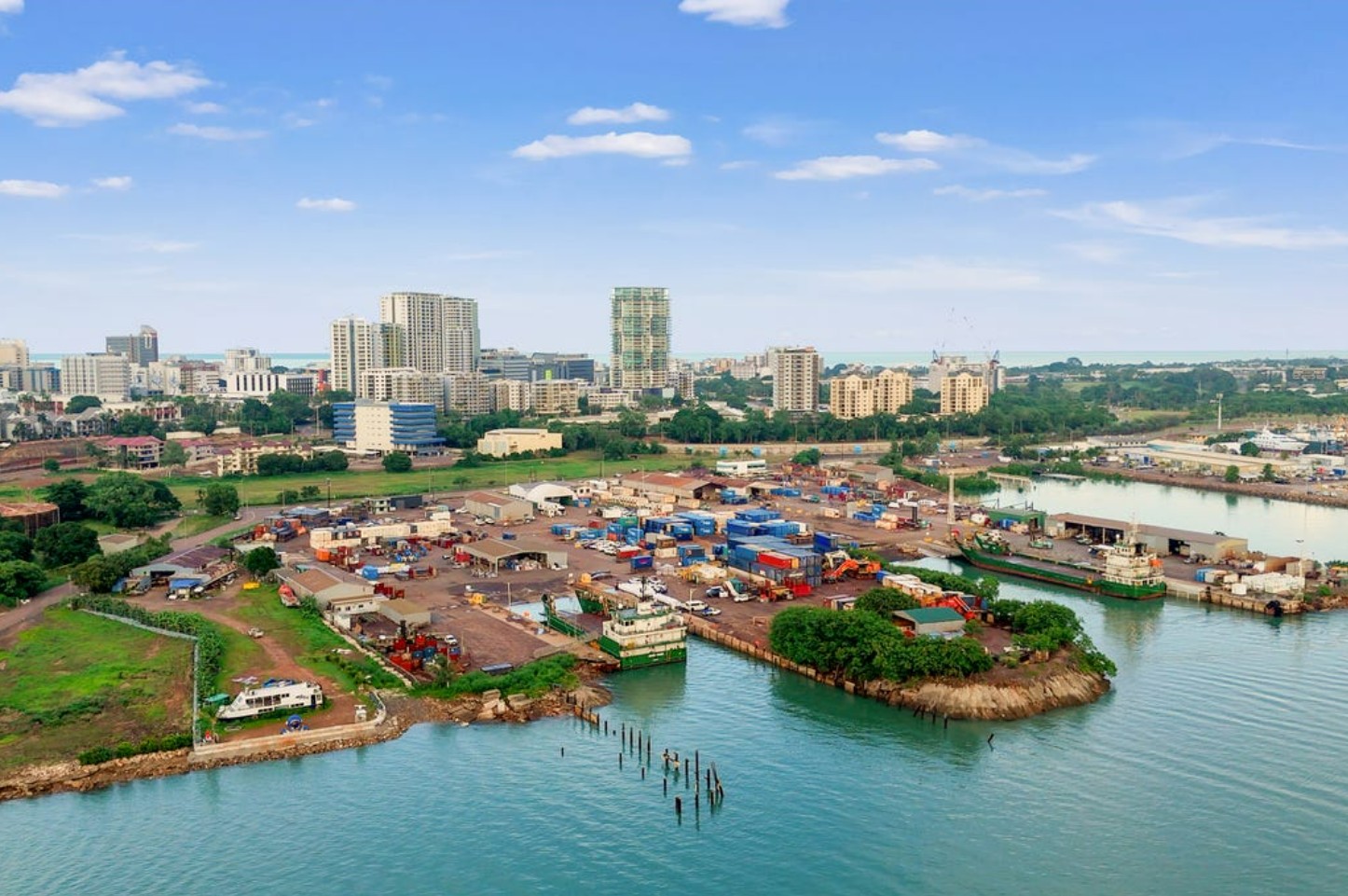
Silverleaf buys $19m Darwin asset

Published

on

Silverleaf buys $19m Darwin asset

The property, on the city’s eastern waterfront, represents the Fremantle-based developer’s first Darwin acquisition.

Continue Reading

Business

UK’s High Pay Centre to close for good amid funding troubles

Published

on

Business Live

The think tank tracked the pay of the country’s top bosses including FTSE 100 executives

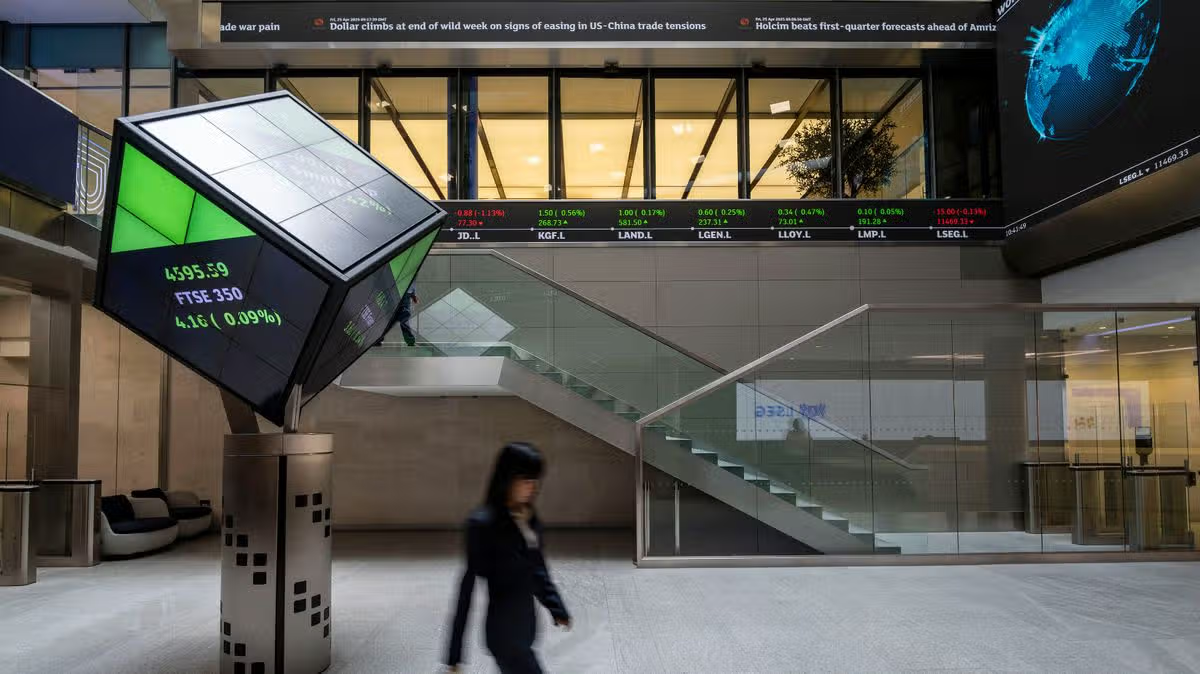
A general view of the London Stock Exchange in the City of London

A general view of the London Stock Exchange in the City of London(Image: Jeff Moore/PA Wire)

A think tank that raised awareness of pay inequality in the UK and tracked the salaries of Britain’s top-paid executives including bosses on the FTSE 100 has announced its closure. The High Pay Centre (HPC) said on Tuesday (July 7) it had faced “considerable fundraising challenges” over the past two years.

The London-based organisation was founded 15 years ago by Deborah Hargreaves, a former business journalist at the Guardian and Financial Times, following the High Pay Commission’s report, which at the time proposed a 12-point plan to curb excessive top executive salaries.

Advertisement

The HPC advocated for fairer pay in Britain and ran a programme of research and events aimed at influencing policy change and public debate around the issue.

But it is understood the organisation came under financial strain in recent years after failing to secure new sources of finance after long-standing donors left the sector.”

“While we have worked hard to develop a more sustainable funding model, unfortunately we have not been able to secure new sources of funding to replace what has been lost,” the company said in a statement.

“The reforms we have advocated for, including greater transparency on executive pay and workforce pay ratios, as well as shareholder ‘say on pay’, have increased transparency and given investors greater opportunities to express their views on company decisions about pay and reward.

Advertisement

“However, while the gap between the pay of top executives and that of British workers remains in excess of 100:1, we are disappointed that successive governments and regulators have not gone further to address an economic model that continues to drive inequality.”

The HPC is set to close later in July but said it would first publish its latest analysis of CEO salaries and pay ratios in the FTSE 100, along with “further reflections” on what is needed to transform the UK’s economic model from one that “exacerbates inequality” to one that “can deliver prosperity while better serving society”.

It also said it was currently exploring whether “other like-minded organisations” might be able to continue its work.

“We hope to share more information before our closure,” the organisation added in a statement.

Advertisement

“In the meantime, we’d like to thank the many individuals and organisations who have supported our work over the years, including those who have donated to help support our survival in recent months.

“We know that many of you will be as disappointed as we are that this day has come. As so many of you have told us recently, the issues we have campaigned on are more important now than ever.”

Continue Reading

Business

Burnham urged to replace stamp duty and council tax with property levy

Published

on

Burnham signals tax movement with business rates cut for pubs & high street firms

Some of Britain’s leading economists have urged Andy Burnham to tear up the UK’s tax system, calling for stamp duty and council tax to be scrapped and replaced with a single annual property value tax.

The group, which includes Lord O’Neill of Gatley, the former Goldman Sachs chief economist who advises Burnham, has written an open letter to the man widely expected to become the next prime minister, warning that structural reform can no longer be delayed.

Their intervention endorses Prosperity 2030, a five-year programme from University College London’s Institute for Global Prosperity launching on Thursday, which the signatories say “models how fiscal, welfare, and infrastructure policies can unlock the gridlock that plagues the country”.

Burnham is on course to enter Downing Street on 20 July if he wins the Labour leadership, inheriting an economy weighed down by high debt and stubbornly low growth. Westminster and the City are watching his fiscal plans, and his choice of chancellor, particularly closely after his Manchester speech last week calling for greater devolution. As Business Matters has reported, Burnham has already signalled “room for movement” on tax, pledging a business rates cut for pubs and high street firms.

The centrepiece of the report is a single national contributions levy that would replace six separate taxes: income tax, employee and self-employed national insurance, dividend tax, inheritance tax and capital gains tax. The levy would run from 0 per cent to a 22 per cent base rate, with a 46 per cent top rate applied to a “flat definition” of income, raising an estimated £75 billion after five years.

Advertisement

That “simpler, more efficient system” would fund nine new universal services, transforming the welfare state by delivering support in kind rather than in cash.

On property, the plan would abolish stamp duty and council tax in favour of a 1 per cent annual property value tax, ending what the report calls “the absurdity of a modest terrace paying proportionally more than a high-value mansion”. A deferral option would ensure “no one is forced to sell to pay it”. The idea echoes proposals already circulating in the Treasury for an annual charge to replace stamp duty, and chimes with the Institute for Fiscal Studies, which has long argued the case for the abolition of stamp duty as one of Britain’s most economically damaging taxes.

A new property levy is unlikely to pass without a fight, however. Sir James Cleverly, the shadow secretary of state for housing, communities and local government, has already branded it a “garden tax … straight out of the Corbyn playbook”. Nor is it the first Burnham-linked tax idea to unsettle boardrooms: the debate over what a Burnham wealth tax could mean for UK business and investors is still fresh.

Andrew Percy, co-chairman of the social prosperity network at the UCL Institute for Global Prosperity and the report’s lead author, said it was a “plan to cut taxes for working people, abolish the taxes holding back the housing market, and get young people into paid work. The question is no longer whether Britain can afford reform. It is whether we can afford another decade without it.”

Advertisement

Alongside Lord O’Neill, the letter’s signatories include Professor Dame Henrietta Moore, founder and director of the institute, Professor Jonathan Portes of King’s College London, Professor John Muellbauer of Nuffield College, Oxford, and Danny Sriskandarajah, chief executive of the New Economics Foundation.

Their verdict on Westminster’s recent record is blunt: “Seven prime ministers in ten years have inherited the same challenge and failed to solve it for the same reasons: the problems are structural and systemic.”


Amy Ingham

Amy is a newly qualified journalist specialising in business journalism at Business Matters with responsibility for news content for what is now the UK’s largest print and online source of current business news.

Advertisement

Continue Reading

Business

Stellantis to sell small Fiat Topolino EV for $13,995 in U.S.

Published

on

Stellantis to sell small Fiat Topolino EV for $13,995 in U.S.

Stellantis plans to offer the Fiat Topolino, an all-electric quadricycle vehicle, in the U.S.

Stellantis

DETROIT — Chrysler parent Stellantis on Tuesday said it has opened ordering for its small Fiat Topolino electric vehicle in the U.S., starting at $13,995.

Advertisement

While the Topolino resembles a small car such as the Fiat 500, the EV is actually a quadricycle that functions more like a golf cart.

Stellantis said the Topolino is capable of going 19 mph, with an electric range of up to 46 miles. A “Low Speed Vehicle” conversion kit can boost the top speed to 25 mph to make it street legal on roads with speed limits of 35 mph or less, according to the trans-Atlantic automaker.

A Stellantis spokeswoman said there will be no charge for the conversion kit but confirmed a mandatory destination fee will add $990 to the base price, bringing the customer price to $14,985.

The Topolino, which translates to “little mouse” in Italian, is produced in Morocco. The company said it will be available in limited quantities this year as a hardtop model with doors or a “Dolce Vita” soft-top convertible model with a rope instead of doors.

Advertisement

2026 Fiat Topolino Dolce Vita.

Courtesy Fiat

“Topolino represents a new chapter for the brand in the U.S. — defined not just by size, but by purpose,” Fiat brand CEO Olivier Francois said in a release. “With Topolino, we bring a feeling, a lifestyle, a reminder that mobility can be joyful, expressive and beautifully simple.”

Stellantis, which also owns American brands such as Jeep and Dodge, late last year confirmed it would bring the vehicle from Italy to the U.S. less than a week after President Donald Trump praised small “Kei” cars from Japan during a meeting at the White House with Stellantis CEO Antonio Filosa and other automotive leaders.

Advertisement

“They’re very small. They’re really cute,” Trump said at the December meeting. “And I said, ‘How would that do in this country?’ And everyone seems to think ‘good,’ but you’re not allowed to build them.”

It’s not illegal to produce such cars in America, but they have to meet American safety standards, speed requirements and other regulations.

Small cars such as Fiats have historically not sold well in the U.S. In its first full year in the U.S. in 2012, Fiat sold 43,772 vehicles domestically. Those sales dwindled to roughly 1,300 Fiat vehicles sold last year in the U.S.

The Stellantis spokeswoman at that time said Fiat’s announcement was unrelated to Trump’s comments and that the automaker had been has been gauging customer interest for the Topolino at U.S. events such as auto shows.

Advertisement
Choose CNBC as your preferred source on Google and never miss a moment from the most trusted name in business news.
Continue Reading

Business

RBI to conduct Rs 25,000-cr overnight variable rate repo auction on Jul 8

Published

on

RBI to conduct Rs 25,000-cr overnight variable rate repo auction on Jul 8
The Reserve Bank of India (RBI) on Tuesday said it will conduct an overnight variable rate repo (VRR) auction for a notified amount of Rs 25,000 crore on July 8.

The auction will take place between 9:30 am and 10:00 am on Wednesday, and the funds will be reversed on July 9, according to the RBI’s notification.

“On a review of current and evolving liquidity conditions, it has been decided to conduct a Variable Rate Repo (VRR) auction on Wednesday, July 8,” the RBI said in a release.

Currently, liquidity in the banking system is estimated to be in surplus of around Rs 1.19 lakh crore as of July 6, according to the RBI’s data.

Advertisement

On July 7, the central bank received a muted response on the overnight VRR auction, with just Rs 1,135 crore worth of bids for a notified amount of Rs 50,000 crore. Experts attributed this to the comfortable surplus liquidity in the banking system.


The central bank accepted the entire amount at a cut-off and weighted average rate of 5.26 per cent, according to the release.
The central bank had infused more than Rs 6 lakh crore of transient liquidity to the banking system through various VRR auctions ranging between overnight and seven days since June.

Continue Reading

Business

Strangeways regeneration: Apartments set to be approved

Published

on

Business Live

Some locals object to plan, with one saying it could ‘de-value many of the existing flats’

Concept images showing plans for a new 24-storey tower known as One Lord Street, based in Manchester's Green Quarter.

Concept images showing plans for a new 24-storey tower known as One Lord Street(Image: Linear Living )

Plans for swanky apartments within eyesight of Strangeways prison are set to be approved this week – but the scheme has already caused a stir among local residents.

Advertisement

The development would create 251 ‘high-quality’ homes in a part-24-storey building. The homes would be for private sale, with none at ‘affordable’ prices below market rates. A report submitted with the plans confirmed the scheme ‘can’t support affordable housing‘.

But 15 objections have been submitted about the proposals, claiming construction would ‘create bottlenecks and congestion’ on the roads, and would ‘block views and create a sense of enclosure’ in the area.

One objector said: “This is going to ruin the stunning view, ruin the area and de-value many of the existing flats.

“Will there be any compensation, financial or otherwise, for the negative impacts on neighbouring apartments and subsequent their loss of value?”

Advertisement

If approved, there would be four two-bed townhouses in the development, alongside 82 one-bed apartments, and 165 two-beds in the scheme overall.

It would be ‘car free’, designed to encourage potential future residents to use public transport or active travel options to get around instead.

There are plenty of public transport options nearby, including Victoria train station which is about a 15-minute walk away and also offers access to trams.

The new building by Linear Living would be based on the corner of Lord Street and Cheetham Hill Road, just minutes away from the Victorian prison that dominates the neighbourhood.

Advertisement

Land earmarked for the development is currently empty and surrounded by hoardings. It sits on the edge of Greengate, a part of Manchester which has been transformed into a popular place for city-centre living.

Concept images showing plans for a new 24-storey tower known as One Lord Street, in Manchester's Green Quarter.

A concept images showing plans for the 24-storey tower known as One Lord Street(Image: Linear Living)

Councillors in Manchester are meeting to make a decision on the plans on Thursday, with a recommendation of approval.

Meanwhile, separate regeneration projects are about to change the face of Strangeways forever, with thousands of new homes coming spread across seven new neighbourhoods.

How the future of Strangeways prison fits into the plans remains to be agreed, but council bosses in Manchester are pushing for a long-term plan to relocate it to another area. It comes as the boundaries of Manchester city centre are expanding outwards after a decade of growth.

Advertisement

In May, it was reported that ‘promising conversations’ are taking place with the government about relocating the prison. It is believed that it’s likely the new location would be outside Greater Manchester.

To find all the planning applications, traffic diversions, road layout changes, alcohol licence applications and more in your community, visit the Public Notices Portal.

Continue Reading

Business

UWE Bristol’s Future Space start-up hub creates nearly 1,000 jobs in decade

Published

on

Business Live

The innovation centre at Frenchay campus is marking its 10th anniversary

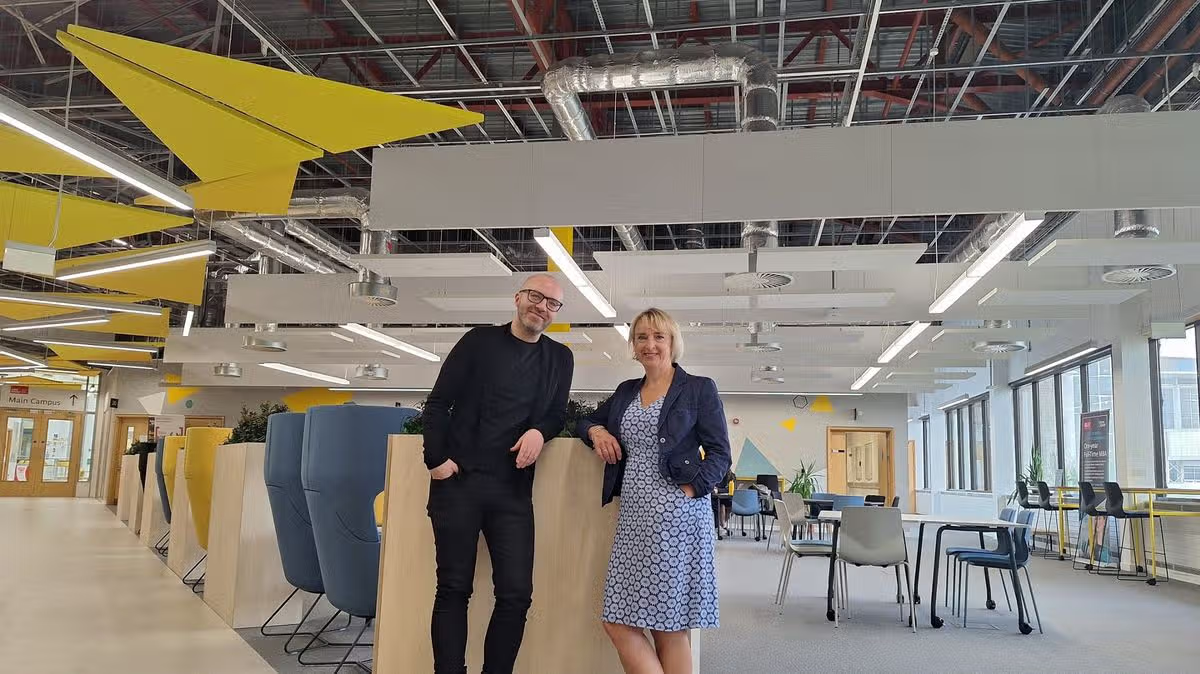
Professor Matt Freeman, Future Space centre director, and Tracey John, director of research and external engagement at UWE Bristol

Professor Matt Freeman, Future Space centre director, and Tracey John, director of research and external engagement at UWE Bristol(Image: UWE Bristol)

A university start-up hub has created nearly 1,000 jobs and contributed £56m to the economy since it was established a decade ago, those behind the initiative have said.

Future Space, the University of the West of England’s (UWE Bristol) innovation centre, was founded in 2016 as part of the Government’s University Enterprise Zone programme. The hub is based at Frenchay campus and offers workspace, university research facilities and business support to start-up and high-growth companies.

Since its founding, Future Space has generated more than £136m in investment and grants, according UWE, and assisted 178 businesses – from robotics to AI to biotech firms – to launch some 588 products.

The centre is managed in partnership with Oxford Innovation Space.

Advertisement

Professor Matt Freeman, centre director of Future Space, said: “Over the last decade, Future Space has become a place where businesses, researchers and student talent stop operating in separate worlds and start innovating together.

“Our impact figures tell a story of hundreds of new products and innovations, almost a thousand jobs, over £136m of investment secured, and thousands of moments where researchers, students, founders and partners have come together to turn ideas into real-world impact.”

The companies Future Space has supported include Albotherm, which offers temperature-responsive greenhouse coatings to support sustainable farming, and cell and gene therapy business eXmoor Pharma.

Another is SAH Diagnostics, which delivers specialist cancer diagnostic services to 34 NHS trusts and hospitals across the UK.

Advertisement

After three years at Future Space developing the world’s first mobile urology unit, SAH Diagnostics has recently opened a new cancer diagnostic centre in Bradley Stoke.

The company has supported the treatment of more than 400,000 patients to date, partnering with UWE Bristol to develop community outreach programmes and working towards an accredited training and education programme.

Tracey John, director of research and external engagement at UWE Bristol, said: “Future Space demonstrates the vital role universities can play in driving innovation, supporting business growth and creating opportunities for people and communities.

“As we celebrate this milestone, we are also celebrating Bristol’s strength as a city of innovation – one that continues to show how partnerships between universities and businesses can help address some of society’s biggest challenges while creating sustainable economic growth.”

Advertisement

In the last year, over 400 UWE Bristol students have engaged with businesses based at Future Space through student projects, funded internships and part-time roles, according to the university.

Jo Stevens, managing director at Oxford Innovation Space, added: “At Oxford Innovation Space, we believe that when innovative businesses are given the right environment to grow, they create jobs, attract investment and strengthen local economies.

“Future Space is a fantastic example of this in action. Over the past 10 years, it has become a catalyst for innovation-led growth in the West of England, helping ambitious founders turn ideas into successful businesses and delivering significant economic impact for the region.”

Advertisement
Continue Reading

Trending

Copyright © 2025