
Entertainment
Common Knows What It Takes To Change the World

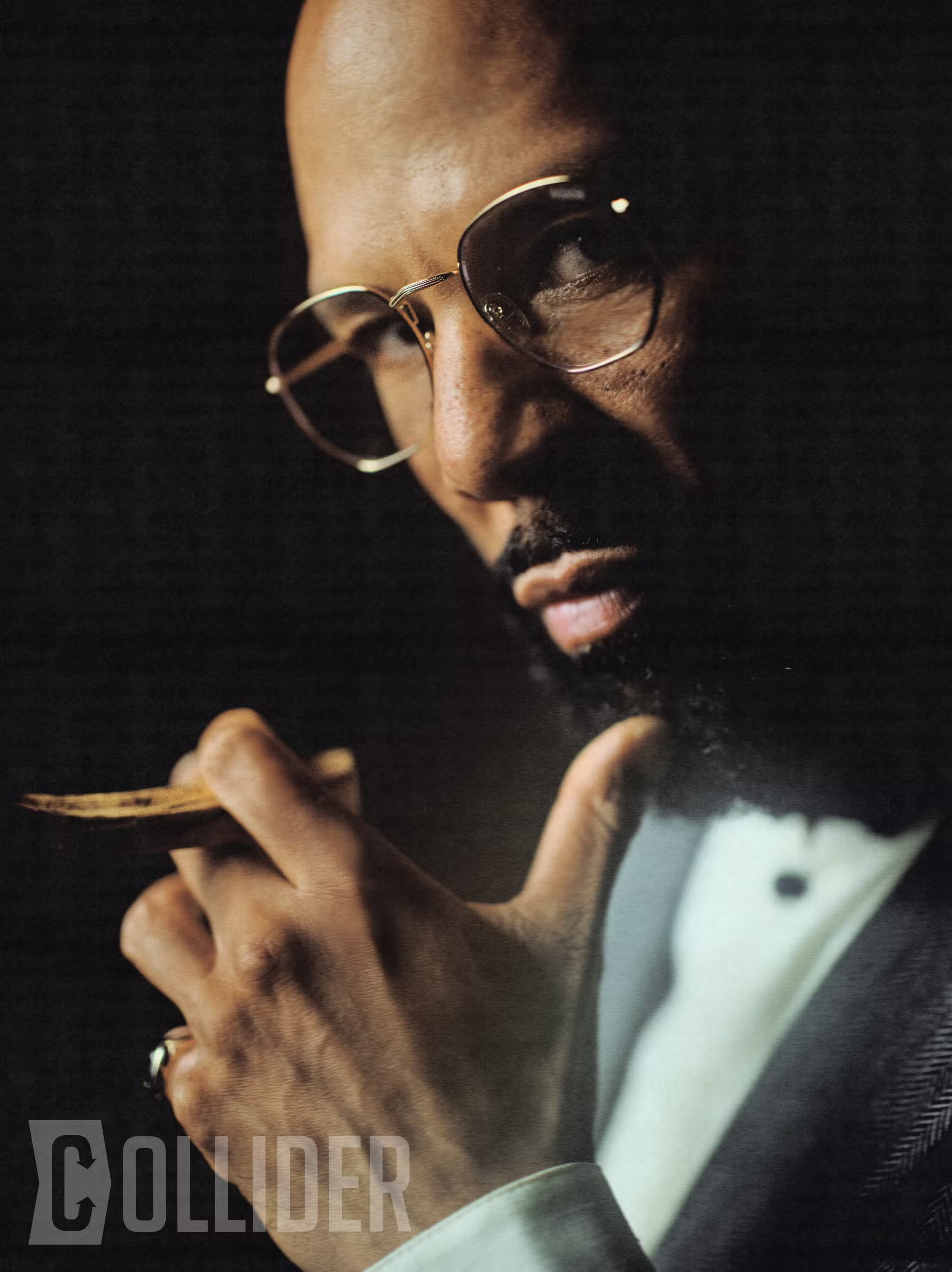
Common has never really been too interested in staying in one lane. More than three decades after first breaking out as a rapper and going on to win multiple Grammys, the Chicago native is still adding new chapters instead of repeating old ones. He might have first lit the flame with music all those years ago, but after a single spark led him to film, television, writing, and activism, none of it feels like reinvention for reinvention’s sake. Long before he was the calculating Robert Sims on Apple TV’s groundbreaking sci-fi, Silo, he was making songs that lingered because they felt lived in. That thread still runs through his work today.
Decked out in an all-white ensemble with a loose sweater draped over his shoulders, Common is the epitome of cool on a Tuesday afternoon in Los Angeles. Junket days rarely leave much room for small talk, but he never rushes our time together. Instead, he greets me with a warm smile, pauses before answering, and speaks with thoughtful intention. It’s even more obvious when I ask about what it means to him to create work that stays with people.
“When I first started my work as an artist, music, all I knew was the love I have for it. I was just putting in my soul and my spirit and my creativity, my imagination, my love for it as a fan of music and all types of art. But as I started to create and put music out there, I liked the way it felt when I created art that resonated with people,” Common says, emphasizing the importance of that element over any record sales. “It was more about the way people responded to the music, that light that I could see in their faces when they were at the shows, the conversations I would have with people about the music. And I think from that point, I realized the power of art; I saw what art can be.”
Listening to him, it’s hard not to draw comparisons to The Flamekeepers in his Apple TV series, Silo. While the group does persist in the deep dark silos, their sole purpose is to preserve fragments of the past so that truth survives. Common isn’t trying to archive history in quite the same way, but there is a similar instinct behind the work he has chosen throughout his career. Whether it’s Selma’s Oscar-winning anthem, “Glory,” his roles in The Hate U Give or Hell on Wheels, or the causes he lends his voice to, Common is continuously drawn to work that outlasts the individual moment in which it was created.
‘Silo’ Season 3 Finally Lets Robert Sims Out of the Shadows
If Common believes the best art lives beyond a specific point in time, then Silo has quietly become one of those rare television series doing exactly that. Fans of the Apple TV show don’t just watch it religiously; they debate and dissect every single frame. It’s that level of attention that makes Robert Sims’ evolution even more satisfying this time around, and he steps into Season 3 as one of its most fascinating and complicated characters.
With his slick black leather jacket, sharp turtleneck, and quiet evil-henchman energy that could rival even the most legendary Bond villains, Robert has spent two seasons as one of Silo’s most intimidating figures — enforcing rules, protecting Judicial, and standing firmly behind a system that rarely welcomes questions (and rarely tolerates them). But he always seems to know more than he’s saying, which is exactly what makes Season 3 such an interesting turning point for the character.
“When you find [him] at the end of Season 2, he and his wife Camille [are] going back and forth on the right way to do it. Some of the things that he believed throughout his life were being questioned, and his wife was one of the people who was bringing it to him. But internally, he was also having questions about the things that he had been fighting for and standing up for and being the head of Judicial for.”
Common never once describes his character as a man losing power, but more as someone losing certainty, and that difference matters. While Robert finds himself caught between the job he’s expected to do and the doubts quietly building beneath the surface, he is one of the people trying to keep everything together despite a cracking foundation. One of the smartest choices Graham Yost’s adaptation of Hugh Howey’s novels makes this season is refusing to turn Robert into either a hero or a villain.
“What interested me the most was the fact that this season, we get to see the human being,” Common reveals. “When you are dealing with trying to protect your son and create something right for your child… [or] when you’re dealing with a relationship, a marriage that you’ve put all your heart and soul into, and built this secure place for your family, and all that is unraveling, and you’ve got to deal with a lot of different emotions, you question a lot of things about yourself.”
For Common, Alexandria Riley’s Camille is the key to understanding Robert this season. Watching those two drift to opposite sides of the same question also gives Season 3 some of its emotional weight, especially because neither of them is acting out of spite toward the other. They’re just arriving at different conclusions, which Common views less as conflict and more as growing uncertainty.
He sees that what she’s been fighting for may not be wrong.
“You could be in a place of authority, but inside, be in a place of unknown, and really trying to find yourself and find your way.” That said, Common admits that his character isn’t “really grounded” at the start of the season, either. “That first episode, though, he has to do the job. It’s like being in a job, and you’re not sure you’re in the right place, and you’re doing the right thing, but you’re still executing it. He has a lot of questions that need to be answered and decisions that need to be made.”
One of the biggest changes Common stresses about Season 3 is how Robert and Camille are at opposite ends of what it means to protect those in Silo 18. “What’s even causing more turmoil and more of him being disgruntled is that he and his wife, the person who was the security blanket, the person who was his confidant, they’re not vibing,” he says.
That tension with his wife that also changes how Robert looks at Rebecca Ferguson’s Juliette. While originally, she represented everything he believed threatened the silo’s survival, she’s now become something else entirely. “I really think that Robert has more room for compassion for Juliette at the beginning of the season,” Common says, adding that there is an element of wonder in how Robert views her, given that she was the only person who went out to clean and came back alive. “He sees that what she’s been fighting for may not be wrong.”
That shift is part of what makes Common’s scenes with Ferguson, whom he describes as a “free bird,” feel so different this year, too. They’re not exactly playing opponents, but more so two people slowly discovering that they may have been searching for the same thing all along, even if they took different roads to get there. Robert’s question of “What is the truth?” also gives him a better understanding of Juliette’s cause.
“They haven’t had any time to communicate or bond, but he looks at her differently. He sees her differently, with more respect and understanding, and wonder.” The scenes he shared with Ferguson, Common says, had “life to them,” simply because the two were so present for each other. “It was interesting to play in the first episode because I know that Robert, as a character, was deceiving her, but I also cared about her.”
Common Has Never Been Afraid of the Risk

That kind of compassion isn’t something Common wields depending on the role. It’s actually the same instinct that’s guided him since he first picked up a microphone in the late 1980s as a student at Luther High School South in Chicago. Long before audiences knew him as Robert Sims on Silo, they knew him as a rapper who wasn’t afraid to grow beyond expectations. That willingness to move before everyone else also defined some of the biggest swings in his music career.
But before Common addresses the risk of 2002’s Electric Circus, the singer-songwriter highlights the impact his favorite artists had on him in terms of what their music could hold for others. “Growing up, it was Stevie Wonder, KRS–One, Nina Simone, Aretha Franklin, and Earth, Wind, and Fire, all these artists who shaped my life and influenced me to be who I was,” he says warmly. “I realized, ‘Wow, this is something that my art can do.’”
It’s interesting that even now, after Grammys, platinum records, and an Academy Award, Common still talks about music not as a form of entertainment, but more as a responsibility. Those artists didn’t simply soundtrack his childhood, but showed him that songs could shift the way we think, feel, or even see ourselves. That’s the standard he quietly set for his own work long before anyone started calling it influential. “I just did my best, and I continue to do my best to be as honest with where I am as an artist,” he says with a smile. “I want to stay open and stay free to grow and keep the higher purpose in the work that I do. I believe that that is what will allow things to have a timeless effect, and when you put the truth into it.”
As luck would have it, that philosophy would finally be tested. By the time his fourth album, Like Water for Chocolate, arrived in 2000, Common had reached the widest audience of his career. His second single off the record, “The Light,” became a smash hit, introducing his music to listeners far beyond hip-hop’s core and giving him his first real taste of commercial success. “That was the first time I was really on the summer jams in Seattle, in Alabama, in freaking Chicago to Brooklyn, to New York, L.A.,” he reflects. The record, which was also produced by J Dilla and Questlove, is one he looks back on fondly as “really soulful and different.”
But while the easier decision would’ve been to make Like Water for Chocolate all over again, Common went in another direction with his sound. After listening to artists like Pink Floyd, Jimi Hendrix, Radiohead, and Stereolab, the artist wondered what those sounds would become through his own perspective. “What does that sound like coming from me, coming from this Black man here from the South Side of Chicago? How do I interpret that music that’s inspired by that?’ And that’s what Electric Circus became,” he says. “And it was very risky.”
Risk, as it turned out, came with consequences, as Common admits. “At least from the hip-hop audience, they were like, ‘Oh, we don’t like this.’ The critics didn’t dig it,” he recalls with a laugh. “Man, it was a tough time, to be honest.”
Time, however, has a funny way of changing the conversation. In the years that followed, the resurgence of the album on streaming would find fans calling it a cult classic. “That album was labeled as one of the most innovative and creative and classic albums of that time period,” he grins. “People to this day come up to me and say, ‘Man, one of my favorite albums of yours is Electric Circus.’”
Common doesn’t tell that story like some kind of victory lap or sign of personal vindication. If anything, he sees it as proof that chasing the truth is usually worth the wait. “As an artist, you gotta go where you are, the love, what you care about,” he adds. “There’s something in creating something from a truthful place that at least allows it to have a timeless effect. It might not always, but it will at least be allowed if you create it from a place of truth. So, that was my truth at that time.”
‘Hell on Wheels’ Taught Common to Trust the Journey

After the creative gamble of Electric Circus, Common found himself searching for another place to grow, and as luck would have it, he found it somewhere he never expected. “My first acting class was like, ‘Wow, I feel that freedom. This is what it should be. This is what I believe God wants me to do, also.’ So I did.”
Never wanting to be “put in a box as a musical artist,” Common now admits he needed to express himself in some artistic way, where he could “feel free.” That sentiment eventually led him to Hell on Wheels, where he spent five seasons playing the incredibly layered former slave turned Chief of Railroad Police, Elam Ferguson. Looking back almost 10 years to the date of the series finale, Common doesn’t simply remember his time on the award-winning drama as another acting credit. Rather, he talks about it the way someone remembers the place where everything finally clicked.
“Hell on Wheels, man, that was like a really great college for me,” he smiles, reclining slightly as he reflects on how the AMC series both taught him to work and be present. “It was a real lesson because it was the first time I was working that consistently, and I got to stay in a character and learn more about that character.” For the first time in his career, Common wasn’t just building a character over the course of a few weeks with various crews and directors, but rather over years. As it goes, TV forced him to embrace something he already learned about in music, which is that you can’t always know where the journey is headed.
“When you read a movie script, you know where your character ends, you know what your character may be doing in Act Three. In a TV series, you don’t, so you have to be open to where they take you. They also build on what you bring into the character,” he points out.
Listening to him talk about the show, it’s easy to understand why Silo’s Robert Sims has been such a natural fit across three seasons. There’s a visible pleasure in the way Common describes that process, as though the uncertainty is part of the appeal. He doesn’t seem interested in deciding who a character is before he steps into their shoes. For him, the work is in the discovery.
My first acting class was like, ‘Wow, I feel that freedom. This is what it should be. This is what I believe God wants me to do, also.’
“I always have to go to what the truth of the character is,” he says. “I always have to go to that character’s purpose in the story, and how they serve the story.” That answer leads me to another question, about something I’d noticed between Elam and Robert. On paper, they’re worlds apart. One has spent years fighting against an unjust system, while the other devotes himself to protecting a version of the same. But beneath those differences, both men are trying to light a spark in worlds that ask impossible things of them.
Turns out that Common has been thinking about that connection, too. “I saw some similarities,” he says, almost squinting. “Initially, playing Robert Sims, I was like, ‘Man, me, Rashid, Common, is not the type of guy like Robert Sims. I’m not that type of person.’” But then, as he puts it, Robert began changing for him. “Elam had to fight against that. He had to buck the system in Hell on Wheels early because he was a Black man in the 1800s. But Robert discovered that this system that he was fighting for or standing up for, there’s no truth in that. So now, he is becoming closer to what Elam is in that way.”
What stayed with Common most about Elam wasn’t just that he fought the system; it was that the world never fully hardened him, even after everything it put him through. “One thing about Elam that I really did my best to bring to the character was, as much as this Black man during that time had been through, he still had love in him. He still had compassion and cared about people.”
It’s an observation that says as much about Common as it does about the characters he chooses to play. Whether he’s stepping into a Western or a dystopian sci-fi series, he isn’t interested in people who already have all the answers. He’s drawn to the beats of confidence that lead to curiosity, because that’s where the humanity lives.
Common Is Still a Student of the World

If Hell on Wheels taught Common anything about himself, it was that growth doesn’t end once you’ve found your footing. In fact, it becomes easier to recognize all the places where real evolution comes from. When I ask how all these chapters of his career have shaped the artist he is today, he laughs. “Oh, man, I’ve got so many different eras. It’s fun sometimes to look back and see pictures of myself or even hear myself on albums, and I’m like, ‘Wow, I said that?’ But the thing that I embrace is being open to the growth and being open to the eras.”
Common doesn’t talk about those branches in time as though they’re versions of himself he’d rather leave behind. Instead, he carries all of them with him, even the difficult ones. “All these different facets of life that I’ve experienced definitely helped shape where I’m going now, and I don’t forget those things. Like the shows where people were throwing pennies at me in New Jersey, at this club where I’m opening up for KRS. I don’t forget that.”
The triumphs matter, too, and Common humbly admits he doesn’t forget the “good moments.” He smiles while recounting one conversation in particular, when Prince walked up to him after hearing “The Light,” which was an experience in itself that later led to a collaboration on Electric Circus for the track “Star *69 (PS With Love).”
“When Prince came to me and said, ‘Man, the song, ‘The Light,’ I really dig that song, man. It’s a major chord.’ I didn’t know music theory like that, so I was just agreeing with Prince, like, ‘Yeah, it’s a major chord!’ Those things gave me fuel,” Common says, laughing. It’s a funny story, but it reveals a lot about how he moves through the world. Along the way, success hasn’t dulled his curiosity, but rather sharpened it.
Similarly, almost 20 years after appearing in Ridley Scott’s crime epic, American Gangster, alongside Denzel Washington and Ruby Dee, Common talks about the experience not through the lens of standing alongside Hollywood legends, but as someone still taking mental notes of everything he witnessed on set. “The times in life when I’m sitting on a set and watching Denzel and Ruby go to work… I’m like, wow, I’m picking up all these things,” he recalls. “Even from some artists that may not be as well known, but I still see them at work. All those things and people help shape and form me and inspire me.”
While watching Hollywood icons work is one classroom, life has always served up different lessons for Common. Some of the people who have left the deepest impression on him aren’t your regular Grammy winners or Academy Award nominees; they’re people he’s met while visiting prisons, where conversations have stayed with him long after he walked back out.
“When I visit people who are incarcerated, and I go there and just have conversations with the women and men who are incarcerated, some conversations make me who I am, like the talks I have with them,” he says with a pause. “Or seeing a guy who taught himself piano on cardboard because he didn’t have a piano in prison, and now he can play piano. That’s inspiring to me.”
It’s also one of the clearest insights Common offers into how he moves through life and contributes to it with several nonprofits he also supports, like Imagine Justice, Common Ground Foundation and Free to Dream. He never ranks where inspiration truly comes from — because, between Prince and a man teaching himself piano on a piece of cardboard, they occupy the same space for what’s possible when we refuse to stop growing. “I feel like being open to life and seeking, as you say, curiosity,” he says. “I’m a seeker. Those things really help inform my eras, you know?”
Common’s Most Important Life Lessons Were Learned at Home

Common might call himself a “seeker,” but long before he was learning from legends or individuals in prison, someone else had quietly shaped the way he sees the world: his mother, Dr. Mahalia Ann Hines, an educator and former principal in Chicago. When asked how his definition of creating an impact has changed over the years, he immediately turns to the foundation his mother laid out for him.
“My mother’s a teacher. She got a doctorate in education,” Common shares. “From the beginning, as long as I can remember life, I’ve seen her looking out for people. It wasn’t always in a formal way, but it was like, sometimes students she had, on the weekends, could come to our house and eat or whatever. I’ve seen her taking care of family too, in certain ways, and making sure they were okay, or helping friends get summer jobs.”
Yet he also admits it was never like philanthropic work; it was more for the community and “doing for people that you’re around who are in need.” He knew he wanted to continue with the same call to action he saw from his mother growing up. “Whether it was my homies, my good friends, that needed something, I would try to provide, or I would be a connector to help them get to a certain place in their lives. Whatever they wanted to pursue, I wanted to do that.”
Listening to Common, it’s clear that instinct never disappeared. Instead, the audience just got bigger, and he got more creative with it. “When I got out there as an artist, I still wanted to be that connector, but now for a bigger amount of people,” he says thoughtfully. “Now, it’s, ‘Okay, how can I connect these kids that come from where I come from, or any pocket on the earth, with people who have high potential but don’t have the access, how can I provide to them?’”
When I got out there as an artist, I still wanted to be that connector, but now for a bigger amount of people.
As he talks, the word “access” keeps resurfacing, proving this is a characteristic that is ingrained in every fiber of Common’s being. As his career expanded, so did the knowledge of what he could offer others through his successes. Mentorship became one part of it, but introducing young people to careers they may never have imagined became another.
“The blessing of certain things being successful or certain things getting out there, like winning an Oscar, was like, ‘Oh, these different people now I can make a call to,” he says most confidently. “I can make a call to the CEO of a company and say, ‘Hey, man, we need to do this,’ and we come up with a 10,000-job initiative in Chicago.”
As he puts it, “it evolves” across the board. “Now I know what a gaffer is. Now I know there are people that do sound on the movie,” he says. “It’s 200 people working on this set… They might eventually say, ‘Oh, I want to be a makeup artist. Well, I want to actually be a director of photography.’”
There’s something quietly consistent about the way Common describes all of it. Whether it’s music, acting, or even advocacy, success for the multifaceted artist only seems valuable if it creates another opportunity for someone else. “At some point… I felt like as much work as I put into my acting and into my music, I wanted to have that same type of work into the activism and the philanthropic work I do, meaning have structure and be strategic and be creative with how you can help people.”
Common’s Found Purpose Beyond Purpose

For every road that Common has taken across 30 years, it’s striking how often they lead back to the same place. Music became acting, while acting expanded into activism, and activism grew alongside service. None of it seems driven by his personal pursuit of another accolade; instead, there’s only the desire to leave something behind that genuinely matters.
While Common began our conversation by talking about work that reaches people long after it’s made, by the end of it all, he admits his journey is still just getting started. “I feel like I’m on a quest to be impactful as an actor and be as inspiring and mood-changing and life-changing as an actor and storyteller as I’ve been as a musician for some people,” he says. “It’s about picking projects that resonate with you. Of course, as an actor, you’re like, ‘I want to work! I want to work!’ But you have to still be aware and conscious and mindful of the projects you choose.”
That mindfulness feels like the quiet ember under everything Common does. He doesn’t pretend there’s a secret formula to building a career that lasts, either. “To me, there’s no formula, but those are the only ingredients and things that I can say I’ve put in that have blessed me and allowed me. Obviously, the power, the Most High, and the purpose of what God has put me here to do is allow me, but my consciousness of it and applying it has been those things.”
It’s a sentiment that quietly reframes everything we’ve spent the last hour talking about, as Common admits he doesn’t see art as something to consume or even create. “I’m grateful that you say that I’m a part of art that is lasting, because that’s one of the ways that you can give to the planet.”
That, more than anything, seems to be the driving force Common keeps circling back to — not legacy as a trophy case or a time capsule found in silos hundreds of years later, but as something passed along. By the time our conversation winds down, the question no longer feels like what Common has been chasing, but what has been carrying him all along.
“I hope [others] feel my driving force was about purpose, about spreading joy, about having a connection to God, to a higher power, and seeing the God that exists in all human beings. That will translate into love, so I hope that they feel like, ‘Man, one thing we got from Common’s acting, from his music, and from the work he did for people was that he put love into it, and he had love for them, and I think it was a funnel of the love of God.’”
Photography Credits: Photographer: Gina Gizella Manning | Production Assistance: GIZELLA | Lighting Director: Mike Pecci | Digital Imaging Technician: Mike Tran | Grip: Lance A. Williams
Styling Credits: Barber: Daronn Carr | Grooming: Tasha Brown | Styling: Kate March

Silo
- Release Date
-
May 5, 2023
- Network
-
Apple TV
- Showrunner
-
Graham Yost
- Directors
-
Morten Tyldum, David Semel, Michael Dinner, Aric Avelino

Continue Reading

Seven years before Rylee Arnold and Hailey Bills slayed the Dancing With the Stars season 34 stage, they were both junior pros on the younger iteration of the ballroom competition.
In 2018, DWTS aired a junior version of the competition where a slate of child stars or kids of celebrities competed for a star-shaped mirrorball trophy. The cast included Ariana Greenblatt, Miles Brown, Mackenzie Ziegler and Olympian Sky Brown, all of whom were partnered with a preteen dancer and mentored by a DWTS professional dancer.
For instance, then-pro Lindsay Arnold served as the mentor and choreographer for sister Rylee’s partnership with Black-ish alum Brown.
“Being on DWTS on its own was a dream for me, and being on DWTS with my youngest sister, every single day when I went into work, I was mind-blown,” Lindsay, who won season 25, told Closer in 2018. “I’m so proud of the way that she handled everything, because it’s tough. She was so mature and handled it so well, and it just made me have a really, really strong appreciation for her.”

Rylee Arnold isn’t the first family member — let alone sibling — of a Dancing With the Stars pro or contestant to enter the ballroom. Julianne Hough was the first dancer to face off against her brother, Derek Hough, on the ABC competition series. After Julianne got her start on the series in season 4 […]
Rylee was 13 at the time, and at 18, she became a first-time pro on the legacy competition during 2023’s season 32. Two years later, she returned to the show for her third season, while Bills, who is fellow pro Jenna Johnson’s niece, made her debut in the troupe.
Keep scrolling to see where the rest of DWTS Juniors pros are now:
Rylee Arnold

Celebrity Partner: Miles Brown
DWTS Mentor: Lindsay Arnold
After making her DWTS Juniors debut, Rylee returned to her native Utah to finish middle and high school. She moved to Los Angeles after graduating when she was cast as a pro on the OG series. Rylee’s been paired with Harry Jowsey, Stephen Nedoroscik and Scott Hoying during seasons 32, 33 and 34, respectively.
Hailey Bills

Celebrity Partner: Tripp Johnston Palin
DWTS Mentor: Jenna Johnson
Bills and Tripp, the son of Bristol Palin and ex Levi Johnston, were the first couple eliminated from the junior show. In the years since, Bills continued dancing and performed with judge Derek Hough at a Savannah Bananas game in September 2025. That same month, Bills joined the DWTS season 34 troupe.
Brightyn Brems

Celebrity Partner: Mandla Morris
DWTS Mentor: Cheryl Burke
After dancing with Stevie Wonder’s son, Brems showed off her skills on World of Dance, America’s Got Talent and her high school drill team. Brems also models and choreographs in her free time.
Artyon Celestine

Celebrity Partner: Ariana Greenblatt
DWTS Mentor: Brandon Armstrong
Celestine, a child performer from A Christmas Story Live! and Lip Sync Battle Shorties, has since started an acting career. His credits include Attaway General, Drama Club, S.W.A.T. and Blaze and the Monster Machines.
Outside of performing, Celestine graduated from high school in June 2025.
JT Church

Celebrity Partner: Sky Brown
DWTS Mentor: Alan Bersten
Church was the runner-up on the younger version of So You Think You Can Dance before he and Brown won DWTS Juniors. Church still dances, with credits that include The Music Man’s Broadway revival, This Is Us, Drama Club and Christmas Waltz. Most recently, Church appeared in a Los Angeles Opera production of West Side Story in fall 2025.
Kameron Couch

Celebrity Partner: Hudson West
DWTS Mentor: Hayley Erbert
Couch graduated from the Orange County School of the Arts in June 2025 before enrolling at the University of Southern California to earn a BFA in dance. She also danced music videos for DJ Snake’s “A Different Way,” Kesha’s “My Own Dance” and multiple projects for JoJo Siwa.
Jake Monreal

Celebrity Partner: Sophia Pippen
DWTS Mentor: Sasha Farber
The ballroom dancer has made the leap into the filmmaking world as he entered his early 20s.
“A huge and rewarding undertaking independently producing my first film,” Monreal wrote via Instagram in March 2025. “It’s the first of many to come in this next juncture of my life all due to my tirelessly dedicated and fantastic crew and talent who I can’t thank enough. Eagerly pursuing what’s to come next in acting and directing!!”
He later appeared on DWTS: The Next Pro, which aired in summer 2026, but was the first castoff.
Tristan Ianiero

Celebrity Partner: Alana “Honey Boo Boo” Thompson
DWTS Mentor: Artem Chigvintsev
After appearing in the ballroom, Ianiero danced on Netflix’s 2022 adaptation of 13: The Musical. He now choreographs and teaches intensive classes in New York.
Lev Cameron Khmelev

Celebrity Partner: Addison Osta Smith
DWTS Mentor: Keo Motsepe
Khmelev released his debut music single, “Messed Up,” in 2022. He’s since released songs “All Night,” “Stalling,” “Embarrassing, “Lunar Love” and “Trust Issues.”
Kamri Peterson

Celebrity Partner: Akash Vukoti
DWTS Mentor: Witney Carson
Peterson is still dancing in Los Angeles, even assisting Rylee and fellow DWTS pro Ezra Sosa at the Press Play convention in October 2025. She also attended several season 34 live tapings and joined the troupe for 2026’s season 35.
Sage Rosen

Celebrity Partner: Mackenzie Ziegler
DWTS Mentor: Gleb Savchenko
After Rosen tangoed with the Dance Moms alum, he worked on projects with Kylie Cantrall, Olivia Rodrigo and acted in The Secret That Binds Us. Rosen recently danced on the DZ: Worlds Collide Tour in 2025.


Elliana Walmsley

Celebrity Partner: Jason Maybaum
DWTS Mentor: Emma Slater
Walmsley joined DWTS Juniors after appearing on Dance Moms’ mini team. As she entered her teen years, Walmsley continued dancing and also started acting. Her credits include Girl Talk, Kylie Cantrall’s “Denim” music video, Classroom Confidential and Chicken Girls. Walmsley launched her fragrance line, Escapade Beauty, in 2025.

The Real Housewives of New Jersey star Dolores Catania was one proud mother-of-the groom at her son Frankie Catania’s wedding to his now-wife, Nicole Perricho.
Frankie, 27, and Nicole, 31, said “I do” on Saturday, August 1, in a dreamy destination wedding in Portugal, per social media footage shared by guests.
For the happy occasion, Nicole was the picture of a blushing bride in her long-sleeved lace ball gown with a matching veil. She later changed into a fitted, strapless sheath for the reception. Frankie, for his part, looked dapped in a khaki-colored suit.
Frankie, the son of Dolores, 55, and ex-husband Frank Catania Sr., popped the question to his girlfriend of three years in February 2025.
“An absolutely amazing day celebrating such a special engagement,” Frankie wrote via Instagram at the time, announcing their engagement. “Thank you so much to everyone for the congratulations and warm wishes!”
In the months leading up to the big day, Dolores offered glimpses of Frankie and Nicole’s planning process.
“They want a destination wedding in Portugal,” the Bravolebrity teased during a March 2025 episode of Page Six’s “Virtual Reali-Tea” podcast. “So, we’ll do that and then he’ll have to have something here because my family doesn’t leave Paterson [New Jersey]. … I got them to New York [City for Frankie’s proposal], that was far enough, so it’s gonna be probably two weddings.”

Nicole Perricho and Frankie Catania. Courtesy of Nicole Perricho/Instagram
When Frankie proposed to Nicole at NYC’s St. Patrick’s Cathedral, Dolores actually hid outside.
“Me incognito waiting for the proposal,” the Traitors alum wrote via Instagram Stories, sharing a glimpse of her oversized sunglasses and face mask to go incognito.
Dolores has showcased her family’s life publicly after she joined RHONJ for 2016’s season 17. (In addition to Frankie, Dolores and her ex-husband also share daughter Gabrielle.)

Dolores Catania poses with wedding guests at her son’s nuptials. Courtesy of Lauren Talerico/Instagram
Dolores and Frank Sr., 61, are now engaged to Paulie Connell and Brittany Mattessich, respectively, and remain cordial.
“It wasn’t hard. It came easy after all the fighting,” Dolores exclusively told Us in May 2024 of maintaining a friendly dynamic with her former spouse. “I tell everybody, ‘You’re not going to remember the things you fought about. So, stop fighting [about it]; they’re not important. It’s just not, let things go and just move on with life.’”
She added at the time, “I remember all the good memories we’ve had, the trips we’ve taken together [and] the holidays we’ve shared together. Those are my memories of me, Frank and the family after my divorce.”

Us Weekly has affiliate partnerships. We receive compensation when you click on a link and make a purchase. Learn more!
Meghan Markle isn’t one to step out in loungewear, but she did find an equally comfy, infinitely chicer alternative. Some call them ‘paper bag shorts,’ while others label them ‘Bermuda trousers.’ All we know, though, is that we need them — and at only $38, Markle’s classy look is already in our cart.
This week, Markle made a surprise visit to an Ojai, California Girl Scout camp for a special screening of Cookie Queens, her new documentary. She rocked the perfect summer-to-fall getup, comprised of a short-sleeve sweater, paper bag shorts and loafers.
Markle’s shorts were oddly elegant, entirely wearable and easily the most-searched silhouette of the moment, which is why we’re copying her look from now until well past Labor Day.
Get the Iwh Dressy Trouser Shorts for $38 (was $40) at Amazon! Please note, prices are accurate at the date of publication but are subject to change.
These Iwh Dressy Trouser Shorts channel everything great about Markle’s $345 version. They feature lengthening front pleats and belt loops for a polished, borrowed-from-menswear feel, and the 7-inch inseam hits at a length most people can actually pull off.

If you’re curious how Beverly Hills rich moms dress, take a peek at Jessica Alba at any given time. Her pieces are equally laid-back yet luxe, so dark-wash jeans fit right in. Thankfully, they fit into our budgets, too. Alba’s denim look is 43% off right now! Spotted in 90210, Alba paired a silky black cami […]
Still, it gets even better. These lookalike shorts have an elasticized waistband that provides comfort where it counts and the perfect fit. So, we can safely assume they’re even easier to wear than Markle’s designer option.
The spandex blend material also means these babies move with you, and if you don’t believe Us, just check the reviews.
“Feels like a skirt and flows like one, too,” one person wrote. “I like the material because it is cool in the summer and does not feel snug once buttoned at the waist. Just the right amount of stretch in the fabric, but doesn’t sag after sitting.”
Another five-star shopper shared, “These are some of my favorite shorts. They look elegant but are very comfortable as well. I always get compliments on them.”
Anchored by this sophisticated shorts style, Markle’s Ojai outfit works across seasons. Copy the Duchess’ sweater and shorts moment once the weather turns, or rock them with a tank and cardigan this weekend. They’re the upgrade your wardrobe begs for at this time of year — and ours, too!
Get the Iwh Dressy Trouser Shorts for $38 (was $40) at Amazon! Please note, prices are accurate at the date of publication but are subject to change.
Looking for something else? Explore more chic shorts, and don’t forget to check out all of Amazon’s Daily Deals for more great finds!
UsNow Summer Sale Alert: These Chic Fashion Finds are over 30% off – Plus Free ShippingWelcome to summer with our biggest sale of the year. This summer’s chicest dresses, tops and swimsuits are all over 30% + free shipping. Inventory is limited so hurry before they’re gone. Shop the UsNow Summer Sale –>

The Odyssey‘s Samantha Morton has opened up about being homeless amid her mother’s mental health issues and father’s battle with alcoholism.
“I went pillar to post with foster families, homeless hostels, sleeping by the bins at the back of the Co-op,” Morton, 49, told The Sunday Times in an article published on Saturday, August 1. “I have made choices that have always been about survival, because I watched my mum trying to survive and I watched my dad trying to survive.”
The English actress, who portrays the sorceress Circe in The Odyssey, is the daughter of her late mom, factory worker Pamela, and late dad, coal miner Peter. Peter died last year while Pamela died in 2017 from lung cancer.
“Someone told me I was resilient when I was younger,” she told the outlet. “But sometimes you’ve got no choice other than to be resilient because if you are not you’re dead.”
Morton spoke about her upbringing during an interview with The Guardian in 2009, detailing that she lived between her separated parents’ houses up until the age of eight when she was placed as a “ward of court,” which sees a person placed under the legal guardianship of the U.K. Court of Protection.
She revealed during the interview that her father hit her. “I think anybody who has been abused as a kid – and I was abused as a kid, by various people – will say it’s irrational because violence is irrational,” she said at the time.
The outlet detailed that as a ward of court, Morton moved between foster parents and care homes before leaving school at the age of 13 and “spending most of her early teens raving, taking ecstasy and hallucinogenics with older children and young adults, lawless and lost.”
Morton noted that between the ages of 13 and 14, she was homeless for “almost a year” and would sleep at friends’ houses or “in bus shelters.” Despite her childhood experiences, she added that she never blamed either of her parents. “Never, never my parents. Always authority. Always the establishment. That’s because I grew up in Nottinghamshire in the 80s with Margaret Thatcher destroying everything,” she said at the time. “Just because somebody doesn’t bring up their children or can’t look after their children doesn’t make them a bad person. There are all sorts of reasons … illness. There are so many reasons you can end up in care.”
If you or someone you know is struggling or in crisis, help is available. Call or text 988 or chat at 988lifeline.org. https://988lifeline.org/

The first Dancing With the Stars season 35 troupe member has been revealed!
News broke at DWTS Con on Sunday, August 2, that Kamri Peterson will perform in the troupe for the upcoming season of the hit ballroom competition. The rest of the cast lineup is set to be announced at a later date.
DWTS fans will remember Kamri, now 18, as one of the “junior pros” on the short-lived youth version of the competition. DWTS: Juniors only ran for one season in 2018, where Kamri cha-cha’d with former Scripps National Spelling Bee champ Akash Vukoti under the tutelage of mentor Witney Carson. (Skateboarder Sky Brown and JT Church ultimately won the show as members of Team Alan Bersten.)
After leaving DWTS: Juniors, Kamri has continued her ballroom training and even worked alongside fellow pros Rylee Arnold and Ezra Sosa, in addition to longtime choreographer Mandy Moore. She also attended multiple season 34 tapings last year, in which Witney, 32, took home the mirrorball with celebrity partner Robert Irwin.

The Dancing With the Stars ballroom is filling up fast for season 35. While simultaneously confirming the reality competition’s renewal, Hulu shared during the Get Real House event in April that Summer House’s Ciara Miller and Love Island star Maura Higgins would be lacing up their dancing shoes. The following month, Savannah Bananas second baseman Jackson […]
As for her professional accolades, Kamri has won the World ProAm champions, is a three-time Latin National Vice Champion and a 12-time Latin finalist. She also once represented the United States at the Open World Championships in Paris.
Kamri is far from the first DWTS: Juniors star to make the leap to the main show. Rylee, 21, was named a pro on DWTS for 2023’s season 32, while Hailey Bills made her troupe debut in season 34.

Kamri Peterson. Felicia Barton
The rest of the DWTS pro roster has not been revealed, with the dancers often learning the news just weeks (or days) before the public.
“Typically, once we have a list of the pros that are gonna be on, we then, at some point, we’ll get the opportunity to hear who’s gonna be [on the show],” show host Alfonso Ribeiro exclusively told Us in September 2025. “But it’s never final, right? It’s ever-changing, and there were some pairings that were different three weeks ago [this year].”
Ribeiro, 54, further explained that dance partnerships can continue “to evolve” as casting changes up until the premiere date.

Several Dancing With the Stars pro dancers began their journey in the ballroom in the troupe. The hit dance competition first introduced its troupe during 2011’s season 12, featuring a selection of performers who didn’t have a celebrity partner but still appeared in group numbers and their own “bumpers” between competitive routines. “When I first […]
“You realize, ‘Oh, actually, this is a better pairing than that pairing.’ And they work on it right up until the final day until [the stars and pros] meet each other,” Ribeiro told Us, adding that show executives Deena Katz, Conrad Green and Rob Mills “always get it right” with teams. “They figure it out. I don’t know how they do it, but they always figure out how to put the right people together. They’re magical.”
The celebrity contestants of season 35 will include Ciara Miller, Maura Higgins, Jackson Olson and Guillermo Rodriguez, with even more yet-to-be-announced famous faces also set to tango across the dance floor.
Dancing With the Stars season 35 premieres concurrently on ABC and Disney+ Tuesday, September 15, and Wednesday, September 16, at 8 p.m. ET and streams the next day on Hulu.
Rihanna and ASAP Rocky are celebrating their son’s third birthday with a timely theme.
The couple honored Riot’s third birthday on Saturday, August 1, with a Spider Man-themed bash, featuring balloons, banners and treats. Rihanna’s sister-in-law Nadia King gave fans a glimpse of the bash via Instagram on Sunday, August 2, sharing a video with decor that read “Riot 3” with fitting colors: blue, black and red.
At the end of the clip, the guests all sang “Happy Birthday” to Riot. Rocky, 37, could be seen wearing a white T-shirt with a baseball hat and scarf tied around his head, while Rihanna, 38, opted for a dress.
“Thanks for the invite Riot Rose,” King captioned the video.
ASAP Rocky is a proud papa while celebrating his and girlfriend Rihanna’s youngest son Riot’s first year around the sun. “HAPPY 1ST BIRTHDAY TO MY 2ND BORN SON RIOT ROSE MAYERS ❤️,” the rapper, 35, captioned a series of Instagram photos with the birthday boy on Thursday, August 1. Rocky, who also shares 2-year-old son […]
Rihanna and Rocky, who confirmed their relationship in 2021, became parents when they welcomed son RZA in 2022. The pair then added to their family with son Riot and daughter Rocki in 2023 and 2025, respectively.
“I’ll have kids — three or four of ’em,” Rihanna told British Vogue in March 2020 of her desire to be a mother even if she hadn’t found the right partner yet. “They diminish you as a mother if there’s not a dad in your kids’ lives. But the only thing that matters is happiness, that’s the only healthy relationship between a parent and a child. That’s the only thing that can raise a child truly, is love.”
Since welcoming her and Rocky’s third child, Rihanna hinted that she’s already thinking about adding a fourth to their brood.
“Deciding whether to get hot and sexy or get pregnant in 2026,” Love Island alum Montana Rose Brown wrote over an Instagram video in January, to which Rihanna commented, “Wait! So I’m not crazy then? Bet!”
Rocky, for his part, has been open about how fatherhood — and finding his person in Rihanna after years of friendship — has altered his life.
“A woman will change your whole life, especially if it’s a companion. Before I had my children, being with my girl took my blindfold off,” Rocky said during a January episode of The New York Times’ “Popcast” podcast. “I got with a very special woman.”
He continued, “We’re on the same page. Born the same year. My dad is from her country. When I go back, I get to see both sides of my family. It’s so many similarities. We laugh about it a lot. She was always my boo.”

The West End revival of Stephen Sondheim’s Sunday in the Park With George production is reacting to Ariana Grande’s announcement that the singer will step back from the public eye after she completes her Eternal Sunshine Tour amid public scrutiny and concern over her body and health.
“Following this evening’s announcement from Ariana Grande’s team, we can confirm that she has decided to step back from Sunday in the Park with George,” the production’s official X account shared via a written statement on Sunday, August 2. “We know this cannot have been an easy decision, and she makes it with our complete understanding and support.”
The production added, “We wish her nothing but the best. The production will open at the Barbican in summer 2027 as planned, and casting will be announced in due course.”
Grande was previously scheduled to appear in the production opposite her Wicked costar, Jonathan Bailey.

Ariana Grande has heard it all about her body, and she’s had enough. The Wicked star recently appeared on the web series Oui Oui Baguette where she vented about the body shaming she has faced since first entering the public eye as a teenager. “I’ve been doing this in front of the public, and kind […]
Hours earlier on Sunday, Grande, 33, announced via her rep in a statement to People that she would be “taking a step back from visibility.”
“Ariana will be taking a step back from visibility after she completes the Eternal Sunshine Tour,” a rep told the publication. “She looks forward to finishing the tour and ending it on a high note, both healthily and happily.”

Ariana Grande Getty Images
The rep also confirmed to the outlet that Grande’s decision serves as a “much-deserved break from public-facing work and appearances,” adding that the singer’s prior engagements have caused “endless, ongoing public scrutiny.”
The singer’s announcement comes on the heels of the Friday, July 3, release of her “Petal” music video, which left numerous fans and social media users concerned about the singer’s thin frame, leaving some to allege she is privately battling an eating disorder.
A source close to the singer also told the outlet that Grande “performs healthily and successfully at a very high level night after night,” pointing to the singer’s continued tour performances as a sign she is not unwell.
Grande has not personally responded to the announcement or criticism and concern. Us reached out to her team at the time for comment.

Ariana Grande got very emotional during a performance in Los Angeles. “Thank you so much, oh, my God. L.A., thank you so much,” Grande, 32, said in footage from the second of four performances at Crypto.com Arena for her Eternal Sunshine Tour. “Are you kidding? What the hell? I’ve never in my life experienced a […]
“This tour has been a beautiful experience for her,” the singer’s rep concluded in the same statement to People. “She loves her fans and has loved every minute of this tour so much.”
While the singer has yet to publicly comment on the growing online discourse over her body, she has previously discussed how those online conversations have impacted her mentally and emotionally.
“I don’t do this often. I don’t like it. I’m not good at it,” Grande said in a TikTok video shared back in April 2023. “I just want to address your concerns about my body. There are ways to compliment someone or to ignore something that you don’t like that I think we should help each other work towards.”
If you or someone you know struggles with an eating disorder, visit the National Alliance for Eating Disorders website or call their hotline at (866) 662-1235. Text “ALLIANCE” to 741741 for free, 24/7 support.

Several Dancing With the Stars pro dancers began their journey in the ballroom in the troupe.
The hit dance competition first introduced its troupe during 2011’s season 12, featuring a selection of performers who didn’t have a celebrity partner but still appeared in group numbers and their own “bumpers” between competitive routines.
“When I first started [in the] troupe, I never had professional ballroom training before,” Britt Stewart said on “The Squeeze” podcast in October 2025. “I was trained in ballet and jazz and contemporary and tap.I was not expecting to get a call from Dancing With the Stars for that one reason.”
Stewart, however, had worked with choreographer Mandy Moore on one of Derek Hough’s outside dance gigs that piqued Moore’s attention. (Moore often crafts pro numbers, while former pro dancer Hough is now a judge.)
“Last minute, Mandy was like, ‘Britt, go dance with Derek,’” she recalled. “That [rehearsal] video, Mandy sent to all the Dancing With the Stars producers, ABC, Disney and I got my audition for troupe from that video. … They knew I wasn’t trained, but they knew I could do it.”
Stewart performed in the troupe for five seasons before she was promoted to a pro in 2020.
Other stars, including Rylee Arnold and Jan Ravnik, were cast as pros without appearing in the troupe first. Ravnik, who gained global recognition as one of Taylor Swift’s backup dancers on her Eras Tour, was cast on DWTS for 2025’s season 34. His inexperience in the ballroom led to some criticism about his dance résumé.
“I mean, look, I am new so I’m gonna take every note that they’re giving to me,” Ravnik exclusively told Us Weekly in October 2025 of the judges’ feedback. “I don’t think it’s in a bad way that they’re always saying.”
Keep scrolling to see which DWTS pros got their big break in the troupe — and who went right to competing with a celebrity partner:
Who Were the First Members of the ‘DWTS’ Troupe?
The group was first formed during season 12 and featured Oksana Dmyrenko, Peta Murgatroyd, Nicole Volynets, Tristan MacMahon, Kiki Nyemchek and Ted Volynets. Out of this squad, Murgatroyd was the sole star to eventually be bumped up to a pro — and later won two mirrorball trophies.
Which ‘DWTS’ Pros Got Their Start in the Troupe?
Many of the most recent pros got their start in the troupe, including Stewart, Brandon Armstrong, Alan Bersten, Sharna Burgess, Witney Carson, Artem Chigvintsev, Sasha Farber, Jenna Johnson, Daniella Karagach, Tristan MacManus, Keo Motsepe, Emma Slater and Ezra Sosa.
The troupe also notably featured dancers including Hayley Erbert, Brittany Cherry, Alexis Warr, Marcquet Hill, Roman Nevinchanyi, Kailyn Rogers and Stephani Sosa, none of whom were ever promoted. Warr, meanwhile, is now a pro on the U.K. precursor of the franchise, Strictly Come Dancing. The season 34 class stars Hailey Bills, Onye Stevenson, Carter Williams and Jaxon Willard.
Just like Hailey previously appeared on DWTS Juniors, costar Kamri Peterson joined the troupe for season 5.

Hailey Bills, Onye Stevenson and Carter Williams during season 34. Eric McCandless/Disney via Getty Images
Are There Any ‘DWTS’ Pros Who Did Not Join the Troupe First?
Aside from the OG pros cast before season 12 — including Derek and Julianne Hough, Maks and Val Chmerkovskiy, Mark Ballas, Louis Van Amstel, Cheryl Burke and more — there have been instances of dancers bypassing the troupe. In addition to Ravnik, stars Pasha Pashkov and sisters Lindsay and Rylee Arnold got star partners when they were first hired. Lindsay, however, later claimed she was “demoted” to the troupe after season 16.
“I was given the boot down to troupe for four or five seasons, and then brought [back] up to pro,” Lindsay said on a 2022 episode of the “Trading Secrets” podcast. “I just was not ready. Honestly, that was probably one of the hardest parts of my career even though it’s such an incredible job; it’s an amazing job.”
She added, “You put in more hours on troupe sometimes than you do as a professional because you are basically on call 24/7. You’re on the show’s schedule, always on call, ready to go. As a backup dancer, back when I did it, yes [the salary was livable], because there were two seasons a year.”
What Are the Troupe Duties?
As a member of the DWTS troupe, dancers will perform in short routines in between competitive numbers and as backups to the celebrities.
“They had a time limit in the recent seasons I was on,” Peta Murgatroyd recalled on her “Penthouse With Peta” podcast in November 2025. “It’s like, ‘They can come on for the first two eight [counts] and then end with you guys if you want.’ You can’t have them for the whole time. … [They’re] like little pops in and out.”

Nikki Bella offered an update on her sister Brie Bella’s condition after she sustained a shoulder injury during WWE’s 2026 SummerSlam.
“She’s doing OK. She is in a lot of pain,” Nikki, 42, said during a Sunday, August 2, appearance on Busted Open Radio, commenting on her identical twin’s health. “[Doctors] are still determining what is going on. Brie will share that whenever. I’ve been told to ‘zip it.’”
Nikki and Brie, also 42, stepped into the ring on Saturday, August 1, for a Six-Woman Tag Team Match. The Bella twins joined forces with fellow wrestling phenom Paige to take on Fatal Influence before eventually turning on Paige, 33.
As the twins walked away victorious, Brie could be seen holding her shoulder in pain.

Brie Bella is receiving treatment after sustaining a shoulder injury during WWE SummerSlam. “Yeah, no, she’s injured,” WWE Chief Content Officer Paul “Triple H” Levesque said during a press conference after SummerSlam on Saturday, August 1. “I don’t have an update yet. She was here, got some treatment here [and] has been taken to the […]
“She’s injured. I don’t have an update yet,” WWE Chief Content Officer Paul “Triple H” Levesque said during a press conference later that night, referring to Brie’s condition. “She was here, got some treatment here [and] has been taken to the hospital to get some scans done.”
At the time, Levesque, 57, stated that he didn’t “have a clean answer” about Brie’s health or a recovery timeline.
“I know [she] hurt her shoulder,” he added. “Seems pretty bad, but I don’t have that answer yet. Hopefully, we will soon and hopefully it won’t be as bad as we thought it was, but that’s the nature of the game.”
Brie, who has not publicly addressed her injury, previously told Us that she was looking forward to stepping into the SummerSlam ring.

Nikki Garcia is getting ready to return to the ring. The WWE Hall of Famer — who goes by Nikki Bella professionally — shared an update on her recovery after undergoing ankle surgery for an injury she sustained in the lead-up to WrestleMania 42 in April. In a series of Instagram Stories posts on Sunday, July […]
“This run has been unlike any run we’ve both have ever done,” Brie exclusively revealed of training on Friday, July 31. “I feel so comfortable, and … when you’re so comfortable, and I’m looking at this as, ‘I’m not gonna lie to myself. I’m not in denial. This is my last run.’”
She continued, “It’s, like, you’re gonna go out there and you’re gonna have fun. I’m gonna make sure I take more moments having fun with the audience and looking at them because I don’t know if it’s the last time I’ll be wrestling in the city.”
Despite her readiness, Brie also acknowledged that it would be a “tough match” against Fatal Influence.
“These women are driven, they’re strong, they’re capable of so many things,” Brie told Us. “Then, you put their personalities on top. It’s why they’re moving fast and they’re making names for themselves, and it’s going to be a tough match at SummerSlam because we are looking at our younger selves. We’re seeing these girls, and they’re not going to give up and they’re going to make a name. We love it.”
WWE SummerSlam continues Sunday, August 2, at U.S. Bank Stadium in Minneapolis, streaming live on ESPN+ at 6 p.m. ET.
Entertainment
Netflix’s Whimsical 3-Part Black Comedy Is the Most Underrated Show You Haven’t Rewatched
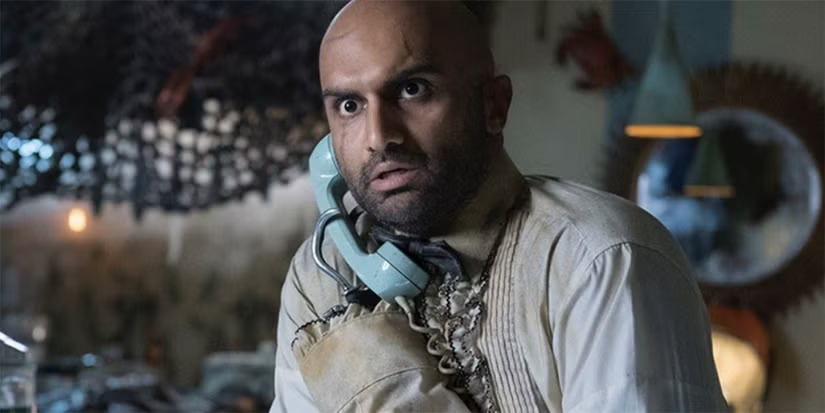
In Netflix’s A Series of Unfortunate Events, Lemony Snicket (Patrick Warburton) tells the dreadful tale of the Baudelaire orphans, Violet (Malina Weissman), Klaus (Louis Hynes), and Sunny (Presley Smith), who recently lost their parents in a terrible fire and are being pursued by a treacherous villain named Count Olaf (Neil Patrick Harris), who is dying to get his greedy hands on their fortune. Visually stunning, delightfully whimsical, and perfectly cast, the series is an adaptation of Lemony Snicket’s (an alias for author Daniel Handler) 13-book children’s series — a much more successful adaptation than the failed 2004 film (sorry, Jim Carrey).
For the average viewer, especially an older viewer, A Series of Unfortunate Events is a fun, if repetitive, ride that roughly follows the same formula: The highly intelligent Baudelaires are placed in the care of a completely incapable guardian, Count Olaf finds them and fools the completely incapable guardian with a terrible disguise, chaos ensues, and then the Baudelaires are shipped off to another incapable guardian. It is, quite literally, a series of unfortunate events. But underneath the theatricality, satire, and brilliant original songs, A Series of Unfortunate Events offers something a little deeper than that.
‘A Series of Unfortunate Events’ Adapts the Tone and Feeling of the Original Series
A Series of Unfortunate Events is a children’s story, but if you look closer, it is also a surprisingly sophisticated musing on the nature of morality. As a child reading the book series, I saw a trio of kids outsmarting the adults time and time again — the classic “adults are clueless, kids are smart” trope that is so common in children’s literature. I laughed at the complete incompetence of Mr. Poe (K. Todd Freeman) and all the other foolish adults who were, without fail, astounded when it was revealed that (gasp!): it was Count Olaf in a disguise all along!
A Series of Unfortunate Events is a faithful adaptation of the book series. It’s tremendously gloomy. It’s hilariously absurd. It’s wildly theatrical. It’s a faithful portrait of everything I envisioned in my head when I was a child. As an adult watching the series come to life on screen, I still laugh just as heartily as I did then because there’s no question that A Series of Unfortunate Events is rich with an absurd, sardonic wit. But unlike when I was just a child with my nose stuck in a book, cracking up over Count Olaf’s latest disguise, I now also find myself struck by how surprisingly, beautifully introspective the series is as the narrative unfolds.
‘A Series of Unfortunate Events’ Doesn’t Shy Away From Confronting Moral Dilemmas

The final season of A Series of Unfortunate Events in particular explores difficult, complex questions about morality. In “Grim Grotto,” the Baudelaire orphans meet Fiona (Kassius Nelson), the daughter of the missing Captain Widdershins and interim captain of his submarine, the Queequeg. They are horrified to learn that Fiona’s mysterious brother is none other than Fernald (Usman Ally), Count Olaf’s hook-handed henchman. While the Baudelaires have started to question the nature of nobleness and treachery after they were forced to make some questionable decisions of their own, their confrontation with Fernald is perhaps their greatest moral conflict yet.
Up until this point, the Baudelaires have based all their decisions and their beliefs on the black and white ideology that there are noble people (their parents, the Snickets), and there are villainous people (Count Olaf, Esme). But Fernald forces them to face the reality that there is always more than one side to the story. Fernald, a former V.F.D. apprentice of Anwhistle Aquatics, burnt down the Anwhistle Aquatics headquarters when he learned that Gregor Anwhistle was doing dangerous research on Medusoid Mycelium, a poisonous mushroom he planned to use on their enemies.
The Baudelaires have trouble reconciling the fact that Fernald did a wicked thing, even if it was for a noble reason. Fernald then says what captures the heart of what A Series of Unfortunate Events is really about: Can a person be both noble and villainous? And if so, then where do you draw the line? When does doing something wicked for a noble reason just not cut it? He says, in a classic Snicket fashion, “People aren’t either wicked or noble. They’re like chef’s salads, with good things and bad things chopped up and mixed together in a vinaigrette of confusion and conflict.”
‘A Series of Unfortunate Events’ Made the Baudelaires Question Themselves
The Baudelaires have also done wicked things for noble reasons, which is something they have to confront during the trial in “Penultimate Peril.” It seems like perhaps the Baudelaires have finally found a safe place where they can tell their side of the story after being unfairly persecuted at every turn by foolish adults who fall for Count Olaf’s schemes. But as Lemony Snicket tells us, there is no happiness in this story. When the Baudelaires call Count Olaf to the stand, he flippantly admits to all of his crimes. (Of course, we know later that he’s not worried because the man with a beard but no hair and the woman with hair but no beard are the two mysterious members of the court.) But unlike the Baudelaires, he says, he doesn’t pretend to be noble.
Suddenly, the tables are turned when Olaf reminds them of the wicked things they’ve done, like burning down Caligari Carnival or stealing Hal’s (David Alan Grier) key and breaking into the hospital’s Library of Records. Any viewer with a conscience knows the Baudelaires are victims, and they were forced to make difficult decisions in order to survive. But the Baudelaires are suddenly not so sure. They plead innocent “enough.” Now they have to face the very thing they accused Fernald of: When is it okay to do a wicked thing for a noble reason?
At the end of “Penultimate Peril,” the Baudelaires choose to set fire to the Hotel Dénouement so that the occupants (who are, again, completely useless) evacuate before Count Olaf can release the Medusoid Mycelium. Setting a fire in A Series of Unfortunate Events is the most unforgivable offense, but the Baudelaires are doing it for the noblest of reasons: to save innocents. Of course, every adult they try to warn about the fire acts like a complete fool, as expected. We can safely assume that everyone in that hotel perished in that fire that the Baudelaires themselves set in motion. Now that is dark for a kids’ series. As the Baudelaires escape with Count Olaf, they are plagued by guilt, wondering if it was right to fight fire with fire, literally and figuratively. Their moral compass says what they’ve done is wicked; but is it really that simple?
‘A Series of Unfortunate Events’ Makes Us Question Our Prejudice Against Count Olaf

Count Olaf is one of the most wicked villains in any children’s series. He tries to marry Violet, a 14-year-old girl, so he can obtain her fortune; he threw Aunt Josephine (Alfre Woodard) to the leeches; he threw a very brave and noble librarian into a pit of lions. But even Count Olaf has brief moments of moral clarity. In “Penultimate Peril,” the Baudelaires step in front of Dewey Denouement (Max Greenfield) before Count Olaf can shoot him with his harpoon gun. As Olaf tentatively gives them to the count of ten to get out of his way, he wavers. The Baudelaires slowly walk toward him and remind him that he doesn’t have to do this. And then, in perhaps the first time in the whole series, Count Olaf appears conflicted, and maybe even a little defeated. He lowers his harpoon gun and, with a regretful slump of his shoulders, says, “It’s all I know how to do.”
Later, we learn that it isn’t in fact all he knows how to do since Olaf was originally on the “good” side of the schism — but after Beatrice (Morena Baccarin) accidentally kills his father with a poison dart, making him an orphan, he does what any person facing a tragic loss would do and decides to turn his back on the people who inflicted that loss. Having lost someone obviously doesn’t excuse any of Olaf’s treacherous deeds, but it does bring the concept of good and evil into focus in a way that many kids’ shows do not.
‘A Series of Unfortunate Events’ Gave Its Most Dastardly Villain Depth in a Brand New Way

In the final episode of the series, appropriately titled “The End,” Count Olaf performs one act of kindness before his demise and carries a pregnant Kit (Allison Williams), his lost love, to shore so that her baby will live. Before he dies, he does something shocking. Count Olaf, a proud anti-intellectual, starts to recite a poem to Kit, “The Night Has a Thousand Eyes.” They recite the poem together, and it’s a bittersweet reminder of the life Olaf used to have before the schism, a man who lived in a world that valued literature and art, who then felt betrayed by that world.
His final words — an excerpt from “This Be the Verse” by poet Philip Larkin — are, “Man hands on misery to man. It deepens like a coastal shelf. Get out as early as you can, And don’t have any kids yourself.” It seems like strange parting words, but it makes perfect sense for Olaf, who was yet another person caught up in the cycle of violence, heartbreak, and death that comes with V.F.D. In the end, the Baudelaires are the ones who have the chance to finally break that cycle with Kit’s child, Beatrice II.
Lemony Snicket told us that this story has no happy endings, and it does seem that way in some respects. In the end, the Baudelaires are essentially alone, no guardian and no adults because they’ve all let them down. But the Baudelaires do get a happy ending with Beatrice. They will be her guardians, and they will break the cycle by teaching her that the world is not as simple as heroes and villains, nobility and treachery. The truth is somewhere in between.
Crypto World55 seconds ago
Coldcard Wallet Attacks Enter Fourth Wave, Putting 449 BTC at Risk

Sports4 minutes ago
Rawiller guides Run Harry Run to victory in 2026 Rosehill Handicap

Tech5 minutes ago
The Best Kids’ Backpacks for the 2026 School Year


-

 Business4 days ago
Why Trees Belong on the Risk Register
-

 Fashion3 days ago
Weekend Open Thread: Wit & Wisdom
-

 Politics2 days ago
Meta enters AI-training agreement with far-right ‘propaganda rag’ Newsmax
-
 Entertainment6 days ago
‘Stargate’ Creator’s New Sci-Fi Series Returns for Season 3 Tomorrow
-

 Politics7 days ago
Luke Littler dismantles Gerwyn Price to retain title in Blackpool
-

 Crypto World2 days ago
MicroStrategy Post-Earnings CLARITY Act Push Could Add New Catalyst for Its Stock
-

 Politics6 days ago
The Part of the Electric Transition Nobody Wants to Discuss
-

 Business5 days ago
Major shareholder moves on Canyon
-

 Crypto World2 days ago
XRP Ledger v3.3.0 brings five institutional features
-

 News Videos4 days ago
Bitcoin Enters the 3rd Stage of the Bear Market
-

 Crypto World5 days ago
Kraken Enables Retail Access to Jersey Mike’s IPO via Tokenized Shares
-

 Tech6 days ago
New macOS Sequoia & Sonoma security updates for older Macs
-

 News Videos5 days ago
Claude: Build Financial Dashboards in Minutes (2026)
-

 Politics4 days ago
Luke Littler’s dominance sparks GOAT debate
-

 Business5 days ago
Johnson & Johnson agrees to $5.5B settlement over talc cancer claims
-

 Sports3 days ago
Seema Kaliramna Wins Discus Throw Bronze, Takes India’s CWG Medals Tally To 17
-

 Crypto World22 hours ago
Crypto PAC spending tops $2M in Michigan House race
-

 Business3 days ago
Trump Announces Hamas Disarmament Agreement as Iran Strikes Kuwait Air Base and US Attacks Pause Overnight
-

 Tech5 days ago
Gemini can now summarize the messiest comment threads in Google Docs
-

 Tech1 day ago
ESET tracks rise in malicious AI skills and adaptable malware
You must be logged in to post a comment Login