

Crypto World
Will Financial Markets Crash in July? Iran Ceasefire Collapse Puts Investors to the Test

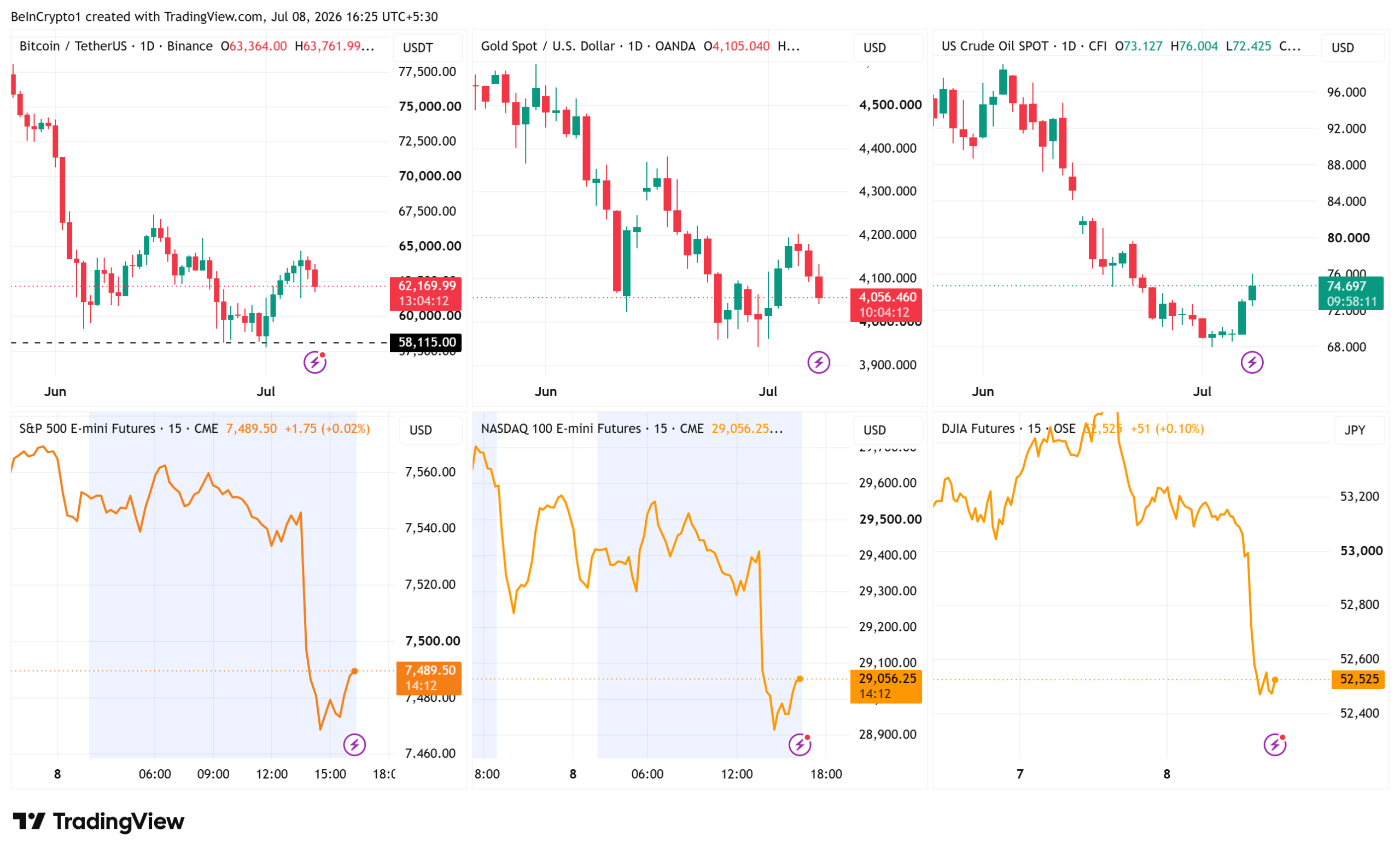
President Donald Trump declared the US-Iran ceasefire over on Wednesday, reviving fears of a markets crash in July. Stock futures fell more than 1% while oil surged and gold climbed.
Wall Street’s early reaction suggests caution rather than panic. The bigger question is whether renewed war risk triggers a deep July sell-off, or whether investors have already built the danger into prices.

Wall Street Repeats a Familiar Risk-Off Script
The US struck more than 80 Iranian targets overnight after Tehran attacked three commercial vessels in the Strait of Hormuz, CENTCOM confirmed.
Iran’s Revolutionary Guard answered with claimed strikes on 85 US military facilities, activating air defenses in Bahrain and Kuwait.
The June truce died less than halfway through the 60-day window negotiators had set. Yet markets responded in orderly fashion. Dow futures fell 1.10%, S&P 500 futures lost 0.87%, and Nasdaq futures dropped 1.33% in early pre-market trading.

Money rotated out of stocks and into safer assets, the classic risk-off pattern.
Brent crude, the global oil benchmark, jumped more than 6% to $79 per barrel. Gold, a classic safe-haven asset, traded near $4,056. Bitcoin (BTC) traded near $62,170, down roughly 1.6% over the past 24 hours, according to BeInCrypto data.
Although Bitcoin initially dropped on Trump’s ceasefire remarks in Ankara, TradingView data showed index futures recovering part of the drop by the afternoon.
Is July Already Priced In?
Investors have traded this war since February, when Iran shut the Strait of Hormuz for the first time since the 1970s. The opening shock cut far deeper than Wednesday’s dip. The S&P 500 fell 5% in March, while global stocks outside the US lost more than 10%, according to Schwab data.
Since then, each truce has sparked a rally. June’s deal even lifted S&P 500 buy ratings to a record 60%.
However, Schwab strategists Michelle Gibley and Chris Ferrarone saw fragility behind that rebound in April. They argued the rally came mostly from traders unwinding bearish bets, not from any real peace.
“We do not view this as a moment to aggressively add risk,” the strategists wrote in the report, which flagged elevated volatility and headline-driven swings ahead.
Follow us on X to get the latest news as it happens
That defensive stance may explain Wednesday’s calm. Investors who had already braced for renewed strikes had less to sell, much as June’s Black Monday fears faded without a crash.
Why a Market Crash in July Hinges on Oil
Crude, not rhetoric, carries the risk of a recession. Brent’s climb this year was already the sharpest in over 40 years of CME Group records, per Schwab.
The firm’s scenario analysis keeps Brent between $75 and $100 in its moderate case, with no major correction. Its adverse case puts crude at $100 to $125 into the second half. That path brings deeper equity corrections and stagnation risk across Europe and Asia.
A severe outcome above $125 implies a global recession and a bear market, a fall of 20% or more in stocks. Veteran trader Dan Dicker already warns of a $135 oil shock. The strait normally carries about 20% of global oil products and 4.5% of world trade.

Tehran’s tone, meanwhile, leaves little room for quick de-escalation. Parliament Speaker Mohammad Bagher Ghalibaf struck a defiant note as the strikes continued.
“The era of bullying and extortion is over… It leads nowhere. We don’t fold,” Ghalibaf said.
July’s verdict now rests on tankers, not rhetoric. If Hormuz traffic and crude prices stabilize, the priced-in camp wins again. A sustained oil spike toward Schwab’s adverse range would hand markets their first true crash test of the summer.
The post Will Financial Markets Crash in July? Iran Ceasefire Collapse Puts Investors to the Test appeared first on BeInCrypto.


Ethereum is slipping by more than 2% as massive $2.5 billion USDT burn on Ethereum dragged its price prediction down. Although ETH barely flinched, as traders believe the burn looks more like Tether moving liquidity than an exit.
Large redemptions often reflect supply shifting between networks instead of cash leaving crypto altogether. Trading volume stayed around $10 billion, showing buyers and sellers kept business humming.
Even so, Ethereum has held onto much of its recent recovery. The token remains roughly 10% higher than a week ago despite today’s pullback. That suggests traders are taking profits without triggering the kind of panic that usually sends charts into freefall.
Attention now shifts to upcoming U.S. inflation and policy updates, which could spark the market’s next move. Until then, Ethereum may keep drifting inside its current range. Traders seem content to wait, even if the blockchain never really sleeps.
Discover: The Best Token Presales
Can Ethereum Price Hit $1,850 This Week?
Ethereum is trading around $1,730 after losing momentum from its recent rebound. The latest pullback has pushed price below the previous support zone, putting sellers back in control. Bulls have some work to do before anyone starts talking about a comeback.
The first support now sits around $1,700. If that level fails, Ethereum could slide toward $1,620, with $1,530 as the next major downside target. Catching a falling knife sounds exciting until you remember who usually gets cut.

Meanwhile, resistance has shifted lower to the $1,750 to $1,770 area. Ethereum needs to reclaim that zone before traders can target $1,845 and $1,865 again. A stronger recovery could eventually bring $1,975 into view, but that remains a stretch for now.
The base case is continued choppy trading while investors wait for fresh macro catalysts. However, a sustained move back above $1,770 would improve the technical picture. Until then, the bears have the upper hand, even if they still can’t resist taking a victory lap too early.
Discover: The Best Crypto to Diversify Your Portfolio
LiquidChain Targets Early Mover Upside as Ethereum Tests Key Levels
ETH at $1,750 is a recovery, not a breakout. Traders positioned since the $1,500 low are sitting on 10% gains, but the $1,865 resistance wall means meaningful additional upside requires a macro catalyst that isn’t confirmed yet. For capital looking for asymmetric exposure without waiting on the next Fed print, early-stage infrastructure plays carry a different risk-reward profile entirely.
LiquidChain ($LIQUID) is a Layer 3 infrastructure project positioning itself as a unified cross-chain execution environment, fusing Bitcoin, Ethereum, and Solana liquidity into a single layer.
An L3 crafted by LiquidChain? — LiquidChain (@getliquidchain) July 6, 2026
That is the most powerful type of Magic.  ⟁https://t.co/vqvBcdSQYC pic.twitter.com/7Rwd3fVOGc
The architecture (Unified Liquidity Layer, Single-Step Execution, Verifiable Settlement, Deploy-Once) targets the fragmentation problem that makes cross-chain development genuinely painful.
As of today, the presale is currently priced at $0.01477, with $890K raised. Recent coverage has tracked its trajectory toward the $900,000 milestone.
Research LiquidChain before making any allocation decision.
Don’t Miss Out on Our $1,000 USDT Airdrop on ByBit
The post Ethereum Price Stabilizes as Tether Burns $2.5 Billion USDT Stablecoins appeared first on Cryptonews.


Nasdaq halted trading in Sadot Group (SDOT) five times this morning as its shares collapsed as much as 72% from yesterday’s close.
The plunge followed a report from short-seller Fugazi Research, which declared that the company has “no meaningful fundamental value and is unsuitable for investment.”
The Nasdaq-listed agri-food company, once a burger chain known as Muscle Maker Grill, still has large financial obligations and evidently collapsing investor confidence.
By late morning in New York, the stock changed hands near $14, down about 65% from Tuesday’s $40.00 close. It briefly traded down to an intraday low of $11.01, or 72% below its 4pm price yesterday.
Each plunge tripped Nasdaq’s trading breakers, designed to maintain orderly market pricing.
As the volatile and relatively small company has swung wildly over the past few weeks, Nasdaq’s limit-up and limit-down circuit breakers have interrupted SDOT trading on roughly a dozen business days since early June.
From burgers to commodities trading
Fugazi Research’s report frames Sadot’s serial reinventions as “monkey-branching” across flimsy businesses. The report’s title derided the company, reading, “Raise Money, Change the Story, Sell Nothing, Repeat.”
The short-seller’s central allegation is that after all of Sadot’s pivots “there is no longer an operating business generating revenue.”
Sadot Group began as Muscle Maker, Inc., a fast-casual restaurant operator, rebranding in 2023 as a global agricultural commodities trader. It positioned itself alongside giants like Cargill and Bunge.
That trading arm booked $132 million in revenue in the first quarter of 2025. One year later, for the quarter ending March 31, 2026, that division reported $0.
Pivots came fast. Sadot sold Muscle Maker Grill and its Pokémoto restaurant brands to Marv Brands in December 2025.
It lost a food farm to a court judgment the same month.
Next, it sold its last trading unit, Sadot Latam LLC, on June 26 for $1,000 in cash plus a share of receivables it does not expect to collect.
As the company pivoted its strategic direction, its balance sheet persisted and deteriorated.
Read more: This penny stock pivoted to Solana and Hyperliquid and lost 99.9%
Sadot Group’s lopsided balance sheet
The company’s Q1 filing shows total liabilities of $60.8 million against total assets of $2.4 million, a shareholders’ deficit of $58.4 million, and discloses substantial doubt about its ability to continue as a going concern.
Management, meanwhile, have been busy diluting shareholders to try to rescue the failing enterprise. In early June it acquired a UAE software company and its trading platform for a headline $12 million, payable almost entirely in stock.
It also took a six-month option on a $125.5 million California real estate portfolio, again payable in stock.
These dilutive events for shareholders have decimated its long-term stock price. Sadot has executed three reverse stock splits within the past two years, most recently a 1-for-20 reverse split on May 27.
Shares have lost 90% of their value over the past 12 months, and 99% over the past five years.
Distressed companies use the reverse split maneuver to manufacture a share price above Nasdaq’s $1 minimum bid requirement per share.
Not enough stockholder equity
However, using reverse splits is not enough to stay listed. Separately, Nasdaq has warned that the company no longer meets its minimum stockholders’ equity rule, and also flagged it in April for filing its annual report late.
Nasdaq’s minimum equity requirement is “either a market value of listed securities of $35 million or net income from continuing operations of $500,000 in the most recently completed fiscal year or in two of the last three most recently completed fiscal years.”
It’s not a particularly high bar for a publicly traded company, yet Sadot Group is certainly struggling to meet it.
Nor is it particularly difficult for a public company to file annual reports on time, but Sadot failed to do that, too.
Fugazi Research also cited a near-term, upcoming catalyst as a possible date of reckoning.
On August 13, Sadot Group is due to release its Q2 earnings announcement. When it discloses results for this quarter, Fugazi Research predicts, the company could disclose that it doesn’t have an operating business generating revenue.
For now, the Nasdaq tape is recording the panic among traders vying for position ahead of the company’s upcoming disclosures about its good, bad, or possibly non-existent Q2 revenue.
SDOT traded as high as $106 intraday on July 2 and closed yesterday at $40.
Shares hit an intraday low of $11.01 today, and its terrifying 52-week range spans from $460 down to $2.63.
Got a tip? Send us an email securely via Protos Leaks. For more informed news and investigations, follow us on X, Bluesky, and Google News, or subscribe to our YouTube channel.
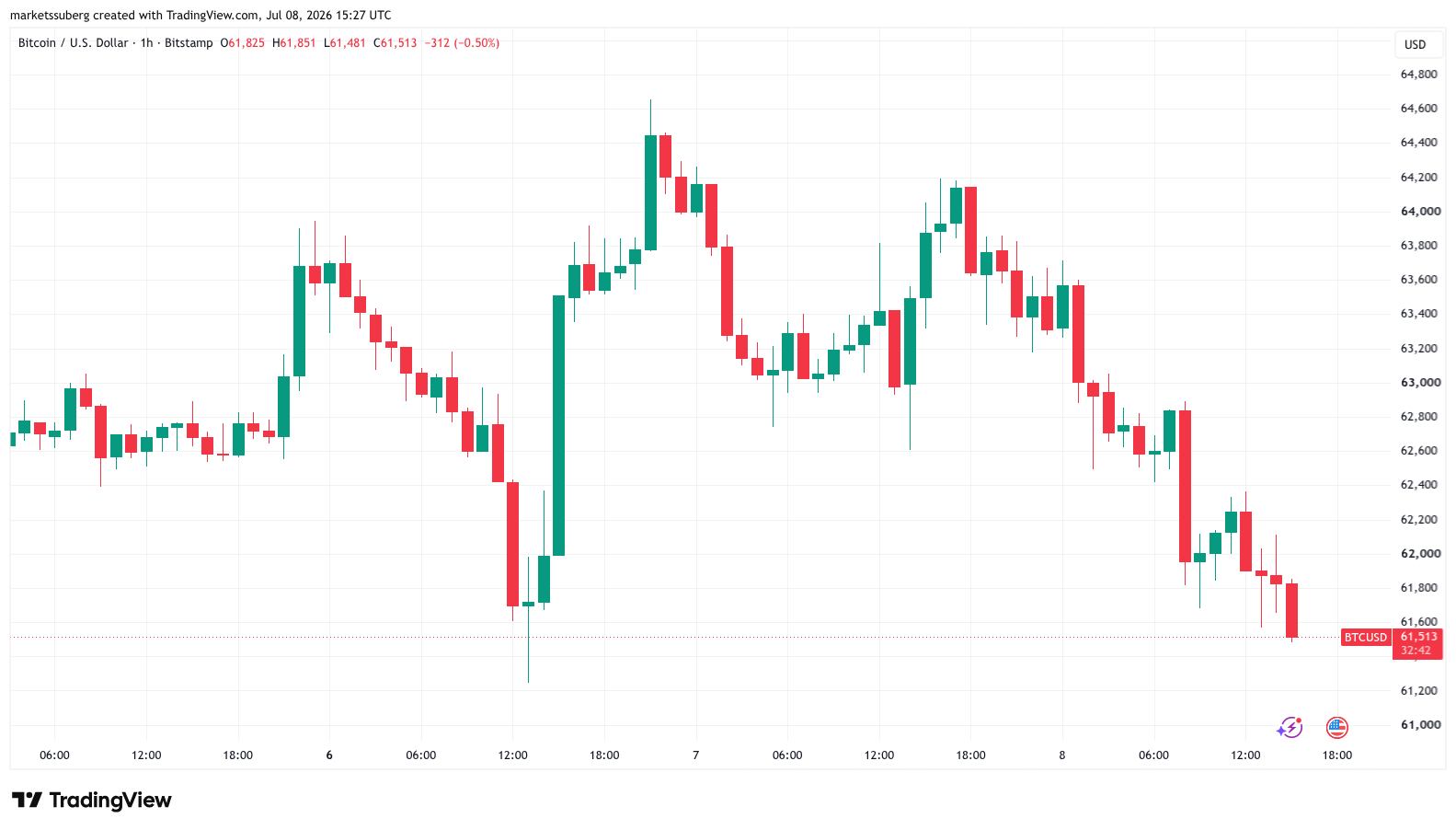
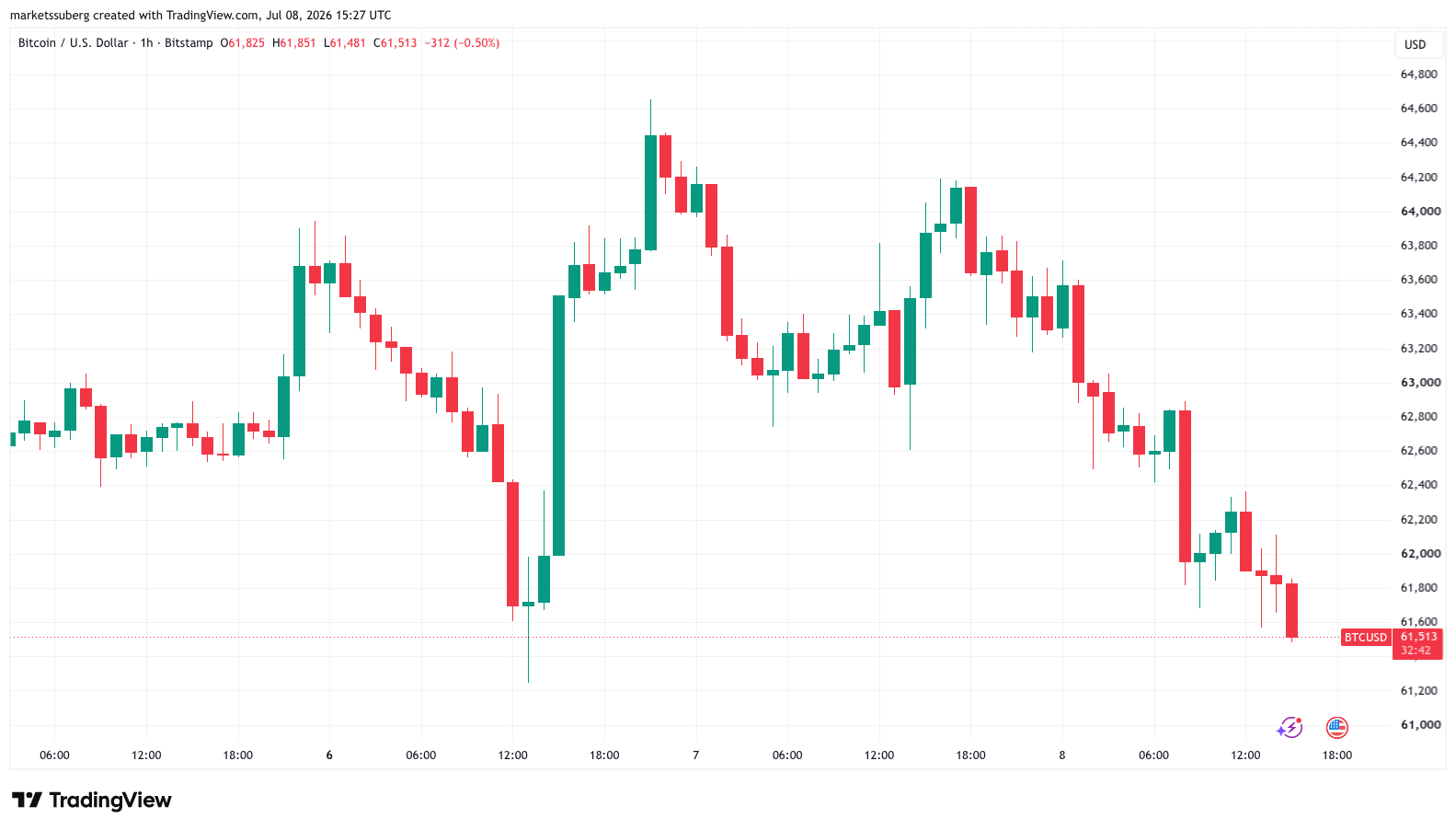
Bitcoin (BTC) stayed below $62,000 after Wednesday’s Wall Street open as US president Donald Trump closing a key world oil route.
Key points:
- Bitcoin drops to $61,500 as Trump says that the ceasefire with Iran is “over.”
- Both sides reportedly threaten to close the Strait of Hormuz, sending oil prices soaring.
- Bitcoin traders anticipate new lows, but analysis sees Trump sweetening the mood later.
Bitcoin gives back gains as Trump says Iran ceasefire “over”
Data from TradingView showed daily BTC price downside circling 2.5% as markets reacted to the collapse of the US-Iran ceasefire.
BTC/USD one-hour chart. Source: Cointelegraph/TradingView
“To me, I think it’s over,” Trump said about the ceasefire during a press conference at the NATO summit in Ankara, Turkey.
Additional reports claimed that both the US and Iran were considering reimposing a blockade of the Strait of Hormuz oil route.
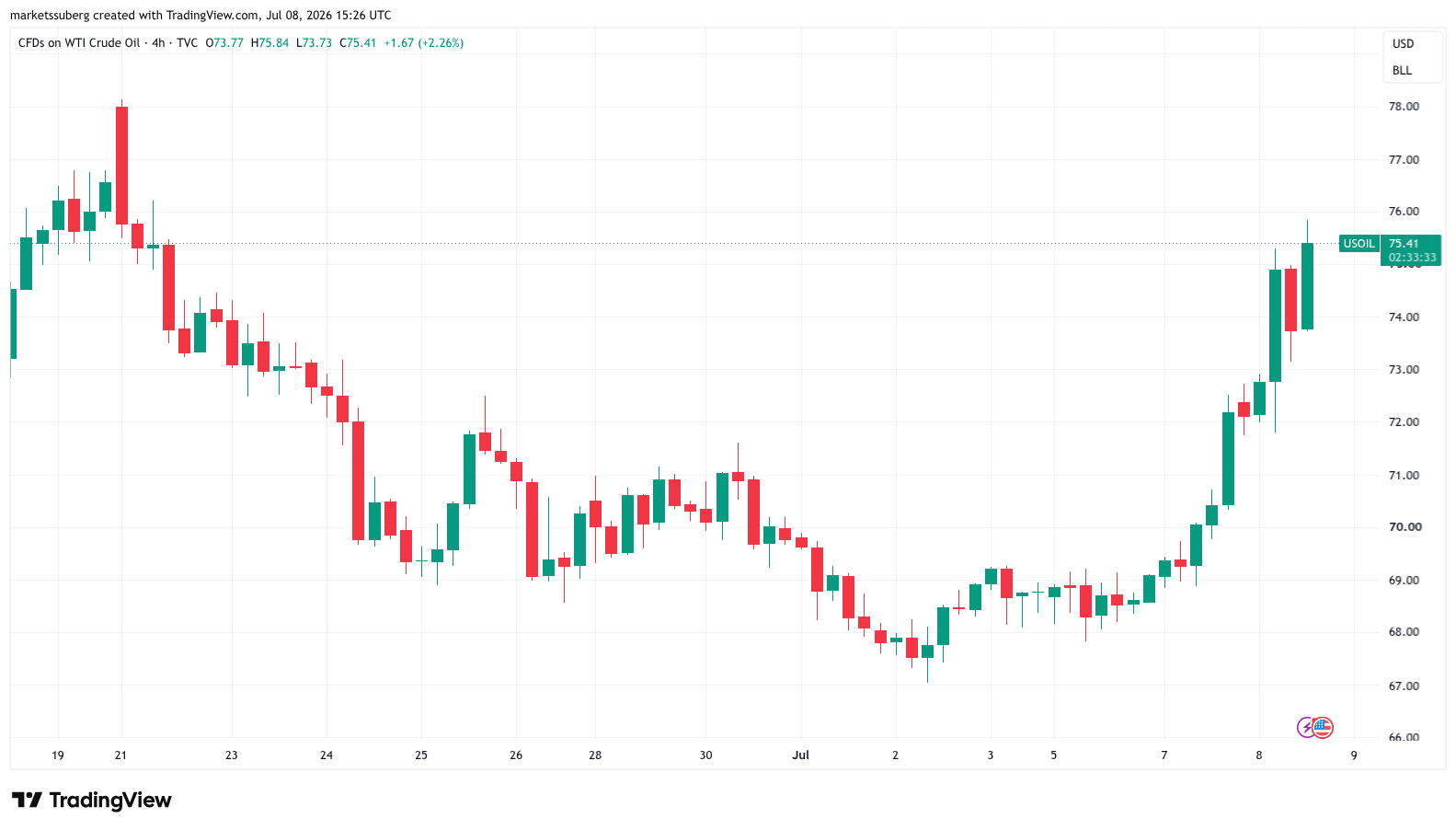
US WTI crude oil passed $75 per barrel on the day, reaching its highest levels since June 22.
CFDs on US WTI crude oil four-hour chart. Source: Cointelegraph/TradingView
The latest events had an instant impact on expectations over financial policy moves by the US Federal Reserve.
The latest data from CME Group’s FedWatch Tool showed increasing odds of an interest-rate hike coming at the Fed’s September meeting, with July’s still tipped to see rates stay at current levels.
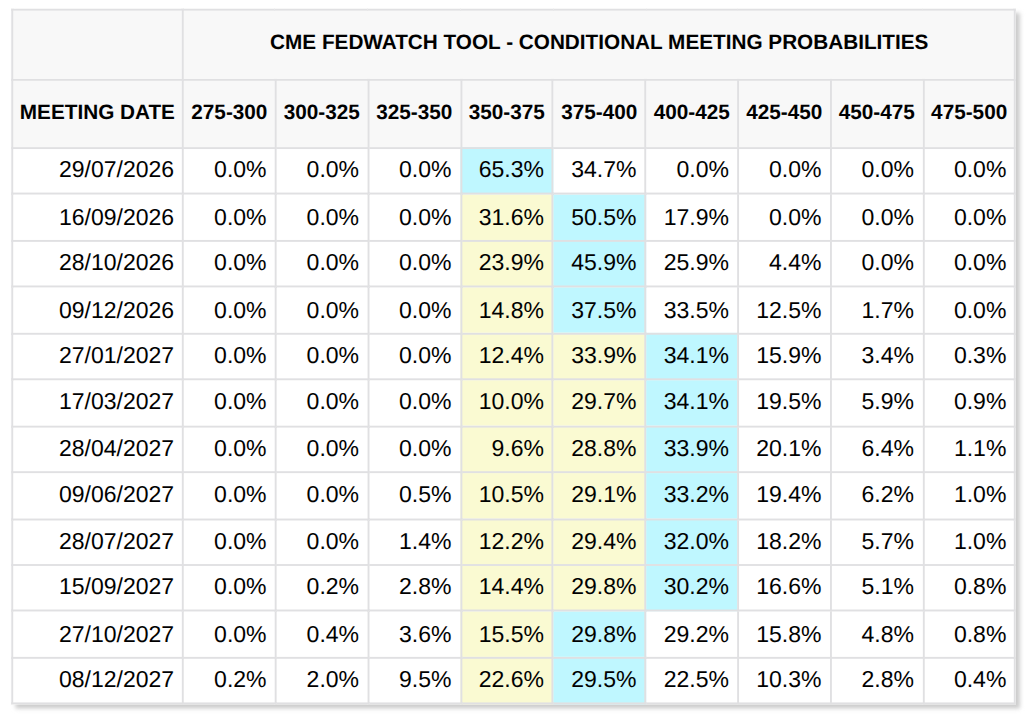
Fed target rate probabilities (screenshot). Source: CME Group
Users on prediction service Kalshi, meanwhile, put the odds of a hike in 2026 at 55%.
Trader names $61,000 as “crucial” BTC price level
Commenting, crypto trader and analyst Michaël Van de Poppe predicted a retest of $61,000 for Bitcoin.
Related: BTC speculators in focus as analysis says ‘textbook Bitcoin bottom’ is underway
“This to happen, and then 1-2 days later; we’re in talks again. And the markets reverse,” he wrote in a post on X.
Earlier, Van de Poppe said that there was “no problem” visible in BTC price action.
“Price remains hovering above $60,000, despite the fact that the Middle East has reactivated the War again. Other than that, as long as it remains a relatively shallow correction, I don’t think we’ll start to see lower levels in the markets,” he wrote.
“The crucial level for me is the $61,000 area.”
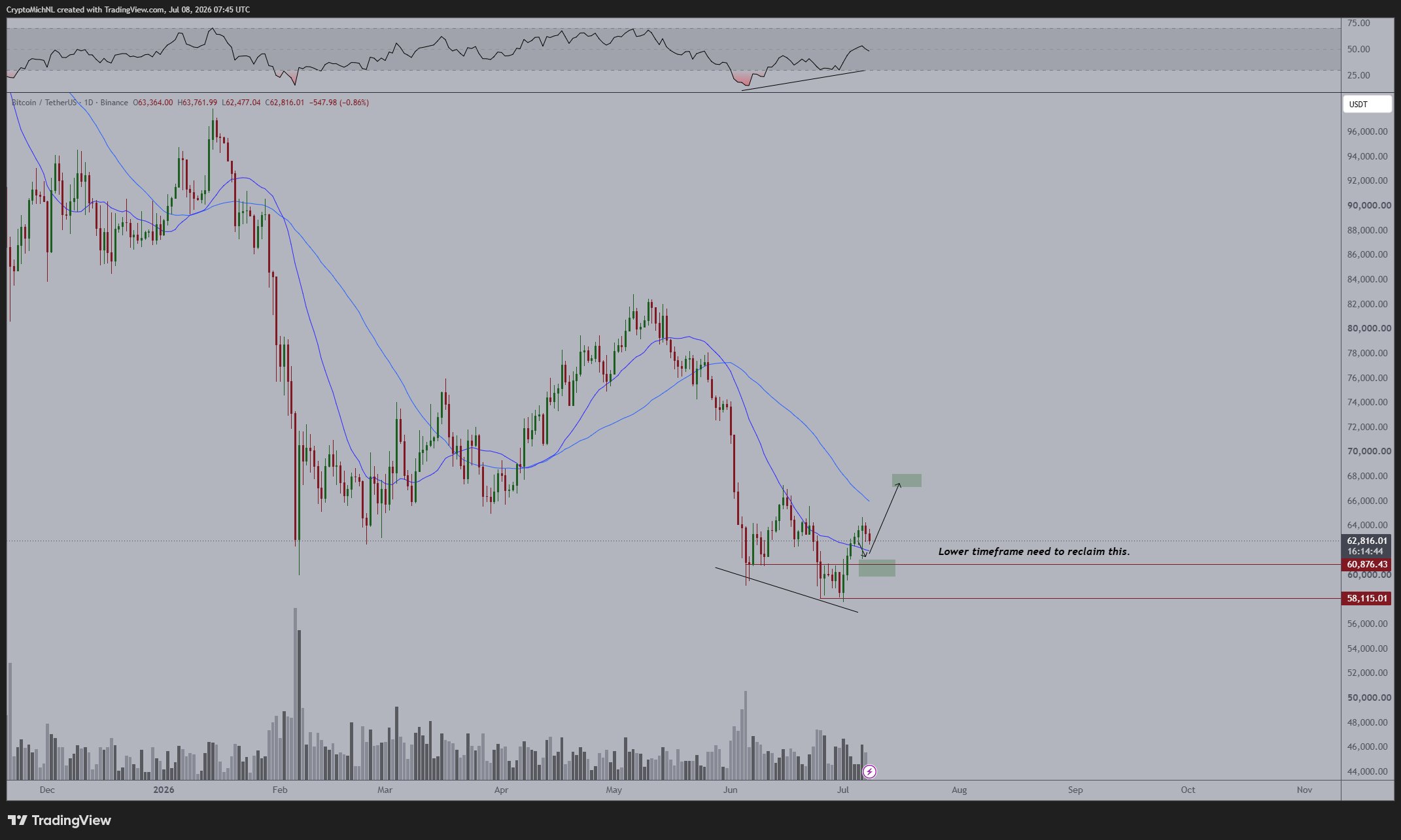
BTC/USDT one-day chart. Source: Michaël Van de Poppe/X
Among traders, anticipation was building over a trip to new local lows.
“Tensions with Iran flaring up again just as $BTC tried to reclaim the previous range lows. Starting to look like we’re getting those cheaper accumulation opportunities we were hoping for,” trader Jelle told X followers.
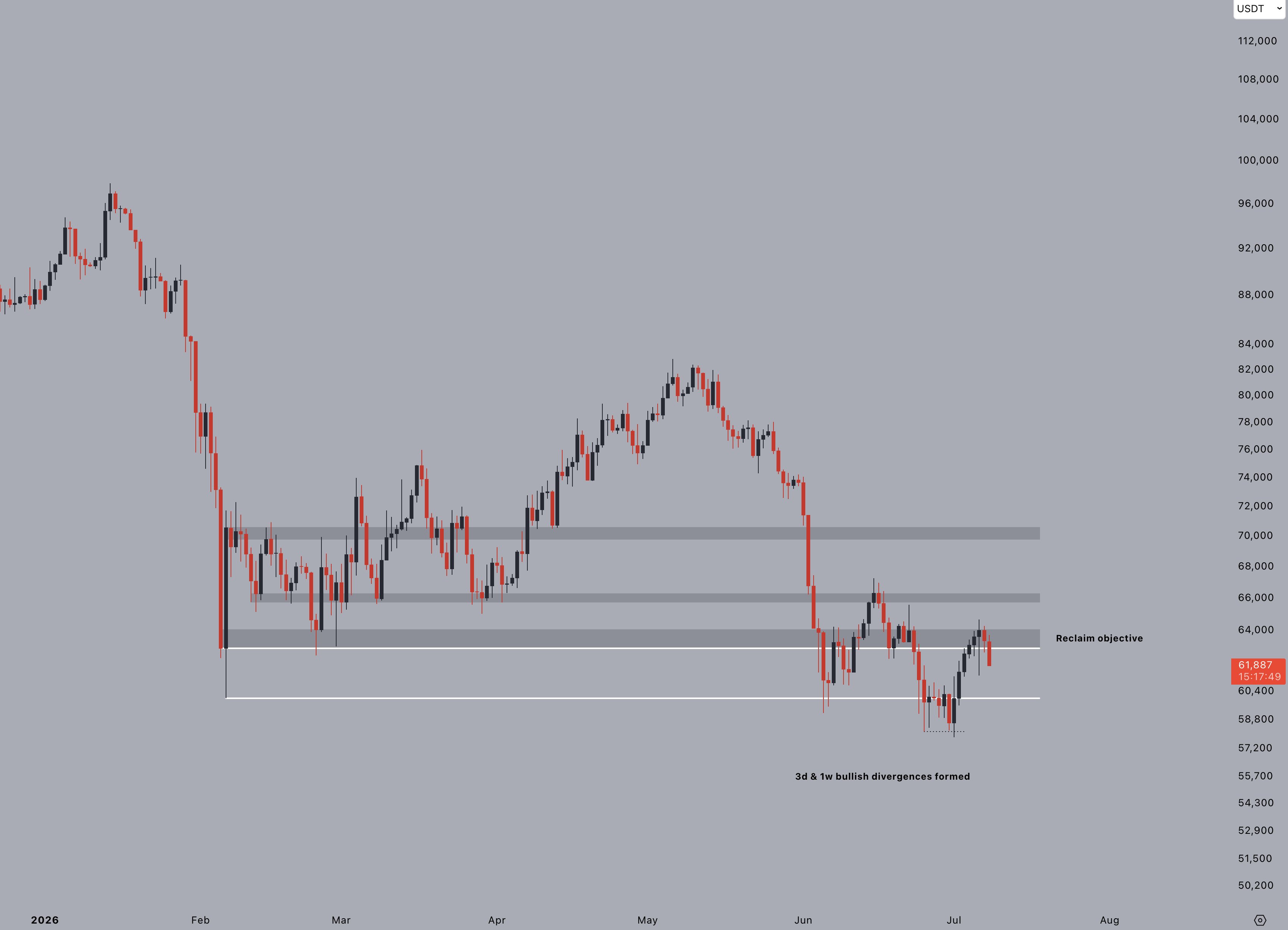
BTC/USD one-day chart. Source: Jelle/X
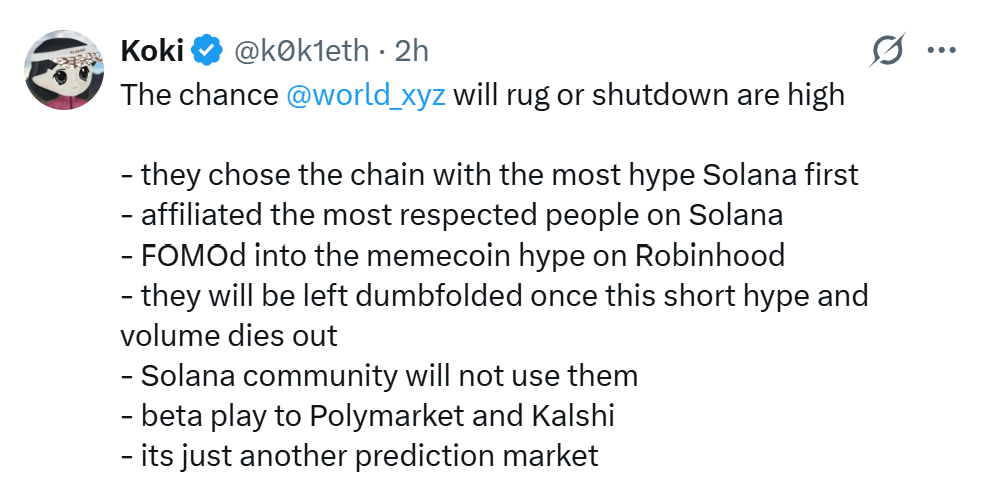
The World prediction market, which launched on Solana (SOL) barely a week ago, said it will move to Robinhood Chain. The team offered no clear reason for leaving so soon after its debut.
The switch reverses a story from days earlier, when World was Solana’s homegrown answer to Polymarket and Kalshi. Now it is tying its future to a mainstream broker’s network.
A Fast Rise for the World Prediction Market
Prediction markets let people bet real money on the outcome of real events, from elections to football matches. World arrived in that fast-growing space with real hype.
The project built attention with a stealth campaign, teasing a glowing globe and the line “Trade Everything” before any product. It then went live inside Phantom on July 1, a wallet with more than 15 million monthly users.
World never holds user money. It settles bets automatically using Chainlink data and pays winners in a stablecoin called CASH.
That hands-off payout set it apart from Polymarket and Kalshi, where users often have to claim their winnings themselves.
The Solana Foundation itself championed the launch. Its head of consumer, Pedro Miranda, called prediction markets a showcase for what the network can do.
The app opened with short-term Bitcoin (BTC) price bets and 2026 FIFA World Cup markets. It also pushed out Kalshi inside Phantom, which had run the wallet’s markets since December 2025.
Its debut landed as the value of open bets across prediction markets hit a record $1.48 billion in June. That figure comes from a16z crypto.
Solana Out of the Prediction Market Race?
World framed the move as a considered choice. In its announcement, the team thanked the Solana Foundation and community but did not explain its thinking.
Follow us on X to get the latest news as it happens
Notably, the team pointed to no technical fault with Solana, which offered low fees, fast trades, and support for Phantom’s users. That silence is why the move looks like a business decision rather than a fix.
The clearest pull is reach. Robinhood Chain launched on July 1 as its own blockchain for tokenized stocks and on-chain finance, built on Arbitrum technology.
Its parent serves nearly 28 million customers across 38 countries, most of them mainstream investors rather than crypto users.
Robinhood also has its own stake in the category. Prediction markets have been its fastest-growing product line by revenue, the company says.
“Robinhood is seeing strong customer demand for prediction markets, and we’re excited to build on that momentum,” said JB Mackenzie, VP and General Manager of Futures and International at Robinhood. “Our investment in infrastructure will position us to deliver an even better experience and more innovative products for customers.”
In its first year, more than 1 million customers traded over 9 billion contracts. Robinhood is now building a CFTC-licensed exchange with market maker Susquehanna.
Continuity helps too. Chainlink, which powers World’s payouts, already works with Robinhood Chain, so its setup can follow along. Such moves often come with grants or funding, though World has confirmed none.
Traders Question the Motive
Not everyone bought the friendly framing. Some users accused World of using Solana for launch-week attention, then leaving once the hype paid off.

Those claims stay unverified, and World has framed the change as a migration, not a shutdown.
Because the protocol never holds user funds, a shutdown alone would not lock up deposits. Still, the doubts flag a real risk for anyone holding open bets.
Still, others see the move as proof of Robinhood’s growing pull, given that a project backed by the Solana Foundation would jump ship so quickly.
The market has rewarded that expansion, with Robinhood’s stock recovering after a notable drawdown earlier in the session.

World Cup betting shows how much money now moves through the prediction market sector. One Polymarket trader lost $11.6 million on those markets in early July.
For now, key details stay thin, including how open bets move and when trading opens on the new chain. Whether the Robinhood bet pays off will hinge on the volume revealed in the coming weeks.
The post The Hottest Prediction Market in Crypto Just Left Solana, But Why? appeared first on BeInCrypto.

American Bitcoin Corp. has surpassed 8,000 BTC, worth $502 million at current prices. Eric Trump announced the milestone on X, saying the crypto company will keep stacking Bitcoin. That stash now places American Bitcoin among the world’s largest corporate holders, moving ahead of several well-known crypto firms.
Corporate buyers keep scooping up coins even as traders wait for Bitcoin to pick a direction. Wall Street may love earnings season, but Bitcoin seems more interested in balance sheets.
Thrilled to announce American Bitcoin crossing the 8,000 BTC mark! — Eric Trump (@EricTrump) July 7, 2026

Even with crypto market volatility, I want to reiterate how we continue to differentiate ourselves, mining at a 52% profit margin in Q1 and continually adding to our treasury, all while maintaining one of the… pic.twitter.com/u7KWeaUjYO
The Trump family’s linked company’s strategy stands out because it mines Bitcoin while steadily adding to its treasury. It also reported a 52% mining margin in the first quarter and maintained lean operating costs. While many public miners sold Bitcoin after the halving to cover expenses, American Bitcoin kept filling the vault instead.
Still, buying headlines alone does not guarantee higher prices. Bitcoin has struggled to build momentum, leaving traders caught between steady corporate demand and cautious market sentiment. For now, accumulation offers support, but the chart still needs to prove it can carry the next leg higher.
Discover: The Best Token Presales
Can Bitcoin Price Break $65,000 with the Help of Trump, The Crypto President?
Bitcoin has settled into a tighter range, trading between roughly $62,800 and $63,200 over the past day. Its market value stands near $1.26 trillion, with just over 20 million BTC in circulation. For now, traders seem happy to watch instead of chase. Even Bitcoin deserves a coffee break sometimes.
The bigger picture still favors caution after Bitcoin confirmed a breakdown from its multi month symmetrical triangle. Price briefly slipped below $60,000 before snapping back, triggering heavy liquidations that mostly wiped out leveraged longs. That flush cleared out crowded positions, but it did not erase the technical damage.
Now, the $60,000 to $61,000 area remains the first line of defense. Meanwhile, the mid $60,000 region has flipped into resistance after acting as support for weeks. Buyers have shown up where it matters, yet they still need enough momentum to push through overhead selling.
Don’t Miss Out on Our $1,000 USDT Airdrop on ByBit
If Bitcoin climbs back above $65,000 with strong volume, short covering could fuel another rally. Otherwise, a sideways stretch between $61,000 and $65,000 remains the most likely path. However, a weekly close below $60,000 would strengthen the bearish case and shift attention toward the $57,000 to $58,000 zone.
Mining difficulty fell by about 10% in early June, marking its second notable drop this year. At the same time, traders continue watching large institutional wallet movements, including a transfer of about 2,700 BTC linked to BlackRock. Those flows may offer clues, but price still gets the final vote. Still, Trump and his influence on crypto could pump Bitcoin at any second.
Discover: The Best Crypto to Diversify Your Portfolio
Bitcoin Hyper Eyes Early-Stage Entry While BTC Works Through Resistance
Traders positioned in spot BTC near $63,000 are looking at a ceiling, not a clear runway. The triangle breakdown means any push toward previous highs above $120,000 requires a full technical reset first, and that takes time. That gap between the current price structure and upside potential is exactly where early-stage infrastructure plays tend to attract attention.
Bitcoin Hyper ($HYPER) is positioning as the first Bitcoin Layer 2 with Solana Virtual Machine integration with sub-Solana latency on top of Bitcoin’s security layer. The presale has raised $33 million at a current price of $0.0136, with staking already live.
The core pitch: Bitcoin’s programmability problem gets solved without abandoning Bitcoin’s trust model. Decentralized canonical bridge for BTC transfers, high-speed smart contract execution, and low fees.
For readers who want to dig into the mechanics, the full breakdown is available at the Bitcoin Hyper presale page.
The post Eric Trump Doubles Down on Crypto as American Bitcoin Amasses 8,000 BTC appeared first on Cryptonews.
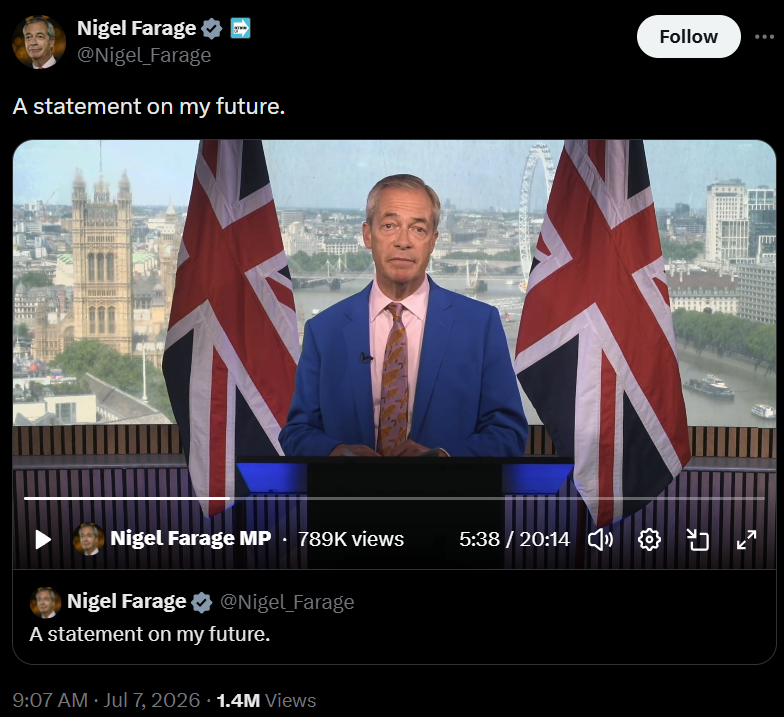
Bank of England Governor Andrew Bailey has reportedly denied that lobbying efforts by Nigel Farage influenced the central bank’s approach to a potential central bank digital currency (CBDC), saying policy decisions were made independently.
According to a Wednesday report by The Guardian, which obtained a letter written by Bailey, the governor said the BoE is “able to spot” attempts to influence its policymaking. The letter followed a meeting with Farage, during which the two discussed several issues, including cryptocurrencies.
“Following our meeting, Mr. Farage spoke with the press outlining that we had discussed a range of topics, including cryptocurrencies,” Bailey reportedly wrote in the letter. “I am happy to confirm that no policy changes have taken place as a result of interventions by Mr. Farage.”
Farage, the leader of the UK’s Reform Party and one of the most prominent supporters of Brexit, resigned his parliamentary seat this week amid reports that he accepted “gifts” from individuals with ties to the crypto industry. He has been an outspoken critic of CBDCs, saying he would “rather go to prison” than live under what he described as a system of financial surveillance.
Despite his resignation, Farage maintained his innocence, stating in an X livestream that he has “not broken the law in any way at all.”
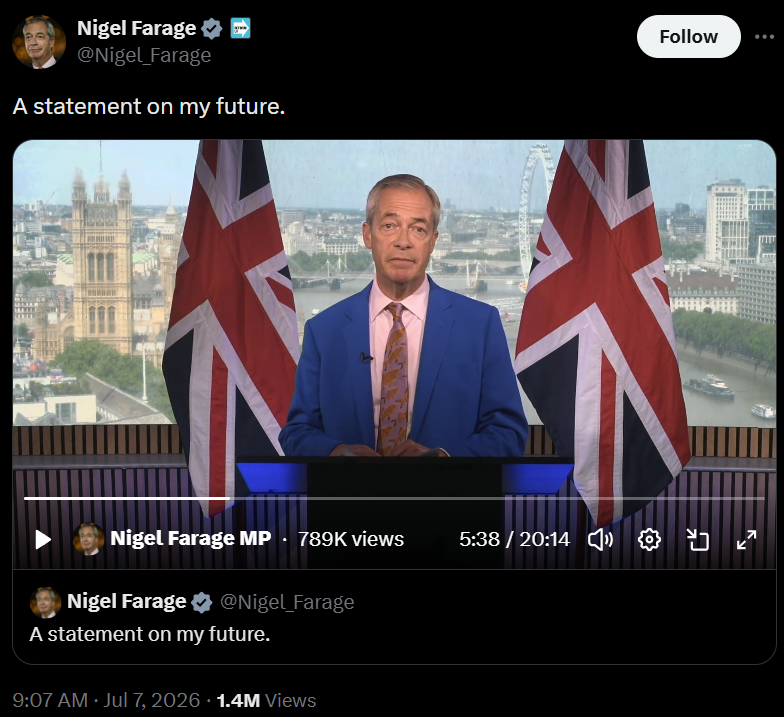
Source: Nigel Farage
Amid the investigations involving Farage, The Guardian also reported Wednesday that the UK’s National Crime Agency is investigating several transactions involving other senior Reform UK figures over suspected money laundering.
Related: Nigel Farage accepted gifts from crypto-linked fraudster: Report
BoE presses ahead with digital pound research
The Bank of England continues to explore a potential central bank digital currency, the proposed “digital pound,” which remains in the design phase as policymakers assess its role in an increasingly digital economy.
“No decision has been made on whether to introduce a digital pound,” the central bank said in a recent update, emphasizing that any launch would require further analysis and public consultation.
Earlier this year, the Bank launched a six-month pilot to explore how tokenized assets could be settled using central bank money. The project, involving 18 companies, is part of the central bank’s broader effort to modernize the UK’s financial infrastructure.
Related: The 5 types of real world assets being tokenized fastest onchain
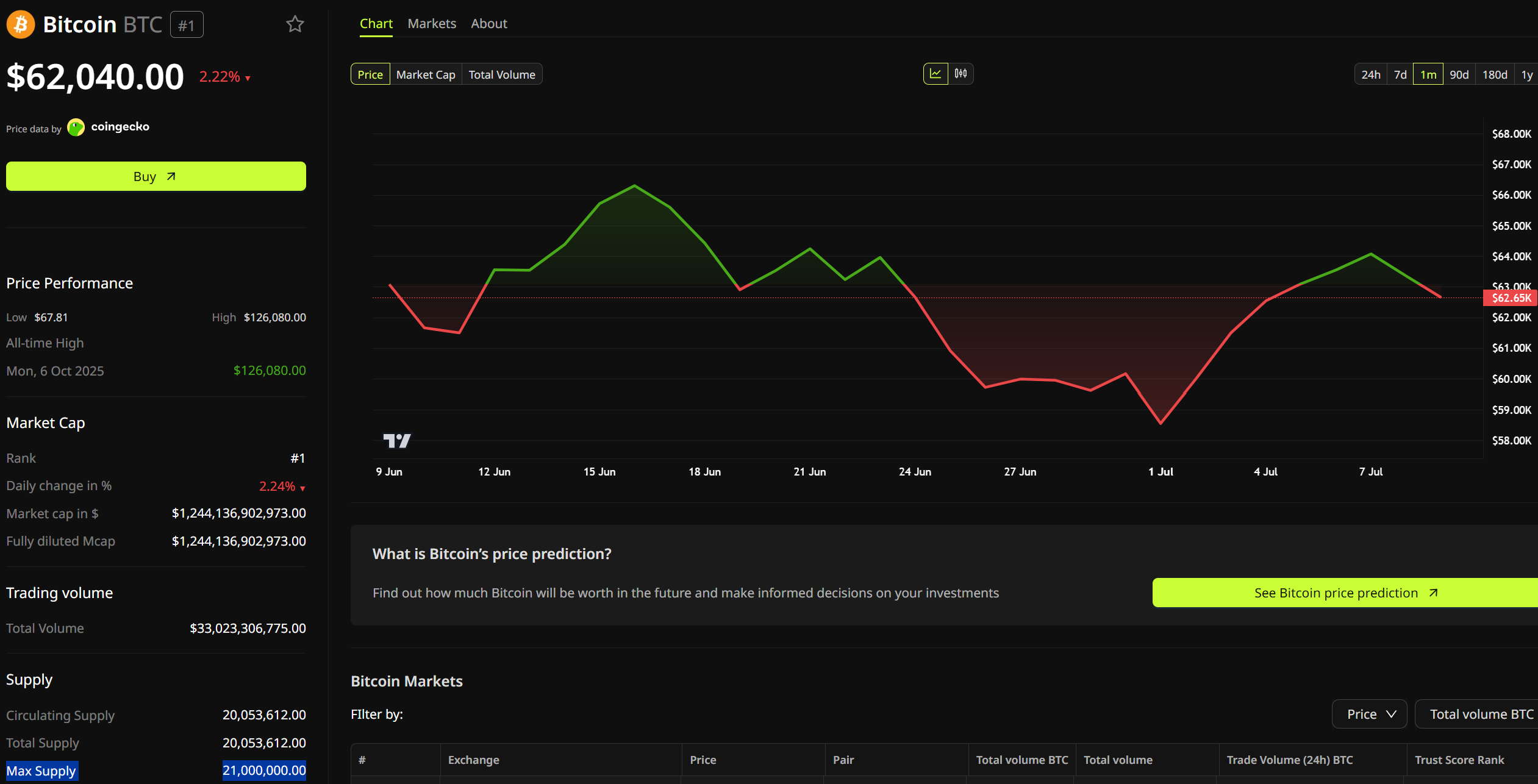
StarkWare CEO Eli Ben-Sasson, a founding scientist of the privacy coin Zcash, challenged Bitcoin’s 21 million cap this week. He argued that lost private keys will steadily shrink the usable supply and proposed a 4% annual issuance limit instead.
The pushback was immediate, since Bitcoin supporters treat the fixed supply as the network’s founding promise. Zcash creator Zooko Wilcox answered with a rival design that keeps hard caps intact.

Why Ben-Sasson Says Bitcoin’s 21 Million Cap Fails
Ben-Sasson helped invent the STARK proof system now used across crypto and co-authored Zerocash, the 2014 design behind Zcash. His critique starts from the numbers on lost coins.
Chainalysis estimated that 2.78 million to 3.79 million BTC were already unrecoverable by 2017. The figure assumes Satoshi Nakamoto’s untouched coins are gone for good. Courts are still weighing dormant Bitcoin wallet claims worth $235 billion.
“Capping the supply of Bitcoin at 21M doesn’t make sense… In fact, as time goes to infinity, all keys will be lost. I strongly support a clear monetary policy with an absolute upper bound on the # of Bitcoins in the future,” he suggested.
He set the ceiling at 4% a year, roughly matching population growth. A steady flow of new coins would also keep paying miners after 2140, when Bitcoin stops minting rewards. Roughly 95.5% of all Bitcoin already exists.
Meanwhile, transaction fees near 2019 lows sharpen that concern, echoing earlier Bitcoin security budget warnings.
Zcash Answers With Burns and Formal Proofs
Wilcox pointed Ben-Sasson to Shielded Labs’ Network Sustainability Mechanism. Holders can voluntarily destroy their own coins, which the network later re-creates as miner rewards. Zcash’s own 21 million cap stays intact.
The numbers explain Ben-Sasson’s doubts. The mechanism proposes burning 60% of transaction fees, about 210 ZEC per year. He argued that sums that small cannot fund miners meaningfully, repeating that capping inflation beats capping supply.
Precedent cuts both ways here. Monero took the other path in 2022, adding a small permanent reward of 0.6 XMR per block. However, Bitcoin developers have repeatedly rejected similar ideas.
The Zcash camp is also attacking the opposite risk, secret inflation. Sean Bowe, the cryptographer behind Zcash’s major privacy upgrades, is building that proof under Tachyon. He said the work is close to showing that no hidden bug can secretly create coins in the new Ironwood pool.
Bitcoin advocates remain unmoved, echoing Michael Saylor’s argument that the network wins by refusing to change.
The proposal has almost no path to activation, yet it revives a question Bitcoin must eventually answer. Can transaction fees alone secure the network once the last rewards disappear?
The post Zcash Founding Scientist Challenges Bitcoin’s 21 Million Cap appeared first on BeInCrypto.
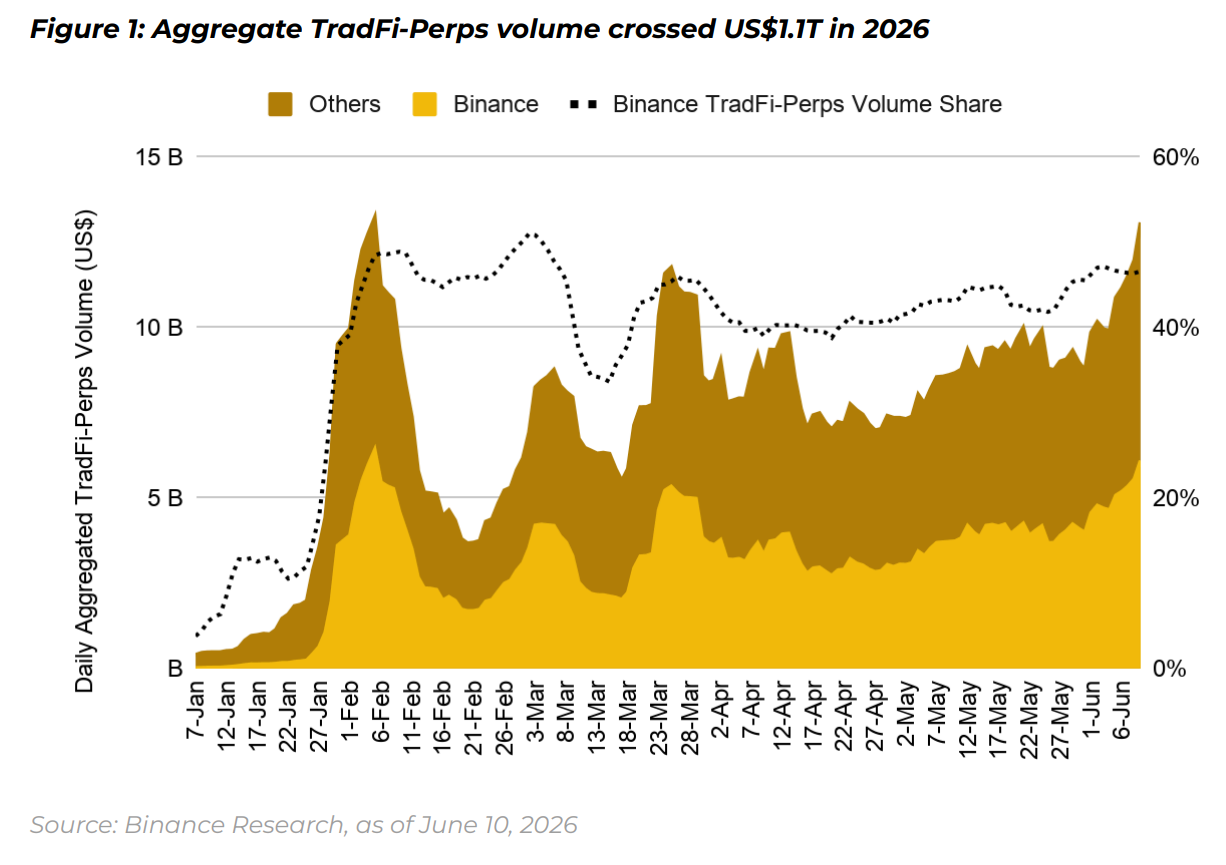
Stablecoin-settled perpetual contracts tied to traditional financial assets topped $1.1 trillion in trading volume during the first half of 2026, according to Binance Research, underscoring the growing role of stablecoins in tokenized financial markets.
According to Binance Research, stablecoins are increasingly being used to settle TradFi-linked perpetual contracts, a market that’s grown to roughly 11% of all crypto perpetual trading volume in the first five months of 2026.
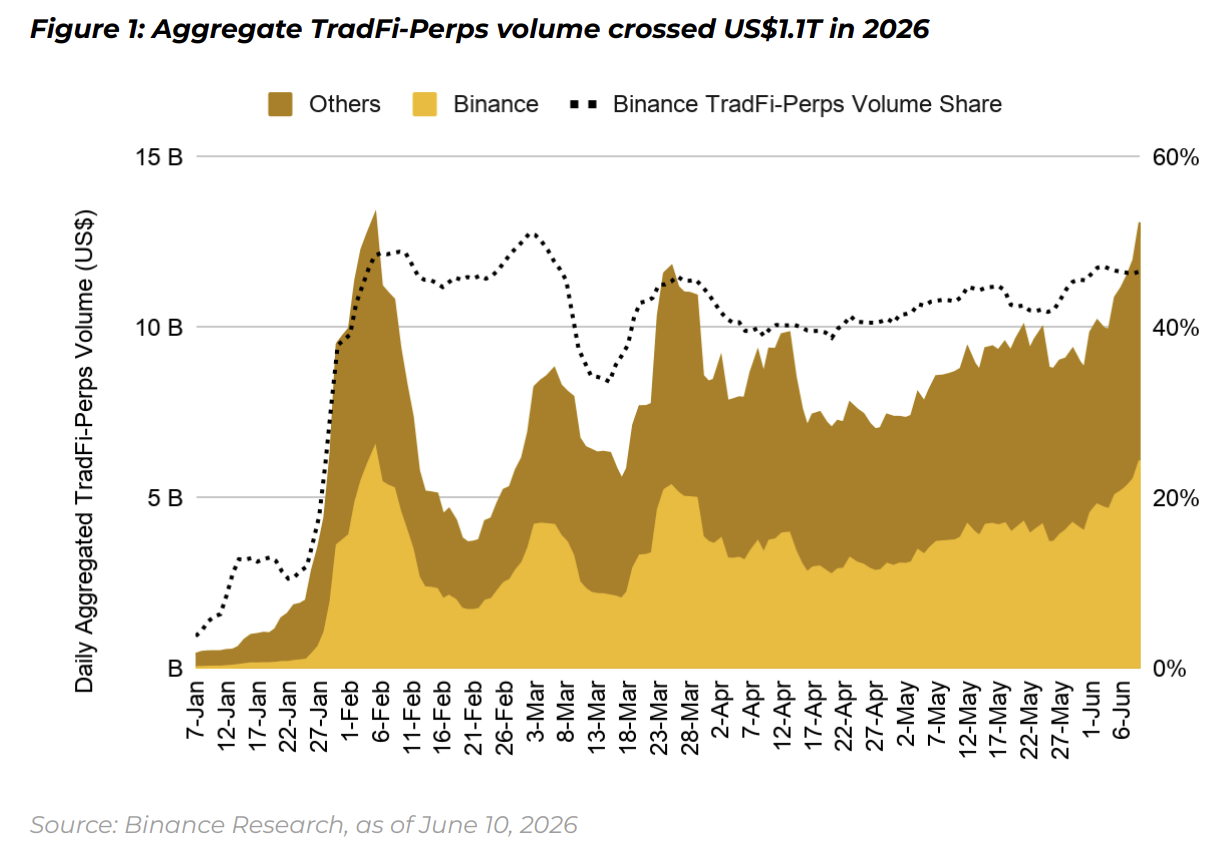
TradFi perpetual volume and Binance market share. Source: Binance Research
Beyond derivatives trading, Binance Research said stablecoins are increasingly being used as long-term stores of value rather than temporary trading assets. It found that 30% of Binance exchange users now hold more than half of their portfolios in stablecoins, up from 4% in 2020.
Related: French banking giant Crédit Agricole launches EURXT euro stablecoin
The global stablecoin market cap has grown to roughly $311 billion, up from about $254 billion a year ago, according to DefiLlama data. Transaction activity has kept pace with market growth. Visa’s Allium-powered stablecoin dashboard showed adjusted stablecoin volume reached a record $1.79 trillion in June, surpassing the previous high set in February.
Latin America emerges as key stablecoin market
Beyond trading and savings, Binance Research also said stablecoins are gaining traction for cross-border payments, particularly in Latin America, where adoption has accelerated over the past 12 months.
The region’s share of Binance stablecoin transfer users more than doubled to 38% in 2026 from 17% in 2025, according to the report, which attributed the increase to growing demand for faster and lower-cost international transfers.
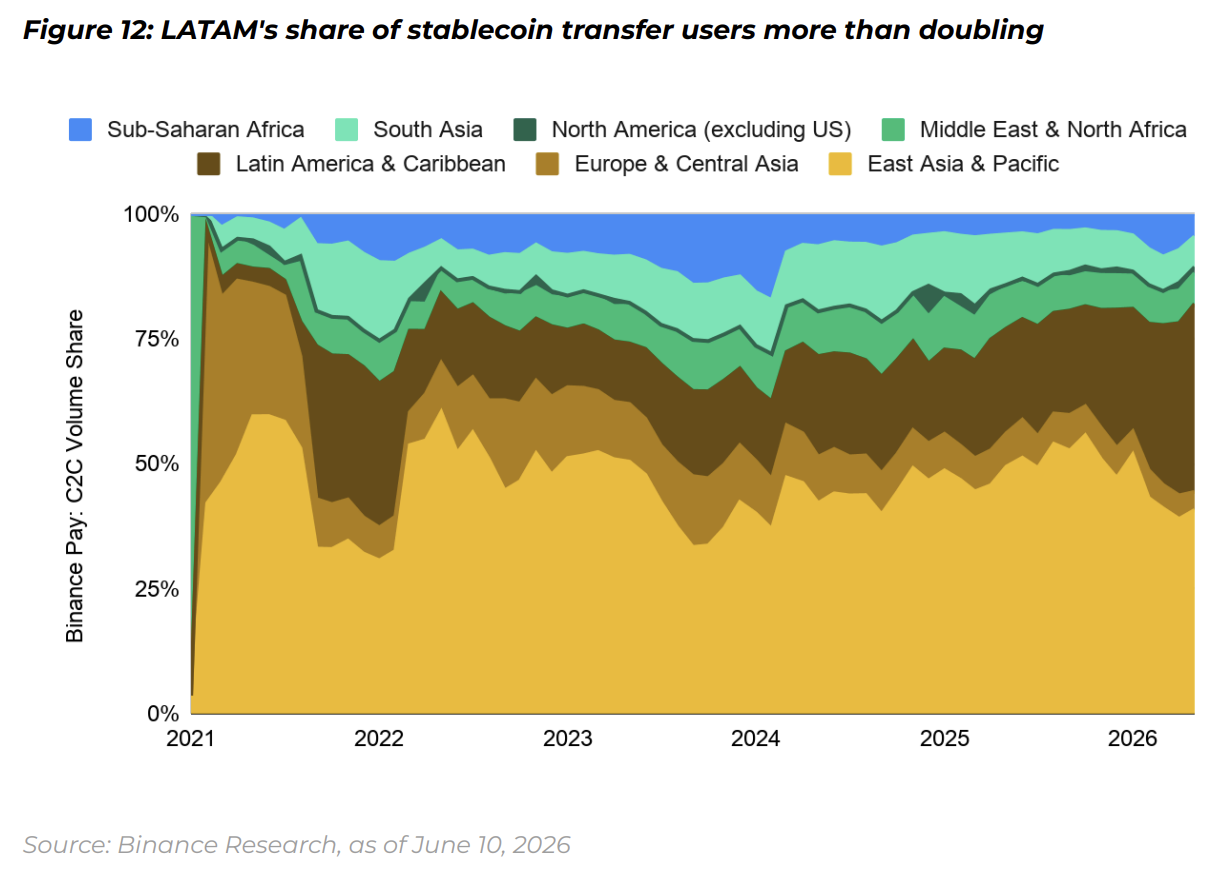
Stablecoin transfers. Source: Binance Research
The findings align with broader regional trends. A report from Mexico City-based crypto exchange Bitso found that US dollar-pegged stablecoins accounted for 40% of crypto asset purchases on its platform in 2025, besting Bitcoin’s 18% share for the first time.
The growing adoption has created a sizable market opportunity. In May, former Bybit executive Claudia Wang estimated that remittance corridors outside the US-to-Mexico market represent a $112 billion opportunity for stablecoin issuers.
Traditional remittance providers have taken notice. In May, Western Union launched its USDPT stablecoin on the Solana network for cross-border payments, followed by rival MoneyGram’s June launch of its MGUSD stablecoin on Stellar, expanding blockchain-based international transfers through its consumer app.
Magazine: AI is banking the unbanked in Africa… faster than crypto
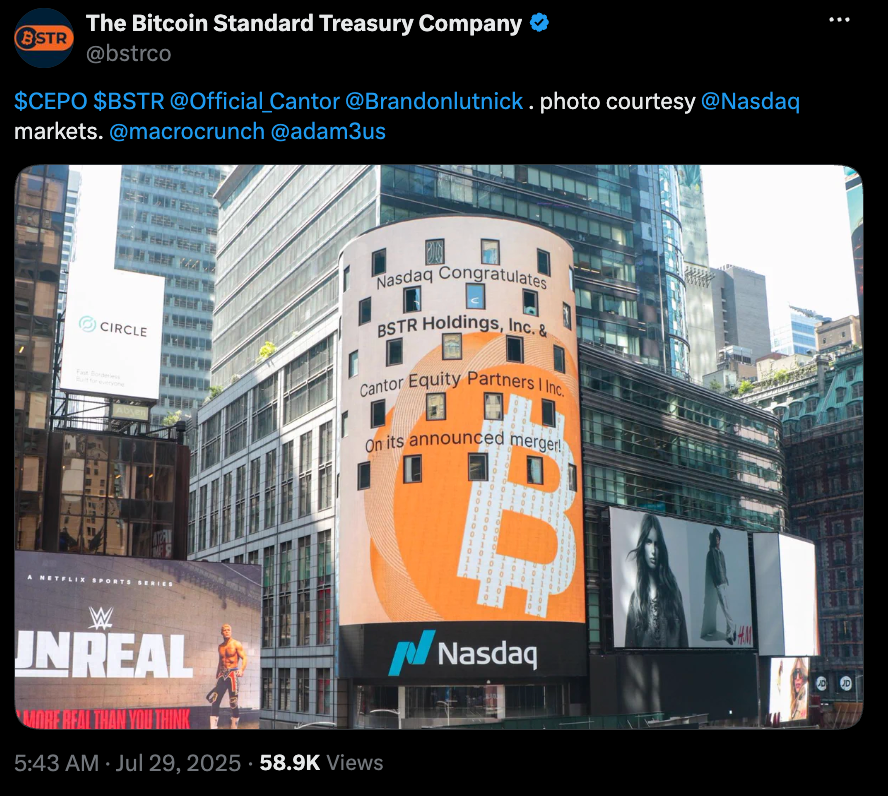
The Bitcoin Standard Treasury Company (BSTR), founded by Blockstream CEO Adam Back, wants to change the terms of its merger agreement with Cantor Equity Partners for a public offering.
According to a Wednesday announcement, BSTR and Cantor Equity Partners I, the special purpose acquisition company (SPAC) created by financial services giant Cantor Fitzgerald, scrapped the original terms of a 2025 merger agreement and will negotiate a new deal. Although the details were not included in the announcement, both companies said that they intended to negotiate terms that “better reflected market conditions.”
Source: BSTR
A shareholder meeting scheduled for Friday intended to address the SPAC merger and a public offering was postponed indefinitely. The companies said that they would “provide further details in due course.”
BSTR’s initial deal included contributing more than 30,000 Bitcoin (BTC) and $1.5 billion in PIPE (Private Investment in Public Equity) financing. The US Securities and Exchange Commission (SEC) recognized the registration statement for the agreement in June, with many expecting the public offering soon to follow.
Related: Capital B raises $1.3M from Adam Back for Bitcoin strategy
According to a February report from Institutional Investor, Cantor was giving itself “a lot of wiggle room” in SPAC deals, no longer keeping its sole focus on Bitcoin treasury companies like BSTR and Twenty One Capital, which completed a $3.6 billion merger deal with Cantor in 2025.
“A Bitcoin treasury SPAC doesn’t look so good now,” said SPACInsider founder and CEO Kristi Marvin, according to Institutional Investor. “Six months from now, I don’t know — maybe.”
Securitize went public with Cantor SPAC last week
The news of the BSTR-Cantor merger potentially falling apart followed tokenization company Securitize making its debut on the New York Stock Exchange (NYSE) after a similar SPAC deal with a Cantor entity.
Securitize, which has $4 billion in assets under management, got approval for a SPAC deal with Cantor Equity Partners II from the SEC in June and began trading on the New York Stock Exchange a week after shareholders signed off. The shares, trading under the ticker SECZ, fell to $7.42 apiece on Wednesday, about 40% below its July 2 closing price of $12.30.
Magazine: Has Strategy’s capital overhaul put an end to ‘death spiral’ fears?


- Cardano (ADA) remains above 10% higher despite a 24-hour pullback.
- Hoskinson says Ethereum is adopting eUTXO-inspired ideas.
- Focus is on the $0.20 resistance level.
Cardano is drawing renewed attention after a week of strong gains, even as the token pulled back to around $0.17.
The latest price movement comes alongside fresh debate over blockchain architecture after Cardano founder Charles Hoskinson claimed that Ethereum is beginning to adopt ideas that Cardano has championed for years through its Extended Unspent Transaction Output (eUTXO) model.
At the time of writing, ADA was trading at $0.1674, down 6.6% over the past 24 hours.
Despite the daily decline, the cryptocurrency remained 10.2% higher over the previous seven days and 12.8% higher over the last two weeks, showing that bulls have retained much of the momentum built during the recent rally.
The recent retreat has placed the spotlight on whether the token can defend the $0.17 area before attempting another move toward the next major resistance level at $0.20.
Hoskinson reignites the Cardano-Ethereum debate
The latest discussion began after Ethereum researcher Toni Wahrstätter introduced EIP-8141, also known as Frame Transactions, as part of Ethereum’s broader efforts to improve scalability and reduce long-term state growth.
The proposal explores introducing UTXO-inspired transaction mechanics for simple transfers.
According to the proposal, this approach could reduce Ethereum’s permanent state footprint for payment-related transactions by approximately 99.8%, while remaining compatible with the network’s broader roadmap.
Hoskinson responded by arguing that Cardano has already implemented similar concepts through its eUTXO accounting model.
He suggested that Ethereum is now recognising the benefits of an architecture that Cardano adopted years ago.
The Cardano founder also made headlines with his remark that “it’s literally a crime in the Ethereum inner circles to mention Cardano,” suggesting that Ethereum developers have been reluctant to acknowledge Cardano’s earlier work despite exploring comparable ideas.
It’s not like I’ve been literally working on this topic for over 10 years of my life and launched a cryptocurrency that was number three on coinmarketcap with millions of users to deploy it. It’s literally a crime in the Ethereum inner circles to mention Cardano. EUTXO is the… https://t.co/3F3l6cg0JE
— Charles Hoskinson (@IOHK_Charles) July 7, 2026
ADA price holds key support as traders watch $0.20
From a technical perspective, ADA’s recent pullback has not erased the gains recorded over the past week.
Instead, focus is now on whether the cryptocurrency can continue holding support around $0.144.
The current price sits close to the lower end of the latest 24-hour trading range after the 6.6% daily decline.
However, the weekly performance remains positive, with ADA still posting a double-digit gain over the previous seven days.
The next major level attracting attention is $0.193, and a move above that level would place the focus on $0.23, another resistance area that traders have identified following the recent recovery.

Cardano continues preparing for its next network milestone
The latest market discussion also comes as the Cardano network continues infrastructure improvements ahead of its next major protocol upgrade.
Developers recently released Cardano Node 9.0.1, a recommended update for mainnet validators designed to address issues related to the network’s bootstrap process and script execution.
Rather than introducing new user-facing features, the release focuses on improving stability before the ecosystem moves toward its next hard fork.
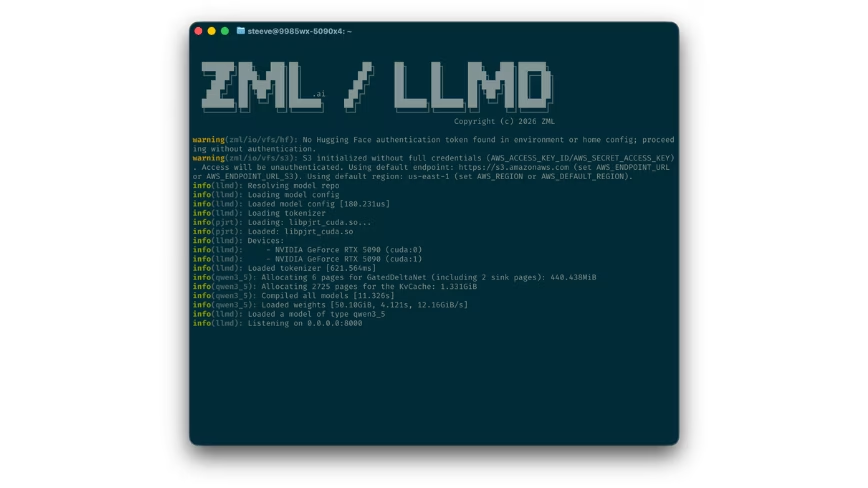
ZML’s free AI server runs on any major chip

Most EXPENSIVE Class in Animal Hospital! #animalhospital #class #tierlist #money #roblox

Leigh-Anne Pinnock reveals she is pregnant with third child with husband Andre Gray


-

 Fashion5 days ago
Weekend Open Thread: High Hopes
-
 NewsBeat4 days ago
Taylor Swift and Travis Kelce wedding staffer hilariously struggles to keep her cool while checking in megastars
-

 Fashion2 days ago
Open Thread: What Great Books Have You Read Recently?
-

 Politics5 days ago
The House | “Reframing the debate from a binary discussion of winners and losers”: Yuan Yang reviews ‘We Are Not Machines’
-

 Crypto World5 days ago
Standard Chartered Secures MiCA License as ESMA Adds 37 New Crypto Firms
-
 Tech1 day ago
Anthropic’s new “J-lens” reveals a silent workspace inside Claude that mirrors a leading theory of consciousness
-

 News Videos2 days ago
Whats Hidden Inside This Cash Register? #treasure #reselling #money
-

 Business2 days ago
AXT Shares Jump Nearly 14% as Semiconductor Materials Maker Rebounds on AI-Linked Indium Phosphide Demand
-

 Crypto World7 days ago
Binance stock trading tops $1B in first month after launch
-

 Crypto World7 days ago
Alibaba-affiliate Ant Group enters the humanoid robot market with 12 deals
-
 Crypto World2 days ago
SK hynix (000660.KS) Stock Dips as $28B Nasdaq ADR Offering Drives AI Memory Expansion
-

 Crypto World3 days ago
South Africa proposes crypto tax guidance under existing rules
-

 News Videos2 days ago
Best Time to Enter Small Caps Right Now? Another Bull Run? | Financially Free
-

 Tech3 days ago
Lenovo laptops are now shipping with YMTC SSDs, a sign of Chinese NAND entering the mainstream
-

 Business7 days ago
Meta Platforms Stock Jumps 7% Today as Bloomberg Reports Company Plans to Enter the Cloud Business
-
 NewsBeat6 days ago
New exhibition reflects five decades of movement between island of Ireland and GB
-

 Business6 days ago
What a 10 Percent Drop Means for Buyers, Sellers and Renters
-
Crypto World5 days ago
ESMA Expands Crypto Register by 37 Firms Following MiCA Transition Period
-

 Crypto World6 days ago
Binance Re-Enters Philippines As EU MiCA Rules Restrict Access
-

 News Videos2 days ago
Avoid entering in FOMO #bitcoin #cryptocurrency #trading #scalping
You must be logged in to post a comment Login