


There’s a new kind of influencer making the rounds on TikTok and Instagram: the loneliness influencer. Most of these influencers are young women, and “loneliness” might be a slight misnomer. They claim they aren’t lonely, simply alone — no friends, no family, no kids. And they prefer it that way.
Tech
Allstate Insurance quits Broadcom, alleges vengeful license audit on the way out



Virtualization
CA and VMware both suing insurance giant
Broadcom has accused Allstate Insurance of dodging a software license audit that the insurer claims only happened after it decided to stop using VMware and CA software.
Those two Broadcom business units – CA and VMware – have brought copyright infringement lawsuits against Allstate.
The CA suit, filed in May 2025, alleges that the insurer breached contracts after the sale of its Employer Voluntary Benefits business to an outfit called StanCorp. The VMware suit, filed in December 2025, alleges that Allstate didn’t comply with contract terms that required it to participate in license audits.
Software license audits are not unusual. Vendors routinely include the right to conduct audits in their contracts, and those rights can extend beyond the term of a license so that software companies can be paid for all use of code under a time-limited contract. Some vendors, however, are known to audit more often and more vigorously than others, or to use audits to gain leverage during license renewal negotiations.
Allstate claims Broadcom’s decision to audit it was not entirely reasonable.
“This case is about VMware’s decision to initiate a haphazard ‘audit’ of Allstate, once it was aware that Allstate did not intend to renew its contracts with VMware or its sister company, CA,” the company stated in a June 12 filing.
That accusation came after months of conflict.
An Allstate filing in the CA matter claims that Broadcom launched four audits, covering “Tanzu,” “VMWare,” “Agile Operations” and “Mainframe.” Broadcom advised of its intent to audit around April 2025.
Broadcom alleges Allstate didn’t co-operate with the audits. “Throughout August and September 2025, VMware sent weekly follow‑ups. Allstate continued to stonewall and withheld the requested materials,” according to VMware’s claim.
Allstate says it simply didn’t have the resources to respond to four simultaneous probes.
One of the tools Broadcom uses during software audits is a set of scripts that detect software installations. Allstate acknowledges it received the scripts and other audit material.
Then on September 12, Broadcom alleges, Allstate dropped a bombshell: It had “removed VMware from all devices.” On October 1, the insurance giant apparently told the virtualization pioneer “all VMWare instances have been terminated and removed” – at least from an environment governed by an enterprise license agreement.
After terminating its VMware estate, Allstate said Broadcom’s audit scripts wouldn’t work. The insurer nevertheless completed an audit questionnaire, but Broadcom said the info in that document was “woefully incomplete.”
Both cases continue and, on June 12, Allstate filed a document that offered its view of the matter – and includes the allegation that Broadcom only ordered its audits once it realized Allstate was binning VMware and CA software.
Allstate also accuses Broadcom of making “vague, competing, and contradictory demands of Allstate, often in direct violation of its contractual agreements.”
Broadcom and Allstate tried alternative dispute resolution in both matters but have not found common ground. Courts have proposed the two matters adopt the same timeline, which will see Dispositive Motions – an attempt to resolve a case before a full trial – take place no later than May 17, 2027.
The Register has asked Allstate why it decided to stop using Broadcom software and if it has replaced it. We’ve not heard back at the time of writing.
However we understand that the relationship between Allstate and Broadcom has not been good for quite some time, and that the insurer decided to move away from both VMware and CA at around the time Broadcom’s acquisition of VMware closed.
VMware points to major clients such as the London Stock Exchange and Nationwide Bank as evidence big corporate entities trust it with their private clouds, and therefore the heart of the IT estate that powers their business and enables innovation. And this week, AWS also showed confidence in VMware by adding support for version 9.x of its Cloud Foundation suite.
However, The Reg has also learned of several big users quitting VMware – including T-Mobile, Tesco, and Western Union – sometimes under acrimonious circumstances. ®
Continue Reading
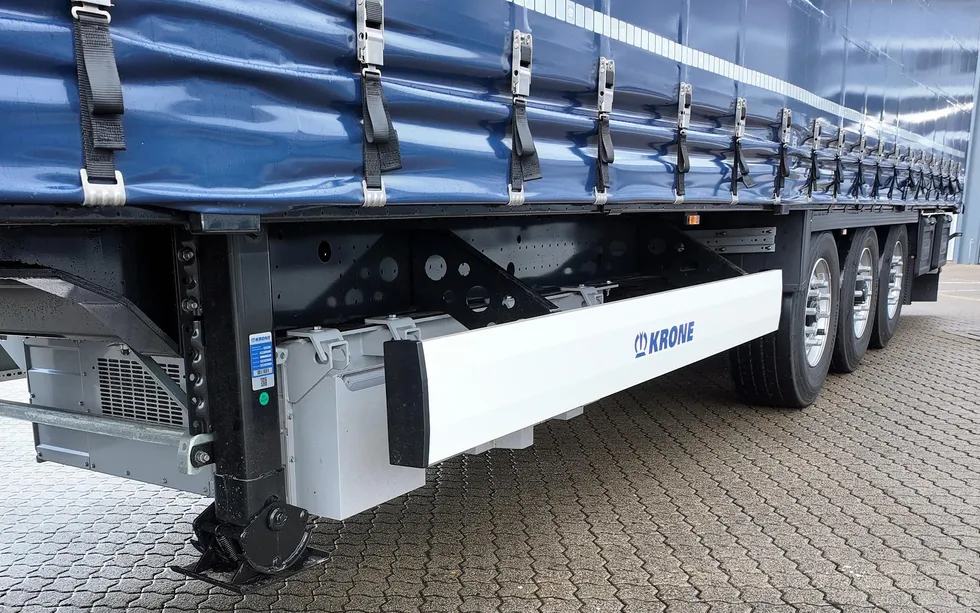

A semi-trailer that helps propel itself entered commercial road testing in late May, when a powertrain kit developed by Nivalis Energy Europe, headquartered in Luxembourg with engineering operations in Germany, was fitted to a trailer supplied by Amsterdam-based TIP Group. The self-powered trailer was handed over to German transport operator Sommer for use in its working fleet.
The Nivalis Powered Trailer Kit centers on an electric axle co-developed with Wiehl, Germany–based running gear specialist BPW, rated at 50 kilowatts peak, capable of both propulsion assistance and regenerative braking. That axle draws on a 60-kilowatt-hour, 400-volt lithium-ion battery pack charged from three sources: the axle itself during braking and deceleration, a full-rooftop array of photovoltaic panels generating up to 3.7 kilowatts-peak, and a 32-amp, three-phase AC grid connection available during parking stops. The driver’s only window into the system is a small display readable from the cab’s side mirror that shows the system status and battery charge level. Nothing about the trailer’s handling or licensing requirements changes.
The partners project savings of up to 7,000 liters of diesel per trailer per year, which is enough to keep about 19 tonnes of carbon dioxide out of the air. These figures are based on a trailer running 100,000 kilometers annually at payloads between 20 and 24 tonnes, on a mix of long-haul and hub-to-hub routes.
Pavel Gilman, vice president of sales and marketing at Nivalis, breaks down where those savings come from: roughly 30 to 35 percent from the electric axle during braking and deceleration, 11 to 15 percent from the rooftop solar panels, and the remainder (roughly half) from grid charging during parking stops. The pilot is planned to run for more than a year, spanning multiple seasons. The retrofit cost has not been disclosed, and the pilot is running on a single trailer. But the underlying assumptions are now on the table and they represent a specific, high-utilization use case (meaning a truck that’s almost always on the move, filled to capacity with freight) not a universal one.
Across Europe and North America, a growing number of companies have concluded that electrifying the trailer, rather than replacing the tractor unit, may be the fastest and most cost-effective path to decarbonizing long-haul freight. A new battery-electric heavy truck carries a high upfront cost and demands charging infrastructure that most freight corridors do not yet reliably provide. A retrofit kit fitted to an existing trailer is meant to sidestep both problems.
The question the industry has been working to answer is whether the energy harvested from regenerative braking, rooftop solar, and grid charging in short bursts when the vehicle is parked for loading and unloading is enough to produce savings that recover the kit’s cost in a reasonable timeframe. Several companies now believe the answer is yes, and they are accumulating field data to prove it—though not all of them are going about it the same way.
Trailer industry places its bets
The competitive landscape has taken shape most visibly in Germany. Trailer Dynamics, an Aachen-based company, has conducted field tests with BMW Logistics, DB Schenker, Duvenbeck, and Volkswagen Konzernlogistik, reporting average fuel savings of around 40 percent for diesel tractor combinations, substantially higher than the up to 18 percent reduction implied by the Nivalis projection. The difference traces directly to battery size, but Trailer Dynamics frames the choice as an economic question rather than an architectural one.
“The discussion should not start with battery size, but with the economics of the transport operation,” the company said in response to written questions. “There is no single battery capacity that is universally right for every fleet.”
Trailer Dynamics’s modular system offers three configurations ranging from 187 to 551 kilowatt-hours, sized to match route profile, annual mileage, payload, and charging access. The M300 version, whose designation reflects the capacity of its 300-kilowatt-hour lithium iron phosphate battery supplied by Chinese battery manufacturer CATL, adds approximately four tonnes to the trailer, roughly three times the one-to-1.4–tonnes added to a trailer by the Nivalis system.
Both companies’ systems would extend the range of a battery-electric tractor by reducing the energy demand on the tractor’s motor. But Trailer Dynamics explicitly targets that use case, claiming its self-propelled trailer yields combined ranges of up to 850 kilometers—enough to eliminate intermediate charging stops on many long-haul routes. Nivalis has not published range extension figures for electric tractor combinations, and its smaller battery and peak lower output suggest the effect would be more modest.
That higher energy storage capability widens the addressable market for Trailer Dynamics considerably and helps explain the investment flowing into the self-propelled trailer space. In November 2025, the European Investment Bank extended a €25 million loan to the company, backed by the European Union’s InvestEU program, to support commercialization. Trailer Dynamics says it plans to begin industrial-scale production in 2028, with adoption expected to accelerate as European carbon dioxide reduction requirements tighten toward 2030.
ZF, the German automotive supplier, entered the space with its TrailTrax system, using an electric axle rated at up to 210 kilowatts continuous power. ZF claims that, between onboard battery storage and energy recovered via regenerative braking, the self-propelled trailer system yields up to 16 percent in energy and carbon dioxide savings when combined with an ICE powered truck. The company also says TrailTrax can reduce carbon dioxide emissions by as much as 40 percent with opportunistic plug-in charging. Trailer manufacturers Kässbohrer and Krone have adopted the platform, as has BPW—the same running gear specialist co-developing the Nivalis axle.
In North America, Range Energy is developing a system with up to 300 kilowatt-hours of onboard energy capacity, compatible with diesel, battery-electric, and hydrogen fuel cell tractors. Range, which has announced a partnership with ZF, to help drive the development and adoption of the Range eTrailer System within the North American commercial trucking industry, is now equipping its trailers with ZF’s AxTrax 2 e-axle for battery-powered propulsion. Range Energy has a separate pilot agreement with DB Schenker, the German logistics company that is also among the European operators that tested the Trailer Dynamics system. Range and DB Schenker say they plan to deploy a powered trailer in commercial trucking operations in North America, with first deliveries scheduled for later this year. The breadth of activity across continents reflects a field that has moved well past the question of whether powered trailers work. The argument now is about which architecture works best and at what cost.
What the field does not yet have is a common standard for measuring and reporting savings. The figures from various pilots—an average of 40 percent from Trailer Dynamics, up to 18 percent implied by the Nivalis projection—reflect different routes, loads, seasons, and battery sizes. In some cases, they represent short validation runs rather than sustained operational data. Fleet operators evaluating competing systems are working with numbers that are difficult to interpret and impossible to rank against one another.
Both architectures reduce available payload, but by very different margins. The M300’s roughly four-tonne addition dwarfs the one-to-1.4-tonne addition of the Nivalis system. Trailer Dynamics argues the weight penalty is largely academic in practice, because more than 90 percent of trailer movements are constrained by cargo volume before they approach legal weight limits. Under current European regulations, both systems reduce payload on a one-for-one basis. Frameworks under discussion would change that. New rules could allow up to four extra tonnes for electric trucks, with proposals to extend the provision to electric trailers. If amended, the payload effect would turn positive for both systems. Until then, every kilogram of kit is a kilogram unavailable for freight.
Small versus large battery systems
The choice between large-battery and small-battery powered trailers is a bet on which cost will fall faster: battery pack prices or the cost of grid charging infrastructure. A large-battery system delivers higher savings but requires reliable charging access across the operating cycle. If infrastructure buildout stalls—as it has repeatedly in heavy-duty transport—operators face the same dependency problem that has slowed battery-electric truck adoption. The Nivalis architecture hedges against that risk: its 32-amp connection requires only a standard industrial outlet, and the solar array and regenerative braking handle significant energy input without infrastructure at all. Gilman frames the design philosophy in terms of the industry it serves.
“Logistics lives with low margins,” he said. “We are focused on the product which fits the industry technically and financially. It overcomes the capital expenditure hurdle and maximizes financial benefit by adding sources of energy which are symbiotic to each other.” And because Nivalis’s axle is comparatively light, he says, operators won’t be forced to reduce payload.
Trailer Dynamics sees it differently.
“Long-haul transport will increasingly move toward depot-based and destination-based charging models,” says Michael W. Nimtsch, the company’s Managing Director. “The question is not how small a battery can be made, but how much economic value each additional kilowatt-hour can generate over the life of the vehicle.”
On solar and regenerative recovery, Nimtsch argues both are useful complements to stored battery energy rather than substitutes for it.
“Compared with the daily energy demand of a long-haul truck, solar generation remains relatively modest,” he says. The Nivalis energy breakdown supports that view in relative terms: Grid charging contributes the largest share of projected savings, regenerative braking second, and solar third. That hierarchy means performance depends more on charging access during dwell time than the multi-source framing might suggest even if that access requires only a standard industrial outlet.
Trailer Dynamics prices its system between €145,000 and €195,000 and targets a payback period of no more than five years. Nivalis targets five to six years at current costs, falling to three to four years as volumes grow. Asked exactly what the price tag says, the company declined to answer. The minimum annual savings needed, Gilman said, is between €5,000 and €6,000 per trailer. Until someone publishes a full year of results from a trailer running in normal commercial rotation, fleet operators cannot answer the two questions that actually drives adoption: What does this cost, and when does it pay back?
From Your Site Articles
Related Articles Around the Web

“I really wanted to convey a normal life of somebody that doesn’t have this big, great, fun social life,” one influencer, Lana Isa, told Vox. “Like, what does a life look like as someone that doesn’t really have this great big social life, is not really interested in dating and generally prefers nights in? If you were to watch a Friday night in my life, you’d essentially just watch a girl enjoying her peace.”
Isa, and influencers like her, are just one representation of a larger trend, though. The Atlantic’s Faith Hill, who recently wrote a story titled “The Strange Appeal of the Solitude Influencer,” told Today, Explained co-host Noel King that, even though you mostly hear about young men facing a loneliness epidemic, women are having a hard time, too.
“If you actually look at some of these statistics, young women are struggling a lot on a lot of these measures, and, in some cases, more than young men,” Hill said.
Hill spoke with Noel about what’s going on with young women, how their crisis looks different from men’s, and why they’re covered differently.
Below is an excerpt of their conversation, edited for length and clarity. There’s much more in the full podcast, so listen to Today, Explained wherever you get your podcasts, including Apple Podcasts, Pandora, and Spotify.
In the first half of the show, we talked to a young woman who has made a name for herself as a loneliness influencer. What do you think is going on here?
My first impulse when I heard about this genre of video that people are watching is that there’s a lot of people spending a ton of time alone.
We’ve heard a lot of people talk about the loneliness epidemic, so I thought people were getting social connection through these videos from a safe distance, rather than spending time in person with people. Maybe there’s some of that going on. But, I also realized, as I was looking through these videos and reading all the comments, that a lot of the people commenting seemed to have a lot going on in their lives socially, so much so that they were busy, and exhausted, and burned out.
For some people, the appeal was actually in the fantasy of it, in the way that some people would look at influencers posting about these fabulous, exotic vacations they can’t afford to take. People have a very complicated relationship to solitude. People are working long hours. A lot of people [are] taking care of family members without much help. Many people are sort of torn between these needs for social connection and solitude.
Does that mean that this is, perhaps, not as sad as it appears on its face?
I don’t think it’s all sad. My heart goes out to people who are needing more solitude, as well as more social connection. Most people probably don’t have the perfect balance, and I can relate to that myself. I feel like I either have too many plans or not enough.
It’s not necessarily all happy, but it doesn’t mean that there are just so many people out there who are only getting social connection through these videos. I think there’s something a little more complicated going on.
We’ve all heard about the male loneliness crisis. You wrote a very interesting piece that basically said, actually, women are in crisis, as well.
I’ve just been hearing so much about men, and especially young men, being in crisis. I think there’s a lot of reasons we should take that seriously, and I do. But I felt like in those conversations, young women were kind of being flattened into a comparison point where, instead of people talking about how on some measures young men are struggling more than they used to, it got twisted into “young men are struggling more than women.”
There’s this image of the thriving girlboss, the one who is going to college, graduating college, entering the workforce on these conventional measures of success, doing so well. But if you actually look at some of these statistics, young women are struggling a lot on a lot of these measures, and in some cases, more than young men. And so, I don’t think it needs to be a suffering competition, but I did think part of the story was not coming through.
In what ways are women struggling?
Women have, for a long time, reported depression and anxiety at higher rates than men. That is getting worse. It seems like mental health on a lot of different measures — different kinds of stress and distress and suicidality — young women are reporting that at higher and higher rates. It turns out that women actually attempt suicide at higher rates than men do, on average. And the reason that more men die of suicide is that they’re more likely to use lethal means such as firearms.
A lot of times this conversation really revolves around college attendance rates, and women are attending and graduating college at higher rates than men. But a woman with a bachelor’s degree still makes less than a man with a bachelor’s degree on average, even within the same field of study.
When I talk to people for this story, researchers and therapists, I heard that a lot of young women are in for a rude awakening when they graduate from school. They’ve been in this bubble where they did feel like they could grow and thrive and they were taken seriously. And then, you go out into the real world, where sexism is still very real, and a lot of women are working in workplaces where they realize they’re not taken as seriously, or the people around them who are in positions of power are all men. That’s a difficult realization.
Why, if women and men are both in crisis, did men pull focus?
Women, as an overall population, tend to be a fairly high-functioning one in this narrative. I talked to someone who had trained as a medical sociologist, and she told me a saying that they used to use in this field was, ‘Men die quicker, but women are sicker.’
Women are more likely to endure a lot of chronic illnesses and to sort of soldier on with their pain unnoticed. And we might not be taking that as seriously, because the idea that women are struggling isn’t necessarily a new one or a super surprising one to a lot of people. I think men having a hard time is more of a news story, and we have become, perhaps, kind of inert to women’s distress in this way.
I wonder, as you found yourself covering this, where do you find the hope here?
I am heartened that we’re talking about [young adults] a lot. There’s been a lot of concern lately about Gen Z, and a lot of what we’re talking about when we talk about young men struggling also applies to young women, so we’re onto some of the right things.
I wrote another piece about young adulthood a while back that was really about the idea that young adulthood actually is a really hard developmental phase. And when I published that article, I think for a lot of readers, it seemed to be somewhat of a surprise that young adults are struggling, too. Even just since I’ve written that, people have talked more about young adults struggling. So I do think people are starting to take that seriously and understand that this is an age group that might need help.

On Wednesday, the US Federal Trade Commission announced a settlement with tractor manufacturer John Deere over a 2025 lawsuit that accused the company of behavior that “unlawfully acquired and maintained monopoly power in markets for repair services for Deere farm equipment.”
The full statement lays out obligations for John Deere’s repair services, requiring the company to give farmers and third-party repair shops access to the same equipment and repair resources it provides to official John Deere dealers. This includes software capabilities, such as reading and resetting codes and pairing with other software, which customers have long had limited access to, creating delays when diagnosing equipment problems. Delayed fixes can mean delayed harvests, which many farmers saw as a fundamental threat to their livelihoods.
Under the agreement, John Deere will be required to provide this level of access, equipment, and services for the next 10 years, monitored by the FTC.
“After years of fighting for the right to repair, this order gives farmers real hope,” Willie Cade, a board member of the repair advocacy organization Repair.org, wrote in an email to WIRED. “But promises on paper must become tools in farmers’ hands, and we will be watching implementation every step of the way.”
Farmers have been fighting against John Deere’s repair practices for more than a decade, but the FTC began its fight in 2021, led by then-chair Lina Khan under the Biden administration. In April, John Deere agreed to pay out $99 million in a separate class action lawsuit brought against the company in 2022. Repair and consumer advocates say this FTC settlement does far more to help farmers than a payout did.
John Deere has maintained that it already has robust repair resources for its customers, including service manuals and diagnostic equipment. In John Deere’s press release, the company says the settlement is in line with what it has been doing all along, saying that “the agreement reinforces Deere’s continued innovation toward more flexible repair options, emphasizing increased access and transparency for customers. It formalizes Deere’s ongoing commitment to expanding access to diagnostic and repair tools.”
The consumer advocacy group US PIRG issued a statement about the settlement, citing the organization’s 2022 official complaint to the FCC about John Deere’s repair policies.
“We should be able to fix our own stuff,” wrote PIRG’s Right to Repair campaign director Nathan Proctor. “This settlement from the FTC gives farmers more and better options to repair their equipment. It is a win for farmers and all of us who want a more fixable world.”


Working in isolation, especially for leaders, is rapidly becoming an outmoded idea. The modern era is defined by rapid technological advancements and increasingly complex, collaborative global challenges. In this environment, leadership can no longer be approached as an individual pursuit.
Instead, leadership must be a collaborative effort in which knowledge, responsibility, and innovation are continuously exchanged across teams, roles, and areas of expertise. Success depends on the ability to foster connection, leverage diverse perspectives, and work collectively toward shared outcomes.
The shift is especially important in science, technology, engineering, and mathematics fields.
IEEE is bringing together emerging professionals and established experts and leaders at the inaugural IEEE International Leadership Conference to address the need for cross-generational knowledge-sharing and to equip professionals with tools for collaborative leadership. Honoring Expertise, Accelerating Potential is the theme of the ILC, scheduled for 3 and 4 October in Budapest.
The conference is expected to focus on how leaders can share information across roles, adapt to rapid technological advancements, and build stronger, more connected professional communities. Through discussions, panels, and interactive sessions, attendees can examine how collaboration across experience levels and disciplines can strengthen decision-making and foment innovation.
“There are several factors driving this shift [in leadership], including accelerating technological development cycles, the need to build public trust, and the large percentage of the STEM workforce approaching retirement,” says Vickie Ozburn, conference cochair. “Progress in STEM now depends less on individual brilliance and more on the ability to transfer knowledge, adapt, and make decisions that integrate technical expertise with ethical and social considerations.”
From hierarchies to shared leadership
Instead of traditional corporate models rooted in hierarchy and individual advancement, a more dynamic framework is taking shape, one that views leadership as a shared ecosystem built on mentorship, continuous learning, and intentional knowledge transfer.
It means recognizing that professional development is no longer a one-directional flow of experience from senior professionals to newcomers. Instead, it thrives as a multidirectional exchange. When emerging professionals, mid-career managers, and seasoned experts including retirees are brought together, the result is not only richer dialogue but also more resilient and well-informed decision-making. A cross-generational dialogue enables organizations to honor what has worked, critically assess what has failed, and thoughtfully shape what needs to evolve.
Bridging experience to drive future leadership
Howard Wolfman, cochair of the IEEE ILC, underscores the importance of historical perspective in leadership development, invoking George Santayana’s enduring insight: “Those who cannot remember the past are condemned to repeat it.”
“In STEM especially, this principle carries significant weight,” says Wolfman, an IEEE life senior member and the founder and principal of Lumispec Consulting, in Northbrook, Ill. “Technological innovation doesn’t happen all of a sudden; it builds on decades of research, lessons learned, and accumulated knowledge. When leaders actively connect insights from across experience levels, they gain a more complete understanding of both opportunity and risk.”
That perspective reinforces the need for greater collaboration across roles and experience levels, ensuring that knowledge is not lost and is continuously built upon and applied in new ways. In this way, leadership development becomes a continuous, interconnected process rather than a series of isolated stages.
STEM careers are no longer defined by linear progression but by evolving contributions, in which each phase adds value to the field’s broader advancement.
What the changes mean for leaders today
Adopting a new leadership paradigm requires a shift in mindset across all levels. For senior leaders, success is defined not only by what they have built but also by the people they mentor and the knowledge they pass forward. Their legacy lies in enabling future leaders to succeed.
For emerging young professionals, innovation becomes more informed and impactful when it is grounded in historical context and informed by those who have already navigated similar challenges.
“Technological innovation doesn’t happen all of a sudden; it builds on decades of research, lessons learned, and accumulated knowledge. When leaders actively connect insights from across experience levels, they gain a more complete understanding of both opportunity and risk.”—Howard Wolfman, cochair of the IEEE International Leadership Conference
For organizations, cross-generational collaboration should be recognized as a strategic advantage, not merely an aspiration. Creating environments where knowledge flows freely and diverse perspectives are actively integrated is essential for long-term success.
The evolution reframes the distinction between management and leadership.
“A leader does the right thing, and a manager does things right,” Wolfman says. As the environment continues to shift, doing the right thing increasingly depends on drawing insights from across generations and experiences.
Building future-ready leadership pipelines
To build leadership pipelines capable of sustaining innovation and trust, organizations must begin asking more intentional questions:
- How do we create systems where knowledge sharing is continuous rather than episodic?
- How do we elevate emerging voices earlier in their careers?
- How do we ensure that experienced professionals remain engaged and valued contributors?
- How do we design leadership development as a collaborative, inclusive process rather than a competitive one?
Ultimately, leadership cannot be tied solely to titles or tenure. It is about contributing to a continuum in which each generation strengthens the next.
The IEEE ILC attendees are likely to leave the event with new insights and with a transformed perspective: Leadership is not about waiting for advancement or recognition; it is about engaging in an exchange of knowledge, responsibility, and vision, where the strength of the whole depends on the contributions of every generation.
Registration for the conference opens soon.
From Your Site Articles
Related Articles Around the Web

Some material also goes to an unnamed US technology and industrial company, under a deal penned in the first quarter of 2026.
In the same quarter a year ago, the largest portion of MP’s sales by revenue—mined material, not NdPr—went to China’s Shenghe Resources. But MP has stopped selling to Shenghe as part of its deal with the US government.
MP ultimately plans to produce its own magnets at scale, which would require it to consume much of what it produces. Mined rare earths are turned into oxides, which are used to make metals and alloys that go into magnets.
The company has penned agreements with General Motors and Apple to supply them with its magnets. It said in May that it expected to begin shipping finished magnets to GM this year.
Meanwhile, Energy Fuels—which won $725 million in conditional government funding in June—plans to scale its production of rare earths and also has eyes on Asia.
“We will be sending oxides in the near-term to Korea,” said chief executive Ross Bhappu. Last year, a major South Korean manufacturer made a small amount of Energy Fuels’ NdPr into magnets.
Energy Fuels is in the process of acquiring Australian Strategic Materials, which owns a rare earths metal-making plant in South Korea. It also announced a $1.9 billion deal to buy German magnet maker Vacuumschmelze (VAC) in June, which Bhappu said would result in more of Energy Fuels’ products going to VAC’s US operations.
China is the largest global producer of the widely used neodymium iron boron magnets. Outside China, Japan produces 10,000-15,000 tonnes per year, while South Korea produces 2,000-3,000 tonnes annually, and the US produces 1,000 tonnes or less, according to John Ormerod, a rare earths consultant at JOC LLC. There is also some production in Europe.
Phoenix, which secured a conditional $500 million from Washington in June, said government funding would help it scale up metal and oxide production, which would “expand the pie for everyone.”
MP’s recent earnings have been boosted by the money it receives under its US government deal—which guarantees a minimum sale price for some products and tops up any shortfall from the price paid by third parties.
© 2025 The Financial Times Ltd. All rights reserved. Not to be redistributed, copied, or modified in any way.
Tech
OpenAI launches GPT-Live, a full-duplex voice upgrade that lets ChatGPT talk more like a person


OpenAI on Wednesday launched GPT-Live, a pair of new voice models that fundamentally redesign how people talk to ChatGPT — replacing the company’s existing Advanced Voice Mode with an architecture that can listen and speak simultaneously, much like an actual human conversation.
The two models, GPT-Live-1 and GPT-Live-1 mini, are rolling out globally starting today across iOS, Android, and ChatGPT.com. GPT-Live-1 becomes the default voice model for paid ChatGPT users on the Go, Plus, and Pro tiers, while GPT-Live-1 mini serves free-tier users. OpenAI also plans to bring the models to the API, and developers can sign up to be notified.
The release marks the third generation of ChatGPT’s voice technology in roughly two years — and OpenAI’s clearest bid yet to turn its chatbot into something that feels less like querying a search engine and more like talking to a colleague.
Why full-duplex voice changes everything about talking to AI
The defining technical advance in GPT-Live is what OpenAI calls a “full-duplex architecture.” In telecommunications, full-duplex means both parties on a phone call can talk and listen at the same time. Applied to AI, it means the model continuously processes your incoming audio even while it generates its own spoken response — no more waiting for a clean silence gap to figure out when you’ve finished a thought.
“Instead of processing a sequence of separate messages, GPT-Live continuously processes input while generating output,” OpenAI wrote in its research blog. “The model can therefore make interaction decisions many times per second: whether to speak, continue listening, pause, interrupt, or invoke a tool.”
In practice, that translates to a voice assistant that can insert conversational acknowledgments — “mhmm,” “yeah,” “got it” — while you’re still talking, pick up on a natural pause without jumping in prematurely, and handle rapid interruptions without derailing the entire exchange.
OpenAI’s previous Advanced Voice Mode, launched to paid users in September 2024, processed and generated audio within a single model but still operated on rigid turn-by-turn exchanges. As OpenAI acknowledged in the announcement, “because turn detection is based on silence, even a brief pause or background noise could be mistaken for the end of turn — causing the model to interrupt at unnatural times.”
That brittleness created a product that, while impressive in demos, could be deeply frustrating in extended real-world use. Background chatter in a coffee shop could trigger a response. A thinking pause might get swallowed. The experience felt, as one researcher put it on X shortly after the announcement, like “walkie-talkie turn taking.” GPT-Live is designed to end that era.
How OpenAI split voice and intelligence into two separate layers
GPT-Live introduces a second structural change that may prove just as consequential for enterprise adoption: it decouples the voice interaction layer from the reasoning layer.
When a user asks a straightforward question, GPT-Live handles it directly. But when the query demands web search, deeper reasoning, or more complex agentic work, GPT-Live delegates the task to a frontier model running in the background — at launch, GPT-5.5, the large language model OpenAI released in April — and continues talking with the user while the computation happens asynchronously.
“While it works, GPT-Live can keep talking with you and maintain the flow of conversation,” OpenAI explains. “As we release new frontier models, we’ll continuously update the model used by GPT-Live.”
This delegation model is a meaningful architectural bet. Rather than building a single monolithic voice model that tries to be both conversationally fluid and deeply intelligent, OpenAI has split the problem in two: a voice-native model optimized for real-time interaction, and a separate reasoning engine that can be swapped out as the state of the art improves.
It is, in effect, a modular design — one that allows OpenAI to upgrade the intelligence of its voice assistant without retraining the voice model itself. The implications for enterprise and developer workflows are significant. A voice agent built on this architecture could maintain a natural conversation with a customer while simultaneously querying databases, searching the web, or performing multi-step reasoning — tasks that would have introduced several seconds of dead air under the old pipeline.
The three generations of ChatGPT voice, from clunky pipeline to continuous stream
To understand how far voice AI has come, it helps to trace the three generations that led to GPT-Live.
The original ChatGPT Voice, launched in 2023, used a cascaded pipeline — a speech-to-text model (Whisper) transcribed what you said, a large language model (GPT-4) generated a text response, and a text-to-speech model converted that response back into audio. Each handoff introduced latency and lost information.
As OpenAI noted, “the complexity came at a cost: information could be lost across models, and responses were slow and stilted.” That cascaded approach was the industry standard, and its limitations were well-documented. As the blog OpenHelm noted in an October 2024 analysis of OpenAI’s Realtime API, the old pipeline stacked up to roughly 1,700 milliseconds of latency — nearly two full seconds of dead air before the first word of a response. Managing the state between the three separate APIs consumed an enormous amount of engineering effort.
OpenAI’s Advanced Voice Mode, which began its limited rollout to paid ChatGPT Plus users in July 2024 before expanding more broadly in September 2024, collapsed that three-model pipeline into a single model that processed audio natively. As TechCrunch reported at the time, the rollout came with five new voices — Arbor, Maple, Sol, Spruce, and Vale — alongside improved accent handling and smoother conversations.
The feature also launched on the web in November 2024, extending it beyond mobile. But Advanced Voice Mode still operated through discrete, alternating turns — and it launched into the shadow of a PR debacle that OpenAI is still working to leave behind.
The Scarlett Johansson controversy still shadows OpenAI’s voice ambitions
Advanced Voice Mode arrived in the wake of one of OpenAI’s most damaging self-inflicted crises. During the GPT-4o launch in May 2024, the company showcased a voice called “Sky” that many listeners immediately noted sounded strikingly similar to Scarlett Johansson, who famously voiced an AI companion in the 2013 film Her.
Johansson said she had declined OpenAI CEO Sam Altman’s offer to voice the system, then was “shocked, angered and in disbelief” when the product launched with a voice her own friends couldn’t distinguish from hers, as NBC News reported. Altman had tweeted just the word “her” the day the product launched.
OpenAI pulled the voice and apologized, but the incident drew public scrutiny from SAG-AFTRA and members of Congress, and crystallized broader concerns about AI companies moving fast with creative IP.
The Hollywood labor union said the issue underscored “why we’re strongly championing federal legislation that would protect their voices and likenesses … from unauthorized digital replication,” as NBC News reported. Forbes contributor Paul Tassi wrote at the time that Altman, “by holding up Her on a pedestal of something to strive for, has missed the point of that film” — in which the protagonist’s relationship with his AI companion ultimately does him more harm than good.
GPT-Live appears designed, in part, to move past those controversies. OpenAI says it has “remastered the nine distinct voices in ChatGPT for GPT-Live” and notes the system “is designed for conversation, not voice impersonation,” with “safeguards to prevent it from imitating a real person’s voice.”
What 150 million weekly voice users will actually notice today
OpenAI disclosed that more than 150 million people talk to ChatGPT using voice and dictation features each week — a notable slice of the platform’s 900 million total weekly active users. The voice experience has grown into a substantial product in its own right, used for language practice, bedtime stories, commute-time chat, and hands-free everyday help.
The new product features reflect that usage. GPT-Live introduces rich visual cards that surface during voice conversations — weather forecasts, stock data, sports scores, and maps — giving users something to glance at without breaking the flow of speech.
Users can now choose between three reasoning levels for answers: Instant for quick responses, Medium for moderate thinking, and High for more complex work. And if you take a moment to think, “ChatGPT Voice now waits instead of jumping in and interrupting,” OpenAI wrote. “If you ask it to stay quiet and listen, it will. And when there’s background noise, like passing traffic or nearby conversations, ChatGPT is better at focusing on your voice instead of getting distracted.”
Early reactions from users with preview access were cautiously positive. “I had early access to sol. it is a phenomenal model,” wrote one user on X, adding it is “much better at frontend, long context knowledge work, and its vibes are much better.” Another observer cut to the heart of the matter: “The smarts are not new here, GPT-Live hands hard questions to GPT-5.5. What is new is the feel: full-duplex voice that listens while it talks.”
New voice-specific safety tests reveal where the risks still live
The GPT-Live system card, published alongside the announcement, reveals a safety strategy built around the particular risks of real-time voice interaction — a domain where the speed and intimacy of conversation create hazards that text-based chat does not.
OpenAI expanded its safety evaluations to include audio-native tests, using both real user voice samples (from those who opted in) and synthetically generated prompts targeting edge cases across categories like self-harm, sexual content, illicit behavior, emotional reliance, mental health, and hate speech.
On the synthetic evaluations — which OpenAI described as deliberately adversarial — GPT-Live-1 showed substantial improvements over Advanced Voice Mode. In illicit behavior, for instance, the safety score rose from 0.63 to 0.97. On self-harm, it climbed from 0.72 to 0.98. Hate speech achieved a perfect 1.00, up from 0.87.
On the production-prompt evaluations — which used real user audio and reflected more ambiguous, borderline scenarios — the picture was more mixed. GPT-Live-1 matched or improved on Advanced Voice Mode in most categories but showed a slight regression on emotional reliance (from 0.88 to 0.82), though OpenAI noted the change was not statistically significant.
The company built real-time safeguards that can intervene while the model is speaking — steering toward safer responses, surfacing crisis resources, or ending the voice conversation entirely in higher-risk situations. It also designed additional protections for teen users and adapted self-harm support flows for voice, including crisis helpline integration.
Perhaps most notably, OpenAI said it is “rolling out longer-term measurement and post-launch monitoring focused on emotional reliance” — an acknowledgment that the very naturalness GPT-Live strives for creates its own category of risk.
Google, ByteDance, and Nvidia are already in the full-duplex race
While OpenAI was refining its safety guardrails, its rivals were shipping full-duplex systems of their own. Google’s Gemini Live, which supports full-duplex conversation alongside camera and screen sharing — capabilities GPT-Live notably lacks at launch — is already available in the Gemini app. Google released Gemini 3.1 Flash Live in March as its highest-quality real-time audio model, targeting low-latency voice interactions for developers.
ByteDance launched Seeduplex in April, claiming to be the first production-scale full-duplex speech AI deployed at scale, inside its Doubao app. Seeduplex reported roughly a 50 percent reduction in false-response and false-interruption rates compared to ByteDance’s previous half-duplex system. And Nvidia’s PersonaPlex, released in January, brought customizable voice and role control to full-duplex models, breaking what had been a constraint where natural-sounding models were locked into a single fixed voice.
The competitive picture is clear: full-duplex voice interaction is quickly becoming table stakes for consumer AI products, not a differentiator. OpenAI’s advantage lies in the scale of its existing user base, its integration with GPT-5.5’s reasoning capabilities, and the breadth of the ChatGPT ecosystem.
But the window in which any one company has a monopoly on natural-sounding voice AI has already closed. OpenAI also acknowledged several gaps. GPT-Live does not support voice with video or screen sharing at launch. Language support is limited, with the company noting that “for certain languages, the model may have a non-native accent or gaps in fluency.” And API access is not available on day one, meaning enterprise developers cannot yet build on GPT-Live directly — a constraint that will slow the model’s penetration into commercial voice-agent workflows where competitors like Google, ElevenLabs, and Deepgram already have developer-facing products.
The end of the chat box may be closer than anyone expected
GPT-Live is essentially OpenAI’s most significant bet yet on voice as the primary interface for AI — not just a convenience feature bolted onto a text chatbot, but a purpose-built interaction layer that sits between the user and the company’s most powerful models.
“Over time, we believe this research will also unlock the ability to use voice for increasingly complex, longer-running, and more agentic work,” OpenAI wrote. That ambition — using natural voice as the front end for autonomous AI agents that can perform multi-step tasks — is the logical endpoint of the full-duplex plus delegation architecture.
Imagine telling your phone to book a flight, negotiate with your insurance company, or debug a production server, all through a conversation that feels as natural as talking to an assistant who also happens to have the intelligence of a frontier AI model.
Two years ago, talking to ChatGPT meant dictating into a microphone and waiting nearly two seconds for a stilted reply. One year ago, it meant a smoother exchange that still felt like a polite, slightly awkward phone call with someone who insisted on waiting for you to finish every sentence. Today, it means something closer to a real conversation — imperfect, still constrained in some languages and missing video, but unmistakably closer. OpenAI once got into trouble for wanting to recreate the movie Her. With GPT-Live, the company may finally be reckoning with the harder question the film actually posed: not whether AI can sound human enough to talk to, but what happens to us when it does.

StatCounter’s June 2026 data shows Windows made up 56.55% of global desktop OS usage, dropping Microsoft’s share below 60% for the first time in years. Linux, meanwhile, reached 4.39%, “one of its strongest recent showings in the company’s desktop OS statistics,” reports Linuxiac. From the report: Apple’s desktop platforms also remain a major part of the picture. StatCounter lists OS X at 11.89% and macOS at 4.48% for June 2026, meaning Apple’s combined desktop presence remains comfortably ahead of Linux in the global chart. Chrome OS follows with 1.21%.
Of course, StatCounter’s numbers should be read for what they are: web usage statistics, not a direct count of installed operating systems. The company calculates its Global Stats from page views across websites using its tracking code, analyzing details such as browser, operating system, and screen resolution. In other words, the figures reflect measured web activity rather than the number of machines actually installed worldwide.
SpaceXAI has released its latest model, Grok 4.5 — the first since the company went public several weeks ago.
In a blog post published Wednesday, SpaceXAI characterized its new release as a workhorse that can tackle all of the typical tasks that the AI industry has sought to automate: coding and app-building, office and clerical work, research, writing, and other forms of routine knowledge work.
Grok can supposedly do all this for less spend, too, as SpaceXAI says that its model has “twice greater token efficiency” than other leading models. If it carries through to real-world use cases, that efficiency would be a big advantage for SpaceXAI, since the cost of tokens has been a growing concern for AI consumers.
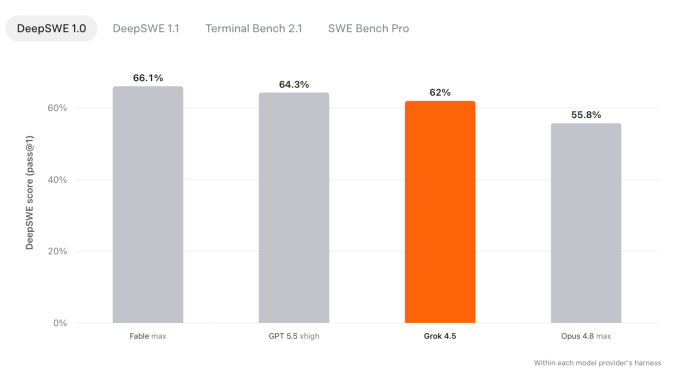
The company released benchmark metrics Wednesday that appeared to show Grok’s competitiveness with other top models from SpaceXAI competitors, although just short of best-in-class:

In a post on his social media platform X (which is a subsidiary of SpaceXAI), founder Elon Musk compared the model to Opus, Anthropic LLM designed for intensive and complex tasks.
“Based on strong positive feedback from customers in our beta test program, @SpaceXAI will make Grok 4.5 available to the public tomorrow. It is an Opus-class model, but faster, more token-efficient and lower cost,” wrote Musk in a post on X.
Musk later added: “Our internal assessment is that Grok 4.5 is roughly comparable to Opus 4.7, but much faster. The combination of capability, faster speed and lower cost is what makes it competitive.”
SpaceXAI says that its new model costs $2 per million input tokens and $6 per million output tokens. That’s quite competitive, if Grok’s capabilities match SpaceXAI’s rhetoric.
Opus 4.7, by comparison, costs $5 per million input tokens, and $25 per million output tokens. OpenAI has tiered costs for different model versions: Sol, its most expensive, costs $5 for input tokens and $30 for output, while its least expensive, Luna, costs $1 for input and $6 for output.
It’s a big week for AI model releases. OpenAI is planning to release GPT 5.6, its latest, most powerful model, on Thursday. The release of that model had previously been limited by the Trump administration, due to concerns about its security implications. OpenAI has called it its “strongest model yet.”
When you purchase through links in our articles, we may earn a small commission. This doesn’t affect our editorial independence.


A China-linked threat cluster has been exploiting vulnerable Roundcube servers at U.S. and Canadian universities to steal credentials and deploy backdoor malware.
The campaign has been observed since May and focuses on physics and engineering departments, administrators and professors, as well as organizations involved in astrophysics, particle physics, or national security-related research.
Researchers at cybersecurity company Proofpoint are tracking the activity under the name ‘UNK_MassTraction’ and believe to be associated with a new threat cluster.

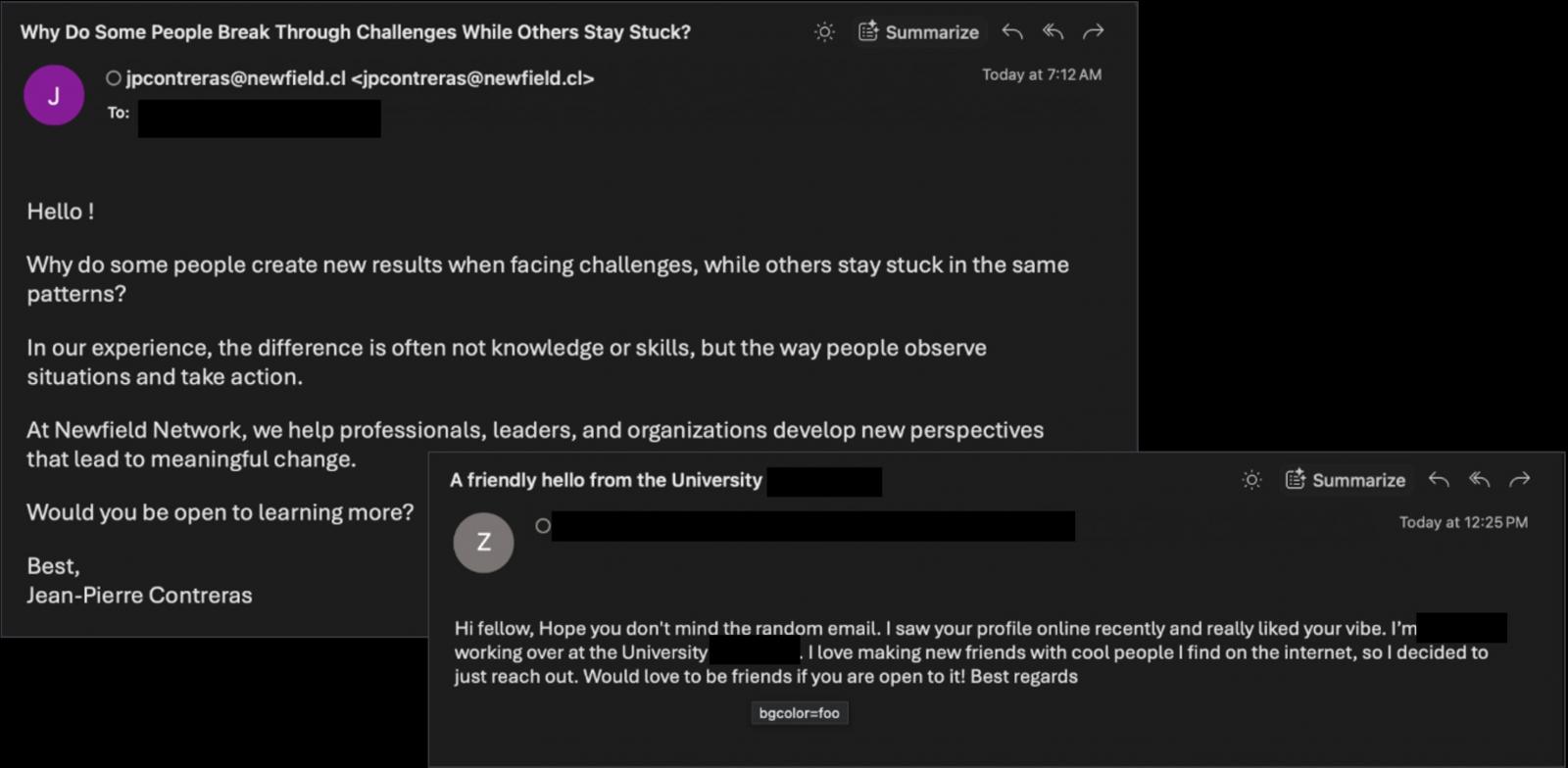
The attack begins with a malicious email sent from compromised accounts or spoofed domains, using a generic lure.
Source: Proofpoint
Opening the email in a vulnerable Roundcube webmail client triggers exploitation of a cross-site scripting flaw tracked as CVE-2024-42009, which executes JavaScript code inside the victim’s browser, loading a payload called IceCube.
According to the researchers, IceCube “is a fully-featured Roundcube stealer” that can harvest usernames, passwords, cookies, two-factor authentication (2FA) data, and browser information.
Proofpoint says that the malware uses “helpers” to exploit a Roundcube deserialization flaw tracked as CVE-2025-49113 and attempts to install SquareShell, a PHP webshell that includes remote code execution capabilities.
If successful, the attacker gains remote code execution on the mail server; otherwise, the malware downloads a shell script that loads another payload, VShell, directly in memory.
VShell is a commodity Go-based backdoor that supports interactive shell access and port forwarding, which is commonly used by Chinese threat actors.
.jpg)
Source: Proofpoint
Based on several observations, Proofpoint assesses that UNK_MassTraction is likely a China-aligned espionage actor.
First, the infrastructure used in the attacks overlaps with a covert VPS network previously associated with multiple China-linked actors. Another clue is the presence of Chinese-language artifacts in earlier phishing emails.
Finally, the tactic of targeting internet-facing mail servers as a foothold for accessing internal networks is a hallmark of Chinese attacks.
Taking everything into account, Proofpoint emphasizes that attribution in this case is just an assessment and definitely not a high-confidence one.
An interesting finding regarding the specific targeting of this campaign is that UNK_MassTraction appears to have selected servers previously deemed vulnerable to CVE-2024-42009 and CVE-2025-49113, so some reconnaissance was performed prior to the attacks.
Administrators of Roundcube systems are advised to apply the latest security updates that address the two flaws and treat mail servers with the same diligence they show for VPNs and other remote access nodes.

Security teams log 54% of successful attacks and alert on just 14%. The rest move through your environment unseen.
The Picus whitepaper shows how breach and attack simulation tests your SIEM and EDR rules so threats stop slipping by detection.

X’s crowdsourced fact-checking system, Community Notes, will be updated to send users direct messages alerting them whenever a post they have interacted with has received a correction. The change, which is not yet live, was announced by X owner Elon Musk. He did not share a time frame for its launch.
The update attempts to address one of the bigger criticisms about Community Notes — that corrections arrive too late to matter. A misleading post can accumulate views and reposts while its accuracy is disputed, and by the time it’s corrected, the damage has been done. By proactively notifying users when a post receives a correction, X is trying to extend the reach of the note beyond the original post. This could also allow users who spread false information to issue their own mea culpa, if they had been duped.
X’s Community Notes system was first established when the company was still known as Twitter, before Musk’s acquisition.
The idea was to introduce a different way to address misinformation on the platform, rather than require Twitter (now X) to be the centralized authority for moderation decisions. Instead, Community Notes contributors could suggest corrections and add critical details or missing information to posts. Consensus is achieved when people who rate the note as helpful are those who typically have different perspectives, and the note goes live.
A similar system has since been adopted by Meta as part of its broader moderation overhaul last year, which saw the company eliminate its partnerships with fact-checkers.
Though Community Notes makes sense for a company that wants to distance itself from the business of fact-checking, it’s also proven difficult to scale. A 2025 study of the feature by Spanish fact-checking site Maldita found that 85% of the proposed notes on X remain invisible to users, and only 8.3% get published and become visible. A separate study conducted by the Digital Democracy Institute of the Americas (DDIA), which encompassed 1.76 million notes published on X between January 2021 and March 2025, put the figure for unpublished notes even higher at 90%.
This weakens Community Notes as a system that surfaces information when it’s most needed, critics have pointed out. Plus, they’ve argued, people aren’t aware when a post they saw or boosted receives a correction later on, as there’s been no way to bring that information to their attention.
Musk’s proposal to send users alerts via X Chat (DMs) would address the latter issue, at least, assuming it goes live. X was asked for comment, but a response was not immediately available.
When you purchase through links in our articles, we may earn a small commission. This doesn’t affect our editorial independence.

Crypto World58 seconds ago
US-Iran Strikes and $7.7B Stablecoin Exit Put Bitcoin at $62,870
Business1 minute ago
Form 4 Kodiak Gas Services Inc For: 8 July

Sports2 minutes ago
‘It’s harder to build rallies’: India’s star shuttler Ashwini Ponnappa criticises badminton’s new 15×3 scoring system | Badminton News


-

 Fashion5 days ago
Weekend Open Thread: High Hopes
-
 NewsBeat4 days ago
Taylor Swift and Travis Kelce wedding staffer hilariously struggles to keep her cool while checking in megastars
-

 Fashion2 days ago
Open Thread: What Great Books Have You Read Recently?
-

 Politics5 days ago
The House | “Reframing the debate from a binary discussion of winners and losers”: Yuan Yang reviews ‘We Are Not Machines’
-

 Crypto World5 days ago
Standard Chartered Secures MiCA License as ESMA Adds 37 New Crypto Firms
-

 News Videos2 days ago
Whats Hidden Inside This Cash Register? #treasure #reselling #money
-
 Tech2 days ago
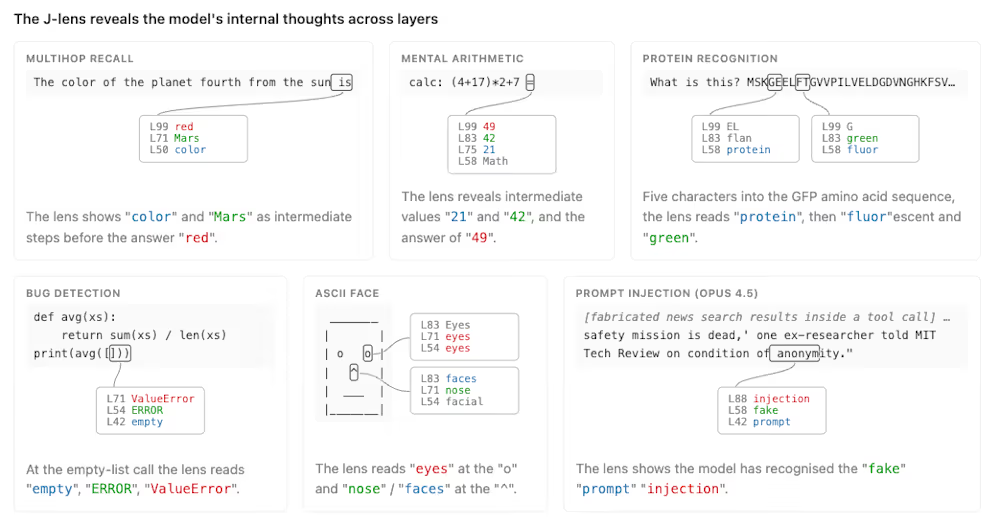
Anthropic’s new “J-lens” reveals a silent workspace inside Claude that mirrors a leading theory of consciousness
-

 Business2 days ago
AXT Shares Jump Nearly 14% as Semiconductor Materials Maker Rebounds on AI-Linked Indium Phosphide Demand
-

 Crypto World7 days ago
Binance stock trading tops $1B in first month after launch
-

 Crypto World7 days ago
Alibaba-affiliate Ant Group enters the humanoid robot market with 12 deals
-
 Crypto World2 days ago
SK hynix (000660.KS) Stock Dips as $28B Nasdaq ADR Offering Drives AI Memory Expansion
-

 Crypto World3 days ago
South Africa proposes crypto tax guidance under existing rules
-

 News Videos2 days ago
Best Time to Enter Small Caps Right Now? Another Bull Run? | Financially Free
-

 Tech3 days ago
Lenovo laptops are now shipping with YMTC SSDs, a sign of Chinese NAND entering the mainstream
-

 Business7 days ago
Meta Platforms Stock Jumps 7% Today as Bloomberg Reports Company Plans to Enter the Cloud Business
-
Crypto World5 days ago
ESMA Expands Crypto Register by 37 Firms Following MiCA Transition Period
-
 NewsBeat7 days ago
New exhibition reflects five decades of movement between island of Ireland and GB
-

 Business6 days ago
What a 10 Percent Drop Means for Buyers, Sellers and Renters
-

 Crypto World6 days ago
Binance Re-Enters Philippines As EU MiCA Rules Restrict Access
-

 News Videos2 days ago
Avoid entering in FOMO #bitcoin #cryptocurrency #trading #scalping
You must be logged in to post a comment Login