

As I am typing this, a device rests on my wrist that purports to unlock a trove of real-time information about my body’s performance. I can click a button and check my heart rate and review how much it’s varied over the course of the day. It can tell me how many steps I’ve taken, how many minutes I’ve been “active” throughout the day, and — if I wore it while I slept — just how well I rested, according to the data its sensors can pick up from my arm.
Tech
How to make sense of your Apple Watch, Oura Ring or FitBit’s health data

The Apple Watch is a remarkable piece of technology, when you stop and really think about what it does. It’s no surprise, perhaps, then, that we have collectively become obsessed with these things. One 2023 government survey found that one in three Americans wear a smartwatch or wristband to track their health and fitness. More recent industry surveys put that figure even higher: More than half of the US population owns a wearable or connected device and tracks at least one health metric with it.
That’s a lot of people who are swimming in the ocean of information that our Apple Watches, and FitBits, and Oura Rings, and Whoops report back to us. Dr. Michael Joyner, who studies the physiology of exercise at the Mayo Clinic, said he has a three-pronged criteria for thinking about the usefulness of these metrics: Is it measurable? Is what you’re measuring actually meaningful? And is the information that you’re receiving actually actionable?
“If one or two are missing, the thing may be the most interesting thing in the world. It may be cool,” he said. “But it’s not going to make a difference in long-term outcomes.”
Across medicine, we are developing remarkable tools for detecting things in the human body, outpacing our ability to interpret what we are finding. We are getting closer to a future where these devices could offer invaluable insights into how our body is performing outside of the doctor’s office or hospital, but here in the present, we should keep our expectations in check.
Here’s what you should know about some of the most common metrics that wearables track.
Do we really understand what our wearables are telling us?
These devices claim to track both old-fashioned and new-fangled measures of your body’s performance. You’ve got your heart rate — something humans have been able to pick up from the wrist before anybody had dreamed of smart devices — and your step count. My Apple Watch estimates how many calories I have burned throughout the day. The Oura Ring takes your temperature, which can help predict ovulation or offer an early sign that you’re coming down with something.
Sign up for the Good Medicine newsletter
Our political wellness landscape has shifted: new leaders, shady science, contradictory advice, broken trust, and overwhelming systems. How is anyone supposed to make sense of it all? Vox’s senior correspondent Dylan Scott has been on the health beat for a long time, and every week, he’ll wade into sticky debates, answer fair questions, and contextualize what’s happening in American healthcare policy. Sign up here.
But as the technology has gotten better, new measures for things many of us have never heard of have emerged. Heart rate variability, or HRV, has gained a lot of recent interest. It assesses the tiny variations, measured in milliseconds, in the rhythm of your heartbeat; the Economist dubbed it “the most useful indicator” of your overall health. Some devices then use HRV to deliver “recovery” scores that judge how well your body bounces back from your workout or “stress” scores that attempt to quantify how much strain you are under.
HRV demonstrates the conundrum that wearables can present to us, Joyner said. The metric itself has a scientific basis: Researchers have, in fact, found that the amount your heart rate varies over time is associated with your overall health. In general, a higher HRV is better than low, because it suggests your body is more adaptable and better regulated.
But that doesn’t necessarily mean that tracking your HRV from minute to minute with a smartwatch will translate to better health. For starters, we don’t have specific interventions for improving HRV, Joyner said. We don’t even have universally accepted definitions of what high or low HRV is.
In any case, the best strategies are the same heart health guidelines we’ve known about for decades: don’t smoke, don’t drink to excess, eat a healthy diet, exercise. You didn’t need a smartwatch to tell you that’s the best way to take care of your heart, Joyner pointed out. So what good was really derived from closely monitoring your HRV?
“As an individual metric that you can track and do something about, it’s interesting, but there’s no definitive data that you’re going to get better,” Joyner, who was speaking for himself and not the Mayo Clinic, said. “Follow the guidelines. People who follow the guidelines are going to do better on these metrics. But whether you can intervene specifically to make the metrics better or should pay much attention to them, who knows?”
Dr. Ami Bhatt, chief innovation officer at the American College of Cardiology, told me that the bedrocks of evaluating your heart health are still the old mainstays like your blood pressure and your cholesterol, along with newer metrics checked via blood test such as ApoB and lipoprotein. Are you a smoker? What’s your family history?
The value from wearables is less about the specific numbers they are reporting — especially with something like HRV, for which there are not universal guidelines — and more about the long-term trends they can track. By collecting your personal data over time, they can help you figure out what’s normal for you and help you notice if something changes. So don’t freak out if your HRV is different from somebody else’s, or you see one abhorrent reading in your daily report. But if you notice a change in your resting heart rate or HRV that persists over time, then it might be worth going to see a doctor about it.
“We don’t want to overreact to just one abnormal reading,” Bhatt said. “If you just know your baseline when you’re relatively healthy, you can catch the trends.”
It’s all about having realistic expectations about what your wearable can deliver — and recognizing that, for some things, the old ways are still better. When it comes to those metrics that incorporate HRV to determine your stress and “recovery,” Joyner said that self-reported data (literally, how do you feel?) remains the more accurate way to evaluate a person.
And at a certain point, your wearable can straight-up make your health worse. Fixating too much on your sleep problems, for example, can paradoxically cause more sleep problem. An American Society of Sleep Medicine survey this year found that 76 percent of US reported losing sleep because they were worrying about their sleep. It’s a problem — dubbed “orthosominia” — that scientists have been warning about for nearly a decade: the possibility that our obsession with better sleep, and doing things like wearing a device to track our sleep, could actually give us insomnia.
Bhatt said she’d like to see these devices develop the capability to detect when a user may be checking their data a little too compulsively. Joyner, for his part, said he worried that the culture around health and wellness could, ironically, create a lot of stress for the people who get deeply invested in tracking their activity.
“I actually worry we’re entering a too-much-information world,” he said. “It’s going to be anxiety-provoking.”
How to have a healthier relationship with your wearables
Even as we recognize the limitations of wearables, that doesn’t mean they can’t be useful — and they’re going to keep getting better.
Right now, there are obvious situations where a wearable can be helpful. As Bhatt suggested, they can help you understand your personal baseline and notice any changes. Certain patients, such as those with congenital heart failure, can clearly benefit from ongoing monitoring of their heart’s performance, per the American Heart Association. Anybody can use a wearable to make sure their heart rate doesn’t reach dangerous levels during a workout. And these devices could ultimately prove effective in catching underlying heart problems — but there is still work to do. A 2019 study on wearables and atrial fibrillation is telling: At the time, only a tiny percentage of wearers received a notification of an irregular heartbeat, suggesting that there were others that the devices were missing. But, for those who did get an alert, the majority of them did in fact have A-fib. (The FDA has since said that several smartwatches are capable of A-fib detection.) Some patients who have had a serious cardiac event are being asked to put on a wearable, so their doctors can remotely monitor their heart, utilizing an AI assistant that checks the incoming data for any signs of a pending emergency.
And these are the worst wearables we’ll ever have. The future iterations of these devices are going to become more precise and more integrated with AI, which could allow them to ultimately provide more value to the people wearing them. The hypothetical potential for integrating wearables with health care delivery more broadly is immense.
“None of these things will exist in a silo,” Bhatt said. “Your health records, how you’re doing, your wearables, your lab data, people are going to be pulling those together…and trying to give you insights.”
But for now, for the average person, it’s more of a personal choice. Joyner, whose work is all about maximizing human performance, does not wear a smartwatch. Bhatt likes to experiment with different devices with a certain goal in mind, like trying to improve her sleep over the course of a few months.
As Bhatt put it to me, if a wearable motivates you to take your health more seriously, then it’s already doing your body some good. “The best health metric is the one that changes what you do in a way that improves your health,” she said. “For you and I, that may be different things. For your grandmother, it’s something else. For the woman down the road, it’s something else.”
At the most fundamental level, people who use wearables tend to move more when they do — up to 40 more minutes of walking per day, according to a 2022 Lancet study. That is a gain for their health; recent research has shown that even a little bit of movement can have life-saving benefits. The more wearables encourage people to move, the more they can deliver real health benefits.
So if you like wearing one, that’s fine. I’m not dropping my Apple Watch’s step tracker any time soon, because it pushes me to get moving. But be mindful of how your use affects you and how preoccupied you are with certain metrics. Stress is one of the worst things for your health. So is a lack of sleep. If you find your sleep metrics are keeping you up at night, or that your sleep seems to have gotten worse since you started using it, it’s okay to take it off.

Continue Reading

Looking for a different day?
A new NYT Strands puzzle appears at midnight each day for your time zone – which means that some people are always playing ‘today’s game’ while others are playing ‘yesterday’s’. If you’re looking for Thursday’s puzzle instead then click here: NYT Strands hints and answers for Thursday, July 9 (game #858).
Strands is the NYT’s latest word game after the likes of Wordle, Spelling Bee and Connections – and it’s great fun. It can be difficult, though, so read on for my Strands hints.
Want more word-based fun? Then check out my NYT Connections today and Quordle today pages for hints and answers for those games, and Marc’s Wordle today page for the original viral word game.
SPOILER WARNING: Information about NYT Strands today is below, so don’t read on if you don’t want to know the answers.
Latest Videos From

NYT Strands today (game #859) – hint #1 – today’s theme
What is the theme of today’s NYT Strands?
• Today’s NYT Strands theme is… I think…
NYT Strands today (game #859) – hint #2 – clue words
Play any of these words to unlock the in-game hints system.
- STAY
- STORY
- SNAKE
- LEEK
- ROBE
- HATE
NYT Strands today (game #859) – hint #3 – spangram letters
How many letters are in today’s spangram?
• Spangram has 11 letters
NYT Strands today (game #859) – hint #4 – spangram position
What are two sides of the board that today’s spangram touches?
• First side: left, 1st row
• Last side: right, 6th row
Right, the answers are below, so DO NOT SCROLL ANY FURTHER IF YOU DON’T WANT TO SEE THEM.
NYT Strands today (game #859) – the answers

The answers to today’s Strands, game #859, are…
- BELIEVE
- HISTORY
- HASTE
- GOOD
- MERRY
- LOVE
- SENSE
- SPANGRAM: WECANMAKEIT
- My rating: Hard
- My score: Perfect
Is it possible to look at today’s theme and not say to yourself “… therefore I am”? Apparently it is, because the words that complete “I think…” here were instead the more seemingly everyday “we can make it”.
Thinking that I was missing out on some cultural reference point I googled all of today’s game words, along with the spangram, and the AI result claimed that all the words feature in the 17th-century Irish Jacobite love song, Mo Ghile Mear (My Gallant Hero). And there was me thinking it was from Ted Lasso or a Taylor Swift song I’d not heard of.
Despite my ignorance I was able to navigate the game without using any hints.
Yesterday’s NYT Strands answers (Thursday, July 9, game #858)
- STICK
- GLOSS
- STAIN
- LINER
- TINT
- BALM
- PLUM
- SPANGRAM: KISSANDMAKEUP
What is NYT Strands?
Strands is the NYT’s not-so-new-any-more word game, following Wordle and Connections. It’s now a fully fledged member of the NYT’s games stable that has been running for a year and which can be played on the NYT Games site on desktop or mobile.
I’ve got a full guide to how to play NYT Strands, complete with tips for solving it, so check that out if you’re struggling to beat it each day.
Looking for a different day?
A new Quordle puzzle appears at midnight each day for your time zone – which means that some people are always playing ‘today’s game’ while others are playing ‘yesterday’s’. If you’re looking for Thursday’s puzzle instead then click here: Quordle hints and answers for Thursday, July 9 (game #1627).
Quordle was one of the original Wordle alternatives and is still going strong now more than 1,500 games later. It offers a genuine challenge, though, so read on if you need some Quordle hints today — or scroll down further for the answers.
Enjoy playing word games? You can also check out my NYT Connections today and NYT Strands today pages for hints and answers for those puzzles, while Marc’s Wordle today column covers the original viral word game.
SPOILER WARNING: Information about Quordle today is below, so don’t read on if you don’t want to know the answers.
Latest Videos From
Quordle today (game #1628) — hint #1 — Vowels
How many different vowels are in Quordle today?
• The number of different vowels in Quordle today is 3*.
* Note that by vowel we mean the five standard vowels (A, E, I, O, U), not Y (which is sometimes counted as a vowel too).
Quordle today (game #1628) — hint #2 — repeated letters
Do any of today’s Quordle answers contain repeated letters?
• The number of Quordle answers containing a repeated letter today is 1.
Quordle today (game #1628) — hint #3 — uncommon letters
Do the letters Q, Z, X or J appear in Quordle today?
• No. None of Q, Z, X or J appear among today’s Quordle answers.
Quordle today (game #1628) — hint #4 — starting letters (1)
Do any of today’s Quordle puzzles start with the same letter?
• The number of today’s Quordle answers starting with the same letter is 0.
If you just want to know the answers at this stage, simply scroll down. If you’re not ready yet then here’s one more clue to make things a lot easier:
Quordle today (game #1628) — hint #5 — starting letters (2)
What letters do today’s Quordle answers start with?
• G
• S
• D
• H
Right, the answers are below, so DO NOT SCROLL ANY FURTHER IF YOU DON’T WANT TO SEE THEM.
Quordle today (game #1628) — the answers

The answers to today’s Quordle, game #1628, are…
It took me a while to realize that my final word must have two letter Es.
But after getting that right I made the error of believing it had a rare letter too.
Fortunately I had enough lines left to survive my impulsiveness.
Daily Sequence today (game #1628) — the answers

The answers to today’s Quordle Daily Sequence, game #1628, are…
Quordle answers: The past 20
- Quordle #1627, Thursday, 9 July: CRUMP, PHONE, SHINY, STONY
- Quordle #1626, Wednesday, 8 July: GHOST, TREND, EXALT, ALONG
- Quordle #1625, Tuesday, 7 July: ARRAY, SUITE, KIOSK, BOULE
- Quordle #1624, Monday, 6 July: TRAWL, SPICE, PIANO, SHARK
- Quordle #1623, Sunday, 5 July: PINEY, SWOON, TITLE, PINTO
- Quordle #1622, Saturday, 4 July: ARGUE, MOTEL, OPERA, TRUCE
- Quordle #1621, Friday, 3 July: AVERT, MOTOR, MANIC, WORDY
- Quordle #1620, Thursday, 2 July: BULKY, PARSE, BELOW, MOVIE
- Quordle #1619, Wednesday, 1 July: EASEL, OTTER, LYRIC, SHACK
- Quordle #1618, Tuesday, 30 June: HALVE, DRYER, THERE, MINTY
- Quordle #1617, Monday, 29 June: SLURP, CRACK, CRANK, PHONY
- Quordle #1616, Sunday, 28 June: RUPEE, TOPAZ, FULLY, BEING
- Quordle #1615, Saturday, 27 June: PRINT, MARRY, SADLY, BICEP
- Quordle #1614, Friday, 26 June: JUICE, ARRAY, BONEY, SKIFF
- Quordle #1613, Thursday, 25 June: SHELF, TAWNY, HYPER, SOLVE
- Quordle #1612, Wednesday, 24 June: SOBER, ECLAT, GOOSE, NINNY
- Quordle #1611, Tuesday, 23 June: ARDOR, DADDY, SERVE, SHEAR
- Quordle #1610, Monday, 22 June: WAXEN, APNEA, CHIME, WAVER
- Quordle #1609, Sunday, 21 June: ABBOT, NOTCH, DREAD, LURID
- Quordle #1608, Saturday, 20 June: SLAIN, TAMER, VIPER, FALSE
Looking for a different day?
A new NYT Connections puzzle appears at midnight each day for your time zone – which means that some people are always playing ‘today’s game’ while others are playing ‘yesterday’s’. If you’re looking for Thursday’s puzzle instead then click here: NYT Connections hints and answers for Thursday, July 9 (game #1124).
Good morning! Let’s play Connections, the NYT’s clever word game that challenges you to group answers in various categories. It can be tough, so read on if you need Connections hints.
What should you do once you’ve finished? Why, play some more word games of course. I’ve also got daily Strands hints and answers and Quordle hints and answers articles if you need help for those too, while Marc’s Wordle today page covers the original viral word game.
SPOILER WARNING: Information about NYT Connections today is below, so don’t read on if you don’t want to know the answers.
Latest Videos From
NYT Connections today (game #1125) – today’s words

Today’s NYT Connections words are…
- OUTKAST
- DEPECHE MODE
- FRESH-BAKED
- BALL GOWN
- DO NOT DISTURB
- À LA MODE
- STRIKE A POSE
- AIRPLANE MODE
- ERASURE
- SAFE MODE
- DECADENT
- NEW ORDER
- HOTSPOT
- PET SHOP BOYS
- MOLTEN
- LOCATION SERVICES
NYT Connections today (game #1125) – hint #1 – group hints
What are some clues for today’s NYT Connections groups?
- YELLOW: iPhone options
- GREEN: Pudding levels
- BLUE: UK chart acts of yesteryear
- PURPLE: Umpire beginnings
Need more clues?
We’re firmly in spoiler territory now, but read on if you want to know what the four theme answers are for today’s NYT Connections puzzles…
NYT Connections today (game #1125) – hint #2 – group answers
What are the answers for today’s NYT Connections groups?
- YELLOW: SMARTPHONE SETTINGS
- GREEN: DESSERT MENU DESCRIPTORS
- BLUE: ‘8OS SYNTH-POP BANDS
- PURPLE: STARTING WITH BASEBALL CALLS
Right, the answers are below, so DO NOT SCROLL ANY FURTHER IF YOU DON’T WANT TO SEE THEM.
NYT Connections today (game #1125) – the answers

The answers to today’s Connections, game #1125, are…
- YELLOW: SMARTPHONE SETTINGS: AIRPLANE MODE, DO NOT DISTURB, HOTSPOT, LOCATION SERVICES
- GREEN: DESSERT MENU DESCRIPTORS: DECADENT, FRESH-BAKED, MOLTEN, À LA MODE
- BLUE: ‘8OS SYNTH-POP BANDS: DEPECHE MODE, ERASURE, NEW ORDER, PET SHOP BOYS
- PURPLE: STARTING WITH BASEBALL CALLS: BALL GOWN, OUTKAST, SAFE MODE, STRIKE A POSE
- My rating: Hard
- My score: 1 mistake
There were a number of fashion links among today’s tiles: A LA MODE, of course, STRIKE A POSE — which features in Madonna’s Vogue — BALL GOWN, and DEPECHE MODE, which was the name of a French fashion magazine.
What caught me out, however, was the SMARTPHONE SETTINGS, as I originally included SAFE MODE instead of DO NOT DISTURB.
Today’s game also featured my two favorite bands — PET SHOP BOYS and NEW ORDER, both of whom joined forces in the 1990s with Electronic and who still tour together occasionally.
Yesterday’s NYT Connections answers (Thursday, July 9, 2026, game #1124)
- YELLOW: NON-ALCOHOLIC DESIGNATORS: NA, SPIRIT-FREE, VIRGIN, ZERO-PROOF
- GREEN: MUSIC PUBLICATIONS: BILLBOARD, PITCHFORK, ROLLING STONE, SPIN
- BLUE: KINDS OF RUGS: PERSIAN, PRAYER, SHAG, THROW
- PURPLE: PONTIAC MODELS: FIREBIRD, G6, GRAND PRIX, TRANS AM
What is NYT Connections?
NYT Connections is one of several increasingly popular word games made by the New York Times. It challenges you to find groups of four items that share something in common, and each group has a different difficulty level: green is easy, yellow a little harder, blue often quite tough and purple usually very difficult.
On the plus side, you don’t technically need to solve the final one, as you’ll be able to answer that one by a process of elimination. What’s more, you can make up to four mistakes, which gives you a little bit of breathing room.
It’s a little more involved than something like Wordle, however, and there are plenty of opportunities for the game to trip you up with tricks. For instance, watch out for homophones and other word games that could disguise the answers.
It’s playable for free via the NYT Games site on desktop or mobile.

Jeff Bezos is letting outside investors into Blue Origin for the first time since he founded it in 2000. The rocket company is seeking about $10bn in fresh capital at a $130bn pre-money valuation, according to CNBC.
For 26 years, Bezos bankrolled the company himself, selling billions in Amazon stock rather than sharing ownership. That solo-funding era is now over.
He is not stepping back entirely, with reporting suggesting he will put around $2bn into the round himself. Hedge fund Coatue Management is expected to add roughly $4bn, with strong institutional interest for the rest.
The obvious question is what changed. The blunt answer is that staying in the space race has outgrown even one of the world’s richest people.
A costly stretch of bad timing

The 💜 of EU tech
The latest rumblings from the EU tech scene, a story from our wise ol’ founder Boris, and some questionable AI art. It’s free, every week, in your inbox. Sign up now!
Blue Origin is trying to do several expensive things at once. It is recovering from a failed New Glenn static-fire test that destroyed a launch pad, while scaling production of that same heavy-lift rocket.
New Glenn is the vehicle Blue Origin is counting on for lunar and national-security missions. Chief executive Dave Limp has committed to returning it to flight before the end of 2026, with launches planned for NASA, Amazon’s Leo satellite network, and AST SpaceMobile.
That combination of recovery and scale-up, more than any single rival’s move, is the sharper reason for the timing. Founder wealth alone cannot comfortably absorb costs at this pace.
Chasing a rival worth far more
The backdrop is SpaceX, which just pulled off the largest IPO in history. It raised a record sum, reportedly near $86bn, at a valuation around $2tn, even as its filing confirmed Musk keeps dominant voting control.
SpaceX’s lead is built on reusable rockets, Starlink, and government work, including a $2.29bn Space Force contract. Catching up on lunar and defence launches now takes tens of billions, not a founder’s cheque.
Investor appetite for space has swelled since that listing, as money that once flowed into SpaceX proxies now has the real thing to chase. Rivals from Stoke Space to Firefly have raised or gone public on the same wave.
Blue Origin has taken only limited outside money before, including a 2021 grant and a 2022 acquisition, and it has not disclosed a closing timeline. Whether $10bn narrows the SpaceX gap or merely buys time depends far less on the capital than on one thing: getting New Glenn back to the launch pad, and off it.

Every time you use ChatGPT or generate an image with AI, there is a memory chip working at extreme speed behind the scenes. However, that chip has a memory bottleneck problem, and a Korean research team may have just solved it.
Researchers at POSTECH (Pohang University of Science and Technology) developed a new way to stack more than 10 ultrathin semiconductor chips on top of each other, achieving a memory density roughly four times higher than the best commercial chips available today (via TechXplore).
Why is stacking chips so hard, and what makes this one different?
High-bandwidth memory, or HBM, is the type of memory that powers AI accelerators. It works by stacking multiple chips vertically, much like building a high-rise instead of spreading out across land.
The problem is that as chips get thinner, they become incredibly fragile. At one-fifth the thickness of a human hair, they bend, warp, and crack under pressure. Current manufacturing methods make this worse, often damaging chips before they even make it into a stack.
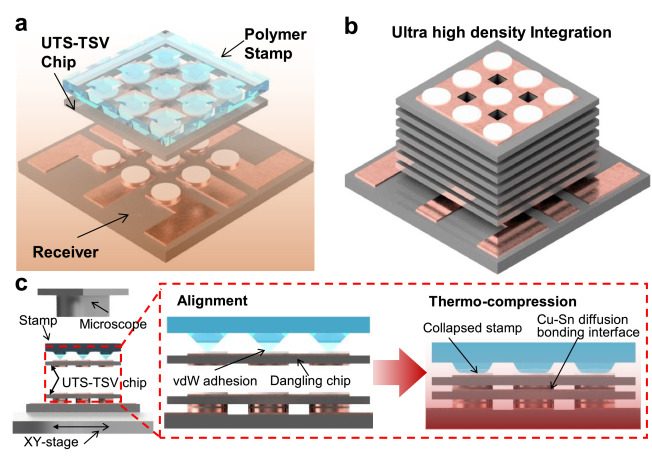
The POSTECH team solved this by combining two techniques into one process. Transfer printing precisely places each chip where it needs to go, while in-situ bonding forms the metallic connections at the same moment, all under low heat below 180 degrees Celsius and low pressure below 20 kilopascals. The result is a stack of more than 10 chips with almost no misalignment and very little warping.
Why this matters for the future of AI
More memory packed into the same space means AI tools can run faster and handle bigger tasks without needing larger or more expensive hardware. The researchers also see uses beyond AI, including next-generation micro-LED displays and advanced processor designs that need the same kind of ultra-precise stacking this method delivers.
Getting this into commercial production is the next step, but if it gets there, the memory ceiling that has been quietly holding AI back could finally start to lift.
Uninstalling apps on macOS is usually very easy. You drag an app to the Trash, empty it, and move on. The annoying part is that many apps still leave residue behind, including support files, caches, preferences, containers, and logs. I have always found that frustrating, especially when old app data keeps sitting around long after the app itself is gone.
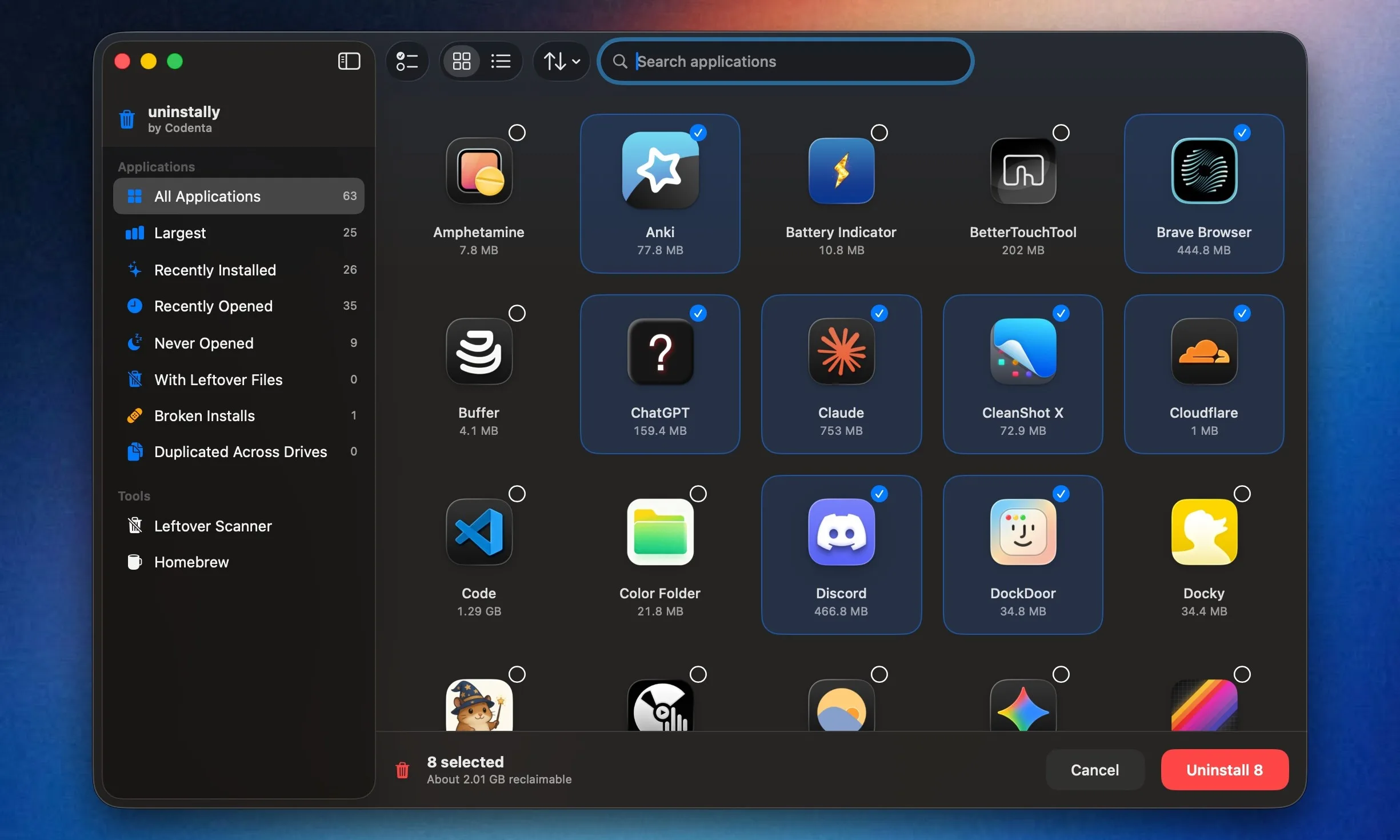
AppCleaner by FreeMacSoft has been the popular go-to option for this for years, and it still does the job well. But I recently came across a new open-source alternative called Uninstally by Codenta, which solves the same basic problem. It removes Mac apps along with the support files, caches, preferences, containers, logs, and other leftovers they usually leave behind.
How does Uninstally work?
Uninstally can be used directly from Finder. Once its Finder extension is enabled, you can right-click any .app bundle and choose “Uninstall with Uninstally.” The app then opens a confirmation window instead of making you start from a separate app browser.
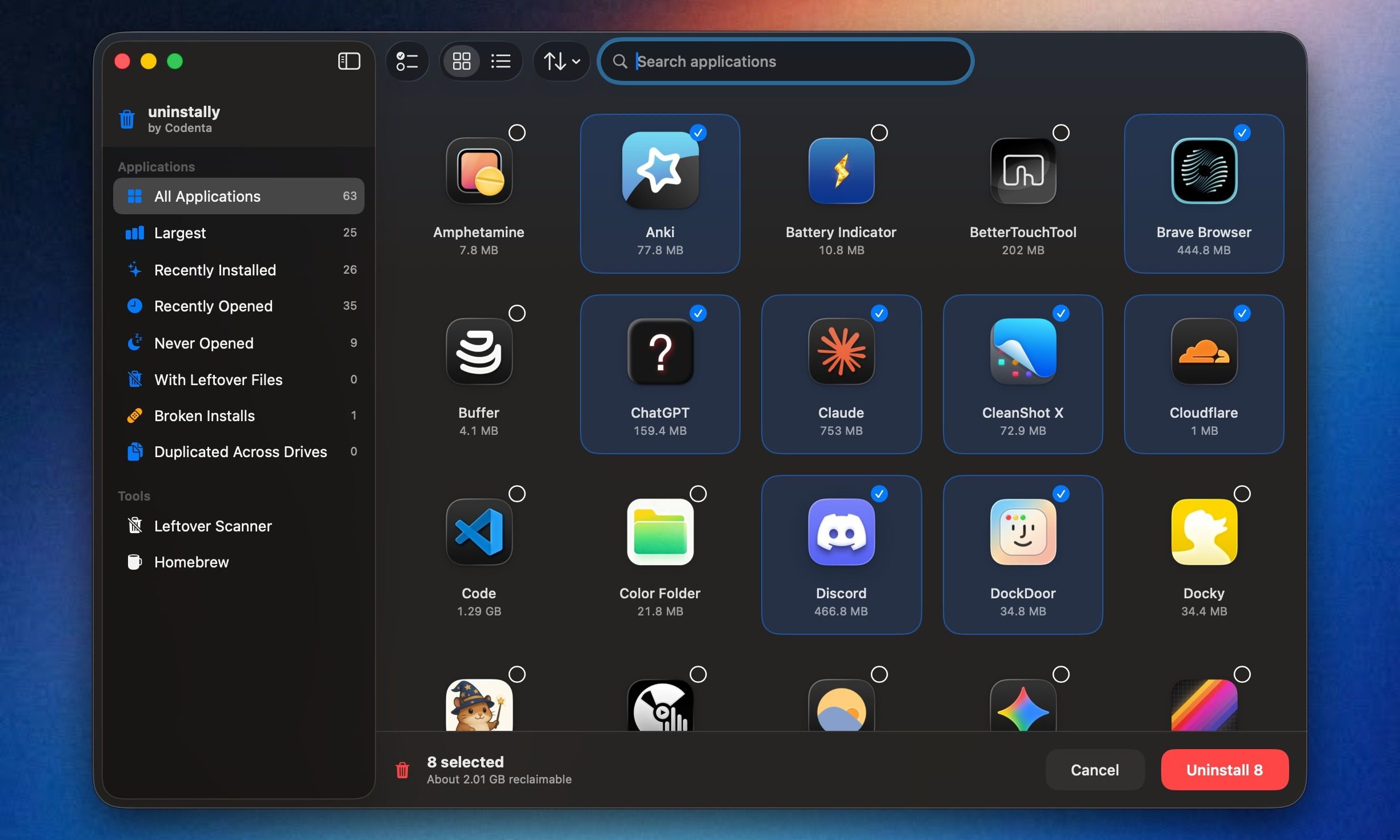
The cleaner part is how it finds related files. Uninstally uses the app’s bundle identifier and helper namespaces to match leftover items across the Library hierarchy, rather than just looking for folders with the same name. Before anything is removed, it shows the app name, icon, reclaimable storage, item count, and lets you review or deselect matched files.
What else makes it useful?
There is also a standalone app browser for a more deliberate cleanup. You can search installed apps, switch between grid and list views, and filter by largest apps, recently installed apps, never opened apps, broken installs, duplicated apps, and apps with leftovers.

Uninstally also includes a leftover scanner for apps you have already removed. Instead of digging through Library folders manually, you can scan for orphaned support files, caches, containers, preferences, logs, and old installers in one place.
It also supports Homebrew casks and formulae, shows dependency relationships, and can remove Homebrew leftovers through optional zap cleanup. User-domain files are moved to the Trash, while privileged items require an administrator prompt. You can download Uninstally from Codenta’s website or its GitHub repo.
Google is rolling out a feature that flags when an advertisement was made using AI. The label will indicate if an ad was created or edited with generative tools, TechCrunch reports.
The disclosure appears in the “My Ad Center” panel, reachable via the three-dot menu or info icon on ads. It covers ads across Google Search, YouTube, and Google Discover, and is available globally.
That panel already lets users block or report ads and learn why one was shown. Now it adds an option labelled “how this ad was made”, which surfaces any AI involvement.
The rationale is straightforward. AI makes it cheap to generate slick product imagery, which can mislead shoppers who assume they are looking at a real photograph rather than a synthetic one.
The 💜 of EU tech
The latest rumblings from the EU tech scene, a story from our wise ol’ founder Boris, and some questionable AI art. It’s free, every week, in your inbox. Sign up now!
Until now, Google only required AI disclosure on election ads. Extending it to commercial ads is a meaningful widening of the policy.
The honour-system catch
The reach of the feature depends heavily on how an ad was built. When advertisers use Google’s own generative AI ad tools, the disclosure is switched on automatically.
When an ad is made elsewhere, though, the advertiser must actively flag that AI was involved. Google says it will not run its own check to verify the claim, so the label rests on advertisers being honest.
That gap matters because the incentive to stay quiet is real. An advertiser hoping a synthetic scene passes for a genuine photo has little reason to volunteer otherwise, and Google is not looking over its shoulder.
Regulators are forcing the issue
The timing is not accidental. Google’s move front-runs tougher rules, as the EU AI Act’s transparency obligations for AI-generated content start to bite in August.
Industry is already resisting the mandatory version, with retailers lobbying to exempt AI-made ads from those EU rules. A voluntary, self-declared label is a far lighter touch than what Brussels has in mind, and part of a broader fight over the AI Act.
Google is not consistent across its own products either. On YouTube it will auto-label AI videos whether or not creators disclose them, a stricter stance than the advertiser honesty it relies on here.
Transparency, up to a point
The feature is still a step toward a market drowning in synthetic media, where even Google has branded some AI content spam. Giving users a place to ask how an ad was made is better than silence.
Whether it changes behaviour is another question, in an ecosystem where deceptive advertising is already a lucrative problem. A label only helps if the people with the most to hide choose to apply it.
For now, Google has built the disclosure and handed advertisers the switch. The honest ones will flip it, and the rest are exactly the reason such a label was needed.


Ireland, Spain, France and the Netherlands are the only member states yet to incorporate the NIS2 directive into national law.
Ireland is one of four countries being referred to the highest court in the European Union for failing to adopt cybersecurity directives into law. The European Commission’s move comes as Ireland commences its six-month rotational presidency heading the EU Council.
The Network and Information Security 2 (NIS2) Directive entered into force in January 2023 and sets high security standards across 18 critical sectors, including health, energy, transport and the public sector, mandating organisations to implement appropriate security measures and report any relevant incidents to the authorities.
However, directives must be incorporated into national legislation by EU member states before gaining effect. Member states had until October 2024 to carry out the transposition.
But by late November 2024, 23 member states, including Denmark, Germany, Finland and Sweden, were yet to transpose the directive, while by May 2025, 19 had still not done so.
In its referral yesterday (8 July), which also includes Spain, France and the Netherlands, the Commission requested the Court of Justice of the European Union to impose financial sanctions on infringing member states, consisting of lump sum and daily penalties until NIS2 is incorporated into national legislation.
The cybersecurity threat landscape is fast evolving, as newer technologies such as AI provide bad actors with advanced tools to commit phishing attacks, scams and infrastructure break-ins, while breaches go underreported in Ireland, according to a recent Compliance Institute report.
“While Ireland is not alone in having missed the deadline, this is not a great start for Ireland to our presidency of the Council of the European Union,” said Dentons partner David Kirton.
“The Government has listed competitiveness and security as two of its three key pillars for the presidency, so putting this legislation into effect would be a strong symbol of that commitment.”
The Government published a general scheme of the National Cyber Security Bill in August 2024, and a National Digital and AI Strategy this February, where it committed to “prioritising legislation to implement the EU NIS2 Directive”, but did not provide a timeline.
The bill remains in pre-legislative scrutiny and is only expected to go before the Oireachtas by September at the earliest.
Transposing the directive will not be straightforward, Kirton said, “as parts of the legislation are technical in nature and present a major change in empowering the National Cyber Security Centre to act in an enforcement role alongside other competent authorities”.
“The Government will need to prioritise the preparation of a bill, which has been promised by the Minister for Justice for later this year, which will no doubt provoke further debate as it proceeds through the legislative process before entering into force,” he added.
Earlier this year, the Commission proposed amendments to simplify NIS2 as part of its digital omnibus overhaul that aims to cut regulatory red tape and make business in the bloc easier.
Amendments to NIS2 aim to increase legal clarity by simplifying jurisdictional rules, streamlining the collection of data on ransomware attacks and facilitating the supervision of cross-border entities, the EU argued.
Don’t miss out on the knowledge you need to succeed. Sign up for the Daily Brief, Silicon Republic’s digest of need-to-know sci-tech news.

We’ve seen a lot of “smart art frames” at CES over the years. Most of them feel like glorified digital photo frames in turtlenecks. However, there’s one that feels genuinely different: Fraimic, and I say that as someone deeply skeptical of this category.
The pitch appears quite compelling at first. Speak a prompt into the device, and its built-in mic sends the command to OpenAI’s GPT Image 2.0, which then generates full-color artwork that lands on a Spectra 6 E Ink display.
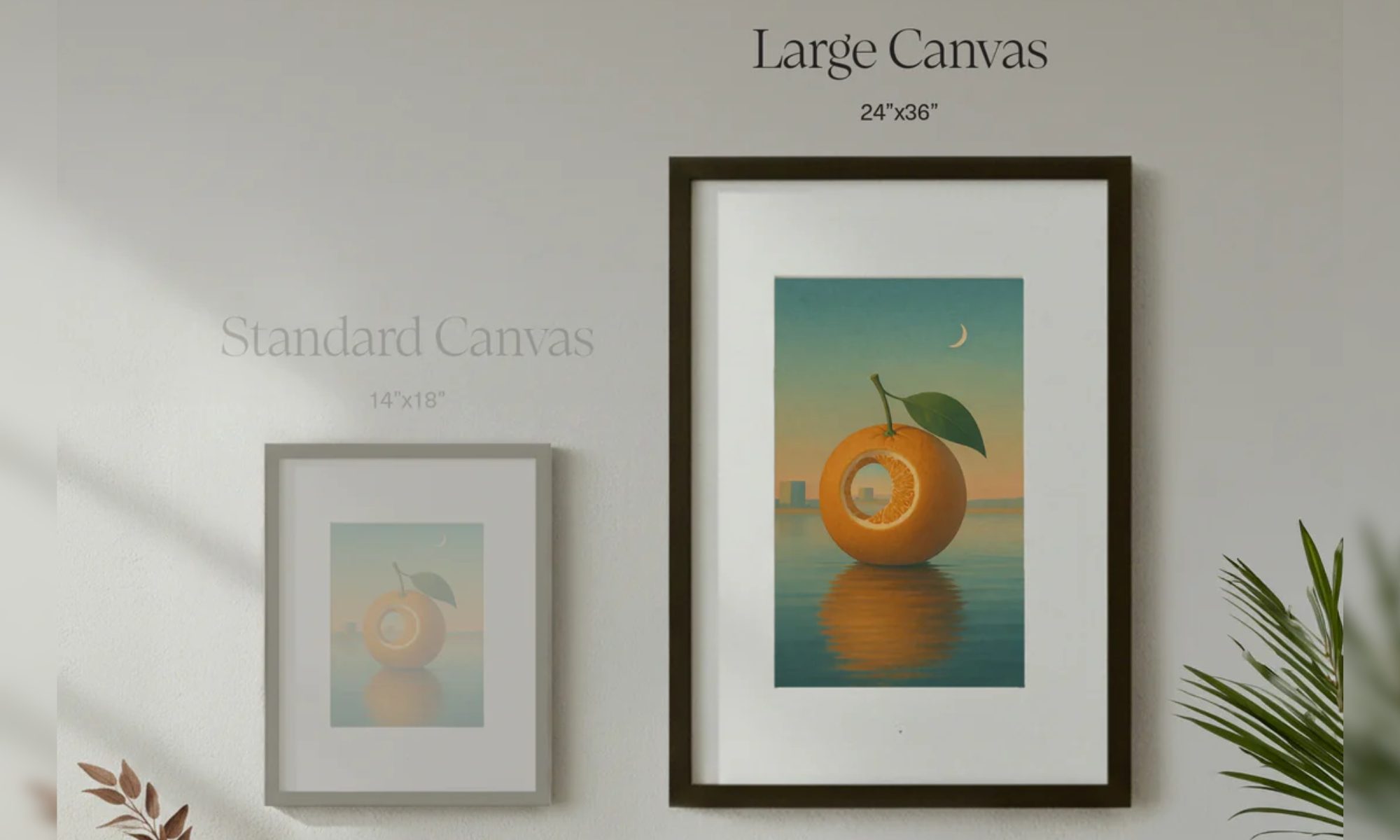
What makes it stand out from competitors like Aura and SwitchBot?
Normally, you’d take out your phone to do that with a regular digital photo frame, but with Fraimic, you just have to tap, speak, and watch something appear on your wall that looks more like paint on paper than pixels on a screen.
The device also features an accelerometer that determines whether it’s oriented in portrait or landscape.
Coming to the competition part, Aura Frames require a subscription and don’t let you swap out the surrounding frame. SwitchBot frames, on the other hand, do not support voice generation. Fraimic does both, while keeping your prompts and images private by default.
The company offers you 100 free AI generations per year and also provides access to thousands of public-domain works from the Metropolitan Museum of Art. A REST API even opens it up to smart home integration for developers.

So why is the price such a tough pill to swallow?
Because $499 for the 13.3-inch and $1,499 for the 31.5-inch sounds a bit too steep. Aura’s comparable frame runs around the same for the smaller size, but it also offers buyers smaller options that cost even less. Switchbot sells a 31.5-inch variant that costs $200 less.
It’s worth noting that the 13.3-inch ships now, but the 31.5-inch shows a July 2026 shipping date on the official website. To make the brand’s case, it did grab a Red Dot Award: Product Design 2026. But for a first-gen device from a Chicago startup, it appears to be asking a lot of your wallet.
To me, Fraimic appears to be sitting in an awkward but interesting spot. It’s too expensive to be an impulse buy, too genuinely capable to dismiss. Anyway, we’ll reserve our final verdict for later, when we actually get our hands on it.


SOFTWARE
Linux distro accuses former contributor of deleting years of work and pushing a package that could have broken installs
OpenMandriva has accused a former contributor of using his trusted admin access to trash repositories and push a package that could have broken desktop installations after a community dispute spilled over into the project’s infrastructure.
The Linux distribution disclosed the incident in a forum post this week, describing what it called an attempted act of “distribution sabotage” allegedly involving Davide Beatrici, a developer known for his work on the Mumble instant messaging app.
According to OpenMandriva, Beatrici joined the project some time ago and later offered to migrate its repository infrastructure from GitHub to his privately operated OneDev instance, mirroring several dozen repositories in the process.
While some maintainers were uneasy about concentrating so much of the project’s infrastructure in one person’s hands, the proposal went ahead because, as the project put it, “he was such a well-known figure that we didn’t expect anything bad.”
OpenMandriva says trouble started after two other contributors joined alongside Beatrici. One allegedly engaged in repeated abusive behavior toward users and project members, much of it in private messages. The project says several contributors left before the maintainers finally stepped in, kicking the individual out of the OpenMandriva-Cooker Matrix chat. He wasn’t banned from the project, but OpenMandriva says the decision “triggered a cascade of events.”
Beatrici and another contributor then resigned. When OpenMandriva later decided there was little point continuing to mirror repositories to Beatrici’s private infrastructure, it says it began severing those connections.
According to the project, that didn’t go down well. “This infuriated Davide so much that, abusing of the administrative privileges he still had, he sabotaged the distribution today in the early morning hours,” the statement says.
OpenMandriva alleges Beatrici deleted parts of its GitHub repositories containing years of development work. It also says he “decided to publish an empty package in the cooker repository, which obsoleted all gnome and cosmic packages, which could have damaged the systems of people using gnome or cosmic.”
The Cooker repository is OpenMandriva’s rolling development branch, not a stable release, so the damage appears to have been confined to bleeding-edge users rather than to everyone running the distro. Even so, having one disgruntled admin yank years of work and potentially break package updates isn’t the sort of resilience test most projects volunteer for.
The project says it is restoring the deleted repositories and repairing the affected packages. It also says it carried out “a full system audit” and found that “aside from the removed packages, we found no other violations.”
OpenMandriva adds that it considered legal action, saying the alleged sabotage “constituted a criminal offense,” but ultimately decided against it.
According to tech publication The Lunduke Journal, Beatrici said that “this was by no means a sabotage. The objective was not to harm the distribution I cared for.” He reportedly admitted deleting Cosmic and Gnome repositories and said he did this because someone was “messing with my work.”
The Register has contacted OpenMandriva to ask whether any stable releases were affected, how many repositories were deleted or modified, and what changes the project plans to make to administrative access. We also reached out to Beatrici but have not heard back.
Every project needs contributors, but they don’t all need the kind of access that can turn a disagreement into a recovery exercise. ®

Crypto World42 seconds ago
Bank of Korea defends bank-first stablecoin plan amid bill deadlock

Sports3 minutes ago
UFC 329 press conference: Where to watch, start time, live stream for McGregor vs. Holloway
Tech5 minutes ago
NYT Strands hints and answers for Friday, July 10 (game #859)


-

 Fashion6 days ago
Weekend Open Thread: High Hopes
-
 NewsBeat5 days ago
Taylor Swift and Travis Kelce wedding staffer hilariously struggles to keep her cool while checking in megastars
-

 Crypto World6 days ago
Standard Chartered Secures MiCA License as ESMA Adds 37 New Crypto Firms
-

 Fashion3 days ago
Open Thread: What Great Books Have You Read Recently?
-

 Politics7 days ago
The House | “Reframing the debate from a binary discussion of winners and losers”: Yuan Yang reviews ‘We Are Not Machines’
-

 Fashion15 hours ago
Loro Piana Fall 2026 Enters Houston’s Art Scene
-

 News Videos3 days ago
Whats Hidden Inside This Cash Register? #treasure #reselling #money
-
 Tech3 days ago
Anthropic’s new “J-lens” reveals a silent workspace inside Claude that mirrors a leading theory of consciousness
-
 Crypto World6 days ago
ESMA Expands Crypto Register by 37 Firms Following MiCA Transition Period
-

 Business3 days ago
AXT Shares Jump Nearly 14% as Semiconductor Materials Maker Rebounds on AI-Linked Indium Phosphide Demand
-

 Sports2 days ago
Joshua Pacio ‘more complete’ ahead of ONE rematch vs Malachiev
-
Crypto World3 days ago
SK hynix (000660.KS) Stock Dips as $28B Nasdaq ADR Offering Drives AI Memory Expansion
-

 Crypto World4 days ago
South Africa proposes crypto tax guidance under existing rules
-
 News Videos3 days ago
Best Time to Enter Small Caps Right Now? Another Bull Run? | Financially Free
-

 Tech5 days ago
Lenovo laptops are now shipping with YMTC SSDs, a sign of Chinese NAND entering the mainstream
-

 Business7 days ago
What a 10 Percent Drop Means for Buyers, Sellers and Renters
-
Sports2 days ago
We have punished the disrespect
-

 News Videos4 days ago
Avoid entering in FOMO #bitcoin #cryptocurrency #trading #scalping
-

 Crypto World7 days ago
Alibaba bans Claude Code over alleged backdoor security concerns
-
 Tech5 days ago
Neuralink Threads Its Way Straight Through the Brain’s Armor
You must be logged in to post a comment Login