

Business
Steven Cress’ Top 10 Stocks For 2026 (Mid-Year Review)


Yutthana Gaetgeaw/iStock via Getty Images

Download this episode on Apple Podcasts or Spotify

Transcript
Rena Sherbill: Very excited to welcome back our very own Steve Cress, our head of Quant and all things quant. And today we are talking mid-year update for the top stocks of the year 2026. Steve, welcome back to Investing Experts.
Steve Cress: Thank you much for having me and organizing this today. It’s a pleasure to be with you.
Rena Sherbill: It’s always a pleasure to have you. I know our audience feels the same. You were with our very own Daniel Snyder yesterday, talking this mid year update in top stocks.
What do you have for us today? We have seen pretty fantastic returns. If you’re looking for alpha, you’ve got some alpha.
Steve Cress: We have. Just by way of background, for those who don’t know me, I’ve been with Seeking Alpha since 2019. Prior to Seeking Alpha, the majority of my career was spent at Morgan Stanley. I was there for 13 years running a prop desk in quantitative strategies. I also was the head of international at Northern Trust Global Investments. I also founded a hedge fund, which I managed from London.
And I also simultaneously started a FinTech company, which for lack of a better description, was sort of an automated analyst where we married conventional analysis with systematic processes and created a fintech company. Seeking Alpha liked it so much they bought it and I joined Seeking Alpha in 2019.
So I just wanted to provide a little color on my background. what we’re gonna cover today, a little bit about what’s happening with the markets, and then we’ll provide an update on our top 10 stocks that we selected back in January.
Which are up 70% to the end of June 30th. So they’ve had quite a return that’s up 70% on average for 10 stocks. And a little bit beyond the top 10 stocks, what people could do if they like those names that we recommend, and they’d want it more than once a year.
So I will start with a recap on the markets. The markets, both the S&P (SP500) and the Dow Jones (DJI) near record highs. you can see the national. NASDAQ (COMP:IND) was sort of at a record high in the beginning of June and between June first and today, I feel like we’ve seen several rotations of risk on, risk off with big movements into safe haven sectors, asset classes, then right back out again, then right back in again.
Today risk is back on. A couple days ago, risk was off. And the markets really more of the Nasdaq than the markets overall are reflecting that volatility as well as the VIX.
The S&P 500, kinda hard to tell that there are difficult periods if you’re just looking at the overall return. Because the underlying sectors are just rotating in and out. So that performance is staying fairly high.
But if we break it down to sector performance, if you look at the table on the right-hand side, you’ll see the year-to-day performance. Technology stocks have done incredibly well, up 27%, industrial stocks up about 19%, and energy up about 18% to get an indication of the volatility, this was actually from a day ago.
And you can see technology was down 2.7% two days ago. today it’s the best performing sector. and what I will say, which is interesting about this, even with technology up 27% year to date and industrials up 19% year to date, our top 10 stocks again are up close to 70%.
So right now, at this time, looking at the CNN fear and greeted index, if you look at the bottom chart. You’ll see we are in fear territory. A year ago, we were in extreme greed territory.
So it’s very interesting to see the sentiment of investors while basically the S&P and the Dow are at all-time highs, and the Nasdaq is just slightly off its all-time highs. But the fear does indicate that investors are concerned. Obviously, there’s geopolitical events, big uncertainty with the war between the US and Iran.
There’s uncertainty over inflation, which has been far stickier than expected. A lot of that had to do with the surge that we had in oil. But also tariffs created pressure on inflation. And of course, that also leads to higher interest rates, which have been higher for longer. And if you want back a year ago, one of the reasons why the market was an extreme greed, a year ago, we the investors really believed that interest rates would be coming down during 2026. In fact,
The anticipation was that there would be three rate cuts. And this next chart really indicates that. You could see this chart it provides the market implied number of rate cuts in 2026 and 2025.
And you could see back in July and September, and even in November of 2025, the market was expecting three interest rate cuts. And then you fast forward to really March and April of 2026.
Those expectations went out the window because interest rates and inflation have been higher than expected. And now the market is actually expecting increases by the end of the year. So when I go to the next table, this is actually interest rate traders, in essence, voting where they believe interest rates will be for the December FOMC meeting and what’s going to happen with that Fed meeting.
And the target rate probability is that 21% of interest rate traders believe that rates will be unchanged, but you have 41% expecting a 25 basis point increase. You have 28% of traders expecting a 50 basis point increase, and you had 8% of traders actually expecting a 75 basis point increase.
So this is entirely different than a year ago when we saw the sentiment indicator from CNN in the range of extreme greed.
Now it is fear because of a lot of uncertainty. And one of the reasons why the market does continue to trade well is earnings have continued to perform. Both top and line earnings for many companies are meeting expectations, along with the incredible capex spending that is occurring for AI. And this chart is from Goldman Sachs. And I think what’s really interesting about this, you could see in 2027.
They’re expecting about 1.4 trillion in hyperscaler AI CapEx. When I made this presentation about a year ago, that 1.5 trillion figure was in the 2035 period. And it’s already been fast forward how much CapEx spending.
And really, when you read the headlines now in the newspapers, you’re seeing mega tech companies, like the Mag 7 companies, actually having bond issuances to raise capital for their AI CapEx spending.
So a lot of underlying companies, it’s not just the big tech companies that are benefiting, a lot of underlying companies are benefiting from this spending and they’re making real money.
They’re earning revenues, they’re generating earnings. And there’s a lot of stocks that we have recommended, especially earlier in the year, that have benefited from that. So this is not a type of situation where there’s a hope that these companies will generate revenue or earnings.
They actually are. So that much spending is actually taking place. And this table here shows where we are with earnings growth. The blue line shows where we are today. And the gray line shows where we were on March 31st. And in all instances for all gig sectors, with the exception of healthcare, investors are anticipating that earnings will continue to grow year over year. And this chart is provided by Facts Ed.
In fact, they are stating that S&P earnings are expected to grow by 24% year over year for the calendar year 2026. So that is actually quite strong, and that really helps support the market at its current levels.
However, in addition to the geopolitical uncertainty and the inflation uncertainty and labor uncertainty and interest rate uncertainty, there is also some seasonal uncertainty, which is on the horizon that’s not too far in November, we have midterm elections.
And if you look back over the last 25 midterm elections, the market has actually been down preceding that election. the good news is even though on average the market comes off prior to the election on average by about 18%, immediately after the election, for the three-month period after the market rebounds on average by 5.8%.
For the six month period, it rebounds on average 10.5%. And for a full year after the midterm election, on average, the market is up 14.8%. So if the market does decline, and history shows that it does going into midterm elections, in addition to all the other uncertainties that we have, there could be a correction.
It would probably be a great buying opportunity. And we have a track record of showing if you purchase stocks with strong fundamentals, as we recommend.
We have a service called Alpha Picks, and of course we focus on quant strong buys and it’s Alpha Picks, a really unique service where we just highlight our two favorite strong buys every month.
On the trading date closest to the first of the month and the 15th of the month, we issue an article of the stock that we’re recommending. And we have a portfolio of about 40 stocks now. And I think what’s really interesting, as I’ve mentioned, we focus on companies with really good fundamentals.
Had you purchased the Alpha Picks portfolio in September 2022, when the market had a little mini crash, it was down about 17.10%. If you purchased Alpha Picks at that time, the portfolio and held it, you would be up 396%. a little bit more recently in the first quarter of 2025, there was a correction and also known as Liberation Day. On April 3rd, the market declined by 12%. And if you bought the Alpha Picks portfolio during that decline and held it, it would be up 146%.
And more recently, we had the oil shock that occurred on March 27th. The market pulled back about eight and a half percent. And if you purchase the Alpha Pix portfolio, then you would already be up a whopping 41%. So this is not only a testament to Alpha Picks, but a testament to buying stocks with strong fundamentals during corrective phases.
Quant really helps to eliminate emotion from investing. A lot of times when individuals recommend stocks or take those recommendations, there’s quite a bit of emotion behind it. It could be a Wall Street analyst who has a close connection with a CEO or a CFO. It could be a family relative that you inherited the stock from. And with Quant, we really try to eliminate the hearsay and the emotion and we stick to the data.
Quant is a data-driven process. It is similar to what a fundamental analyst does at Morgan Stanley or Goldman Sachs or Merrill Lynch. We do look at fundamentals, and the five core factors that we look at are value, growth, profitability, EPS revisions, and momentum.
I refer to it often as a GARP plus strategy. GARP is growth at a reasonable price. So we take that strategy, but we add the power of computer processing. So I I have been an analyst myself, and most analysts on Wall Street.
Typically could really only cover about 15 to 20 stocks. When you employ the power of computer processing, you have the ability to analyze 5,000 stocks, but you also have the ability to analyze those stocks every single day. And that’s exactly what we do.
We run our databases every single day with fresh numbers. So we’re looking at all the companies that we cover, we’re looking at their balance sheets, cash flow statements, income statements, and hundreds of financial metrics.
And part of the quant process is actually to compare the metrics for every company compared to its sector. And by doing this comparison, we can actually separate the strong companies from the weak company. So that’s why we use quant.
It gives us a lot of breadth in terms of our coverage universe and we know the data is fresh. As a result, every day we can see if a sock is a strong buy or a strong sell. And it’s way better than like looking at an analyst research report from eight weeks ago.
Because you want to make an investment decision based on fresh data, not data from eight weeks ago. Because a lot can change in eight weeks or four weeks or even two weeks.
So we have a very good track record. You can see over the last five years that it was up 180% compared to refreshing Wall Street analyst drawn buys every day. They were up only 17% compared to our 180%. And that’s also versus the S&P up 54%. But outside of our overall quant system, when you look at our top 10 stock recommendations, that has a very good track record too.
If you took our top 10 stocks from 2025, those were up 91% versus the S&P up 27%.8 percent and that’s if you bought them in January of twenty twenty five and held them to the end of June 2026 recently so that’d be 91% versus 21% that was for 2025 if you looked at 2024 the top 10 stocks were up 329% versus the S&P up 60% if you looked at 2023 our top 10 stocks were up 232% versus the S&P up 95%.
And if we come to our most recent selection of stocks in January of this year, 2026, the top 10 stocks at the end of June were up 69.56% versus the S&P up just 8.32%. So we’ve had a really good track record picking quant strong buys at our top 10 at that, at the beginning of the year and halfway through the year.
To show you how the performance was of the underlying stocks that we selected, we had Micron Technology (MU), which was our best performing stock. That was up 267%.
We had (AMD), another semiconductor company up 144%. We had Coherent (COHR), an IT company, up 109%. We had Ciena (CIEN) up 107%. We had a defense company in the industrial sector up 64%. We had Allstate Financial (ALL), which is an insurance company, property and casualty, up eighteen point six three percent.
And Celestica (CLS), another IT company, up 17%, and Incyte Healthcare (INCY) up 12.64%. So eight of the stocks handedly beat the S&P 500. We did have two stocks that were down, Barrick Mining (B) and Willdan (WLDN) down 18% and 27%.
But in total, the average return of those stocks was up almost 70% compared to the S&P 500, up 8.32%. And if you took the S&P 500 on an equal weighted basis, that was up 10.3%
This is what the top 10 looks like right now. We have seven of the stocks still a strong buy. One of them is a hold, which is Barrack Mining Corporation, and two of them are now holds, Coherent and Willdan. And actually, at one point, Willdan fell to a sell but came back to a hold. So that sort of provides you with a little bit of the data on our performance.
What I like to show people in terms of fundamentals. If you took the top 10 stocks, they have an average forward revenue growth rate. And forward revenue growth rate is using consensus estimates from analysts for each stock. So the average growth rate would be about 33% compared to the S&P 500, up 8.5%. And the average EPS growth rate for our top 10 stocks is 88% compared to the S&P at 19.66%. Our companies do have a rich PE.
The forward PE is 34 times on average compared to the SP 24 times, but you’re getting 88% EPS growth versus 19.6. So it’s well worth the multiple being a little bit higher.
I want to provide an update on a couple of our stocks that were from the top 10 in the beginning of the year. Micron Technology, as I mentioned, was up 267%. That is a semiconductor company. It still ranks number one out of all our IT stocks and number one out of 69 semiconductor companies.
And in fact, despite the stock being up 267%, the valuation framework is actually more attractive now than it was six months ago. The current valuation factor grade from Seeking Alpha is an A minus. And these factor grades are sector relative, so it’s not in absolute terms.
When you look at that valuation grade or growth grade or profitability, it shows you the company relative to the sector. And an A, of course, is just about as good as you can get.
The valuation is great. And six months ago it was B plus. Growth is an A plus, which puts it at the highest growth rate versus the IT sector. Profitability is an A plus versus the sector. Momentum is an A plus and
The EPS revisions and A-grade. EPS revisions are actually the quantity of analysts taking the rest of it’s up versus down. And this again is relative to the sector. So relative to the sector, the EPS revision movement is far stronger. AMD, which is Advanced MicroDevices, another semiconductor stock, that one ranks five out of 531 technology companies.
And within semiconductors, it ranks four out of 69. You can see that the valuation grade here on the right hand side is a C. So the valuation is in line with the sector. But interesting enough, six months ago, it was actually a D plus. So the valuation framework is actually better now compared to where it was then.
And the stock is up 144%. So in essence, you should almost ignore the return that these stocks had because when you look at them compared.
To the rest of the sector, the valuation framework is better and the growth framework is better and the profitability. So there are a lot of reasons to own these stocks now and not be concerned that they’re at a 52-week high or the level of movement in the share price.
Our number three company is Ciena Corporation. Here’s another example of a stock that’s up significantly. Since January, it’s up 107%.
And here the valuation grade is a C plus versus D six months ago. So again, valuation framework is better. And the growth grade here is an A versus A minus. So even a slight improvement in the growth scenario. So lots of great reasons to still own these stocks that we recommended in the beginning of the year.
Now, as I mentioned, not all the stocks were winners. We did have two losers. Barrick Mining Corporation is down 18%. Even with the stock being down 18%, it is still ranked a quant buy, and the value compared to the sector and the growth compared to the sector is still relatively strong.
Barrick Mining is a leading mining company with a strong focus on copper, and copper is the metal of electrification. So there are strong tailwinds for this company with the developments that we have with AI and data centers and the huge consumption of electricity.
The company’s forward EPS growth rate is fifty-four percent versus the sector at 14%. They have nine billion in cash from operations. And if you look at the PEG, which is a ratio that I really like, it’s a valuation metric where you take the PE and growth combined on a PEG basis, it’s at a 57% discount to the sector.
So stock is down, and that mostly is due to a weird phenomenon that occurred that year, probably one of the strangest events for gold and companies that focus on gold or gold mining.
Typically, when you have geopolitical events that are very hostile, there is a rotation into gold stocks. This year was completely different. as the crisis occurred with the US and Iran, there was a big impact on the dollar, and gold actually had an inverse relationship to the dollar this time around.
Many gold stocks actually fell and it’s really driven by sentiment because the fundamentals for this company look fantastic. So it is still a buy.
One company that did not look fantastic was Willdan. That stock was down 27%. It is rated a hold now. You can see we’re very transparent, so we show the rating history every single day, and you can see the brief period where it actually went to a sell, and then it went right back to holding. The stock did appreciate when it moved from a sell to hold.
The valuation for this company is better now than it was six months ago. The growth is not quite as strong. And I believe it’s because there were expectations that growth was not going to be quite as strong as it was. That is one of the reasons why the stock fell 27%.
So those were that was a recap of our top 10. Where do we go beyond the top 10 for January?
Well, next week on Tuesday, July 14th, I’ll be announcing my top ten stocks for the second half of the year. So hopefully you can join us. Rena, at some point you might be able to put a link here to that event and people will be able to register for it.
So we don’t do top ten just in January, we also do top ten in July. And hopefully again you can join us for that presentation. But we also have other products and you can’t really rely just on investing twice a year in January. July.
We have investable products. We have three products, and I’m sure one of these products could be suited for the needs of most investors. One of the products is the Pro Quant Portfolio, which is a portfolio of 30 stocks. It’s fixed at 30 stocks and it provides a high frequency of ideas. Every Monday it rebalances. If that is a little bit too frequent for you in terms of trading, Alpha Picks book.
Might be a much better product. AlphaPix focuses on just our top two quant strong buys every month. As I mentioned earlier, on the first and the 15th of the month, we issue a research report with our recommendation. and it’s had great performance.
And then if you are a little bit more interested and conservative, we actually have a product which we just launched in June called the Quant Growth and Income Portfolio. That is a portfolio of 30 dividend-paying stocks, and it rebalances every other Wednesday, so twice a month. On average, there might be two stocks during that rebalance every other Wednesday.
And again, all the stocks there pay dividends, and it is focused on both capital appreciation and income generation. And all three products have had great performance. the Alpha Picks product here, this is actually not the 52 week return, but since inception, it’s up 378% compared to the S&P up 97%.
And that’s since July of 2022. The other products that I’m showing here, the since inception return for the Pro Quant Portfolio, which started, we’re on a one-year anniversary now, pretty much. That is up 54% in the last year versus the S&P on an equal weighted basis up 24%.
And QGI, the quant growth and income product, which we just launched in June, is already up six percent compared to its benchmark, which is the Vanguard High Yield Index ETF, which is pretty flat for the year.
So Rena, let me ask, first, I want to say thank you for allowing me to present on our top 10 stocks. And I’m sure you probably have a couple questions.
Rena Sherbill: That is actually exactly what I have. A couple questions indeed. thank you for taking the time, packed full of like really quality info.
I just wanted to highlight for those listening, number one, this video will be up on our YouTube channel, on Seeking Alpha’s YouTube channel. You can always catch Investing Experts clips and episodes on our playlist there that you can find under podcasts.
Also, those that just want to listen to this episode, those wondering where Steve was getting that data from, it’s on the quote pages of those stock tickers on Seeking Alpha. And you can have all of that at your fingertips and eyesight if you are a premium member. Just wanted to make note of that.
So, my first question, Steve, is a question that we have gotten a lot on your appearances in the recent, I would say in the recent 12 months, especially since QG&I came out. People wondering why not make these ETFs?
Steve Cress: Very good question. And we do get that a lot. at Seeking Alpha, we provide investment research. We’re not an asset manager, we’re not a broker dealer, we’re not an investment bank. our focus is really providing investment research, and we have a couple channels that we do that through.
We have thousands of contributors that write articles on individual stocks and ETFs and the macro economy, and that’s available on premium. We have news on stocks all over the world and we have our Seeking Alpha quant system. So they’re really three independent sources of investment research, but we’re not an asset manager. So hopefully that answers the question.
Rena Sherbill: I think it does. Appreciate that.
So, my other question for you is actually not my own question, although I I like it very much and support it. It’s from our friend Gary Vaughan over at Daily Stock Picks, who, as you know well, is a huge, huge fan of yours. So here’s his question:
Steve, can you take one of your picks and tell us the story of how you found it? We see the research you use on the platform. It’s amazing, but year after year you do find these winning stocks. So the finding is the special sauce. Is the quant telling you the sector to look at. Can you tell us one stock you researched and decided against including in the list and how you found it and why it did not make the cut? Thank you in advance.
Steve Cress: Yeah, so when I provide the list of top ten, the first thing I do is I go to the Seeking Alpha screen and I sort stocks by the quant recommendation of the strong buy. So they’re all ranked, you’ll find over 4,800 stocks ranked. And I sort of filter it down to our quant strong buys.
Now, when I provide the top 10 lists, there are some criteria and parameters that I use. I don’t want to put all the eggs in one basket. So a lot of times there could be quite a bit of congestion of a certain sector. So I’ll try to limit any one sector to about four stocks, then I move on to the next sector.
So there could be stock five, six, seven, eight that doesn’t get included because it’s the same sector. in this case, you know, recently IT has been leading, which is probably no surprise if you looked at the S&P 500 and the top 10 stocks or almost all technology stocks in the S&P 500.
So there is a really strong clustering effect right now. And I want to eliminate that clustering effect. I want to reduce the risk. So I only allow four stocks from one sector. That’s probably the predominant reason for eliminating stocks. But I am also looking for companies that have really strong revenue growth rates and earnings growth rates.
And there could be a stock that might be super profitable and have a great valuation where it ranks high. And when we rank our stocks, I should mention we use five investment factors that are all weighted. I believe I mentioned them earlier, which are value, growth, profitability, momentum, and EPS revisions, all five of those factors have a weight.
Sometimes a single factor could be a real outlier. So by example, a company could have like a PE of three. So it would definitely be like an A, you know, if the other valuation factors were just as cheap. But if I’m focusing on revenue and earnings growth, I might pass over that stock, even though it could have a higher ranking.
So these are sort of two examples for passing over stocks. And Gary, that was a great question. Thank you very much.
Rena Sherbill: Much appreciated. I’m gonna piggyback off Gary’s question if that’s okay. Anything that missed the list any of the years that you’ve been doing it? Like does anything stick in your mind in terms of one you wish you had put on but didn’t? Or are you like pretty religiously devoted to the process?
Steve Cress: Well, there could always be a stock that you miss. I will say for this time around, the second half of the year, I wanted the list to be completely fresh. Because of the past when I’ve gotten to the half year mark, people have commented several of the stocks were picked in January and they already own them.
So what we’re actually gonna do this time is we’re gonna highlight the names that would have been on the list, but were already picked in January.
So we’re gonna highlight those names and then we’re gonna have 10 completely fresh names.
Rena Sherbill: That’s a great tease. The B cuts made the A cuts. Love that. Love that. Okay, awesome. That’s July 14th. Steve, appreciate it. Any final words?
And anybody that’s interested in more Steve and quant content, please follow Steve Cress on Seeking Alpha. Steve, any final words?
Steve Cress: No, I just really appreciate everyone who attends and their time today. taking you know the the effort to listen to our podcast. I truly appreciate it. And Rena, thank you so much for organizing it. Really appreciate it.


Check out what’s clicking on FoxBusiness.com.
Costco has been hit with a class action lawsuit alleging that one of the products it sells contains “dangerous” levels of heavy metals, including lead, arsenic and cadmium.
The lawsuit centers on Orgain protein powders, including the Vanilla Bean and Creamy Chocolate Fudge varieties, which are marketed in stores and online as providing “good, clean nutrition.”
Seven plaintiffs from across the U.S. allege Costco failed to properly screen the products for toxic heavy metals or disclose their presence to consumers, according to the lawsuit filed Tuesday in the U.S. District Court for the Western District of Washington state.
The plaintiffs are seeking to hold the warehouse retailer accountable for marketing the protein powders as safe and healthy despite the alleged presence of the contaminants.
COSTCO QUIETLY DISCONTINUES AWARD-WINNING KIRKLAND ITEM FANS CALL ‘ONE OF THE BEST’ IN THE MARKET

Costco has been hit with a class action lawsuit alleging that one of the products it sells contains “dangerous” levels of heavy metals. (Lindsey Nicholson/UCG/Universal Images Group, File / Getty Images)
“Many consumers who buy and use protein powder do so routinely as part of a continuing focus on their fitness and health,” Steve Berman, managing partner and co-founder of law firm Hagens Berman, said.
“These same health-conscious consumers have unknowingly ingested alarming levels of toxic heavy metals — lead, cadmium and arsenic — again and again, trusting that Costco’s quality assurance would not allow something like this to happen.”
Orgain pushed back on the allegations, saying its products are safe to consume.
“Orgain products are safe to consume,” the company said in a July 9 statement provided to USA Today. “While trace amounts of substances that occur in the environment can be present in plant-based ingredients, our products comply with applicable food safety standards and guidance. We stand behind the safety and quality of our products.”
Costco sells at least four Orgain product lines on its website. The retailer’s protein powder listings include a disclaimer stating, “Product details have been supplied by the manufacturer and are hosted by a third party.”
SURPRISE RIVAL KNOCKS COSTCO’S FAMOUS ROTISSERIE CHICKEN OFF ITS PERCH AS BEST BIRD

Costco has been hit with a class action lawsuit alleging that its Orgain protein powders contain elevated levels of heavy metals, including lead, arsenic and cadmium. ( / iStock)
According to the complaint, independent testing commissioned by the plaintiffs found that Orgain’s Vanilla Bean flavor contained lead levels exceeding California’s Proposition 65 limits by more than 600%.
The allegations also cite separate 2025 reports from nonprofit organization Clean Label Project and Consumer Reports that identified elevated levels of heavy metals in certain protein powders.
Consumer Reports flagged Orgain’s Vanilla Bean flavor for containing lead at 143% of its level of concern. The publication classified the product as “okay to eat occasionally” but recommended limiting consumption to roughly four servings per week.
The complaint further cited findings that plant-based protein powders, particularly organic varieties, contained higher levels of heavy metals compared with nonorganic and whey or beef-based counterparts.
COSTCO MAKES PAYMENT CHANGE THAT COULD SPEED UP CHECKOUT FOR MEMBERS

Orgain says its products are safe to consume. (iStock)
In response to the findings, California lawmakers introduced a bill im February requiring mandatory testing and public disclosure of heavy metals in protein products.
Texas Attorney General Ken Paxton also announced in early June that the state had launched an industry-wide investigation into the manufacturers over related concerns.
“Consumer Reports tested 23 products and found that lead levels in plant-based protein powders were, on average, nine times higher than those made with dairy proteins such as whey and twice as high as beef-based products,” Paxton’s office said in a June 8 statement.
| Ticker | Security | Last | Change | Change % |
|---|---|---|---|---|
| COST | COSTCO WHOLESALE CORP. | 912.97 | -40.16 | -4.21% |
According to the Food and Drug Administration, there is no known safe level of lead exposure.
Studies suggest that the metal can accumulate in the body faster than it can be eliminated, meaning repeated exposure may increase health risks.
Chronic lead exposure has been linked to immune suppression, reproductive problems, kidney damage and elevated blood pressure.
GET FOX BUSINESS ON THE GO BY CLICKING HERE
Children, pregnant women and older adults are particularly vulnerable to heavy metal exposure.
Orgain and Costco did not immediately respond to FOX Business’ request for comment.
Business
LARRY KUDLOW: The socialist-communist Democratic dog won’t hunt come November in the Midterms


FOX Business host Larry Kudlow discusses what Americans have to look forward to in the midterm elections on ‘Kudlow.’
President Trump gave three brilliant speeches over July 4th weekend. First at the freedom and faith convention, then at Mount Rushmore, and then on July 4th on the National Mall at Washington D.C.
He emphasized two large-scale thoughts. First, America’s greatness both past, present and future. And second, godless communism is a mortal threat that must be extinguished without delay. And he hammered these points again and again. Essentially giving GOP officials and candidates their talking points for the midterm elections.
Meanwhile, the superb Democratic pollster, Mark Penn, writes that Democrats are unwisely choosing candidates who are completely unqualified for the Senate or House. Graham Platner is a perfect example. And Mr. Penn writes that “antisemitism is anti-Americanism and no tent of any party should be big enough to make room for it.”
Fox News political analysts Reince Priebus and Gianno Caldwell break down Maine Democratic U.S. Senate candidate Graham Platner’s embattled campaign on ‘Kudlow.’
Republican strategist Karl Rove writes that socialists spell trouble for Democrats. They can win in deep blue districts, but they’ll weigh down the party elsewhere. And he talks about some of the platforms of these socialist–communist Democrats “all cops are bastards” and “no more police at all ever” from Darializa Avila Chevalier at New York City or another socialist communist, Manny Rutinel in Colorado, who wants to shift money away from the military, policing, and prisons.
All this will be banner headline ads by Republicans who already hold a vast fundraising advantage over Democrats, due in large part from the recent Supreme Court decision that will allow, say, the Republican National Committee pulling money in with the Senate and House campaign committees, and thereby helping federal races state-by-state. It’s a tremendous thing.
Jim McLaughlin writes that President Trump has a 50 percent approval rating among likely voters, with 60 percent approval among Hispanics and 32 percent with blacks. Senator Chuck Schumer is a dead man walking with a 29 percent favorable rating.
For sure the Mamdani-Sanders-AOC socialist communist tail is wagging the Democratic party dog. Yet that dog is not going to hunt come November.

Check out what’s clicking on FoxBusiness.com.
A California city is weighing a ban on drive-throughs after some residents expressed concern that a proposed In-N-Out could hurt air quality, worsen traffic and create safety issues for pedestrians and cyclists.
The City Council in Culver City, California, passed a 45-day moratorium last month to prohibit permits for new drive-throughs while staff drafted a potential ban, according to LAist. This comes after the city’s mobility subcommittee voted to recommend staff draft the ban in May.
If the city council approves a ban, only new businesses would be affected.
In-N-Out would be the first new drive-thru in Culver City since 1997, according to a city staff report. The proposed fast-food restaurant would include 61 parking spaces and a drive-thru lane that could fit 26 vehicles.
IN-N-OUT TO ENTER NEW MARKET WITH MULTIPLE RESTAURANTS BY YEAR’S END: REPORT

The City Council in Culver City, California, passed a 45-day moratorium last month to prohibit permits for new drive-thrus while staff drafted a potential ban. (Retuers/Daniel Cole / Reuters)
The burger chain had not submitted the formal application for a permit it was preparing when the city passed the moratorium, a city spokesperson told LAist.
FOX Business reached out to In-N-Out for comment.
“As a private, family-owned company, we generally don’t comment publicly on business matters,” a spokesperson for In-N-Out told LAist.
Critics of In-N-Out’s plan have slammed the proposal for potentially hurting the city’s ability to be safe and walkable.
“Density is inevitable, and development is inevitable,” Vanessa Martin, a city resident organizing support for the drive-thru ban, told LAist. “We want to be proactive and smart about it.”
Martin’s wife, Cynthia, created an online petition calling on residents and the city council to oppose the In-N-Out “mega drive-thru,” arguing it would create traffic congestion, worsen air quality and pose safety concerns for pedestrians and cyclists.

In-N-Out would be the first new drive-thru in Culver City since 1997. (Reuters/Daniel Cole / Reuters)
Another resident, Paul Hewitt, began handing out flyers to his neighbors calling the project a “terrible idea.”
Culver City Councilmember Bubba Fish, who sits on the city’s mobility subcommittee, said the city needs to create “more walkable, bikeable, safer streets for people of all modes, and drive-throughs are the antithesis of that.”
But opponents of the ban said drive-throughs are an important option for consumers, including people with disabilities and families with children.
Jot Condie, the president of the California Restaurant Association, said he believes drive-thru bans are generally “shortsighted.”
“You’re essentially banning quick-service restaurants without specifically stating that,” Condie said.
A DAD REVEALED HOW HIS FAMILY OF 5 EATS AT CHICK-FIL-A FOR UNDER $45
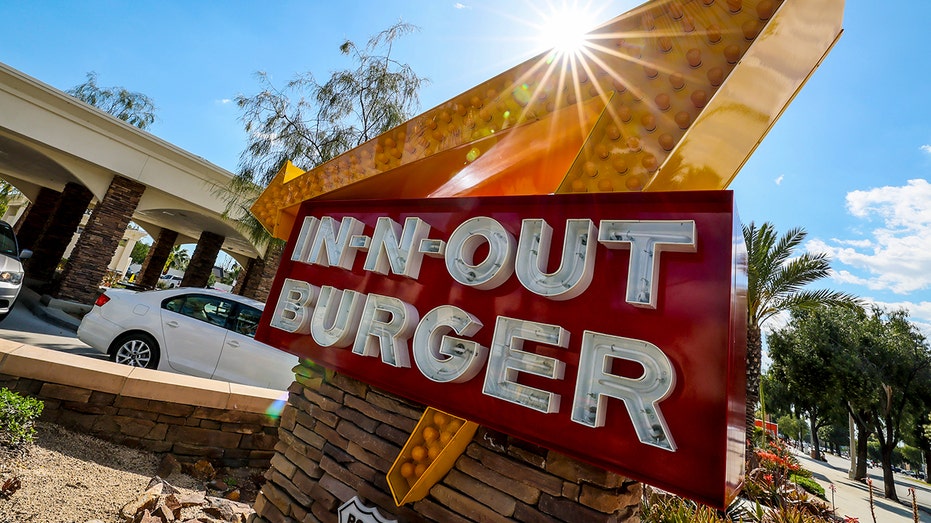
Critics of In-N-Out’s plan have slammed the proposal for potentially hurting the city’s ability to be safe and walkable. (Robert Gauthier/Los Angeles Times via Getty Images / Getty Images)
GET FOX BUSINESS ON THE GO BY CLICKING HERE
Around 70% of all fast-food sales come from drive-thru orders, according to the American Planning Association.
This is not the first attempt at a drive-thru ban in the Golden State.
Culver City already bans drive-throughs in its downtown area, while Santa Barbara and San Luis Obispo have had citywide bans for decades, according to LAist. Carlsbad recently eased a citywide ban that began in the late 1990s to allow for consideration of new drive-throughs on a case-by-case basis.
When San Diego considered a partial drive-thru ban in 2021, the California Restaurant Association sent a letter arguing that a ban would prevent certain groups, including people with disabilities, from accessing products and services, the outlet reported.
South Korean computer chip maker SK Hynix has raised $26.5bn (£19.8bn) in its New York share offering, marking the largest ever listing by a foreign firm in the US.
The company, a key supplier to artificial intelligence (AI) chip giant Nvidia, said on Thursday that it had sold 177.9 million American depositary shares for $149 each. The shares are set to begin trading on Friday on the Nasdaq.
In May, SK Hynix saw its market value top $1tn in its home country, lifted by the boom in demand for AI chips.
Its share price has more than tripled in South Korea this year, which along with Samsung Electronics has helped boost the benchmark Kospi index by more than 70% over the same period.
The offering gives US investors a way to buy SK Hynix shares without having to trade via an overseas stock exchange.
This gives the company easier access to the huge amounts of potential investment from the world’s biggest economy.
The company is one of the world’s biggest manufacturers of advanced memory chips used in AI infrastucture such as data centres.
Demand for the offering was reportedly over seven times more than the number of shares available, highlighting the strong investor appetite for a key company in the AI supply chain.

- Thailand’s Constitutional Court upheld the government’s emergency decree authorizing 400 billion baht ($11.95 billion) in borrowing to address the energy crisis. Nine judges unanimously approved the core borrowing provision, while a 7-2 majority upheld funding for renewable energy transition, rejecting a constitutional challenge filed by 133 lawmakers.
- The loan is split between easing citizen cost-of-living pressures tied to global energy price volatility and funding Thailand’s shift from fossil fuels to cleaner energy sources. The ruling gives the government legal authority to advance both its short-term economic relief efforts and longer-term energy infrastructure goals.
Thailand’s Constitutional Court unanimously upheld the government’s emergency decree allowing 400 billion baht ($11.95 billion) in borrowing to address the energy crisis. Judges ruled 7-2 to maintain provisions for renewable energy transition funding, rejecting lawmakers’ constitutional challenge, enabling the government to proceed with its economic support plan.
Key Points
• Thailand’s Constitutional Court unanimously upheld the government’s emergency decree allowing 400 billion baht ($11.95B) in borrowing to address the energy crisis, rejecting claims from 133 lawmakers that it bypassed normal legislative процесс.
• The court ruled 7-2 to approve using funds for renewable energy transition, with 200 billion baht easing living costs amid Middle East-driven price hikes.
• This decision provides legal backing for Thailand’s energy support and clean energy investment plans.
Constitutional Court Upholds Emergency Borrowing Decree
On July 9, Thailand’s Constitutional Court ruled that the government’s emergency decree authorizing a 400-billion-baht (about $11.95 billion) loan to address the energy crisis is constitutional. A panel of nine judges unanimously approved the core provision empowering the Ministry of Finance to borrow funds to counter the effects of volatile global energy prices. By a 7–2 vote, the court also upheld the clause allocating budget resources toward transitioning from fossil fuels to renewable energy. The ruling followed a challenge by 133 members of the House of Representatives, who argued that the decree bypassed normal legislative procedures reserved for genuine emergencies or economic crises.
Allocation and Purpose of the Loan
The 400-billion-baht plan, approved by the Thai cabinet in May, is divided into two main components. Approximately 200 billion baht will help ease the cost-of-living burden on citizens amid rising global energy prices linked to the Middle East conflict. The remaining funds are earmarked for energy transition initiatives, supporting Thailand’s shift away from fossil fuel dependency toward cleaner, more sustainable energy sources. The government emphasizes that this dual-purpose funding strategy aims to stabilize the economy in the short term while laying the groundwork for a resilient, diversified energy sector capable of adapting to future global market fluctuations.
Broader Implications for Thailand’s Energy Strategy
The Constitutional Court’s decision provides the government with a solid legal foundation to proceed with its large-scale economic support package. Officials view this ruling as pivotal in accelerating investment in energy infrastructure and diversification programs over the coming years. As many nations intensify efforts toward emission reduction and energy security, Thailand’s approved borrowing plan positions the country to align with these global trends. Beyond immediate economic relief, the initiative reflects a broader strategic vision—balancing short-term financial stability with long-term structural reform, reinforcing Thailand’s commitment to sustainable growth and energy resilience amid ongoing international market uncertainties.
Source : Thailand officially approves emergency loan of nearly 12 billion USD
Other People are Reading

Digital platforms now provide multiple services within one system. Instead of relying on separate services for communication, customer management, accounting, and reporting, businesses can access these functions on a single platform.
For example, Microsoft 365 includes email, file storage, meetings, and collaboration, while HubSpot combines CRM, marketing, and support within one environment.
This model is not limited to business software. Consumer platforms follow the same structure. Netflix, for instance, started as a streaming service but now offers films, series, mobile games, and personalised content within one platform.
The same applies to platforms like Amazon, which combine shopping, streaming, cloud services, and subscriptions. A similar approach can be seen in online gaming platforms such as MrQ Casino, which offers slots, live casino games, bingo games, and jackpot games within one platform.
Software Fragmentation Is Creating Operational Inefficiencies
Many UK businesses operate with multiple software tools across departments. Sales, finance, customer support, and internal communication are often managed through separate systems. While each tool addresses a specific function, this structure creates fragmentation at the operational level.
The primary issue is not the number of tools, but the separation of data and workflows. When systems operate independently, information must be transferred manually or through integrations. This introduces delays, duplication, and inconsistencies.
In practice, this leads to:
- Multiple versions of the same data
- Delayed reporting and decision-making
- Increased administrative workload
- Higher risk of errors in financial and customer records
These inefficiencies become more visible as businesses grow and processes become more complex.
Integration-Based Systems Have Structural Limitations
Most multi-tool environments rely on integrations to connect systems. These integrations are typically API-based and allow data to move between applications.
However, integration does not eliminate fragmentation. It only creates a link between separate systems.
Common limitations include:
- Data synchronisation delays
- Inconsistent data structures between tools
- Partial or failed data transfers
- Increased maintenance requirements
For example, customer data may be updated in a CRM system but not immediately reflected in accounting or support platforms. This results in misaligned records and incomplete reporting. As the number of tools increases, the number of integrations grows, adding further complexity.
Platform-Based Systems Use a Shared Data Structure
In contrast, platform-based systems operate on a unified architecture. Multiple business functions are managed within a single environment, supported by a shared data layer.
This approach eliminates the need for data transfer between systems.
Key characteristics include:
- Centralised data storage
- Unified user identity and access control
- Built-in workflows across departments
- Real-time updates across all functions
Examples of platform-based systems used in the UK include:
- Microsoft 365, which combines communication, document management, collaboration tools, and automation within one environment
- HubSpot, which integrates CRM, marketing, sales, and customer support on a single data model
- Zoho One, which provides a suite of business applications covering finance, HR, operations, and customer management
- Sage, which combines accounting, payroll, and compliance functions tailored to UK regulatory requirements
In these systems, actions performed in one area are immediately reflected across the platform.
Workflow Continuity Improves Operational Efficiency
A key advantage of platform-based systems is workflow continuity. Processes can operate across departments without interruption or manual intervention.
In a fragmented system:
- Data must be exported or re-entered
- Teams rely on manual updates
- Processes are delayed at each transition point
In a platform-based system:
- Data flows automatically between functions
- Processes are triggered in real time
- Reporting reflects current operational activity
For example, when a sale is recorded in a unified platform:
- The customer record is updated automatically
- Billing processes can be triggered immediately
- Support systems have access to the same information
- Reports are updated without manual input
This reduces administrative effort and improves data accuracy.
Regulatory Requirements Support Platform Adoption in the UK
Regulatory developments in the UK are reinforcing the move toward integrated systems.
The introduction of Making Tax Digital requires businesses to maintain digital financial records and submit data using compatible software. This increases the importance of accurate, consistent data across financial processes.
Using multiple disconnected tools increases the risk of:
- Inconsistent financial records
- Manual reconciliation errors
- Delays in reporting
Platforms such as Sage address these challenges by combining accounting, payroll, and reporting within a single system. This reduces the need for data transfers and supports compliance requirements.
Artificial Intelligence Requires Integrated Data Environments
The adoption of artificial intelligence is further accelerating platform consolidation. AI systems depend on access to structured, consistent data. In fragmented environments, data is incomplete or distributed across multiple systems, limiting the effectiveness of AI tools.
In platform-based environments:
- AI can access a complete dataset
- Automation can operate across workflows
- Insights are based on real-time information
This allows businesses to implement automation and analytics at a broader operational level, rather than within isolated tools.
Platform Adoption Introduces Dependency Considerations
While platform-based systems reduce complexity, they also introduce dependency on a single provider.
Key considerations include:
- Data portability and export capabilities
- Integration options with external tools
- Long-term pricing structures
- Vendor lock-in risks
In the UK cloud market, switching between providers remains limited due to the complexity of migration and system dependencies. As a result, platform selection becomes a strategic decision.

Amid top line deceleration, the country’s largest software exporter has been reporting traction in new contracts involving solutions based on artificial intelligence (AI) platforms. However, AI revenue currently forms only a small portion of the total revenue. To improve client engagement in a fast-evolving technology landscape, it needs to scale up rapidly thereby requiring higher capital investments. If this has to happen without burdening the balance sheet, it requires a relook at the current policy of returning cash to investors.
 Agencies
New Math Scaling investments could require a rethink of the IT major’s generous dividend policy
TCS reported a double-digit sequential growth of 13.6% in annualised AI revenue, even though annualised total revenue in the June quarter failed to increase. To be sure, at $2.6 billion, AI revenue accounts for just about 8.5% of total annualised revenue of $30.5 billion, implying that it has a long way to go before AI initiatives start contributing meaningfully without affecting overall operating margins. This may require greater investments in AI capabilities and partnerships.
In this backdrop, the company needs to revisit its liberal dividend policy. It paid ₹39,571 crore in dividends in FY26 while generating an estimated ₹47,288 crore in free cash flow (FCF), which is operating cash flow net of capital expenditure. In the previous three years, dividends ranged between ₹44,962 crore and ₹46,223 crore, while FCF was between ₹41,440 crore and ₹46,449 crore. This shows that it has been returning the majority of free cash to shareholders. While it may be a suitable option for a mature business such as consumer goods, a company such as TCS that caters to client requirements shaped by tectonic shifts in technology will need to divert internal accruals to invest for future growth. The dividend yield at present is over five considering the FY26 dividend, buoyed by a sharp 36% fall in the TCS stock price in 2026 so far. Historically, it has remained under three. For the June quarter, the company has declared an interim dividend of ₹12.
Amid slower revenue growth, continued momentum in fresh orders may offer some solace. TCS clocked $9.5 billion in total contract value orders bagged during the June quarter, in line with the $9-10 billion range seen during the past few quarters. Its employee attrition rate remained stable sequentially at 13.6%. Its headcount expanded sequentially for the second straight quarter, this time by 9,279 to 5.9 lakh. These factors offer hope for long term growth amid short-term uncertainty.


Form 4 Netskope Inc For: 9 July

The regulator in an ex-parte interim order said, the textile company’s shares surged nearly 842%, from ₹50.40 on January 30, 2025 to ₹474.80 on January 27, 2026, followed by another sharp rise in May 2026, despite no material positive corporate developments.
Sebi’s preliminary examination found that the top 10 contributors to the stock’s last traded price accounted for 67.38% of the market’s positive LTP contribution during April 30-May 14, 2026. All of them traded through the Hoshiarpur branch of Shreni Shares Ltd, managed by the husband of Osiajee Texfab’s managing director. The regulator also alleged that the company misled investors by claiming its textile business was ‘growing steadily’ even though its standalone textile operations generated virtually no revenue.

Tatiana Dyuvbanova/iStock via Getty Images

By Jennifer Nash
Existing home sales unexpectedly fell in June, dropping 2.4% after a 3.7% increase in May. According to the National Association of Realtors (NAR), sales reached a seasonally adjusted annual rate of 4.09 million units, falling short of the

Bank of Korea defends bank-first stablecoin plan amid bill deadlock

UFC 329 press conference: Where to watch, start time, live stream for McGregor vs. Holloway

NYT Strands hints and answers for Friday, July 10 (game #859)


-

 Fashion6 days ago
Weekend Open Thread: High Hopes
-
 NewsBeat5 days ago
Taylor Swift and Travis Kelce wedding staffer hilariously struggles to keep her cool while checking in megastars
-

 Crypto World6 days ago
Standard Chartered Secures MiCA License as ESMA Adds 37 New Crypto Firms
-

 Fashion3 days ago
Open Thread: What Great Books Have You Read Recently?
-

 Politics7 days ago
The House | “Reframing the debate from a binary discussion of winners and losers”: Yuan Yang reviews ‘We Are Not Machines’
-

 Fashion15 hours ago
Loro Piana Fall 2026 Enters Houston’s Art Scene
-

 News Videos3 days ago
Whats Hidden Inside This Cash Register? #treasure #reselling #money
-
 Tech3 days ago
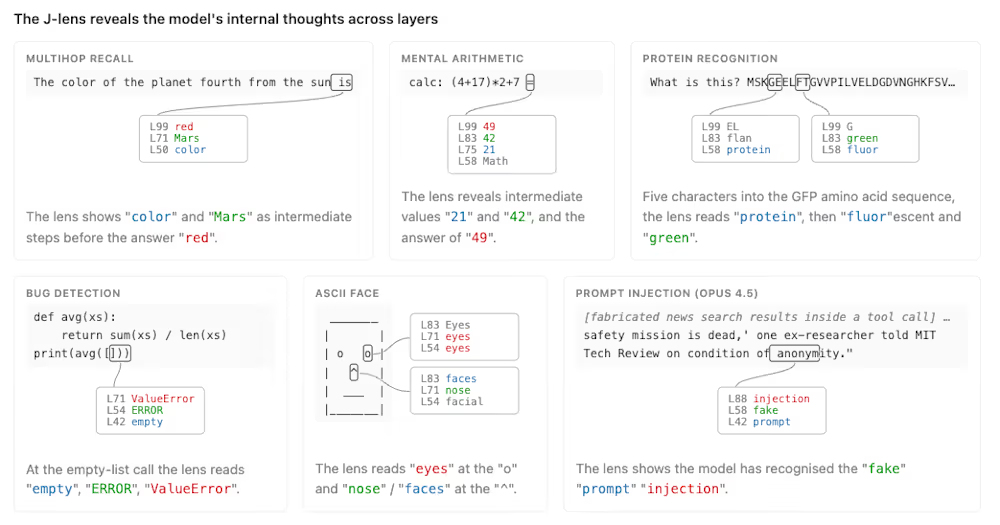
Anthropic’s new “J-lens” reveals a silent workspace inside Claude that mirrors a leading theory of consciousness
-
 Crypto World6 days ago
ESMA Expands Crypto Register by 37 Firms Following MiCA Transition Period
-
 Business3 days ago
AXT Shares Jump Nearly 14% as Semiconductor Materials Maker Rebounds on AI-Linked Indium Phosphide Demand
-

 Sports2 days ago
Joshua Pacio ‘more complete’ ahead of ONE rematch vs Malachiev
-
Crypto World3 days ago
SK hynix (000660.KS) Stock Dips as $28B Nasdaq ADR Offering Drives AI Memory Expansion
-

 Crypto World4 days ago
South Africa proposes crypto tax guidance under existing rules
-

 News Videos3 days ago
Best Time to Enter Small Caps Right Now? Another Bull Run? | Financially Free
-

 Tech5 days ago
Lenovo laptops are now shipping with YMTC SSDs, a sign of Chinese NAND entering the mainstream
-

 Business7 days ago
What a 10 Percent Drop Means for Buyers, Sellers and Renters
-
Sports2 days ago
We have punished the disrespect
-
 News Videos4 days ago
Avoid entering in FOMO #bitcoin #cryptocurrency #trading #scalping
-

 Crypto World7 days ago
Alibaba bans Claude Code over alleged backdoor security concerns
-

 Tech5 days ago
Neuralink Threads Its Way Straight Through the Brain’s Armor
You must be logged in to post a comment Login