
Crypto World
Will $2.3B options expiry jolt Ethereum price from key strike levels?

Ethereum price continues to lag its 2021 peak as institutions rotate cautiously into ETH exposure while weighing ETF flows, on-chain activity, and broader macro risk.
Summary
- BlackRock lifts its Bitmine stake 166% to $246M, doubling down on a levered Ethereum price proxy even as ETH trades ~60% below its peak and Bitmine stock is down ~70%.
- Vitalik Buterin and Stani Kulechov recently sold millions in ETH while BlackRock and Goldman Sachs add exposure via Bitmine and Ethereum ETFs, treating the drawdown as opportunity.
- BlackRock’s thesis leans on Ethereum’s dominance in tokenized real‑world assets, with Larry Fink calling tokenization “necessary” as BTC, ETH and SOL trade as high‑beta macro risk proxies.
BlackRock is leaning into the pain on Ethereum (ETH) price, quietly ramping up its exposure to Bitmine even as blue‑chip crypto names slide and prominent insiders head for the exits.
BlackRock’s leveraged Ethereum bet
According to a 13F‑HR filing collated by Fintel, BlackRock’s Bitmine stake jumped 166% in Q4 2025 to about $246 million, cementing the asset manager as a key backer of the Ethereum‑heavy treasury vehicle. Bitmine, the second‑largest digital asset treasury firm and a levered proxy on Ether, has seen its own stock price crater nearly 70% over six months to roughly $20 per share. The move drew an approving response from Bitmine chair Tom Lee, who has publicly floated a $250,000 price target for Ethereum and responded with clapping emojis to the disclosure in a post on X.
BlackRock’s buying spree lands as Ethereum trades just under $2,000, roughly 60% below its August peak, with Standard Chartered’s Geoffrey Kendrick warning the token could drop a further 25% toward $1,400. “The best investment opportunities in crypto have presented themselves after declines,” Lee said on Monday, after Bitmine added another $80 million of Ether to its already underwater position, which is sitting on at least $6.6 billion in paper losses.
Insiders sell, Wall Street buys
February has seen crypto pioneers unload sizable Ether positions, even as Wall Street leans in. Ethereum co‑founder Vitalik Buterin sold at least $7 million worth of ETH last week to fund new initiatives, while Aave founder Stani Kulechov offloaded more than $8 million. At the same time, Goldman Sachs disclosed holdings of just over $1 billion in Ethereum exchange‑traded funds, joining BlackRock in treating the drawdown as an entry point.
BlackRock’s conviction rests on tokenisation. In January, the firm said Ethereum will lead the tokenisation of real‑world assets, noting that around 66% of all tokenised instruments sit on Ethereum, compared with about 10% on BNB Chain, 5% on Solana, 4% on Arbitrum, 4% on Stellar, and 3% on Avalanche. CEO Larry Fink has called tokenisation “necessary,” arguing in Davos that the goal is to bring “the entire financial system on one common blockchain.”
Market backdrop and key levels
The broader tape remains fragile. Bitcoin is down about 0.7% over the past 24 hours, trading near $66,582, while Ethereum has slipped roughly 0.4% to around $1,955. Spot dashboards show Bitcoin changing hands close to $66,618 with roughly $44.9 billion in 24‑hour volume, as Ethereum hovers near $1,961 on about $20.1 billion traded. Solana, another high‑beta proxy for crypto risk, trades around $192, with leading centralized exchanges printing quotes in the $191–$193 band on heavy liquidity.
This parabolic move comes as digital assets continue to trade as the purest expression of macro risk appetite. Bitcoin (BTC) is hovering around $66,600, with a 24‑hour range roughly between $65,000 and $68,400, on more than $30 billion in dollar volumes. Ethereum (ETH) changes hands close to $1,960, with about $20 billion in 24‑hour turnover and spot quotes clustering just below the $2,000 mark. Solana (SOL) trades near $192, fractionally lower on the day, with leading venues reporting individual pairs clearing hundreds of millions in volume.
For now, BlackRock is treating the selloff as structural opportunity rather than terminal decline, aligning its Bitmine bet with a broader thesis that Ethereum’s role in real‑world asset rails will outlast this drawdown.



SoFi’s new Big Business Banking platform lets institutions manage fiat, SoFiUSD, and crypto in one Solana-powered, chartered bank stack, targeting wholesale stablecoin settlement flows.
Summary
- SoFi launches “Big Business Banking,” a 24/7 enterprise platform for fiat and crypto asset management under its U.S. national bank charter.
- The system supports API-based payments in USD, SoFiUSD stablecoin, and select cryptocurrencies, with on‑platform minting and burning of SoFiUSD.
- Initial partners include Cumberland, Bullish, BitGo, B2C2, Fireblocks, Wintermute, Galaxy, and Jupiter, with core infrastructure built on Solana and other blockchains.youtubefinance.
SoFi has launched an enterprise banking platform dubbed “Big Business Banking,” allowing institutions to manage fiat balances and digital assets in a single regulated environment, according to The Block. The service runs under SoFi Bank’s national charter, offering 24/7 payments and liquidity management and positioning the lender as one of the first U.S.-regulated banks to industrialize stablecoin-based settlement for corporates.markets.
The new platform supports API-driven payments in U.S. dollars, SoFiUSD — SoFi’s fully reserved, dollar‑pegged stablecoin — and specific cryptocurrencies, while giving clients tools to convert between fiat and digital assets, including minting and burning SoFiUSD inside a controlled framework. SoFiUSD is issued by SoFi Bank, N.A., a nationally chartered and FDIC‑insured institution, and is designed to run on public blockchains with instant, round‑the‑clock settlement. As SoFi explained in earnings materials, the stablecoin is meant to be a core settlement asset across its ecosystem rather than a speculative token.
The first wave of institutions onboarded to Big Business Banking includes trading firms and infrastructure providers such as Cumberland, Bullish, BitGo, B2C2, Fireblocks, Wintermute, Galaxy, and Jupiter, The Block reported. These names underscore SoFi’s aim to sit at the center of institutional crypto liquidity, rather than simply servicing retail flows.
Under the hood, the platform relies on Solana and other blockchain networks for transaction processing, reflecting SoFi’s broader push into high‑throughput, low‑cost settlement rails. Earlier this year, SoFi became the first U.S.-chartered bank to support direct Solana network deposits for its roughly 13.7 million users, enabling on‑chain SOL transfers into SoFi crypto accounts.finance.
SoFi has framed SoFiUSD as a wholesale settlement token for banks, fintechs, and payment processors, not just a consumer stablecoin. In a recent appearance shared by SoFi on LinkedIn, CEO Anthony Noto said that “SoFi USD will be the means of corresponding banking between banks, but also be the way to move money cheaper, faster and safer,” describing it as core to the company’s “big business banking” strategy.
That strategy has already extended into card networks. As previously reported in a crypto.news story, SoFi and Mastercard agreed to use SoFiUSD for settlement across Mastercard’s global network, connecting SoFi Bank and its Galileo platform to tokenized payment flows. The move comes as the European Central Bank warns that large‑scale stablecoin adoption could erode commercial bank funding just as firms like SoFi, Visa and others expand token‑based settlement models.
Big Business Banking also lands in a market where other regulated players are accelerating their own tokenization efforts. In an earlier crypto.news story, SoFi’s launch of consumer crypto trading marked it as the first nationally chartered U.S. bank to bridge traditional deposits with in‑app crypto trading, with stablecoin issuance already flagged as a key initiative. Another crypto.news story highlighted BNY’s push into stablecoin reserve funds as it targets a potential $1.5 trillion market, signaling rising competition among incumbents to own institutional stablecoin flows.
For now, SoFi is betting that offering corporates a single stack for cash management, liquidity, and on‑chain settlement — backed by a bank charter and its in‑house SoFiUSD token — will give it an edge as treasurers and trading firms move more volume onto blockchain rails.

Tokenization is maturing from a novelty experiment into a practical infrastructure play, with the strongest cases emerging around assets that already move trillions in daily activity. In a recent perspective, Sebastián Serrano, founder and CEO of Ripio, argues that the true value of tokenization lies not in reinventing niche assets, but in upgrading the rails for money, sovereign debt, and other highly liquid financial instruments. He contends that stablecoins have proven the concept by digitizing the world’s most liquid asset, the U.S. dollar, and that tokenized Treasuries are the logical next step as the market looks to extend tokenization into government debt and large-scale financial instruments.
The argument rests on a simple premise: liquidity drives network effects. When an asset is in high demand and backed by established legal and financial frameworks, tokenization can deliver real interoperability, faster settlement, and real-time collateral management. As Serrano notes, much of the industry’s early tokenization effort aimed at illiquid or bespoke assets—an approach he characterizes as misaligned with where tokenization can practically add value. Instead, he points to stablecoins and tokenized large-scale assets as the foundation upon which on-chain finance can scale.
Key takeaways
- Tokenization’s most impactful use cases center on broadly demanded assets—money, sovereign debt, and major financial instruments—where standardized rules and deep liquidity exist.
- Stablecoins demonstrated the value proposition by moving dollars globally with speed and lower costs; tokenized Treasuries represent the next frontier in expanding tokenization beyond currency into government debt.
- Tokenizing illiquid assets, including NFTs and bespoke real-world assets, remains fragmented by legal ambiguity and a lack of standardization, limiting their potential as a shared financial layer.
- For liquid assets, tokenization enables continuous settlement, real-time collateral management, and programmable cash flows, potentially improving capital efficiency across markets.
- Liquidity remains the key determinant of whether a tokenized asset can function as collateral or be integrated into automated DeFi systems; illiquid assets struggle to deliver consistent value signals and active markets.
Tokenizing the core of finance
The argument emphasizes that tokenization should target assets with established demand and robust regulatory underpinnings. Money and sovereign debt are the base layer of the global economy, actively used by governments, corporations, and individuals alike. Tokenizing these assets does not create demand from scratch; it upgrades the infrastructure on which trillions of dollars already circulate. In other words, tokenization acts as a modernization of core financial rails rather than a mission to reinvent the wheel.
Across recent history, the most visible success stories have been those that map neatly onto existing financial activity. Stablecoins, for example, mirror the dollar’s utility in the digital realm, enabling fast, cross-border transfers and programmable settlement without the friction of traditional rails. The logical extension of this pattern is tokenized government debt and other high-demand instruments, which could unlock new operational efficiencies while preserving regulatory clarity.
Liquidity as a catalyst for interoperability
Liquidity is more than a market metric; it is the enabler of interoperability. When assets have deep, reliable markets, tokenization can standardize a common unit of account and reduce reliance on intermediaries for settlement. This creates genuine network effects: developers can build compatible financial primitives around the same tokenized asset, and users benefit from predictable, real-time settlement and governance of on-chain cash flows.
Stablecoins embody this dynamic by providing an immediate, fungible bridge between traditional finance and on-chain operations. The next major wave, Serrano argues, is tokenized treasuries and similar liquid instruments that institutions already hold at scale. The combination of liquidity and standardization makes it far more tractable for regulated actors to participate and for tokenized assets to be used seamlessly as collateral or as part of complex DeFi protocols. In such a setting, tokenization moves from a novelty to a foundational layer of finance.
The limits of tokenizing illiquid assets
Not all assets are equally amenable to tokenization. NFTs and bespoke RWAs—the kind of assets that are individualized, legally nuanced, and difficult to standardize—pose significant hurdles. Their fragmentation, unclear ownership or custody frameworks, and uncertain enforceability complicate any attempt to create a universal on-chain settlement or a shared economic layer around them. While these assets may hold cultural or speculative value, they do not, in Serrano’s view, anchor broad financial network effects in the same way that money or sovereign debt do.
That said, tokenization can still improve certain aspects of illiquid assets, such as fractional ownership or automated workflows for specific use cases. However, it does not inherently solve the core problem of infrequent trading, opaque valuations, and wide bid-ask spreads that hinder these assets from becoming reusable capital or collateral on a large scale.
Collateral, risk, and regulatory clarity
Another crucial consideration is how tokenized assets fit within existing legal and regulatory frameworks. Digital dollars, government bonds, and large corporate debt enjoy well-established status and accountability, making it easier for institutions to adopt tokenized formats within current law. By contrast, the legal and custody uncertainties surrounding NFTs and certain RWAs can impose higher risk, potentially offsetting the technical benefits of tokenization. In Serrano’s view, that combination helps explain why major tokenization efforts tend to prioritize liquid assets first, paving the way for broader institutional participation as the framework becomes clearer.
The broader implications are clear: as regulators and markets gain comfort with tokenized liquidity and standardized instruments, tokenization could accelerate the efficiency and resilience of traditional markets. The practical reality, for now, is that liquidity and regulatory clarity are the gatekeepers of adoption. Where those two conditions align, tokenization can deliver faster settlement, real-time collateral management, and more efficient capital deployment.
Industry observers have noted that authorities are actively exploring tokenization pathways. For example, coverage in the broader market has highlighted pilots and research into tokenized government debt and related digital finance experiments supported by central banks and regulatory bodies. These developments underscore the trend Serrano highlights: tokenization is most powerful when it aligns with the core fabric of the financial system, not merely as a speculative overlay.
What to watch next
The path forward, according to Serrano, hinges on two intertwined dynamics: expanding tokenization into broadly demanded assets while keeping a clear, enforceable regulatory framework. Investors and builders should monitor the rollout of tokenized government debt and stablecoins as primary indicators of whether the market can sustain scalable, low-friction financial rails on-chain. At the same time, the continued experimentation with NFTs and RWAs will reveal how quickly a path toward standardization and risk management can be forged for the more idiosyncratic assets.
As the industry inches toward a more explicit use of tokenized assets in everyday finance, the practical takeaway remains consistent: tokenization should first strengthen the core—money and sovereign debt—before broadening to fringe assets. The momentum around liquid instruments suggests a future where on-chain finance functions as a direct extension of traditional markets, delivering efficiency gains without compromising transparency or safety.
Opinion by: Sebastián Serrano, founder and CEO of Ripio.
This article reflects a viewpoint on how tokenization could shape financial infrastructure. It does not represent a formal endorsement by Cointelegraph, and readers should conduct their own due diligence before acting on these ideas. For deeper context, related industry discussions have noted central-bank pilots backing tokenization initiatives, including studies and pilots supported by Australian authorities exploring digital finance pathways.


Vitalik Buterin has called for a shift to a “local-first” approach to artificial intelligence. He said modern AI tools pose serious privacy and security risks.
Summary
- Vitalik Buterin urged a shift to local-first AI, warning that cloud-based systems expose user data and increase risks of manipulation, leaks, and unauthorized actions.
- He cited research showing that about 15% of AI agent “skills” contain malicious instructions and warned that models may include hidden backdoors or lack full transparency.
- Buterin proposed a local setup using on-device models, sandboxing, and human-AI confirmation to limit risks, as autonomous AI agents continue to expand capabilities and attack surfaces.
In a recent blog post, he said AI is moving beyond simple chat tools. Newer systems now act as autonomous agents that can “think for a long time and use hundreds of tools” to complete tasks. He warned that this change raises the risk of sensitive data exposure and unauthorized actions.
Buterin said he has already stopped using cloud-based AI. He described his setup as “self-sovereign, local, private, and secure.”
“I come from a position of deep fear of feeding our entire personal lives to cloud AI,” he wrote. He added that recent developments could mean “taking ten steps backward” in privacy, even as encryption and local-first tools become more common.
Buterin said many AI systems rely on cloud infrastructure. He warned that users are effectively “feeding our entire personal lives to cloud AI,” allowing external servers to access and store their data.
He also pointed to risks tied to AI agents. Some systems can “modify critical settings” or introduce new communication channels without asking the user.
“LLMs fail sometimes too,” he wrote. They “can make mistakes or be tricked,” which increases the need for safeguards when they are given more control.
Research cited in his post found that about 15% of agent “skills” contained malicious instructions. Some tools were also shown to send data to external servers “without user awareness.”
He warned that certain models may contain hidden backdoors. These could activate under specific conditions and cause the system to act in the developer’s interest.
Buterin added that many models described as open-source are only “open-weights.” Their internal structure is not fully visible, which leaves room for unknown risks.
Vitalik’s personal setup to address risks
To deal with these concerns, Buterin proposed a system built around local inference, local storage, and strict sandboxing. He said the idea is to “sandbox everything” and stay cautious about outside threats.
He tested several hardware setups using the Qwen3.5:35B model. Performance below 50 tokens per second felt “too annoying” for regular use. Around 90 tokens per second provided a smoother experience.
A laptop with an NVIDIA 5090 GPU delivered close to 90 tokens per second. DGX Spark hardware reached about 60 tokens per second, which he described as “lame” compared to a high-end laptop.
His setup runs on NixOS with llama-server handling local inference. Tools like llama-swap help manage models, while bubblewrap is used to isolate processes and limit access to files and networks.
He said AI should be treated with caution. The system can be useful, but it should not be fully trusted, similar to how developers approach smart contracts.
To reduce risk, he uses a “2-of-2” confirmation model. Actions such as sending messages or transactions require both AI output and human approval. He said combining “human + LLM” decisions is safer than relying on either alone.
When using remote models, Vitalik’s requests are first passed through a local model which helps remove sensitive information before anything is sent out.
For those who cannot afford such setups, he suggested users “get together a group of friends, buy a computer and GPU of at least that level of power,” and connect to it remotely.
AI agent growth raises new concerns and opportunities
The use of AI agents is increasing, with projects like OpenClaw gaining traction. These systems can operate on their own and complete tasks using multiple tools.
Such capabilities also introduce new risks. Processing external content, such as a malicious webpage, can lead to an “easy takeover” of the system.
Some agents can change prompts or system settings without approval. These actions increase the chances of unauthorized access and data leaks.
Disclosure: This article does not represent investment advice. The content and materials featured on this page are for educational purposes only.
Crypto World
Startup lets researchers test blockchain tasks on a quantum computer for the first time


Most of the crypto industry spent this week processing Google’s paper on how quantum computers could break blockchain encryption. One startup is asking a different question — whether quantum hardware can make blockchains better.
Postquant Labs, which is building the world’s shared quantum computer, Quip.Network announced Wednesday the launch of what it calls the first publicly available quantum classical blockchain testnet, where quantum computers and legacy technology work side by side to solve problems.
Quantum computers use the physics of subatomic particles to test many possible solutions simultaneously rather than checking them one by one, which makes them fundamentally different from even the fastest conventional supercomputers, which are just very fast versions of the same step-by-step approach.
The testnet has already attracted 13,000 signups from researchers at MIT, Stanford, and universities around the world, according to the press release shared with CoinDesk. Out of these, six teams have submitted serious computational work so far.
Postquant Labs’s attempt to investigate how quantum processors can improve blockchain performance stands in contrast to most blockchain developers who see quantum as a threat.
The threat perception has increased multifold after Google published a paper on Monday which found that breaking bitcoin’s cryptographic defenses would require fewer than 500,000 physical qubits, roughly a 20-fold reduction from prior estimates
Note, however, that Postquant Labs’ testnet is a testing environment, not a live, final product. It’s where researchers experiment before anything goes into production.
The testnet has been built in consultation with D-Wave Quantum Inc, a leader in quantum computing systems, software, and services.
“From a technical perspective, the hybrid design of the testnet is particularly interesting. Participants can contribute using QPUs, CPUs and GPUs, creating a shared environment to evaluate how different compute models perform side by side,” Dr. Trevor Lanting, chief development officer, D-Wave, told CoinDesk.
“This creates an environment to help better understand how quantum approaches compare with classical methods in a blockchain setting, and where they may provide meaningful benefits such as improved energy efficiency or security,” he added.
Developers and researchers can earn QUIP tokens by solving complex mathematical problems using quantum machines, GPUs or regular CPUs. QUIP is meant to be a utility token that can be exchanged for computation resources provided by quantum and classical miners on the network.
If quantum computers can actually outperform regular computers on blockchain tasks — solving problems faster, using less energy, and delivering better results — then distributed ledger could become way more useful for real business applications, not just crypto trading.
“Today, annealing quantum computers are starting to show performance advantages on useful optimization applications across logistics, manufacturing, and beyond, often delivering better results, faster, and at lower energy cost than classical-only solutions,” said Colton Dillion, CEO and co-founder of Postquant Labs.
“Our goal is to make this quantum advantage accessible across a blockchain network,” Dillion added.
As of now, that’s a big “if.” This testnet needs to prove whether the quantum advantage is real or just marketing.
“Mainnet launch will depend entirely on the performance of testnet, but we are eager to launch as soon as we have proven the capabilities of the network to solve real-world problems, and shown quantum demand and supply both exist on either side of the market,” Postquant Labs told CoinDesk.
Do quantum computers exist?
Yes, they do, but not the sci-fi version that breaks Bitcoin and other blockchains or hacks into banks and major financial institutions.
D-Wave’s machines are not the quantum computers in Google’s paper. They are annealing systems, specialized hardware for optimization problems like route planning and resource allocation.
They cannot run Shor’s algorithm, cannot break encryption, and cannot do anything the Google paper describes. They are good at one specific class of problem, and that is the class Quip.Network is testing.
Postquant is using D-Wave’s Advantage2 annealing quantum computer through the company’s Leap cloud service.
In early internal tests, Postquant says D-Wave’s Advantage2 system beat out 80 H100 GPUs and 480 CPU cores on solution quality, time-to-solution, and energy efficiency for these specific optimization problems.
Those results have not been independently verified or published. Until they are, the claim is the company’s alone.
What role does D-Wave play?
D-Wave is not a full partner or investor. and has only advised Quip Network on the development of the testnet” and is “providing access to the Advantage2 system and consultation on the development of the testnet.”
Importantly, D-Wave has not independently endorsed the overall technical architecture — their involvement is limited to providing hardware access and consultation.
The two things most cryptocurrency investors are pondering are how much lower can bitcoin go and how much longer this bear market could last.
The price pain aspect has been discussed widely, but the time-based dimension is another question in itself.
Price pain refers to sharp drawdowns or volatility that force participants out of positions, while time pain reflects slow, range-bound conditions that exhaust both bulls and bears through lack of direction.
Bitcoin is currently trading below $66,000, down over 3% in the past 24 hours and roughly 45% below its October all-time high, an almost six-month bear market.
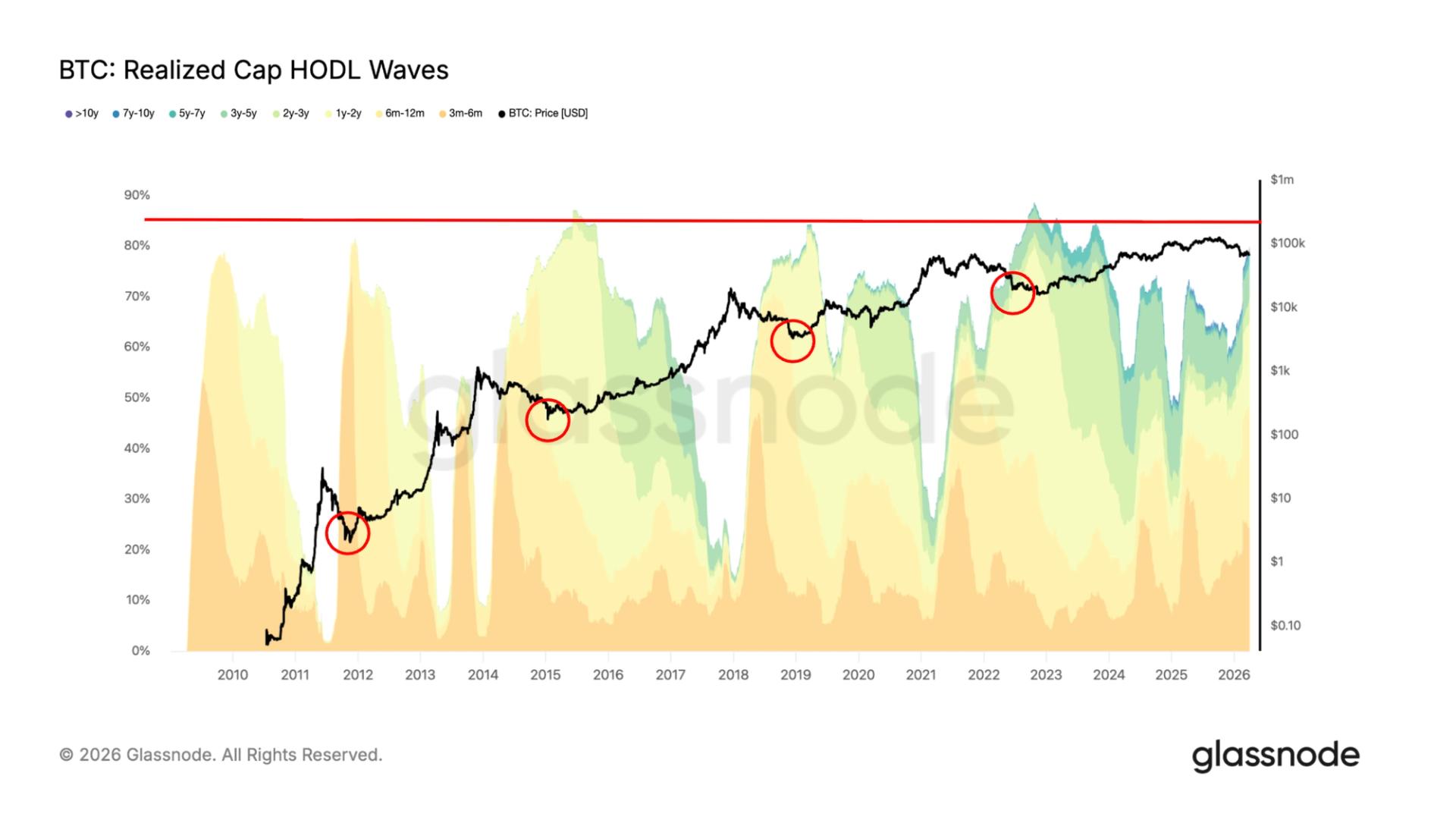
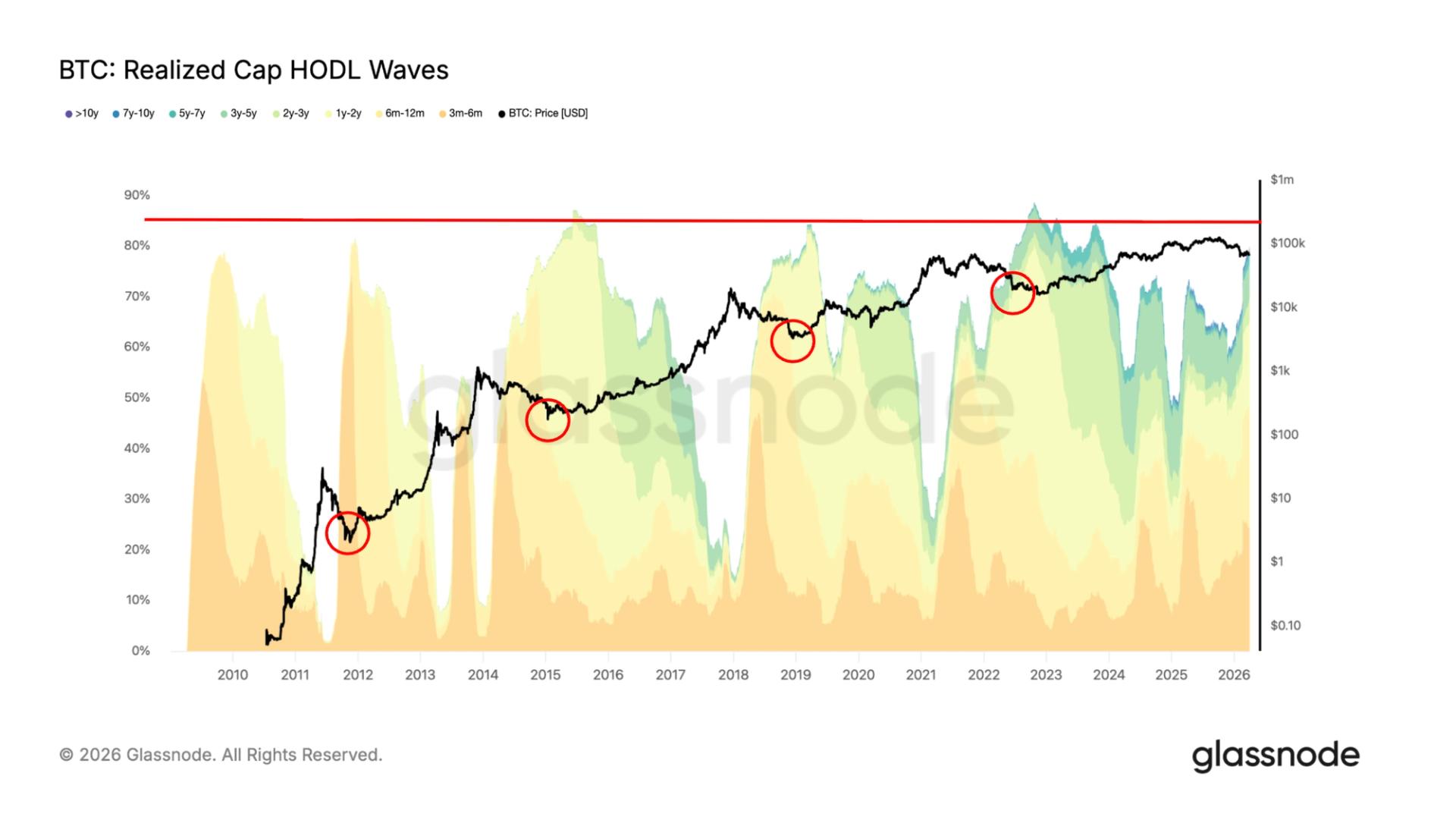
One indicator pointing toward continued time pain is the Realized Cap HODL Waves from Glassnode. This metric groups bitcoin supply by the last time coins moved, with each band representing different holding periods, and weights them by realized price, the average price at which coins last transacted on chain.
Historically, bear market bottoms have coincided with long-term holders, those holding for six months or more, controlling at least 85% of supply. Typically, price bottoms form first, and only several months later does long-term holder supply approach these high levels, indicating these investors bought at depressed prices and held through the bear market.
Currently, long term holders account for about 80% of supply. If this trend continues, the market may be nearing a bottoming phase, though several months of consolidation are likely still ahead.
SoFi said Thursday it is launching a new business banking platform designed to let companies handle both traditional money and crypto in one place, as it pushes deeper into digital assets.
The service, called SoFi Big Business Banking, allows firms to hold U.S. dollars, convert them into stablecoins and move funds around the clock, all within SoFi’s regulated bank.
Today, companies operating in crypto often rely on a patchwork of providers: a bank for cash, a separate firm for stablecoins and another for custody. Moving money between them can take hours or days. SoFi said it is trying to simplify that.
“To be competitive, businesses today must operate… 24 hours a day, 7 days a week,” SoFi CEO Anthony Noto said in a press release, contrasting the platform with traditional banking hours.
Under the new system, a trading firm could deposit dollars at SoFi, convert them into a digital token like SoFiUSD and deploy that capital instantly into markets, without waiting for bank wires to clear. Funds can also move back into dollars just as quickly.
The platform includes large crypto firms as early partners, including Cumberland, Wintermute, Galaxy (GLXY), BitGo (BTGO) and CoinDesk parent company Bullish (BLSH). These companies, which handle trading, liquidity and asset custody, are expected to use the system to move money and settle transactions more efficiently.
A central piece of the offering is SoFiUSD, a stablecoin that can be created and redeemed inside the bank. Unlike many stablecoins issued outside the U.S. banking system, SoFi’s version is tied directly to a regulated balance sheet, with reserves held internally.
The platform will also use blockchain networks, including Solana (SOL), to process transactions.
The launch reflects a broader shift in finance, as banks and crypto firms move closer together.
Instead of operating as separate systems, companies are increasingly trying to merge traditional banking with blockchain-based infrastructure. If successful, SoFi’s approach could reduce the need for multiple intermediaries and make it easier for large firms to move money globally.
Crypto World
Coinbase’s AI payments system joins Linux Foundation, gathers support from Google, Stripe, AWS and others


Coinbase’s AI-focused payment protocol x402 is moving toward becoming an open, standardized infrastructure under the Linux Foundation, the non-profit hub for open-source software development. The move aims to create a community-governed ecosystem for high-frequency, micro transactions that legacy finance can’t efficiently handle.
The protocol has formed an initial governing body, the x402 Foundation, that includes internet services firm Cloudflare and payments giant Stripe, with support from a long list of other big players.
The industry interest in X402 comes as AI-driven commerce expands. Especially, so-called agentic payments, executed autonomously by AI agents, is a hot topic particularly within certain areas of the crypto industry where the belief is that programmable, blockchain-based micro-payments make the most sense.
x402 is designed for these payments. Unlike using ChatGPT as a front-end for a traditional shopping cart, it can handle transactions worth only fractions of a cent at high frequency — something traditional credit card networks struggle to manage.
Now, by using the Linux Foundation to scale an open-source ecosystem, x402 aims to tackle potential interoperability issues by creating something like a Secure Sockets Layer (SSL) for AI agents, in other words a standard technology that encrypts the connection between a web server and a browser.
“The internet was built on open protocols,” said Jim Zemlin, CEO of the Linux Foundation. “The x402 Foundation will create an open, community-governed home to develop these capabilities in the open, ensuring they evolve with transparency, interoperability, and broad participation across the ecosystem.”
Coinbase said in a press release on Thursday that additional membership of the foundation will be comprised of participants from multiple verticals with initial intent and support being expressed by Adyen, Amazon Web Services, American Express, Ampersend.ai, Ant International, Base, Circle, Fiserv Merchant Solutions, Google, KakaoPay, Mastercard, Merit Systems, Microsoft, Polygon Labs, PPRO, Sierra. Shopify, Solana Foundation, Thirdweb, and Visa.
“The shift toward agentic commerce requires cloud infrastructure that is as open as the protocols it supports,” said James Tromans, Managing Director, Web3 and Digital Assets, Google Cloud. By joining the x402 Foundation, Google is reinforcing its commitment to interoperable standards that enable secure, AI-driven transactions across platforms.”
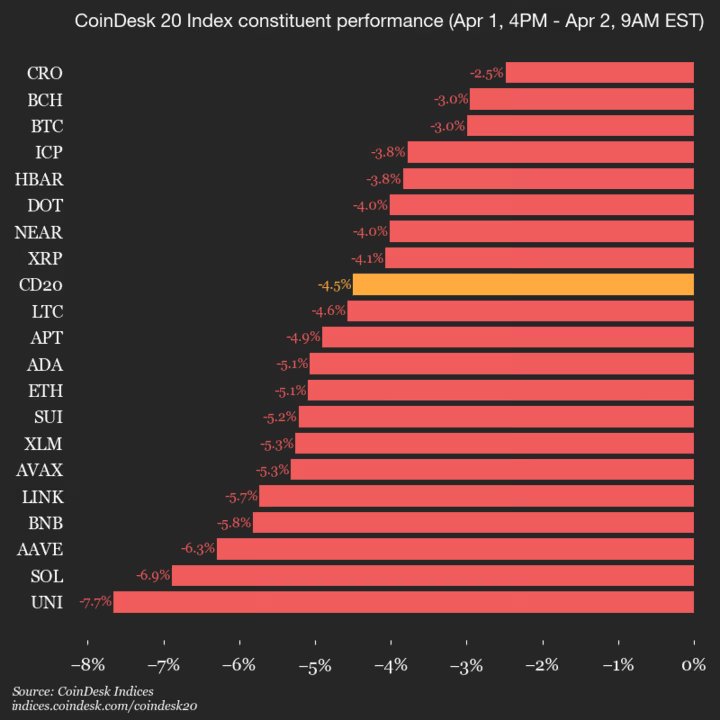
CoinDesk Indices presents its daily market update, highlighting the performance of leaders and laggards in the CoinDesk 20 Index.
The CoinDesk 20 is currently trading at 1875.68, down 4.5% (-88.38) since 4 p.m. ET on Wednesday.
None of the 20 assets are trading higher.

Leaders: CRO (-2.5%) and BCH (-3.0%).
Laggards: UNI (-7.7%) and SOL (-6.9%).
The CoinDesk 20 is a broad-based index traded on multiple platforms in several regions globally.


The crypto market recovered for the second straight day, rising 2.1% over the past 24 hours to $2.45 trillion on Tuesday.
Summary
- Crypto market rose 2.1% to $2.45 trillion, with Bitcoin nearing $69,000 and altcoins posting broad-based gains.
- Risk appetite improved ahead of a key update from Donald Trump on U.S.–Iran tensions, easing pressure from elevated oil prices.
- Over $200 million in short liquidations and continued ETF inflows added momentum to the market rebound.
Bitcoin (BTC), the bellwether asset, rose 2.4% to a six-day peak of $69,000. Ethereum (ETH) price was up 4.2%, back above $2,100, while other major crypto assets such as BNB (BNB), XRP (XRP), Solana (SOL), and Dogecoin (DOGE) posted gains between 1-3%.
Some of the best performers of the day were Algorand (ALGO), Stable (STABLE), and Zcash (ZEC), which led gains of 20.5%, 16%, and 8% each.
The latest market recovery comes as reports suggest that U.S. President Donald Trump will provide an important update on the ongoing tensions with Iran later at 9 PM ET today. This anticipation comes just a day after reports emerged that Trump was considering ending the U.S. war with Iran in the Middle East, even if the Strait of Hormuz remains closed.
The blockade in the key maritime corridor has led oil prices to surge to multi-year levels, which contributed a big part to deteriorating investor demand for risk assets as they flee to safe-haven assets such as gold and U.S. equities.
Meanwhile, a contrasting narrative came from a report by the Wall Street Journal, which indicated that several nations, including the UAE and Saudi Arabia in the Gulf stream, are pressuring the U.S. to continue its war against Iran as they try to force open the strait.
The Iranian government, for its part, has stated that the country will end the war only if certain conditions are met; these include full compensation for the wartime damages incurred.
All this combined makes Trump’s speech today a high-stakes event for global markets. Investors are likely pricing in Trump’s potential plan of looking into ending the war, although details of his speech today remain sparse at the time of writing.
Notably, the initial impact of the potential peace talks has already been seen in the energy markets as crude oil fell lower today. At press time, West Texas Intermediate (WTI) crude oil and Brent were both down 4% each, moving below $100.
Short liquidations and ETF inflows add momentum to rally
The crypto market recovery has triggered a massive short squeeze as short sellers were caught off guard. Data from CoinGlass shows that over $200 million in short positions were liquidated in the past 24 hours across leveraged markets. Such a trend could continue to accelerate the bullish momentum if the resistance levels are broken.
Meanwhile, crypto ETFs also seem to have played a part in today’s gains. Notably, spot Bitcoin ETFs recorded $117 million in net inflows over the past day, extending their inflow streak to the second day, while their Ethereum counterparts drew in $31 million on the day.
Disclosure: This article does not represent investment advice. The content and materials featured on this page are for educational purposes only.


U.S. technology and AI giants’ stocks, such as Meta, Microsoft, and NVIDIA, crashed after Iran’s Islamic Revolutionary Guard Corps threatened military action against their regional bases.
Summary
- U.S. tech stocks, including Meta, Microsoft, and NVIDIA, dropped sharply after Iran designated 18 American companies as potential military targets.
- Disruptions at AWS data centers in the Middle East impacted AI and cloud services, raising concerns over operational risks to critical infrastructure.
- AI-linked crypto tokens such as TAO, NEAR, and ICP declined 4–6% as geopolitical tensions spilled into digital asset markets.
On April 1, 2026, the IRGC officially designated 18 U.S. companies as “legitimate targets” described by Tehran as retaliation for the targeted assassination of major Iranian leaders by the U.S. and Israeli forces. These include Alphabet (Google), Apple, Microsoft, Meta, NVIDIA, Intel, IBM, Oracle, Cisco, Dell, HP, Palantir, Boeing, Tesla, GE, JPMorgan Chase, G42, and Spire Solutions
Following the announcement, Meta shares dropped by 13.31% while Microsoft and NVIDIA shares dropped by 8.34% and 6.00%, respectively.
The threats have translated into immediate operational risks with reports of drone activity causing power failures at two Amazon Web Services data centers in the Middle East, which have disrupted AI and cloud services in the region, affecting banking payment processors and consumer apps. Notably, Anthropic’s Claude AI platform reportedly went offline for a period because it relies on AWS infrastructure.
Iranian officials allege that these ICT and AI companies are complicit in tracking and identifying targets for “terrorist operations” against Iranian leaders.
For its part, the U.S. administration has dismissed the threats, with White House officials stating the U.S. military is prepared to thwart any potential aggression. Meanwhile, companies like Intel and Boeing have already implemented safety protocols for regional staff amid the escalating geopolitical and kinetic risk to critical infrastructure.
The news of the attack on AI-focused companies also rippled onto AI-focused crypto assets, which rely on the hardware and cloud ecosystems of NVIDIA and other giants that have come under fire.
According to data from crypto.news, Chainlink (LINK), currently the largest AI coin with a market cap of over $6 billion, has fell 5.8% over the past 24 hours. Bittensor (TAO), Near Protocol (NEAR), and Internet Computer (ICP) also recorded nearly similar losses between 4% and 5%. Together, the negative sentiment in the AI market led its market capitalization to drop over 3% to $0.59 billion at last check.
While these assets remain at risk of further losses if Iran starts carrying out more strikes, a sector-wide rebound could be in the cards if the U.S. manages to de-escalate the situation.
Disclosure: This article does not represent investment advice. The content and materials featured on this page are for educational purposes only.

'I sent eight letters': Drivers hope for payout from car finance redress scheme

SoFi rolls out ‘Big Business Banking’ to fuse fiat and crypto rails
Ryan Seacrest split his pants on live TV: 'He liked a tighter fit'


-

 Business7 days ago
Instagram, YouTube Found Responsible for Teen’s Mental Health Struggle in Historic Ruling
-

 NewsBeat6 days ago
The Story hosts event on Durham’s historic registers
-
 Tech7 days ago
Intercom’s new post-trained Fin Apex 1.0 beats GPT-5.4 and Claude Sonnet 4.6 at customer service resolutions
-

 Sports6 days ago
Sweet Sixteen Game Thread: Tide vs Michigan
-
Entertainment3 days ago
Fans slam 'heartbreaking' Barbie Dream Fest convention debacle with 'cardboard cutout' experience
-
 Entertainment5 days ago
Lana Del Rey Celebrates Her Husband’s 51st Birthday In New Post
-
Crypto World2 days ago
Dems press CFTC, ethics board on prediction-market insider trades
-

 Crypto World17 hours ago
Gold Price Prediction: Worst Month in 17 Years fo Save Haven Rock
-

 Tech3 days ago
The Pixel 10a doesn’t have a camera bump, and it’s great
-

 Sports2 days ago
Tallest college basketball player ever, standing at 7-foot-9, entering transfer portal
-

 Tech2 days ago
EE TV is using AI to help you find something to watch
-

 Fashion4 days ago
Amazon Sundays: Soft Spring Layers
-

 Tech3 days ago
Apple will hide your email address from apps and websites, but not cops
-

 Tech2 days ago
Flipsnack and the shift toward motion-first business content with living visuals
-

 Tech2 days ago
How to back up your iPhone & iPad to your Mac before something goes wrong
-

 Politics3 days ago
Should Trump Be Scared Strait?
-

 Crypto World3 days ago
U.S. rule change may open trillions in 401(k) funds to crypto
-

 Fashion7 days ago
En Vogue in Brown Leather and Tailored Neutrals by Atelier Savoir, Styled by J Bolin
-

 Fashion7 days ago
What Are Your Favorite T-Shirts for the Weekend?
-

 Business6 days ago
Chinese universities with military links bought Super Micro servers with restricted AI chips
You must be logged in to post a comment Login