

Crypto World
Kraken Plans AI Investing Assistant as It Revamps Its App

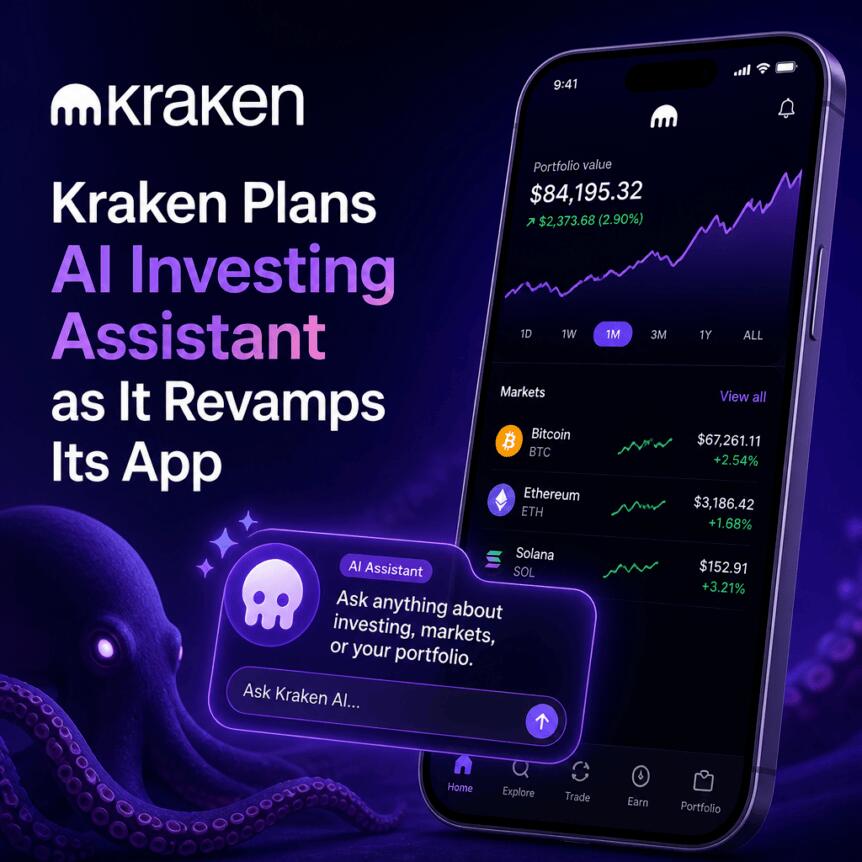
Kraken is rolling out a new set of AI-powered financial tools inside its mobile app, aiming to shift the experience from manual trading workflows to goal-based investing guidance. The update is built around users setting financial objectives and preferences up front—so the app can tailor recommendations and the on-screen experience around what they are trying to achieve.
In its announcement, Kraken described the core system as “financial intelligence” that monitors markets, spots investment opportunities, and suggests trades. Importantly, it positions the technology as decision support rather than fully automated execution: every recommendation must be reviewed and approved by the user before any transaction is placed.
Key takeaways
- Kraken’s mobile update uses AI to align trading recommendations with user-defined goals like home purchases, retirement savings, and emergency funds.
- The “financial intelligence” layer recommends trades and updates, but Kraken says it does not execute transactions autonomously.
- According to CNBC, Kraken also incorporates user risk tolerance, funding preferences, and financial profile to generate reviewable portfolio suggestions.
- Kraken’s launch follows broader moves across crypto by exchanges and fintech firms adding AI agents and conversational workflows, including tools that still require user approval.
Goal-based investing with user control
Kraken’s approach starts with how users set expectations. Rather than forcing customers to navigate complex trading screens, the redesigned app prompts them to specify financial goals and preferences. From there, Kraken says the system tailors the interface and recommendations to those objectives.
Examples Kraken highlighted include buying a home, saving for retirement, and building an emergency fund. The emphasis on goals matters because it potentially reframes investing from “choose an asset and execute” to “define an outcome and get guidance that fits it,” which could be especially relevant for less experienced users who struggle to translate long-term needs into day-to-day trading decisions.
Kraken also clarified the operational model of its AI tooling. While it continuously monitors markets and identifies opportunities, it requires a user’s explicit approval before any trade is submitted. That distinction—recommendation versus execution—may help address a key concern with AI in finance: reducing the risk of unintended trades while still offering more timely, personalized guidance than static forms or generic alerts.
How the app generates suggestions
CNBC reported that Kraken’s app uses information from its market monitoring system alongside user-specific inputs such as risk tolerance, funding preferences, and financial profile to create a suggested portfolio. The user is then able to review and adjust the proposed allocation before investing.
After a user invests, the app shifts from one-time advice to ongoing support. It provides personalized portfolio updates and additional investment suggestions tailored to what the user holds, again with the expectation that the user remains in control of whether to proceed with any action.
In an interview with CNBC, Kraken chief data officer Kamo Asatryan framed the purpose of the technology as narrowing the gap between retail users and the exchange’s most active traders. He said the system is designed to deliver everyday investors “the same market awareness” as high-frequency traders—using continuous monitoring and opportunity identification paired with recommendations that can be expressed in plain language.
“[T]here’s an opportunity for everyday people to become high-frequency traders and do so using plain English,” Asatryan said, according to CNBC.
Kraken joins a wider push for AI agents in crypto
Kraken’s rollout lands as exchanges and fintech platforms increasingly explore AI-driven interfaces that let users analyze markets, manage portfolios, and interact via conversation-like flows. The broader theme across the industry is not just automation, but “agentic” assistance—systems that can interpret a user’s intent, prepare actions, and streamline the steps between analysis and execution.
Earlier this year, OKX launched a beta marketplace where AI agents can transact autonomously, complete onchain tasks, and build blockchain-based reputations. In the same timeframe, Coinbase introduced a tool described as enabling AI agents to make payments and trade cryptocurrencies on behalf of users using its x402 payments protocol.
Activity reports suggest adoption is already taking shape. Chainalysis reported last month that agentic payment activity on Coinbase’s Base network surpassed 100 million transactions. While Chainalysis said transaction growth has stabilized, it also noted that higher-value transfers have become more common—an indicator that usage may be maturing beyond initial small-scale experiments, even if the overall pace of transactions is less explosive than earlier periods.
Other platforms are also leaning into conversational investing and AI-assisted trading workflows. On Friday, Revolut launched an upgrade to its Revolut X exchange that allows customers to connect AI assistants—including Claude, Gemini, Cursor, and OpenClaw—to analyze markets, backtest trading strategies, and place orders through natural-language prompts. Like Kraken’s model, Revolut’s approach requires users to review and approve every trade before execution.
The key question: when does “help” become automation?
What differentiates Kraken’s update from the most autonomous agent narratives is the explicit requirement for user approval. That control layer may be a practical compromise: it can preserve trust and reduce operational risk, while still giving users a more personalized and potentially faster way to evaluate opportunities.
At the same time, the industry is clearly moving toward workflows where users express intent in simpler terms and software translates that intent into trading and portfolio actions. For investors and traders, the near-term watch items are likely to be transparency and usability: how recommendations are explained, how risk factors are reflected, and how consistently the app updates guidance after portfolio changes.
For builders, the broader implication is that AI agents in finance are increasingly being packaged as user-facing product layers rather than back-office experiments—often paired with human approval gates that keep execution responsibility with the customer.
As Kraken begins deploying these tools in its mobile app, the next phase will likely reveal how quickly users adopt goal-based investing workflows, and whether the guidance becomes meaningfully better aligned with individual outcomes over time. Readers should also watch for additional details on how Kraken communicates recommendation logic and manages edge cases where market conditions or user preferences conflict.

Exclusive analysis of the RWA.xyz database surfaces three surprising tokenization stats. They show that tokenization’s growth engine has quietly moved. The money is no longer where the headlines say it is.
Three figures from RWA.xyz data between May 31 and July 9, 2026 tell one story. The famous category has stalled, a $20 billion giant hides in plain sight, and stablecoins are quietly rotating.
How to Read These Tokenization Stats
All figures come from one source, RWA.xyz, using its dashboard convention. That means distributed on-chain value, or tokens natively issued on a blockchain, counted once per asset.
Want more token insights like this? Sign up for Editor Harsh Notariya’s Daily Crypto Newsletter here.
Growth rates use the dashboard’s 30-day change, or daily API snapshots normalized to daily averages.
Tokenized Stocks Are Growing Nearly 40x Faster Than Tokenized Treasuries
For two years, tokenization mostly meant putting US government bonds on a blockchain. That trade has stalled.
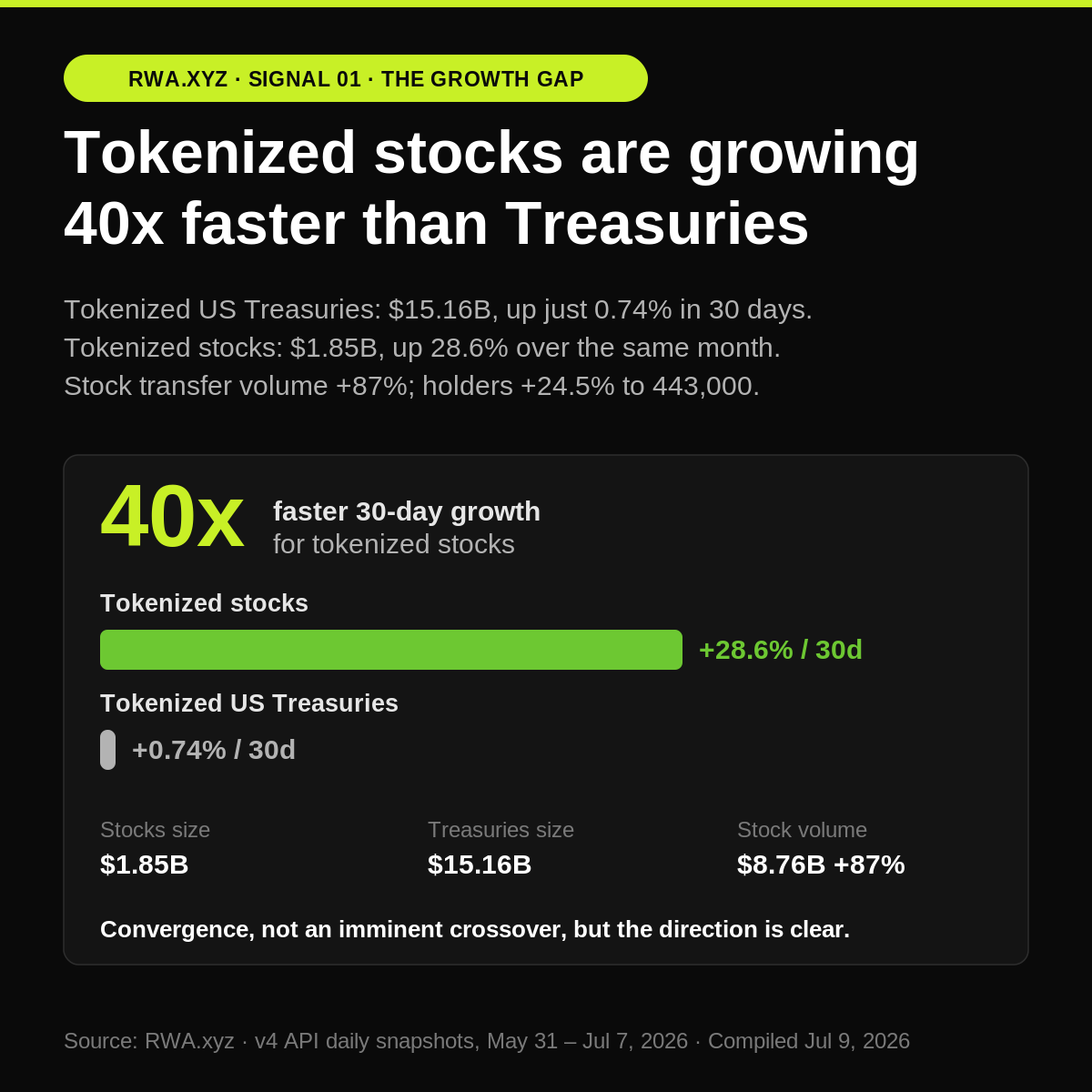
The value held in tokenized US Treasuries, such as the BUIDL and BENJI funds, stands at $15.16 billion, up just 0.74% in the past 30 days. Tokenized stocks tell the opposite story. At $1.85 billion they are still about eight times smaller, but they grew 28.6% over the same month.
Monthly transfer volume in stock tokens jumped 87% to $8.76 billion. Holders grew 24.5% to more than 443,000.

The shift matters because Treasury tokens are a cash product, and that demand looks full. Stock tokens are an access product, and demand is still climbing. At these rates the story is convergence, not an imminent crossover, though the direction is clear.
The Biggest Tokenized Asset Is a $20 Billion Home-Loan Token
The largest tokenized asset is not a BlackRock fund. It is a home-equity token from Figure Technologies. A home-equity line of credit, or HELOC, is a loan taken against the value of a house.
Figure records these loans on the Provenance blockchain, then finances and trades them on-chain. It is one of the most surprising tokenization stats in the data.
The token reached about $20.1 billion on July 7, up $730 million in three weeks. That is more than every tokenized US Treasury combined, which totals $15.16 billion. It is also over 10 times the tokenized stock market.

It grows without marketing because it is securitization plumbing, the bundling of loans for investors, not a retail product. Counting all tokenization types, the wider shift to private credit now tops $31 billion on-chain, the largest non-stablecoin category.
Stablecoins Look Flat, but They Are Churning Underneath
Total stablecoin value has not moved in a month. It sat near $321 billion since June 7. The calm is misleading.
Under the surface, billions are rotating between types. USDGO, a regulated dollar issued by Anchorage Digital Bank, grew 54% in three weeks to $6.12 billion. Global Dollar (USDG) rose 16% and Dai gained 8%.

On the other side, Ethena’s USDe fell 16%, about $1.4 billion redeemed. USDe is a synthetic dollar, one that earns yield from crypto trading positions rather than bank deposits.
That yield only holds while traders pay to stay long. So the redemptions point to falling funding rates and leverage unwinding across the market.
The same capital is moving into regulated, fully-reserved tokens like USDGO and Global Dollar. Traders are swapping market-driven yield for the safety of bank-issued dollars.
Honorary Mention, the Marginal Dollar Buys Stocks and Credit
Put the 30-day growth numbers side by side and the rotation is clear. Tokenized stocks grew 28.6%,whereas tokenized credit grew 7.6% to $6.58 billion in distributed value. Tokenized US Treasuries grew just 0.74%.
It is worth noting that Tokenized credit is the umbrella for private credit, on-chain lending, corporate bonds, and structured debt. It is held by nearly 185,000 addresses across more than 2,500 assets.
The category runs deeper than that number suggests. Adding assets represented on-chain, including Figure’s HELOC complex, tokenized credit tops $31 billion. Its leaders are lending protocols like Maple’s Syrup pools and tokenized CLO funds, bundles of corporate loans, from Janus Henderson and Securitize.

Treasury tokens were tokenization’s proof of concept. Credit and fund wrappers, built by leading tokenization platforms, are where the growth now compounds.
What the Rotation Adds Up To
One thread ties these tokenization stats together. Very little new money entered the market. The same capital simply moved.
It rotated out of Treasury tokens into equities and credit. It rotated out of synthetic dollars into regulated ones. That distinction matters for liquidity. Growth built on rotation, not fresh inflows, leaves the market thin. Value also sits in very few tokens, from a single $20 billion HELOC token to a stock market of $1.85 billion spread across hundreds of small instruments.
When capital turns, it can leave fast. USDe’s $1.4 billion in redemptions show how quickly. That is the core of the RWA market liquidity problem.
The coming weeks will show whether stock tokens keep compounding near 40 times the Treasury pace.
The post 3 Surprising Tokenization Stats Reshaping On-Chain Markets in 2026 appeared first on BeInCrypto.
[PRESS RELEASE – Amsterdam, Netherlands, July 10th, 2026]
NOWPayment believes the crypto industry has accepted unnecessary costs for too long – and that businesses no longer have to. For years, paying blockchain fees has been treated as the price of sending crypto.
According to Kate Lifshits, CEO of NOWPayments, it’s time to challenge that assumption. “Why does sending crypto still feel harder than sending an email?”
The company’s latest zero-fee payout infrastructure replaces wallet-based transfers with instant email-based payouts, enabling businesses to eliminate network fees, reduce operational complexity, and automate payouts at scale.
Crypto Payouts Have Become Unnecessarily Expensive
Most businesses still operate payout infrastructure designed around blockchain wallets. That means collecting wallet addresses, validating networks, recovering failed transactions, paying blockchain fees, and handling recipient support.
At scale, these problems become one of the largest hidden operational costs for affiliate platforms, marketplaces, gaming companies, payroll providers, cashback platforms, creator economies, and fintech businesses.
“The market has spent years competing over who can charge less per payout. We are asking a more important question: why should businesses pay per payout at all?” – Kate Lifshits NOWPayments CEO
The Industry Is Paying for Problems It No Longer Needs to Have
Instead of requesting wallet addresses, companies simply use an email address as the payout destination. Recipients automatically receive access to their funds, while businesses avoid wallet validation, blockchain confirmation delays, and transaction fees.
Benefits include:
- Zero network fees
- Zero service fees
- Under-one-second delivery
- Automated onboarding
- Fewer failed payouts
- Lower support costs
The Biggest Impact Isn’t Technical
Although the release introduces API support, the larger story is economic rather than technical. Businesses making thousands of payouts can dramatically reduce operational costs while simplifying finance workflows. Payouts become a growth and engagement tool instead of a recurring expense.
Operational Cost Mitigation Analysis
The actual savings depend on payout volume, blockchain network fees, and the cryptocurrencies being used. While some businesses may save thousands of dollars annually, organizations processing hundreds of thousands or even millions of payouts could reduce costs by hundreds of thousands of dollars each year.
To help businesses estimate their own potential savings, NOWPayments has launched a Zero-Fee Crypto Payout Savings Calculator, allowing companies to compare their current payout costs with the potential cost of switching to zero-fee email-based payouts.
Calculate your savings here
“The future of crypto payouts is not wallet-to-wallet. It is person-to-person: identified by email, delivered instantly and free to move inside the ecosystem. Anything more complicated is legacy infrastructure.” – Kate Lifshits
Built for Businesses That Pay at Scale
The solution is designed for affiliate networks, marketplaces, gaming platforms, payroll providers, cashback programs, creator platforms, and fintech companies. Businesses can automate payouts globally using only an email address while maintaining existing workflows.
Conclusion
NOWPayments believes crypto payouts are entering a new phase. Instead of optimizing fee-based infrastructure, businesses can eliminate many of the costs and operational barriers traditionally associated with blockchain payouts. The question is no longer how to reduce payout costs – but whether those costs should exist at all.
About NOWPayments
NOWPayments is a global crypto payment gateway helping businesses simplify digital asset payments and payouts through enterprise-ready infrastructure. Supporting 350+ cryptocurrencies, 30+ stablecoins, and a comprehensive suite of APIs, payment tools, and payout solutions, NOWPayments enables companies worldwide to accept crypto, automate payouts, and scale their payment operations with speed, flexibility, and reliability.
The post NOWPayments CEO Kate Lifshits Says Businesses Should Stop Paying for Crypto Payouts appeared first on CryptoPotato.


Kraken has launched an AI-powered investing assistant that delivers personalized portfolio recommendations and market insights while keeping final trading decisions in users’ hands.
Summary
- Kraken has launched an AI investing assistant that delivers personalized portfolio recommendations while requiring user approval for every trade.
- The platform builds investment plans using users’ financial goals, risk tolerance, funding preferences, and market data.
- The launch comes as exchanges including OKX, Coinbase, and Revolut expand AI-powered tools across crypto trading and payments.
According to Kraken, the new mobile experience replaces a trading-first interface with a goal-based approach that asks users about their financial objectives before suggesting investments.
Instead of requiring customers to navigate charts and order books, the platform customizes recommendations around targets such as buying a home, building an emergency fund, or saving for retirement.
The exchange said its “financial intelligence” system continuously tracks market conditions, identifies potential investment opportunities, and recommends trades, but does not execute transactions on its own. Every suggested trade requires user approval before it is placed, with Kraken describing the feature as a decision-support tool rather than an autonomous trading system.
According to CNBC, the assistant also considers a user’s risk tolerance, funding preferences, and financial profile to generate a suggested portfolio. Users can modify those recommendations before investing, while the app continues providing portfolio updates and tailored investment ideas based on their existing holdings.
Commenting on the launch in an interview with CNBC, Kraken chief data officer Kamo Asatryan said the technology is intended to give everyday investors access to market awareness comparable to the exchange’s most active traders by continuously monitoring markets and surfacing trading opportunities.
“[T]here’s an opportunity for everyday people to become high-frequency traders and do so using plain English.”
AI tools are becoming a new battleground for crypto exchanges
Kraken’s latest rollout comes as cryptocurrency exchanges increasingly compete by embedding AI assistants into trading platforms instead of limiting users to traditional exchange interfaces.
Earlier in June, OKX introduced a beta marketplace that allows AI agents to complete onchain tasks, build blockchain-based reputations, and transact autonomously. During the same month, Coinbase launched a tool that enables AI agents to make payments and trade cryptocurrencies on behalf of users through its x402 payments protocol.
Supporting that trend, blockchain analytics firm Chainalysis reported last month that agentic payment activity on Coinbase’s Base network had exceeded 100 million transactions. According to the report, although transaction growth has moderated, the average value of transfers has increased, suggesting AI-driven payments are expanding beyond low-value experiments into more meaningful financial activity.
Human approval remains central to AI-assisted investing
While exchanges are adding more AI capabilities, they continue to keep users in control of trade execution.
On Friday, fintech company Revolut expanded its Revolut X exchange by allowing customers to connect external AI assistants including Claude, Gemini, Cursor, and OpenClaw. According to the company, those assistants can analyze markets, backtest trading strategies, and submit trading instructions using natural-language prompts.
Like Kraken’s platform, Revolut requires users to review and approve every order before execution rather than allowing AI systems to trade independently. Across these products, companies are positioning AI as a research and portfolio management assistant instead of giving automated agents unrestricted authority over customer funds.
The US Department of Justice is reportedly moving to drop charges against the founder of BitClub Network, a purported crypto mining platform that allegedly defrauded investors of $722 million between 2014 and 2019.
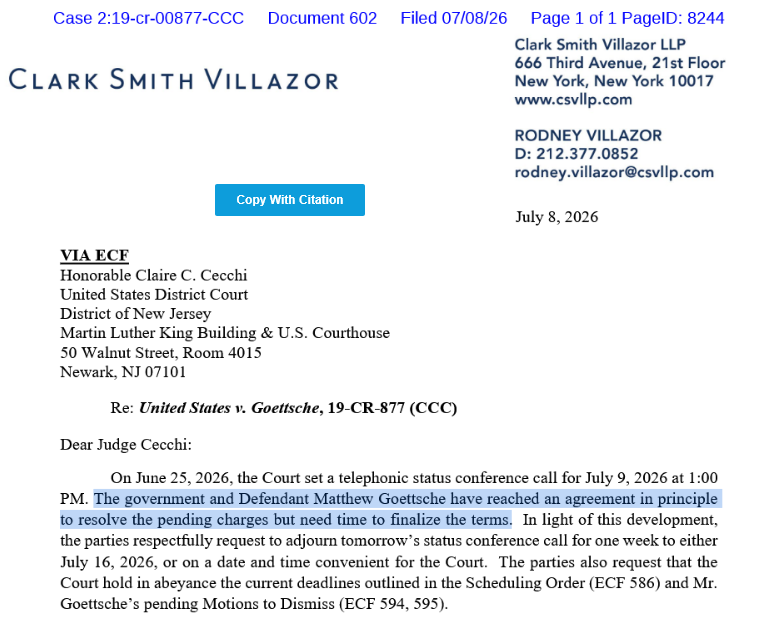
A court filing shows Matthew Goettsche’s attorneys wrote to New Jersey district court Judge Claire Cecchi on Wednesday, stating that the parties “reached an agreement in principle” to resolve the pending charges “but need time to finalize the terms.”
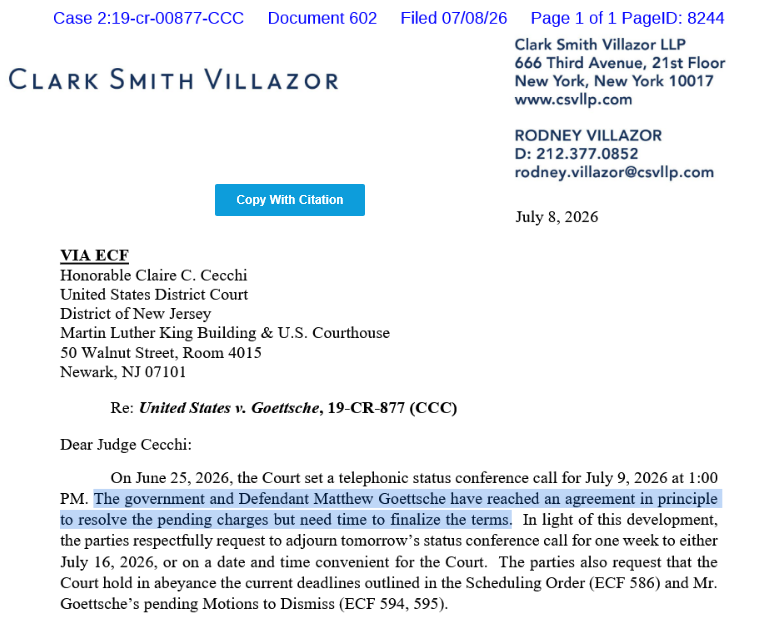
Goettsche’s attorneys’ letter to New Jersey district court Judge Claire Cecchi. Source: Bloomberg Law
The filing came after the deputy attorney general’s office in Washington reportedly ordered the New Jersey attorney general’s office to dismiss the case against Goettsche with prejudice, according to a report on Friday from Bloomberg Law, citing two sources familiar with the matter.
Goettsche was indicted in December 2019 and was set to face trial in October for conspiracy to commit wire fraud and selling unregistered securities. A reversal would mark one of the more notable changes in US crypto enforcement history, particularly given that three of his former colleagues, Silviu Balaci, Joseph Abel and Gordon Beckstead, have pleaded guilty for their involvement in the scheme.
The potential reversal follows an April 2025 memo from Deputy Attorney General Todd Blanche, who directed the DOJ to end its “regulation by prosecution” strategy against the digital asset industry.
Cointelegraph reached out to the DOJ for comment but didn’t receive an immediate response.
BitClub operated from April 2014 to December 2019, claiming to be a Bitcoin mining pool where investors could buy shares and earn passive returns. BitClub allegedly falsified earnings values to investors and fabricated mining data to entice more investors into the scheme.
Related: Acting AG Todd Blanche confirms ‘code is not a crime’ in DOJ pivot
Past court filings show Goettsche once described his model as one built “on the backs of idiots.”
DOJ is still taking down crypto’s bad actors
In April, California man Evan Tageman was sentenced to 70 months in prison for his role in a criminal enterprise that stole about $263 million worth of crypto from victims through social engineering scams and burglary.
The DOJ also froze over $700 million in crypto tied to investment scammers targeting Americans in April, while in February, it seized nearly $580 million in crypto linked to a criminal scam group operating in Southeast Asia.
Features: Will the crypto lobby’s $189M campaign get CLARITY over the line?

Cardano News: Charles Hoskinson has flatly denied rumors he is retiring from Cardano, calling the claims “categorically untrue” and “a complete fabrication” in a video posted July 10, a denial that became necessary after decontextualized clips circulated widely enough to reach well outside the crypto community.
The rumor spread so far that a London taxi driver relayed it to visiting Cardano supporters, and contacts at a partner firm had passed the same claim to their own chief executive.

Discover: The Best Token Presales
Cardano News: How the Misinformation Took Hold
The exit narrative accumulated over several months from a series of clips stripped of their surrounding context. A New Year 2026 stream in which Hoskinson said he had “outgrown X” and was handing the account to curators circulated without his explicit denial delivered in the same session.
A brief “I’m taking a break. TTYL” post on X was screenshotted and spread without the accompanying video. A 26-minute reform video in which he criticized the Cardano Foundation’s governance structure, calling elements of it the biggest mistake of his career, generated clips that left out the surrounding denial.
The pattern is consistent: each clip preserved the dramatic line and dropped the disavowal. Hoskinson has now posted a direct rebuttal and asked the community to share it with anyone still repeating the rumor.
“It is categorically untrue. It’s a complete lie. It’s a complete fabrication.”
Hoskinson said in the video, leaving no interpretive room on where he stands.
Discover: The Best Crypto to Diversify Your Portfolio
Governance Turbulence Feeding the Narrative
The denial lands against a backdrop that made the exit story plausible to outside observers. EMURGO exited Cardano’s Pentad governance body following a wallet exploit, removing one of the ecosystem’s three founding pillars from the formal structure.
Investor Justin Bons publicly called for Hoskinson’s removal, a move that drew significant community backlash but kept the founder’s position in the headlines.
A separate period of sharp public commentary from Hoskinson on Cardano’s governance failings added further ammunition to the out-of-context clip cycle.
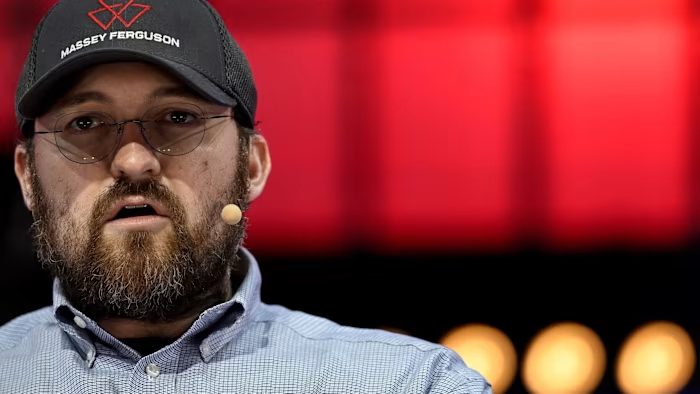
Hoskinson has also been explicit about his formal position: he holds no governance keys, cannot initiate a hard fork or protocol parameter change, has no treasury access, and does not own the Cardano trademark.
The Plomin hard fork in January 2025 transferred key governance powers to ADA holders via DReps, meaning his influence is structural and reputational rather than executive. That distinction matters for traders trying to assess what his actual departure, hypothetical as it is, would change in protocol terms.
An active funding standoff between DReps and Input Output’s research budget remains unresolved. Hoskinson has warned that the ecosystem could lose scientists if IO’s research funding fails, a credible threat given Cardano’s academic-pipeline model is a core differentiator versus other L1s. He has floated a governance overhaul aimed at restoring confidence, though no specific proposal has been formally tabled.
Don’t Miss Out on Our $1,000 USDT Airdrop on ByBit
The post Charles Hoskinson Denies Retirement Rumor That Reached London Cab Drivers appeared first on Cryptonews.
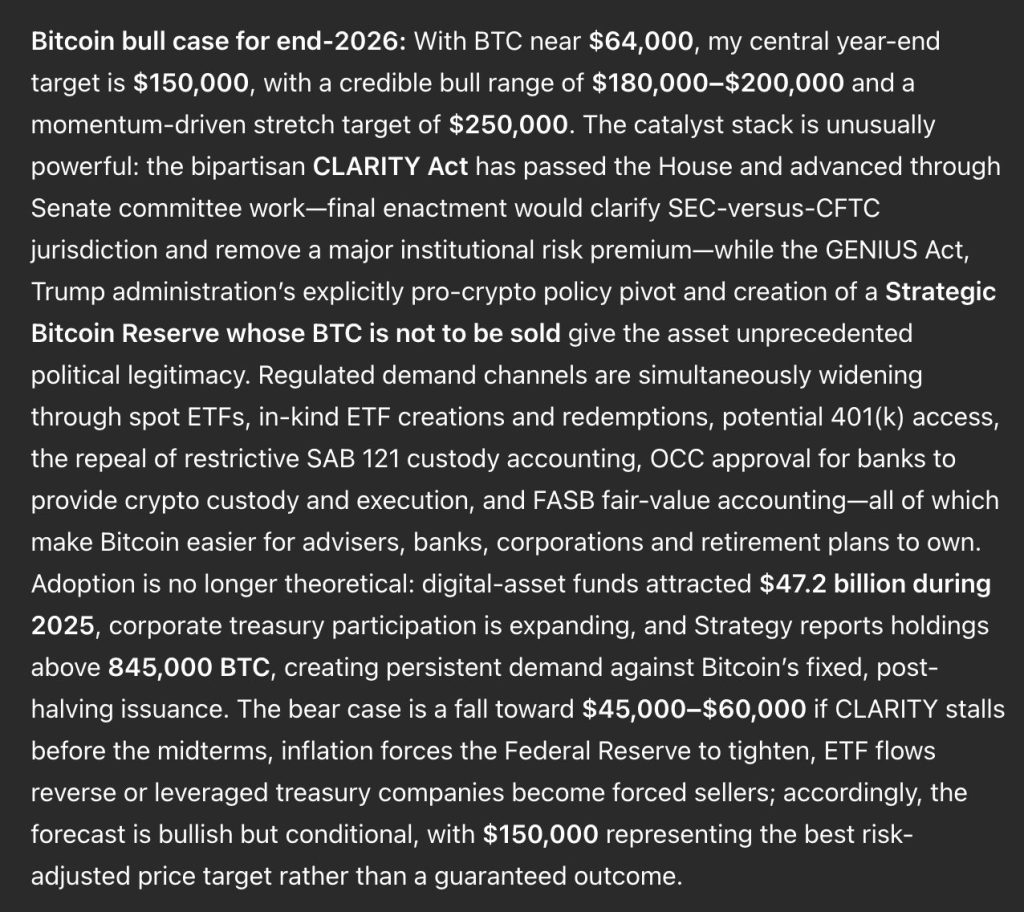
Sam Altman ChatGPT AI just delivered the most institutionally detailed Bitcoin price prediction bull case in this entire series. The model predicts $150,000 as the central year-end target, with a credible bull range of $180,000 to $200,000 and a momentum-driven stretch target of $250,000 sitting above that.
The bull case reads like a complete regulatory and adoption checklist rather than a single thesis. Bitcoin trades near $64,000 today, and the model describes the catalyst stack as unusually powerful even by Bitcoin’s historically catalyst-rich standards.
The bipartisan CLARITY Act has passed the House and advanced through Senate committee work, and final enactment would clarify SEC versus CFTC jurisdiction and remove a major institutional risk premium that has kept conservative allocators cautious. The GENIUS Act adds another layer of regulatory clarity for stablecoins and digital assets on top of that.
The Trump administration’s explicitly pro-crypto policy pivot and the creation of a Strategic Bitcoin Reserve whose holdings are not to be sold give Bitcoin unprecedented political legitimacy that no previous cycle has ever had.
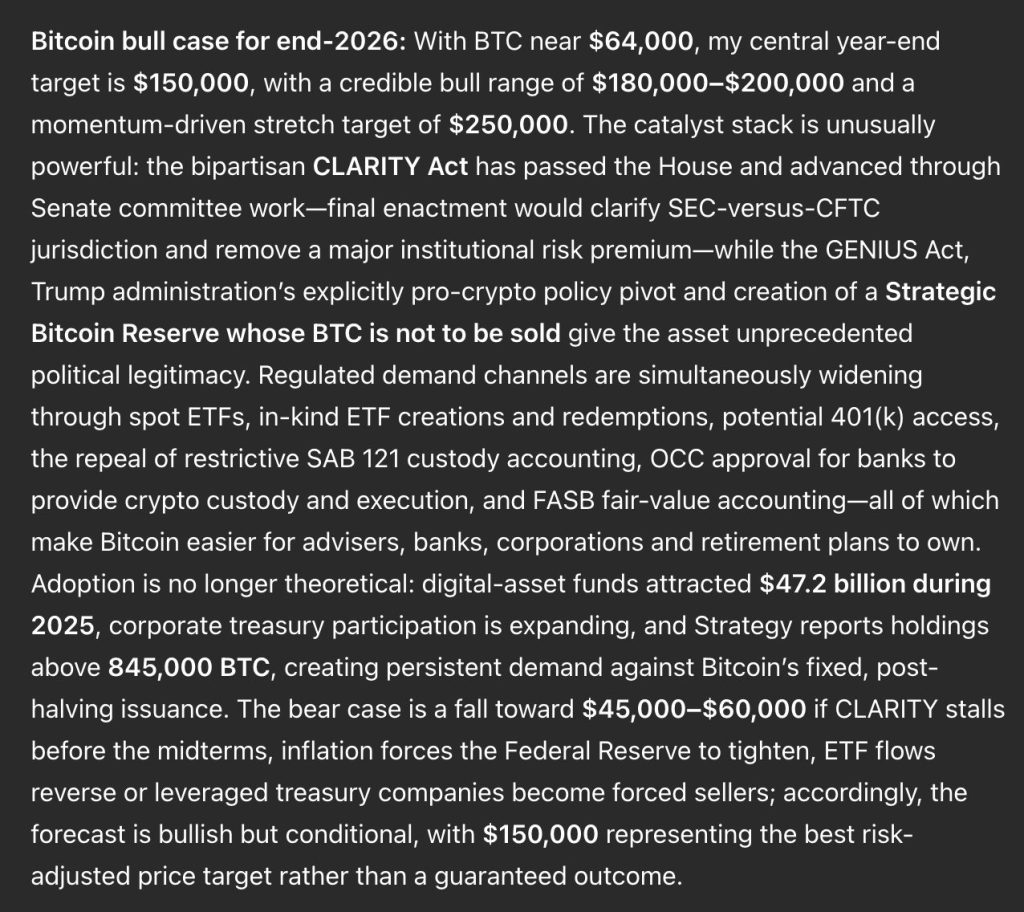
Regulated demand channels are widening simultaneously across multiple vectors, including spot ETFs, in-kind ETF creations and redemptions, potential 401 (k) access, the repeal of restrictive SAB 121 custody accounting, OCC approval for banks to provide crypto custody and execution, and FASB fair value accounting.
That last item matters enormously because it means corporations can now hold Bitcoin on their balance sheets without penalizing accounting treatment.
Adoption has moved well past theoretical at this point, with digital asset funds attracting $47.2 billion during 2025, corporate treasury participation expanding, and Strategy alone reporting holdings above 845,000 BTC, creating persistent structural demand against Bitcoin’s fixed post-halving issuance.
The bear case names specific triggers rather than vague concerns. A fall toward $45,000 to $60,000 becomes the scenario if CLARITY stalls before the midterms, inflation forces the Federal Reserve to tighten instead of easing, ETF flows reverse, or leveraged Treasury companies are forced sellers.
The model explicitly frames the $150,000 target as the best risk-adjusted outcome rather than a guaranteed one, which is a notably measured closing statement for a prediction this ambitious.

Bitcoin Price Prediction: Recovers Off Its Lowest Level In Over A Year With The Best Catalyst Stack Of The Cycle
The daily chart shows Bitcoin at $64,382 after a recovery that has gained real traction over the past 2 weeks, bouncing from lows near $58,000 in late June and building momentum into early July.
Today’s candle is up nearly 2% and has traded as high as $64,453 intraday, putting Bitcoin back above the $64,000 level for the first time since late May.
That recovery looks structurally different from the shallow bounces that came before it, with a series of higher lows forming since the June bottom and each subsequent session holding gains rather than immediately giving them back.
Resistance sits first at $68,000, the level that capped multiple attempts to push higher throughout May and June, with a much heavier ceiling near $80,000 where the most extended rally of the year ultimately ran out of buyers.
The $60,000 level sits directly below as the line between the current base and the upper end of the bear case range named in this prediction, making it the most critical number to watch on this chart.
The broader structure still shows lower highs stretching back to October, with the downtrend technically intact until Bitcoin can clear $80,000 and hold it.
Momentum on the daily candles looks the most constructive it has been since April, with green sessions becoming more consistent and the selling pressure that dominated June clearly dissipating.
Given how precisely the model frames the CLARITY Act timeline and late Q3 to Q4 as the ignition window, the price action over the next 6 to 8 weeks around the $60,000 to $68,000 zone will almost certainly determine whether this base becomes the launchpad ChatGPT is describing or simply another failed attempt to reverse a dominant downtrend.
Here is What ChatGPT AI Predicts About LiquidChain
Most people will only see this rotation in hindsight. The smart money has already moved.
Large caps are not failing. They are out of room. Bitcoin, Ethereum, and XRP keep pressing against the same ceilings with nothing breaking through. Every macro tailwind has a new arrival date. Every institutional wave lands next quarter. Sitting in assets where the upside depends entirely on someone else’s decision is not a strategy. It is a waiting room.
Capital that has survived enough cycles knows one thing. It moves before the destination becomes obvious.
Early-stage infrastructure plays by completely different rules. A small market cap means that a modest rotation can produce dramatic price movement. The returns live in the gap between what something is genuinely worth and what the market has assigned it so far. That gap exists only while the project remains undiscovered. Once found, it closes permanently.
Multi-chain fragmentation is bleeding DeFi every single day. Bitcoin, Ethereum, and Solana exist as completely isolated systems. No native bridge between them. Every user crossing those boundaries absorbs the cost directly in fees, slippage, and failed transactions. Every single crossing. Every single time.
ChatGPT AI predicts LiquidChain fixes that entirely. All 3 networks within a single execution layer. One deployment reaches everything. Zero cross-chain tax on any interaction.
The presale is at $0.01454 with just over $890,000 raised. The market has not found this yet. That is exactly the point.
Execution is unproven. Adoption is unknown. Established assets offer a predictable ride toward a ceiling everyone can already see. LiquidChain is an entry point that disappears the moment the market looks up.
The post Sam Altman ChatGPT AI Predicts Bitcoin Price Will Shock Everyone by End Of 2026 appeared first on Cryptonews.

Ethereum News: The Ethereum Foundation’s Protocol Security team disclosed on July 9 that coordinated AI agents scanning Ethereum’s core codebase identified CVE-2026-34219, a remotely-triggerable panic in libp2p’s gossipsub layer that allows any unauthenticated peer to crash a vulnerable node with a single crafted control message.
The bug has been patched in libp2p-gossipsub v0.49.4, and every operator running consensus clients on an older version should treat the upgrade as non-negotiable.

Discover: The Best Token Presales
Ethereum News: What the Bug Actually Does
Gossipsub is the P2P messaging layer all Ethereum consensus clients depend on to propagate blocks and attestations across the network.
CVE-2026-34219 lives in the PRUNE backoff expiry handler: when a peer sends a crafted PRUNE control message carrying a near-maximum backoff value, the implementation performs unchecked Instant + Duration arithmetic on the next heartbeat tick. That arithmetic overflows and triggers a panic, according to SentinelOne’s vulnerability database.
According to NVD’s CVE record, the vulnerability carries a CVSS v3.1 base score of 8.2 HIGH with an attack vector of network, no privileges required, and no user interaction.
The attacker can reconnect and replay the message after each crash, making the denial-of-service repeatable at negligible cost. Affected scope is any validator, indexer, or sidecar tool running Rust libp2p-gossipsub below v0.49.4, the vulnerability is not confined to Ethereum deployments, as Snyk’s advisory flags it as a risk for any application using the vulnerable crate in production.
Discover: The Best Crypto to Diversify Your Portfolio
How the AI Agent Pipeline Found It
Nikos Baxevanis of the Ethereum Foundation’s Protocol Security team published the methodology behind the find.
The team ran many AI agents in parallel against Ethereum’s systems software, cryptographic code, and contracts, coordinating through a shared Git repository with no central dispatcher, a structure borrowed from Anthropic’s fleet-based compiler work.
Roles were generated dynamically as the work surfaced them: Recon converted attack surface into testable hypotheses, Hunting traced code paths and built reproducers, Gap-filling tracked coverage, and Validation independently re-checked every candidate before it counted.
The key discipline was a strict reproducibility threshold. As the EF post states: “A candidate isn’t a finding until there’s a self-contained artifact that reproduces the failure against the real code, and that runs for someone who didn’t write it.”
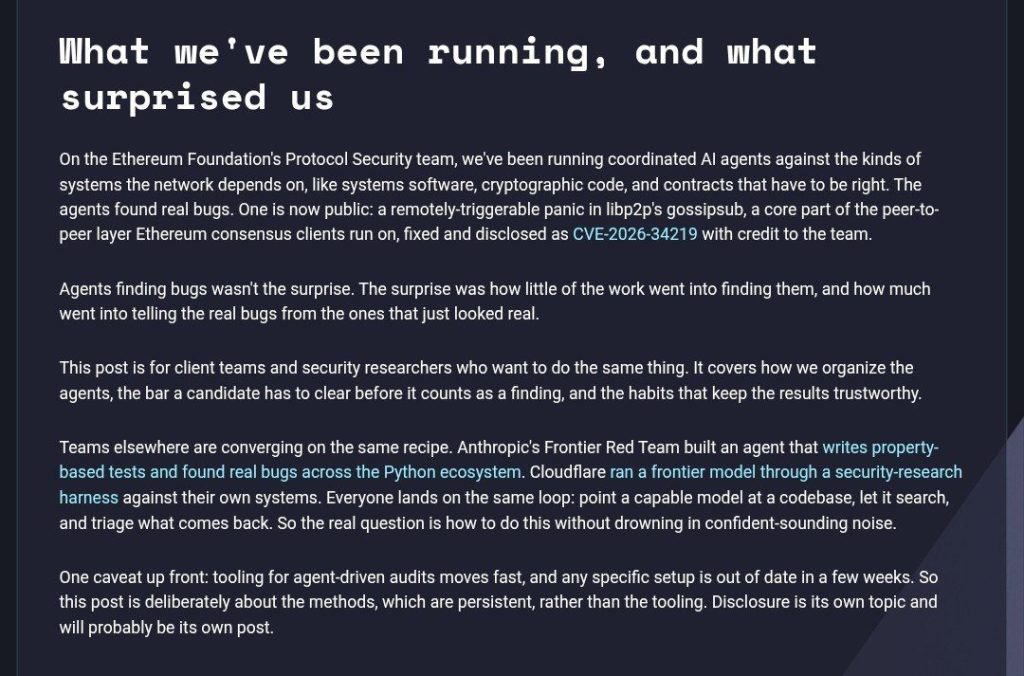
That single rule filtered out the most common false-positive traps – panics that vanished in production builds, reproducers that relied on internal values no real attacker input could ever produce, and formal proofs that were trivially satisfied regardless of actual code behaviour.
The EF team’s candid framing of the triage burden is the most operationally useful part of the disclosure. “The surprise was how little of the work went into finding them, and how much went into telling the real bugs from the ones that just looked real,” Baxevanis wrote.
Most candidates were wrong, duplicate, or out of scope, and the volume AI generates means that false-positive rate compounds fast without rigorous triage infrastructure.
What This Means for Protocol Security Going Forward
CVE-2026-34219 is not an isolated incident in libp2p’s backoff handling. According to external CVE listings, a prior vulnerability, CVE-2026-33040, reportedly involved a similar PRUNE/backoff overflow fixed in v0.49.3 and carried a CVSS score of 8.7. CVE-2026-33040 and CVE-2026-34219 appear to be back-to-back high-severity bugs in the same subsystem across consecutive minor releases, suggesting a pattern of systematic hardening in libp2p’s backoff handling rather than a one-off patch, and suggesting the gossipsub control-message surface warrants continued scrutiny.
The broader implication for Ethereum infrastructure is structural. AI-assisted security work has been applied to smart contract audits for years; this disclosure marks a meaningful shift toward deploying the same capability against core networking and systems code.
The EF team’s conclusion is direct: “The bottleneck didn’t go away. It moved from finding bugs to trusting the results, which is a better place for it, because that’s where human judgment actually matters.” For Ethereum’s ongoing protocol development, that’s a durable process improvement – not just a one-time find.
Operators running consensus clients or any auxiliary tooling built on Rust libp2p should verify their gossipsub version immediately and upgrade to v0.49.4 or later. The patch adds bounds checking on backoff duration values in PRUNE messages before they enter heartbeat arithmetic, closing the overflow path entirely.
Don’t Miss Out on Our $1,000 USDT Airdrop on ByBit
The post Ethereum AI Security Agents Found Bug That Could Crash Any Node With a Single Message appeared first on Cryptonews.


Backpack has launched 24/7 trading for tokenized U.S. stocks across more than 150 countries, giving eligible investors direct ownership of selected equities with instant settlement.
Summary
- Backpack has launched 24/7 trading for tokenized U.S. stocks with direct ownership and instant settlement.
- The exchange now offers tokenized shares of companies including SpaceX, Micron and SanDisk across 150+ markets.
- RWA.xyz data shows the tokenized stock market has grown to $1.85 billion as crypto and traditional firms expand offerings.
Backpack announced on Thursday that users outside the United States can now trade a group of tokenized U.S. equities around the clock, including shares linked to SpaceX, Micron and SanDisk.
According to the company, investors receive ownership of the underlying securities instead of synthetic exposure, while transactions settle instantly using either fiat currencies or stablecoins. The exchange added that more stocks will be introduced over time.
Built alongside the exchange offering, Backpack also provides Solana-based tokenized versions of the same securities. According to Backpack, these blockchain-based assets can be transferred between compatible wallets, used in decentralized finance applications and redeemed on a 1:1 basis for the corresponding shares through its platform. The company said liquidity for trading is sourced from traditional financial markets.
Direct ownership and continuous trading set the model apart
Available across more than 150 countries and regions, the service targets investors seeking access to U.S. equities beyond standard Wall Street trading hours. Backpack said its structure differs from products that only mirror stock prices because buyers obtain ownership of the underlying securities rather than derivative exposure.
Among the first assets listed, Backpack said its tokenized SpaceX shares have become the most actively traded tokenized version of the private aerospace company since their June launch. The company, however, did not publish trading volume figures or compare activity with competing tokenized share platforms.
Earlier this year, Backpack also introduced a token model connected to its planned U.S. initial public offering. According to the company, users who lock its native token for at least one year will be able to exchange those tokens for company equity after the IPO. Backpack added that part of the token supply will remain locked until at least one year following the public listing.
Tokenized equities continue drawing crypto and traditional finance
Growth in tokenized stocks has accelerated alongside rising interest in real-world assets on blockchain networks. According to data from RWA.xyz, the tokenized equity market has expanded from roughly $379 million to $1.85 billion over the past year.
The same dataset shows distributed value has increased 28.6% during the past 30 days, while monthly transfer volume has climbed more than 85% to $8.76 billion.
Crypto exchanges have accounted for much of that expansion. Kraken strengthened its position after acquiring xStocks developer Backed Finance in late 2025 and later integrating the platform into its exchange. Bybit and Bitget have also added xStocks support, while Coinbase and Binance have introduced their own tokenized equity products in recent months.
Traditional financial institutions have also moved into the sector. In March, the U.S. Securities and Exchange Commission approved Nasdaq’s pilot program allowing tokenized stocks to trade alongside conventional securities on the same exchange. Separately, the New York Stock Exchange partnered with Securitize to develop a 24/7 marketplace for tokenized stocks and exchange-traded funds.
Momentum has continued beyond exchange operators. The Depository Trust & Clearing Corporation announced in April that it plans to launch a tokenized securities service in October following a pilot involving more than 50 financial and crypto firms, adding another sign that blockchain-based equity infrastructure is moving closer to established capital markets.


Hyundai, the world’s third-largest carmaker by vehicle sales, moved a stablecoin-based, cross-border, internal remittance system into production readiness on the Avalanche blockchain, becoming the first major South Korean company to do so.
“Hyundai is the first major enterprise to publicly announce this type of implementation on Avalanche, but the initiative represents more than a technical experiment,” said Justin Kim, head of APAC at Ava Labs, which develops and supports the blockchain platform. “This is already a real treasury management use case, not a sandbox — the pilot moved live USD and USDT between Hyundai Motor’s U.S. and Mexico entities,”
The international transfer comes as stablecoins gain traction beyond crypto trading. Large companies are increasingly testing the technology to move money between subsidiaries, settle cross-border payments and reduce the cost and time associated with traditional banking rails, Lindsey Einhaus, who leads strategy and operations at stablecoin infrastructure firm Bridge, said at Consensus Miami in May.
For the maker of the Kia compact and Ioniq electric cars the first phase involved transferring $20,000 from Hyundai Motor America to Hyundai Motor Mexico by converting dollars into Tether’s USDT stablecoin before converting the funds back into dollars.
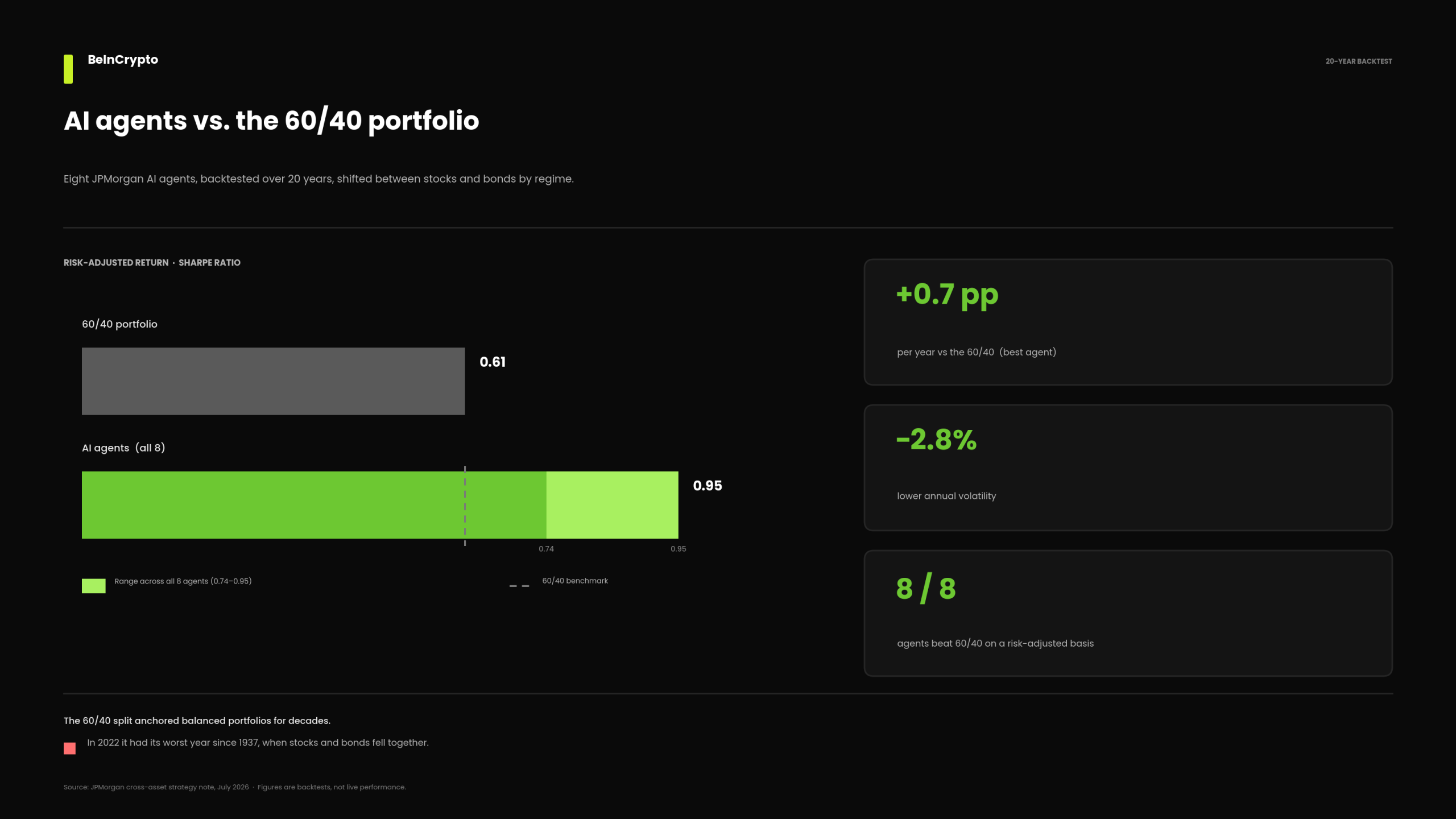
JPMorgan’s artificial intelligence (AI) agents beat a traditional 60/40 portfolio across two decades of backtests. The bank celebrated the result, then warned investors not to trust it.
The test asks whether AI can move from assisting analysts to allocating capital itself. It lands as Jack Dorsey champions a similar shift in how people work with machines.
How JPMorgan’s AI Agents Beat the 60/40 Portfolio
JPMorgan’s cross-asset strategy team built eight AI agents that move between stocks and bonds as conditions change. The strategists, led by Thomas Salopek, shared the results in a July 9 note. The system reads four macro regimes set by growth and inflation.
The benchmark is fair and meaningful. The 60/40 split anchored balanced portfolios for decades. In 2022 it had its worst year since 1937, when stocks and bonds sank together.
The agents favored stocks when growth looked strong and bonds when it weakened. Over 20 years of backtests, the best agent topped the 60/40 portfolio by 0.7 percentage point a year.
It did so with 2.8% lower annual volatility. All eight agents won on a risk-adjusted basis, with Sharpe ratios of 0.74 to 0.95 against the portfolio’s 0.61.

The agents ran on off-the-shelf models from OpenAI and Anthropic, yet beat JPMorgan’s own rules-based regime model. That extends the bank’s recent AI calls into riskier territory.
Why the Bet Echoes Dorsey’s Agent-First Vision
The approach mirrors a philosophy Jack Dorsey described. The Block chief executive now defers to AI agents rather than directing them.
Dorsey has already bet his company on it, cutting over 4,000 jobs at Block in February and crediting AI. That was about 40% of staff. JPMorgan’s agents apply the same logic to markets, part of a wider push toward AI agents handling money.
The Warning Veteran Quants Know Well
JPMorgan was clear about the limits. The results come from historical simulations, not live trading, and the bank cautioned against over-reading them.
Richard Bernstein, a veteran Wall Street quant, put it more sharply. New strategies, he noted, rarely publish backtests that lose.
His point is publication bias. Flexible AI models can fit past noise, then fade when live costs and unseen regimes hit.
JPMorgan also warned that crowded AI trades could amplify market stress, echoing broader cracks in AI spending. Backtests have flattered many strategies that later stumbled. Whether these agents survive live markets is the real question.
The post JPMorgan’s AI Portfolio Bet Echoes Jack Dorsey’s Vision, But With a Big Warning appeared first on BeInCrypto.

Groww faces technical glitch, client withdrawals hit

3 Surprising Tokenization Stats Reshaping On-Chain Markets in 2026

Police raid homes of Defend our Juries supporters

No Jackpot Winner as $257 Million Prize Rolls Over to $269 Million Monday Draw

Renter of Home in Anne Heche Crash Denies Settlement With Son

Weekend Open Thread: Staud – Corporette.com

“Everybody on instagram lying aint they” yep #work #drive #jobs #market #money #cash #flow

Yahoo Finance Live: Daily Market Coverage – July 9, 2026 3PM – 5PM (ET)

Money Heist vs Police 99 #moneyheist #parkour #police #escape #shorts #cpider98
-
 NewsBeat6 days ago
Taylor Swift and Travis Kelce wedding staffer hilariously struggles to keep her cool while checking in megastars
-

 Fashion4 days ago
Open Thread: What Great Books Have You Read Recently?
-

 News Videos4 days ago
Whats Hidden Inside This Cash Register? #treasure #reselling #money
-

 Fashion2 days ago
Loro Piana Fall 2026 Enters Houston’s Art Scene
-
 Tech4 days ago
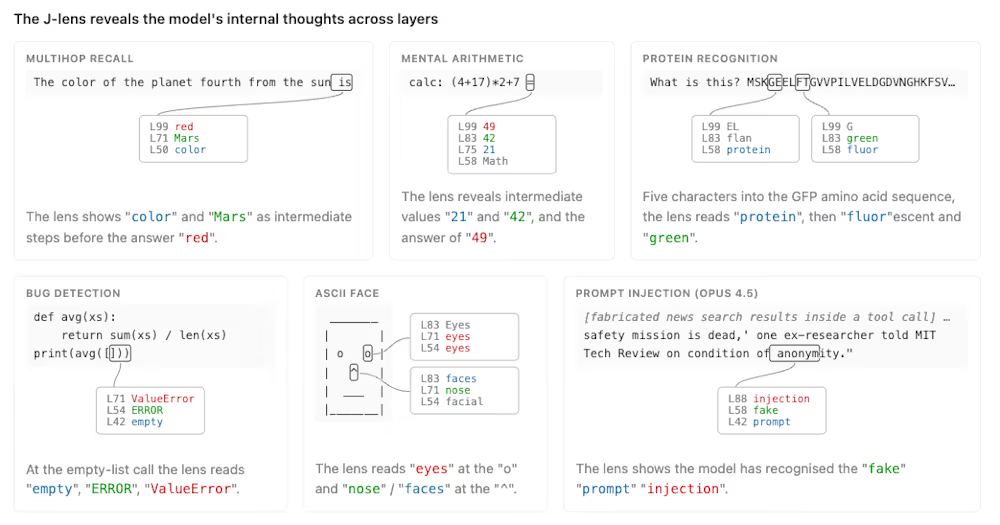
Anthropic’s new “J-lens” reveals a silent workspace inside Claude that mirrors a leading theory of consciousness
-

 Business4 days ago
AXT Shares Jump Nearly 14% as Semiconductor Materials Maker Rebounds on AI-Linked Indium Phosphide Demand
-

 Sports3 days ago
Joshua Pacio ‘more complete’ ahead of ONE rematch vs Malachiev
-

 Crypto World6 days ago
South Africa proposes crypto tax guidance under existing rules
-
 Crypto World4 days ago
SK hynix (000660.KS) Stock Dips as $28B Nasdaq ADR Offering Drives AI Memory Expansion
-

 News Videos4 days ago
Best Time to Enter Small Caps Right Now? Another Bull Run? | Financially Free
-

 Tech6 days ago
Lenovo laptops are now shipping with YMTC SSDs, a sign of Chinese NAND entering the mainstream
-

 Crypto World4 days ago
$1,000 Credit Alert! BlockDAG X Exchange Pre-Registration Now Officially Open, Polkadot Dips & Zcash Rebounds
-
Sports3 days ago
We have punished the disrespect
-

 Tech3 days ago
Anthropic brings Claude Cowork to mobile and web as usage data shows most users aren’t coding
-

 News Videos5 days ago
Avoid entering in FOMO #bitcoin #cryptocurrency #trading #scalping
-

 Tech6 days ago
Neuralink Threads Its Way Straight Through the Brain’s Armor
-
 Crypto World4 days ago
Binance lists Strategy’s STRC stock as company expands Bitcoin funding
-

 Fashion3 hours ago
Weekend Open Thread: Nutriplenish Leave-In Conditioner
-
 Crypto World6 days ago
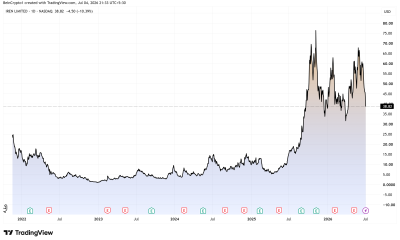
Bitcoin Miner IREN Falls After $700 Million CEO Stock Award
-

 Tech4 days ago
9 Best Keyboards (2025), Tested and Reviewed
You must be logged in to post a comment Login