

Crypto World
XRP Demand Cools Across 3 Metrics, but Funding Hints at Rebound

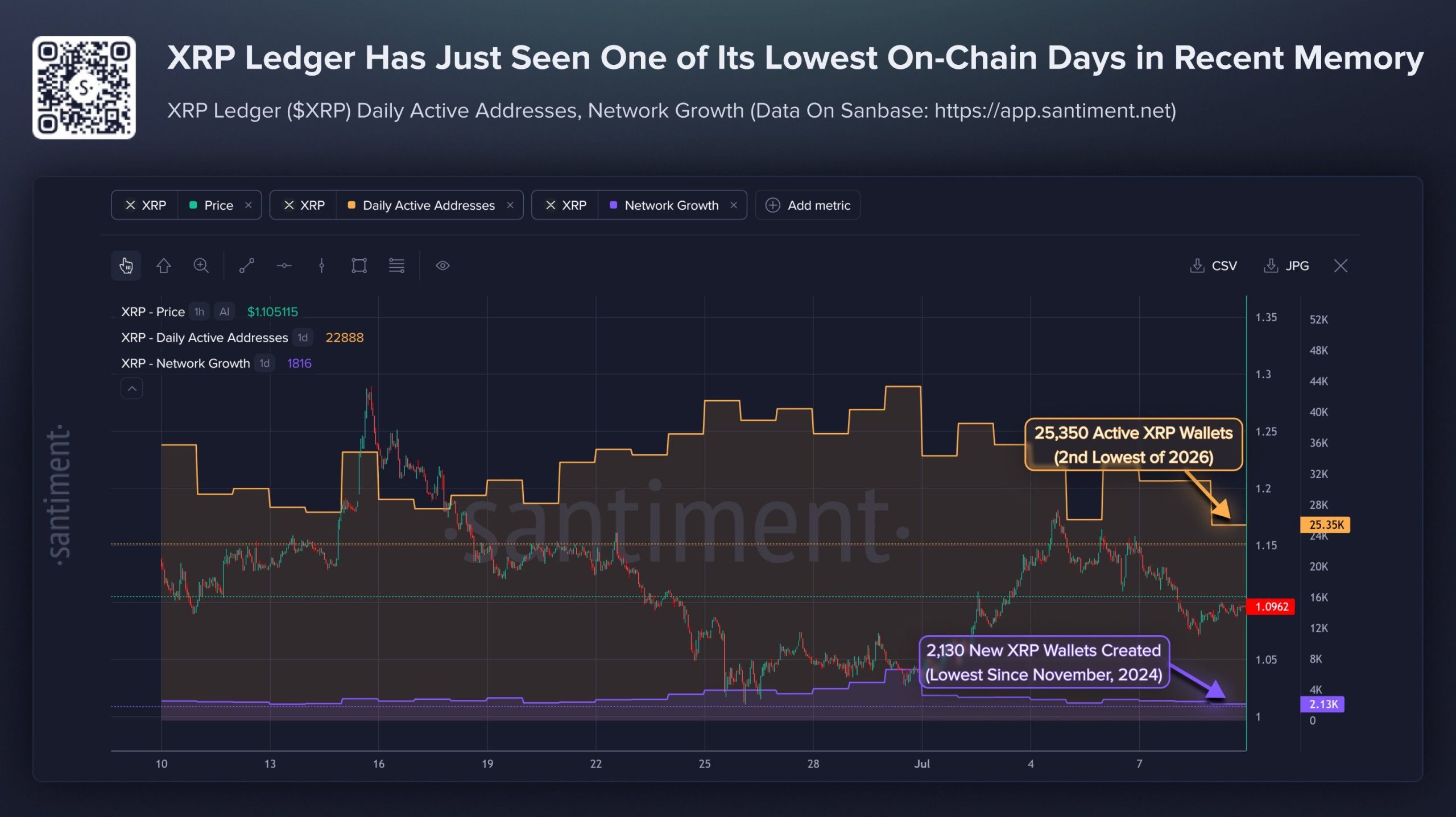
XRP demand weakened across three fronts in early July as on-chain activity, futures positioning, and spot ETF flows all cooled.
However, extreme bearish funding rates have drawn the attention of analysts, who read such conditions as a possible setup for a rebound.
3 Signs Point to Cooling XRP Demand
On-chain activity on the XRP Ledger has slid in July. Santiment recorded 25,350 active wallets, the second-lowest daily reading of 2026. In addition, new wallet creation fell to 2,130, the weakest level since November 2024.
“After late-June dip-buying excitement, this looks like traders are waiting for a real catalyst instead of chasing another small bounce,” the firm said.
Follow us on X to get the latest news as it happens

Derivatives told a similar story. XRP futures open interest on Binance dropped to roughly 397 million XRP. This marked the metric’s lowest level in over three months.
A falling reading during price weakness usually indicates that traders are trimming leveraged exposure.
“Although a decline in open interest is not necessarily a definitive bearish signal, it does point to reduced trader participation in the derivatives market. In many cases, this phase represents a period of repositioning as investors await a clearer market direction,” an analyst wrote.
Institutional demand has cooled, too. US spot XRP ETFs posted a $7.29 million net outflow on July 8. That marked their largest single-day withdrawal since March.
The weekly picture turned as well. Bitcoin and Ethereum ETF flows swung positive in the week ending July 10, per SoSoValue. XRP went the other way, posting a red week that broke a 9-week inflow streak.

Why an XRP Reversal May Be Near
Despite the bearish signs, analyst Darkfost flagged a contrarian angle. XRP funding rates on Binance, aggregated over 30 days, have reached extreme negative levels after the token fell about 70% from its July 2025 high.
Such one-sided pessimism often precedes a turn. Darkfost noted a comparable setup in April 2025 near $1.25, which was followed by a 126% rally.
“When such a strong consensus forms, especially after a correction on the order of 70%, it is often a sign that a potential reversal may be developing over the medium term,” the analyst stated.
Santiment sees potential catalysts beyond price. Growth in RLUSD, tokenized assets, payment use cases, EVM sidechain expansion, and on-chain lending could pull users back if any of these narratives gain traction.
For now, spot flows rather than leverage may steer XRP’s price. The next decisive move likely depends on whether one of those catalysts revives on-chain activity.
Subscribe to our YouTube channel to watch leaders and journalists provide expert insights
The post XRP Demand Cools Across 3 Metrics, but Funding Hints at Rebound appeared first on BeInCrypto.

Bitcoin price climbed back above $65,000 on July 27 as the pause in US-Iran strikes drove oil lower and restored demand for risk assets.
Summary
- Bitcoin traded at $65,386, recovering from a daily low of $64,892.
- 4-hour RSI reached 58.64, while a bullish MACD crossover supported the rebound.
- $67,181 remains the key resistance, with major downside liquidity concentrated near $63,000-$63,500.
Bitcoin price rises as US-Iran strikes pause
Bitcoin was trading at $65,386 at the time of the July 27 chart, nearly unchanged for the day after moving between $64,892 and $65,744. The latest advance extended its recovery from the July 25 low near $63,700.
The immediate catalyst came from the Middle East, where the United States and Iran refrained from attacking each other for a third consecutive day. Regional mediators reported progress toward an interim ceasefire, although Washington and Tehran had not resumed direct negotiations. AP reported that Iran and Oman were also discussing how to manage shipping through the Strait of Hormuz.
Oil prices fell sharply as the pause reduced fears of a prolonged supply disruption. Brent crude dropped 6.5% to $90.45, while the weaker oil outlook supported stocks, cryptocurrencies and other risk-sensitive markets. Bitcoin rose to about $65,155 during the session.
Lower energy prices can reduce near-term inflation pressure, a factor that matters for US crypto investors ahead of the Federal Reserve’s July 28-29 policy meeting. However, futures markets still assigned a 33% probability to a rate increase, up from 16% a week earlier, Reuters reported.
The geopolitical risk has also not disappeared. Iran’s foreign ministry said Tehran had not requested renewed talks with Washington and reported no change in the status of the Strait of Hormuz, according to a separate Reuters report.
Bitcoin indicators favor another test of $67,181
Bitcoin remains inside an ascending parallel channel on the 4-hour chart. The lower boundary now passes through approximately $64,000, while the upper trendline approaches the $67,800-$68,000 region.
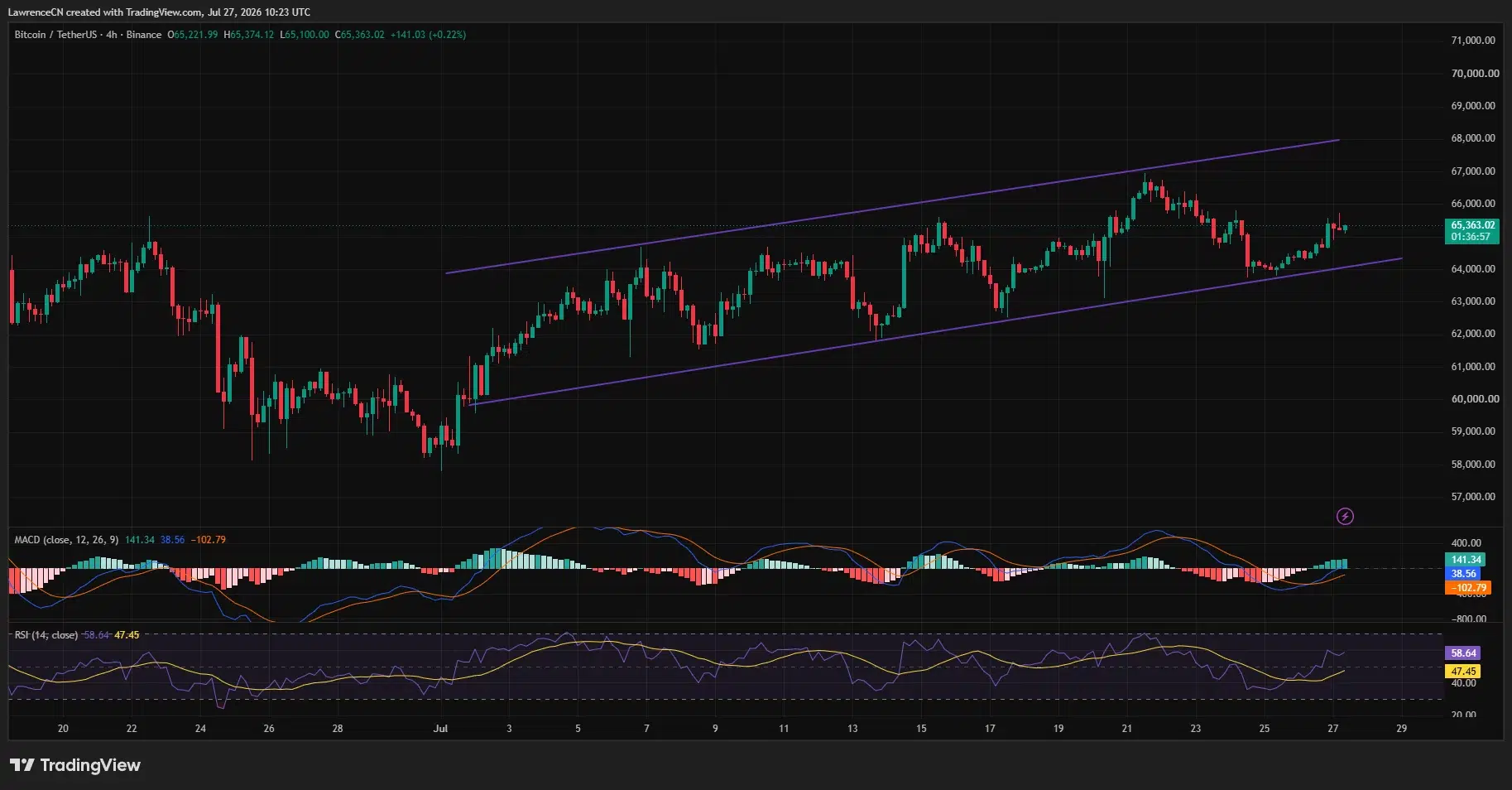
BTC rebounded from the lower trendline on July 25 and moved back above $65,000, preserving the pattern of higher lows established at the beginning of July. The channel therefore remains valid unless sellers force a 4-hour close below the rising support.
Momentum indicators have also improved. The 4-hour relative strength index rose to 58.64 from below 40, placing it above its moving average of 47.45 without entering overbought territory.
The moving average convergence divergence indicator completed a bullish crossover. Its histogram increased to 141.34, showing that positive momentum was rebuilding after the July 21-25 pullback.
Daily indicators are less decisive but still lean constructive. The Aroon Up reading stood at 57.14%, while Aroon Down fell to zero, showing that recent highs carried more weight than recent lows. Chaikin Money Flow remained positive at 0.04, indicating modest net buying pressure rather than aggressive capital inflows.
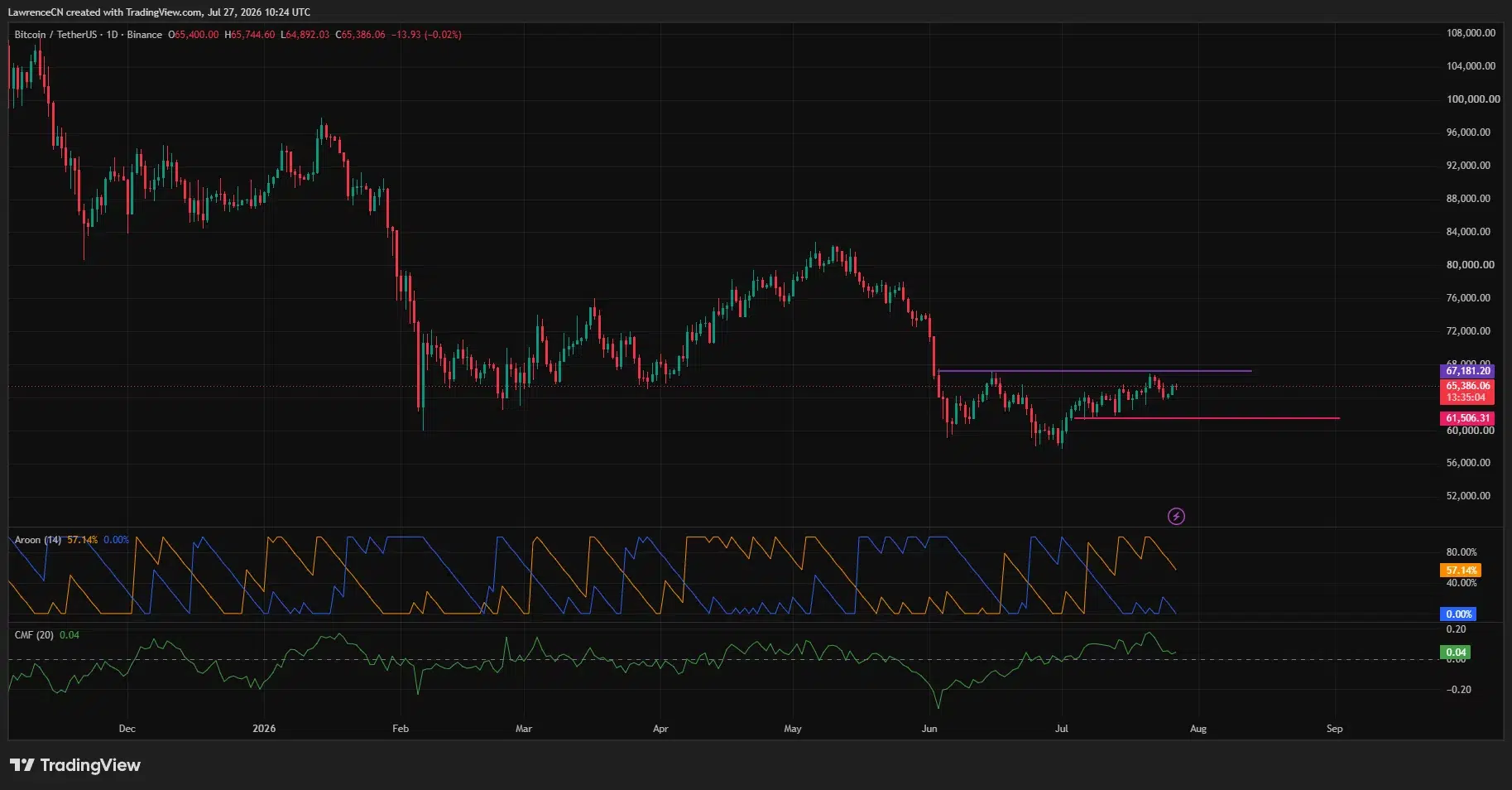
Bitcoin must now close above the daily resistance at $67,181 to leave its current consolidation range. That level rejected the July 21 advance and sits close to the upper boundary of the 4-hour channel.
Liquidation heatmap puts $68,000 within reach
The three-day CoinGlass liquidation heatmap shows that Bitcoin cleared several leveraged clusters between $64,500 and $65,300 during its rebound. The move likely forced some short positions to close, adding buy orders to the rally.
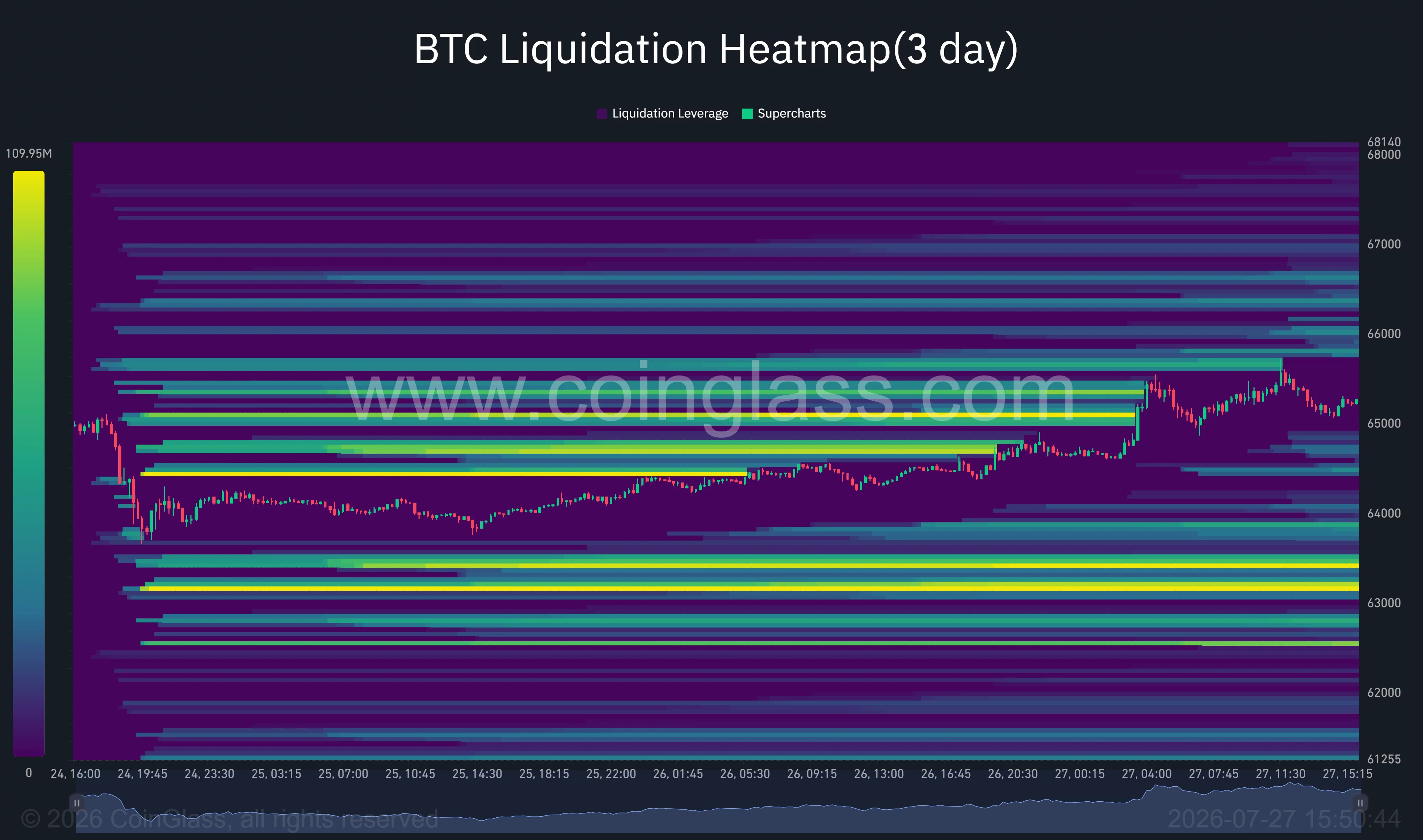
Further liquidation bands appear between $65,800 and $66,600. A sustained move above the latest intraday high of $65,744 could draw price toward these positions before BTC challenges $67,181.
Crypto analyst Ted Pillows also identified $68,000 as a possible target if US lawmakers make progress on the CLARITY Act.
“Any chance of it moving forward could send Bitcoin to $68,000 soon,” Pillows wrote.
That target broadly matches the upper boundary of the ascending channel. However, the policy catalyst remains uncertain. Polymarket traders placed the probability of the CLARITY Act becoming law in 2026 at about 38% as of July 27, with $2.8 million wagered on the market.
US spot Bitcoin ETF demand also remains uneven. The funds recorded $33 million in net inflows after three weeks of weaker activity, but SoSoValue data showed a $240.08 million net outflow on July 24. The mixed flows suggest institutional demand has improved without confirming a sustained reversal.
BTC risks a return to $63,000 if support fails
The bullish setup would weaken if Bitcoin loses the channel floor near $64,000. The daily chart places the broader range support at $61,506, leaving room for a deeper decline if the current higher-low structure breaks.
The liquidation heatmap identifies the strongest downside clusters between $63,000 and $63,500. These bright bands could attract price if weekend gains unwind or tensions between the US and Iran return.
According to crypto analyst Lennaert Snyder, weekend Bitcoin rallies are often retraced. He is watching for a possible short setup after a sweep of recent highs, with $63,700 as the initial downside target. Snyder identified the $60,000 region as his first preferred area for a potential long position if the correction deepens.
For the bullish case, Bitcoin needs to defend $64,000 and break $67,181. That would expose $68,000, where the channel ceiling and analyst target converge. A rejection followed by a move below $64,000 would instead put $63,500, $61,506, and eventually $60,000 back in focus.
Disclosure: This article does not represent investment advice. The content and materials featured on this page are for educational purposes only.


The FXStreet platform helps traders compare drawdowns, profit targets, restrictions and platform compatibility according to their experience and risk profile.
Barcelona, July 21, 2026: FXStreet has launched Propinder, a free prop firm comparison tool designed to help traders identify prop trading challenges that align with their experience, risk tolerance, platform preferences and country of residence. The platform presents key challenge conditions in a structured format before traders commit any money.
Profile-based prop firm comparison
Propinder begins with a profiling questionnaire that takes less than two minutes to complete. Traders provide information about their level of experience, preferred trading platform, approach to risk and country of residence.
The platform combines these inputs with aggregated and anonymized information from traders with similar profiles. It then presents a shortlist of prop trading challenges that users can explore and compare.
Propinder does not predict whether a trader will pass a challenge or recommend that the trader purchase a particular product.
Challenge rules displayed before payment
Prop trading challenges can have similar account sizes and profit targets while applying substantially different operating conditions.
These differences may include:
- The type and calculation of drawdown.
- Daily and maximum loss limits.
- Time limits.
- Instrument restrictions.
- Rules affecting trading around news events.
- Trading platform compatibility.
- Requirements for achieving profit targets.
Propinder presents these conditions in a comparable format so traders can evaluate how each challenge works before paying an entry fee.
The platform covers different prop trading models, including instant funding firms, evaluation-based challenges and firms offering futures programs.
Commercial agreements do not determine rankings
Propinder is not owned by a prop trading firm.
FXStreet states that prop firms cannot pay to obtain a higher position in the results and that challenges associated with affiliate partners do not receive preferential treatment.
Listings are created using publicly available challenge information and the results generated by Propinder’s profiling methodology.
“We are here to make sure that when a trader reads the conditions, they understand them before it costs them anything,” said Javier Hertfelder, CEO of Propinder.
Built by FXStreet in partnership with Swiset
Propinder is a product of FXStreet, the financial media company that has provided market and trading information for more than 25 years.
The platform was developed in partnership with Swiset, a trading technology provider serving brokers, prop firms and trading communities.
Swiset provides technology supporting trader profiling, performance analysis and challenge data management. FXStreet is responsible for the Propinder product and its approach to information, comparison and transparency.
Free access for traders
The Propinder profiling questionnaire, challenge comparison results and displayed rule information are available without charge.
The platform does not have a paid subscription or premium access tier.
Traders can access Propinder at propinder.com, review the suggested challenges and explore individual prop firm pages.
The final decision remains with the user. Information provided by Propinder should not be interpreted as trading, investment or financial advice.
About Propinder
Propinder is a free prop firm comparison tool that helps traders explore prop trading challenges according to their experience, risk tolerance, platform preferences and country of residence. The platform presents information about drawdowns, profit targets, time limits, restrictions and platform compatibility in a comparable format. Propinder uses aggregated and anonymized profile information and does not provide trading advice or predict challenge outcomes. Propinder is a product of FXStreet developed in partnership with Swiset. More information is available at propinder.com.
The post Propinder Launches Free Prop Firm Comparison Tool For Trading Challenges appeared first on BeInCrypto.

In the latest XRP news, Ripple CEO Brad Garlinghouse went public on July 22 with a direct call for Congress to advance the Digital Asset Market CLARITY Act, amplifying a message from Ripple Chief Legal Officer Stu Alderoty with a blunt verdict: “Perfect can’t be the enemy of good. Let’s get this done!”
The push comes as the bill sits in active Senate negotiations, with seven Senate Democrats seeking stronger consumer and enforcement safeguards before any floor vote.
Alderoty had framed the CLARITY Act explicitly as a consumer protection measure, pointing to its strengthened anti-money laundering requirements, expanded enforcement tools for law enforcement agencies, and new authority for state attorneys general. Garlinghouse endorsed that framing wholesale.
Ripple global co-head of public policy Lauren Belive sharpened the stakes further, warning that rejecting the bill could leave digital asset users exposed to the same structural gaps that enabled the FTX collapse.
The institutional dimension is central to Ripple’s advocacy calculus. Garlinghouse has repeatedly described the CLARITY Act as the final legislative barrier to XRP achieving genuine institutional crypto scale, the kind of CFTC commodity classification that would help expand institutional access
Discover: The Best Crypto to Diversify Your Portfolio
XRP News: Lummis Defends the Framework as Democrats Push Back
Senator Cynthia Lummis has continued anchoring the bill’s Republican defense, framing CLARITY as a framework that sharpens regulator accountability, improves market oversight, and gives compliant companies defined operating rules.
Her argument is that clearer federal standards benefit both legitimate firms and the regulators tasked with policing misconduct, a position designed to draw Democratic votes by rebranding the bill as enforcement infrastructure, not industry relief.

That argument has not yet closed the gap with Senate holdouts. With concerns centering on oversight requirements and financial consumer protections, Garlinghouse is now publicly pressuring lawmakers to resolve.
Discover: The Best Token Presales
Financial Giants and Tech Firms Expand the Coalition
Support for the CLARITY Act has moved well beyond the native crypto regulation constituency. Fidelity has pushed directly for Senate action, citing institutional participation trends that make regulatory certainty urgent.
Goldman Sachs’s chief executive has expressed support for a defined digital asset framework. Stand With Crypto is running a coordinated grassroots campaign to translate user sentiment into congressional contact.
More than 200 organizations have joined the formal call for progress on the legislation, with over 1,200 technology firms separately backing a federal crypto framework.

The breadth of that coalition is the strongest structural argument Ripple has: when Wall Street incumbents and Silicon Valley supply chains are aligned on the same bill, Senate moderates face real political cost in holding out on procedural grounds alone.
For XRP specifically, the stakes are concrete. Institutional friction around Ripple’s RLUSD and the broader XRP ecosystem has persisted precisely because statutory classification remains unresolved. Clearer regulatory standards under the CLARITY Act would remove that ambiguity, unlocking access to capital pools that currently treat regulatory gray-area assets as off-limits.
Don’t Miss Out on Our $1,000 USDT Airdrop on ByBit
The post Garlinghouse Calls CLARITY Act XRP’s Last Regulatory Hurdle, Urges Senate to Act Now appeared first on Cryptonews.
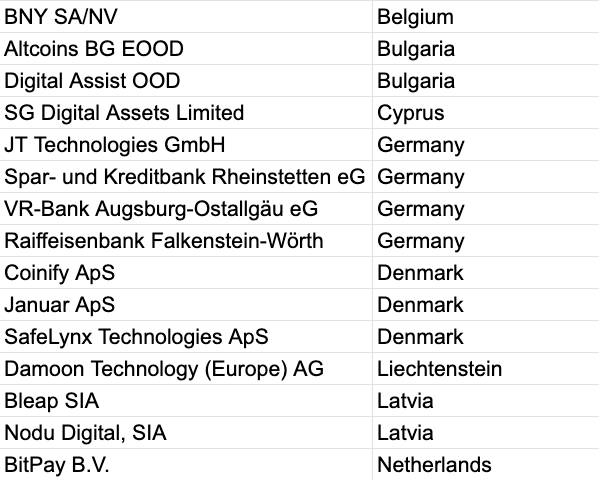
European authorities added 15 crypto companies including a BNY Mellon unit to the Markets in Crypto-Assets (MiCA) framework register in the third update of regulated providers since the July 1 transitional deadline.
With the European Securities and Markets Authority’s (ESMA) update on Friday, its interim MiCA register shows 309 licensed crypto-asset service providers (CASPs).
The latest entries include four banking institutions, including BNY SA/NV, the Belgian subsidiary of US banking giant BNY Mellon, and three German banks, alongside digital asset platforms such as BitPay, Coinify and Bleap.
The update comes as regulators continue building out the MiCA framework, which introduced the European Union’s first unified rules for crypto service providers and aims to bring more oversight to the sector.
Germany and Denmark lead latest CASP additions
Germany and Denmark accounted for the largest number of the latest additions, with three new CASPs registered in each country. Bulgaria and Latvia followed with two additions each, while Belgium, Cyprus, Liechtenstein and the Netherlands each added one provider.
The German additions included cooperative financial societies Spar-und Kreditbank Rheinstetten and VR-Bank Augsburg-Ostallgäu, along with Raiffeisenbank Falkenstein-Wörth.
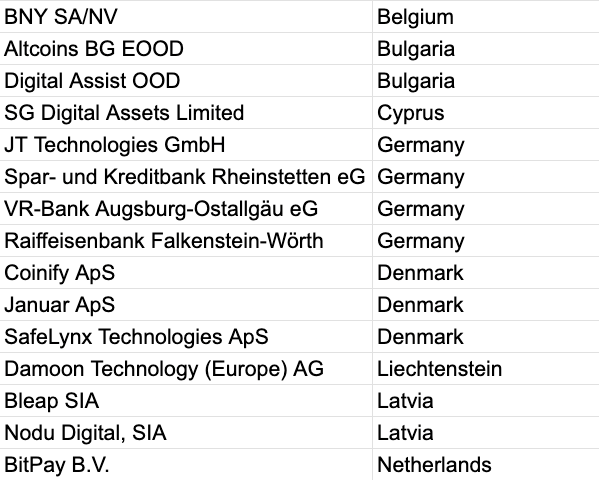
15 new CASPs in the MiCA register update on Thursday. Source: ESMA
Other newly listed providers include: Bulgaria’s Altcoins BG and Digital Assist; Denmark’s SafeLynx Technologies and Januar, a digital asset infrastructure company; and, Latvia-registered providers Bleap and Nodu Digital.
MiCA expansion continues after July deadline
The latest update follows ESMA’s previous register additions after the July 1 deadline, including 14 CASPs added in the regulator’s second post-deadline update, which included major industry companies such as Ripple Payments Europe.
While the CASP roster expanded, ESMA reported no changes to other MiCA-related registers in the latest update, including authorized issuers of asset-referenced tokens (ARTs), e-money tokens (EMTs), and crypto assets, as well as non-compliant entities.
Related: Swiss bank BancaStato launches regulated crypto trading with Sygnum
The continued updates show that MiCA implementation remains an evolving process, with regulators still adding authorized providers as companies complete licensing procedures across European markets.
At the same time, some industry executives warn that the cost of maintaining a MiCA license could push smaller firms out of the market, with Gate Europe CEO Giovanni Cunti saying some licensed companies may struggle to sustain the compliance resources required over the long term.
Magazine: Here’s why the CLARITY Act’s ethics deal may be so hard to reach
Crypto World
Ballooning U.S. debt sends investors to bitcoin (BTC), gold to shelter from dollar devaluation: Crypto Daily


“This is the world of fiscal dominance and ultimately will dictate Fed policy. Rates will necessarily need to be kept artificially low and liquidity will need to be provided to help fund the refinancing cycle,” the founders told CoinDesk. “The ‘debasement’ trade was a popular narrative last year but has gone quiet. Yet it’s set to go into overdrive!,” the founders told CoinDesk.
Several observers have raised the alarm over the ballooning debt in recent months.
Apollo chief economist Torsten Slok warned that the U.S. debt-to-GDP ratio of over 120% means there is little room to spend more money should a recession arrive. Moreover, the Fed can’t cut interest rates as aggressively as during previous recessions because that would add to inflation and, more importantly, reduce the yield on bonds. The government needs to issue more bonds to fund deficits and those need to offer a high return to draw demand.
“The U.S. has never entered a recession with this little fiscal buffer,” he wrote in a blog post in May.
All this means that if a recession occurs, the pain could be longer-lasting and may trigger demand for assets that fall largely outside of the financial system, such as BTC and cryptocurrencies. That said, since its inception in 2010, BTC has moved largely like a tech stock and not a haven investment.
Crypto World
Bitcoin Price Prediction: ETF Inflow Streak Ends and Turns Negative, Yet BTC Price Holds
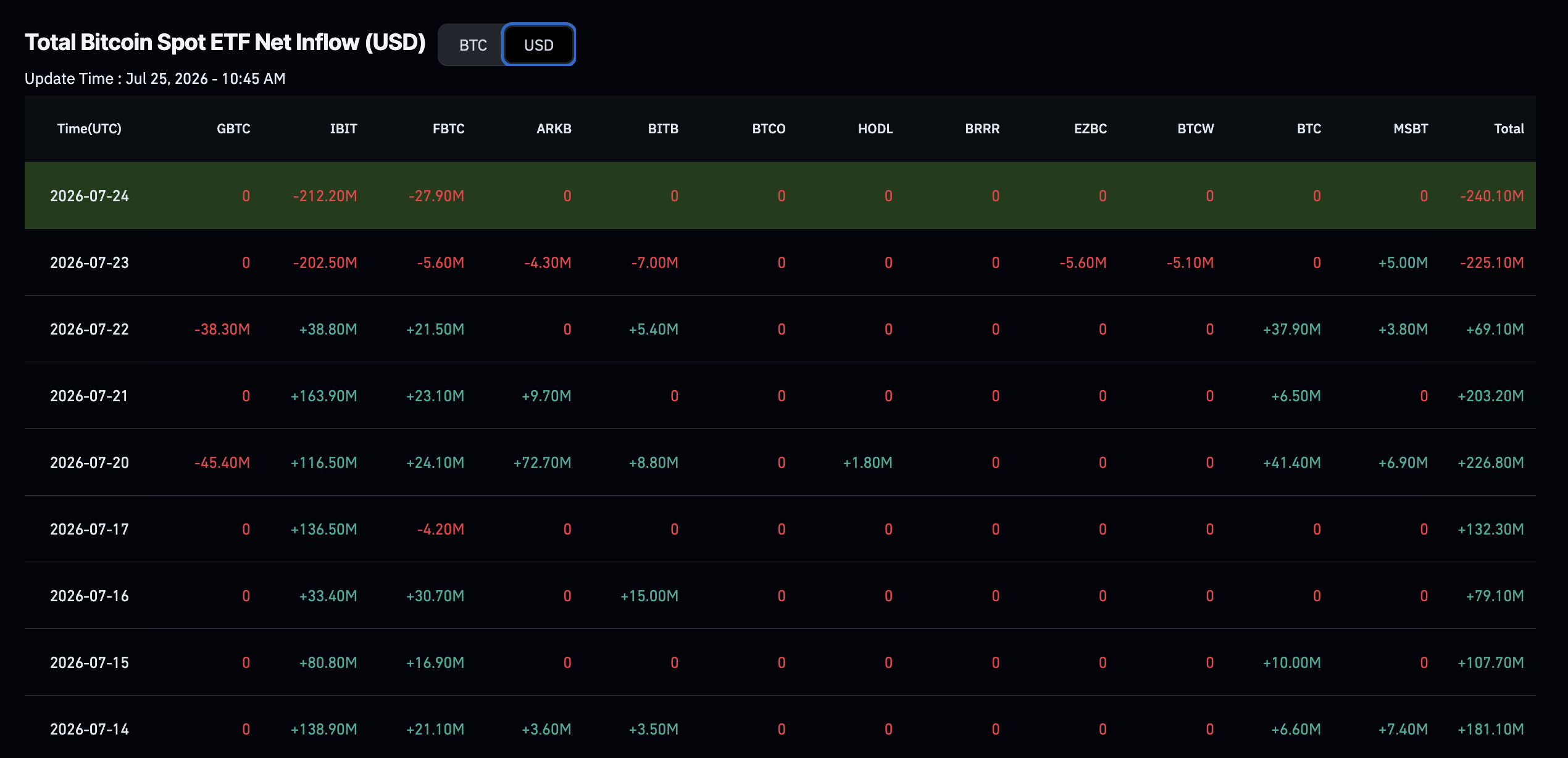
Bitcoin price prediction remains in focus as BTC USD traded near $65,350 during early Asian trading on Monday, gaining about 1.4% despite $465 million in U.S. spot ETF outflows across July 23 and 24.
Even so, Bitcoin held its ground instead of breaking lower. That resilience may point to steady underlying demand, although it could also reflect temporary calm before another move. For now, ETF flows alone are not enough to confirm either outcome.
The ETF reversal came as expectations for tighter Federal Reserve policy returned to the spotlight. At the same time, optimism surrounding the Clarity Act faded into the background. FalconX senior derivatives trader Ivan Lim said the recent Bitcoin ETF outflows reflected caution over the legislation and renewed expectations for higher interest rates.

Meanwhile, geopolitical developments added another layer of uncertainty. A pause in tensions involving the U.S. and Iran helped lift Bitcoin alongside other risk assets. As a result, traders found support from improving sentiment even as institutional flows weakened.
The market now sits between macro pressure and surprisingly resilient price action. Bitcoin has avoided a deeper pullback despite fading ETF demand. The next few sessions should reveal whether buyers remain in control or macro risks finally take over.
Discover: The Best Token Presales
Bitcoin Price Prediction: Break Past $70,000 This Week?
Bitcoin is holding support around the $64,000 to $65,000 area after rebounding from July’s low near $58,000. The recovery above $65,000 reinforces that zone as an important technical floor. Meanwhile, immediate resistance sits around $66,000 to $67,000, where recent rallies have struggled to build momentum. Monday’s price action is testing that region once again.
Volume remains an important piece of the puzzle. The $221.7 million ETF inflow that ended a 10-day, $2.73 billion outflow streak looked encouraging, but it barely dented the bigger trend. Year to date, U.S. spot Bitcoin ETFs still show roughly $5.4 billion in net outflows, suggesting institutional sentiment remains cautious despite July’s rebound.

If ETF demand strengthens alongside clearer signals from the Clarity Act or a more dovish Federal Reserve, Bitcoin could break above $67,000 and target the $68,000 to $70,000 region. A less dramatic outcome would see Bitcoin continue ranging between $64,000 and $67,000 while traders wait for fresh macro catalysts.
On the downside, another wave of ETF outflows above $200 million per day, combined with a hawkish Fed surprise, could drag Bitcoin back toward $58,000. The $70,000 target remains achievable, but only if institutional flows recover and macro conditions improve. Until then, resilient price action alone is not enough to confirm a sustained breakout.
Trade Bitcoin on Bybit and Get a Chance to Win Our $1,000 USDT Airdrop
Bitcoin Hyper Targets Early-Mover Upside as Bitcoin Tests Key Resistance
BTC holding $65,000 is constructive, but the upside from spot Bitcoin at this stage of the cycle is structurally capped by that $5.4 billion year-to-date ETF outflow overhang. Traders looking for asymmetric exposure within the Bitcoin ecosystem are increasingly looking at infrastructure plays, specifically, projects building programmability and speed directly onto Bitcoin’s base layer.
Bitcoin Hyper ($HYPER) is the first Bitcoin Layer 2 integrating the Solana Virtual Machine (SVM), targeting the core limitations that have kept Bitcoin from competing as a smart contract platform: slow finality, high fees, and zero programmability.
The pitch isn’t theoretical; the SVM integration delivers sub-second finality with low-cost execution, while a Decentralized Canonical Bridge handles BTC transfers without wrapping friction.
The presale has raised $32.9 million at a current price of $0.0136837, with staking available for early participants.
With the Clarity Act framing regulatory boundaries for Bitcoin infrastructure, Layer 2 positioning may prove well-timed.
Research Bitcoin Hyper before the presale window closes.
Discover: The Best Crypto to Diversify Your Portfolio
The post Bitcoin Price Prediction: ETF Inflow Streak Ends and Turns Negative, Yet BTC Price Holds appeared first on Cryptonews.


Two crypto platforms disclosed security incidents over the weekend. WEMIX said ownership of a WEMIX$-related contract was compromised, while Garden Finance took its app offline after identifying unusual activity.
Both incidents are small by dollar value. Yet they match the pattern that has shaped crypto security this year, with attack counts climbing to records while individual losses shrink.
What Happened at WEMIX and Garden
WEMIX reported abnormal transactions on the evening of July 26. Approximately 5,225,525 WEMIX$ were issued without authorization.
That supply converted into 30,736 WEMIX and 724,198.27 USDC.e. The assets moved through bridges to Ethereum and BSC, then into assets including Ether (ETH) and Tether (USDT).
Some of those assets reached centralized exchanges. WEMIX said it has asked exchanges and stablecoin issuers to freeze the attacker’s wallets.
“All bridges connected to and from WEMIX3.0 have been suspended temporarily. Chainlink CCIP has been suspended, and the PLAY Bridge has also been temporarily suspended,” the platform said.
The company said the cause remains under investigation, and the numbers may change.
Separately, Blockaid flagged an exploit on Garden Finance. The firm counted about $450,000 in USDT drained across Ethereum, Base, Arbitrum (ARB), and BSC at the time of its alert.
Follow us on X to get the latest news as it happens
Record Crypto Hacks Define 2026
TRM Labs recorded 207 hacks in the first half of 2026. That is more than double the 83 logged a year earlier. The firm said the figure was the highest it had recorded in any six-month period.
However, total hack losses moved in the opposite direction. Roughly $972 million was stolen, against about $2.3 billion in H1 2025.
The data points to a split between frequency and severity. More attacks landed, yet the largest sums concentrated on a handful of high-value targets, including KelpDAO and Drift Protocol.
Last week reinforced the pattern. Lookonchain counted three attacks last week totaling $35.55 million, hitting AFX Trade, the Verus Ethereum bridge, and B2 Network.
Subscribe to our YouTube channel to watch leaders and journalists provide expert insights
The post WEMIX and Garden Hacks Add to Record 2026 Crypto Breaches appeared first on BeInCrypto.
Crypto World
Bitcoin ETFs post third straight weekly inflows despite $465 million in late-week losses
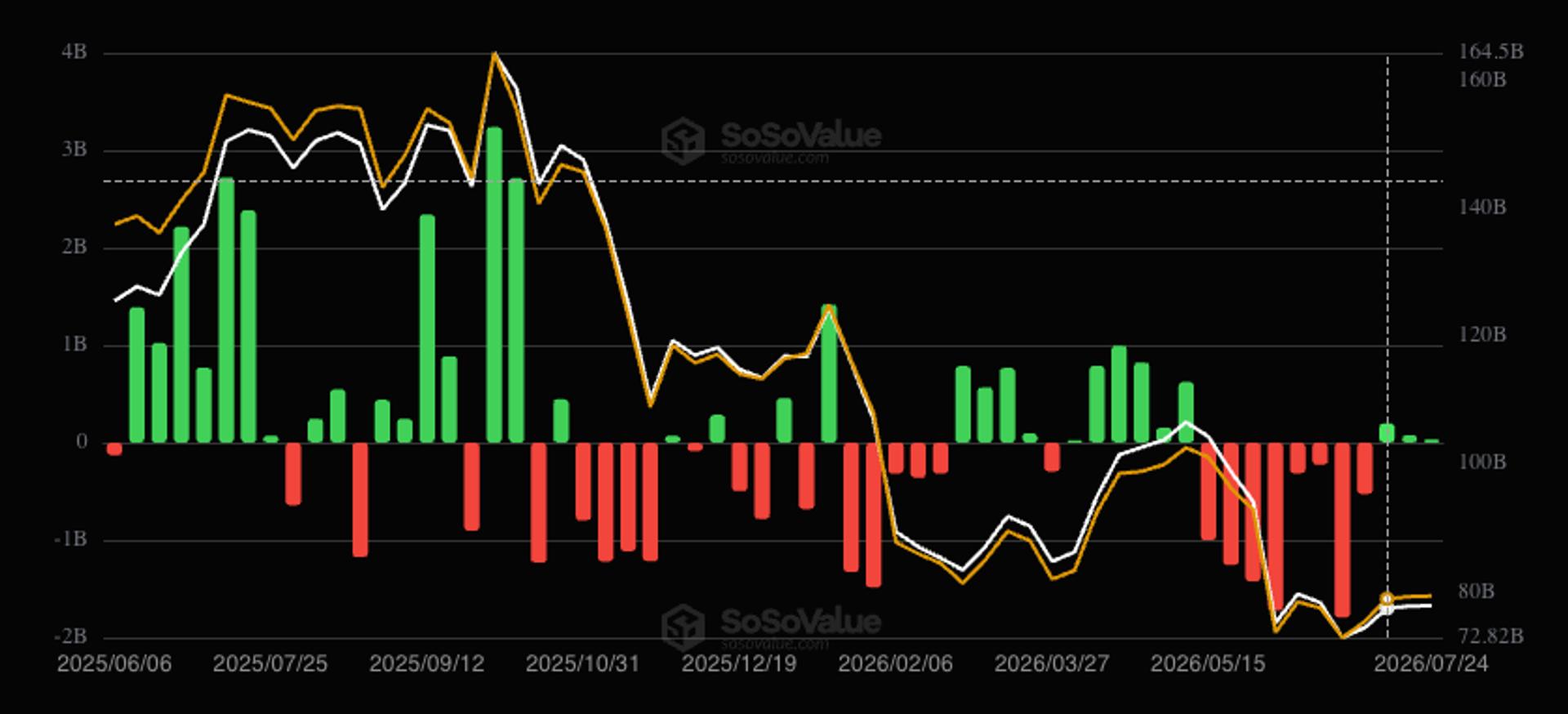
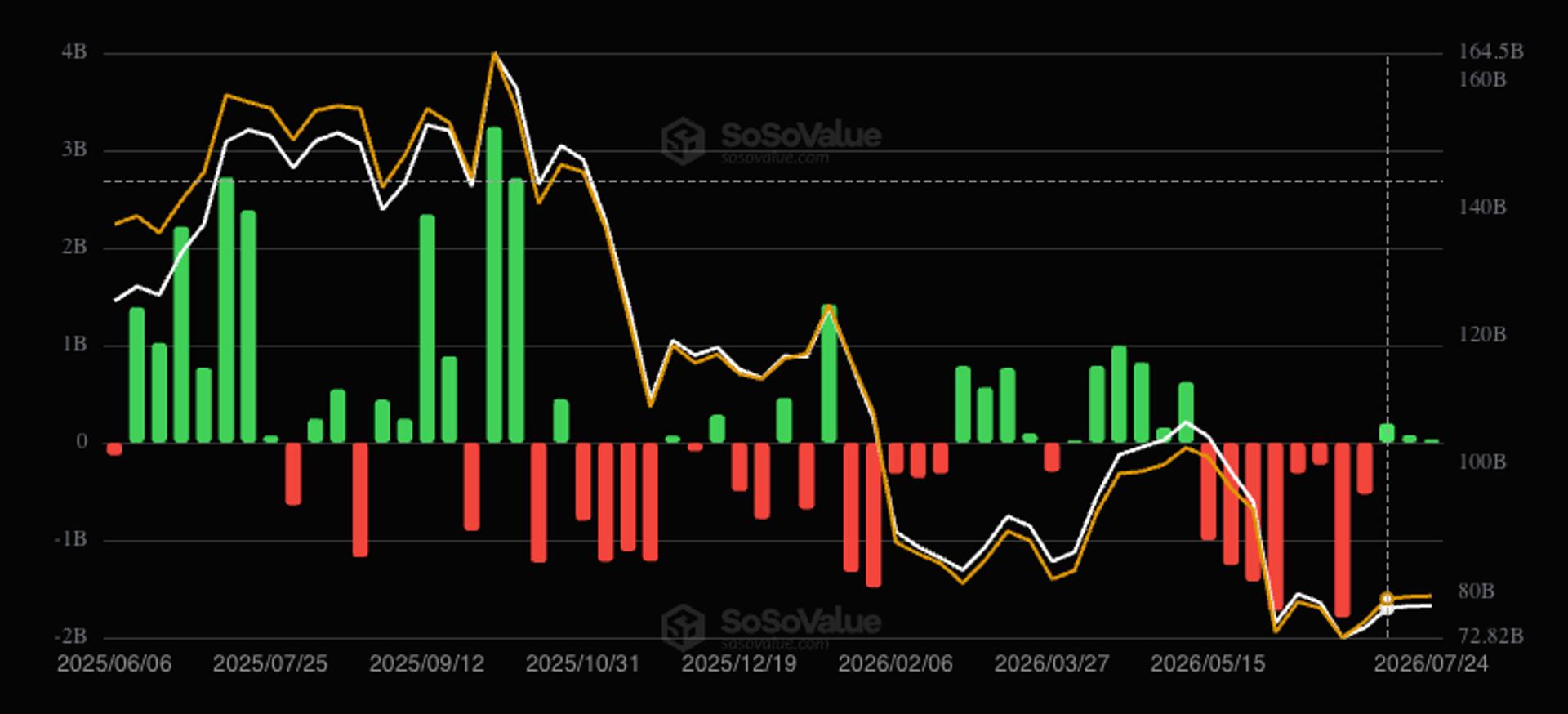
The U.S.-listed spot bitcoin exchange-traded funds (ETFs) have logged their first three-week inflows streak since early May.
These funds attracted $33.79 million in the week ended July 24. That figure would have been much bigger had it not been for net outflows of around $225.2 million and $240.1 million on July 23 and 24 respectively, according to data tracked by SoSoValue.
These late-week outflows also make the total weekly figure the smallest compared to the previous two weeks of inflows of $197 million and $75.67 million.
The story, therefore, is that institutional demand has returned, but it’s anemic and not as powerful as typically observed during bull runs.
“After May and June’s heavy outflows, July’s repair phase has brought relief, but institutional demand is still cautious,” crypto analytics firm BRN said in a email to CoinDesk.
Bitcoin rallied to a July high of over $66,500 on the Tuesday, before retreating below $64,000 by the end of the week, amid profit-taking and weak action in the stock market with the Nasdaq 100 pulled down by chipmaker stocks, a bellwether for the AI industry.
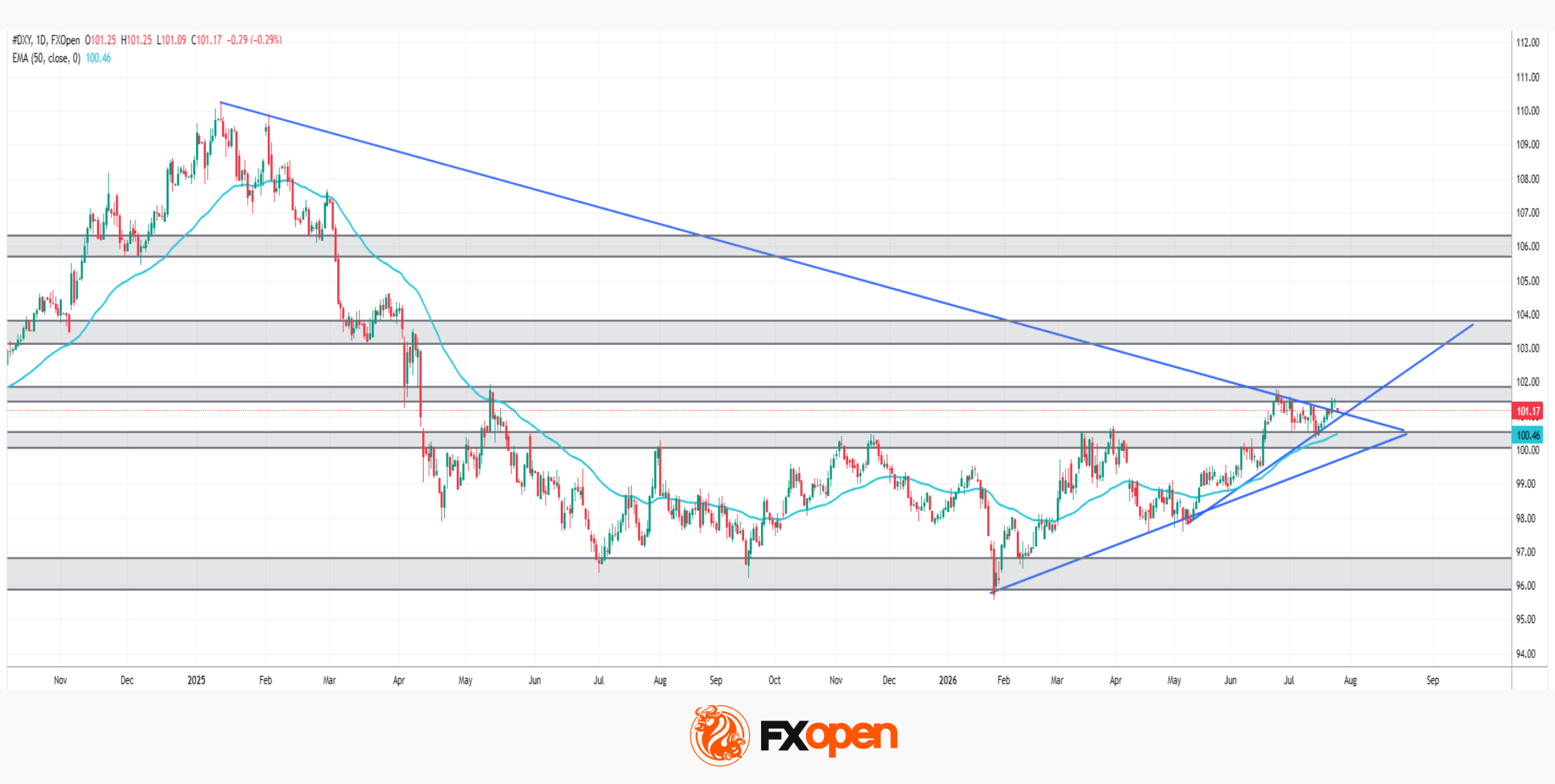
The dollar heads into a pivotal week trading near 101.80, just off a 15-month high, with the Fed’s July 29 meeting standing as the clear focal point. Markets currently price roughly a 65% chance of a hold, though renewed Middle East escalation has kept a hike back on the table for later this year. Energy remains the wildcard: the collapse of the Iran ceasefire and blockades affecting Persian Gulf shipping lanes have pushed oil higher, reigniting inflation concerns that could complicate the Fed’s messaging.
Adding to the uncertainty, private-sector hiring has slowed for a fourth straight week according to ADP data, even as jobless claims fell to a two-month low, painting a genuinely mixed labor picture. Fed Chair Kevin Warsh’s Congressional testimony offered little directional clarity, reaffirming a commitment to price stability without tipping the committee’s hand.
With the ECB decision now behind markets and flash PMI data already digested, all eyes turn to Wednesday’s Fed decision as the week’s true catalyst, one capable of resolving—or extending—the dollar’s recent indecision.
Technical Analysis of the DXY
The coming week carries real technical weight, with the DXY caught in a hotly contested zone between 100.00 and 102.00. The Fed’s rate decision, and the volatility it brings, could well define the dollar’s path over the near to medium term.
Bullish Scenario
After a rough start to 2026, the DXY rebounded sharply from January’s 96-97 support, gaining roughly 6% since then. Having recently broken and held above the psychological 100.00 level, price now sits supported by both an ascending trendline and the 50-period EMA. A confirmed break above 102.00 would open the path toward 103-104, and eventually 106-107.
Bearish Scenario
The index is currently struggling at the 102.00 resistance. A rejection here, breaking the ascending trendline while respecting the longer-term descending trendline from 2025’s highs, would send price back to retest the critical 100.00 zone—and potentially, on a deeper break, all the way back to the 96-97 support.
With the Fed’s decision now just days away, the dollar finds itself standing exactly where it needs to: at the edge of a decision. Whether the DXY breaks free toward fresh highs or slips back into its earlier struggles, this week’s outcome won’t just move the greenback—it will set the tone for every asset priced against it heading into autumn.
Trade global index CFDs with zero commission and tight spreads (additional fees may apply). Open your FXOpen account now or learn more about trading index CFDs with FXOpen.
This article represents the opinion of the Companies operating under the FXOpen brand only. It is not to be construed as an offer, solicitation, or recommendation with respect to products and services provided by the Companies operating under the FXOpen brand, nor is it to be considered financial advice.

Coinbase CEO Brian Armstrong has pushed back on the idea that the rise of artificial intelligence will reduce the relevance of crypto. In a post on X on Sunday, Armstrong argued that “AI being a megatrend” does not replace crypto—if anything, it increases the need for programmable financial rails that can be used by autonomous software.
Armstrong framed his argument around “agentic finance,” describing Coinbase’s Base network alongside USDC and the company’s x402 payment protocol as key components for machine-to-machine payments. His comments also arrive as the broader crypto industry increasingly markets blockchain networks as payment infrastructure for AI agents.
Key takeaways
- Armstrong says AI agents will drive demand for programmable money, positioning crypto as more—not less—relevant.
- Coinbase’s agentic payments stack centers on Base, USDC, and x402, built for automated stablecoin transfers between applications.
- Chainalysis reported in June that agentic payments on Base via x402 surpassed 100 million transactions within about nine months of tracked activity.
- Regulators and traditional payment systems are still designed around human accounts, while x402 targets payment flows that can be triggered automatically.
Armstrong’s case: AI needs programmable payments
Armstrong’s argument is rooted in how autonomous systems are expected to operate. If AI agents can act independently—making purchases, paying for data, or settling for APIs—then they require a payment mechanism that software can initiate without relying on traditional banking checkout steps.
“AI being a megatrend takes nothing away from crypto,” Armstrong wrote on X, adding that agentic systems will instead create demand for programmable money. The underlying pitch is that blockchain-based payments are better suited to low-friction, automated interactions than systems that assume a human user completes each transaction.
How Base, x402, and USDC fit together
Armstrong’s “AiFi” framing points to a specific infrastructure stack rather than a broad concept. Base launched in 2023 as an Ethereum layer-2 network intended to improve the speed and cost of building onchain applications, with the design aimed at general-purpose use rather than solely AI payments.
In 2025, Coinbase introduced x402, a payment protocol built around the HTTP “402 Payment Required” concept. As Coinbase describes it, x402 enables automated stablecoin payments between software applications, allowing one system to pay another—such as for digital resources—without traditional account-based workflows. In practice, the protocol is intended to make it easier for autonomous agents to complete payments as part of a software interaction.
USDC is one of the stablecoins used within this ecosystem. Launched in 2018 by Circle and supported by the Coinbase-backed Centre Consortium, USDC provides the dollar-pegged unit that enables consistent value transfer for automated payments. Together, Base (execution environment), x402 (payment protocol), and USDC (payment asset) form the core of Coinbase’s current approach to agentic payments.
What Chainalysis measured on Base’s agentic payment flows
Beyond Coinbase’s product narrative, third-party analytics have begun to quantify activity. In a June report, Chainalysis said agentic payments on Base using x402 surpassed 100 million transactions within roughly nine months of activity.
According to Chainalysis, it identified agentic payment activity by tracking x402-related payment flows onchain. The firm stated that transactions worth at least $1 represented 95% of total transferred value, suggesting that the measured activity was not just tiny test transfers.
Chainalysis also reported behavioral differences between agentic payment wallets and the average Base user. It said agentic wallets were typically newer, tended to hold more asset types, and carried smaller balances than the broader user base.
Cointelegraph asked Chainalysis for updated x402 activity figures and additional details on how its methodology works, but the firm had not responded by publication time.
Separately, Cointelegraph had previously noted that agentic payment activity on Base topped 100 million transactions in June, citing the same kind of measurement that Chainalysis described.
Earnings and market attention on Coinbase’s infrastructure strategy
Armstrong’s push for “agentic finance” comes as Coinbase prepares to report second-quarter earnings on Thursday. Yahoo Finance data shows analysts’ average expectations for revenue of $1.29 billion, with sales projected to decline 13.8% compared to the same period last year. Earnings per share are expected to be flat.
While the earnings forecast does not directly measure Base or x402 usage, the timing matters: Coinbase is attempting to position its networks and payment rails as foundational plumbing for a new wave of automated transactions. For investors and builders, the key question is whether agentic payment volumes translate into sustained demand for onchain infrastructure—particularly if more AI-driven services embed payment logic as part of normal operation.
What to watch next is how quickly “agentic” payment flows evolve beyond early activity: updated figures from Chainalysis on x402 usage, whether more stablecoin-based automation moves from experimentation to production, and how clearly Coinbase can connect its infrastructure push to broader business performance. As AI agent adoption grows, the debate is likely to shift from whether crypto is “relevant” to whether crypto-based rails are practical enough to become the default mechanism for machine-initiated payments.

Tom Lee: “Ethereum Is the Cure for the Uncanny Valley of Wealth” | Bitmine Chairman’s Message

Beat The Heat With YETI’s Must-Have Coolers For Frosty Beverages On The Go

The huge social impact of Cardiff City’s community foundation

Renter of Home in Anne Heche Crash Denies Settlement With Son

No Jackpot Winner as $257 Million Prize Rolls Over to $269 Million Monday Draw

Weekend Open Thread: Staud – Corporette.com
Tom Lee: “Ethereum Is the Cure for the Uncanny Valley of Wealth” | Bitmine Chairman’s Message

Btc Live Trading | Crypto Live Trading | Live Trading | Live Crypto Trading | Bitcoin Live Trading

‘Love or Money’ FULL MOVIE | Angelica Panganiban, Coco Martin
-

 Fashion3 days ago
Weekend Open Thread: Brooks Brothers
-

 Crypto World6 days ago
Grayscale Files For Worldcoin ETF, WLD Registers Sharp Rise
-

 NewsBeat6 days ago
How a former Blue Peter presenter stunned America’s Got Talent judges
-

 Tech11 hours ago
Intel is reversing course and bringing hyper-threading back to its server chips
-

 Tech6 days ago
Sail Virtually Aboard The “Itanic” With IA-64 Emulator
-
 Tech6 days ago
Turtle Beach Command Series KB7 review: a nifty screen-equipped gaming keyboard
-
 Business5 days ago
New Jersey voter registration controversy explained: How 6,600 noncitizens got on the rolls, and what happens next
-
 Entertainment6 days ago
Johnny Depp’s R-Rated Gothic Cult Classic Gets New Release Ahead of Sydney Sweeney Remake
-

 Tech7 days ago
Watch Flock Safety CEO Garrett Langley discuss the future of surveillance at TechCrunch Disrupt 2026
-

 Crypto World4 days ago
Ethics, other provisions in crypto Clarity Act to be further discussed
-
 NewsBeat6 days ago
Shanghai science forum photos show China’s AI and robotics advances in rivalry with US
-
 Sports15 hours ago
Commonwealth Games boxing: Jadumani Singh seals dominant 5-0 win over Pakistan’s Sumama Rehman to enter quarter-finals | Commonwealth Games News
-

 News Videos4 days ago
The Peugeot Family: How 200 Years of an “Old Money” Dynasty Died in A Boardroom
-

 Sports3 days ago
2026 3M Open leaderboard: Scottie Scheffler finds putter in Round 1, sits three back
-

 Politics23 hours ago
Spain sweeps the board at 2026 World Cup with individual awards
-

 Fashion3 days ago
16 Dresses for the High Summer Event
-

 Crypto World6 days ago
Andrew Cuomo joins OKX board as crypto exchange expands in U.S.
-
 Entertainment3 days ago
A New Post-Apocalyptic Gundam Anime Series Blasts Into SDCC
-

 News Videos15 hours ago
BITCOIN JUST ENTERED THIS CRITICAL ZONE…
-

 Crypto World1 day ago
XRP Ledger adds $2.6B as RWA inflows rank second
You must be logged in to post a comment Login