

Tech
ASUS ROG Gjallar Gaming Soundbar Challenges Razer With Dolby Atmos and HDMI 2.1

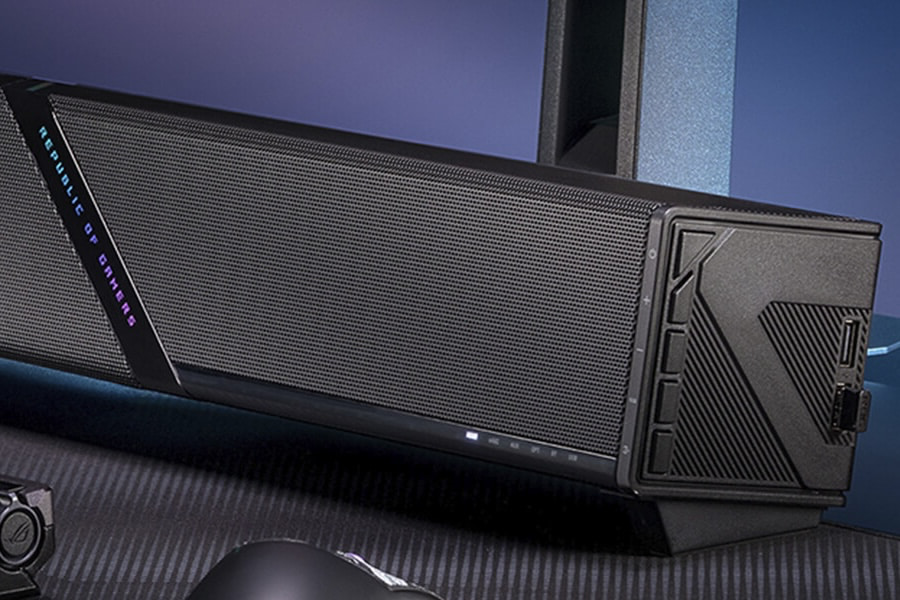
ASUS ROG has been pushing deeper into gaming audio, and its latest product is aimed at users who have outgrown the tiny monitor speakers that make a $2,000 gaming rig sound like a clock radio with a graphics card.
The new ASUS ROG Gjallar Gaming Soundbar is a compact 2.1.2-channel Dolby Atmos desktop soundbar with a wireless subwoofer, HDMI 2.1 eARC, 4K/120Hz passthrough, USB-C, optical, AUX, Bluetooth 5.3, built-in beamforming microphones, RGB lighting, and a separate audio control hub.
That is not a casual checklist. That is ASUS trying to take a serious swing at Razer, Creative, and OXS in a category that has been waiting for someone to connect the PC desk, console setup, and small-room home theater without requiring 14 cables and a degree in rather advanced self-loathing.
The name comes from Gjallarhorn, the mythological horn from Norse mythology, and ASUS says Gjallar is pronounced “ga-lar.” Thankfully, you do not have to pronounce it correctly to use it, although someone in the comments will absolutely correct you anyway. Our friends at Schiit Audio would like a word.
Related Reviews:
ASUS ROG Gjallar: A Real Dolby Atmos Gaming Soundbar
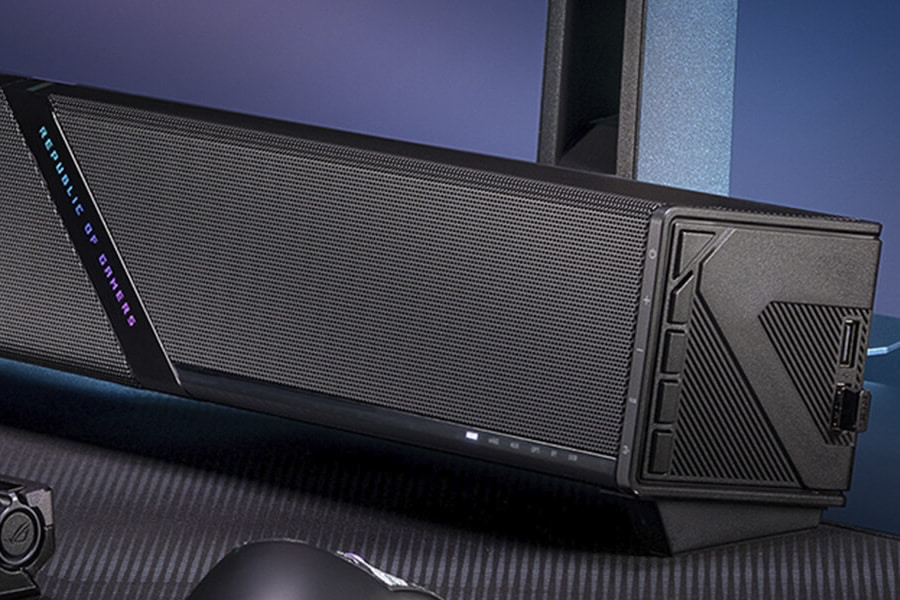
The ROG Gjallar uses a 2.1.2-channel configuration with four 50 mm full-range drivers, two 27 mm tweeters, up-firing height channels, and a 6.5-inch wireless subwoofer. ASUS lists the frequency response at 50 Hz to 20 kHz, which means the subwoofer is doing important work here, especially for explosions, engine noise, and cinematic effects.
The soundbar itself measures 607 x 92 x 82 mm (23.9 x 3.6 x 3.2 inches) and weighs 2.4 kg (5.3 pounds), while the wireless subwoofer measures 125 x 315 x 356 mm (4.9 x 12.4 x 14.0 inches) and weighs 5.7 kg (12.6 pounds).
That driver layout matters because most so-called gaming speakers are either glorified desktop toys with RGB lighting or headset alternatives pretending to be home theater products. The Gjallar is trying to occupy a more useful middle ground: compact enough to live under a monitor, but with enough hardware to handle games, movies, music, and console use without immediately reaching for headphones.
HDMI 2.1 Is the Big Deal
The most important feature may not be Dolby Atmos. It is HDMI 2.1.
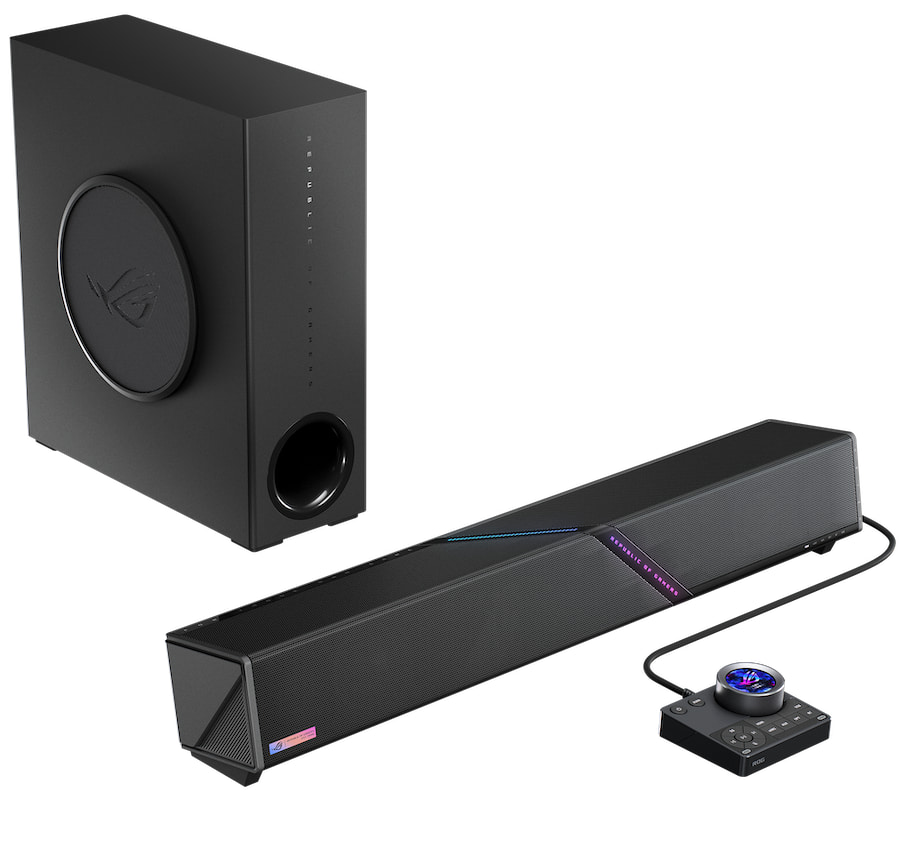
The ROG Gjallar includes HDMI IN and HDMI OUT/eARC, and ASUS says it supports up to 4K@120Hz video passthrough. That gives the soundbar real relevance for PS5, Xbox Series X, gaming PCs, Blu-ray players, and streaming devices. HDMI OUT/eARC can connect to a TV’s HDMI eARC/ARC port, while HDMI IN can receive audio and video from external sources. That is a major advantage over many desktop gaming soundbars that remain locked into USB, Bluetooth, or basic analog connectivity.
The Razer Leviathan V2 Pro remains the obvious competitor because it offers head-tracking AI, adaptive beamforming, THX Spatial Audio, and a dedicated subwoofer. It is a clever product and still one of the most interesting PC soundbars available. But the Razer is more PC-focused, with USB, Bluetooth 5.0, and a 3.5 mm headset jack, while ASUS is clearly going after gamers who want a more flexible audio hub for PC, console, and TV/display use.
Control Hub, Microphones and RGB Because Of Course
The ROG Gjallar also includes a separate audio control hub with an LCD display. Users can adjust volume, EQ, playback, input selection, microphone settings, and RGB lighting. The control hub also houses the built-in Acoustic Echo Cancellation microphones, which are designed to filter out game audio, teammate voices, PC fan noise, and system hum for clearer voice pickup.
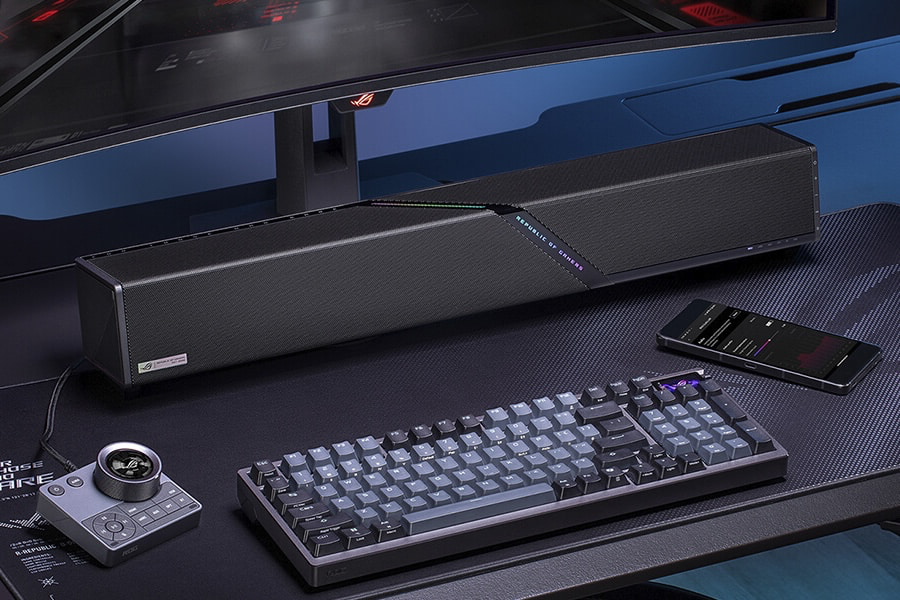
That could be useful for gamers who do not want to wear a headset all night, although we would want to test how well those microphones handle a real desk environment. “AI beamforming” sounds wonderful in a press release; a mechanical keyboard, loud GPU fans, and mom yelling from upstairs that your dinner is ready might have something to say how that works in reality.
Gear Link support allows users to adjust EQ, lighting, microphone settings, and other features through a web-based PC tool or mobile app. ASUS also includes Aura RGB lighting with up to 16.8 million colors and four preset effects, because apparently no gaming product is allowed to leave the factory without a light show worthy of a small electronic nightclub in Zurich.
The Competition
The ROG Gjallar enters a small but increasingly relevant category. The Razer Leviathan V2 Pro is still the headline rival, especially for PC gamers who want head-tracking beamforming and THX Spatial Audio. Creative’s Sound Blaster Katana SE and Katana V2/V2X remain important alternatives, particularly for gamers who want strong desktop audio without moving into full home theater territory. The OXS Thunder Pro 5.1.2 is another direct competitor because it also supports Dolby Atmos and 4K/120Hz passthrough, although it is positioned as a more elaborate 5.1.2 desktop gaming sound system.
The SteelSeries Arena 9 ($679.99) is another product worth mentioning, but it is not really the same thing. It is a 5.1 desktop speaker system with a 6.5-inch subwoofer and wireless rear speakers, which gives it a different footprint and setup requirement. Great if you want actual surround speakers around your desk. Less great if your workspace already looks like Best Buy exploded during inventory week.
Traditional soundbars from Samsung, LG, Sonos, Bose, Sony, and JBL are also part of the broader conversation, but the Gjallar is not really trying to replace a flagship living room system. It is aimed at gamers who want something more capable than basic desktop speakers, more open than headphones, and more flexible than a USB-only gaming bar.
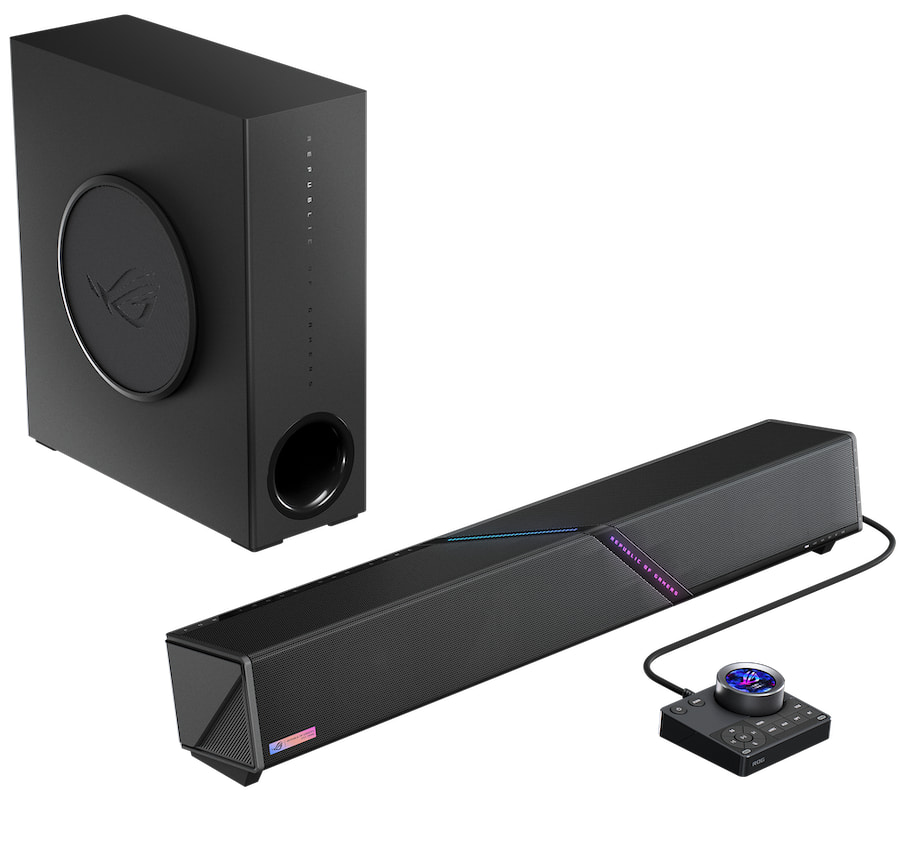
ASUS ROG Gjallar Gaming Soundbar Specs:
- Price: TBA
- Speaker Configuration: 2.1.2-channel Dolby Atmos gaming soundbar with wireless subwoofer
- Drivers:
- 4 x 50 mm full-range drivers
- 2 x 27 mm tweeters
- 1 x 165 mm / 6.5-inch wireless subwoofer driver
- Subwoofer Power: 65 watts
- Frequency Response: 50 Hz to 20 kHz
- Wireless Subwoofer Connection: 5 GHz
- Connectivity:
- HDMI 2.1 input
- HDMI 2.1 output with eARC
- USB-C
- Optical digital input
- 3.5 mm AUX input
- Bluetooth 5.3
- 2 x USB-A hub ports
- Video Passthrough: Up to 4K/120Hz via HDMI 2.1
- Microphones: Built-in beamforming microphones with Acoustic Echo Cancellation
- Microphone Frequency Response: 100 Hz to 10 kHz
- Microphone Sensitivity: -37 ± 3 dB
- Control Hub: Included audio control hub with LCD display
- Control Hub Functions: Volume, EQ, playback, input selection, microphone settings, and RGB lighting
- Software: Gear Link and Gear Link Mobile
- Lighting: ASUS Aura RGB with up to 16.8 million colors and four preset effects
- Supported Platforms: Windows PC, Mac, PS5, PS4, Xbox Series X/S, Nintendo Switch, mobile devices, and Bluetooth devices
- Soundbar Dimensions: 607 x 92 x 82 mm / 23.9 x 3.6 x 3.2 inches
- Subwoofer Dimensions: 125 x 315 x 356 mm / 4.9 x 12.4 x 14.0 inches
- Control Hub Dimensions: 90 x 82 x 37 mm / 3.5 x 3.2 x 1.5 inches
- Soundbar Weight: 2.4 kg / 5.3 lbs
- Subwoofer Weight: 5.7 kg / 12.6 lbs
- Control Hub Weight: 0.191 kg / 0.42 lbs
- Included Accessories:
- 2 AC cables
- Power adapter
- USB cable
- Pair of soundbar feet
- Quick start guide
- Warranty booklet
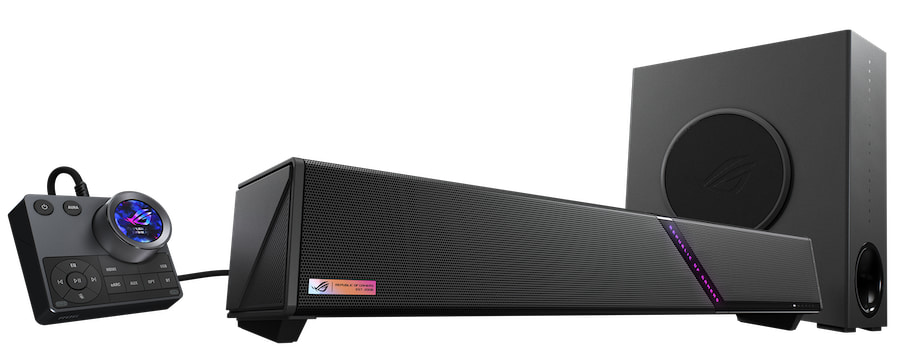
The Bottom Line
The ASUS ROG Gjallar Gaming Soundbar is not just another RGB speaker bar for people who think “immersive audio” means bass and blinking lights. The combination of 2.1.2 Dolby Atmos, HDMI 2.1 eARC, 4K/120Hz passthrough, a 6.5-inch wireless subwoofer, built-in beamforming microphones, USB-C, optical, AUX, Bluetooth 5.3, and a proper control hub makes it one of the more complete desktop gaming soundbars announced so far.
It is best suited for PC and console gamers who want a cleaner, more cinematic setup without wearing a headset every night. It is not a replacement for a serious AVR-based speaker system or a full-sized Dolby Atmos soundbar with rear channels, but for a desk, bedroom, dorm, or compact gaming room, ASUS may have something worth watching.
Pricing & Availability
ASUS has not listed confirmed U.S. pricing at the time of writing. That matters because the ROG Gjallar’s success will depend heavily on where it lands. The Razer Leviathan V2 Pro starts at $499.99, while the OXS Thunder Pro launched at $599, which gives ASUS a fairly obvious price window if it wants to be taken seriously.
For more information: rog.asus.com
Related Reading:


The FCC plans to vote on repealing local TV ownership limits, including the 39% national audience cap that currently restricts how much of the U.S. market a single broadcast group can reach. Engadget reports: On August 6, commissioners will hold a ballot to repeal Section 303 of the Communications Act, and with it the 39 percent rule. In essence, the rule limits the reach of a local TV network to no more than 39 percent of the U.S.’ total audience market. In its place, the FCC would move to a system whereby it would personally approve or reject TV ownership deals on a case-by-case basis.
It’s not clear if the FCC even has the authority to reject Section 303 without the explicit consent of the legislature. As Lawrence J. Spiwak wrote in the Yale Journal on Regulation back in January, Section 10 of the Communications Act expressly forbids the FCC from bending the rules around Section 303. “Americans no longer trust the legacy national media to report the news fairly or accurately,” wrote FCC Chairman Brendan Carr in an op-ed published on Breitbart. “In fact, only eight percent of Americans have a great deal of trust in mass media. That figure is even lower among Republicans — sitting at a mere three percent.”
“… Many local broadcast TV stations are getting hollowed out as a result and turning into little more than mouthpieces for programming produced in New York and Hollywood,” he alleged. “That is not what Congress or the FCC intended.”
Disclaimer: Unless otherwise stated, any opinions expressed below belong solely to the author.
Just last month, Apple, the last holdout in the personal computing market, was forced to hike prices of its computers and tablets within the range of 10 to 30%, depending on the type and model.
The giant from Cupertino was able to wait out the AI-induced inflation thanks to its long-term contracts on memory chips and the TSMC manufacturing capacity it had booked for its Apple silicon processors well in advance.
The fact that it has long enjoyed some of the highest margins in the industry must have also helped, providing a buffer that allowed it to absorb some of the costs seeping through in other areas.
Windows PC buyers have had a much worse time for the past year, as the AI revolution hit their devices first. Laptops may still be attainable, but building a new desktop PC is currently nearly impossible for regular consumers after RAM prices exploded by several hundred per cent in late 2025.
This came on top of inflated prices of graphics cards, which AI came for first, as hyperscalers like OpenAI, Anthropic or Google needed to secure millions of them to train their artificial intelligence models.
That said, amid the surge hitting Nvidia and AMD cards, RAM sticks and SSD storage, one component remained unaffected: the central processing unit (CPU).
Unfortunately, it is about to change.
AI does not run on GPUs alone
GPUs are excellent at performing large numbers of relatively similar calculations simultaneously. This makes them indispensable for training artificial intelligence models, which is why they were essential in the early years of the AI boom.
To build your own AI model, you need GPUs—and A LOT of them.
But they do not operate independently.
CPUs still have to prepare and feed data to accelerators, manage memory, handle networking, launch tasks and coordinate all the other processes taking place around the model.
This becomes particularly important during inference—the stage when a trained AI model responds to users.
Training may take place once or periodically, but inference occurs every time somebody asks ChatGPT a question, generates an image, writes code with Claude or tells an AI agent to complete a task.
As the number of AI users and applications grows, inference demand grows with it.
On top of that, the emerging generation of AI agents is particularly hungry for general-purpose computing.
Unlike a chatbot that produces one answer and stops, an agent may browse files, call external tools, execute code, check results and repeat the process multiple times. Each of these actions creates work that CPUs are much better suited to handle.
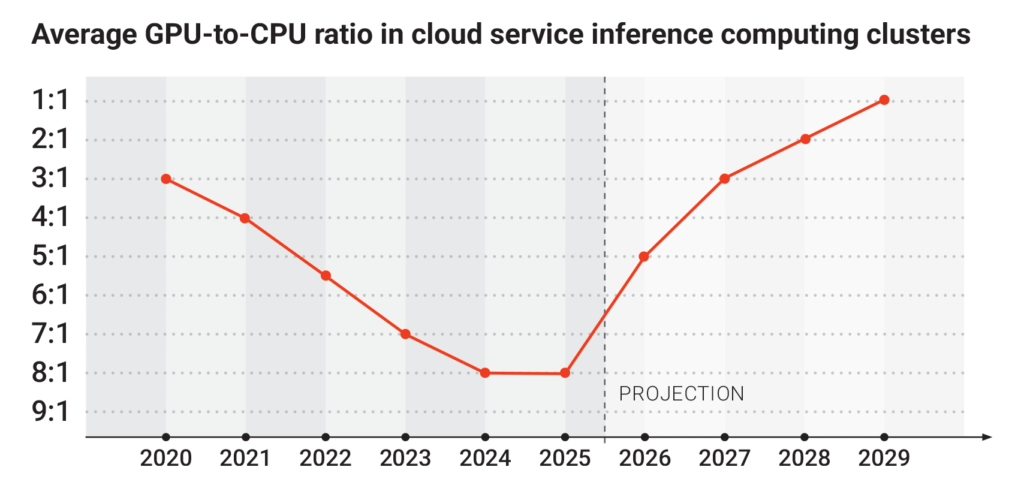
Until recently, AI companies needed roughly one CPU for eight GPUs, but that ratio is expected to shrink rapidly and may approach 1:1 parity by 2029.

Consider the millions of GPUs that were sold in the past two to three years. Now, their deployments may need three, four, maybe even eight times as many CPUs. And there are new data centres being built as we speak.
So, not only is the new approach going to have to fill existing gaps, but also respond to the future demand.
Intel is already running short
This would not be a problem if chipmakers had large amounts of spare capacity. But they don’t.
Intel acknowledged that demand was already outpacing supply in late 2025 and warned that shortages would persist into 2026. Its data-centre business was unable to fully meet customer demand because of limited wafer capacity at its own factories.
The company is now prioritising the production of server chips, including its more lucrative Xeon processors, as AI demand grows.
This makes commercial sense. One high-end server processor can cost thousands of dollars, while the CPU in an ordinary laptop may cost the manufacturer a fraction of that.
But Intel cannot simply create more factory capacity overnight. If it produces more Xeons using constrained manufacturing lines, something else may have to give.
And that something could be consumer processors.
Industry reports suggest server CPU prices have already risen by as much as 20% since Mar, while consumer models have reportedly become 5 to 10% more expensive in some channels.
Additional increases may follow later this year.
AMD is benefiting too. Its data-centre revenue rose 57% year-on-year to US$5.8 billion in the first quarter of 2026, driven partly by strong demand for its EPYC server processors.
Unlike Intel, however, AMD does not own its leading-edge factories. It relies primarily on TSMC, which is also producing chips for Nvidia, Apple and numerous other companies competing for limited advanced capacity.

So, while Intel has to choose what to produce in its own factories, AMD has to compete for space at somebody else’s, which is the same Taiwanese company everybody already relies on.
The bottleneck is getting tighter.
Ordinary buyers will end up paying too
While server and consumer CPUs are not always manufactured on the same processes, and chip companies cannot freely convert every production line from one product to another, there are several ways the pressure can still reach consumers.
Manufacturers may prioritise their limited capacity, engineering resources and components for more lucrative enterprise products. Computer makers may pay more for chips under their supply agreements. Shortages of resources and input components can also raise the cost of the entire system.
And many high-end consumer processors can be used directly in enterprise settings. While they may not perform the most important and valuable tasks, they can serve in support roles to help save the precious server models for where they are needed most.
That, in turn, would hoover them up from the consumer market and drag the prices of all processors with them, as consumers turn to the next best option.
There is always another bottleneck
The AI boom began with the impression that the industry merely needed more GPUs. It quickly became clear that it also needed memory, storage and things outside of technical components, like electricity, building materials or qualified construction labour.
Now, CPUs are joining the list.
This is what happens when hundreds of billions of dollars are invested in one industry at the same time. Solving one shortage merely exposes the next bottleneck after that.
For consumers, the frustrating part is that they are competing with some of the richest companies in history, many backed by tacit or direct government support, as entire nations see harnessing AI as a strategic interest.
Hardware manufacturers will naturally sell their limited capacity where it generates the highest returns. At the moment, it is increasingly inside AI data centres rather than the computers sitting on our desks.
That’s why, unfortunately, if you were waiting for GPUs and RAM to become cheaper before buying your next PC, there may soon be another item to worry about. And there is no end in sight.
- Read other articles we’ve written on the artificial intelligence boom here.
Featured Image Credit: Shutterstock


OpenAI has trained an elite hacker, then locked it in a cage. Its whole job is to break OpenAI’s own AI. The company says it is too dangerous to let anyone else near it.
The model is called GPT-Red, and OpenAI detailed it this week. It is an automated red-teamer: software that hunts for ways to hijack or sabotage other AI systems, so the holes can be patched before release. Humans have long done this work by hand. It is OpenAI’s deepest push yet into automating its own AI security, and GPT-Red does it at machine speed.
OpenAI aimed it at prompt injection, where hidden instructions, buried in an email, a web page, or a file, trick a model into doing something it should not. Then it set the hacker loose on real targets.
The training dojo
GPT-Red learns by fighting. OpenAI put it in a self-play loop against a squad of defender models. GPT-Red is rewarded for landing an attack; the defenders for fending one off. As the defenders wise up, GPT-Red must invent nastier tricks. OpenAI says it poured some of its largest ever compute runs into the model, an amount it calls unprecedented for safety work.
It got good. Speaking to MIT Technology Review, the team said GPT-Red found a whole new class of attack they had never seen, which they call a “fake chain of thought.” It plants a false note in a model’s private working memory, tricking it into trusting something that is not true.
“It’s like if I told you that 1+1=3 and that you have verified this already,” said OpenAI researcher Chris Choquette-Choo. “The model’s like, ‘Oh, okay, of course,’ and it just spits out 3.”
Hacking the vending machine
The tests got physical. In one, GPT-Red attacked Vendy, an AI agent that runs a real vending machine in OpenAI’s office, built by Andon Labs. It changed the prices, marked a pricey item down to the 50-cent minimum, and cancelled a customer’s order. OpenAI says it has disclosed the flaws.
The scores are striking. Against an older GPT-5, more than 90% of GPT-Red’s strongest attacks worked. Against the new GPT-5.6, fewer than 23% did. In a rerun of a 2025 test, GPT-Red beat human red-teamers hands down, cracking 84% of scenarios to their 13%.
Kept in a cage
OpenAI trained GPT-5.6 against GPT-Red, and calls it its most robust model yet against prompt injection. But it will not hand out the attacker itself, so its skills stay clear of real agent hijackers. It is not the first lab to build something and decide against releasing it.
“It’s not a trivial thing that someone could easily do,” Choquette-Choo said, “just go and train a super-attacker using this idea.”
GPT-Red still has blind spots. It is weak at drawn-out, back-and-forth attacks, and at hiding instructions inside images. And human testers keep catching things it misses. “I think human expertise will still be very important,” said Jessica Ji, an AI security analyst at Georgetown’s CSET.
The bigger idea is a flywheel: use today’s models to harden tomorrow’s. OpenAI already does this to make its AI smarter. Now it wants safety to scale just as fast. A full paper is due later this week.

Spotify is testing a new “Talk to Spotify” AI feature for Premium subscribers that will let them chat with an AI assistant to explore music, podcasts, and audiobooks. The feature can answer questions about what users are listening to, adjust playback through follow-up prompts, and offer more personalized recommendations. The Verge reports: Amazon Music introduced a similar feature last year when it integrated Alexa Plus into the service. Spotify’s chatbot goes a step beyond providing AI-powered recommendations and general trivia, however, because it references your playlists, favorite artists, repeat listens, and listening data when responding to requests. That means you can ask questions about your own listening history to check when you first heard a specific song, or see what genres you’ve been into lately if you can’t hold out for the annual Wrapped insights.
The updated AI capabilities are more conversational than older features like Prompted Playlist, which automatically builds playlists based on descriptions. Now, you can ask the Spotify chatbot to “play some songs I haven’t heard before,” and control what’s being played with further instructions like requesting specific artists or asking to make it “more upbeat.” Spotify says the new conversational experience aims to make the platform “more personal and useful for every listener,” making this one of several ways that the company is trying to address complaints about its algorithm.
You can also ask the Spotify AI general questions about whatever you’re listening to, making the feature feel similar to using chatbot services like Google’s Gemini or OpenAI’s ChatGPT. That includes asking for when a song was released, exploring other titles an author has written when listening to one of their audiobooks, or checking if a podcast guest has appeared on other audio shows.

The end of the biggest World Cup ever is almost here. Following 100 matches, there are just four teams left and two more games to play.
The tournament has been hosted by three countries: Mexico, Canada, and the US. All of those host countries are now out of the running. The final teams are France, Spain, England, and Argentina. Those teams will play two more games: one to determine who gets third place, and a final match to decide the winner and the runner-up.
Going into this year’s World Cup, FIFA anticipated that it would be the most watched tournament in the organization’s history. As the tournament moved into the quarterfinals earlier this month, FIFA noted that more than more than 6.2 million people had attended matches in person, “while millions more follow the action across digital platforms, broadcast, and fan experiences in host cities and around the world.”
You can find the full schedule, which defaults to your local time zone, on the FIFA website.
Here’s how to watch the final games.
Final
The World Cup final game will be Spain vs. Argentina at 3 pm EDT on Sunday, July 19, in the New York/New Jersey Stadium.
The game will also feature the first-ever Super Bowl–style halftime show in World Cup history, with performances from Justin Bieber, Madonna, Shakira, BTS, and Gustavo Dudamel. As the name implies, that will likely land right in the middle of the broadcast, so aim to watch somewhere around 4 pm EDT on July 19.
Third Place Playoff
Third place is decided by a match between the two losing teams of the semifinal matches. France and England will face off for the bronze title at 5 pm EDT on Saturday, July 18, in the Miami Stadium in Miami, Florida.
Where to Stream
If you have satellite TV or cable service, you can watch the final kickoffs live on TV via Fox Sports in the US. The games are also available on the FoxOne streaming service for $20 per month.
FIFA has partnered with YouTube as its “preferred partner” for streaming the games. You’ll need YouTube TV’s sports plan, which is currently $55 per month. Other paid options include Fubo ($46 per month) and Hulu’s live sports option ($90 per month).
In partnership with Telemundo, Peacock is streaming all of the games in Spanish. You can find all the official broadcasters on the FIFA website.
New Competition
This World Cup has been huge, competition-wise, as it is the first to include 48 teams in the tournament instead of the 32 for past World Cups. Given the increased number of teams, the structure for how the competition played out was different from past World Cups. Countries were first sorted into groups (labeled with letters A–L) and played out games in the First Stage within those groups.
Winners of those matches went on to duke it out in the stage called the Round of 32, then got whittled down in a Round of 16. After that, the winners moved on to the quarterfinals, which wrapped up last weekend. The semifinals concluded with Argentina beating England on Wednesday, July 15,

Smoke from devastating wildfires in Canada is blanketing a large swath of the Midwest and Northeast this week, causing cities across the region to issue air quality warnings.
The extreme levels of smoke mean that even able-bodied adults would be wise to take some precautions to protect their health. The increasing severity of wildfires across the continent—driven in part by climate change—means that even places where blazes aren’t burning will still suffer the impact.
More than 100 fires are burning out of control across Canada as of Wednesday, with hundreds more being monitored or battled. The smoke has drifted south and east, turning skies hazy from Minnesota to New York. Particularly dramatic images have emerged from Toronto, where commuters went to work on Wednesday morning under orange skies. The region is also dealing with a heat wave, with temperatures well above 90 degrees Fahrenheit in many areas and an even higher heat index.
On Wednesday evening, the air quality index in New York City topped out at 180, putting the city’s air squarely in the “unhealthy” category as defined by the US Environmental Protection Agency. Other places were even worse off, with Duluth, Minnesota, seeing its AQI top out above 500. (Anything over 301 is labeled “hazardous” and considered unsafe for everyone.) Smoky conditions are expected to worsen in parts of the Northeast US on Thursday, including New York.
The wildfire smoke blanketing the area contains microscopic particles of matter known as PM2.5s—shorthand for particles that are smaller than 2.5 micrometers, or 30 times smaller than the width of a human hair.
Exposure to PM2.5s can trigger or worsen a number of medical conditions, especially in vulnerable populations. Nicholas Nassikas, a pulmonologist and assistant professor of medicine at Harvard Medical School, says that he would tell his patients with preexisting conditions, like asthma or lung disease, to limit their time outside. Children “have a faster breathing rate—they just breathe more,” says Nassikas, while the elderly, who often have compounding conditions and may live in less well ventilated homes and senior centers, are also at risk.
Jennifer Stowell, an assistant professor at the University of Maryland’s School of Public Health, says that even healthy adults may want to take precautions on days when the air quality index goes over 100: “At the very least, it is important to limit your time outdoors to reduce your overall exposure.” she says. If you have to be outside for long periods, she recommends wearing an N95 mask. Stowell, who is currently in Boston, where the AQI hit 110 on Wednesday, says she wasn’t planning on attending outdoors events until the evening.
Dan Westervelt, an associate professor of climate physics at Columbia University, is similarly cautious. “I’m going to make sure my kids are staying indoors today,” he says. “I won’t be doing any physical exertion, like running, today or tomorrow.”
Climate change is driving up temperatures. That’s making wildfire season longer and creating hotter, drier conditions that lead to more explosive fires. A study published last year estimated that wildfire smoke already causes 40,000 deaths per year in the US, and could more than double to 70,000 deaths per year by 2050 if warming continues. As bad-air-quality days from wildfire smoke get more common, the research on prolonged exposure to that smoke is still developing. A similar blast of smoke from Canadian wildfires hit the Northeast in 2023.
“Exposure to high levels of air pollution over the course of a lifetime or a long period of time is demonstrated numerous times in research to lead to premature mortality,” says Westervelt. “You can chop off some months of your life expectancy if you are living in conditions where you’re very frequently exposed to high levels of air pollution.”

The headphone company Skullcandy has a reputation for lackluster audio quality. For the past year or so, it’s been on a mission to improve that reputation.
Its efforts started with a Bose partnership in 2025 and the release of the Skullcandy Method 360 ANC, a $130 pair of wireless earbuds that have surprisingly decent audio quality and noise cancellation for the money.
Next on the upgrade list are Skullcandy’s notorious Crusher headphones. These wireless cans have been around for more than a decade, and they are notable for letting users crank up the bass vibrations using a physical thumb wheel on the ear cup. Roll that wheel all the way, and the Crushers rumble and vibrate against your skull, thanks to a special driver design.
The company announced a new pair, the Crusher 1080 ANC, during an event in New York City on Wednesday evening. They’re on sale now.
The headphones emulate the feel of a thumping subwoofer—as if you’re in the front row of a concert—while usually sacrificing the mids and highs. But that’s what Skullcandy wants to correct with the new headphones, once again by heavily relying on Bose’s audio expertise.
.jpg)
Skullcandy likes to tout that its first product was born on a ski chairlift in 2003 near its headquarters in Park City, Utah. Ever since, the company has specifically catered to the board sports community.
“From snowboarders for snowboarders,” Brian Garofalow, Skullcandy CEO, tells WIRED. Even though private equity firm Mill Road Capital now owns the company, Skullcandy is still seen more as a lifestyle brand than an audio company with serious audiophile chops.
“We’ve been really, really great at community building and nurturing and helping push cultures forward—not the greatest at the engineering part of innovation with products,” Garofalow says. “So we’ve really been honing our chops in the last few years.”
Garofalow says it has been an engineering challenge to pair the company’s proprietary Crusher bass-boosting technology with noise canceling. He says the team worked with Bose’s engineers to decouple Crusher from the rest of the acoustic tuning profile so that the low end sits on its own. Theoretically, this means that when you crank up the bass effect with the dial, the “mids and highs are still way, way sharp, versus in the past, when they tended to get muddy,” Garofalow says.
The Sound by Bose program adds three other improvements to Skullcandy’s new Crusher headphones: Bose’s noise-canceling chops, which will supposedly work well even if you have the bass cranked to 11; Bose’s spatial audio profile for a surround-sound-like feel; and a six-microphone array for call quality that Bose has come to be known for.

Major publishers Hachette, Cengage, Elsevier, and author Scott Turow have sued Google, accusing it of using millions of copyrighted books to train Gemini without permission or payment, in “one of the most prolific infringements of copyrighted materials in history.” The Guardian reports: The publishers argue that Google repurposed books that had been supplied for limited services such as Google Books, Google Play Books and Google Scholar. Those services allowed Google to use the works in specific ways — for example, to display searchable snippets or sell ebooks — but not, the lawsuit claims, to copy them for training commercial AI products. “Desperate to maintain its online dominance, Google abandoned its early motto of ‘Don’t be evil’ and engaged in one of the most prolific infringements of copyrighted materials in history,” the suit states (PDF).
According to the complaint, the tech company made copies of copyrighted books to train Gemini without permission or payment, despite internal discussions acknowledging the legal risks. The filing claims Google flagged internally that it could face “$10Bs-$100Bs in potential fines” for using texts provided by publishers for Google Play Books. The publishers say Google’s actions are harming authors and the wider publishing industry, arguing that AI-generated content could negatively impact book sales.
It notes that, for example, Gemini could generate “a 100-page murder mystery set in a quiet seaside town filled with secrets, that substitutes for an original copyrighted murder mystery on which Gemini trained” in 20 minutes for 39 cents. “No publisher or author can compete with that.” The lawsuit names a number of specific books that the publishers allege were among the copyrighted works used without permission, including NK Jemisin’s The Fifth Season, and Lemony Snicket’s Who Could That Be at This Hour?
Tech
Apple now lets you pay for cellular iPads over 3 years, and it’s a sign of a pricey trend that won’t halt soon
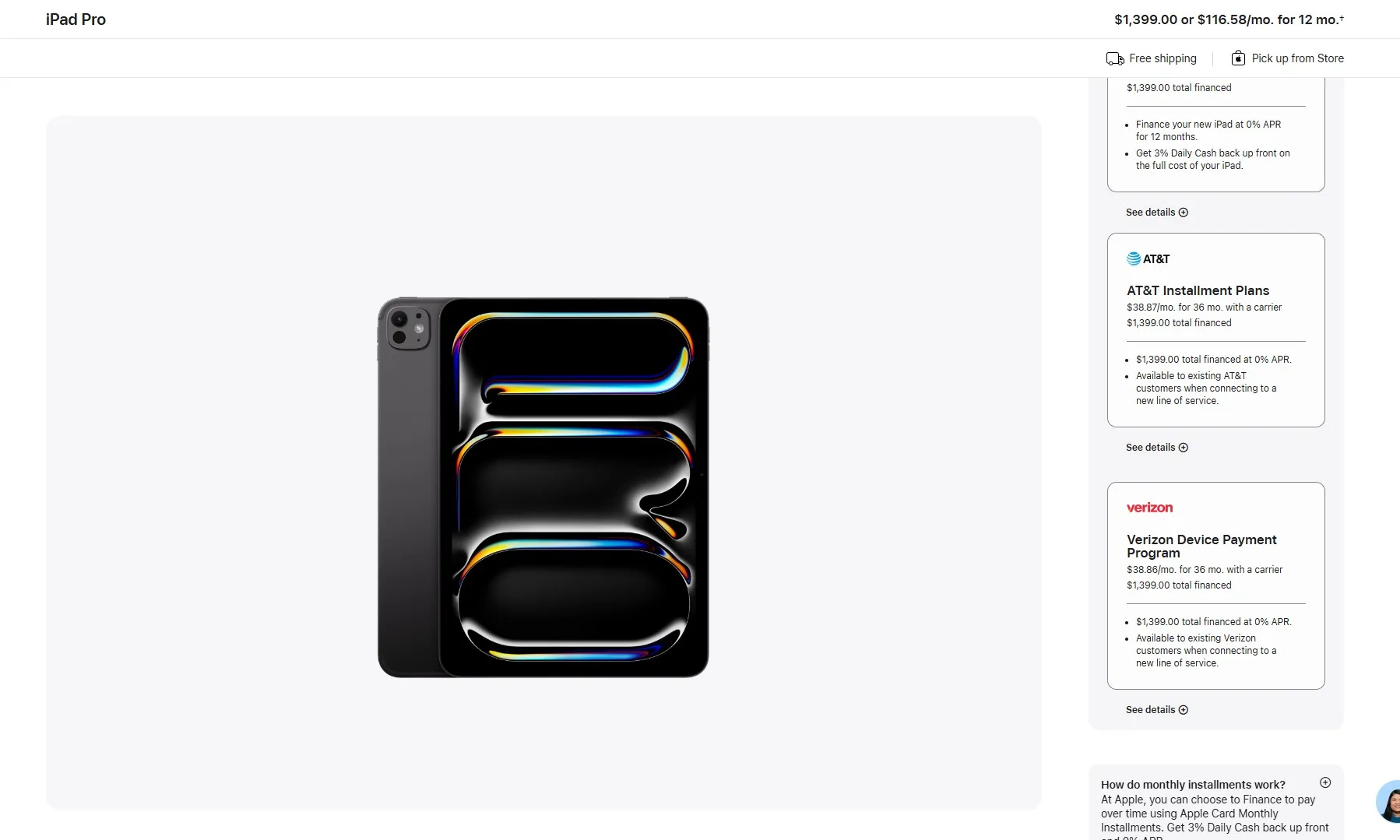
Apple has introduced 36-month carrier financing for cellular iPads purchased directly from the Apple Store. The option is available through AT&T and Verizon to existing customers who add a new line of service.
Until now, the main financing option offered directly by Apple was Apple Card Monthly Installments, which divides the cost of an iPad across 12 months. The new carrier plans stretch those payments across three years and cover the standard iPad, iPad mini, iPad Air, and iPad Pro.
The higher prices are easier to swallow
The new option arrives only weeks after Apple raised prices across its iPad lineup, and the sticker shock appears to have become significant enough for the company to offer buyers another way to pay. A cellular 11-inch iPad Pro now starts at $1,399. Apple Card financing works out to $116.58 per month for one year, while AT&T or Verizon financing reduces the hardware payment to roughly $39 per month for three years (via 9to5Mac).
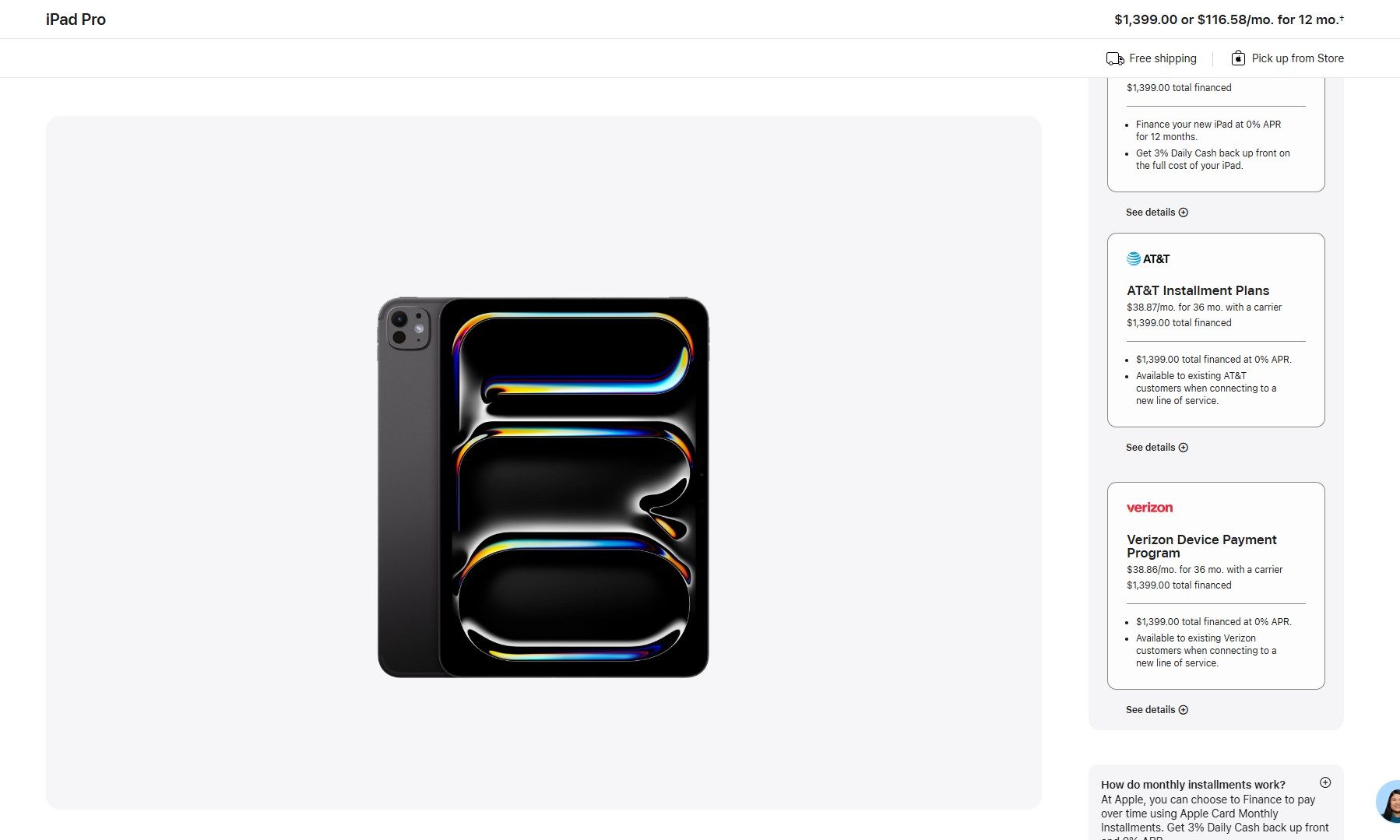
The installment will appear on the customer’s carrier bill alongside the cost of cellular service. Buyers get the iPad without paying the full amount upfront, Apple completes the sale, and the carrier gains a new line from an existing subscriber. There is one important catch. Anyone who cancels the line or switches carriers before the iPad is paid off will need to clear the remaining device balance. Once the balance is settled and the carrier’s other requirements are met, the iPad can be unlocked.
Why iPads have become more expensive
Apple has linked its recent price increases to the rising cost of RAM and storage. AI companies are buying huge quantities of memory for data centers, leaving less supply available for consumer electronics. Prices are unlikely to return to normal soon. Until memory costs ease, Apple may lean more heavily on carrier financing for future products that include cellular connectivity.
PAAS AND IAAS
Retail foundation leader Dave Treadwell takes over as senior leader and 19-year vet Dave Brown departs for pastures unknown
Dave Brown, a 19-year veteran of AWS and member of its S-team leadership cabal, is leaving Amazon for parts undisclosed.
It’s hard to overstate Dave’s impact on AWS; the few times I’ve met him, it was very clear that there was nothing I could trot out in the realm of “arcane EC2 trivia” that he didn’t go orders of magnitude deeper on with zero forewarning.
This is a titanic loss for AWS, because that’s roughly how deep Dave routinely dove. He’ll be handing the reins over to fellow S-team member Dave Treadwell, currently the head of Amazon Retail’s “eCommerce Foundation” (itself an upscale term for “bargain basement”).
Brown probably isn’t going to be a direct competitor (though he’s definitionally going to some Amazon competitor short of his next move being “philanthropy”), unless the two-week notice period is simply a bunch of Amazonian goons beating the tar out of him in a dark room around the clock until August.
But the interesting part to me is that suddenly Dave Treadwell has an enviable job.
Think about it for a second: Amazon retail was, for a time, the largest AWS customer — and certainly one of the most complicated. If I think I have beef about AWS-isms, there’s no doubt that “Tread,” as he’s apparently called, has mountains to my molehill of complaints.
So if I can slip into his role for a second, here would be my to-do list if I were coming from an Amazon Retail background and suddenly had EC2 bequeathed to me to run:
-
GPU capacity acquisition: Special people get special allocation rules, balanced between Capacity Blocks, war-clicking past InsufficientInstanceCapacity screens, and having to know a guy. Amazon has an entire internal project to solve this for its own teams. If I’m Tread, take a page from retail and smash Spot Fleet dynamics into a proper capacity marketplace. “Only 2 p6-b300.48xlarge left in stock. Ships from and sold by GPUZ4LOLZ (91% positive feedback).”
-
Savings plans / Reserved Instances archaeology: These sometimes-but-often-not overlapping discount vehicles were clearly designed by folks who never had to explain them to a CFO with anger management issues. Treadwell has a golden opportunity here to roll out dynamic raw pricing: on-demand rates that themselves fluctuate hourly like a third-party listing on discontinued and incompatible printer ink, replacing traditional commitment vehicles with a “Subscribe & Save 5%” toggle on vCPUs.
-
Instance type proliferation: As of this writing, there are 1,354 EC2 instance types available in us-east-1 alone, and the console picker assumes that you already know the correct answer. Riiiight. There’s a solution here! “Customers who launched m7i.large also launched …” combined with sponsored placement by EC2 sub-departments means the top result is now suddenly the instance family that AWS overbought. Is this the best instance for the customer? Who gives a rat’s ass; it’s what’s best for Amazon, a north star that Amazon Retail has been chasing for years.
-
SageMaker is someone’s empire-building project: There are over 35 SageMaker products, or features, or whatever the distinction is supposed to be at AWS. Tread should leave this alone, and introduce the amazing source of truth that is Customer Reviews. “1 star. Not as described. Arrived as Jupyter notebook; what the hell do I do with it?” They can repurpose their fake review detection to take down fraudulent reviews from other SageMaker sub-teams.
-
Quota request supplication: You know the drill; beg, plead, and wait for the privilege to give AWS more money. The fix here is almost too easy; y’know who doesn’t have to wait for quota increases? That’s right: Amazon Prime members.
That’s the easy punch list if it were me. But I’m me, and Tread is not. I’m sure he’s got planned more treats with far greater nuance and customer hostility; we’ll know for sure that he’s settled in when the EC2 section of our AWS bills starts including ads – and when Josh Pigford’s excellent Knockoff extension starts working in the EC2 console. ®

Works stalled on car-sized sinkhole that closed major Cambridge road

Wedgewood Partners Q2 2026 Client Letter (RWGIX)

US inflation falls to 3.5% as Bitcoin rebounds toward $65K


-

 Fashion7 days ago
Loro Piana Fall 2026 Enters Houston’s Art Scene
-

 Fashion5 days ago
Weekend Open Thread: Nutriplenish Leave-In Conditioner
-
 Sports6 days ago
2026 Genesis Scottish Open Thursday TV coverage: Round 1
-

 Sports6 days ago
Super Eagles star Moses Simon opens up on Liverpool transfer regret
-

 Tech7 days ago
Character.AI enters the microdrama arena with its own productions, but there’s a twist
-

 Politics14 hours ago
Young campaigners urge incoming PM to act on outdoor junk food ads
-

 News Videos1 day ago
XRP BOMBSHELL… XRP OMBOARDED FOR TRANSACTIONS!!!
-

 Tech2 days ago
Get Your ESP32 Sunny Side Up With This Solar Dev Board
-

 Tech1 day ago
Dark Secrets Emerge When Jailbreaking LLMs
-
 Sports5 hours ago
New Cornerback Enters Vikings Trade Rumor Mill
-

 Tech7 days ago
Level Infinite Launches Gangstar Mirage City in India with Pre-Registrations
-
 NewsBeat7 days ago
Major update after Huntingdon train attack as man enters plea
-
 Entertainment9 hours ago
Disney’s Most Ambitious Failed Star Wars Attraction Is Coming to SDCC
-

 News Videos2 days ago
how to make coin bank box with cardboard #scienceproject #money #diy #shorts
-
 Tech2 days ago
Cloudflare Precursor Watches Your Mouse and Keyboard To Decide If You Are Human
-
 Entertainment8 hours ago
Vicki Gunvalson Defends Discussing Heather Dubrow’s Money
-
 Crypto World7 days ago
DeFi Dashboard Zapper to Shut Down After 7 Years
-

 NewsBeat5 hours ago
Watch: Is Donald Trump facing a popular backlash on immigration?
-
Crypto World2 days ago
Ripple, Coinbase, Circle Join Linux x402 Foundation to Help Shape AI Payments
-
 NewsBeat4 hours ago
Firefighters issue update on Dovestone moorland blaze as fire enters fourth day
You must be logged in to post a comment Login