

Crypto World
Signs of life?: State of Crypto

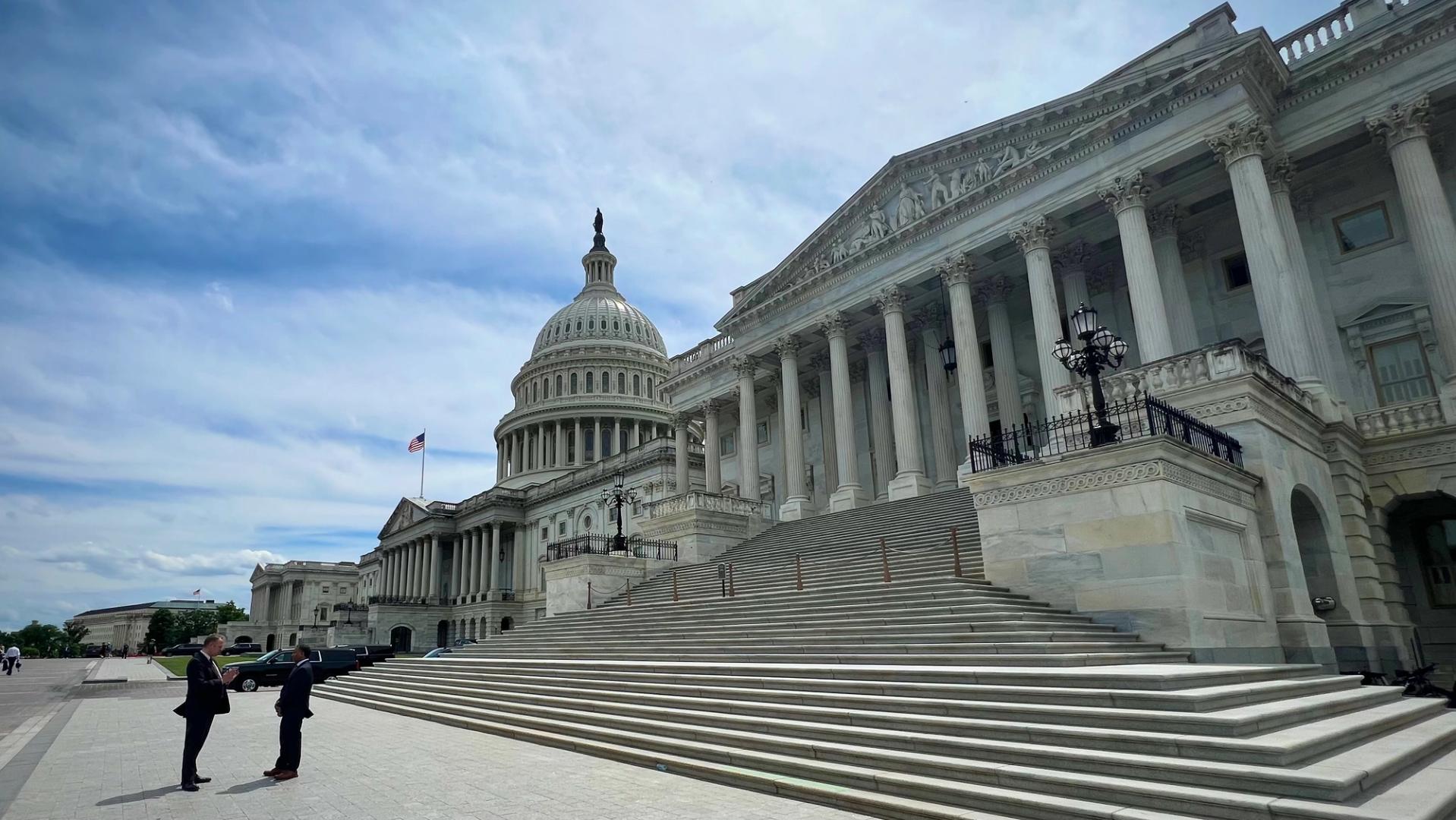
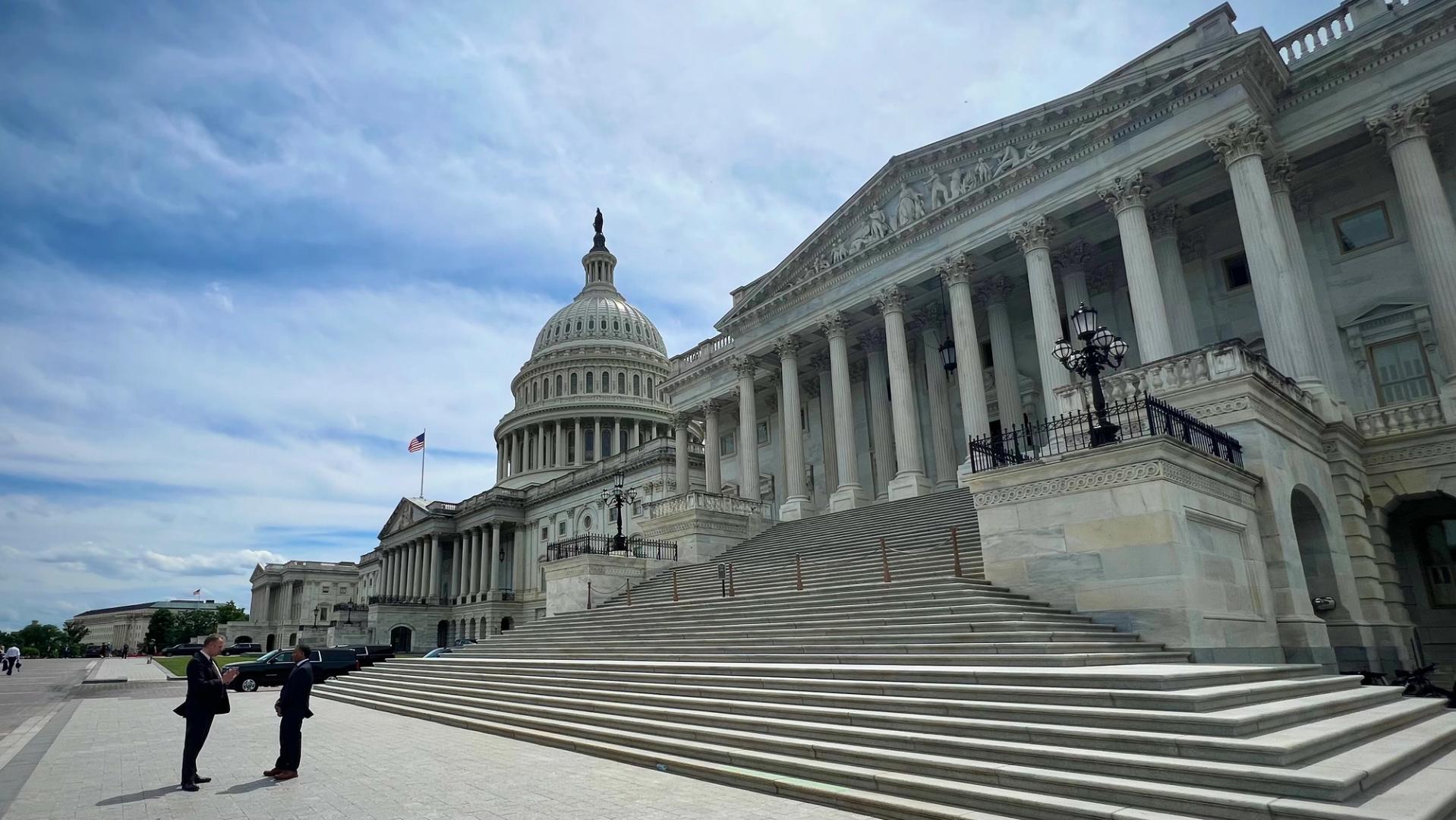
But the 2026 midterm election is coming up quite soon — Nov. 3, so less than four months from now — and lawmakers will have to face their own base and flanks after they break for the summer recess and go into the final campaign swing.
That means that U.S. President Donald Trump and the $1.4 billion he made off crypto will be a key factor in the floor vote. More specifically, if there isn’t an ethics provision, it’s unlikely that sufficient Democrats will vote for the bill in the Senate. If the text that drops next week doesn’t even include a placeholder to address the ethics portion, that may even be counterproductive to getting full bipartisan support for the bill, an individual said.
That means that Trump will still need to sign off on an ethics agreement. Several of the sources CoinDesk spoke to last week said the White House had not been as engaged recently as it had earlier in the summer, but another individual told CoinDesk in early July that it may just be a matter of waiting to see whether all the other outstanding issues are resolved first.
One bright side for the bill’s proponents: Assuming the President did not veto the housing bill sitting on his desk sometime between this newsletter’s filing and 12:00 a.m. on Saturday, a provision banning the Federal Reserve from issuing a central bank digital currency for at least four years will have taken effect. There was concern from industry players that House lawmakers might push to include a CBDC ban in Clarity if the Senate advanced the bill, which would further strain the negotiation process and timeline. But that issue should be resolved for now through at least until 2030, with the inclusion in the housing bill.

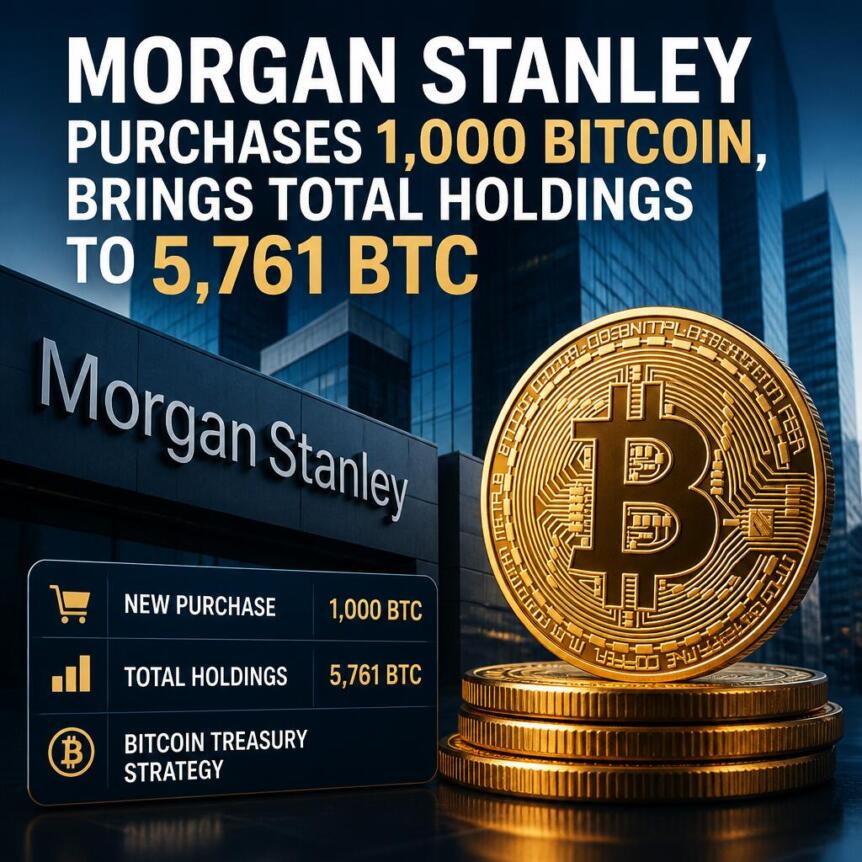
Banking giant Morgan Stanley acquired nearly 1,000 BTC over the past two weeks, taking its total holdings to 5,761 BTC, worth roughly $370 million.
According to data from Arkham, the bank added BTC to its existing stash during the market pullback through its spot Bitcoin investment product.
Morgan Stanley Adds To Bitcoin Stash
Morgan Stanley added to its Bitcoin holdings during the recent market pullback. The banking giant currently holds 5,761 BTC, making it one of the biggest institutional holders of the flagship cryptocurrency.
The acquisition was executed through a series of transfers instead of a single purchase. Arkham data shows large transfers from Coinbase Prime wallets. The transaction history also includes a 1 BTC transfer back to Coinbase Prime along with minor operational transfers.
The inflows originated from Coinbase Prime custody and deposit addresses, indicating the transfers were completed via Morgan Stanley’s spot Bitcoin investment product.
Buying The Dip
Arkham classifies Morgan Stanley as a fund, an exchange-traded product, and a Bitcoin whale. It has also linked the banking giant’s portfolio to 11 wallet addresses. The latest round of purchases is in line with Morgan Stanley’s strategy of accumulating during price dips.
However, Arkham or Morgan Stanley have not disclosed whether the purchases are direct purchases, client subscriptions, or operational inflows into its investment vehicle. Arkham has also not identified the underlying investors or whether the assets are being managed on behalf of clients or are firm-based holdings.
Morgan Stanley Increasing Its Crypto Footprint
Morgan Stanley Wealth Management recently announced a partnership with Galaxy Digital to expand its digital asset footprint. Under the partnership, high-net-worth individuals can lend their digital assets, including Bitcoin (BTC), Solana (SOL), and Ethereum (ETH), to Galaxy Digital in return for shares in spot crypto investment products, including the Morgan Stanley Bitcoin Trust. The program allows investors to gain crypto exposure in a regulated environment without selling their digital assets.
Morgan Stanley and Galaxy Digital claim the partnership also reduces the in-kind crypto-to-exchange-trading product onboarding times by 75%. The offering is part of a growing trend of on-chain accumulation as institutional interest and participation rise.
Disclaimer: This article is provided for informational purposes only. It is not offered or intended to be used as legal, tax, investment, financial, or other advice.
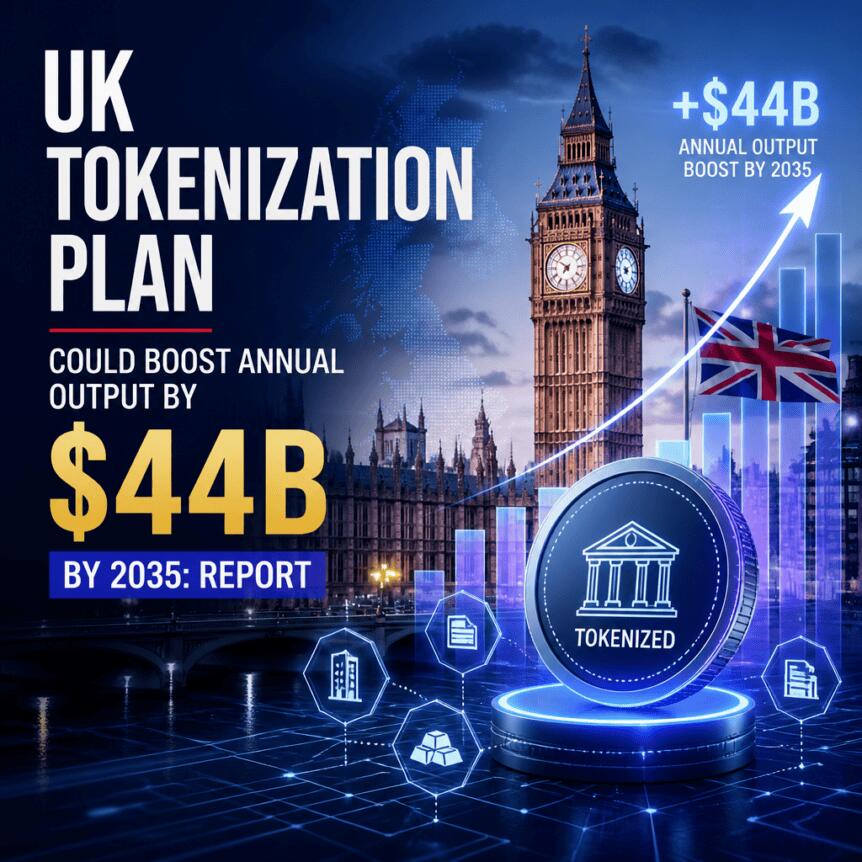
The UK is preparing to move tokenized financial markets from experimental pilots to scaled, live trading and settlement, according to a government-backed industry task force report published by Wholesale Digital Markets Champion Chris Woolard. The document estimates that, if the country becomes a leader in tokenized markets, the effort could add as much as £33 billion (about $44 billion) to annual economic output by 2035.
The report outlines a 12-month plan to test blockchain technology in a financial transaction that uses securities to borrow cash, and it calls for the UK to issue its first tokenized government bond—known as a gilt—by the first quarter of 2027. Woolard’s role is tied to HM Treasury’s digital markets strategy, with the task force assembled to connect traditional market infrastructure providers with digital-asset firms.
Key takeaways
- The task force aims to progress from isolated blockchain trials to “scale,” with real-market trading, settlement, and use of tokenized securities as collateral.
- Plans include a 12-month blockchain test focused on repo-like mechanics where securities are used to raise cash.
- The roadmap targets a first tokenized UK government bond issuance by the first quarter of 2027.
- The report urges the Bank of England to accept tokenized gilts as collateral, positioning collateral eligibility as a major adoption gate.
- Task force membership spans leading banks, market infrastructure firms, and crypto companies, underscoring a cross-industry approach.
From pilots to live tokenized securities markets
While tokenization has been discussed for years, the report’s emphasis is on practical market plumbing—moving beyond demonstrations toward arrangements that can support securities issuance, secondary-market activity, and settlement workflows. The task force describes its mission as shifting “from pilots to scale” and “from ambition to action,” reflecting a more implementation-focused posture than many earlier initiatives.
Central to that approach is the report’s view that tokenized assets have limited real-world value unless they can be traded and used to obtain cash. In the document’s framing, the ability to raise funding against tokenized securities—and to have those tokens participate in established collateral frameworks—determines whether tokenization can materially change market behavior.
To that end, the task force’s 12-month plan centers on testing blockchain in a financial transaction where securities are used to borrow cash. Although the report does not present additional implementation details in the provided text, the structure aligns with the market logic of repo transactions, where the speed and settlement efficiency of collateral exchanges can have meaningful operational and cost implications.
Tokenized gilts: a timeline and expanded end goals
Tokenized government bonds are not a brand-new idea in the UK. The government previously announced the Digital Gilt Instrument (digit) pilot in November 2024, using public documentation to describe the initiative.
Later updates pushed the concept further. A July 2025 update laid out intentions covering onchain settlement, over-the-counter trading, and secondary-market development. The government also appointed HSBC’s Orion platform to support the pilot on Feb. 12, signaling that at least part of the effort is geared toward real operational systems rather than purely theoretical trials.
The new task force report builds on that foundation by adding a clearer timetable and broadening how the tokenized gilt would be used. Beyond issuance, the roadmap seeks subsequent digital-gilt offerings, live secondary-market trading, and—importantly—eligibility for use as central bank collateral.
The collateral angle is where the report becomes more than a rollout plan. It explicitly argues that tokenized securities only become economically meaningful when they can be used to raise cash, and it calls on the Bank of England to accept digital gilts as collateral. For market participants, that would be a key step toward turning tokenized assets into a mainstream funding and settlement tool rather than a niche alternative.
Task force composition and industry buy-in
Woolard’s first report was developed with a task force described as bringing together more than 50 companies spanning traditional finance and crypto. The membership list in the text includes BlackRock, Goldman Sachs, JPMorgan, Morgan Stanley, HSBC, UBS, Coinbase, Circle, Ripple, Kraken, DTCC, and Euroclear.
Ripple, which appears among the industry members, publicly supported the initiative in a statement shared on Monday. The company said that onchain funds, bonds, and repo are not experiments, arguing that such instruments are already proving “cheaper, better and faster” than legacy equivalents.
For investors and builders, the breadth of the task force matters. A tokenization roadmap that includes both major securities market infrastructure players and crypto platforms suggests the UK is trying to align interfaces—custody, settlement, and compliance—rather than relying on a single ecosystem.
How UK payment infrastructure could connect the dots
The report’s tokenized-gilt ambition also intersects with existing UK efforts to improve settlement and payments. The text points to a blockchain-based wholesale payment infrastructure that could support tokenized-market settlement.
In December 2023, London-based Fnality launched a sterling-denominated payment system tied to central bank reserves. The network was designed to enable real-time repo, tokenized securities settlement, and cross-currency payments, potentially providing the infrastructure layer needed for tokenized collateral to move quickly and consistently across parties.
By pairing that sort of settlement/payment capability with a phased approach to tokenized gilts and secondary-market trading, the UK’s roadmap is effectively trying to solve two problems at once: how tokenized assets are issued and traded, and how the cash legs and settlement mechanics work end to end.
Still, the biggest practical uncertainty remains whether collateral eligibility—specifically Bank of England acceptance of digital gilts—can be achieved on a timeline that matches the planned issuance and market scaling. The report’s call for central bank collateral suggests that regulators and system operators will play a decisive role in determining how quickly tokenization can move into full-market usage.
Going forward, market participants should watch for updates on the 12-month blockchain test details, the operational requirements for secondary trading, and any announcements that clarify how the Bank of England and other oversight bodies plan to treat tokenized gilts as collateral. If those pieces align, the UK could shift tokenization from a series of pilots into a functioning market segment with real funding utility.
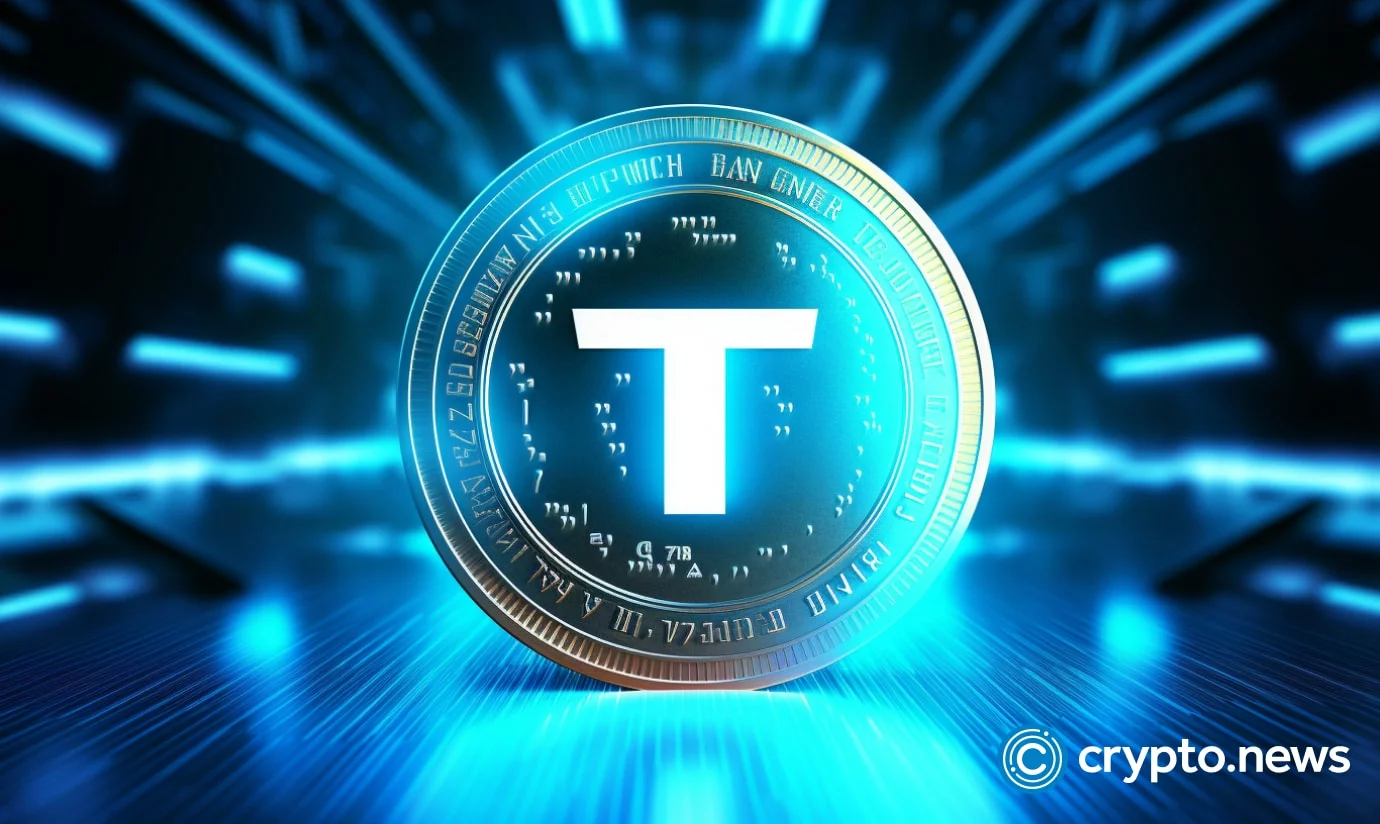

Bolivia has moved closer to recognizing Tether’s USDT as an official payment option alongside the boliviano and the U.S. dollar as the country continues to grapple with a prolonged shortage of foreign currency.
Summary
- Bolivia is considering recognizing USDT as an official payment option alongside the boliviano and U.S. dollar.
- Local banks already support USDT services as the country struggles with a prolonged dollar shortage.
- Tether is expanding institutional use of USDT while pursuing stronger reserve transparency through a KPMG audit.
According to reports from Bolivia, government officials are weighing a proposal that would allow USDT to circulate as part of the national payment system, a step that would formalize a practice already taking shape across parts of the country’s financial sector.
If approved, the move would make Bolivia the first Latin American nation to officially recognize USDT as a payment option alongside its domestic currency and the U.S. dollar.
Years of declining natural gas production and exports have steadily reduced Bolivia’s dollar reserves, leaving businesses and importers struggling to secure foreign currency. The shortage has pushed authorities to explore alternative payment methods, with crypto gradually becoming part of that strategy instead of remaining a niche financial product.
Dollar shortages have accelerated USDT adoption
The government’s first major crypto-related measure came in March 2025, when state-owned energy company YPFB received authorization to use cryptocurrency payments for fuel imports during the country’s worsening dollar shortage.
Retail adoption followed soon after. In June 2025, Tether chief executive Paolo Ardoino shared images on social media showing Bolivian stores listing everyday products, including dairy goods and chocolate, with prices displayed in USDT.
The posts suggested stablecoins were already being used for ordinary purchases rather than remaining limited to investment activity.
Crypto analyst CryptoPatel later argued on X that economic conditions, rather than regulation, were encouraging people to move toward stable assets, writing, “When your currency fails, bring in the stable one.”
His comments accompanied growing evidence that many consumers were choosing the dollar-pegged stablecoin as access to physical U.S. dollars became increasingly difficult.
Meanwhile, Bolivia’s banking sector has already begun supporting the ecosystem. Local lenders Banco Unión and Banco FIE currently provide services linked to USDT, indicating that much of the financial infrastructure needed for wider adoption is already in place.
Formal recognition would instead establish a regulatory framework around an existing trend, potentially making remittances faster, lowering transaction costs and offering an alternative to informal dollar markets.
Tether expands institutional use of USDT
Outside Bolivia, Tether has continued promoting USDT for larger financial transactions. As previously reported by crypto.news, Hyundai Motor America and Hyundai Motor Mexico completed a pilot cross-border treasury payment using USDT on the Avalanche blockchain.
According to Tether, Hyundai Motor America converted U.S. dollars into USDT before transferring the stablecoin to its Mexican subsidiary, where it was exchanged back into U.S. dollars.
The company said the $20,000 transfer, including verification, was completed in about seven minutes, compared with three to four hours or longer for a conventional bank transfer.
Institutional credibility has also become a focus for the stablecoin issuer. In March 2026, Tether appointed KPMG to conduct a full audit of reserves backing roughly $185 billion worth of USDT. The company said the audit is intended to strengthen confidence in the token’s reserve backing following years of scrutiny over its transparency.
Operationally, Tether has concentrated its stablecoin strategy around USDT after discontinuing its aUSDT product, reinforcing the flagship token’s role in its international business.
Despite growing momentum, Bolivia has not yet finalized the legal framework for integrating USDT into its payment system. Neither the Central Bank of Bolivia nor lawmakers have published formal implementation rules.
Still, reports indicate the proposal has advanced further than previous crypto initiatives in the country, while other emerging economies facing persistent dollar shortages are expected by analysts to watch Bolivia’s experience closely.
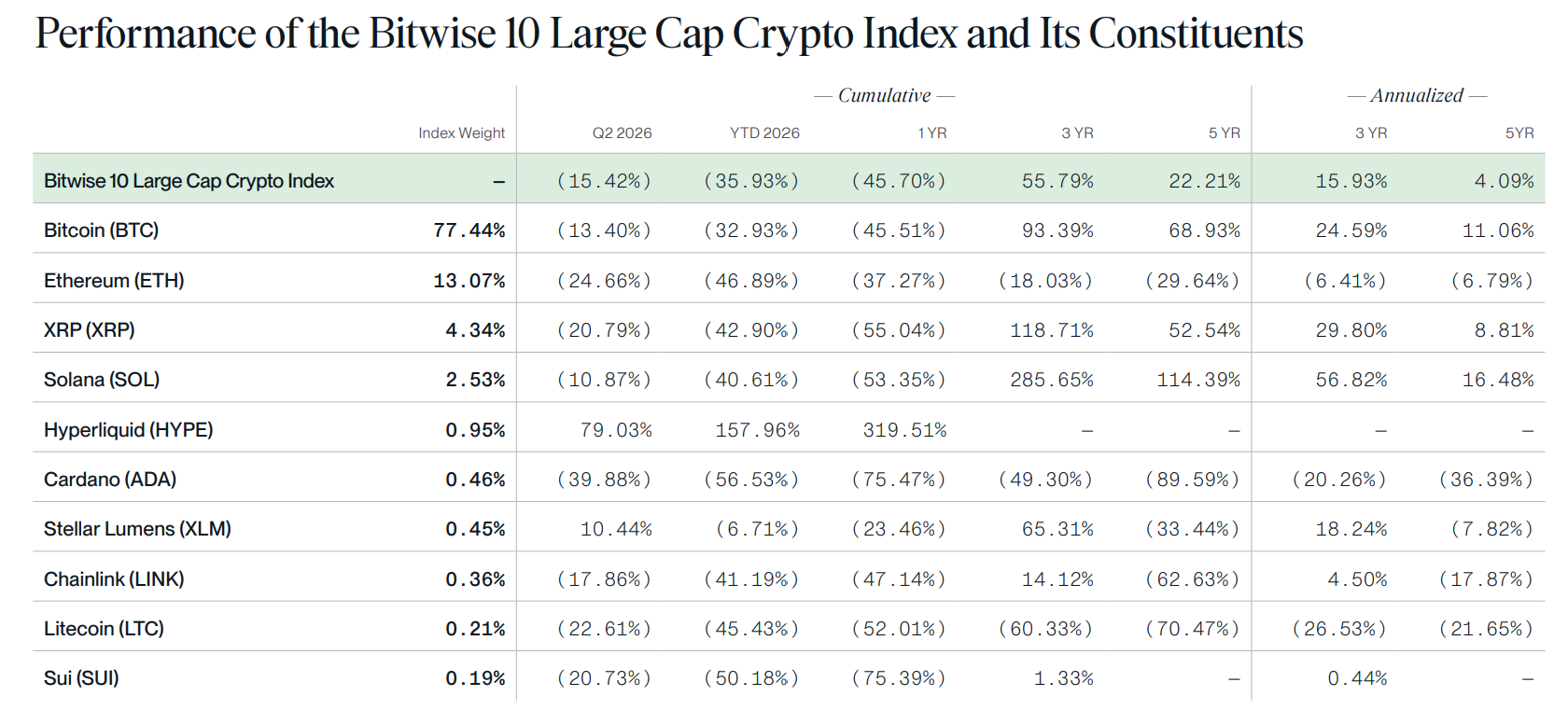
Stablecoin volume hit a record $1.79 trillion in June, even as the tokens’ total supply shrank. The split captures a market pricing crypto for a downturn while its usage keeps climbing.
A Bitwise report, Visa’s on-chain data, and new ownership figures point the same way. Stablecoin transfers and prediction markets hit records even as the Bitwise 10 Large Cap Crypto Index fell 15.4%.

Prices Fell, But the Plumbing Kept Growing
The second quarter was crypto’s third straight losing quarter, the longest run since 2022. Spot Bitcoin (BTC) exchange-traded funds posted their worst quarter of outflows. On-chain activity and trading volume slipped.
Yet the Bitwise report argues the market has it backwards. Crypto is being priced for a bear market, it says, even though the industry is roughly twice its 2022 size. Deeper liquidity and more institutions now sit on-chain.
The gap shows up in the fundamentals. Measured against the 2022 low, Ethereum (ETH) transaction activity is up about 13 times. Value locked in decentralized finance has climbed more than 60%, and stablecoin assets have roughly doubled.
Prices still lagged. The flagship crypto index fund lost ground, with eight of its 10 holdings in the red.
That divide has reopened the question of whether the market has already found the bear market bottom.
Stablecoin Volume and Derivatives Led the Quarter
Stablecoins settled about 2.3 times Visa’s payment volume over the past year, Bitwise said. In June, transfers reached the $1.79 trillion record, according to Visa Onchain Analytics. Rising institutional stablecoin volume kept settlement near all-time highs.
A shrinking stablecoin supply once signaled trouble. Terra’s 2022 collapse erased tens of billions and froze the market. This time supply eased while transfers set a record, a very different backdrop.
USD Coin (USDC) handled about two-thirds of that volume. Regulated dollars are taking share as institutions lean in.
Trading told a similar story. June spot volume across major exchanges fell roughly 5% from May, while derivatives volume rose about 4%. Active traders stayed engaged even as casual buyers stepped back.

Tokenized Assets and Prediction Markets Set Records
Tokenized real-world assets climbed 50.3% this year to $32.89 billion, the report said. Prediction market volume hit a record $43.2 billion in the quarter, close to 18 times its level a year earlier.
Crypto equities held up too. The Bitwise Crypto Innovators 30 Index rose 30.6%. Apps such as Hyperliquid, PancakeSwap, and Aave each earned close to $900 million in revenue over the past year.

Advisers increasingly favor stablecoins and tokenization over direct Bitcoin bets. Individuals still hold about two-thirds of Bitcoin supply.
However, institutions and funds bought roughly 829,000 BTC in 2025, while retail wallets shed about 696,000, according to River.
Bitwise framed the split between price and progress as the setup for the next cycle.
“That foundation won’t stop the winter, but it determines what grows in the spring,” Matt Hougan wrote.
The next few quarters will test whether usage pulls prices up or weak prices sap momentum. For now, the data shows an industry still growing while its market value waits to catch up.
The post Crypto Bear Market? These Reports Say the Industry Has Never Been Stronger appeared first on BeInCrypto.


Jito has proposed a governance overhaul that would direct 100% of the DAO’s JTX revenue share toward open-market JTO buybacks and permanent token burns through at least Q4 2027.
Summary
- Jito has proposed using DAO revenue for JTO buybacks and permanent token burns through Q4 2027.
- JIP-38 would place most protocol revenue under DAO control, with JTO holders governing allocations.
- JTO rose as much as 8% after the governance proposal was unveiled, according to crypto.news.
According to a governance proposal published by Jito on July 13, the protocol has introduced JIP-38, which would formally classify Jito as a token-centric network where nearly all major network revenue flows to the decentralized autonomous organization and remains under the control of JTO token holders.
The proposal triggered an immediate market reaction, with Jito (JTO) climbing as much as 8% shortly after its release, according to data from crypto.news.
Revenue would be redirected to JTO holders
Under JIP-38, Jito proposes using the DAO’s entire share of JTX revenue to buy JTO tokens on the open market before permanently removing those tokens from circulation. According to the proposal, this arrangement would remain in place for at least one year, extending through the fourth quarter of 2027.
One exception remains in the framework. The proposal states that 20% of JTX platform fees would continue to be reinvested into JTX development rather than being allocated to buybacks and burns. Jito said the remaining major revenue streams would continue flowing through the DAO under governance controlled by JTO holders.
To carry out the program, the proposal calls for buybacks to be executed automatically through a Rev Splitter mechanism overseen by the project’s Dev Council. Alongside the automation process, Jito plans to update its governance documentation so the protocol’s operating model formally recognizes the token-centric structure.
According to JIP-38, existing revenue allocation commitments would be completed before a comprehensive review of protocol fee streams takes place in Q4 2027.
During that review, governance participants would evaluate the performance of token buybacks, ecosystem incentives, and other capital allocation methods before JTO holders vote on the network’s next long-term revenue framework.
Governance changes extend beyond token burns
Beyond the buyback program, JIP-38 outlines several operational changes intended to support the new revenue structure. According to the proposal, the Rev Splitter would become progressively more automated while governance records would be updated to match the revised economic model.
Jito also stated in the proposal that the framework is designed so value generated across the network accrues to the JTO token instead of external corporate entities. Any future changes to revenue allocation after Q4 2027 would require approval through governance voting by JTO holders.
The proposal arrives as Jito continues expanding its presence across the Solana ecosystem. Earlier this year, as previously reported by crypto.news, 21Shares launched the 21Shares Jito Staked SOL ETP (JSOL) on Euronext Amsterdam and Euronext Paris.
The issuer said the product provides regulated exchange-traded exposure to Solana through JitoSOL while embedding staking rewards, allowing investors to access the asset through traditional brokers and banks without managing wallets or staking infrastructure.
Institutional support for the protocol has also grown over the past year. As previously reported by crypto.news, Andreessen Horowitz’s (a16z) crypto division invested $50 million in Jito to help expand the Solana staking protocol’s ecosystem.
The investment included an allocation of JTO tokens to the venture firm, adding another high-profile backer as the protocol seeks approval for its latest governance proposal.


Strategy has raised $466.7 million through fresh MSTR stock sales while leaving its Bitcoin holdings unchanged at 843,775 BTC for the week ending July 12.
Summary
- Strategy raises $466.7 million through MSTR stock sales.
- Company keeps Bitcoin holdings unchanged at 843,775 BTC.
- Standard Chartered maintains $100,000 Bitcoin target despite treasury concerns.
According to a Form 8-K filed with the U.S. Securities and Exchange Commission (SEC), Michael Saylor-led Strategy sold 4,818,781 Class A MSTR shares between July 6 and July 12 through its at-the-market (ATM) program, generating approximately $466.7 million in net proceeds. Despite the capital raise, the company reported that it did not purchase or sell any Bitcoin during the reporting period.
The filing showed Strategy continued to hold 843,775 BTC, acquired for about $63.69 billion at an average purchase price of $75,476 per Bitcoin, excluding fees and expenses. Following the latest issuance, the company still has roughly $23.79 billion available under its MSTR ATM stock program.
Strategy keeps Bitcoin holdings unchanged after recent sale
Fresh SEC disclosures also showed Strategy held approximately $3 billion in U.S. dollar reserves as of July 12. According to the filing, the cash is intended to cover preferred stock dividends and interest payments on the company’s debt. The reported balance also includes expected proceeds from ATM share sales that had not settled by the reporting date.
The company further disclosed that it did not repurchase any shares under its existing buyback programs during the same week.
The latest filing follows Strategy’s $216 million Bitcoin sale disclosed the previous week, only the second BTC sale in the company’s history. At the time, the company said the proceeds would be used to fund dividends tied to its STRC preferred stock and other digital credit securities. After that transaction, Strategy’s Bitcoin balance fell to 843,775 BTC, where it has remained through the latest reporting period.
Earlier reports also noted that Strategy has authorization to sell up to $1.25 billion worth of Bitcoin under its BTC Monetization Program, a development that has drawn close attention from market participants even though the company has not announced additional BTC sales.
Standard Chartered says treasury uncertainty drove recent weakness
Attention around Strategy’s Bitcoin plans increased after Executive Chairman Michael Saylor posted the company’s familiar Bitcoin acquisition chart on July 12 with the message, “Orange dots tell only part of the story.” As crypto.news reported earlier, the post did not confirm whether Strategy had bought, sold, or held Bitcoin during the latest reporting week.
Crypto.news also noted that Strategy’s public Bitcoin tracker continued to show 843,775 BTC, matching the latest SEC filing. The company typically reports treasury activity through regulatory filings, meaning social media posts do not establish whether a transaction has occurred or indicate its direction.
The latest disclosure comes as Bitcoin has climbed back above $64,000 after Standard Chartered reaffirmed its $100,000 price target for the end of 2026. In a research note, the bank said recent weakness in Bitcoin was driven largely by uncertainty surrounding Strategy’s evolving treasury approach rather than by any deterioration in Bitcoin’s underlying fundamentals.
Standard Chartered added that the recent pullback should not be interpreted as a change to its long-term bullish outlook for the cryptocurrency.

Reed Smith, the global law firm with more than 30 offices across North America, Europe and Asia, has introduced an automated compliance platform aimed at helping crypto firms prepare for the European Union’s Markets in Crypto-Assets (MiCA) regime as oversight intensifies. The tool, called “Aquarius,” is designed to streamline parts of the MiCA workload while keeping legal review integrated into the process.
Reed Smith says Aquarius can automate tasks such as crypto-asset classification, regulatory white paper generation, due diligence workflows and environmental, social and governance (ESG) disclosures. The firm also plans to extend the platform to other compliance environments beyond the EU, including the United Kingdom, the United Arab Emirates, Hong Kong and Singapore.
Key takeaways
- Reed Smith’s Aquarius platform targets MiCA implementation by automating classification, documentation, due diligence and ESG disclosures.
- The rollout comes as the EU moves deeper into full MiCA enforcement following the end of the July 1 transition period.
- Even with harmonized rules, authorization and ongoing supervision—especially for custodians—remain operationally demanding.
- Policymakers are also discussing possible changes to MiCA’s stablecoin framework, including rules for non-euro-denominated issuers.
Aquarius aims to reduce compliance friction as MiCA matures
MiCA is intended to create a consistent licensing and rulebook for digital asset service providers across the EU’s 27 member states, covering areas such as consumer protection and operational requirements. Reed Smith’s stated goal with Aquarius is to make entry into the European market—or expansion within it—more manageable by combining automated workflows with legal expertise.
The timing is notable. Earlier this month, the EU’s MiCA transition period ended on July 1, after which firms could no longer rely on temporary national exemptions tied to countries that had previously adopted longer grandfathering arrangements. For companies that had planned compliance in phases, the end of that window effectively tightened the deadline pressure and increased the urgency to demonstrate readiness under the full framework.
For operators, this matters because MiCA compliance is not a one-time checkbox. Firms must be able to show they meet licensing criteria and operational expectations, and they must be prepared for ongoing regulatory attention as supervisory activities ramp up.
MiCA authorization is only the start for custodians
Even though MiCA harmonizes the regulatory landscape, authorization still appears challenging for many service providers. Last week, the European Securities and Markets Authority (ESMA) launched a supervisory review of authorized crypto-asset service providers. According to earlier reporting referenced in the source material, ESMA’s focus includes how custodians safeguard client assets and how they manage operational risks.
That emphasis aligns with industry concerns around the practical burden of compliance. Sebastien Dessimoz, co-founder and managing partner of Taurus (a digital asset infrastructure provider), is cited as saying that a MiCA license is “only the beginning” for custodians. He points to continued scrutiny over cybersecurity, governance and the ability to protect client assets—issues that do not end at the moment a firm receives authorization.
In other words, compliance strategy increasingly becomes a continual operational process: firms must maintain controls, demonstrate effectiveness over time and ensure that risk management keeps pace with both technology and regulatory expectations.
Potential stablecoin rule revisions add uncertainty for issuers
Beyond licensing, the regulatory picture may be shifting for specific segments of the market. Reports suggest that EU policymakers are considering revisions to MiCA’s stablecoin framework, particularly rules governing the issuance of stablecoins that are not denominated in euros.
As cited in the source material, Euronews attributes part of the impetus for the discussions to the United States’ GENIUS Act, which created a federal framework for payment stablecoins. While the details of any EU changes were not specified in the source excerpt, the implication for market participants is clear: stablecoin issuers may need to plan for evolving requirements, especially where cross-border regulatory influence could reshape how issuers are classified and supervised.
For companies preparing documentation, disclosures or product roadmaps, this type of policy uncertainty can materially affect timelines and internal sign-offs—particularly if compliance artifacts must be updated to reflect shifting interpretations or amended standards.
Why automated compliance tools are gaining attention
Reed Smith positions Aquarius as a way to combine standardized processes with legal oversight, targeting repetitive and documentation-heavy steps that can slow down onboarding and expansion. If implemented effectively, automation could help reduce time-to-readiness by making it easier for firms to assemble core compliance outputs—such as classification materials, regulatory white paper drafts, and due diligence documentation—before legal teams finalize and validate them.
At the same time, automation does not eliminate the underlying regulatory obligations. The ESMA supervisory review referenced in the source underscores that regulators are looking beyond initial submissions to real-world custody practices, operational controls and risk management behavior.
Readers should watch how platforms like Aquarius are used in practice: whether firms treat automation as a way to build defensible compliance packages and then continuously monitor operations, or whether they simply accelerate paperwork without improving the controls supervisors expect.
As MiCA supervision expands and stablecoin-specific discussions continue, the next phase of compliance will likely be defined by two tracks: ongoing custody and operational scrutiny from regulators, and potential adjustments to stablecoin rules that could ripple into disclosures and product structures. Firms should monitor both developments while validating that their compliance systems can adapt quickly as requirements evolve.
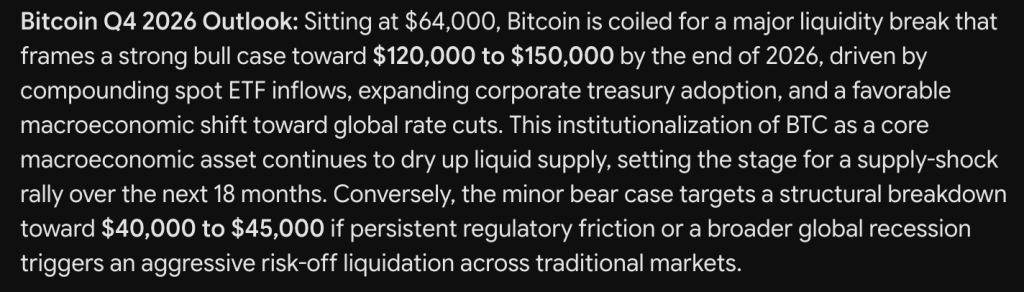
Google Gemini AI just framed Bitcoin current price position as a coiled spring rather than a broken asset. The model predicts $120,000 to $150,000 by the end of 2026, treating the current $64,000 level as the exact setup that precedes a major liquidity break.
The bull case is built on 3 compounding forces rather than a single catalyst. Bitcoin sits near $64,000 today, and the model opens by describing the setup as coiled for a major liquidity break, which is a specific framing that implies the move will be fast and sharp rather than gradual once it begins.
Compounding spot ETF inflows are the first force, with institutional demand continuing to absorb supply at a pace that steadily reduces what is available on the open market.
Expanding corporate treasury adoption is the second force, with more companies following the Strategy playbook and treating Bitcoin as a core balance sheet reserve rather than a speculative bet.
The third force is a favorable macroeconomic shift toward global rate cuts, which loosens liquidity conditions and pushes capital toward higher returning assets as cash yields decline.
Together these 3 forces are described as institutionalizing Bitcoin as a core macroeconomic asset, which continues to dry up liquid supply and sets the stage for a supply shock rally over the next 18 months.
The model does not pin everything on a single legislative event or exact timing window, instead treating the structural forces already in motion as sufficient to push price toward that $120,000 to $150,000 target by year end.
The bear case is the starkest downside scenario in any Bitcoin prediction covered in this series. If persistent regulatory friction or a broader global recession triggers aggressive risk off liquidation across traditional markets, the model sees a structural breakdown toward $40,000 to $45,000.
That bear case is notably more severe than the $55,000 to $60,000 floors named in most other predictions in this series, reflecting how seriously Gemini treats the tail risk of a genuine macro shock rather than just a crypto specific pullback.

Bitcoin Price Prediction: BTC Quietly Builds A Base While The Market Waits For The Next Liquidity Break
The daily chart shows Bitcoin at $64,135 after a recovery off the June lows near $58,000 that has been building steadily over the past 2 weeks.
Price has pushed back above $64,000 on this candle, which is the highest close since late May and represents a series of higher lows forming since the June bottom.
That pattern of higher lows combined with relatively consistent green sessions is the most encouraging technical development this chart has shown in months. Resistance sits first at $68,000, the level that capped multiple push attempts throughout May and June, with a much heavier ceiling near $80,000 where the most extended rally of 2026 ultimately stalled.
The $40,000 to $45,000 bear case floor sits well below current price but is not so remote that it can be dismissed, given how far Bitcoin has already fallen from its October highs near $127,000.
Support holds at $59,000, the most recent cycle low that was tested and held in late June. The broader structure still shows lower highs stretching all the way back to October, meaning the dominant downtrend has not reversed on any technical basis yet.
Momentum on the daily candles looks constructive and improving, with the past week delivering some of the cleaner green closes seen anywhere on this chart since the April rally attempt.
The supply shock framing Gemini uses fits what the chart is showing in one important way, price is not breaking down despite sustained selling pressure over many months, which suggests a floor may genuinely be forming. A clean break and hold above $68,000 would be the first real signal that the coiled spring Gemini is describing has finally started to release.
Here is What Gemini AI Predicts About LiquidChain
Most people will only see this rotation in hindsight. The smart money has already moved.
Large caps are not failing. They are out of room. Bitcoin, Ethereum, and XRP keep pressing against the same ceilings with nothing breaking through. Every macro tailwind has a new arrival date. Every institutional wave lands next quarter. Sitting in assets where the upside depends entirely on someone else’s decision is not a strategy. It is a waiting room.
Capital that has survived enough cycles knows one thing. It moves before the destination becomes obvious.
Early-stage infrastructure plays by completely different rules. A small market cap means that a modest rotation can produce dramatic price movement. The returns live in the gap between what something is genuinely worth and what the market has assigned it so far. That gap exists only while the project remains undiscovered. Once found, it closes permanently.
Multi-chain fragmentation is bleeding DeFi every single day. Bitcoin, Ethereum, and Solana exist as completely isolated systems. No native bridge between them. Every user crossing those boundaries absorbs the cost directly in fees, slippage, and failed transactions. Every single crossing. Every single time.
Gemini AI predicts LiquidChain fixes that entirely. All 3 networks within a single execution layer. One deployment reaches everything. Zero cross-chain tax on any interaction.
The presale is at $0.01454 with just over $890,000 raised. The market has not found this yet. That is exactly the point.
Execution is unproven. Adoption is unknown. Established assets offer a predictable ride toward a ceiling everyone can already see. LiquidChain is an entry point that disappears the moment the market looks up.
The post Google Gemini AI Predicts Shocking Bitcoin Price by End of 2026 appeared first on Cryptonews.
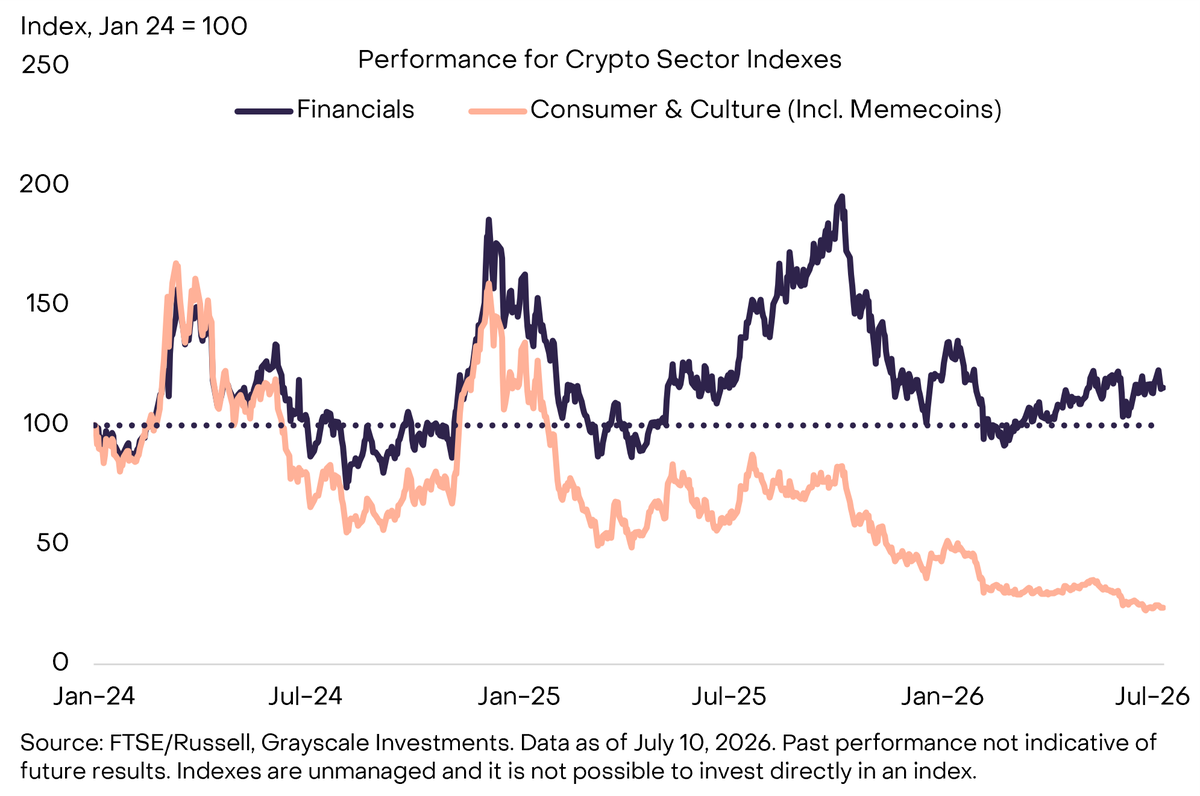
Grayscale says the crypto market is increasingly rewarding tokens with real fundamentals, and financial protocols led by Hyperliquid (HYPE) are pulling far ahead of meme coins.
The asset manager attributes the divide to a crypto bear market and rising institutional adoption. Both forces are separating revenue-generating projects from speculative tokens with little underlying value.
Why the Crypto Market Rewards Fundamentals Now
Grayscale built its case with its Crypto Sectors framework, a set of indexes developed with FTSE Russell. The system sorts more than 150 protocols by function and is reassessed each quarter. Grayscale’s recent research groups tokens by what they do, not the story around them.
Follow us on X to get the latest news as it happens
The Financials Crypto Sector covers protocols that deliver financial transactions and services on-chain. Their fundamentals track the adoption of stablecoins, tokenized assets, and other blockchain use cases.
Stablecoin settlement volume recently hit fresh records, reinforcing that demand. The gap widens in a downturn, when tokens without revenue fall hardest.
Hyperliquid Pulls Ahead as Memecoins Fade
Since the start of 2024, the Financials Crypto Sector has gained roughly 15%, while the Consumer and Culture Crypto Sector has fallen about 75%. That leaves financial tokens ahead of their consumer peers by about 90 percentage points.

By contrast, the lagging sector is dominated by meme coins like Dogecoin (DOGE), the 2013 original, which Grayscale says now make up around 85% of its market value.
Grayscale singles out Hyperliquid as the standout. The on-chain exchange routes trading fees into an assistance fund that buys back HYPE, tying the token’s value to actual platform usage.
Hyperliquid’s HYPE token has climbed from an all-time low near $3.81 in late 2024 to a June 2026 peak of $76.70. It traded near $63 on Monday, up about 29% on the year, and ranks 10th by market value.

“Crypto markets are rewarding tokens with strong fundamentals. These include Hyperliquid and other leading financial applications of blockchains,” Grayscale noted.
Some fund managers make the same case. Tushar Jain, chief investment officer of Multicoin Capital, says leading protocols should be judged like companies. His firm holds HYPE and sees Hyperliquid leading in on-chain derivatives.
“Solana is a business. Hyperliquid is a business. They are meant to go and generate cash flow, and that is the primary thing that gives those tokens value…” Jain said in a recent interview.
Other revenue-focused projects have leaned into the same shift, including a recent revenue-funded token burn. Whether that lead holds may hinge on consumer tokens building real income. For now, Grayscale’s data suggests fundamentals, not speculation, are setting the market’s winners apart.
The post Grayscale Says the Crypto Market Is Rewarding a Different Kind of Token appeared first on BeInCrypto.

Coinbase Ventures maintained its lead among crypto-focused venture capital investors in the first half of 2026, completing the most funding deals in CryptoRank’s dataset. The Coinbase exchange’s corporate VC arm recorded 30 deals from January through June, edging out Animoca Brands (19), a16z (18), and Tether (15), according to CryptoRank’s funding analytics.
While top investors kept showing up, the wider market remains under pressure. Total funding for crypto companies dropped to $1.4 billion in June, down from $3.8 billion in April—an indication that deal activity is still more fragile than headline counts alone suggest. Even so, July brought a modest rebound, with $456 million raised across 12 funding rounds so far.
Key takeaways
- Coinbase Ventures led deal counts in H1 2026 with 30 investments, followed by Animoca Brands (19), a16z (18), and Tether (15), per CryptoRank.
- Funding volumes remain depressed: June totals fell to $1.4 billion (down from $3.8 billion in April), alongside fewer rounds (61 in June vs. 89 in May).
- DeFi, payments, and AI dominate VC interest over the past year, collectively accounting for hundreds of fundraising rounds.
- Investor participation narrowed: unique investors fell to 242 in June from 452 in October 2025.
- Geography is uneven: US-based VCs led in capital deployed over six months, while a large share of funds came from undisclosed locations.
Coinbase Ventures stays on top as deal volume softens
Across the first half of 2026, the most active crypto-focused investors by number of deals were concentrated among a handful of firms. Coinbase Ventures’ 30 transactions placed it above Animoca Brands, a16z, and Tether in CryptoRank’s tally.
Looking beyond H1, CryptoRank data shows that Coinbase Ventures also remained highly active over the previous 12 months, completing 75 deals—more than any other listed contender. Animoca Brands followed with 40 deals, YZi Labs (formerly Binance Labs) with 39, GSR with 31, and a16z with 30.
Those sustained activity levels stand in contrast to softer market conditions. Crypto VC fundraising fell to $1.4 billion in June, down 63% from $3.8 billion in April. Deal counts declined as well: June saw 61 fundraising rounds, compared with 89 in May.
Still, the pattern is not uniformly downward. CryptoRank data indicates a slight recovery relative to earlier in the year: April’s totals included a two-year low of $698 million across 71 fundraising rounds, and June—while weaker than May—did not repeat that extreme low.
Where the capital goes: DeFi, payments, and AI lead
Crypto VC interest over the past year skewed heavily toward three categories: decentralized finance, payments, and AI-linked crypto initiatives. According to CryptoRank, DeFi protocols accounted for 216 fundraising rounds, payments startups logged 131 rounds, and AI-crypto companies raised through 128 rounds.
Infrastructure also remained a consistent focus. CryptoRank reports 110 funding rounds for infrastructure providers during the same period, while all other sectors recorded fewer than 100 rounds.
For investors and founders, this distribution matters because it suggests VC capital is still flowing toward applications and rails rather than exclusively chasing speculative narratives. Even during a period of reduced fundraising totals, the categories attracting the most rounds tend to have clearer product pathways—whether that’s enabling on-chain finance, improving transaction and settlement use cases, or integrating AI capabilities into crypto systems.
Shifts inside the portfolio: Coinbase Ventures’ thematic exposure
Coinbase Ventures’ participation over the last six months shows a thematic pattern aligned with broader market preferences, though with a degree of specificity. CryptoRank data indicates Coinbase Ventures took part in:
- Seven investment rounds linked to payment protocols
- Four rounds supporting DeFi projects
- Three rounds tied to infrastructure and real-world asset tokenization
That mix reflects a VC approach that emphasizes core crypto primitives and monetizable use cases. At the same time, the relatively small number of rounds in each subcategory (for Coinbase Ventures’ own activity) highlights that even top investors are not scaling uniformly—rather, they are selecting fewer bets while still covering key themes.
Fewer participants, different geography, and what to watch next
Even as deal counts remained steady for certain lead investors, the broader ecosystem saw reduced participation. CryptoRank shows the number of unique investors in June fell to 242 from 452 unique investors in October 2025. That contraction suggests a more selective capital environment: fewer players are deploying money, even if some large funds continue to originate deals.
Geography provides another lens on how VC behavior is concentrating. Over the past six months, US-based VCs contributed $5.8 billion, while Australia-based VCs deployed $3.6 billion. CryptoRank also reports that more than $11.6 billion was invested from undisclosed locations, underscoring how opaque parts of the fundraising landscape remain.
With July activity already showing $456 million raised across 12 funding rounds so far, the immediate question for market participants is whether this qualifies as a durable rebound or merely a short-term uptick. CryptoRank’s June-to-July movement suggests conditions can improve after declines, but the drop in unique investors—and the still-low June fundraising level versus April—signals that conviction and breadth in the VC market may take longer to fully return.

2026 Home Run Derby results: Follow along with every swing

Uber’s product chief on hotels, robotaxis, and why the company doesn’t want to be “everything for everyone”

Sham Fight 2026: Details of Royal Black Institution celebrations at Scarva and Bangor


-

 News Videos7 days ago
Whats Hidden Inside This Cash Register? #treasure #reselling #money
-

 Fashion5 days ago
Loro Piana Fall 2026 Enters Houston’s Art Scene
-

 Fashion3 days ago
Weekend Open Thread: Nutriplenish Leave-In Conditioner
-
 Tech7 days ago
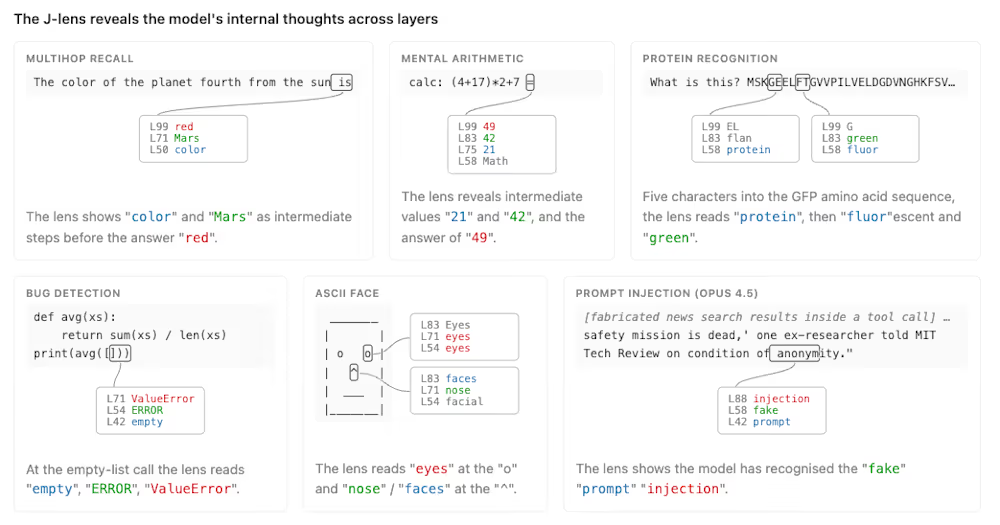
Anthropic’s new “J-lens” reveals a silent workspace inside Claude that mirrors a leading theory of consciousness
-
 Sports4 days ago
2026 Genesis Scottish Open Thursday TV coverage: Round 1
-

 Sports6 days ago
Joshua Pacio ‘more complete’ ahead of ONE rematch vs Malachiev
-

 Tech6 days ago
Anthropic brings Claude Cowork to mobile and web as usage data shows most users aren’t coding
-

 Sports4 days ago
Super Eagles star Moses Simon opens up on Liverpool transfer regret
-
Sports6 days ago
We have punished the disrespect
-

 Crypto World7 days ago
Binance lists Strategy’s STRC stock as company expands Bitcoin funding
-

 Tech4 days ago
Character.AI enters the microdrama arena with its own productions, but there’s a twist
-

 Tech7 days ago
9 Best Keyboards (2025), Tested and Reviewed
-
 Business7 days ago
Enbridge: AI Tailwind Priced In (Rating Downgrade)
-
 Crypto World6 days ago
Claude AI Created Something Anthropic Never Designed
-

 News Videos7 days ago
“What’s going on?!” Carl Froch discusses Floyd Mayweather Jr financial issues
-

 Crypto World6 days ago
Nasdaq arthritis company holding Moshe Hogeg crypto hits all-time low
-
 Entertainment7 days ago
Taylen Biggs Reveals The Celebrity She Dreams Of Interviewing
-
 Crypto World7 days ago
Microsoft Cuts 4,800 Jobs as Xbox Loses 3,200 Roles in Reset
-

 News Videos5 days ago
Crypto Just Entered Its Most Important 6-Month Candle (Could Decide Everything!)
-

 Tech6 days ago
Keychron is stepping outside keyboards with a $349 Thunderbolt 5 dock aimed at power users
You must be logged in to post a comment Login