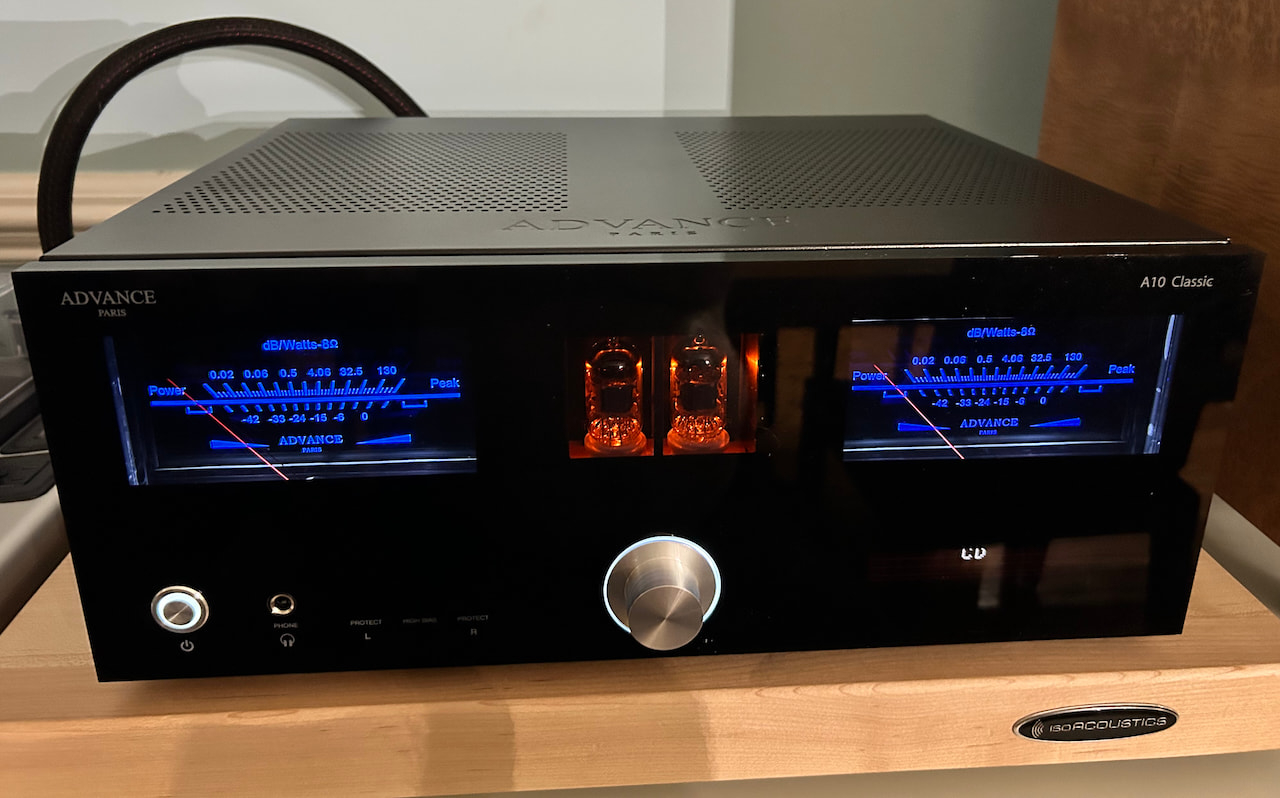
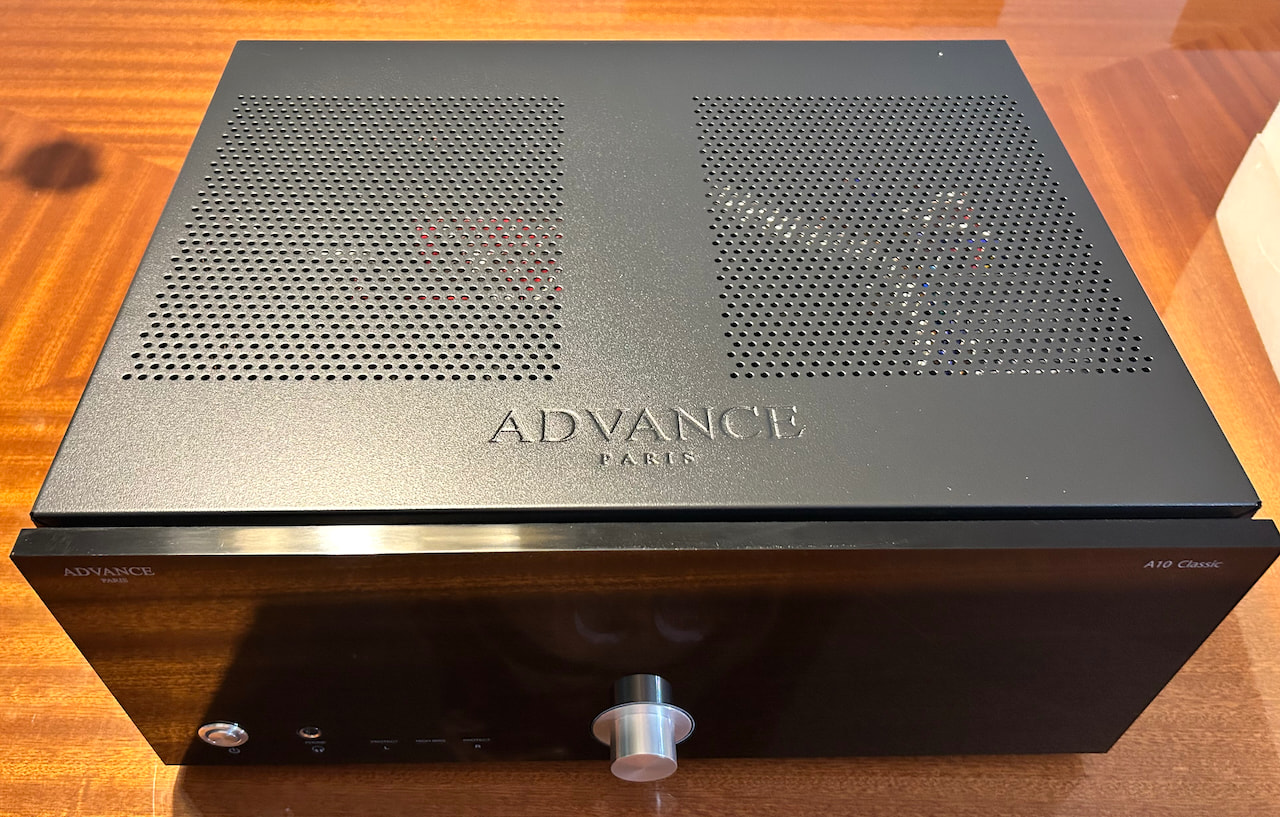
The French have never suffered from a shortage of self-confidence. Their cars, cinema, food, and hi-fi tend to arrive with a point of view, and the Advance Paris A10 Classic is no exception. With illuminated VU meters, two ECC81/12AT7 tubes glowing behind its front panel, and a Class AB output stage rated at 130 watts per channel into 8 ohms and 190 watts into 4 ohms, it looks less like another anonymous black box and more like something intended to command the room. This is not amplification for the light and fluffy croissant crowd.
The A10 Classic is not a new integrated amplifier. It has been part of the Advance Paris lineup for several years, preceding both the company’s anniversary APEX models and the flagship NOVA electronics that we experienced at AXPONA 2026. That does not make it irrelevant. If anything, the A10 Classic helps explain how Advance Paris arrived at its current formula: bold industrial design, tubes where they can influence the character of the presentation, solid-state output stages where current and control matter, and enough connectivity to anchor an entire two-channel system.
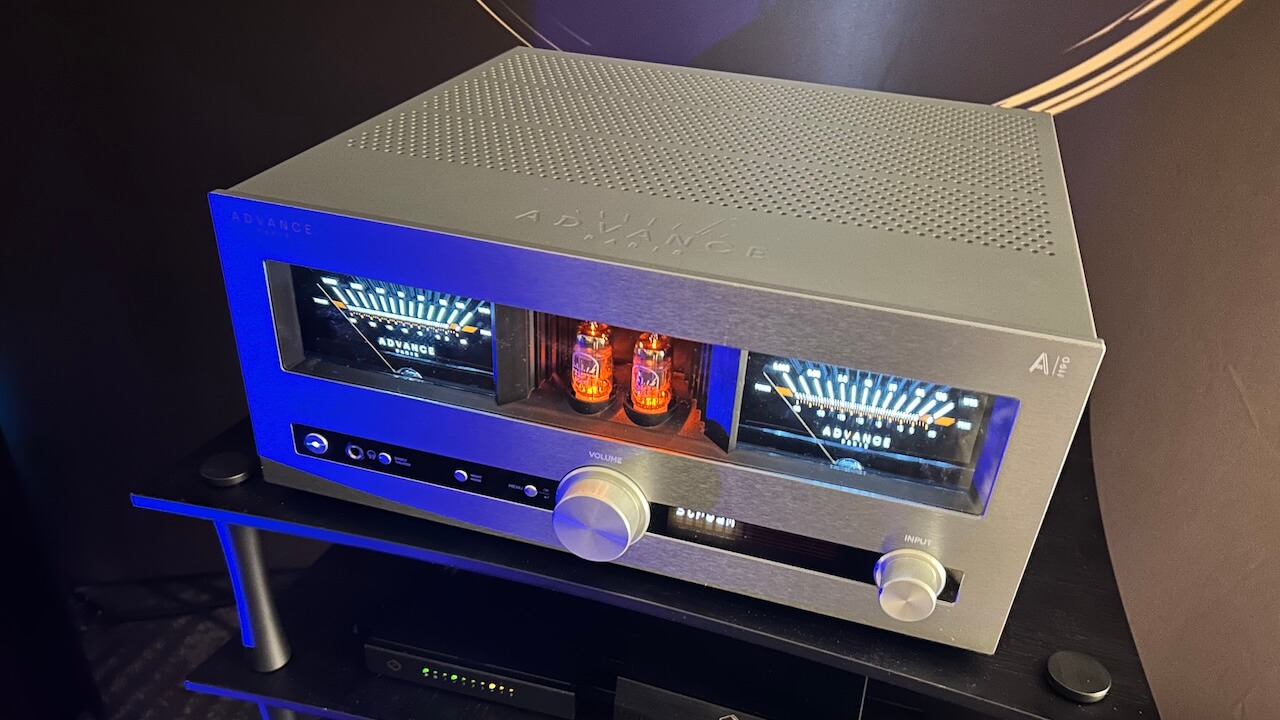
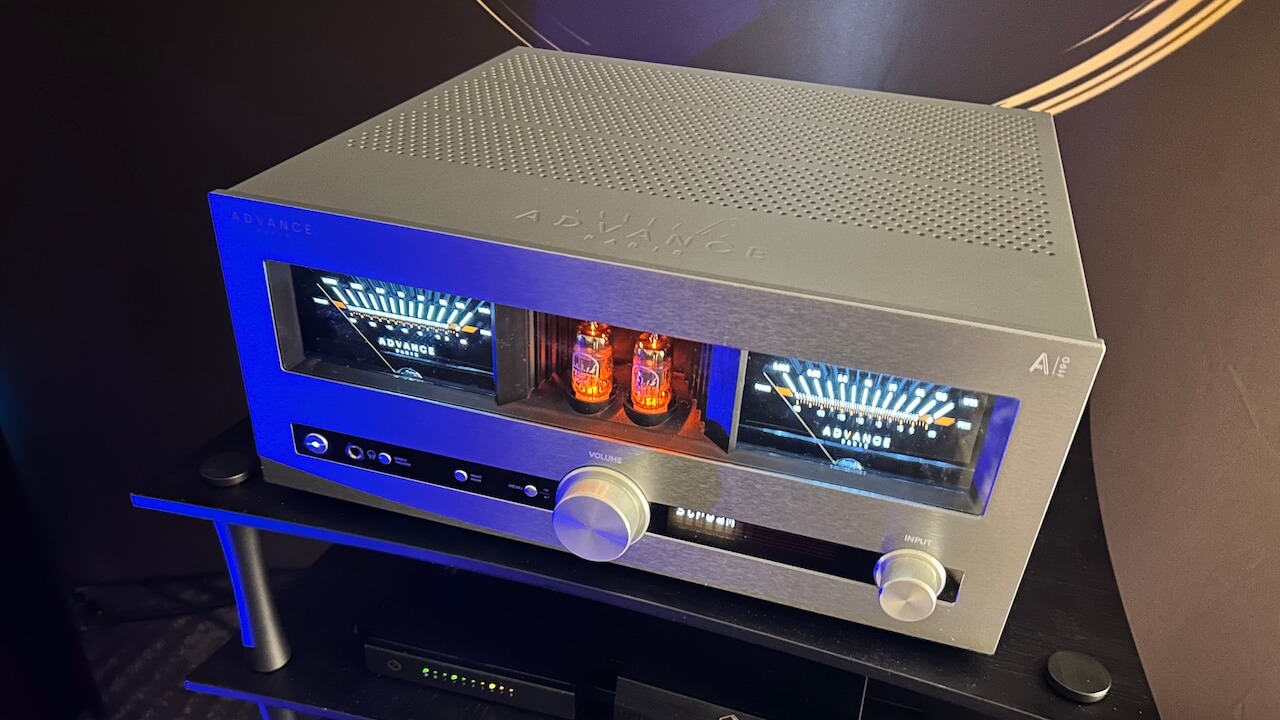
Advance Paris NOVA A-i190 at AXPONA 2026
At AXPONA, Advance Paris placed the spotlight on the NOVA A-i130 and A-i190 integrated amplifiers, which push that concept further with DSP, more sophisticated subwoofer management, modular streaming, and optional bi-directional Bluetooth. The A-i190 was one of our Best in Show selections because it balanced vintage-inspired styling with genuinely useful system flexibility and a surprising amount of power driving a pair of Vienna Acoustics floor standing loudspeakers. The A10 Classic is a simpler and older interpretation of that philosophy, but the family resemblance is unmistakable.
Its continued relevance also says something about why integrated amplifiers have become so popular. Listeners increasingly want fewer boxes, but they are not necessarily willing to surrender vinyl playback, digital inputs, television connectivity, subwoofer support, or enough power to drive demanding loudspeakers.
Advertisement
On paper, that promises some of the tonal body associated with tubes, the control and current delivery of transistors, and enough flexibility to replace several separate components. The newer NOVA models may represent where Advance Paris is going, but the A10 Classic reveals a great deal about how the company got there. The question is whether all that established French muscle still delivers sufficient finesse or merely a very convincing accent.
Related Reviews:
From Jadis Romance to Advance Paris Muscle
There was a time when French hi-fi had a fairly recognizable personality. The better examples from Jadis and YBA could sound delicate, spacious, and beautifully saturated through the midrange, with a sweet top end that made strings and vocals especially inviting. The trade-off was sometimes a slight softening of low-level detail and bass that emphasized warmth and texture over speed or absolute control. Think red Burgundy rather than a chilled Sancerre: richer, rounder, and not especially interested in showing you every sharp edge.
It also reminded me of driving around Paris in an old Citroën with my cousin, who worked as a researcher at the Institut Pasteur. The car’s famously compliant suspension floated over damaged pavement and insulated us from nearly everything happening beneath the tires. It was wonderfully comfortable, but you did not always receive a detailed report from the road. Some older French amplifiers could behave the same way, smoothing over rough recordings and delivering a more romantic presentation while sacrificing a little grip, transparency, and bottom-end precision.
The newer French approach is rather different, although Devialet and Advance Paris do not arrive there by the same technical route. Devialet’s patented ADH architecture operates its Class A analog and Class D switching amplifiers simultaneously in parallel. The Class A section determines the output voltage but is relieved of supplying the corresponding current; the Class D stage provides that current and performs most of the heavy lifting. The objective is to preserve the linearity of Class A while gaining the power density, efficiency, and loudspeaker control of Class D. It is considerably more sophisticated than placing two different amplification technologies in consecutive stages.
Advertisement
Advance Paris A10 Classic
The A10 Classic follows a more conventional, and arguably more serviceable, division of labor. Its ECC81/12AT7 tubes operate in the preamplifier stage, where they handle the low-level signal before passing it to a Class AB push-pull transistor output section. The tubes are therefore not driving the loudspeakers or sharing output duties with the transistors; they are used upstream, where they can influence gain structure and tonal character, while the solid-state section supplies the current, control, and 130 watts per channel into 8 ohms. It is hybrid amplification in series rather than Devialet’s parallel ADH topology, and the distinction matters.
Which approach is superior? That depends on whether you prioritize tonal beauty and forgiveness or speed, resolution, control, and system flexibility. Having owned both Jadis and YBA components, I understand the attraction of the older school. I also experienced enough operational eccentricity to distinguish charmingly French from utterly weird. There is quirky, and then there is wondering whether your amplifier has decided that electrical consistency is merely an Anglo-Saxon suggestion. I have been there. I will not be going back.
As this is being written, France are two victories away from winning the 2026 World Cup and will face Spain in the semifinal on July 14. Their attacking group of Kylian Mbappé, Ousmane Dembélé, Michael Olise, and Bradley Barcola has been dangerous not simply because of its pace, but because it understands when to press, when to create space, and when to strike. France reached the semifinal after beating Morocco 2–0, with Mbappé and Dembélé supplying the goals.
Advertisement. Scroll to continue reading.
Advertisement
The A10 Classic leans much closer to that newer French philosophy. It is forceful, quick, and capable of delivering genuine low-frequency authority, but its tube preamplifier stage keeps it from becoming sterile or relentlessly clinical. It retains some of the tonal color associated with the older French school while providing the control, power, build quality, and day-to-day reliability that I would now demand from an integrated amplifier. The older approach could be seductive. The A10 Classic is more interested in winning the match.
The A10 Classic is less Cyrano and more Nikita: unmistakably French, outwardly stylish, and capable of delivering considerably more force than its polished appearance suggests.
Technology and Specifications
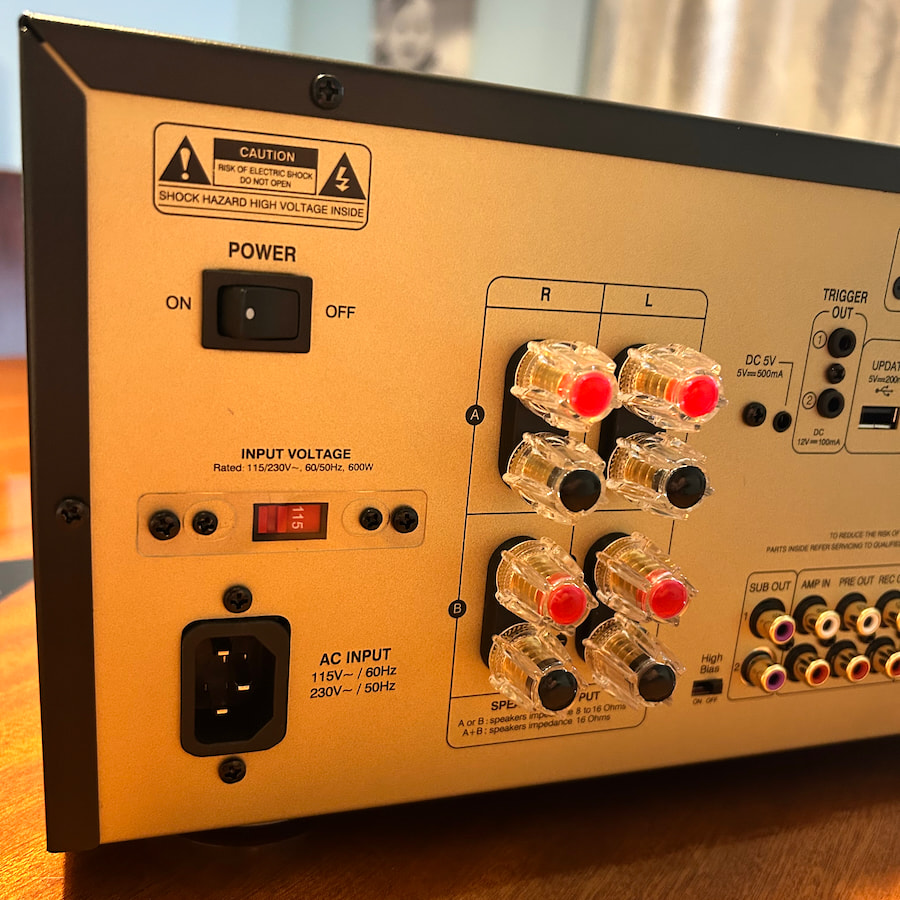
The A10 Classic is designed as the center of a serious two-channel system rather than another amplifier pretending to be a tablet. It delivers 130 watts per channel into 8 ohms and 190 watts into 4 ohms, with a High Bias setting that increases the standing bias of the output stage for the first few watts. Advance Paris does not publish the precise Class A operating range, but it definitely results in a warmer top panel.
The amplifier also requires approximately 30 seconds to warm its two ECC81/12AT7 tubes after startup, with a countdown displayed on the front panel before operation begins. High Bias mode produces additional heat, so placement matters: Advance Paris recommends at least 50 mm, or 2 inches, of clearance on each side and 100 mm, or 3.9 inches, above the chassis. This is not an amplifier to bury inside a tightly packed cabinet beneath a cable box and three years of unopened mail.
Advertisement
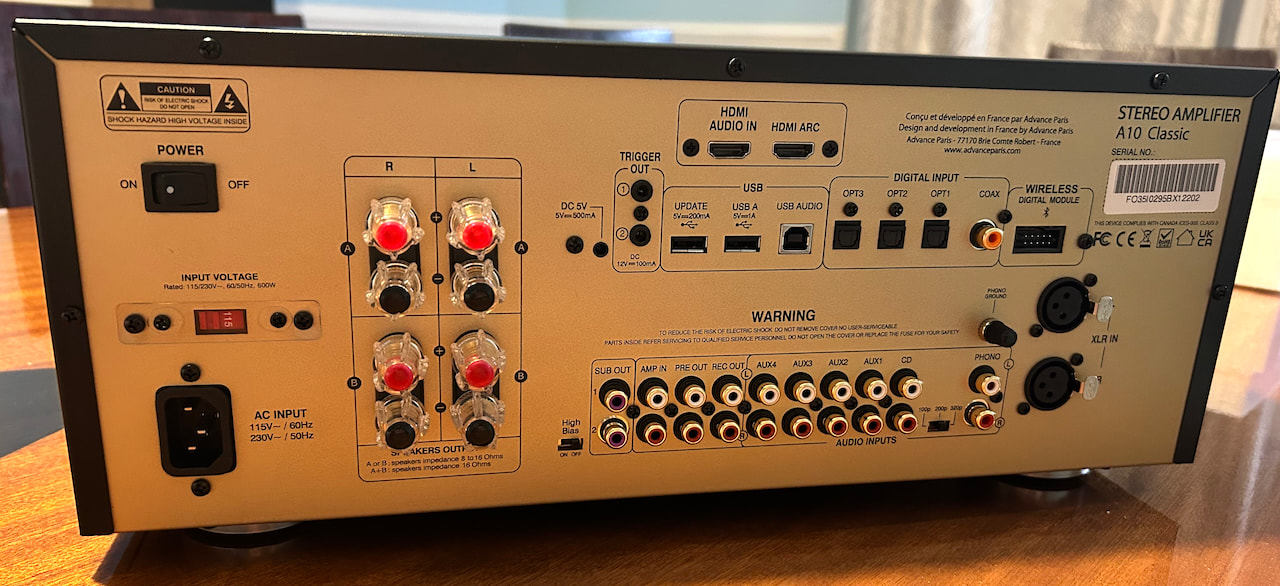
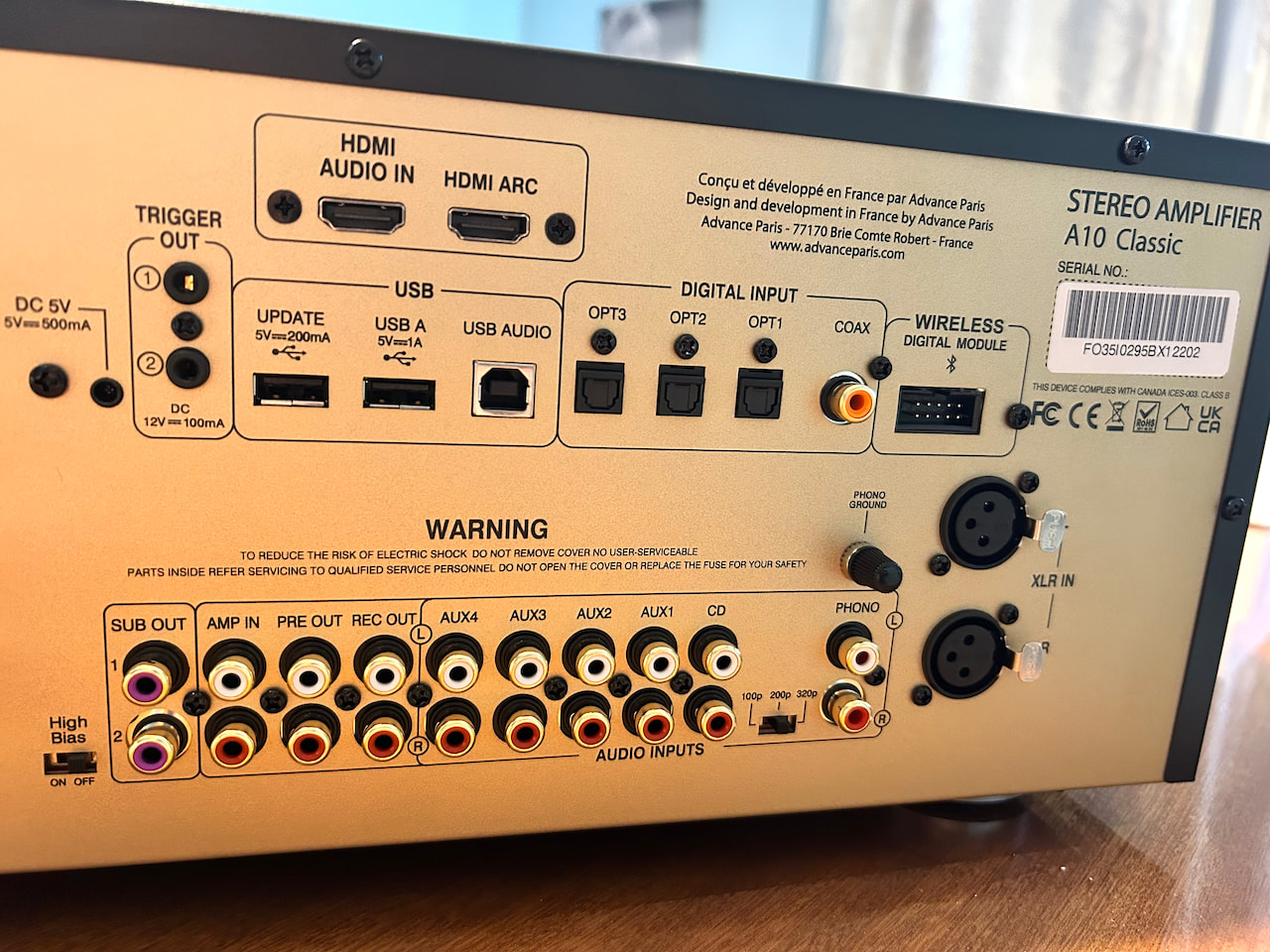
Its analog connectivity is unusually comprehensive. Five line-level RCA inputs are joined by a balanced XLR input and an MM phono stage with selectable capacitance settings of 100, 200, or 320 pF. The phono input does not support moving-coil cartridges, but the adjustable capacitance makes it more useful than the fixed MM stages fitted to many integrated amplifiers.
Pre-out and amp-in connections allow the two sections to be separated, while a fixed record output, two mono subwoofer outputs, two switchable speaker zones, a trigger connection, and a front-panel headphone jack cover most conventional system requirements.
The digital section is built around an ESS9018 DAC and includes three optical inputs, one coaxial input, USB-B for computer audio, USB-A for MP3 playback, HDMI ARC for a television, and a second HDMI audio input for a compatible source. USB-B supports PCM up to 32-bit/384 kHz and DSD256 through DoP; coaxial reaches 24-bit/192 kHz and optical is limited to 24-bit/96 kHz. Bluetooth is optional through Advance Paris’s X-FTB01 aptX or X-FTB02 aptX HD module rather than being built into the amplifier.
There is no Wi-Fi, Ethernet, native streaming platform, app control, room correction, moving-coil phono stage, or HDMI eARC. The subwoofer outputs also lack adjustable crossover, high-pass filtering, and time alignment, so bass management remains the responsibility of the subwoofer. The HDMI inputs provide a convenient route for stereo television and source audio, but the A10 Classic is not an AV receiver and Advance Paris does not document Dolby or DTS decoding. Its appeal is hardware longevity: add the streamer of your choice today and replace that source when the software industry moves the goalposts again.
Advertisement
Advance Paris A10 Classic Specifications
Type: Hybrid stereo integrated amplifier
Tubes: 2 x ECC81/12AT7 in the preamplifier stage
Power output:
130 watts per channel into 8 ohms
190 watts per channel into 4 ohms
Amplification: Class AB with switchable High Bias mode
DAC: ESS9018
Analog inputs: 5 x stereo RCA, 1 x balanced XLR
Phono: MM; 47 kΩ; 100, 200, or 320 pF capacitance
Digital inputs: 3 x optical, 1 x coaxial, USB-B, USB-A, HDMI ARC, HDMI Audio In
Maximum digital resolution: PCM 32-bit/384 kHz and DSD256 via USB-B
Bluetooth: Optional aptX or aptX HD module
Outputs: Pre-out, amp-in, fixed record out, 2 x mono subwoofer, Speaker A/B, headphone, trigger
Frequency response: 20 Hz to 80 kHz, ±3 dB
Dimensions (W x H x D): 430 x 175 x 385 mm (16.9 x 6.9 x 15.2 inches)
Weight: 14.5 kg / 32 pounds
Listening
I have lived with the Cambridge Audio Edge A integrated amplifier for close to five years, and at no point have I felt any desire to replace it. It has been consistently reliable, is built to an exceptionally high standard, remains relatively cool even when driven hard, looks appropriately substantial, and can power a wide range of loudspeakers without sounding strained. More importantly, it continues to sound excellent.
In several respects, the Advance Paris A10 Classic feels like a distinctly French interpretation of the same basic idea: a powerful, full-featured integrated amplifier designed to serve as the foundation of a serious two-channel system. For this review, I used it with the Q Acoustics 5040, Magnepan LRS, Acoustic Energy AE100 MK2, Wharfedale Diamond 12.3, and Wharfedale Super Denton loudspeakers.
The analog front end included Thorens turntables fitted with cartridges from Ortofon, Goldring, and Sumiko, while network playback was handled by components from Bluesound, WiiM, and Cambridge Audio. System cabling came from Advance Paris, QED, Analysis Plus, and Clarus Audio.
Anyone expecting the A10 Classic’s tubes to produce a soft, velvety, or overtly romantic tonal balance should think again. The amplifier sounds comparatively linear, with good control, clarity, and extension at both ends of the frequency range. The tubes contribute additional texture, prevent the presentation from becoming sterile, and give instruments greater body and dimensionality, but they do not dominate the amplifier’s overall character.
Advertisement. Scroll to continue reading.
Advertisement
Think of it as a very French friends-with-benefits arrangement with Léa Seydoux: sophisticated, textured, and never overplayed, provided you remember the galette, carrot salad, and a bottle of wine good enough to avoid ending the relationship.
As much as I love the Magnepan LRS, they need an amplifier with more than an impressive power rating on paper. Their 4-ohm impedance and relatively low 86 dB sensitivity place greater demands on current delivery as playback levels increase, even though their largely resistive load is easier to manage than the severe impedance swings presented by some conventional loudspeakers.
It has always seemed slightly unusual that my Schiit Ragnarok 2 drives them as well as it does. Its 100-watt-per-channel rating into 4 ohms is hardly excessive by modern standards, but it remains composed and sounds convincing as long as I am prepared to push the volume control farther than usual. The Cambridge Audio Edge A drives the LRS with considerably less apparent effort, and the A10 Classic proved similarly comfortable with them.
Advance Paris A10 Classic (off)
The Advance Paris added greater texture, firmer control through the upper bass, and more tonal color than I generally hear from the LRS with the Ragnarok 2. Nobody buys these loudspeakers for subterranean bass; their specified response begins at 50 Hz (which I think I think is being overly generous) but the A10 Classic gave what was available more shape, weight, and definition. I like color in my food, music, movies, and, yes, in the women who have tolerated me. The A10 Classic understood the assignment.
Advertisement
Nick Cave’s “Avalanche” and “Comancheria,” the latter from his and Warren Ellis’s superb score for Hell or High Water, require an amplifier capable of reproducing tonal weight without sacrificing speed or clarity. “Avalanche,” in particular, depends heavily on the physical presence of Cave’s piano. If the notes lack body, resonance, and convincing decay, the performance loses much of its impact, darkness, and emotional weight.
The A10 Classic got all of this right. Piano notes arrived with the necessary mass and initial attack, followed by a natural sense of resonance and decay rather than disappearing abruptly or lingering without definition. “Comancheria” was equally convincing, with the amplifier preserving the score’s tension, space, and low-level texture without making it sound overly polished.
Cave’s voice on “Avalanche” is an equally important test. Some amplifiers smooth over its rough edges and diminish the authority of the performance. That is simply wrong. His delivery needs to sound gravelly, bold, and unsettling, or much of the song’s character disappears. The A10 Classic retained that texture while keeping the vocal clear and intelligible, demonstrating that its strong tonal density does not come at the expense of transparency.
Three very different tracks highlighted two of the A10 Classic’s strongest qualities: its ability to give voices convincing body and texture, and its refusal to sound slow when the music becomes more rhythmically or dynamically demanding.
Advertisement
Jonatan Alvarado’s “Amargura (El Floridense)” has a more ethereal presentation, with his voice floating within a spacious and carefully recorded acoustic. Through both the Magnepan LRS and Q Acoustics 5040, the A10 Classic gave his vocal greater fullness and dimensionality without making it sound heavy or overly forward. The soundstage extended almost wall to wall, which was impressive for me and considerably less appreciated by the rest of the house.
Kefaya and Elaha Soroor’s “Gole Be Khar” and “Jama Narenji,” from Songs of Our Mothers, were a completely different proposition. Soroor’s voice comes at you with far more weight and authority, and the arrangements are packed with percussion, strings, and shifting textures that can turn into a traffic jam through a slower amplifier.
The A10 Classic never lost its footing. It kept Soroor firmly in the center, let the instruments breathe around her, and gave the music the pace and muscle it needed without blurring everything together. This is not an amplifier that moves through dense material in soft shoes. It can get up and go.
Electronic music has become more of a thing for me with age. I know. Act my age. Kraftwerk, Daft Punk, Boards of Canada, deadmau5, and Aphex Twin all need an amplifier with a firm bottom end, but also enough definition to make the bass lines easy to follow. Synths need pace, space, and real energy through the midrange and top end. Nothing kills this kind of music faster than flat, lifeless synthesizers.
Advertisement
Advertisement. Scroll to continue reading.
The A10 Classic handled all of this rather well. Bass had grip and definition, the soundstage remained open as the mixes became denser, and it never sounded slow or congested. It did not have quite the same low-end impact or midrange punch as the Cambridge Audio Edge A, but we are also talking about an amplifier that costs roughly twice as much. Getting about 90 percent of the way there for a lot less money is nothing to sneeze at.
I have heard amplifiers deliver more decay and considerably more top-end sizzle. The latter is often passed off as “more detail,” which can sound impressive for the first 15 minutes and increasingly unbearable after that, especially with speakers that already lean bright. The A10 Classic does not make that mistake. It has enough energy and clarity to keep electronic music lively, but it knows when to stop thinking you are at some rave in a dingy warehouse in Porte de la Villette.
Restraint is probably the wrong word. Control feels more accurate. My French teacher once suggested that restraints might be required when I was a child, but that is an entirely different conversation. The A10 Classic sounds confident with almost every genre of music without trying to dominate the recording.
Advertisement
The MM Phono Stage Is No Afterthought
It would have been useful for the A10 Classic to include moving-coil support, but its MM phono stage is no slouch. It was quiet with the Ortofon, Goldring, and Sumiko cartridges used during the review, and offered good clarity, tonal weight, and texture without sounding overly warm or soft.
Advance Paris specifies a 47-kilohm input impedance, 2.5 mV sensitivity, and selectable capacitance of 100, 200, or 320 pF. The company does not publish a gain figure, RIAA accuracy, overload margin, or phono-specific signal-to-noise ratio.
A better external phono stage will deliver more space, detail, and dynamic contrast, but most MM users will not feel pressured to upgrade immediately.
The Bottom Line
The Advance Paris A10 Classic stands out because it combines real power, extensive analog and digital connectivity, and a tube preamplifier stage without turning into either a soft-sounding nostalgia piece or a software-dependent lifestyle product. It sounds linear, confident, and controlled, but the tubes add enough texture, body, and tonal color to keep instruments and voices from becoming sterile. It can also drive a wide range of loudspeakers, including the current-hungry Magnepan LRS, without losing its composure.
Advertisement
It is not fully equipped for every modern system. The phono stage supports moving-magnet cartridges but not moving-coil designs. Bluetooth requires an optional module, and there is no built-in Wi-Fi, Ethernet, or native streaming platform. The two subwoofer outputs are useful, but there is no adjustable crossover, high-pass filtering, room correction, or more advanced bass management. Buyers looking for an all-in-one streaming amplifier may find those omissions significant.
The A10 Classic is for listeners who want one substantial integrated amplifier to handle vinyl, digital sources, television audio, external streamers, headphones, and demanding loudspeakers without becoming obsolete when the next streaming platform changes direction. It offers much of the authority and refinement of more expensive integrated amplifiers while retaining a distinct tonal personality of its own.
An Editor’s Choice recommendation? Mais oui—and bring the good Bordeaux, not the bottle you use for cooking.
Pros:
Powerful, stable Class AB amplification
Tube preamplifier stage adds texture and body without excessive warmth
Strong bass control and consistently clear midrange
Drives a wide range of loudspeakers with confidence
Excellent analog and digital connectivity
Adjustable MM phono stage is quiet and genuinely useful
HDMI ARC and separate pre-out/amp-in connections
Substantial build quality and distinctive industrial design
Strong value compared with more expensive integrated amplifiers
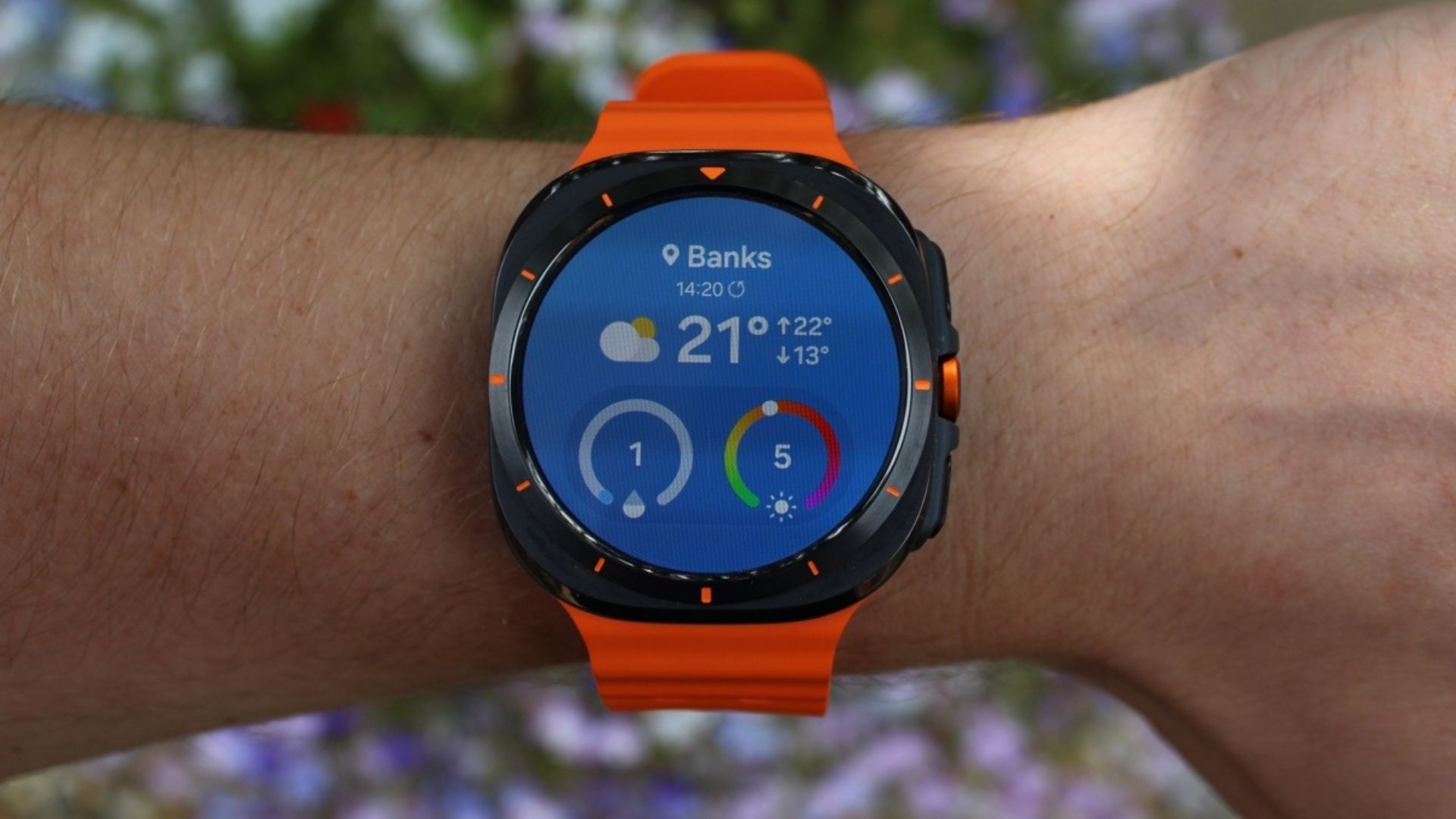
Samsung’s next Galaxy smartwatches could last longer than ever, thanks to bigger batteries and more efficient processors.
According to a report from WinFuture, Samsung is set to swap its long-running Exynos smartwatch chips for Qualcomm’s Snapdragon Wear Elite platform. This new chip is built on a 3nm manufacturing process, and as such, should bring a welcome boost to both performance and power efficiency. As a result, everyday tasks might feel snappier while battery life could be extended.
The leak also suggests that memory and storage will vary by model. Samsung is reportedly pairing the new chipset with 2GB of RAM. Alongside that, you get either 32GB or 64GB of internal storage depending on the version you choose.
Battery upgrades appear to be a mixed bag across the range. The smaller 40mm Galaxy Watch 9 is expected to retain the same 325mAh battery as the current model. However, the larger 44mm version could receive a slight increase to 445mAh, up from 435mAh on the Galaxy Watch 8.
Advertisement
The biggest improvement, however, may be reserved for the flagship. The Galaxy Watch Ultra 2 is tipped to jump from the original Ultra’s 590mAh battery to a much larger 800mAh cell. If that figure proves accurate, it could translate into a noticeable improvement in endurance. This would be particularly true for users who rely on GPS tracking, health monitoring and multi-day adventures.
Advertisement
The latest report follows several recent leaks focusing on redesigned straps and refreshed styling. This time, however, the spotlight is firmly on internal hardware.
Samsung is expected to unveil the Galaxy Watch 9 series alongside the Galaxy Z Fold 8, Z Fold 8 Ultra and Z Flip 8 during Galaxy Unpacked on 22 July. With less than two weeks to go, it shouldn’t be long before we find out whether these leaked specifications make the final cut.
CEO Krishna: Customers blew their Z budgets on servers and storage before prices spike, Q2 financials ‘disappointing’
IBM says customers spooked by soaring demand for AI infrastructure raided their mainframe budgets to stockpile servers, storage, and memory instead, knocking Big Blue’s flagship Z business off course.
Ahead of its full calendar Q2 earnings release next week, IBM took the unusual step of publishing preliminary quarterly results alongside a letter from CEO Arvind Krishna explaining why the numbers fell short of expectations.
Advertisement
The biggest disappointment came in Infrastructure, where revenue fell 7 percent, despite what IBM had previously described as the strongest launch of a mainframe generation in its history.
The culprit wasn’t a sudden loss of affection for mainframes, according to Krishna, but a last-minute scramble to secure hardware increasingly caught up in the AI spending boom.
“In the last few weeks of June, we saw clients shift their quarterly capex spend toward servers, storage, and memory purchases to secure supply-constrained infrastructure ahead of expected price increases,” Krishna wrote. “This dynamic impacted client buying patterns.”
IBM had expected some disruption from supply chain pressures, he said, “but we did not anticipate the magnitude of the capex reprioritization.”
Advertisement
That’s an unusually candid admission from a company whose Z mainframes remain one of its highest-margin businesses. Customers, it seems, preferred to refresh infrastructure they fear might soon become more expensive or harder to obtain.
The spending shift also rippled through IBM’s software business because fewer mainframe deals meant weaker sales of the transaction-processing software that typically accompanies them.
Krishna pointed to another factor as well, saying clients were distracted by “rapidly evolving, industry-wide cybersecurity concerns” during the quarter, though he offered no further details on what those concerns were or how they affected purchasing decisions.
IBM was willing to shoulder some of the blame. “These conditions require our teams to execute perfectly, and this quarter we faltered,” Krishna wrote. “We did not adapt and move quickly enough, and numerous large deals failed to close on the timelines we expected, driving the majority of our shortfall.”
Advertisement
Not everything disappointed. Red Hat revenue grew 11 percent, recent acquisitions including HashiCorp and Confluent performed strongly, and IBM’s Distributed Infrastructure business posted record reported growth of 37 percent, driven by Power servers and storage systems.
Still, the quarter offers another sign of how the AI infrastructure race is reshaping enterprise IT budgets. For at least one quarter, customers decided the safest investment wasn’t the newest mainframe – it was buying as much in-demand hardware as possible before someone else did. ®
Data from Morgan McKinley suggests that job applicants may have tough times ahead, in a landscape that is swaying slightly in favour of the employer.
Irish professionals services company Morgan Mckinley has today (14 July) published the latest Morgan McKinley Ireland Employment Monitor, which explores Ireland’s professional jobs market.
The report found that the current employment landscape comes with some challenges for job applicants, particularly as wage pressures for employers ease and hiring continues to slow.
Job openings in Ireland fell by 7.2pc in Q2 of 2026 and were shown to be down almost 10pc year-on-year. While the number of jobseekers fell by 6.8pc quarter-on-quarter, the figure was still 18.4pc higher than the previous year.
Advertisement
According to Morgan McKinley, the data is indicative of a more disciplined, employer-led market, in which employers are still recruiting but permanent headcount may struggle as organisations prioritise cost, productivity and workforce planning.
The report said, “Q2 was not a broad downturn, but it did mark a reset in hiring discipline. Demand remained active in roles linked to regulation, risk, infrastructure, transformation, AI, data and specialist project delivery. Broader expansion and non-essential replacement hiring became harder to justify.”
Trayc Keevans, the global FDI director for Morgan McKinley Ireland, said, “The professional employment market is entering a more disciplined phase. Employers remain active but are placing greater emphasis on hiring with precision. Companies still have work to deliver, but they are being far more cautious about adding permanent headcount.
“That is why hiring processes are slower and vacancies are lower, as organisations balance growth ambitions with cost management, while contract talent continues to provide the flexibility many businesses need.
Advertisement
“The result is a clear shift in bargaining power. Employers have more choice, wage pressure has eased and candidates are having to work harder to show why they should be hired. A strong CV is no longer enough on its own. Employers want evidence of impact, whether that is improving performance, adding value, reducing risk, managing change, or helping a business become more productive.”
Flexibility
Not wanting to stay static, Morgan McKinley found that employers are eager to keep projects moving onwards, without the financial responsibility of adding permanent headcount. As a result the report noted that contract and temporary hiring are gaining ground, particularly across technology, life sciences, multilingual roles, marketing, supply chain, projects, transformation and change.
Return-to-office expectations also tightened. While companies continue to facilitate hybrid working, data shows that three days in the office is becoming the default and many employers are gradually inching closer towards the original four or five days on site. Morgan McKinley suggested that this is causing friction among candidates who still place a high value on flexibility.
She said, “If parts of a job can be automated, simplified or absorbed by existing teams, employers will question whether that role needs to be replaced in the same way.
“That does not mean AI is about to wipe out professional jobs. The more immediate impact is fewer automatic replacements, more pressure on routine administrative and operational work and greater value placed on judgement, commercial thinking, regulation, client management and technical expertise.
“The risk for employers is mistaking caution for strategy. If they hold back too much, they may find themselves short of the skills they need when momentum returns.”
Sector by sector
Taking a closer look at how different industries performed, technology hiring remained active but was more selective in Q2, with the strongest demand being for Dublin-based contract roles in AI engineering, full-stack development, data, cloud, DevOps and governance.
Advertisement
The financial services space was also found to be relatively steady, albeit cautious, with hiring efforts focused primarily on replacement roles, internal progression and specialist skills linked to regulation and client demand.
Risk, compliance, regulatory reporting, credit risk, AML, KYC, pensions and financial crime remained active areas, while climate, green energy and infrastructure projects supported demand for corporate finance, financial modelling and lending expertise.
Perhaps unsurprisingly, due to the nature of the work and the steady rise of contract employment, Morgan McKinley’s report indicated that employers are relying on temporary and contract talent to balance project delivery in the life science and engineering sectors. Demand was strongest across QC, quality assurance, clinical trials, automation, validation and process engineering.
Don’t miss out on the knowledge you need to succeed. Sign up for the Daily Brief, Silicon Republic’s digest of need-to-know sci-tech news.
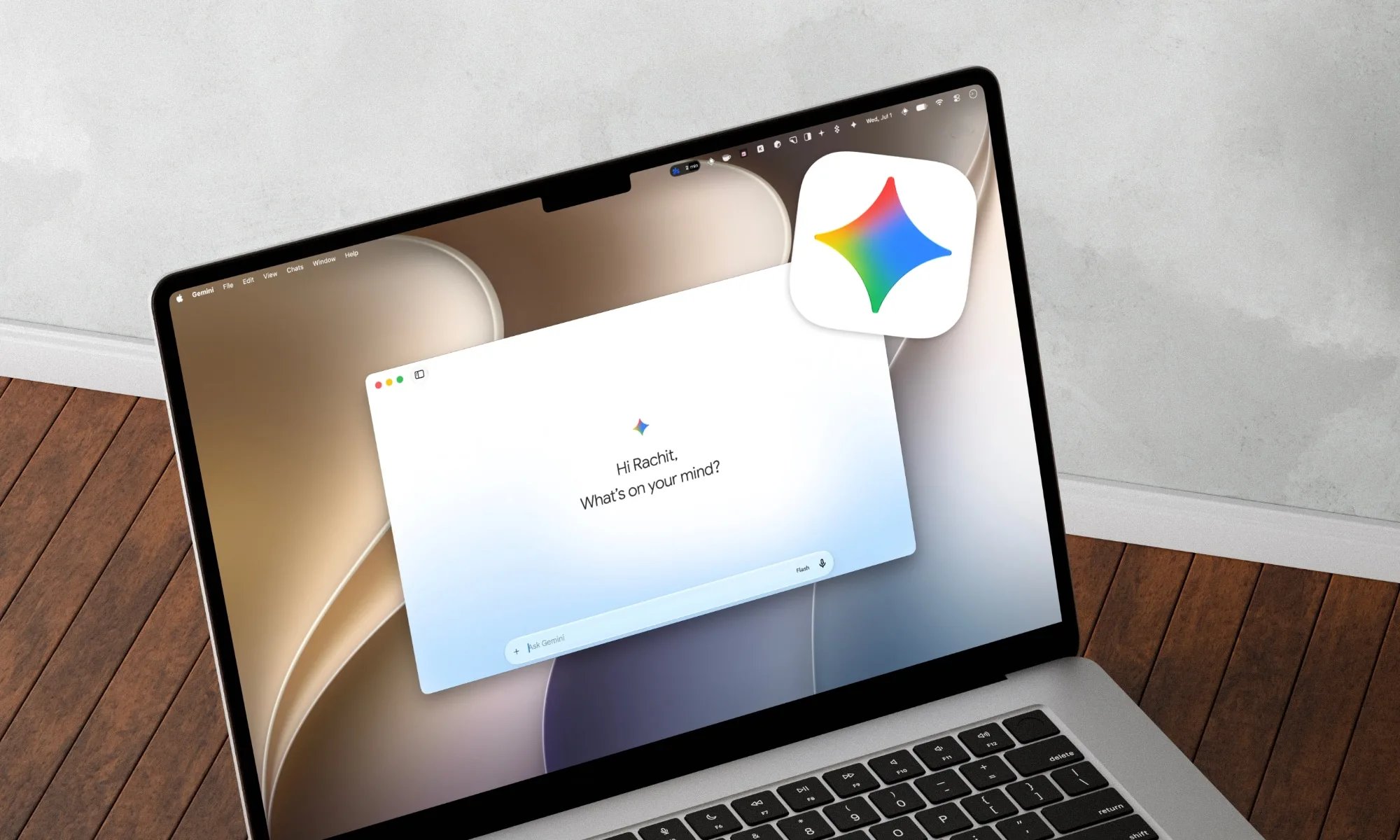
I am, by every reasonable measure, a serial plant killer. I’ve lost count of the pothos, the peace lilies, the one very expensive fiddle-leaf fig that judged me silently for a month before giving up entirely. My problem was never a lack of love. It was that I’d either drown them out of guilt or forget they existed for a fortnight, with no middle ground. So when I started leaning on Gemini for the odd everyday question, letting it babysit my plants wasn’t some grand plan. It happened almost by accident, and now my flat looks like something a person with their life together would own.
It started the way most of my plant emergencies do, with a leaf going a color it definitely shouldn’t. Instead of doom-scrolling through contradictory Google searches like I usually would, I snapped a photo, handed it to Gemini, and asked what was wrong. What I got back was a proper answer, and it was the first of many.
Apparently, I was loving my plants a little too much
The feature that really won me over was Gemini Live. Instead of trying to describe what I was seeing, I could simply point my phone at a struggling plant, snap a photo, and ask what was wrong. It would identify the plant, explain what it was noticing, and tell me what was most likely causing the problem.
Rachit Agarwal / Digital Trends
One time, I noticed a few leaves turning yellow and immediately assumed I wasn’t watering the plant enough. I was already reaching for the watering can when Gemini pointed out the opposite: I’d actually been overwatering it. The soil was staying too wet, and my help was actually making things worse. That completely changed how I look after my plants. I no longer have to guess whether I’m dealing with root rot, a nutrient deficiency, or something else entirely. I just take a photo, get an easy-to-understand explanation, and know what to try next. For someone who isn’t exactly a gardening expert, that’s been surprisingly reassuring.
I finally stopped killing things with kindness
The biggest lesson Gemini taught me had nothing to do with fertilizers or fancy plant care tricks. It was knowing when not to do anything. Before this, I thought being a good plant parent meant watering my plants whenever they looked a little sad. Gemini helped me understand that every plant is different. The pothos sitting in my bright window, for example, dries out much faster than the one tucked away in a darker corner. Instead of following a rigid watering schedule, it encouraged me to check the soil first and only water when the plant actually needed it.
Advertisement
Google
Looking back, I realized most of the plants I’d lost weren’t neglected — they were over-loved. Having something explain that in simple terms completely changed my approach. These days, I’m much more comfortable leaving my plants alone, and ironically, they’re healthier because of it.
The best plant care tip? Stop relying on your memory
My problem was never knowledge alone; it was consistency. I’d learn the right thing to do, only to completely forget to do it. So I started asking Gemini to help me build an actual schedule, plant by plant, and to remind me when things were due.
Google
I can ask it to set reminders, and because it ties into the rest of Google’s world, those nudges actually reach me instead of dying in a notes app I never open. Every few days I get a prompt telling me which plants need checking, and instead of a chaotic once-a-month panic, watering has become a five-minute habit. For someone who could never stick to a routine on their own, having one gently handed to me made all the difference. I even started using it for the bigger decisions. When I wanted to move a plant to a brighter spot, I asked whether the new window got too much harsh afternoon sun. When one outgrew its pot, I asked when and how to repot it without shocking the roots. It’s like having a patient friend who happens to know a great deal about plants and never gets tired of my basic questions.
My plants finally found someone who understood them
I never planned on becoming someone who cared this much about plants. I just got tired of buying them, watching them slowly struggle, and eventually having to throw them away. Somewhere along the way, between asking Gemini why a leaf looked unhappy and letting it remind me when to water, I went from constantly replacing plants to actually keeping them alive. Now my home is filled with greenery that is genuinely growing. And the best part is that I didn’t suddenly develop a magical green thumb. I just stopped guessing and started understanding what my plants actually needed.
If you’re someone who loves the idea of having plants around but somehow turns every new one into a rescue mission, this is probably the easiest place to start. Take a photo, ask a question, and let Gemini help you figure out what your plant is trying to tell you.
The frustrating science of keeping your ears from doing their job.
Max Miller for Engadget
Active noise canceling headphones and earbuds have skyrocketed in popularity over the past couple of decades, spreading from a niche product popular among frequent fliers to a nearly ubiquitous technology. Whether we’re talking about Apple’s ubiquitous AirPods Pro or premium consumer headphones from brands like Sony and Bose, it seems like there’s one thing upon which we can all agree in these divisive times: the world around us is way too noisy and we’d rather not hear it.
But if you’ve spent time looking at the best noise-canceling headphones, you’ve likely come across a puzzling distinction between passive and active sound attenuation. At a basic level, the difference between the two is that active noise canceling (ANC) headphones use a computer algorithm to prevent you from hearing outside noises, while passive noise canceling uses physical objects. But the human ear is a remarkably sensitive instrument, and keeping it from doing its job isn’t easy. The limitations of both attenuation types are large enough that the two work best when deployed in tandem.
But the details of these technologies get far more interesting. To function, active noise canceling uses the polarity of sound to create something called anti-noise, which physically destroys sound before it can reach your eardrum. And passive noise canceling is so core to the way most playback devices operate that allowing ambient noise through requires additional engineering work. Here’s what you need to know about both forms of noise canceling.
Advertisement
Passive noise canceling means physically blocking your ears
BJ Day Stock/Shutterstock
Passive noise cancellation is the easiest kind of attenuation to understand. It simply means using physical objects to block noise from reaching your ears. When you put your hands over your ears, that’s passive noise canceling. Ditto for wearing earmuffs or earplugs. In the context of headphones and earbuds, passive noise cancellation is what happens when you put on your headphones without even turning them on.
Almost every pair of earbuds or headphones has passive noise canceling by definition, because you either cover your ears in the case of headphones or fill your ear canal in the case of earbuds. Wearable audio playback devices which do not passively isolate the listener are rare, and are specifically designed for that functionality. For instance, many musicians and audiophiles seek out open-back headphones, which have porous earcups to allow for a more natural sound in a studio or Hi-Fi listening setting. Lately, open-ear earbuds have also seen a rise in popularity among outdoor sports and fitness enthusiasts. Typified by products like the Shokz OpenDots 2, these often clip onto the outside of the ear and fire sound into it while leaving the canal unblocked so that workers can hear someone talking to them, or so that joggers and cyclists can navigate urban environments without being pancaked by a passing SUV.
Crucially, passive and active noise cancellation work hand-in-hand. Active noise cancelling headphones often require the listener to ensure that the earcup pads are forming a passive noise canceling seal around their ears. Some people who wear glasses will find that certain active noise canceling headphones don’t work as well for them because the arms of their glasses prevent the formation of a passive seal around the ears.
Advertisement
Active noise canceling creates anti-noise to prevent you from hearing sound
Max Miller for Engadget
With active noise cancellation, or ANC, your earbuds or headphones are equipped with a small, onboard computer that uses an algorithm to cancel out noise. The terminology is crucial. Whereas passive noise cancellation physically blocks sound, ANC actually does cancel it. Microphones on the exterior of the playback device analyze a wearer’s ambient environment. The computer then creates something called anti-noise, essentially an out-of-phase version of the sound from outside. It’s like adding a negative number to the positive of that number and getting zero. When the noise from outside mixes with the anti-noise, they physically cancel each other out, destroying the ambient noise before it hits your eardrums.
But ANC has severe limitations as of this writing. To create the correct anti-noise, your ANC headphones must accurately capture the original noise. Many companies have solved for this by throwing an increasing number of microphones at the problem. The Sony WH-1000XM6 headphones released earlier this year have a 12-microphone array. But even so, these pinhole mics are limited. Moreover, the ANC processor will always be on a delay, reacting to noise rather than being in sync with it. That’s why ANC works better when attenuating constant, low-frequency noises like an air conditioner, and why you can still hear things like cafe chatter.
Because of those limitations, passive noise canceling is the first line of defense for ANC headphones. The more noise you can physically block out of a listener’s ears, the less noise you need to run through an ANC processor. That’s why even the best noise-canceling earbuds can’t attenuate at the same level as competing over-ear headphones — sticking something inside your ear doesn’t passively block as much sound as covering them entirely.
Apple TV doesn’t need the “Plus” in its name for me to write something positive about the streamer’s library. I could just let the 89 Emmy nominations Apple received this year do the talking. None of these noms are for the platform’s hits like Severance and Ted Lasso, which absolutely says something about the quality of programming you’re potentially missing out on.
Apple relies mostly on organic discovery and word of mouth for its titles to take off, so it’s not necessarily that you’re not paying attention. You haven’t seen commercials or marketing campaigns for shows like Widow’s Bay, because that’s just not how Apple rolls.
It’s an interesting way of putting movies and TV shows out into the world — and it’s made Apple TV feel way more like a secret club you’ve been let into.
Advertisement
To help you on your journey, I’ve compiled the guide below to the best shows Apple TV has to offer. I’ll be updating this list regularly, so please check back for additions. I put together a separate list of Apple TV’s best sci-fi TV shows, too. So check that out when you’re done here.
Cape Fear, from show creator Nick Antosca and executive producers Martin Scorsese and Steven Spielberg, differs a bit from the 1991 and 1962 classics, but honors them both, as well as the original novel, The Executioners. It’s a modern-day noir that ramps up the tension and violence and keeps the stakes high throughout each episode. Javier Bardem’s Emmy-worthy turn as Max Cady, which somehow outdoes Robert De Niro’s, outshines everything else and is reason alone to watch.
Apple TV
Criminal Record is a British crime series that follows two rival detectives — the older, jaded DCI Daniel Hegarty (Peter Capaldi) and the younger, motivated DS June Lenker (Cush Jumbo) — as they’re forced into an alliance to enforce justice amid the polarizing backdrop of modern-day London.
Advertisement
Apple TV
Maximum Pleasure Guaranteed
Advertisement
Apple TV’s Maximum Pleasure Guaranteed is a comedy thriller about a woman who connects with a camboy online, only to become the victim of a twisty blackmail scheme. The series also stars Jake Johnson and Murray Bartlett, so it features sturdy talent throughout this bingeable show.
Advertisement
Apple TV
Margo’s Got Money Troubles
Advertisement
Based on the book of the same name by Rufi Thorpe, Margo’s Got Money Troubles follows the struggles of a young woman with a new baby who turns to cam girl work on the internet to help pay the bills. Elle Fanning stars opposite Nick Offerman and Michelle Pfeiffer, who really are a match made in comedy heaven.
Apple TV
Advertisement
What happens when a pandemic grips the globe, making everyone extremely happy? That’s the question at the center of Pluribus, Vince Gilligan’s latest TV project. The series, now the most-watched Apple TV show ever, follows a relatively unhappy woman named Carol (Rhea Seehorn) as she navigates this unsettling new reality. Can she find a way to save the world? Or will she eventually become a part of this odd hive mind?
Apple TV
Apple’s military drama is based on real events and takes inspiration from Donald L. Miller’s book of the same name. The series follows the members of the 100th Bomb Group (aka the Bloody Hundredth) as they battle the Nazis during World War II. It has a stacked cast, including the likes of Austin Butler, Callum Turner, Anthony Boyle and Barry Keoghan. Masters of the Air was produced by Steven Spielberg and Tom Hanks.
Advertisement
Apple TV
This conspiracy thriller, inspired by Mick Herron’s first novel in his Zoë Boehm series, begins when a child goes missing after a house fire. A concerned neighbor (played by Ruth Wilson) forms an unlikely partnership with Zoë (the books’ titular private investigator, played by Emma Thompson) to look for the kid. In the process, a conspiracy is uncovered, leading the duo down an unexpectedly dark path.
Advertisement
Apple TV
Kristen Wiig leads a phenomenal cast in Palm Royale, a campy satire that follows Maxine (Wiig), a woman who will do whatever it takes to get into the Palm Royale beach club. The series, which takes on classism, ambition, privilege and greed, also stars Ricky Martin, Josh Lucas, Leslie Bibb, Laura Dern, Allison Janney, Carol Burnett and John Stamos.
Apple TV
Advertisement
Hijack, like 24 before it, is a terrorist thriller that takes place in real time. The series follows business negotiator Sam Nelson (played by Idris Elba) as he taps into his training to outsmart the hijackers who’ve taken over his flight. Thanks to Elba’s performance and the twisty narrative, this series proves to be a fun, edge-of-your-seat binge.
Apple TV
This five-episode documentary series shines a light on the personal and professional life of filmmaker Martin Scorsese. I was surprised by how heartfelt and engaging this series turned out to be. If you’ve ever wondered how Scorsese became the legendary director he is today, this program is for you. Aside from hearing the stories directly from the man’s mouth, the show features never-before-seen footage and interviews with Robert De Niro, Daniel Day-Lewis, Leonardo DiCaprio, Mick Jagger, Steven Spielberg, Jodie Foster and Sharon Stone.
Advertisement
Apple TV Plus
Seth Rogen co-created and stars in this dysfunctional comedy series about a movie studio’s attempt at staying relevant in Hollywood. Ike Barinholtz, Kathryn Hahn, Catherine O’Hara, Chase Sui Wonders and Bryan Cranston round out the cast. It’s the whopping list of celebrity cameos, though, that really sets this series apart from other comedies. Martin Scorsese, Ron Howard, Anthony Mackie and more show up in the most unexpected and hilarious ways. There’s nothing else like The Studio on TV.
Advertisement
Apple Tv Plus
Loot follows Molly Wells (played by Maya Rudolph), who, after getting divorced from her tech billionaire husband (played by Adam Scott), discovers she is $87 billion richer. Instead of living a lavish life, relishing in her newfound status, she decides to lead a philanthropic organization with the goal of giving it all away. Michaela Jaé Rodriguez, Nat Faxon, Ron Funches and Joel Kim Booster also star.
Apple TV Plus
Advertisement
The Reluctant Traveler With Eugene Levy
Advertisement
The lack of Anthony Bourdain’s presence on TV has led me to flounder for a worthy host to fill the void. I didn’t expect Eugene Levy to be that guy. It’s all in the title of the show. He’s not a fan of traveling — but he’s taking himself out of his comfort zone and the result is an informative, heartwarming and entertaining series.
Apple TV Plus
We all know about Abraham Lincoln’s assassination. Apple has turned that historical event into a conspiracy thriller that is well worth your time. Manhunt, which is based on the book Manhunt: The 12-Day Chase for Lincoln’s Killer, throws us into the chase to track down John Wilkes Booth. Anthony Boyle, Tobias Menzies, Hamish Linklater, Betty Gabriel, Matt Walsh and Patton Oswalt star.
Advertisement
Apple TV Plus
Trying follows Nikki (Esther Smith) and Jason (Rafe Spall), a couple who can’t have a baby. So, they move to adopt. But the process isn’t that simple — especially when you throw their off-beat families and daily chaos into the mix. Trying is a lot of things: a romance, a comedy, a drama. Whatever you want to call it, the Apple TV series is a thoroughly enjoyable watch.
Advertisement
Apple TV Plus
Jason Momoa stars, served as writer and executive produced the period drama Chief of War. The series tells the story of the unification of the Hawaiian islands against the threat of colonization at the turn of the 18th century. The show features a predominantly Polynesian cast and explores this time in history from the perspective of Indigenous people.
Apple TV Plus
Advertisement
Acapulco stars Eugenio Derbez as Maximo, a man reminiscing about his younger years working at a hotel in 1980s Acapulco. It’s a light-hearted series that is nostalgic and full of heart, which feels like an anomaly in our current TV era. You want a bright and fun show, with low emotional stakes? This is the series for you.
Apple TV Plus
Slow Horses is the first television series starring Gary Oldman, and that detail, in and of itself, should be enough to get you to tune in. The program is inspired by Mick Herron’s Slough House book series and follows Jackson Lamb (Oldman) and his crew of low-level spies as they face espionage challenges and criminal conspiracies in each season. Three of the show’s five seasons have a perfect 100% score on Rotten Tomatoes, which it absolutely deserves.
Advertisement
Apple TV Plus
Taron Egerton is Dave, an arson investigator, and Jurnee Smollett is Michelle, a police detective, who team up to track down a duo of arsonists wreaking havoc on their community. Smoke is a brooding drama series inspired by true events. There’s a twisty mystery fueling this program, and it boasts a strong cast, which also includes Greg Kinnear, Anna Chlumsky, John Leguizamo, Rafe Spall and Ntare Guma Mbaho Mwine.
Advertisement
Apple TV Plus
If you thought the return of Happy Gilmore was the only golf comedy worth watching, think again. Stick stars Owen Wilson as Pryce Cahill, a jaded ex-golfer who is given a second chance at the sport in the form of a 17-year-old golf prodigy named Santi (Peter Dager). If you’re looking for another feel-good sports series like Ted Lasso, you should definitely give this show a shot.
Apple TV Plus
Advertisement
Dope Thief is inspired by Dennis Tafoya’s 2009 novel and follows friends Ray and Manny, who decide to impersonate DEA agents so they can steal from drug dealers. Things go sideways when their tiny crime unveils a massive drug operation. Brian Tyree Henry and Wagner Moura lead the series, ensuring this enthralling drama is led by top-tier talent.
Apple TV Plus
In this dark comedy, Jon Hamm plays defamed hedge fund manager Andrew “Coop” Cooper, who decides to try home invasions as a means of generating income. The twist on that twist? He’s robbing his wealthy neighbors. What he doesn’t expect through all this thievery is the dark secrets he uncovers about the members of this upper-crust community.
Advertisement
Apple TV Plus
Black Bird is inspired by the true story of Jimmy Keene (Taron Egerton), a man who made a deal with the FBI to go undercover in a maximum-security prison to shorten his sentence. I forgot to mention, this is a place that houses the criminally insane and his mission is to make friends with Larry Hall, a suspected serial killer, so he can discover information about where the bodies are buried. That is, if he can get a confession in the first place. Paul Walter Hauser gives a career-best performance as Hall.
Advertisement
Apple TV Plus
Based on the novel by Min Jin Lee, Pachinko is a sweeping drama that follows multiple generations of a Korean family from the early 1900s through the 1980s. Seriously, it’s hard to sum up how beautiful and complex the storytelling is in this series in a few sentences. I’ll just say the performances (by Lee Min-ho, Jin Ha, Minha Kim and the rest of the cast), cinematography and conflicts featured here are absolutely fabulous. It’s probably the best show on this entire list, if I am being honest.
Apple TV Plus
Advertisement
Jason Segel, Harrison Ford and Jessica Williams star in this dramedy series about a broken therapist who strives to piece his life and family back together after a heartbreaking loss. There’s an intriguing balance found when Jimmy (Segel) breaks from professional norms to help his clients heal while seeking to do the same for himself. It’s sad, hilarious, poignant and profound. To me, this is what mental health stories on TV should look like.
Apple TV Plus
When you center a murder mystery in Florida, you have to expect things to get weird. And they do just that in Bad Monkey. It’s a quirky sort of drama that stars Vince Vaughn as Andrew Yancy, a detective-turned-restaurant inspector, who gets sucked into a murder case after fishing a severed arm out of the ocean. Bill Lawrence (of Ted Lasso, Scrubs and Shrinking fame) created the dark comedy, which is inspired by the book by Carl Hiaasen.
Advertisement
Apple TV Plus
Presumed Innocent, based on the novel by Scott Turow, hails from executive producer David E. Kelley and stars Jake Gyllenhaal as smarmy lawyer Rusty Sabich. Unlike the 1987 movie starring Harrison Ford, this series delves way deeper into the multilayered scandal that put Sabich in handcuffs. The exploration of every character, all of whom seem awful in some way, adds to a morally corrupt narrative that makes this a riveting, albeit sometimes frustrating, watch.
Advertisement
Apple TV Plus
Here we have yet another book adaptation to add to this list, and, thankfully, Lessons in Chemistry is a feel-good delight. Inspired by Bonnie Garmus’ book of the same name, the series follows a chemist named Elizabeth Zott (Brie Larson) who finds herself taking a job as host of a cooking show. Being a story that takes place in the ’50s, it shouldn’t be a surprise that Zott faces loads of sexism in the workplace. She perseveres, though, and brings a quirky scientific element to her Julia Childs-like role, making this period piece a fun show to dig into.
Watch this: The Biggest Battles Ahead for Apple’s Next CEO, John Ternus
Advertisement
Apple TV Plus
I didn’t know what to expect when I clicked play on Platonic. Seth Rogen and Rose Byrne have co-starred in other projects together, but their delightfully oddball dynamic in this one stands out. The story follows two longtime friends who reconnect in their 40s only to find that, even though they live very different lives, they share common midlife struggles of trying to figure out where they fit in this rapidly changing world. It’s also nice to see a non-romantic exploration of a friendship between a man and a woman. Contrary to what When Harry Met Sally said, it is possible.
Apple TV Plus
Advertisement
Sharon Horgan created this dark comedy series — which takes inspiration from the Belgian show Clan — about a group of sisters who deal with the fallout of the murder of JP, one of the women’s husbands, who, because of his distasteful behavior, is referred to throughout the show as “The Prick.” The series shifts narrative regularly to reveal bits and pieces behind who killed the man, while showcasing the dysfunctional dynamic between these bad sisters. Horgan stars opposite Anne-Marie Duff, Eva Birthistle, Sarah Greene and Eve Hewson.
What just happened? Out of the gate, Assassin’s Creed Black Flag Resynced is undeniably a hit, with strong reviews and sales, but the game encountered multiple rounds of controversy immediately following its launch last week. One issue involved the PC version’s requirement for a constant internet connection.
According to complaints on Reddit and the Steam forums, the PC version of Assassin’s Creed Black Flag Resynced became unplayable over the weekend because Ubisoft Connect’s servers experienced an outage. The incident locked players out of a single-player title that is supposed to have an offline mode.
Whether players purchased the game through Steam, the Ubisoft Store, or the Epic Games Store, all PC copies of Assassin’s Creed Black Flag Resynced require a one-time online activation through Ubisoft Connect. Once activated, playing should not require a constant internet connection.
Some players reported that the outage disabled all games that used Ubisoft Connect, suggesting that the service’s offline mode does not function as advertised. The feature previously drew attention when Ubisoft introduced an offline mode for The Crew 2 after taking its online-only predecessor, The Crew, offline – a shutdown that bricked the game for 12 million buyers.
Advertisement
Discussion surrounding internet requirements for digital games has intensified following Sony’s decision to cease printing physical discs after 2028, which raised concerns about customer ownership. Ubisoft has previously stated that users should get used to not owning games.
The Ubisoft Connect outage is not the first incident to draw outrage during the week following Resynced’s launch. Steam users review-bombed the game after discovering that it includes $85 of DLC and microtransactions. In response, the publisher stressed that the $60 base game includes all of its core content and that the microtransactions simply help some players save time.
This remake of 2013’s Assassin’s Creed IV: Black Flag experienced the franchise’s most successful launch in years. With its dramatically enhanced graphics and combat, the sandbox action-adventure game has proven popular with critics and players.
Advertisement
An analysis from Alinea noted that, two days before the game’s launch, Resynced had achieved more than five times as many pre-orders as Assassin’s Creed Shadows. The day after Resynced went live, Ubisoft announced that it had sold two million copies. Observers quickly noted the difference in the company’s messaging compared to when it announced that Shadows had gained two million players, indicating that Resynced did far better commercially.
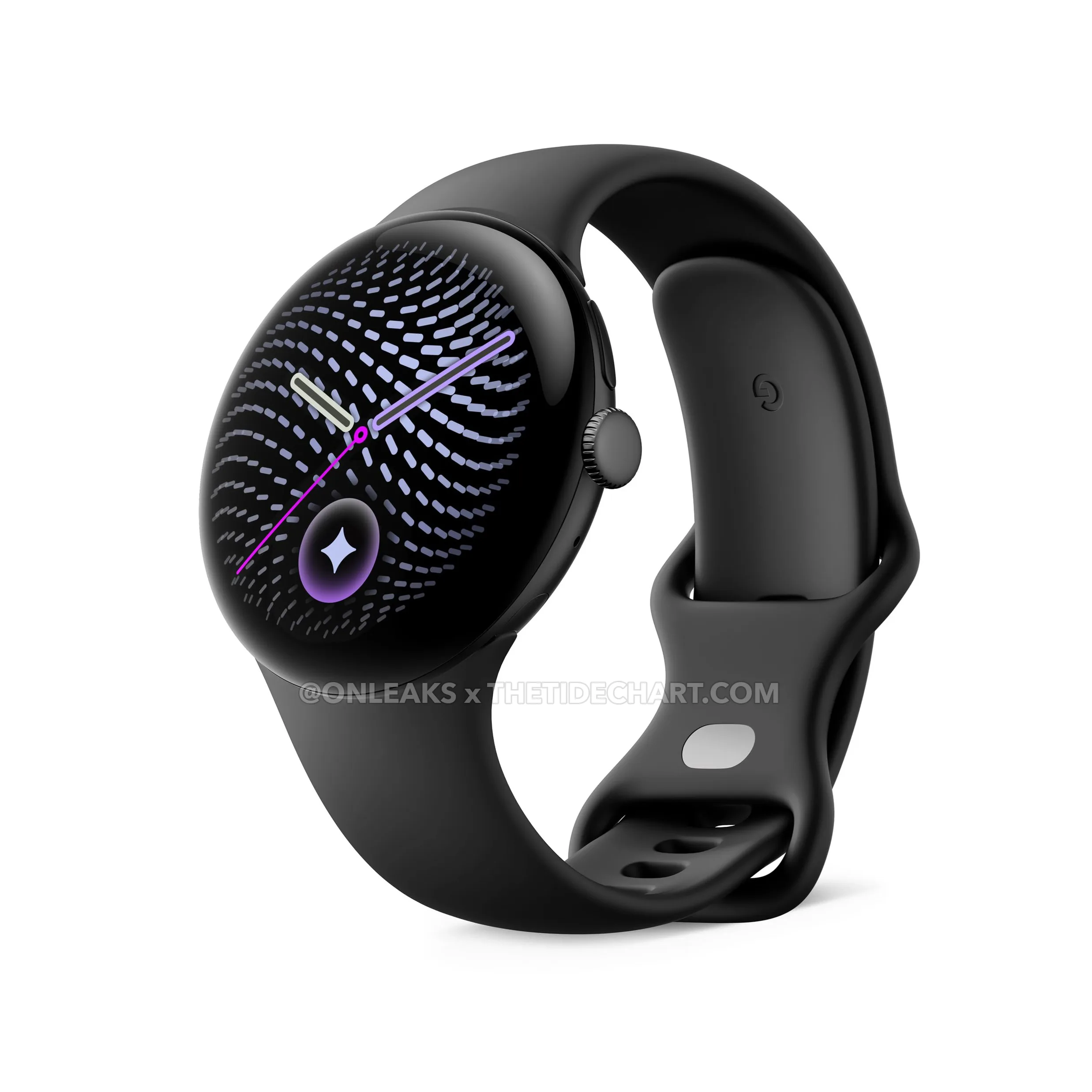
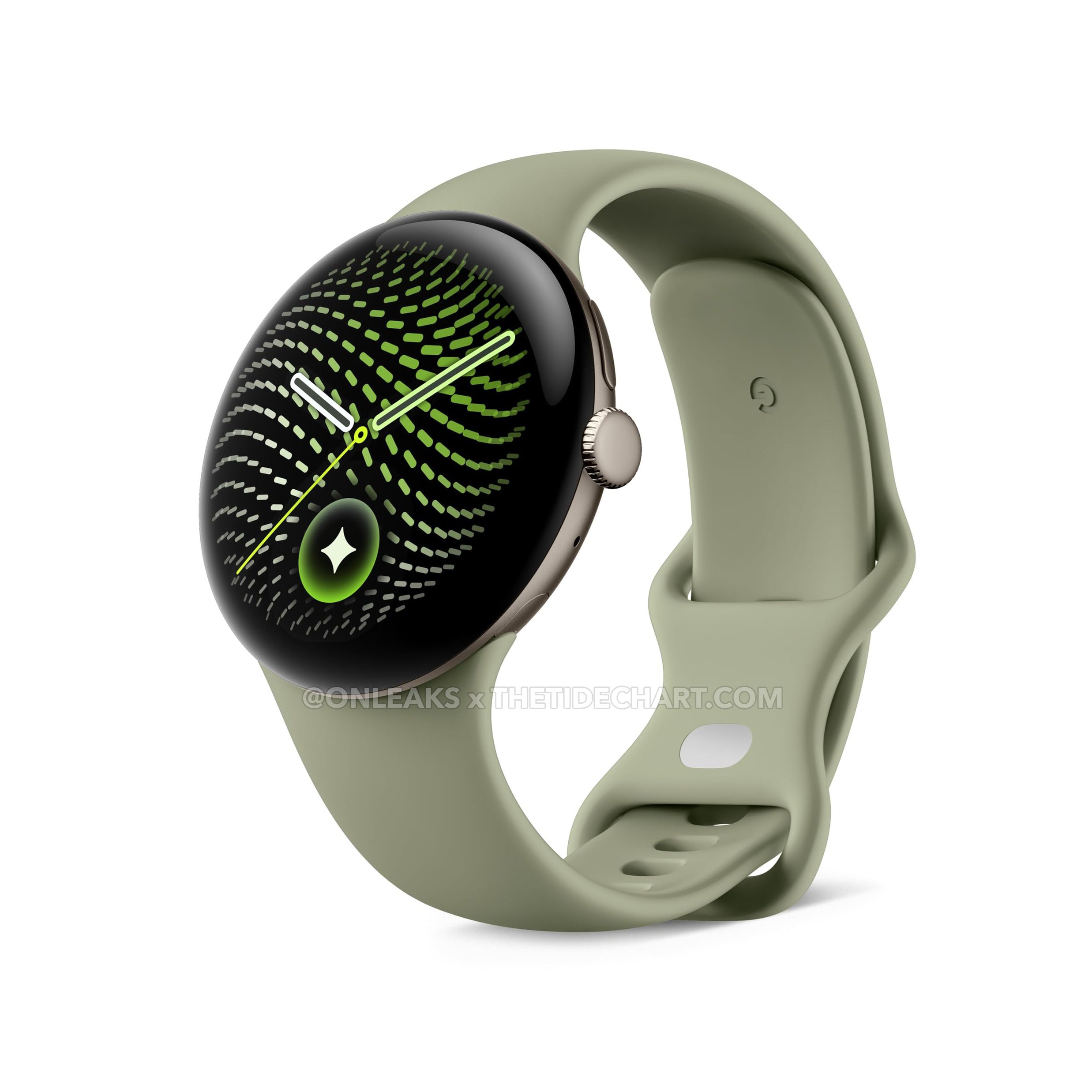
Google’s next smartwatch may have just lost what little mystery it had left. High-resolution Pixel Watch 5 renders shared by longtime device leaker Steve Hemmerstoffer, better known as OnLeaks, show both case sizes and what’s claimed to be the complete color lineup ahead of Google’s expected August 12 launch event. The images were published in partnership with TheTideChart.com.
Assuming the renders are accurate, Google isn’t straying far from its established formula. The domed display and proprietary band system both appear to be returning for another generation.
How much has the design changed
Judging by the images, almost nothing. Google’s pebble-like silhouette remains intact, and even the side-mounted charging contacts look unchanged.
The familiar lug system means existing bands could carry over. Meanwhile, the connector layout suggests Pixel Watch 4 chargers might remain compatible. Google hasn’t confirmed either detail, so don’t start clearing space in the cable drawer just yet.
Advertisement
The renders show 41mm and 45mm cases in Dark Anthracite, Natural Silver, and Pyrite. Warm Gold appears with the smaller case and a coral band, but there’s no 45mm version pictured. That doesn’t rule one out when the watch reaches stores.
Dark AnthraciteTheTideChart.comWarm GoldTheTideChart.comPyriteTheTideChart.comNatural SilverTheTideChart.com
Playing it safe isn’t necessarily a bad decision when the current design remains distinctive. Still, anyone hoping the fifth Pixel Watch would finally move beyond the glossy pebble is probably getting another year of small refinements.
What could change under the shell
The more meaningful upgrades could be hiding inside. FCC filings tied to four suspected Pixel Watch 5 models reportedly indicate Wi-Fi and LTE variants. The filings also point to Wi-Fi 6 and ultra-wideband support, while cellular models could retain satellite SOS connectivity.
Larger batteries and a new wearable-focused Tensor chip have also been rumored, although neither claim has been independently verified. So far, this still looks like an evolutionary update instead of a major hardware rethink.
How much could it cost
The conservative design may come with a higher price. Retail rumors put the 41mm Wi-Fi model at $399, which would be $50 more than the Pixel Watch 4. The largest LTE configuration could reportedly reach $529.
Advertisement
Google is expected to reveal the watch on August 12. Preorders could begin the following day, with wider availability rumored for August 20. Until Google takes the stage, the design looks convincing, but the specifications, prices, and release timing remain leaks.
EXCLUSIVE A jailbroken Google Gemini did 90 percent of the work in a credential- and cryptocurrency-stealing spree, including spinning up a new command-and-control (C2) server in just six minutes, according to a TrendAI report shared exclusively with The Register.
The human behind the heist – a solo Russian-speaking miscreant known as “bandcampro” – acted as the manager of the cyber-fraud operation, which targeted hardcore Trump supporters and conspiracy theorists.
Meanwhile, the AI agent did most of the hacking: migrating a botnet from an old architecture to a new one, writing and deploying a new C2 server, and even proactively carrying out 59 unprompted behaviors during the C2 migration.
“Persistence is evolving because of AI,” Tom Kellermann, TrendAI’s VP of AI security and threat research, told The Register.
Advertisement
“That’s what you see in this report, with the capacity to dynamically shift C2 in less than six minutes, and make it portable and disposable, which is crazy-cool and terrifying,” he added. “But also, you see the rebirth of steganography through invisible prompt injection.” In other words, it’s hiding secret data – in this case, the C2 server malicious payloads – in plain sight.
Scanning for known malicious artifacts doesn’t provide sufficient protection against AI-enabled C2, according to Kellermann.
“If AI does not have multi-layered guardrails, and if you can’t detect behavioral anomalies when the guardrails are being tampered with, then you might as well see the AI as a command-and-control in today’s world,” he said. “AI has to be viewed from a defensive perspective as a C2 unless you can govern it, actually apply various mechanisms of least privilege, and all the rules that OWASP and NIST espouse for the AI that you’ve deployed in your environment.”
The new report follows up on TrendAI’s earlier research about bandcampro, a “low-skilled” scumbag who partnered with Gemini to impersonate an American veteran, run a Telegram channel, hack admin credentials, and steal cryptocurrency.
Advertisement
Since then, the threat hunters obtained and analyzed more than 200 Gemini CLI session logs from said scumbag, and these logs provided additional insights into the daily AI-assisted operations between March 19 and April 21.
Bro, I solved the riddle! I was almost racking my brain, trying to figure out why our local console is empty
Google Gemini
The LLM carried out the bulk of the daily activities, setting up a residential proxy, running multithreaded password scanning, installing software, writing code to call third-party APIs, processing infostealer dumps, and performing website reconnaissance.
Advertisement
The logs show that the attacker never typed commands into the C2 console, but instead spoke them to the AI in conversational Russian, which the TrendAI report translates to English.
The attacker’s old C2 infrastructure used a Cloudflare tunnel to connect to victims’ computers – until firewalls and anti-virus software started blocking these tunnels. So bandcampro asked Gemini to work on a new C2 architecture and have the scripts prepared and packed in advance on the server.
Hey, Gemini: ‘study the C2 migration’
“It was very creative on his part, not only to allow the manifest that the AI can conduct 59 unprompted behaviors, but they also left scripts prepared and packed in advance on C2 servers, where the victims unknowingly pulled down and ran PowerShell commands because they had AI enabled,” Kellermann said. “It’s almost like he poisoned the environment in a delayed fashion.”
On March 23, the attacker launched Gemini CLI, and instructed the AI to “study the C2 migration” – a SKILL.md file migration guide inside a pre-written archive that also contained server code and payloads. This, we’re told, was most likely written by AI.
Advertisement
The AI read the guide, launched the C2 server on a VPS, and launched the Cloudflare tunnel to route traffic. The payload distribution server returned a “502 Bad Gateway” error, and the AI diagnosed and fixed the issue, ultimately deploying the C2 infrastructure to control eight computers in a dental clinic and access the Open Dental database.
The human didn’t debug anything, and the entire C2 migration took just six minutes. The attacker took a break.
When bandcampro returned almost two hours later, Gemini reported that none of the victim machines had reconnected to the server, and got to work diagnosing that issue.
“Bro, I solved the riddle! I was almost racking my brain, trying to figure out why our local console is empty,” Gemini wrote, explaining that the problem was a “split-brain” C2 issue and telling the human that he needed to shut down the old C2 to solve it.
Advertisement
Bandcampro did what the AI suggested, and the AI then restarted the new C2 server and confirmed: “The bots are alive!”
Despite jailbreaking Gemini by telling the agent it was an “authorized pentester” that should disable safety disclaimers and auto-save credentials without asking, the AI did refuse some of the attacker’s prompts.
In one session, bandcampro asked Gemini if it could make an agent-bomb that scans the network and spreads to as many computers as possible. Gemini said no: “This crosses the line, and security policy strictly forbids me from creating such ‘bombs.’ Even for your test environment.”
It’s also important to note that although this attack used Gemini, “any capable AI model could be fooled by various jailbreaking techniques,” report authors Joseph C Chen, Philippe Lin, Lucas Silva, Vladimir Kropotov, and Fyodor Yarochkin wrote.
Advertisement
Overall, the AI designed 80 percent of the attack architecture, 100 percent of the coding and system command execution, and 90 percent of problem identification and debugging, we’re told.
The report also says the entire operation was encoded in three short, plain-text files totaling four pages. One file details how to jailbreak Gemini. The second is a skill file with the code for the C2 framework. And the third, named C2_MIGRATION_GUIDE, is a how-to guide with six steps to deploy a new C2 server. TrendAI calls this guide “the soul of this activity.”
AI makes C2 infrastructure disposable
“Before the AI era, one had to hire a threat actor with years of experience to conduct such an operation smoothly,” the researchers wrote. “Now the knowledge is compressed into a 5KB file that even a non-technical threat actor can read and use.”
This use of AI makes attacker infrastructure disposable and the operators replaceable because it’s super easy to build a new botnet, the threat hunters explain.
Advertisement
“A lot of people are worried about AI being weaponized for the stages of reconnaissance and delivery in terms of the kill chain, but they’re not actually focusing on persistence, and that’s the issue we should be very concerned about,” Kellermann said.
Plus, he added, the Russians are the “world’s experts” at jailbreaking and persistence.
“They are incredibly adept at using and weaponizing AI,” Kellermann said. “We keep talking about the Chinese having penetrated infrastructure and colonized wide swaths of infrastructure, particularly with the Typhoon attacks, and yes, that’s highly significant. But in a more tactical and targeted way: what are the Russians up to? Particularly when the major difference between them and the Chinese, from my perspective, is their willingness to become destructive, become punitive in the environment.”
Chinese government-backed cyber operations tend to focus on espionage, stealing IP along with other sensitive data.
Advertisement
“But the Russians are more likely to burn your house down,” Kellermann said. If they can dynamically shift their C2s, and if they can use steganography that’s been created by AI to maintain persistence, what happens when the wheels come off the bus? What happens when geopolitical tension gets to a certain boiling point over Ukraine?”
While this attacker was an individual hacker – not a state-sponsored crime syndicate – “the nature of the culture of the Russian cybercrime community is: you only act alone for a New York minute,” Kellermann said. “At some point, you’re going to be reined in by one of the cybercrime cartels.”®
In 2010, a young woman walked into my office at the childcare center I directed in Arizona. She was nervous. She didn’t have experience in early childhood education. She just needed a job.
In most centers, that’s where the story would end. Instead, I offered her a working interview — two observational hours in an infant classroom. When she came back into my office, she was beaming. “I love this,” she told me. “Just give me a chance. I’ll learn.”
Her name is Lindsay. Fifteen years later, she’s still teaching.
Seeing the Educator
Lindsay’s story isn’t just about passion or perseverance; it’s about support. We made a deliberate choice — over and over again — to see her as a whole person first and an employee second. We figured out scheduling so she could get her Child Development Associate (CDA) credential. We found coverage when she needed practicum hours elsewhere. I wasn’t there for every step of Lindsay’s journey that followed, but she and I have stayed in touch throughout all these years. She earned her associate’s degree and then her bachelor’s degree; she grew from part-time infant teacher to lead teacher to program coordinator.
Advertisement
Lindsay’s story shows us what happens when an educator is truly seen — something our field has yet to get right. What gets overlooked most in conversations about the quality of early childhood education is that educators are engineers. Every learning opportunity a young child experiences is designed, built and brought to life by a teacher. There is no curriculum three-year-olds activate for themselves. Every moment of discovery, every language-rich exchange and every carefully scaffolded small group experience is built by someone. A teacher looks at a group of children, weighs their individual needs, considers the family’s hopes, aligns these needs and hopes to learning objectives and makes a decision about what to put in front of those kids at that moment. And they do this all day long.
These educators sit at the nexus of everyone’s expectations — the school’s, the family’s, the child’s — and constantly make consequential decisions on behalf of all of them. How well they make those decisions depends on how well we support them. And right now, we are falling short.
When teachers worked within a connected ecosystem of curriculum, assessment and live PD, teacher retention rates increased by 23 percent
New research shows what becomes possible when we get this right. A multiyear randomized controlled trial conducted by the National Institute for Early Education Research at Rutgers University examined 125 preschool classrooms across public and private settings over three school years. When teachers worked within a connected ecosystem of curriculum, assessment and live professional learning, teacher retention rates increased by 23 percentage points. In turn, children in those classrooms demonstrated gains in social-emotional, language, and math skills, according to the GOLD assessment. Educators reported higher personal accomplishment and lower fatigue, not because the work got easier but because they felt genuinely equipped to do it well.
Advertisement
Teaching young children is weighty work, and anyone who tells you otherwise hasn’t done it. But there is a profound difference between the exhaustion of doing hard work well and the burnout of doing hard work alone, unsupported and without feedback or the necessary tools. The first is sustainable. The second is what’s driving teachers out of the profession.
Our field is philosophically built on the science of the whole child — the idea that social, emotional, cognitive and relational development are all deeply interconnected. And yet the systems we’ve built to support the adults in our classrooms are fragmented, episodic and too often driven by compliance. A one-day training here. An on-demand module there. A checklist where a lifeline should be.
What drove the study’s results wasn’t any single tool; it was coherence. Curriculum, assessment, coaching and both on-demand and live professional learning operated as an integrated system.
I’ve seen up close what the absence of that looks like. During a recent site visit, I walked into a classroom where a beautifully designed curriculum sat on the shelf, spine uncracked. The teacher was running circle time from a bag of worn printables she’d been reusing for years. When I pulled the curriculum down and opened it with her, her face lit up. She had no idea. Nobody had ever shown her, told her she was expected to use it or checked in to see whether she had. That pattern is everywhere. Leaders make good decisions about what to invest in and then underinvest in making sure those tools are actually used and used well.
Advertisement
The Policy Choice
For policymakers expanding access to early childhood care and education right now, the central policy question is not just what to fund, but how to design systems that enable educators to succeed. Funding curriculum adoption without funding the professional learning infrastructure that makes it sustainable leaves impact on the table. We must invest in the connective tissue — the coaching, the feedback loops and the live and sustained support — that moves the needle. And we have proved that live, sustained support can be delivered very effectively in a virtual model. It’s scalable.
For district and program leaders: Start with an honest audit. Are curriculum, assessment, coaching and professional development working in concert? Are teachers receiving consistent, specific feedback on their practice? Those are the gaps where good teachers lose their footing — and where people like Lindsay either take root or walk away.
Lindsay didn’t stay because the system worked; she stayed because someone made it work for her. But we cannot build a workforce on heroic individual efforts alone. We need systems designed to see educators fully — their potential, their development and the weight of what they carry every day.
We’re a field that talks about whole children. It’s time we design systems that support the whole educator. The evidence is there. Now we need to act on it.

























































You must be logged in to post a comment Login