Tech
Advance Paris A10 Classic Review: A French Hybrid Amplifier With More Bordeaux Than Bubbles

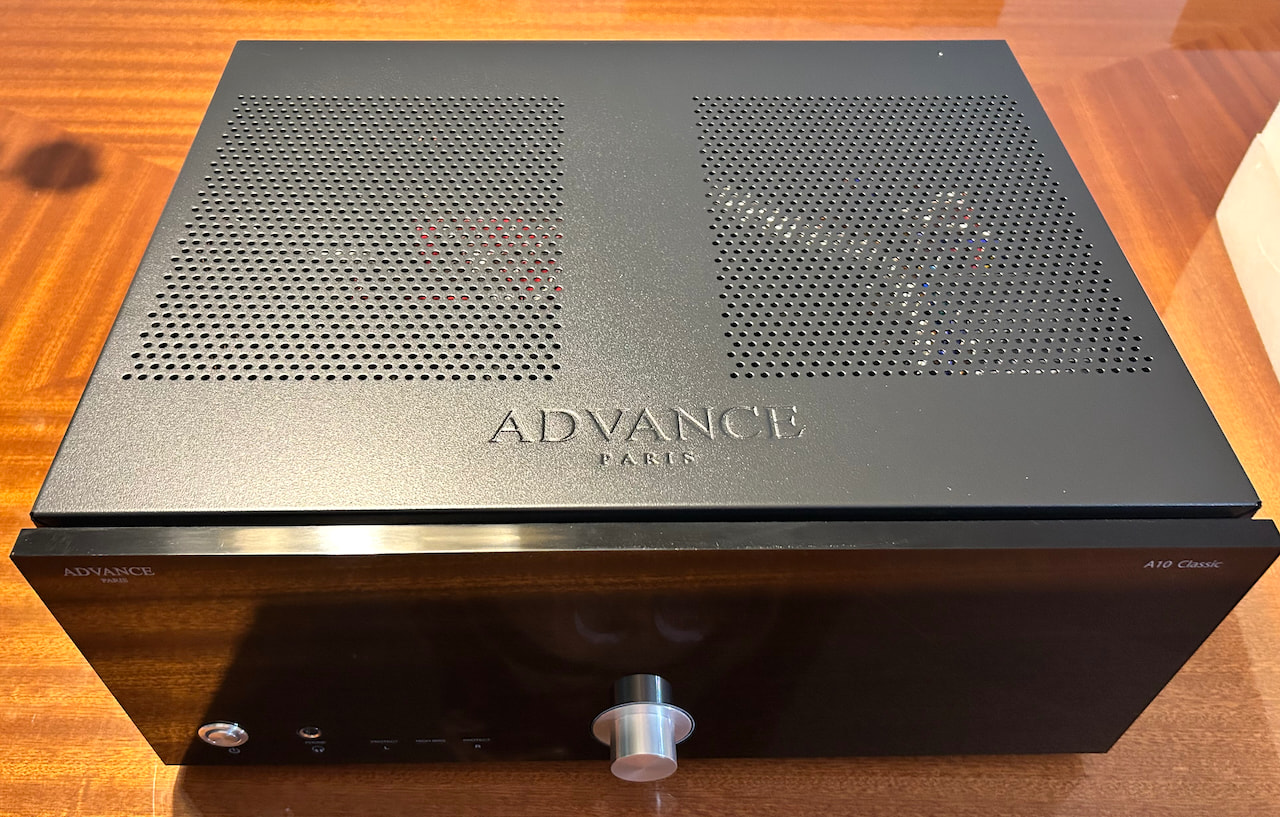
The French have never suffered from a shortage of self-confidence. Their cars, cinema, food, and hi-fi tend to arrive with a point of view, and the Advance Paris A10 Classic is no exception. With illuminated VU meters, two ECC81/12AT7 tubes glowing behind its front panel, and a Class AB output stage rated at 130 watts per channel into 8 ohms and 190 watts into 4 ohms, it looks less like another anonymous black box and more like something intended to command the room. This is not amplification for the light and fluffy croissant crowd.
The A10 Classic is not a new integrated amplifier. It has been part of the Advance Paris lineup for several years, preceding both the company’s anniversary APEX models and the flagship NOVA electronics that we experienced at AXPONA 2026. That does not make it irrelevant. If anything, the A10 Classic helps explain how Advance Paris arrived at its current formula: bold industrial design, tubes where they can influence the character of the presentation, solid-state output stages where current and control matter, and enough connectivity to anchor an entire two-channel system.
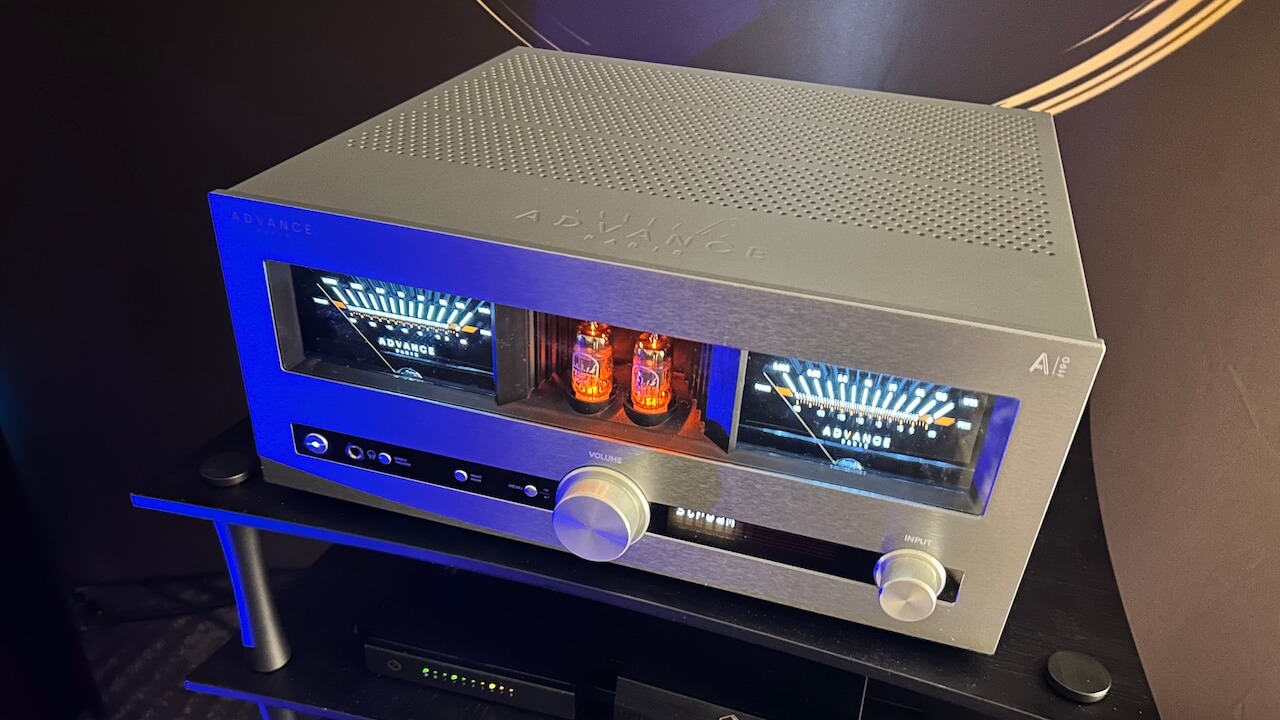

At AXPONA, Advance Paris placed the spotlight on the NOVA A-i130 and A-i190 integrated amplifiers, which push that concept further with DSP, more sophisticated subwoofer management, modular streaming, and optional bi-directional Bluetooth. The A-i190 was one of our Best in Show selections because it balanced vintage-inspired styling with genuinely useful system flexibility and a surprising amount of power driving a pair of Vienna Acoustics floor standing loudspeakers. The A10 Classic is a simpler and older interpretation of that philosophy, but the family resemblance is unmistakable.
Its continued relevance also says something about why integrated amplifiers have become so popular. Listeners increasingly want fewer boxes, but they are not necessarily willing to surrender vinyl playback, digital inputs, television connectivity, subwoofer support, or enough power to drive demanding loudspeakers.
On paper, that promises some of the tonal body associated with tubes, the control and current delivery of transistors, and enough flexibility to replace several separate components. The newer NOVA models may represent where Advance Paris is going, but the A10 Classic reveals a great deal about how the company got there. The question is whether all that established French muscle still delivers sufficient finesse or merely a very convincing accent.
Related Reviews:
From Jadis Romance to Advance Paris Muscle
There was a time when French hi-fi had a fairly recognizable personality. The better examples from Jadis and YBA could sound delicate, spacious, and beautifully saturated through the midrange, with a sweet top end that made strings and vocals especially inviting. The trade-off was sometimes a slight softening of low-level detail and bass that emphasized warmth and texture over speed or absolute control. Think red Burgundy rather than a chilled Sancerre: richer, rounder, and not especially interested in showing you every sharp edge.
It also reminded me of driving around Paris in an old Citroën with my cousin, who worked as a researcher at the Institut Pasteur. The car’s famously compliant suspension floated over damaged pavement and insulated us from nearly everything happening beneath the tires. It was wonderfully comfortable, but you did not always receive a detailed report from the road. Some older French amplifiers could behave the same way, smoothing over rough recordings and delivering a more romantic presentation while sacrificing a little grip, transparency, and bottom-end precision.
The newer French approach is rather different, although Devialet and Advance Paris do not arrive there by the same technical route. Devialet’s patented ADH architecture operates its Class A analog and Class D switching amplifiers simultaneously in parallel. The Class A section determines the output voltage but is relieved of supplying the corresponding current; the Class D stage provides that current and performs most of the heavy lifting. The objective is to preserve the linearity of Class A while gaining the power density, efficiency, and loudspeaker control of Class D. It is considerably more sophisticated than placing two different amplification technologies in consecutive stages.

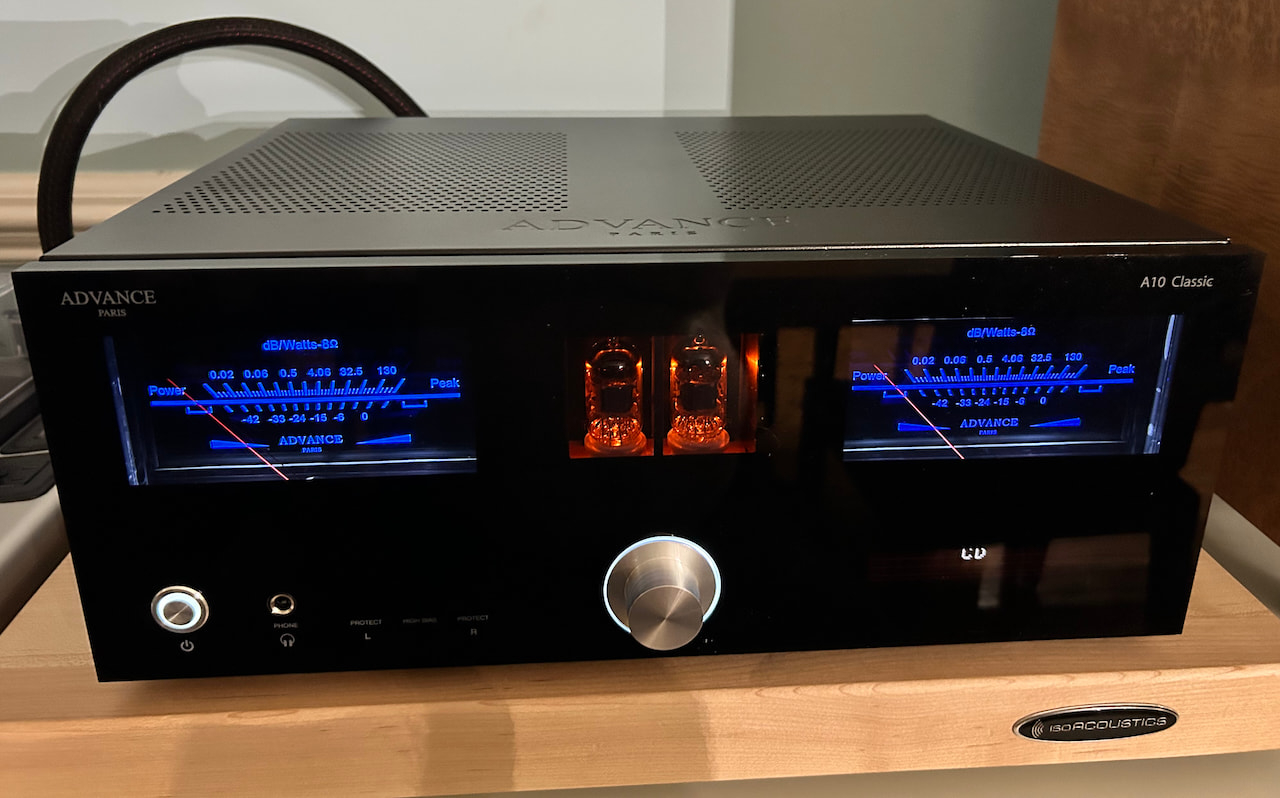
The A10 Classic follows a more conventional, and arguably more serviceable, division of labor. Its ECC81/12AT7 tubes operate in the preamplifier stage, where they handle the low-level signal before passing it to a Class AB push-pull transistor output section. The tubes are therefore not driving the loudspeakers or sharing output duties with the transistors; they are used upstream, where they can influence gain structure and tonal character, while the solid-state section supplies the current, control, and 130 watts per channel into 8 ohms. It is hybrid amplification in series rather than Devialet’s parallel ADH topology, and the distinction matters.
Which approach is superior? That depends on whether you prioritize tonal beauty and forgiveness or speed, resolution, control, and system flexibility. Having owned both Jadis and YBA components, I understand the attraction of the older school. I also experienced enough operational eccentricity to distinguish charmingly French from utterly weird. There is quirky, and then there is wondering whether your amplifier has decided that electrical consistency is merely an Anglo-Saxon suggestion. I have been there. I will not be going back.
As this is being written, France are two victories away from winning the 2026 World Cup and will face Spain in the semifinal on July 14. Their attacking group of Kylian Mbappé, Ousmane Dembélé, Michael Olise, and Bradley Barcola has been dangerous not simply because of its pace, but because it understands when to press, when to create space, and when to strike. France reached the semifinal after beating Morocco 2–0, with Mbappé and Dembélé supplying the goals.
The A10 Classic leans much closer to that newer French philosophy. It is forceful, quick, and capable of delivering genuine low-frequency authority, but its tube preamplifier stage keeps it from becoming sterile or relentlessly clinical. It retains some of the tonal color associated with the older French school while providing the control, power, build quality, and day-to-day reliability that I would now demand from an integrated amplifier. The older approach could be seductive. The A10 Classic is more interested in winning the match.
The A10 Classic is less Cyrano and more Nikita: unmistakably French, outwardly stylish, and capable of delivering considerably more force than its polished appearance suggests.
Technology and Specifications
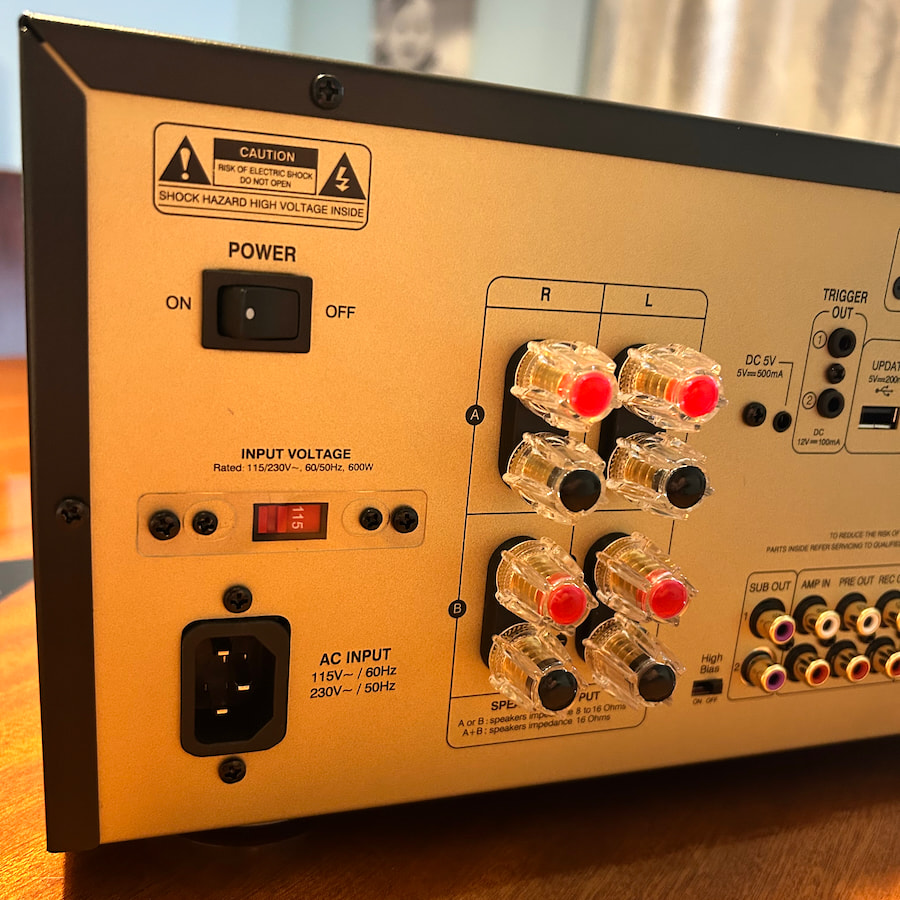
The A10 Classic is designed as the center of a serious two-channel system rather than another amplifier pretending to be a tablet. It delivers 130 watts per channel into 8 ohms and 190 watts into 4 ohms, with a High Bias setting that increases the standing bias of the output stage for the first few watts. Advance Paris does not publish the precise Class A operating range, but it definitely results in a warmer top panel.
The amplifier also requires approximately 30 seconds to warm its two ECC81/12AT7 tubes after startup, with a countdown displayed on the front panel before operation begins. High Bias mode produces additional heat, so placement matters: Advance Paris recommends at least 50 mm, or 2 inches, of clearance on each side and 100 mm, or 3.9 inches, above the chassis. This is not an amplifier to bury inside a tightly packed cabinet beneath a cable box and three years of unopened mail.

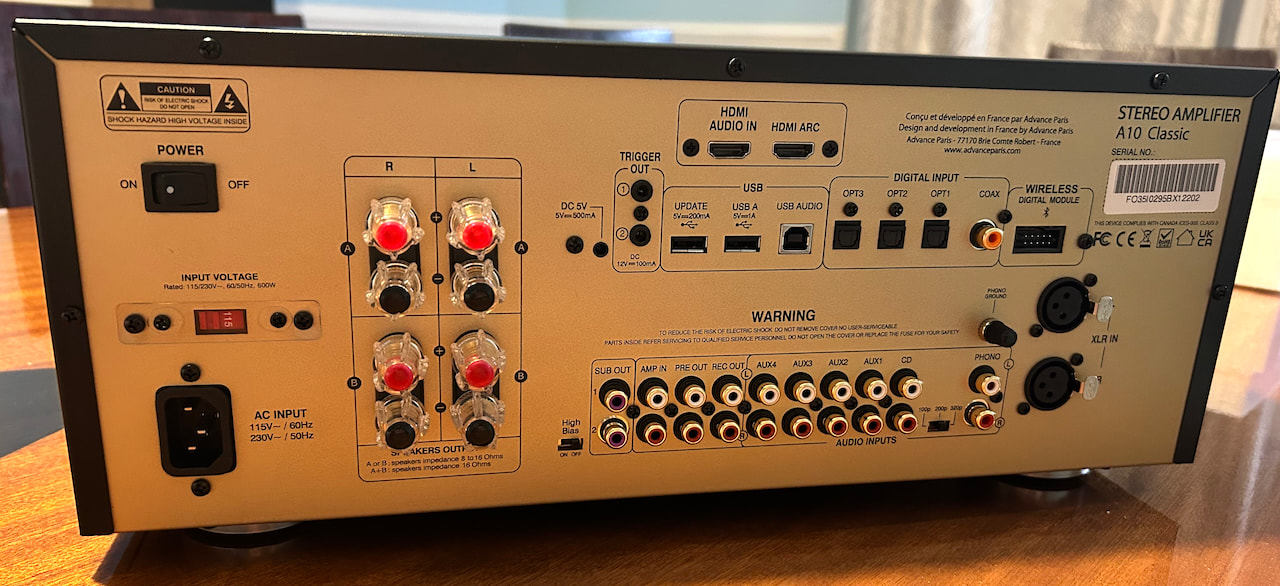
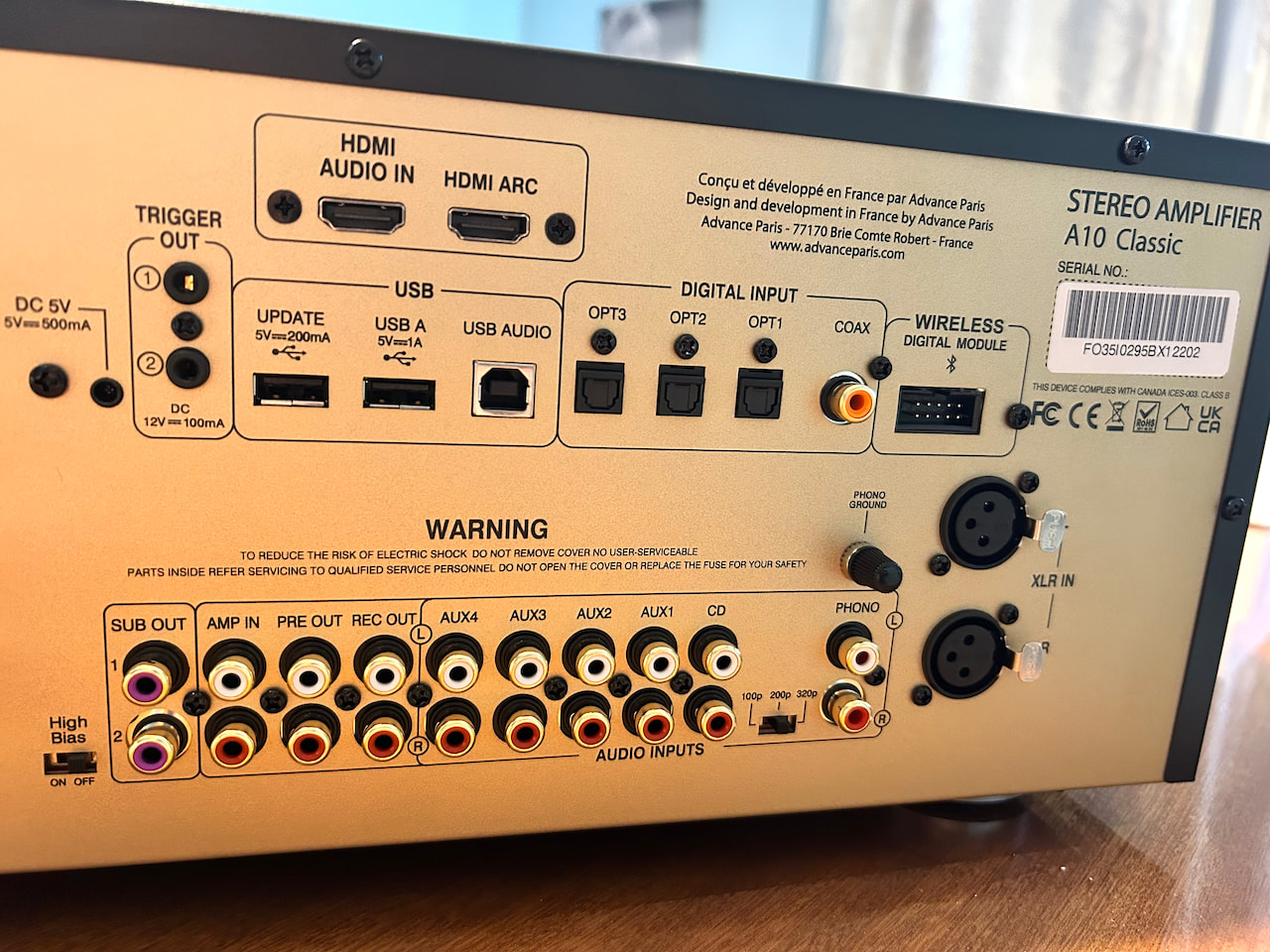
Its analog connectivity is unusually comprehensive. Five line-level RCA inputs are joined by a balanced XLR input and an MM phono stage with selectable capacitance settings of 100, 200, or 320 pF. The phono input does not support moving-coil cartridges, but the adjustable capacitance makes it more useful than the fixed MM stages fitted to many integrated amplifiers.
Pre-out and amp-in connections allow the two sections to be separated, while a fixed record output, two mono subwoofer outputs, two switchable speaker zones, a trigger connection, and a front-panel headphone jack cover most conventional system requirements.
The digital section is built around an ESS9018 DAC and includes three optical inputs, one coaxial input, USB-B for computer audio, USB-A for MP3 playback, HDMI ARC for a television, and a second HDMI audio input for a compatible source. USB-B supports PCM up to 32-bit/384 kHz and DSD256 through DoP; coaxial reaches 24-bit/192 kHz and optical is limited to 24-bit/96 kHz. Bluetooth is optional through Advance Paris’s X-FTB01 aptX or X-FTB02 aptX HD module rather than being built into the amplifier.
There is no Wi-Fi, Ethernet, native streaming platform, app control, room correction, moving-coil phono stage, or HDMI eARC. The subwoofer outputs also lack adjustable crossover, high-pass filtering, and time alignment, so bass management remains the responsibility of the subwoofer. The HDMI inputs provide a convenient route for stereo television and source audio, but the A10 Classic is not an AV receiver and Advance Paris does not document Dolby or DTS decoding. Its appeal is hardware longevity: add the streamer of your choice today and replace that source when the software industry moves the goalposts again.

Advance Paris A10 Classic Specifications
- Type: Hybrid stereo integrated amplifier
- Tubes: 2 x ECC81/12AT7 in the preamplifier stage
- Power output:
- 130 watts per channel into 8 ohms
- 190 watts per channel into 4 ohms
- Amplification: Class AB with switchable High Bias mode
- DAC: ESS9018
- Analog inputs: 5 x stereo RCA, 1 x balanced XLR
- Phono: MM; 47 kΩ; 100, 200, or 320 pF capacitance
- Digital inputs: 3 x optical, 1 x coaxial, USB-B, USB-A, HDMI ARC, HDMI Audio In
- Maximum digital resolution: PCM 32-bit/384 kHz and DSD256 via USB-B
- Bluetooth: Optional aptX or aptX HD module
- Outputs: Pre-out, amp-in, fixed record out, 2 x mono subwoofer, Speaker A/B, headphone, trigger
- Frequency response: 20 Hz to 80 kHz, ±3 dB
- Dimensions (W x H x D): 430 x 175 x 385 mm (16.9 x 6.9 x 15.2 inches)
- Weight: 14.5 kg / 32 pounds

Listening
I have lived with the Cambridge Audio Edge A integrated amplifier for close to five years, and at no point have I felt any desire to replace it. It has been consistently reliable, is built to an exceptionally high standard, remains relatively cool even when driven hard, looks appropriately substantial, and can power a wide range of loudspeakers without sounding strained. More importantly, it continues to sound excellent.
In several respects, the Advance Paris A10 Classic feels like a distinctly French interpretation of the same basic idea: a powerful, full-featured integrated amplifier designed to serve as the foundation of a serious two-channel system. For this review, I used it with the Q Acoustics 5040, Magnepan LRS, Acoustic Energy AE100 MK2, Wharfedale Diamond 12.3, and Wharfedale Super Denton loudspeakers.
The analog front end included Thorens turntables fitted with cartridges from Ortofon, Goldring, and Sumiko, while network playback was handled by components from Bluesound, WiiM, and Cambridge Audio. System cabling came from Advance Paris, QED, Analysis Plus, and Clarus Audio.
Anyone expecting the A10 Classic’s tubes to produce a soft, velvety, or overtly romantic tonal balance should think again. The amplifier sounds comparatively linear, with good control, clarity, and extension at both ends of the frequency range. The tubes contribute additional texture, prevent the presentation from becoming sterile, and give instruments greater body and dimensionality, but they do not dominate the amplifier’s overall character.
Think of it as a very French friends-with-benefits arrangement with Léa Seydoux: sophisticated, textured, and never overplayed, provided you remember the galette, carrot salad, and a bottle of wine good enough to avoid ending the relationship.
As much as I love the Magnepan LRS, they need an amplifier with more than an impressive power rating on paper. Their 4-ohm impedance and relatively low 86 dB sensitivity place greater demands on current delivery as playback levels increase, even though their largely resistive load is easier to manage than the severe impedance swings presented by some conventional loudspeakers.
It has always seemed slightly unusual that my Schiit Ragnarok 2 drives them as well as it does. Its 100-watt-per-channel rating into 4 ohms is hardly excessive by modern standards, but it remains composed and sounds convincing as long as I am prepared to push the volume control farther than usual. The Cambridge Audio Edge A drives the LRS with considerably less apparent effort, and the A10 Classic proved similarly comfortable with them.

The Advance Paris added greater texture, firmer control through the upper bass, and more tonal color than I generally hear from the LRS with the Ragnarok 2. Nobody buys these loudspeakers for subterranean bass; their specified response begins at 50 Hz (which I think I think is being overly generous) but the A10 Classic gave what was available more shape, weight, and definition. I like color in my food, music, movies, and, yes, in the women who have tolerated me. The A10 Classic understood the assignment.
Nick Cave’s “Avalanche” and “Comancheria,” the latter from his and Warren Ellis’s superb score for Hell or High Water, require an amplifier capable of reproducing tonal weight without sacrificing speed or clarity. “Avalanche,” in particular, depends heavily on the physical presence of Cave’s piano. If the notes lack body, resonance, and convincing decay, the performance loses much of its impact, darkness, and emotional weight.
The A10 Classic got all of this right. Piano notes arrived with the necessary mass and initial attack, followed by a natural sense of resonance and decay rather than disappearing abruptly or lingering without definition. “Comancheria” was equally convincing, with the amplifier preserving the score’s tension, space, and low-level texture without making it sound overly polished.
Cave’s voice on “Avalanche” is an equally important test. Some amplifiers smooth over its rough edges and diminish the authority of the performance. That is simply wrong. His delivery needs to sound gravelly, bold, and unsettling, or much of the song’s character disappears. The A10 Classic retained that texture while keeping the vocal clear and intelligible, demonstrating that its strong tonal density does not come at the expense of transparency.
Three very different tracks highlighted two of the A10 Classic’s strongest qualities: its ability to give voices convincing body and texture, and its refusal to sound slow when the music becomes more rhythmically or dynamically demanding.
Jonatan Alvarado’s “Amargura (El Floridense)” has a more ethereal presentation, with his voice floating within a spacious and carefully recorded acoustic. Through both the Magnepan LRS and Q Acoustics 5040, the A10 Classic gave his vocal greater fullness and dimensionality without making it sound heavy or overly forward. The soundstage extended almost wall to wall, which was impressive for me and considerably less appreciated by the rest of the house.
Kefaya and Elaha Soroor’s “Gole Be Khar” and “Jama Narenji,” from Songs of Our Mothers, were a completely different proposition. Soroor’s voice comes at you with far more weight and authority, and the arrangements are packed with percussion, strings, and shifting textures that can turn into a traffic jam through a slower amplifier.

The A10 Classic never lost its footing. It kept Soroor firmly in the center, let the instruments breathe around her, and gave the music the pace and muscle it needed without blurring everything together. This is not an amplifier that moves through dense material in soft shoes. It can get up and go.
Electronic music has become more of a thing for me with age. I know. Act my age. Kraftwerk, Daft Punk, Boards of Canada, deadmau5, and Aphex Twin all need an amplifier with a firm bottom end, but also enough definition to make the bass lines easy to follow. Synths need pace, space, and real energy through the midrange and top end. Nothing kills this kind of music faster than flat, lifeless synthesizers.
The A10 Classic handled all of this rather well. Bass had grip and definition, the soundstage remained open as the mixes became denser, and it never sounded slow or congested. It did not have quite the same low-end impact or midrange punch as the Cambridge Audio Edge A, but we are also talking about an amplifier that costs roughly twice as much. Getting about 90 percent of the way there for a lot less money is nothing to sneeze at.
I have heard amplifiers deliver more decay and considerably more top-end sizzle. The latter is often passed off as “more detail,” which can sound impressive for the first 15 minutes and increasingly unbearable after that, especially with speakers that already lean bright. The A10 Classic does not make that mistake. It has enough energy and clarity to keep electronic music lively, but it knows when to stop thinking you are at some rave in a dingy warehouse in Porte de la Villette.
Restraint is probably the wrong word. Control feels more accurate. My French teacher once suggested that restraints might be required when I was a child, but that is an entirely different conversation. The A10 Classic sounds confident with almost every genre of music without trying to dominate the recording.
The MM Phono Stage Is No Afterthought
It would have been useful for the A10 Classic to include moving-coil support, but its MM phono stage is no slouch. It was quiet with the Ortofon, Goldring, and Sumiko cartridges used during the review, and offered good clarity, tonal weight, and texture without sounding overly warm or soft.
Advance Paris specifies a 47-kilohm input impedance, 2.5 mV sensitivity, and selectable capacitance of 100, 200, or 320 pF. The company does not publish a gain figure, RIAA accuracy, overload margin, or phono-specific signal-to-noise ratio.
A better external phono stage will deliver more space, detail, and dynamic contrast, but most MM users will not feel pressured to upgrade immediately.


The Bottom Line
The Advance Paris A10 Classic stands out because it combines real power, extensive analog and digital connectivity, and a tube preamplifier stage without turning into either a soft-sounding nostalgia piece or a software-dependent lifestyle product. It sounds linear, confident, and controlled, but the tubes add enough texture, body, and tonal color to keep instruments and voices from becoming sterile. It can also drive a wide range of loudspeakers, including the current-hungry Magnepan LRS, without losing its composure.
It is not fully equipped for every modern system. The phono stage supports moving-magnet cartridges but not moving-coil designs. Bluetooth requires an optional module, and there is no built-in Wi-Fi, Ethernet, or native streaming platform. The two subwoofer outputs are useful, but there is no adjustable crossover, high-pass filtering, room correction, or more advanced bass management. Buyers looking for an all-in-one streaming amplifier may find those omissions significant.
The A10 Classic is for listeners who want one substantial integrated amplifier to handle vinyl, digital sources, television audio, external streamers, headphones, and demanding loudspeakers without becoming obsolete when the next streaming platform changes direction. It offers much of the authority and refinement of more expensive integrated amplifiers while retaining a distinct tonal personality of its own.
An Editor’s Choice recommendation? Mais oui—and bring the good Bordeaux, not the bottle you use for cooking.
Pros:
- Powerful, stable Class AB amplification
- Tube preamplifier stage adds texture and body without excessive warmth
- Strong bass control and consistently clear midrange
- Drives a wide range of loudspeakers with confidence
- Excellent analog and digital connectivity
- Adjustable MM phono stage is quiet and genuinely useful
- HDMI ARC and separate pre-out/amp-in connections
- Substantial build quality and distinctive industrial design
- Strong value compared with more expensive integrated amplifiers
Cons:
- No moving-coil phono support
- No built-in network streaming, Wi-Fi, or Ethernet
- Bluetooth requires an optional module
- HDMI ARC rather than eARC
- Limited subwoofer management with no adjustable crossover or high-pass filtering
- High Bias mode requires generous ventilation
Our Ratings
★★★★★★★★★★ Sound Quality
★★★★★★★★★★ Build Quality
★★★★★★★★★★ Connectivity
★★★★★★★★★★ Value
You must be logged in to post a comment Login