

Business
Bookkeeping for Small Business: Step-by-Step Guide(2026)

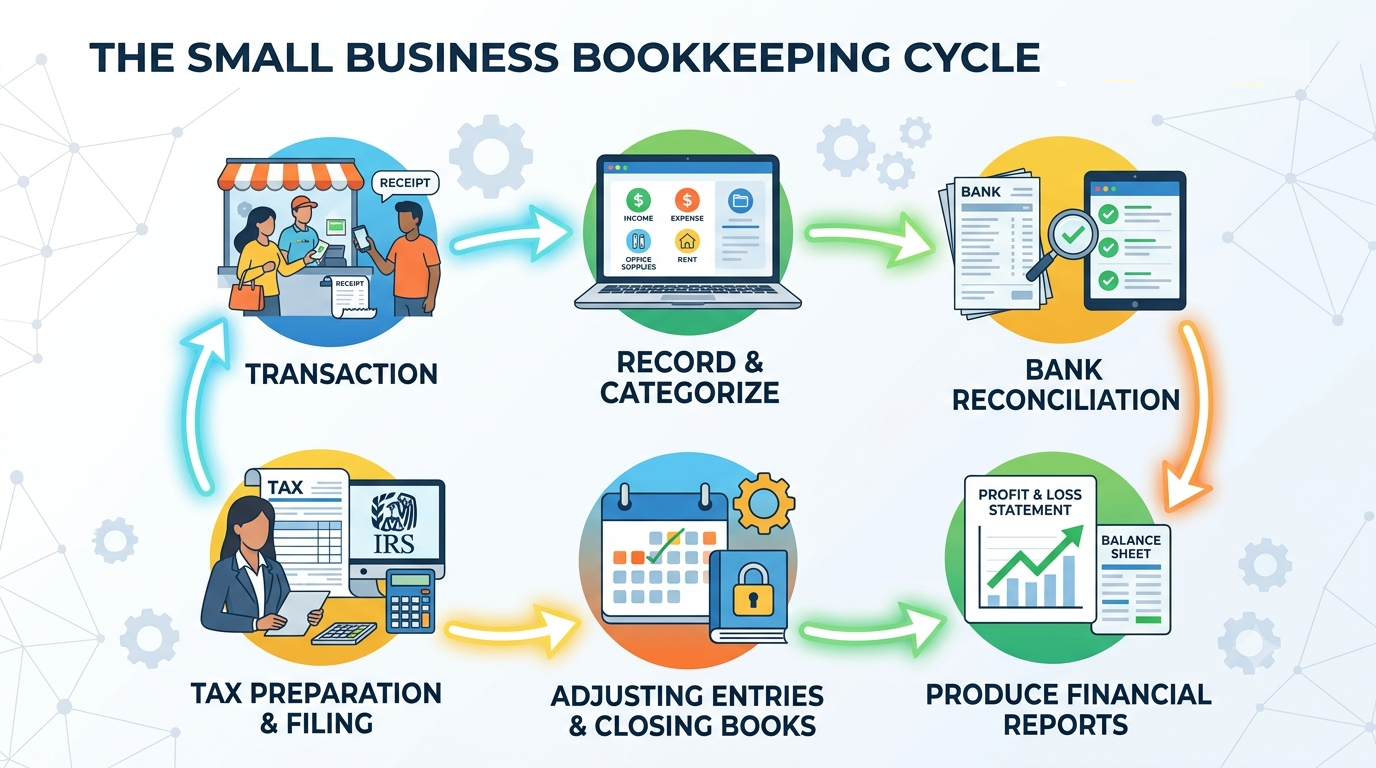
There was a period — let’s call it the Shoebox Era — when my entire bookkeeping system consisted of a spreadsheet named IMPORTANT_FINAL_v3_ACTUALFINAL.xlsx, a rubber-banded stack of receipts fading in the sun on my dashboard, and a business bank account that had, on more than one occasion, quietly paid for my dog’s vet bill. I found out I owed real, actual money to the IRS roughly eleven minutes before I found out I was two months behind on categorizing anything at all. Character-building? Sure. Necessary? Absolutely not.
If any of that sounds familiar, you’re not bad at business — you just haven’t built a system yet. So what does a bookkeeping system that actually works look like, and how much of it can you realistically run yourself? Let’s find out.
Bookkeeping for small business is the ongoing process of recording, organizing, and categorizing every financial transaction a company makes — sales, expenses, payroll, and beyond — to produce accurate records for tax filing, cash flow tracking, and informed decision-making. Done consistently, it turns a shoebox of receipts into a real-time picture of how your business is actually doing.
Bookkeeping vs. Accounting: What’s the Difference?
People use these words interchangeably, which is a bit like confusing the person who logs your grocery receipts with the person who tells you whether you can afford to eat out this month. Related jobs. Very different altitudes.
| Bookkeeping | Accounting | |
|---|---|---|
| Focus | Recording day-to-day transactions | Interpreting and analyzing financial data |
| Timeframe | Present — what happened today/this week | Big picture — trends, forecasts, strategy |
| Typical tasks | Categorizing expenses, invoicing, reconciling accounts | Preparing financial statements, tax strategy, advising on decisions |
| Who does it | You, an employee, or a bookkeeper | A CPA or accountant (often building on bookkeeping records) |
Good bookkeeping is what makes good accounting possible. Skip the first and the second one is just guessing with better vocabulary.
Cash Basis vs. Accrual Accounting: Which Should You Choose?
Before you record a single transaction, you need to pick an accounting method — it determines when income and expenses actually count.
Cash Basis
Accrual Basis
When revenue is recorded
When cash is received
When it’s earned (invoice sent), regardless of payment
When expenses are recorded
When cash leaves your account
When the expense is incurred, regardless of payment
Complexity
Simple, intuitive
More involved, needs more diligent tracking
Best for
Freelancers, solopreneurs, service businesses without inventory
Businesses with inventory, receivables, or that want a more accurate real-time financial picture
IRS note
Available to most businesses under $30M in average gross receipts (check current threshold)
Required for larger businesses and those carrying inventory
If you’re a one-person consultancy invoicing a handful of clients, cash basis will probably feel more intuitive and require less bookkeeping overhead. If you’re holding inventory, extending credit to customers, or want financial statements that actually reflect your business’s health at a glance rather than just your bank balance, accrual is worth the extra structure.
How Do You Set Up a Small Business Bookkeeping System?
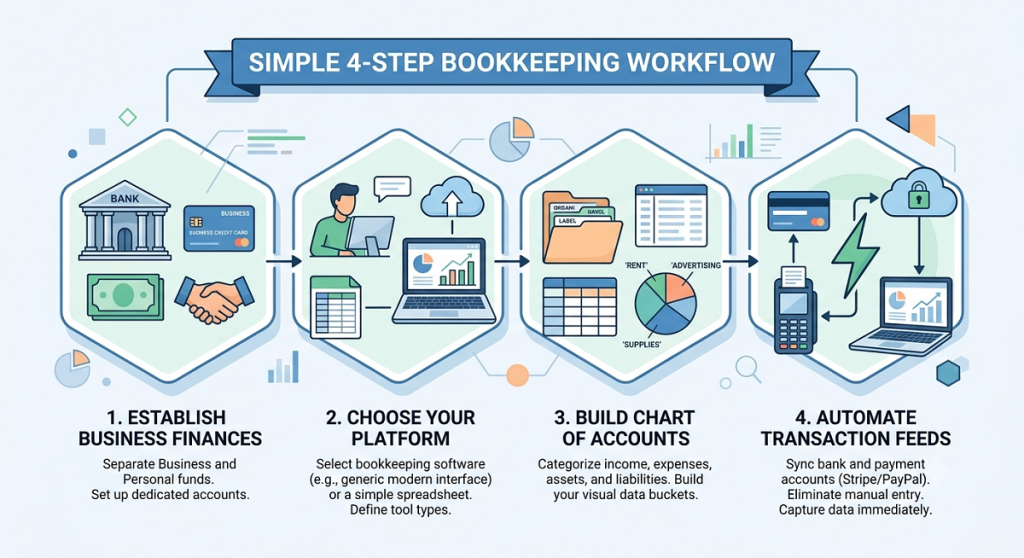
Four foundational steps, done once, save you from redoing everything later.
Step 1: Open a Dedicated Business Bank Account
This is non-negotiable, and not just because it looks more professional. Mixing personal and business funds — commonly called “commingling” — makes every subsequent bookkeeping task harder, muddies your legal liability protection if you’re an LLC, and turns tax season into forensic archaeology.
Step 2: Choose Your Bookkeeping Tool (Spreadsheets vs. Software)
A spreadsheet can work for the first few months of a very simple business. But most modern bookkeeping software pays for itself by automatically syncing bank and card transactions, auto-categorizing recurring expenses, and exporting tax-ready reports — the kind of manual work that eats hours every month if you’re doing it by hand. QuickBooks and Xero remain the most widely used general-purpose options, with a growing field of leaner, cheaper alternatives built specifically for solo and micro businesses.
Step 3: Customize Your Chart of Accounts
Your chart of accounts is the categorized list of buckets — income, expenses, assets, liabilities, equity — that every transaction gets sorted into. Most software gives you a generic template to start from, but it’s worth tailoring it to your actual business. A construction company needs job-costing categories; a service business needs to separate subcontractor costs from software subscriptions. Set it up thoughtfully once, and every report you pull later will actually mean something.
Step 4: Automate Your Transaction Data Feeds
Connect your bank accounts, credit cards, and payment processors (Stripe, PayPal, Square) directly to your bookkeeping software so transactions import automatically instead of requiring manual entry. Manual entry isn’t just tedious — it’s the single fastest way to fall behind, because it’s the first task that gets skipped when you’re busy.
What Should Be on Your Small Business Bookkeeping Checklist?
Consistency beats intensity here. A little bit weekly prevents a lot of pain quarterly.
Weekly tasks
- Categorize new transactions
- Capture and file receipts (a phone photo the moment you get one beats a shoebox every time)
- Send any outstanding invoices
Monthly tasks
- Reconcile bank and credit card statements against your books
- Follow up on unpaid invoices
- Review your Profit & Loss statement for anything that looks off
Quarterly and annual tasks
- Make estimated tax payments, if applicable
- Review your books with a bookkeeper or accountant before filing
- Close out the year’s books and prepare year-end financial statements
If you’re self-employed or otherwise responsible for quarterly estimated taxes in the U.S., the 2026 federal due dates are April 15, June 15, and September 15, 2026, with the fourth-quarter payment due January 15, 2027 — generally owed if you expect to owe $1,000 or more in federal tax for the year. Penalties are avoidable by paying at least 90% of the current year’s tax, or 100% of the prior year’s tax (110% if you’re a higher earner).
Which 3 Financial Reports Should You Actually Monitor?
Bookkeeping produces data. These three reports are what turn that data into decisions.
The Profit and Loss Statement (P&L)
Also called an income statement, this shows revenue minus expenses over a given period — the report that answers “am I actually making money?” Review it monthly, not just at tax time, so you catch a problem while it’s still small.
The Balance Sheet
A snapshot of what your business owns (assets), owes (liabilities), and what’s left over (equity) at a specific point in time. The foundational equation — assets equal liabilities plus equity — is what keeps this report balanced, literally.
The Cash Flow Statement
Profitable on paper and broke in reality is a more common combination than most new business owners expect, especially under accrual accounting where revenue is recorded before cash actually arrives. The cash flow statement tracks the physical movement of money in and out, which is what actually determines whether you can make payroll next week.
What Bookkeeping Mistakes Are Costing You Money?
1. Mixing personal and business expenses. Beyond the bookkeeping headache, commingling can undermine the liability protection an LLC or corporation is supposed to give you.
2. Misclassifying contractors and employees. Getting 1099 vs. W-2 status wrong isn’t a paperwork technicality — it carries real financial and legal consequences with the IRS.
3. Letting your paper trail go cold. No receipt, no proof — and no proof means no deduction if you’re ever audited. Most U.S. tax professionals recommend keeping supporting records for at least three to seven years, depending on the situation, so build a digital filing habit rather than trusting a shoebox (or its digital equivalent, the “Downloads” folder).
4. Skipping reconciliation. This is the step where errors, duplicate charges, and outright fraud get caught. Skip it for a few months and you’re not just behind — you’re bookkeeping blind.
Frequently Asked Questions
How much do bookkeepers charge? Pricing varies widely by scope and service model. Basic software-supported plans can start in the low hundreds per month, while services that include a dedicated bookkeeper or controller oversight tend to run higher. Get quotes based on your actual transaction volume rather than relying on a single benchmark figure.
Can I do my own bookkeeping? Yes, especially in the early stages of a simple business — plenty of solo founders manage their own books using accounting software. The trade-off is time and risk: as transaction volume and complexity grow (payroll, inventory, multiple revenue streams), the hours it takes and the cost of a mistake both climb, which is usually the point where outsourcing starts to pay for itself.
What records do I need to keep for taxes? At minimum: bank and credit card statements, receipts and invoices for income and expenses, payroll records if you have employees, and documentation for any major purchases or contracts. Digital, organized, and backed up beats a shoebox every time — you’ve heard that from me twice now, and I mean it both times.
The Bottom Line
Good bookkeeping isn’t about becoming a numbers person overnight. It’s about building small, boring, repeatable habits — a weekly ten minutes here, a monthly reconciliation there — so that tax season stops being a crisis and starts being a formality. Consistency beats perfection every time.


Philip Morris shares may move 4.9% on July 22 earnings report


JPMorgan Chase CEO Jamie Dimon on Wednesday announced a $24 million effort to help revive American shipbuilding, his latest move under the bank’s $1.5 trillion security project aimed at bolstering industries critical to U.S. economic and national security.
The figure includes $18 million in loans and $6 million in grants to finance a new submarine manufacturing facility at the Philadelphia Navy Yard being built by Rhoads Industries, expand lending to maritime-related small businesses and strengthen regional suppliers, JPMorgan said.
“The arsenal of democracy has been reignited,” Dimon told CNBC’s Andrew Ross Sorkin.
“People said it couldn’t happen, but here you have Hanwha shipbuilding at the Philadelphia Navy Yard,” Dimon said, naming a South Korean conglomerate with a U.S. vessel-making subsidiary.
The announcement comes as rising geopolitical tensions, including wars in the Middle East and Ukraine, spur governments to rearm and reinvest in domestic industrial capacity.
Last year, JPMorgan launched a $1.5 trillion initiative to finance sectors it considers critical to U.S. economic and national security, including shipbuilding. The firm announced an expansion of the program into Europe this year.

JPMorgan Chase CEO Jamie Dimon joins ‘Mornings with Maria’ in a wide-ranging interview on AI risks, stablecoin regulation, housing affordability and his recent meeting with New York City Mayor Zohran Mamdani.
JPMorgan Chase Chairman and CEO Jamie Dimon is validating the growing frustration of working-class Americans, admitting in a recent interview that he completely understands why many have grown “anti-rich.”
The Wall Street billionaire argued that decades of ineffective public policies have left lower-income families behind in struggling rural areas and inner cities, forcing them to navigate failing schools and rising crime while wealthy elites remain insulated from those problems.
“The anti-rich thing has been around a long time, and I do understand it because I think, separate the two pieces, the piece that’s really important is that we have, in fact, left the lower-income folks behind,” Dimon told Axios. “And I remind people who are well off that they don’t worry about their schools. They don’t live in crime-ridden neighborhoods. So if you are making less income in your poor rural area or an inner-city area, your schools aren’t good. You go to crime-ridden neighborhoods – more divorce, less jobs, all the things that, yeah, it’s becoming de-generational. So let’s acknowledge it and fix it.”
JPMORGAN NAMES 2 NEW CO-PRESIDENTS, SETTING UP RACE TO SUCCEED JAMIE DIMON
“All of us, Democrats, including unions, Republicans should say, ‘That shouldn’t happen that way.’ And the policies that created that were both Democrat and Republican. All of those policies did not work in the inner cities,” he continued.

Chairman and CEO of JPMorgan Chase & Co. Jamie Dimon speaks during an event on Liberty Island in New York City, on July 1, 2026. (Getty Images)
“If you were the average citizen here and you say, ‘These wealthy people are getting unbelievably wealthy, and this segment has been left behind,’ that’s kind of annoying. Now, if we look at America in truth from the 50s, 60s, 70s, 80s, 90s to 2020s, Americans have been doing much better, including the lower income.”
Data from the Federal Reserve’s Distributional Financial Accounts highlight a highly concentrated wealth distribution in the United States. The bottom 50% of households hold a combined $4.27 trillion of the nation’s roughly $174 trillion in household wealth.
Charles Payne and Daniel Lacalle express confusion over the Federal Reserve’s monetary policy, questioning why they slow the economy when wages rise and hike rates when gas prices are already high.
In contrast, the top 0.1% of ultra-wealthy individuals command about $25.07 trillion, while those in the 99th through 99.9th percentiles own just under $30 trillion.
“I’ve been complaining a little bit about, I’ve just been speaking about, the fraying of the American Dream for years. And I think you have to acknowledge that there’s a flaw. And it’s more for the lower-paid individuals in America,” Dimon said.
GET FOX BUSINESS ON THE GO BY CLICKING HERE
Longtime NYSE trader Peter Tuchman shares his perspective on the American Dream and the resilience of the market from the exchange floor.
“We asked our team… What more can JPMorgan do?” Dimon detailed the “Vital Institutions” initiative, which directs capital, banking and philanthropic support to organizations like hospitals, universities and local governments to boost low-to-moderate-income communities.
“Economic strength is somewhat predicated, affected – it’s life, liberty and the pursuit of happiness, and equal opportunity. So if you wanna have an equal opportunity country, you need to do some of these things to give people more opportunity,” he said.


Pythia Research focuses on multi-bagger stocks, primarily in the technology sector. Our approach combines financial analysis, behavioral finance, psychology, social sciences, and alternative metrics to assess companies with high conviction and asymmetric risk-reward potential. By leveraging both traditional and unconventional insights, we aim to uncover breakout opportunities before they gain mainstream attention. Our multidisciplinary strategy helps us navigate market sentiment, identify emerging trends, and invest in transformative businesses poised for exponential growth. We don’t just follow the market—we anticipate where disruption will create the next big winners.Markets don’t move purely on fundamentals; they move on perception, emotion, and bias. We lean into that reality. Investor behavior, anchoring to past valuations, herd mentality during rallies, panic selling from recency bias, creates persistent inefficiencies. These moments of mispricing often mark the start of a breakout, not the end of one.Rather than avoid psychological noise, we analyze it. When the crowd sees volatility, we assess whether it’s driven by emotion or fundamentals. Status quo bias can keep investors blind to companies redefining their category. Fear of uncertainty can delay recognition of businesses with clear but unconventional growth paths. We look for these disconnects.Our process blends deep research with signals others miss: sudden shifts in narrative, early social traction, founder-driven vision, or underappreciated momentum in developer or user adoption. These are often the precursors to exponential moves, if you catch them early.We focus on conviction plays, not safe bets. Each opportunity is evaluated for Risk/Reward profile: limited downside, explosive upside. We believe that the best returns come from understanding where belief is lagging reality.
Analyst’s Disclosure: I/we have a beneficial long position in the shares of PLTR either through stock ownership, options, or other derivatives. I wrote this article myself, and it expresses my own opinions. I am not receiving compensation for it (other than from Seeking Alpha). I have no business relationship with any company whose stock is mentioned in this article.
Seeking Alpha’s Disclosure: Past performance is no guarantee of future results. No recommendation or advice is being given as to whether any investment is suitable for a particular investor. Any views or opinions expressed above may not reflect those of Seeking Alpha as a whole. Seeking Alpha is not a licensed securities dealer, broker or US investment adviser or investment bank. Our analysts are third party authors that include both professional investors and individual investors who may not be licensed or certified by any institute or regulatory body.
Business
NSA warns Russian hackers exploiting vulnerable internet routers to infiltrate business networks

Former White House ‘AI czar’ David Sacks discusses AI regulation, competition with China and the risks of advanced AI-powered ‘cyber weapons’ on ‘Kudlow.’
The National Security Agency is warning that Russian government-backed hackers continue targeting internet routers used by businesses and critical infrastructure, urging organizations to shore up basic network security to reduce the risk of cyber intrusions.
In a joint cybersecurity advisory released Monday, the NSA, FBI, Cybersecurity and Infrastructure Security Agency (CISA) and nearly 20 allied cybersecurity agencies said cyber actors linked to Russia’s Federal Security Service, or FSB, have spent years exploiting vulnerable or poorly configured networking devices to gain access to sensitive networks.
The advisory said organizations in the financial services, energy, communications, healthcare, government and defense industrial base sectors have been affected. Officials said those industries play a critical role in the U.S. economy.
IBM SENDS ‘SHOCKWAVE’ THROUGH TECH INDUSTRY WITH AI WARNING
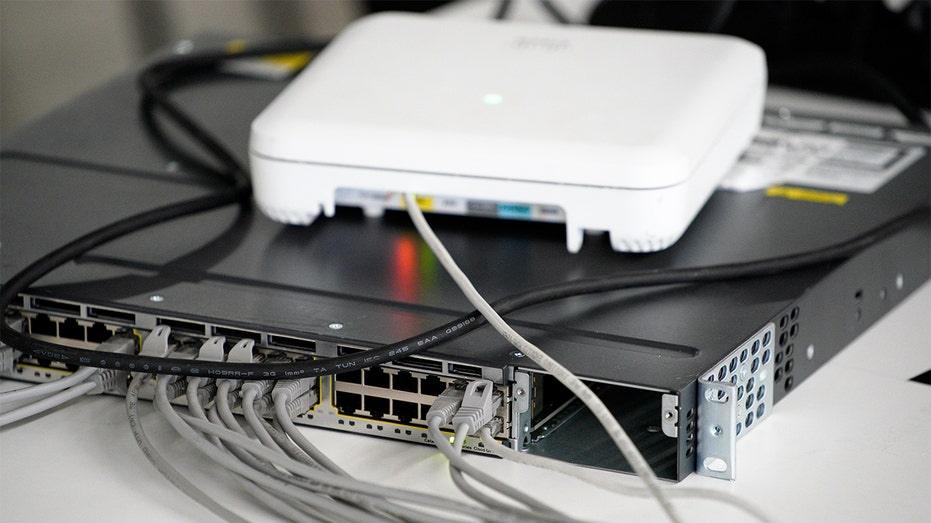
Officials said the campaign frequently relies on poor “router hygiene.” (Jaap Arriens/NurPhoto via Getty Images)
Rather than launching disruptive attacks immediately, the hackers often scan the internet looking for outdated or improperly secured routers, then quietly copy device configuration files that can contain administrator credentials, network layouts and other information useful for gaining deeper access into an organization’s systems, according to the advisory.
Officials said the campaign frequently relies on poor “router hygiene” – basic security practices such as keeping router software up to date, replacing default passwords with strong, unique credentials and disabling unnecessary remote management features.

The advisory said organizations in the financial services, energy, communications, healthcare, government and defense industrial base sectors have been affected. (Getty Images)
HACKERS ARE GOING AFTER WHATEVER THEY CAN ATTACK TO MAKE NEWS, RUBRIK CEO SAYS
Officials said many of the attacks can be prevented by following a handful of basic cybersecurity practices, including updating router software and firmware to patch known vulnerabilities, using stronger authentication methods, restricting access to network management tools and replacing legacy security settings with more modern protections.
The advisory builds on an earlier FBI warning about Russian cyber activity targeting networking devices, saying the campaign has persisted for more than a decade and continues to threaten critical infrastructure worldwide. Officials said the same defensive measures can also help protect organizations against similar tactics used by other sophisticated hacking groups.
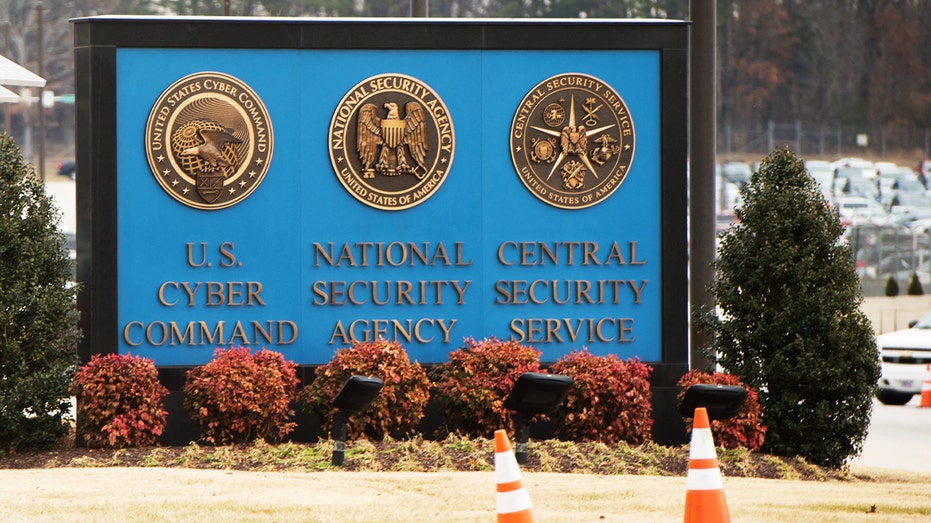
Officials said many of the attacks can be prevented by following a handful of basic cybersecurity practices. (Saul Loeb/AFP via Getty Images)
Cybersecurity researchers have tracked Russian activity under several names over the years, including “Dragonfly,” “Energetic Bear” and “Ghost Blizzard,” though different security firms use different naming conventions for the same threat actors.
CLICK HERE TO GET FOX BUSINESS ON THE GO
The warning was issued jointly by the NSA, FBI, CISA, the Department of Defense Cyber Crime Center and cybersecurity agencies from the United Kingdom, Canada, Australia, New Zealand and numerous European allies, underscoring what officials described as an ongoing threat to organizations that rely on internet-connected networking equipment.


Company debuts french fry-inspired, fruit-forward flavored frozen novelties.


Global flavors were trending on the show floor.

Karl Hersvik
Chief Executive Officer
Good morning, everyone, and welcome to Aker BP’s second quarter presentation. It was a quarter of strong operational execution and robust financial results. Production averaged 384,000 barrels of oil equivalents per day and operating cash flow was $3.1 billion. And we have raised the lower end and narrowed our production guidance for the year.
Our major projects remain on track with important milestones across Yggdrasil, Valhall PWP–Fenris, Skarv Satellites and Johan Sverdrup Phase 3. At the same time, we continue to strengthen the portfolio for future growth, including through a new strategic collaboration with Equinor. We also maintain a robust financial position with $6 billion in available liquidity and an unchanged quarterly dividend.
Operationally, this was a quarter shaped by seasonally high level of activity with continued high efficiency across the portfolio. Production was lower than in the previous quarter, mainly due to planned maintenance at Edvard Grieg and Ivar Aasen combined with normal quarter-to-quarter variations. Despite these planned impacts, production efficiency was 94%, a very strong performance by industry standards. Production costs increased to $8.8 per barrel, mainly reflecting planned seasonal activity across the portfolio, including maintenance at Edvard Grieg and Ivar Aasen, diving operations at Alvheim and well intervention activity


Vladimir Dimitrov, CFA is a former strategy consultant within the field of brand and intangible assets valuation. During his career in the City of London he has been working with some of the largest global brands within the technology, telecom and banking sectors. He graduated from the London School of Economics and is interested in finding reasonably priced businesses with sustainable long-term competitive advantages.
Analyst’s Disclosure: I/we have a beneficial long position in the shares of CVX either through stock ownership, options, or other derivatives. I wrote this article myself, and it expresses my own opinions. I am not receiving compensation for it (other than from Seeking Alpha). I have no business relationship with any company whose stock is mentioned in this article.
Please do your own due diligence and consult with your financial advisor, if you have one, before making any investment decisions. The author is not acting in an investment adviser capacity. The author’s opinions expressed herein address only select aspects of potential investment in securities of the companies mentioned and cannot be a substitute for comprehensive investment analysis. The author recommends that potential and existing investors conduct thorough investment research of their own, including a detailed review of the companies’ SEC filings. Any opinions or estimates constitute the author’s best judgment as of the date of publication and are subject to change without notice.
Seeking Alpha’s Disclosure: Past performance is no guarantee of future results. No recommendation or advice is being given as to whether any investment is suitable for a particular investor. Any views or opinions expressed above may not reflect those of Seeking Alpha as a whole. Seeking Alpha is not a licensed securities dealer, broker or US investment adviser or investment bank. Our analysts are third party authors that include both professional investors and individual investors who may not be licensed or certified by any institute or regulatory body.


Always on the hunt for undervalued, promising stocks with a focus on risk and reward. Limited risks and decent to high upside by knowing what one’s owning. I strongly believe that the best investment ideas are often the simplest. If contrarian, the better.
Analyst’s Disclosure: I/we have no stock, option or similar derivative position in any of the companies mentioned, and no plans to initiate any such positions within the next 72 hours. I wrote this article myself, and it expresses my own opinions. I am not receiving compensation for it (other than from Seeking Alpha). I have no business relationship with any company whose stock is mentioned in this article.
Seeking Alpha’s Disclosure: Past performance is no guarantee of future results. No recommendation or advice is being given as to whether any investment is suitable for a particular investor. Any views or opinions expressed above may not reflect those of Seeking Alpha as a whole. Seeking Alpha is not a licensed securities dealer, broker or US investment adviser or investment bank. Our analysts are third party authors that include both professional investors and individual investors who may not be licensed or certified by any institute or regulatory body.

Protesters confront NatureScot at biodiversity conference over guga hunt licence

Wayne Rooney’s cheating scandals, arrest at US airport and huge BBC salary

Ada Kejutan Keuangan Untukmu


-

 Fashion6 days ago
Loro Piana Fall 2026 Enters Houston’s Art Scene
-

 Fashion5 days ago
Weekend Open Thread: Nutriplenish Leave-In Conditioner
-
 Sports6 days ago
2026 Genesis Scottish Open Thursday TV coverage: Round 1
-

 Sports5 days ago
Super Eagles star Moses Simon opens up on Liverpool transfer regret
-

 Tech6 days ago
Character.AI enters the microdrama arena with its own productions, but there’s a twist
-

 Politics3 hours ago
Young campaigners urge incoming PM to act on outdoor junk food ads
-

 News Videos19 hours ago
XRP BOMBSHELL… XRP OMBOARDED FOR TRANSACTIONS!!!
-

 Tech1 day ago
Get Your ESP32 Sunny Side Up With This Solar Dev Board
-

 Tech19 hours ago
Dark Secrets Emerge When Jailbreaking LLMs
-

 News Videos7 days ago
Crypto Just Entered Its Most Important 6-Month Candle (Could Decide Everything!)
-
 NewsBeat6 days ago
Major update after Huntingdon train attack as man enters plea
-

 Tech6 days ago
Level Infinite Launches Gangstar Mirage City in India with Pre-Registrations
-

 News Videos2 days ago
how to make coin bank box with cardboard #scienceproject #money #diy #shorts
-
 Tech2 days ago
Cloudflare Precursor Watches Your Mouse and Keyboard To Decide If You Are Human
-

 Tech7 days ago
Entra passkey enrollment vishing targets Microsoft 365 users
-

 Crypto World7 days ago
DeFi Dashboard Zapper to Shut Down After 7 Years
-
 Crypto World6 days ago
Mark Cuban-Backed DeFi Dashboard Zapper Shuts Down After 7 Years
-
 Tech6 days ago
Claude’s New Reflect Dashboard Wants To Help You Log Off Of Claude
-

 Crypto World7 days ago
Fed minutes June 2026: officials split on rates
-
 Entertainment2 days ago
Kathryn Newton and Lana Condor Are Caught in the Maw of Prime Video’s Chilling Survival Thriller in New Look [Exclusive]
You must be logged in to post a comment Login