

Business
Jamie Dimon says he understands anti-rich anger over wealth inequality


JPMorgan Chase CEO Jamie Dimon joins ‘Mornings with Maria’ in a wide-ranging interview on AI risks, stablecoin regulation, housing affordability and his recent meeting with New York City Mayor Zohran Mamdani.
JPMorgan Chase Chairman and CEO Jamie Dimon is validating the growing frustration of working-class Americans, admitting in a recent interview that he completely understands why many have grown “anti-rich.”
The Wall Street billionaire argued that decades of ineffective public policies have left lower-income families behind in struggling rural areas and inner cities, forcing them to navigate failing schools and rising crime while wealthy elites remain insulated from those problems.
“The anti-rich thing has been around a long time, and I do understand it because I think, separate the two pieces, the piece that’s really important is that we have, in fact, left the lower-income folks behind,” Dimon told Axios. “And I remind people who are well off that they don’t worry about their schools. They don’t live in crime-ridden neighborhoods. So if you are making less income in your poor rural area or an inner-city area, your schools aren’t good. You go to crime-ridden neighborhoods – more divorce, less jobs, all the things that, yeah, it’s becoming de-generational. So let’s acknowledge it and fix it.”
JPMORGAN NAMES 2 NEW CO-PRESIDENTS, SETTING UP RACE TO SUCCEED JAMIE DIMON
“All of us, Democrats, including unions, Republicans should say, ‘That shouldn’t happen that way.’ And the policies that created that were both Democrat and Republican. All of those policies did not work in the inner cities,” he continued.

Chairman and CEO of JPMorgan Chase & Co. Jamie Dimon speaks during an event on Liberty Island in New York City, on July 1, 2026. (Getty Images)
“If you were the average citizen here and you say, ‘These wealthy people are getting unbelievably wealthy, and this segment has been left behind,’ that’s kind of annoying. Now, if we look at America in truth from the 50s, 60s, 70s, 80s, 90s to 2020s, Americans have been doing much better, including the lower income.”
Data from the Federal Reserve’s Distributional Financial Accounts highlight a highly concentrated wealth distribution in the United States. The bottom 50% of households hold a combined $4.27 trillion of the nation’s roughly $174 trillion in household wealth.
Charles Payne and Daniel Lacalle express confusion over the Federal Reserve’s monetary policy, questioning why they slow the economy when wages rise and hike rates when gas prices are already high.
In contrast, the top 0.1% of ultra-wealthy individuals command about $25.07 trillion, while those in the 99th through 99.9th percentiles own just under $30 trillion.
“I’ve been complaining a little bit about, I’ve just been speaking about, the fraying of the American Dream for years. And I think you have to acknowledge that there’s a flaw. And it’s more for the lower-paid individuals in America,” Dimon said.
GET FOX BUSINESS ON THE GO BY CLICKING HERE
Longtime NYSE trader Peter Tuchman shares his perspective on the American Dream and the resilience of the market from the exchange floor.
“We asked our team… What more can JPMorgan do?” Dimon detailed the “Vital Institutions” initiative, which directs capital, banking and philanthropic support to organizations like hospitals, universities and local governments to boost low-to-moderate-income communities.
“Economic strength is somewhat predicated, affected – it’s life, liberty and the pursuit of happiness, and equal opportunity. So if you wanna have an equal opportunity country, you need to do some of these things to give people more opportunity,” he said.


Among the 11 major sectors in the S&P 500, technology was one of the biggest percentage losers, with semiconductor stocks weighing heavily on the broader market.
Daily moves in chips have increasingly dictated the overall movement of the major U.S. stock indexes, particularly the tech-heavy Nasdaq.
“It comes strictly down to the weight of the chips in the S&P 500,” said Paul Nolte, senior wealth advisor & market strategist at Murphy & Sylvest in Elmhurst, Illinois. “Three or four years ago, it was 8%, and now it’s over 20%. If you look at the rest of the market, it’s doing fine.”
The weakness in chips, even after chip demand bellwether TSMC posted a 77% jump in quarterly profit, demonstrated the lofty expectations for a sector that has soared by nearly 70% so far this year. U.S.-listed shares of the chipmaker lost ground on the day.

Memory-chip makers were among the biggest laggards, with SanDisk, Western Digital, Seagate Technology , and Intel among the largest percentage losers.
“This extreme volatility is very disconcerting for the average investor when they see these huge swings in their portfolio value,” said Tim Ghriskey, senior portfolio strategist at Ingalls & Snyder in New York. “(But) a number of the non-tech sectors are doing well, so it’s a real mix here.”According to preliminary data, the S&P 500 lost 37.78 points, or 0.50%, to end at 7,534.62 points, while the Nasdaq Composite lost 383.76 points, or 1.47%, to 25,885.47. The Dow Jones Industrial Average fell 109.13 points, or 0.21%, to 52,549.51.
The Dow’s losses were cushioned in part by UnitedHealth Group’s advance after the company beat Wall Street earnings estimates and hiked its 2026 forecast.
United Airlines fell as surging oil prices weighed on its forward guidance.
GE Aerospace slid even after the company lifted its 2026 profit forecast.
Analysts have set a high bar for second-quarter earnings season. S&P 500 companies, in aggregate, are expected to post year-on-year earnings growth of 24.8%. Technology earnings alone are seen jumping 65.5% from the year-ago quarter, according to the latest available data from LSEG.
SOLID RETAIL SALES, LOW JOBLESS CLAIMS, WEAK HOUSING DATA
A spate of U.S.economic indicators released on Thursday showed solid core retail sales, a drop in jobless claims and surging manufacturing activity in the Northeast.
Less positive data came from the housing sector, with a bigger than expected drop in pending home sales and souring homebuilder sentiment reflecting high borrowing costs and strained affordability for would-be homebuyers.
The U.S. and Iran extended their barrage of airstrikes, prolonging a week-long escalation that has all but voided last month’s truce. But Iran’s release of a U.S. citizen suggested a path remains for the two sides to avert the resumption of all-out war.
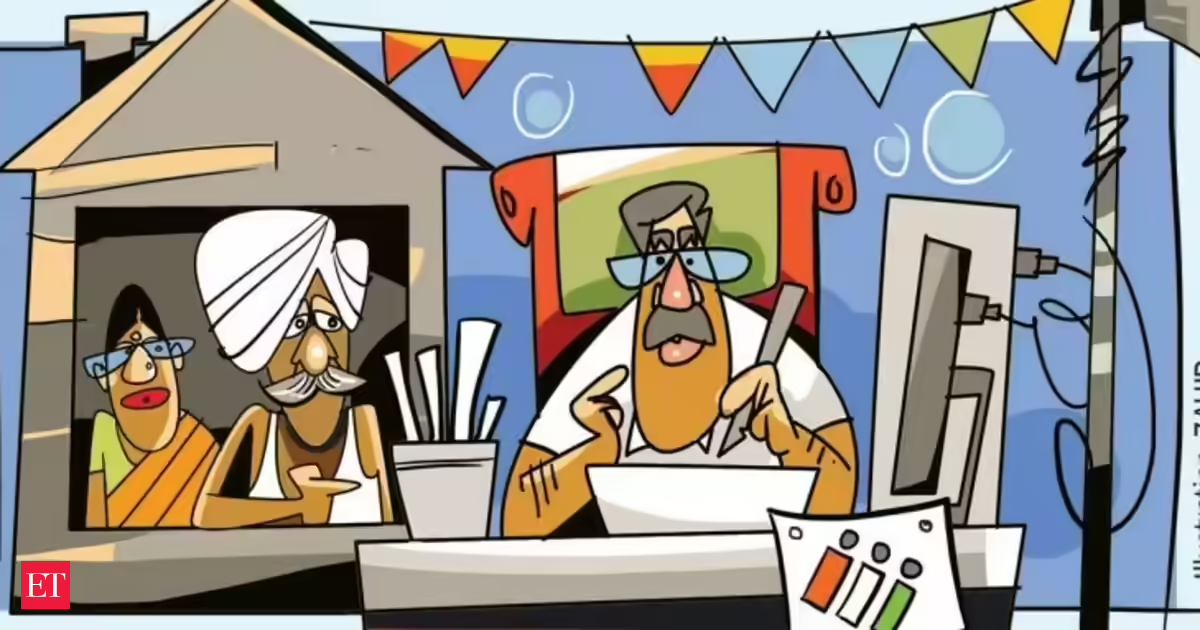
Factor the last such instances: In June 2004, ECI ordered ‘Intensive Revision of Electoral Rolls‘ in seven northeastern states and J&K.
Alongside, it ordered a ‘special summary revision‘ in Andhra Pradesh, Bihar, Chhattisgarh, Goa, Gujarat, Haryana, Himachal Pradesh, Jharkhand, Karnataka, Kerala, Madhya Pradesh, Maharashtra, Orissa, Punjab, Rajasthan, Sikkim, Tamil Nadu, Uttar Pradesh, Uttaranchal, West Bengal, and Union Territories of Andaman & Nicobar Islands, Chandigarh, Daman & Diu, Dadra & Nagar Haveli, NCT of Delhi, Lakshadweep and Pondicherry.Prior to that, ‘intensive revision’ of the electoral rolls was conducted in 20 other states/UTs, including Bihar, in two phases during 2002 and 2003, except the northeastern states and J&K.
BIHAR 2025- A unique case
The 2025 SIR in Bihar is different on several counts. While an ‘intensive’ revision mostly involves a ‘de novo’ exercise, drawing up a fresh electoral roll from the scratch, the Bihar SIR is using the 2002-03 electoral roll as a base to build upon. At the same time, it involves a new pre-printed enumeration form included in the usual house-to-house verification format and document submission, associated with an ‘intensive’ revision. It is, also, very different from previous intensive revision exercises in terms of timing.
EC has seldom ordered a full state and full-scale intensive revision in a state 4-6 months ahead of scheduled assembly elections, as is the case with Bihar. Bihar saw its last intensive revision in 2002, a good three years away from the assembly polls held in October 2005.
Similarly, when the EC, on June 29, 2004 announced an intensive roll revision in eight states, it chose to leave out two states which were pending a similar intensive roll revision. These were Arunachal Pradesh & Maharashtra where assembly polls were due in October 2004.
“In Arunachal Pradesh and Maharashtra, general elections to the assemblies are to be held in the latter half of 2004. Therefore, the programme in these two states will be announced after the completion of the elections,” the EC press note on 29.06.2004 read.
Instead, a ‘special summary revision of rolls’ was announced for Maharashtra ahead of the October 2024 assembly polls with house-to-house enumeration, as per the September-December 2004 EC newsletter.
The EC has, in fact, often conducted ‘intensive’ revision in certain areas of a state. In Tamil Nadu- after inquiry reports indicated ‘shortcomings in the conduct of different levels of election officers at the time of intensive revision of electoral rolls in 2002’- the poll panel on October 19, 2004 ordered a ‘special revision of intensive nature with house-to-house enumeration’ in six municipal corporation areas across 33 constituencies, spanning parts of Chennai, Salem, Coimbatore, Tiruchirappalli, Madurai, and Tirunelveli.
In the aftermath of Gujarat riots, the ECI on August 16,2002, announced a repeat of the 2002 ‘special revision of intensive nature’.
Types Of Electoral Roll Revisions
Intensive Revision: It’s usually a de-novo process without reference to earlier existing roll; involves at least 2 household verification visits by booth-level officer
Summary Revision: Roll is simply updated; no house-to-house enumeration but objections are addressed before final roll publication
Special Summary Revision: EC can order so if it finds inaccuracies or poor coverage of any area. EC can adopt changes in existing procedure
Partly Intensive and Partly Summary Revision: Existing electoral rolls are published in draft and checked through household verification and put through claims/objection process
Roll revision chronology
1950
Originally Section 23 of Representation of the People Act, 1950 provided for annual revision with March 1 as qualifying date
1952
After first gen election in 1952, EC directed that from 1952 to 1956, annual revision of electoral rolls should cover 1/5th of entire state area so that every locality might have its electoral roll intensively revised at least once before 2nd gen polls
1956
EC directed intensive revision of rolls every year in some areas where electoral rolls were likely to become inaccurate: (i) Urban Areas (ii) Areas with floating labour population (iii) Areas where fairly large movements of population had taken place
1957
Post 1957: Lok Sabha polls: EC directed that during each of the three following years, the electoral rolls of 1/3rd of the entire state area be revised intensively, while during 1961 the revision would be intensive only in urban areas, areas with floating, migratory population and service voters
1960
Following amendments to RP Act, 1950, EC ordered annual revision of rolls between January 1 and Jan 31 of the year
1962
Post 1962 LS Polls: EC directed ‘summary revision’ adequate for 1963 and 1964. In 1965 intensive revision conducted again in 40% of the country; the rest 60% was done in 1966
1966
Post 1966: District Election Officer appointed in each district and summary roll revision conducted in 1969-70 and 1975
1976
Emergency: no Lok Sabha polls in 1976; EC held summary roll revision
1983
1983 on: Staggered intensive revision of all rural constituencies ahead of 1985 LS polls
1987-88
All constituencies revised intensively; special revision in 1989
1992
Summary revision ordered followed by intensive revision in 1993 along with introduction of EPIC card
1995
Intensive Revision comes in
1999-2000
Amid computerisation electoral rolls, no intensive revision in 1999, 2000
2002
Special intensive revision in 20 states; intensive revision in 7 states in 2003-04

Morgan Stanley Profit Rises 58% on Trading, Dealmaking Strength

I Was Wrong About Johnson & Johnson: Upgrading To Hold (Rating Upgrade)

The U.K. antitrust watchdog launched an initial merger probe into the proposed $1.2 billion acquisition of Huel by Danone BN to examine whether the deal would lessen competition in the country.
Danone, the French food company behind Activia yogurt and Evian water, agreed to buy the British supplier of plant-based food powders and meal-replacement drinks earlier this year.
Copyright ©2026 Dow Jones & Company, Inc. All Rights Reserved. 87990cbe856818d5eddac44c7b1cdeb8

Abbott reported GAAP diluted earnings per share of $0.53, while adjusted diluted earnings per share came in at $1.31, excluding specified items. The company also raised its full-year 2026 adjusted diluted EPS guidance to a range of $5.45 to $5.60. The company had earlier guided for adjusted EPS of $5.38 to $5.58. It reaffirmed its full-year comparable sales growth guidance of 6.5% to 7.5%.
“Our second-quarter results reflect the momentum we are building,” said Robert B. Ford, chairman and chief executive officer of Abbott. “We expect this momentum to continue and drive accelerating sales and earnings growth in the second half of the year.”
Sales momentum lifts sentiment
The rise in Abbott shares suggests investors were encouraged by the company’s sales growth and the higher profit forecast. The company’s comparable sales growth measure includes the prior and current year sales of Exact Sciences, the cancer diagnostics company Abbott acquired on March 23, 2026.
Also Read: ‘We faltered, did not move quickly:’ How IBM CEO Arvind Krishna’s statement led to $70 billion wipeoutComparable sales growth excludes foreign exchange impact and certain revenue linked to compensation payments received by Abbott’s Structural Heart business under a multi-year agreement with a competitor. The final payment under that agreement was recognised in the first quarter of 2026.
Product pipeline remains active
Abbott also highlighted progress across its medical device and diagnostics pipeline.
In April, the company completed enrolment in its TECTONIC US pivotal trial. The trial is evaluating Abbott’s investigational Coronary Intravascular Lithotripsy system, which is designed to treat severe calcium build-up in coronary arteries before stent implantation.
At the Heart Rhythm Society conference in April, Abbott presented late-breaking data from four clinical trials. The data showed strong clinical outcomes across its pulsed field ablation and conduction system pacing portfolios.
In May, Abbott secured CE Mark approval for Libre Duo, which it described as the world’s first dual glucose-ketone biowearable sensor. The device gives real-time visibility into glucose and ketone levels. This can help people with diabetes detect rising ketone levels, which may lead to diabetic ketoacidosis, a serious condition.
Abbott also completed its submission to the US Food and Drug Administration seeking approval for its Amulet 360 left atrial appendage device.
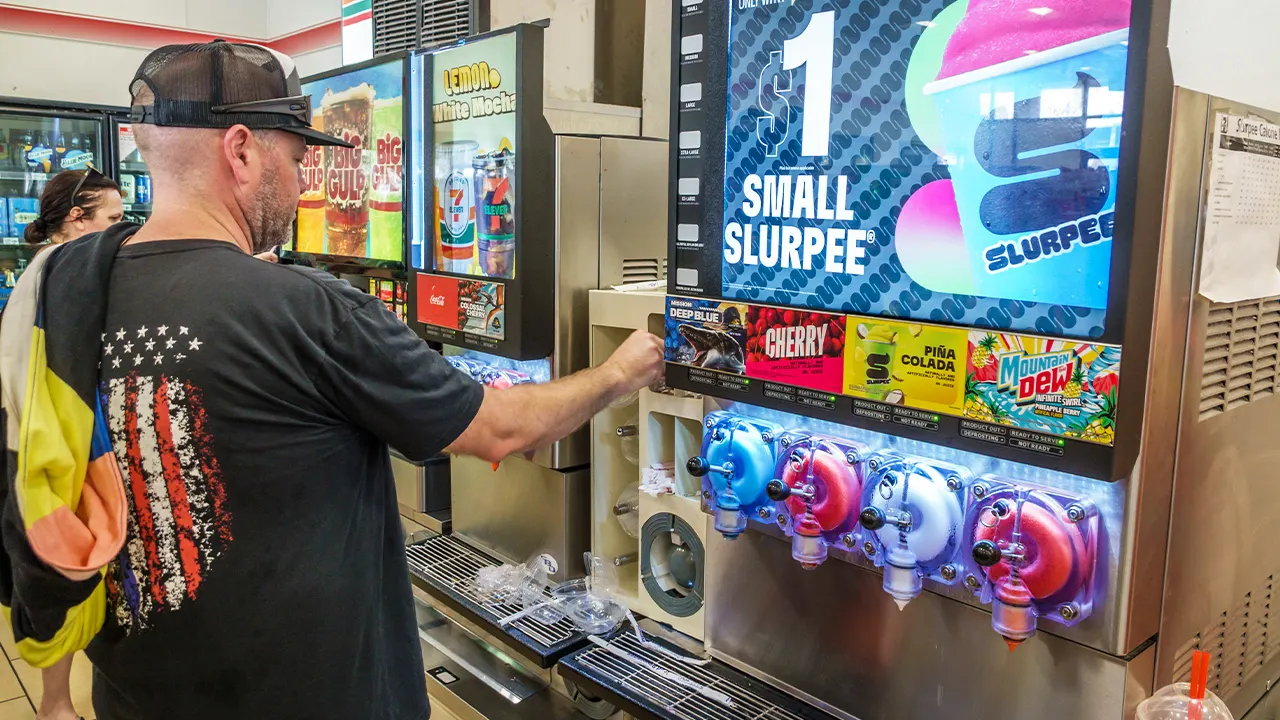
Cheryl Casone highlights upcoming June CPI, PPI and retail sales data that will influence Federal Reserve interest rate policy this week.
The parent company of 7-Eleven convenience stores shed more light on its plan to close hundreds of stores in the U.S. this year.
Parent company Seven & i Holdings indicated in a filing earlier this year that it planned to close 645 7-Eleven stores in the company’s fiscal year 2026.
Seven & i Holdings’ latest quarterly earnings report included a presentation about the company’s various initiatives, including the restructuring of its store network amid the closure plans as well as conversion, remodels and new openings.
It said that it plans to close 200 unprofitable 7-Eleven stores in fiscal year 2026, with 45 stores closed to date.
POPULAR CONVENIENCE STORE CHAIN TO CLOSE HUNDREDS OF STORES
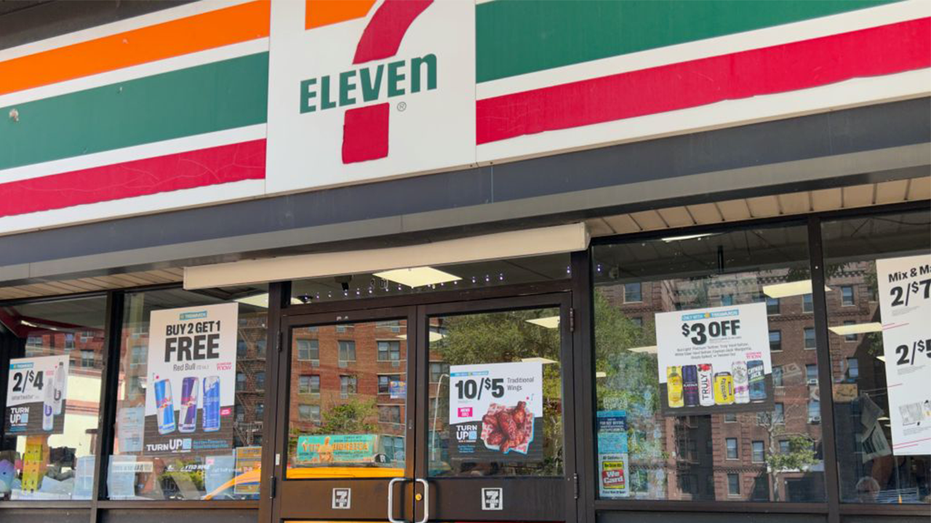
7-Eleven’s parent company is reducing its footprint of stores in the U.S. while converting many convenience stores to wholesale fuel sites. (Getty Images)
The company also said that it plans to convert 350 of its convenience stores to wholesale fuel sites in the fiscal year, with 72 stores having been converted as of the first quarter.
Seven & i Holdings is planning to convert 390 stores to franchises this fiscal year and has done 43 to date.
Despite the company’s pullback, it’s also pursuing selective expansion and is planning to open 205 stores this year. The presentation noted it had opened 30 to date in the first quarter.
CONSUMER INFLATION COOLED MORE THAN EXPECTED IN JUNE AS GAS PRICES FELL
7-Eleven has seen decreased traffic in recent years. (Jeffrey Greenberg/Universal Images Group via Getty Images)
Seven & i Holdings’ plans to remodel 200 stores this fiscal year are expected to get underway in the second half of the fiscal year.
Overall, the plans outlined by the company earlier this year show the total number of 7-Eleven stores in the U.S. declining from 12,712 as of February to 12,272 at the end of the year, for a net decrease of 440 stores.
In late 2024, the company reported having 13,145 7-Eleven locations.

Seven & i Holdings is the parent company of the 7-Eleven stores located in North America. (Soichiro Koriyama/Bloomberg via Getty Images)
The company’s North American business has faced softer performance amid declines in customer traffic, according to company data.
The planned closures come as Seven & i Holdings looks to streamline operations and optimize its store portfolio. The company didn’t disclose which specific locations will be affected by the closures.
GET FOX BUSINESS ON THE GO BY CLICKING HERE
FOX Business’ Bradford Betz contributed to this report.

Form 144 Schrodinger For: 16 July
PepsiCo CEO Ramon Laguarta discusses how the food and beverage giant is seeing massive paybacks after slashing consumer prices on ‘The Claman Countdown.’
General Mills is pulling more than 735,000 Pillsbury bread rolls from shelves due to concerns the products may contain glass.
The recall affects certain frozen Pillsbury bread rolls, including “Hard Roll Dough” and “Kaiser Roll Dough” products, according to a recall report shared by the Food and Drug Administration (FDA).
The FDA classified the recall as Class II on July 13. A Class II recall means that using the product could cause “temporary or medically reversible” health consequences.
BMW RECALLS NEARLY 30K VEHICLES OVER ENGINE STARTER DEFECT THAT COULD CAUSE FIRE
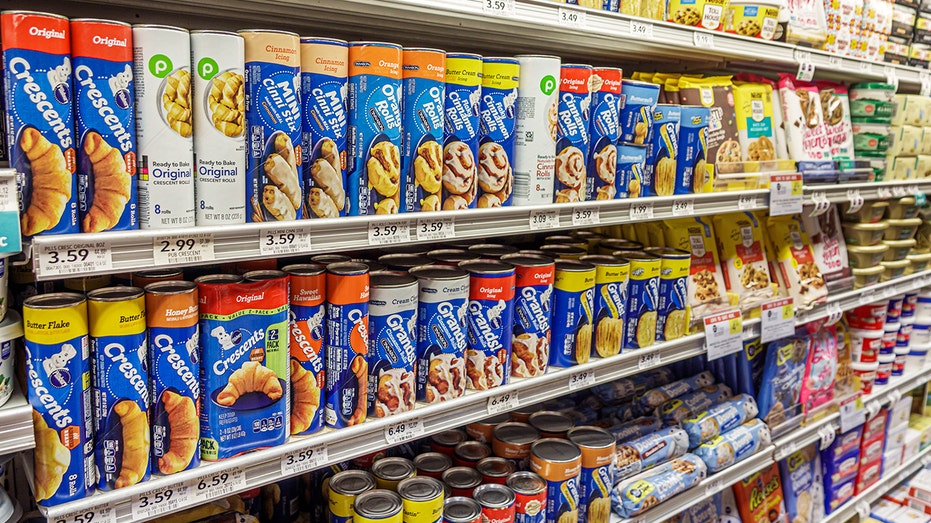
Pillsbury refrigerated dough products are displayed at a Publix Super Market in Miami’s Brickell Financial District. (Jeffrey Greenberg/Universal Images Group via Getty Images)
The affected units include 3,080 cases of Pillsbury “Hard Roll Dough” products, with 180 units per case. They have “Better if Used by” dates of Oct. 12, 2026, and Oct. 13, 2026, with lot numbers 11JUN6JL and 12JUN6JL.
The recall also includes 1,260 cases of Pillsbury “Kaiser Roll Dough” products, with 144 units per case. Those products have a “Better if Used by” date of Oct. 13, 2026, and lot number 12JUN6JL, as noted in the report.

General Mills’ world headquarters in Golden Valley, Minn. (Michael Siluk/UCG/Universal Images Group via Getty Images)
The recalled cases amount to roughly 735,840 rolls.
The products were distributed in Arkansas, California, Florida, Georgia, Indiana, Louisiana, Maine, Missouri, New Mexico, New York, Ohio, Oklahoma, Pennsylvania, South Carolina, Tennessee, Texas, Virginia, Washington and Wyoming, the FDA said.
| Ticker | Security | Last | Change | Change % |
|---|---|---|---|---|
| GIS | GENERAL MILLS INC. | 38.74 | +1.52 | +4.10% |
MORE THAN 1.7M GRILL BRUSHES RECALLED OVER BRISTLE HAZARD, RISK OF ‘SERIOUS INTERNAL INJURIES’
The recall comes amid several other recent food safety alerts.
The FDA also recently upgraded a recall of certain Utz Quality Foods potato chips to its highest risk classification, warning that the products could cause serious health consequences or death if contaminated with salmonella.

The FDA also recently upgraded a recall of certain Utz Quality Foods potato chips to its highest risk classification. (FDA)
FOX Business reached out to General Mills for comment.
FOX Business’ Brittany Miller contributed to this report.
Comcast shares may move 5.2% on July 23 earnings report

DeChambeau gets in the mix and trails by a shot at Open Championship

Even Chemical Bonds Obey Einstein’s Relativity
US stocks today: Nasdaq ends lower as chip weakness offsets solid earnings, economic data


-

 Fashion6 days ago
Weekend Open Thread: Nutriplenish Leave-In Conditioner
-
 NewsBeat5 hours ago
London Mayor Sadiq Khan handed a peerage by Keir Starmer alongside 15 other Labour figures… just days before the PM leaves No10
-

 Sports7 days ago
Super Eagles star Moses Simon opens up on Liverpool transfer regret
-

 Business17 hours ago
Nvidia Stock Slips After Big Tuesday Rally as Huang Confirms Vera Rubin Chip Is Now in Production Today
-

 Crypto World19 hours ago
CFTC blocks Kalshi from unwinding Michigan trades after court order
-

 Politics1 day ago
Young campaigners urge incoming PM to act on outdoor junk food ads
-

 News Videos2 days ago
XRP BOMBSHELL… XRP OMBOARDED FOR TRANSACTIONS!!!
-

 Tech3 days ago
Get Your ESP32 Sunny Side Up With This Solar Dev Board
-
 Entertainment1 day ago
Disney’s Most Ambitious Failed Star Wars Attraction Is Coming to SDCC
-

 Tech2 days ago
Dark Secrets Emerge When Jailbreaking LLMs
-
 Sports23 hours ago
New Cornerback Enters Vikings Trade Rumor Mill
-
 Tech3 days ago
Cloudflare Precursor Watches Your Mouse and Keyboard To Decide If You Are Human
-

 News Videos3 days ago
how to make coin bank box with cardboard #scienceproject #money #diy #shorts
-
 Entertainment1 day ago
Vicki Gunvalson Defends Discussing Heather Dubrow’s Money
-
Crypto World2 days ago
Ripple, Coinbase, Circle Join Linux x402 Foundation to Help Shape AI Payments
-

 NewsBeat23 hours ago
Watch: Is Donald Trump facing a popular backlash on immigration?
-

 Business2 days ago
ACCC warns AI could lift insurance costs in risk-prone areas
-

 Sports20 hours ago
Michigan officials not expected to discuss AD Warde Manuel at Thursday meeting
-
 NewsBeat22 hours ago
Firefighters issue update on Dovestone moorland blaze as fire enters fourth day
-

 Business2 days ago
Subaru recalls 541,000 vehicles over federal safety sticker mistake: NHTSA
You must be logged in to post a comment Login