

Tech
Former CDC CMO: RFK Jr. Is Doing ‘Irreparable Harm’


from the alarm-bells dept
I’m not sure who out there is in RFK Jr.’s corner anymore, beyond some unfortunately powerful people in seats of federal power at the moment. That Kennedy’s tenure at HHS has lasted even this long is as absurd as it is dangerous, given the mountains of chaos he’s created in a mere year and change thus far. All of this anti-vaxxer nonsense, the seemingly random attacks on Tylenol of all things, an ongoing measles outbreak he’s mismanaging, and an inability to follow proper governmental procedure has produced a sample size of sucking that really should have been enough to get him booted from office at this point. Whatever you might think of Kennedy’s conspiracy theories and policies, there is simply no arguing that he doesn’t completely suck at his job.
The public polling around Kennedy has reflected this reality. Spineless senators who once supported him in the role are turning their backs. And then there are the warning bells being rung from people who were very recently insiders at CDC, such as its former Chief Medical Officer.
Dr. Debra Houry, the former chief medical officer at the Centers for Disease Control and Prevention (CDC), decried the direction of the agency under Department of Health and Human Services (HHS) Secretary Robert F. Kennedy Jr.
“I think the secretary has caused a lot of irreparable harm, and when you look at many of the polls out there, the trust in public health, specifically CDC, has decreased dramatically, over 20 points in many polls,” Houry told host Margaret Brennan in an interview that aired Sunday on CBS News’s “Face the Nation.”
“That’s really difficult to recover from, and when states are removing links to the CDC website and following other medical organizations, I don’t know how you build back that trust overnight,” she added.
You absolutely don’t and this is a point I’ve been making for many months. It doesn’t take much skill or time to destroy the trust the public has in federal health officials. That part is very fast and very easy, as Kennedy is demonstrating. But to rebuild that trust, to win back the faith of the public, is going to take years, or decades, or perhaps may never really happen at all. The consequences of the idiotic placement and confirmation of RFK Jr. to lead HHS is going to span decades. The nihilists who managed to put this current cadre of clowns into federal office may not understand that, or may simply not care. But that is the reality.
A poll conducted by Harvard University’s T.H. Chan School of Public Health and the de Beaumont Foundation’s Public Health Listening Lab from March 19 through April 1 found that 50 percent of 2,205 U.S. adults said they trust health recommendations from the CDC.
In spring 2025, 77 percent of respondents to a similar survey conducted by the joint pollsters said they trust recommendations from the agency.
Whenever this country moves past the MAGA era, it’s going to have what might be the Sisyphean task of repairing all of this damage. And not just in terms of reestablishing good, sane health policies. That’s just part of the task. The other will be the public messaging that must go along with it. That is equally, if not more important to repairing all of the damage Kennedy has and is doing. It’s not enough to have good policy built on science. Someone has to actually get the public to buy into and trust in those policies.
And the public is going to be in a very reasonable place when they ask why they should trust the next government to not be anymore idiotic than this one.
Filed Under: cdc, debra houry, health, health & human services, rfk jr.


Further complicating the process, even the expiration of the Microsoft certificate that signed the shims, which took place late last month, isn’t enough to revoke the ones ESET identified.
A rogue’s gallery of defective shims
The shims identified by ESET authorize secondary components that are known to be vulnerable to various exploits. The Oracle shim, for instance, signs a binary vulnerable to CVE-2015-5381. Smolár said the skill required to exploit the vulnerability is low. Other vulnerable shims fail to support protections, such as MOK deny-list enforcement and SBAT enforcement, both of which came into effect after the affected shim was released. Still other identified shims contain vulnerabilities in their own code.
In the interest of brevity, many additional details included in Tuesday’s report are omitted from this article.
An unsettling prospect
As noted, these vulnerable shims can be used against Windows and Linux machines alike, although likely not Windows 11 Secured-core PCs in their default state. Any Windows user who has installed Microsoft’s June update batch is no longer vulnerable. Linux users should check the Linux Vendor Firmware Service or consult their distributor. Revocation statuses are available using the uefi-dbx-audit script.
The prospect that attackers have had the means to bypass Secure Boot for more than a decade through what amounts to hack-by-numbers scripts isn’t much of an endorsement of the mechanism proposed by Microsoft in partnership with hardware makers. As mentioned earlier, a key contributor to this debacle is its complexity.
“This is a solid rebuke of the entire secure boot model,” HD Moore, a firmware security expert, CEO and founder of runZero, and a long-time critic of Secure Boot, said in an interview. His complaints include Microsoft being the de facto root of trust for the entire UEFI platform, the inability of the protection to scale sufficiently, and the ability for components to boot even after top-level certificates expire.
“The end result is a huge number of unknown (to everyone but Microsoft) signed things that bypass Secure Boot—some of which can then be used to boot other things—and both have normal security bugs and other mistakes that mean they can be used to boot nearly anything,” Moore added. “The whole ecosystem is somewhat broken and needs a reboot.”
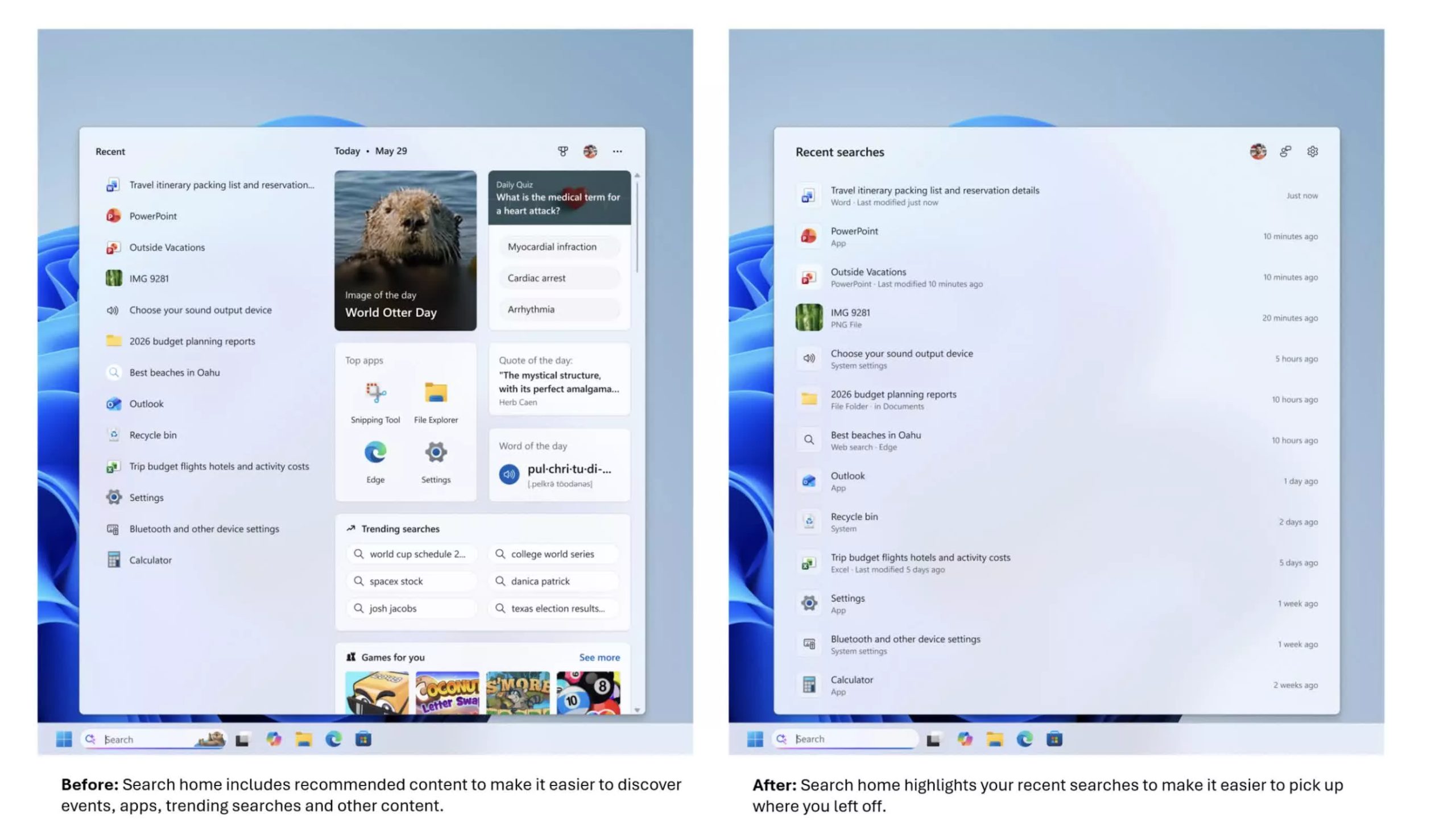
Wishful thinking: Microsoft is finally stripping the Windows search box down to what many users wanted from it all along: a simple way to quickly find apps, files, and settings without being distracted by additional content. In test builds now rolling out to Windows Insiders in the Experimental channel, the experience looks and behaves very differently from recent versions of Windows.
The change appears first on the search home screen. Instead of the old layout – with recently used apps on the left and tiles on the right asking “What day is it today?” or offering features such as “Daily quiz,” “Word of the day,” “Search trends,” and “Recommended games” – the new view is much cleaner.
The home screen now focuses on recent searches and local content rather than making the search box feel like a news or entertainment hub. For people who use search as a starting point, this shift is likely the first thing they will notice.
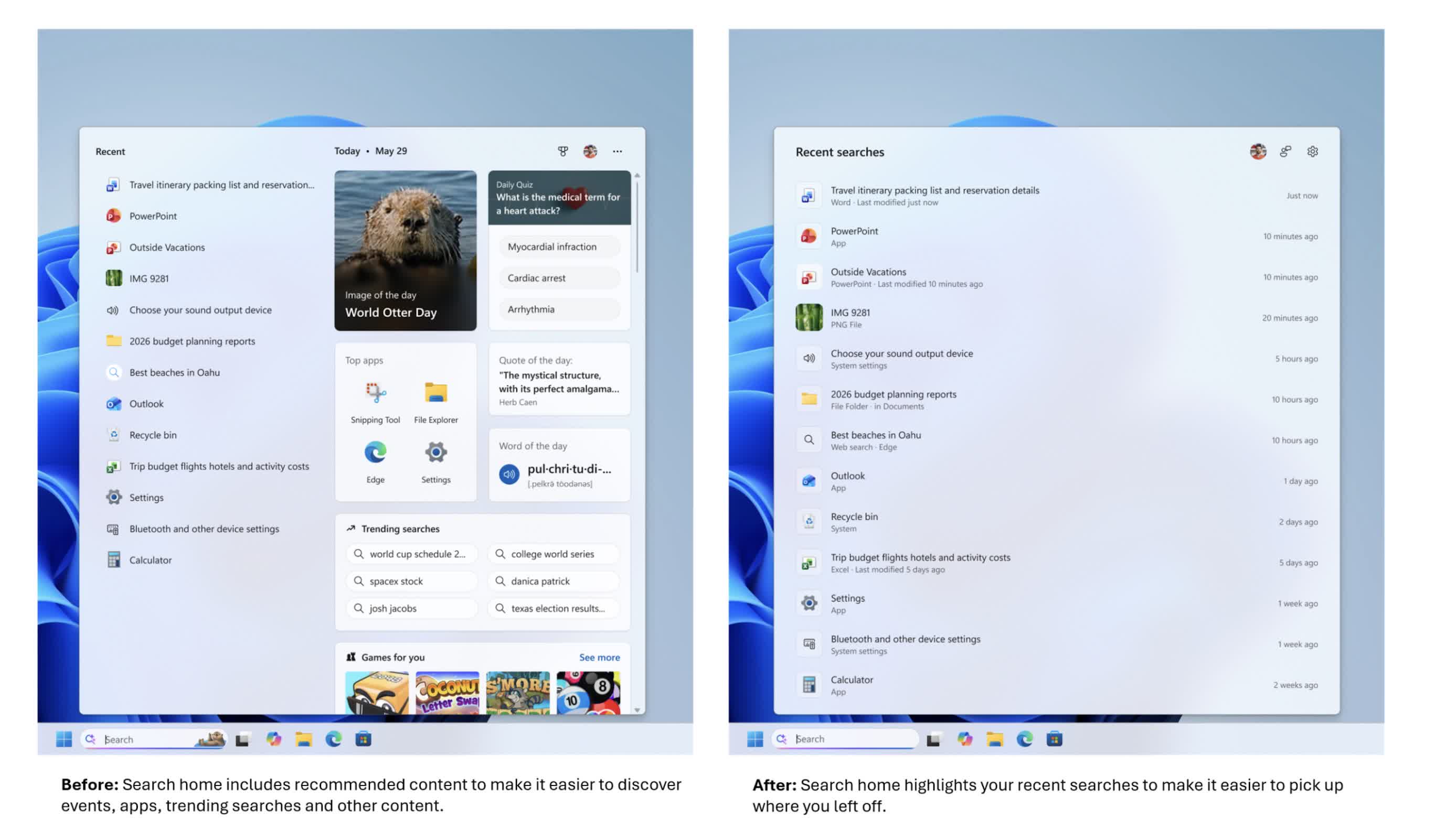
Beneath the simpler UI, Microsoft is putting more emphasis on helping users understand what they are about to click on. Search results now more clearly identify whether an item is an app, a setting, a file, a web result, or a Microsoft Store suggestion.
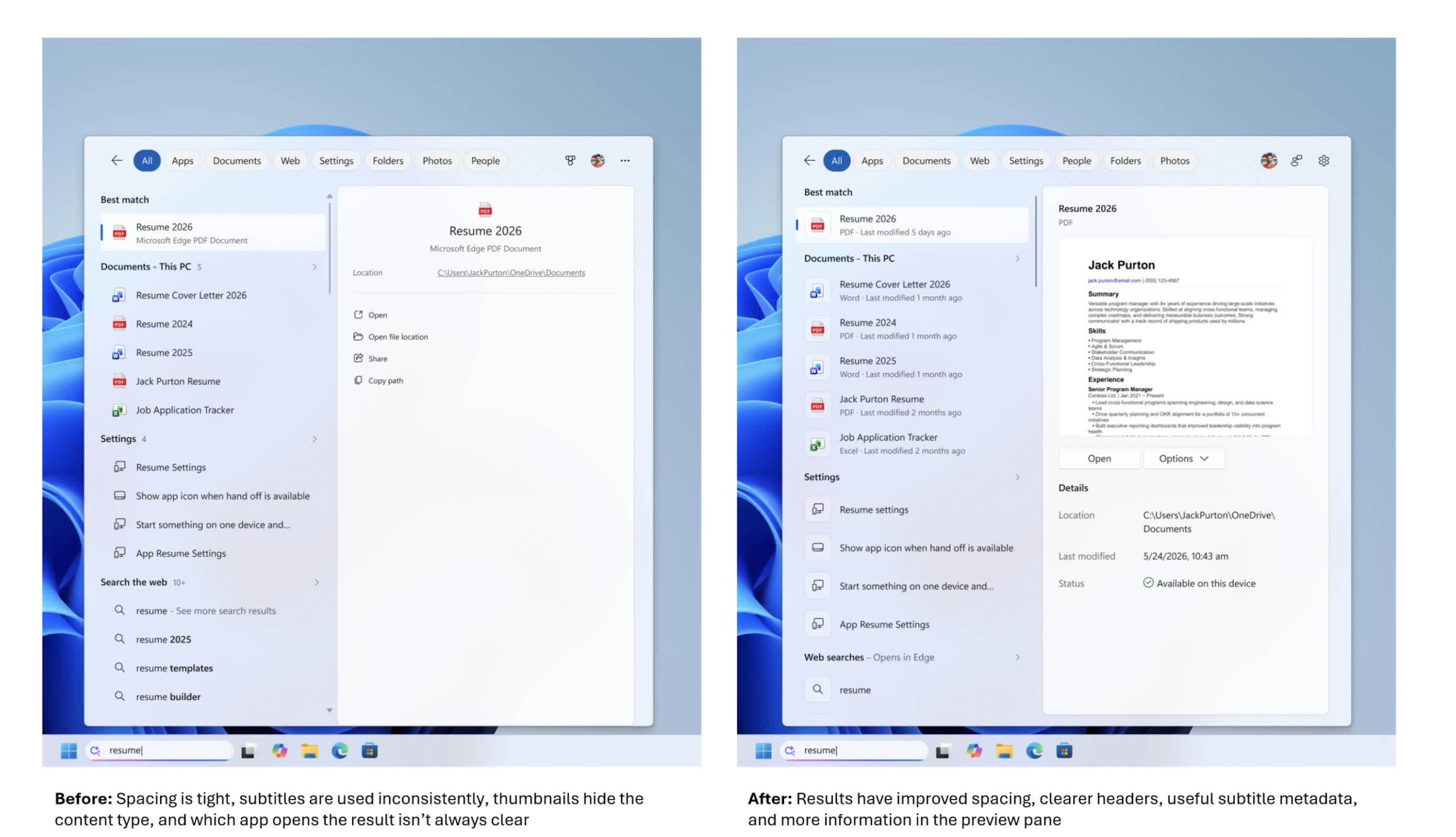
That sounds basic, but the search box has become a primary launch point for opening apps, finding files, changing settings, and getting quick answers from the web. Making the source and type of each result clearer is intended to help users choose the right option more easily.
The company is also removing promotional content from web results. In earlier versions of Windows 11, web results displayed in the search box could begin with product-related suggestions and other promotional material.
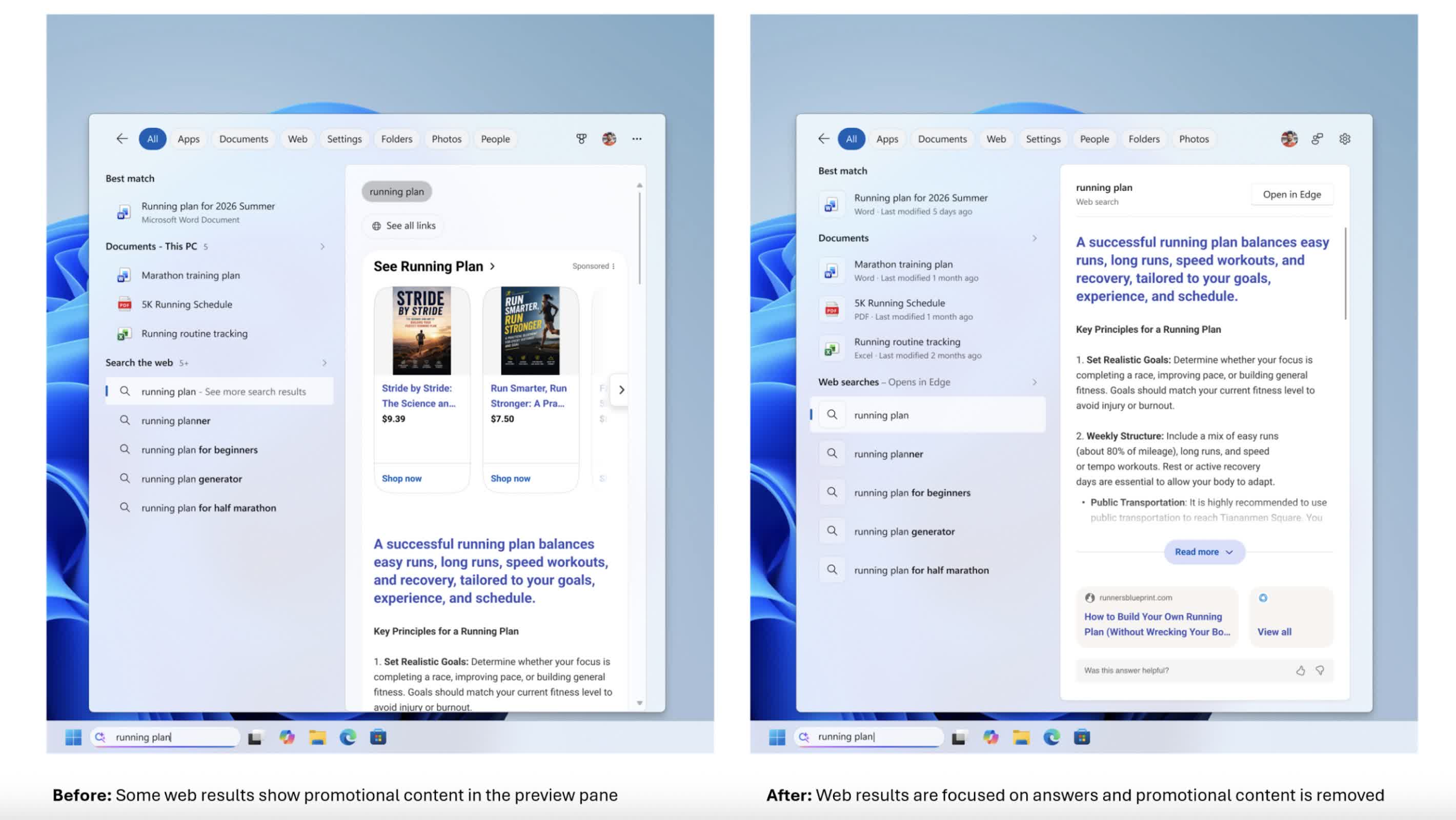
In the new experience, the focus is squarely on the answer itself. Web results are presented more directly, without layers of promotional content appearing above them. For users who rely on the search box to quickly find information, the change makes it feel less like an advertising space and more like a straightforward tool.
Another notable change is the level of control users have over how much online content appears in search results. A new setting under Settings > Privacy & Security > Search allows users to choose whether web and Microsoft Store suggestions appear alongside local results.
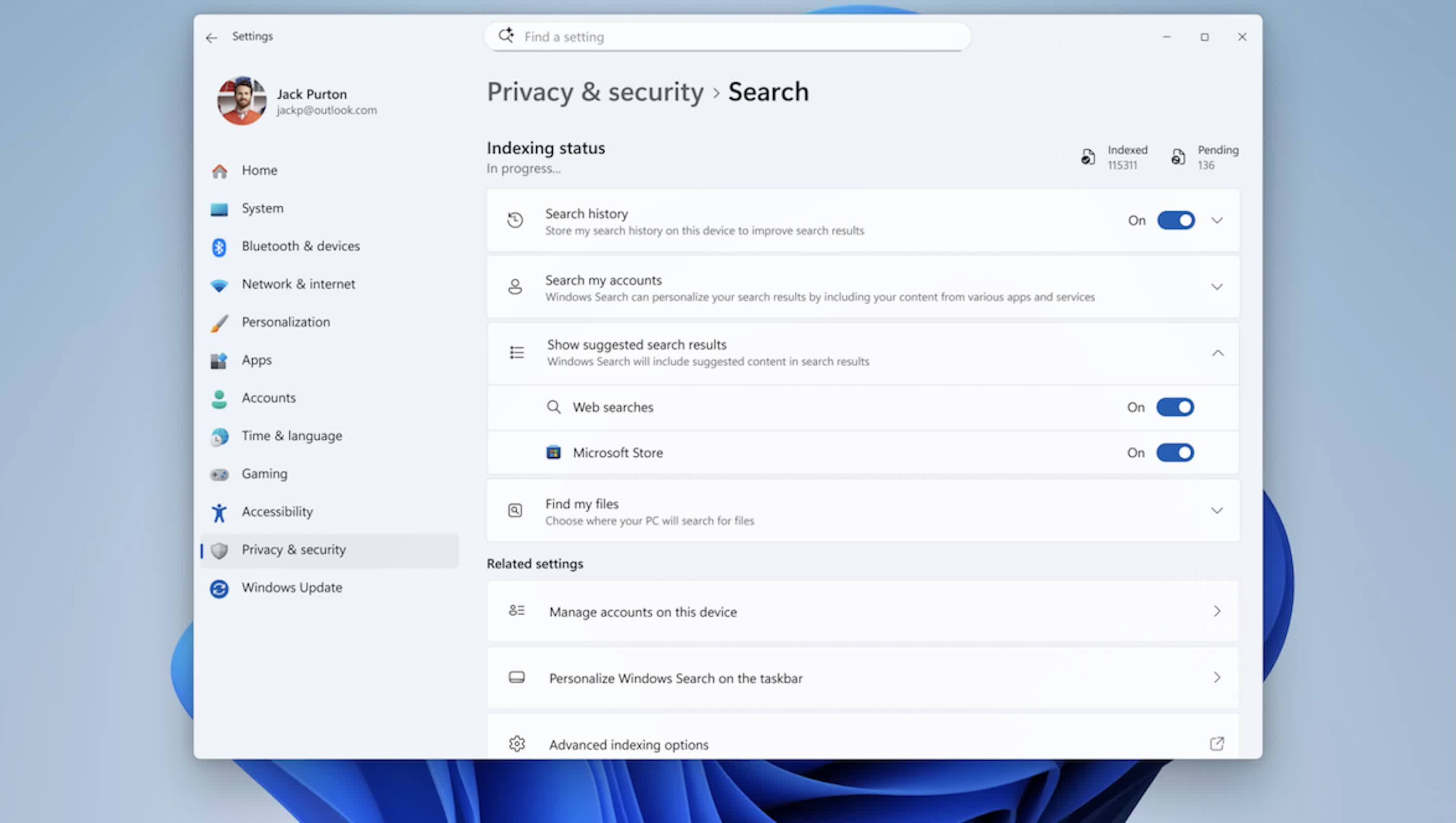
If that option is turned off, the search box behaves more like a local launcher and file finder rather than mixing in web and Store suggestions. The option is simple, but it acknowledges that not everyone wants online suggestions in a workflow focused primarily on opening content that is already stored on the machine.
Behind the scenes, Microsoft has adjusted how it ranks results to better support this local-first approach. Apps, settings, and files are now more likely to appear ahead of web and Store items when they are a strong match for a query.
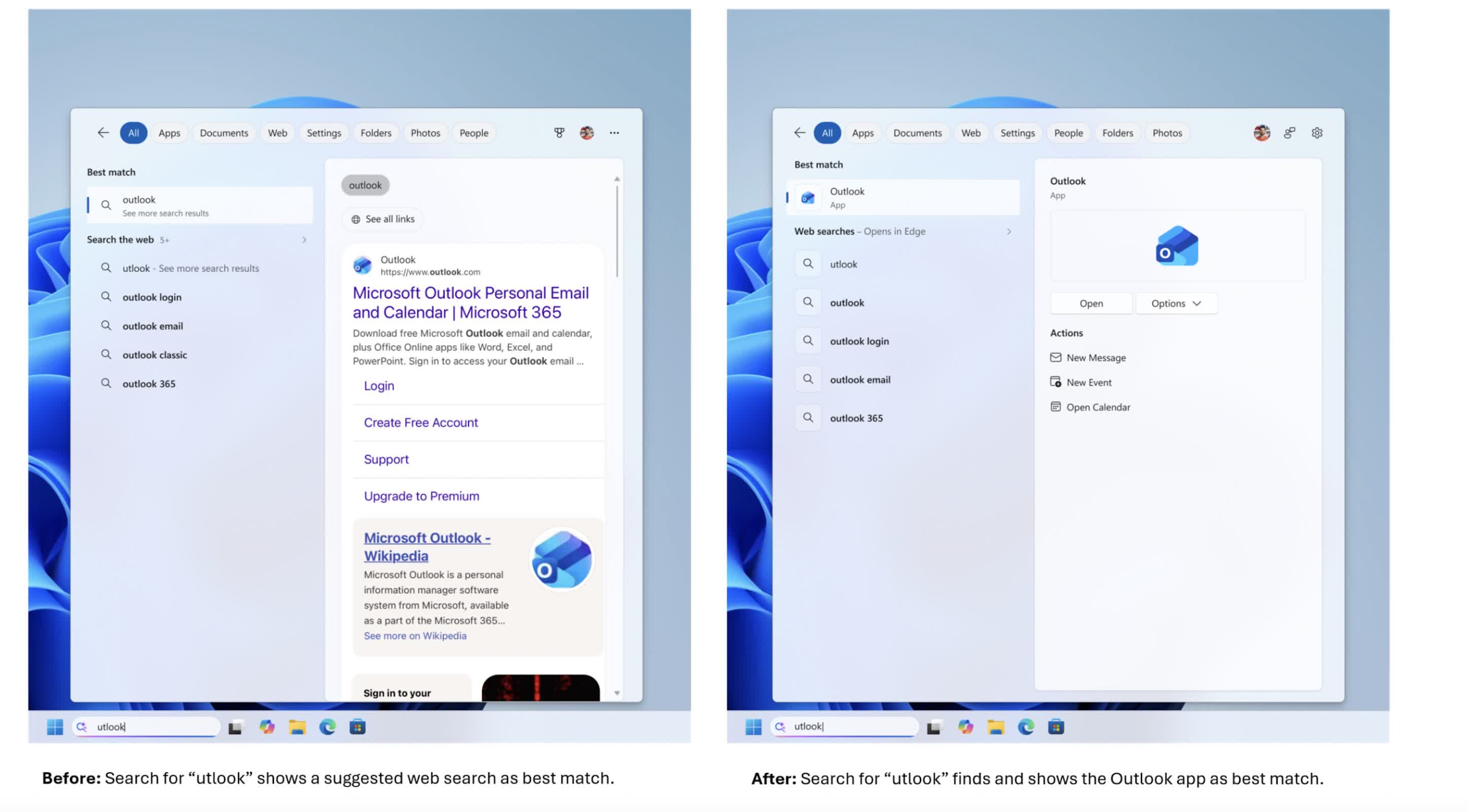
Core system objects, such as This PC and Recycle Bin, now appear more reliably instead of getting lost among tiles and other content. The search engine is also more forgiving of app names, handling typos, extra letters, and partial queries – so something like “utlook” can still find Outlook.
File search has been improved as well. The updated search box can handle very short queries, including two-character strings, which is useful for users working with short codes or brief file names.
Microsoft has also improved how cloud and connected files are surfaced, bringing them into view when they appear to be a better match than local content. The goal is to help users move more quickly from entering a search term to opening the document, download, or folder they intended to find, whether it is stored on the device or in online storage.
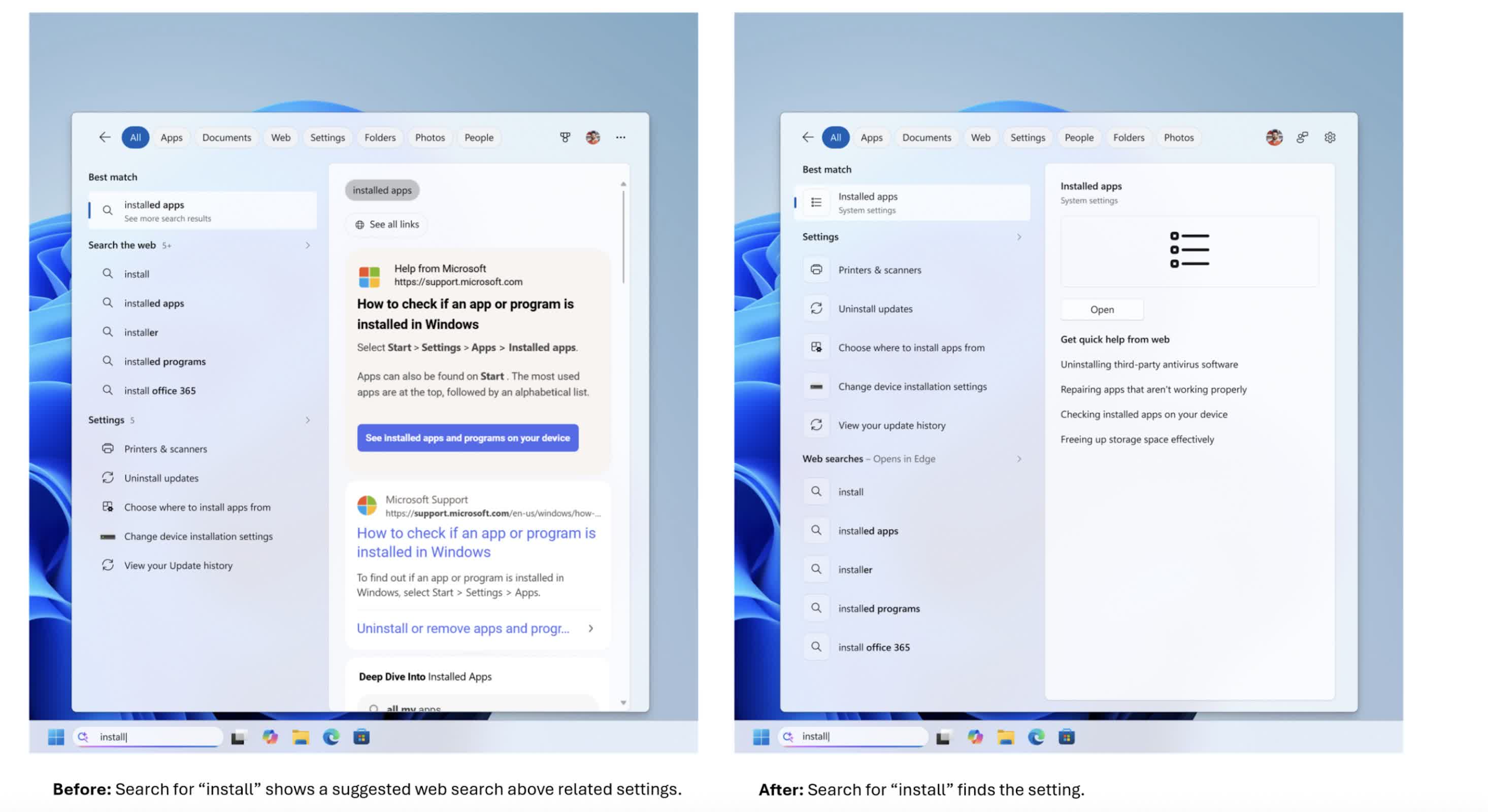
Settings search is getting attention as well. The company has made an initial round of changes to how settings results are ranked, aiming to surface more relevant controls higher in the list.
More tuning is planned as Microsoft collects data and feedback from the Experimental channel, meaning this part of the experience is likely to evolve over time. The company is also working on improving reliability by reducing crashes and search-related loading issues, with additional work still underway.
As with many recent Windows changes, the rollout will be gradual. The new search box is being distributed through Microsoft’s Controlled Feature Rollout system, so even users in the Experimental channel may not see it immediately.
Some users may receive the update after a reboot, while others may need to enable it through feature flags. Broader availability will follow as Microsoft refines the feature based on performance data and user feedback. For users who have been asking for a faster, cleaner, and more predictable search experience, this redesign arriving in 2026 represents a significant shift in how Microsoft approaches one of Windows’ most visible features.
Tech
RFK Jr. Cut Funding For FoodNet, Making It Harder To Figure Out Why You’re Shitting Yourself Uncontrollably
from the shitshow dept
Are you currently pooping yourself uncontrollably and want to know why? Well, the CDC made that slightly more difficult last year, but you might just have cyclosporiasis, the unintentional weight loss craze that is gripping parts of the country.
The disease — cyclosporiasis — is a foodborne illness caused by a microscopic parasite called cyclospora. Fresh produce is almost always the source. Previous outbreaks have involved raspberries, bagged lettuce or salads, cilantro and basil. Rarely, it can also be waterborne.
However it enters the human body, people usually start feeling sick about a week later. The illness can begin with flu-like symptoms, such as severe fatigue and body aches. What really sets cyclosporiasis symptoms apart is explosive, watery diarrhea that’s sometimes uncontrollable. People may also have unusually bad gas, stomach cramps and nausea. Consequently, most people lose their appetite. Low-grade fevers are rare.
It is, by all accounts, an absolutely awful experience. 10% of cases will result in hospitalization and it is particularly dangerous for the very young and elderly populations. Cyclosporiasis, while not traditionally in the popular lexicon, is also not new. It’s generally seasonal with case counts in the 10s in many states. What’s making this at all newsworthy is just how far in front of that pace the current outbreaks in Michigan, Ohio, New York, and Illinois are.
The outbreak has been particularly intense in Michigan, which had 1,562 cases as of Friday. Illnesses, caused by the cyclospora parasite, have also been reported in neighboring Ohio, as well as in Colorado, Illinois, New York, North Carolina, Texas, Wisconsin and other states.
Dr. Natasha Bagdasarian, chief medical executive of Michigan, said the rapid rise is “highly unusual.” The state usually sees 40 to 50 cases of cyclosporiasis a year. She said laboratories in the state are scrambling to sequence the genome of the bug to track where it came from.
Now, we had a program for surveilling and tracking this sort of thing. Unfortunately, that program was severely scaled back in 2025 by the Trump administration and RFK Jr. The CDC’s FoodNet program is a federal-state partnership for tracking foodborne illness. 10 states participate in the program. To be clear, New York and Colorado are the only states currently dealing with serious concerns for cyclosporiasis that also participate in the program… but that’s largely besides the point. Looking at which states participate, it’s obvious that they were chosen because they are spread out throughout the states to give you a decent national sampling for an outbreak.
And the government scaled FoodNet back in 2025 in a way that now looks rather stupid.
As of July 1, the Foodborne Diseases Active Surveillance Network (FoodNet) program has reduced surveillance to just two pathogens: salmonella and Shiga toxin-producing E. coli (STEC), a spokesperson for the Centers for Disease Control and Prevention told NBC News.
Before July, the program had been tracking infections caused by six additional pathogens: campylobacter, cyclospora, listeria, shigella, vibrio and Yersinia. Some of them can lead to severe or life-threatening illnesses, particularly for newborns and people who are pregnant or have weakened immune systems. Monitoring for the six pathogens is no longer required for the 10 states that participate in the program, though those states aren’t precluded from conducting surveillance on their own.
Now that this current outbreak appears to be spreading across state lines, that kind of surveillance infrastructure sure would be a nice to have, especially as individual state health departments are “scrambling” to sequence the genomes of the illness and do that work as best they can.
In lieu of that, all we have instead is a hope and a prayer that RFK Jr. is paying as much attention as his spokespeople claim he is.
In a statement to USA TODAY, the Food and Drug Administration said, “Under the leadership of Secretary [Robert Kennedy Jr.], FDA is currently investigating cyclospora outbreaks using established epidemiologic, laboratory and traceback tools in close coordination with CDC and state and local partners.”
Somehow, I have my doubts. Unless there are vaccines or autism involved, Kennedy rarely shows much interest in doing HHS’ work at all.
Filed Under: cdc, cycloporiasis, foodnet, health & human services, rfk jr.
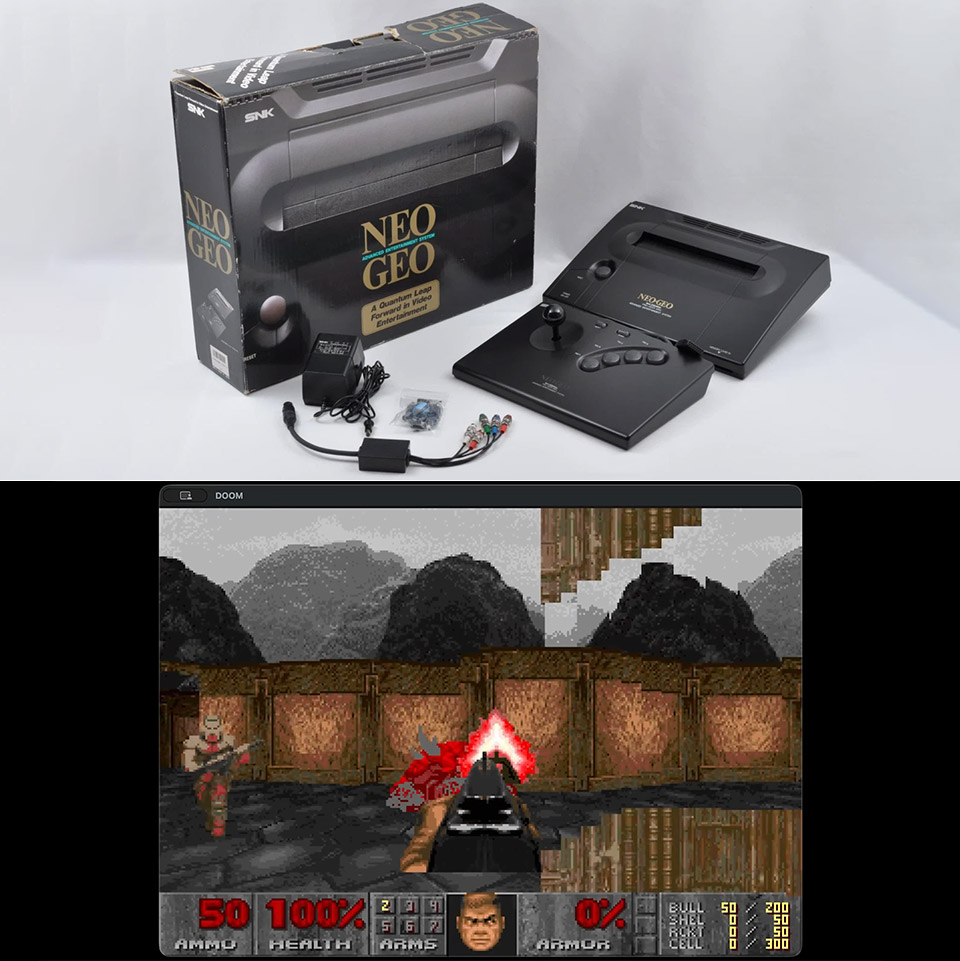
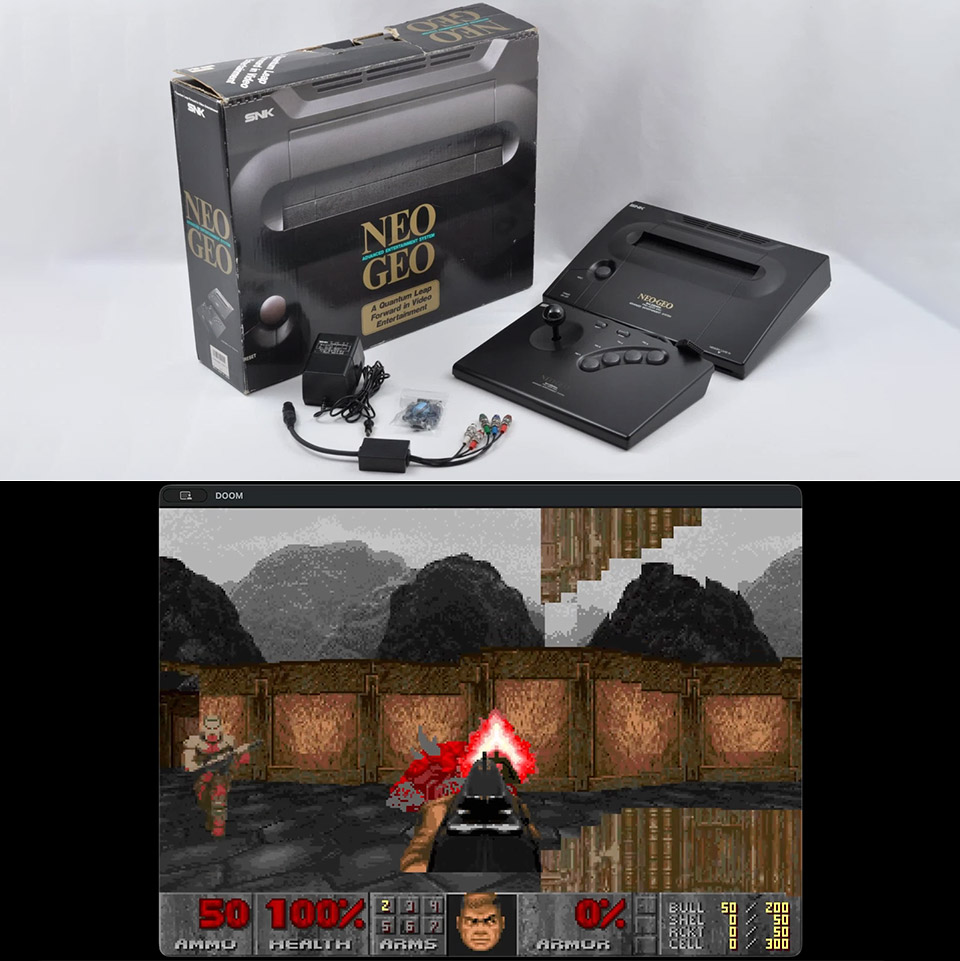
Longtime owners of the Neo Geo AES have watched countless other platforms receive Doom ports over the decades. The console always looked like a strong candidate on paper, with its fast 68000 processor and graphics hardware built for fast sprite handling. Yet the 64 kilobytes of RAM available to the main CPU kept creating a hard stop for anyone who tried a straight conversion. A fresh project shows the limitation was never as final as it once seemed.
SNK designed the Neo Geo with the goal of making as much visual impact as possible with the limited memory they had available, and boy did they succeed. It’s a console that really excels when developers know how to give it well-organized sprites and tile data rather than expecting it to draw things on the fly. Classic Doom, on the other hand, builds its environment one vertical strip at a time, transmitting it all to the screen from a large framebuffer, but that approach is far too memory intensive, and the Neo Geo simply cannot keep up.

NEOGEO AES+ Anniversary Edition
- Legendary video game console reborn
- 1:1 replica of the original console from the 90s
- Unmistakable and uncompromising arcade-grade build
Miguel Sabino figured out a way around this by starting the DoomGeo project on a standard computer with a bunch of conversion tools. These programs consume a Doom WAD file before spitting it out in a format that the Neo Geo can understand. Walls become strips of sprite graphics, along with all of the background elements and animations, because they are all pre-baked and ready to go, rather than having to be created on the fly. In the end, all of this is squeezed onto the cartridge as neat little tables and sprite banks.

Once the ROM boots up, the 68000 CPU’s primary function is to update the sprite control blocks rather than going in and filling in a whole framebuffer pixel by pixel. The hardware sprite system then places, scales, and layers all of those strips to create a great first-person perspective. Floors and ceilings are handled by pre-baked planes that scroll and tilt as they move, while the fixed tile layer houses the entire heads-up display, which includes the status bar, the marine’s face, key indications, and ammo counters. They kept memory demands low by breaking things up this way, yet the game still looks and plays well.

The current build will support every original weapon, including your fist, rocket launcher, and BFG. Monsters have several rotation frames, ensuring that they always face the player in the correct manner while moving about. Doors open, secrets are tucked away, floors that will damage you do exactly that, and the AI inside keeps the enemies on their toes. Even the collision checks take into account the player’s height and step height, ensuring that the movement seems completely natural. A solid 16×16 homemade map becomes the major showpiece, with some experimental paths that can even capture a full-on E1M1 level from the original Doom for testing, and, of course, there’s the audio conversion for the YM2610 sound chip, which is still on the to-do list.
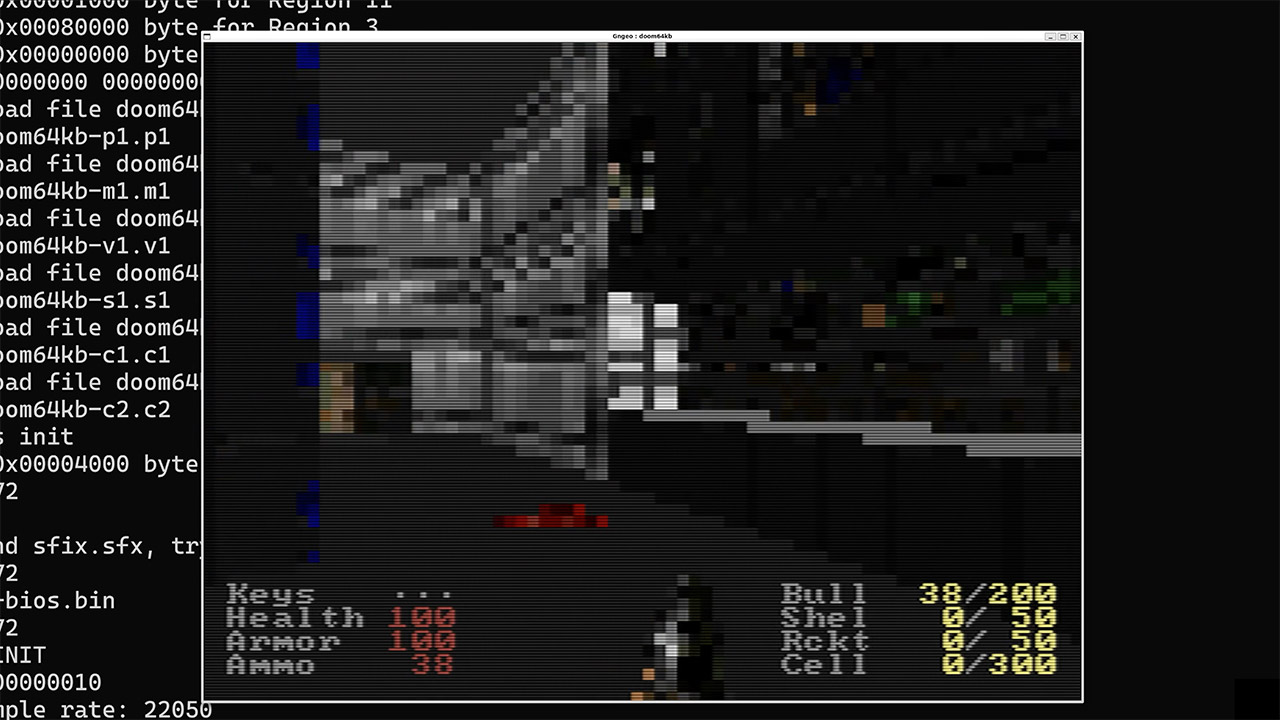
Doom64KB, an even more stripped-down project, takes a completely different approach. It’s based on an older low-memory PC port, and it reduces features even further to fit under the same 64k RAM limit. Floors and ceilings lose their texture maps, music is removed, saving and loading are no longer possible, and only a few particular maps may be played, but hey, it works, even if it sacrifices much of the original experience in the process.
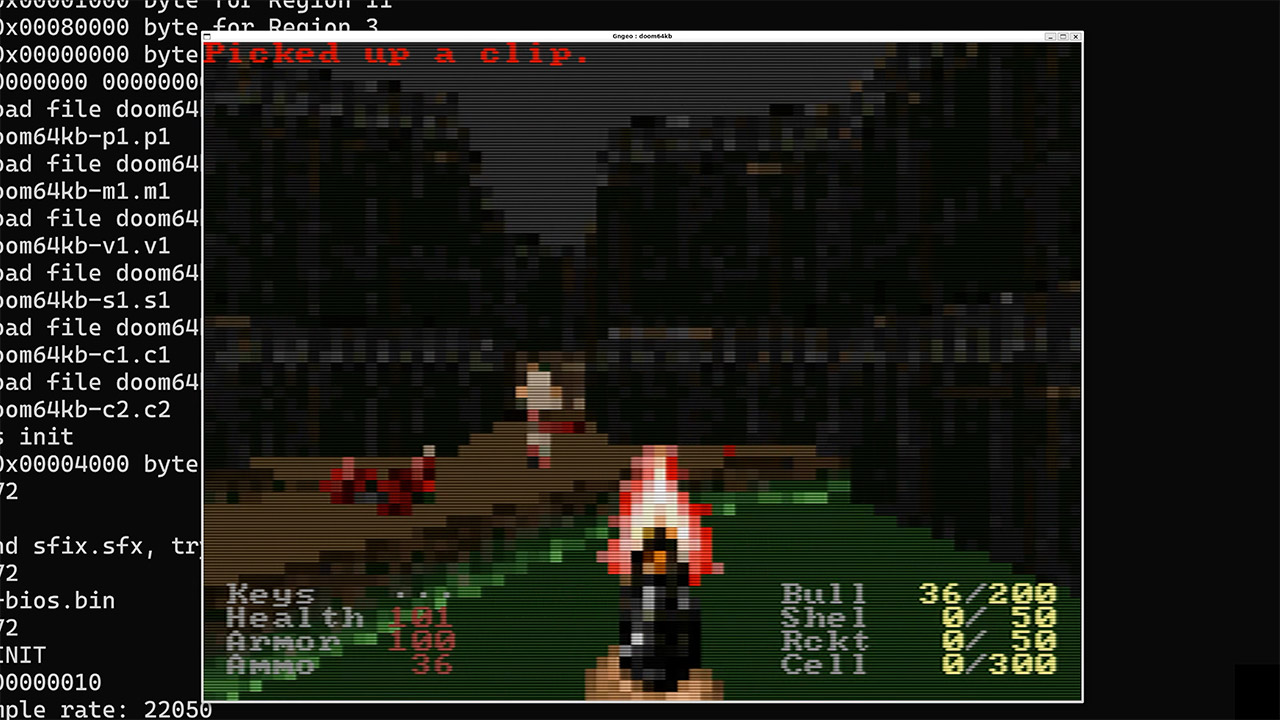
Both of these projects emphasize one basic point: the Neo Geo’s processor and sprite hardware were never the issue. The big challenge was making Doom’s original graphics model to fit within that small memory footprint. These recent initiatives have ultimately overcome that barrier by shifting the heavy lifting to the pre-processing stage and allowing the current sprite system to perform its job, all without the need for additional RAM or custom hardware.
[Source]

Winners & losers: Famed video game director Konrad Tomaszkiewicz has shared surprisingly contrarian views on the impact of delayed next-generation consoles on game developers and publishers, arguing that such delays could actually benefit indie studios and startups. Best known as the director of The Witcher 3, Tomaszkiewicz is currently leading development of the upcoming vampire-themed RPG The Blood of Dawnwalker.
Speaking to Eurogamer, Tomaszkiewicz said he believes the reported delays could be a blessing in disguise for small studios like Rebel Wolves, which he co-founded with other industry veterans in 2022. According to him, smaller teams and indie developers have an easier time optimizing their games for existing consoles than developing for entirely new hardware.
Tomaszkiewicz revealed that Rebel Wolves is preparing four builds of The Blood of Dawnwalker – one each for Xbox Series and PlayStation 5, along with two PC versions tailored for different regions with varying ratings restrictions. According to him, delivering bug-free patches for four versions of a game is already challenging enough without having to develop additional builds for next-generation consoles.
Tomaszkiewicz argued that supporting new platforms multiplies the workload required not only from developers but also from testers, who must ensure that the game “has no blockers (and) you can finish it from the beginning to the end.” He added that the extra work could make development exponentially more complex and prohibitively expensive for smaller teams.
Originally announced in January 2025, The Blood of Dawnwalker is an open-world dark fantasy RPG set in a fictional vampire-infested kingdom in 14th-century southeastern Europe. Players take on the role of Coen, the game’s main protagonist, and complete quests using his human abilities during the day and vampiric powers at night.
The game also features a time-sensitive structure, giving players 30 days and nights to achieve their goal. It offers a wide range of choices that can alter the storyline while providing more freedom than The Witcher 3. Tomaszkiewicz claims that the game draws inspiration from the first two Fallout titles.
Rebel Wolves revealed gameplay details and system requirements for The Blood of Dawnwalker in April, following weeks of media speculation about its storyline and release date. Built using Unreal Engine 5, the game launches on September 3 for PC, PlayStation 5, and Xbox Series.

The city of Los Angeles is letting a three-year contract with Flock Security expire — at least for now — amid concerns about privacy, data storage and the effectiveness of Flock’s license plate reader technology, as well as moves by other cities to distance themselves from the Atlanta-based surveillance company.
Over the weekend, the Los Angeles Police Department announced it would no longer use the 138 mounted surveillance cameras in the city operated by Flock, which were being used to track vehicles by automatically reading their license plates. A few months ago, the Los Angeles Times reported on discontent in LA over Flock potentially sharing information with the US government, including the Immigration and Customs Enforcement agency, although at the time the LAPD praised Flock’s cameras as “tremendous investigative tools.”
In May, a city council member moved to suspend new contracts or agreements with Flock.
Neither the LAPD, the LA City Council nor Flock Safety responded immediately to a request for comment.
The LAPD told news outlets that a sticking point on moving forward with the company was uncertainty about the data that Flock collects from its cameras, including who owns it and how it can be used once it’s collected.
Flock’s statement to outlets, including KTLA, suggested that misperceptions were driving the decision and that it had been working with the LAPD on data privacy protections and limits around data access. “While this latest development comes as a surprise, we remain committed to continuing our active and ongoing conversations with LAPD to find a path forward,” a Flock spokesperson told the TV station.
Cities dropping or reevaluating Flock
A number of US cities have decided to part ways with Flock Safety this year, but even after contracts ended, some continued to have issues with the company.
Dayton, Ohio, and Evanston, Illinois, both used trash bags to cover Flock cameras to prevent the company from continuing to operate them.
Dayton accused the company of data-sharing violations, including searched related to immigration enforcement. Evanston issued a cease-and-desist order after discovering that Flock had reinstalled cameras the city had ordered removed.
Other cities that have canceled contracts with Flock include Mountain View and Oakland, California; Knoxville, Tennessee; Flagstaff, Arizona; Cambridge, Massachusetts; San Marcos, Texas; and Redmond, Washington. The website DeFlock is maintaining a running list of city councils that have canceled contracts or rejected bids from Flock.
As DeFlock points out, Flock isn’t the only vendor of software and hardware that performs automatic license plate reading. Others include Axon, Genetec and Motorola Solutions.
We may receive a commission on purchases made from links.
Not having the right tools to handle things that go wrong and need repairing around the house can quickly make a small problem much more stressful, especially when it’s something you know you can handle yourself. Instead of having to make outcalls to get problems fixed, having high-quality, reliable tools on hand can help you save plenty of time and money in the long run. And there are very few brands that fit this bill better than Milwaukee.
Competing with the likes of Ryobi in just about every category relevant to homeowners, Milwaukee’s smaller, more affordable hand tools are often the most well-reviewed across the board. Many of them are designed to be as practical as possible, combining multiple tools into one compact unit or just taking extra care with the simplest tools. Alongside fixing things, Milwaukee has no shortage of options to help put things together to make building and DIY as easy as possible. Here’s a look at five tools that every homeowner should consider investing in.
11-in-1 Multi-Tip Combination Screwdriver
Whether you’re moving into a new home or are just looking to make some additions, there’s a strong chance you’ll be building things. And to do that, a screwdriver will almost certainly be needed. Furniture sold in pieces is often much cheaper than pre-built items, so having the tools to build it all will make a massive difference. Unsurprisingly, Milwaukee offers plenty of screwdrivers, but this 11-in-1 combination screwdriver is useful for putting furniture together, but its use doesn’t end there.
If you feel confident that you can handle various electrical issues that often come up in a house, one of the eight bits included with the driver can take out the bolts used on power outlets and their cases, as well as things like light switches. This screwdriver comes with two Philips, two slotted, two square, and two Torx bits, alongside the three nut drivers, to help cover all bases with your home electronics. While it’s a professional-grade tool, its versatility is what makes it worth the $11.97 it’s sold for at Home Depot, where over 900 user reviews give it an average of 4.5 stars out of five.
Combination Electricians 6-in-1 Wire Stripper/Cutter Pliers
Another tool that’s geared towards professional use but will still prove massively useful is the combination electrician’s 6-in-1 Wire Stripper and Cutter Pliers. Similar to the combination screwdriver, this is another Milwaukee piece that prevents you from having to buy multiple tools, ultimately saving you money while being more practical.
If you do have the skills, there isn’t much in regard to small electrical installations and fixes that this tool won’t be able to help out with. The wire stripping element has the ability to strip solid wire between 8 and 18 AWG for solid wire, and between 10 and 20 AWG stranded wire. The wire cutter itself has a slight curve to it, making it more adept at making clean cuts on stranded pieces as well as the standard solid wire. The tip of the pliers doubles as a reamer and a regular grooved plier head, ideal for gripping and shaping. The price of $19.97 on Home Depot is pretty good for how much you can do with this tool.
25 ft. Magnetic Tape Measure
This next product from Milwaukee is a little more standard of a tool than others here, and there’s a good chance you already have a few lying around the house. However, if you ever decide to renovate your home, whether that’s something major like a new kitchen or you just want to move things around, you’ll quickly appreciate how useful a reliable tape measure can be. Milwaukee again has many different options, but based on reviews, this 25-foot magnetic tape measure more than stands out.
While having a magnetic tape measure isn’t essential, having the ability to easily latch onto hard-to-reach places could easily come in handy at some point down the road. The blade itself falls in line with a few other options from Milwaukee, having a maximum reach of 15 feet. The more important rating is the 12 feet of standout, though, making this a great option for a one-person job. Owners note how sturdy the tape measure is. At Home Depot, this Milwaukee magnetic tape measure goes for around $25.
Adjustable wrench
While a nut driver can easily handle smaller external fasteners that are common throughout most homes, they don’t always provide enough leverage for more demanding jobs. Whether it’s building or maintenance work, having a solid wrench on hand will never be an inconvenience. Similar to the tape measures, Milwaukee offers plenty of different sizes for its adjustable wrench, ranging from six inches up to 15 inches, for when you’re working with extra stubborn fasteners. The smaller sizes are affordable, but the larger ones do climb up the price ladder quite quickly.
This is an inherently simple tool compared to others, even on this list, doing one job and one job only. Milwaukee still makes sure all areas are optimized, however, no matter what size you go for. Measurements are lasered on to create a ruler below the jaws. The screw itself uses a proprietary system to keep the jaws firmly locked onto fasteners, and the smooth, slightly curved handle is designed to be as comfortable as a wrench can be. Reviews of all adjustable wrench sizes from Home Depot confirm how effective these tools are, with the bundles of different sizes being quite a popular choice. Going down the middle for an eight or 10-inch wrench should be more than enough for tightening external bolts around the house, though.
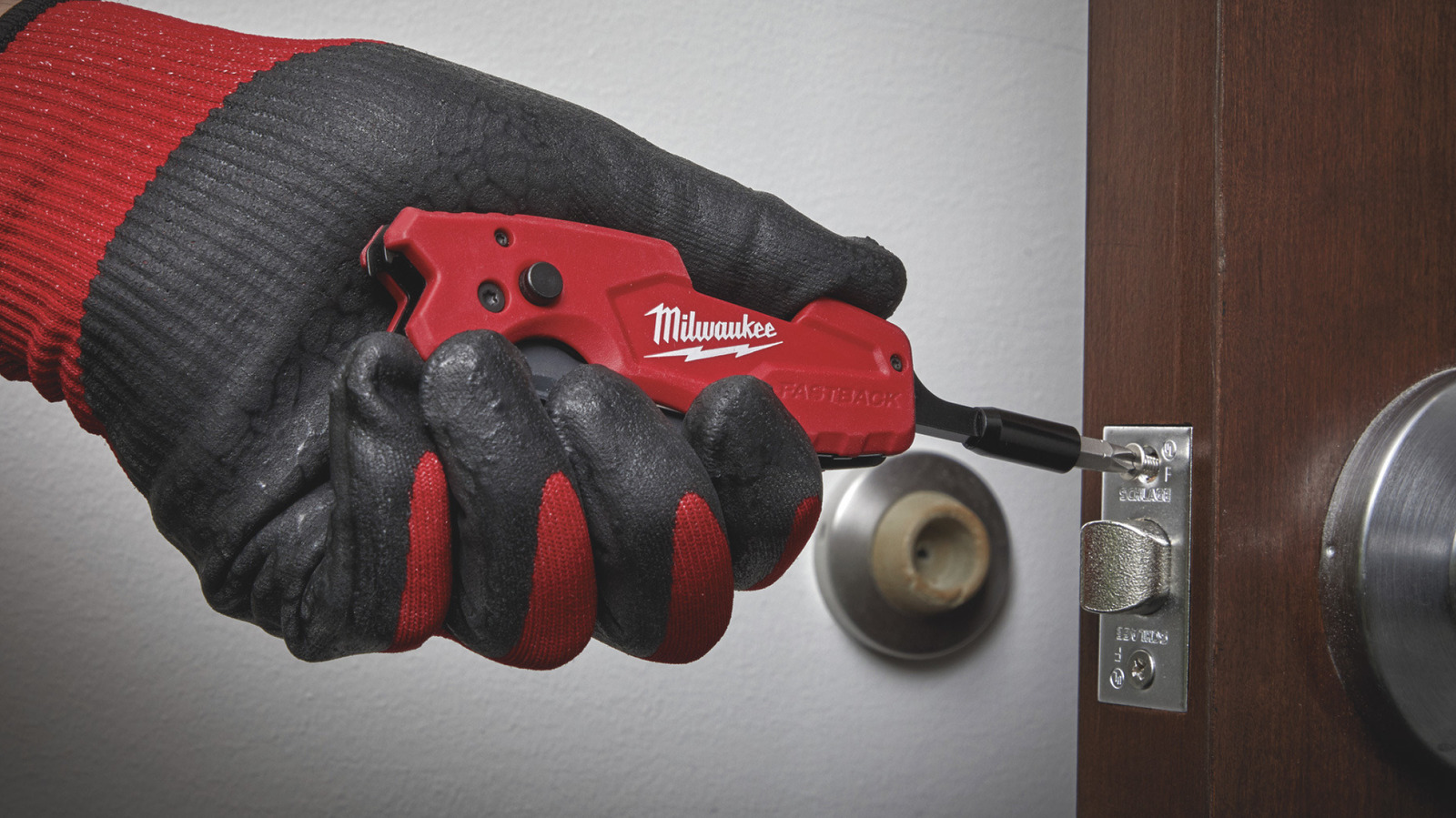
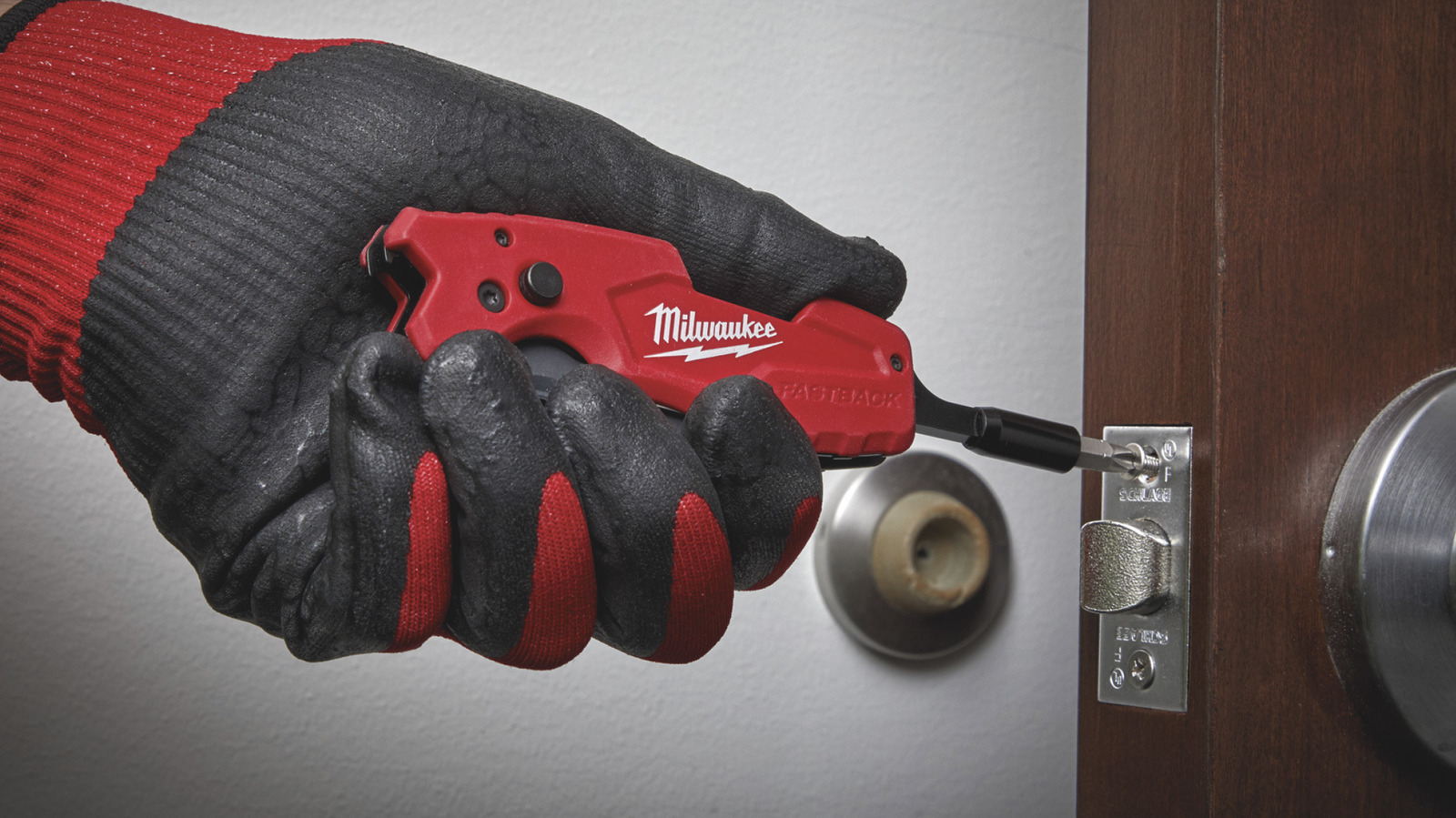
Fastback 6-in-1 Folding Utility Knife
If you want a tool that can be applied and be useful in so many different jobs around the house, Milwaukee’s Fastback Folding Utility Knife can be one of the best time-savers you can buy from this brand, for a few different reasons. This specific knife comes with a general-purpose blade pre-installed, but it also has the ability to hold different compatible blades if you want to buy them as well. But even with the standard blade that extends 1.27 inches from the body can help you with all sorts of DIY projects and repairs. Simple tasks like opening well-packaged boxes also become a breeze.
While having a high-quality blade is worth it alone, this Milwaukee knife has other features that help it earn a $21.97 price tag at Home Depot. You get a small wire stripper built into the blade guard, making it even more useful for electrical work. The folding screwdriver is also a neat addition, and it’s always there in case you need it. It comes with a reversible Philips #2 bit and a slotted 1/4-inch bit. You also get a built-in bottle opener, saving you from needing another item with you, even for something as minor as this. This is unsurprisingly one of the most reviewed Milwaukee products we included on this list, with almost 2,000 reviews averaging 4.4 stars out of five.
Methodology
When selecting Milwaukee tools for this list, we first made sure that they were readily available from The Home Depot, the biggest hardware store that sells Milwaukee tools. Then, we checked that each tool had at least 100 reviews averaging a score of at least four of out five stars. We only selected tools geared towards general DIY and repair jobs that can come up in any home, nothing too specialized, and made sure to find some user reviews mentioning how useful they can be around the house.

In a secluded room deep within Samsung Display’s headquarters in South Korea, rows of whirring gray and black machines repeatedly fold, flex and stress test the company’s newest mobile displays. During a mid-June visit, I was among the first people outside the company to step inside the high-security lab and see how Samsung pushes its foldable screens to their limits before they reach consumers.
On Tuesday, Samsung unveiled Flex Titanium, a new display technology for its upcoming Galaxy foldable phones including the Z Fold 8. It combines a titanium-alloy film with a titanium plate to create a thinner, more durable display structure designed to better withstand drops and other impacts — an important consideration for foldable phones that can cost thousands of dollars.
Samsung Display designs and manufactures screens for Samsung Electronics as well as competitors including Apple, and has become one of the industry’s leading developers of flexible and advanced display technology. Beyond commercial products, the company regularly showcases futuristic display concepts for phones, tablets and other devices.
Watch this: I Went Inside Samsung’s Secret Display Lab and Saw Its Wildest Phone Concepts
As Samsung makes its foldable phones thinner — last year’s Galaxy Z Fold 7 measures an impressively slim 4.2mm when open — the company is looking for ways to scale back various components to maintain a sleek profile. Samsung says it spent about three years developing Flex Titanium technology while examining customer feedback across seven generations of its foldable phones.
“We have to understand user behavior and various display challenges like dropping or pressure with a large object or a tiny object,” Samsung executive vice president Byung Duk Yang said in an interview. “Because of that, we have developed a very comprehensive and sophisticated evaluation method to understand user behavior in the real world.”
These are the machines that fold Samsung’s displays hundreds of thousands of times to ensure durability.
Testing the endurance of foldable displays
As we navigated the maze-like, pristine white hallways snaking below Samsung Display’s headquarters in Korea, about 20 miles from Seoul, our guide touted the exclusivity of what we’d be seeing. No one outside the company — not even the employee’s mom and dad — had been here, she said as she led us into the testing lab.
In this secluded room, which only engineers enter, equipment runs around the clock, folding and unfolding display panels to ensure they can pass 500,000 folding tests. Once the metal latch is closed, the Z Fold 8 panels (there are four inside right now) are subjected to extreme temperatures ranging from -20 degrees to 60 degrees Celsius (or -4 degrees to 140 degrees Fahrenheit).
Outside the machine, a monitor shows what’s happening inside from eight different camera angles. The footage, which is also being recorded, can detect issues such as the display lifting off the device frame. Currently, the display panels being tested are off, but the machine can evaluate how operational displays respond to extreme conditions, too.
The machine to my left tests a display’s image quality. You can slide open the panels to peer inside via the small windows.
Down another long hallway (I feel like I’m in an episode of Severance at this point), we enter a lab for examining the display’s image quality, including brightness and color. After placing a display in the center of the machine and closing what looks like a miniature garage door with sliders on the windows for peering in, the testing begins.
A series of bright lights beams down on the panel, and the machine measures how much light is reflected — the less, the better. That’s for a few reasons: The display’s colors appear deeper, less reflection makes it easier to see the screen under bright lighting and you’re less likely to just be staring at your reflection when you look down at your phone. It takes about three minutes to test one panel.
The ball drop test ensures a display can effectively absorb and distribute pressure from a small, heavy metal ball.
Another test I saw appeared rather simple compared to these more deeply technical mechanics, but it’s equally important for ensuring a display’s durability. A towering 220-pound machine propped on a counter holds a marble-sized metal ball weighing around 21 grams. An arm-like structure drops the ball from a height of 30 centimeters onto the display three times to ensure it won’t crack. In our demo, we pushed the limits to higher drops from 40 and 50 centimeters, and the display effectively absorbed and distributed the pressure to avoid damage.
This marble-sized ball is small but mighty. It’s dropped onto a display panel to test if it cracks.
Making a “better display”
Samsung’s new Flex Titanium is all about bolstering durabily without adding bulk. Compared to polymer film, titanium-alloy film has 20 times greater mechanical stiffness, the company says, meaning it better retains its shape. This component sits below the OLED panel and is less than one-third the thickness of a human hair. Below that is the titanium plate, which Samsung says can provide more stable support when the phone is unfolded without compromising flexibility.
Last year’s Z Fold 7 also used a titanium plate, but the display structure was made up of multiple polymer-based support layers. Samsung has now consolidated those layers into a single titanium-alloy film, reducing the thickness of the display module while maintaining strength, flexibility and long-term durability, the company says.
The layers of Samsung’s Flex Titanium display.
See also: Beyond the Galaxy Z Fold: Samsung’s Future Phone Concepts That Roll, Slide and Expand
Notably, the upgraded display also has a reduced crease — a growing focal point in the world of foldable phones. Samsung Display showed off a creaseless foldable concept screen at CES earlier this year. The company is reportedly working with Apple to develop a creaseless screen for a foldable iPhone, which could make its debut this fall. What I saw at Samsung Display in June still had a minimal crease, although it’s much less apparent than the Z Fold 7’s.
At CES 2026, Samsung Display showed off a concept for a creaseless screen.
Samsung is slated to share more about Flex Titanium and upcoming Galaxy foldable devices, including the Z Fold 8, during its summer Unpacked event on July 22. These advancements look to be a step toward mitigating many of the durability and aesthetic compromises that have long characterized foldable phones — though the work is far from done.
“Years ago, Samsung created this foldable category,” Yang said. “And the foldable display and the structure we developed became the standard. So we feel some responsibility for this market; we have to make a better display.”
Tech
Meta used AI to target staff with medical conditions & pregnancies for layoffs, lawsuit alleges

Twenty-six anonymous Meta employees have sued the company in federal court in Oakland, California, alleging it used AI-powered software to disproportionately target workers with disabilities, medical leave histories, and pregnancies during mass layoffs.
The employees are seeking to halt the next round of layoffs, scheduled to begin on Jul 22, while they pursue arbitration.
The plaintiffs, from six states, including California, New York and Washington, DC, accused Meta of using tools such as Metamate and productivity metrics to rank employees when it cut thousands of jobs—about 10% of its workforce—earlier in 2026.
The lawsuit, filed on July 13, said that this disadvantages people who missed work because of medical conditions or to care for family members, violating federal and state discrimination and retaliation laws.
However, Meta has refuted the claims, stating that they lack merit and that people, not AI, made the workforce decisions.
The lawsuit appears to be the first against a major company to challenge the alleged use of AI in conducting layoffs.
- Read other articles we’ve written on Singapore’s job landscape here.
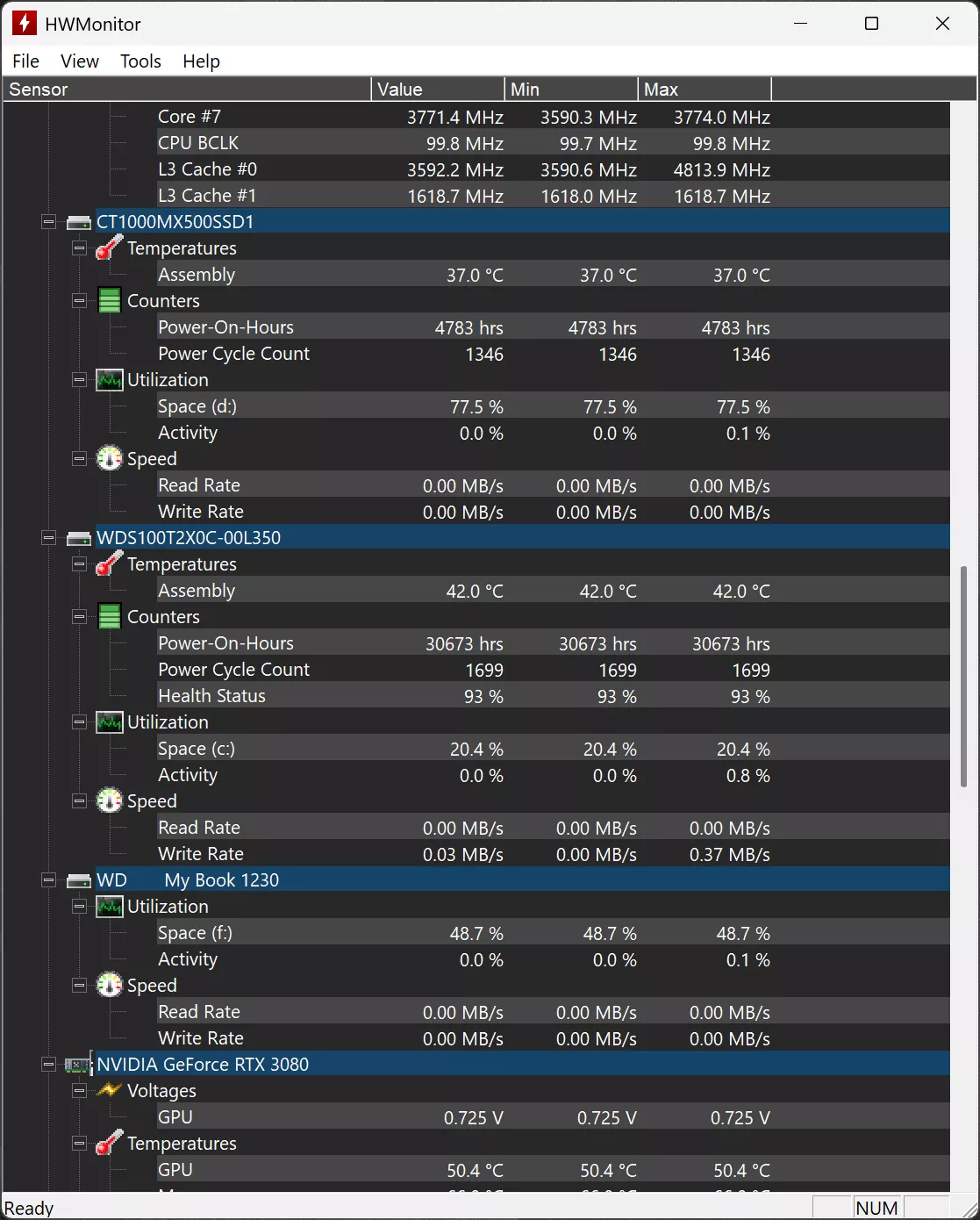
HWMonitor is a lightweight hardware monitoring program that reads your system’s main health sensors. It provides real-time data on voltages, temperatures, fan speeds, and power consumption for CPUs, GPUs, motherboards, storage devices, and more.
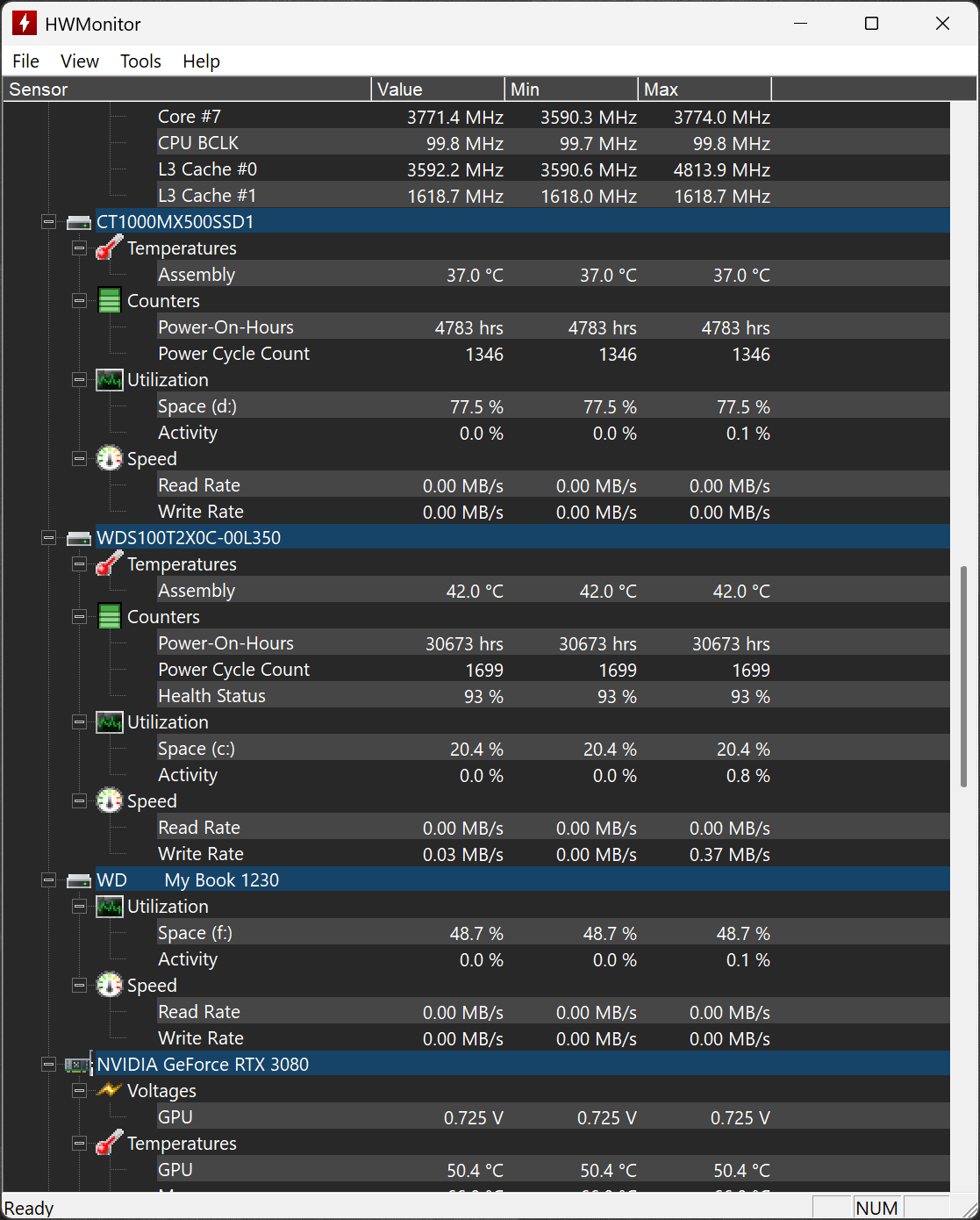
Whether you’re troubleshooting, stress testing, or just keeping an eye on system health, HWMonitor delivers clear and reliable metrics in a simple interface. Ideal for PC enthusiasts, overclockers, and tech professionals. The program handles the most common sensor chips, like ITE IT87 series, most Winbond ICs, and others. In addition, it can read modern CPUs on-die core thermal sensors, as well has hard drives temperature via S.M.A.R.T, and GPU temperature.
Why does HWMonitor show several different CPU temperatures?
HWMonitor lists core temperatures individually (Core 0, Core 1, etc.) and also shows an overall CPU package temperature. The core readings are from thermal sensors inside each CPU core, while the package temperature represents the hottest part of the CPU die. When monitoring for thermal issues or stress testing, the highest of these values is the most important.
Is HWMonitor accurate for reporting GPU temperatures?
HWMonitor is generally accurate for GPU temperature readings, as it pulls data directly from the onboard sensors. However, some users report small differences when comparing with MSI Afterburner and other tools. If you need exact numbers for overclocking or thermal analysis, it’s worth comparing with a second tool.
Can HWMonitor show how much power my GPU is using?
Yes, HWMonitor can display GPU power usage if your graphics card supports it. It shows readings from the PCIe slot and the auxiliary power connectors (6-pin or 8-pin). By adding these values together, you can estimate the total power draw of your GPU. This can be helpful when deciding whether your power supply is sufficient or if you’re planning an upgrade.
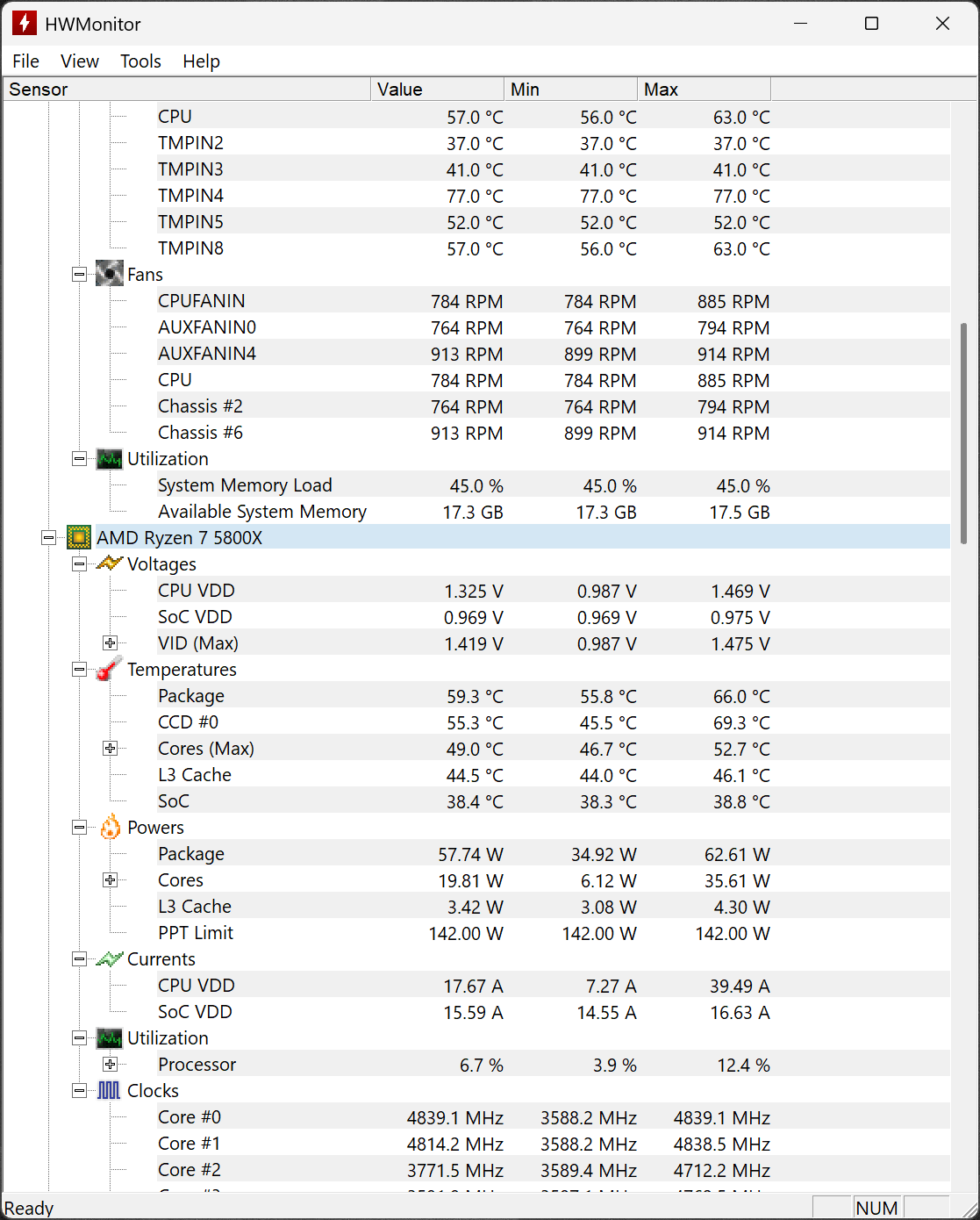
What are TMPIN readings in HWMonitor?
TMPIN labels are temperature sensors on the motherboard, but their exact purpose can vary depending on the manufacturer. They might monitor the VRMs, CPU socket area, chipset, or other components. Because the naming isn’t standardized, the readings can be hard to interpret without checking your motherboard documentation.
Which CPU temperature should I focus on: package, cores, or motherboard?
The most important temperatures to monitor are the CPU package and the highest individual core temperatures. These reflect the real thermal state of your processor. Motherboard CPU readings are often lower and less precise. As long as your CPU stays below 90 – 95 °C under load, it’s within safe limits for most modern CPUs.
What’s New:
- Hotspot temperature on NVIDIA RTX 50×0 GPUs.
- Preliminary support of Lisuan 7G100 GPU.
Previous Release Notes:
- Intel Arc G3 & G3 Extreme (Panther Lake).
- Intel Core Ultra 5 250KF Plus (Arrow Lake Refresh).
- AMD Ryzen 7 7700X3D (Raphael).
- AMD Ryzen AI Max+ 495, 492, 488 (Gorgon Halo).
- AMD Ryzen AI Max 490, 485 (Gorgon Halo).
- AMD Ryzen AI Max PRO 495, 490, 485, 480 (Gorgon Halo).
- AMD Ryzen 9 9950X3D2 (Granite Ridge).
- AMD Ryzen 9 PRO 9965X3D, PRO 9945 (Granite Ridge).
- AMD Ryzen 7 PRO 9755, PRO 9745 (Granite Ridge).
- AMD Ryzen 5 PRO 9645 (Granite Ridge).
- AMD Ryzen AI 7/PRO 450G/GE (Gorgon Point 2).
- AMD Ryzen AI 5/PRO 440G/GE (Gorgon Point 2).
- AMD Ryzen AI 5/PRO 435G/GE (Gorgon Point 3).
- Support of HUDIMM and HSODIMM memory modules.
- New themes.
- New real-time graphs.

Zoomex Monthly On-Chain Report: June 2026

“We’re coming for you”: Moses Itauma called out for world heavyweight title fight

Microsoft’s Secure Boot has been broken for a decade and no one noticed until now


-

 Fashion6 days ago
Loro Piana Fall 2026 Enters Houston’s Art Scene
-

 Fashion4 days ago
Weekend Open Thread: Nutriplenish Leave-In Conditioner
-
 Sports6 days ago
2026 Genesis Scottish Open Thursday TV coverage: Round 1
-

 Sports5 days ago
Super Eagles star Moses Simon opens up on Liverpool transfer regret
-

 Tech6 days ago
Character.AI enters the microdrama arena with its own productions, but there’s a twist
-

 News Videos12 hours ago
XRP BOMBSHELL… XRP OMBOARDED FOR TRANSACTIONS!!!
-

 Tech1 day ago
Get Your ESP32 Sunny Side Up With This Solar Dev Board
-

 Tech12 hours ago
Dark Secrets Emerge When Jailbreaking LLMs
-

 News Videos6 days ago
Crypto Just Entered Its Most Important 6-Month Candle (Could Decide Everything!)
-
 NewsBeat6 days ago
Major update after Huntingdon train attack as man enters plea
-

 News Videos2 days ago
how to make coin bank box with cardboard #scienceproject #money #diy #shorts
-

 Sports7 days ago
39-year-old Djokovic wins five-hour thriller to enter Wimbledon semis | Other Sports News
-

 Tech6 days ago
Level Infinite Launches Gangstar Mirage City in India with Pre-Registrations
-
 Tech2 days ago
Cloudflare Precursor Watches Your Mouse and Keyboard To Decide If You Are Human
-

 Tech6 days ago
Entra passkey enrollment vishing targets Microsoft 365 users
-

 Crypto World6 days ago
DeFi Dashboard Zapper to Shut Down After 7 Years
-

 Crypto World6 days ago
Mark Cuban-Backed DeFi Dashboard Zapper Shuts Down After 7 Years
-

 Tech6 days ago
Claude’s New Reflect Dashboard Wants To Help You Log Off Of Claude
-

 Crypto World6 days ago
Fed minutes June 2026: officials split on rates
-

 Tech7 days ago
Former OpenAI exec Kevin Weil is now on the board of Stoke Space
You must be logged in to post a comment Login