An anonymous reader quotes a report from the Associated Press: Hundreds of economists say in an open letter that institutions “must act now” to address how artificial intelligence could transform the economy and could put many people out of work. The statement released Monday was signed by top economists, along with computer scientists and some executives at tech companies including Anthropic, Google and OpenAI.
“AI may become radically more powerful over the next 10 years,” says the letter organized by Stanford University’s digital economy lab. “This could drive an unprecedented transformation of our economy, larger than the Industrial Revolution, but unfolding over a vastly shorter time frame. It could bring risks, including large-scale job displacement, as well as opportunities such as major gains in living standards.”
The letter, which has only four sentences, says leaders must “build the incentives, guardrails, and institutions needed to steer AI in a direction that complements humans and benefits society.” The Stanford lab says the letter has so far been signed by more than 200 economists and AI researchers, including 16 winners of a Nobel Prize. “We must be intentional and make collective, democratic choices, rather than letting market forces play out and risking leaving most citizens behind,” wrote computer scientist and AI pioneer Yoshua Bengio, who was also among the signatories. He said it “it is highly plausible that AI will drastically transform our economies.”
Other signatories include Google CEO Eric Schmidt, LinkedIn cofounder Reid Hoffman, and Nobel laureates Joseph Stiglitz, Daron Acemonglu, and Simon Johnson.
This following statement is a lie: “I am telling the truth”. Okay, now that it’s just us meatbags, let’s get down to brass tacks. Captain Kirk’s logic bombs couldn’t possibly work on modern LLMs, right? Surely that was just a bit of 1960s silliness from when computers filled rooms and were esoteric magic even to most sci-fi writers?
Well, not entirely, according to a recent article in IEEE Spectrum. While you might not be able to make a data center explode, you certainly can use a lot of tokens by making an LLM overthink with your prompt.
It comes down to the much-vaunted ‘reasoning’ ability of the new models — which isn’t really reasoning the way we think of it, but does involve breaking the stated prompt down into smaller problems. That’s part of what lets the new models tackle such involved tasks as porting MicroPython to the SNES with a prompt like “Please make this [stuff] work now!” It’s also a weakness, because with the right prompt you can get that virtual ‘reasoning’ to tie itself in knots with mutually incompatible smaller steps.
Advertisement
The models seem to be able to break out of it, but they burn a lot of tokens along the way, which is an attack in and of itself if you’re found a way to inject prompts into someone else’s API. It’s a little more subtle than what Kirk got up to, but underneath it’s essentially the same thing. At scale, it could serve as a DDoS attack on LLM servers. (Un)Fortunately, modern computers are better designed than their imaginary 23rd-Century counterparts, and there’s no way to craft a logic bomb into something that will let out the magic smoke.
And it’s an add-on you don’t have to get if you only want the main black-and-white display.
Hisense
Hisense has an upcoming E Ink Android phone that has two screens, and one of them is detachable. According to reports on X and Weibo, the Hisense A10 will come with a 6.13-inch E Ink touchscreen main display. It will be paper-like, similar to ereaders like the Kindle Scribe, and is meant for reading and note-taking. The detachable display is a color LCD screen that magnetically attaches to the device’s rear. You can leave it behind if you want — you don’t even have to purchase it, because Hisense can reportedly sell you the main device alone without the detachable display. It’s expected to have 5G connectivity and to run Android 16.
This isn’t the first dual screen phone we’ve seen. Bigme, another Chinese brand, recently launched a crowdfunding campaign for the HiBreak Dual 2, which also has an E Ink screen as its main display and a color LCD on the back. The E Ink screen can even be either black and white or colored.
According to Good E Reader, the Hisense A10 could be powered by the Snapdragon 8 Gen 3 chip and could be sold for prices starting at $590. Seeing as you can get the detachable LCD separately, that price is most likely for the main device with the E Ink display only, and you have to be prepared to pay more for the detachable LCD. The Hisense A10 most likely won’t be available in the US, but you might be able to import it from Chinese e-commerce channels if its E Ink and detachable displays sound intriguing enough.
Advertisement
Hisense A10 E Ink Smartphone Officially Announced.
• 6.13-inch E Ink main display • Paper-like screen for reading, studying and note-taking • Magnetic detachable color LCD secondary screen • Color display for photos, comics, charts and entertainment#HisenseA10#Hisensepic.twitter.com/6EcJE9hRrE
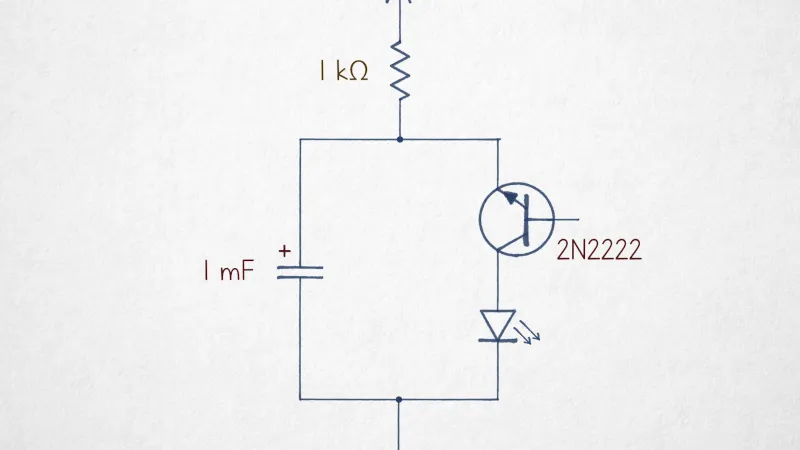
Back in the days when an integrated circuit meant a simple but expensive device such as a 741 or a 555, most electronics enthusiasts made do with discrete transistor circuits. The common emitter amplifier and its variants are the most familiar, but the humble 3-legged device can do so much more. A particularly obtuse circuit is the subject of examination by [lcamtuf], the reverse avalanche oscillator. A 2N2222, a capacitor, an LED, and a resistor, the transistor is the wrong way round, and there’s nothing on its base. Yet the LED flashes, what on earth is up!
The answer lies in avalanche breakdown, the behavior of a reverse biased diode junction as the voltage across it increases. Eventually the electric field reaches the point at which an avalanche of electrons crosses the depletion layer, and the junction conducts. When connected across an RC circuit, the voltage in the capacitor slowly rises to the point at which avalanche breakdown occurs, and the capacitor abruptly discharges. As the voltage falls the avalanche conduction stops, and the cycle repeats itself. It’s a relaxation oscillator.
We’re treated to an explanation of why a transistor behaves this way and why a simple diode doesn’t, due to a “hump” in its I/V curve, and why the emitter-base junction has a lower breakdown voltage than the collector-base. It’s one of those circuits which looks as though it shouldn’t work, but never fails to oscillate.
The Esports World Cup 2026 has just begun in Paris and is expected to see thousands of players compete over the coming weeks. The tournament will continue until August 23 at the Paris Expo Porte de Versailles. The event has seen the participation of over 2,000 professional players and over 200 esports teams from over 100 nations. With a record $75 million prize pool on the line, the event promises weeks of intense competition across some of the world’s most popular games like PUBG Mobile. Here’s everything you need to know.
Players had to compete through the biggest qualification program in Esports World Cup history. More than 1.5 million players joined the qualification process. Organizers hosted around 330 qualifying tournaments, publisher leagues, and international circuits worldwide. Only the best-performing players and teams reached the final stage in Paris.
Club Championship Returns with Massive Rewards
The Club Championship remains one of the major highlights of the Esports World Cup 2026. Points can be scored by different teams playing many games over seven weeks. The championship will not be about winning a particular title but rather about the clubs’ performance. As much as $30 million in total will be awarded across different positions, with the winner receiving $7 million. Team Falcons will aim for another successful campaign after winning previous editions.
The Esports World Cup 2026 has retained Cristiano Ronaldo and Magnus Carlsen as Global Ambassadors. Both icons represent excellence in their respective fields. The involvement of these individuals enables the link between the worlds of esports, football, and chess.
Advertisement
Games Included in Esports World Cup 2026
The Esports World Cup 2026 comprises 25 tournaments across 24 esports titles. Some of the best-known games on PC, console, and mobile platforms will be represented in this list.
VALORANT
Counter-Strike 2
Dota 2
League of Legends
PUBG MOBILE
PUBG: Battlegrounds
Fortnite
Apex Legends
Rocket League
EA SPORTS FC 26
Call of Duty: Black Ops 7
Call of Duty: Warzone
Chess
Tekken 8
Street Fighter 6
Honor of Kings
Mobile Legends: Bang Bang
Overwatch 2
Rainbow Six Siege X
Teamfight Tactics
Free Fire
Crossfire
Fatal Fury: City of the Wolves
Trackmania
The 2026 Esports World Cup will be widely available on TV and online platforms. Viewers from more than 160 countries can follow the tournament on television and the Internet. Coverage will be available in more than 40 languages worldwide, and over 100 broadcasting partners will air the tournament. There will be over 7,000 hours of live coverage and 5,000 official co-streamers.
The three-match 2026 England v India ODI series, from July 14 to 19, sees Virat Kohli and Jasprit Bumrah return to the Indian team after prolonged absences.
Kohli will play his first game for the national side since January. Bumrah has not played a ODI since the 2023 ODI World Cup final. India have named an experienced squad with Rohit Sharma also back alongside captain Shubman Gill.
India, the top-ranked ODI side, will be looking for an upturn in their fortunes on this tour, which so far has seen 2-0 and 4-0 defeats to Ireland and England respectively in T20Is.
Advertisement
England, under Harry Brook, will be looking to take the momentum from the T20 series into the ODI series. They also need some decent ODI results to ensure automatic qualification for the 2027 World Cup. The top eight teams in the rankings automatically qualify and England are currently on the cut line in eighth position.
So read on as we explain how to watch the England vs India 2026 ODI series online, on TV and potentially for free wherever you are.
Can you watch the England vs India 2026 ODI series for free?
England vs India ODI coverage is locked behind a paywall, but in Australia there are free trials.
Advertisement
Kayo Sports in Australia comes with a 7-day free trial, after which a subscription starts at AU$30/month.
You’ll need a VPN to prevent you from getting geoblocked if you’re abroad right now. We recommend NordVPN.
How to watch any England vs India 2026 ODI stream using a VPN
A VPN is handy piece of software that can make your device appear as if it’s back in your home country, so you can unlock your usual service. The best VPN right now? We recommend NordVPN – it does everything and comes with up to 75% off.
Advertisement
How to watch England vs India 2026 ODI live streams in the US
(Image credit: Other)
In the US, dedicated cricket streaming service Willow TV is the place to watch every game of the England vs India 2026 ODI series.
If you don’t have it as part of your cable package, you can watch Willow coverage through your choice of Sling TV’s Desi Binge Plus or Dakshin Flex plans – starting from $10 per month.
Outside the US? Use NordVPN to watch Willow TV’s England vs India ODI coverage from anywhere.
Advertisement
How to watch England vs India 2026 ODI live streams in the UK
(Image credit: Other)
The England vs India 2026 ODI series is being shown on Sky Sports.
Sky Sports plans start from £35/month, or £20 if you’re an existing Sky subscriber. Alternatively, grab a Now Sports subscription from £14.99/day or £34.99/month.
Outside the UK right now? Use NordVPN to access your preferred coverage of the ENG vs IND ODI series.
Advertisement
How to watch England vs India 2026 ODI live streams in India
(Image credit: Wikimedia Commons)
The England vs India 2026 ODI series is being shown on the Sony Sports Network in India, with live streaming available via Sony LIV.
Sony LIV subscription plans in India start at ₹599 for the Mobile-Only yearly plan, while the Premium yearly plan costs ₹999.
If you’re currently out of India but want to watch an England vs India ODI live stream, you’ll need to get yourself a VPN, as per the instructions above.
Advertisement
How to watch England vs India 2026 ODI live streams in Australia
(Image credit: free)
The England vs India ODI series is being shown on Fox Cricket via Foxtel in Australia, with live streaming available via Kayo Sports.
Kayo Sports starts at AU$30 per month after a 7-day free trial. Or you can get your first month for AU$1.
Remember if you’re out of Australia at all during the series, get yourself a VPN to stream ENG vs IND from anywhere in the world.
Advertisement
How to watch England vs India 2026 ODI live streams in South Africa
The England vs India 2026 ODI series is being shown on Supersport in South Africa.
You’ll need to get a DStv access package to watch all five games, with prices starting at Rs99/month for the streaming version.
Abroad right now? Just use a VPN and tell your device that you’re back home and you’ll be good to go.
Advertisement
How to watch England vs India 2026 ODI live streams in New Zealand
In New Zealand, Sky Sport NZis showing the England vs India ODI series.
You can access Sky Sport through satellite TV or get a live stream, with the Sky Sport Now subscription service starting at $29.99 per day or $54.99 per month.
Those outside of New Zealand for any part of the series can use NordVPN to gain access to their home streaming service.
England ODI squad: Harry Brook (captain), Joe Root, Jos Buttler, Ben Duckett, Will Jacks, Jacob Bethell, Tom Banton, James Coles, Sam Curran, Liam Dawson, Rehan Ahmed, Jofra Archer, Gus Atkinson, Saqib Mahmood, Adil Rashid, Josh Tongue.
India ODI squad: Shubman Gill (captain), Rohit Sharma, Virat Kohli, Shreyas Iyer, KL Rahul, Ishan Kishan, Washington Sundar, Axar Patel, Shivam Dube, Kuldeep Yadav, Jasprit Bumrah, Prasidh Krishna, Arshdeep Singh, Gurnoor Brar, Prince Yadav.
We test and review VPN services in the context of legal recreational uses. For example: 1. Accessing a service from another country (subject to the terms and conditions of that service). 2. Protecting your online security and strengthening your online privacy when abroad. We do not support or condone the illegal or malicious use of VPN services. Consuming pirated content that is paid-for is neither endorsed nor approved by Future Publishing.
Apple said that it reached out to OpenAI in February to share its concerns, but didn’t receive a response.
Apple, in a new lawsuit, has accused OpenAI of stealing trade secrets, as Big Tech races to develop next-generation consumer gadgets powered by AI.
In its suit filed last Friday (10 July), Apple levelled accusations of a “coordinated pattern of misconduct at an institutional level” against OpenAI, including at Io – the hardware start-up that the AI giant acquired last year.
Bloomberg reported that tensions between the two companies worsened after OpenAI enlisted Apple design visionary and Io co-founder Jony Ive to help with its product line. The company already owned around 23pc of Io prior to the acquisition.
Advertisement
Apple, according to the filing, said that it reached out to OpenAI in February to share its concerns regarding confidential information belonging to it, but didn’t receive a response. OpenAI, meanwhile, said that it has “no interest in other companies’ trade secrets”.
The lawsuit accused a number of former Apple employees who moved to OpenAI of a “pattern of theft” and alleged that OpenAI instructed potential job candidates from Apple to bring design artefacts and prototypes to their interviews. More than 400 former Apple workers are now employed at OpenAI.
Apple accused Chang Liu, its former senior system electrical engineer for iPhone, of leaving for OpenAI earlier this year without returning his devices or complying with exit procedures.
According to the filing, Liu allegedly told a former colleague that he still had access to an Apple-issued computer which he planned to access for sensitive information.
Advertisement
The lawsuit accused Liu of accessing his former colleague’s work computer without the company’s authorisation, and said that he exploited a previously unknown authentication bug without notifying Apple.
“He celebrated his improper access, exclaiming in a message left on his colleague’s Apple-issued work laptop, ‘LOL’, and that it was ‘so funny’”, the lawsuit read. It also accused Liu of accessing and downloading “dozens of Apple’s confidential hardware-related files” while developing hardware products for OpenAI.
The lawsuit further accused Liu of coaching a former Apple colleague on how to copy confidential information from Apple. “Knowing that OpenAI interviews would involve discussing Apple technology, Mr Liu advised her on which confidential Apple material about unannounced Apple products she should study before her interview,” the lawsuit read.
Another defendant, Tang Yew Tan, who currently works as OpenAI’s chief hardware officer, has been accused of “methodically using Apple’s confidential information to benefit OpenAI”.
Advertisement
Tan left Apple to co-found Io – alongside Jony Ive, Scott Cannon and Evans Hankey in 2024 – where he led the line as its chief hardware officer.
In his 20-plus-year stint at Apple, Tan also worked as the company’s VP of product design for iPhone and Apple Watches. Ive, Cannon and Hankey weren’t named in the lawsuit.
The lawsuit alleged that Tan, in the months before leaving for OpenAI, met with the company or its collaborators to discuss details of private meetings with an Apple supplier.
Tan allegedly used unauthorised access to seek information on an unannounced Apple product, the company said. He has also been accused of directing job candidates still working at Apple to bring confidential physical parts from products under development for ‘show and tell’ sessions at OpenAI.
Advertisement
“Other former Apple employees who had gone to work for OpenAI emailed themselves Apple’s confidential information to personal accounts on their way out the door,” Apple said.
“And others were improperly using their knowledge of Apple’s confidential and trade secret information to assist OpenAI in developing hardware.”
Don’t miss out on the knowledge you need to succeed. Sign up for the Daily Brief, Silicon Republic’s digest of need-to-know sci-tech news.
When humans mess with the sun in science fiction, it’s usually when a supervillain covers it up and imposes permanent darkness. A space tech company called Reflect Orbital wants to do the opposite: bring sunlight to the dark side of Earth with satellites equipped with giant mirrors. The FCC approved a single satellite as a test demonstration on Thursday, and some scientists are already unhappy about it.
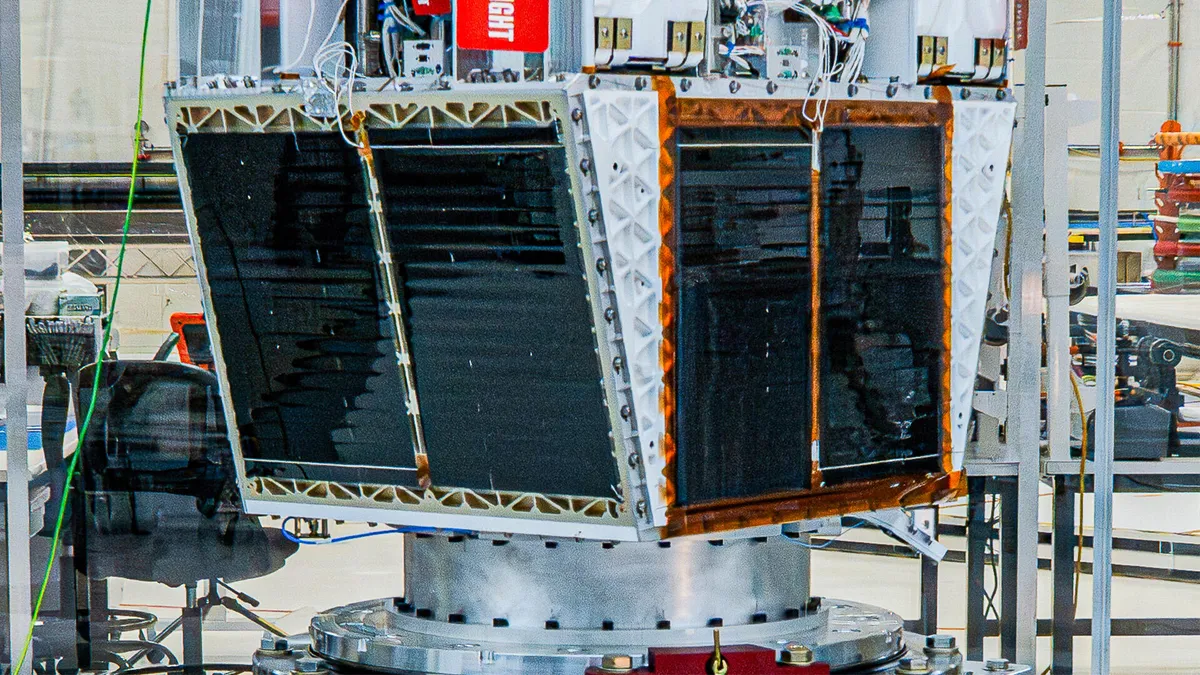
The approval green-lights Reflect Orbital to send its Eärendil-1 satellite into orbit. It’s a relatively small spacecraft, weighing 142 kilograms (313 pounds).
Housed in its body is a thin-film square mirror measuring 18 meters by 18 meters (about 60 feet by 60 feet). The satellite is scheduled to launch into space on a SpaceX Falcon 9 later in 2026.
Advertisement
Eärendil-1 promises to reflect sunlight onto Earth in a 3-mile circle that can be aimed basically anywhere that doesn’t have sunlight. The company has a web tool that shows you what this would look like, and it’s wide enough to light up entire neighborhoods, making it appear like daytime when it’s actually night.
Earendil-1 is able to reflect sunlight down to a roughly three-mile radius, giving it the capacity to light up an entire neighborhood.
Reflect Orbital
Ostensibly, this would be used to power solar panels at night, thus bypassing the one big drawback of solar panels: They can collect power only during the day. According to Reflect Orbital, electricity demand spikes right around sunset, which means power companies have to make the most power when the sun isn’t around to help. That increases fossil fuel usage, which is a contributing factor to climate change.
Advertisement
Reflect Orbital says that it wants to deploy 50,000 of these satellites in the event that the tech demonstration proves successful. That would put 16.2 million square meters of mirrors in Low Earth Orbit to light up large portions of the Earth on demand. For now, only the single Eärendil-1 satellite is approved for launch.
Only one satellite is approved for testing right now, but Reflect Orbital wants to put 50,000 of them in orbit someday.
Reflect Orbital
Advertisement
Scientists say this could be a disaster
Academics have been opposing the launch of Eärendil-1 since long before its FCC approval. Over 1,800 comments were made during the proposal stage, and most of them were negative.
Researchers tend to agree that having 50,000 satellites beaming sunlight back to the Earth might be just as bad as a supervillain blocking out the sunlight entirely.
Multiple organizations filed complaints, including the American Astronomical Society and DarkSky, among others, citing potential problems with directing 16 million square miles’ worth of sunlight back onto Earth in the middle of the night.
“The concept of illuminating Earth from orbit represents a new category of artificial light at night with global ecological, cultural and regulatory consequences,” DarkSky said in an open letter to Reflect Orbital. “Based on the current scientific evidence, we do not see a viable pathway for this technology to align with responsible lighting principles or with our mission to protect natural darkness.”
Advertisement
Astronomers are also high on the list of people who oppose a big mirror brightening up the night, noting that even a single mirror flying in front of a telescope can easily overwhelm sensitive equipment in observatories on Earth. And since most astronomy research has to be done at specific times, thanks to the movement of the greater universe, missing an opportunity to observe something thanks to an army of mirrors may cause unrecoverable data loss.
Scientists from other parts of the world are also unhappy with the notion that a single company in one country could ruin the sky for the rest of the world.
“An individual RO satellite like Eärendil-1 is expected to have an optical brightness of at least 2 to 4 times that of the full moon,” the American Astronomical Society said in a complaint to the FCC. The AAS also notes that it’s not just the mirrors; because light scatters when it hits Earth’s atmosphere, the mirrors would also make the sky around them too bright to view, causing even more disruption in research.
“For example, immediately adjacent to the sharp edge of the full moon, the sky is 10,000 times brighter than a dark sky with no moon,” the AAS said. “We expect a similar level of brightness surrounding Eärendil-1.”
Advertisement
Reflect Orbital admits that this is a regulatory blind spot, stating that there is “no established regulatory framework for space-based energy and lighting services.” The company says it’s open to regulation and working alongside scientists, while also stating that it intends to learn as much as it can from its test satellite before sending 50,000 more into space.
On Friday, Apple dropped the bombshell news it was suing OpenAI over the alleged theft of trade secrets, claiming that OpenAI stole Apple’s confidential data and engaged in efforts to learn proprietary information while recruiting former Apple employees.
In accusing OpenAI of stealing secrets about Apple’s unreleased products, Apple revealed that a former employee allegedly siphoned reams of sensitive files from the company’s shared network folders, weeks after leaving Apple for a job at OpenAI.
In its complaint, Apple says the former employee, a system electrical engineer named Chang Liu, allegedly “exploited a rare, previously unknown authentication bug” that allowed access to the company’s network. The bug is classified as a zero-day vulnerability, meaning that Apple had no time to fix it before it was allegedly exploited.
Apple has since fixed the bug and said it terminated the employee’s access once it learned of this “security breach.” In its complaint, Apple said the bug could have allowed a “few other” people to access data on its network, but alleged that only Liu exploited the bug to steal Apple’s confidential information while no longer an employee, citing a check of its server logs.
Advertisement
The disclosure, while light in detail, highlights the challenges that organizations face with protecting sensitive corporate data after employees no longer work there. Companies often move to immediately cut off departing staff from further access to protect any sensitive information from leaving, including inadvertently. Companies that fail to fully decommission their employees’ accounts can face future security lapses, data breaches, or malicious actions by disgruntled staff.
Apple spokespeople did not respond to an email from TechCrunch with questions about the security vulnerability, how it was exploited, and when the company decommissioned the employee’s credentials.
“LOL… so funny.”
In the complaint, Apple alleged that Liu took “dozens of Apple’s confidential hardware-related files” over the course of several weeks while as a new OpenAI employee.
Apple said the files contained “detailed information about unreleased products, engineering presentations, technical specifications, and proprietary project data.”
Advertisement
The company claims Liu failed to return the Apple-issued work laptop he had previously used to access Apple’s network, suggesting it was once able to send and receive files from Apple’s internal systems. The complaint said that Liu allegedly claimed to have “another computer.” While he was at OpenAI, Liu also allegedly misused the access of an acquaintance, Yu-Ting Peng, a then-Apple employee who later went to work for OpenAI. Liu allegedly used Peng’s Apple-issued work laptop “while she was still employed at Apple and he was not.”
Apple said that during February 2026, Liu “tried to access Apple’s network storage — a cloud-based file repository containing Apple’s confidential engineering files, project documentation, and other proprietary information.”
Liu had allegedly discovered that he “still could access Apple’s network repository after leaving Apple, the result of a then-unknown authentication vulnerability.”
Apple did not describe the authentication “bug” that Liu allegedly used to access Apple’s network. However, authentication bugs generally refer to flaws in the login process that allow improper access to systems or data, either because of a weakness in how the login mechanism works or due to a misconfiguration, such as overbroad permissions or not decommissioning the login credentials of a former employee.
Advertisement
Apple wrote in its complaint that when Liu learned he had unauthorized access to Apple’s systems, he did not report the bug to Apple under his employment agreement obligations, nor did he return his Apple-issued work laptop.
The complaint added that Liu also failed to “delete the program that allowed the access” to Apple’s network. The company did not say what program or app that Liu allegedly used to access Apple’s systems. It’s not uncommon for employees to have tools, such as a work-approved VPN or remote-viewing app, that allow them to access sensitive data from outside of the company’s offices using their credentials.
Given that Liu was previously granted credentials to Apple’s network as an employee, TechCrunch asked Apple when the company decommissioned Liu’s access, but we did not hear back.
Once Liu allegedly gained access to the network share, he wrote to Peng: “LOL, I found out I can access the [network storage], so funny.”
Advertisement
Apple filed its suit in the U.S. District Court for the Northern District of California in San Jose, and has demanded a jury trial. OpenAI previously said it has “no interest in other companies’ trade secrets.”
The case, if it proceeds, could begin this year.
When you purchase through links in our articles, we may earn a small commission. This doesn’t affect our editorial independence.
Meta’s acquisition of Manus drew widespread criticism in China for what was perceived as the handing over of critical technology to a geopolitical rival.
Chinese multinational technology company Tencent is in talks to become the largest external shareholder at AI start-up Manus in a deal that would further unwind Meta from a similar deal made previously, according to a report from Reuters, which cited two sources close to the matter.
It was previously reported that US tech giant Meta would acquire Manus for roughly $2bn as the organisation aimed to further advance its work in the AI space. However, in April of this year, it was announced that Manus – which is based in Singapore, but originated in China – and Meta had begun dismantling the deal as a result of the Chinese government blocking it on the grounds of national security.
When the deal was initially announced, it drew widespread criticism in China for what was perceived as the handing over of critical technology to a geopolitical rival.
Advertisement
An investigation commenced soon after, leading to the eventual dissolution of the agreement after the Chinese government blocked the deal.
Other investors reported to be involved in the new deal – which was first reported by the Financial Times – alongside Tencent are ZhenFund and HSG, both of whom were original investors in Manus.
Investing in Manus is, for Tencent, an opportunity to further develop a reputation in the booming global artificial intelligence sector. In June, the organisation began testing a new AI assistant on its own app, WeChat, in an attempt to keep pace with its competitors in the space.
WeChat users can interact with Xiaowei, Tencent’s AI agent, via text or voice prompts and the AI uses WeChat’s own large language model WeLM, while also tapping into DeepSeek to process additional queries.
Advertisement
Tencent has recently backed other innovators working in the AI space, such as DeepSeek, according to reports. In mid-June it was reported that Tencent was involved in a round in which the DeepSeek raised more than $7.4bn at a $50bn-plus post-money valuation. Tencent was also reported to have proposed taking a 20pc stake in DeepSeek.
Updated, 2.43pm, 13 July 2026: This article was amended to clarify facts related to China’s investigation of the Meta-Manus acquisition, to clarify that ZhenFund and HSG were original investors in Manus before the Meta acquisition, and to clarify that Reuters and the Financial Times published the original reports.
Don’t miss out on the knowledge you need to succeed. Sign up for the Daily Brief, Silicon Republic’s digest of need-to-know sci-tech news.
Inconvo had offered configurable AI assistants connected to user-facing data, with the aim of allowing customers to analyse their data through a ChatGPT-like interface.
Attio, a London-based developer of AI-powered customer relationship management (CRM) software, has acquired Irish-founded AI analytics platform Inconvo for an undisclosed sum.
In a blogpost, Attio said that Inconvo’s founders, Eoghan and Liam Mulcahy, would be joining its engineering team in order to “expand Attio’s ecosystem of agents and integrations” and help to “make natural language interfaces ubiquitous in all of the tools” offered by Attio.
Inconvo’s independent platform has been shut down following the acquisition, according to a blogpost from Eoghan Mulcahy, who wrote that the founders’ goal in creating the platform two years ago was to get answers from data “by just asking, in plain language”.
Advertisement
He added: “Natural language access to data isn’t a nice add-on. It’s infrastructure, and it belongs right at the centre of the tools teams use every day.”
Inconvo had offered configurable AI assistants connected to user-facing data, with the aim of allowing customers to analyse their data through a ChatGPT-like interface.
“Eoghan and Liam are builders at heart and perfectly encapsulate the philosophy of our team and product,” said Nicolas Sharp, CEO and co-founder of Attio.
Inconvo was part of Y Combinator‘s summer 2023 batch and launched in 2024. Attio, founded in 2019, said that integrating Inconvo’s founding team would help it to build architecture that “lets teams move at a speed, scale and quality previously out of reach, with first-class agentic access wherever they operate”.
Advertisement
“Their vision to make natural language interfaces ubiquitous in all of the tools we use is one piece of the larger shift we’re driving at Attio – a CRM that transforms how revenue work gets done,” the UK company said.
Attio lists companies such as Modal, Snackpass and Union Square Ventures as users of its CRM platform.
Don’t miss out on the knowledge you need to succeed. Sign up for the Daily Brief, Silicon Republic’s digest of need-to-know sci-tech news.
















































You must be logged in to post a comment Login