

Crypto World
US Treasury, Tether Freezes $131M in Crypto Tied to Iran

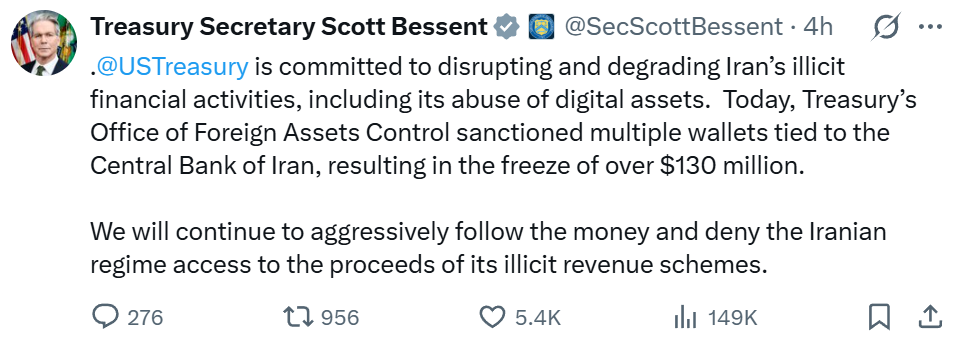
US Treasury Secretary Scott Bessent confirmed the US government ordered the freezing of more than $130 million in cryptocurrency held in wallets linked to Iran on Tuesday, as hostilities ramped up in the Middle East.
Earlier on Tuesday, blockchain investigator Specter pointed to onchain data showing Tether froze four Tron wallets holding $131 million worth of USDt (USDT). Bessent confirmed on X that the wallets were tied to the Central Bank of Iran.
“US Treasury is committed to disrupting and degrading Iran’s illicit financial activities, including its abuse of digital assets,” Bessent said Tuesday. “We will continue to aggressively follow the money and deny the Iranian regime access to the proceeds of its illicit revenue schemes.”
The asset freeze comes amid a collapse in the ceasefire between the US and Iran. The US said it has renewed its blockade of Iranian ports, while the US military’s Central Command announced a new wave of strikes on Iran. Meanwhile, Iran’s military claimed on Tuesday that it carried out drone strikes against US military facilities at Jordan’s Al Azraq Air Base.
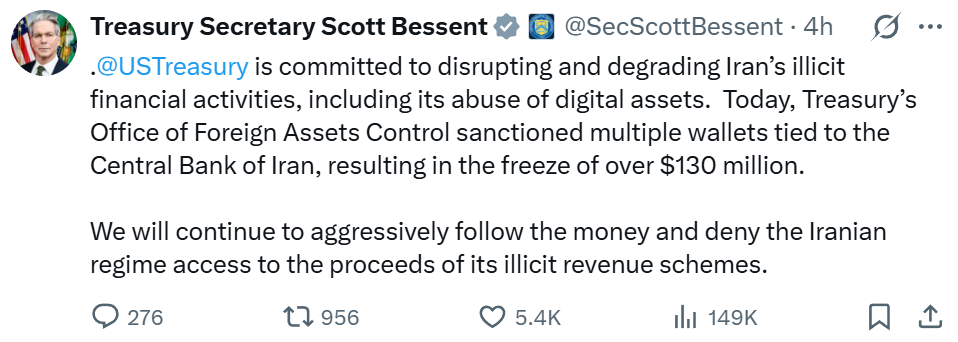
Source: Scott Bessent
The move follows a similar freeze in April, when stablecoin issuer Tether confirmed it had frozen more than $344 million in USDT at the request of US authorities.
In May, Bessent said the US has seized around $1 billion in Iranian crypto assets as part of the US financial pressure campaign against Iran known as Operation Economic Fury, which launched in March 2025.
Related: Iran-linked entities moved $3.8B through CoinEx, TRM says
“Through Economic Fury, the Treasury Department is disrupting the foreign procurement networks that support the Iranian military’s efforts to acquire weapons,” Bessent said in a statement in June.
“Treasury has frozen the Iranian regime’s assets, severely disrupted its economy, and dismantled the Iranian war machine. Treasury will not tolerate any support of the Iranian military.”
Magazine: Thai scammer’s $122M wallet, Japan embraces crypto credit: Asia Express


BitMine Immersion Technologies posted revenue of $46.5 million in the three months ended May 31, a 22x jump from a year earlier, even as a $9.1 billion nine-month net loss dominated its latest filing.
The loss stems almost entirely from a non-cash markdown on the company’s Ethereum (ETH) holdings. Underneath it, BitMine’s staking business scaled from almost nothing into the firm’s dominant revenue source.
Staking Drives BitMine’s Revenue
According to BitMine’s filing, revenue from staking and validation reached $45.7 million, about 98% of the total. A year earlier, that line was zero. The rest came from small self-mining and consulting lines, together under $800,000.
Follow us on X to get the latest news as it happens

As of the latest data, BitMine has staked 4.9 million ETH, roughly 85% of its holdings, through its MAVAN validator platform. The company projects annualized staking revenue near $242 million.
“Annualized staking revenues are now projected at $242 million. And this 4.9 million ETH is 85% of the 5.77 million ETH held by Bitmine. Bitmine’s own staking operations generated a 7-day yield of 2.70% (annualized),” said Tom Lee.
That income rests on a large ETH position. As of July 12, BitMine holds 5.77 million ETH, worth roughly $10.5 billion and equal to 4.8% of supply. The stake makes it the largest corporate ETH treasury.
The trend extends well beyond BitMine. One recent study found that staking accounted for 60% of disclosed revenue across listed ETH treasury firms in 2025.
A $9 Billion Loss That Missed the Numbers
The headline loss looks alarming, but the timing matters. BitMine’s $9.1 billion nine-month net loss came almost entirely from a $9.04 billion unrealized markdown on its digital assets, according to its SEC filing.
That damage landed as the value of its ETH holdings fell. In the three months ended May 31, the net loss narrowed to $83.6 million.
The period’s operating loss was $11.9 million. The bigger hit came from a $92 million loss on derivative contracts.
The split screen defines BitMine’s model. Its reported earnings will swing with ETH’s price, while its staking operation generates a growing revenue stream. The coming months will test whether staking income can offset that volatility.
Subscribe to our YouTube channel to watch leaders and journalists provide expert insights
The post BitMine Revenue Jumps 22x Even as It Posts $9 Billion Net Loss appeared first on BeInCrypto.
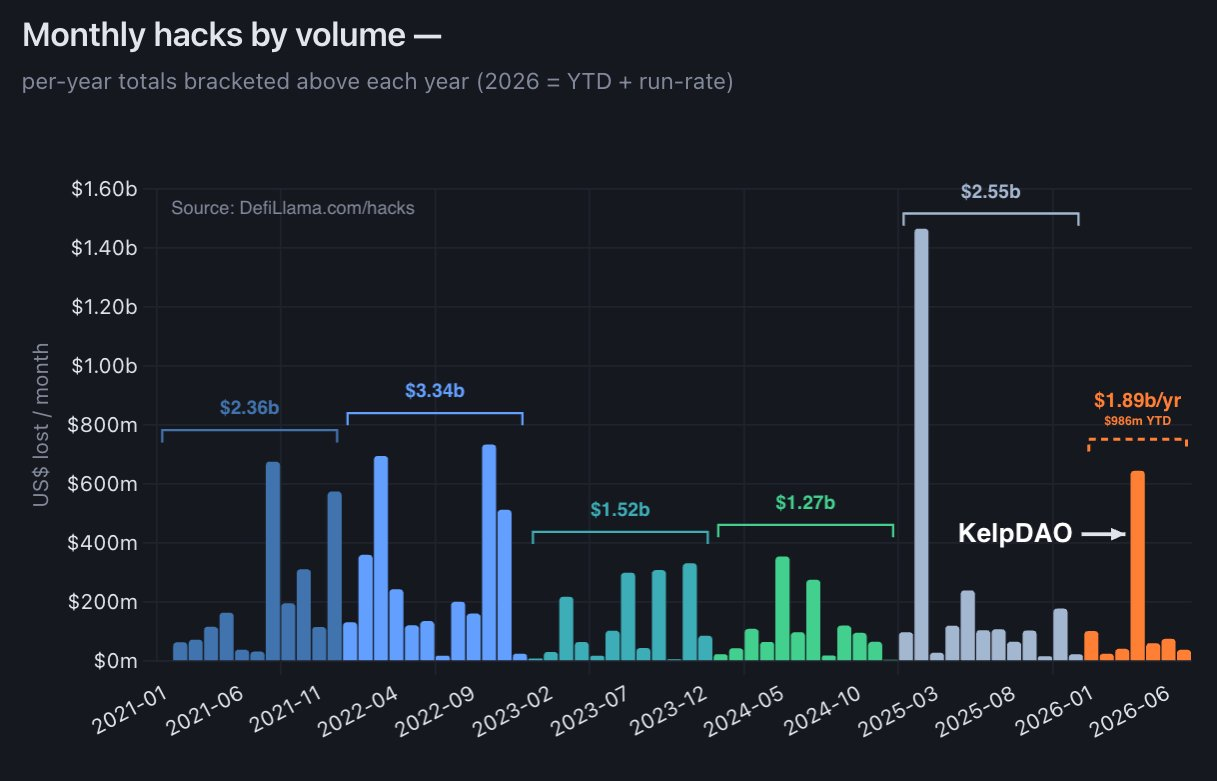
Fears that artificial intelligence would trigger a wave of catastrophic decentralized finance (DeFi) hacks in what was coined as a “hackpocalypse” have not materialized, according to Dragonfly managing partner Haseeb Qureshi.
While the incident count grew to a record high, the median size of hacks has dipped below $500,000 this year, down from over $2 million in 2025. Qureshi argued that this shows malicious actors using AI are targeting “small protocols and abandonware” while larger DeFi protocols have fortified themselves against AI’s threat.
Excluding outlier months with large incidents, such as the Bybit hack in February 2025 along with the Drift Protocol and KelpDAO exploits in April of this year, 2026 has still seen less value hacked per month than the previous year, said Qureshi.
The comments come in response to concerns shared by blockchain security platform OpenZeppelin’s founder, Manuel Aráoz, who said that he considers “all of DeFi unsafe,” citing the growing ability of AI coding agents to identify smart contract vulnerabilities.
Broader industry datasets, which include centralized platforms, wallet compromises and phishing, as well as DeFi exploits, offer a less reassuring picture. In April, crypto hacks surged, resulting in losses of around $644 million, marking an over one-year high last seen in February 2025 when the $1.4 billion Bybit hack pushed monthly losses to $1.46 billion, according to DefiLlama.
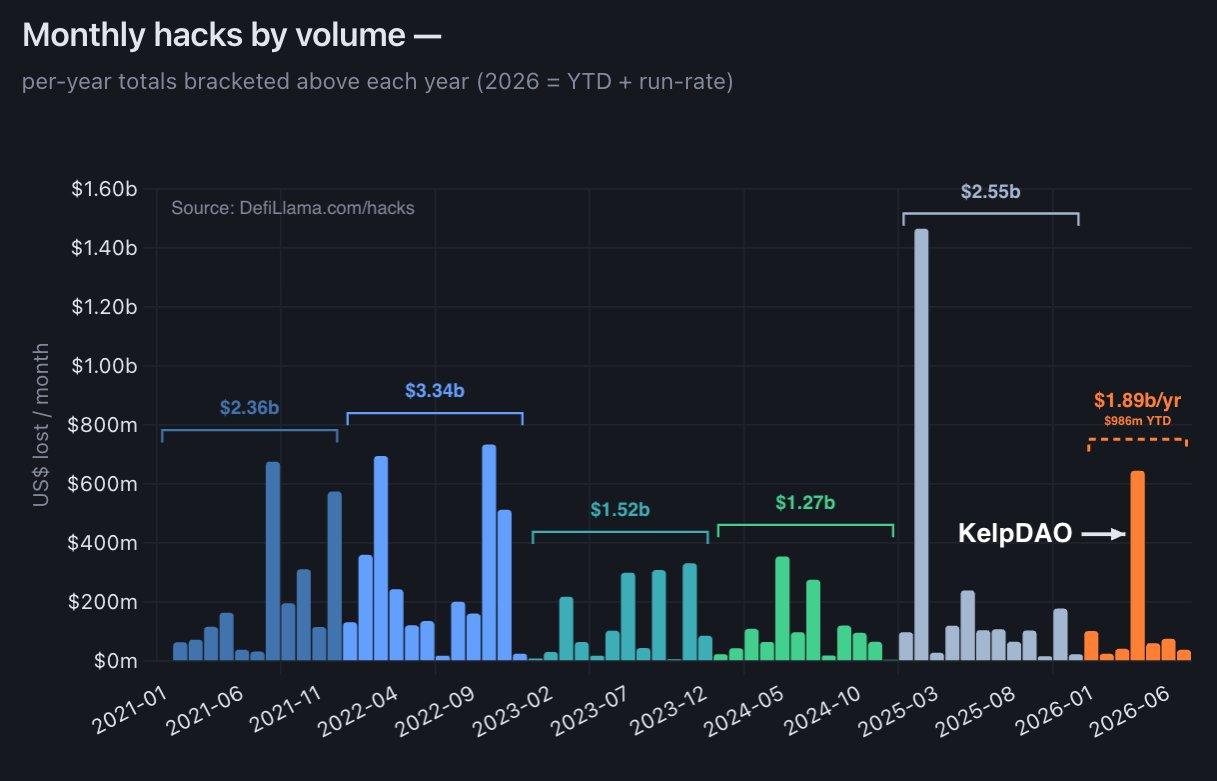
Source: Haseeb
Crypto hacks fall 47% in H1, but crypto industry not necessarily safer: CertiK
Losses to cryptocurrency hacks fell 46.8% year-on-year to $1.32 billion in the first half of 2026, but blockchain security company CertiK argued that the Web3 industry’s lower headline losses do not necessarily mean the industry is safer.
Related: Belgian police arrest suspected phishing gang leader tied to $572K theft
While it marks a significant drop in dollar value, last year’s figures were skewed by the $1.4 billion Bybit hack, the largest in crypto history, CertiK told Cointelegraph.
During the second quarter of 2026, over 70% of the losses stemmed from the KelpDAO and Drift Protocol exploits, which were largely attributed to North Korean state-sponsored hackers.
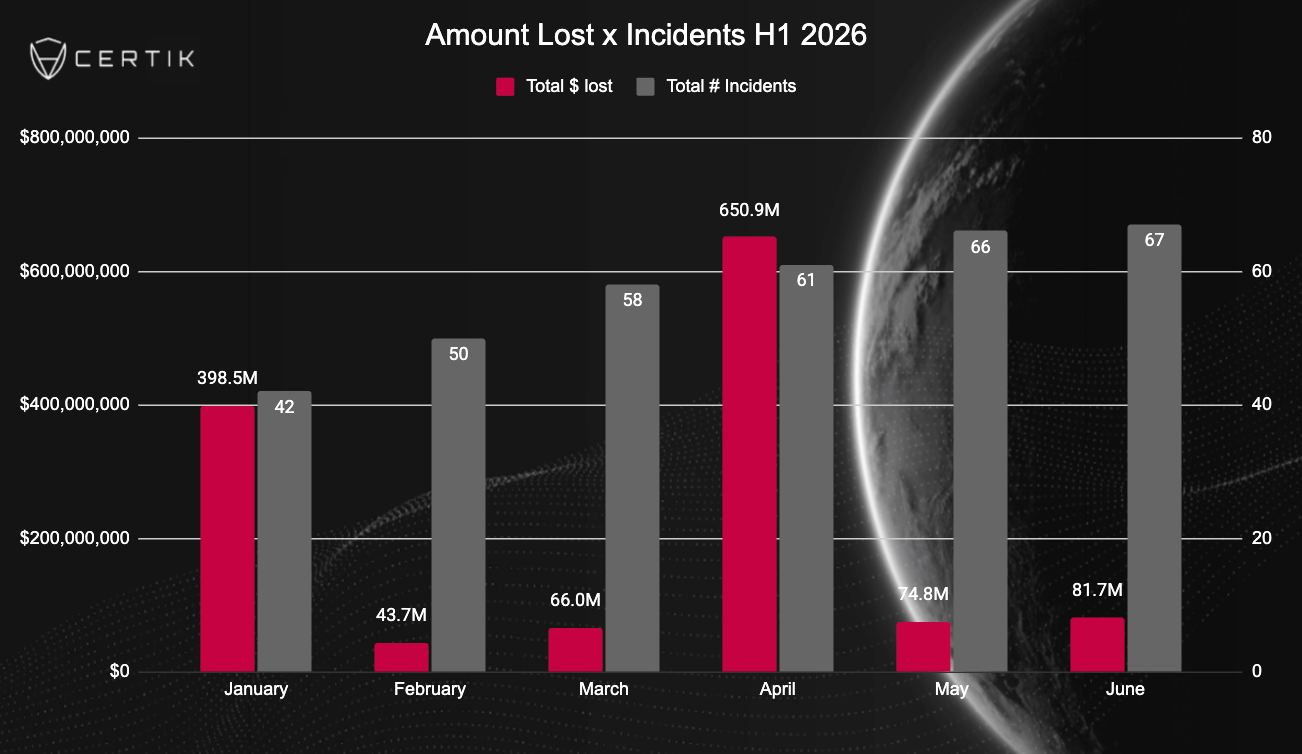
Monthly change in crypto exploit amounts and number of incidents across H1. Source: CertiK
The data underscores the continued threat that North Korean hackers pose to the crypto industry, having stolen more than $6 billion worth of crypto since 2017, TRM Labs estimated in April.
Magazine: Does Botanix’s failure prove Bitcoiners don’t care about DeFi?


Coinbase, among others, filled that gap in May 2025. Under x402, a server that wants payment answers a request with a 402 and a price. The client signs a stablecoin transfer, usually USDC, resends the request with the payment attached, and gets the data. The exchange takes seconds and needs no account, no card, and no prior relationship between the two sides.
That is why the AI industry cares. An autonomous agent cannot open a bank account, pass a credit check or sign a SaaS contract, but can sign a transaction. Google has wired x402 into its own agent payments protocol, and Cloudflare ships it in its agent toolkit.
The announcement included no usage figures, though x402 publishes them on its own homepage. The protocol handled about 75 million transactions over the past 30 days, or roughly 29 every second, moving about $24 million between some 94,000 buyers and 22,000 sellers.
That works out to an average payment of about 32 cents, meaning the machine-to-machine thesis works as designed, as no card network can process a such small charges profitably.
Still, $24 million a month is a fraction of what any of x402’s premier members move in a day.
PI crashed 40% this week after a massive sell-off that drove it to consecutive all-time lows. However, it has rocketed by 10% since those lows, begging the question of whether the bottom is in.
PI Network (PI) Price Predictions: Analysis
Key support levels: $0.07
Key resistance levels: $0.10, $0.13, $0.16
PI Crashed to $0.07
PI just had one of the worst weeks in 2026 after the price lost support at $0.10. With this level turned into resistance, sellers rushed for the exits and sent the price into a nose-dive to $0.07, which became its latest record low.
With confidence gone, buyers had vanished. For example, in the past 10 days, only one day closed in the green. This shows that the sentiment is extremely bearish and the downtrend has entered a new phase where a bottom could be found much quicker.
More positive news came in the past several hours, with PI finally rebounding to $0.08 as of press time. However, it remains to be seen whether this is another dead-cat bounce.
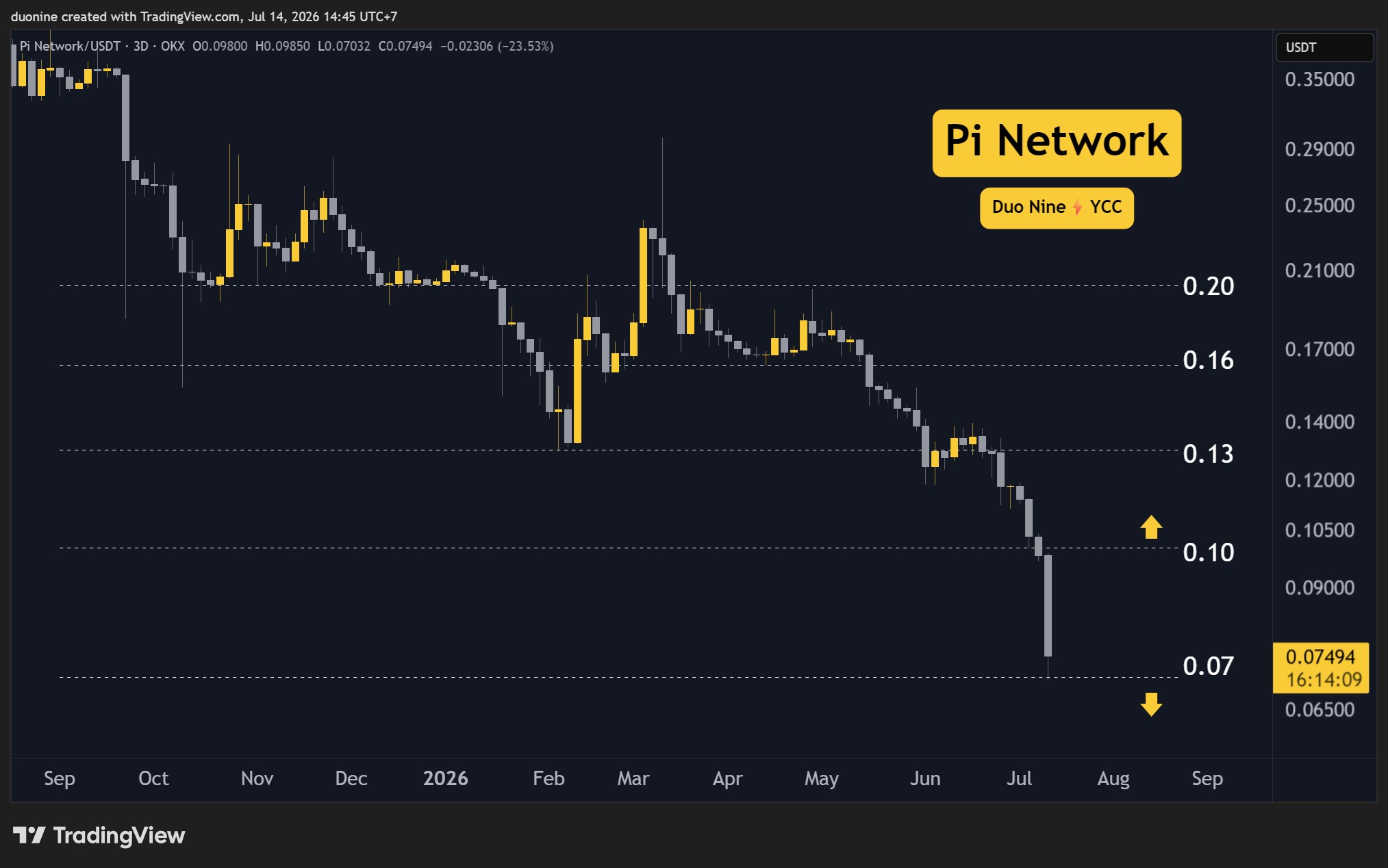
Sell-Side Volume Exploded
As soon as the support at $0.10 was lost, sell volume began to pick up. This only made things worse and likely led to cascade liquidations that put even more pressure on the falling price.
While the sell pressure has decreased compared to yesterday, the day is not over, and this could still change. The price held above $0.07 and bounced to $0.08, but this could very well be just a temporary pause before new lows.

Momentum Indicators Are at Extremes
Due to heavy selling pressure, the momentum indicators have reached extreme levels. For example, the daily RSI is at 12 points, a level never seen before for this cryptocurrency. Extremes are also the place where bottoms are found.
Hopefully, this price action will bring about an end to the downtrend and allow PI to consolidate and confirm a bottom. If the support at $0.07 won’t hold, then buyers will likely retreat to $0.06 or even $0.05. The current resistance is at $0.10.

The post Pi Network Price Predictions for This Week as PI Surges 10% in 24 Hours (July 15) appeared first on CryptoPotato.
Crypto World
Finassets Raises Affiliate Revenue Share to 40%, Becoming One of the Highest-Paying Crypto Affiliate Programs
[PRESS RELEASE – Marbella, Panama, July 15th, 2026]
Finassets, a crypto payment gateway for businesses, announced an increase to its partner revenue share. The first-year referral rate rises to 40% of the processing revenue a referred merchant generates. From year two, the rate continues at 20% for five additional years while the merchant keeps processing, extending the total partner earning window to six years per referral, with the term extendable based on the merchant profile.
Payout speed, contract length, and dashboard visibility are among the key considerations affiliate marketers weigh when comparing crypto affiliate programs, and this update puts Finassets among the top crypto affiliate programs open to B2B partners.
A different model from trading-based programs
Many crypto exchange affiliate programs and trading platforms base payouts on trading fees generated by active traders, tying affiliate income to short-term trading volume through a fixed commission plan or a minimum payout threshold. Finassets ties partner earnings to a merchant’s ongoing processing volume instead — a relationship that can continue for the full six-year term.
One agreement, six years of revenue share
- Apply to become a partner. Submit an application and our team handles onboarding and sets clear terms from day one, with a personal referral link and dashboard account.
- Finassets onboards the merchant. KYB, compliance, and integration are handled entirely by Finassets.
- The partner earns. Revenue share is calculated per merchant and paid same-day, in crypto. The term can be extended based on the referred user profile.
A merchant referred through a partner’s affiliate link and processing $500,000 a month generates about $2,000 a month in processing fees at Finassets’ 0.40% rate. Here’s how that translates into partner earnings:

Based on a merchant processing $500,000/month at Finassets’ 0.40% fee. Illustrative; actual earnings depend on the merchant’s processing volume.
“Most cryptocurrency affiliate programs ask partners to keep generating referrals just to keep earning,” said Vitalijs F., CEO of Finassets. “We built this revenue share model so one merchant relationship can keep paying out for years, without additional marketing efforts from the partner after the introduction.”
Real-time visibility, reliable payouts
The agent dashboard tracks referral volume and revenue share per merchant in real time, with a full transaction history for reconciliation and one-click withdrawals. Deposits are typically credited within about 30 seconds of network confirmation, and partners are supported by dedicated account managers who respond quickly. Payouts are same-day, in crypto. Finassets supports 70+ cryptocurrencies across its full product suite, the same infrastructure referred merchants use to process payments.

The affiliate program is open to eligible B2B participants in selected international markets, subject to Finassets programme terms and applicable jurisdictional requirements.
More information and the partner application: https://www.finassets.io/en/affiliate-program/
About Finassets
Founded in 2021, Finassets is a Panama-registered crypto payment gateway supporting cross-border and crypto-driven businesses across eligible markets. Finassets provides crypto invoicing, payment links, payment buttons, mass payouts, API integration, crypto checkout, and an affiliate program within a structured, transparent environment for crypto payment processing.
Website: https://www.finassets.io
The post Finassets Raises Affiliate Revenue Share to 40%, Becoming One of the Highest-Paying Crypto Affiliate Programs appeared first on CryptoPotato.


The United Kingdom and United States have agreed to pursue closer coordination on stablecoin regulation, cross-border payments and tokenized financial markets.
Summary
- UK and US regulators seek aligned stablecoin rules while preserving competition and cross-border market access.
- Stablecoins used as money should hold one-to-one reserves and protect holders during issuer insolvency proceedings.
- Officials will explore pathways allowing regulated stablecoins from either jurisdiction to enter the other market.
The two governments also plan to explore how regulated stablecoins issued in one country could gain access to the other market.
The commitments appear in a joint UK-US statement on stablecoins released on July 14. The statement forms part of recommendations from the Transatlantic Taskforce for Markets of the Future, which the two governments established in September 2025.
UK and US set common stablecoin principles
The two governments said stablecoins can support payments, settlement and capital market transactions when regulators apply proper safeguards. They plan to seek “comparable outcomes for comparable risks and activities” while allowing each country to develop requirements under its own legal framework.
The approach does not require identical regulations. Instead, officials want to reduce unnecessary differences that could block cross-border activity. The governments also said they would avoid rules that impose costs out of proportion to the risks or create unnecessary barriers for new competitors.
As reported by crypto.news, the agreement comes as stablecoin rules remain a major policy issue in Washington. U.S. lawmakers and banking groups continue to debate how digital dollar products should interact with traditional banks and financial markets.
Stablecoins should maintain at least 1:1 backing
The joint statement says stablecoins presented as money should hold at least one dollar or equivalent in high-quality liquid assets for every unit issued. Each country will decide which reserve assets qualify under its domestic framework.
Issuers should also separate reserve assets from their own corporate funds. The governments said holders should receive timely redemptions and clear information about their legal rights. In an issuer failure, holders should have a protected claim on reserves, including priority over other creditors where domestic law allows it.
The principles broadly match the direction of U.S. stablecoin regulation under the GENIUS Act. The Treasury began proposing implementation rules in 2026 as the United States prepares its federal framework for payment stablecoin issuers.
Governments explore cross-border stablecoin access
The UK and US plan to examine a clear pathway that could allow stablecoins regulated in either jurisdiction to reach customers and markets in the other. Any access arrangement would remain subject to each country’s laws and regulatory processes.
Both governments also support fair, risk-based access to banks and other financial services for lawful regulated digital asset companies. They said stablecoins could serve as settlement instruments in securities and commodities markets when firms meet the required safeguards.
The statement does not create automatic mutual recognition or approve any specific stablecoin for cross-border distribution. Regulators still need to develop the legal routes and standards required to put the plan into practice.
Tokenized finance forms part of wider cooperation
The agreement extends beyond stablecoins. Under the broader Transatlantic Taskforce recommendations, the two countries plan to work with a private-sector group to test cross-border uses for tokenized assets over a one-year period.
The SEC, CFTC, FCA and Bank of England will also seek common approaches to areas including tokenized securities settlement and the possible use of stablecoins or tokenized money market funds as collateral at clearing houses.
The recommendations leave both countries free to complete their own regulatory processes. Their stated aim is to reduce cross-border friction while giving regulated stablecoins and tokenized financial products clearer routes between two major global financial markets.
Kalshi says it is being put in an “impossible position” after the US commodities regulator on Tuesday said it was blocking the prediction market platform from canceling trades in Michigan, contradicting a recent state court order.
On June 29, Kalshi was ordered by Ingham County Circuit Court Judge Rosemarie Aquilina to cease offering sports betting contracts to Michigan users while a lawsuit over whether Kalshi violated the state’s sports betting laws plays out. The Commodity Futures Trading Commission ordered Kalshi on Tuesday not to comply with the state order and continue operating.
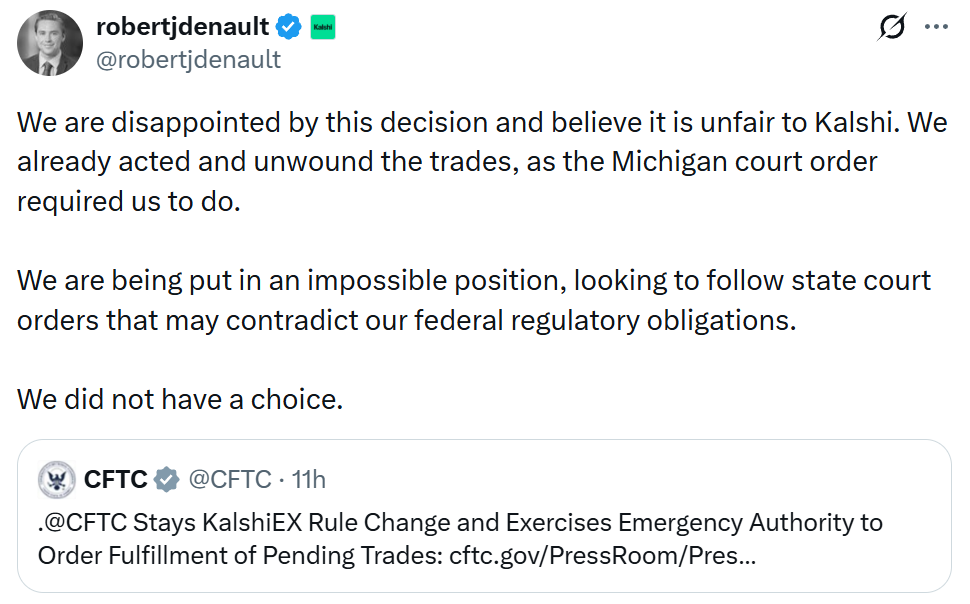
“We are disappointed by this decision and believe it is unfair to Kalshi,” Robert DeNault, the company’s head of enforcement and legal counsel said in a statement on X.
“We already acted and unwound the trades, as the Michigan court order required us to do. We are being put in an impossible position, looking to follow state court orders that may contradict our federal regulatory obligations. We did not have a choice.”
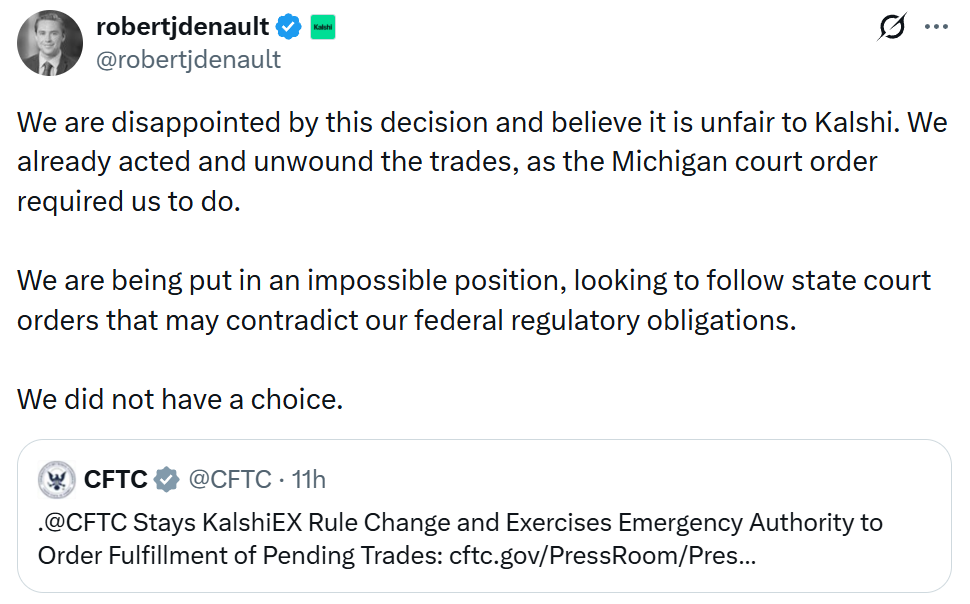
Source: Robert DeNault
The conflicting orders highlight an unresolved regulatory divide between the CFTC and nearly two dozen state regulators over which authorities have jurisdiction over prediction markets. The CFTC said Michigan was the first state to attempt to interfere with executed derivatives transactions.
“Canceling trades that have already been executed is an unprecedented step that risks a cascading effect on the entire marketplace and undermines the certainty in contracting that is a necessary component of a functioning market,” said Selig.
“The Commission will not allow states or state courts to bully registered entities into violating the Commodity Exchange Act and CFTC regulations.”
A Kalshi spokesperson said it was reviewing the CFTC’s order and considering its next steps, according to Reuters.
Related: OpenAI quietly adds Kalshi World Cup odds to ChatGPT: Report
Speaking on Fox Business on Friday, CFTC Chair Michael Selig said it is “critical” that the regulator maintains its regulatory authority over prediction markets.
“We’ve sued nine states now, and we’ll continue to sue any state that attempts to impose criminal or civil fines against CFTC-registered exchanges.”
Magazine: Strategy became a symbol of the dot-com crash: Could history repeat?


Mizuho has downgraded Circle Internet Group from Neutral to Underperform and cut its price target from $85 to $50, citing competition from Open USD.
Summary
- Mizuho cut Circle’s price target to $50, warning Open USD could further squeeze stablecoin margins.
- Open USD shares reserve earnings with partners, challenging Circle’s existing distribution economics around USDC globally.
- Circle also faces margin pressure from Hyperliquid revenue-sharing terms despite recent federal banking approval milestone.
The Japanese investment bank said the stablecoin model could pressure the economics behind Circle’s USDC business.
According to a CoinDesk report, analysts led by Dan Dolev said Open USD “could fundamentally alter CRCL’s business model” by changing how reserve income flows to distributors. Circle shares traded at $62.63 when the report was published.
Mizuho cuts Circle’s 2027 earnings outlook
Mizuho raised its estimate for Circle’s distribution and transaction expense ratio in 2027 from 64% to 73%. The bank also lowered its adjusted EBITDA forecast from $1.09 billion to $699 million, about 25% below the analyst consensus cited in the report.
The bank said higher interest rates could support reserve income but may not fully offset pressure from changing stablecoin economics. Its concern centers on how much yield Circle can retain after paying distribution partners, including companies that help USDC reach users and financial platforms.
Open USD challenges the existing stablecoin model
Open USD was announced on June 30 by Open Standard, with more than 140 companies participating in its ecosystem. Partners include Coinbase, Mastercard, Stripe and BlackRock. The project says businesses will be able to mint and redeem the stablecoin without fees or artificial volume limits.
Under the model, partners receive reserve earnings after a small management fee covers operating costs. That differs from Circle’s structure, where reserve income is generated before revenue-sharing payments to major distribution partners. As previously reported, Open USD’s announcement raised questions over whether Circle’s own partners could support a rival while continuing to distribute USDC.
Coinbase relationship adds another pressure point
Mizuho also pointed to Circle’s revenue-sharing relationship with Coinbase. The bank said the agreement is expected to come up for renegotiation in August, and Coinbase’s participation in Open USD could give it more leverage in future talks.
A separate warning came from JPMorgan. As reported by crypto.news, the bank cut earnings forecasts for Circle and Coinbase after a new USDC revenue-sharing arrangement with Hyperliquid. JPMorgan said the deal could reduce reserve income retained by both companies even if USDC usage grows.
Circle continues to expand USDC infrastructure
The downgrade comes as Circle expands its regulatory and payments footprint.Circle data showed USDC circulation at about $73 billion as of July 13, down from $77 billion at the end of the first quarter.
Circle also recently received final approval to establish Circle National Trust. The federally regulated entity will initially focus on digital asset custody for Circle and its affiliates, with possible future services for selected institutional clients.
The company is also expanding USDC use in Asia. JCB and Circle announced a pilot covering cross-border treasury transfers and possible merchant payments in Japan. The project will start with JCB’s internal transfers before the companies assess wider retail payment uses.
Mizuho’s downgrade focuses on Circle’s ability to protect margins as stablecoin competition changes how reserve income is shared. Open USD has not proved it can match USDC’s distribution or liquidity, but its partner-led model creates a new pricing benchmark. Circle’s earnings path will depend partly on USDC supply, interest rates and future revenue-sharing agreements.

A solo Bitcoin miner has validated a block using just one low-cost Bitaxe machine, landing the standard 3.125 BTC reward in what looks like a statistically unlikely outcome. The win underscores how, even in today’s highly competitive mining environment, hobby-scale setups can still occasionally hit the lottery.
According to blockchain data from mempool.space, the miner solved block number 957382 on Friday and received 3.125 BTC, worth roughly $200,000 at current market valuations. The miner’s setup reportedly consisted of a single Bitaxe rig, as noted by the mining pool Public Pool in a post on X.
Key takeaways
- A retail solo miner validated block 957382 and received the 3.125 BTC reward, per data from mempool.space.
- The winning setup reportedly used a single Bitaxe miner, credited by Public Pool on X.
- Bitaxe is positioned as a low-power, budget device—its hashrate is about 1 TH/s, tiny compared to the network.
- Solo block wins remain rare but are still happening regularly enough to add up: Bennet data places the last 12 months’ solo payouts above $4.7 million.
How a single miner found a solo block
The defining detail in this case is not the size of the reward—every successful solo miner receives the standard block subsidy—but the scale of the hardware involved. Public Pool attributed the find to a lone Bitaxe mining rig.
As described by Bitaxe, the device is a budget, lower-power Bitcoin miner with an estimated hashrate around 1 TH/s, according to the article’s referenced materials. In practical terms, that figure is extremely small relative to the overall Bitcoin network hashrate, which is why solo block wins are usually framed as long-shot events for individual miners.
Yet the nature of mining is that the network doesn’t “know” how small your share is—only probability matters. That’s what makes these events notable for retail miners: even when odds are against you, the process can still produce occasional, outsized payoffs.
Why this case stands out among recent solo wins
This isn’t the first time a solo Bitcoin block has been found with retail-level participation, but it adds another example of how DIY mining setups continue to surface wins.
Earlier coverage referenced by the source notes that another solo Bitcoin miner validated a block in April through CKPool’s solo mining service. In February, another retail miner reportedly found a solo block using rented hashrate—meaning the miner may not have owned the physical hardware performing the work.
The difference matters because “solo mining” can be implemented in different ways. Solo mining technically means the miner is working toward their own block candidate rather than sharing block rewards with a pool. But the hardware—and whether it is owned outright, rented, or handled through a service—changes the economic reality: electricity costs, capital risk, and the probability profile investors associate with each approach.
In this latest instance, the emphasis is on an owned, single-rig setup using Bitaxe, making it a closer analog to the traditional idea of a hobbyist miner aiming at a solo prize.
Solo mining trends: frequency, droughts, and annual totals
While any single solo block is a rare event, aggregators show that wins are not disappearing. The source points to a year-long tally using Bennet’s solo miner tracking.
According to Bennet data cited in the article, solo blocks mined increased by 41% year-on-year. Over the past year, solo miners validated 24 blocks, pushing total rewards paid to 75.4 BTC—stated as more than $4.7 million in the referenced coverage.
Timing also remains a crucial detail for anyone planning for long horizons. The source reports an average interval of 15.2 days between successful solo blocks, while the longest drought without a solo win was 58 days. These numbers are useful because they help retail participants calibrate expectations: solo mining doesn’t deliver predictable returns, but it also doesn’t mean “never.” The distribution of outcomes can be lumpy—short streaks and longer gaps can both occur.
For investors and builders watching Bitcoin’s ecosystem, this matters because solo participation—even if small—reflects ongoing access to mining at the consumer end. It also highlights that, despite industrial-scale competition, individual miners can still engage meaningfully, at least occasionally, with affordable hardware.
What to watch next for retail solo miners
Retail solo mining remains a game of probability, but the most practical question for the near term is whether these Bitaxe-style, small-hashrate successes keep showing up with enough regularity to sustain interest. Readers should watch the spacing between solo wins and the reported hardware profiles behind them, since both determine how realistic solo mining feels for hobby participants after each new cycle of difficulty adjustments.
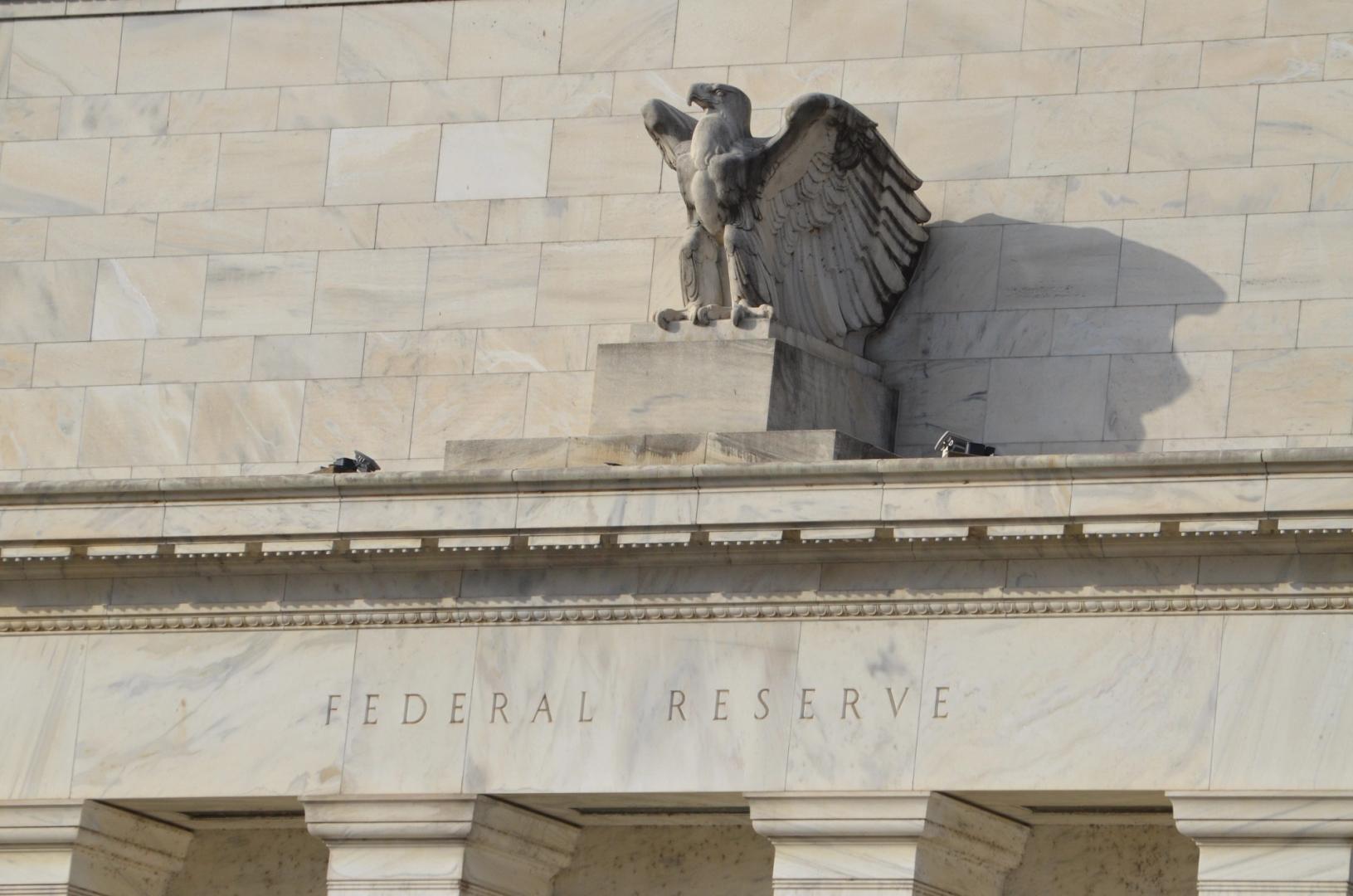
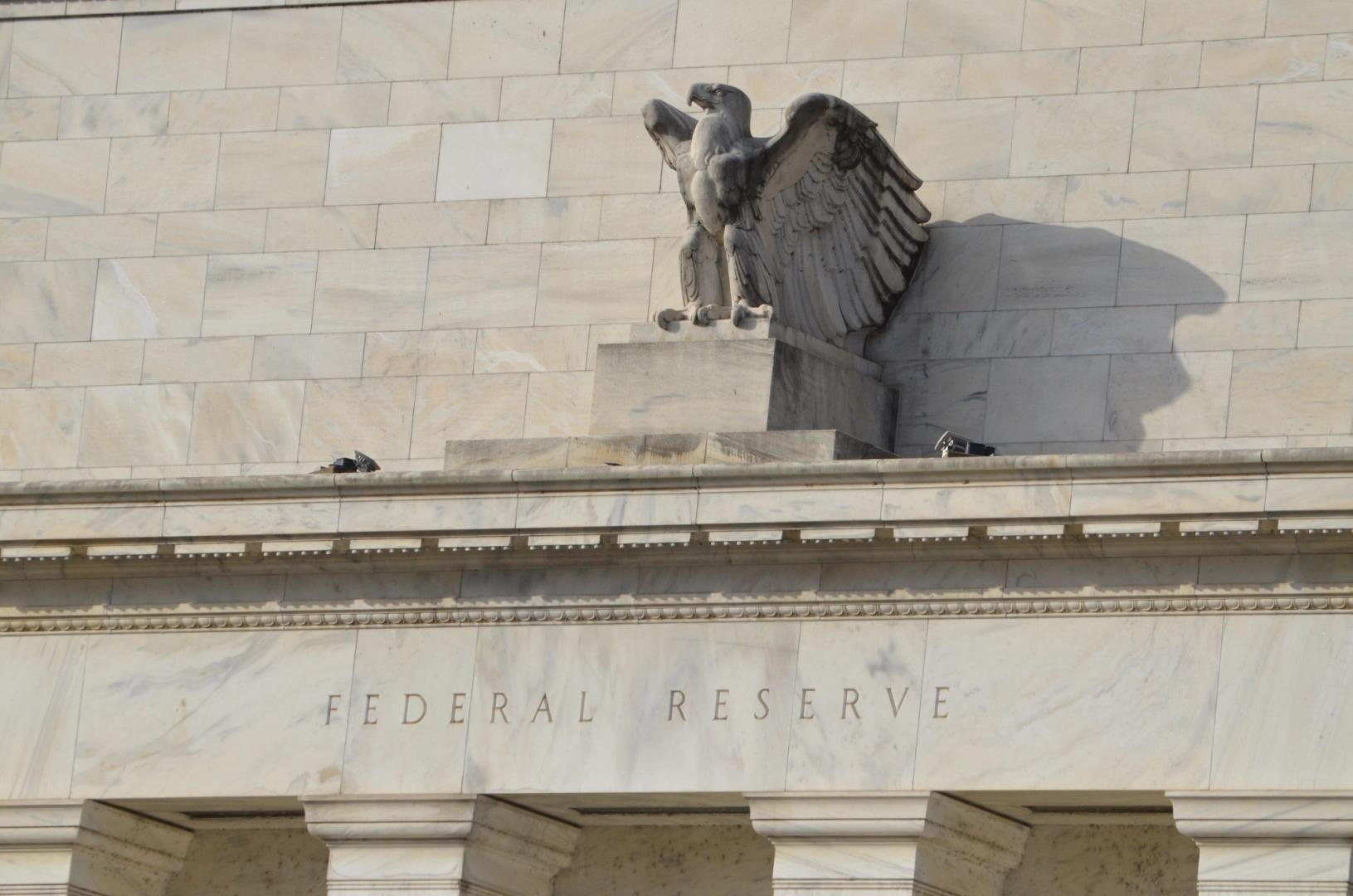
Higher rates hurt bitcoin and risk assets as when the Fed raises rates, cash and Treasury bonds start paying a decent, guaranteed return, so investors have less reason to hold something that pays no yield and swings 5% in a session.
On the other hand, cooler inflation means the Fed has less reason to raise, so that pull weakens and money flows back the other way.
Elsewhere, brent crude advanced 1% to above $85 a barrel, a third consecutive day of gains, after President Trump threatened further strikes on Iran and the U.S. resumed its blockade of Iranian shipping through the Strait of Hormuz. Crude has now surged 11% in two sessions.
Equities took the same cue as crypto. MSCI’s Asia Pacific gauge climbed 2.3%, its biggest advance in a month, with technology shares leading. South Korea’s Kospi jumped 8.2%, retaking its position as the world’s best-performing major benchmark this year, and SK Hynix rose 13% in Seoul after its American depositary receipts surged 27%.
“Bitcoin remains a rate-sensitive risk asset rather than a macro hedge,” said Jeff Ko, chief analyst at CoinEx, who said the print as reducing ‘“immediate downside pressure without building a durable breakout.”
Core inflation at 2.6% is still above the Fed’s 2% target, so the print buys the central bank room to hold rather than reason to cut. Ko pointed to the September FOMC meeting as the next real macro test, along with the direction of the dollar and whether bitcoin ETF flows can sustain themselves.

Caleb Banks Lands a Brutal Bust Prediction

Meta used AI to target staff with medical conditions & pregnancies for layoffs, lawsuit alleges
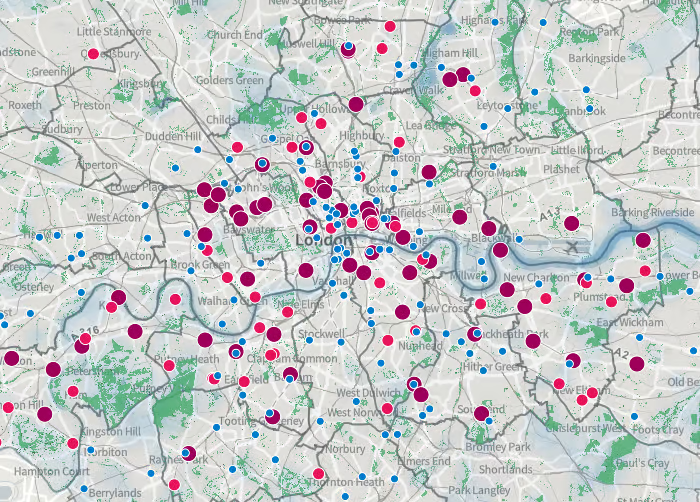
London’s coolest places revealed: Interactive map shows where to escape searing 40C heat


-

 Fashion6 days ago
Loro Piana Fall 2026 Enters Houston’s Art Scene
-

 Fashion4 days ago
Weekend Open Thread: Nutriplenish Leave-In Conditioner
-
 Sports6 days ago
2026 Genesis Scottish Open Thursday TV coverage: Round 1
-

 Sports5 days ago
Super Eagles star Moses Simon opens up on Liverpool transfer regret
-

 Tech6 days ago
Character.AI enters the microdrama arena with its own productions, but there’s a twist
-

 News Videos11 hours ago
XRP BOMBSHELL… XRP OMBOARDED FOR TRANSACTIONS!!!
-

 Tech1 day ago
Get Your ESP32 Sunny Side Up With This Solar Dev Board
-

 Tech10 hours ago
Dark Secrets Emerge When Jailbreaking LLMs
-

 News Videos6 days ago
Crypto Just Entered Its Most Important 6-Month Candle (Could Decide Everything!)
-
 NewsBeat6 days ago
Major update after Huntingdon train attack as man enters plea
-

 News Videos2 days ago
how to make coin bank box with cardboard #scienceproject #money #diy #shorts
-

 Sports7 days ago
39-year-old Djokovic wins five-hour thriller to enter Wimbledon semis | Other Sports News
-

 Tech6 days ago
Level Infinite Launches Gangstar Mirage City in India with Pre-Registrations
-
 Tech1 day ago
Cloudflare Precursor Watches Your Mouse and Keyboard To Decide If You Are Human
-

 Tech6 days ago
Entra passkey enrollment vishing targets Microsoft 365 users
-
 Crypto World6 days ago
DeFi Dashboard Zapper to Shut Down After 7 Years
-

 Crypto World6 days ago
Mark Cuban-Backed DeFi Dashboard Zapper Shuts Down After 7 Years
-

 Tech6 days ago
Claude’s New Reflect Dashboard Wants To Help You Log Off Of Claude
-

 Crypto World7 days ago
Microsoft Cuts AI Bill by Replacing OpenAI and Anthropic in Software Products
-

 Crypto World6 days ago
Fed minutes June 2026: officials split on rates
You must be logged in to post a comment Login