

Crypto World
Pi Network Price Predictions for This Week as PI Surges 10% in 24 Hours (July 15)

PI crashed 40% this week after a massive sell-off that drove it to consecutive all-time lows. However, it has rocketed by 10% since those lows, begging the question of whether the bottom is in.
PI Network (PI) Price Predictions: Analysis
Key support levels: $0.07
Key resistance levels: $0.10, $0.13, $0.16
PI Crashed to $0.07
PI just had one of the worst weeks in 2026 after the price lost support at $0.10. With this level turned into resistance, sellers rushed for the exits and sent the price into a nose-dive to $0.07, which became its latest record low.
With confidence gone, buyers had vanished. For example, in the past 10 days, only one day closed in the green. This shows that the sentiment is extremely bearish and the downtrend has entered a new phase where a bottom could be found much quicker.
More positive news came in the past several hours, with PI finally rebounding to $0.08 as of press time. However, it remains to be seen whether this is another dead-cat bounce.
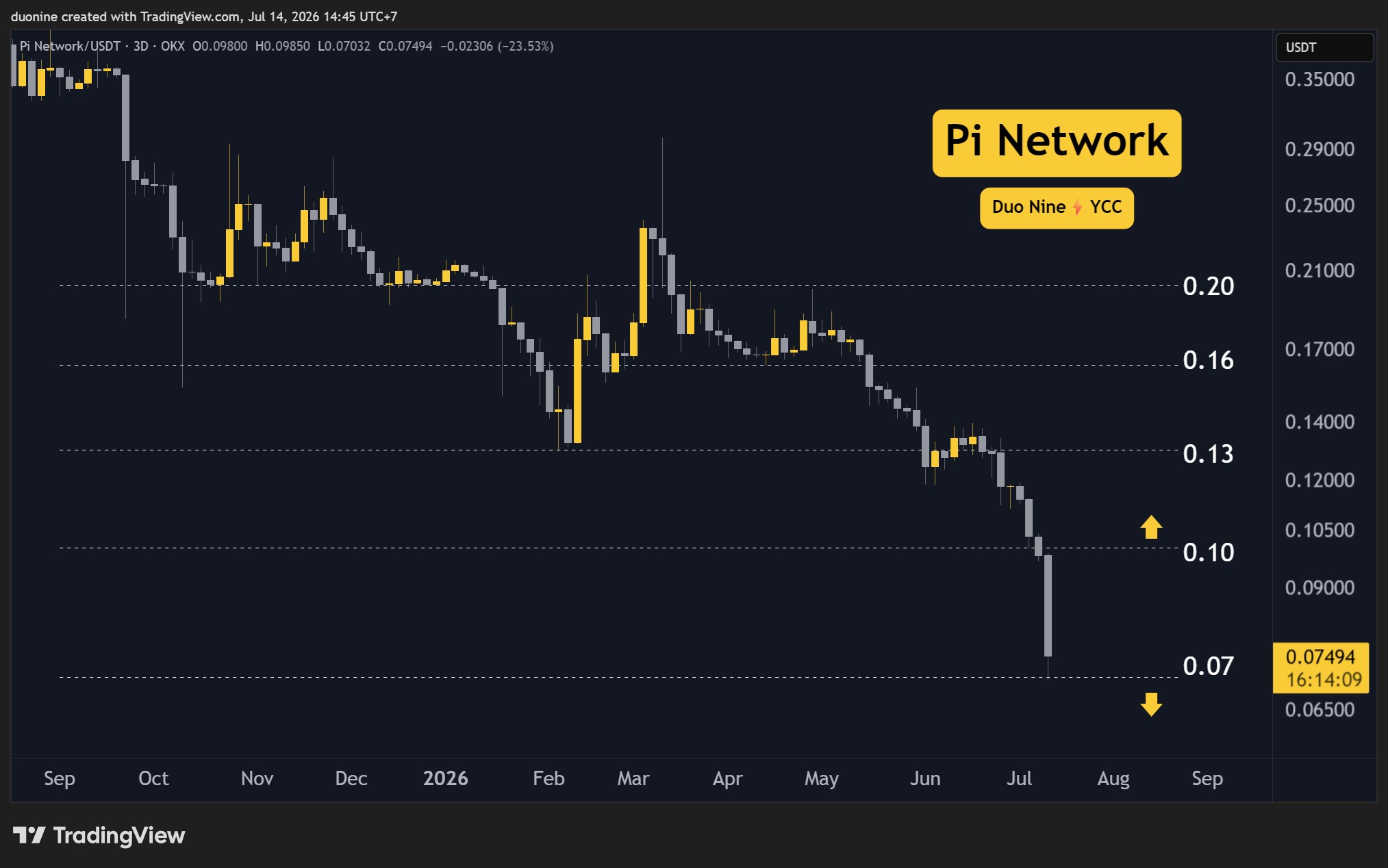
Sell-Side Volume Exploded
As soon as the support at $0.10 was lost, sell volume began to pick up. This only made things worse and likely led to cascade liquidations that put even more pressure on the falling price.
While the sell pressure has decreased compared to yesterday, the day is not over, and this could still change. The price held above $0.07 and bounced to $0.08, but this could very well be just a temporary pause before new lows.

Momentum Indicators Are at Extremes
Due to heavy selling pressure, the momentum indicators have reached extreme levels. For example, the daily RSI is at 12 points, a level never seen before for this cryptocurrency. Extremes are also the place where bottoms are found.
Hopefully, this price action will bring about an end to the downtrend and allow PI to consolidate and confirm a bottom. If the support at $0.07 won’t hold, then buyers will likely retreat to $0.06 or even $0.05. The current resistance is at $0.10.

The post Pi Network Price Predictions for This Week as PI Surges 10% in 24 Hours (July 15) appeared first on CryptoPotato.



The U.K. plans to issue a digital sovereign bond by early 2027, becoming the first of the seven leading industrialized nations to place government debt on a distributed-ledger infrastructure.
Chancellor Rachel Reeves announced the timeline in her annual Mansion House speech to industry leaders. The government plans further issuance after the initial sale.
The Digital Gilt Instrument, known as DIGIT, will be a sterling-denominated government security issued on HSBC’s Orion platform and will operate inside the Bank of England and Financial Conduct Authority’s Digital Securities Sandbox.
The Treasury announced the pilot in 2024 to test whether blockchain infrastructure could reduce settlement times, reconciliation work and operating costs. HSBC was appointed to run the platform in February, having issued over $3.5 billion in digital bonds through its Orion blockchain.
Speaking at the same event, Bank of England Governor Andrew Bailey said the central bank will work to make DIGIT eligible as collateral in its market operations. That could support tokenized repo and allow banks to use the bond in central bank funding transactions.
The Treasury has not disclosed the bond’s size, maturity, coupon, investor eligibility or settlement asset. The initial sale will sit outside the government’s conventional gilt-financing program.
June was a month of contrasts for Zoomex. While broader crypto markets absorbed one of the sharpest macro shocks of the year, the platform kept shipping, a full Prediction Market launch, an expanded World Cup campaign calendar, a run of tokenized equity products, and a five part charity initiative built around its Formula 1 and football partnerships. The month proved that infrastructure discipline matters most precisely when the market gets loud.
Market Overview: June 2026
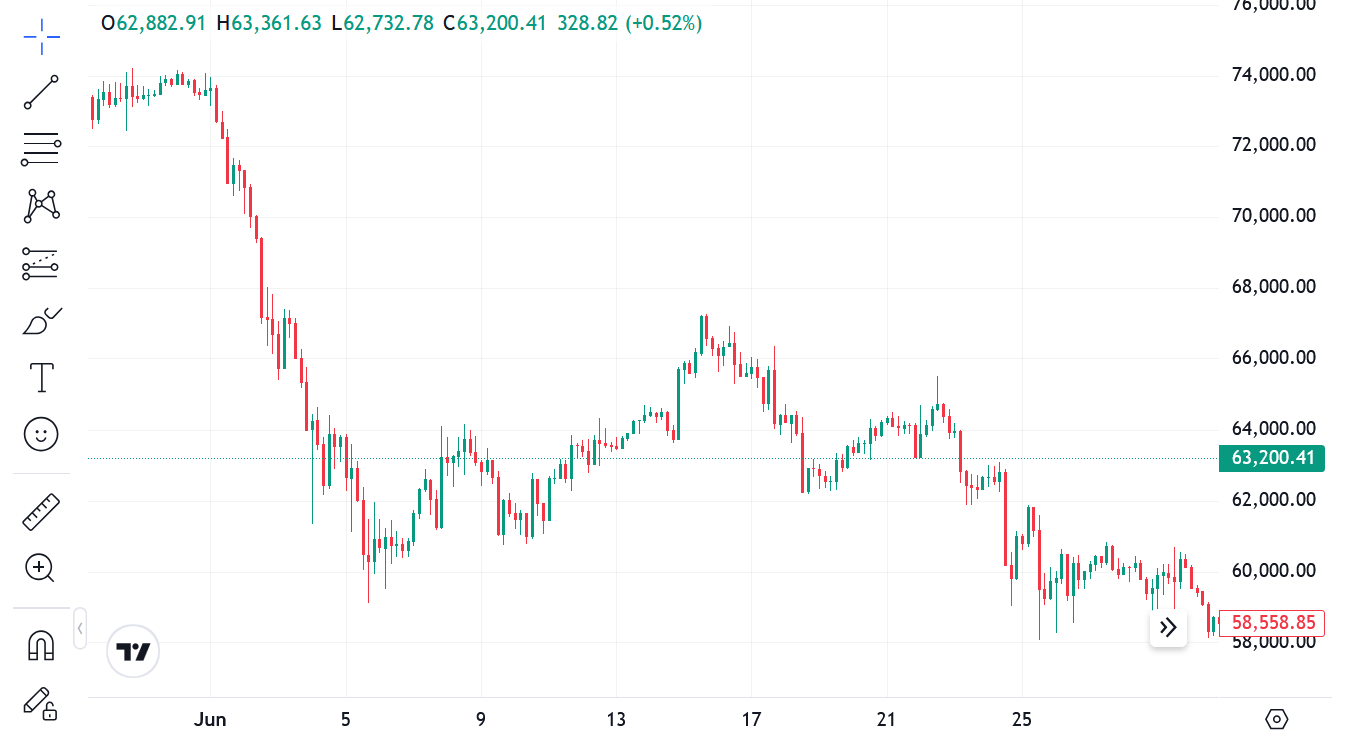
June opened with Bitcoin near $73,600 and closed down roughly 18% for the month, one of the worst monthly candles of the year.

Source: Coinmarketcap
The slide started early, a surprise Strategy sell off of 32 BTC on June 3 rattled leveraged longs, and by June 5, Bitcoin had broken below $62,000, triggering roughly $1.5 billion in liquidations in a single day. U.S. spot Bitcoin ETFs bled about $2.7 billion that same week, pushing 2026 year to date net outflows past $3.1 billion, as institutional capital rotated hard toward AI and semiconductor names instead.

The real inflection point came on June 17, when new Fed Chair Kevin Warsh held his first FOMC meeting. The rate held at 3.50% to 3.75% was fully priced in, but Warsh’s decision to abandon forward guidance and the dot plot’s jump to a 3.8% median year end projection, up from 3.4% in March, caught markets off guard. The hawkish surprise wiped out roughly $2 trillion across stocks, gold, silver, and Bitcoin within minutes, and the Crypto Fear & Greed Index dropped into “Extreme Fear,” touching a low of 13.

Source: Coinmarketcap
Bitcoin spent the rest of the month consolidating in the high $50,000s to mid $60,000s range, closing near $58,500 on June 30, more than $48,000 below where it stood a year earlier. Ethereum tracked the same weakness, sliding toward the $1,700 to $1,750 zone around the FOMC decision.

Source: Coinmarketcap
Against that backdrop, capital rotation became the defining theme of the month rather than a single price level. AI and semiconductor stocks surged roughly 170% over the same stretch that ETFs saw outflows, a divergence sharp enough that a single session saw the Philadelphia Semiconductor Index rise 5.9% as Bitcoin fell around 4%.

For traders who wanted exposure to both stories without leaving a single account, that gap became the argument for the month.
Zoomex by the Numbers
Zoomex’s core value proposition, sub-10ms execution latency, deep liquidity, and a minimalist interface, held up through a month defined by whipsaw price action rather than steady trends. The platform continues to serve 3 million plus registered users across 35+ regions, with a catalogue that has grown past 700 trading pairs spanning Perpetual USDT, Inverse Perpetuals, Spot, and now tokenized equities. Order book depth and dual liquidity pool architecture, combining internal liquidity with aggregated external market depth, remained the platform’s answer to the kind of volatility that broke matching engines elsewhere during comparable stress events.
The month’s real infrastructure test arrived on June 17, when the FOMC’s hawkish surprise triggered a wave of liquidations across the derivatives market. Platforms with thin order books or single source liquidity typically see slippage spike hardest in exactly these windows. Zoomex’s architecture is built for that scenario specifically, minimal spread degradation during high volatility, institutional grade uptime, and a fee and reward structure that keeps user capital moving rather than parked. June’s rotation toward tokenized stocks, discussed below, only reinforced why that infrastructure choice matters when traders are actively moving capital between asset classes inside a single account.
What We Shipped in June
Zoomex Prediction Market: Officially Live

On June 4, Zoomex officially launched its Prediction Market, timed almost exactly with the World Cup kickoff. The product lets users take a position on crypto price movements, sports outcomes, and trending global events using crypto, and its standout feature is flexibility: unlike a traditional pre-match bet, users can sell, increase, reduce, or reverse their prediction shares as a match unfolds, turning static predictions into an in-play trading experience shaped by goals, cards, substitutions, and shifting market sentiment.
Zoomex announce Global Stock-Related Assets Land on Zoomex Perpetual Contracts

Zoomex has officially launched 50 stock-related perpetual contracts covering major global assets across tech, AI, crypto-concepts, and ETFs, offering leverage options up to 20x. While registration for the previous 50% trading fee rebate campaign has closed (fully concluding on June 26, 2026), traders are encouraged to sign up for the newly launched, limited-time campaign to trade these stock perpetuals with zero fees.
Stablecoins Are the New Payment Rails: What It Means for Traders

Stablecoins have officially evolved into mainstream financial infrastructure, with on-chain settlement volumes surpassing $33 trillion and major networks like Visa, Stripe, and PayPal natively integrating them into production. Driven by regulatory clarity from the US GENIUS Act and EU’s MiCA, stablecoins like USDT and USDC provide instant, low-cost cross-border efficiency that completely bypasses legacy banking friction.
For traders, Web3-native platforms like Zoomex capitalize on this shift by operating entirely within a stablecoin-denominated environment, offering 24/7 derivatives trading with deeper liquidity, tighter spreads, and instant capital redeployment. Ultimately, the accelerating velocity of stablecoins marks a permanent upgrade to global payment rails, rendering traditional fiat constraints obsolete.
Zoomex X Space With Ollie Bearman, WallStreetBets, and Nuseir Yassin

The Zoomex X Spaces session, moderated by Fernando Lillo, united Haas F1 driver Ollie Bearman, crypto commentator WallStreetBets, and creator Nuseir Yassin to explore the shared dynamics of high-stakes environments, rapid decision-making, and the psychological traps of success. Bearman highlighted that while rigorous preparation sets a baseline, long-term accumulated instinct is what truly allows someone to navigate unpredictable challenges on the track.
WallStreetBets and Yassin built on this by reframing intense pressure as a powerful drug for growth rather than a symptom to manage, advocating for public accountability and leveraging AI rather than resisting it. Crucially, the speakers warned that success can insulate individuals from reality, creating a dangerous feedback loop—meaning that maintaining ruthless self-discipline and keeping honest people close is vital. Blending these insights with corporate innovation, the session concluded with the announcement of Zoomex’s new prediction market partnership with Polymarket, signaling an expansion into global sports and macroeconomic forecasting.
Zoomex: The Prediction Market

Zoomex held Episode 4 of its panel series, moderated by Fernando Lillo, which took place on June 11th at 15:00 UTC. The session brought together speakers @Teo Mercer, @Xia, and @Moon1lightSt to discuss pressing crypto and sports trends, specifically focusing on the prediction market, the World Cup, and the recent Bitcoin dip. Highlighted by a 500 USDT incentive, the event put a special spotlight on @Moon1lightSt’s insights regarding football dynamics and market forecasting.
Zoomex announce MCP Server

Zoomex has officially launched its new Zoomex MCP Server, allowing users to connect their AI assistants directly to the platform for a more streamlined trading experience. Through a single, unified interface, traders can now enjoy faster access to real-time market data, asset overviews, live positions, and order histories. Aimed at helping users trade smarter with highly organized information, this integration marks the beginning of a broader rollout of advanced AI capabilities promised by Zoomex.
World Cup Prediction Market Campaign

Building directly on the Prediction Market launch, Zoomex opened its dedicated World Cup Prediction Market Campaign on June 16, running through July 18. Users complete tasks to unlock Lucky Spin draws for rewards including World Cup final and semi-final tickets, gift boxes, airdrop rewards, margin deduction coupons, and futures trial funds, extending crypto’s role in fan engagement well beyond simple giveaways.
Zoomex World Cup Pass Challenge

Zoomex hosted its World Cup Pass Challenge, an interactive promotion where users can predict, trade, and climb the leaderboard to win tickets to a FIFA World Cup match. The platform highlighted that the first group of winners and partners, including representatives from Discover Crypto – has already arrived in Kansas to witness football stars Lionel Messi and Emiliano “Dibu” Martínez play for Argentina. For traders looking to secure their own spots, Zoomex emphasized that the event window remains open, offering an ongoing opportunity to join the challenge and win tickets.
Zoomex X Space Recap With Djibril Cissé and the World Cup Trading Panel

Zoomex hosted the first episode of its World Cup Edition X Space as part of the ZoomX World Cup Impact Pledge, bringing together Champions League winner Djibril Cissé and four crypto traders: Dieguito Charts, Bitsofwealth, Mega, and 5.0 Trading. Fernando Aranda hosted the session, which ran across pressure management, football analysis, career philosophy, and the kind of crypto-to-football comparisons that only hold together when neither side takes them too seriously.
Zoomex Stocks
Amidst a notable shift of institutional capital from crypto to artificial intelligence, Zoomex has launched Zoomex Stocks to give traders seamless, 24/7 access to both asset classes from a single account. The launch arrives as U.S. spot Bitcoin ETFs faced $2.7 billion in weekly outflows in early June 2026, while AI and semiconductor stocks surged.
Available under the platform’s Spot section, the product features twelve major tokenized U.S. equities and ETFs (including NVDAx, TSLAx, and QQQx) powered 1:1 by MiFID II-compliant real assets via xStocks. By utilizing the existing Unified Trading Account (UTA), crypto-native traders can instantly rotate their positions into high-momentum equities using USDT, bypassing traditional brokerage barriers, fiat rails, and rigid market hours with a flat 0.50% fee and near-instant on-chain settlement.
Zoomex Monthly On-Chain Report: May 2026

The Zoomex May 2026 Monthly On-Chain Report highlights the platform’s commitment to strict financial transparency, backed by independently verifiable metrics via DefiLlama’s CEX Transparency module. Navigating a high-volume, highly volatile market where Bitcoin peaked near $111,000 before a 20% correction, Zoomex processed $168 billion in total combined volume for the month—a staggering 74% month-over-month growth driven by active retail flows shifting away from traditional crypto ETPs.
Operating with sub-10ms matching latency and a low 0.03% slippage, the exchange reported $23.99 million in verified multi-chain reserves alongside a separate $50 million insurance fund. Furthermore, the report emphasizes Zoomex’s robust spot market structure (dominated by BTC/USDT and an incredibly deep USDC/USDT stablecoin corridor), steady liquidity in its 24/7 macro-hedging XAUT/USDT pair, and the successful traction of ZoomexStocks, a unified feature allowing seamless, crypto-native exposure to major traditional equities like Tesla, NVIDIA, and Apple.
Zoomex X Space With Didi Hamann and the World Cup Trading Panel

Zoomex hosted the second episode of its World Cup Edition X Space as part of the Zoomex World Cup Impact Pledge, bringing together Champions League winner Didi Hamann and three traders: Mario from Forex Trading & Investing, Crank, and Joseph. Fernando Aranda hosted the session, which ran across World Cup analysis, the German squad debate, career philosophy, and the kind of crypto-to-football comparisons that only hold together when neither side takes them too seriously.
Conclusion
June was the month the macro backdrop finally caught up with crypto, and Zoomex’s response was to keep building rather than retreat. A live Prediction Market timed to the World Cup, a full tokenized equities suite answering the AI rotation directly, two World Cup campaigns running in parallel, and a five part charity series pairing football culture with real donations. Not a pause. Continued output through the sharpest drawdown of the year.
The macro numbers explain why that mattered: Bitcoin down roughly 18% for the month, $2 trillion wiped out across risk assets in minutes on June 17, and the Fear & Greed Index sitting in Extreme Fear for most of the back half of the month. Zoomex’s sub-10ms execution infrastructure and dual liquidity pool architecture were built for exactly this kind of stress, and the platform’s regulatory stack, FINTRAC, FinCEN, NFA, AUSTRAC, FATF Travel Rule, stayed unchanged and fully active through it.
No platform token. No VC entanglements. No user funds at risk.
June confirmed what May suggested: reliability compounds precisely when markets don’t cooperate, and the platforms still shipping through a hawkish Fed surprise and an $18 billion monthly drawdown are the ones building for the World Cup final and beyond, not just for the next bull run.
The post Zoomex Monthly Transparency Report: June 2026 appeared first on BeInCrypto.
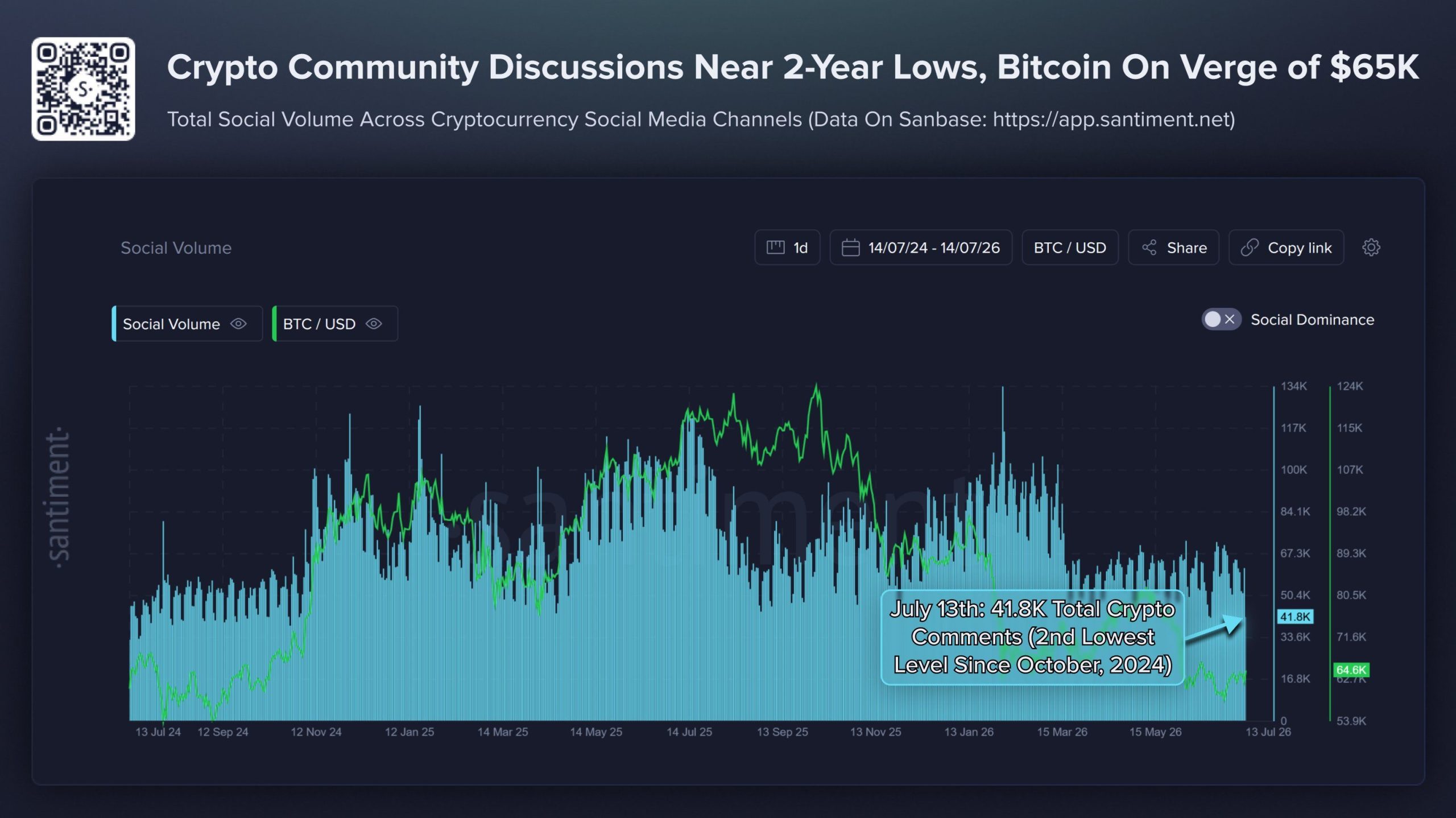
Crypto social volume dropped to 41,800 daily comments in July, its second-lowest reading since October 2024, as market chatter thinned across major platforms.
Trading activity has cooled alongside the silence. Top-cap crypto volumes are fading toward their weakest average levels in two years, pointing to softer spot demand and cautious positioning.
Why Crypto Interest Has Faded
The slowdown in chatter is broad. Comments have thinned across X, Reddit, Telegram, and other channels, according to Santiment. Bitcoin (BTC) meanwhile holds in the low-to-mid $60,000s.
Follow us on X to get the latest news as it happens

The decline extends to trading. Santiment also flagged that top-cap trading volumes have been sliding since July 2024.
Trading activity has dropped near its weakest average levels in two years, a sign that traders have stopped rotating into riskier bets.
Broader market data confirms the trend. Centralized exchange spot volume fell to $3 trillion in the second quarter. That marked the weakest three-month stretch in two years, per CryptoRank.
Several forces sit behind the quiet. Macro uncertainty, geopolitical tensions, swings in Bitcoin exchange-traded fund (ETF) flows, and cautious risk appetite have kept many traders sidelined.
Crypto Social Volume and Trading Both Near 2-Year Lows: What Now
Low activity cuts in both directions. Thin liquidity can stall rallies when demand dries up. It can also let modest buying move prices faster once sellers are exhausted.
Santiment also argued that fading interest is an underrated form of fear, uncertainty, and doubt (FUD).
“When people stop arguing, posting, and chasing every candle, markets can become easier for large buyers to move because fewer retail traders are actively crowding the trade,” it added.
Notably, large holders appear to be positioning. Santiment tracked wallets holding 10-10,000 BTC, a whale and shark tier. That group added about 11,000 coins over the past week. The firm framed the accumulation as a shift by stronger hands.
“Stronger hands are absorbing supply before the crowd realizes momentum has changed,” it said.
The firm added that a tired, doubtful market has historically favored patient whales. It cautioned that no rebound is certain, yet past cycles have rewarded large holders who positioned before retail noticed the shift.
Price signals point in the same direction but remain unconfirmed. On-chain data shows Bitcoin in a bottoming process, though a durable recovery remains elusive.
The tension is clear. Whales are buying quietly while attention sits near multi-year lows, but no confirmed floor has formed. Whether the next demand shift meets thin resistance or fresh sellers may set Bitcoin’s near-term path.
Subscribe to our YouTube channel to watch leaders and journalists provide expert insights
The post What Washed-Out Crypto Sentiment Means for Bitcoin’s Next Move appeared first on BeInCrypto.
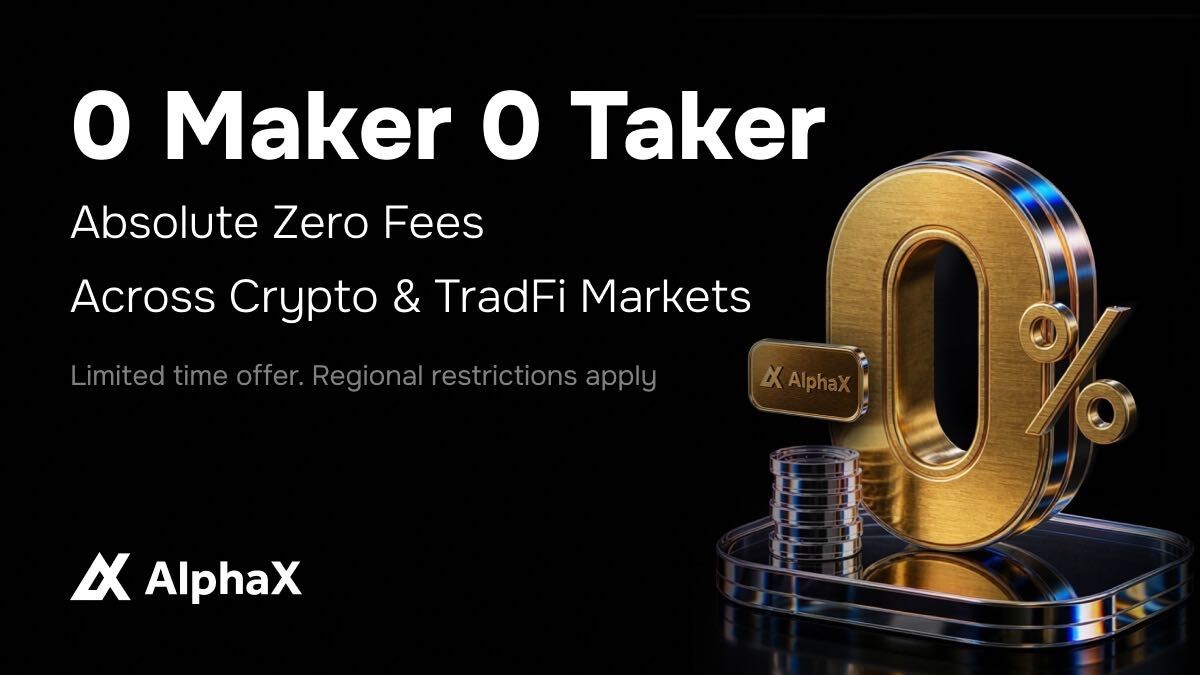

AlphaX, a high-performance on-chain trading exchange committed to delivering a simplified, efficient, and reliable trading experience, today unveiled the global launch of its Zero-Fee Trading Initiative, extending fee-free trading across TradFi perpetual futures, crypto spot, and crypto futures markets.
This limited-time zero-fee framework enables all market makers and takers in eligible regions to trade a range of financial instruments without transaction fees. TradFi contracts are offered as USDT-margined perpetual futures, allowing traders to gain exposure to global assets while maintaining capital flexibility.
Built on a dual-core architecture, AlphaX combines the execution speed associated with centralized exchanges with the security of decentralized infrastructure. Users can create an account with only an email address, without KYC requirements or seed phrases, and begin trading in as little as 10 seconds.
Alongside the zero-fee initiative, AlphaX is introducing Auto Earn, an integrated yield feature designed to improve capital efficiency. Users can earn yields of up to 5% APY on USDT without transferring assets into separate products or committing to lock-up periods. Interest continues to accrue even when funds are allocated to pending limit orders or used as futures margin, enabling trading capital to remain productive while supporting active trading strategies.
To mark the global rollout, AlphaX is launching its $20,000 Daily Trading Competition, where users who generate at least 1 USDT in daily trading profit are automatically entered into the daily leaderboard and eligible to share a 20,000 USDT prize pool.
About AlphaX
AlphaX is a high performance on-chain cryptocurrency exchange committed to delivering a simplified, efficient and reliable trading experience. Embedding the principle of “Alpha towards Excellence” into all aspects of the platform, AlphaX is dedicated to building a transparent and sustainable on-chain trading platform through efficiency experience and all-round security measures, unlocking more freedom in traders’ financial lives. By combining acute market insights with a minimalist interaction philosophy, AlphaX transforms complex on-chain derivatives into accessible opportunities for the global trading community.
The post AlphaX Rolls Out Global Zero-Fee Trading Initiative Across TradFi and Crypto Markets appeared first on BeInCrypto.
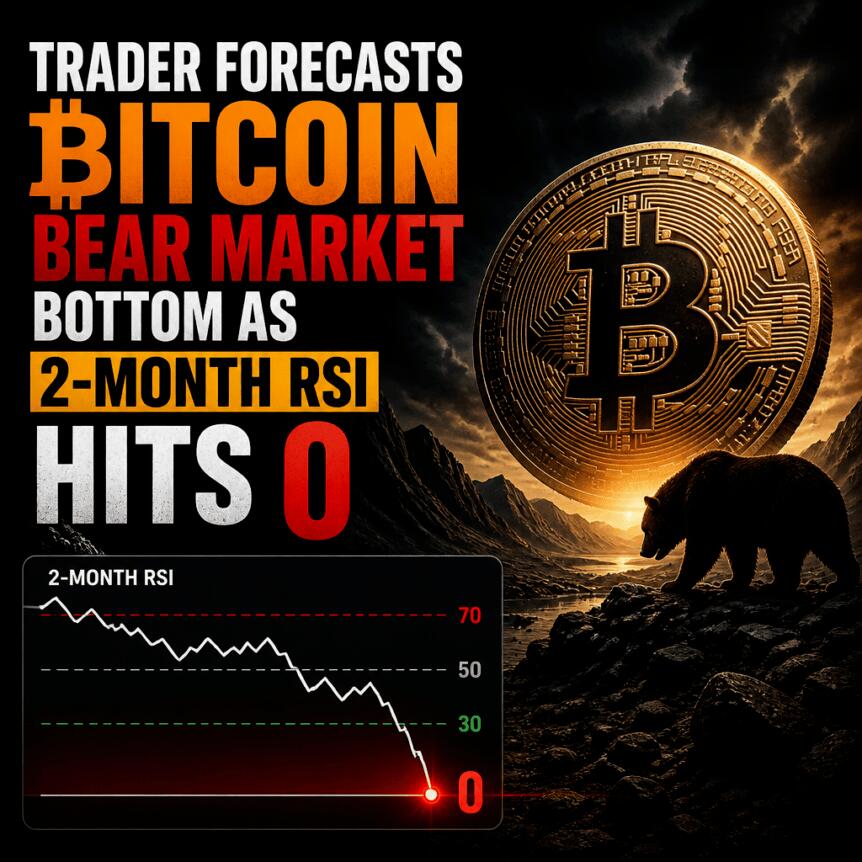
Bitcoin’s path out of its current bear-market phase is once again being framed by a familiar set of momentum signals: stochastic RSI “bottoming” behavior that traders say has appeared at major turnarounds in past cycles. This time, the focus is on a two-month stochastic RSI indicator reaching (or revisiting) zero—an event one analyst argues has repeatedly marked the end of drawdowns.
Separately, other market participants are pointing to RSI divergences and extreme oversold readings earlier this year, suggesting the market may already be transitioning. However, as always with oscillator-based forecasts, the key question for traders is whether these signals play out with the same consistency as in earlier bear markets.
Key takeaways
- Trader Max Crypto argues that a two-month stochastic RSI “drop to 0” has historically lined up with BTC bear-market bottoms in 2014, 2018, and 2022.
- The same analyst says the bear market is likely over once two-month stoch RSI reaches zero again.
- TradingView data indicates two-month stochastic RSI has recently fallen into sub-30 “oversold” territory, with the current reading cited as 4.81.
- Other traders have highlighted RSI-related setups, including notes that extreme daily RSI readings have previously failed to break lower before rebounds.
- BTC’s move back above $64,000 this month is being linked—by market commentators—to bullish RSI divergences across time frames.
Why two-month stochastic RSI has become the latest “cycle” checklist
In an X post over the weekend, trader Max Crypto made a specific forecast for the end of the 2026 bear market based on stochastic relative strength index (stoch RSI). The core idea is tied to the behavior of a two-month stochastic RSI reading when it hits a new swing low and later crosses in a bullish direction.
Stoch RSI is built from RSI, but it tends to react more directly to recent momentum shifts. In Max Crypto’s view, that responsiveness is exactly why the indicator has served as an effective timing tool when markets have approached major bottoms.
“Every time the 2M Stoch RSI had a bullish cross and dropped to 0, $BTC bottomed,” Max Crypto wrote, adding that this pattern occurred in 2014, 2018, and 2022—and, in his words, “will happen again.”
What matters for readers is the conditional nature of the signal: the claim is not that stochastic RSI alone automatically predicts a bottom, but that the combination of a bullish cross and a subsequent drop to zero has marked turning points in earlier bear-market periods.
Where the indicator stands now: oversold, but not at zero
TradingView data referenced in the article shows that two-month stoch RSI has been sliding into the sub-30 “oversold” zone during March, with a current value of 4.81. The same reference notes that the levels seen recently were last observed just over three years ago—an observation meant to highlight rarity and potential importance rather than to guarantee an outcome.
In other words, the indicator appears to be near where market participants previously became attentive to “bottoming” behavior, but it has not yet reached the specific trigger point Max Crypto associates with bear-market completion.
As a result, traders watching this setup are likely to interpret any further decline toward zero as progress toward the forecast timeline, while a rebound before reaching zero could either reflect an early bottom or invalidate the clean version of the pattern.
RSI divergences and extreme oversold readings add a second layer of timing
Beyond stochastic RSI, the article also points to other RSI-focused analysis that has circulated among traders. The recurring theme is divergence—when price action and oscillator behavior fail to align in the expected bearish way—alongside signals of unusually weak momentum earlier in the year.
One example cited is a trader and investor account (“BitcoinHyper”) highlighting a bullish divergence setup against the S&P 500. While the exact decision framework is not detailed in the provided text, the implication is that correlation-linked weakness may have been less damaging than it looked on price alone.
Another thread comes from trader Osemka, who discussed an especially low daily RSI reading. According to the article, at the start of June daily RSI dropped to around 15—an extreme oversold level that Osemka later described as one of a small set of “extremely powerful selling events.” Osemka’s key point was that there has been at least one case where an RSI oversold extreme did not break lower; instead, price swept the low and then turned.
Osemka connected this idea to historical behavior, noting that such an outcome occurred at the end of an accumulation range in 2015. He then suggested that the present situation is similar in the sense that the market has “only swept the low” on a comparable powerful move down.
This is a useful nuance for readers: oscillator extremes can sometimes be followed by continuation lower, but there are also documented instances where the market uses the low as a liquidity grab before reversing. The current debate among traders is essentially whether BTC is repeating the latter type of bear-market ending behavior.
From $64,000 to the bigger question: are these signals converging?
The article ties these RSI narratives together with BTC’s return above $64,000 this month. It states that the move coincided with bullish RSI divergences across multiple time frames—an alignment that, if it continues to hold, can strengthen the argument that downside momentum is fading.
Importantly, the article does not frame the recovery as a guarantee. Oscillator-based “bottom” calls can be directionally correct but timing can slip, especially if broader risk sentiment or macro conditions remain unstable. That said, the convergence of several independent oscillator themes—two-month stochastic RSI approaching key lows, and RSI divergences appearing across time frames—may be why so many traders are treating this period as decision-heavy.
Earlier commentary referenced in the article also shows how widely these comparisons have been circulating this year. In April, another trader (“Quantum Ascend”) reportedly described BTC’s price behavior as “playing out nearly perfectly” relative to the 2022 bear market, reflecting how closely many participants are watching for structural repetition.
What to watch next
For now, the most actionable watch item from Max Crypto’s thesis is whether two-month stochastic RSI actually reaches zero again after entering oversold territory; if it does, the historical parallel implied by the indicator may gain credibility. Traders should also monitor whether RSI divergences continue to persist across higher and lower time frames—because a late breakdown would be the clearest sign that the market is not repeating past bear-market patterns.
Crypto World
CT3 Announces Dedicated Storage Contracts to Expand Decentralized Storage Infrastructure

[PRESS RELEASE – London, United Kingdom, July 15th, 2026]
CT3 today announced the transition of its decentralized storage infrastructure to a dedicated Storage Contracts model designed to support continued platform growth, improve infrastructure scalability, and expand storage capacity as demand increases.
The transition follows rapid growth across the CT3 ecosystem, with more than 180,000 unique users having used the platform and more than 500,000 uploads completed. Each upload is linked to an NFT access key, allowing platform activity and network usage to be independently verified on-chain.
Continued growth in demand for ct-3.cloud services has increased pressure on the existing infrastructure. Processing all new uploads through a single main collection and one smart contract may reduce scaling flexibility and make storage capacity more difficult to manage as network activity expands.
Under the new architecture, new uploads will be distributed across dedicated Storage Contracts rather than a single main contract. Each Storage Contract is linked to a fixed amount of storage capacity and operates as an independent infrastructure segment with its own capacity, utilization level, and on-chain statistics.
The new model is intended to distribute workloads across multiple smart contracts, improve the transparency and measurement of resource utilization, and support the deployment of additional storage capacity as demand grows. Participants may finance the deployment of new Storage Contracts and the addition of storage capacity. The allocated capacity is used to store files uploaded through ct-3.cloud, while the resulting profit is shared between CT3 and the participant who financed the infrastructure expansion.
Infrastructure Segmentation
Previously, CT3 keys were issued primarily through the main collection and a single contract flow. As the platform expanded, this model became less flexible for handling different categories of data.
Storage Contracts divide the infrastructure into separate segments. Each segment:
- operates through its own smart contract;
- is linked to a specific amount of storage capacity;
- can serve a particular category of files;
- allows capacity utilization and workload to be measured independently;
- reduces pressure on the main NFT key issuance process.
This separation makes the infrastructure more resilient and allows individual areas of the platform to scale without rebuilding the entire system.
How the Allocated Storage Capacity is Used
Each Storage Contract is linked to a defined amount of capacity within the CT3 network. Once activated, the corresponding storage space is supplied by network nodes and used to store data uploaded through ct-3.cloud.
The allocated capacity may be used for:
- standard user files;
- corporate archives;
- automatic backups;
- long-term datasets;
- future CT3 products and applications.
Larger contracts can accommodate heavier files and more substantial flows of corporate or backup data. This allows the network to direct workloads to infrastructure segments with sufficient available capacity.
Storage Contract Economics
The commercial model behind Storage Contracts is based on the real use of CT3 infrastructure. The platform acquires storage capacity from node operators and provides it to ct-3.cloud customers at the market price of the storage service.
A participant finances the deployment of a new Storage Contract and the expansion of the network’s available capacity. Once launched, this capacity is used to store personal and corporate data, while the generated profit is distributed between the investor and CT3.
The financial performance of each contract depends on two main factors:
- the actual utilization of the allocated capacity;
- the margin between the cost of acquiring storage capacity and the price charged to end users.
Storage Contracts therefore allow participants to take part in the growth of CT3 infrastructure and potentially earn income linked to real demand for storage services. The more actively the allocated capacity is used, the greater the contract’s potential result.
On-chain transparency
The operation of each Storage Contract can be verified through the blockchain. Files stored within the allocated capacity are represented by NFT keys containing storage-related metadata.
The combined size of the files associated with these keys can be compared with the utilization figure displayed for the contract. Through the smart contract address, an investor can verify issued NFTs, collection activity, and the actual use of the capacity they helped finance.
This model makes it possible to independently verify:
- the number of keys created;
- the volume of stored data;
- utilization of the allocated capacity;
- activity within a specific Storage Contract;
- the relationship between infrastructure usage and profit generation.
For ct-3.cloud users, the experience remains unchanged: both existing and new NFT keys continue to be supported, and the transition to the new architecture requires no additional action.
About CT3
CT3 is developing a decentralized data storage infrastructure that combines independent nodes, the ct-3.cloud interface, NFT access keys, and blockchain verification.
Users upload files through ct-3.cloud, after which the data is distributed across network nodes. An NFT key is created for every stored object, confirming access rights and containing the relevant storage metadata.
Within this model, nodes provide physical storage capacity, CT3 manages data distribution and access, while individual and corporate users generate demand for storage services.
As the number of users and uploads increases, the network must continuously expand its available capacity. At certain times, demand growth may outpace the addition of new capacity from node operators. Storage Contracts allow CT3 to add new resources in a structured way and allocate them to specific areas of use.
The post CT3 Announces Dedicated Storage Contracts to Expand Decentralized Storage Infrastructure appeared first on CryptoPotato.
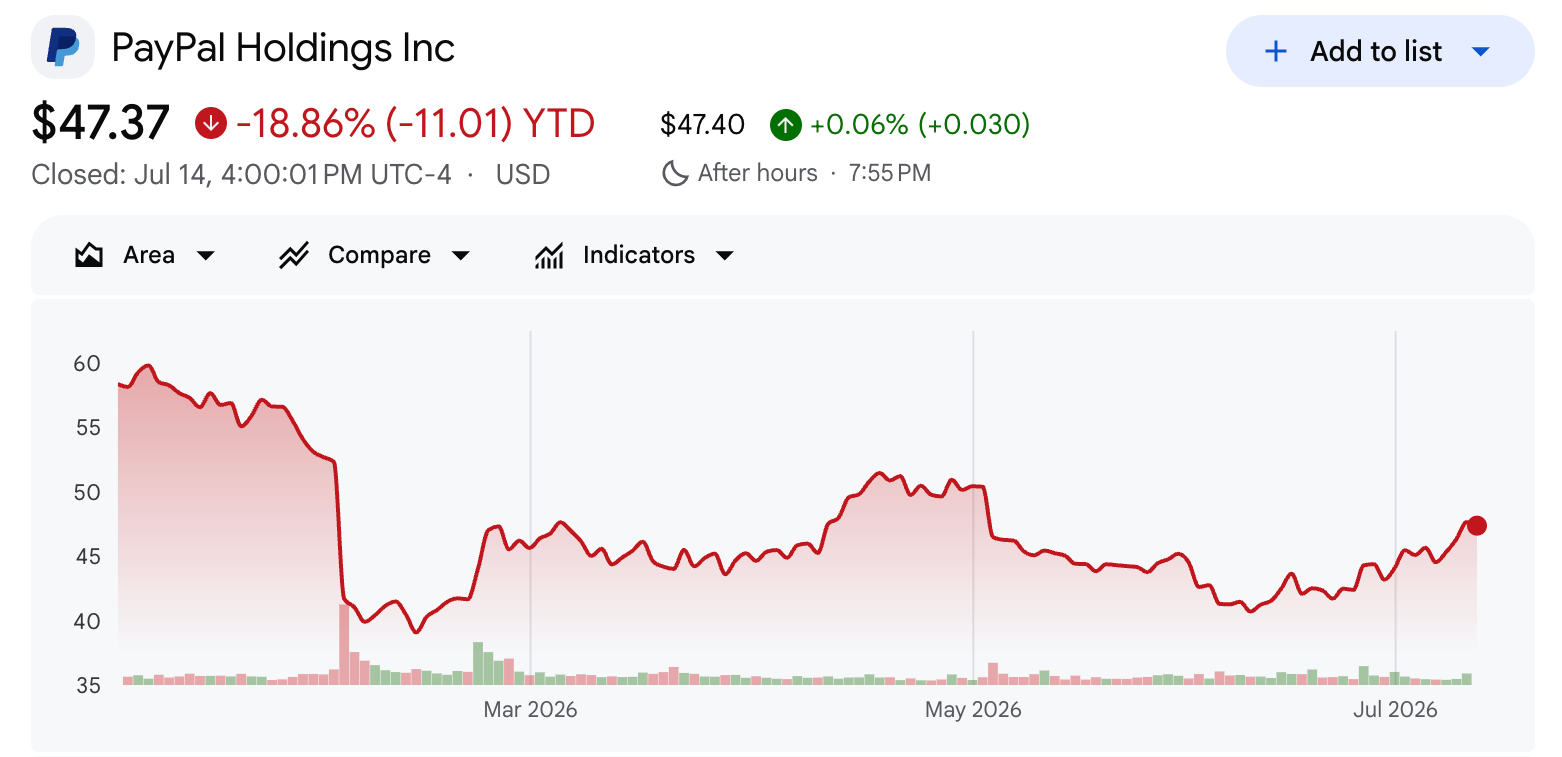
Stripe has teamed up with private equity firm Advent International to make a play for one of its oldest rivals, PayPal.
The two submitted a joint bid of $60.50 per share, a 28% premium to PayPal’s closing share price of $47.37 on Tuesday, which the company has so far left unanswered.

Why PayPal Became a Target
PayPal once led digital payments, but growth has slowed against rivals such as Apple Pay and Google Pay. Its market value peaked near $360 billion in 2021. That figure sank to about $36 billion this year, a 40% drop over 12 months.
Stripe and Advent submitted the offer earlier this month, following an initial approach in April, Reuters reported. The bid is backed by about $50 billion in committed bank financing. Under the proposal, the two buyers would hold equal stakes and keep PayPal intact rather than break it up.
The bid lands during a busy stretch for financial dealmaking. Global merger activity hit a record $2.8 trillion in the first half of 2026 and is projected to grow to $4 trillion this year.
Follow us on X to get the latest news as it happens
What a Combined Company Could Hold
PayPal has not responded yet. Stripe and Advent still hope to move talks forward within weeks, sources told Reuters.
A deal would bring together two large payment networks under a single owner. Stripe owns Bridge, a stablecoin infrastructure platform it bought for $1.1 billion in 2025. Bridge lets businesses issue their own dollar-backed tokens rather than running a consumer coin of its own.
PayPal brings the other half. Its PYUSD stablecoin already reaches everyday users, with a market cap of nearly $2.9 billion. Pairing Bridge’s issuance tools with PYUSD’s consumer base would give the combined firm both ends of the stablecoin stack.
There is no certainty that the approach leads to a deal. The coming weeks may show whether PayPal’s board engages.
Subscribe to our YouTube channel to watch leaders and journalists provide expert insights
The post PayPal Draws $53 Billion Takeover Bid From Stripe and Advent appeared first on BeInCrypto.
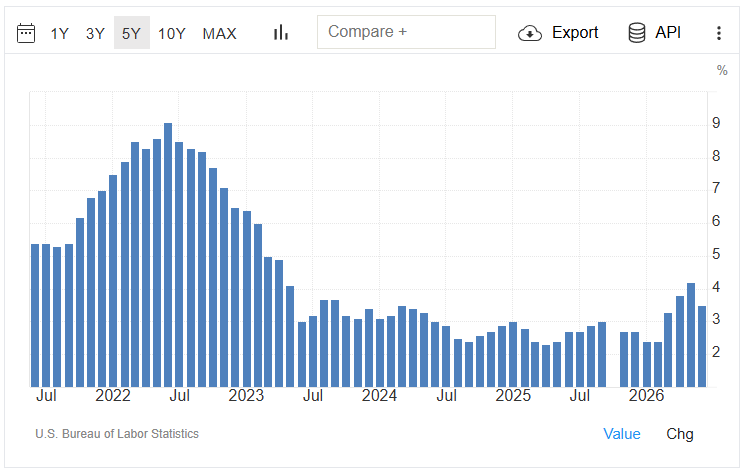
Federal Reserve Chair Kevin Warsh told Congress yesterday, July 14, that the central bank’s 2020 approach to managing inflation was a mistake, pledging a policy “regime change” as he prepares for a second day of testimony before the Senate.
Warsh added the Fed has no tolerance for persistently elevated inflation and vowed to restore the price stability mandate that the 2020 policy set aside.
What the 2020 Framework Actually Did
In 2020, under then-Chair Jerome Powell, the Fed adopted a policy called flexible average inflation targeting. Instead of treating 2% as a hard ceiling, the framework let inflation run moderately above that target for a stretch, as long as it had spent time running below target beforehand. The idea was to average price growth out over time rather than react to every short-term swing.

The framework had a second, less publicized goal. It also let the Fed tolerate a period of above-target inflation if doing so helped support employment, particularly for workers left behind in earlier recoveries. That employment-focused tradeoff is the piece of the policy Warsh singled out.
Why Warsh Calls It a Mistake
Warsh testified before the House Financial Services Committee that using inflation policy to manage employment outcomes falls outside what the Fed should be doing.
“That central bank wasn’t the first central bank to ask for a little more inflation and end up with a lot more. It was a mistake.”
Inflation has run above the Fed’s 2% mandate every year since 2021, and Warsh argues the 2020 framework gave the Fed cover to let it run hotter for longer than it should have. He noted the policy was already abandoned before he took over as chair two months ago, framing his job now as finishing the cleanup rather than starting it.
“The framework did not succeed in its objectives, and I am pleased that before my arrival, my predecessors took that and cast it aside.”
What Warsh Wants Instead
Warsh has not proposed a replacement framework in detail, but he has set up five internal task forces to rebuild how the Fed operates: its public communications, its technology, its balance sheet, the economic data it relies on, and the methodology it uses to measure inflation itself.
He described the effort as reform across five dimensions of monetary policy, with more detail expected as the task forces report back.
The message to Congress was that the Fed’s job is to bring inflation back to 2% without ambiguity or tradeoffs, not to manage it flexibly around other goals.
That stance follows his rate hike outlook preview published ahead of the hearing, and lands just as June inflation data came in cooler than expected, even as economists flagged AI-driven inflation risk tied to data center spending. That optimism comes alongside lower recession risk estimates that give the Fed more room to hold rates steady.
Warsh returns to Capitol Hill tomorrow, July 15, for bank earnings week testimony before the Senate Banking Committee, where lawmakers are likely to press him on how the task forces’ work will translate into an actual policy framework.
The post Kevin Warsh Calls Fed’s Flexible Inflation Framework a Mistake: What Happens Next? appeared first on BeInCrypto.
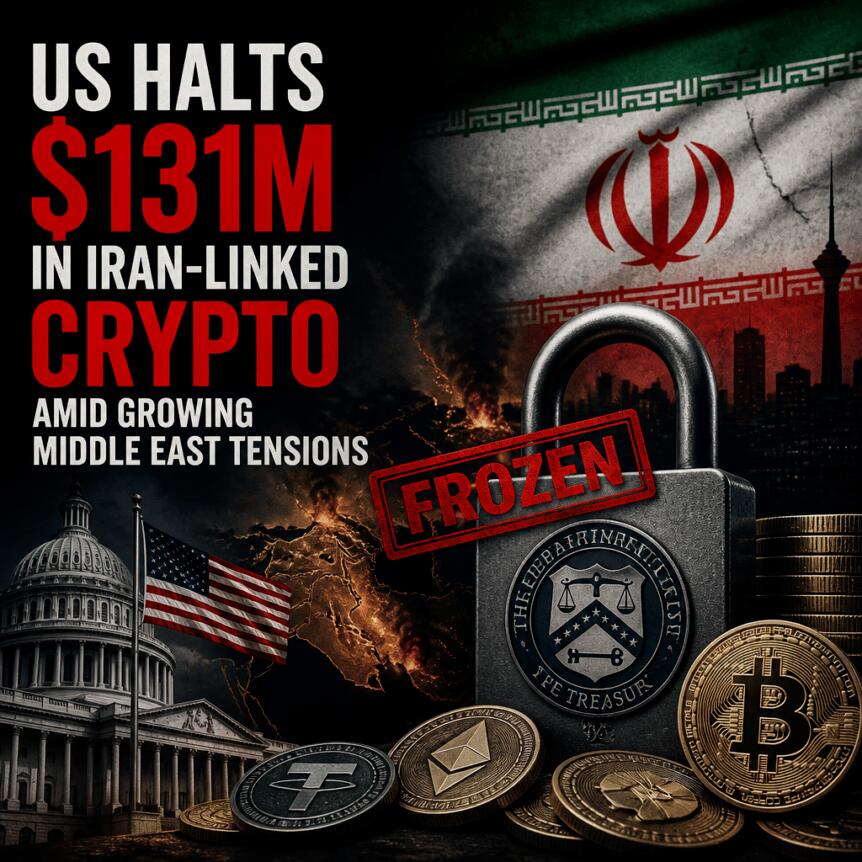
The U.S. Treasury has ordered the freezing of more than $130 million in cryptocurrency linked to Iran, as tensions between the two countries have escalated. On Tuesday, Treasury Secretary Scott Bessent confirmed the action is part of a broader effort to disrupt Iran’s access to proceeds from illicit activity, including through digital assets.
The development comes shortly after blockchain investigator Specter highlighted on-chain activity indicating that Tether had frozen four Tron wallets containing $131 million worth of USDt (USDT). Bessent said the wallets are tied to the Central Bank of Iran, naming the targeted addresses in an X post.
Key takeaways
- U.S. Treasury ordered the freezing of over $130 million in crypto held in wallets linked to Iran, according to Scott Bessent.
- On-chain investigator Specter connected the freeze to Tether’s action against four Tron wallets holding $131 million of USDT.
- Bessent linked the move to the wider U.S. push to restrict Iranian access to illicit financial flows during renewed hostilities.
- The freeze follows a prior action in April, when Tether reported freezing more than $344 million in USDT at the request of U.S. authorities.
Treasury confirms a new freeze linked to Iran
Bessent confirmed on Tuesday that the U.S. government directed the freezing of cryptocurrency held in wallets “tied to the Central Bank of Iran.” He framed the measure as part of an ongoing U.S. strategy to “disrupt and degrade Iran’s illicit financial activities” and to prevent the Iranian regime from accessing proceeds tied to illicit revenue streams.
He also emphasized that the Treasury will continue to “aggressively follow the money,” signaling that additional asset-targeting actions could follow if more wallets are identified through investigations.
Earlier coverage referenced on-chain signals from Specter, which pointed to the specific USDT freeze activity. Specter’s analysis indicated that four Tron wallets were frozen after holding roughly $131 million in USDT, aligning with the figure Bessent cited regarding the U.S. order.
Why stablecoin freezes matter during renewed tensions
The Treasury action underscores how stablecoins, despite being designed to track fiat value, can still sit at the center of sanctions enforcement. When authorities identify addresses connected to sanctioned institutions or networks, freezes can limit the ability to move funds quickly—even if the assets are technically “tokenized” rather than held directly in traditional bank accounts.
In this case, the freeze is tied to hostilities and intensifying U.S.-Iran tensions. The U.S. said it renewed its blockade of Iranian ports, while Central Command announced a new wave of strikes on Iran. Iran’s military, in turn, claimed it carried out drone strikes against U.S. military facilities at Jordan’s Al Azraq Air Base.
That geopolitical backdrop helps explain the urgency of targeting digital assets. For sanctions planners, stablecoins can function as high-speed rails in attempts to move value across borders—making them a logical focus during periods when financial pressure is meant to disrupt procurement networks and operational funding.
A pattern in April and beyond
This is not the first time Tether-related freezing activity has been linked to U.S. sanctions against Iran. In April, Tether confirmed it had frozen more than $344 million in USDT at the request of U.S. authorities, described as an earlier wave of actions consistent with the same enforcement theme: using token controls to prevent access by designated entities.
Separately, Bessent previously said in May that the U.S. has seized around $1 billion in Iranian crypto assets as part of a broader pressure campaign against Iran known as Operation Economic Fury, which launched in March 2025. In a statement in June, Bessent described the operation as targeting foreign procurement networks that support the Iranian military’s efforts to acquire weapons.
Taken together, Tuesday’s reported freeze fits an established trajectory: U.S. authorities identify wallets, impose restrictions through sanctions processes, and then coordinate with market participants capable of freezing stablecoins tied to those addresses.
What to watch next: identification, enforcement, and transparency
For investors, traders, and builders, the practical question is less about whether USDT will “hold its value” and more about how sanctions compliance and wallet targeting continue to affect where stablecoins can flow. These freezes can quickly reduce the ability of certain wallets to access funds, and they can also influence how analysts and market participants assess wallet-level risks associated with regulated enforcement.
Going forward, readers should watch for whether additional Iranian-linked wallets are identified through on-chain investigations and whether further freezes are publicly confirmed by U.S. officials and stablecoin issuers. The key uncertainty remains how widely the freeze net expands—both in terms of the number of wallets and the total value affected—as U.S.-Iran tensions continue to evolve.
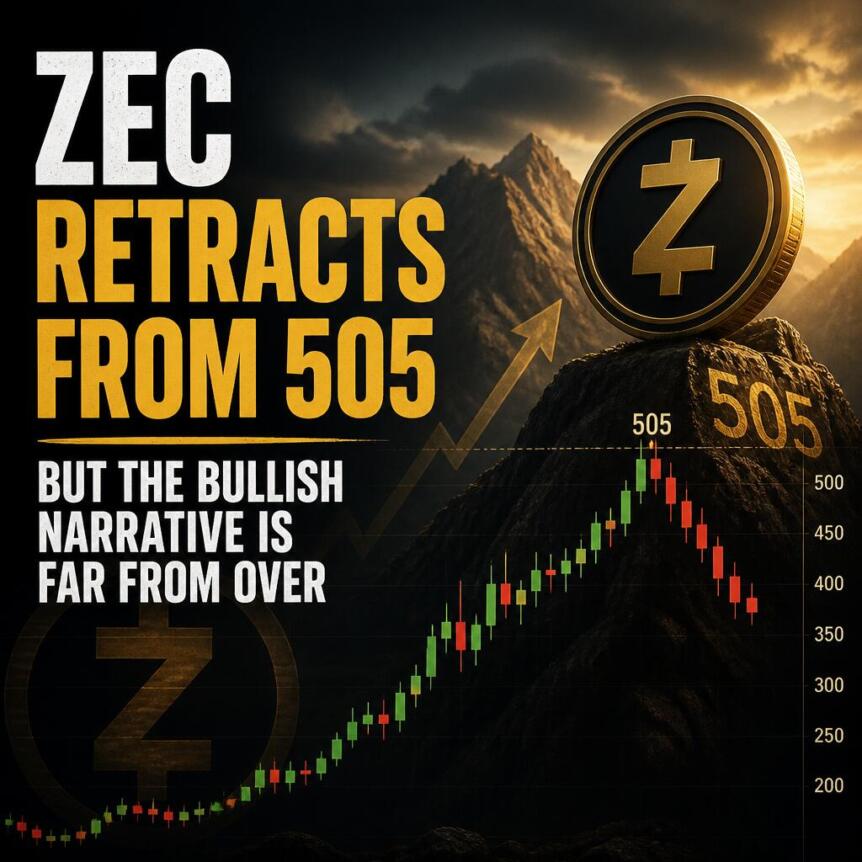
Zcash (ZEC) gained much popularity as it moved toward the $505 region but faced significant selling pressure. The move was met with a retreat as traders decided to take profits in one of the most critical psychological resistance regions on the charts.
The development caused controversy among traders regarding the cryptocurrency’s future. Some suggest that the rejection indicates reduced momentum after the fast-moving advance, while others say the retracement is natural after the gains.
However, despite the negative move, ZEC remains above the support levels and the overall recovery setup remains intact. In any case, the following trading sessions will define which side wins.
Zec Retreats Amid Major Resistance Rejection
After reaching around $505, ZEC moved down toward the $466 level due to an increase in profit taking. The high number of leveraged longs at the resistance level provided additional selling pressure when prices reversed course.
This drop in price triggered numerous liquidations and helped market makers take advantage and push prices down temporarily. Soon after, buyers emerged at the $440 support level to prevent the fall in prices beyond that.
This support level is crucial for the existing market structure, as a sustained breach would give an impetus to the bears to move further downward. On the other hand, a successful defense of this level means buying interest still exists.
Social Sentiment Falls While Confidence Rises
The market’s mood has changed significantly over the past few weeks as well. As per Santiment, there was an uptick in social activity around Zcash after it dipped below $362 amid the revelation of the vulnerability of the Orchard shielded pool. Daily social mentions exceeded 1,100 in those days as traders responded to the risk.
On the other hand, social sentiment fell dramatically as the price recovered by almost 29%. Low social activity does not necessarily indicate a bearish sentiment. In most scenarios, less chatter indicates a relatively calm market and fewer panic sales.
Ironwood Network Upgrade Improves Future Prospects
Among the major reasons to be optimistic about Zcash’s future is the scheduled Ironwood network upgrade.
According to developers, the Ironwood network upgrade will be implemented in several days, bringing enhanced mathematics-based proof of concept designed to protect against unnoticeable forgery in Zcash’s privacy pools.
The scheduled network upgrade comes after its emergency fix for the issue related to the vulnerability of the Orchard shielded pool.
Investors find the network upgrade important for Zcash’s future prospects, regardless of current price dynamics.
Technical Indicators Highlight The Most Critical Resistance Level
Technical analysis indicates that ZEC is set to face another crucial challenge.
The first resistance level lies in the range of $480 to $490. It incorporates past horizontal resistance, the upper Bollinger Band, and the 0.786 Fibonacci retracement level.
According to analyst Ardi, the potential to break past $480 on the daily chart can give bulls hope of reaching $500. A further breakdown below this level may provide an opportunity to target the next resistance level at $540.
CryptDollar, another analyst, has also pointed to this resistance level as the most critical one to watch before confirming the continuation of the latest recovery trend.
Momentum Indicators Still Favor Bulls
While there are no definitive signs yet, several signals support the current trend.
Chaikin Money Flow is still positive at 0.13, indicating capital inflows into the asset. In addition, the Aroon Up indicator remains above 92%, meaning the uptrend is still alive.
TradingView’s Moving Average still shows a Strong Buy signal despite several neutral momentum oscillators.
Liquidation charts can also be helpful for gauging future volatility. Large short positions are formed in the range of $480 to $500. As a result, a breakout of the range will likely bring more momentum to the next leg higher due to short liquidations.

Review of MP security needed after Widdecombe death, Burnham says

At Close of Business podcast July 15 2026

UK plans first G7 digital sovereign bond by early 2027


-

 Fashion6 days ago
Loro Piana Fall 2026 Enters Houston’s Art Scene
-

 Fashion4 days ago
Weekend Open Thread: Nutriplenish Leave-In Conditioner
-
 Sports6 days ago
2026 Genesis Scottish Open Thursday TV coverage: Round 1
-

 Sports5 days ago
Super Eagles star Moses Simon opens up on Liverpool transfer regret
-

 Tech6 days ago
Character.AI enters the microdrama arena with its own productions, but there’s a twist
-

 News Videos12 hours ago
XRP BOMBSHELL… XRP OMBOARDED FOR TRANSACTIONS!!!
-

 Tech1 day ago
Get Your ESP32 Sunny Side Up With This Solar Dev Board
-

 Tech12 hours ago
Dark Secrets Emerge When Jailbreaking LLMs
-

 News Videos6 days ago
Crypto Just Entered Its Most Important 6-Month Candle (Could Decide Everything!)
-
 NewsBeat6 days ago
Major update after Huntingdon train attack as man enters plea
-

 News Videos2 days ago
how to make coin bank box with cardboard #scienceproject #money #diy #shorts
-
 Sports7 days ago
39-year-old Djokovic wins five-hour thriller to enter Wimbledon semis | Other Sports News
-

 Tech6 days ago
Level Infinite Launches Gangstar Mirage City in India with Pre-Registrations
-
 Tech2 days ago
Cloudflare Precursor Watches Your Mouse and Keyboard To Decide If You Are Human
-

 Tech6 days ago
Entra passkey enrollment vishing targets Microsoft 365 users
-
 Crypto World6 days ago
DeFi Dashboard Zapper to Shut Down After 7 Years
-
 Crypto World6 days ago
Mark Cuban-Backed DeFi Dashboard Zapper Shuts Down After 7 Years
-

 Tech6 days ago
Claude’s New Reflect Dashboard Wants To Help You Log Off Of Claude
-

 Crypto World6 days ago
Fed minutes June 2026: officials split on rates
-

 Tech7 days ago
Former OpenAI exec Kevin Weil is now on the board of Stoke Space
You must be logged in to post a comment Login