Connect with us
DAPA Banner
DAPA Coin
DAPA
COIN PAYMENT ASSET
PRIVACY · BLOCKDAG · HOMOMORPHIC ENCRYPTION · RUST
ElGamal Encrypted MINE DAPA
🚫 GENESIS SOLD OUT
DAPAPAY COMING

Business

48 Small Business AI Adoption Statistics for 2026 (And Why They Don’t All Agree)

Published

on

48 Small Business AI Adoption Statistics for 2026 (And Why They Don't All Agree)

Last updated: July 2026

Ask five different sources what percentage of small businesses use AI, and you’ll get five different answers, anywhere from single digits to nearly 90%. That’s not sloppy research. It’s five surveys measuring five different things, and almost nobody bothers to say so before quoting the number that sounds best.

So before we get to the data: every stat below is dated and sourced, and where two credible reports disagree, we’ve said so rather than pretending there’s one clean number. If you’re trying to figure out where your business actually stands relative to your peers, that distinction matters more than the headline percentage.

The Short Answer

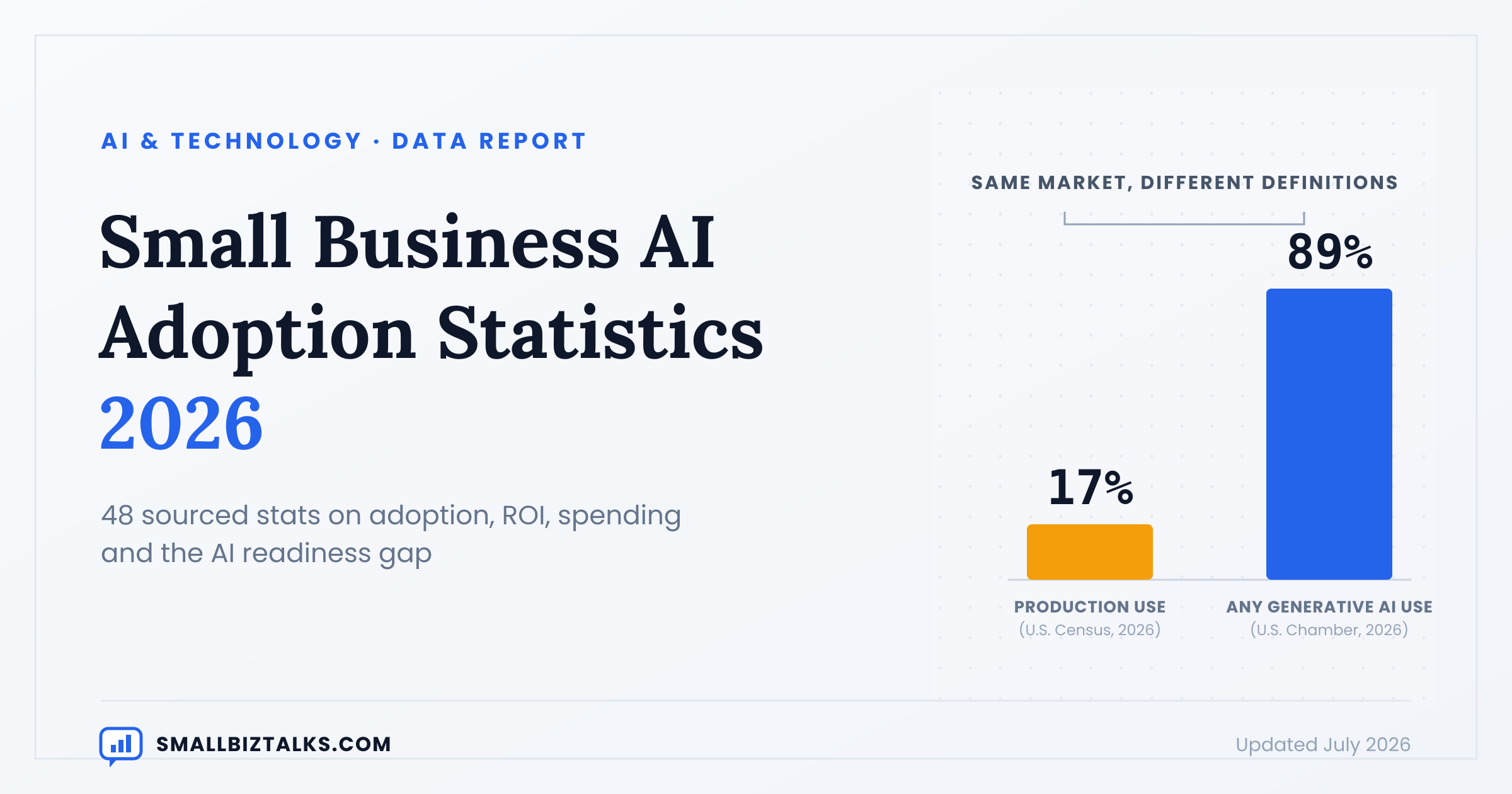
  • Somewhere between 17% and 20% of small businesses are using AI in actual production operations, per U.S. Census Bureau data from May 2026.
  • Somewhere between 58% and 89%, depending on the survey, have used a generative AI tool like ChatGPT for at least one task.
  • 91% of the businesses that do use AI report a revenue increase — but only 14% have fully integrated it into core operations.

Both of those things are true at once. That’s the story this page tells.

How Many Small Businesses Actually Use AI in 2026?

The gap between “AI adoption” headlines usually comes down to definition:

Advertisement
  • The U.S. Census Bureau’s Business Trends and Outlook Survey (BTOS) asks whether a business uses AI to produce its goods or services — a strict, production-level bar. By that measure, adoption sat in the high single digits as recently as 2023 and had climbed to roughly 17–20% by May 2026.
  • The JPMorgan Chase Institute, using transaction-based data rather than self-reporting, found the small business AI adopter base expanded from 5.2% in 2023 to 17.7% by the end of 2025 — a figure that lines up closely with the Census numbers.
  • Broader surveys that ask about any generative AI use — drafting an email with ChatGPT counts — report far higher numbers. Thryv’s April 2026 survey of 561 small business owners found AI adoption at 66%, up from 55% a year earlier.
  • The U.S. Chamber of Commerce’s 2026 Small Business Survey put generative AI use at 89%, up from 36% in 2023. An earlier 2025 wave of Chamber data had already shown a climb from 23% (2023) to 58% (2025) — consistent with the trajectory, if not the exact figure, reported a year later.

The practical takeaway: if you’re citing an adoption rate, cite the definition along with it. “58% of small businesses use AI” and “18% of small businesses use AI in production” can both be accurate descriptions of the same market.

What Are Small Businesses Actually Using AI For?

  • 41% of small businesses use AI for marketing and content creation — the single most common use case (HubSpot State of Marketing, 2025).
  • 29% use it for customer service, including chatbots and automated ticket routing (Salesforce Small Business Trends, 2025).
  • 24% use it for data analysis and business intelligence, including sales forecasting and inventory optimization (Deloitte Small Business Survey, 2025).
  • Among businesses already using AI, the 2026 NFIB survey found marketing content creation the top use case at 68% — a higher share than the HubSpot figure above, another reminder that survey population and phrasing move these numbers.
  • 42% of small businesses use generative AI chatbots specifically, though state-level adoption ranges from 13% to 71% (U.S. Chamber of Commerce, 2025).

Among the AI tools small businesses adopt, category-specific usage breaks down as:

  • 24% use AI accounting tools such as QuickBooks AI or Xero (Intuit, 2025).
  • 19% use AI customer service tools such as Zendesk AI or Intercom Fin (Zendesk, 2026).
  • 14% use AI design tools such as Canva Magic or Midjourney (Canva, 2025).
  • 11% use AI coding or development tools such as GitHub Copilot (GitHub, 2025).

Is AI Actually Paying Off for Small Businesses?

  • 91% of small businesses using AI report a measurable revenue increase (Salesforce, 2025).
  • 90% say AI has made their operations more efficient (Salesforce, 2025).
  • Small businesses using AI are 2.3x more likely to report revenue growth than those that don’t (U.S. Chamber of Commerce, 2026).
  • 70% of Thryv survey respondents said AI contributed to increased revenue over the past 12 months.
  • 92% of AI users in the same survey said the technology saves them time, with 79% expecting to reclaim between 11 and 60 hours per month.
  • 61% estimate AI will save their business between $500 and $2,000 per month (Thryv, April 2026).
  • The average small business saves 5.6 hours per week using AI tools; owners and managers specifically save more than 7 hours per week (Business.com, 2026).
  • In a Goldman Sachs survey of 1,256 small business owners conducted with Babson College and David Binder Research (January–February 2026), 93% reported a positive business impact from AI but only 14% said they’d fully integrated it into core operations.

That last gap — strong reported impact, low structural integration — shows up again and again in the barrier data below.

What’s Actually Holding Small Businesses Back?

  • 77% of small businesses that haven’t adopted AI say they see no applicable use case for their business (SBA Office of Advocacy, 2025). Among businesses with fewer than five employees specifically, that figure rises to 82%.
  • 45% of small business AI users cite a lack of technical expertise as a challenge, and 47% say it’s difficult to choose the right tools (Goldman Sachs, 2026).
  • 70% of small business owners say they need more, or significantly more, training to use AI productively (Thryv, April 2026) — despite 86% describing themselves as comfortable to extremely comfortable using it.
  • 77% of small businesses using AI have no formal prompting strategy or system in place (Aufsite Research, 2026).
  • Only 23% of small businesses using AI have received any formal training on the tools they’re using.
  • Roughly 77% of small businesses using AI have no written AI policy, leaving them exposed to data leaks and unchecked AI-generated output in client-facing work.

How Much Are Small Businesses Spending on AI?

  • 53% of small businesses now spend at least $100 per month on AI tools (Thryv, April 2026).
  • Median AI spending per firm actually peaked around $80 per month in 2022 and had fallen to roughly $30 per month by 2025 (JPMorgan Chase Institute) not because established users are spending less, but because the pool of new, lower-spending adopters using $20–$30/month entry-tier tools has grown so fast it pulls the average down.
  • That entry-level tier now makes up roughly 63% of the small business AI user base, up sharply since 2022, while the highest-spending tier has shrunk to about 16%.
  • The overall small business AI adopter base more than tripled between 2023 and 2025 (JPMorgan Chase Institute, 2026).

Which Businesses Are Leading — and Which Are Lagging?

  • Adoption follows a U-shaped curve by firm size: the very smallest businesses, those with fewer than five employees, actually over-index on AI use compared to mid-sized small businesses (U.S. Census Bureau / SBA, 2025). For a solo operator, AI functions less like a tool and more like a first hire.
  • By industry: 36% of small real estate businesses use AI (National Association of Realtors, 2025), 33% of small education and training businesses (National Center for Education Statistics, 2025), and 31% of small construction businesses — the lowest adoption rate of any major sector, largely due to field-based, low-digital-maturity work (Associated General Contractors, 2025).
  • The gap between large-enterprise and small-business AI adoption has narrowed from roughly 1.8x to 1.2x over the course of 2025, with the smallest firms actually over-indexing on certain use cases like marketing automation (SBA Office of Advocacy, 2025).

Where Is This Headed?

  • New businesses founded in 2025 reached 10% AI adoption within just six months — compared to 77 months for businesses founded in 2019. That’s roughly a 13-fold acceleration in how quickly new companies fold AI into operations (JPMorgan Chase Institute, 2026).
  • The OECD projects a 19.34% compound annual growth rate for SME AI adoption through 2031.
  • Gartner projects that 60% of commercial research queries will be AI-assisted by the end of 2026 — a shift that affects how small businesses need to think about discoverability, not just tool adoption.
  • 96% of small business owners say they plan to adopt emerging technologies including AI (U.S. Chamber of Commerce, 2026).
  • 71% plan to increase their AI investment over the next year (Salesforce, 2025), and 53% of small businesses not yet using AI say they’re considering it (Intuit QuickBooks, 2025).

The holdouts are shrinking. The gap that matters in 2026 isn’t between businesses that use AI and businesses that don’t, it’s between the ones treating it as a free-tier experiment and the ones actually building it into how they operate.

Sources

Methodology note: figures above are drawn directly from primary research reports rather than from other roundups, and each stat is dated to its source’s survey period. Where two reputable sources report different numbers for what appears to be the same question, both are presented rather than collapsed into a single figure.

Continue Reading
Click to comment

You must be logged in to post a comment Login

Leave a Reply

Business

Indonesia stocks higher at close of trade; IDX Composite Index up 0.12%

Published

on


Indonesia stocks higher at close of trade; IDX Composite Index up 0.12%

Continue Reading

Business

Talented Stars Driving Global Interest in the Women’s Game

Published

on

Alisha Lehmann

Women’s soccer continues its rapid rise in popularity in 2026, with players blending exceptional on-field talent, leadership and growing public profiles that draw fans across continents. As leagues like the NWSL and Europe’s top divisions expand media deals and attendance, several athletes stand out for their performances and ability to connect with audiences beyond the pitch.

Discussions around prominent figures often highlight a mix of established stars and emerging talents whose skills, marketability and social media presence amplify the sport’s appeal. Rankings that focus on popularity remain subjective, reflecting fan engagement, endorsements and cultural impact alongside athletic achievements. No major senior international tournament anchors the calendar this year, shifting attention to club campaigns and individual honors such as the Ballon d’Or Féminin race.

Barcelona continues to dominate conversations, while NWSL clubs secure record contracts that underscore the league’s growing stature. Here are 10 players frequently cited in conversations about the sport’s most visible and influential figures this season.

Alisha Lehmann of Aston Villa and the Switzerland national team tops many fan-driven lists for her dynamic playing style and substantial online following. The forward has built a global audience through skillful dribbling and energetic presence, amassing millions of social media followers and securing brand partnerships. Her profile illustrates how on-pitch flair combined with off-field visibility helps grow interest in women’s soccer.

Advertisement

Alexia Putellas remains a central figure at Barcelona after overcoming earlier injury challenges. The Spanish midfielder and two-time Ballon d’Or winner posted strong numbers in the 2025/26 campaign, contributing goals and assists while helping her club secure major domestic and European titles. Putellas’ return to elite form has positioned her as a leading contender for the 2026 Ballon d’Or Féminin, with observers noting her leadership and technical quality.

Aitana Bonmatí, also of Barcelona and Spain, enters the year as a three-time Ballon d’Or Féminin winner despite an injury-disrupted 2025/26 season. The midfielder’s vision, work rate and consistency have set benchmarks in recent years. Her representatives have highlighted the connection between performance and market value. “Aitana is the highest-paid female footballer in the world and has the best contract in history because she is the best female footballer in the world, and that has a lot to do with her performance and contribution on the pitch,” said Cristian Martin, CEO of WOM Sports Management, in comments reported earlier this year.

Claudia Pina has emerged as one of Barcelona’s most clinical forwards during the 2025/26 season. The Spanish attacker recorded high goal tallies and assists, drawing attention for her finishing ability and role in the team’s success across competitions. Her rapid development has made her a focal point in discussions about the next generation of stars.

Ewa Pajor continues to deliver prolific scoring form at Barcelona. The Polish forward’s goal output in league and European play has kept her among the most dangerous attackers in women’s soccer. Pajor’s consistency helps drive Barcelona’s attacking identity and contributes to the club’s sustained dominance.

Advertisement

Khadija Shaw of Manchester City and Jamaica maintains her reputation as a reliable goal threat. The forward’s performances in the Women’s Super League and on the international stage have earned consistent recognition. Shaw’s blend of power and finishing ability makes her a key reference point when assessing top strikers.

Alessia Russo has become a central figure at Arsenal and for the England national team. The forward’s contributions in the Women’s Super League and UEFA competitions, including important goals in high-stakes matches, have elevated her profile. Russo’s movement and finishing add a clinical edge to Arsenal’s attack.

Trinity Rodman of the Washington Spirit and the United States national team represents the NWSL’s rising commercial appeal. The forward secured a significant new contract reflecting the league’s progress in player compensation. Rodman’s speed, creativity and visibility have helped position her among the most recognizable young talents in the game.

Sophia Smith remains a cornerstone of the U.S. women’s national team attack. The forward’s pace and goal-scoring threat have been central to club and country performances. Her profile benefits from the broader spotlight on American players in a league that continues to attract investment and attention.

Advertisement

Caroline Graham Hansen of Barcelona and Norway adds width and creativity from the flanks. The winger’s dribbling, crossing and goal contributions have been vital to Barcelona’s success. Hansen’s technical quality and experience make her a consistent presence in conversations about elite European players.

These athletes reflect broader trends in 2026. Record transfers and contracts in the NWSL, including deals for players like Catarina Macario, signal increasing professionalization. Barcelona’s continued success across fronts keeps Spanish players prominent in individual award discussions. Social media engagement amplifies reach, allowing fans worldwide to follow careers in real time and turning matches into shared cultural moments.

The absence of a major tournament this summer has focused attention on domestic leagues and the ongoing Ballon d’Or Féminin campaign, scheduled for October. Voters weigh club performances heavily in a year without Euros or World Cup action. Barcelona’s quartet of Putellas, Bonmatí, Pina and Pajor features prominently in early speculation.

Growth metrics tell a positive story. Attendance figures in top leagues have risen steadily, supported by better broadcasting and marketing. Players with strong personal brands help attract casual viewers who then discover the quality of play. Endorsements and media appearances further embed women’s soccer in mainstream culture.

Advertisement

Challenges remain, including fixture congestion, injury management and the need for continued investment in grassroots development. Yet the visibility of these athletes contributes to momentum. Young fans see role models who combine elite performance with approachability through digital platforms.

As the 2026 club season progresses toward its conclusion and the Ballon d’Or ceremony approaches, attention will stay on how these players and their peers shape the next chapter. Their stories—marked by resilience, skill and expanding influence—illustrate why women’s soccer commands growing audiences and why individual profiles matter as much as team results.

The sport’s trajectory depends on sustained excellence on the pitch paired with smart off-field engagement. Players who excel in both areas help ensure the gains of recent years continue. In 2026, that combination appears stronger than ever across multiple leagues and national teams.

Advertisement
Continue Reading

Business

Farnborough Airshow 2026 Finance Summit draws 600 investors

Published

on

Farnborough Airshow 2026 Finance Summit draws 600 investors

More than 600 senior investors from around 350 firms, including Goldman Sachs, Blackstone and the Qatar Investment Authority, will descend on Hampshire this month for a new Finance Summit at the Farnborough International Airshow, and for once the guest list is not reserved for the primes.

The Aerospace Global Forum: Finance Summit, launching at this year’s show, is designed to connect global capital with opportunities across aerospace, defence, space, cyber and enabling technologies, from the industry’s biggest names down to emerging start-ups.

For UK founders and scale-ups in the sector, that matters. The programme puts sovereign wealth funds, private equity houses, venture capital firms, hedge funds and M&A specialists in the same halls as the businesses hunting for growth capital, at a show where the 2024 edition generated at least £13 billion in deals for the UK.

Senior representatives are expected from Goldman Sachs, J.P. Morgan, Citigroup, Barclays, HSBC, Deutsche Bank, UBS, Blackstone, Carlyle, Warburg Pincus, Mubadala, the Qatar Investment Authority, Temasek International and Tikehau Capital, among others.

British institutions are on the list too, including the British Business Bank, the London Stock Exchange and UK Export Finance, the government’s export credit agency, a signal that the summit is as much about backing domestic suppliers as courting overseas money.

Advertisement

Gareth Rogers, CEO of Farnborough International, said: “Finance and investment have always been underlying themes of the airshow, but we wanted to give it emphasis to support the industry as it accelerates. The launch of the Finance Summit is our response to the growing demand from investors seeking direct access to high-quality market insight, business development opportunities and emerging innovation across aerospace, defence and space.”

The timing is hard to fault. UK aerospace, defence, security and space industries contribute more than £42 billion a year to the economy, according to ADS Group figures, and ministers have been working to pull smaller defence suppliers deeper into the MoD’s supply chain through a dedicated growth unit. Capital, in short, is looking for a home in exactly the sectors where British SMEs are strongest.

Attendees have identified the conference programme, market trends, new business partnerships, existing partner engagement and visibility of new projects as their key reasons for coming, according to the organisers.

The summit will run keynote sessions, panel discussions, roundtables and dedicated networking as part of the wider Aerospace Global Forum, with the stated aim of connecting investors, banks and consultancies with organisations ranging from global primes to emerging start-ups.

Advertisement

For a smaller business, the calculation is straightforward. Investor meetings of this calibre usually mean a trip to Mayfair or Manhattan and a warm introduction. For one week this summer, the capital comes to Farnborough instead, at what organisers expect to be the biggest show in the event’s history.


Amy Ingham

Amy is a newly qualified journalist specialising in business journalism at Business Matters with responsibility for news content for what is now the UK’s largest print and online source of current business news.

Advertisement
Continue Reading

Business

At Close of Business podcast July 15 2026

Published

on

At Close of Business podcast July 15 2026

Sam Jones and Isabel Vieira discuss the bi-annual corporate finance feature.

Continue Reading

Business

Maine Democrats, rattled by Platner’s downfall, protest fatal ICE shooting

Published

on


Maine Democrats, rattled by Platner’s downfall, protest fatal ICE shooting

Continue Reading

Business

SpaceX Stock Closes at New Low

Published

on

SpaceX Stock Closes at New Low

SpaceX Stock Closes at New Low

Continue Reading

Business

Hemab Therapeutics: A Cash-Rich Coagulation Franchise With Multiple Clinical Catalysts

Published

on

Hemab Therapeutics: A Cash-Rich Coagulation Franchise With Multiple Clinical Catalysts

This article was written by

I have a strong inclination towards high-growth companies, often treading in sectors poised for exponential expansion. My expertise lies in understanding and investing in disruptive technologies and forward-thinking enterprises. My approach is a mix of fundamental analysis and future trend prediction. I believe in the power of innovation to yield substantial returns and aim to provide insightful analysis on such companies here on SeekingAlpha.

Analyst’s Disclosure: I/we have no stock, option or similar derivative position in any of the companies mentioned, and no plans to initiate any such positions within the next 72 hours. I wrote this article myself, and it expresses my own opinions. I am not receiving compensation for it (other than from Seeking Alpha). I have no business relationship with any company whose stock is mentioned in this article.

Seeking Alpha’s Disclosure: Past performance is no guarantee of future results. No recommendation or advice is being given as to whether any investment is suitable for a particular investor. Any views or opinions expressed above may not reflect those of Seeking Alpha as a whole. Seeking Alpha is not a licensed securities dealer, broker or US investment adviser or investment bank. Our analysts are third party authors that include both professional investors and individual investors who may not be licensed or certified by any institute or regulatory body.

Advertisement
Continue Reading

Business

JPMorgan initiates Tango Therapeutics stock at Overweight

Published

on


JPMorgan initiates Tango Therapeutics stock at Overweight

Continue Reading

Business

Old Somerset cattle market could be turned into 100 new homes

Published

on

Business Live

The former Yeovil cattle market site has been assessed for potential housing development

The former cattle market site, seen from Court Ash in Yeovil. CREDIT: Daniel Mumby. Free to use for all BBC wire partners.

The former cattle market site, seen from Court Ash in Yeovil(Image: Local Democracy Reporting Service / Daniel Mumby)

A former cattle market in Yeovil town centre could be converted into as many as 100 new homes if the site progresses under the new Somerset Local Plan.

Advertisement

Somerset Council has recently begun the first phase of public consultation on its new Somerset Local Plan, which will determine where new housing and employment sites are designated until 2045.

As part of the Local Plan procedure, the council has published the results of its housing and employment land availability assessment (HELAA), which identifies every site submitted during the ‘call for sites’ in early 2025 (which invited developers, promoters and landowners to put forward sites for future development).

Among the sites included within the HELAA is the former cattle market south of the A30 Reckleford and Market Street – with local councillors suggesting it could accommodate up to 100 new properties.

Councillors Mike Hewitson and Oliver Patrick, who represent the Coker division near Yeovil, highlighted the issue in their latest monthly newsletter to their constituents.

Advertisement

They said: “Councils are required to have up to date Local Plans in order to. demonstrate how they are delivering central government housing targets for their area.

“The HELAA process sits as a first stage in the wider Local Plan site selection process. It does not allocate sites or grant them planning permission or planning status of any kind.”

The cattle market was designated as one of the principal regeneration locations within the Yeovil Refresh regeneration scheme, launched by South Somerset District Council and supported by £9.75m from the then-Conservative government’s future high streets fund.

After the current Labour government took office in July 2024, the programme was restructured to enable the remaining funds to be concentrated on the Glovers Walk site and several smaller projects in the town centre.

Advertisement

The cattle market component of the Yeovil Refresh programme was formally scrapped in August 2024, alongside any proposed improvements to the Poundland outlet at 72-74 Middle Street.

Hewitson and Patrick added: “The owners of the cattle market have submitted their land for consideration in the Local Plan. They have indicated it could accommodate approximately 100 homes.

“Could we finally see this major brownfield site finally come forward for redevelopment?”

In their formal evaluation of the location, the council’s own planning officers said the cattle market was “potentially suitable” for inclusion within the Local Plan as a “regeneration site” (i.e. one where central government funding could be targeted to unlock new homes).

Advertisement

The officers added: “The site has been promoted for housing development and therefore is not considered available for economic development.

“The site is adjacent to multiple highways, so it is assumed that access could be taken from multiple points.

“The promoter has identified a few common constraints but anticipates that they can be overcome.”

A summary of the consultation responses is due to be published in early November, with the second round of consultation, incorporating further details of proposed development sites, expected to commence in September 2027.

Advertisement

The third and final round of public consultation is currently scheduled for March 2028, after which the Local Plan will be submitted to the Planning Inspectorate, which may hold additional public hearings should it be deemed necessary.

If everything proceeds, the new Local Plan will be formally adopted on March 16, 2029.

Continue Reading

Business

Meta Faces Lawsuit Alleging AI Tools Discriminated Against Workers on Protected Leave in Mass Layoffs

Published

on

Is Claude Still Down? Anthropic's Claude AI Chatbot Hit by

SAN FRANCISCO — Dozens of Meta employees have filed a federal lawsuit accusing the social media giant of using artificial intelligence systems to select workers for layoffs in a way that disproportionately targeted those who took maternity, medical or disability leave.

The 71-page complaint, filed Monday in U.S. District Court in the Northern District of California, was brought by 26 current and former employees who claim the company’s AI-driven performance evaluations penalized them for exercising legally protected rights to time off. The workers are among approximately 8,000 employees, or about 10% of Meta’s global workforce, notified of layoffs beginning in May.

Meta, the parent company of Facebook, Instagram and WhatsApp, has disputed the allegations. “These claims lack merit and are not based on facts,” a Meta spokesperson said in a statement. “Workforce management and organizational decisions were and are made by people, not AI.”

The lawsuit alleges that Meta relied on a “constellation of internal artificial intelligence systems” — including AI performance ratings, keystroke and activity monitoring, productivity metrics and AI token-usage dashboards — to score, rank and select employees for termination. These tools, according to the complaint, failed to account for periods when employees were on approved leave, effectively punishing them for absences required by law.

Advertisement

“Meta did not assemble the termination list through the considered judgment of managers who knew the work,” the complaint states. “Instead, the company used AI systems to score, rank and select employees for inclusion on the list.”

Plaintiffs include a scientist notified of her layoff just days before giving birth while on approved pre-birth pregnancy leave, an engineer who received a lowered rating due to time off for an injury, and a manager let go 16 days into medical leave. All 26 plaintiffs, who are proceeding anonymously as Does 1-26, had taken protected leave in the 24 months prior to the layoffs, the suit says.

Eight of the plaintiffs are women who took maternity or pregnancy-related leave, four are men who took parental leave, and another took leave to care for a family member followed by bereavement leave, according to the filing. The suit claims the practices violate the Family and Medical Leave Act, the Americans with Disabilities Act, the Pregnancy Discrimination Act, the Pregnant Workers Fairness Act and various state laws.

The case highlights growing concerns about the use of AI in workplace decisions. Regulators and lawmakers in states including California, Colorado and Illinois have enacted rules in recent years to address potential bias in automated employment tools. The U.S. Equal Employment Opportunity Commission has also stated that existing anti-discrimination laws apply when employers use AI for such purposes.

Advertisement

Meta announced the latest round of job cuts in April as part of efforts to improve efficiency and redirect resources toward artificial intelligence development. Employees received notices starting around May 20, with departures scheduled through July 22. The company also reassigned thousands of other workers to AI-related initiatives during the restructuring.

The lawsuit points to Meta’s employee-monitoring program, introduced earlier this year, which captured keystrokes, mouse movements, browser history, messages, emails and location data on company devices. The program was intended to train the company’s AI systems on employee behaviors, according to internal statements attributed to CEO Mark Zuckerberg.

In an internal meeting reported by The Information, Zuckerberg said the AI models would “learn from watching really smart people do things,” noting that the average intelligence at the company was higher than what could be obtained externally for certain tasks.

Plaintiffs allege the monitoring program was rolled out with limited notice and little opportunity for opt-out, contributing to an environment where data collection fed into layoff decisions without proper safeguards for protected leave.

Advertisement

The suit seeks a preliminary injunction to halt the finalization of layoffs for the plaintiffs, along with reinstatement, back pay, lost equity, benefits and other damages. Because of Meta’s arbitration agreements, the plaintiffs are not seeking class-action status but are pursuing individual claims.

Legal experts following the case say it could test how courts view the intersection of AI tools and employment protections. If the metrics used in decision-making inherently disadvantage workers on leave, companies may need to implement more robust adjustments or human oversight to comply with federal and state laws.

The controversy unfolds amid broader tensions at Meta over its aggressive push into AI. Employees have expressed concerns about surveillance tools, reassignments to data-labeling roles described internally by some as “draftees” work, and the overall pace of change. Petitions and internal protests have highlighted worries that AI initiatives are coming at the expense of worker well-being.

Meta has defended its approach as necessary for remaining competitive in the rapidly evolving technology landscape. In communications to staff, executives have emphasized flattening organizational structures, increasing ownership on smaller teams and leveraging AI to boost productivity.

Advertisement

The company has paused aspects of its monitoring program at times due to internal data concerns and employee feedback, but continues to integrate AI deeply into operations.

This latest lawsuit adds to a series of legal challenges facing big tech companies over AI deployment. As tools become more sophisticated, questions about transparency, bias detection and accountability are likely to intensify.

For the plaintiffs, the stakes are personal. One researcher reportedly received her first “Meets Most” performance rating shortly after disclosing a disability and requesting accommodations, according to details in the complaint. Others describe lowered scores directly tied to leave periods.

The case is assigned to U.S. District Judge William Orrick in Oakland. Plaintiffs are seeking preservation of relevant data, models and logs, as well as an independent audit of the algorithmic selection process.

Advertisement

Meta’s spokesperson reiterated that decisions involved human judgment and that the company complies with all applicable employment laws.

As the tech industry grapples with balancing innovation and worker rights, the outcome of this suit could influence how other companies approach AI-assisted workforce management. With AI adoption accelerating, similar disputes may become more common.

The plaintiffs’ attorneys from firms specializing in employment law argue that failing to adjust for protected leave in automated systems amounts to built-in discrimination. They call for greater scrutiny of “black box” AI tools in high-stakes employment decisions.

Industry observers note that while AI can streamline processes, it requires careful calibration to avoid unintended biases, particularly around sensitive areas like health and family responsibilities.

Advertisement

Meta, with a workforce of around 78,000 at the end of the first quarter, has conducted multiple rounds of layoffs in recent years as it pivots toward AI. Previous cuts in 2022 and 2023 were larger in scale, but the 2026 reductions come as the company invests heavily in computing infrastructure and model development.

Zuckerberg has publicly stated that AI will transform many aspects of work, including at Meta itself. The company’s internal AI efforts include tools like Metamate, described as a large language model assistant, and “second brain” systems trained on employee data.

Critics within the company have raised alarms about the potential for these systems to create feedback loops that favor constant availability and high-volume output, metrics difficult to maintain during legitimate absences.

The lawsuit does not seek class certification due to arbitration clauses but requests the court issue a preliminary ruling preserving the status quo for the named plaintiffs while their claims proceed.

Advertisement

Broader implications could extend to other employers using similar technologies. Employment lawyers advise companies to audit AI tools for disparate impact on protected groups and to maintain clear documentation of human involvement in final decisions.

As of mid-2026, the debate over AI in human resources continues to evolve, with calls for federal guidelines gaining traction alongside state-level regulations.

The case underscores the challenges of integrating powerful new technologies into traditional employment frameworks. For Meta and its workforce, the resolution may help define the boundaries of acceptable AI use in one of the most consequential areas of business operations: deciding who stays and who goes.

Advertisement
Continue Reading

Trending

Copyright © 2025