


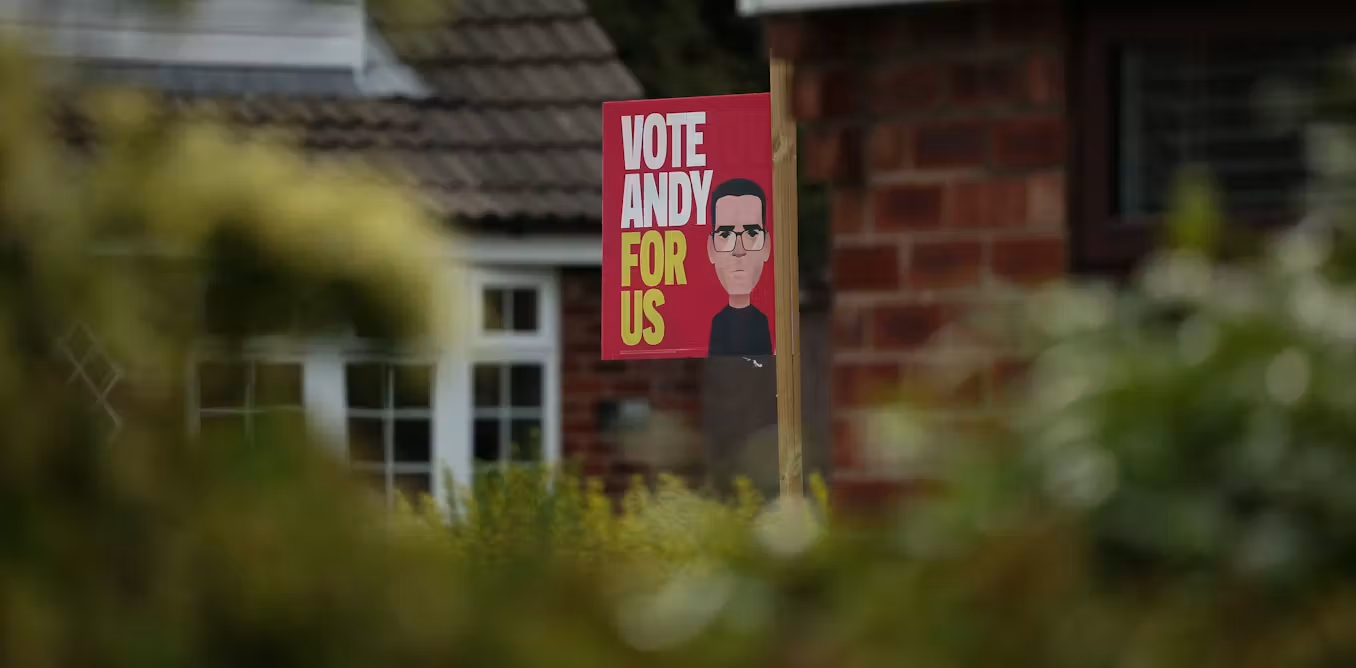
Almost ten years ago – just weeks before he was elected as Greater Manchester’s first metro-mayor – I sat down with Andy Burnham and interviewed him for The Conversation.
Back then he was making the transition from Westminster cabinet minister to regional politician, swapping the shadow front bench for a role that most people at the time considered a consolation prize.
It didn’t look that way for very long.
À lire aussi :
Manchester, devolution and Brexit – Andy Burnham Q&A
Looking back over our conversation, a few things stand out. Firstly, he saw Brexit coming – but not quite in the way people remember.
Before he had been elected mayor, Burnham was already framing the Brexit result as a symptom of England’s hyper-centralisation around London and the M25. Policies made in Westminster, he argued, simply did not speak to communities in Bolton, Leigh or Oldham.
The northern English city of Manchester has played a critical role in the development of Andy Burnham’s political and social outlook. This series considers what some have dubbed Manchesterism and what it might mean for the future of the UK.
That analysis has aged well. Look at the geography of the 2024 Reform surge. The communities that swung hardest away from Labour – post-industrial towns like Wigan, where Reform took 24 of the 25 available seats, and Tameside, where they took 18 of 19 – map more or less neatly onto the pattern Burnham described in 2017. He was identifying the problem that would define the next decade of English politics, while others were focused on trade deals.
Andy Burnham Q&A in 2017
His answer at the time was devolution: as a practical mechanism to make policy that worked for specific places. That framing also sat at the core of his pitch for the Labour leadership.
On transport, he delivered
Burnham’s promise to bring Manchester’s buses back under public control was met with scepticism, legal challenge, and considerable institutional resistance.
Bus operators Stagecoach and Rotala fought the franchising plans through the courts. He won in the High Court in 2022. By September 2023, Greater Manchester became the first place in England to reverse bus deregulation after nearly four decades.
The Bee Network was launched. It boasted integrated fares, capped £2 adult single fares, and free travel for 16-18-year-olds. Burnham flagged this in our original interview as a tool for social inclusion.
National satisfaction survey data shows that Greater Manchester saw the largest increase in passenger satisfaction of any area in England in the first full year of the Bee Network, with value for money perceptions rising sharply. It is probably his clearest policy success.
On rough sleeping, the picture is complicated
Burnham pledged to end rough sleeping in Greater Manchester by 2020. He missed that target and said so publicly in late 2019.
The record since has been mixed. Numbers fell from a peak of 268 in 2017 to a low of 89 in 2021, which should be celebrated.
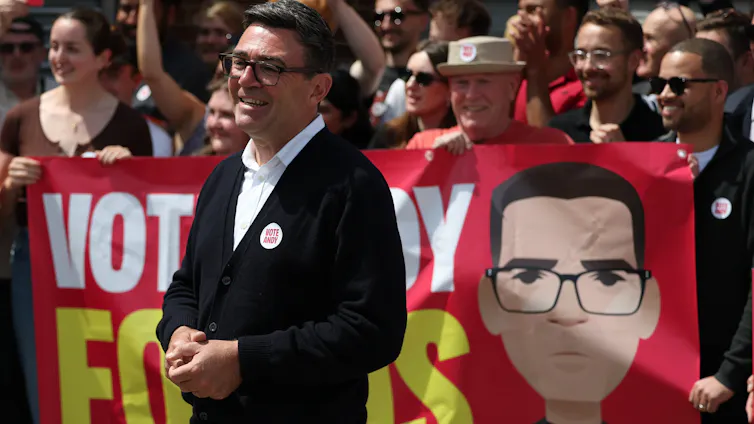
EPA/ADAM VAUGHAN
This was driven partly by the national pandemic-era Everyone In policy and partly by Burnham’s own A Bed Every Night scheme, which provides emergency shelter across all ten boroughs.
The Housing First programme, which gives rough sleepers a permanent home immediately with wraparound support – rather than making housing conditional on sobriety or compliance – has supported 426 people since its 2019 launch. Around 78% of those housed were still in their homes 18 months later; a huge outcome for people who tend to have highly complex needs and experiences.
But that trajectory has since reversed. Rough sleeping has risen for four consecutive years, reaching 197 on the official autumn 2025 count. That’s more than double the 2021 low, and edging back toward the 268 recorded when Burnham took office.
This can, though, be partly attributed to national factors like frozen Local Housing Allowance rates, increased evictions from asylum accommodation and unmet health and social care needs.
Those structural explanations play a huge role, but four years of rising figures may lead some to see Burnham’s record of success in more binary terms.
On housing, his powers ran out
Burnham spoke in 2017 about the need for truly affordable homes to rent and criticised the decades-long national obsession with owner-occupation. He wanted to use Greater Manchester’s housing fund to regenerate post-industrial towns in the north of the city region through high-quality residential development. He wanted to target towns like Leigh, his own previous constituency.
But progress was limited for most of his mayoralty. The 2023 Trailblazer devolution deal brought meaningful new powers, £150 million in brownfield funding, local control of the affordable homes programme, and new rights to act against poor-performing private landlords.
But these powers came six years into his tenure. By 2023/24, there were 13,422 social lettings across Greater Manchester, half the number available a decade earlier. There were also over 5,400 households (including nearly 8,000 children) who were living in temporary accommodation.
His pledge to build 10,000 new council homes only came after his third election victory in 2024. The housing crisis deepened on his watch, even if the causes were largely national.
COVID was the making of him nationally
The interview predates the pandemic, but any assessment of Burnham’s mayoralty has to reckon with the Tier 3 stand-off in October 2020. When the government attempted to impose the tightest restrictions on Greater Manchester without adequate financial support, Burnham refused.
He held press conferences outside Manchester Town Hall. He made the argument publicly, repeatedly and in plain English that what was being offered was insufficient and that the city region was being treated as an afterthought.
He was publicly told via social media, mid-press conference, that restrictions would be imposed regardless. It was a textbook illustration of precisely the centralisation problem he had identified in our 2017 interview. That moment did more to build his national political profile than anything else in his nine years as mayor.
Did he make Greater Manchester great?
The Conversation interview we had was never about grand promises. What he spoke about was inclusive growth, economic progress felt across all ten boroughs, not concentrated in the city centre, and a politics of place that could speak to communities London had forgotten.
Greater Manchester’s economy grew faster than the national average throughout Burnham’s mayoralty, though that trajectory was already established before he took office in 2017.
His contribution was to sustain it and to articulate a more explicit theory of inclusive growth, culminating in the £1 billion Good Growth Fund launched in late 2025, which directs investment to priority projects across all ten boroughs. It is too early to assess its impact.
The honest assessment is that Burnham leaves Greater Manchester in a stronger position than he found it on economic and transport measures, and with a clearer policy framework than existed before.
Whether growth has genuinely reached the towns he spoke about in 2017 – places like Bolton, Oldham and Leigh – is a harder question. Although the Good Growth Fund is implicitly an admission that it has not.
None of this provides a perfect or complete record for Burnham. The housing crisis remains, inequality within the city region persists, the northern towns he spoke about in 2017 still face structural challenges that no metro-mayor can solve alone.
But the question he implicitly posed in that interview was whether devolution could be a vehicle for a genuinely different kind of politics, one that starts from the needs of places rather than the priorities of Whitehall.
On that, his answer was yes. The question now is whether Manchesterism can survive the journey to Westminster and whether he can unpick the structural challenges holding the regions back.











































You must be logged in to post a comment Login