

Crypto World
Ethereum price pulls back after CPI rally as analysts keep $2,000 breakout in focus

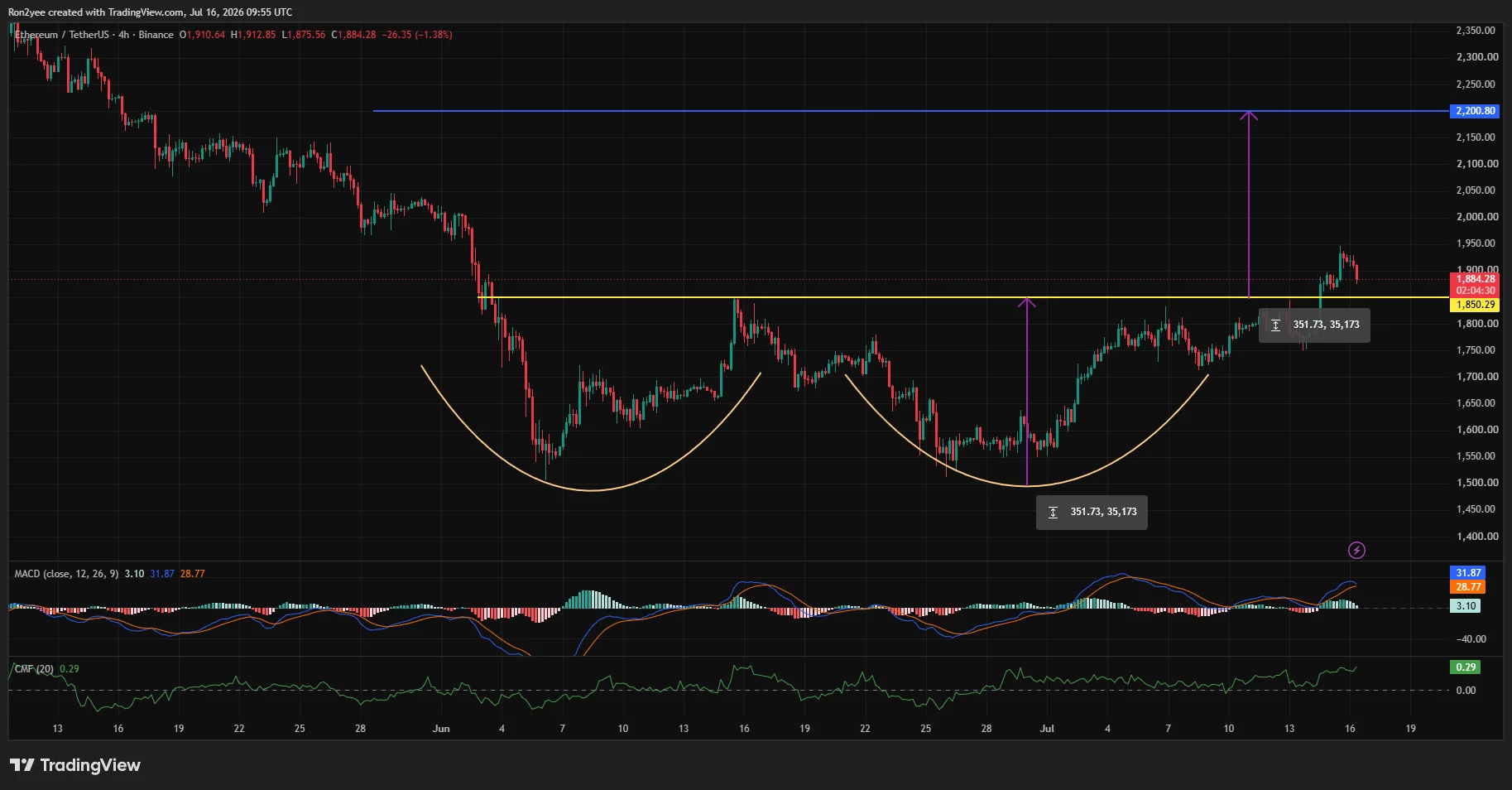
Ethereum price has retreated from a two-month high after traders locked in profits, though analysts still expect a push toward $2,000 while key support holds.
Summary
- Ethereum price pulled back after a 5% CPI-driven rally as traders booked profits near $1,930.
- Strong support around $1,850 keeps the technical outlook intact, with $2,000 remaining the next key target.
- Liquidation clusters, ETF flows, and Fed expectations will likely determine Ethereum’s next move.
The June U.S. CPI and PPI data initially fueled a risk-on move across crypto markets, lifting ETH more than 5% before sellers emerged near a major resistance area. The rally briefly pushed Ethereum above a multi-month descending trendline, but momentum faded around $1,930 as short-term traders adopted a classic sell-the-news strategy.
The pullback drove Ethereum (ETH) price as low as $1,878 before buyers returned around the $1,880 region, which now serves as the first line of support after the breakout attempt.
Derivatives activity accelerated the reversal. Funding rates climbed as leveraged longs entered the market during the move above $1,900, leaving positions vulnerable once upside momentum stalled. The retreat triggered a wave of long liquidations across major exchanges, adding forced market-selling pressure to an already weakening spot market.
Macro markets also turned less supportive as the trading session progressed. Oil prices rebounded sharply after the inflation data, reviving concerns that energy costs could complicate the Federal Reserve’s path on interest rates.
Treasury yields moved higher alongside the U.S. Dollar Index, reducing appetite for risk assets and encouraging some investors to rotate capital toward traditional fixed-income markets instead of cryptocurrencies.
Technical structure continues to favor another test of $2,000
Ethereum’s 4-hour chart still presents a constructive technical picture despite the latest rejection. Price has completed a second rounded-bottom formation after rebounding from the June lows near $1,500 and recently reclaimed the horizontal resistance around $1,850.
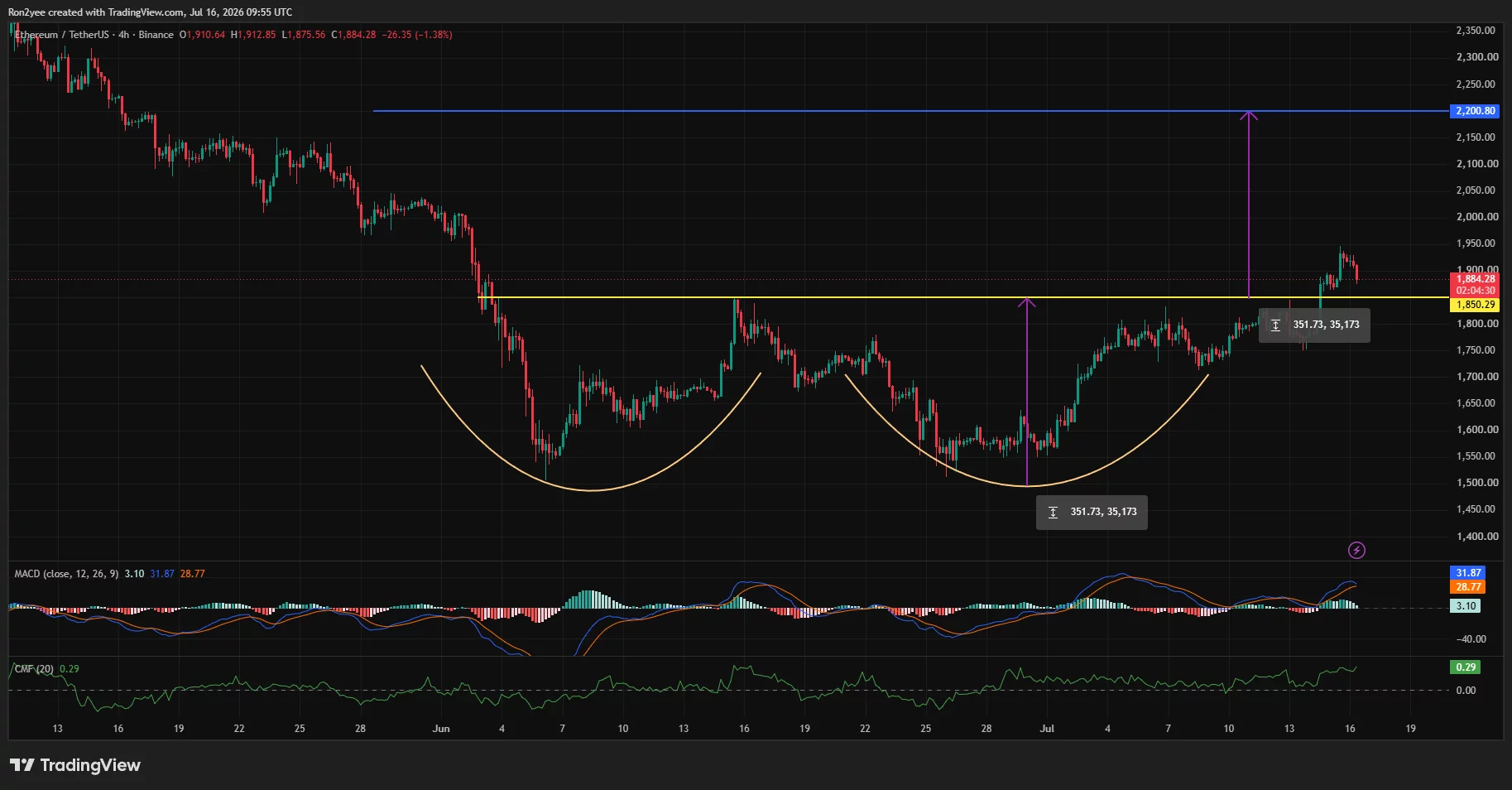
This former ceiling now represents the primary support level, while the measured move from the pattern projects an upside target near $2,200 if buyers regain control above the recent highs.
Momentum indicators continue to lean positive. The MACD remains above the zero line with its signal line intact despite a modest slowdown after the rejection, while the Chaikin Money Flow holds around 0.29, showing capital has continued entering Ethereum over recent weeks instead of exiting the market. Together, those indicators suggest the recent decline has so far resembled profit-taking rather than a complete trend reversal.
Liquidation data also identifies the next battleground. CoinGlass’ 3-day ETH liquidation heatmap shows one of the largest clusters of leveraged positions concentrated between roughly $1,840 and $1,860, reinforcing the importance of that support zone.
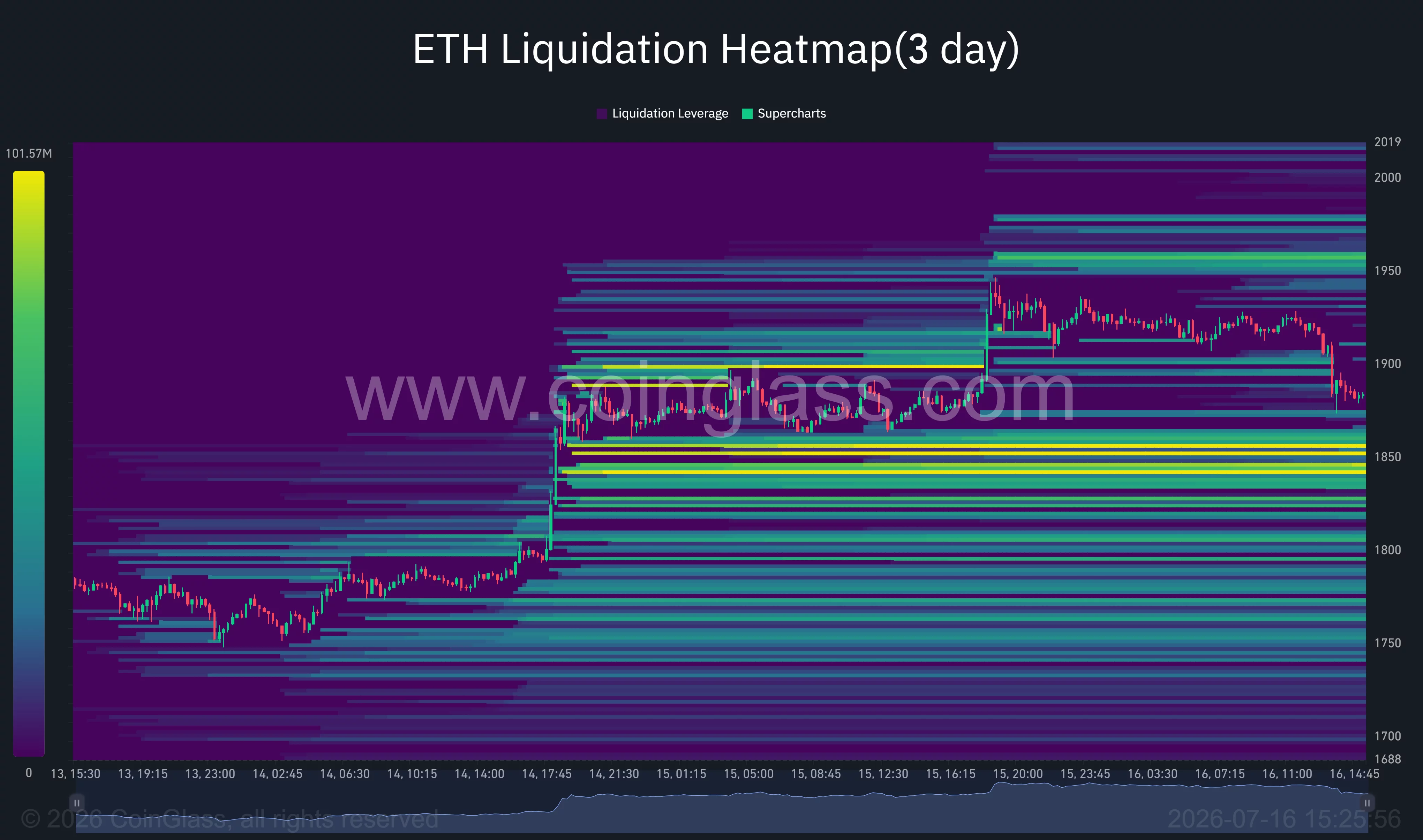
A successful defense there could allow Ethereum to target liquidity around $1,950 before challenging the psychological $2,000 level, where another large concentration of short liquidations sits waiting above price.
Commenting on the move, analyst Ted Pillows noted the recent decline remains a healthy pause rather than the start of a larger correction.
“As long as Ethereum holds above the $1,850 level, the next move will be towards $2,000.”
Separately, according to Michaël van de Poppe, the current environment remains a buy-the-dip market, adding, “There’s a lot more upside going to come on this one.”
Loss of $1,850 could delay the bullish breakout
Several risks could still invalidate Ethereum’s recovery. A decisive break below the $1,850 support would negate the recent breakout and expose the asset to a deeper retracement toward the $1,750-$1,800 region, where another concentration of liquidity has formed. Failure to hold that area would shift attention back toward the June base near $1,500.
Outside the charts, macro developments remain an important variable. Renewed strength in the U.S. dollar, higher Treasury yields, persistent spot ETF outflows, or fresh geopolitical tensions that lift energy prices could reduce demand for crypto assets again.
Exchange inflows from larger holders and continued capital rotation into AI and technology equities also present headwinds, making sustained spot buying essential if Ethereum is to convert its recent breakout into a move above $2,000.
Disclosure: This article does not represent investment advice. The content and materials featured on this page are for educational purposes only.


SBI Holdings has secured regulatory approval from Singapore’s central bank to take control of Holdbuild, the parent company behind crypto exchange Coinhako, completing a deal that strengthens the Japanese financial group’s footprint in Southeast Asia.
In a statement released Thursday, SBI said it received authorization from the Monetary Authority of Singapore (MAS), allowing the company to acquire shares from existing shareholders via a capital injection. Following the transaction, Coinhako will become a consolidated subsidiary of SBI.
Key takeaways
- SBI’s majority stake in Coinhako was enabled by MAS regulatory approval, making the acquisition effective through a capital injection.
- Coinhako operates under a Major Payment Institution license in Singapore via its subsidiary, Hako Technology Pte. Ltd.
- SBI plans to combine Coinhako’s customer base and regional network with its own financial services and digital asset initiatives.
- SBI’s strategy in Asia is advancing through a mix of acquisitions and infrastructure-building, including tokenization and stablecoin-related efforts.
Regulatory green light in Singapore
The move hinges on MAS authorization, which SBI said was a prerequisite to completing its majority acquisition of Holdbuild. Once the capital injection was carried out, SBI positioned Coinhako for consolidation within its group structure.
For Coinhako, the Singapore compliance framework matters. The exchange holds a Major Payment Institution license under MAS through Hako Technology Pte. Ltd., the operating subsidiary referenced in coverage of the transaction. That regulated footing is one reason the approval process is closely watched by market participants evaluating how smoothly crypto businesses can scale in highly supervised jurisdictions.
From February intent to majority control
SBI first disclosed its intention to buy a majority stake in Coinhako in February, signaling an expansion beyond Japan into a market it described as strategically important for digital assets. The latest announcement confirms that the deal cleared Singapore’s regulatory gatekeeping, turning a planned move into an operational corporate change.
While SBI did not provide financial details, its structure of acquisition—purchasing shares from existing holders through additional funding—suggests a direct ownership consolidation rather than a partnership model. For investors and industry watchers, that difference typically affects how future growth initiatives can be managed, financed, and integrated across the parent and subsidiary.
How SBI says it will use Coinhako
According to SBI, the acquisition is designed to merge Coinhako’s customer base and regional distribution capabilities with SBI’s broader financial services and digital asset businesses. The company specifically pointed to its JPYSC stablecoin initiative as part of its longer-term integration plans.
Such linkages are meaningful because stablecoin infrastructure and regulated exchange distribution can reinforce each other: exchange users often serve as on-ramps for stablecoin settlement and collateral use cases, while stablecoin rails can improve how value moves across services. SBI’s stated intent indicates it is aiming to align its Singapore presence with its payments and tokenization direction.
Financial terms of the transaction were not disclosed, and SBI did not immediately respond to a request for additional deal details. That leaves several practical questions open for the market, including the pace of operational integration and whether Coinhako’s product suite will be expanded with SBI-linked services.
SBI’s wider push across digital assets and tokenization
This acquisition fits within a broader pattern of SBI expanding in digital assets through investments, acquisitions, and infrastructure. Earlier this month, SBI led a $76 million Series C funding round for institutional crypto exchange EDX Markets, positioning the group in markets aimed at professional trading. SBI also previously shared plans to acquire Bitbank for $289 million, a move intended to build one of Japan’s largest crypto exchange platforms.
Beyond exchange ownership, SBI has been investing in the infrastructure layer. The company partnered with Ondo Finance to bring tokenized Japanese stocks and to integrate its JPYSC stablecoin for settlement and collateral, according to reporting that circulated this week. Earlier, SBI and Startale Group unveiled Strium, a layer-1 blockchain focused on tokenized securities and real-world assets, with designs intended to support continuous trading and tokenized equity settlement for institutional applications.
Taken together, SBI’s approach appears to be converging three areas: regulated distribution (via exchanges), tokenized asset issuance and settlement (via blockchain and tokenization efforts), and stablecoin utility (via JPYSC). Coinhako’s regulated status in Singapore and its regional network could give SBI a clearer pathway to deploy those capabilities outside Japan.
What to watch next
Readers should watch for how SBI operationally integrates Coinhako—particularly around stablecoin-related settlement and collateral use cases—and whether Coinhako’s product offerings expand in step with SBI’s tokenization and blockchain infrastructure. With MAS approval already in hand, the next milestones are likely to be execution details: integration timelines, governance changes, and any new regional initiatives announced after consolidation.
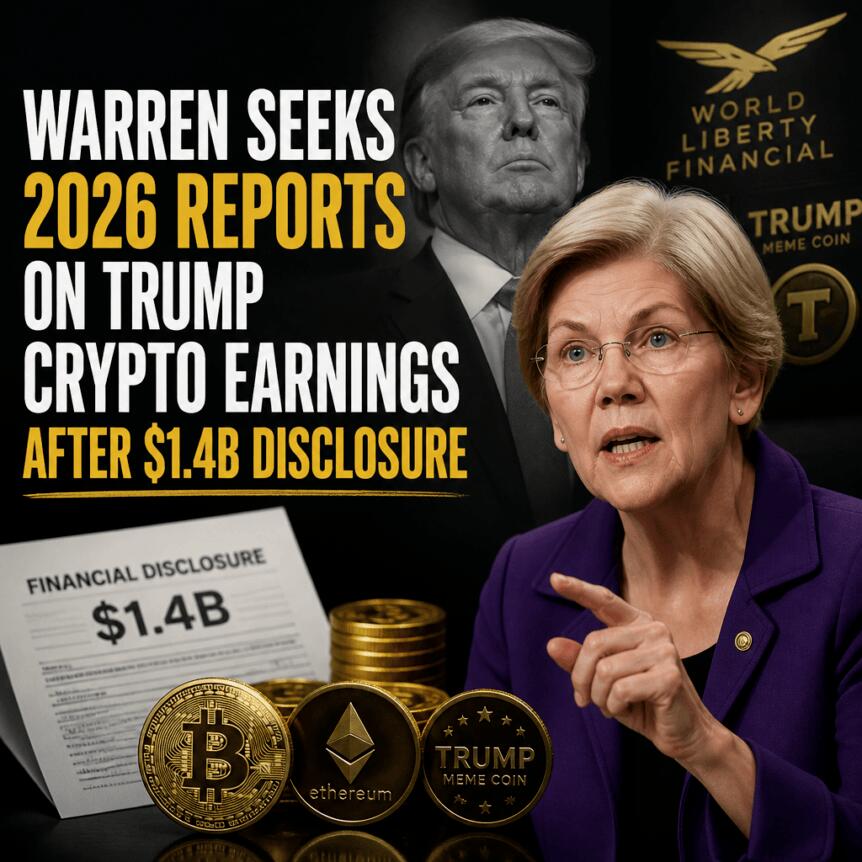
Senator Elizabeth Warren has urged President Donald Trump to provide updated information about his cryptocurrency earnings, arguing that the timing matters as the US Senate weighs a major crypto market structure bill.
In a letter sent to the White House, Warren asked Trump to voluntarily release a financial disclosure covering crypto-related income from Jan. 1 through July 15. The request is tied to pending consideration of the Digital Asset Market Clarity (CLARITY) Act, legislation Warren warns could worsen perceived conflicts of interest if stronger ethics guardrails are not in place.
Key takeaways
- Warren wants Trump to disclose crypto earnings for Jan. 1–July 15 ahead of a Senate vote on the CLARITY Act.
- The senator’s pressure follows disclosures filed in 2025 that showed significant crypto-related earnings.
- Warren argues the bill could “turbocharge” conflicts without adequate ethics protections.
- White House officials have previously said the president’s assets are held in discretionary accounts managed by independent third parties.
- House and Senate activity suggests CLARITY’s path depends not only on market rules but also on ethics provisions.
Warren presses for earlier crypto earnings disclosures
Warren’s Thursday letter requested that Trump provide an updated financial disclosure report covering his cryptocurrency earnings between Jan. 1 and July 15. The senator made the appeal ahead of a mandated reporting timeline: Warren noted Trump is not required to file his 2026 annual report until May 2027, but asked him to release the information voluntarily by July 23.
The deadline aligns with a period when the Senate is considering the CLARITY Act, a bill aimed at establishing a regulatory framework for digital assets. Warren’s central claim is that ethics questions surrounding the president’s and his family’s crypto holdings remain unresolved, particularly while lawmakers debate market structure provisions.
“Without adequate guardrails, [CLARITY] would turbocharge the President’s significant conflicts of interest and almost certainly boost the value of his and his family’s crypto holdings.”
Why the request follows the president’s 2025 disclosures
Warren’s call comes after Trump’s 2025 financial disclosures drew attention for large crypto-related earnings. According to reporting on the filings, Trump earned $1.4 billion from crypto-related ventures in 2025, including through his memecoin, Official Trump (TRUMP), and via his family’s company World Liberty Financial. (Those details were highlighted in earlier coverage on Cointelegraph, referencing the disclosures.)
The new request focuses on a shorter, more current window—Jan. 1 to July 15—suggesting Warren wants lawmakers and the public to understand how crypto-related interests may be evolving while Congress evaluates CLARITY.
Warren also questioned the broader appropriateness of senior officials and their families profiting from the crypto industry during active legislative consideration of a bill she says could affect the value of crypto holdings.
White House response and the ethics debate around CLARITY
Cointelegraph reported that Warren’s office was contacted for comment but did not provide an immediate response. The same reporting noted that during a July 2 interview, Trump said there was “nothing illegal” and “nothing wrong” with profiting from his crypto investments as president. Separately, White House spokesperson Anna Kelly said that “all of the president’s assets are in held in fully discretionary accounts managed by independent third-party financial institutions” and that “there are no conflicts of interest.”
That exchange highlights a key tension in the current debate: while the White House emphasizes third-party management and the absence of conflicts, Warren argues that the existence of significant holdings—combined with a potentially market-moving legislative package—creates conflicts that require more explicit guardrails.
Senate Majority Leader John Thune has indicated the chamber plans to hold a vote on the crypto bill before the Senate breaks for August state work periods. Cointelegraph previously noted that many Democrats have signaled they will not support legislation without clearer ethics provisions, with some pointing specifically to potential conflicts connected to Trump’s holdings.
CLARITY gathers momentum in the House while Senate scrutiny grows
Activity around CLARITY has not been limited to the Senate. On Friday, the House Financial Services Committee’s Subcommittee on Digital Assets, Financial Technology, and Artificial Intelligence held a field hearing in New York City focused on the bill.
According to Cointelegraph’s account of the hearing, CLARITY had already passed the House of Representatives in July 2025, but would return to the chamber if approved in the Senate with 60 votes. Representative French Hill—who chairs the full committee and attended the hearing—described CLARITY as a “bipartisan priority.”
Still, the hearing also reflected partisan and procedural friction. Cointelegraph reported that no Democratic representatives appeared to attend the session. The outlet also said it reached out to Democratic lawmakers on the committee for comment but did not receive an immediate response. A related Cointelegraph piece previously framed the CLARITY process as facing a partisan struggle centered on ethics on the Senate floor.
Taken together, the events suggest CLARITY’s prospects depend on more than simply whether the legislation can win enough votes in each chamber. The debate now appears to be increasingly about whether lawmakers believe current disclosures and account structures are sufficient—or whether additional ethics and conflict-of-interest protections must be embedded directly into the bill itself.
As the July 23 disclosure request and the Senate vote timetable approach, investors and builders should watch for any added ethics language that could shift the bill’s support in the upper chamber. The uncertainty remains whether lawmakers will treat third-party managed discretionary accounts as resolving concerns—or whether stronger statutory guardrails will be required before CLARITY can move forward.

Stablecoins are increasingly moving beyond the “faster transfer” narrative and into more basic functions: helping people and businesses access dollars when local currency conditions are unstable. In Bolivia, a new proposal would formally recognize Tether’s USDT for payments—an attempt to widen access to dollar-denominated value as the country grapples with persistent foreign-exchange pressure.
Meanwhile, the market’s attention is also shifting to how crypto-native infrastructure companies translate new strategies into shareholder value. Bitcoin miners pitching AI and high-performance computing plans are drawing renewed scrutiny as investors focus on governance and insider activity, even as selected deals attract major attention.
Key takeaways
- Bolivia is reviewing a framework that would allow USDT to circulate alongside the boliviano and the U.S. dollar for payments and savings, with anti-money laundering controls planned.
- The push is tied to a prolonged shortage of dollars and widening pressure on official versus parallel exchange rates, increasing demand for dollar-denominated alternatives.
- Bitcoin miners’ AI infrastructure pivots are facing closer investor scrutiny, including questions around insider stock sales and whether AI-driven upside reaches public shareholders.
- CleanSpark’s Georgia data center lease highlights the sector’s effort to replace or supplement mining revenue with longer-term infrastructure contracts.
- Bitmine reported $45.7 million in revenue from Ethereum staking and validation last quarter, underscoring that staking businesses can remain cash-generative even when token prices are choppy.
Bolivia moves to recognize USDT as a payment option
Bolivia is considering a regulatory approach that would recognize Tether’s USDT as a payment currency, according to earlier coverage from Cointelegraph (Bolivia weighs USDT payment currency amid dollar shortage). If adopted, the rules would reportedly enable USDT to circulate in parallel with the boliviano and the U.S. dollar for both payments and savings.
Economy and Public Finance Minister Jose Gabriel Espinoza said the proposal would also include anti-money laundering safeguards. That matters in Bolivia’s case because the country is still on the Financial Action Task Force’s “gray list,” a status that tends to raise compliance expectations for any financial product that could touch broader cross-border flows.
The initiative follows two related developments. First, Bolivia lifted its crypto ban in 2024. Second, Cointelegraph previously reported that the new administration has pledged to broaden access to digital asset services (Bolivia integrate crypto stablecoins financial system).
While stablecoins have often been marketed as a tool to move value quickly across borders, Bolivia’s case highlights a different driver: domestic dollar scarcity. The proposal comes as Bolivia has faced a prolonged shortage of U.S. dollars after pressures on foreign-exchange reserves forced the government to abandon a long-standing currency peg earlier this year. That shift has increased demand for dollar-denominated alternatives, with USDT becoming a practical payment channel for those seeking steadier value than the boliviano.
For investors and builders, the significance is not only policy-level. It’s a signal that stablecoins are being pulled into mainstream economic coping mechanisms—especially in markets where official access to dollars is constrained and parallel market spreads are widening. What remains uncertain is how quickly the framework could move from proposal to implementation, and how regulators will operationalize AML requirements in practice.
Miners’ AI strategy meets governance and insider-trading questions
In a separate thread of crypto industry news, investor attention is increasingly turning from miners’ AI aspirations to the question of execution and accountability. Earlier coverage from Cointelegraph noted that investors are scrutinizing insider stock sales at Bitcoin miners pursuing AI infrastructure strategies as enthusiasm for the theme cools and governance concerns come into focus (Bitcoin miners’ AI pivot faces investor scrutiny over insider sales).
According to Blocksbridge Consulting, executives at TeraWulf, Cipher Digital, Riot Platforms, and Core Scientific have disclosed stock sales in recent months. Many of these sales were reportedly made under prearranged Rule 10b5-1 trading plans. In addition, Blocksbridge said that some strategic investors also reduced their holdings, including Tether—reported to have cut its stake in Bitdeer after Bitdeer’s AI-related rally.
The scrutiny is landing at a time when the AI narrative may not be performing as strongly as investors expected. Cointelegraph cited that the TEM AI Infrastructure Growth Index has fallen 16% over the past month, suggesting the “AI tailwind” for infrastructure-adjacent equities has cooled.
Blocksbridge’s framing for why this matters is straightforward: investors are looking beyond the AI growth story to evaluate whether the benefits of miners’ strategic pivots are translating into value for public shareholders. In other words, it’s not enough to adopt AI infrastructure as a theme—markets want clarity on timing, cash flows, and whether management’s incentives align with long-term shareholder outcomes.
CleanSpark’s lease deal signals a shift toward contracted infrastructure revenue
Even with investor scrutiny in the background, not all AI infrastructure developments are treated equally. CleanSpark’s stock surge—reported as up as much as 22%—followed its signing of a 20-year data center lease in Georgia, according to Cointelegraph coverage (CleanSpark shares jump after Georgia data center lease).
The agreement covers a 175-megawatt data center at the company’s Sandersville, Georgia campus. Cointelegraph reported the lease was signed with an undisclosed investment-grade global technology company, with the tenant expected to install computing equipment at the site. Phased deliveries are expected to begin in the fourth quarter of 2027.
CleanSpark could see substantial contracted revenue: Cointelegraph said the deal could generate up to $6.6 billion in contracted revenue. If the customer exercises two five-year extension options, the total value could reportedly reach $11.6 billion. Deals like this can be especially important for miners because they may provide more predictable income streams beyond operating-margin swings tied to mining economics.
The context also matters. Cointelegraph noted that the agreement reflects a broader trend among publicly traded miners seeking new revenue sources as post-halving mining conditions remain under pressure. While many peers have reduced Bitcoin holdings to bolster liquidity, CleanSpark has largely remained a net accumulator, though it reportedly sold some BTC earlier this year to fund operations. The company’s stance is closely watched because it influences how aggressively it can invest while still maintaining exposure to Bitcoin’s upside.
For readers following the sector, the key is to watch whether more miners can structure similar long-term contracts with clear timeline milestones—and whether these assets produce measurable diversification benefits in financial results, not just in announcements.
Bitmine adds $45.7 million from Ethereum staking and validation
On the business side of crypto infrastructure, Bitmine Immersion Technologies reported financial performance driven heavily by staking. According to Cointelegraph, the company generated $45.7 million in revenue from Ethereum staking and validation last quarter (Bitmine generated $46m from Ethereum staking last quarter).
For the three months ended May 31, Ethereum staking represented 98% of Bitmine’s revenue. By comparison, Cointelegraph reported $624,000 from self-mining Bitcoin and $168,000 from consulting services.
The results build on Bitmine’s staking platform roadmap. Cointelegraph noted that Bitmine launched MAVAN in March, an institutional Ethereum staking platform built on the acquisition of validator operator Pier Two Holdings. The company said it has staked roughly 85% of its Ether holdings—about 4.9 million ETH.
Chairman Tom Lee said Bitmine now stakes more Ether than any other entity and projects annualized staking rewards of $284 million once its holdings are fully staked through MAVAN and its partners. Even without the narrative excitement that often surrounds mining-related headlines, staking operations can offer a different kind of resilience: fees and staking participation can remain a core revenue engine when price volatility affects trading activity.
What to monitor next is how quickly Bitmine can reach full staked exposure through MAVAN and partner channels, and whether the company’s reward outlook holds as network conditions and competitive staking dynamics evolve.
Across these stories, the common thread is how crypto infrastructure is adapting to real constraints—whether that’s dollar shortages driving stablecoin payments, or miners searching for steadier cash flows through contracted computing capacity, or staking providers scaling revenue through platform distribution. The near-term question for market participants is which of these approaches translate into durable compliance, predictable income, and shareholder-aligned governance rather than just short-lived momentum.


Robert Kiyosaki said he bought more gold and silver during the latest pullback, echoing Jim Rogers with a blunt forecast on July 17 that both metals are headed higher.
The author of “Rich Dad Poor Dad” frames the retracement as an opportunity, though critics see familiar risks.
The Brutal Pullback Behind Kiyosaki’s Latest Call
A retracement is a temporary price decline inside a broader uptrend, distinct from a full reversal. Traders watch these pullbacks closely because they often shake out recent buyers before the trend resumes.
The recent numbers show why the topic matters. Gold reached a high near $5,405 before sliding back toward $4,006, a drop of roughly 26%.
Follow us on X to get the latest news as it happens.
Silver moved even more violently. The precious metal climbed to $118, then retraced to $56, cutting its peak by more than half.
Kiyosaki quoted JimRogers directly on X, writing that gold and silver are going to the moon. He added an important caveat from the veteran commodities investor.
According to that view, the eventual surge will not arrive in a straight line. Severe retracements and heavy volatility should be expected along the way, testing investor resolve.
“Interesting, many ‘speculators’ buy at the TOP then selling at the BOTTOM. I am in agreement with my friend Jim Rogers. During this last ‘retracement’ or ‘crash’ I bought more gold and silver,” Kiyosaki said on X.
The behavioral point sits at the center of his argument. Kiyosaki claims many speculators buy at peaks driven by fear of missing out, then panic-sell at lows.
Why are Kiyosaki and Rogers Bullish on Gold and Silver
Kiyosaki also revealed that he had bought more metals during the drop. Asked by a friend for his reasoning, he pointed to a troubled global economy and his distrust of central banks and political leaders.
His overall position is neither new nor subtle. For years, he has warned about government debt, fiat currency devaluation, and the steady erosion of purchasing power through inflation.
The context helps explain the audience. Elevated national debts, geopolitical tensions, and doubts about monetary policy keep pushing capital toward perceived safe havens.
For Jim Rogers, Gold and silver form his standard duo of recommended hedges. The thesis holds that tangible assets with intrinsic value protect wealth when institutional trust deteriorates.
“Gold and silver have been going straight up. I am not buying now, but I am not selling either. If they go down, I hope I am smart enough to buy more,” Rogers previously noted.
The counterargument deserves equal space. Precious metals yield nothing, and their volatility can punish investors who mistime entries or lack patience.
Kiyosaki himself repeats that he is not a financial advisor. He encourages readers to research independently and consult professionals before acting on anything he publishes.
Whether the lunar trajectory materializes remains unproven. The debate, meanwhile, keeps drawing attention from investors worried about preserving wealth.
Subscribe to our YouTube channel to watch leaders and journalists provide expert insights.
The post Robert Kiyosaki and Jim Rogers Give Moonshot Prediction for Gold and Silver appeared first on BeInCrypto.

Galaxy Digital has secured a 15-year naming rights deal with Texas Tech, renaming the university’s football stadium “Galaxy Stadium” starting with the 2026 season. The announcement also positions Galaxy as Texas Tech Athletics’ official data center and digital assets partner, with both sides pointing to collaboration on student-athlete NFT and broader AI initiatives.
Under the partnership, the venue’s new name will debut on Sept. 5, when Texas Tech opens its season against Abilene Christian. Financial terms were not disclosed.
Key takeaways
- Galaxy Digital signed a 15-year naming rights agreement that renames Texas Tech’s stadium “Galaxy Stadium” beginning in 2026.
- Galaxy will serve as Texas Tech Athletics’ official data center and digital assets partner.
- The parties plan to explore student-athlete name, image and likeness (NIL) opportunities alongside AI initiatives and workforce development.
- Galaxy’s move extends its presence in West Texas, where it operates the Helios data center campus with approved capacity aimed at AI and high-performance computing.
Why this deal goes beyond branding
Naming-rights arrangements are nothing new in collegiate sports, but Galaxy’s agreement is structured to tie its infrastructure and digital assets capabilities directly to athletics operations. Alongside the stadium name change, Texas Tech Athletics will adopt Galaxy as its “official data center and digital assets partner,” creating a platform for technical collaboration that can affect everything from data handling to AI-focused projects.
The partnership framework also highlights business development goals beyond entertainment value. Texas Tech and Galaxy said they plan to collaborate on student-athlete NIL opportunities, artificial intelligence initiatives, and workforce development programs. For investors and builders, that matters because it suggests Galaxy is not just pursuing consumer-facing visibility; it is seeking real-world integration with institutional workflows and talent pipelines.
The 2026 kickoff date gives both sides a runway to align on technical and program requirements ahead of the Sept. 5 season opener against Abilene Christian.
Galaxy’s West Texas footprint meets Texas Tech
The new agreement expands Galaxy’s reach in West Texas, where it already operates the Helios data center campus in nearby Dickens County, about 60 miles east of Lubbock.
According to Galaxy’s announcement, the Helios site has 1.6 gigawatts of approved capacity for artificial intelligence and high-performance computing (HPC). That approved power is a key detail for anyone tracking the race among infrastructure providers: data centers increasingly need both power availability and AI-ready capacity, and partnerships like this can help anchor long-term demand for compute capacity and related services.
While naming rights primarily function as marketing, attaching the agreement to data center and digital assets partnership suggests the collaboration could leverage that approved compute posture toward athletics-related research, analytics, and AI initiatives—especially as universities look for scalable technology partners.
Texas continues to court crypto infrastructure and policy
This stadium deal lands amid a broader push by Texas to become a central destination for crypto-adjacent activity, pairing large-scale mining and digital infrastructure growth with political momentum and pro-crypto policy moves.
Texas already hosts several prominent mining and infrastructure operators, including Riot Platforms, Cipher Mining, Core Scientific, CleanSpark, IREN and Hut 8.
Recent investment activity cited in earlier coverage underscores the state’s pull. In February, Canaan acquired a 49% stake in three operating Texas mining facilities from Cipher Mining for nearly $40 million, as reported by Cointelegraph (see original report). Earlier in the same month, MARA Holdings announced plans to acquire a 2-gigawatt powered site in Texas to develop a digital infrastructure campus supporting both HPC and Bitcoin mining, according to Cointelegraph’s coverage (see original report).
Beyond industry investment, political spending has also been a notable component of the Texas story. In May, industry-affiliated political action committees spent more than $10 million supporting candidates in Texas congressional primary runoffs, and Cointelegraph reported that all six backed candidates won (see original report).
Policy developments have reinforced the same direction. Last year, Gov. Greg Abbott signed legislation creating the Texas Strategic Bitcoin Reserve, following the enactment of Texas Senate Bill 21. Cointelegraph previously reported that state officials began transitioning reserve holdings from a spot Bitcoin ETF to directly custodied bitcoin in May (see original report). The bill history is maintained by the Texas Legislature (Texas Legislature).
What to watch next
The Galaxy–Texas Tech partnership raises practical questions that will matter once the agreement moves from announcement to execution: how the NIL and AI programs are designed, what role digital assets will play in athletics-specific workflows, and whether Helios’s approved AI/HPC capacity translates into measurable university and sports-related deployments. With the stadium renaming scheduled for the Sept. 5 opener, the next signposts to track are program milestones and the rollout timeline for the planned NIL, AI, and workforce initiatives.


A North Korean developer spent about a month inside MetaMask, a leading crypto wallet used by more than 30 million people each month. Its maker, Consensys, did not know who he really was.
He used a fake name, Tyler Knapp. He helped write core wallet code. Some of it moved money between crypto and cash. Then Consensys caught him, cut his access, and found nothing had been taken.
How the North Korean developer got in
He came in through a contractor. Consensys hired him as a consultant, not a full employee. On GitHub, he used the handle imyugioh. His code changes ran from March 9 until April, when the company cut him off.
That access worries investigators. Intelligence firm TRM Labs says developer setups are now the fastest route to a crypto firm’s keys. Attackers use them to reach the systems that approve withdrawals.
In April, general counsel Matt Corva told staff to halt all product releases and avoid the man. The firm alerted law enforcement and is reviewing its contractor vetting process.
“We discovered the threat… and launched a comprehensive investigation that confirmed there was no misappropriation of assets or data, no malicious code deployed, and no impact to user safety and security,” Matt Corva, Consensys general counsel said in a statement to Drop Site News.
Follow us on X to get the latest news as it happens
Why North Korea Keeps Trying
This was not a one-off. North Korean workers pose as engineers to win remote jobs, then steal secrets or plant a way back in. One Ethereum-funded project recently found 100 suspected North Korean IT workers across 53 crypto projects.
The trick usually starts with a fake job offer or a phony recruiter. US courts have jailed Americans for helping these workers look local.
The stakes are huge. Last year, North Korean hackers stole $1.5 billion from the Bybit exchange, the FBI said. TRM Labs says the country took more than half of the $2.7 billion lost to crypto hacks in 2025.
Some crypto firms are fighting back. They now share threat intelligence to catch them early.
Consensys caught this one in time. The test is whether the next firm spots its fake hire before the code ships.
The post MetaMask Owner Uncovers North Korean Developer Hidden in Its Team appeared first on BeInCrypto.
The FTX Recovery Trust says its next round of creditor repayments will begin on July 31, with approximately $900 million earmarked for eligible claimants. In a notice published Friday, the trust said funds will be distributed to creditors under the plan’s “convenience” and “non-convenience” claim categories.
For eligible creditors, payments are expected to be sent to BitGo, Kraken, or Payoneer accounts, with transfers taking one to three business days after the July 31 start date. This will be the fifth distribution effort under the recovery plan.
Key takeaways
- The FTX Recovery Trust plans a new creditor payout starting July 31, totaling about $900 million.
- Claimants can receive reimbursement via BitGo, Kraken, or Payoneer, typically within one to three business days after July 31.
- “Convenience” claims under $50,000 are set to receive 120% reimbursement under the recovery plan, while other claims are expected at roughly 103–105%.
- The payment marks the fifth payout round, following earlier large distributions since FTX filed for bankruptcy in November 2022.
What the July 31 distribution covers
According to the notice, the July 31 distribution will cover claimants in two groups: “convenience and non-convenience classes” included in the recovery plan. The trust estimates the payout will be “about $900 million” to creditors through the reimbursement framework laid out for different claim sizes and circumstances.
The structure remains tied to reimbursement levels set by the plan. Creditors with convenience claims under $50,000 are scheduled to be reimbursed at 120%. For other eligible claimants, the distribution is described as falling in the 103–105% range.
Progress since bankruptcy filing
FTX filed for bankruptcy in November 2022 as the broader crypto market downturn triggered waves of exchange failures and Chapter 11 filings. Since then, the Recovery Trust has pushed forward a multi-stage repayment process.
Earlier distributions included a March payout of $2.2 billion, referenced in earlier reporting by Cointelegraph. That round contributed to an overall payout figure of about $10 billion paid out to creditors, based on the trust’s cumulative repayment progress described in the same reporting context.
With the July 31 distribution, the trust is effectively continuing a steady cadence—one that matters for creditors because it converts long-running claims into liquid reimbursements over time, reducing uncertainty even as final amounts and timing remain contingent on the recovery plan’s execution.
FTX announces fifth distribution (PR Newswire)
Legal and settlement updates around the collapse
While the trust works through distributions, litigation tied to FTX’s collapse continues to run in parallel. Earlier reporting from Cointelegraph noted that Fenwick & West, the law firm that advised FTX before its collapse, agreed to pay $54 million to settle a class action lawsuit brought by former users.
Cointelegraph also reported that a separate lawsuit sought $525 million, filed days earlier by a group of 20 FTX users alleging the law firm’s role in the failure. These disputes underscore that FTX’s bankruptcy is not only about liquidation and repayment mechanics—it is also entangled with contested responsibility among parties involved in the broader ecosystem of the exchange’s operations and aftermath.
Cointelegraph on the $54 million Fenwick & West settlement
Cointelegraph on the $525 million lawsuit
Clemeny prospects for Sam Bankman-Fried face new political headwinds
Separately from the repayment schedule, the fate of former FTX CEO Sam “SBF” Bankman-Fried remains a major ongoing storyline. Bankman-Fried was found guilty and sentenced to 25 years in prison in 2024 for his role in the misuse of customer funds, and his appeal was denied last month after a federal court upheld a New York court ruling, as covered by Cointelegraph.
Cointelegraph also reported that Bankman-Fried applied for a pardon from Donald Trump. Trump indicated in a January interview that he did not plan to grant such clemency. In this week’s development, the US Senate unanimously adopted a resolution opposing clemency for Bankman-Fried.
Although the resolution cannot stop the president from issuing a pardon if he chooses to do so, it signals bipartisan resistance within Congress—an important political factor for anyone tracking how public pressure and legislative sentiment might shape clemency decisions.
The clemency debate has also been tied by lawmakers to broader concerns about how high-profile crypto-related criminal cases are treated. Cointelegraph reported that criticism has extended to Trump’s decision to pardon former Binance CEO Changpeng Zhao following a UAE investment into Binance using a stablecoin linked to World Liberty Financial, a project associated with the Trump family business.
Cointelegraph on the denial of SBF’s appeal
Cointelegraph on SBF’s clemency bid
Cointelegraph on the Senate resolution opposing clemency
For creditors and market participants, the July 31 distribution date is the immediate practical milestone—something to watch for in payment confirmations on supported platforms. At the same time, the political fight over clemency for Bankman-Fried remains unresolved, and developments there could still influence the broader public narrative around FTX’s fallout and its lingering legal and regulatory consequences.
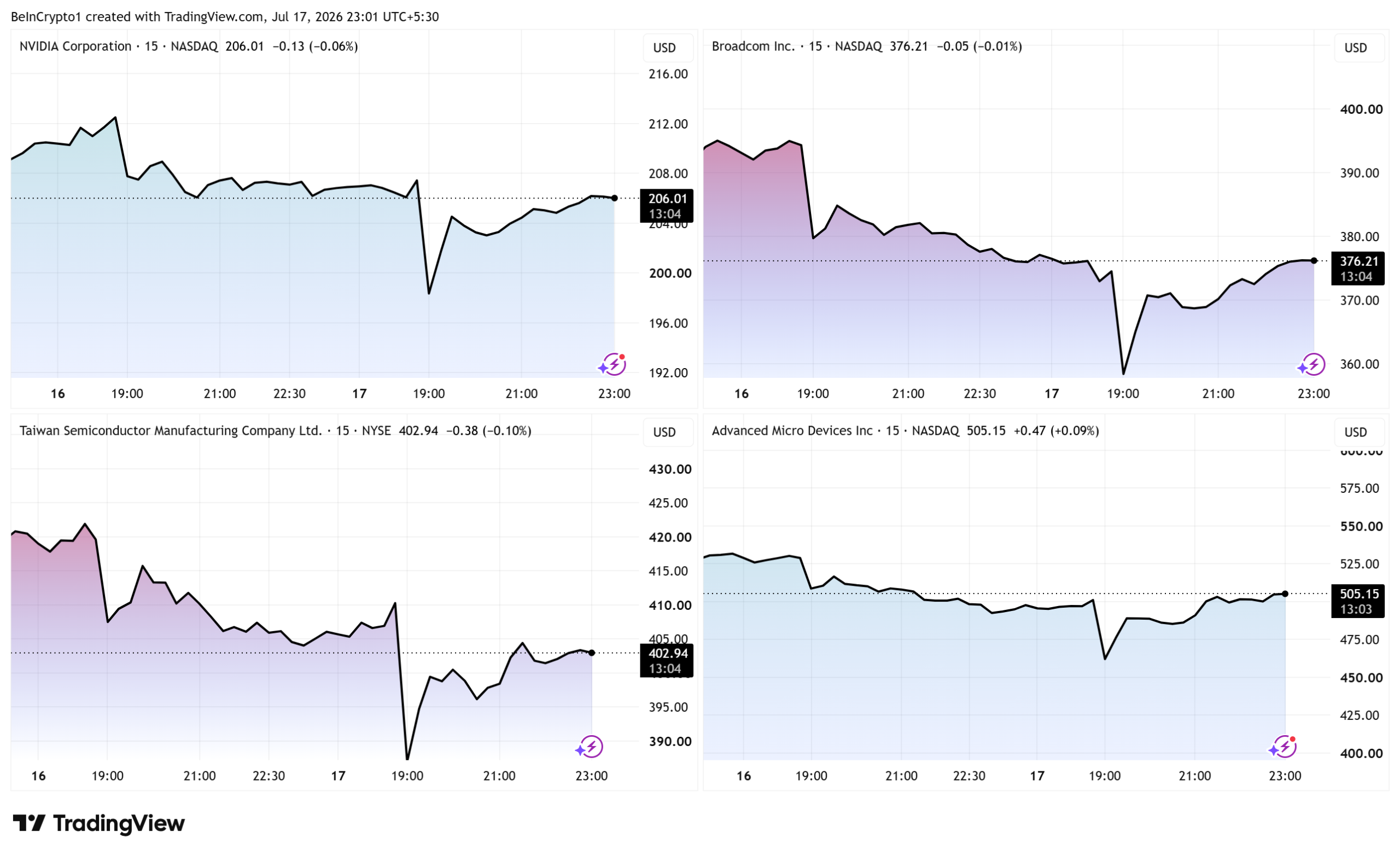
China’s Moonshot released Kimi K3 on Thursday, a model it says matches Anthropic’s Claude Fable and OpenAI’s GPT-5.6. US chip stocks sank as investors asked if America’s AI lead is safe.
Kimi K3 packs 2.8 trillion parameters, making it the largest open model ever released. Moonshot, an Alibaba-backed startup, will let anyone download it free from July 27.

Chip Stocks Just Had Their Worst Week in 15 Months
The Philadelphia Semiconductor Index, which tracks America’s biggest chipmakers, fell 12.5% this week, marking its worst week in over 15 months. Nvidia, AMD, and Broadcom all fell hard. Still, the index remains up more than 60% this year.

“Investors are questioning the strength of the AI-driven rally after China’s Moonshot unveiled a powerful open AI model. Nvidia, AMD and Broadcom all fell sharply, though the chip index remains up more than 60% this year,” Walter Bloomberg noted.
China’s own AI stocks fell too. In Hong Kong trading on Friday, Zhipu dropped 28% and MiniMax lost 16%, per market data. Meanwhile, the AI bubble question is back in focus.
Markets have seen this movie before. When China’s DeepSeek stunned Wall Street in January 2025, Nvidia lost $589 billion in one day. CNBC called it the biggest single-day loss in market history.
CNBC host Jim Cramer expects a repeat, and says the real issue is trust.
Follow us on X to get the latest news as it happens
Traders are even betting on the fight itself:
- Bernstein says crypto-style derivatives now trade on AI computing power.
- CME Group plans the first compute futures with Silicon Data,
- ICE announced GPU contracts with Ornn.
Why Kimi K3 Has Everyone’s Attention
Kimi K3 earned the hype. This week, it topped Arena’s coding leaderboard with 1,679 points, pushing Claude Fable 5 into second place.
It is also cheap. Moonshot charges $3 per million input tokens, while Fable 5 costs $10. The model reads a million tokens at once, enough to hold an entire codebase in one prompt.Founder and CEO Zhilin Yang explained the plan in a recent session.
He named three ways to scale AI: Squeeze more from each token, stretch the context, and run agent swarms in parallel.
“…token efficiency is not just about efficiency. It’s actually also about improving the upper bound of intelligence,” read a transcript of his Yang’s speech.
What Kimi K3 Means for America’s AI Lead
Price is the first battleground. Days before the launch, investor Chamath Palihapitiya priced the problem on CNBC’s Squawk Box. A million tokens costs $56 from Anthropic, $26 from OpenAI, and 50 cents from Chinese labs, he said.
Usage tells the same story. Chinese models have overtaken US rivals in monthly token use. Washington keeps squeezing chip exports, and Nvidia just purged Asian chip buyers.
Yet Moonshot trained its recent models on Nvidia’s export-grade H800 chips anyway.
America still holds the top scores on most major benchmarks. However, July 27 changes the math, because anyone can then run Kimi K3 for free.
If trust keeps enterprise money in US models, as Cramer argues, the lead holds. If price wins, the race gets very close, very fast.
The post China’s Kimi K3 Hits US Stock Markets. Is the American AI Boom Over? appeared first on BeInCrypto.
The FTX Recovery Trust says its next wave of payments to creditors tied to the defunct exchange will begin on July 31, with about $900 million earmarked for eligible claimants. The distribution is the fifth attempt under the trust’s court-approved recovery plan, continuing a multi-year process that has already returned roughly $10 billion since FTX filed for bankruptcy in November 2022.
In a notice released Friday, the trust said creditors in the plan’s “convenience and non-convenience classes” can expect payouts through BitGo, Kraken, or Payoneer accounts. Payments are scheduled to start on July 31 and are expected to land within one to three business days for those who are eligible.
Key takeaways
- The FTX Recovery Trust plans a new distribution of about $900 million starting July 31 for “convenience and non-convenience” creditor groups.
- Eligible creditors can receive funds via BitGo, Kraken, or Payoneer accounts beginning July 31, with transfers expected within one to three business days.
- Under the recovery plan, convenience claims under $50,000 are set to be reimbursed at 120%, while other claims are projected at roughly 103%–105%.
- The July 31 payment marks the fifth distribution since the bankruptcy filing, following earlier payouts including a $2.2 billion distribution in March.
Next FTX creditor payout set for July 31
According to the Friday notice, the upcoming distribution will send approximately $900 million to creditors classified under the recovery plan’s two groups: “convenience and non-convenience classes.” The trust did not indicate in the notice an alternate schedule for different claimants, instead tying the start of distribution to a single date—July 31—with the practical timeline depending on the payment rails used.
For claimants using BitGo, Kraken, or Payoneer, the trust said funds should be available within one to three business days after the July 31 start. This matters for creditors because the trust’s distributions have become a key milestone for claimants watching for liquidity after years of legal and administrative delays following FTX’s collapse.
How reimbursement levels work under the plan
The notice also reiterated the recovery plan’s reimbursement framework. Convenience claims under $50,000 are expected to receive 120% reimbursement, while non-convenience claims are projected to receive a distribution in the 103%–105% range.
That structure reflects a common approach in insolvency distributions: smaller claims are often treated more favorably to reduce friction and ensure faster, simpler resolution for retail-sized creditors. Larger claims typically receive slightly less, reflecting the available asset pool and the plan’s calculations across categories.
What has already been paid since FTX’s bankruptcy
The July 31 distribution will be the fifth creditor payment attempt connected to the trust’s recovery process. After a March distribution of $2.2 billion, the trust has paid out about $10 billion in total since FTX entered bankruptcy in November 2022.
Earlier coverage from Cointelegraph noted that the March distribution was part of the trust’s continuing efforts to unwind the exchange’s estate during a period when the broader crypto market was still reeling from the 2022 downturn. When FTX collapsed, it triggered multiple Chapter 11 filings across the sector, as liquidity stress and customer withdrawals rippled through the industry.
As payments continue, creditors will likely be attentive to whether later distributions match the same reimbursement percentages—or if the economics of recovery change as the trust works through remaining assets, legal complexities, and administrative processes.
Ongoing legal fallout and clemency debate
FTX’s recovery story has continued alongside criminal proceedings involving former leadership. Former FTX executives including CEO Sam “SBF” Bankman-Fried and Ryan Salame—co-CEO of FTX’s Bahamian affiliate—remain in federal prison connected to the misuse of customer funds.
Bankman-Fried, who pleaded not guilty to criminal charges, was found guilty and sentenced to 25 years in prison in 2024. Cointelegraph reported that his appeal to overturn his conviction and sentence was denied last month after a federal court upheld the prior New York ruling.
Alongside the court process, Bankman-Fried had sought clemency. Before the appellate decision became public, he applied for a presidential pardon from Donald Trump, and Trump indicated in a January interview he did not plan to grant such a request, according to reporting by The New York Times. Even so, this week the US Senate adopted a resolution opposing clemency for the former FTX CEO, and described bipartisan concern over the prospect of a pardon for a convicted felon.
Cointelegraph has also reported that lawmakers criticized Trump’s pardon of former Binance CEO Changpeng Zhao, adding to the broader political friction surrounding clemency decisions in high-profile crypto cases.
Meanwhile, the civil side of the fallout has continued. In May, the law firm Fenwick & West—according to coverage by Cointelegraph—agreed to pay $54 million to settle a class action lawsuit brought by former users. Cointelegraph also reported earlier that a group of 20 FTX users sued Fenwick & West for $525 million shortly before that settlement agreement.
With another distribution scheduled for late July, creditors will have a near-term datapoint for how the recovery plan is progressing. The next question is whether future distributions will continue on a similar cadence and whether remaining legal and asset-related variables—rather than payout mechanics—will ultimately determine how quickly the trust can close out the recovery process.

Galaxy Digital has secured a 15-year naming rights agreement with Texas Tech University, with the school announcing that its football stadium will be renamed Galaxy Stadium starting in the 2026 season. The partnership is also designed to extend beyond branding, positioning Galaxy as an official partner for data center services and digital assets within Texas Tech Athletics.
According to the announcement, the venue will debut under its new name on Sept. 5, when Texas Tech opens its season against Abilene Christian. Financial terms were not disclosed.
Key takeaways
- Texas Tech Stadium will be renamed Galaxy Stadium for the 2026 season, starting Sept. 5.
- Galaxy will serve as the university’s official data center and digital assets partner for athletics.
- The agreement aims to cover AI initiatives, student-athlete name, image and likeness opportunities, and workforce development.
- The deal reinforces Galaxy’s presence in West Texas, where it operates the Helios data center campus.
- The announcement lands as Texas continues expanding its crypto footprint through both infrastructure investment and pro-crypto policy.
What Galaxy’s Texas Tech deal actually covers
Galaxy Digital’s agreement with Texas Tech includes a combination of commercial branding and operational collaboration. Beyond the naming rights, the company will be the official provider for data center services and digital assets related to Texas Tech Athletics.
The partners said they plan to work together on student-athlete name, image and likeness (NIL) opportunities, alongside artificial intelligence initiatives and workforce development programs. While details of the programs were not expanded in the announcement, the scope signals a broader strategy: using university athletics as a platform for workforce and technology-oriented partnerships tied to digital infrastructure.
For Galaxy, it also creates a high-visibility link between its infrastructure footprint and a major institutional brand, while for Texas Tech it offers a clear pathway to connect compute and digital-asset expertise to campus programs that can support both athletic and career development goals.
Helios in West Texas: the infrastructure underpinning the partnership
The Texas Tech announcement also ties back to Galaxy’s existing operations in the region. The company operates the Helios data center campus in nearby Dickens County, approximately 60 miles east of Lubbock.
Galaxy stated that Helios has 1.6 gigawatts of approved capacity for artificial intelligence and high-performance computing (HPC). That capacity is a key reason deals like this matter to crypto and AI-focused investors: it shows how digital asset infrastructure providers are increasingly positioned at the intersection of compute-heavy applications—often driven by AI—and blockchain-adjacent digital services.
At the same time, it remains to be seen how much of Helios’ capacity will be directed toward specific Texas Tech initiatives, or whether the partnership will focus primarily on student and athletics-facing programs rather than direct compute allocation. Readers should watch for follow-on details as the 2026 season approaches.
Texas continues building a pro-crypto ecosystem
Galaxy’s university deal comes as Texas continues to strengthen its role in the crypto industry—combining large-scale mining and digital infrastructure investment with political momentum and pro-crypto state policy.
Texas is already home to several of the industry’s notable Bitcoin mining and infrastructure operators, including Riot Platforms, Cipher Mining, Core Scientific, CleanSpark, IREN and Hut 8.
Recent months have also featured major infrastructure moves and corporate activity. In February, Bitcoin mining hardware maker Canaan acquired a 49% stake in three operating Texas mining facilities from Cipher Mining for nearly $40 million. Earlier this month, MARA Holdings announced plans to acquire a 2-gigawatt powered Texas site aimed at building a digital infrastructure campus supporting both HPC and Bitcoin mining.
Policy tailwinds: spending, legislation, and reserve custody
Beyond infrastructure, Texas has also drawn attention for crypto-related political activity. In May, industry-affiliated political action committees spent more than $10 million supporting candidates in Texas congressional primary runoffs, with all six backed candidates winning, according to coverage cited in the announcement.
The state has also backed the industry through public policy. Last year, Gov. Greg Abbott signed legislation creating the Texas Strategic Bitcoin Reserve, a move tied to Texas Senate Bill 21. In May, state officials began transitioning the reserve’s holdings from a spot Bitcoin ETF to directly custodied bitcoin.
Taken together, the pattern suggests Texas is reinforcing crypto with both hardware and compute build-outs and policy frameworks that are intended to make digital assets easier to integrate into state-level plans. Galaxy’s partnership with a major public university fits the broader theme: moving from energy and compute deployment into education, workforce development, and institution-facing adoption.
As the 2026 season approaches, the most important question for stakeholders is how quickly this kind of university partnership translates into measurable outcomes—whether through concrete NIL-related programs, AI or workforce initiatives with defined participation, or operational use cases tied to Galaxy’s Helios capacity. With Texas continuing to attract capital and policy support, the next signal to watch will be what practical projects emerge from the agreement once it begins naming the stadium.

Three intense Coronation Street spoiler videos ‘confirm’ the end for two characters | Soaps

Guardians, Pirates prepare to play 2 after air-quality postponement
5 Hidden Features Of Your Android Phone’s Power Button


-
 NewsBeat2 days ago
London Mayor Sadiq Khan handed a peerage by Keir Starmer alongside 15 other Labour figures… just days before the PM leaves No10
-

 Fashion10 hours ago
Weekend Open Thread – Corporette.com
-

 Politics3 days ago
Young campaigners urge incoming PM to act on outdoor junk food ads
-

 Crypto World2 days ago
CFTC blocks Kalshi from unwinding Michigan trades after court order
-

 Business2 days ago
Nvidia Stock Slips After Big Tuesday Rally as Huang Confirms Vera Rubin Chip Is Now in Production Today
-
 Entertainment2 days ago
Disney’s Most Ambitious Failed Star Wars Attraction Is Coming to SDCC
-

 Crypto World6 hours ago
Ripple wins EU-wide access as ESMA adds it to MiCA register
-

 News Videos3 days ago
XRP BOMBSHELL… XRP OMBOARDED FOR TRANSACTIONS!!!
-

 Crypto World1 day ago
Injective Submits SEC Transfer-Agent Registration to Onchain Ownership Records
-

 Tech4 days ago
Get Your ESP32 Sunny Side Up With This Solar Dev Board
-

 NewsBeat16 hours ago
Registration is now open for March for Men with Kev 2026
-

 Business2 days ago
Palantir Shares Rise After Expanded Nvidia Partnership and Fresh Analyst Upgrades Ahead of Earnings Day
-

 Tech3 days ago
Dark Secrets Emerge When Jailbreaking LLMs
-

 News Videos21 hours ago
Money | Class 12 Economics | CBSE Board Exam 2026-27
-
 Sports2 days ago
New Cornerback Enters Vikings Trade Rumor Mill
-

 Business1 day ago
Banco Bilbao Vizcaya Argentaria, S.A. (BBVA) Discusses Global Macro Environment and Economic Outlook for Core Markets Transcript
-
 Tech4 days ago
Cloudflare Precursor Watches Your Mouse and Keyboard To Decide If You Are Human
-

 Business9 hours ago
Airlines warn Sunshine Protection Act could disrupt flight scheduling
-

 News Videos5 days ago
how to make coin bank box with cardboard #scienceproject #money #diy #shorts
-
 Entertainment2 days ago
Vicki Gunvalson Defends Discussing Heather Dubrow’s Money
You must be logged in to post a comment Login