Connect with us
DAPA Banner
DAPA Coin
DAPA
COIN PAYMENT ASSET
PRIVACY · BLOCKDAG · HOMOMORPHIC ENCRYPTION · RUST
ElGamal Encrypted MINE DAPA
🚫 GENESIS SOLD OUT
DAPAPAY COMING

Business

What is SAVE America Act? Here’s all about Trump’s plan to overhaul voting in America

Published

on

What is SAVE America Act? Here's all about Trump's plan to overhaul voting in America
A Republican-backed bill that would require proof of citizenship to register and photo ID to vote has become one of the most fought-over pieces of legislation in Washington this year. Here’s what’s actually in it, where it stands, and what it could mean for you at the ballot box.

If you’ve been scrolling through the news lately and keep seeing the phrase “SAVE America Act,” you’re not imagining things, it’s been dominating headlines out of Washington for months, and President Donald Trump has made it one of his top legislative priorities of 2026. Supporters call it a common-sense fix to election security. Opponents call it the biggest rollback of voting access in a generation. Here’s a plain-English breakdown of what’s really going on.

What does the Save America Act Do?

The SAVE America Act, short for the Safeguard American Voter Eligibility Act, is a federal bill that would change how Americans register to vote and what they need to bring with them on Election Day. Two changes sit at the heart of it:

  • Proof of citizenship to register: Anyone registering to vote in a federal election would need to show a document proving U.S. citizenship, think a passport, a certified birth certificate, or a REAL ID-compliant license that specifically indicates citizenship. A standard driver’s license alone typically wouldn’t cut it.
  • Photo ID to vote: Every voter would need to show government-issued photo identification at the polls, a driver’s license, state ID, passport, military ID, or tribal ID. The same requirement would extend to absentee and mail-in ballots, where voters would need to include a copy of their ID both when requesting and returning a ballot.

The bill would also require states to scrub noncitizens from their voter rolls, and it creates new legal tools, including the ability for private citizens to sue, to enforce the rules, along with criminal penalties for violations.

Where Did The Save America Bill Come From?

This isn’t a brand-new idea. A version of the SAVE Act has been kicking around Congress since 2024, passing the House twice before but always stalling out in the Senate. The 2026 version, technically House Resolution 7296, cleared the House on February 11, 2026, by a narrow 218-213 vote, almost entirely along party lines.
From there, it moved to the Senate, where it needs 60 votes to survive a filibuster. Republicans control 53 seats, meaning they’d need at least seven Democrats to cross over, support that, so far, hasn’t materialized. In March 2026, the Senate held its first real test vote on the bill; it advanced narrowly on a 51-48 procedural vote, with Alaska Republican Lisa Murkowski breaking ranks to vote no. A later attempt to force a final vote failed 53-47.
Frustrated by the standstill, President Trump used his July 4th address to renew his call for the bill’s passage, and days later, House Speaker Mike Johnson said the chamber would try passing it “one more time,” this time through the budget reconciliation process, a procedural route that only requires a simple majority and sidesteps the filibuster entirely. As of mid-July, that effort is still unfolding, and the bill has not become law.

Advertisement

How Save America Act Mean for You?

For most Americans who are already registered and have a driver’s license or passport handy, day-to-day voting probably wouldn’t look dramatically different. But for millions of others, the bill would add real friction:

  • Online and mail-in registration would get harder: Because the law would require an in-person document check in most cases, it would upend registration drives, DMV-based registration, and the online systems most states now rely on. Election-law groups estimate that in a recent election cycle, more than 7 million people registered by mail and nearly 11 million registered online, all systems this bill would force to be reworked.
  • Married Women: Married women and others who’ve changed their name could be disproportionately affected. A birth certificate that doesn’t match a current legal name, common after marriage, could complicate the citizenship-proof process unless additional paperwork is provided.
  • Rural Older Voters: Rural voters, older Americans, and lower-income voters may face bigger hurdles, since they’re statistically less likely to have a passport or easy access to a certified birth certificate or a DMV office.
  • Anyone updating their registration, after a move, a name change, or a party switch, would need to go through the same documentation process again, not just first-time registrants.
  • Absentee and mail voters would need to attach an ID copy to both their ballot request and their returned ballot, an extra step that doesn’t currently exist in most states.

Why Trump is Pushing for Save America Act?

Supporters, led by Trump and House Republicans like Rep. Nancy Mace and Rep. Bryan Steil, argue the bill closes a loophole that lets noncitizens end up on voter rolls, even if only rarely, and that requiring ID to vote is a basic, reasonable safeguard most other democracies already use. Backers frame it as restoring public confidence in elections ahead of the 2026 midterms, when control of Congress is on the line, and reject claims that it would be used to purge eligible voters.

Why Many Legislators are Opposing the Save America Act?

Critics, including most Democrats, the League of Women Voters, the Campaign Legal Center, and the Brennan Center for Justice, counter that noncitizen voting is already illegal, already rare, and already actively prosecuted when it happens, meaning the bill solves a problem that barely exists while creating a much bigger one: locking out eligible citizens who lack easy access to the right paperwork. They point to the bill’s national ID mandate as stricter than nearly every existing state voter-ID law, and warn it would hit women, students, elderly voters, people with disabilities, and rural Americans hardest.

Save America Act 2026: What Happens Next

As of mid-July 2026, the SAVE America Act remains stuck, passed by the House, but unable to clear the Senate’s 60-vote threshold. With President Trump pushing hard for a reconciliation-based path that would need only a simple majority, and Speaker Johnson signaling the House is ready to move again, the fight is far from over. Whether it becomes law before the 2026 midterms could shape how tens of millions of Americans register and vote for years to come.

Advertisement
Continue Reading
Click to comment

You must be logged in to post a comment Login

Leave a Reply

Business

Call for more Avanti services to Blackpool from London

Published

on

Business Live

Avanti bidding to bring back weekday services

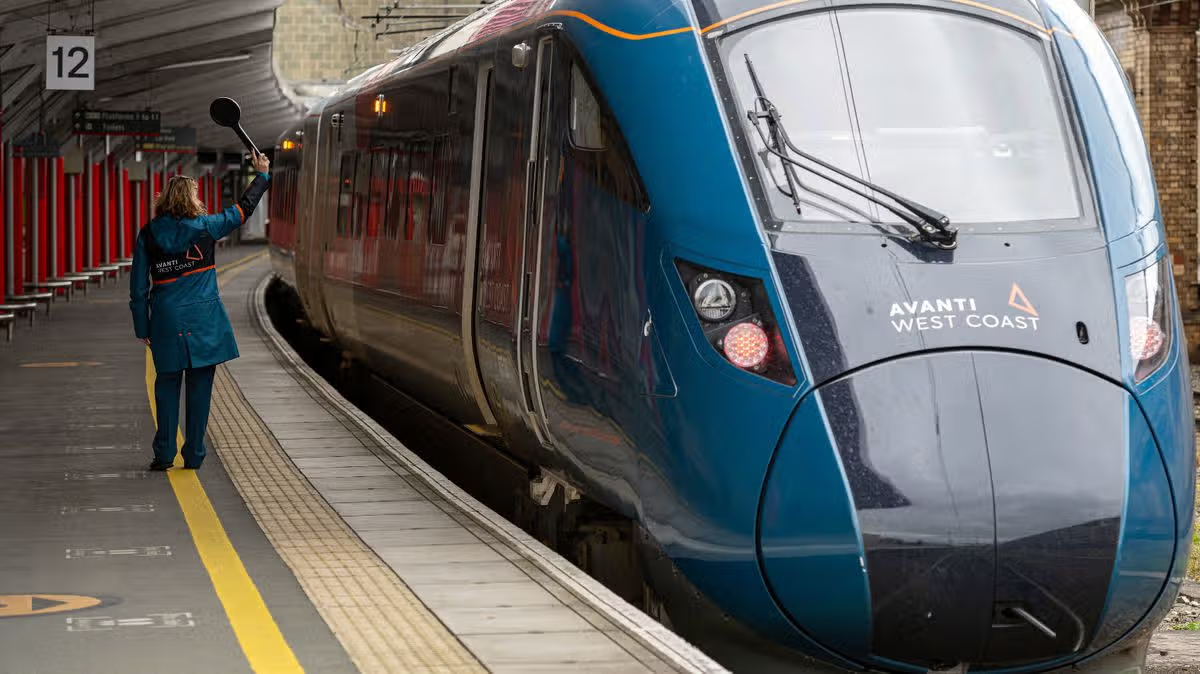
An Avanti West Coast train at Crewe station

Avanti West Coast wants to offer more Blackpool services(Image: PA)

Attempts to increase Blackpool’s rail connection with London have stalled – despite coming at a time when the resort is enjoying massive multi-million investment.

Advertisement

Train operator Avanti West Coast says it has made a new bid to bring back two weekday services it lost last year, plus an extra weekend provision. It was hoped that these could begin at the start of last week.

But the company, which is responsible for providing the service between Blackpool and the capital, says it is still waiting for confirmation from the Office of Rail and Road (ORR), an independent, non-ministerial government department.

Without the green light from ORR, no progress can be made.

Ironically, the axing of services last year came at a time when there has been a £350m mixed-use regeneration project in the town described as “an economic game changer”.

Advertisement

The Talbot Gateway project, located within a short walk to Blackpool North train station, is creating a central business district and civic quarter for more than 8,000 workers and students, helping to attract a rising number of corporate and commercial visitors.

It has even been hailed as a ‘mini-Canary Wharf, after the Riverside area of London’s which is one of the city’s major financial districts.

The hold-up also comes at a town when Blackpool’s famous holiday season is about to begin, in readines for visitors to flock in to the resort. Extra trains coming into town from London would be particularly welcome, as well as services going the other way.

A local rail user and campaigner, known as Stef M, said the situation was frustrating because Avanti had replied to him personally to say it was still waiting for ORR to make a decision on its bid.

Advertisement

The campaigner said: “Avanti are ready to increase the service but it is the government preventing this from happening. This is just shocking, we need these services restoring.”

It follows Avanti’s confirmation last year that its four daily weekday services to and from the resort were being cut to just two a day, starting from early December.

The move led to local anger that Avanti was halving the service, but it was then revealed that the decision had come from ORR , with hoteliers and MP Chris Webb slamming the move.

Last year, ORR explained that it took the action because it was advised by Network Rail that there were serious capacity issues on the south end of the West Coast Main Line, which Network Rail has declared as “congested infrastructure” since 2020

Advertisement

A spokesman for ORR said at that time: “We recognise that passengers will be disappointed that these services will not be in the timetable from December.

“In every timetable change train operators bid to add or amend services, and we are informed in our decision making by what Network Rail tells us is possible.

“In this case, Network Rail provided evidence and recommended that ORR decline the applications to secure better reliability on the network as a whole.

“We would welcome the opportunity to work with Network Rail and train operators should they consider that there is room for these services in future timetables.”

Advertisement

The LDRS approached the ORR for a new comment this week.

An Avanti West Coast spokesperson said of the latest situation: “We have applied to Network Rail for the access rights to re-instate two weekday Blackpool services that we previously operated and re-introduce a return service on a Saturday.

“These are still awaiting confirmation from the ORR and we will continue to work with them to understand what needs to be done to bring these important services to the seaside town.”

Avanti West Coast currently operates an 0940 London Euston to Blackpool North and a 1252 Blackpool North to London Euston on weekdays.

Advertisement

To find all the planning applications, traffic diversions, road layout changes, alcohol licence applications and more in your community, visit the Public Notices Portal.

Continue Reading

Business

Swedbank reports Q2 profit of 7.2 billion kronor

Published

on


Swedbank reports Q2 profit of 7.2 billion kronor

Continue Reading

Business

Tech Stocks Are on the Rise Despite the Chip Dip

Published

on

Stocks Little Changed After Fed Decision

There’s a tale of two tech sectors unfolding in today’s stock market.

Hardware names, including chip stocks, are having a tough trading session, but some of the biggest tech companies are climbing higher.

The Nasdaq was up 0.5%, while the S&P 500 rose 0.3%, and the Dow increased 0.3% or 151 points. The major indexes flirted with the flatline throughout the trading day, before moving higher in the afternoon.

Continue Reading

Business

2026 Already Near All-Time IPO Raise Record

Published

on

2026 Already Near All-Time IPO Raise Record

2026 Already Near All-Time IPO Raise Record

Continue Reading

Business

Singapore Budget 2026 and its Impact on Foreign Investors: Tax, Incentives, and Strategic Signals

Published

on

Singapore Budget 2026 and its Impact on Foreign Investors: Tax, Incentives, and Strategic Signals

Singapore’s 2026 Budget emphasizes a capability-driven hub, focusing on innovation, regional functions, and talent. Tax incentives support high-value activities, influencing global corporate and investment strategies.

Singapore’s 2026 Budget: Focus on Capability Enhancement

Singapore’s 2026 Budget emphasizes its role as a capability-driven hub rather than a cost-competitive entry point in Asia. This strategic focus impacts foreign investors’ location decisions, as the country’s appeal hinges on leveraging innovation ecosystems, regional coordination, or specialized talent pools. Investors now consider whether their models capitalize on Singapore’s strengths in high-value activities rather than cost savings alone.

Opportunities for Regional HQs and Treasury Centers

Regional headquarters and treasury centers can use their stable taxable income to fund expansion and capability investments. These entities benefit from Singapore’s supportive tax environment, using liquidity for growth initiatives. In contrast, early-stage companies with limited profits may see fewer direct benefits, primarily through fixed cash grants, influencing their investment strategies.

Tax Incentives and Innovation Support

Global minimum tax reforms are shifting the focus toward operational substance and the interaction of incentives with actual activities. Singapore maintains its attractiveness when multinational firms demonstrate high-value activities like regional management, innovation, and R&D. Budget 2026 also enhances support for innovation, expanding the scope of the Enterprise Innovation Scheme to include AI, making Singapore a strategic hub for digital transformation and high-value activities.

Advertisement


Read the original article : Singapore Budget 2026 and its Impact on Foreign Investors: Tax, Incentives, and Strategic Signals

Continue Reading

Business

Volvo Cars posts smaller profit for the second quarter

Published

on


Volvo Cars posts smaller profit for the second quarter

Continue Reading

Business

Billerud reports Q2 sales decline amid European weakness

Published

on


Billerud reports Q2 sales decline amid European weakness

Continue Reading

Business

Opinion: Flag win window to a windfall

Published

on

Opinion: Flag win window to a windfall

OPINION: Winning the flag would be a transformational moment for the Dockers.

Continue Reading

Business

Arhaus Stock Continues To Struggle With Comp Sales (NASDAQ:ARHS)

Published

on

Hooker Furnishings Corporation: Good Turnaround Efforts But Not Sold On Momentum

This article was written by

Long-only investment, evaluating companies from an operational, buy-and-hold perspective.Quipus Capital does not focus on market-driven dynamics and future price action. Instead, our articles focus on operational aspects, understanding the long-term earnings power of companies, the competitive dynamics of the industries where they participate, and buying companies that we would like to hold independently of how the price moves in the future. Most QC calls will be holds, and that is by design. Only a very small fraction of companies should be a buy at any point in time. However, hold articles provide important information for future investors and a healthy dose of skepticism to a relatively bullish-biased market.Disclaimer: All of the author’s articles are written on an “as is” basis and without warranty. They represent the author’s opinion only and in no way constitute professional investment advice. It is the responsibility of the reader to conduct their due diligence and seek investment advice from a licensed professional before making any investment decisions. The author disclaims all liability for any actions taken based on the information contained in any articles published.

Analyst’s Disclosure: I/we have no stock, option or similar derivative position in any of the companies mentioned, and no plans to initiate any such positions within the next 72 hours. I wrote this article myself, and it expresses my own opinions. I am not receiving compensation for it (other than from Seeking Alpha). I have no business relationship with any company whose stock is mentioned in this article.

Seeking Alpha’s Disclosure: Past performance is no guarantee of future results. No recommendation or advice is being given as to whether any investment is suitable for a particular investor. Any views or opinions expressed above may not reflect those of Seeking Alpha as a whole. Seeking Alpha is not a licensed securities dealer, broker or US investment adviser or investment bank. Our analysts are third party authors that include both professional investors and individual investors who may not be licensed or certified by any institute or regulatory body.

Advertisement
Continue Reading

Business

Free Payroll Software for Small Business: The Honest 2026 Guide

Published

on

Free Payroll Software for Small Business: The Honest 2026 Guide

The first time I ran payroll for my own team, I paid a freelance writer twice in the same week and then, with the kind of confidence only total ignorance can produce, forgot to pay her at all the following month. I was managing three websites, a spreadsheet held together with hope, and a growing suspicion that “payroll” was just accounting’s way of punishing people who’d rather be writing headlines.

So when I say I get why “free payroll software for small business” is one of the most searched phrases among small business owners, I mean it personally. Nobody wants to pay a monthly fee to do math they already resent doing. But is any payroll software actually free, or is that the retail equivalent of “no annual fee” credit cards that mysteriously charge you in year two?

Turns out, some of it really is free. Not “free trial that turns into $50 a month.” Actually, indefinitely, no-credit-card free. Here’s what’s real, what’s a trap, and which option fits a business like yours.

The Short Version

If you’re in a hurry, here’s the quick read on free payroll software for small business owners in 2026:

Advertisement
  • Payroll4Free.com — genuinely free core payroll, tax calculations, and direct deposit if you pay nine or fewer employees a month. Best for very small U.S. teams.
  • ExcelPayroll — a free, downloadable spreadsheet system. Best if you already live in Excel and don’t mind manual data entry.
  • HR.my — free forever with no employee cap, cloud-based, and available in 66 languages. Best for unlimited headcount, though U.S. tax depth is thinner than the U.S.-built options.
  • Wave, Zoho Payroll, Homebase, and QuickBooks — genuinely useful, but payroll itself is a paid add-on, not a free tier. Worth knowing before you sign up expecting otherwise.

Now, the longer, more useful version — including where each of these can quietly cost you money or time.

So What Actually Counts as “Free” Payroll Software?

Here’s the trick with this keyword: a lot of “free payroll software” lists are really “free trial” lists wearing a disguise. QuickBooks Payroll, Gusto, SurePayroll, and RUN by ADP all show up in free payroll searches, and all of them require a paid subscription once the trial ends or your first payroll run happens.

That’s not a scam, it’s just not what most small business owners mean when they type “free” into Google. If you want software that’s free indefinitely, with no credit card and no expiration date, the real list is much shorter than the SEO content around it suggests.

Is Payroll4Free Actually Free, or Is There a Catch?

Payroll4Free.com is the closest thing to a true free lunch in this space, and the “catch” is refreshingly honest: the company keeps the lights on by showing small ads inside the software when you log in to process payroll. That’s it. No feature countdown, no “free for 30 days,” no forced upgrade.

The free tier covers businesses paying nine or fewer people a month, and includes wage and tax calculations, paid time off tracking, an employee self-service portal, reporting, and either paper checks or direct deposit through your own bank account. Optional paid add-ons exist if you’d rather Payroll4Free handle your tax filings or run direct deposit through their bank instead of yours.

Advertisement

The trade-offs are real, though. It’s Windows-based rather than cloud-native, so there’s no mobile app for you or your employees, and it’s built for U.S. payroll specifically.

What About ExcelPayroll — Is a Spreadsheet Really Enough?

There’s something almost defiant about ExcelPayroll’s pitch: yes, in 2026, you can still run payroll from a spreadsheet, and it still works. ExcelPayroll is a free, downloadable template system that calculates wages, taxes, and deductions inside Microsoft Excel, and generates the tax forms you need at year-end.

It’s genuinely free with no paid tier at all — but “free” assumes you already have Excel, which itself is a paid product unless you’re using an older standalone license. And because it’s a spreadsheet rather than a hosted service, there’s no employee portal, no direct deposit, and no automatic tax filing. You are, in effect, the payroll department.

This one’s best suited to a business owner who already thinks in spreadsheets, has a handful of employees with fairly simple pay structures, and doesn’t mind being their own IT support if a formula breaks.

Advertisement

Can HR.my Really Handle Unlimited Employees for Free?

Somewhat improbably, yes. HR.my doesn’t cap employee count on its free plan — a genuinely rare feature in this category, where most “free” tools quietly gate you at 9, 10, or 25 people. It’s cloud-based, has a mobile-friendly portal, and supports 66 languages, which makes it a strong fit for businesses with international or multilingual teams.

Here’s where I’d slow down before switching, though: HR.my is built as a global HR and payroll platform, which means its depth on U.S.-specific payroll tax rules isn’t necessarily as tight as tools designed around U.S. compliance from the ground up. If your business operates in a single U.S. state with straightforward payroll, that may not matter much. If you’re juggling multi-state tax withholding, it’s worth stress-testing before you commit.

Wasn’t TimeTrex Supposed to Be Free Too?

You’ll still see TimeTrex on a lot of “best free payroll” lists, and it deserves a specific callout because the story here has changed. TimeTrex discontinued its free, open-source, on-site Community Edition on October 1, 2024 — the version still runs for existing users, but it no longer receives security patches or tax table updates, which is a real problem for anything touching payroll calculations. TimeTrex now markets a cloud-based “Community Edition” as free with unlimited users, but given how recently the on-site free tier was pulled, I’d confirm current terms directly with TimeTrex before building a payroll process around it, rather than trusting an older roundup post.

Isn’t Zoho Payroll Free? (Not Anymore — Here’s What Changed)

You’ll also see Zoho Payroll described as free in a handful of “best free payroll” articles, and it’s worth correcting directly: as of its U.S. relaunch, Zoho Payroll offers a 14-day free trial only, not a free-forever tier. Pricing starts at $29 to $39 a month per organization plus a per-employee fee, depending on whether you pay monthly or annually. It’s a strong product for businesses already living inside the Zoho ecosystem, and it’s genuinely built for U.S. tax compliance — just don’t go in expecting it to be free indefinitely. It also doesn’t currently support paying 1099 contractors in the U.S. edition, which matters if your team includes freelancers.

Advertisement

Wave and Homebase follow a similar pattern worth knowing about: Wave’s accounting and invoicing tools are free, but payroll itself is a separate paid add-on. Homebase offers free scheduling and time tracking for small teams, but payroll again sits behind a paid plan.

When Does “Free” Stop Making Sense for Your Business?

Free payroll software is genuinely good enough for a specific kind of business: small headcount, relatively simple pay structures, and an owner who has the time (or patience) to handle some of the manual work these tools don’t automate. But there’s a point where free starts costing you more than a subscription would.

Ask yourself:

  • Are you outgrowing the employee cap? Most free tiers max out around 9 to 10 people. Cross that line and you’re either upgrading or switching tools entirely.
  • Do you need automated tax filing, not just tax calculation? Several free tools calculate what you owe but leave the actual filing to you. If quarterly Form 941 filings already make your stomach drop, that manual step is worth paying to eliminate.
  • Are you hiring across state lines? Multi-state payroll tax compliance is exactly where free and low-cost tools tend to get thin.
  • Would a mistake actually hurt you? A missed contractor payment (ask me how I know) is embarrassing. A payroll tax filing error is expensive.

So Which Free Payroll Software Should You Actually Use?

If you’re a solo founder or run a team of nine or fewer in the U.S. and want the most complete free feature set, Payroll4Free is the obvious starting point. If you’re comfortable owning your own spreadsheets and want zero dependency on a third-party platform, ExcelPayroll gets the job done without ever asking for a card number. And if your team is larger than most free tiers allow, or spans multiple countries, HR.my is the rare free option that doesn’t punish you for growing.

None of them will hold your hand the way a $40-a-month platform will. But none of them will bill you either, and for a lot of small businesses, that trade is worth making, at least until the business outgrows it. Mine did, eventually. The freelance writer, for the record, did eventually get paid- and forgave me, mostly.

Advertisement
Continue Reading

Trending

Copyright © 2025