






Connect with us
DAPA Banner
DAPA Coin
DAPA
COIN PAYMENT ASSET
PRIVACY · BLOCKDAG · HOMOMORPHIC ENCRYPTION · RUST
ElGamal Encrypted MINE DAPA
🚫 GENESIS SOLD OUT
DAPAPAY COMING

Tech

Inside the Search for “Clean” Residential Proxies for Carding

Published

on

Carding

Residential proxies are no longer treated as a simple anonymity tool in carding circles. They are increasingly discussed as one component of a broader identity-simulation stack, alongside device fingerprints, browser profiles, billing information, time zones, cookies, and transaction behavior.

To better understand how criminal actors currently use and evaluate this infrastructure, Flare researchers analyzed 2,889 unique underground posts published in the past two years across approximately 545 discussion threads. The conversations include operational guides, troubleshooting requests, provider comparisons, transaction-failure discussions, and advertisements for supposedly “clean” or finance-compatible proxy services. 

Together, they show that residential IP addresses remain important to carders but are no longer viewed as a reliable bypass on their own. Instead, actors repeatedly describe a market in which proxy pools become overused, addresses accumulate poor reputations, location data is inaccurate, and financial services block entire ranges. As a result, carders are becoming more selective, attempting to match IP geography with stolen identity data while combining proxies with antidetect browsers and other techniques designed to create a convincing digital identity.

The findings suggest that residential proxies remain a key part of the carding ecosystem, but also one of its increasingly fragile components.

Advertisement

Key points

  • Carders increasingly judge a proxy by its history, not merely whether it belongs to a residential internet provider.

  • Geographic consistency now extends beyond country matching to city, ZIP code, time zone, browser language, and billing information.

  • Residential IPs are rarely considered sufficient alone and are frequently paired with antidetect browsers and fingerprint manipulation.

  • Advertisement
  • Provider restrictions are creating a secondary market for supposedly “clean” residential IPs capable of reaching financial services.

  • Defenders should treat residential traffic as context—not evidence that a user is legitimate.

What are residential proxies?

A residential proxy routes traffic through an IP address assigned by an internet service provider to a household or consumer device.

To a website, the connection may resemble that of an ordinary home user rather than traffic originating from a hosting provider or commercial VPN.

Residential proxies have legitimate uses, including localization testing, advertising verification, and brand protection.  Criminal actors value them because they can make fraudulent sessions appear closer to normal consumer traffic.

Advertisement

“Clean” has replaced “residential”

One of the clearest findings from the dataset is that carders no longer speak about residential proxies as a single trusted category. Instead, they divide them into “clean” and “dirty” pools.

A widely reposted underground guide titled “Getting the Cleanest Possible IPs for Carding” (see screenshot below) argues that even residential pools deteriorate as addresses are repeatedly used for abuse.

Another guide claimed that the important question was not simply whether an IP was residential, but whether it had previously been used against banks, payment processors, or other fraud-sensitive services.

Forum post on Ascarding
Screenshot of a post in the dataset taken from Flare’s platform.
Sign up for the free trial to access if you aren’t already a customer.

This thinking also appears in troubleshooting discussions. Users compare fraud-score services, complain that the same address receives dramatically different reputational ratings, and report that an IP initially considered clean can become high-risk after a short period of activity.

The underlying assumption is significant: carders increasingly believe that proxy reputation is dynamic and influenced by every other customer using the same infrastructure.

Advertisement

From “clean” residential proxies to antidetect browser setups, fraud actors are openly discussing how to build convincing digital identities on criminal forums.

Flare monitors these conversations, so your team is on top of their emerging techniques. 

Uncover Underground Carding Schemes for Free

Precision is moving from country to identity consistency

Older carding advice is often focused on selecting an IP in the same country as the stolen card. Recent posts describe a far narrower standard. 

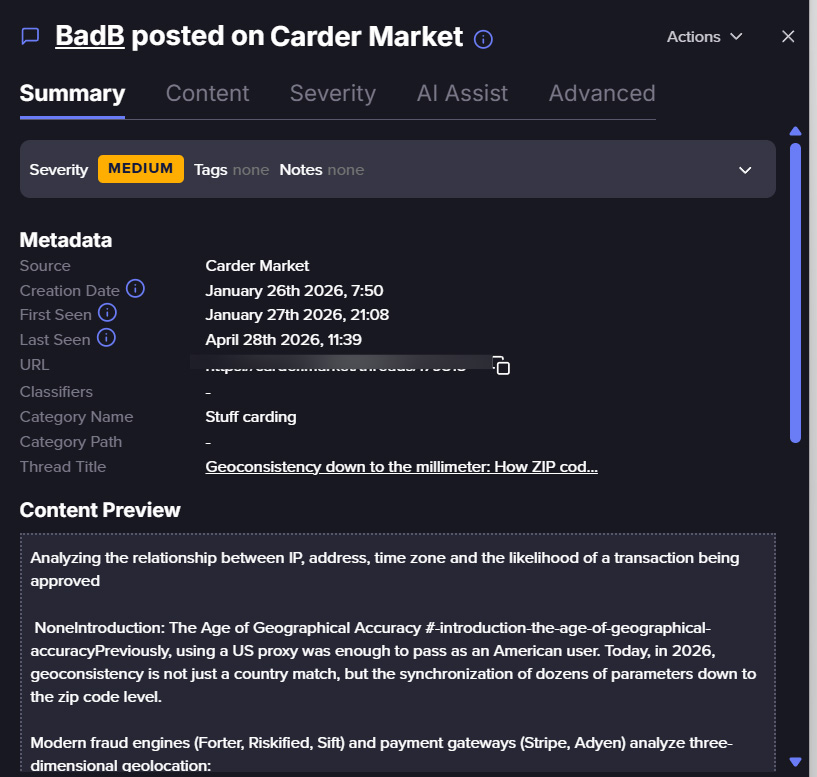
A January 2026 thread about “geoconsistency” (see screenshot below) discussed matching an IP’s approximate location with the billing ZIP code, device time zone, operating-system language, and browser characteristics.

Advertisement
Forum post on Carding Market
Screenshot of a post in the dataset taken from Flare’s platform.

Sign up for the free trial to access if you aren’t already a customer.

In another discussion, a user complained that major residential-proxy providers had removed ZIP-code targeting and now offered only country, state, and city selection.

The actor feared that city-level targeting would no longer provide enough precision to avoid fraud controls.

Not every technical claim made in underground forums is necessarily accurate. However, the discussions clearly demonstrate the actors’ operational mindset: they are trying to construct a coherent digital identity rather than merely concealing their real IP address.

The proxy is only one layer

The dataset repeatedly connects residential proxies with antidetection browsers, isolated devices, cookie history, WebRTC configuration, Canvas and WebGL fingerprints, and user-agent consistency.

One April 2026 guide warned that a “perfect residential proxy” would still fail if the browser profile exposed contradictory information. Another setup guide argued that copying a fixed configuration was ineffective because the device, proxy, account history, payment information, and target merchant must all be evaluated together.

Advertisement
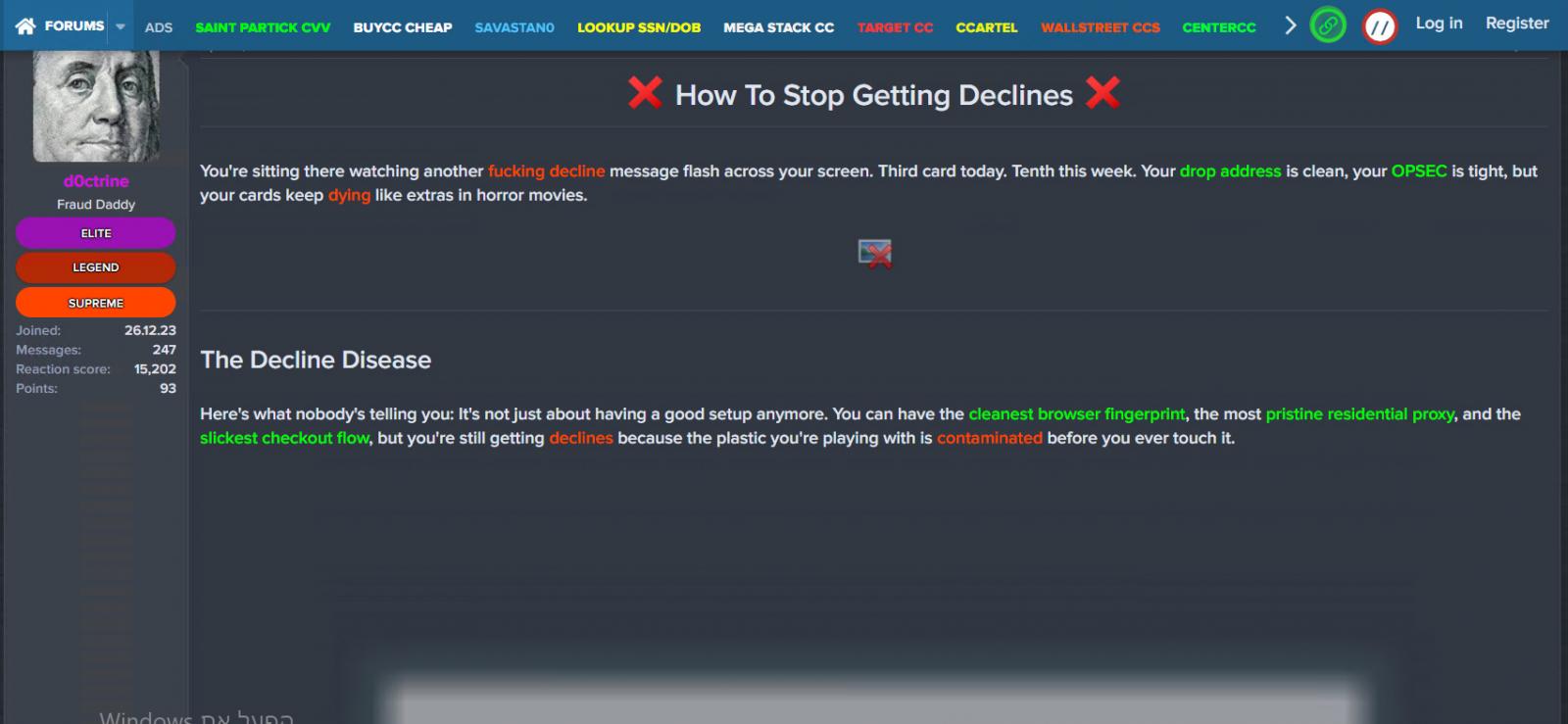
Screenshot from one of the carding guides posted in a carding forum

This reflects the direction of modern fraud detection. Stripe’s documentation describes controls that combine transaction, identity, card, and historical signals rather than relying on one indicator. Its guidance on card testing also highlights velocity, repeated declines, inconsistent billing information, and the reuse of cards or customer details.

Carders are searching for finance-compatible IPs

Several posts complain that established proxy providers restrict access to banks, payment processors, government portals, and other fraud-sensitive services. This creates a practical problem for carders: an IP may appear residential and have a low fraud score yet still be unusable against the intended target.

Some actors interpret these restrictions as a sign that the provider is protecting its address pool from abuse. One widely circulated guide even suggested that restricted residential pools may contain cleaner IPs precisely because they have not been repeatedly used against financial institutions.

At the same time, the restrictions are creating demand for services advertised as “finance enabled,” “bank compatible,” or capable of accessing specific payment platforms.

Underground users exchange provider recommendations and methods for testing connectivity, although the reliability of these advertisements is difficult to verify and some may be scams.

Advertisement

This search for usable residential infrastructure is taking place within a much larger and increasingly contested proxy ecosystem. In July 2026, the FBI and industry partners seized hundreds of domains associated with the NetNut residential proxy platform and the Popa botnet.

Researchers connected the network to at least two million compromised devices, including smart TVs and streaming boxes, which were converted into residential proxy nodes.

The infrastructure was reportedly used for activities including advertising fraud, account takeover, and other abusive traffic.

A March 2026 FBI alert further warned that criminals can select residential proxy addresses down to the state and city level and specifically cited their use for account takeover, including matching an IP address to the victim’s city to reduce the likelihood of triggering a bank’s geolocation controls.

Advertisement

Together, the underground discussions and recent disruptions show why carders increasingly distinguish between merely obtaining a residential address and obtaining one that is sufficiently clean, precisely located, and permitted to interact with financial services.

What defenders can take

Residential IP addresses should not be treated as inherently trustworthy. The stronger signal is consistency across the entire session: device history, account age, browser fingerprint, payment instrument, billing information, transaction velocity, and behavior after checkout.

Organizations should also look for patterns that proxies do not easily conceal, including repeated identity creation, multiple cards connected to similar devices, abrupt geography changes, mismatched time zones, and clusters of low-value authorization attempts.

The underground discussions suggest that defenders are already raising the cost of fraud. Carders are spending more time searching for uncontaminated infrastructure, debating conflicting reputation scores, and trying to align increasingly granular identity signals.

Advertisement

Residential proxies remain valuable to carders, but they are no longer a universal bypass. Their effectiveness increasingly depends on the credibility of everything surrounding them and that broader identity is a much harder challenge for cybercriminals.

Learn more by signing up for our free trial.

Sponsored and written by Flare.

Advertisement

Source link

Continue Reading
Click to comment

You must be logged in to post a comment Login

Leave a Reply

Tech

4 Compact Cars With Better Ratings Than The Toyota Corolla

Published

on


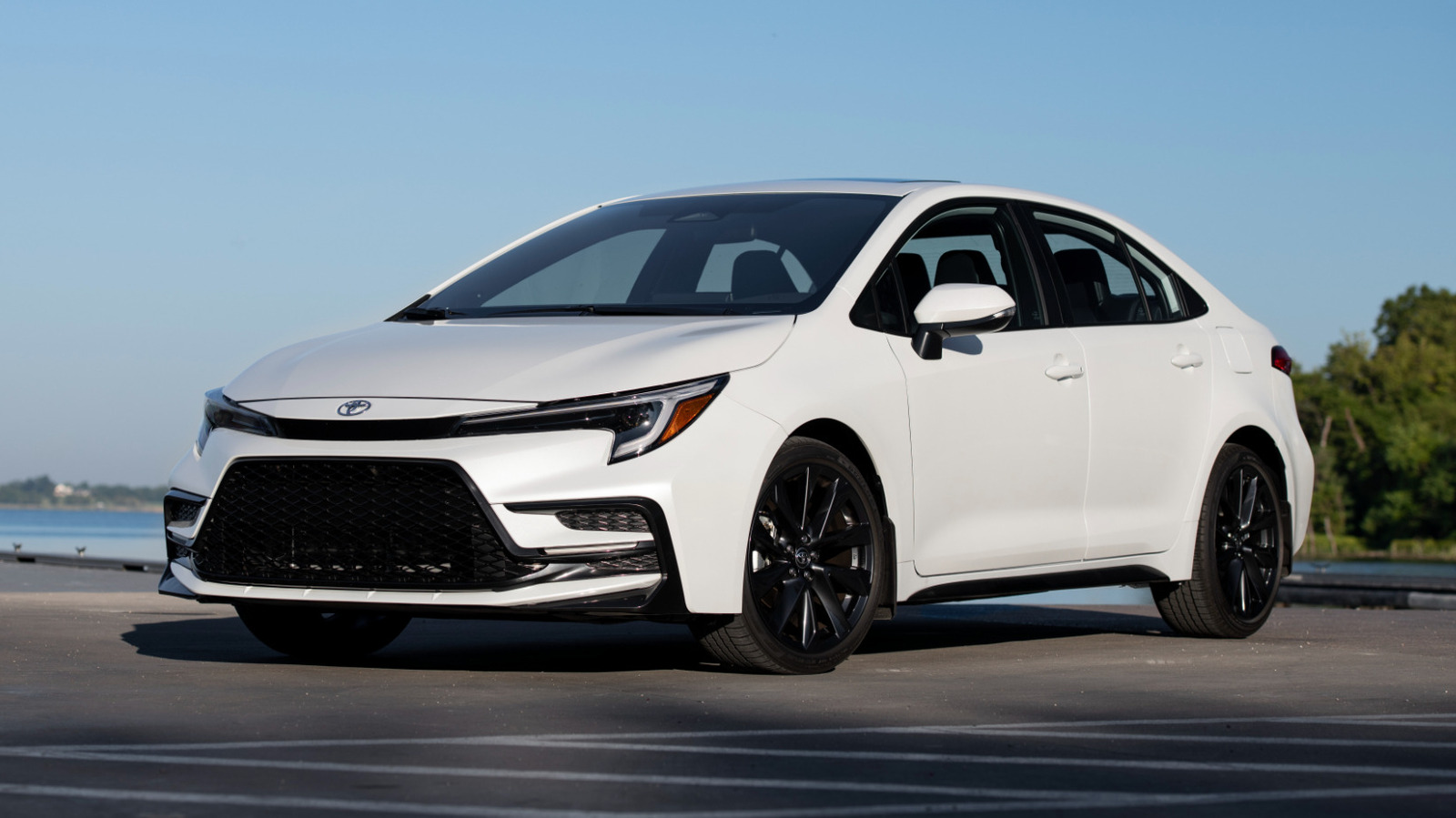
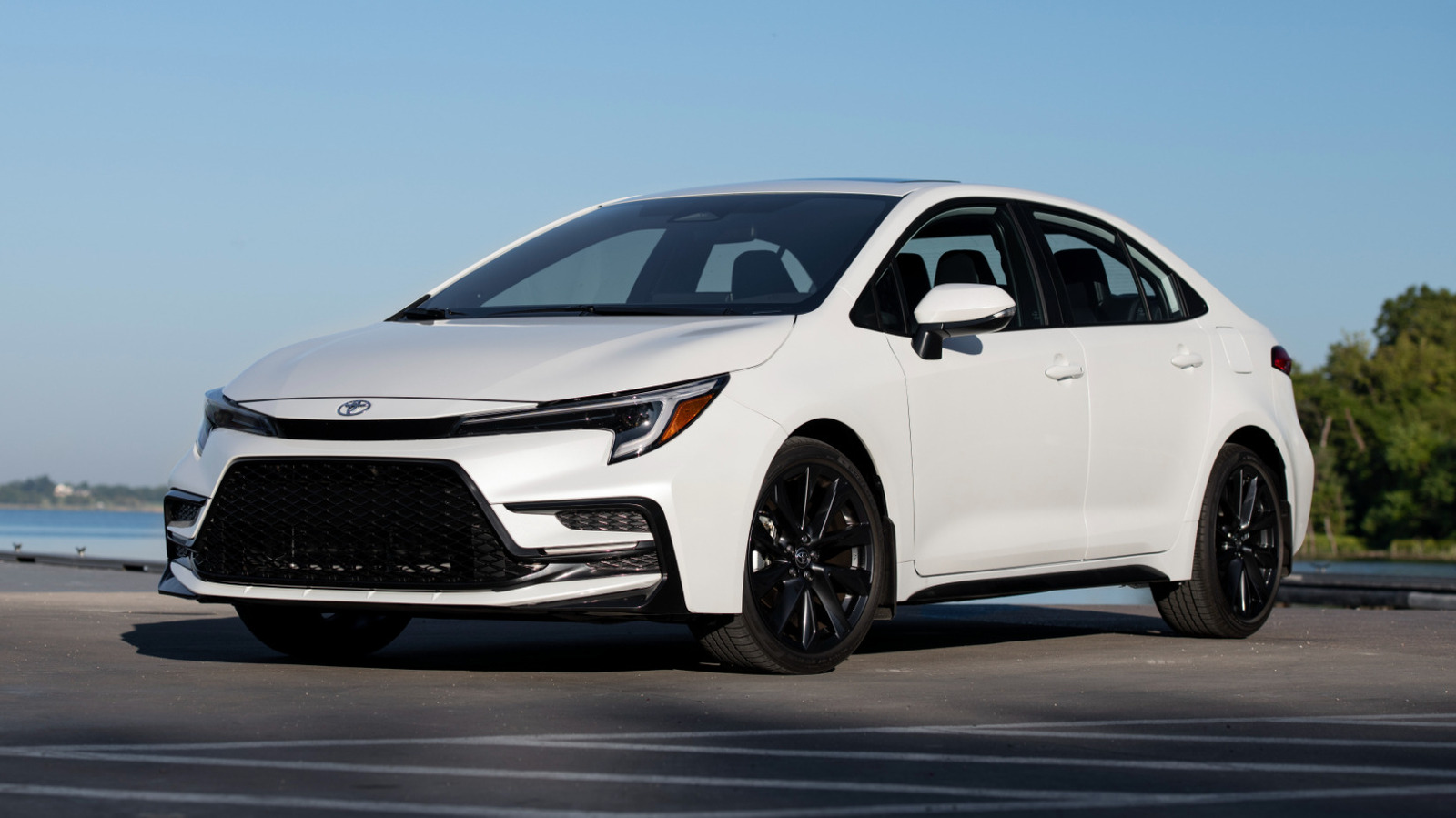
It’s no surprise that people love the Toyota Corolla. Toyota has produced this compact car since the 1960s, and it has sold over 50 million units in that time. As of this writing, Car and Driver lists it as the twelfth best-selling vehicle in the United States in 2026, and in a market dominated by SUVs and pickup trucks, it’s the only one of two compact cars to crack that top dozen. When you combine the fact that Toyota is renowned for its consistent production of incredibly reliable vehicles with the Corolla’s very reasonable starting price of $23,125 (plus a $1,295 delivery, processing, and handling fee), there’s very little reason as to why it shouldn’t be as popular as it is.

Looking at the ratings from experts and customers alike compiled by the likes of Consumer Reports and J.D. Power, they typically concur with these positive opinions. However, the Toyota Corolla isn’t the compact car on the market that gets the absolute highest of marks. We’re going to look at four different compact car models from different companies that receive better ratings than the Corolla. Sometimes, the overall scores will be higher, but in others where the overall scores are quite similar, there are models that outpace the Toyota in areas like reliability or performance. So, if you’re considering getting yourself a Toyota Corolla for your compact car needs, there’s a chance these other options better fit your particular needs.

Advertisement

Honda Civic Hybrid

The one compact car that the Toyota Corolla slightly trails in 2026 sales is the Honda Civic. Only about 1,000 units sold separate the two, and fun fact, their spots in that ranking flipped in the midst of this article being written. Effectively, the two models are neck-and-neck. That equivalency is apparent in their ratings too. According to Consumer Reports, the 2026 Corolla and Civic have the exact same overall score. The Corolla slightly outpaces the Civic in reliability, while the Civic has the edge in owner satisfaction. When you get to the hybrid version of the Honda Civic though, it’s a different story.

Advertisement

Out of every compact car rated by the publication, the 2026 Honda Civic Hybrid has the overall highest rating by Consumer Reports. That comes with an excellent road test score from its in-house experts and quite high owners’ satisfaction score from actual customers. The ratings determined by J.D. Power are a little trickier to parse, as it doesn’t distinguish between the traditional and hybrid models of the Civic, but it ties for first amongst compact cars, sharing an 85 out of 100 overall average with the 2026 Nissan Sentra. If the ratings correlate between the two publications, the Civic Hybrid is even higher than that 85 on its own. If not, it still gets to be number one regardless.

The starting price for a 2026 Civic Hybrid is $29,395 (plus a $1,195 destination and handling fee). That’s a bit more than your standard 2026 Corolla or one with a hybrid powertrain (starting at $24,975 plus a $1,295 delivery, processing, and handling fee), but you’re getting something people generally prefer slightly more.

Advertisement

Subaru Impreza

To stay with the Japanese automakers, another compact car you see getting better scores from experts and owners than the Toyota Corolla is the 2026 Subaru Impreza. This hatchback may not be nearly as popular as the previous two mentioned vehicles, as it doesn’t even crack Car and Driver’s top 25 best-selling vehicles in 2026 so far, but that doesn’t mean people don’t like it any less.

Based on J.D. Power’s ratings, the Impreza earned an 84 out of 100 overall score, just one point behind the top-rated Honda Civic. While drivers surveyed by the publication found their driving experience on the high end of average, they did determine that the car’s quality, reliability, and resale value were all excellent. The dealership experience even managed to get a 91 rating, 15 points higher than the Corolla.

On the Consumer Reports side, the 2026 Impreza doesn’t quite reach the overall heights of the Honda Civic Hybrid among small cars, but it does outperform the Toyota Corolla on the whole. Owner satisfaction is what the publication has calculated as the Impreza’s greatest strength over the Corolla, but it also has higher ratings for its road testing and reliability as well.

Advertisement

A 2026 Subaru Impreza starts at $26,595 (plus a destination and delivery fee of $1,195). That may be a few thousand dollars more than the starting price of a Toyota Corolla, but if the owners and experts are to be believed, you are not sacrificing any semblance of quality with that moderately higher price. Unlike the Corolla or the Civic, the Subaru Impreza doesn’t have a hybrid powertrain option.

Advertisement

Hyundai Elantra

Moving from Japanese automakers to those from South Korea, we arrive at the 2026 Hyundai Elantra. While not quite as popular as the Toyota Corolla — only just cracking Car and Driver’s top 25 best-selling vehicles in the United States in 2026 so far at spot 24 — the overall reception to this compact car alternative exceeds it, whether we are talking about the standard gas-powered model or one with a hybrid powertrain.

The Hyundai Elantra Hybrid actually ties the top overall score of the Honda Civic Hybrid awarded by Consumer Reports among compact cars. The standard Hybrid doesn’t quite reach the top of the mountain there, but it still outpaces the Corolla, though the Toyota does have a better reliability rating from the publication. On the J.D. Power side of things, the 2026 Elantra finishes third overall among compact cars with a score of 83 out of 100, situating nicely between the Subaru Impreza and Toyota Corolla, with those surveyed labeling its quality and reliability, their driving experience, and its resale value all as great on average.

Another appealing factor with the Hyundai Elantra is that it’s actually one of the less expensive alternatives to the Corolla. With a starting price of $22,625 (plus a $1,245 freight fee) for the base SE trim, you’d be saving about $550 compared to the base Corolla. That may not seem like much in the grand scheme of car buying, but saving any money on something that is generally liked more is rarely a negative. However, the Elantra Hybrid starts at $25,450 (plus a $1,245 freight fee), which is $425 more than the base Corolla Hybrid, so savings aren’t necessarily guaranteed.

Advertisement

Kia K4

For the final compact car on the list, we move over to another South Korean brand. That would be the 2026 Kia K4. This is only the second model year for this car, but it’s already established itself as something owners and experts are enjoying quite a lot, making SlashGear’s list of the best debut vehicles for its first model year. When compared to the Toyota Corolla, the gap in appreciation isn’t quite as noticeable as it is with the other vehicles on this list, but there are certainly areas where the K4 pulls ahead.

According to those surveyed by J.D. Power, the K4 ties the Subaru Impreza with an overall average score of 84 out of 100 for the second-best compact car on the market. It received great scores in every category except for dealership experience, which was determined to be fairly average. When you move over to Consumer Reports, the Kia K4 and Toyota Corolla actually earned the exact same overall score. When you look into the details though, there are important differences. Yes, the Corolla does earn a higher reliability score, but the K4 earned higher expert road test and owner satisfaction scores than the Toyota. Depending on what you value in a vehicle, you could certainly perceive the K4 as the better liked model.

Advertisement

The 2026 Kia K4 is also a cheaper model than a new Corolla. It has a starting price of $22,290 (plus a $1,245 destination fee), making it the least expensive model on this list. At worst, it’s comparable to the Corolla. At best, it’s the better reviewed of the two. Either way, you’re saving money on quality.

Advertisement

Methodology

Determining how a fellow compact car was better rated than the Toyota Corolla came down to a couple of different factors. Firstly, we’re looking specifically at compact cars. There are other small vehicles, such as sports cars, but these are really their own class of vehicle. Comparing them would be apples and oranges. Secondly, these are the ratings of the latest 2026 models of these vehicles.

Consumer Reports and J.D. Power are the two best sources for these kinds of ratings. With both, you get consensus opinions on these vehicles from thousands of verified owners who are honestly reflecting on their actual experiences with these cars. Consumer Reports has the added benefit of having its own in-house experts perform their own tests with these vehicles as well. While overall average scores were the most important determining factor for how a car could make this list, a car having higher ratings in specific areas — such as reliability or owner satisfaction — would also be considered if the overall scores were very close together or the same. After all of that, these four compact cars could be selected.

Advertisement


Source link

Continue Reading

Tech

Alien World Chemistry Found Inside Meteorite That Struck New Jersey Home

Published

on

Researchers say a meteorite that crashed through the roof of a Hillsborough, New Jersey, home in 2024 contains unusually pristine evidence of salty fluids and organic chemistry from near the surface of a primitive asteroid. “A forensic study of the fragments revealed that they contained preserved bits from near the surface of a primitive asteroid, where it experienced concentrated salty fluids — a process not previously known from this type of protoplanet world,” said lead author and meteor astronomer Peter Jenniskens of the SETI Institute and NASA’s Ames Research Center in California’s Silicon Valley. Phys.org reports: According to paper co-author Mike Zolensky, a meteoriticist at NASA’s Johnson Space Center in Houston, analysis of the Hillsborough meteorite found fragments that were more extensively altered by water on the meteorite’s parent asteroid than is typically seen in CM2 carbonaceous chondrites. The analysis classified the specimen as a CM1/2 carbonaceous chondrite, an intermediate classification between petrographic types CM1 and CM2. […] Zolensky and colleague JangMi Han found small salt-rich CM1 fragments within the Hillsborough meteorite, suggesting they originated from a near-surface region of the parent asteroid where liquid water evaporated and concentrated salts. They are now working to identify the salt minerals for comparison with similar phases found among samples returned to Earth from asteroids Ryugu and Bennu.

The high concentration of salt in briny fluids can potentially create molecules crucial to life on Earth. Brines allow phosphate to remain in solution and can catalyze chemical reactions between organics and precipitate minerals. “Isotope studies of carbon and nitrogen suggest that primitive carbonaceous chondrites, including CM types, delivered organic matter to the early Earth,” said cosmochemist Queenie Chan of Royal Holloway University of London, England, and biogeochemist Nana Ogawa of the Biogeochemistry Research Center at the Japan Agency for Marine-Earth Science and Technology. “The Hillsborough meteorite contained 1.8% by weight of carbon and 0.07% of nitrogen, and had carbon and nitrogen isotopes typical for CM-type meteorites.”

The meteorite contained a wide variety of soluble organic compounds, and its compositional range confirms that the Hillsborough meteorite was more altered by water than most other CM-type meteorites. “A high fraction of compounds were the product of organic chemistry with minerals,” said organic mass spectrometry specialist Phil Schmitt-Kopplin of Technical University Munich. “We do not know if these magnesium organic compounds were contributed by brine chemistry or were simply left over from earlier impact shock processes.” In living organisms, organometallic compounds are found in blood and used in photosynthesis. Among the soluble organic compounds were many amino acids, similar to those found in more moderately altered CM2 chondrites.

Astrobiologist Danny Glavin of NASA’s Goddard Space Flight Center in Greenbelt, Maryland, and his team in Goddard’s Astrobiology Analytical Lab concluded that the delivery of amino acids, carboxylic acids and other soluble organic molecules by CM-type bodies may have contributed to the prebiotic organic inventory that preceded the emergence of life on Earth. Their analysis suggests the complex distribution of amino acids observed in the Hillsborough meteorite formed within the parent body, likely assisted by brine fluid chemistry.
The findings have been published in the journal Science Advances.

Advertisement

Source link

Continue Reading

Tech

Databricks hits $188B valuation, extending its run as AI’s favorite second act

Published

on

Databricks on Thursday announced a new round of funding that values the company at $188 billion. The round was led by Coatue.

Databricks didn’t disclose exactly how much it raised; it said the money isn’t in its hands yet and that the round will close later this summer. (Other outlets have since reported the raise is roughly $3 billion.) While it’s unusual for a company to announce before it gets the money, a VC tells TechCrunch that the deal is solid, with so many firms wanting in that the company had no reason to keep its shiny new valuation a secret.

In fact, Databricks has been on a year-and-a-half fundraising tear as it successfully transitioned its image into an AI provider and not just a yesteryear SaaS sensation. Yesteryear being back in the BC times (Before ChatGPT).

Only five months ago, in February, Databricks closed a $5 billion Series L raise at a $134 billion valuation. Five months before that, in September 2025, it raised $1 billion at a $100 billion valuation. And roughly nine months before that, in December 2024, it raised what was a record-breaking round at the time of $10 billion at a $62 billion valuation.

Advertisement

Databricks has raised so many rounds over the years that this latest one became the subject of memes about running out of letters of the alphabet. “Turning on alerts for when we get a Series AA,” one person posted.

But its image reconstruction has been legit. Founded in 2013, it initially grew to success back in the big data era, with software that enabled enterprises to store enormous amounts of data in the cloud, yet produce speedy analytics.

Because it already sat on troves of enterprise data, Databricks was then well-positioned to respond as companies started wanting AI with the same security and governance they expect from traditional enterprise software.

The company began rolling out one AI product after another, like Lakebase, its database built for AI agents, and Unity, its AI gateway, along with a “meta-harness” called Omnigent that manages multiple agents.

Advertisement

Databricks also increasingly became known as one of the big examples of enterprises adopting more affordable Chinese-based open-weight models (models whose underlying code is published for anyone to use and modify) for cost control, one of the big trends of 2026. It is a particular champion of Z.ai’s GLM 5.2 as a model for coding.

Last week Databricks CEO Ali Ghodsi shared the results of some internal benchmarking done to manage his own AI costs for his 3,000 software engineers.

The company compared AI models on the actual tasks its programmers do. Not surprisingly, in the blog post revealing the results, Databricks shared that “open models, and GLM 5.2 in particular, are now able to handle even the highest level of task difficulty” in coding, and at a total lower cost than proprietary models from Anthropic and OpenAI.

But it did surprise people by finding that the choice of harness — the agentic coding tool, like Codex or Claude Code, that wraps around a model and manages its context and instructions — equally impacted costs. It found that open-source harness Pi to be one of the best at managing context surrounding each prompt, and therefore one of the lowest costs choices without sacrificing quality.

Advertisement

“The lesson here isn’t that one harness is always cheaper or that native harnesses are worse,” the post declared. “Instead, model choice is only one piece of the puzzle.”

All of this has added to Databricks image as an AI company, even if it wasn’t founded as an AI lab. This, in turn, has granted it the AI-halo for raising money and leaping its valuation. As we previously reported, the AI effect is so strong these days, that even sandwich shop Jersey Mike’s mentioned AI 22 times in its S-1 documents.

When you purchase through links in our articles, we may earn a small commission. This doesn’t affect our editorial independence.

Source link

Advertisement
Continue Reading

Tech

NextBSD returns to dollop Apple source on FreeBSD

Published

on

One of the most interesting BSD variants of the 2010s, NextBSD, has come back to life under new management. The Reg FOSS desk is intrigued.

Aside from the homepage, there’s a GitHub repository – but beware, this is separate from the old one, whose repo is still there although the most recent changes were seven years ago. The new project also has a project history giving credit where it’s due.

The main man behind the revival is Joe Maloney, known on GitHub as pkgdemon. In case his name rings a bell, we’ve mentioned him before: he put together the Gershwin desktop in GhostBSD. Soon after we covered Gershwin on GhostBSD, he asked the maintainers if he could take over the NextBSD project. He did have a relatively minor role in the original – you can see his list of commits.

The original NextBSD project was started by FreeBSD co-founder Jordan Hubbard in 2015 – its Wikipedia article has some of the history. The plan was to port some of the components of Apple’s Darwin OS to FreeBSD. Darwin is the Unix foundation on which macOS and Apple’s other OSes are built: it’s open source and the code can be pulled direct from GitHub. Some of the initial goals are explained in this presentation from the original team.

Advertisement

The reasoning goes like this… Apple’s various operating systems, from macOS to iOS to the cut-down ones in the Apple Watch and Apple TV, are all built from a single common core, derived from NeXTstep. That was built on Mach and BSD UNIX, which were Free Software – the term “open source” didn’t exist yet. Apple’s OSes are sophisticated, highly developed, and are used in billions of customer-facing devices with next to no technical support.

Today, much of Apple’s OSes are open source. Along with the XNU kernel, which handles inter-process communication using Mach IPC, there’s its init system launchd, IOkit for handling devices and drivers, the Apple System Log facility and its logging daemon syslogd, and much more.

Although Apple shares much of the BSD-based text-mode parts of its OS, the lower-level parts – the XNU kernel and drivers – are designed and built purely for Apple hardware. When OS X was still quite new, there were various efforts to take the Darwin OS and build versions for PC hardware. OpenDarwin started in 2002, but ended in 2006. It was followed by PureDarwin, which put out releases in 2015 and 2019, and was still maintained as recently as 2024. There were others, including GNU Darwin and DarwinBSD.

Just how difficult it is to make this all work is demonstrated by the way that all these projects ultimately faltered or ended. So the NextBSD plan is to take the FreeBSD kernel, the most capable of the FOSS BSD kernels, but replace FreeBSD’s traditional and server-focused userland with the relevant parts of the publicly available Apple code.

Advertisement

The rebooted NextBSD-redux is not based on a fork of the decade-old code. FreeBSD has moved on substantially in that time, and so have macOS and Darwin. This is a new project by a new developer, but it picks up the same overall plan, aims to assemble the same puzzle pieces, and shares the same intended goal.

In places, it does draw on a little of the same code, though. The NextBSD-redux README describes what’s working so far, with a lot more detail in the porting notes. Although there’s no graphical desktop yet, that’s underway as well. Naturally enough, it’s Maloney’s own Gershwin, and the current status is described in the gershwin-on-nextbsd repository.

For us, perhaps the key aspect of NextBSD – both the original version and NextBSD-redux – is that it isn’t an effort to build something completely new from scratch. It’s an effort to cherry-pick and combine elements of existing separate FOSS projects, and assemble them into a useful whole.

The inspiration it shares with Maloney’s Gershwin desktop is clear. Gershwin combines components taken from the GNUstep Project, plus the window manager from the Xfce desktop, plus other components, aiming to create a broadly Mac-like desktop environment.

Advertisement

Outside of the efforts to create a FOSS PC OS based on Apple Darwin, or a Mac-like desktop environment, there have been several other efforts to create a macOS-like OS from existing FOSS parts. What’s encouraging is that many of them share code with one another.

Gershwin on GhostBSD was not the first effort to put a macOS-like desktop on a BSD OS. In 2023, we reported on helloSystem 0.8. It was the second look at this prototype OS in The Register after an earlier article in 2021. helloSystem was being put together by Simon “ProbonoPD” Peter, the creator of the AppImage cross-distro packaging format. helloSystem was based on a graphical distro of FreeBSD called FuryBSD, but unfortunately that project shut down in 2020. ProbonoPD moved over to help with Gershwin development instead.

helloSystem was not ProbonoPD’s first rodeo either. Before that, he had a Linux-based live distro based on GNUstep, called LIVEstep, and he was also one of the core team behind PureDarwin. 

In the same vicinity, there is also a very ambitious project called ravynOS. As its FAQ file back in 2022 acknowledged: “We have been in fact working with helloSystem! As some people have noticed, Release 0.2.X was basically helloSystem. (That was the second PoC. The first had been built on vanilla FreeBSD and had no GUI at all.)”

Advertisement

Although ravynOS may have started out as a fork of helloSystem, it was more ambitious. From its early days, it aimed for some limited degree of macOS binary compatibility, thanks to a project called Darling. These days, its architecture starts with Darwin 19.6, which corresponds to macOS 10.15 “Catalina.” The new NextBSD uses some of ravynOS’s libraries, such as the libxpc library, which came out of the original NextBSD project.

Maloney went public with his rebooted NextBSD project in May. He mentioned it in a Reddit comment and then explained more in a thread titled “NextBSD – the BSD of the 21st century.”

There’s one aspect of the project restart that will alienate some people, though: he is using AI. The Team section of the homepage says it’s Maloney and Anthropic’s Claude Code.

We asked him how and for what he was using it. He told The Register: “From my perspective, AI is a force multiplier here. It is my team of developers, but I am steering the entire thing. I can understand that won’t be for everyone. If others happen to like it, awesome. If others happen to contribute later, awesome. I selfishly just enjoy doing it, and want it to exist for myself. I can think of no better name for the project than NextBSD.

Advertisement

“I get and understand the skepticism around AI people have, because I am not sure how much I trust AI-generated code myself, especially without review from humans. In my case, AI has always been more of an effort to accelerate my knowledge of what code does faster, versus not learning anything. With that said, I would still understand the reservations people would have in production environments.”

At the moment, the oldest commits in the nextbsd-redux repository are only two months old. He told us that he didn’t do all this development in just that brief period.

“I’ve had two iterations of this work before anything migrated outside of my personal GitHub account into an org. The first iteration was entirely vibe coded just to see if it could be done with a sockets-only version of launchd, without Mach and LaunchDaemons for devmatch and devd.

“The entire time, I was documenting everything extensively at pkgdemon.github.io. I did things like compare FreeBSD’s mechanisms for kernel module loading to Linux and Darwin. I figured out what the gaps were. I confirmed that Darwin had solutions to fill the gaps that I wanted to fill, but I would need Mach. This is where I started using AI more heavily for months of just planning, researching, refining plans.

Advertisement

“So for the second iteration, I repeated the same work with just a Mach kernel module only, and launchd in a single repo. Then I took a few things like libxpc, last updated by RavynOS, and first created by the original NextBSD developers to act as the glue for launchd bootstrap. There were a few glue components like that, where there were no code drops from Darwin that NextBSD had written alternatives for, and rayvnOS continued to carry forward. That is where the NextBSD original code lives on; the rest is clean room. This is also where I began to more interactively review every code change with Claude Code developing automated testing all the way through – starting only with a Mach kernel getting loaded, let’s write tests that cover every part of it, etc.

“Specifically for the third iteration, I broke everything out into repos for things like the kernel itself, modules to be converted to kexts, the superset of tooling from Darwin. This is where I moved to cross building everything natively in GitHub with automated tests to gate everything. So in that sense, AI tooling is involved in almost every stage of things still, but so am I if that makes any sense.”

This vulture is intensely skeptical about the use of LLMs for writing code, but for such an interesting experiment as this, we’re willing to suspend our disbelief. Currently, NextBSD is more about experimentally trying to bring together components and code from very different sources, and get them working together. We’d be fascinated to see if NextBSD can get to the stage of being a working OS that can run on a laptop, bringing elements of Apple’s userland to FreeBSD’s very solid kernel. We’re happy to see this project back and in active development, and we hope it delivers interesting results. ®

Source link

Advertisement
Continue Reading

Tech

How to watch Australia vs Italy: FREE streams & TV channels

Published

on

Two sides with less-than-clever records meet on Matchday 3 of the Nations Championship 2026 as Australia host Italy in Perth. Joe Schmidt takes charge of the Wallabies for the final time with both teams desperate to avoid ending the Southern Hemisphere Series with three defeats from three.

Schmidt has more than a little pride on his agenda to go out on high. His Wallabies side are on a six-game losing streak, winning just one of their past 10 outings. Another defeat here and Schmidt will end an ignominious two-year spell with the lowest win percentage of any Aussie coach in the professional era. The Kiwi has kept faith with Declan Meredith at fly half after last weekend’s 42-26 loss to France, with Ben Donaldson returning to the bench. Local Perth hero Carlo Tizzano gets the nod in the back row, with Fraser McReight on the bench. Max Jorgensen again starts on the wing.

Source link

Advertisement
Continue Reading

Tech

Neil Rimer thinks the AI money is coming back out

Published

on

In late May, Neil Rimer said something during a sit-down I had with him in Athens that I haven’t been able to shake. At a vibrant new tech festival in the city, talking about the wealth piling up around AI, he said he has “a strong sense that there will be some sort of a redistribution.” He continued on. “It’ll either be voluntary or it’ll be involuntary, but it’ll happen, and I hope it’s voluntary,” he told me, adding that he thinks tech leaders “can play a leading role in seeing that through.”

Coming from most people, that would sound like standard-issue populism. Coming from Rimer, a co-founder of Index Ventures, one of the most successful venture firms of the last three decades, it seemed a striking thing to say in public.

Rimer stepped back from day-to-day investing in 2021, and these days spends much of his time in Athens, where his wife is from and where his children treasure their Greek passports. He turned up to our interview in a rumpled button-down and jeans, not the quarter-zips and fine knitwear that mark so many of his peers. Yet Index’s returns in recent years have been exceptional: the firm has raised roughly $15 billion from outside investors since its founding, and last year’s exits including Figma’s IPO and Google’s purchase of the cybersecurity firm Wiz reportedly netted Index roughly $9 billion.

Rimer has found ways to give back. He sits on the board of Endeavor Greece, which mentors entrepreneurs in emerging markets, and chaired the board of Human Rights Watch from 2019 to 2025. In late 2021, he and his father and two brothers gave $13 million to McGill University to renovate a campus building, now the Rimer Building, and found a new Institute for Indigenous Research and Knowledges.

Advertisement

In the meantime, his comment about redistribution comes at an odd moment, to be charitable, for giving. The Giving Pledge, the promise Warren Buffett and Bill Gates launched in 2010 to get billionaires to commit half their fortunes to charity, is becoming increasingly irrelevant. One hundred and thirteen families signed in its first five years, then 72, then 43, then just four in all of 2024, per a New York Times report in March that underscored how out-of-fashion philanthropy has become among some of the richest people in tech. (Noted that piece: “Elon Musk, the world’s wealthiest person, has said that his businesses ‘are philanthropy.’”)

The pattern appears to hold beyond the Pledge. Total American charitable giving hit a record $592.5 billion in 2024, but the number of Americans actually giving has fallen for five straight years, down 4.5% in 2024 alone, according to the Stanford Social Innovation Review. Two-thirds of households donated in 2000; roughly half do now, and Bank of America and Lilly Family School data shows even affluent-household giving has slipped, from 90% in 2017 to 81% last year.

The pattern shows up in Index’s own portfolio, too, which includes Anthropic. Business Insider recently asked a financial planner, Alex Caswell, whether his newly wealthy clients, many of them Anthropic employees tied to effective altruism, were pledging to give away the bulk of their fortunes. Anthropic matches employee donations of up to 25% of their equity to charity, and some of Caswell’s clients have used it, he told BI, but most weren’t building philanthropy into their plans at all; they were focused on angel investing or starting their own companies. “That’s what I’m seeing more than the desire to become philanthropic,” he told the outlet.

Unsurprisingly, the absence of voluntary giving is now running up against attempts to legislate the outcome instead. California voters will decide this year on a 5% one-time wealth tax that targets the state’s billionaires. Some, including Google founders Sergey Brin and Larry Page, have already moved their primary residences to South Florida to be on the safe side.

Advertisement

OpenAI is reportedly considering going public in 2027, and cynically, one reason among others may be that the tax, if passed, will calculate net worth based on an individual’s worldwide assets as of the end of this calendar year.

As unsurprisingly, there is plenty of opposition to any kind of wealth-redistribution measure of this scale, including by Governor Gavin Newsom, and including by economists who point out that many industrialized countries have repealed similar wealth taxes since 1990 after watching their wealthy residents skedaddle.

Other options on the table are as controversial. OpenAI has reportedly discussed handing the federal government a 5% equity stake, an idea CEO Sam Altman has framed as sharing AI’s upside with the public, but critics see it instead as a way to buy political cover in Washington. In either case, Silicon Valley has never been eager to put Uncle Sam on the cap table. Joked veteran investor Roelof Botha during a separate sit-down with this editor last year: “[Some] of the most dangerous words in the world are: ‘I’m from the government, and I’m here to help.’”

It’s worth thinking through how much wealth sits outside these mechanisms. Musk is worth just over $1 trillion, after SpaceX’s IPO last month made him the first person to reach that mark. Forbes counted 45 new AI billionaires in its 2026 rankings alone, worth a combined $2.9 trillion, and that’s before either Anthropic or OpenAI has gone public. In that same BI story about Anthropic employees, BI notes that once Anthropic and OpenAI complete their IPOs, their combined employees will hold enough wealth to buy nearly a third of all homes in the San Francisco metro area.

Advertisement

It feels unprecedented, but whether it represents an historic extreme is a matter of some debate. The share of wealth held by the top 1% of U.S. households hit 31.7% in the third quarter of last year, a record since the Federal Reserve began tracking the data in 1989, and roughly equal to what the other 90% of households outside the top decile held combined.

That’s still below the 45% the top 1% commanded at the Gilded Age peak in 1916. But narrow the lens to the tippy top, and the picture flips. Renowned economist Gabriel Zucman calculates that at the height of the Gilded Age, around 1910, America’s four largest fortunes were worth a combined 4% of U.S. GDP. Today, that same sliver of the population — now 19 households instead of four — is worth 14%.

Rimer’s two paths, voluntary or forced, have precedent from the last time American wealth concentration reached this level. In 1889, at the peak of the first Gilded Age, Andrew Carnegie published an essay arguing that a rich man should treat his fortune as a trust to be distributed for the public good within his own lifetime, calling it a disgrace to die wealthy. That essay, “The Gospel of Wealth,” became the founding document of modern philanthropy and the intellectual ancestor of the Giving Pledge.

It didn’t hold off the other path for long, though. By the mid-1930s, Louisiana Senator Huey Long had built a national following behind a program called Share Our Wealth, demanding steep taxes on the rich to fund a guaranteed income for every American. Worried about losing working-class support to Long, Franklin Roosevelt pushed through what the press called the “soak-the-rich tax,” raising the top marginal income tax rate as high as 79%. It redistributed less than Long wanted, but it remains the clearest example in American history of politically forced redistribution arriving once voluntary giving failed to adequately address the pressure building underneath it.

Advertisement

None of this is news to Rimer, who has spent his career in tech. What’s more curious to him is “the moral center of tech companies,” a fascination he traced to being a Stanford undergrad in 1984, when Apple discounted the first Macintosh for students and Steve Jobs and Apple’s other founders were, in his words, “heroes” for building something he felt was genuinely good for the world.

What troubles him now, he said, is hearing his own children talk about certain tech companies the way an earlier generation talked about defense contractors or cigarette makers.

Critics may note that Rimer — as an investor in Anthropic and other tech companies — is a direct beneficiary of the windfall he says will eventually need to be shared. But he’d rather see his fellow beneficiaries choose to give some of the money back than have it taken from them. There’s an easy way to do this and a hard way, and Rimer is betting on people picking the easy one before history picks it for them.

When you purchase through links in our articles, we may earn a small commission. This doesn’t affect our editorial independence.

Advertisement

Source link

Continue Reading

Tech

Ctrl-Alt-Speech: Putting Some Meat On The Bans

Published

on

from the ctrl-alt-speech dept

Ctrl-Alt-Speech is a weekly podcast about the latest news in online speech, from Mike Masnick and Everything in Moderation‘s Ben Whitelaw.

Subscribe now on Apple Podcasts, Overcast, Spotify, Pocket Casts, YouTube, or your podcast app of choice — or go straight to the RSS feed. To get extended episodes with additional coverage, support us on Patreon.

In this week’s roundup of the latest news in online speech, content moderation and internet regulation, Ben is joined by Niklas Eder, co-founder and co-CEO of User Rights, a designated out of court dispute settlement body under the Digital Services Act which reviews complaints from users whose social media posts have been deleted or moderated. Together, Ben and Niklas discuss:

Advertisement

And in the extended episode for Patreon supporters, they cover:

Our fun links this week are a lawn mowing game for post-World Cup stress relief and the Center for the Alignment of AI Alignment Centers because we need more satire right now. 

This episode is sponsored by PwC, whose upcoming 2026 Trust and Safety Outlook Report explores the forces reshaping how organizations are approaching online safety and integrity. In our special bonus chat, Ben sits down with Dan Hays, Principal Partner of Strategy& (part of the PwC network), to talk about the future of trust and safety and get a sneak peek at some of the themes in their report before its release next week at TrustCon.

If you’re already a Patreon supporter, you can get the extended episode on Patreon.

Advertisement

Filed Under: child safety, content moderation, eu, immigration, social media, trust and safety, uk

Companies: discord, meta

Source link

Advertisement
Continue Reading

Tech

Departing AWS exec Dave Brown is reportedly joining Meta, as Facebook parent mulls its own cloud

Published

on

Dave Brown, the departing AWS senior vice president, has been a member of its senior leadership team. (Amazon Photo)

One of Amazon’s top cloud leaders will be joining Meta as the Facebook parent company considers turning its massive AI buildout into a cloud business of its own.

That’s the report from the Wall Street Journal overnight, quoting anonymous sources saying that Dave Brown, the senior Amazon executive who led AWS compute and AI services, will join Meta in the coming weeks to work on its data center build-out.

Meta hasn’t committed to becoming a cloud provider, but CEO Mark Zuckerberg has said the idea is on the table. He told shareholders in May that companies were regularly approaching Meta to pay for access to its AI models or spare computing capacity — a business that would put Meta in competition with cloud providers it now relies on, including AWS.

At Meta, Brown will report to infrastructure chief Santosh Janardhan, according to the WSJ report. Janardhan co-leads Meta Compute, an initiative Zuckerberg launched in January to plan the company’s data center buildout. Meta has said it expects to spend $125 billion to $145 billion on capital expenditures this year, much of it tied to AI data centers.

Amazon isn’t commenting on the report. We’ve contacted Meta for confirmation and details.

Advertisement

Brown’s departure from AWS was announced on Wednesday, with a warmly worded message from AWS CEO Matt Garman giving no indication that Amazon would try to challenge or restrict his new role on competitive grounds.

AWS has gone to court before to enforce noncompete agreements against departing executives, suing two AWS leaders who left for Google Cloud in 2019 and 2020, respectively. But such agreements have grown harder to enforce. California bars them almost entirely, and Washington — Amazon’s home state — enacted a near-total ban this year, though it doesn’t take effect until mid-2027.

Garman’s message said Brown had decided to take “a new role outside of the company” but did not say where he was going. He’s remaining at AWS through the end of July to help with the transition.

At AWS, Brown will be succeeded by Dave Treadwell, a longtime Amazon executive who has run the technology behind the company’s retail operations and spent 27 years at Microsoft before joining Amazon in 2016. He takes over AWS Compute and ML Services on Aug. 1.

Advertisement

Source link

Continue Reading

Tech

EU to force Google to share data and access with competitors

Published

on

Google warns that new legal orders could put EU users’ privacy at risk.

The European Union is ordering Google to level the playing field for its competitors on two fronts in the latest attempt to curtail Big Tech dominance within the bloc.

A ruling from the European Commission means competitors must be given the same level of access to features on the Android operating system as Google enjoys in order to ensure that their AI services can compete with the likes of Gemini.

A second order asks the tech giant to offer third-party search engines access to search data that only Google can collect given its scale and reach.

Advertisement

The company has until January 2027 to begin sharing its search data, and until July 2027 to open up Android to competing AI providers.

These orders result from EU proceedings that try to detail how the bloc’s strict Digital Markets Act (DMA) rules should be implemented for proper compliance. The Commission began these particular deliberations in January.

In its decision yesterday (16 July), the EU argued that competing AI assistants on Android devices have restricted access to the operating system’s functionalities. Without full access, third-party providers are limited in how they offer their services, making them less attractive to 60pc of Android users in the bloc, the Commission said.

The order, the EU said, would ensure users can activate their preferred AI assistant via voice commands comparable to ‘Hey Google’ and use third-party AI agents on Android devices.

Advertisement

The Commission also wants Google to share anonymised search data with competing search engines – data that it would currently use to optimise its own services.

“[Google] was removing between 90pc and 100pc of unique search queries from the dataset” it had previously shared as part of a DMA compliance proposal, the EU said.

“It was also unduly restricting the potential pool of beneficiaries by excluding AI chatbots that provide search services. As a result, there has been no meaningful uptake by potential beneficiaries.”

Google, however, will maintain the right to assess privacy and security risks before sharing any data.

Advertisement

Kent Walker, Google and Alphabet’s president of global affairs, said that the orders “risk undermining vital privacy and security guardrails for millions of Europeans”.

“We have repeatedly offered solutions to safeguard users while satisfying the DMA’s goals, but these rulings discount extensive evidence of user harm.”

Walker argued that third-party AI assistants can already “safely” access Android functionalities. Phone manufacturers play a key role in vetting eligible AI providers, he added, and suggested the ruling “threatens device security by granting external apps sensitive and powerful device permissions without these safeguards”.

The latest ruling comes just as the EU is expected to hand the tech giant a major penalty over breaching the DMA with its tactics around search ranking and its app marketplace Google Play.

Advertisement

German publication Handelsblatt reported in May that the expected high triple-digit-million-euro penalty could be the highest fine imposed under the DMA since its enactment in 2022.

So far, Apple and Meta are the only companies to be penalised under the law, with Apple receiving a €500m fine last year – the highest penalty yet.

Don’t miss out on the knowledge you need to succeed. Sign up for the Daily Brief, Silicon Republic’s digest of need-to-know sci-tech news.

Updated, 2:31pm, 17 July 2026: This article has been updated with background information in the final three paragraphs.

Advertisement

Source link

Continue Reading

Tech

Google’s AI just recreated the best goal ever by Pele that was never actually filmed

Published

on

If you look at the AI landscape, a majority of its usage in the film and television industry has been pretty controversial. Bringing dead actors to life on a screen, using AI to record vintage songs that were never completed, or just using it to film scenes or handle any other part of the creative process — the backlash has been pretty vocal. But there are a few slivers of hopeful AI usage, too, and Google just delivered one of those in a heartwarming fashion using Gemini AI.

I wonder the world never archived

This is how the story goes. In 1959, Brazilian football legend Pele scored a goal. And in his own words, it was the best goal of his career. The “Black Pearl” pulled off three consecutive sombreros past the defenders, performed a knee flick past the goalkeeper, and then headed the ball into the net. Getting past multiple opponents, without the ball ever touching the ground, and finishing it off without a perfect header. It’s something you rarely ever see, even at the highest levels of professional football. The problem? It was never filmed.

The “Gol da Rua Javari” was only witnessed by the thousand of fans and other players on the pitch, only a handful of whom are still alive. The only archival memory was an old photogaraph of the header moment. Google’s team conducted interviews with people how saw the even in person, some six decades, and pieced together Pele’s steps. Then, using photographs of the stadium, fans, and other players on the ground, a vision was developed of how the events unfolded.

Next, Google’s team recreated the whole scene with real humans in the same stadium where Pele scored the goal. For accuracy, they even created the heavy leather ball from that era, alongside Pele’s dark boots, and even the uniforms. The whole act was mapped, somewhat like motion capture in films, but without any of the specialized dresses and gear involved.

Advertisement

The whole foundation was fed into a system, and using Gemini Omni, Nano Banana Pro image generator, and the Google Veo video engine, the captured data was restyled and given a vintage look resembling the old photographs. Characters were replaced (the stunt person wearing the iconic No. 10 jersey was swapped with Pele’s digital likeness) and the whole stadium from that fateful match in 1959 was recreated.

A feat reanimated from the pages of history

“To ensure the generations looked as period accurate as possible, we ran the digital output through a filmout machine, capturing the distinct look and feel of 1950s cinema,” Google writes in its blog. It was a lot of work. But the end result is simply stunning. Seeing Pele’s legendary goal for the first time in action, the sheer ball skill, and on-field mastery come to life on video is a sight to behold.

The fact that it happened with the consent of Pele’s family, and with support from footballers, fans, and real historians, is something that seprates it from your usual cash-grab AI deployment. ““He would be so proud to see all this happening. He’d always say it was a shame that the goal was never recorded. So being able to relive it, with all this technology, is amazing.” Pele’s daughter was quoated as saying.

Source link

Advertisement
Continue Reading

Trending

Copyright © 2025