

Crypto World
Trump targets Brazil’s Pix as dollar stablecoins gain ground



The United States is preparing to impose a 25% tariff on most Brazilian imports after naming the country’s Pix instant-payment system among trade practices it considers unfair.
Summary
- Trump’s new tariff action names Pix as dollar stablecoins dominate Brazil’s fast-growing digital asset market.
- Pix serves Brazil’s domestic payments while stablecoins increasingly carry dollar value across crypto and commerce.
- Brazil is tightening stablecoin settlement rules even as U.S. pressure targets its public payment infrastructure.
The move comes as dollar-backed stablecoins account for a large share of Brazil’s crypto activity, creating a split between domestic payment policy and demand for digital dollars.
The U.S. Trade Representative’s July 15 action followed a year-long Section 301 investigation covering digital trade, electronic payments and other issues. The final tariff notice says the duty takes effect on July 22, with exemptions for products.
Washington puts Pix inside a wider trade dispute
USTR said Brazil has “unfairly disadvantaged” American electronic payment companies through policies that favor Pix. The agency did not impose a separate tariff on the payment system. Instead, it included electronic payments among the practices used to justify tariffs on Brazilian goods.
Pix has become a core part of everyday payments since the Central Bank of Brazil launched it in 2020. The central bank said the system processed 63 billion transactions worth BRL 26.4 trillion in 2024. Its adoption has increased competition with card networks and other payment services.
Dollar stablecoins keep expanding alongside Pix
The trade dispute comes as dollar-linked stablecoins play a growing role in Brazil’s digital asset market. Brazil’s central bank has said stablecoins account for about 90% of reported crypto flows, with users often turning to dollar-linked tokens for payments and value transfer.
The two systems can connect. As reported by crypto.news, Tether-backed Oobit added Pix support in June, allowing users to deposit reais, hold USDT and pay through Pix keys or QR codes. The product uses stablecoins behind an interface built around a familiar payment method.
Stablecoin use has also grown across the region. Crypto.news reported that dollar-pegged tokens represented 40% of crypto purchases on Bitso in 2025, ahead of Bitcoin. The data shows continued demand for digital dollars alongside established local payment systems.
Brazil draws a line around regulated cross-border payments
Brazilian regulators are tightening rules around how crypto can interact with official payment channels.Resolution BCB No. 561 bars virtual assets from settling payments inside regulated electronic foreign-exchange channels.
As reported by crypto.news, the rule does not ban stablecoins or crypto transfers in Brazil. It prevents regulated eFX providers from using digital assets to settle covered cross-border payments, keeping those flows inside approved foreign-exchange channels.
The policy separates private crypto use from regulated international settlement. Stablecoins can still circulate through exchanges, wallets and other services, while supervised payment firms must follow central bank foreign-exchange rules.
Trade pressure meets Brazil’s changing payment landscape
The U.S. action also arrives after Brazil promoted alternatives for international settlement during its 2025 BRICS presidency. Crypto.news reported that Brazilian officials discussed blockchain payment infrastructure while rejecting claims that the bloc was building a common currency to replace the dollar.
Washington’s action puts Pix inside a wider trade case rather than treating it as a crypto issue. At the same time, Brazil’s stablecoin market shows that dollar demand remains active through blockchain rails.
The payment market is moving in several directions. Pix dominates domestic instant payments, regulators are restricting crypto settlement in supervised cross-border channels, and dollar-backed stablecoins continue to attract users. The 25% tariff adds trade pressure to that changing landscape.


This photograph taken on Jan. 21, 2026 shows signage of the Coinbase logo during the World Economic Forum (WEF) annual meeting in Davos.
Ina Fassbender | AFP | Getty Images
As bitcoin prices fell yet again in the second quarter, traders on prediction market platform Kalshi think Coinbase’s trading volumes suffered once again.
The cryptocurrency trading platform is expected to post a third consecutive quarterly decline of trading volumes, and speculators are also feeling confident that total trading volume will slip below $200 billion for the first time since third quarter 2024.
Traders give a 41% chance that trading volume is above $160 billion, and just a 25% chance it’s above $170 billion. That compares to analysts’ consensus estimates for $168.5 billion, according to FactSet.
Speculators are more certain volume will be above $150 billion, giving that a 99% chance of happening.
Coinbase is set to deliver its second-quarter earnings report on July 30.
The contract on Kalshi asks traders if Coinbase trading volume will be above various levels, and the outcome is resolved using information from investment research platform Fiscal.ai.
Shares of Coinbase are down more than 55% since bitcoin prices — which are off slightly less than 50% — peaked in October 2025. Coinbase trading volume’s previous declines in the first quarter of 2026 and fourth quarter of 2025 came also as Bitcoin prices tumbled over that period.

Coinbase since Oct. 7, 2025.
Bitcoin prices fell again in the second quarter, off about 12%.
Disclosure: CNBC and Kalshi have a commercial relationship that includes customer acquisition and a minority investment.
XRP remains under pressure across the higher timeframes, with buyers struggling to reclaim key resistance levels despite several rebound attempts. The broader structure continues to favor sellers, although the price is still holding above an important demand area that could determine the next directional move.
XRP Price Analysis: The Daily Chart
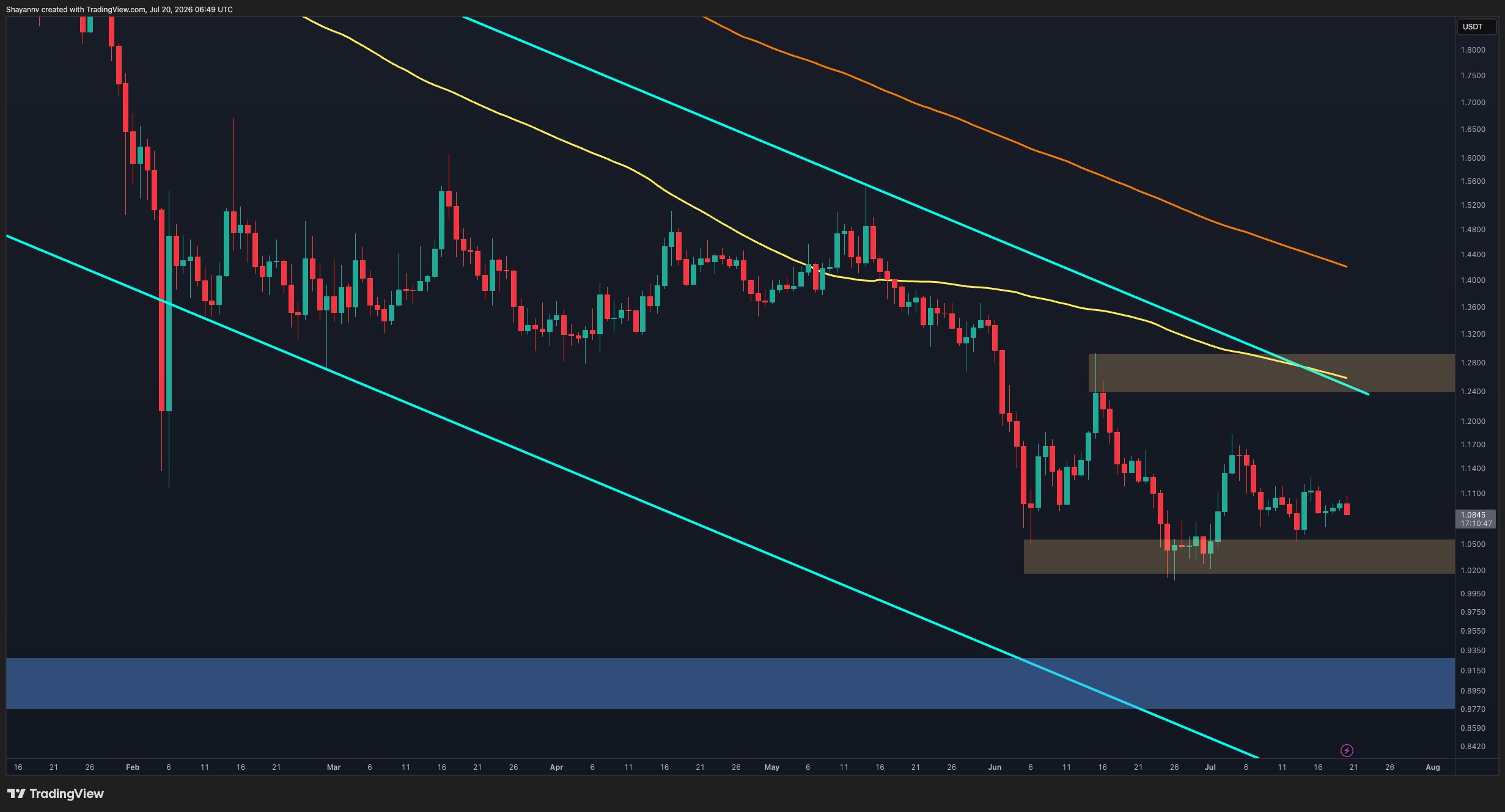
On the daily timeframe, XRP continues to trade inside a well-defined descending channel, reflecting the broader bearish trend that has dominated the market for several months. The 100-day and 200-day moving averages remain above the price and continue sloping lower, reinforcing the negative higher-timeframe bias.
The recent recovery attempt stalled precisely beneath the $1.24-$1.28 supply zone, where the descending channel’s upper boundary converges with the moving averages. This confluence strengthens the resistance area and explains why sellers quickly regained control after the latest rally.
Meanwhile, the asset continues to defend the $1.02-$1.06 demand zone. This support has repeatedly attracted buyers over recent weeks and remains the most important level to monitor. A sustained break below this area would expose the broader demand region around $0.88-$0.92, while holding above it keeps the possibility of another recovery toward the channel resistance alive.
XRP/USDT 4-Hour Chart
On the 4-hour chart, XRP remains confined beneath a descending trendline that has capped every recovery since the mid-June peak. Although buyers have managed to produce several short-lived rebounds, none have been strong enough to invalidate the sequence of lower highs.
The $1.16-$1.18 zone represents the first meaningful resistance and aligns with the descending trendline, creating a key decision area for short-term price action. A decisive breakout above this confluence would improve the short-term structure and could pave the way for another test of the higher supply zone around $1.24-$1.29.
On the downside, the $1.02-$1.06 demand region continues to provide solid support. As long as this area remains intact, Ripple could continue consolidating within the current range. However, losing this support would likely accelerate bearish momentum and shift focus toward the higher-timeframe demand around $0.88-$0.92.

The post Ripple Price Analysis: What’s Next for XRP After Holding Key Support? appeared first on CryptoPotato.


Bitcoin miner and AI infrastructure developer Hut 8 (HUT) jumped as much as 14% after announcing a $9.8 billion, 15-year lease for the second phase of its Beacon Point data center campus in Texas, helping lift shares across the sector.
The agreement, signed with the same investment-grade tenant that leased the first phase of the project, fully commercializes the 1-gigawatt campus. Hut 8 will build another 352 megawatts (MW) of AI computing capacity based on Nvidia’s data center architecture, bringing the tenant’s total contracted capacity at the site to 704 MW.
The second lease fully commercializes Beacon Point’s 1-gigawatt power capacity and raises the campus’ base contract value to $19.6 billion over the initial lease term.
Hut 8 rose to as high as $104.51 on Monday, and the announcement spilled over to peers in the high-performance compute sector. IREN (IREN) climbed 15%, Cipher Mining (CIFR) gained 11% and TeraWulf (WULF) added 6.4% in early trading. The CoinShares Bitcoin Miners ETF (WGMI) advanced 9.3%.
The share-price surge comes after AI infrastructure companies stumbled in recent weeks as investors questioned whether the industry’s breakneck spending on data centers would continue.
Earlier buoyant sentiment cooled after Chinese firms released open-source AI models that appeared to require less computing power than Western rivals. Before that, reports that Facebook parent Meta Platforms (META) was considering a cloud service to rent AI computing capacity also raised concerns that additional supply could weigh on data center operators.


Crypto wallet firm Exodus Movement (EXOD) will cut about 25% of its global workforce as it reshapes its business around stablecoin payments and card infrastructure.
The Omaha, Nebraska-based company said in a filing the layoffs are part of a broader effort to lower costs while supporting its strategy of building a full-stack payments platform.
The restructuring comes as Exodus continues to integrate Monavate, an electronic money institution, and crypto payments firm Baanx, two acquisitions that have expanded its payments capabilities and international footprint.
Exodus said it expects to record pre-tax restructuring charges of between $2.5 million and $3.5 million, mostly tied to severance and employee-related costs. Affected workers will receive severance, continued benefits and transition support.
The company said the restructuring should generate annual cash operating expense savings of $10 million to $13 million, with the full benefit expected in 2027.
EXOD is higher by 2.2% in early trading Monday, but remains down nearly 85% year-over-year.
Crypto World
Digital Native Generations May Never Need A Bank Account Here’s Why That Terrifies Banks
This isn’t a prediction. It’s already happening in emerging markets. And banks have no idea how to respond.
The Statement Banks Don’t Want You To Read
This week, crypto executives made a claim that should have been front page news:
Digital-native generations may never need a bank account.
Not “might eventually move away from banks.” Not “could reduce their dependence on traditional finance.” May never need one. At all. Ever.
And the evidence isn’t coming from Silicon Valley futurists or crypto Twitter maximalists. It’s coming from data on the ground in emerging markets, where younger users are already driving crypto adoption at scale—not as speculation, but as their primary financial infrastructure.
This isn’t a prediction about the future. It’s an observation about what’s already happening.
And it terrifies banks.
What “Never Need A Bank Account” Actually Means
Let’s be precise about what we’re talking about.
A bank account does several things:
- Stores value safely
- Enables payments and transfers
- Provides access to credit
- Connects you to the broader financial system
For most of human history, a bank was the only institution that could do all of these things reliably. You needed one. Full stop.
But in 2026, every single one of these functions can be performed without a bank:
Store value: Stablecoins, Bitcoin, hardware wallets. No bank required.
Payments and transfers: Crypto rails, stablecoin transfers, peer-to-peer payments. Instant. Global. No bank required.
Access to credit: DeFi lending protocols. Collateralized loans. No bank required.
Connect to the financial system: If your employer pays in crypto, your vendors accept crypto, and your savings are in crypto, the “financial system” you need to connect to is crypto.
For digital natives growing up in this environment, the bank account isn’t the foundation of their financial life. It’s an optional add-on they might never bother with.
Where It’s Already Happening
This isn’t theoretical. Look at the markets where it’s already real.
Sub-Saharan Africa: Mobile money (M-Pesa and its successors) already replaced banks for tens of millions of people. The next generation isn’t going from mobile money to banks. They’re going from mobile money to crypto. The bank is being skipped entirely.
Southeast Asia: Philippines, Vietnam, Indonesia—crypto adoption rates among under-30s are among the highest in the world. Not for trading. For remittances, for savings, for daily transactions. The bank account was never the entry point.
Latin America: Argentina, Venezuela, Brazil—in countries with currency instability, young people don’t trust local banks enough to use them as primary savings vehicles. Stablecoins are their savings account. USDC doesn’t devalue at 100% annually. Their local currency does.
Middle East and North Africa: Young, unbanked populations with high smartphone penetration. Crypto-first financial behavior isn’t the exception. For the under-25 demographic in several MENA markets, it’s becoming the norm.
The pattern is consistent: in markets where banks failed their populations—through hyperinflation, capital controls, exclusion, corruption, or simple inaccessibility—younger generations didn’t wait for the banks to fix themselves. They built financial lives without them.
Why This Generation Is Different
Every generation has been skeptical of banks. What makes digital natives different is that for the first time, the skepticism comes with a working alternative.
Previous generations who distrusted banks had two options: keep cash under the mattress, or use the bank anyway because there was no third option.
Digital natives have a third option that actually works. It’s on their phone. It’s accessible globally. It settles in seconds. It doesn’t require a physical branch, a minimum balance, a credit history, or a government ID in some cases.
The alternative exists. And it’s better in several measurable ways:
Speed: Crypto transfers settle in minutes or seconds. Bank wires take days.
Access: A crypto wallet requires a smartphone and internet access. A bank account requires documentation, minimum balances, and physical presence in many markets.
Cost: Cross-border crypto transfers cost fractions of a cent. Bank wire fees can be $25–50 plus exchange rate margins.
Control: You own your crypto wallet. A bank can freeze your account, limit withdrawals, or fail entirely.
Availability: Crypto markets run 24/7/365. Banks close on weekends.
For a generation that grew up with instant everything—instant messaging, instant delivery, instant streaming—waiting three days for a wire transfer to clear isn’t a minor inconvenience. It’s evidence that the system is broken.
What Banks Actually Provide That Crypto Doesn’t
To be fair: banks still offer things crypto doesn’t fully replace.
Deposit insurance: In most countries, bank deposits are insured by the government up to a certain amount. Your crypto wallet has no equivalent protection.
Consumer protection: Fraudulent bank transactions can often be reversed. A crypto transaction is permanent.
Credit scoring: Banks build credit histories that unlock mortgages, car loans, business financing. Crypto has no equivalent mainstream credit infrastructure yet.
Integration with legacy systems: Payroll, tax systems, government benefits—most of the world’s financial infrastructure still routes through banks.
These are real limitations. They’re also getting smaller every year.
DeFi credit protocols are building on-chain credit histories. Insurance products for crypto holdings are emerging. Governments in several countries are exploring how to integrate crypto rails with existing payment systems.
The gaps are closing. Not fast enough for banks to relax. Fast enough for a generation that’s comfortable waiting.
Why This Terrifies Banks The Real Reason
The obvious reason banks should be scared: losing customers.
But that’s not the deep terror.
The deep terror is this: banks’ entire business model is built on the assumption that everyone needs them.
Banks don’t just earn money from fees. They earn money from the float—the money sitting in your account that they lend out at interest while you earn little or nothing. They earn from the data about your spending that they monetize. They earn from the cross-sell: you have a checking account, so we offer you a mortgage, a credit card, an investment account.
All of that depends on you having no alternative.
The moment a generation exists that has a credible alternative—one that doesn’t need the checking account as the entry point—the entire model starts to unwind.
You can’t cross-sell to someone who never walked in the door.
You can’t earn float on money that’s sitting in a stablecoin wallet.
You can’t build a credit relationship with someone whose financial life lives on-chain.
This isn’t about one product. It’s about the structural dependency that banking is built on. And digital natives are the first generation that might grow up without that dependency.
The Response Banks Are Getting Wrong
Banks have noticed. They’re responding.
JPMorgan has a blockchain division. Bank of America filed hundreds of crypto patents. Fidelity offers crypto custody. Every major bank has an “innovation lab” with someone whose job title includes “blockchain.”
But the response is almost universally the same: take crypto, put it inside our existing infrastructure, and offer it as a product within our existing customer relationship.
JPMorgan Crypto. Bank of America Bitcoin ETF access. Fidelity Digital Assets.
These are banks saying: “If you want crypto, get it from us. Stay in our ecosystem. Keep your bank account.”
The problem: digital natives don’t want to get crypto from JPMorgan. They want to skip JPMorgan entirely.
Banks are building products that assume the customer still needs them as the starting point. The entire threat is that they might not be the starting point anymore.
Offering Bitcoin within a bank app to someone who already has a bank account is not a response to the generation that never opens the bank app in the first place.
What The Next Decade Actually Looks Like
The shift won’t be sudden. It will be generational. Literally.
Today: Digital natives in emerging markets build financial lives on crypto rails. Older generations in developed markets maintain bank accounts. Both coexist.
Five years: The emerging market pattern spreads to developed markets as the infrastructure matures. Crypto-native financial products (lending, insurance, investment) become mainstream enough that bank accounts feel optional, not required.
Ten years: The generation that never needed a bank account is in their 30s. They’re buying homes, starting businesses, raising families. They’re doing it on financial infrastructure that doesn’t route through a bank. Banks serving this generation have to offer genuinely competitive products—not just crypto wrappers—or lose them entirely.
The question isn’t whether this happens. The data says it’s already happening.
The question is whether banks adapt fast enough. Not by offering crypto products, but by rethinking what value they actually provide in a world where the infrastructure they built is no longer the only option.
The Uncomfortable Truth For Everyone
For banks: Your moat is eroding. Not because crypto is winning, but because the generation that’s growing up has options you didn’t count on.
For crypto: This is the adoption story you’ve been waiting for. But it’s not coming from the people you were targeting with your ads. It’s coming from the people who never had access to what you were claiming to replace.
For regulators: The unbanked populations you’ve spent decades trying to bring into formal finance are building their own formal finance. The question is whether your regulatory frameworks will include or exclude them.
For digital natives: You may be the first generation with genuine financial sovereignty—the ability to hold, transfer, and grow value without asking permission from an institution. Whether you use that wisely is a different question.
The bank account defined financial participation for a century.
For the next generation, it might be optional.
And that changes everything.

Ethereum is trading around $1,850, and bulls remain focused on one technical price trigger to initiate a big rally. Bulls are waiting for a sustained close above the 100-day EMA near $1,938. That is the line in the sand. Crack it with convincing volume, and the medium-term picture finally starts looking brighter. Miss it, and late longs could end up holding the bag.
The data behind this setup still looks tidy. Exchange outflows continue to reduce available sell-side supply, while staking keeps locking away circulating ETH. Meanwhile, futures volume has jumped sharply, and funding rates remain positive. That tells us buyers are still willing to pay for exposure, although the market has not reached full euphoria just yet.

The long-to-short ratio sits close to 0.96, keeping positioning near balance instead of leaning too heavily in one direction. At the same time, Ethereum has tightened into an intraday range between $1,845 and $1,865. Markets love making traders wait, but tight ranges rarely stay quiet for long. Institutional interest has also continued to build, adding another layer of support beneath the chart.
With the MACD crossing into positive territory and ETH holding above the 50-day EMA near $1,818, the technical structure still leans bullish. Even so, this remains a level-by-level trade rather than a victory lap. As always, the chart gets the final vote, not our opinions.
Discover: The Best Crypto to Diversify Your Portfolio
Can Ethereum Price Break and Hold Above $1,940 This Week?
Ethereum price has gained about 4% over the past seven days, making it one of the stronger performers among the top ten cryptocurrencies by market cap. Trading activity has also picked up, with 24-hour volume hovering around $7.0 billion. Fresh money appears to be joining the move instead of traders simply passing the same chips around.
The technical picture remains straightforward. Support sits near the 50-day EMA around $1,818, and losing that level would weaken the recovery story. Resistance now stretches between $1,875 and $1,900, while the 100-day EMA near $1,938 remains the real gatekeeper. A convincing daily close above it puts $2,000 firmly back on the radar.
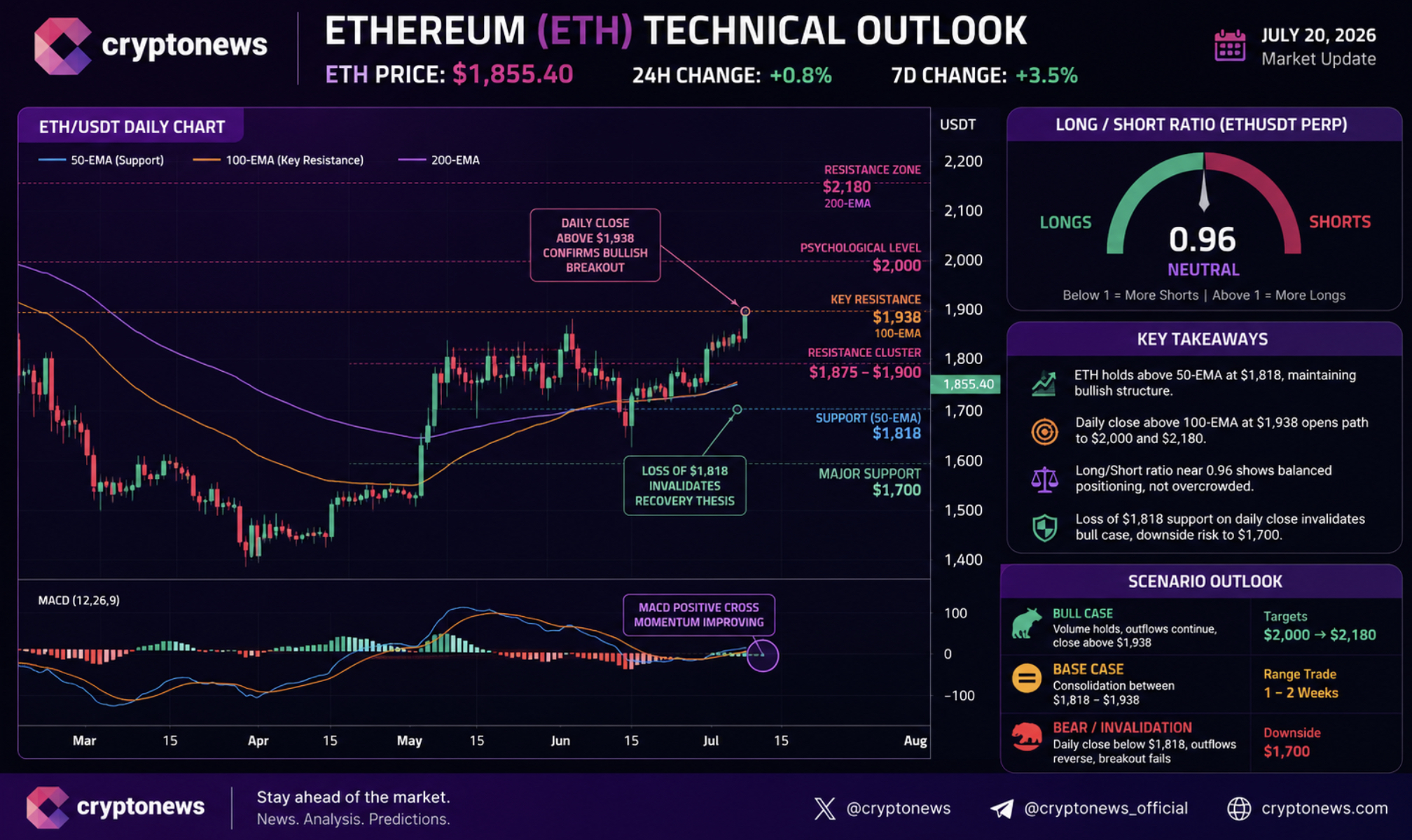
If buyers keep volume elevated, exchange outflows continue, and ETH closes above $1,938, the next stops become $2,000 and then the 200-day EMA near $2,180. That would finally give bulls something more exciting than another day of staring at candles.
The base case is less dramatic. Ethereum could spend another week chopping between $1,818 and $1,938 while traders wait for fresh macro catalysts. However, if ETH loses $1,818 on a daily close and exchange outflows reverse, this rally could fizzle out, exposing the $1,700 area once again.
The positive MACD crossover and improving momentum still favor buyers. Even so, charts reward patience more than enthusiasm. Watch the daily close, not every five-minute candle, trying to steal the spotlight.
Trade Ethereum on Bybit and Get a Chance to Win Our $1,000 USDT Airdrop
Bitcoin Hyper Targets Early-Mover Upside as Ethereum Tests Key Levels
ETH at $1,860 is a recovery trade with defined upside targets. The math to $2,180 is roughly 16% from current levels. It’s a respectable target, but that’s a move back to levels ETH already occupied months ago.
For traders who want asymmetric upside tied to the same crypto risk cycle, the early-stage presale market is where the leverage lives.
Bitcoin Hyper ($HYPER) is positioning itself at what could be a genuinely underexplored infrastructure niche: it’s the first Bitcoin Layer 2 to integrate the Solana Virtual Machine, targeting sub-second finality and low-cost smart contract execution while inheriting Bitcoin’s security model.
The project has raised $32.9 millio0n at a current presale price of $0.0136834, with staking rewards available to early participants. The $33 million milestone is already within reach, which tends to accelerate visibility and the next price step-up.
The core pitch of bringing Solana-speed programmability to Bitcoin’s trust layer via a Decentralized Canonical Bridge addresses limitations that have kept Bitcoin-native DeFi marginal.
Research Bitcoin Hyper before the next price tier closes.
Discover: The Best Token Presales
The post Ethereum Bulls are Preparing for a Major Price Breakout Above the 100-day EMA appeared first on Cryptonews.
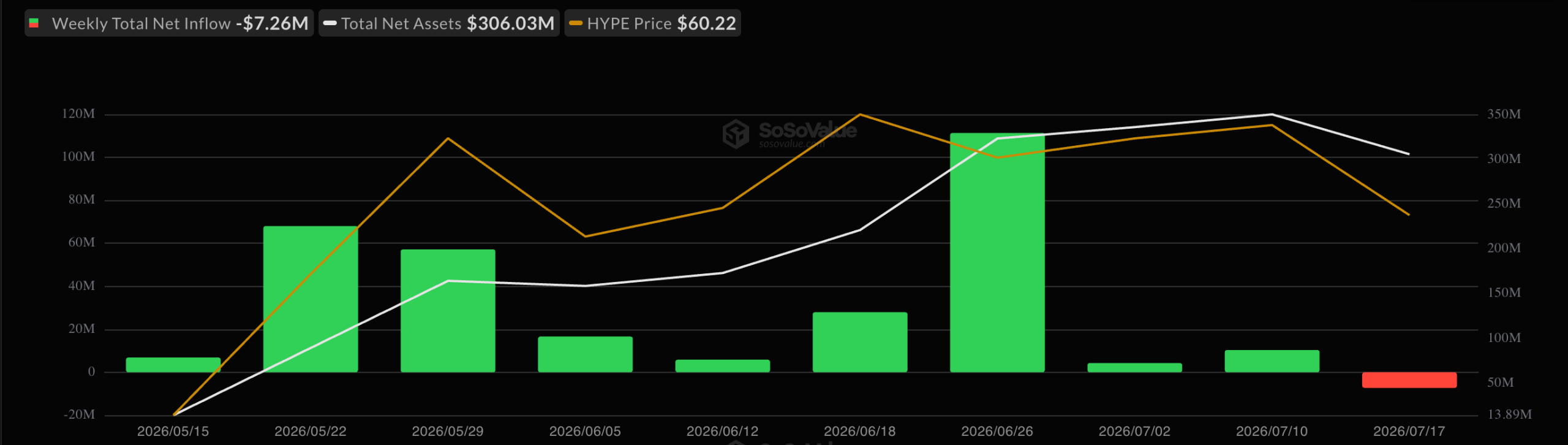
Spot Hyperliquid (HYPE) exchange-traded funds (ETFs) recorded their first weekly outflow since launching in May.
Bitcoin (BTC) and Ethereum (ETH) funds moved the other way, pulling in fresh capital for a second straight week. The reversal came alongside a sharp decline in the token’s price.
HYPE ETF Streak Ends While Majors Recover
The HYPE funds shed $7.26 million in the week ending July 17, according to SoSoValue data. That ended a run of 9 consecutive inflow weeks.
It cut cumulative net inflows from $308.6 million to $301.34 million. Meanwhile, net assets fell 12.7% to $306.03 million.
Follow us on X to get the latest news as it happens

Meanwhile, the largest crypto funds moved in the opposite direction. Bitcoin ETFs drew $75.67 million, their second straight positive week after 8 consecutive weeks of outflows.
Ethereum ETFs added $105.44 million, their strongest weekly haul since late April. XRP (XRP) funds gained $6.78 million, and Solana (SOL) products collected nearly $1 million. Combined, the four major fund groups attracted over $188 million.
HYPE Leads Top 10 Losses This Week
The ETF outflows tracked a weak stretch for the token itself. HYPE has dropped over 8% in the past week, making it the biggest loser among the top 10 cryptocurrencies.

The token fell below $60 last week. It has moved back above the level and trades at $60.66. The selloff also coincided with a broader risk-off move across altcoins last week. However, HYPE underperformed the total market cap, which stayed roughly flat over the same period.
Whether ETF investors return may depend on how the token holds its current support. Next week’s flow data will show whether the outflow was a one-off or the start of a rotation away from HYPE.
Subscribe to our YouTube channel to watch leaders and journalists provide expert insights
The post HYPE ETFs Post First Outflow Since May, Ending a 9-Week Streak appeared first on BeInCrypto.


Zilliqa said exchanges paused ZIL deposits and withdrawals after an exchange partner’s cold wallet was compromised, with the amount stolen still undisclosed.
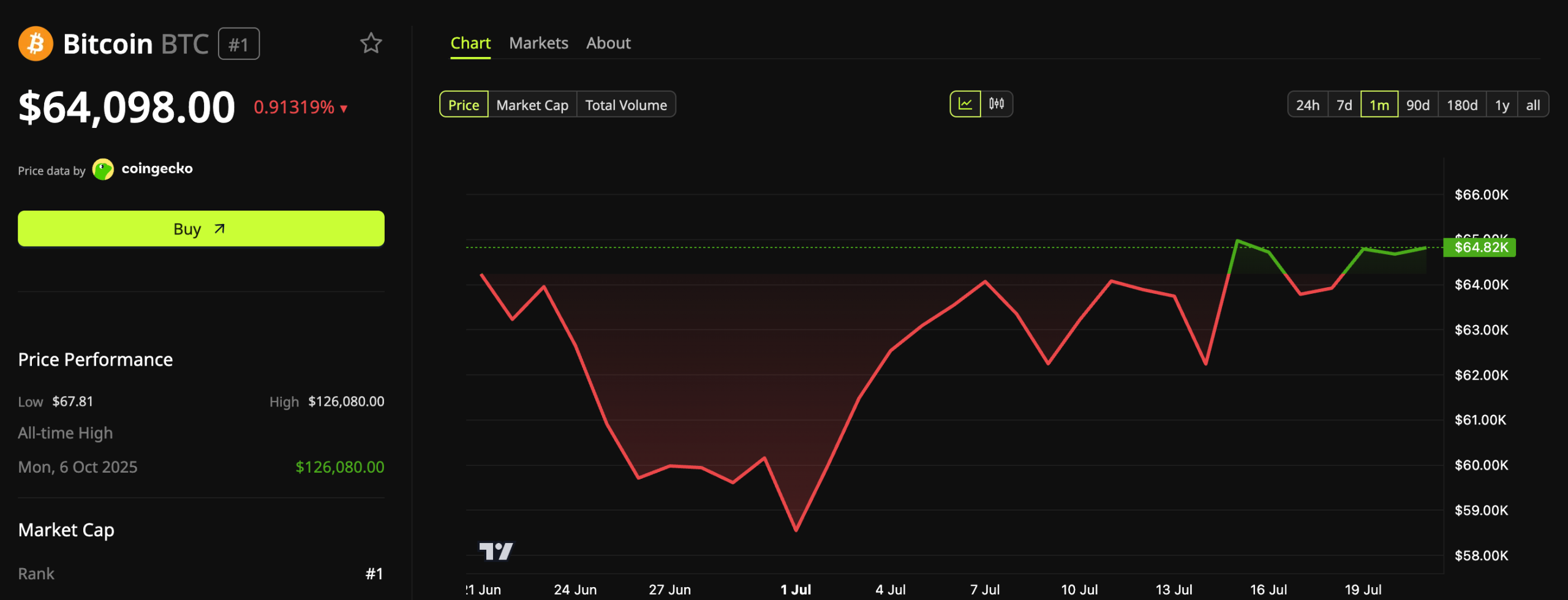
Bitcoin (BTC) has seen a modest recovery over the past week, with prices up 2%. The asset is trading near $64,000, yet three on-chain signals flash bearish for its July rebound.
The pressure builds as US strikes on Iran continue, lifting oil prices. That risk-off backdrop has added pressure across crypto markets.

Exchange Data Turns Bearish
The first signal comes from exchange reserves. Stablecoins act as dry powder for buying cryptocurrencies. Over the past 30 days, roughly $2.3 billion in stablecoins left Binance and Bybit, according to analyst Darkfost.
He said the decline points to weakening liquidity and softer buying demand. The analyst added that investors are increasingly withdrawing stablecoins from exchanges rather than keeping them available for trading.
“It is therefore this still-too-pessimistic market-wide positioning that continues to deprive BTC of the resources it needs to durably break out of this consolidation zone,” the analyst wrote.
Follow us on X to get the latest news as it happens

A second bearish indicator comes from the Coinbase Premium Index. The metric has remained consistently below zero since early May and currently stands at -0.062.
A negative Coinbase Premium typically signals weaker buying interest from US-based investors, particularly institutions, as Bitcoin trades at a discount on Coinbase relative to global exchanges.
The prolonged negative reading suggests demand from this cohort has remained subdued, adding to concerns that buying pressure is fading despite Bitcoin’s recent price action.

Bitcoin’s Top Buyers Capitulate at a Loss
The third signal comes from holders. Analyst Darkfost reported that recent top buyers are now selling at a loss. These investors entered between $75,000 and $126,000 over the past 6 to 18 months.
This group holds 2,450 BTC at a loss on exchanges, on a 30-day average. Their realized losses have set a record, with a monthly average near $90 million.
The trend extends to long-term holders (LTHs) across the market.
The reading cuts both ways. Some analysts view record losses as a sign of late-stage seller exhaustion. Darkfost, however, notes these phases confirm a bear market is already well advanced.
Subscribe to our YouTube channel to watch leaders and journalists provide expert insights
The post 3 Bearish Signs Flashing for Bitcoin in July 2026 appeared first on BeInCrypto.

Artificial intelligence is evolving faster than ever. New AI tools, platforms, models, and business opportunities are appearing almost every day, making it difficult to keep up with everything happening in the industry.
In this article, I will cover eight of the best AI YouTube channels to follow in 2026. These channels publish AI-focused videos that can help viewers discover new tools, understand emerging trends, and stay informed about the latest developments in artificial intelligence.
This list is useful for anyone searching for reliable AI YouTubers, AI influencers and AI KOLs.
These channels may also be valuable for AI founders, developers, marketers, and startup teams. When you are running an AI project, launching a new tool, or promoting an innovative platform, you can contact relevant creators to discuss a possible review, demonstration, interview, collaboration
Key Takeaways
- These channels can help viewers discover AI tools, understand emerging technology, and stay updated with artificial intelligence content.
- Founders can contact suitable AI YouTubers for potential product reviews, demonstrations, interviews, sponsored videos, or creator partnerships.
- The AI Plug, AI BUZZ, DailyExplainedAI, Facto Dream, CRYPTO BAR, Crypto Vector, Voice of Crypto, and Crypto Labs are eight AI-related YouTube channels to consider following in 2026
- Viewers should follow multiple AI creators and conduct independent research before making purchasing, investment, or business decisions.
1. The AI Plug
The AI Plug is an AI-focused YouTube channel for viewers who want to stay connected with the rapidly changing world of artificial intelligence.
The channel can be a useful destination for discovering AI-related content, emerging technology, new platforms, and discussions surrounding the future of automation. Its straightforward branding also makes it easy for viewers to understand the channel’s central focus.
For professionals and everyday users alike, The AI Plug can help make AI developments feel more accessible. Instead of trying to follow dozens of websites and social media accounts, viewers can use the channel as another source for exploring what is happening across the AI ecosystem.
Founders launching an AI tool or technology project may also consider contacting The AI Plug for a potential product review or promotional collaboration. A clear pitch should explain what the tool does, who it helps, and why it would be valuable to the channel’s audience.
2. AI BUZZ

AI BUZZ is another AI YouTube channel worth following in 2026. As its name suggests, the channel is positioned around the conversations, tools, and developments generating attention in the artificial intelligence industry.
This type of content can be especially helpful for viewers who want to discover what is gaining momentum without reading lengthy technical reports. AI-focused videos can introduce audiences to important trends in a more engaging and understandable format.
AI BUZZ may appeal to technology enthusiasts, content creators, marketers, entrepreneurs, and people beginning their AI learning journey. It can also be useful for viewers looking for ideas on how artificial intelligence is influencing online work, digital products, and business operations.
AI companies and project owners can contact the channel to explore opportunities for tool demonstrations, feature videos, sponsored content, or other collaborations. The strongest outreach messages are brief, personalized, and supported by a working product link.
3. DailyExplainedAI

DailyExplainedAI has a name that immediately communicates its purpose: explaining artificial intelligence content in a clear and accessible way.
AI can often feel unnecessarily complicated, particularly when discussions involve technical terminology, machine-learning concepts, new models, or fast-changing product announcements. Explanation-focused channels can help close the gap between complex technology and the people who want to understand it.
DailyExplainedAI is a relevant channel for beginners, students, professionals, and curious viewers searching for understandable AI videos. It may also appeal to people who want to learn how AI developments could affect their careers, businesses, or creative work.
For AI founders, an explanation-based channel can be particularly valuable. A well-produced video can show viewers how a tool works, what problem it solves, and how it differs from competing products. Project owners can approach the channel with a concise overview, demonstration access, and clear information about the intended audience.
4. Facto Dream

Facto Dream is an AI-content channel that viewers can add to their list of technology resources for 2026.
The channel offers another way to explore artificial intelligence through video content. This is valuable because AI is not only a technical subject. It is also shaping creativity, media, productivity, communication, online businesses, and the way people use digital platforms.
Channels such as Facto Dream can help introduce viewers to AI-related ideas in a format that is easier to consume and share. This makes the channel potentially relevant to both casual viewers and people actively working in technology.
AI tool developers and startup teams may also consider Facto Dream when planning creator outreach. Before contacting the channel, prepare a short explanation of the product, its main benefits, and the type of video collaboration you are proposing. Providing free access or a demonstration account can also make it easier for a creator to evaluate the tool
5. CRYPTO BAR

CRYPTO BAR is included in this list for its AI-related video content and its relevance to audiences interested in emerging digital technologies.
Artificial intelligence increasingly overlaps with other technology sectors. AI-powered analytics, automated systems, intelligent platforms, data-processing tools, and digital communities are becoming part of a much broader technology conversation.
This makes CRYPTO BAR a channel that may interest viewers who want to explore AI from a wider digital-innovation perspective. It can also help audiences discover how artificial intelligence is being discussed across different online industries.
For AI companies, channels with technology-focused audiences may offer useful promotional opportunities. Founders can contact CRYPTO BAR about a possible AI project review, platform walkthrough, interview, or sponsored feature.
Any collaboration proposal should clearly state that the product is AI-related. It should also explain how the tool benefits users and why it matches the interests of the channel’s audience.
6. Crypto Vector

Crypto Vector is another channel publishing content connected to AI and emerging technology.
The channel may be relevant for viewers who want to follow artificial intelligence developments from a broader technology and digital-market perspective. As AI becomes integrated into more products and platforms, audiences are increasingly interested in both the technology itself and its practical applications.
Crypto Vector can therefore be included among AI creators and technology influencers worth watching in 2026. Its content can introduce viewers to projects, discussions, and developments within the expanding AI landscape.
AI founders looking for promotional coverage can also approach the channel with a professional proposal. Avoid sending a generic message that simply asks for promotion. Instead, introduce the project, explain the problem it solves, provide a demonstration, and suggest a specific type of collaboration.
A focused pitch makes it easier for an AI YouTuber or technology creator to decide whether the project is suitable for the channel.
7. Voice of Crypto

Voice of Crypto is a technology-focused channel that also features content related to artificial intelligence.
Its inclusion highlights an important trend: AI content is no longer limited to channels that discuss only machine learning or software development. Artificial intelligence has become part of a much larger conversation involving digital platforms, automation, online communities, and emerging technologies.
Voice of Crypto may appeal to viewers who prefer following AI developments within this wider context. It can also introduce audiences to projects and ideas that might not appear on traditional educational AI channels.
For founders, creators with broad technology audiences can be valuable partners when launching a product designed for digital users. AI projects can contact Voice of Crypto to discuss possible reviews, interviews, sponsored features, or educational videos.
The outreach should remain transparent. Clearly disclose whether you are proposing paid promotion, an affiliate arrangement, early access, or an independent review opportunity.
8. Crypto Labs

Crypto Labs completes this list of AI YouTube channels and technology creators to follow in 2026.
The channel features content associated with artificial intelligence and emerging digital innovation. Its technology-oriented audience makes it potentially useful for viewers interested in discovering AI tools, platforms, projects, and industry developments.
Crypto Labs may be particularly relevant for people who want to understand how AI is expanding beyond standalone chatbots and image generators. Artificial intelligence is now being incorporated into analytics platforms, productivity software, automated services, digital products, and many other technology categories.
Developers and founders can also consider contacting Crypto Labs when promoting an AI-based product. A strong collaboration request should include a working website, product description, target audience, key features, and suggested content format.
Giving the creator enough information to independently understand and test the product can improve the quality of any resulting coverage.
Final Thoughts
The best AI YouTube channels do more than report technology news. They help audiences discover tools, understand new ideas, and see how artificial intelligence is being used in real-world situations.
The AI Plug, AI BUZZ, DailyExplainedAI, Facto Dream, CRYPTO BAR, Crypto Vector, Voice of Crypto, and Crypto Labs are eight channels to consider following for AI-related video content in 2026.
Whether you are an AI enthusiast, entrepreneur, marketer, developer, investor, or content creator, these channels can help you remain connected to the latest artificial intelligence conversations.
For AI founders and project owners, they may also provide opportunities to introduce a tool to a wider audience through reviews, demonstrations, interviews, and promotional collaborations. Research each channel, prepare a personalized proposal, and focus on creating genuine value for both the creator and their viewers.

North East’s Steve and Karen launch breakfast show on Hits Radio 00s
Kalshi traders think Coinbase’s trading volume will fall again

6 Best Hard Sci-fi Movies Released Since 2000


-
 NewsBeat4 days ago
London Mayor Sadiq Khan handed a peerage by Keir Starmer alongside 15 other Labour figures… just days before the PM leaves No10
-

 Fashion3 days ago
Weekend Open Thread – Corporette.com
-

 Politics2 days ago
The House | The City of London can help the new chancellor deliver growth in every postcode
-

 Politics5 days ago
Young campaigners urge incoming PM to act on outdoor junk food ads
-

 Crypto World5 days ago
CFTC blocks Kalshi from unwinding Michigan trades after court order
-
 Crypto World3 days ago
Two July Windows Left: The CLARITY Act’s Senate Fight and What Failure Means
-

 Business4 days ago
Nvidia Stock Slips After Big Tuesday Rally as Huang Confirms Vera Rubin Chip Is Now in Production Today
-

 Crypto World2 days ago
Ripple Payments Joins MiCA With 14 Firms, Does It Mean Anything For XRP?
-

 Politics1 day ago
Democrats look to World Cup watch parties to register thousands of voters
-
 Entertainment5 days ago
Disney’s Most Ambitious Failed Star Wars Attraction Is Coming to SDCC
-

 Crypto World3 days ago
Ripple wins EU-wide access as ESMA adds it to MiCA register
-

 Business4 days ago
Palantir Shares Rise After Expanded Nvidia Partnership and Fresh Analyst Upgrades Ahead of Earnings Day
-

 Crypto World4 days ago
Injective Submits SEC Transfer-Agent Registration to Onchain Ownership Records
-

 Tech6 days ago
Get Your ESP32 Sunny Side Up With This Solar Dev Board
-

 NewsBeat3 days ago
Registration is now open for March for Men with Kev 2026
-

 News Videos6 days ago
XRP BOMBSHELL… XRP OMBOARDED FOR TRANSACTIONS!!!
-

 Tech6 days ago
Dark Secrets Emerge When Jailbreaking LLMs
-

 NewsBeat3 hours ago
Unregistered fitter used Gas Safe logo on business flyers
-
 Sports5 days ago
New Cornerback Enters Vikings Trade Rumor Mill
-

 News Videos3 days ago
Money | Class 12 Economics | CBSE Board Exam 2026-27
You must be logged in to post a comment Login