

Crypto World
Ethereum Bulls are Preparing for a Major Price Breakout Above the 100-day EMA


Ethereum is trading around $1,850, and bulls remain focused on one technical price trigger to initiate a big rally. Bulls are waiting for a sustained close above the 100-day EMA near $1,938. That is the line in the sand. Crack it with convincing volume, and the medium-term picture finally starts looking brighter. Miss it, and late longs could end up holding the bag.
The data behind this setup still looks tidy. Exchange outflows continue to reduce available sell-side supply, while staking keeps locking away circulating ETH. Meanwhile, futures volume has jumped sharply, and funding rates remain positive. That tells us buyers are still willing to pay for exposure, although the market has not reached full euphoria just yet.

The long-to-short ratio sits close to 0.96, keeping positioning near balance instead of leaning too heavily in one direction. At the same time, Ethereum has tightened into an intraday range between $1,845 and $1,865. Markets love making traders wait, but tight ranges rarely stay quiet for long. Institutional interest has also continued to build, adding another layer of support beneath the chart.
With the MACD crossing into positive territory and ETH holding above the 50-day EMA near $1,818, the technical structure still leans bullish. Even so, this remains a level-by-level trade rather than a victory lap. As always, the chart gets the final vote, not our opinions.
Discover: The Best Crypto to Diversify Your Portfolio
Can Ethereum Price Break and Hold Above $1,940 This Week?
Ethereum price has gained about 4% over the past seven days, making it one of the stronger performers among the top ten cryptocurrencies by market cap. Trading activity has also picked up, with 24-hour volume hovering around $7.0 billion. Fresh money appears to be joining the move instead of traders simply passing the same chips around.
The technical picture remains straightforward. Support sits near the 50-day EMA around $1,818, and losing that level would weaken the recovery story. Resistance now stretches between $1,875 and $1,900, while the 100-day EMA near $1,938 remains the real gatekeeper. A convincing daily close above it puts $2,000 firmly back on the radar.
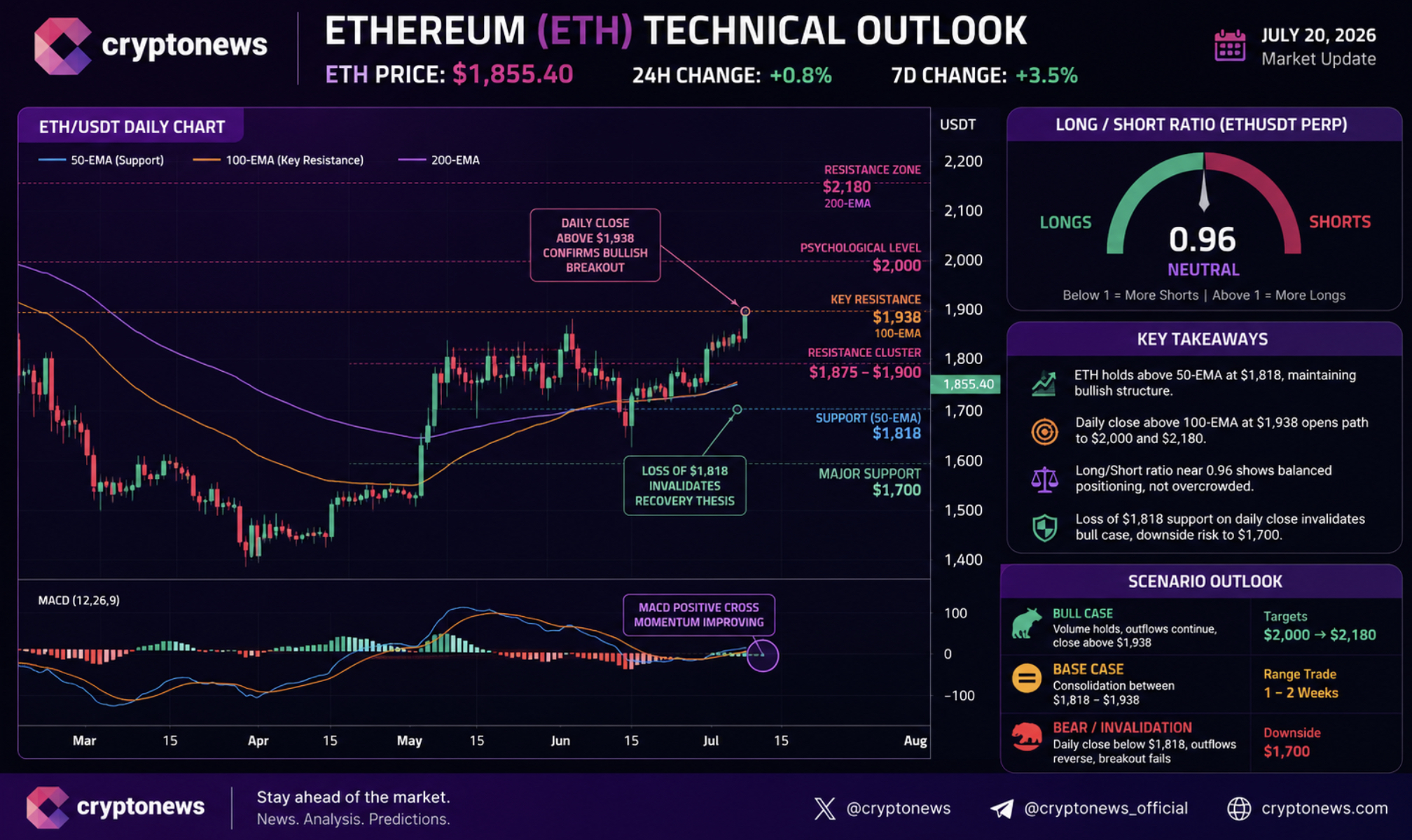
If buyers keep volume elevated, exchange outflows continue, and ETH closes above $1,938, the next stops become $2,000 and then the 200-day EMA near $2,180. That would finally give bulls something more exciting than another day of staring at candles.
The base case is less dramatic. Ethereum could spend another week chopping between $1,818 and $1,938 while traders wait for fresh macro catalysts. However, if ETH loses $1,818 on a daily close and exchange outflows reverse, this rally could fizzle out, exposing the $1,700 area once again.
The positive MACD crossover and improving momentum still favor buyers. Even so, charts reward patience more than enthusiasm. Watch the daily close, not every five-minute candle, trying to steal the spotlight.
Trade Ethereum on Bybit and Get a Chance to Win Our $1,000 USDT Airdrop
Bitcoin Hyper Targets Early-Mover Upside as Ethereum Tests Key Levels
ETH at $1,860 is a recovery trade with defined upside targets. The math to $2,180 is roughly 16% from current levels. It’s a respectable target, but that’s a move back to levels ETH already occupied months ago.
For traders who want asymmetric upside tied to the same crypto risk cycle, the early-stage presale market is where the leverage lives.
Bitcoin Hyper ($HYPER) is positioning itself at what could be a genuinely underexplored infrastructure niche: it’s the first Bitcoin Layer 2 to integrate the Solana Virtual Machine, targeting sub-second finality and low-cost smart contract execution while inheriting Bitcoin’s security model.
The project has raised $32.9 millio0n at a current presale price of $0.0136834, with staking rewards available to early participants. The $33 million milestone is already within reach, which tends to accelerate visibility and the next price step-up.
The core pitch of bringing Solana-speed programmability to Bitcoin’s trust layer via a Decentralized Canonical Bridge addresses limitations that have kept Bitcoin-native DeFi marginal.
Research Bitcoin Hyper before the next price tier closes.
Discover: The Best Token Presales
The post Ethereum Bulls are Preparing for a Major Price Breakout Above the 100-day EMA appeared first on Cryptonews.



CASHCAT, the flagship token of the two-week-old Robinhood Chain, has fallen roughly 70% from its record high, unwinding most of the run that briefly carried its market value above $200 million after leveraged trading arrived. The token changed hands at about $0.065 on Friday, down about 70% from… Read the full story at The Defiant


Celsius co-founders Shlomi Daniel Leon and Hanoch “Nuke” Goldstein have been ordered to pay over $6 million to settle Federal Trade Commission charges alleging they misrepresented the safety of the Celsius platform before the company collapsed.
Goldstein, Celsius’ former chief technology officer, was ordered to pay $2.014 million under an order signed Monday by US District Judge Denise Cote. Leon, the firm’s former chief strategy officer, was ordered to pay $4.1 million under a separate order entered on June 29.
The settlements extend the fallout from the 2022 collapse of Celsius beyond its former CEO Alex Mashinsky. The crypto lending platform, which held $25 billion in assets at its peak, owed its users $4.7 billion when it filed for bankruptcy in July 2022.
The order also bars Leon from marketing or selling products or services that can be used to deposit, exchange, invest or withdraw assets, the FTC said in a statement Monday.
“Similarly, Goldstein has agreed to a ban on marketing or selling retail products or services that can be used to buy, sell, deposit, withdraw, distribute or trade cryptocurrency.”
Related: Celsius’ Mashinsky gets permanent trading ban in CFTC settlement
FTC allegations against Celsius co-founders
The FTC alleged that Celsius falsely told customers it held sufficient reserves to meet withdrawal demands, maintained a $750 million insurance policy covering customer deposits and did not issue unsecured loans.
“The FTC, however, alleged that the promises were false and that its top executives continued to claim that customers’ deposits were safe days before the company filed for bankruptcy,” it said.
Mashinsky settles FTC case for $10 million
In April, Mashinsky agreed to an FTC settlement that permanently bars him from promoting asset-related products and required him to pay $10 million as part of a broader, partially suspended $4.72 billion judgment.
The $2.014 million and $4.1 million payments from Goldstein and Leon, respectively, will also be credited against the $4.72 billion judgment. The judgments reflect the consumer harm alleged by the FTC.
Separately, Mashinsky was sentenced to 12 years in prison in May 2025 after pleading guilty to commodities and securities fraud charges, with prosecutors saying he misled Celsius customers about the company’s profitability, investment risks and the safety of customer funds.
Magazine: Binance & OKX users face $1900 fines in Vietnam, Coinbase in China? Asia Express


Tokenized stocks are seeing more onchain trading and are starting to be used as lending collateral, though both remain a small share of DeFi activity, according to data published July 16 by Token Terminal, an onchain analytics provider. The firm's dashboard put spot DEX trading volume for tokenized… Read the full story at The Defiant


OKX said its Unified Tokenized Stocks product is now live for eligible traders, with users in the United States and the European Union excluded. The crypto exchange listed more than 40 tokenized US stocks and ETFs, including XNVDA, XAAPL and XTSLA, tradable against the USDT stablecoin. The design… Read the full story at The Defiant
Crypto World
Vietnam Targets Binance and OKX Users With $1,900 Fines; Coinbase Faces Scrutiny in China

Vietnam is moving to tighten oversight of crypto trading by cracking down on retail users who access overseas platforms not licensed in the country. At the same time, lawmakers and regulators across Asia are continuing to reshape how digital assets fit into financial law—through new classifications, asset-management rules, and enforcement actions.
Below is a regional roundup of the most consequential policy and compliance developments highlighted across Vietnam, Malaysia, Japan, South Korea, China and Hong Kong, and Indonesia.
Key takeaways
- Vietnam plans penalties of up to $1,900 for retail crypto trading on unlicensed offshore exchanges such as Binance, OKX, and Bybit, ahead of a regulated market rollout that is scheduled to begin on September 1.
- Japan’s parliament has passed revisions that reclassify cryptocurrencies as financial assets, shifting oversight away from the Payment Services Act and introducing new compliance requirements.
- South Korea is seeking to include crypto within the country’s “national assets” framework by rewriting the State Property Act as a National Asset Basic Act.
- In South Korea, regulators have begun sanction procedures against Upbit operator Dunamu following a $30 million hack, while broader legislative gaps around digital asset failures remain under review.
- Malaysia’s immigration and local authorities are investigating an Israeli citizenship controversy tied to Network School in Forest City, amid claims that the venue has been used through second passports.
Vietnam sets penalties for retail trading on offshore exchanges
Vietnam’s Finance Ministry has outlined fines targeting retail users who trade crypto on unlicensed overseas platforms rather than using locally licensed exchanges. The proposed penalties can reach up to $1,900 for retail participants, depending on the specifics of the activity and the platform involved.
The enforcement focus extends beyond individual traders. Domestic investors who trade crypto assets designated exclusively for foreign investors can face fines up to $3,800. Meanwhile, crypto companies that provide or advertise services without a license—or fail to properly identify customers—or unlawfully handle crypto account data can be fined up to $7,600.
The policy is scheduled to take effect alongside a regulated digital asset market framework due to start on September 1. However, the sticking point is that Vietnam’s regulator has not yet issued exchange licenses for the regulated market, even though five exchanges have reportedly been approved “in principle.”
For investors and traders, this gap matters: penalties are aimed at use of unlicensed offshore venues, but the local licensing pipeline is still not operational. Market participants should watch closely for when Vietnam’s first regulated exchange licenses are formally issued and which products and investor categories each approved platform will be allowed to support.
Malaysia investigation highlights passport and visa compliance risk
Malaysia’s immigration authorities are investigating claims that Network School in Forest City—founded by Balaji Srinivasan and designed around the idea of “network states”—has been hosting Israeli citizens via second passports.
According to reporting linked in the source coverage, the allegations trace back to an activist group, Malaysia Protest 4 Palestine, which accused the school of operating as a “gathering place for Israeli entrepreneurs.” In response to the controversy, Srinivasan had threatened to remove the Network School and its associated investments from Malaysia, according to earlier international headlines mentioned in the source.
The Immigration Department said its investigation found that 266 foreigners have valid documents. Separately, the Johor state government is continuing its probe to ensure compliance with local rules, including business licenses, building usage, and commercial operations.
From a policy perspective, the episode underscores how quickly immigration, licensing, and nationality rules can collide with crypto-adjacent narratives and cross-border talent flows. While dual nationals holding Israeli passports are reported to be allowed “for now,” the controversy suggests scrutiny could intensify, potentially closing loopholes that make certain residency or entry routes easier than regulators intend.
Japan reclassifies crypto as financial assets
Japan has moved to tighten the legal framework around digital assets by passing revisions to the Financial Instruments and Exchange Act that reclassify cryptocurrencies as financial assets.
As described in the source coverage, this change takes crypto regulations out of the Payment Services Act. The shift is framed as a mixed outcome for market participants: it brings regulatory expectations closer to traditional finance (TradFi), including stricter enforcement and compliance burdens, while also changing the tax profile for holders.
One of the most immediate implications is enforcement. The source notes that unlicensed crypto platforms could face penalties of 10 million yen or up to 10 years in jail. A new ban on insider trading in crypto is also included, to be policed by the Securities and Exchange Surveillance Commission.
On the tax side, current crypto tax rates—reported as up to 55%—are expected to be reduced to approximately 20%, with a three-year carry forward for losses. However, the revised tax rules do not take effect until 2028.
This timing gap creates uncertainty for investors trying to plan around a trading and tax strategy that spans the transition. Market participants should consider how current tax treatment applies until the 2028 effective date, and whether future guidance clarifies how trading activity should be recorded across the regulatory transition.
South Korea proposes crypto inclusion in national asset management
South Korea is looking to formally expand the scope of state asset management to include both crypto and intellectual property. The Ministry of Economy and Finance announced it is rewriting the 1950 State Property Act into a National Asset Basic Act, which would define “national assets” in a way that explicitly embeds cryptocurrency.
The source coverage emphasizes that the older framework was developed during an economy centered largely on real estate, and that the update would shift emphasis from merely managing assets to generating value from them. The practical implications for the industry are straightforward: if crypto is treated as a category of national assets, it could influence how the state approaches custody, risk management expectations, and the boundaries of public participation or oversight.
Regulatory enforcement and legislative follow-through
South Korea’s broader regulatory direction also includes enforcement actions. The source notes that the Financial Supervisory Service (FSS) has started sanction procedures against Upbit operator Dunamu after the platform was hacked for about $30 million in November. The FSS is reportedly determining whether the incident violated the Virtual Asset User Protection Act, while the source highlights that the law may not provide sanctions specifically for hacks or IT failures.
The coverage further states that legislators are expected to address that oversight in a forthcoming Digital Asset Basic Act, with talks reportedly restarted after a four-month pause.
Alongside enforcement and legislation, the source includes other ongoing developments, such as extensions of victim compensation schemes to cover crypto scams and a proposal by tax authorities to establish clearer procedures for seizing self-custodied crypto wallets during investigations.
Coinbase verification shift for mainland China users
Separately, Wu Blockchain reports that Coinbase has opened up user verification for accounts solely based in China. Previously, Chinese users reportedly needed to provide a Hong Kong address; the source claims they can now verify using only a Chinese ID card and a Chinese address.
However, the report also states that China does not currently appear in Coinbase’s list of supported countries on its help documentation. That mismatch suggests either a narrow operational change or a staged rollout of verification capabilities that does not equate to full country support for services.
For users, the practical takeaway is to confirm eligibility directly during onboarding and to treat verification availability as distinct from whether all account features are accessible in a given jurisdiction.
Other regional updates: Hong Kong tokenized funds and Bybit’s Indonesia platform
In Hong Kong, the source notes that the territory approved its first crypto-native tokenized fund from Baillie Gifford, allowing professional investors to have direct blockchain-based ownership of underlying assets.
Meanwhile in Indonesia, the coverage says Bybit is launching a regulated platform following its acquisition of the local NOBI exchange. Bybit is reportedly retaining NOBI’s senior management team to run the Bybit Indonesia operation, signaling continuity on the operating side while shifting regulatory posture under the new ownership structure.
Across the region, the common theme is that regulation is tightening while timelines and operational gaps remain: Vietnam’s licensing is still pending even as penalties loom, Japan’s tax relief arrives years after the legal reclassification, and South Korea’s state-asset framework is taking shape alongside enforcement for platform security. The next signal to watch is how quickly regulators turn policy announcements into functioning compliance infrastructure—especially licenses, tax guidance, and enforcement standards that affect day-to-day trading and custody decisions.
A memecoin riffing on Coinbase Chief Executive Brian Armstrong has collapsed after he dropped the token's artwork as his X profile picture and switched to a CryptoPunk, the latest sign of how tightly Base's markets track the moves of the chain's most prominent backer. The $BRIAN token, a… Read the full story at The Defiant


Strategy raised another $263.5 million by selling Class A common stock while leaving its Bitcoin holdings unchanged for a second straight week.
Summary
- Strategy raised $263.5 million through MSTR sales while keeping its Bitcoin holdings unchanged this week.
- Strategy increased its U.S. dollar reserve to $3.225 billion to support dividends and debt obligations.
- STRC valuation debate continues as investors assess cash flows, leverage, dividend coverage and Bitcoin exposure.
The company sold 2,732,318 MSTR shares between July 13 and July 19 through its at-the-market program, according to a July 20 filing with the U.S. Securities and Exchange Commission. Strategy reported no sales under its STRC, STRF, STRK or STRD preferred stock programs during the period.
Strategy also made no Bitcoin purchases or sales during the week. Its holdings therefore remained at 843,775 BTC, acquired for about $63.69 billion at an average cost of $75,476 per Bitcoin, including fees and expenses. The company’s official Bitcoin tracker confirms the same total.
MSTR sales push cash reserve above $3.2 billion
The latest share sales lifted Strategy’s U.S. dollar reserve to $3.225 billion as of July 19. The figure includes expected proceeds from ATM sales that had not yet settled by the reporting date. Strategy uses the reserve to support preferred stock dividends and interest payments on outstanding debt.
The company still had about $23.53 billion available under its MSTR ATM program after the latest transactions. It also reported no share repurchases during the week, despite having previously authorized programs covering both common and preferred securities.
The latest capital raise follows an even larger stock sale in the prior week. As crypto.news reported, Strategy raised $466.7 million by selling about 4.82 million MSTR shares between July 6 and July 12. Its Bitcoin holdings also remained unchanged at 843,775 BTC during that period, while the U.S. dollar reserve reached $3 billion.
Together, the two weekly updates show Strategy continuing to raise cash through common equity without adding to its Bitcoin position. The company has now increased its reserve by $675 million since July 5, when it reported $2.55 billion in cash after a separate Bitcoin sale.
Bitcoin holdings remain unchanged after earlier sale
Strategy’s current 843,775 BTC balance follows the sale of 3,588 Bitcoin between June 29 and July 5. The company raised about $216 million from that transaction and said the proceeds would support payments tied to its Digital Credit securities. Crypto.news reported at the time that the sale reduced Strategy’s holdings to their present level.
That transaction followed Strategy’s introduction of a broader Digital Credit Capital Framework. The plan gives the company authority to sell up to $1.25 billion in Bitcoin under certain conditions, primarily to strengthen its U.S. dollar reserve and meet dividend, interest and other capital needs. The authorization does not require Strategy to sell the full amount.
As previously reported by crypto.news, the framework also included $2 billion in authorized repurchases across common and preferred securities. Strategy also raised STRC’s annual dividend rate to 12% from 11.5%, effective from July.
For now, Strategy has chosen common stock sales rather than further Bitcoin sales to add liquidity. The company’s current Bitcoin balance remains below the 847,363 BTC it held before its July transactions, while its cash reserve has continued to rise.
STRC valuation debate continues as shares trade below par
The latest filing comes as investors continue to assess Strategy’s preferred stock structure. STRC closed at $85.29 on July 17, well below its $100 reference value, while MSTR ended the same session at $94.85, according to Yahoo Finance historical data.
Credit investor Khing Oei argued that investors may be placing too much weight on STRC’s current headline yield when valuing the security. “Never value a stream by dividing this year’s coupon by today’s price,” Oei wrote, arguing that investors should instead examine expected future cash flows and Strategy’s ability to fund distributions. His assessment represents his own valuation view rather than company guidance.
Strategy has already changed STRC’s payment structure as part of its effort to support the security. As crypto.news reported in June, the company moved toward semi-monthly STRC dividend payments while the shares continued trading below their $100 reference level.
The growing U.S. dollar reserve gives Strategy more cash available to service those obligations without immediately selling additional Bitcoin. However, dividend costs, debt interest, future capital raises and Bitcoin prices remain factors investors are tracking when assessing the company’s securities and treasury structure.
Strategy’s latest filing shows that common equity remains a large source of available financing. After raising $263.5 million during the week, the company retained approximately $23.53 billion of capacity for additional MSTR sales under its ATM arrangements.
The company has not indicated when it will use that remaining capacity or when it could resume buying Bitcoin. Its last two weekly filings showed no Bitcoin acquisitions, while its U.S. dollar reserve rose from $3 billion to $3.225 billion.


The FDIC protects bank depositors, and through a mechanism called pass-through insurance, it can protect people who hold money through intermediaries. Stablecoin holders assumed they were next in line. The FDIC has now said, in a speech and a proposal, that they are not, and the reasons teach you exactly what a stablecoin is.
Summary
- Pass-through deposit insurance extends FDIC protection through an intermediary to the underlying owners of money, which is how fintech app balances held in custodial bank accounts can be insured even though the app is not a bank.
- It only works when strict conditions are met: the account must be properly titled as custodial, records must identify each owner and their share, and the funds must actually sit at an insured bank.
- FDIC leadership stated in March, and an April proposal would codify, that stablecoin reserve arrangements do not qualify: holding a stablecoin makes you a creditor of the issuer, not a depositor of any bank.
- The GENIUS Act reinforces the line from the other side, prohibiting issuers from marketing stablecoins as insured or government-backed, while substituting different protections: full reserves and first-in-line priority if an issuer fails.
- The contrast that makes it all click: tokenized deposits are insured because they are deposits. The insurance question is a test of what the instrument legally is, and stablecoins fail it by design.
There is a sentence buried in the fine print of the American banking system that most stablecoin holders have never read and are implicitly betting on: deposit insurance can pass through an intermediary to reach the real owner of the money. It is why the balance in a fintech app can be FDIC-insured even though the app is not a bank, and why brokerage cash sweeps carry insurance even though the broker is not a bank. For years, a reasonable person could assume the same logic would eventually reach stablecoins, digital dollars whose reserves sit substantially in banks and Treasury bills. Crypto.news has also explained how the products actually hold value. In March, the FDIC’s chairman addressed the assumption directly, and in April the agency proposed to write the answer into its rules. The answer is no. A stablecoin holder is not an insured depositor, not through pass-through, not through the issuer’s accounts, not at all. Understanding precisely why is the single most clarifying exercise available for understanding what a stablecoin actually is, and this guide walks through it.
What deposit insurance actually covers
Start with the base layer, because pass-through only makes sense on top of it.
The FDIC insures deposits at member banks up to the statutory limit, currently $250,000 per depositor, per insured bank, per ownership category. The insured object is a deposit: a claim on a bank arising from money placed with it. The insured party is a depositor: the person or entity holding that claim. When an insured bank fails, the FDIC pays depositors up to the limit, typically within days, funded by the Deposit Insurance Fund that banks themselves pay into through assessments. The system’s entire purpose is run-prevention: depositors who know they will be made whole do not race to withdraw, so failures stay orderly instead of cascading.
Notice what the definition excludes. Insurance attaches to deposits at banks, not to money-like claims in general. A money market fund share is not insured. A prepaid card balance may or may not be. A bond issued by a bank is not. The perimeter is legal form, not economic resemblance, and everything in the stablecoin story turns on that.
How pass-through works, and when it does not
Pass-through insurance is the doctrine that lets the FDIC look through an intermediary to the real owners of pooled money.
The canonical setup: a company that is not a bank, a payments app, a broker, a benefits administrator, collects money from thousands of customers and places it in a single custodial account at an insured bank, often titled for benefit of its customers. If the bank fails, the question is whose deposit that was. Pass-through says: if the account records show that the intermediary held the money as custodian, and if the ownership records identify each customer and their share, then each underlying customer is treated as the depositor for their portion, each separately insured up to the limit. One $50 million custodial account can thus represent thousands of fully insured small balances.
The conditions are strict because the doctrine is easy to abuse. The account titling must disclose the custodial relationship. The records, at the bank or the intermediary, must actually identify the beneficial owners and amounts. And the money must genuinely sit as deposits at the insured bank. When those conditions fail, the protection fails with them, a lesson American fintech customers learned brutally in the Synapse collapse of 2024, where a middleware company’s ledgers were too broken to prove who owned what, and thousands of app users with FDIC-insured marketing discovered that insurance they thought followed their balance could not attach through defective records. Pass-through is real, and it is a machine with parts, and every part has to work.
Note also what pass-through insures against: the bank failing. It has never protected against the intermediary failing. If the fintech collapses but the bank is fine, the money is at the bank and the fight is over records and bankruptcy, not insurance. This distinction, which failure are you protected from, is about to do all the work.
One refinement completes the base layer, because the $250,000 figure is less absolute than it sounds. Coverage applies per depositor, per insured bank, per ownership category, and the categories, single accounts, joint accounts, certain retirement accounts, trust arrangements, stack. A couple with individual and joint accounts at one bank can hold well over a million dollars fully insured; a business with accounts at four banks is covered at each. Sophisticated cash management builds on this arithmetic deliberately, through sweep networks that spread large balances across many insured banks in insured-size pieces, a service sold precisely because the coverage architecture rewards distribution.
The detail matters for this guide because it defines what insurance is for: it is a retail and operational protection, engineered to make ordinary balances safe and runs unnecessary, not a guarantee for concentrated institutional money. Every instrument discussed below inherits its position from where it sits relative to that design. A tokenized deposit slots into the architecture natively, category rules, sweep logic, and all. A stablecoin sits entirely outside it, and no amount of reserve quality changes which side of the perimeter the holder’s claim lives on.
Why stablecoins do not qualify
Now run a stablecoin through the machine, and watch which parts fail.
A stablecoin holder owns a token: a claim against the issuer, redeemable for a dollar under the issuer’s terms. The issuer holds reserves, under the GENIUS Act, full reserves in liquid assets, some portion of which sits as deposits at insured banks, with the rest in Treasury bills, repo, and government money funds. The question is whether the holder’s coin is, through pass-through, an insured deposit for the holder’s benefit.
FDIC Chairman Travis Hill answered publicly in a March 11 speech, and the agency’s April proposal would codify the position: no. The holder of a stablecoin is a creditor of the issuer, not a depositor of the issuer’s banks. The reserve deposits belong to the issuer; they back the issuer’s obligations generally rather than being held as custodial property of identified coinholders; and the coinholder’s claim is against the issuer’s promise to redeem, not against any bank. Structurally, the arrangement fails the custodial-titling and beneficial-ownership requirements at once, because it was never built as a custody chain. It was built as an issuer with a balance sheet, which is a different animal wearing similar clothes.
The practical consequences stack up quickly. The issuer’s own accounts at any bank are insured only up to $250,000 for the issuer itself, a rounding error against tens of billions in reserves, which is why most reserve assets sit in instruments that never pretended to be insured. If a reserve bank fails, the issuer eats the uninsured exposure, and the coin’s fate depends on the size of the hole, which is precisely what the world watched in March 2023 when $3.3 billion of Circle’s reserves were trapped at Silicon Valley Bank and USDC traded to 87 cents. And if the issuer itself fails, insurance is not even the right vocabulary; the holder is in an insolvency, holding whatever the law of that insolvency provides.
Congress, for its part, closed the loop from the marketing side: the GENIUS Act prohibits presenting payment stablecoins as FDIC-insured or backed by the government, an acknowledgment that the confusion is foreseeable enough to legislate against.
What protects holders instead
None of this means stablecoin holders are naked. It means their protection is a different machine, and it is worth naming its parts as precisely as the insurance it replaces.
The first part is reserve composition. The GENIUS Act requires full backing in high-quality liquid assets, cash, short Treasuries, and similar, so that redemption demands can be met by selling assets whose value is not the question. After 2023, major issuers also restructured where reserves live, shifting toward government money funds and custody arrangements and away from concentrated uninsured bank deposits, shrinking the exact exposure that broke USDC’s peg.
The second part is the priority rule. If a permitted issuer fails, the Act pays stablecoin holders ahead of other creditors, first claim on the reserve pool. That is a genuinely strong legal position, closer to a secured creditor than to a shareholder, and it is the Act’s deliberate substitute for insurance: not a guarantee that a dollar is there, but a guarantee about who gets the dollars that are. For more context, crypto.news has covered the priority rule that substitutes for insurance.
The third part is disclosure and supervision, monthly reserve reporting and, eventually, the full supervisory regime, though here the honest caveat is dated: the agencies missed the Act’s July 18 rulemaking deadline, so the operational details of custody, redemption, and examination remain proposals, and the protective machine is running with several parts still on the workbench.
The comparison that makes the whole topic click is the one banks are building on purpose. A tokenized deposit, a bank deposit represented as a token, is insured, up to the limit, like any deposit, because it is one; the FDIC’s current rulemaking addresses its treatment explicitly. Insurance follows legal form. A token that is a deposit gets a depositor’s protections. A token that is an IOU from an issuer gets a creditor’s protections, however good the issuer’s assets. The entire regulatory architecture of digital dollars, the GENIUS reserve rules, the marketing prohibition, the banks’ tokenized-deposit push, is downstream of that one distinction, and a holder who understands it will never again be surprised by what the fine print says.
The Synapse lesson, in full
The 2024 Synapse collapse deserves more than the passing mention above, because it is the closest thing American finance has produced to a controlled experiment in what happens when pass-through protection is assumed instead of verified, and every dynamic it exposed has a stablecoin analogue.
Synapse was middleware: a banking-as-a-service company that sat between consumer fintech apps and the insured banks actually holding customer money. Millions of end users held balances in apps advertising FDIC insurance, their funds pooled in custodial accounts across partner banks, with Synapse keeping the ledger of who owned what. When Synapse failed, the banks were solvent and the money was, in aggregate, mostly there, and none of it could move, because the ledger reconciling individual ownership was incomplete, contradictory, and in bankruptcy. Users spent months locked out of balances, and a shortfall in the tens of millions of dollars emerged between what the apps’ records said users held and what the banks’ accounts contained, a gap that pass-through insurance could do nothing about, because no bank had failed. The FDIC’s later record-keeping rulemaking for custodial accounts was a direct response: the protection had proven only as strong as the intermediary’s books.
Hold that episode against the stablecoin structure and the instructive differences emerge on both sides. In one respect stablecoins are more honest than the Synapse-era fintechs: nobody with a compliant product claims your USDC is insured, and the GENIUS Act now forbids the claim outright, so the assumption Synapse users were lured into is legally off the table. In another respect the structures rhyme uncomfortably: a stablecoin holder’s position also depends on an intermediary’s internal records and asset segregation, the issuer’s reserve accounting, its custody arrangements, the cleanliness of the line between corporate assets and reserve assets. The GENIUS holder-priority rule is powerful precisely to the degree that the reserve pool is identifiable, segregated, and provably matched to outstanding coins on the day it matters. A priority claim on a commingled mess is the Synapse experience with extra steps.
That is the practical translation of all the doctrine in this guide. The question a holder should carry is not the abstract is it insured, the answer is settled and negative, but the operational one Synapse taught: if this intermediary froze today, how fast could anyone prove what I am owed, and from what identified pool would I be paid? For bank deposits, the answer is institutionalized, insured, and measured in days. For fintech balances, the answer post-Synapse depends on record-keeping rules written in its aftermath. For stablecoins, the answer currently lives in attestation reports, custody disclosures, and a rulebook the agencies have not finished. The instruments are converging in user experience and remain far apart in that one dimension, and that dimension is the entire subject.
How to think about it practically
Three habits of mind follow for anyone who holds or uses stablecoins, offered as orientation rather than advice.
Think in failure modes, not in blanket safety. The question is never is this safe but what fails, and what happens to me when it does. If a reserve bank fails: the issuer absorbs uninsured losses, and the coin’s stability depends on the hole’s size relative to the buffer, the 2023 scenario. If the issuer fails: holders stand first in line against a full-reserve pool under the GENIUS priority, strong but slower and less certain than insurance. If a platform holding your coins fails: neither insurance nor the priority rule addresses your custody arrangement at all, which is a separate risk with its own literature.
Read claims of insurance as a red flag, not a comfort. Under the GENIUS Act, a stablecoin marketed as FDIC-insured is either lying or describing something narrow, like the issuer’s own operating accounts, in a misleading way. The presence of the claim tells you about the marketer.
And watch the rulemaking, because the substitute protections are only as real as their implementation. The priority rule and reserve requirements are statute; the mechanics that make them operational in a weekend crisis are in the unfinished rules the agencies owed by July 18. The distance between a legal right and a working process is exactly where the 2024 fintech customers lived for months, and the stablecoin version of that distance is what the current rulemaking exists to close.
Deposit insurance is the quiet technology that makes bank money boring, and its absence is the honest price of stablecoins’ openness. The instruments that carry insurance require a bank in the loop. The instruments that require no bank cannot carry the insurance. Everything else in the digital-dollar debate is a negotiation over that trade, and now you can read it fluently.
Frequently asked questions
What is pass-through deposit insurance?
It is the FDIC doctrine that extends deposit insurance through a custodial intermediary to the true owners of pooled money. When a non-bank places customer funds in a properly titled custodial account at an insured bank, and records identify each customer’s share, each customer is treated as the depositor for their portion, separately insured up to $250,000. It is how fintech app balances and brokerage sweeps can be insured.
What conditions does pass-through require?
Three essentials. The account must be titled to disclose the custodial or fiduciary relationship. Ownership records, at the bank or the intermediary, must identify each beneficial owner and their exact share. And the funds must actually be deposits at an insured bank. If any condition fails, coverage fails, which the 2024 Synapse collapse showed in practice when broken records left fintech customers unable to prove their claims.
Why do stablecoin holders not get pass-through insurance?
Because the structure is not a custody chain. A stablecoin holder is a creditor of the issuer, holding a redemption claim, while the reserve deposits belong to the issuer and back its obligations generally rather than being held as identified customers’ property. FDIC Chairman Travis Hill said as much in a March 2026 speech, and an April FDIC proposal would codify it. The arrangement fails the custodial-titling and beneficial-ownership requirements simultaneously.
Is any part of a stablecoin arrangement insured?
Only trivially. The issuer’s own accounts at an insured bank are covered up to $250,000 for the issuer, which is negligible against reserves in the tens of billions, and most reserve assets, Treasury bills, repo, government money funds, are not deposits at all. That is why a reserve bank’s failure, as with Silicon Valley Bank holding $3.3 billion of Circle’s reserves in 2023, hits the issuer as uninsured exposure.
What protects stablecoin holders instead of insurance?
Three things under the GENIUS Act. Full reserves in high-quality liquid assets, so redemptions are met from assets whose value is stable. A priority rule paying stablecoin holders ahead of other creditors if a permitted issuer fails, a strong first-claim position on the reserve pool. And disclosure plus supervision, though the detailed implementing rules remain unfinished after regulators missed the July 2026 rulemaking deadline.
Can a stablecoin legally advertise itself as FDIC-insured?
No. The GENIUS Act prohibits marketing payment stablecoins as insured by the FDIC or backed by the US government. Congress included the ban precisely because the confusion is foreseeable: the products feel deposit-like, and issuers had incentives to blur the line. A stablecoin promoted with insurance claims is a warning sign about the promoter, not a feature of the product.
Are tokenized deposits insured, then?
Yes, up to statutory limits, because they are deposits: bank money represented as a token while remaining on the bank’s balance sheet, with the FDIC’s current rulemaking addressing their treatment explicitly. The contrast is the cleanest way to see the principle. Insurance follows the instrument’s legal form. A token that is a deposit carries a depositor’s protection; a token that is an issuer’s IOU carries a creditor’s.
Does the SVB episode mean the government will protect stablecoins anyway?
It means something narrower. USDC recovered in 2023 because regulators invoked the one time protection arrived anyway to protect all depositors of a failing bank, and Circle happened to be a depositor. The rescue targeted banking contagion; the stablecoin benefited as a spillover. Reserve reforms since then have moved issuer assets away from bank deposits, narrowing that accidental channel instead of institutionalizing it. Nothing in current law insures holders directly. This is educational information, not financial advice.
Disclaimer: This article is for information and educational purposes only and does not constitute financial, investment, or legal advice. Insurance treatment, regulatory proposals, and issuer practices described here are subject to change, and individual products differ. Always do your own research. Information is accurate as of July 20, 2026.


Spot Hyperliquid (HYPE) exchange-traded products recorded their first weekly outflow since launching in May, according to CoinShares' weekly Digital Asset Fund Flows report. The products shed $7.26 million in the week ending July 17, ending a run of nine consecutive weeks of inflows. The withdrawal… Read the full story at The Defiant


Bitmine Immersion Technologies (NYSE: BMNR) acquired 7,430 ether (ETH) over the past week, its smallest weekly purchase since launching its treasury strategy, as the company shifted capital toward buying back its own stock, according to a company press release issued July 20. The purchase lifted… Read the full story at The Defiant

Akwa United’s Somto Nnoli Named in Flying Eagles Squad for WAFU B U20 Championship

Will AI Replace Financial Advisers?!
KPMG Australia appoints new CEO from its own ranks in wake of audit leak scandal


-
 NewsBeat4 days ago
London Mayor Sadiq Khan handed a peerage by Keir Starmer alongside 15 other Labour figures… just days before the PM leaves No10
-

 Fashion3 days ago
Weekend Open Thread – Corporette.com
-

 Politics3 days ago
The House | The City of London can help the new chancellor deliver growth in every postcode
-

 Politics6 days ago
Young campaigners urge incoming PM to act on outdoor junk food ads
-

 Crypto World5 days ago
CFTC blocks Kalshi from unwinding Michigan trades after court order
-
 Crypto World4 days ago
Two July Windows Left: The CLARITY Act’s Senate Fight and What Failure Means
-

 Crypto World3 days ago
Ripple Payments Joins MiCA With 14 Firms, Does It Mean Anything For XRP?
-

 Business5 days ago
Nvidia Stock Slips After Big Tuesday Rally as Huang Confirms Vera Rubin Chip Is Now in Production Today
-

 Politics2 days ago
Democrats look to World Cup watch parties to register thousands of voters
-
 Entertainment5 days ago
Disney’s Most Ambitious Failed Star Wars Attraction Is Coming to SDCC
-

 Crypto World3 days ago
Ripple wins EU-wide access as ESMA adds it to MiCA register
-

 Business5 days ago
Palantir Shares Rise After Expanded Nvidia Partnership and Fresh Analyst Upgrades Ahead of Earnings Day
-

 Crypto World4 days ago
Injective Submits SEC Transfer-Agent Registration to Onchain Ownership Records
-

 Tech3 hours ago
Sail Virtually Aboard The “Itanic” With IA-64 Emulator
-

 News Videos6 days ago
XRP BOMBSHELL… XRP OMBOARDED FOR TRANSACTIONS!!!
-

 NewsBeat4 days ago
Registration is now open for March for Men with Kev 2026
-

 Tech7 days ago
Get Your ESP32 Sunny Side Up With This Solar Dev Board
-

 Tech6 days ago
Dark Secrets Emerge When Jailbreaking LLMs
-

 NewsBeat16 hours ago
Unregistered fitter used Gas Safe logo on business flyers
-
 Sports5 days ago
New Cornerback Enters Vikings Trade Rumor Mill
You must be logged in to post a comment Login