

Crypto World
South Korean Regulator Begins Sanctions Process Against Dunamu: Report



South Korea’s Financial Supervisory Service (FSS) has reportedly sent an inspection opinion letter to Dunamu, the operator of crypto exchange Upbit, regarding the $36 million hack from November 2025.
Local news outlet Yonhap News reported Sunday that the FSS had recently sent Dunamu an inspection opinion letter.
The letter marks the formal start of a sanctions procedure by the financial authorities. It provides Dunamu with an opportunity to respond to the inspection’s findings before the regulator notifies the company of its proposed sanctions.
Cointelegraph has approached Dunamu for comment on the matter.
Related: Kaspersky identifies malware framework targeting crypto investors
Upbit faced criticism for delaying its announcement of the $36 million exploit, according to Yonhap.
The breach lasted about 54 minutes, starting at 4:42 a.m. KST on November 27, but Upbit only announced the hack at the end of the day, after a merger-related event involving internet giant Naver Financial concluded.
The financial regulator said it is reviewing whether the exchange violated the Virtual Asset User Protection Act, which provides no direct sanctions provisions related to cyberattacks or computer hacks.
The report said South Korean authorities plan to address the regulatory gap by adding sanctions and compensation provisions for hacking and computer system failures to the second phase of the Digital Asset Basic Act.
Upbit reimburses users, launches onchain tracing system for fund recovery
In a statement following the November exploit, Upbit said it froze approximately 2.3 billion won ($1.5 million) worth of funds. The exchange said it would fully reimburse affected customers using its own balance sheet assets.
Upbit said it initiated an overhaul of its crypto wallet architecture to address potential vulnerabilities after the exploit and migrated all assets from affected wallets.
In December 2025, Upbit said it developed an automatic onchain tracking service, Onchain AI Tracer System, to track the path of the stolen funds and aid potential recovery efforts.
Upbit ranks third in CoinMarketCap’s crypto spot exchange rankings, based on scores that include traffic, liquidity and trading volumes.
Magazine: Does Botanix’s failure prove Bitcoiners don’t care about DeFi?



- Daily Avalanche transactions surged from 300K to 6.2 million in a year.
- A $23.3 million AVAX unlock could shape short-term price action.
- AVAX must hold $6.32 support to keep bullish momentum alive.
Avalanche enters a critical week with two contrasting forces shaping the outlook for AVAX.
On one hand, activity on the network has climbed sharply over the past year, highlighting growing usage across the ecosystem.
On the other, the market is preparing for a token unlock worth roughly $23.3 million on July 21, an event that could influence short-term price action as traders assess whether additional supply will trigger fresh selling.
At the time of writing, AVAX was trading at $6.58, up 2.1% over the previous 24 hours.
While the latest gains point to some buying interest, the token remains well below its historical peak, raising questions about whether improving network fundamentals can eventually translate into stronger price performance.
Avalanche network activity outpaces price performance
Avalanche has recorded one of its strongest periods of on-chain growth in recent months.
Daily transaction activity expanded dramatically over the past year, rising from roughly 300,000 transactions per day during the second quarter of 2025 to a peak of 6.2 million daily transactions in July 2026.

Although activity later cooled from that peak, the network was still processing around 2.62 million daily transactions, a level that remains significantly higher than a year ago.
The figures suggest that user activity has continued despite broader weakness across the cryptocurrency market.
The increase in network usage has also been accompanied by continued token burns.
Around 135.65 AVAX was recently removed from circulation through Avalanche’s fee-burning mechanism, showing that on-chain activity has remained active even during periods of price consolidation.
Liquidity across the ecosystem has also improved.
Stablecoin balances on Avalanche have expanded significantly over recent months, at one stage exceeding $2 billion, reflecting greater capital flowing through decentralised applications and blockchain services built on the network.
Despite those developments, AVAX has struggled to establish a sustained recovery.
The divergence between stronger blockchain activity and subdued price performance has become one of the key themes surrounding Avalanche in recent months.
FIFA partnership adds another long-term adoption milestone
Avalanche has also strengthened its position through one of the largest sporting organizations in the world.
FIFA selected Avalanche as the blockchain infrastructure supporting its dedicated Layer-1 network for FIFA Collect, bringing blockchain technology to a platform connected with millions of football fans worldwide.
The timing was particularly notable seeing FIFA World Cup is one of the world’s biggest sporting events.
The just-concluded 2026 FIFA World Cup tournament increased visibility for blockchain-powered digital collectibles and fan engagement initiatives.
Rising ticket prices linked to dynamic pricing models and travel restrictions affecting some international supporters attracted widespread attention.
Token unlock puts short-term price levels in focus
The immediate event drawing traders’ attention is the scheduled July 21 token unlock, which will release approximately $23.3 million worth of AVAX into the market.
Although the unlock represents only around 0.7% of the existing token supply available for trading, such events often receive close attention because they can increase short-term selling pressure if recipients decide to realise profits.
From a technical perspective, AVAX is approaching an important resistance level at $6.62, which aligns with the 38.2% Fibonacci retracement.

A decisive move above that level could shift attention toward the next upside target around $6.80.
On the downside, $6.32 remains the key support level. The price has managed to hold above that area so far, but a break below it would increase the possibility of a move back toward the recent swing low near $5.85.
Trading volume around the token unlock is likely to become one of the main indicators traders monitor as the additional tokens enter circulation.


When the Fed chair was asked whether the central bank would rescue crypto in a crisis, he avoided one topic with lawyerly care: Section 13(3), the emergency lending power behind every modern bailout. Here is what it is, how 2010 rewrote it, and why a stablecoin rescue through it is closer to illegal than unlikely.
Summary
- Section 13(3) of the Federal Reserve Act is the Fed’s emergency lending authority, allowing it to lend beyond banks in unusual and exigent circumstances. It powered the rescues of Bear Stearns and AIG in 2008 and the pandemic facilities of 2020.
- The Dodd-Frank Act rewrote it in 2010: emergency lending must now be broad-based instead of aimed at a single firm, borrowers must be solvent, collateral must protect taxpayers, and the Treasury secretary must approve.
- Those amendments mean the Fed cannot legally rescue one failing stablecoin issuer even if it wanted to. The only lawful path is a market-wide liquidity facility, and a broken issuer would likely fail the solvency test anyway.
- Fed Chair Kevin Warsh told Congress on July 14 the Fed does not want to be in the bailout business, while avoiding specifics on 13(3). The statute explains the silence: the power is narrower than the market assumes.
- The 2023 rescue that restored USDC’s peg did not use 13(3) at all. It ran through a different tool at a different agency, which is a distinction anyone assessing crypto’s safety net needs to hold clearly.
Every modern financial rescue Americans can name ran through the same fourteen words of statute. Bear Stearns, AIG, the alphabet of 2008 facilities, the pandemic programs of 2020: all of them drew their legal authority from the third paragraph of Section 13 of the Federal Reserve Act, which permits the Fed, in unusual and exigent circumstances, to lend beyond the banking system it normally serves. So when Representative Brad Sherman asked the new Fed chair on July 14 whether crypto would get the treatment money market funds got in 2008, and Kevin Warsh answered that the Fed does not want to be in the bailout business while conspicuously declining to discuss his emergency authority, the exchange pointed directly at this provision. For readers tracking the exchange, crypto.news has also covered the testimony this statute sits under. Most of the crypto market has never read it. That is worth fixing, because what the statute actually says, especially after Congress rewrote it in 2010, changes the question from whether the Fed would rescue a stablecoin issuer to whether it lawfully could. The answer is narrower than almost anyone trading on the assumption of a backstop believes.
Where the power came from
Section 13(3) is a Depression artifact, and its origin explains its shape.
The Federal Reserve of 1913 was built to lend to banks against short-term commercial paper, a deliberately narrow design. The Great Depression broke the design’s assumptions: thousands of banks failed, surviving banks hoarded, and creditworthy businesses could not borrow at any price. Congress responded with the Emergency Relief and Construction Act of July 1932, adding a third paragraph to Section 13 that let the Reserve Banks lend to individuals, partnerships, and corporations, anyone, in effect, when circumstances were unusual and exigent, the borrower could post satisfactory collateral, and at least five members of the Federal Reserve Board approved. Historians of the provision note that its framers meant it to reach the real economy, not merely a weakened financial sector: it was a tool for lending to merchants when the banking system had seized.
Then it went to sleep. The authority sat essentially unused for three-quarters of a century, a loaded but forgotten instrument, until 2008.
What 2008 did with it
The financial crisis turned Section 13(3) from a footnote into the operating system of the rescue.
The Fed invoked it in two distinct ways, and the distinction is the entire modern debate. The first was broad-based: facilities open to whole classes of borrowers, created to revive whole markets. Programs for primary dealers, for commercial paper, for asset-backed securities, six facilities designed, five used, all justified as providing liquidity to the financial system rather than saving anyone in particular. The second was tailored: special assistance built for exactly one counterparty at a time. A $13 billion direct loan to Bear Stearns and roughly $30 billion more to grease its sale to JPMorgan. The AIG rescue. Support arrangements for Citigroup and Bank of America. Four firms the Fed judged too big to fail, each receiving a bespoke intervention under the same fourteen words written for Depression-era merchants.
The tailored rescues worked, in the narrow sense that the firms did not collapse, and they poisoned the politics of the authority, in the broad sense that Congress concluded a central bank should never again design a private rescue for a chosen firm. That conclusion became law.
How Dodd-Frank rewired it
The 2010 Dodd-Frank Act did not repeal Section 13(3). It did something more interesting: it kept the power and removed the part crypto is implicitly counting on.
The amendments, implemented in a final Fed rule in 2015, impose five binding constraints. Emergency lending must be through a program or facility with broad-based eligibility, meaning open to a class of borrowers, designed to supply liquidity to the financial system, and explicitly not for the purpose of aiding a single failing financial company. Borrowers must be solvent; the Fed is required to maintain procedures prohibiting credit to insolvent firms. Collateral must be sufficient to protect taxpayers from losses. The Treasury secretary must approve any program before it launches. And the whole exercise runs under mandatory disclosure with a lag plus Government Accountability Office audit.
Read those constraints against the 2008 record and the intent is unmistakable: the broad facilities would have been legal under the new rules, and Bear Stearns, AIG, Citigroup, and Bank of America would not. Congress banned the bespoke bailout while preserving the market-wide fire hose. The 2020 pandemic response proved the surviving architecture works as designed: the Fed reopened its broad facilities and built new ones, corporate credit, municipal liquidity, Main Street lending, all broad-based, all Treasury-approved, several capitalized with Treasury equity that the Fed leveraged, and none of them a rescue of any single named firm.
Now apply it to crypto
Walk a stablecoin crisis through the modern statute and the market’s implicit assumptions start failing the text.
Scenario one: a major issuer breaks. Its coin depegs, redemptions surge, and its reserves, wherever they sit, cannot be liquidated fast enough. Crypto.news has explained what a run on an issuer looks like in stablecoin markets. Could the Fed lend to the issuer to bridge the run? Under post-2010 law, almost certainly not. A loan to one named issuer is precisely the single-firm assistance Dodd-Frank prohibits; a facility gerrymandered to reach only that issuer would be the same thing in costume, which the 2015 rule anticipates. And an issuer whose liabilities exceed the realizable value of its assets in the relevant window has a solvency problem, which triggers the categorical bar. The legal analysis is not close. The tool the market imagines, the Fed catching a falling Tether or Circle the way it caught AIG, was welded shut fifteen years ago.
Scenario two: the sector runs, not one firm. A generalized stablecoin panic forces mass liquidation of reserve assets, Treasury bills and repo, at fire-sale speed, and the stress starts transmitting into the funding markets banks and money funds share, which is exactly the channel the New York Fed’s staff research has flagged. Here a lawful path exists: a broad-based facility lending against high-quality reserve assets to a defined class of participants, justified as protecting the Treasury and money markets rather than any issuer. It would need Treasury sign-off, five board votes, taxpayer-protective collateral, and eventual disclosure, and it would look less like saving crypto than like the Fed defending the government securities market with crypto as an incidental beneficiary.
Which is the precise shape of Warsh’s July 14 testimony. His full stop, no bailouts, maps onto what the statute already forbids: firm-specific rescue. His hedge, mitigating extraordinary risks, maps onto what the statute still permits: broad liquidity defense of the system. The chair avoided discussing 13(3) not because the answer is embarrassing but because the answer is the law, and stating it plainly, we legally cannot save your issuer, and might flood the market it drowns in, is not a sentence any central banker volunteers.
One more concreteness is worth adding before leaving the crypto scenarios, because the abstract phrase broad-based facility hides real design choices that would decide who actually benefits. A lawful stablecoin-crisis facility would have to define its borrower class, and every plausible definition changes the politics. A facility lending to banks against Treasury collateral, the 2023 template, helps issuers only indirectly, by keeping the bill market orderly while they liquidate. A facility lending to registered stablecoin issuers as a class against their reserve assets would be legally defensible under the broad-based test once the GENIUS regime defines who a permitted issuer is, and it would instantly raise the question Congress fought over in 2008: why this industry’s liquidity and not another’s. A facility reaching exchanges or custodians would strain the financial-system purpose language and almost certainly fail the Treasury-approval gate. The unfinished GENIUS rulebook matters here too, in an underappreciated way: a facility for permitted payment stablecoin issuers is only definable once the licensing rules say who they are. The missed July deadline did not just delay compliance paperwork. It delayed the existence of the borrower class any lawful crypto facility would need, which means that today, in a crisis, even the legal path would begin with regulators improvising definitions, the exact condition emergency lending law was rewritten to prevent.
The rescue that confused everyone
One episode makes the market chronically overestimate the crypto safety net, and it deserves to be filed correctly: March 2023, when USDC broke and was made whole.
That was not Section 13(3), and it was not the Fed acting as lender of last resort to crypto. Circle held $3.3 billion of USDC reserves as deposits at Silicon Valley Bank; the bank failed; the coin fell to roughly 87 cents. What restored it was the FDIC’s systemic risk exception, the different tool that actually rescued crypto once, a separate authority at a separate agency under separate law, which allowed regulators to guarantee all SVB depositors, uninsured ones included, to stop a regional banking contagion. Circle was a depositor, so Circle was caught in the net, so the peg recovered. The Fed’s contribution that weekend was a new lending facility for banks, broad-based, exactly as Dodd-Frank prescribes.
The correct lesson is double-edged. Crypto’s one historical rescue was an accident, a spillover from the traditional system saving itself, and the specific channel it flowed through, uninsured issuer deposits at a bank, is precisely the exposure the post-2023 reserve reforms and the GENIUS Act’s rules are designed to shrink. The accidental-bailout pathway is narrowing by design. What remains, on the Fed side, is only the broad facility, with its political gate at Treasury and its solvency screen at the door.
The money market fund precedent, examined
The exchange that produced Warsh’s testimony began with a specific historical reference, Sherman asking whether crypto would get what money market funds got in 2008, and the comparison rewards a closer look, because it is simultaneously the strongest argument for crypto’s eventual rescue and the strongest argument against it.
What money market funds got in 2008 was not, strictly, a Section 13(3) loan to a failing fund. When the Reserve Primary Fund broke the buck after Lehman’s collapse and a run began across the industry, the response came in two parts. Treasury created a temporary guarantee program for money fund shares, backed by its own Exchange Stabilization Fund, effectively insurance conjured overnight for an uninsured product. The Fed, for its part, built broad-based 13(3) facilities that lent against the assets funds were dumping, restoring the markets the funds needed to meet redemptions. Firm-specific rescue never happened; system-wide liquidity and an improvised guarantee did, and together they stopped the run within weeks.
The parallel to a future stablecoin crisis is close enough to be uncomfortable. A stablecoin is functionally a bearer money market share: a claim on a pool of short-dated assets, promising par, redeemable on demand, held by users who treat it as cash. A sector-wide stablecoin run would look like September 2008 in miniature, mass redemption, fire sales of bills and repo, contagion through whatever the coins collateralize. And the toolkit that worked then maps onto what remains legal now: the Fed could lawfully build a broad facility against reserve assets, exactly as it did for the funds’ assets, and Treasury retains its own instruments outside the Fed’s statute entirely. Anyone reasoning from 2008 concludes that the system, pressed hard enough, finds a way, and that conclusion is not naive. It is the historical base rate.
But the aftermath of 2008 is the other half of the precedent, and it points the opposite way. The money fund rescue was followed by fifteen years of regulatory effort to ensure it never recurred: floating net asset values for institutional funds, liquidity fees, gates, reform fights in 2014 and again in 2023, all animated by the conviction that an uninsured product which received an improvised guarantee once must be restructured so it never needs one again. The rescue bought the industry survival and cost it the presumption of independence. Stablecoins are receiving the sequel in advance: the GENIUS Act’s full-reserve and holder-priority rules are the money fund reforms applied before the crisis instead of after, a legislature attempting to pre-position the orderly-failure machinery so the improvised-guarantee moment never arrives.
Which resolves the Sherman question more precisely than either a yes or a no. Would crypto get what money market funds got? The firm rescues, never, those are barred. The broad liquidity, plausibly, that door remains open by design. The improvised guarantee, only at the point where a stablecoin run visibly threatens the Treasury market itself, and the entire current regulatory project is an attempt to make sure the question is never asked, by making failure survivable before it happens. The 2008 precedent is real, and it comes with its own warning label: the products that used it spent the next decade paying it back.
Why the narrowness is the point
It is tempting to read all this as crypto being uniquely disfavored. The truth is closer to the opposite: crypto is being handed, in advance and in writing, the exact deal the rest of finance learned the hard way.
The GENIUS Act is the resolution regime that makes no-bailout credible. Its full-reserve requirement and its rule paying stablecoin holders ahead of other creditors in an insolvency are the components of orderly failure, the thing a system needs so that firms can die without rescues. A resolution regime and a constrained lender of last resort are complements: the first makes the second credible. The unfinished state of the GENIUS rulebook, all six agencies having missed the July 18 rulemaking deadline, is therefore not a side story. Crypto.news has also covered the unfinished rulebook behind the doctrine. Until redemption mechanics and supervisory triggers are final, an issuer failure would be improvised, and improvisation is historically where no-bailout doctrines go to die. The statute bars the tailored rescue; only a working resolution process bars the pressure for one.
For anyone holding or building in the sector, the practical summary is short. There is no lawful mechanism for the Fed to rescue your issuer, your exchange, or your custodian as such. There is a lawful mechanism for the Fed to flood the markets your issuer’s reserves live in, if a failure ever threatens those markets, and using it requires the Treasury secretary’s signature and a solvent counterparty class. Everything else, reserve quality, segregation, attestation, legal priority, is the actual safety net, and it is private. Section 13(3) is the most famous emergency power in finance, and the most important fact about it for crypto is fourteen years old: Congress already decided who it cannot save.
Frequently asked questions
What is Section 13(3) in plain terms?
It is the provision of the Federal Reserve Act that lets the Fed lend beyond banks, to markets and firms it does not normally serve, when circumstances are unusual and exigent. Added in 1932 to fight the Depression, it requires approval by at least five members of the Federal Reserve Board and satisfactory collateral, and since 2010 it carries additional strict conditions on how and to whom the Fed may lend.
What was it used for historically?
Almost nothing for 75 years, then everything. In 2008 it powered both broad facilities, for primary dealers, commercial paper, and asset-backed securities, and tailored rescues of Bear Stearns, AIG, Citigroup, and Bank of America. In 2020 it authorized the pandemic facilities, including corporate credit and municipal liquidity programs, several backed by Treasury equity. The tailored 2008 rescues are the ones later legislation banned.
How did Dodd-Frank change it?
Five ways. Emergency lending must be broad-based, open to a class of borrowers, and not designed to aid a single failing firm. Borrowers must be solvent. Collateral must be sufficient to protect taxpayers. The Treasury secretary must approve any program. And lending is subject to delayed public disclosure and GAO audit. A 2015 Fed rule implemented these requirements, closing the loophole of single-firm facilities dressed as programs.
Could the Fed use it to save a failing stablecoin issuer?
Under current law, effectively no. A rescue of one named issuer is the single-firm assistance Dodd-Frank prohibits, and an issuer unable to meet redemptions would likely fail the solvency requirement outright. The only lawful use in a stablecoin crisis would be a broad-based liquidity facility serving a whole class of participants, aimed at stabilizing the markets where reserves are held, not at saving any particular company.
Is that what the Fed chair meant by no bailouts?
It maps closely. Kevin Warsh told the House on July 14 that the Fed does not want to be in the bailout business, while pledging to mitigate extraordinary risks and avoiding specifics on 13(3). The statute already forbids the firm-specific rescue and preserves the broad systemic tool, so his stated policy and his hedge track the actual legal boundary rather than a personal preference.
Did Section 13(3) rescue USDC in 2023?
No, and the distinction matters. USDC’s peg was restored because the FDIC invoked its systemic risk exception to make all Silicon Valley Bank depositors whole, and Circle was a depositor with $3.3 billion at the bank. That is a different authority, at a different agency, aimed at banking contagion. The Fed’s role that weekend was a broad-based bank lending facility, consistent with its post-2010 constraints.
Who has to approve emergency lending now?
Three layers. At least five members of the Federal Reserve Board must vote to authorize a program. The Treasury secretary must approve it before launch, which inserts a political checkpoint into every use of the power. And afterward, the program faces mandatory disclosure of participants and terms on a lag, plus audit by the Government Accountability Office.
What actually protects stablecoin holders, then?
The private architecture, not the Fed. Under the GENIUS Act, issuers must hold full reserves in liquid assets and holders are paid ahead of other creditors if an issuer fails, though the detailed implementing rules remain unfinished after regulators missed the July 2026 deadline. Reserve quality, segregation, attestations, and that legal priority are the operative safety net. This is educational information, not financial advice.
Disclaimer: This article is for information and educational purposes only and does not constitute financial, investment, or legal advice. It summarizes statutes and regulatory practice that are subject to interpretation and change, and no description here should be relied on as a prediction of official action. Always do your own research. Information is accurate as of July 20, 2026.
Kevin Warsh held stakes in a stablecoin venture and a dozen protocols, called Bitcoin the new gold, and became the friendliest Fed chair crypto has ever had. Then Congress asked whether the Fed would rescue the sector in a run, and he said the one word the industry was not expecting.
Summary
- On July 14, in his first congressional testimony as Federal Reserve chair, Kevin Warsh told the House Financial Services Committee the Fed will not rescue crypto or stablecoins if the sector faces a run.
- His exact words carried weight because of who said them: before confirmation, Warsh disclosed venture stakes in a Bitcoin payments startup, Bitwise, a stablecoin venture, and more than a dozen protocols, all divested under Fed ethics rules.
- The line came with a hedge. In the same exchange he pledged to mitigate extraordinary risks over the next four years, and he declined to rule out any future step-in, which is where the real policy lives.
- The context sharpens it: the stablecoin market sits near $310 billion, a New York Fed report finds stablecoin stress can transmit to banks, and crypto’s only rescue to date, the 2023 SVB intervention that restored USDC’s peg, was accidental.
- Four days after Warsh said the Fed was racing to publish its GENIUS Act rules on time, every agency missed the deadline, leaving the sector with a disclaimed backstop and an unfinished rulebook at the same moment.
The most consequential sentence in crypto this month was not said by anyone in crypto. It was said in a House hearing room on July 14 by a Federal Reserve chair two months into the job, answering a question from a congressman who has spent years as the industry’s most reliable antagonist. Representative Brad Sherman asked Kevin Warsh whether the Fed would backstop failing digital-asset firms the way it supported money market funds in 2008. Warsh, who sat inside the Fed during that crisis and helped design those rescues, answered: “We do not want to be in the bailout business, full stop.” He then added that the goal is a position where nobody gets bailed out, crypto included. The industry has spent a decade assuming that if the worst happened, the safety net underneath the traditional system would stretch, however grudgingly, underneath the digital one. The friendliest chair in Fed history just said it will not, and the fine print of how he said it matters more than the headline.
The man making the promise
Warsh’s biography is what makes the statement land, in both directions at once.
He took office on May 15 and presided over his first FOMC meeting in June. Before that, he was the youngest Federal Reserve governor in history during the 2008 crisis, serving under Ben Bernanke, where he helped construct the emergency programs he now disavows. He spent the following years as one of the loudest internal critics of the Fed’s expanding footprint, opposing large-scale asset purchases and the 2020 pandemic lending facilities. A chair who designed bailouts, watched what they did to incentives, and concluded the institution should never do them again is not making a casual remark when he says full stop. He is stating a career position.
The crypto side of the biography is what makes it remarkable. Before his confirmation, Warsh disclosed venture stakes in a Bitcoin payments startup, the crypto index manager Bitwise, and a stablecoin venture, plus exposure to more than a dozen blockchain protocols, all divested under the Fed’s ethics rules. He has called Bitcoin the new gold for investors under 40, and said at his April confirmation hearing that cryptocurrencies should not exist outside the financial system, a line the industry read, correctly, as an invitation inside. This is not a Powell-style institutionalist keeping crypto at arm’s length or a Warren ally hunting it. This is the closest thing to a crypto-native ever to run the world’s most important central bank, and he is precisely the official now telling the sector that its risk is its own.
That combination cuts both ways, and the market should hold both edges. From a sympathetic chair, no bailout reads as respect: the sector is mature enough to bear its own losses, and pre-committing against rescue is how you prevent the moral hazard that turns markets into wards of the state. From any chair, it reads as notice: the presumptive federal backstop that firms, custodians, and issuers have quietly priced in has been publicly disclaimed, by the one person with authority to disclaim it.
The hedge inside the full stop
The headline sentence was absolute. The full exchange was not, and the gap between them is where every serious question lives.
Immediately after the full stop, Warsh told lawmakers the Fed will do everything it can to mitigate extraordinary risks if and when they arise over the next four years. Pressed on the scenario Sherman actually posed, a run on one issuer spreading across a $310 billion sector, Warsh declined to offer an absolute pledge, and observers including American Banker noted that he did not rule out any future step-in. He also avoided specifics on the Fed’s Section 13(3) emergency lending authority, the legal machinery through which every modern rescue has actually flowed.
Read as a lawyer would, the position is: no bailouts as policy, discretion preserved as fact. That is not hypocrisy; it is how central banks talk, because a chair who genuinely forecloses intervention in all states of the world is writing a suicide note for some future crisis. But it means the practical content of the testimony is narrower than the market’s first reading.
What Warsh disclaimed is the routine expectation of rescue, the assumption that a large custodian or issuer failing would automatically summon the 2008 playbook. What he retained is the option to act when a failure stops being a crypto story and starts being a systemic one.
The dividing line, then, is the word extraordinary, and nobody knows where it sits. A mid-sized issuer breaking its peg and burning its own holders is, on this testimony, on its own. A run on the largest stablecoins, transmitting into the Treasury bills and repo markets where their reserves live, forcing fire sales that move the assets banks and money funds also hold, starts to look like exactly the sort of spillover a central bank exists to contain.
The New York Fed’s own staff work this year found that stablecoin activity can transmit liquidity stress to banks, which is the analytical groundwork you lay when you think the extraordinary scenario is possible. Warsh’s testimony draws a bright line for small failures and a deliberately blurry one for large ones, and the blur is the policy.
The history that tests the promise
The reason to take no bailout seriously, and the reason to doubt it, live in the same two precedents.
The first is 2008 itself, which Warsh watched from the inside. The lesson he draws from it is the standard post-crisis critique: rescues beget rescues, backstops get priced in, and institutions grow to the size of the guarantee behind them. The money market fund support Sherman cited is the perfect example, because it converted a product that promised to be cash-like into one the government actually made cash-like, and the industry spent the next decade fighting the reforms meant to prevent a repeat. A chair determined not to let stablecoins become the next money market funds, growing enormous on an implicit guarantee, has exactly one tool: refuse the guarantee loudly, early, and before the crisis, which is what July 14 was.
The second precedent points the other way, and crypto lived it. In March 2023, Circle disclosed that $3.3 billion of USDC’s reserves sat at the failed Silicon Valley Bank, and the coin fell to roughly 87 cents. What restored it was not crypto infrastructure or arbitrage; it was the FDIC’s systemic risk exception making SVB’s depositors whole, a rescue aimed at regional banking that happened to catch a stablecoin in its net. Crypto’s only bailout to date was an accident, a spillover benefit of the traditional system saving itself. The uncomfortable reading is that this is precisely how the next one would happen too: not as a decision to save crypto, but as a decision to save something crypto is plugged into, with the sector’s exposure riding along. Warsh can refuse to rescue crypto and still end up rescuing it, because the plumbing is now shared, which is the thing his own staff’s research keeps documenting.
The GENIUS Act complicates the picture further, in a direction that supports his position.
The law requires full liquid reserves and pays stablecoin holders ahead of other creditors in an issuer failure, which is a resolution regime, the thing you build so that failures can happen without rescues. On July 15, at Senate Banking, Warsh urged the agencies to coordinate their GENIUS rulemaking to prevent regulatory arbitrage and was described as racing to publish the Fed’s piece on time. Three days later, the statutory deadline passed with no agency finished. The sector is therefore in the strangest possible configuration: the backstop has been disclaimed, the resolution rulebook that justifies disclaiming it is unfinished, and the effective date that makes the rulebook binding, January 18, 2027, is fixed. No net, no manual, timer running.
What it means for who
For stablecoin holders, the testimony plus the FDIC’s confirmation that stablecoin wallets carry no pass-through deposit insurance settles the hierarchy of protection. A holder’s safety rests on the issuer’s reserves and the GENIUS priority rule, not on any federal guarantee, and the difference between those things is the difference between a strong legal claim in a bankruptcy and money that is simply there. Full reserves make failure unlikely; nothing now makes it costless.
For custodians and centralized platforms, the message is sharper. These are the entities whose business models most resemble the institutions 2008 actually rescued, and they are the ones whose presumptive backstop was disclaimed by name. The era in which counterparty risk on a large crypto platform could be waved off with an assumption of federal intervention, an assumption FTX’s creditors can testify was always fiction, now has a chair’s testimony attached to its falsity.
For self-custody, nothing changed, which is the point its advocates will make loudly and correctly. An asset held in your own keys was never inside the perimeter of rescue and never needed to be. The testimony is, among other things, an inadvertent advertisement for the sector’s founding design.
And for the Fed itself, the statement is a bet. If the next crypto failure is contained, Warsh banks the credibility of a promise kept cheaply. If the next failure is large enough to reach the banks, the money funds, and the Treasury market, he faces the choice every no-bailout chair has eventually faced, between the promise and the panic, and the historical record of that choice is not on the promise’s side. Bernanke did not want to be in the bailout business either. The business came to him.
The moral hazard ledger
Underneath the exchange with Sherman sits a genuine economic argument, and it deserves to be laid out straight rather than through slogans, because where you land on it determines whether the testimony reads as discipline or as bluff.
The case for the full stop is the moral hazard ledger from 2008, which Warsh watched being written. A backstop, once revealed, gets priced. Money market funds promised cash-like safety for decades; when the promise broke in 2008 and the government made it true retroactively, the sector internalized the guarantee, fought the reforms designed to remove it, and grew for another decade on an implicit subsidy. The same mechanism, applied to stablecoins, is easy to sketch: let the market believe the Fed stands behind the largest issuers and those issuers become utilities in expectation, their coins trade as insured deposits without the premiums, their reserve managers reach for yield the guarantee lets them reach for, and the eventual failure is larger for every year the belief compounds. On this ledger, the cheapest moment to refuse a bailout is now, loudly, before any crisis makes the refusal expensive, and a chair with Warsh’s history is exactly the official who would insist on paying early.
The case against taking the full stop at face value is the same ledger read forward. No-bailout doctrines have a specific historical property: they hold until the afternoon they do not. The Fed had no intention of rescuing investment banks until Bear Stearns, no appetite for insurers until AIG, and the 2023 regional banking episode, the one that accidentally rescued USDC, began with official assurances that the system was sound and no extraordinary measures were contemplated. The doctrine is real as a preference and soft as a constraint, because the constraint is tested precisely when the cost of honoring it is highest. Markets know this, which produces the uncomfortable equilibrium: a disclaimed backstop that everyone suspects still exists functions almost identically to an acknowledged one, except that nobody pays for it and nobody regulates against it.
What breaks the equilibrium, in theory, is a resolution regime credible enough that failures can actually happen. This is the deep connection between the testimony and the missed GENIUS deadline, and it is why the two stories are one story. The Act’s holder-priority rule and full-reserve requirement are the machinery of lettable failure: if an issuer can die in an orderly way, with holders paid first from segregated liquid reserves, then the Fed’s refusal to intervene is credible, because non-intervention no longer implies chaos. But that machinery lives in the unfinished rules. Until redemption mechanics, custody standards, and supervisory triggers are final, an issuer failure would be resolved through improvisation, and improvisation is the environment in which every no-bailout doctrine in history has died. Warsh’s promise is, in the most literal sense, only as strong as the rulebook his fellow regulators just failed to deliver on time. He drew the line four days before the deadline proved the ground under it was still wet.
What to watch
Where the rules land. The unfinished GENIUS rulebook is the substance behind the rhetoric. A finished regime with real reserve, redemption, and resolution mechanics makes no bailout credible, because failures become processable. A rulebook still floating next year makes the disclaimer a bluff the market may eventually test.
Concentration in the reserve chain. The transmission channel the New York Fed flags runs through where stablecoin reserves live: T-bills, repo, and bank deposits. The more the largest issuers grow, and the market is near $310 billion with two issuers dominating, the more a run stops being a crypto event and starts being a money market event, which is the category Warsh’s hedge was built for.
The first mid-sized failure. The clean test of the doctrine is not the catastrophe; it is the medium disaster, an issuer or platform large enough to make headlines and small enough to be genuinely lettable-fail. If the Fed and Treasury stand back, the promise has teeth. If official statements of reassurance start flowing within hours, the market will conclude the old regime never left.
The full stop was real, and so was everything after it. Crypto now operates under the most explicitly stated no-rescue doctrine in its history, delivered by the most crypto-fluent chair in the Fed’s history, with a hedge exactly wide enough to drive a crisis through. The sector asked for years to be taken seriously by the institution at the center of the dollar system. On July 14 it was, and being taken seriously turned out to mean being told the losses are yours.
Disclaimer: This article is for information and educational purposes only and does not constitute financial or investment advice. It describes central bank statements and pending regulation, both of which can change, and no outcome discussed here is guaranteed. Nothing in this article is a recommendation to buy, sell, or hold any asset. Always do your own research. Information is accurate as of July 20, 2026.
Frequently Asked Questions
What did the Fed chair actually say?
Testifying before the House Financial Services Committee on July 14, 2026, Kevin Warsh was asked by Representative Brad Sherman whether the Fed would backstop failing digital-asset firms as it supported money market funds in 2008. Warsh said the Fed does not want to be in the bailout business, full stop, and that the goal is a position where nobody, including crypto, gets bailed out.
Did he leave any room for intervention?
Yes, and it is the most important detail. In the same exchange he pledged to do everything possible to mitigate extraordinary risks over the next four years, declined to offer an absolute no-rescue pledge for a sector-wide run, and avoided specifics on the Fed’s Section 13(3) emergency lending authority. The practical position is no routine rescues, with discretion preserved for systemic events.
Why does Warsh’s background matter here?
Because he is simultaneously crypto’s most sympathetic chair and a career bailout skeptic. Before confirmation he disclosed stakes in a Bitcoin payments startup, Bitwise, a stablecoin venture, and more than a dozen protocols, all divested under ethics rules, and he has called Bitcoin the new gold for younger investors. He was also the youngest Fed governor during the 2008 crisis and later opposed quantitative easing and the 2020 emergency programs.
Has crypto ever actually been bailed out?
Once, by accident. In March 2023, $3.3 billion of Circle’s USDC reserves were trapped at Silicon Valley Bank and the coin fell to roughly 87 cents. The FDIC’s systemic risk exception made SVB depositors whole, which restored the peg. The rescue targeted regional banking, and USDC’s recovery was a spillover, which illustrates how a future intervention could reach crypto without being aimed at it.
Are stablecoin holders protected without a Fed backstop?
Partly. The GENIUS Act requires issuers to hold full reserves in liquid assets and pays stablecoin holders ahead of other creditors if an issuer fails. However, the FDIC has confirmed stablecoin wallets carry no pass-through deposit insurance, and the detailed rules implementing the law remain unfinished after regulators missed the July 18 statutory deadline. Protection rests on reserves and legal priority, not on any guarantee.
What is the systemic concern with a $310 billion stablecoin market?
Transmission. Stablecoin reserves sit in Treasury bills, repo, and bank deposits, and a New York Fed staff report this year found stablecoin activity can transmit liquidity stress to banks. A run on a major issuer could force rapid asset sales in markets that banks and money funds also depend on, converting a crypto event into a money market event, which is the scenario Warsh’s extraordinary-risk hedge appears designed for.
How does this connect to the GENIUS Act deadline?
Directly. On July 15, Warsh urged regulators to coordinate their GENIUS rulemaking to prevent regulatory arbitrage, with the Fed described as racing to publish on time. Three days later, all the relevant agencies missed the law’s one-year rulemaking deadline. The sector is therefore operating with a disclaimed backstop and an unfinished resolution rulebook simultaneously, ahead of the law’s fixed January 18, 2027 effective date.
What should investors take from this?
That the assumption of a federal safety net under large crypto platforms and issuers has been explicitly disclaimed, and risk should be priced accordingly. Reserve quality, redemption mechanics, and legal structure now carry the full weight of protection. Self-custodied assets are unaffected by the change, since they were never inside any rescue perimeter. This is not investment advice, and individual circumstances vary.


Cointelegraph is committed to providing independent, high-quality journalism across the crypto, blockchain, AI, and fintech industries.
All news, reviews, and analyses are produced with full journalistic independence and integrity. For more details on our standards and processes, please read our Editorial Policy.
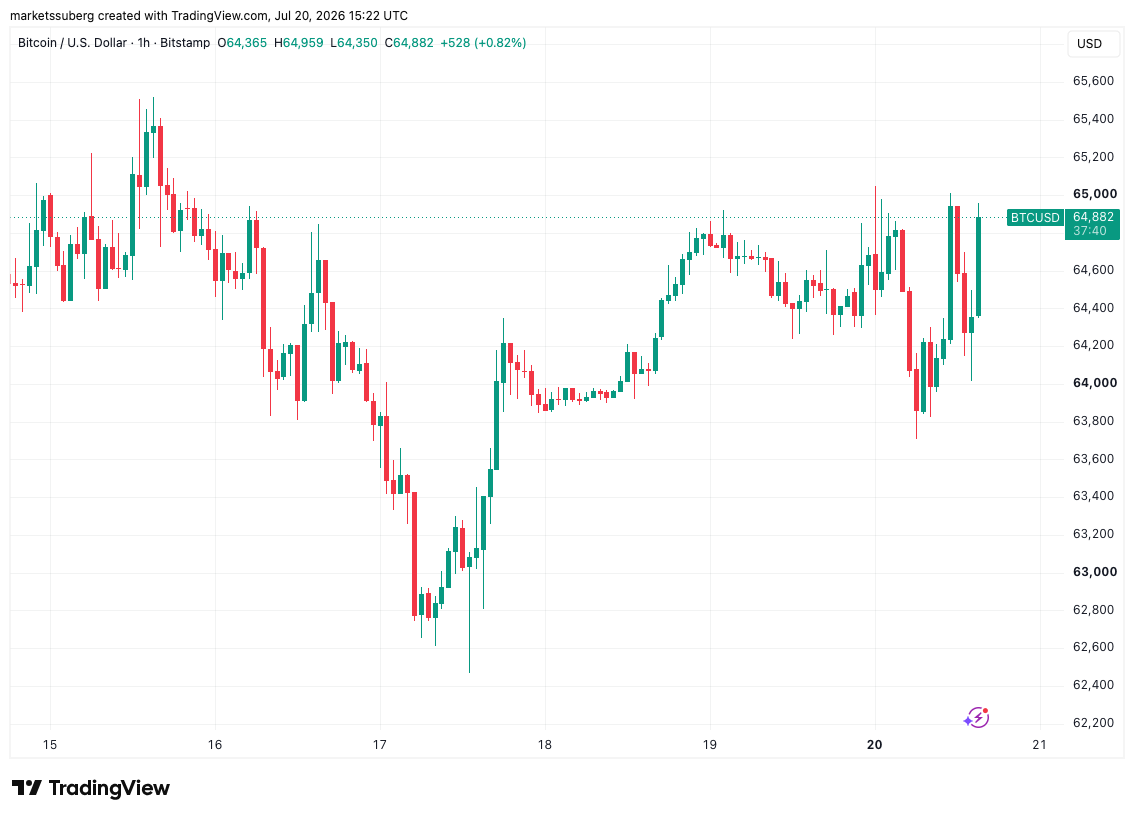
Traders balked on Bitcoin (BTC) at $65,000 on Monday as crypto and risk-assets remained under pressure.
Key points:
- Bitcoin staged several unsuccessful attempts to break and hold $65,000.
- US stocks face pressure from both the Iran war and an ongoing institutional tech sell-off.
- Bitcoin traders stay positive on the odds of BTC/USD heading closer to $70,000 next.
Crypto stocks face “record pace” of US tech-stock selling
Data from TradingView showed BTC price volatility returning around Monday’s Wall Street open.
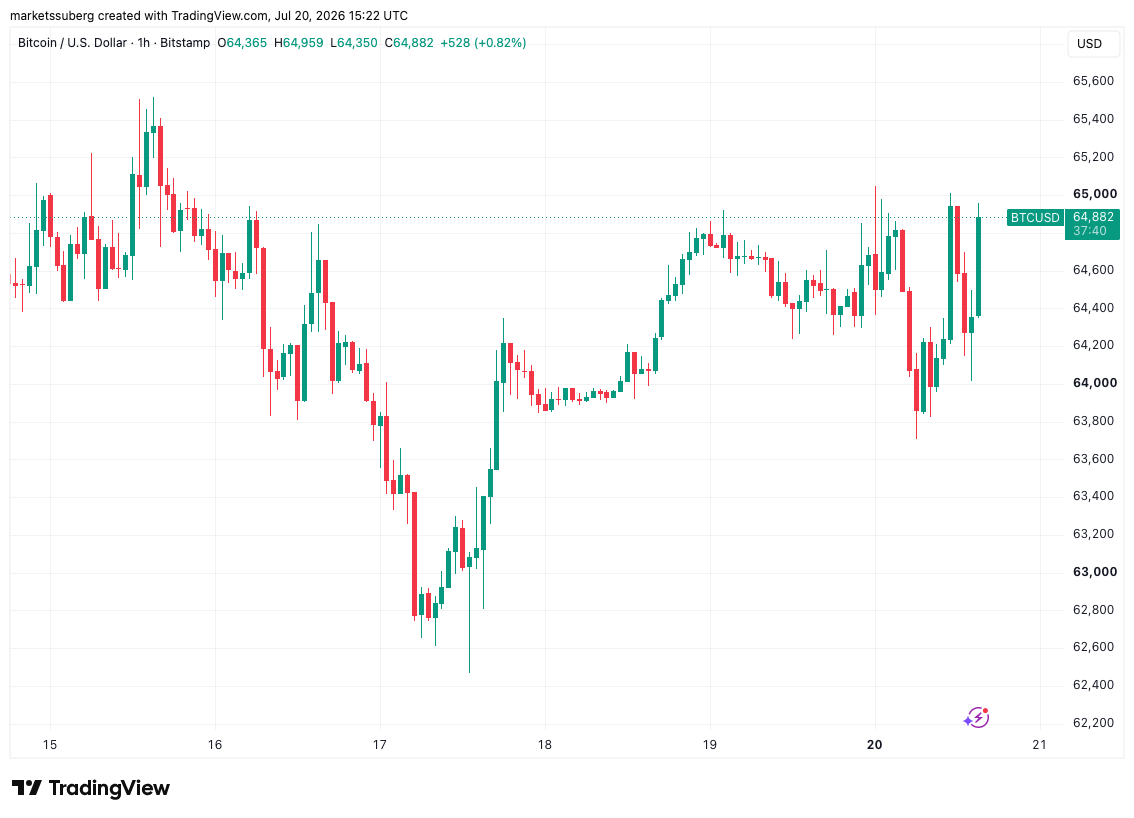
BTC/USD one-hour chart. Source: Cointelegraph/TradingView
US equities faced multiple headwinds to start the week, with the US-Iran war quashing risk appetite and a tech-stock sell-off gaining strength.
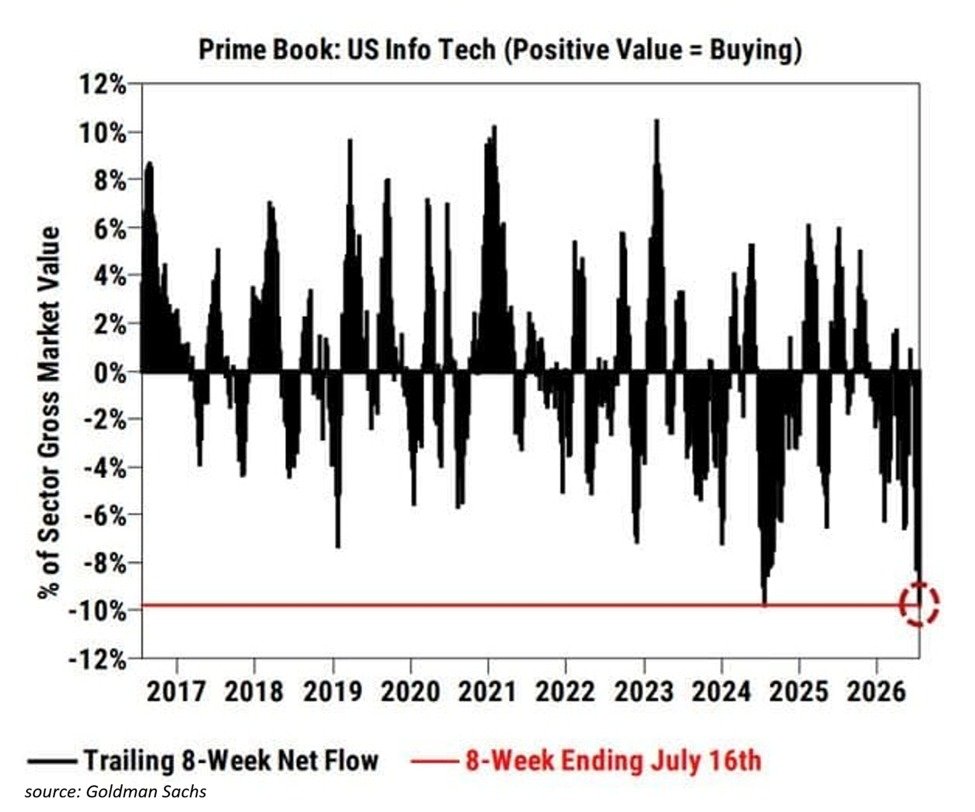
Trading resource The Kobeissi Letter reported that hedge funds were selling tech stocks “at a record pace.”
“Hedge funds have sold information technology stocks in 6 of the last 8 weeks. This brings total 8-week sales to the largest in at least 10 years,” it said in a post on X, citing Goldman Sachs data.
US tech stock investment trend data. Source: The Kobeissi Letter/X
To be sure, the S&P 500 Index and Nasdaq Composite Index were both modestly higher at the time of writing, while the Dow Jones was down 0.3% on the day.
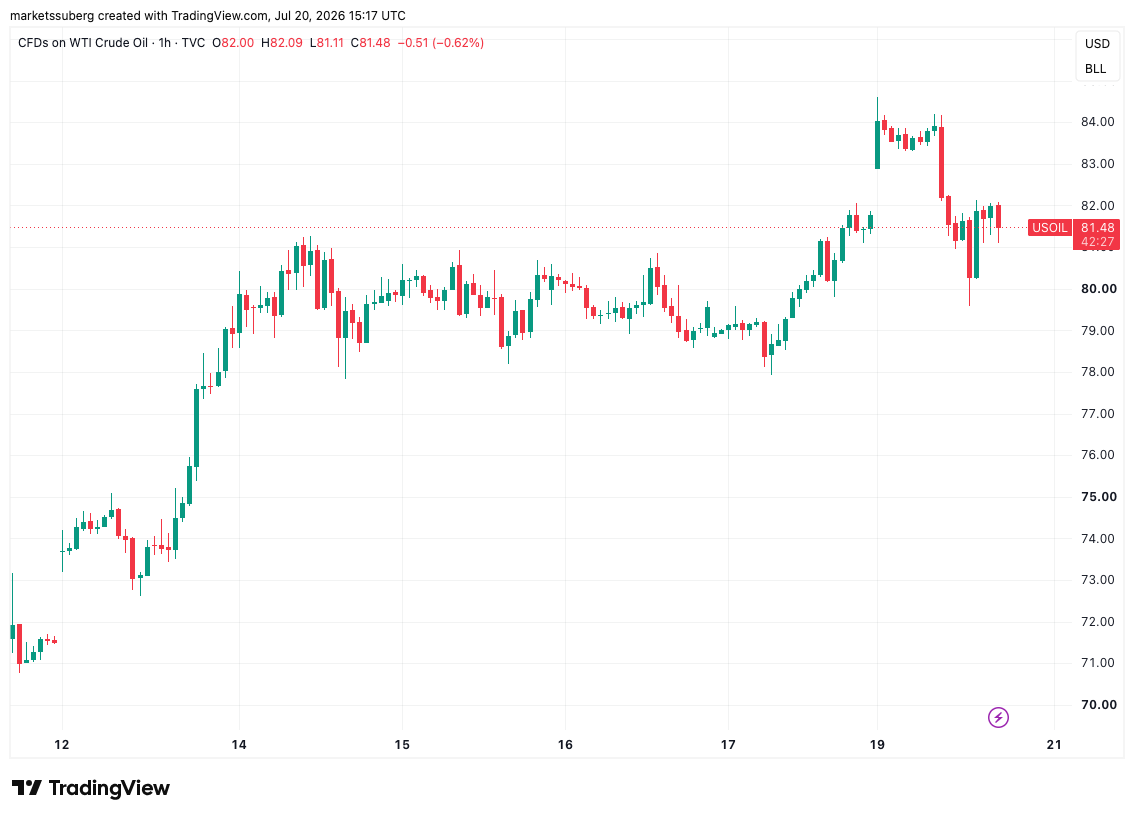
Oil prices remained above $80 per barrel as the Strait of Hormuz looked set to stay closed amid intensifying rhetoric from both the US and Iran.
CFDs on US WTI crude oil one-day chart. Source: Cointelegraph/TradingView
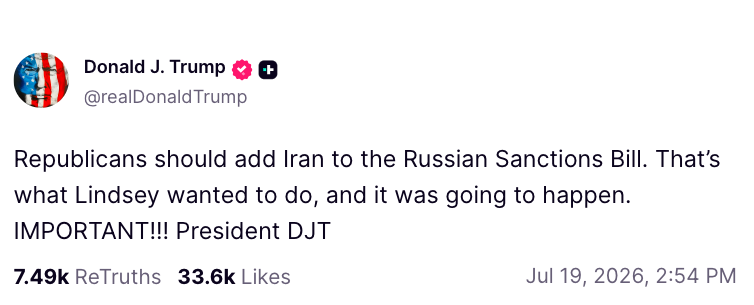
In a post on Truth Social at the weekend, US president Donald Trump called for Iran to be included in a sanctions package initially focused on Russia.
Source: Truth Social
Bitcoin price upside hits $65,000 roadblock
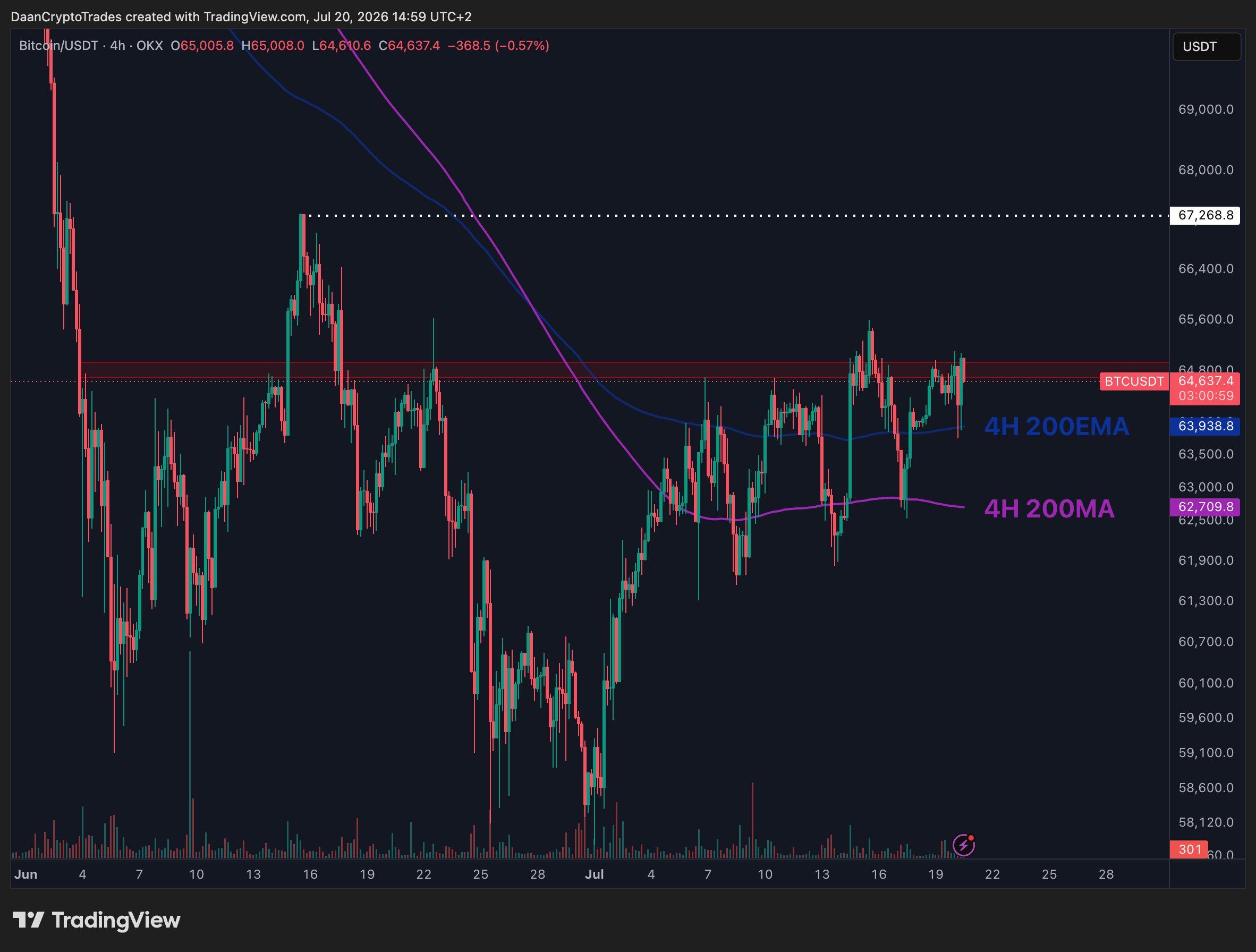
BTC price action found little room for upside as the $65,000 mark became a point of repeated momentum failure.
Related: Trader maintains $67K BTC price target: Five things to know in Bitcoin this week
“The $65K level has capped price for the entirety of July so far,” trader Daan Crypto Trades wrote in an X post.
“But I do think the longer price spends here, the more likely the $65K level is to break. Especially with the higher lows being made over the past 3 weeks.”
BTC/USD four-hour chart. Source: Daan Crypto Trades/X
Daan Crypto Trades joined those who saw the next likely upside target at just above $67,000. He said this was where BTC/USD would “break into a bullish market structure.”
Others referenced seasonality directing current price behavior, with summer traditionally devoid of major moves up or down.
“The markets are in a summer break, it feels like,” crypto trader and analyst Michael van de Poppe told his roughly 819,000 X followers while discussing largest altcoin Ether (ETH).
In a separate post, Van de Poppe gave a BTC price target of between $67,500 and $69,000 for the “coming weeks.” Earlier, he saw August offering even higher levels of up to $80,000, a level last seen in mid-May.
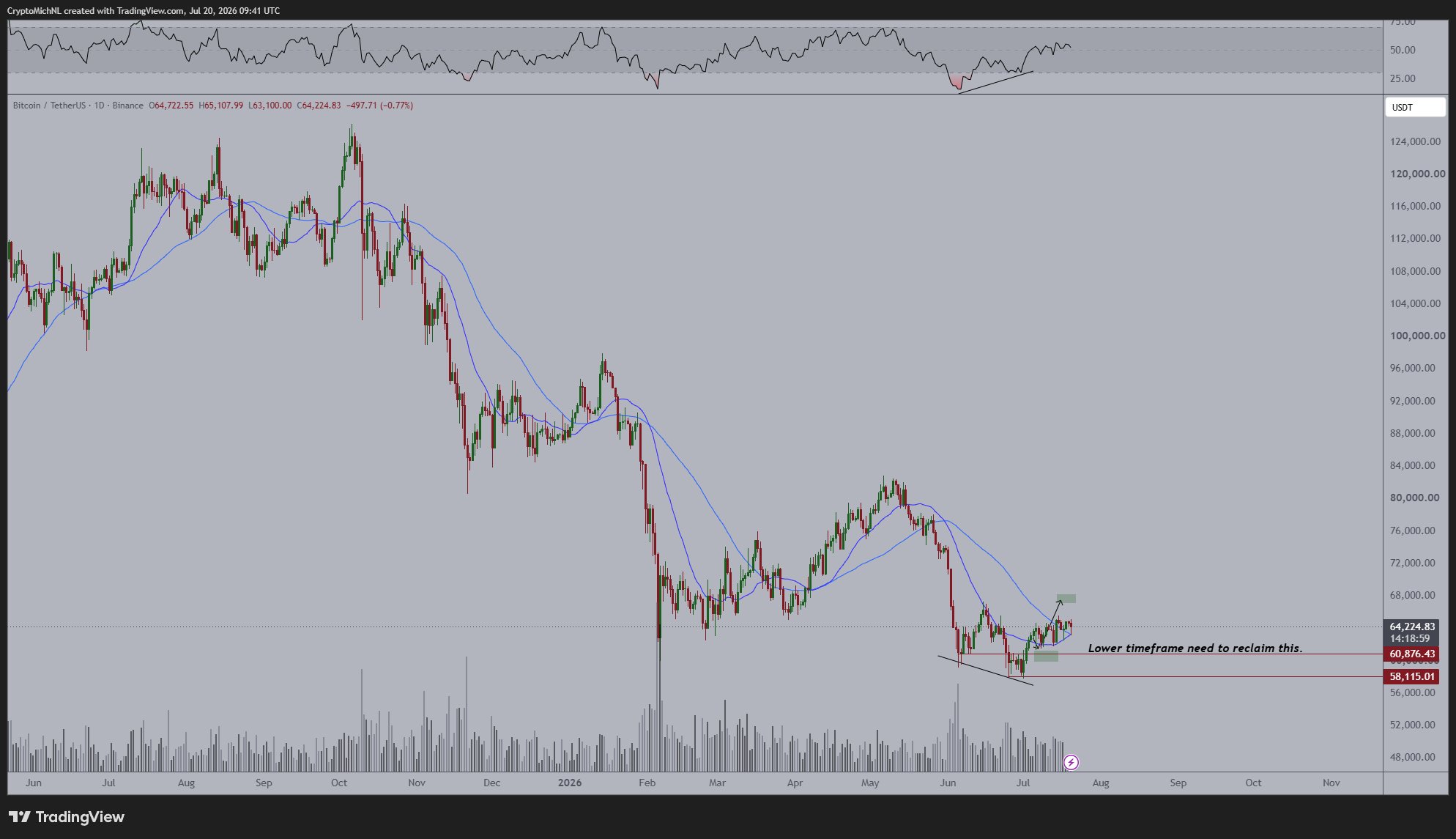
BTC/USDT one-day chart. Source: Michaël van de Poppe/X

Veteran market analyst Peter Brandt believes Bitcoin’s next major drawdown will still have room to run—despite the recent bounce that has kept many traders watching the idea of a “cycle bottom” around the current price range. In an interview with Cointelegraph, Brandt pinned his expected low to October 4, 2026, arguing that markets rarely bottom without the kind of stress and capitulation that is typically absent when sentiment is merely “neutral.”
At the time of publication, Bitcoin was trading at $63,661, according to CoinMarketCap. Brandt’s stance is more cautious: he says price could drop below $50,000 and possibly into the high-$40,000s before the cycle low is set.
Key takeaways
- Peter Brandt expects Bitcoin to bottom on October 4, 2026, framing it as the cycle’s turning point.
- He warns Bitcoin may need to fall below $50,000 before buyers gain enough conviction to reverse the trend.
- Brandt says major bottoms historically align with panic and high volume, not neutral sentiment.
- He doubts the long-term durability of capital rotation into AI stocks and suggests balancing risk with Bitcoin and precious metals.
- Brandt projects a Bitcoin cycle peak in 2029, estimating a range of $250,000 to $300,000.
Why Brandt is waiting for more pain
Brandt acknowledged that calling the exact day of a market low is difficult, but he has maintained his October prediction for a cycle low for some time. His argument centers on both price-range expectations and how bottoms tend to form when traders are forced to reassess their positions.
He said Bitcoin could test levels under $50,000 and potentially trade in the high-$40,000 area before establishing what he expects will be the cycle low. Brandt also pointed to Bitcoin’s historical drawdowns, stating that each major bear market since Bitcoin’s inception has featured an 80% or greater correction. He linked this pattern to his view of where downside could travel if the current cycle follows precedent.
While a number of market participants appear to believe the market is close to a turning point near $60,000, Brandt’s view is that optimism at current levels is still too high for a true bottom to be in.
“Right now it’s neutral [sentiment]. Markets don’t bottom on neutral sentiment. Markets bottom on panic and volume.”
In Brandt’s framing, bottoms form when enough participants abandon the trade—when the most confident holders are forced out and new demand becomes possible. He contrasted “neutral” conditions with the kind of emotion-driven selling that typically accompanies capitulation.
“The same people that are saying Bitcoin’s bottom at some point in time will be giving up on Bitcoin, throwing in the towel, and saying we’re done with Bitcoin, we’re going on to other assets, the Bitcoin phenomenon is done,” Brandt says.
AI optimism vs. crypto’s expected timeline
Brandt also pushed back on the idea that the recent strength in artificial intelligence-themed trades is permanently redirecting capital away from Bitcoin. While some have suggested that the AI boom is pulling liquidity from broader crypto exposure, he does not believe that trade can keep compounding indefinitely.
In his view, investors who chase AI aggressively today may not feel rewarded several years from now. He did not offer specific benchmarks for that judgment, but he described a portfolio split he would make if he had additional funds at current prices: 50% Bitcoin and 50% precious metals.
Brandt’s reasoning is twofold. First, he believes precious metals are closer to a price bottom, implying the timing of entry may be less dependent on waiting for a macro-driven liquidation event. Second, he expects Bitcoin may be closer to a time-based inflection—meaning the market could have to play out before the cycle low arrives, rather than bottoming immediately at current levels.
This distinction matters for traders and investors deciding how to express conviction during drawdowns. If Brandt is right, waiting may not be about “buying lower” alone; it could also be about buying at the moment when sellers finally exhaust themselves.
Forecasts for Bitcoin’s peak and how they compare to major projections
Brandt’s comments extend beyond the expected cycle low. He projected Bitcoin’s next major peak in 2029, estimating a price range of $250,000 to $300,000. In his scenario, the market would have roughly a year to move from that peak range upward toward far larger targets often discussed by influential figures in the ecosystem.
Brandt’s framing also referenced widely circulated, more ambitious longer-term expectations. He noted that Coinbase CEO Brian Armstrong and Ark Invest CEO Cathie Wood have projected a $1 million target for 2030. If Bitcoin does reach Brandt’s 2029 peak range, his timeline suggests a rapid escalation would still be required to bridge the gap to the $1 million narrative by 2030.
For readers, the key tension is not whether any single target is “correct,” but how different forecasts imply different pacing. A range-bound peak followed by accelerated upside has different risk dynamics than a smoother grind higher—especially for traders managing leverage, duration, and event-driven exposure.
What to watch before the October thesis is tested
Brandt’s view hinges on two practical signals: whether Bitcoin experiences the kind of panic and volume that historically accompanies major cycle lows, and whether sentiment truly shifts from neutral into capitulation. The most important question for investors isn’t just where prices trade next, but whether market behavior reflects forced selling rather than selective dip-buying.

Michael Saylor’s bitcoin-accumulating giant continues to refrain from increasing its cryptocurrency stash after a large wave of uncertainty hit the market and its stock performance.
Instead, Strategy continues to focus on rebuilding its USD reserve. In the past week alone, the NASDAQ-listed business intelligence giant ramped up its greenback stash by another $225 million for a total of over $3.2 billion.
Strategy has increased its USD Reserve by $225 million. As of 7/19/2026, we hodl ₿843,775 in our BTC Reserve and $3.2 billion in our USD Reserve. $MSTR $STRC https://t.co/sci7bZHzsy
— Michael Saylor (@saylor) July 20, 2026
Strategy’s bitcoin fortune remains at 843,775 units, accumulated for approximately $63.7 billion at an average price of $75,500 per BTC. The firm remains deep in the red, as the current value of its crypto stash sits around $10 billion lower.
Recent History
Before today’s announcement, Strategy and its co-founder and former CEO changed their course on trading with bitcoin, as it’s no longer a simple buy-and-hold strategy.
Instead, the largest corporate holder of the cryptocurrency made a couple of sales in the past several months, with the second, announced earlier this month, becoming the largest; over 3,500 BTC sold for about $216 million at the time.
Strategy also launched the Digital Credit Capital Framework to enhance its available liquidity to cover monthly dividend payments and increase its long-term bitcoin exposure. It managed to increase its USD reserve to $3 billion before today’s announcement, which was enough to cover payments for over two years.
Although this pivot from consistent bitcoin purchases was described as a safe and good first step, some analysts continue to question the long-term BTC plan.
The post Strategy Extends Bitcoin Buying Pause While Growing Its USD Reserve: Details appeared first on CryptoPotato.
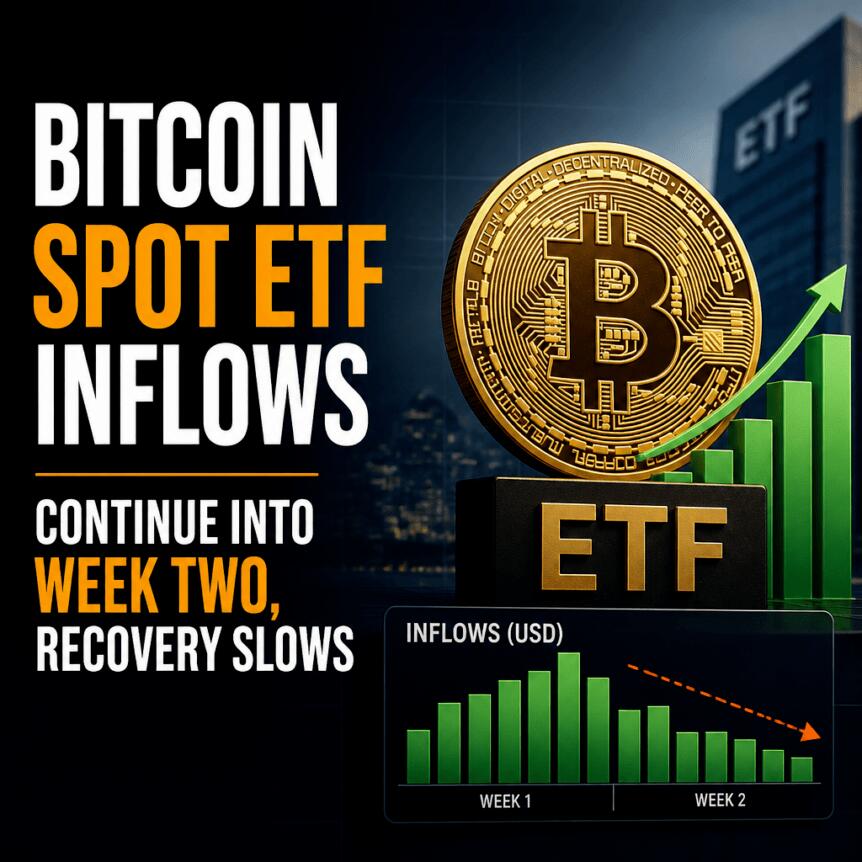
US-listed spot Bitcoin exchange-traded funds (ETFs) have seen a fresh wave of buying, with net inflows returning for a second straight week. However, traders and analysts say the pace of demand is still not strong enough to confirm that the rebound is turning into a durable trend.
According to SoSoValue, spot Bitcoin ETFs in the US recorded $75.7 million in net inflows for the week ending July 17. This followed $197.4 million in net inflows the prior week, lifting total inflows for July to $200.2 million.
Key takeaways
- SoSoValue data shows US spot Bitcoin ETFs posted net inflows for two consecutive weeks, totaling $200.2 million for July so far.
- Analysts caution that even multiple inflow days may only indicate easing selling pressure—not broad, sustained institutional buying.
- Bitcoin’s recovery has not yet produced the decisive price breakout some analysts say is needed to validate a new uptrend.
- Citi’s latest stance remains cautious, cutting its 12-month Bitcoin ETF inflow forecast to zero and lowering its Bitcoin price target.
- ETF analysts compare the product cycle to gold ETFs: rapid adoption followed by longer stretches of weaker performance.
ETFs return to inflows, but momentum remains limited
The renewed inflow streak comes after a difficult period. Cointelegraph previously reported that US spot Bitcoin ETFs recorded $4.5 billion in net outflows in June, leaving 2026 total net flows still negative at $5.2 billion. In that context, July’s partial rebound matters, but it hasn’t erased the bigger picture of persistent withdrawals.
Simon-Peter Massabni, head of business development at XS.com, told Cointelegraph that the return of inflows suggests selling pressure is easing. Yet he stressed that the current buying rhythm does not necessarily signal a broad institutional return.
“Four consecutive sessions of inflows should be interpreted as a sign that selling pressure is easing, rather than clear evidence that institutional investors have returned on a broad scale,” Massabni said, referring to the daily ETF flow data from last week.
Why the market still needs more than “a few green days”
Massabni connected the ETF flow improvement to Bitcoin’s price action. Bitcoin has recovered toward $64,000 after falling from higher levels seen in June, but the move has not yet met the threshold he associates with a convincing reversal.
He argued that Bitcoin needs to “decisively break above the $65,000–$65,500 range” to confirm a new uptrend. In his view, the recovery still “lacks real strength,” implying that spot demand visible through ETFs must align with broader market conviction.
From an investor’s perspective, this distinction is important: inflow streaks can reflect short-term positioning and relief from prior selling, while sustained, higher-volume inflows typically correlate better with durable trend changes. Readers watching the next leg of ETF flows will likely want to see whether weekly inflows continue to scale upward, rather than merely alternating with quieter periods.
Citi turns more cautious as institutional demand remains in question
While ETF flows have improved recently, Citi’s updated outlook underscores how uneven the institutional picture still appears. Massabni pointed to Citi’s revision to its Bitcoin ETF expectations, which he said is rooted in concerns about the strength of institutional demand.
On July 1, Citi cut its 12-month ETF inflow forecast from $10 billion to zero after weaker-than-expected flows and recent outflows. The bank also lowered its 12-month Bitcoin price target from $112,000 to $82,000.
Massabni argued that the market may not lack reasons to buy, but what remains missing is a sufficiently strong driver. “The market does not lack reasons to start buying Bitcoin,” he said, “what is still missing is a sufficiently strong catalyst—most likely a flow of capital large and persistent enough to turn the current rebound into a genuine trend.”
ETF cycles may resemble gold: fast adoption, then long drawdowns
Another lens on the current setup comes from ETF industry comparisons. Bloomberg ETF analyst Eric Balchunas has likened Bitcoin ETF behavior to that of gold ETFs, noting that both products saw rapid adoption followed by extended stretches of weaker performance.
In a post on X on Friday, Balchunas said Bitcoin ETFs may follow a similar pattern of “spectacular gains, painful drawdowns and recoveries,” and that each cycle could potentially set higher highs over time. The point for investors is not that drawdowns are inevitable, but that ETF performance can be nonlinear—driven by waves of positioning rather than straight-line progress.
As July inflows accumulate, the market will likely test whether this resembles the “recovery” phase of prior cycles or whether it remains a modest rebound inside a broader period of net outflows.
What to watch next for Bitcoin ETFs and the broader trend
For now, the most immediate indicators are whether weekly inflows persist and whether Bitcoin can clear the $65,000–$65,500 zone that Massabni highlighted as a confirmation level. The next few weeks of ETF flow data will show whether July’s demand is just a pause in selling or the start of a more sustained institutional bid.

Toobit is one of the most popular centralized cryptocurrency exchanges. It’s built for users who are looking to trade more than just crypto – a model adopted by many exchanges in the industry.
Alongside spot trading, the platform offers perpetual futures, copy trading, automated bots, AI-assisted market analysis, programmable AI-based agent tools, and exposure to traditional financial markets.
If all of this sounds complicated, don’t worry; I will break it all down in the following guide. When it comes down to it, there are four very important features that I will be looking at. These are its AI trading assistant and MCP-based AI Agent Trade Kit, the leverage proposition of up to 500x on eligible markets, zero maker and taker fees for standard spot trading, as well as TradFi products linked to metals, forex, stocks, commodities, and indices.
In this Toobit guide, I will explain how those features work, what else the exchange has to offer, its current fee structure and security measures, as well as the risks you should understand before trading.
What is Toobit?
First things first, though, let’s lay down some fundamentals. As mentioned above, Toobit is a centralized exchange, but this definition doesn’t do it much justice. It would be fairer to say that it’s a multi-product crypto exchange that’s available through a web platform and mobile applications.
Its core trading propositions include spot trading, USDT-margined and USDC-margined perpetual futures, copy trading, and crypto trading bots. The platform, however, has also expanded into decentralized finance, prediction markets, Event Contracts, crypto Earn products, as well as derivatives linked to traditional financial instruments.
The resulting product is an exchange that’s designed primarily for those of you who trade actively. But this doesn’t mean that the platform is not suited for beginners – they do offer a range of different educational materials and simple products which are aimed towards those taking their first steps in the industry.
Once you’ve created an account, you can fund it in several different ways. Users can deposit crypto from another exchange or a self-custody wallet, but you can also buy crypto with a bank card or use a supported third-party payment service.
What Makes Toobit Stand Out in 2026?
And while the exchange offers a product kit similar to those of many of the best cryptocurrency exchanges in 2026, there are a few features that make it stand out, and that’s what I’ll focus on in this section.
AI Trading Assistant and MCP AI Agent Trade Kit
We live in times where artificial intelligence is spreading like wildfire, and people are using it more and more in their everyday tasks. This doesn’t exclude trading. In fact, AI is becoming a more prominent part of the crypto trading experience.
That said, Toobit’s AI goes beyond a conventional chatbot.
The first component is called Toobit Synapse – an AI-powered market assistant that can turn market data into structured analysis, which covers areas such as current conditions, technical indicators, trends, and possible trading strategies.
Users can select an asset and receive an AI-generated market report, rather than having to interpret every chart and indicator manually.
The exchange argues that Synapse takes advantage of the Model Context Protocol (or MCP), to access current market information. The tool is intended to simplify research and help traders identify relevant signals a lot quicker. Planned functions include automated alerts, rule-based order management, and more.
The second component is the Toobit AI Agent Trade Kit. This is an open-source toolkit that lets compatible AI agents interact with Toobit through natural-language prompts or terminal commands.
In essence, the toolkit provides two main interfaces:
- MCP Server connects compatible AI models and applications to Toobit via a conversational interface.
- Command-line interface, which gives those users who are more technically experienced access to trading and account functions from a terminal
According to the exchange, the kit contains 65 tools, which cover spot orders, USDT-margined perps, balances, positions, fees, market data, profit and loss, transaction histories, and fund management.
A simple use case could be for the user to ask a connected AI agent to retrieve available BTC market data, review open positions, check account balances, or prepare a spot futures order. The agent can also work with take-profit and stop-loss orders.
High-Leverage Futures Trading
Toobit provides USDT-margined and USDC-margined perpetual contracts. These allow traders to speculate on rising or falling crypto prices without having to own the underlying asset directly. These contracts have no expiry date, but users have to pay (or receive) funding fees.
A major selling point here (or not) is the leverage of up to 500x on eligible futures markets. Naturally, this means that a 0.2% move in the wrong direction would see your position liquidated, arguably pushing this far beyond the scope of traditional trading.
That said, there are traders who are looking for aggressive strategies, and having this option does make the platform more versatile. Of course, you should be well aware that any type of leverage trading significantly amplifies your risk and the chances of getting liquidated.
Therefore, this high leverage trading style is most appropriate for extremely experienced traders who have very strict position-sizing and risk-management rules, as well as understanding of market dynamics.
Zero Spot Trading Fees
Toobit’s standard spot markets currently have 0% maker fees and 0% taker fees across every single VIP level.
This can make the platform very attractive to frequent spot traders, as well as people who rebalance their portfolios very often or use multiple orders to execute their strategies.
There is an important exception, though. Spot pairs, which are placed in Toobit’s Assessment Zone, are excluded from the zero-fee policy and follow a separate VIP-based schedule. At VIP 0, the current Assessment Zone rate is 0.075% for makers and 0.1% for takers.
Zero trading commission also doesn’t mean that every transaction is free. Users may still encounter:
- Difference between bid and ask prices (spread)
- Blockchain withdrawal fees
- Card-processing or third-party provider charges
- Slippage
- Perpetual-futures funding fees
TradFi Trading: Stocks and Other Traditional Markets
Toobit’s TradFi section allows users to trade different instruments, which are linked to traditional financial markets, while using USDT for margin and settlement.
Available categories include stocks, foreign exchange, precious metals, indices, and commodities. You can both long and short these. You can trade various stocks like Tesla, SpaceX, Nvidia, and more.
There is an important caveat here. You shouldn’t confuse these products with buying shares through a conventional stockbroker. Toobit’s stock products are basically USDT-settled perpetual futures – an instrument designed to track the price of an underlying asset.
You can use various leverage and you can trade 24/7 – something rarely available on existing traditional alternatives. Of course, trading outside the underlying market’s normal hours is likely to have an impact on liquidity, pricing, and funding conditions, so keep that in mind.
Other Toobit Products and Trading Tools
Although the above four are some of the more distinctive features of the platform, this doesn’t mean that there aren’t more.
Copy Trading
This allows you to follow experienced traders and automatically reproduce their positions. You can compare profiles using metrics such as ROI and win rate. Copiers can also adjust their copy mode, leverage, and other settings rather than following each strategy with identical parameters.
One of the interesting features is that Toobit has optimized its system to allow for zero slippage when copy trading.
Trading Bots
There are multiple bots that you can set up, including Futures Grid and Futures DCA or even Martingale strategies. Grid bots palace orders across a predetermined price range, while DCA-style strategies may increase a position as the market moves.
DEX+
This feature provides access to selected Web3 on-chain assets through Toobit’s interface. It’s suitable for those users who are looking for a more crypto-native experience. Users can also trade on-chain using the USDT they have deposited in their spot account, making it for a frictionless experience.
Is Toobit Safe?
Yes, Toobit is considered a safe cryptocurrency exchange. It lists multi-factor authentication, ongoing audits, phishing detection, encrypted infrastructure, real-time account monitoring, as well as cold storage practices among its security measures.
When you create an account, I highly recommend that you activate all of the available protections, such as a unique password and two-factor authentication before depositing funds.
The exchange also publishes a Proof of Reserves system, which helps users see if deposits are matched 1:1. It uses a summation Merkle tree to allow users to confirm these numbers.
Toobit Pros and Cons
Toobit’s principal advantages are its broad range of trading products, AI-assisted research, open-source MCP toolkit, zero-fee standard spot markets and access to both crypto and TradFi-linked derivatives. Copy Trading, bots, APIs, TradingView tools and demo trading give active users several ways to build and test a strategy.
Its main limitations are closely connected to those features. High leverage creates substantial liquidation risk. AI output can be inaccurate. Copy Trading and bots can reproduce losses as efficiently as profitable trades. TradFi contracts do not provide the same rights as owning the underlying shares, and some services may be unavailable in particular jurisdictions.
Like any centralized exchange, Toobit also requires users to accept custodial risk while assets remain on the platform.
Frequently Asked Questions
Is Toobit a cryptocurrency exchange?
Yes, Toobit is a centralized cryptocurrency exchange. It offers spot trading, perpetual futures, copy trading, bots, AI tools, and trading products linked to traditional financial instruments like stocks and commodities.
Does Toobit charge spot trading fees?
Standard spot markets currently have 0% maker and taker fees. There are some pairs which are excluded from the offering.
How much leverage does Toobit offer?
Toobit advertises leverage of up to 500x on eligible markets. The maximum varies by contract, asset, position size and current risk rules, so 500x is not available universally.
Does Toobit require KYC?
Toobit has different verification levels. The required level depends on the service, withdrawal limit and account function. Advanced verification is required for read-and-write API permissions.
Does Toobit publish Proof of Reserves?
Yes. Toobit publishes reserve information and provides Merkle-tree-based tools through which users can check the inclusion of their balances. The exchange says it conducts comprehensive audits monthly.
Conclusion: Is Toobit Worth Considering in 2026?
Over the years, Toobit has developed into a wide-ranging trading platform rather than a basic spot exchange. Some of its strongest differentiators are its AI trading assistant and MCP AI Agent Trade Kit, zero-fee standard spot trading, leverage of up to 500x on some eligible markets, and USDT-settled access to TradFi-linked products.
Those features make Toobit particularly relevant to traders who are active and technically confident.
That said, there is a range of comprehensive tooling for beginners as well. Of course, some of the abovementioned options do come with certain risks, which have to be accounted for – just like any other exchange.
The post Toobit Exchange Guide 2026: AI Trading, Zero Spot Fees, High Leverage, TradFi and More appeared first on CryptoPotato.
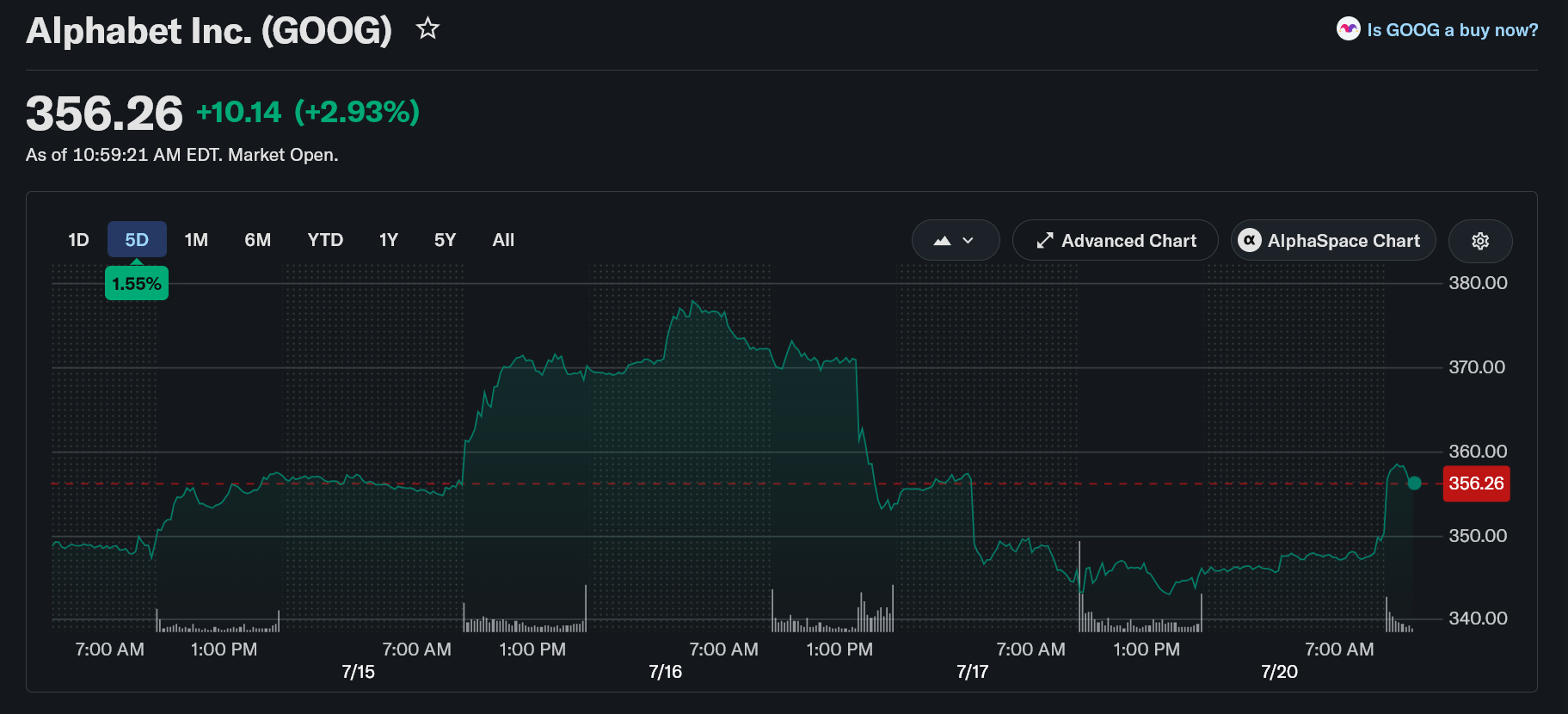
After hitting $370 on July 15, Alphabet (GOOGL) sold off sharply last week, days before an earnings report that could define its place in the AI race. The Google stock slide followed a report that Gemini 3.5 Pro, Alphabet’s most powerful AI model, is delayed.
It also spotlights a bigger shift, since Alphabet just broke a roughly 20-year habit to fund the AI build-out it must defend on Wednesday.

Why Google Stock Just Dropped
Alphabet (GOOGL) fell by more than 9% between July 16 and 17 after the delay was reported, amid heavy selling volume. That volume matters because it suggests large holders, not just regular retail traders, were cutting exposure.

The timing stings. Alphabet reports second-quarter results on July 22 after the close, and Alphabet’s Gemini setback has raised the bar for what those numbers must show.
Want more insights like this? Sign up for Editor Harsh Notariya’s Daily Newsletter here.
Yet the sell-off traces back to one bigger figure. Investors are nervous about the $190 billion Google now plans to spend on AI this year, and whether it will ever pay off.
The $190 Billion Bet It Can No Longer Self-Fund
That budget is the heart of the story. Alphabet’s 2026 capital spending guidance sits between $180 billion and $190 billion, roughly double last year’s $91 billion, with an even higher 2027 already flagged.

For the first time in years, its cash machine cannot cover the bill on its own. Free cash flow roughly halved in the first quarter, even as capital spending more than doubled from a year earlier.

So Alphabet did something it had avoided for roughly 20 years.
It launched an $80 billion equity raise, its first major stock sale in about two decades, that reversed years of buybacks, with Warren Buffett’s Berkshire Hathaway adding $10 billion.
That reversal is why Wall Street now scrutinizes every dollar of this spending.
Depreciation Is the Real Test
Here is the part that few readers see. Chips and data centers are capitalized and depreciated over five to six years, so today’s spending becomes a rising cost that slowly erodes profit, long after the cash leaves.
Think of it like buying a delivery van. The cash goes out all at once, but the cost is booked in small yearly slices as the van wears down.
That shifts the key question. It is no longer how much Google spends, but whether AI revenue grows faster than the depreciation that spending creates.
Google Cloud is where that answer shows up first. It grew 63% last quarter to $20 billion at a record margin, and some previews expect close to $22 billion this time.

If that pace holds, revenue may finally be outrunning depreciation, though AI revenue bubble fears still shadow the sector.
TPUs Are the Swing Factor
Alphabet’s own chips could tip the math. Its Tensor Processing Units (TPUs), custom AI chips built to rival Nvidia, let it avoid paying Nvidia’s rich margins and now pull in outside customers.
The company has backed TPU projects with billions in guarantees and a $5 billion venture with Blackstone. Citadel Securities says it runs some workloads about 30% cheaper and up to four times faster on TPUs.
Doubts remain, however. One cloud provider, Nebius, said in early July that roughly 99% of demand still points to Nvidia, arguing TPU interest is thin outside Google’s own orbit.
What Wall Street Expects on Wednesday
Despite the drop, analysts stay firmly bullish. The consensus rating is a Strong Buy with an average target near $438.

Plus, there are no Sell ratings on record, and Wedbush recently opened coverage at a Street high of $671.

Big money agrees. Buffett personally initiated Berkshire’s stake and still calls the AI spending race real money, a stance laid out in how Buffett backs Alphabet.
Beyond Berkshire, 13F filings show funds run by Ken Fisher and Ray Dalio added shares last quarter, though some rivals trimmed.

The numbers set the stakes. Analysts expect about $116.9 billion in revenue and $2.90 in earnings per share this quarter, both up more than 20% from a year earlier.
Beating those figures, especially on cloud, would show that the spending is converting into growth. Falling short, or raising the capex bar again, would harden the doubts.
So Wednesday reveals whether Google’s $190 billion bet looks visionary or reckless.
The post Google Broke a 20-Year Funding Habit. How Will Its Stock React? appeared first on BeInCrypto.

The Best Couch Gag In Simpsons History Was Extremely Dark And Nearly Got The Episode Pulled By Fox

⚽World Cup 2026: Donald Trump tries to steal the spotlight from Spain

FA-1 | FINANCIAL ACCOUNTING | SUBJECT STRATEGY | SEMESTER-1 OSMANIA UNIVERSITY | @shivanipallela


-
 NewsBeat4 days ago
London Mayor Sadiq Khan handed a peerage by Keir Starmer alongside 15 other Labour figures… just days before the PM leaves No10
-

 Fashion3 days ago
Weekend Open Thread – Corporette.com
-

 Politics2 days ago
The House | The City of London can help the new chancellor deliver growth in every postcode
-

 Politics5 days ago
Young campaigners urge incoming PM to act on outdoor junk food ads
-

 Crypto World5 days ago
CFTC blocks Kalshi from unwinding Michigan trades after court order
-
 Crypto World3 days ago
Two July Windows Left: The CLARITY Act’s Senate Fight and What Failure Means
-

 Business5 days ago
Nvidia Stock Slips After Big Tuesday Rally as Huang Confirms Vera Rubin Chip Is Now in Production Today
-

 Crypto World2 days ago
Ripple Payments Joins MiCA With 14 Firms, Does It Mean Anything For XRP?
-

 Politics1 day ago
Democrats look to World Cup watch parties to register thousands of voters
-
 Entertainment5 days ago
Disney’s Most Ambitious Failed Star Wars Attraction Is Coming to SDCC
-

 Crypto World3 days ago
Ripple wins EU-wide access as ESMA adds it to MiCA register
-

 Business5 days ago
Palantir Shares Rise After Expanded Nvidia Partnership and Fresh Analyst Upgrades Ahead of Earnings Day
-

 Crypto World4 days ago
Injective Submits SEC Transfer-Agent Registration to Onchain Ownership Records
-

 Tech6 days ago
Get Your ESP32 Sunny Side Up With This Solar Dev Board
-

 NewsBeat3 days ago
Registration is now open for March for Men with Kev 2026
-

 News Videos6 days ago
XRP BOMBSHELL… XRP OMBOARDED FOR TRANSACTIONS!!!
-

 Tech6 days ago
Dark Secrets Emerge When Jailbreaking LLMs
-

 NewsBeat6 hours ago
Unregistered fitter used Gas Safe logo on business flyers
-
 Sports5 days ago
New Cornerback Enters Vikings Trade Rumor Mill
-

 News Videos3 days ago
Money | Class 12 Economics | CBSE Board Exam 2026-27
You must be logged in to post a comment Login