

Crypto World
Ex-Goldman Credit Veteran Says Markets May Be Mispricing MicroStrategy’s STRC by 13%

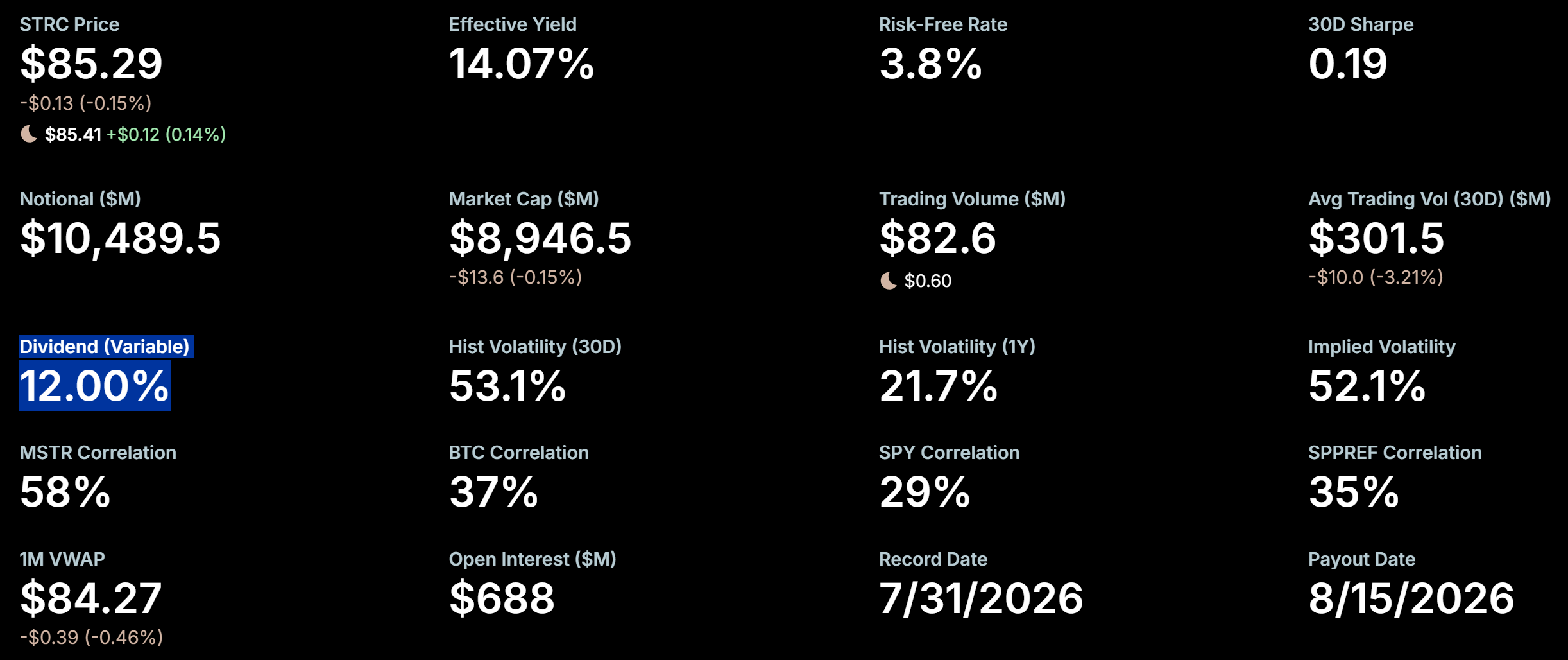
Khing Oei, a former Goldman Sachs credit investor, says the market has Strategy’s STRC preferred stock priced wrong. His math says it is worth about $96. It trades near $85.
Oei spent 25 years valuing risky debt at Goldman Sachs and hedge funds. He shared his STRC model in a recent lengthy discussion.
Why the 14% Yield on MicroStrategy’s STRC Misleads
STRC pays a 12% dividend. Divide that by today’s discounted price and you get a yield above 14%. That number is everywhere. Oei says it is wrong.

Here is the problem. That math assumes STRC pays out forever, no matter what. STRC promises no such thing. It never matures and never has to repay its $100 face value, known as par. It pays only while MicroStrategy can afford it.
The shares crashed 25% below par during June’s Bitcoin selloff. That is what made the yield look so juicy.
“That experience leaves you with a simple instinct: never value a stream by dividing this year’s coupon by today’s price,” Oei wrote in his analysis.
Follow us on X to get the latest news as it happens
So he values STRC like a bond. Count the cash it will actually pay out, and nothing more. Strategy’s dashboard showed 843,775 Bitcoin (BTC) worth $54 billion, plus $3 billion in cash. Debt and senior preferred shares claim $8 billion of that first. STRC’s $10.5 billion comes next.
29 Years of Dividends Even if Bitcoin Never Rises
Strip out the senior claims and $50.2 billion backs the preferred shares. The dividend bill runs $1.73 billion a year.
That produces two striking numbers. Bitcoin only needs to grow 3.4% a year and the dividends never stop. If Bitcoin stays flat forever, the money still lasts 29 years.
Value those 29 years of payments at a 12% discount rate and STRC is worth $96.30. BeInCrypto checked the math. It holds.
The market pays $85.29. That price only buys 17 years of dividends. Oei thinks that is too gloomy, since STRF, the safer Strategy share above STRC, yields just 10.4%.

That gap between $85 and $96 is the 13% mispricing. It carries a sharp implication. If Oei is right, buyers collect the 14% yield while the price climbs toward fair value. If the market is right, the discount is a warning that the dividend may one day stop.
Some buyers seem to agree with Oei. A BitcoinTreasuries survey found over half of holders bought the dip below par.
The Road Back to $100
Bitcoin’s price does most of the work. Oei’s table puts STRC back at $100 if Bitcoin reaches $80,000. At $40,000, it drops to $58.
MicroStrategy holds levers too. STRC listed in July 2025 at $90 with a 9% dividend. The board has raised the rate again and again, now 12%, to pull the price toward par.
Cash helps as well. Each $1 billion raised and held in reserve adds about four points, Oei estimates. A buyback adds five, since Strategy would pay $85 for something he values at $96.
The mispricing itself becomes the company’s cheapest tool. The growing cash pile fits what one research desk called a Bitcoin winter pivot.
One caveat applies. Oei runs Treasury, a European Bitcoin treasury firm, so he benefits when these shares are taken seriously. Skeptics also remain. Economist Peter Schiff just predicted a crash toward $20,000, and others ask who ultimately pays if Strategy’s $64 billion bet unwinds.
The question is now a simple one. Does a company with $57 billion in assets deserve this much doubt over a $1.73 billion dividend bill? Bitcoin’s next move will go a long way toward answering it.
The post Ex-Goldman Credit Veteran Says Markets May Be Mispricing MicroStrategy’s STRC by 13% appeared first on BeInCrypto.



Crypto prices climbed on Tuesday after reports that the White House had reached agreement on the ethics provision that had stalled the Digital Asset Market Clarity Act in the Senate, reviving the odds of a floor vote before Congress breaks for its August recess. The ethics language had been the… Read the full story at The Defiant
Crypto World
Fewer Than 300 Made the Cut: Ivan Nevzorov on MiCA, CASP Licensing, and What’s Next for Crypto Firms
Of the more than 3,000 companies that were legally serving crypto clients across the EU as recently as this June, fewer than 300 hold the right to do so today, according to CASP Tracker.
The reason is the Markets in Crypto-Assets Regulation (MiCA), which took full effect across the European Union on 1 July 2026: from that date, only a company holding Crypto-Asset Service Provider (CASP) authorisation — granted by a regulator in one EU member state and passported across the rest of the bloc — can serve EU clients. Companies that previously operated under national Virtual Asset Service Provider (VASP) registrations had exactly until that date to convert. Most didn’t.
We talked to Ivan Nevzorov, CEO at SBSB Fintech Lawyers, about what’s actually left for them now — and why the shortcuts most of them reach for first usually aren’t the ones that hold up.

Let’s start with the obvious one. A company still doesn’t have a CASP licence today — what happens to it now?
Ivan Nevzorov: Look, here’s the thing people don’t want to hear: the deadline’s already passed. From July 1st, every day you keep serving EU clients without authorisation is a day you’re in breach of MiCA — a minimum €5 million fine under Article 111, and in France it can mean criminal liability for whoever’s responsible. So the answer everyone expects to hear, “just go get licensed,” isn’t actually on the table anymore for a company operating today. You can’t file an application, keep the lights on for months while it gets reviewed, and call that compliance.
Which really leaves two paths. One, you wind down, because the business can’t meet the new standard. Two, you relocate — move your base to a friendlier jurisdiction. Though that one only keeps you legal if you stop marketing into the EU completely and let clients come to you on their own, what’s called reverse solicitation. Keep advertising to EU users from outside the bloc, and you’re breaking the exact same rule, just from a different address.
We’ll come back to relocating, because it’s genuinely its own conversation. Let’s start with winding down, since that’s where most of these companies actually are right now — and honestly, it’s painful to watch, because most of them didn’t do anything wrong. They just didn’t get there in time, and for a lot of them, the reasons had nothing to do with how good their compliance actually was.
Winding down sounds like the more straightforward path, at least. Is it actually?
Ivan Nevzorov: Not as straightforward as people think, and there’s a right way and a wrong way to do it. The wrong way is switching off the app and disappearing — the client assets sitting in those accounts don’t vanish, and holding them is a regulated activity in itself. To the regulator, that company hasn’t gone anywhere. It’s still operating without a licence, only now it’s also stopped answering its clients. The right way is one of two things: an orderly wind-down, or transferring your clients to a CASP that’s already authorised.
ESMA’s actually spelled out what an orderly wind-down has to look like: stop onboarding, stop any marketing into the EU, restrict yourself to settling what’s already open. And transferring clients sounds simpler on paper, but being on the CASP register only tells you a firm’s allowed to take clients — it doesn’t tell you they’re actually set up to onboard a few thousand new ones at once. A lot of the firms that got authorised fastest didn’t build a crypto compliance function from zero — they already held a MiFID or e-money licence and just converted it, lighter scrutiny attached. Good for them, but it also means some of these brand-new CASPs are banks running crypto as a side product, not specialists who can absorb a wave of migrating clients. Every single one of those clients still needs full AML and KYC re-verification before the new CASP can touch their money. That’s months of work for a team that does it every day. Longer for a team that doesn’t.
You’d think the bigger platforms would have this solved by now. Is that actually the case?
Ivan Nevzorov: Less than people think, and Binance is actually a fair example of why. A platform with years of European operating history and enormous legal and compliance resources still ran into real MiCA licensing problems — the same wall a lot of much smaller companies are hitting. That tells you something worth sitting with: this isn’t a gap you close just by throwing money or headcount at it. If a company at that scale couldn’t get it fully sorted before the deadline, a smaller operator shouldn’t assume they’ll just muscle through it either.
Let’s rewind for a second — only a couple hundred companies actually made it through while that was still possible. What was going wrong for the rest?
Ivan Nevzorov: Honestly, it’s rarely the paperwork. A technically correct application just gets you in the room — it doesn’t win you the decision. We saw one filing get rejected over how the share capital was deposited, and that requirement isn’t even written into MiCA, anywhere. The regulator just invented a formality that isn’t in the text. That’s the pattern I keep seeing: whatever reason they put on paper is almost never the real one. The real reason comes to you informally, if it comes at all, and it’s about how they read the company — do you actually understand your own risk model, who’s accountable for what, who your clients really are. A compliance policy copied from a template answers none of that. It’s the first thing I flag when someone walks into SBSB with one.
And the second thing people underestimate completely: where you filed mattered almost as much as what you filed. This wasn’t one process across the EU — it was twenty-seven versions of it, moving at completely different speeds, with completely different appetites for saying no. Germany’s BaFin wasn’t shy about it: its first-ever MiCA enforcement action was rejecting Ethena’s application and then forcing the company to wind down its German operation and redeem its tokens. Italy’s regulator went the other way — it spent most of the transition period without having authorised anyone at all, so filings there just sat. Same regulation, wildly different odds depending on the door you knocked on. A few countries never even built the door — Poland’s the loudest example, it went into the deadline with no authority issuing CASP licences at all — but that’s the extreme end of a spectrum the whole market was sitting on.
Let’s talk about the companies actually going through the licensing process, then — a first application in a market they haven’t touched yet, or a return down the line after an orderly exit. What does a strategy that actually works look like, in practice?
Ivan Nevzorov: Honestly, it starts before you’ve touched a single form. You go talk to the regulator first, find out exactly what they expect from a business like this one, and only then do you build the structure around that answer — the AML policy, the governance, the documentation. MiCA’s a directive, which means every country implements it a little differently, so a compliance package that worked in one member state gets rechecked before you dare reuse it somewhere else. People skip that step constantly, and it costs them.
At SBSB, a full mandate for us looks like this: company formation, the application itself, handling the regulator correspondence, and then the parts most founders genuinely can’t build alone — banking relationships, payment infrastructure, penetration testing through our partners, licensed compliance software. And staffing matters just as much. Regulators check AML certifications early, so get that sorted before the application goes in, not after you’ve already filed.
How should a company actually choose which EU market to apply in — Germany, Austria, the Netherlands, Estonia?
Ivan Nevzorov: I don’t give every client the same answer, honestly, and if anyone tells you there’s one magic jurisdiction, they’re oversimplifying it for you. But the differences between regulators are real, and by now they’re well documented. Germany’s BaFin gives you the heaviest signature in Europe — corporate clients respect it — but you pay for it: a German entity, at least two qualified directors actually present in the country, capital paid up at filing, and a documentation pack that runs to hundreds of pages, with the formal filing in German. France is the opposite story: the AMF had been licensing crypto firms under its own national regime for five years before MiCA existed, so firms already registered there got a genuinely streamlined path, and the regulator’s crypto unit knows what it’s looking at. Luxembourg, Ireland, and Malta became the hubs the big exchanges actually picked: Coinbase went through Luxembourg, Kraken through Ireland, OKX and Crypto.com through Malta. That’s not a coincidence; it’s where the process was mature enough to handle a file that size.
But here’s what I actually tell clients: the regulator’s speed shouldn’t decide it — your own capacity should. Every serious regulator now checks for the same thing: a real office, real staff on the ground, a credible plan for that specific market. Pick the jurisdiction where you can honestly show that, not whoever’s got the shortest queue — a fast process with no substance behind your application just gets you a fast rejection. And yes, Germany leads on raw licence numbers right now, but a good chunk of that is banks and brokers converting a licence they already had, not crypto-native firms getting freshly approved. “Germany has the most CASPs” and “Germany’s the easiest place for a crypto company” are two different claims, and people mix them up constantly. I don’t think any single country’s lead holds for long anyway — regulator capacity is finite everywhere. We’ve watched this movie before, it’s basically what happened with Curaçao’s gaming licence reform. Once the volume outpaces what the regulator can actually process, the process itself becomes the bottleneck.
Let’s come back to relocating, the third path you mentioned earlier. For companies thinking globally, how should they weigh an EU licence against licences elsewhere — Latin America, Asia, offshore?
Ivan Nevzorov: Look, the safest position is full compliance everywhere you operate — better banking terms, full market access, nothing sitting in a grey area. But that takes a budget most startups just don’t have. So in practice, most of them end up running from a business-friendly base — El Salvador, Panama, the UAE, Singapore, Mexico, these come up constantly — and serving EU clients only through reverse solicitation, sometimes with geo-blocks stacked on top for the riskier markets.
But notice what those two options really are: one’s too expensive for most, and the other cuts you off from actively winning EU clients at all. Which is why the question I hear constantly right now is: can’t I just operate under someone else’s licence? And here’s where MiCA catches people off guard. In payments, under the Second Payment Services Directive, PSD2, there’s a proper agent model — an unlicensed company can work the market on behalf of a licensed one, and the industry uses it everywhere. MiCA has nothing like that. Articles 59 and 60 draw a hard line around who’s allowed to provide crypto services at all, so the classic white-label — an unlicensed provider serving clients in its own name under someone else’s licence — formally doesn’t work.
What nobody forbids, though, is supplying a licensed CASP with technology or marketing. That’s fully legal, and the entire market has rushed into the gap between those two points — KvarnX, Bitpanda, Bit2Me are all running their own versions of it, and Spain’s regulator has even given the grey-label approach a cautiously positive read, with real limits attached. The catch is what role you’re actually playing: the licensed partner holds every wallet, every bank account, every client transaction. You’re the technology behind their offer, not the provider in front of the client. For a lot of companies that’s a perfectly good way back into the EU market. Just be honest with yourself about which side of that line your business model actually needs to be on.
Last one — once a company has the CASP licence, what does the ongoing workload actually look like?
Ivan Nevzorov: Getting the licence is honestly the easy part to talk about. Staying licensed is where companies actually get tested. I’ve watched a licence get pulled by an EU regulator within months of being granted, because the business just didn’t follow through on what it promised in the application. What actually matters, once you’re authorised, is exactly what you signed up for on paper — active risk assessment, ongoing AML monitoring, reporting to the regulator on time, every single time.
Has that gap between paperwork and practice actually cost one of your clients?
Ivan Nevzorov: This one’s a bit different — no regulator pulled anything here, and it’s actually from outside crypto. But it’s the same underlying lesson, so it’s worth telling. We had a client at SBSB who did everything right on paper: MSB registration, their API — Authorised Payment Institution — licence, connected to a banking-as-a-service partner, targeting the European market. Business plan solid, AML policy solid, source-of-funds checks all cleared. Where it fell apart was the economics nobody had stress-tested. The marketing spend needed to actually hit their projected client volume ran well above what they’d budgeted. The partner bank’s own compliance screening filtered out a chunk of the high-risk client segment their whole model was built around. And the tariffs the bank actually offered were thinner than what they’d planned for. Nothing illegal happened anywhere in that chain. The business just didn’t survive contact with the market it was built for. They made the call to sell, and we’ve already found a buyer — sold it, more or less, at this point.
One thing that’s genuinely changed the economics here is AI in compliance monitoring. Transaction monitoring that used to eat up a whole team can run with a fraction of the people now — cheaper for the company, and from what regulators have signalled, easier for them to work with too. None of that replaces the basic requirement, though. The licence is the easy part. Staying licensed — that’s the job.
If you had to give one piece of advice to a company still sitting on this decision — wind down or relocate, transfer or hold — what would it be?
Ivan Nevzorov: Pick your strategy and start moving — this week, not this quarter. The window between now and the first wave of regulatory checks is the only asset these companies have left, and it’s shrinking: we flagged back in May that the first checks would land around the third quarter of this year, and the Netherlands has already shown how this plays out — their central bank fined Kraken €4 million and Crypto.com €2.85 million under the old registration regime, and OKX €2.25 million just last year, for something that happened two years earlier.
A company that uses these months to actually execute — transfer the clients, close out the obligations, or get the relocation structure in place — walks into that first check with a story of action behind it. A company that’s still weighing its options in September walks in with an explanation for why it did nothing. Given the choice, I know which conversation I’d rather have with a regulator.
Disclaimer: The above article is sponsored content; it’s written by a third party. CryptoPotato doesn’t endorse or assume responsibility for the content, advertising, products, quality, accuracy, or other materials on this page. Nothing in it should be construed as financial advice. Readers are strongly advised to verify the information independently and carefully before engaging with any company or project mentioned and to do their own research. Investing in cryptocurrencies carries a risk of capital loss, and readers are also advised to consult a professional before making any decisions that may or may not be based on the above-sponsored content.
Readers are also advised to read CryptoPotato’s full disclaimer.
The post Fewer Than 300 Made the Cut: Ivan Nevzorov on MiCA, CASP Licensing, and What’s Next for Crypto Firms appeared first on CryptoPotato.
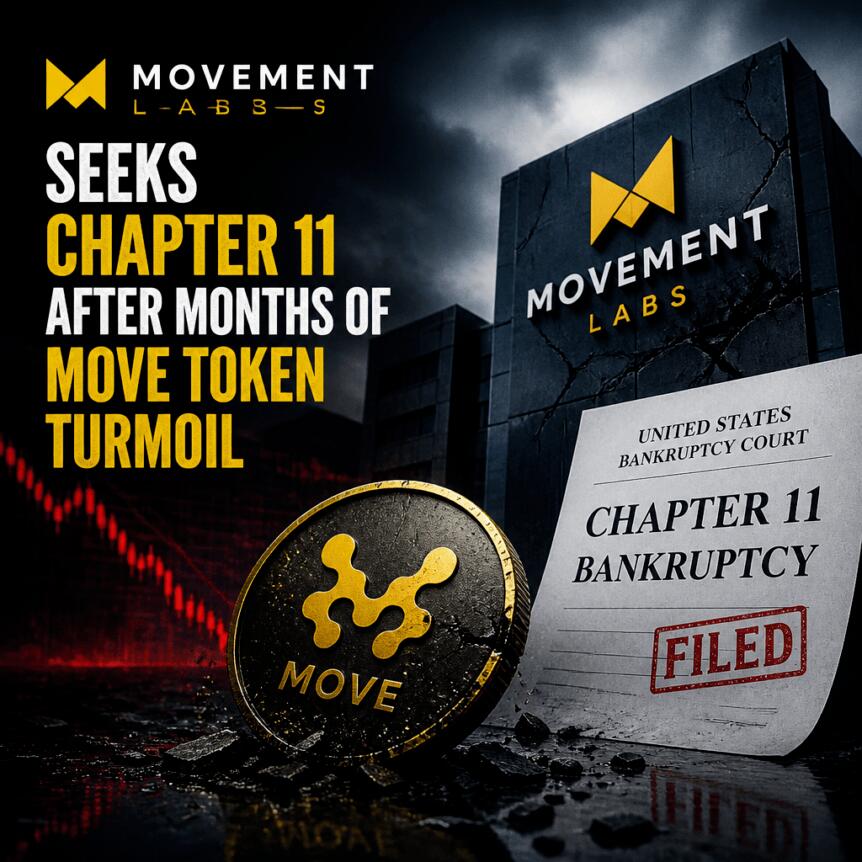
Movement Labs, the team behind the Movement Ethereum layer-2 network, has filed for Chapter 11 bankruptcy protection in the United States, according to court records. The filing places the company under court supervision as it restructures following a series of controversies around the launch of the MOVE token and subsequent corporate disruptions.
The petition was submitted on July 15 in the U.S. Bankruptcy Court for the District of Delaware under Subchapter V, a streamlined reorganization route available to qualifying small businesses. If approved, Subchapter V can allow a business to continue operating while it works toward a plan for creditors.
Key takeaways
- Movement Labs filed Chapter 11 under Subchapter V on July 15, with operations continuing during restructuring under court oversight.
- The court approved interim measures including retention of bank accounts/cash management and permission to pursue debtor-in-possession financing.
- Creditors have until Sept. 14 to submit claims related to the bankruptcy.
- Move Industries CEO Torab Torabi says the bankruptcy is limited to Movement Labs, while Move Industries continues operating normally.
- The move comes after months of fallout tied to MOVE’s launch, a market-making dispute, and exchange delistings that contributed to a major decline in token value.
Chapter 11 filing under Subchapter V
Court documents show that Movement Labs, Inc. sought Chapter 11 protection on July 15 using Subchapter V, which is designed to streamline reorganizations for certain small businesses. That status is significant for stakeholders because it can change the pace and structure of the restructuring process compared with a traditional Chapter 11 case.
Following the filing, the court granted interim requests that allow Movement Labs to maintain its bank accounts and cash management systems. The court also approved the company’s ability to obtain debtor-in-possession (DIP) financing, a common mechanism in Chapter 11 cases that helps fund operations while a debtor reorganizes.
For creditors and counterparties, timing matters. The court set a claims deadline of Sept. 14, giving parties a defined window to file claims tied to Movement Labs’ bankruptcy.
Move Industries says it is not covered
After the bankruptcy filing became public, Move Industries CEO Torab Torabi addressed the situation on X. According to Torabi’s statement, the Chapter 11 filing applies only to Movement Labs.
Torabi also said Move Industries—an entity that took over development and operations of the Movement ecosystem from Movement Labs in December 2025—continues to operate normally.
The distinction is important to users and developers because it suggests the broader ecosystem stewardship may not be directly suspended by Movement Labs’ restructuring. However, readers should still watch for how responsibilities, funding, and contractual relationships between the entities are handled during the bankruptcy process.
Earlier coverage from Movement’s community materials indicates the handoff occurred as part of a broader operational transition. Torabi’s post points to that separation as a reason investors should not automatically assume the entire Movement network is winding down.
Market-making controversy and exchange action preceded the filing
Movement Labs’ bankruptcy arrives after months of turmoil surrounding the MOVE token launch and a controversial market-making agreement. Cointelegraph previously reported that Movement Labs suspended co-founder Rushi Manche in May 2025 in connection with a deal he helped broker with Web3Port.
According to that earlier reporting, the market maker received 66 million MOVE—about 5% of the token’s supply—and later sold the holdings. The arrangement drew scrutiny after it reportedly exerted significant downward pressure on the token price, and an independent investigation was launched.
Cointelegraph also reported that Coinbase suspended MOVE trading later in May 2025 after determining the token no longer met its listing standards, with the market-making review ongoing at the time.
Those steps—suspension of a co-founder, ongoing investigation, and an exchange delisting—formed a damaging sequence that affected both market confidence and liquidity. A Chapter 11 filing typically signals that the financial and operational strain from such disruptions can no longer be contained internally.
Token collapse underscores the pressure on the project
The filing is occurring against a backdrop of a steep decline in MOVE’s market value. Cointelegraph’s source material notes that MOVE has fallen by more than 94% over the past year to roughly $0.01. While token price alone is not proof of bankruptcy, it often reflects a wider loss of trust, reduced trading activity, and potentially diminished revenue for token-linked business operations.
For market participants, the deeper implication is less about the immediate price reaction and more about what bankruptcy means for governance, funding, and stakeholder claims. In restructurings like this, creditors may seek repayment through settlement terms or equity arrangements depending on the company’s assets and liabilities—details that typically emerge gradually as the case proceeds.
What to watch next
Movement Labs’ restructuring plan and DIP financing terms will likely be the next decisive signals for investors and ecosystem participants. Readers should also monitor whether the separation from Move Industries remains operational in practice—especially around access to resources, continuity of development, and how any claims tied to past token-related controversies are handled.


MVMT Labs, Inc., the developer behind the Movement blockchain, filed for Chapter 11 bankruptcy in the U.S. Bankruptcy Court for the District of Delaware on July 15, according to the court docket. The voluntary petition, docketed as case number 26-11113 and assigned to Judge Thomas M. Horan, lists… Read the full story at The Defiant
The team behind the popular meme coin tried to settle an interesting competition, but instead became the subject of criticism from its community.
SHIB’s price has finally rebounded, while several bullish factors suggest a much more substantial rally could be on the horizon.
The SHIB Army Demands Action
Inspired by Spain’s victory in the FIFA World Cup, Shiba Inu’s official X account tried to settle “the real competition,” asking where on Earth the meme coin has the strongest presence.
Some of the answers included Brazil, Japan, the USA, and Turkey, yet the vast majority of users found the question totally inappropriate, suggesting that SHIB’s team should focus on more pressing matters instead.
Many showed their frustration at the recent inactivity of the entire ecosystem, urging the developers to act fast before they lose even more traction. One X user, named Mehmet, said Shiba Inu’s team has been “mocking” people who trusted the project, adding that he regrets the moment when he learned about SHIB.
“People trusted you and invested. I really regret the day I learned about Shib. Leash has turned to trash. The value of Treat and Bone keeps dropping every day. Shame on you.”
Others went even further, labeling Shiba Inu as a scam and a dead project.
Good Days Ahead?
Besides the stalled ecosystem developments, SHIB’s holders are perhaps even more frustrated by the meme coin’s price collapse. It currently trades at around $0.000004272, representing a 72% decline on a yearly scale. On the bright side, this is a 4% increase over the past week, while certain elements signal that the bulls may stage a more decisive comeback in the short term.
The first is the resurgence of Shiba Inu’s burning mechanism. The burn rate has soared by nearly 280% over the last month, indicating that many tokens have been effectively removed from circulation. Still, SHIB’s supply remains extremely large, meaning that both the team and the community will need to ramp up their efforts in that field to support a stronger rally.

Next on the list is the meme coin’s declining amount on exchanges. According to CryptoQuant, the figure has dropped to a fresh five-year low, signaling that numerous investors have abandoned centralized platforms in favor of self-custody wallets, thereby reducing immediate selling pressure.

The post Shiba Inu (SHIB) Team Faces Backlash Over Controversial Social Media Campaign: Details appeared first on CryptoPotato.


S&P Dow Jones Indices and Pantera Capital have launched the S&P Pantera Digital Asset Index, a benchmark for institutional investors seeking a more disciplined and structured approach to digital asset allocation, the index provider said in a press release published Tuesday. The index screens for… Read the full story at The Defiant
Bitcoin’s move above $66,000 has lifted CRCL, BMNR and MSTR by as much as 8.6% as investors position for the Federal Reserve’s July meeting.
Summary
- Bitcoin’s move above $66,000 lifted CRCL, BMNR and MSTR during Tuesday’s trading.
- CRCL and BMNR broke descending resistance, while MSTR reclaimed the key $100 level.
- The Federal Reserve’s July decision could determine whether the three stock rallies continue.
According to data from crypto.news, Bitcoin climbed past $66,000 on July 21, while Ethereum traded above $1,900 and XRP recovered beyond $1.14. The combined value of all cryptocurrencies increased 2.08% within 24 hours to reach $2.26 trillion.
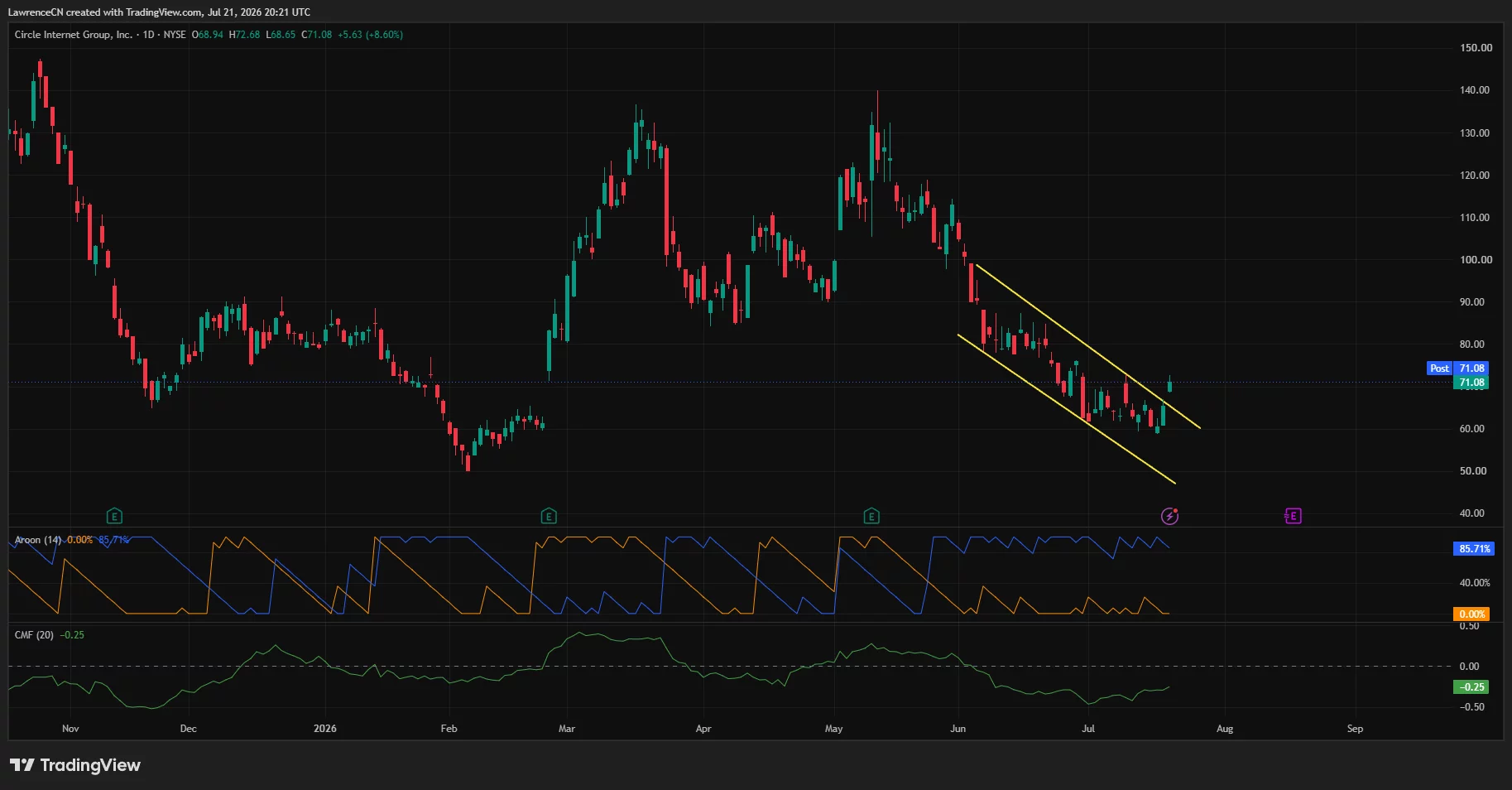
Stocks tied to digital assets followed the market higher during Tuesday’s session. Circle Internet Group gained 8.6%, BitMine Immersion Technologies advanced 3.61%, and Strategy rose 4.22%, according to the daily TradingView charts supplied with the report.
Investor interest also increased as U.S. lawmakers moved closer to establishing clearer rules for digital assets. As such, expectations surrounding the CLARITY Act supported companies with direct exposure to cryptocurrency prices, stablecoin activity and corporate crypto holdings.
Crypto strength has lifted all three stocks
Circle Internet Group recorded the largest gain among the three companies, with CRCL closing at $71.08 after opening at $68.94. TradingView data showed that the stock reached an intraday high of $72.68 and a low of $68.65 before ending the session 8.6% higher.
CRCL also moved above the upper boundary of a descending channel that had controlled its price since early June. The supplied daily chart places the former channel resistance near $65, making that level the first area buyers may need to defend if the breakout faces a retest.
Momentum indicators support the recovery, although money flow remains a concern. CRCL’s Aroon Up reading reached 85.71%, while Aroon Down fell to zero, which the TradingView chart identifies as stronger upward momentum; however, the Chaikin Money Flow reading remained negative at -0.25, showing that buying pressure has not yet produced sustained capital inflows.
Based on the visible chart structure, the next resistance range sits between $75 and $80. A move back below the broken channel boundary near $65 would weaken the breakout, while the recent base around $60 provides the next visible support area.
BitMine Immersion Technologies closed at $17.23, rising 3.61% after trading between $16.69 and $17.24. The advance came as investors assessed BitMine’s latest Ethereum purchases and its share-repurchase program ahead of the Fed meeting.
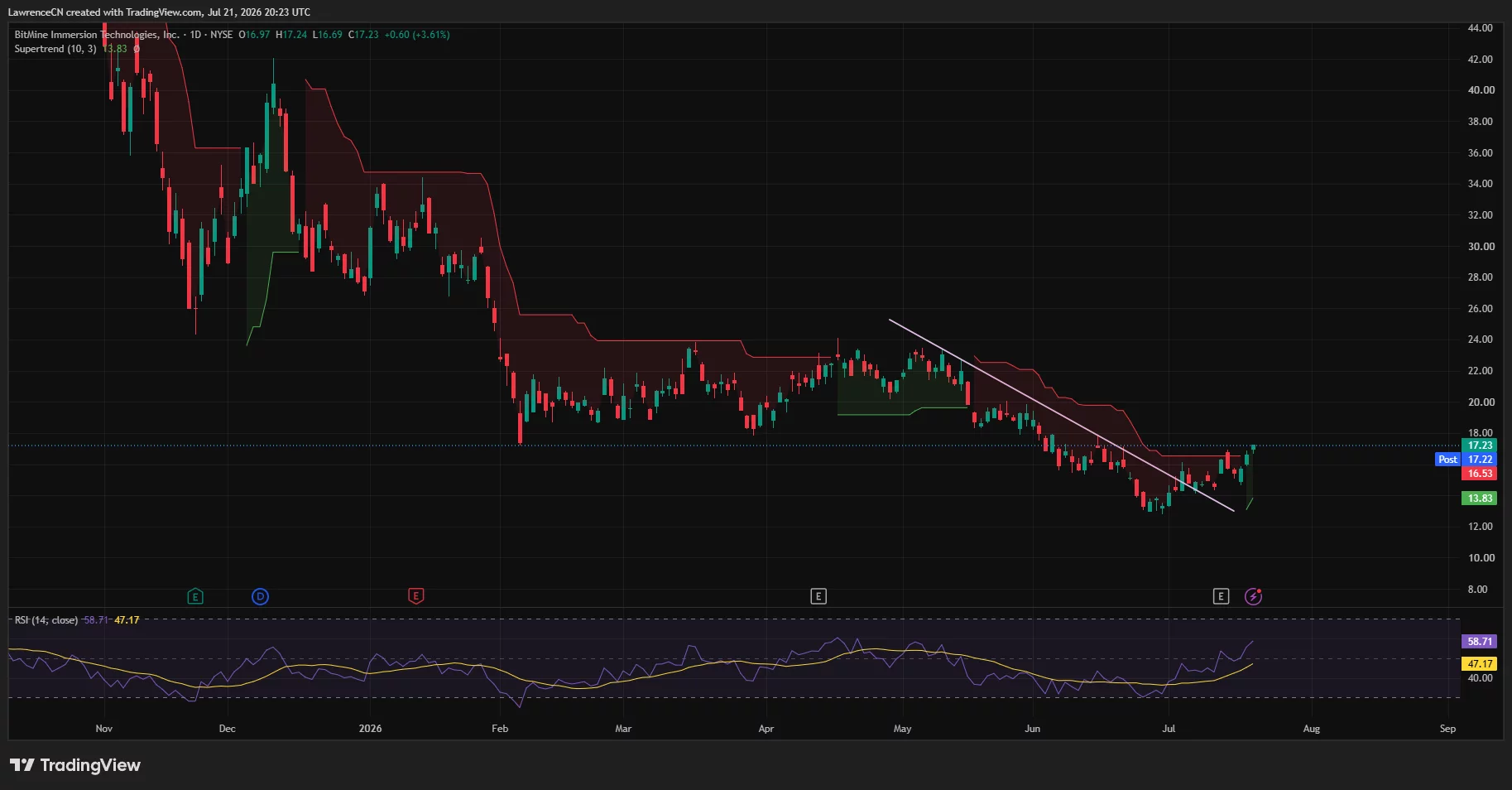
According to the company figures cited in the report, BitMine acquired another 7,430 ETH during the week, raising its holdings to 5.78 million tokens. The company has staked 4.92 million ETH, equal to about 85% of its Ethereum treasury, while its combined crypto assets, cash, and investments stood at $11.5 billion.
BitMine also repurchased 5.5 million shares at an average price of $15.62, according to the same company update. Its daily chart showed BMNR breaking above a descending trendline that had capped the stock since May, while the price also crossed the Supertrend level at $16.53.
BMNR’s Relative Strength Index rose to 58.71, compared with its signal average of 47.17, according to TradingView. Since the RSI remains below the 70 overbought threshold, the indicator leaves room for an advance toward the visible $18 resistance, followed by the previous consolidation area near $20; a close below $16.53 would weaken the reversal setup, with additional support shown at $13.83.
Strategy shares ended Tuesday at $101.95 after rising 4.22%, TradingView data showed. MSTR traded as high as $104.60 and briefly fell to $99.95, but buyers returned around the psychologically important $100 level before the close.
Michael Saylor disclosed that Strategy increased its U.S. dollar reserves by $225 million, bringing the company’s cash reserve to $3.2 billion. The report also placed Strategy’s Bitcoin holdings at 843,775 BTC, keeping MSTR closely exposed to changes in the cryptocurrency’s market value.
Fed guidance will test the new breakouts
MSTR has reclaimed the Bollinger Bands midpoint at $94.79 and is approaching the upper band at $105.36, according to the supplied daily chart. A confirmed move above that upper boundary could open the area around $110, while a rejection would keep $100 and the middle band near $95 as the first support levels.
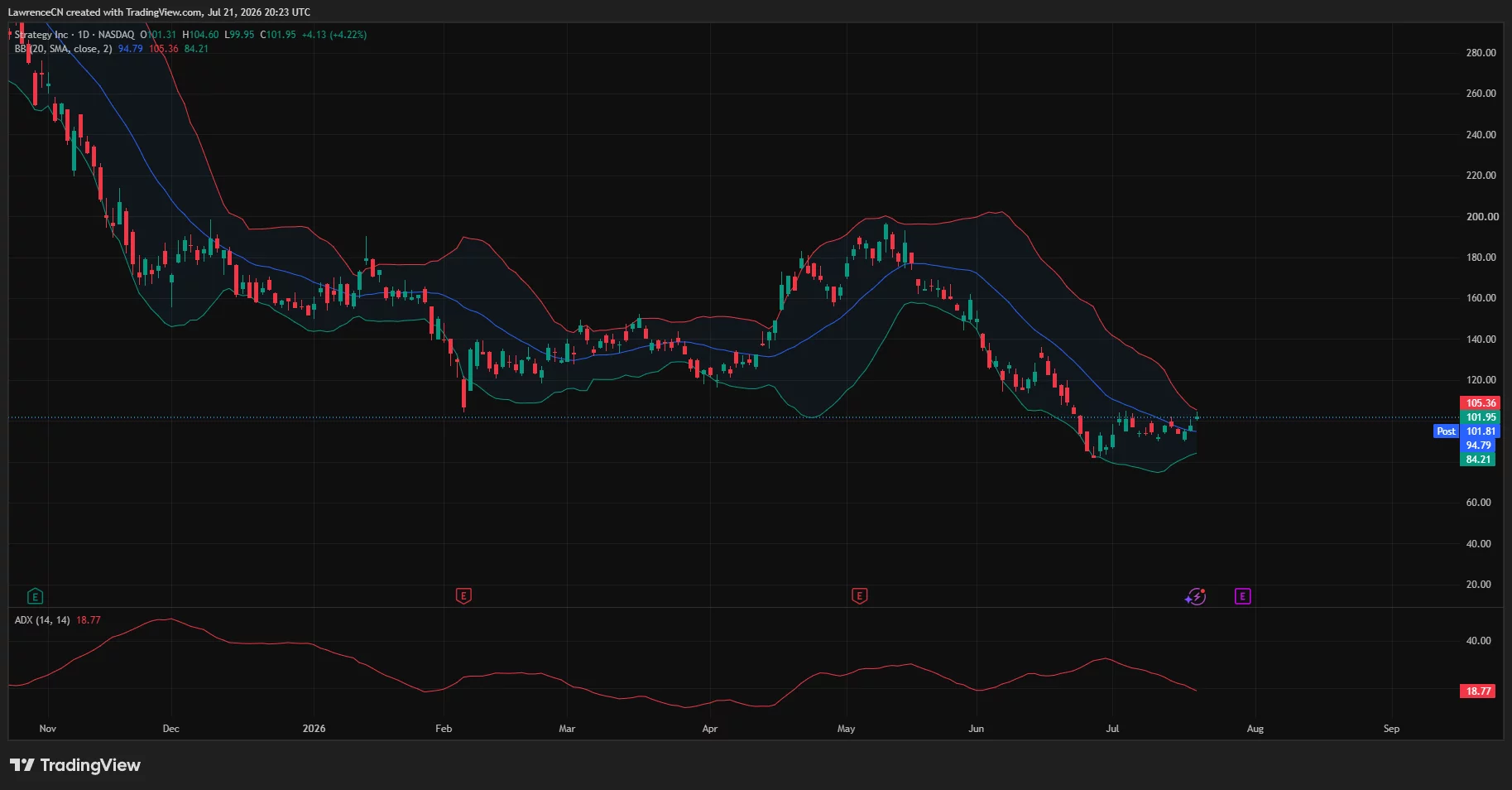
Despite Tuesday’s recovery, MSTR’s Average Directional Index stood at 18.77. TradingView’s indicator reading shows that the stock does not yet have a strong directional trend, leaving the breakout vulnerable if Bitcoin loses momentum or the Fed delivers a more restrictive policy message.
The Federal Reserve is scheduled to meet on July 28 and 29, with markets expecting policymakers to leave interest rates unchanged, according to the report. Investors will instead examine Chair Kevin Warsh’s comments for clues about inflation, economic growth and the timing of future policy changes.
A balanced policy message could help Bitcoin and crypto-linked equities preserve Tuesday’s gains. More hawkish guidance could encourage profit-taking, placing CRCL’s channel breakout, BMNR’s Supertrend reversal and MSTR’s recovery above $100 under immediate pressure.
Disclosure: This article does not represent investment advice. The content and materials featured on this page are for educational purposes only.
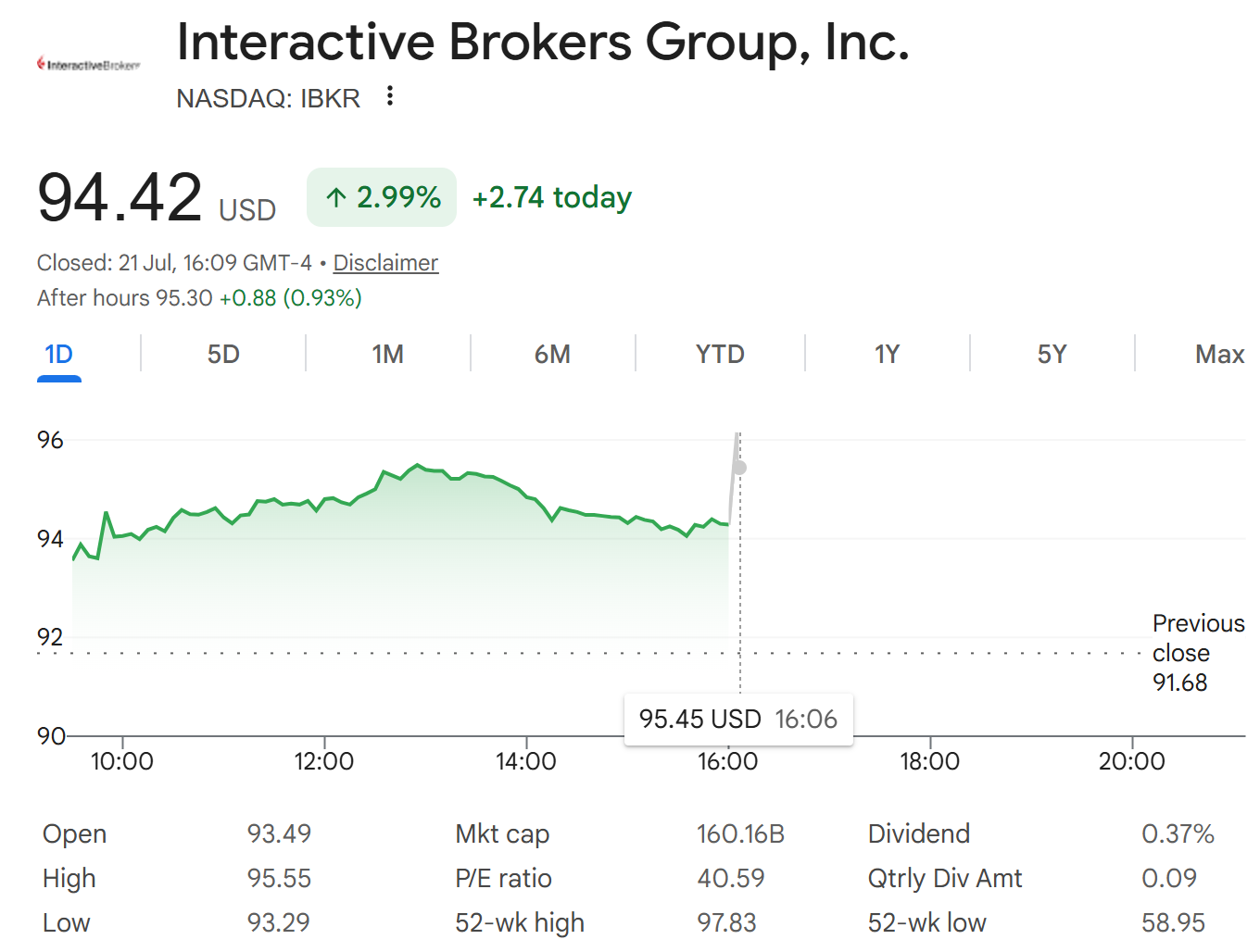
Interactive Brokers (IBKR) posted second-quarter revenue of $1.90 billion and adjusted earnings per share (EPS) of $0.69. Both figures beat Wall Street estimates of $1.80 billion and $0.64, and the stock climbed about 4% in after-hours trading.
The automated global brokerage, which offers stocks, options, futures, crypto, and prediction markets, lifted profits on booming customer activity. Its pretax profit margin reached 77%, up from 75% a year earlier.

Trading Boom Powers Interactive Brokers Earnings Beat
Commission revenue rose 30% year-over-year to $673 million. Customer trading volumes in options and stocks increased 17% and 14%, respectively.
Meanwhile, net interest income climbed 23% to $1.06 billion, ahead of the $994 million FactSet consensus. Customer margin loans jumped 67% to $108.5 billion, while customer credits rose 27% to $182.4 billion.
The results cap a strong week for brokerages after Charles Schwab’s record quarter on Monday. Retail engagement has also picked up since the pattern day trader rule ended in June.
Client Growth Keeps the Bar High for IBKR Stock
Customer accounts grew 34% to 5.19 million, and customer equity expanded 40% to $930.3 billion. Daily average revenue trades (DARTs), a measure of customer orders that generate commissions, rose 36% to 4.82 million.
Beyond equities, the firm keeps widening its reach among brokers integrating crypto trading. It also became the first venue for Cboe’s new prediction markets products in June.
The board declared a quarterly dividend of $0.0875 per share, payable September 14. However, the stock entered the report near the top of its historical valuation range.
Management’s earnings call commentary may decide whether the after-hours gains hold into the second half.
The post Interactive Brokers Earnings Reveal $1.90B Revenue, How Will IBKR Stock React? appeared first on BeInCrypto.

Dollar-backed stablecoins are becoming a new channel for “digital dollarization” that BIS researchers say is largely resistant to capital controls—especially in emerging markets where households and businesses already face currency and access constraints.
In a study released by the Bank for International Settlements (BIS), researchers compared foreign-currency bank deposits with inflows into dollar-pegged stablecoins across more than 130 economies. They found that both measures tend to rise during macroeconomic stress, but stablecoin flows react far less to capital controls and other FX restrictions—an asymmetry the authors attribute to stablecoins circulating “partly outside the regulatory perimeter.”
Key takeaways
- BIS research links both foreign-currency deposits and dollar-pegged stablecoin inflows to periods of macroeconomic stress.
- Stablecoin inflows appear far less sensitive to capital controls than traditional foreign-currency deposits.
- That resilience could limit policymakers’ ability to curb stablecoin adoption using tools designed for the banking system.
- BIS reports limited evidence that deposit dollarization weakens monetary policy transmission, though higher foreign-currency deposits correlate with greater inflation risk.
- The study suggests financial-stability regulation may need updating as tokenized assets expand beyond existing oversight structures.
Digital dollarization beyond traditional banking channels
BIS researchers frame stablecoins as potentially creating a parallel dollar-use ecosystem. Their analysis draws a comparison between two ways residents can move into foreign currency: by holding bank deposits denominated in foreign exchange and by holding dollar-pegged stablecoins.
According to the BIS study, both categories increase during periods of macroeconomic stress. That finding aligns with a common pattern in emerging-market finance: when local currencies weaken and uncertainty rises, demand for dollar assets often grows.
The important difference is how each channel responds to government attempts to restrict cross-border capital movement. The BIS team reports that stablecoin inflows show little reaction to capital controls or other FX restrictions, while foreign-currency deposits behave more like a traditional financial variable—tending to reflect policy measures more directly.
The authors argue this divergence is likely because stablecoins can circulate outside the regulatory perimeter. In practice, that means stablecoin adoption may not map neatly onto the same enforcement mechanisms used for bank deposits or conventional foreign-currency flows.
Why capital controls may be less effective with stablecoins
Capital controls and FX restrictions are designed to influence the movement of funds across borders and within domestic financial systems. BIS’s findings suggest that when a new, tokenized “dollar” route emerges, those tools can lose traction.
The study does not claim stablecoins are immune to every policy influence. Rather, it highlights reduced responsiveness in stablecoin flows relative to traditional foreign-currency deposits. For policymakers, that raises a practical question: how much of financial stability management still depends on the banking system being the main gateway for dollarization?
BIS also warns that stablecoins could undermine monetary sovereignty even if inflation dynamics remain similar in some cases. The concern is that households and businesses may shift into dollar exposure outside the banking system, particularly where local currencies are fragile or access to reliable financial services is limited.
Monetary policy transmission and inflation risk remain mixed
While the BIS study raises sovereignty questions, it also includes a more nuanced assessment of monetary policy effectiveness. The researchers report little evidence that dollarization via deposits weakens monetary policy transmission.
However, the study notes that countries with higher levels of foreign-currency deposits faced a somewhat greater risk of elevated inflation. That distinction matters because it suggests the impact of dollarization on macro outcomes may depend on structure and context—even if stablecoins and deposits are both dollar-linked.
For investors and risk managers, the takeaway is that “digital dollarization” may not automatically translate into immediate policy failure, but it can still complicate how central banks gauge demand for foreign-currency assets and anticipate pressure points in financial stability.
Regulators may need new tools for a tokenized financial system
BIS concludes that policymakers may need updated instruments to manage financial stability as stablecoin usage grows. The argument is not simply that stablecoins are “new,” but that existing regulations built for traditional banks and foreign-currency deposits may be less effective when the dollar exposure is tokenized and potentially distributed across channels that fall outside established compliance boundaries.
That becomes especially relevant as stablecoins are increasingly used for payments in emerging markets. In such settings, stablecoin adoption can be driven not only by speculative motives, but by operational realities—cross-border transfer speed, remittance costs, and persistent gaps in access to foreign exchange.
Stablecoin adoption is already spreading for payments and cross-border use
The BIS analysis arrives as other institutions document rising stablecoin use in the real economy. In a separate assessment focused on Nigeria, the International Monetary Fund (IMF) found that households and small businesses use US dollar-pegged stablecoins for cross-border payments, remittances, and access to dollar-denominated assets. The IMF attributed demand to factors such as inflation, currency depreciation, and limited access to foreign exchange.
In that IMF report, stablecoins were described as reducing the time and cost of moving money across borders while expanding access to financial services for users outside the traditional banking system. At the same time, the IMF warned that broader adoption of dollar-backed tokens could weaken monetary sovereignty by reducing demand for local currency and moving more financial activity outside conventional banking channels.
Beyond Africa, stablecoin payments have also accelerated in Latin America. Bitso Business, the enterprise payments arm of crypto exchange Bitso, reported an 81% year-over-year increase in stablecoin payment volume during the first half of 2026. The company also said that Circle’s USDC and Tether’s USDT made up 40% of all crypto purchases in the region in 2025, surpassing Bitcoin for the first time.
Separately, broader market data points to the scale of this shift. Stablecoin market capitalization has reportedly risen to about $309.7 billion, up from roughly $260 billion a year earlier, according to the figures cited in the original reporting and shown via DefiLlama’s stablecoin data.
For markets, the key question now is how policymakers will respond if stablecoin flows keep behaving differently than foreign-currency deposits. BIS’s evidence suggests traditional capital-control playbooks may be less effective, so the next watch items are regulatory measures that target tokenized dollar access directly—and whether stablecoin adoption continues to decouple from FX restrictions across more jurisdictions.
The White House has reportedly reached an agreement on ethics language for the Digital Asset Market Clarity (CLARITY) Act, a US crypto market-structure bill currently awaiting a possible Senate vote. The development is framed as a potential pathway to secure support from at least some Democratic lawmakers—an outcome that could prove decisive in a chamber where passage may require broad consensus.
According to a Tuesday report from Punchbowl, White House officials met with Republican Senators Cynthia Lummis and Bernie Moreno to align on the bill’s ethics provisions. Neither senator has publicly detailed the terms of the understanding, but the report suggested the outcome could also influence how US President Donald Trump’s crypto-related investments are viewed politically.
Key takeaways
- The White House is reportedly working to finalize ethics language in the CLARITY Act after meetings with Sen. Cynthia Lummis and Sen. Bernie Moreno.
- Support from some Democrats would matter because the Senate is expected to face a tight decision and likely needs 60 votes for passage.
- Many Democrats have previously indicated that CLARITY would be “worthless” without ethics provisions addressing conflicts they associate with Trump’s connections to the crypto industry.
- While the House passed CLARITY in July 2025, delays tied to shutdowns and unresolved policy questions have kept the Senate process uncertain.
Why ethics language has become the gatekeeper
The CLARITY Act has been positioned as a major effort to establish market-structure rules for crypto in the United States. The House passed the bill in July 2025 as part of Republicans’ “Crypto Week” agenda, but its Senate timeline has been complicated by multiple delays. The reported sticking points have ranged from lawmakers’ concerns over ethics to questions around tokenization and stablecoin-related rewards, alongside calls to protect developers from potential enforcement actions.
The central political friction in the Senate appears to be ethics and conflict-of-interest concerns, particularly as they relate to the Trump administration. Earlier coverage from Cointelegraph noted that Trump urged the Senate to pass CLARITY “in honor of” the late Senator Lindsey Graham, who the president said was a major supporter of the bill.
Still, several Senate Democrats have been explicit that they will not treat the legislation as complete without additional safeguards. According to Cointelegraph reporting, Senators including Elizabeth Warren, Chris Murphy, Jeff Merkley, and Chris Van Hollen said that any CLARITY bill would be “worthless” without ethics provisions addressing potential conflicts they believe stem from Trump’s ties to the crypto industry, including his memecoin and the family’s World Liberty Financial business.
Unclear vote math as Senate calendar remains unsettled
Even with a reported ethics agreement, it is not yet clear whether CLARITY can secure the 60-vote threshold that typically applies to overcome Senate procedural hurdles. The bill’s prospects hinge on whether enough lawmakers—especially among Democrats—are persuaded that the ethics provisions adequately address their concerns.
As of Tuesday, the congressional calendar reportedly did not show a CLARITY vote, and the bill text had not been made public. That lack of transparency can further complicate support: lawmakers frequently need full access to the exact language before they can credibly assess whether amendments actually address the specific ethics risks they have raised.
Cointelegraph also reported that it requested details of the agreement from Lummis’ office but did not receive an immediate response, underscoring that the negotiation’s specifics remain largely undisclosed to the public.
Administration message: “comprehensive” ethics provisions
While the details of the reported deal have not been released, a White House official told Cointelegraph that the administration is committed to advancing CLARITY and said it had agreed to “the most comprehensive and wide-ranging ethics provision in history.” The official also characterized the process as highly responsive to Democratic concerns, saying the administration had “bent over backward to accommodate [Democrats’] concerns.”
At the same time, opposition has not disappeared. Many Democrats have argued that hearings are necessary to examine Trump’s crypto investments and related connections before any vote. Those calls reflect a broader concern: even if language is improved, lawmakers may still want a formal record and additional scrutiny through hearings to determine whether conflicts persist.
Coinbase vice chair Ryan VanGrack, cited in Cointelegraph reporting, suggested that Democrats have already been able to negotiate customer protection provisions into the Senate version of the bill. However, that progress on one policy area does not appear to have resolved the ethics debate, which remains a key driver of uncertainty.
Crypto market reaction tracks the political development
Bitcoin moved higher during the news cycle, climbing above $66,000 early on Tuesday and reaching a seven-week high, according to Cointelegraph’s coverage. Traders linked the move to reports of an ethics deal and to separate developments involving Trump’s plans to introduce additional 10% international trade tariffs.
In social media commentary, Michaël van de Poppe, founder and chief investment officer of MN Fund and MN Capital, attributed the rally to expectations surrounding potential approval of the CLARITY Act. The observation highlights how tightly some market participants are tying near-term price action to US regulatory and legislative progress, particularly when bills are framed as shaping how crypto markets will operate.
What to watch next
Investors and builders should focus on whether the Senate bill’s text becomes publicly available and whether lawmakers’ concerns—especially around ethics—are reflected in verifiable drafting. The next inflection point is not just whether CLARITY advances procedurally, but whether enough senators are willing to commit before any final vote amid ongoing questions about conflicts and the adequacy of proposed safeguards.

BBC game show contestant exposes behind-the-scenes rule

Last Week’s Mini DeepSeek Moment Blows Over, but KOSPI Struggles Persist

Crypto Rallies as Reported Ethics Deal Revives Odds of CLARITY Act Senate Vote


-
 NewsBeat5 days ago
London Mayor Sadiq Khan handed a peerage by Keir Starmer alongside 15 other Labour figures… just days before the PM leaves No10
-

 Fashion4 days ago
Weekend Open Thread – Corporette.com
-

 Politics3 days ago
The House | The City of London can help the new chancellor deliver growth in every postcode
-

 Politics6 days ago
Young campaigners urge incoming PM to act on outdoor junk food ads
-
 Crypto World4 days ago
Two July Windows Left: The CLARITY Act’s Senate Fight and What Failure Means
-

 Crypto World6 days ago
CFTC blocks Kalshi from unwinding Michigan trades after court order
-

 Crypto World3 days ago
Ripple Payments Joins MiCA With 14 Firms, Does It Mean Anything For XRP?
-

 Business6 days ago
Nvidia Stock Slips After Big Tuesday Rally as Huang Confirms Vera Rubin Chip Is Now in Production Today
-

 Politics2 days ago
Democrats look to World Cup watch parties to register thousands of voters
-
 Entertainment6 days ago
Disney’s Most Ambitious Failed Star Wars Attraction Is Coming to SDCC
-

 Crypto World4 days ago
Ripple wins EU-wide access as ESMA adds it to MiCA register
-

 Crypto World13 hours ago
Grayscale Files For Worldcoin ETF, WLD Registers Sharp Rise
-

 Crypto World5 days ago
Injective Submits SEC Transfer-Agent Registration to Onchain Ownership Records
-

 Business6 days ago
Palantir Shares Rise After Expanded Nvidia Partnership and Fresh Analyst Upgrades Ahead of Earnings Day
-

 Tech21 hours ago
Sail Virtually Aboard The “Itanic” With IA-64 Emulator
-
 Tech18 hours ago
Turtle Beach Command Series KB7 review: a nifty screen-equipped gaming keyboard
-

 NewsBeat4 days ago
Registration is now open for March for Men with Kev 2026
-

 NewsBeat1 day ago
Unregistered fitter used Gas Safe logo on business flyers
-
 Sports6 days ago
New Cornerback Enters Vikings Trade Rumor Mill
-

 News Videos5 days ago
Money | Class 12 Economics | CBSE Board Exam 2026-27
You must be logged in to post a comment Login