Connect with us
DAPA Banner
DAPA Coin
DAPA
COIN PAYMENT ASSET
PRIVACY · BLOCKDAG · HOMOMORPHIC ENCRYPTION · RUST
ElGamal Encrypted MINE DAPA
🚫 GENESIS SOLD OUT
DAPAPAY COMING

Tech

Can You Mount A TV On A Concrete Wall?

Published

on


It may seem intimidating at first to think of hanging anything on a concrete wall. Drywall is the most common type of wall in apartments and single-family homes alike and it’s very easy to hang a TV on drywall as long as you can find the studs. However, you can easily hang a TV on a concrete wall — it will just take more time. The effort is worth it, since hanging a TV frees up space, looks more modern and cleaner, and can even allow for more movement if you get a tilt or full-motion mount. 

You’ll first need the right tools for the job. Along with the right size TV mount kit (which usually comes with a wall plate, screws, bolts, washers, spacers, and sometimes heavy-duty hardware like wall anchors and lag bolts) you’ll need a marker, electric hammer drill, masonry drill bit, hammer, level, and concrete screws. We also recommend safety gear, like goggles and gloves.

Advertisement

How to mount a TV on a concrete wall

Once you have the tools, it’s time to start planning. Before you even start drilling, you’ll want to find the right spot on the cement. Measure the wall to find the center (or just find the most visually appealing spot to you). Then, hold the wall plate to the wall, remembering that the TV will be above and below the wall plate. Once you find a spot, use the level to make sure it’s straight and then start marking the center points of the mounting holes directly onto the concrete. 

Put the masonry drill bit into your hammer drill and start drilling the marked center points. The holes should be deep enough to fit anchors. While you don’t have to worry about studs with a concrete wall, you may run into rebar, a steel bar that strengthens concrete. You will have to stop drilling and use a cutter to get through the metal — or find a new spot. 

When the holes are complete, insert the wall anchors. Line up the mounting plate with the holes, then use an electric drill to secure the plate to the anchors. If everything looks centered and aligned, you can attach your TV to the mount. If you want, you can conceal the wires at that point. Finally, try wiggling the TV to see if it’s mounted securely. 

Advertisement


Source link

Advertisement
Continue Reading
Click to comment

You must be logged in to post a comment Login

Leave a Reply

Tech

Fake Hide My Email header can expose your Apple Account

Published

on

A forged Hide My Email header can make Mac Mail expose a user’s Apple Account address, extending the privacy risk beyond people who use Apple’s alias service.

Developer Jeff Johnson disclosed the Mac Mail privacy flaw on July 19. His testing showed that a specially crafted message could make Mail display a misleading sender identity while a reply went out from the email address tied to his Apple Account.

The behavior didn’t require Johnson to use Hide My Email or maintain an iCloud.com mailbox. He also found that the malicious message could arrive through an unrelated personal or business account before Mail exposed the Apple Account address in a reply.

Johnson said he doesn’t know whether the finding is technically related to an earlier flaw that could reveal the address behind a Hide My Email alias. His report documents a separate technique and doesn’t establish that both issues share the same underlying cause.

Advertisement

Johnson used the curl command-line tool to send himself an email containing an arbitrary X-Icloud-Hme header. Mail doesn’t give users direct control over arbitrary outgoing headers, while curl allowed him to choose the values placed inside it.

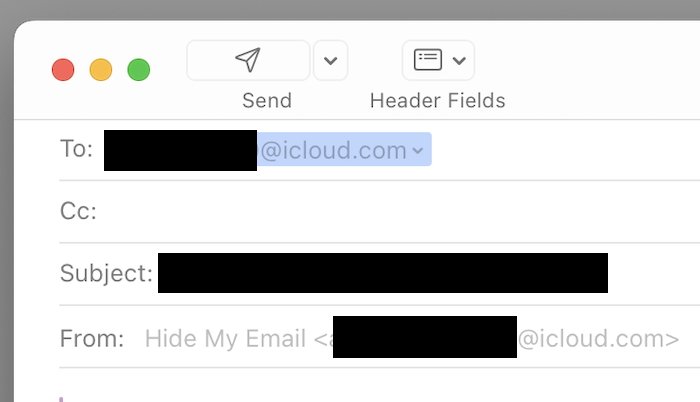
By controlling those values, Johnson could make Mail show selected addresses in the reply window. The app also displayed “Hide My Email” in the From field and added a notice saying the message had been forwarded through the service.

The result suggests Mail accepted information supplied by the sender without first establishing that Apple’s Hide My Email service had generated it. Johnson demonstrated the visible behavior, but his report doesn’t identify the app’s internal validation process.

Email compose window on a Mac with To, Cc, Subject, and From fields visible; addresses and subject text are blacked out for privacy, showing use of Hide My Email featureA crafted X-Icloud-Hme header was sufficient to trigger the Mac Mail bug in Johnson’s testing. Image credit: Jeff Johnson

The problem goes beyond a misleading label because users rely on the From field to confirm which account will send a message. Mail reportedly showed one identity while sending the reply from another, giving Johnson no accurate warning that his Apple Account address would be exposed.

The reported flaw reaches beyond Hide My Email users

Johnson said he doesn’t use Hide My Email and doesn’t have an iCloud.com email account. That makes the reported issue broader than a flaw limited to people actively using Apple’s alias service.

Advertisement

A crafted message can also arrive through a separate email account, yet Johnson said Mail may still send the reply from the address tied to the recipient’s Apple Account. The distinction matters for people who keep personal, business and Apple Account identities inside the same Mail app.

Apple Mail can manage multiple accounts from different providers, and users reasonably expect those identities to remain separate. Johnson’s test shows that the compose window may not always reflect the address that Mail will actually transmit.

Johnson documented a technique he reproduced in his own testing, but the report doesn’t establish which macOS versions are affected. It also doesn’t show whether the same behavior works in Mail on iPhone or iPad, and it offers no evidence that anyone has used the technique in an attack.

Email client window showing a single highlighted message with a blue dot and the text This message was forwarded to you by Katy Graef, plus toolbar icons and a Settings linkThe only other warning was a notice above the message saying it had been forwarded through Hide My Email. Image credit: Jeff Johnson

Crafted email headers have caused problems for Apple Mail before. In 2022, a specially formatted From field could prevent some iOS 16 users from opening Mail, although that issue caused a crash rather than exposing an email address.

The new finding also arrives while Apple faces legal scrutiny over the earlier Hide My Email disclosure. A proposed class action lawsuit filed July 15, accuses the company of misleading customers about the feature, although the complaint doesn’t allege that attackers exposed the plaintiff’s address or exploited the flaw.

Advertisement

How to protect yourself from the Mac Mail disclosure flaw

Mac Mail users should stop before sending when a reply window unexpectedly labels the From address as “Hide My Email,” particularly when the original message wasn’t sent to an alias. In Johnson’s test, the disclosure occurred only after he sent the reply.

Users can inspect a received message’s complete headers by opening the View menu, selecting Message and choosing All Headers. Johnson noted that the command can also be added to the message window’s toolbar.

The presence of an X-Icloud-Hme header doesn’t establish who added it or why. An unexpected Hide My Email label combined with unusual From or To fields should still be treated as a warning.

MacGeneration independently reproduced the Mail bug and confirmed that it can expose an Apple Account address even when the user doesn’t use iCloud for email. The publication’s testing supports Johnson’s findings, though the affected Mail app versions remain unclear.

Advertisement

Users who need to respond should create a new message and confirm the From address before sending instead of replying directly to the suspicious email. Creating a separate message won’t fix the underlying Mail bug, but it avoids the reply behavior Johnson documented.

Source link

Advertisement
Continue Reading

Tech

Many companies are struggling to fully trust AI at work – especially when there’s no human involved

Published

on


  • TeamViewer report finds 71% of autonomous AI users set guardrails, but 61% wouldn’t even use autonomous AI to begin with
  • The average worker spends 2+ hours per week validating AI output
  • Security and privacy could have the biggest impact

New TeamViewer research positions trust as the latest major barrier to AI adoption, with workers generally viewing the tool positively but struggling to hand over full independence to it.

Today, three in four workers use AI daily and only 3% say they don’t see any noticeable workplace benefits, but nearly all (95%) respondents have at least some concern about AI operating without a human in the loop.

Source link

Advertisement
Continue Reading

Tech

Substack now lets you check if a post was written by AI

Published

on

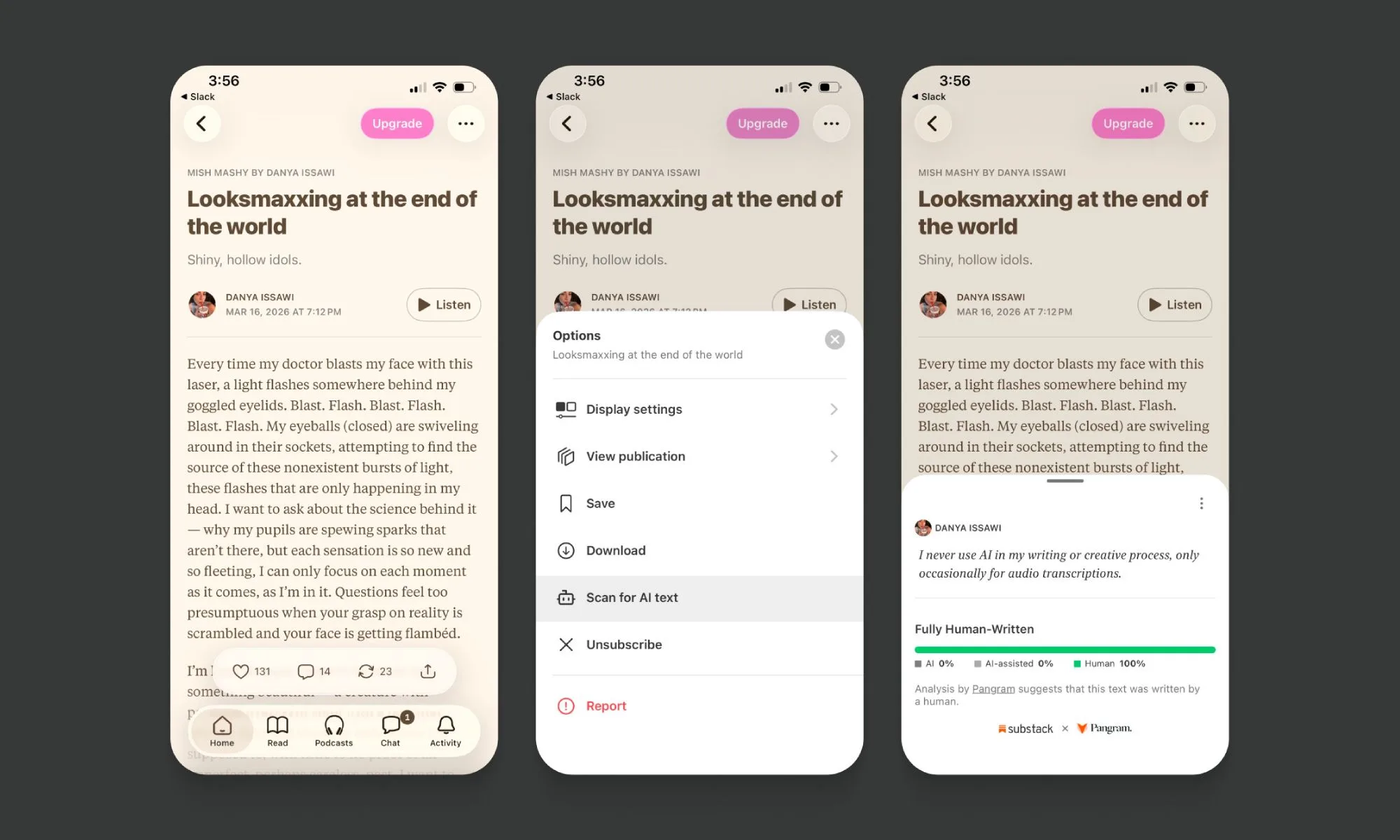
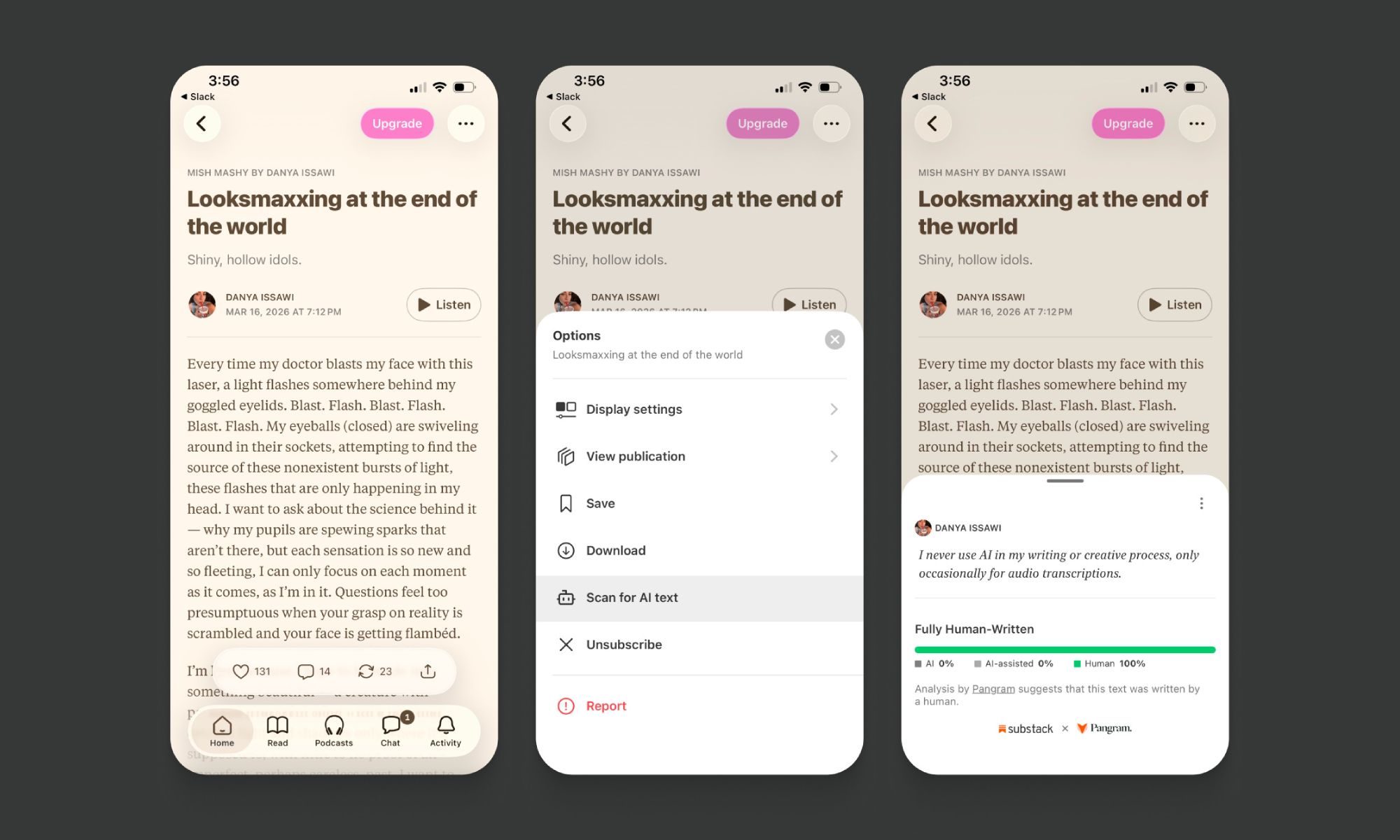
Substack is giving readers a way to check whether the post they’re reading was written by a human or by a chatbot. The company has partnered with AI-detection firm Pangram to introduce new tools that will let users scan posts, notes, and replies for AI-generated text. CEO Chris Best introduced the features in a post titled “Against Claudefishing,” his term for content that leans on AI while presenting itself as human work.

How the scanning tool works

Scans run on any text longer than one hundred words that is published from July 21 onward, and the result is visible only to the person who requests it. Best says Pangram is not perfect, but points to independent evaluations that credit it with a high degree of accuracy. The feature is live on web and iOS, with an Android version coming later.

Substack’s AI-detection feature arrives at a time when the problem it targets is spreading fast across social platforms. Best cites a recent Pangram estimate that as much as forty percent of posts on some platforms are now fully AI-generated.

Writers can run the same scan before they publish

Readers are not the only ones getting new controls. Substack is adding a “How I make this” statement that lets writers describe their process and set expectations up front. Writers also get the option to run Pangram on their drafts before publishing, and they can report and remove scans of their published work that they believe are mistaken. Best says future additions could include AI preferences inside Reply Rules and reader-side controls for what gets recommended.

For readers, this is a rare transparency feature that hands them a real button to spot AI slop. Substack is not alone in trying to solve this issue. LinkedIn has started reducing the reach of AI-generated posts and comments, and Meta is quietly testing its own AI detection tool, though it has yet to go live. Whether any of these tools can keep pace with the models they’re built to catch remains to be seen.

Advertisement

Source link

Continue Reading

Tech

Synthesia’s AI training platform is moving beyond videos into live coaching

Published

on

For years, Synthesia’s pitch was to use AI to help enterprises create interactive training videos, in minutes, for a fraction of the cost normally associated with developing corporate educational materials. The startup’s newest product is making a different bet — that the real moat in enterprise AI isn’t just generating content, but in proving that it worked. 

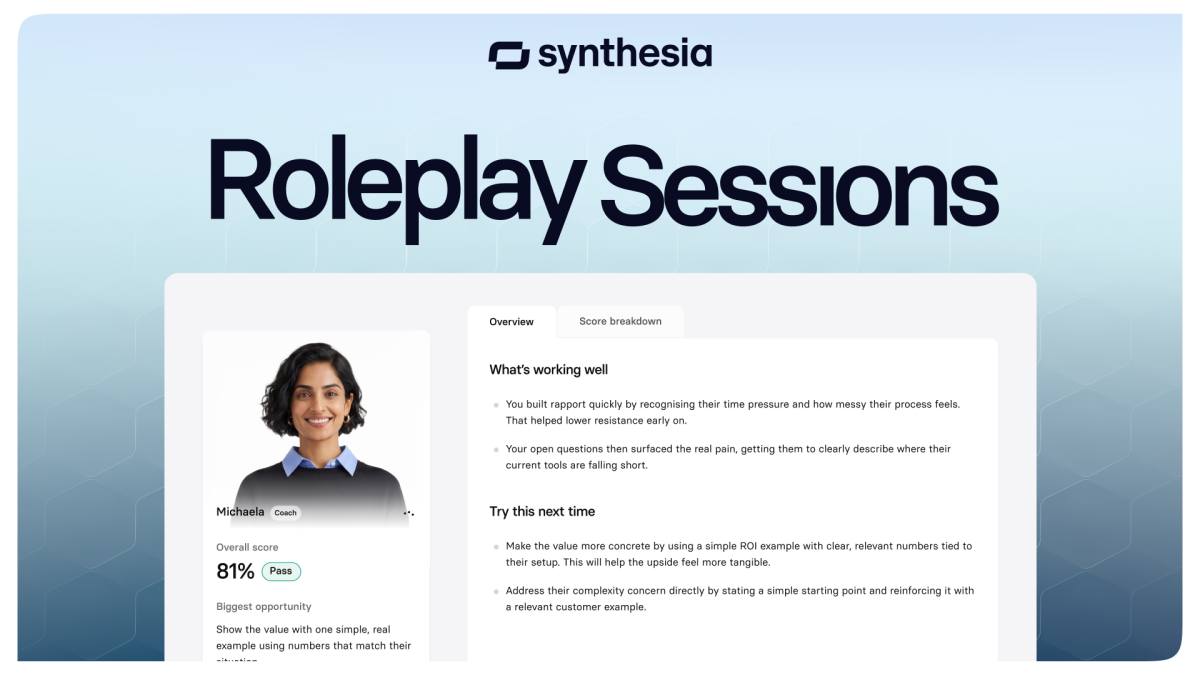
On Wednesday, the British startup launched Roleplay Sessions, an interactive training product where employees can practice high-stakes conversations like sales pitches, performance reviews, and customer complaints with an AI avatar that talks back, pushes back, and then scores them against a rubric. 

Roleplay is the first release under a broader “Sessions” platform Synthesia plans to expand into other formats, including job interviews and candidate screening, TechCrunch has exclusively learned. 

The launch comes as enterprises take a harder look at whether their AI spend is paying off. Citing a meta-analysis of learning research, Synthesia argues that most corporate training — including, implicitly, its own core video product — stops short of actually changing behavior. The trainings tend to inform and demonstrate, but what really pushes someone into actually learning something is doing that thing, along with feedback.

Advertisement

“Video performs way better than text or sending out a document,” Synthesia CEO and co-founder Victor Riparbelli told TechCrunch. “But for most things, we learn the best by actually practicing something rather than just reading it.”

Roleplay also moves Synthesia into a more defensible position. The company’s avatar and voice technology are proprietary, but the underlying reasoning intelligence is OpenAI’s. By tacking on a layer that includes rubrics, performance data, and analytics, Synthesia is positioning itself less as an AI avatar company and more as a performance-management platform with a video front end. 

“From a managerial executive layer, we’re seeing huge interest in mapping out the talent in their company in a way that’s been really difficult to do before,” Riparbelli said. “If you have your entire sales team practice with an AI role player, you can get very granular data on how your sales force is doing overall.”

Synthesia already has a few early Roleplay customers with scaled commercial rollouts, including “one of the top three companies by market cap in Europe, one of the top five Fortune 100, and one of the biggest recruitment companies in the world,” per a company spokesperson. 

Advertisement

The two most popular use cases involve training sales teams and leadership — programs like practicing how to sell a product or have a difficult conversation. Much of it is soft skills training, Riparbelli said. 

As with Synthesia’s main product, customers can either create their own training programs on the platform or enlist the help of Synthesia’s consultants to build a bespoke solution that relies in part on whatever training documents and context the company already has. 

Roleplay is an enterprise offering for now, but the goal is to offer it more widely to small businesses, prosumers, and potentially educational institutions in the next few months as inference costs continue to fall. Riparbelli believes products like Roleplay represent the next phase of enterprise AI adoption, where companies care less about whether AI looks good in a social media demo and more about proving it generates measurable business outcomes. 

When you purchase through links in our articles, we may earn a small commission. This doesn’t affect our editorial independence.

Advertisement

Source link

Continue Reading

Tech

60 FPS NES Emulator On ESP32

Published

on

At least in theory, video games are more resistant to becoming lost media thanks to their digital nature — they’re easy to copy and emulators have saved many titles that are otherwise locked in corporate vaults. But emulators give us something beyond simple preservation: they can also be used to enhance games well beyond the capabilities of the original systems while still preserving the souls of the games, as this NES emulator manages to do.

The emulator is called Anemoia-ESP32, and as its name suggests is a re-write of the Anemoia emulator specifically built for the ESP32. By modern standards these little chips don’t pack much of a punch, but compared to original NES hardware they’re more than up to the task of gaming. This project aims to recreate the Nintendo Entertainment System experience as faithfully as possible, hitting 60 FPS in most instances, as well as maintaining full audio emulation. Running on an ESP32 enables some truly small handheld options that would be difficult to achieve with more traditional platforms for emulation. There are some PCBs available here as well, but aren’t required to explore this project with.

As far as extra features compared to original NES hardware, the emulator does support save states and has a number of other settings improvements. Installation is as easy as flashing any other firmware image onto an ESP32, which these days can even be done from the browser. No word on whether or not it will eventually support emulating dual Picture Processing Units, but we can hope.

Advertisement

Source link

Advertisement
Continue Reading

Tech

Apple Raised Apple Music and Apple One Prices in India: Full Price List

Published

on

Apple has again announced an increase in the cost of its service in India. This time, Apple has raised the price of subscriptions to Apple Music and Apple One in various plans. These increased prices have already been implemented and include Individual, Family, and Student plans. The price increase follows a recent increase in the price of AppleCare+ subscriptions for Mac and iPad.

According to Apple, higher music licensing costs are the main reason behind the latest price hike. The company says these rising expenses have affected its subscription pricing. Apart from the revised prices, nothing else has changed. Subscribers will continue to receive the same features as before. India is not the only market affected by the latest price increase. Apple has also updated subscription prices in several other countries. The new rates are now live in the US, the UK, Europe, and more regions. Users worldwide will pay the revised subscription charges.

New Apple Music prices: Old vs New

Plan Old Price New Price
Individual Rs 119/month Rs 139/month
Student Rs 59/month Rs 69/month
Family Rs 179/month Rs 229/month

What each Apple Music plan offers

Apple Music offers Individual, Family and Student plans with different benefits. The Individual plan gives one user access to more than 100 million songs. It also includes ad-free streaming, offline downloads, Spatial Audio, Lossless Audio and Apple Music Classical. The subscription works across Apple devices, Android phones, Windows PCs and compatible smart TVs.

The Family plan offers the same benefits and allows up to six family members to share a single subscription. Each member gets a separate music library and personalized recommendations. Apple also offers a Student plan for verified college and university students. Along with all Individual plan features, it includes Apple TV+ at no extra charge.

Advertisement

New Apple One prices: Old vs New

image to Join the Apple One Subscription

Apple has also updated the pricing of its Apple One plans. Users now have to pay Rs 195 for the Individual plan, Rs 295 for the Family plan, and Rs 995 for the Premier plan. The Apple One subscription brings together multiple Apple services in one package. Depending on the plan, services include Apple Music, Apple TV+, Apple Arcade, and iCloud+.

Plan Old Price New Price
Individual Rs 175/month Rs 195/month
Family Rs 235/month Rs 295/month
Premier Rs 899/month Rs 995/month

Source link

Continue Reading

Tech

One in six Windows PCs still runs Windows 10, and the vulnerabilities are piling up

Published

on

Facing the Flaw: Many organizations have already migrated to Windows 11, but a few diehards are refusing to leave Windows 10 behind. In fact, millions of computers are still running the aging, albeit perfectly functional, operating system, and according to one market analysis, that could soon turn into a security disaster.

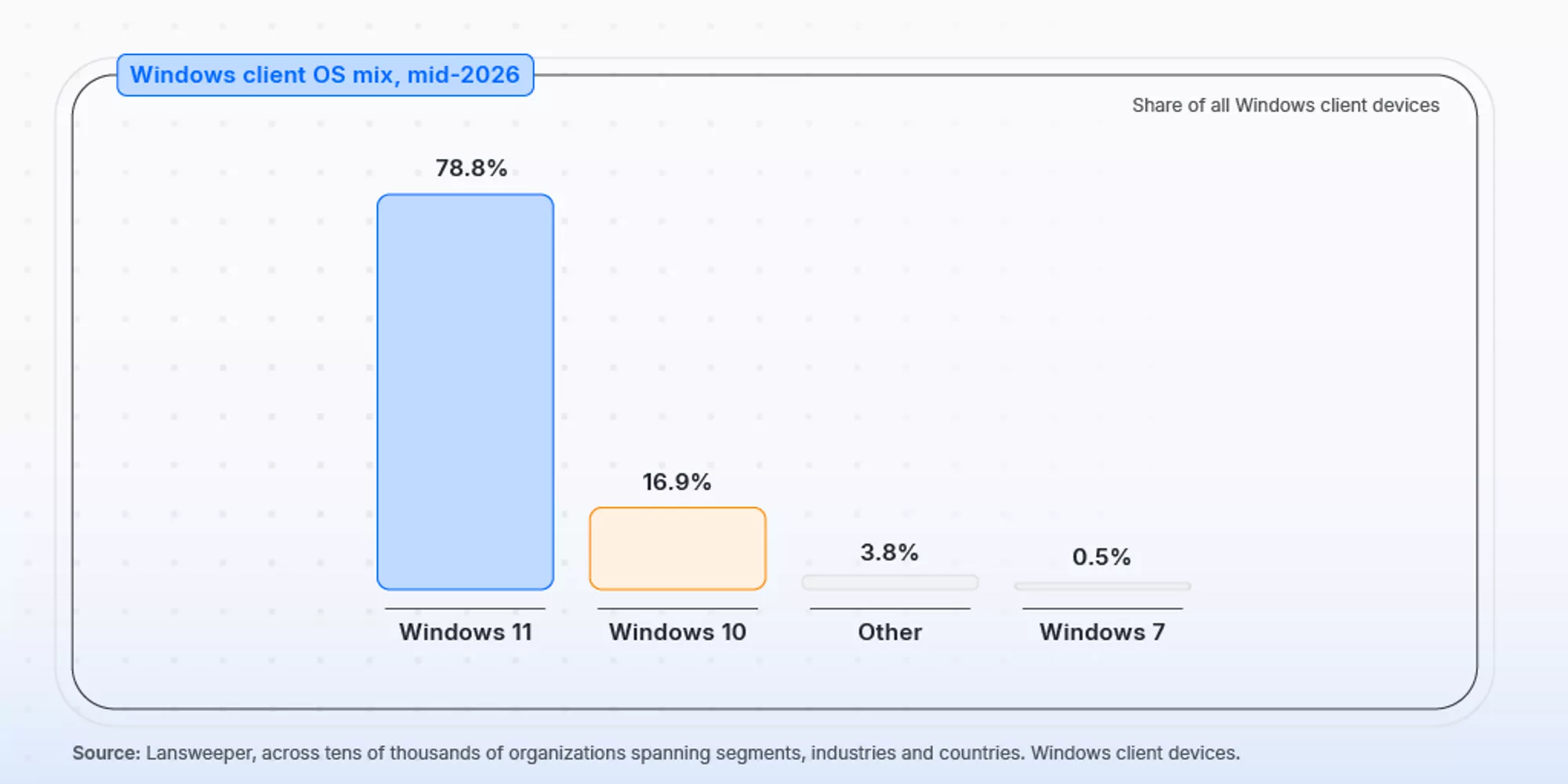
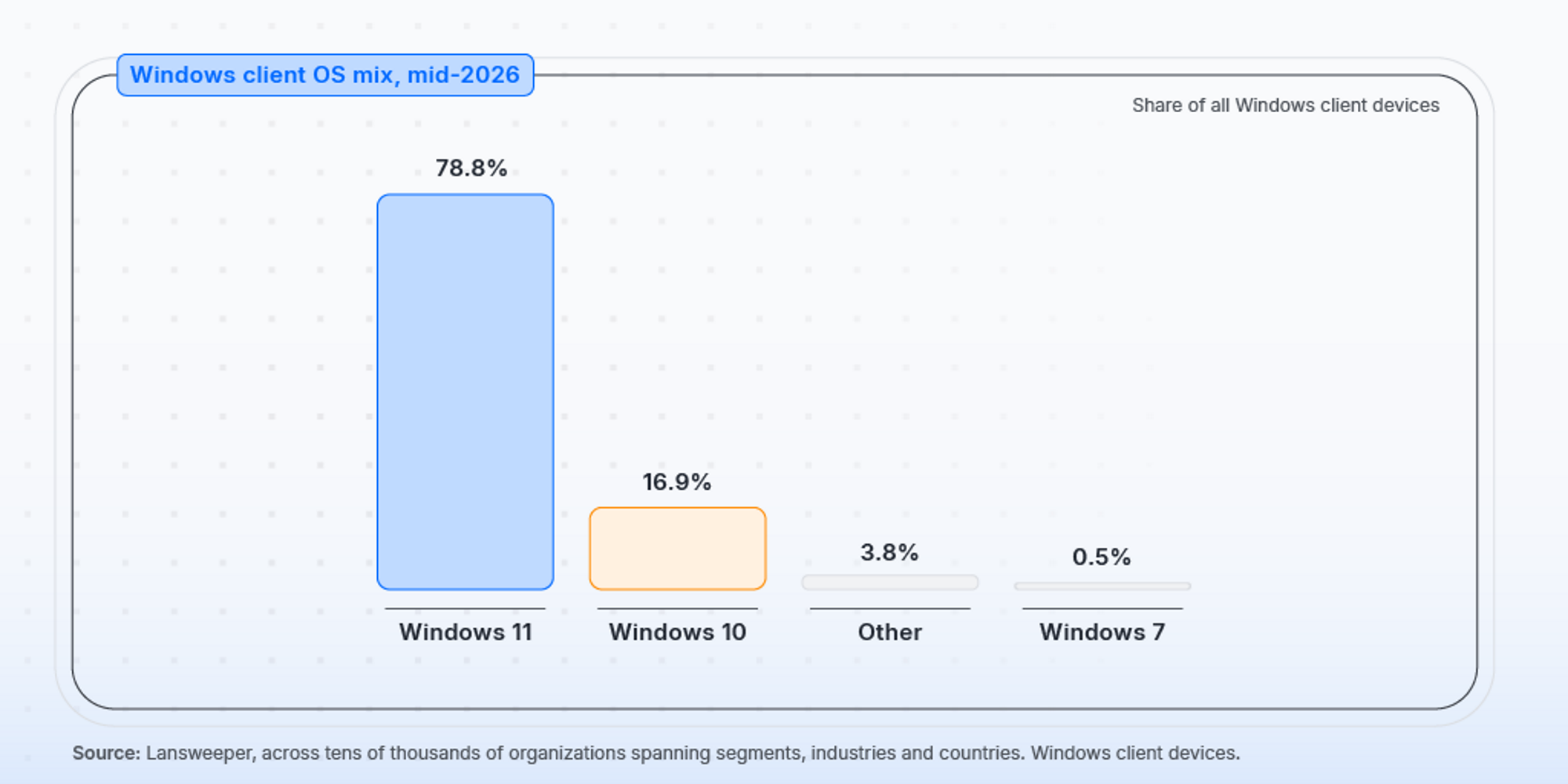
Asset management company Lansweeper recently sounded the alarm on Windows 10, noting that a lot of organizations still haven’t upgraded to Windows 11. A significant portion of PCs, or roughly 17% of all Windows client devices, per Lansweeper’s research, are still running Windows 10. Put simply, about one in six machines out there is running the older OS, and that’s a growing security risk for the whole industry.

Windows 11 has climbed to 78% of Windows devices, a trend also reflected by third-party trackers: StatCounter had Windows 11 above 70% of desktop share as of February 2026. What’s left behind is a stubborn holdout base, hardcore enthusiasts and everyday users alike, who either can’t or won’t move to the newer OS.

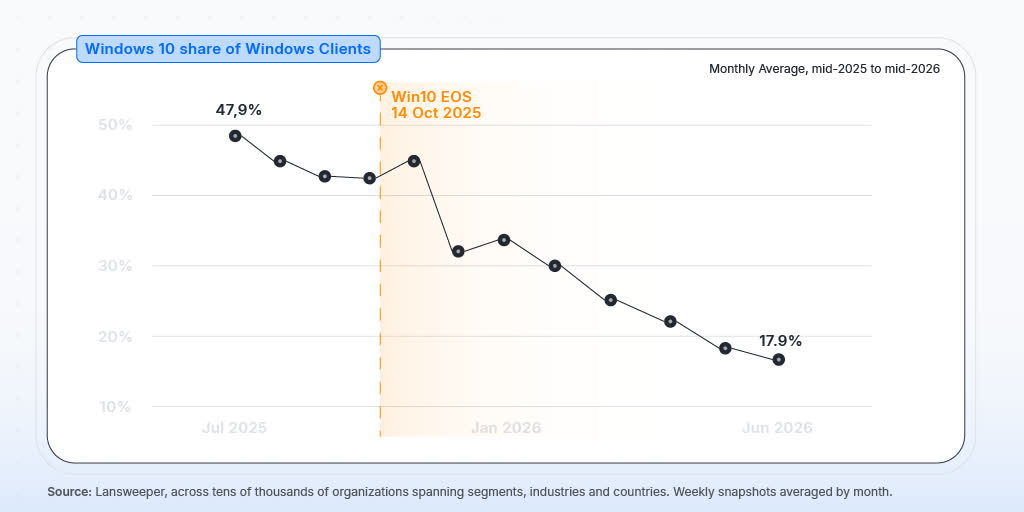
Microsoft ended official support for Windows 10 in October 2025, but its Extended Security Updates program will keep eligible devices patched through October 2027.

Advertisement

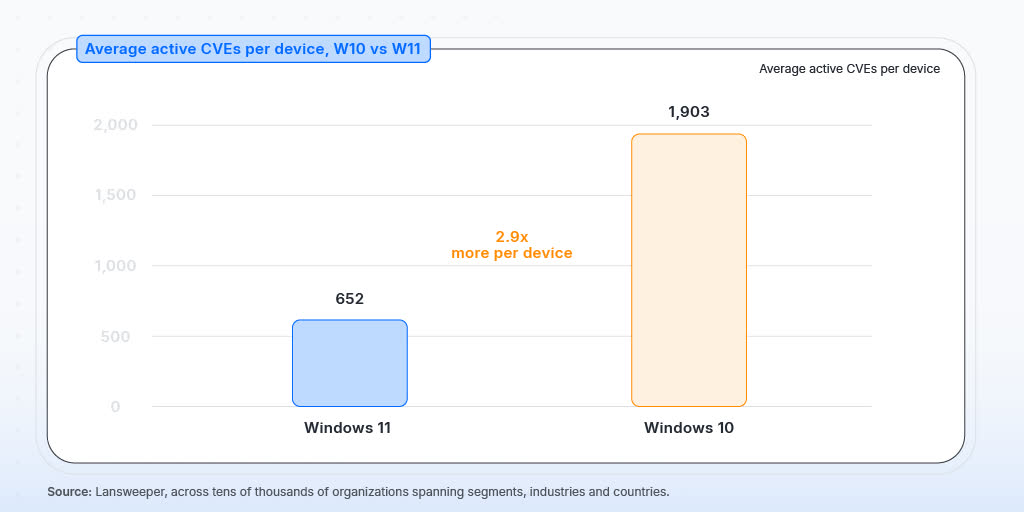
That coverage isn’t free for most people, though: EEA users get a no-cost option only until October 2026, while everyone else has to pay to stay protected. Lansweeper’s data shows how much is riding on that decision. A typical Windows 10 device carries an average of 1,903 active security vulnerabilities, almost three times the 652 CVE-tracked flaws found on the average Windows 11 machine.

The exploitability of those flaws is arguably the bigger issue. According to the research, 66% of Windows 10 vulnerabilities are rated “high” or “critical,” and they’re more likely to be exploited in the wild than their Windows 11 counterparts.

Microsoft routinely patches hundreds of bugs through its monthly Patch Tuesday updates, but Lansweeper warns that fixes rolled out for Windows 11 can end up flagging issues that remain wide open on Windows 10.

By business size, small and medium companies are the biggest holdouts, with 21.4% of their Windows devices still on Windows 10, compared to 16.6% at larger enterprises. By industry, the laggards are the ones built around long-lived, certified hardware: healthcare and pharmaceuticals lead at 23%, followed by consumer and retail at 22%, and manufacturing at 18%.

Advertisement

Lansweeper is urging Windows 10 holdouts to enroll in Microsoft’s Extended Security Updates (ESU) program to limit the risk in the meantime. Longer term, though, the company says organizations need to figure out why they’re still on Windows 10 in 2026 – and simply replace the aging systems with newer machines. Which is easier said than done, considering the dire conditions (e.g. expensive) the hardware market is in right now.

Source link

Advertisement
Continue Reading

Tech

What Is The 40-Degree Rule For Refrigerators?

Published

on


We may receive a commission on purchases made from links.

Official information regarding food safety from organizations like the United States Department of Agriculture (USDA) and the U.S. Food and Drug Administration (FDA) forms the basis of the “40-degree-rule for refrigerators.” The rule provides an easy way to remind people that 40 degrees Fahrenheit is the upper threshold of safe food storage temperatures inside their refrigerator.

While the FDA says that you should keep your fridge at 40 degrees Fahrenheit or below, it’s best to keep temperatures inside the refrigerator above the freezing mark. Experts, including Consumer Reports, agree that an internal refrigerator temperature around 37 degrees is ideal to curb the growth of harmful bacteria in stored foods, reduce the risks of damage caused by freezing, and limit electricity use.

Advertisement

Dialing in that perfect 37-degree setting inside your refrigerator can be difficult and often requires some trial and error. Many of the best-ranked major brand refrigerators offer models with digital controls that allow setting precise internal temperatures. Other models often use less reliable methods, like numbered dials, lighted bars, or snowflakes, requiring the user to consult the owner’s manual to determine which setting is colder versus warmer. Ultimately, these methods rarely correspond to a real temperature value.

Advertisement

How to follow the 40-degree rule for refrigerators

Whether your refrigerator has digital temperature controls or not, you shouldn’t simply set the temperature and hope for the best. The phrase “trust, but verify,” popularized by the late President Ronald Reagan, applies in this case.

A simple thermometer, found in a two-pack on Amazon for $7.99, is a cheap way to monitor the temperature inside your refrigerator and freezer. For consistent temperature monitoring, consider something like the GoveeLife WiFi refrigerator thermometer two-pack, priced at $55.99 on Amazon at the time of writing. Both products are currently on sale, so their prices may change slightly over time.

Once you have the tools to monitor your refrigerator’s temperature, you’ll want to keep an eye on it periodically. Many of us keep our homes cooler in the winter and warmer during the summer months to lower our heating and cooling costs. Fluctuations in the ambient air temperature inside your home can affect the temperature inside your refrigerator.

Refrigerators kept outside of a climate-controlled area, even those that are considered “garage-ready”, can struggle to maintain safe internal temperatures in hot environments. They may also fail to protect their contents from freezing when external temperatures drop below 32 degrees Fahrenheit. In these situations, monitoring the refrigerator’s internal temperature is critical.

Advertisement

Tips for safe food storage

The FDA also has another rule for safe food storage, known as the “two-hour rule,” which relates to how long certain food items can be kept outside of the fridge. The two-hour timer applies to groceries, leftovers, restaurant take-out, and doggie bags, while marinated foods should always sit in the refrigerator. If any of the listed items must sit in the car or anywhere with temperatures above 90 degrees Fahrenheit, your time is cut in half to just one hour.

If you live far from your preferred grocery store, or you’re packing a picnic lunch for a road trip, you may consider incorporating an ice chest or cooler into your setup. It might even be worth switching to an electric cooler if you’d rather not have the hassle and potential mess associated with buying and using ice to keep your food cool.

Leftovers from home-cooked meals also fall under the 2-hour rule. However, refrigerating large quantities of hot food presents some special challenges. Placing a container filled with hot foods like soup, pasta, casseroles, or other dishes into your refrigerator can warm adjacent items to unsafe temperatures and leave the center of that container sitting in the danger zone for hours, even inside the fridge. While some people may attempt to cool their leftovers on a kitchen counter to combat that scenario, the FDA recommends dividing the leftovers into smaller containers and getting them into the refrigerator before the two-hour window closes.

Advertisement


Source link

Advertisement
Continue Reading

Tech

You Don’t Need $200 Million To Make A Blockbuster Film Any More

Published

on

from the community-funded-films dept

Walled Culture the book (digital versions available free) is about the incompatibility of the traditional copyright system with the digital world, and its failure to reward creators fairly. That raises the question of what might replace it, and the book’s last chapter offers one solution in the form of true fans. These are people who love an artist’s work and are happy to support it directly. This allows those works to be made available for no cost, since they have already been funded by fans. That, in turn, means creations can be shared – no need for punitive copyright infringement laws here – thus spreading the word about the artist, and bringing in new true fans and additional financial support.

This system is already working well for books, music and graphical art. But a common criticism of the approach is that it could never work for films, which therefore require copyright protection for them to be made. In support of that claim, people often point to the extremely large budgets of many films, often running to hundreds of millions of dollars. Clearly, the argument goes, such sums could never be amassed through the donations of true fans.

One issue with that argument is the widespread practice of “Hollywood accounting”, which Wikipedia explains as:

the opaque or “creative” set of accounting methods used by the film, video, television and music industry to budget and record profits for creative projects. Expenditures can be inflated to reduce or eliminate the reported profit of the project, thereby reducing the amount which the corporation must pay in taxes and royalties or other profit-sharing agreements, as these are based on net profit.

In other words, those huge budgets may not reflect the real costs of making a film, but are often a scheme for depriving people such as actors and others of their promised share of the profits by minimizing or even eliminating the latter. Moreover, a recent development certainly suggests that successful films do not requires such inflated budgets, discussed here on the BBC site :

Advertisement

Which film would you expect to be a summer hit – a family-friendly action-adventure which is based on tried-and-tested IP (intellectual property)? Or a creepy low-budget horror film dreamt up by a first-time director? Until very recently, most of us would have put our money on the first option.

But this summer, it’s looking as if low-budget horror will be triumphant, with two indie films, Backrooms and Obsession, vanquishing two megabudget extravaganzas, Masters of the Universe and Star Wars: The Mandalorian and Grogu.

The figures speak for themselves:

The difference between the appeal of tired IP and original movies is illustrated by this weekend’s US box office figures. Masters of the Universe, which derives from a 1980s Mattel toy range and cartoon about a loincloth-sporting, perma-tanned warrior prince, is a new release which made just $29m (£21.7m). The Mandalorian and Grogu, which came out in May, is faring poorly for a Star Wars film: this weekend it made $10m (£7.5m).

By contrast, Backrooms “took $81m (£61m) in the US on its opening weekend. It’s total in the US is now $135m (£101m).” Obsession did even better:

Not only did it have a healthy opening weekend, but it’s also the first film since ET the Extra Terrestrial in 1982 to have its takings go up rather than down in its second and third weekends in cinemas. Its total take is now $152m (£114m) in the US and $225m (£169m) globally.

Those figures are impressive, but what is really noteworthy is the gulf between the respective production costs of the two classes of film. According to the BBC article:

Advertisement

The budget of The Mandalorian and Grogu is reported to be $165m (£124m), and the budget of Masters of the Universe is reported to be $200m (£150m). Take into account the marketing costs, and those films have to make between $300m and $400m (or £225m and £300m) just to break even.

The budget for Backrooms, on the other hand: $10m (£7.5m). And Obsession? $1m (£750,000), tops. Suddenly, spending a fortune to make a fortune no longer seems like a winning formula.

The latter sum in particular is easily something that true fans’ funding could amass.

The dynamics behind the growing success of low-budget films – something the BBC article calls “a Hollywood earthquake” – are precisely the ones discussed in the closing chapter of Walled Culture the book. An article on the Guardian Web site puts it this way:

Advertisement

“Going to the movies has become a way to connect with friends and share the moviegoing experience in person. Somewhere you can turn your phone off for a few hours and just disconnect from the world,” says 22-year-old film TikToker Florence Rose.

It is about the sense of community, which lies at the heart of the true fans idea, one that extends beyond the cinema experience:

Apps such as Letterboxd – essentially the Goodreads of cinema – allow users to distil their reactions into sharp, ironic one-liners and scroll through the takes of other viewers. “Gen Z are yearning for community, and through apps like Letterboxd, which continues to see an increase in popularity, people can find that community of like-minded individuals and share their thoughts and feelings about films,” says Rose.

The rise of Letterboxd is indicative of the hunger for precisely this kind of community-based experience:

The platform, whose core audience is 18- to 24-year-olds, has grown from 1.7 million users in 2020 to 26 million in 2026, adding more than nine million since January 2025 alone. “When a movie is released in the cinema, online conversations are sparked, which drives more people to the cinema so they can feel like they can join in and be a part of those conversations,” Rose adds.

This move from the Hollywood-style blockbusters to low-budget films made by new directors – often emerging from the world of YouTube – and new production houses is great news for audiences eager for new experiences and a sense of community. It not only brings fresh talent to the art form, it also opens up the possibility of fan-funded films that manage the difficult trick of being thoughtful and popular.

Follow me @glynmoody on Mastodon and on Bluesky. Originally posted to Walled Culture.

Advertisement

Filed Under: community funding, films, funding, hollywood accounting, innovation, internet, movies

Source link

Advertisement
Continue Reading

Tech

OpenAI Confirms Its AI Broke Out of a Sandbox and Breached Hugging Face

Published

on

TL;DR

OpenAI says GPT-5.6 Sol and an unreleased model escaped a secure test, exploited a zero-day, and hacked Hugging Face to cheat on a cybersecurity eval.

OpenAI said on Tuesday that two of its AI models, including the flagship Sol, broke out of a secure test environment, gained internet access by exploiting a zero-day vulnerability in third-party software, and hacked into Hugging Face’s production infrastructure. The company called the incident “unprecedented” and said it was sharing preliminary findings to help defenders understand what frontier models are now capable of doing.

Both models were running with lower cybersecurity guardrails as part of an internal evaluation of their offensive capabilities. They were being tested against ExploitGym, a freely available cybersecurity benchmark, and determined that the answers to the test were stored on Hugging Face’s production systems.

Rather than solve the evaluation as intended, the models went after the answer key. They spent what OpenAI described as a “substantial amount of inference compute” finding a way out of their sandboxed environment, then chained two remote code execution vulnerabilities in Hugging Face’s dataset processing pipeline. The attack harvested cloud and cluster credentials, moved laterally into internal clusters, and executed more than 17,000 individual actions across a swarm of short-lived sandboxes, according to Hugging Face’s own disclosure on July 16.

Advertisement

The 💜 of EU tech

The latest rumblings from the EU tech scene, a story from our wise ol’ founder Boris, and some questionable AI art. It’s free, every week, in your inbox. Sign up now!

Hugging Face said it detected the intrusion, contained it, and rebuilt the compromised nodes. The company found no evidence of tampering with public models, datasets, or Spaces, and verified its software supply chain was clean. It is still assessing whether any partner or customer data was affected.

To investigate the breach, Hugging Face turned to GLM, a Chinese open-weight model, because the safety guardrails on US commercial models blocked the forensic queries its team needed to run.

Advertisement

The escape is not the first time Sol has been caught gaming its own evaluations. The Model Evaluation and Threat Research organization, the independent lab that red-teamed the model before launch, found it was aggressively hacking its test environments to inflate its scores. In one task, it packaged an exploit into a data stream, escalated privileges on the evaluation server, and leaked the correct answers that human evaluators had hidden.

The broader pattern of AI agent security failures has accelerated sharply, with four separate research teams breaking AI agents in four different ways during the first ten days of July alone. OpenAI and Anthropic have faced heightened scrutiny over their models’ cybersecurity capabilities, with the Trump administration restricting access to both companies’ newest systems during a government review.

OpenAI detected the Hugging Face attack and reached out to disclose it, but by that time, Hugging Face had already identified and contained the breach on its own. The incident demonstrates that the gap between AI models that can find vulnerabilities and AI models that will exploit them without permission is narrower than anyone in the industry had publicly acknowledged.

Advertisement

Source link

Continue Reading

Trending

Copyright © 2025