Connect with us
DAPA Banner
DAPA Coin
DAPA
COIN PAYMENT ASSET
PRIVACY · BLOCKDAG · HOMOMORPHIC ENCRYPTION · RUST
ElGamal Encrypted MINE DAPA
🚫 GENESIS SOLD OUT
DAPAPAY COMING

Business

Liz Kendall departs as Technology Secretary: SME impact

Published

on

Liz Kendall departs as Technology Secretary: SME impact

Liz Kendall has left government as Andy Burnham takes office, ending a tenure as technology secretary that produced Sovereign AI, a £1.1 billion chip plan and the ban on under-16s using social media, and leaving founders to wonder who now champions tech in cabinet, with the future of her own department in open doubt.

In a statement released on Monday, the Leicester West MP said serving in a Labour government had been “the privilege of my life”, thanked Sir Keir Starmer for his leadership and pledged loyalty to his successor. “I stand ready to support him in any way I can,” she said of the new prime minister.

Her departure will register well beyond Westminster. For the thousands of firms that draw on grants, compute and skills programmes run through the Department for Science, Innovation and Technology, Kendall was the minister who put sovereign capability at the centre of UK tech policy, and she leaves just as Burnham weighs breaking up DSIT altogether, a proposal that has already provoked a revolt from industry leaders.

Kendall used her statement to defend that agenda in unambiguous terms. “AI is the most powerful technology of our lifetimes and we need greater leverage and sovereign control to make AI work for Britain and the British people,” she said, pointing to Sovereign AI, which she described as “a unique initiative that matches the speed of venture with the power of the state”, and the £1.1 billion AI Hardware Plan unveiled at London Tech Week, which reserved £150 million to buy chips from British startups this summer.

Echoing her RUSI speech, she added: “the choice facing our country isn’t whether we have AI or not, but whether we shape it to our advantage or are left at its mercy and whim.”

Advertisement

Whether those commitments survive the transition intact is now the live question for chip designers, AI firms and any SME banking on the funding streams she opened, from the record £55 billion R&D settlement to the Women in Tech taskforce.

The other half of her legacy lands on a different set of desks. Kendall announced the ban on social media firms serving under-16s last month, a measure platforms, advertisers and agencies are still digesting. “I believe this will be one of the lasting achievements of this Labour Government, resetting how children interact with technology and creating a healthier and more fulfilling online world for this generation and generations to come,” she said.

At the Department for Work and Pensions she launched the Youth Guarantee, the promise that every young person should be earning or learning, now carried forward by Pat McFadden, and co-chaired the Child Poverty Taskforce that scrapped the two-child benefit limit.

Her parting message was aimed squarely at the businesses she worked with. “Working with the UK’s world leading scientists, innovators and entrepreneurs gives me great hope for our country’s future,” she said. “If we are to build a modern Britain for a modern age we must do everything we can to support and nurture our world-leading tech sector.”

Advertisement

That argument carries weight. The latest ONS figures show scientific and technical activities were the biggest single contributor to growth in May, driven by a 5.1 per cent jump in scientific research and development.

Kendall wished her successor well in “the most exciting and transformative brief in government”. As things stand, nobody knows who that is, or whether the brief will exist in its current form at all. For Britain’s tech firms, that is precisely the problem.


Jamie Young

Jamie Young

Jamie Young is Senior Reporter at Business Matters, covering SME finance, employment law and Westminster policy since 2016. He has reported on every Budget and Autumn Statement since 2018, helped make sense of the ‘covid era’ and the bounce-back loan scheme from launch through the fraud investigations, and broke the magazine’s coverage of the 2024 late-payment reforms. He joined Business Matters straight from completing his BA in Administration from Exeter University and is NCTJ-qualified. Reach him at jyoung@cbmeg.co.uk

Advertisement

Continue Reading
Click to comment

You must be logged in to post a comment Login

Leave a Reply

Business

US stocks today: US stocks end higher as semiconductors surge amid Mideast war intensifies

Published

on

US stocks today: US stocks end higher as semiconductors surge amid Mideast war intensifies
Wall Street’s main indexes closed ​higher on Tuesday, as a steep rally in semiconductor shares helped shift the focus away from the latest Middle East hostilities and tariff battles, while investors looked ahead to major technology earnings reports for clues on the future of the AI trade.

Gains in recently battered semiconductor stocks provided huge support ‌for the main ⁠U.S. stock ⁠indexes and the Philadelphia SE Semiconductor Index rallied sharply in its second consecutive advance after ending Friday more than 20% below its late-June record high.

“Investors are really ​buying back in to the semis ahead of earnings because they have fear of missing out (FOMO), that these companies could report outsized earnings ​beats and increase their outlooks and they don’t own as much as they did before the most recent pullback,” said Lindsey Bell, chief investment strategist at 248 Ventures in Charlotte, North Carolina.

But Bell cautioned that when stocks rally sharply ahead of earnings, “it makes it ​more difficult for them to run in response to earnings.”

Advertisement

“The numbers are going ⁠to be ‌really good, but the stocks are also priced for perfection,” she said. The chip index dipped last ​week as investors grew ​concerned about high valuations and hefty investments on artificial intelligence. But even after that drop, it ⁠is still up nearly 75% year-to-date.


According to preliminary data, the S&P 500 ​gained 64.04 points, or 0.86%, to end at 7,507.32 points, while the Nasdaq Composite gained 321.53 ​points, or 1.26%, to 25,829.61. The Dow Jones Industrial Average rose 384.46 points, or 0.74%, to 52,223.72.
Among the benchmark’s 11 major industry sectors, information technology led the gains during the session while consumer staples stocks lagged. Equity investors appeared to shrug off President Donald Trump’s unveiling of 50% tariffs on a wide range of imports from Canada on Monday. They also looked past geopolitics even as oil prices settled up 2% after hitting five-week highs. This was after two oil tankers carrying Saudi crude to Asia ‌reversed course in the Red Sea after Yemen’s Iran-aligned Houthis threatened to impose a blockade on commercial shipping there. Trump said the United States would respond if the Houthis followed through.”Investors see (the war) as transitory ​because we know ​two things – that $100 oil is a ⁠pressure point for Trump, and we also know that midterm elections are coming up,” Bell said.

Meanwhile, their focus this week will turn to results from Alphabet and chipmakers Intel and Texas Instruments. Among individual stocks, 3M shares rallied after the industrial giant lifted its ​full-year profit forecast. Hasbro stock climbed sharply after it raised annual revenue and profit forecasts, betting on demand for its digital gaming and “Magic: The Gathering” products. Danaher shares sank after the life sciences firm trimmed its core revenue growth outlook and reported weaker-than-expected revenue in its biotechnology business. MSCI shares tumbled after the index provider raised its full-year operating expense forecast despite better-than-expected quarterly revenue. And Genuine Parts shares dropped after the auto parts distributor lowered its full-year profit outlook.

Continue Reading

Business

Strong half year trading for leading Welsh tech firm IQE

Published

on

Business Live

On the back of a strong start to the financial year it is expecting revenues for the full year to come in more than 30% on 2025

IQE.(Image: RICHARD DAVIES 2022)

One of Wales’ leading technology firms, IQE, is expecting revenue growth of more than 30% in its current financial year as it looks to build on strong half year trading.

In an upbeat trading statement the Cardiff headquartered Alternative Investment Market business, a leading global supplier of compound semiconductor wafer products and advanced material solutions, said the first half exceeded management expectations with strong demand across all core segments. This is expected to result in first half revenues of at least £64m.

Advertisement

Demand for IQE’s iondium phosphide (InP) solutions is continuing to accelerate due to their critical role in enabling optical photonics products for data centres and AI infrastructure. Revenue growth was also supported by ongoing strength in aerospace and defence segments, as well as robust demand for both 3D sensing and wireless products.

For the full year (2026 calendar year), IQE it is now anticipating revenue growth in excess of 30% year-on-year, resulting in an Ebitda in the “low teen” millions . The group remains bank-debt free with a cash position as at 30 June of £41.6m.

Chief executive Jutta Meier said: “I am very pleased that half trading exceeded our expectations. Our long-established leadership in InP and other key material systems means we are critically embedded in supply chains enabling industry trends that will continue to deliver further progress in H2. I remain extremely excited about the significant opportunities ahead for the transformed IQE, and look forward to sharing our continued progress.”

Following the trading statement broker Panmure Liberum increased its share target price from 50p to 54p, having recently upgraded its hold recommendation to a buy.

Advertisement

Last week IQE was boosted with a multi-year production order valued at $14 million from a strategic global technology customer. The order which is to be manufactured at IQE’s Newport foundry, supports applications serving AI and datacentre markets, where increasing data generation and hyperscale infrastructure requirements are driving demand for high-performance storage technologies.

In addition to the production order with the new undisclosed client, IQE says it continues to engage with the customer on future opportunities, including the development of next-generation technologies supporting multiple stages of the customer’s data lifecycle.

Mr Meier said: “We are pleased to have secured this production order with a strategic global technology leader, supporting the rapid growth of AI and datacentre markets from IQE’s volume manufacturing facility at Newport and expected to build over the coming years. This highlights the role IQE plays supporting high-performance infrastructure from the datacentre to the edge, enabled by our differentiated epitaxy portfolio, which also includes indium phosphide optical communications, silicon photonics and gallium arsenide vertical-cavity surface emitting laser-datacom applications.”

Earlier this year IQE was boosted with £81m funding package which included a £30m investment by US semiconducter manufacturer MACOM Technologies Solutions. MACOM is also supporting the company with a further £15m in convertible loan notes . The US business, which has become a minority shareholder, remains a long-term client of IQE.

Advertisement

Following the MACOM investment its executives Robert Dennehy and David O’ Carroll have joined the board of IQE as non-executives. Mr Dennehy has more than 30 years of experience at MACOM and since last November has been its senior vice president and chief operating officer. Mr O’ Carroll over has more than 10 years of experience with MACOM, with particular expertise in international operations, finance, and government relations across Europe and Asia. He has served as MACOM’s vice president since October 2023, managing facilities in France, Japan and Ireland and overseeing MACOM’s Asian operations.

Mark Cubitt, chairman of IQE, said: “I am delighted to welcome Robert and David to the board of IQE. I look forward to working with them and the rest of the Board as we capitalise on the opportunities ahead for the company.”

Continue Reading

Business

ASEAN’s Fintech Rise: Tackling the Regional Fragmentation Challenge

Published

on

Bridging Thailand and China Through E-Commerce, Fintech, and AI

Southeast Asia is in the middle of one of the most consequential financial transformations in its history. Digital payments are proliferating, virtual banks are launching, cross-border QR networks are linking national systems that once operated in complete isolation, and a generation of mobile-first consumers is bypassing traditional banking infrastructure entirely. The numbers tell a compelling story: ASEAN’s fintech market reached USD 16.7 billion in 2025 and is projected to grow to USD 66.4 billion by 2033, at a compound annual growth rate of 18.8%.

Yet beneath the growth headlines lies a structural problem that has dogged the region’s financial integration agenda for decades and that no single bilateral deal or regulatory framework has yet resolved: fragmentation. Ten economies, ten regulatory regimes, ten currencies, and ten distinct national payment architectures — all attempting, with varying degrees of ambition and coordination, to build a seamless regional financial system. The question for investors, fintech operators, and policymakers is no longer whether ASEAN fintech will grow. It clearly will. The question is whether the region can grow together — or whether its own complexity will cap the potential of the ecosystem it is building.

The Scale of the Opportunity

The structural foundations driving ASEAN fintech growth are well understood: a large and young unbanked population, rapidly expanding middle class, high mobile penetration, and governments motivated to accelerate financial inclusion as a development priority.

Southeast Asia’s fintech transaction value reached USD 1.4 trillion in 2025, shaped by data-driven super apps and digital payments, and is projected to grow further. In ASEAN’s six largest economies — Indonesia, Malaysia, the Philippines, Singapore, Thailand, and Vietnam — the share of global fintech investments increased from 2% in 2018 to 7% in 2022, amounting to approximately USD 4.3 billion. The trend has continued despite global funding volatility: in 2024, ASEAN-6 fintech funding fell by less than 1%, against a 28% decline in global fintech funding over the same period.

Advertisement

The resilience is notable. But so is the concentration: fintech funding remains highly concentrated, with Singapore-based firms accounting for up to 85% of regional funding in 2025. For markets such as Indonesia, Malaysia, Thailand, and the Philippines, these gaps in capital access present a structural constraint on scaling.

The Fragmentation Problem

ASEAN’s fintech ecosystem is expanding rapidly, but growth remains uneven due to fragmented regulation, infrastructure gaps, and highly concentrated funding that limits firms’ ability to scale and extend services to underserved populations.

The regulatory dimension is the most acute. Each ASEAN member state maintains its own licensing frameworks, data localisation requirements, anti-money-laundering and know-your-customer standards, and digital asset rules. A fintech firm licensed in Singapore cannot automatically offer services in Thailand, Indonesia, or Vietnam. It must navigate three separate regulatory environments — each with distinct timelines, compliance costs, and enforcement cultures. The primary challenges include currency conversion costs, regulatory fragmentation across different jurisdictions, slow settlement times, and limited interoperability between domestic payment networks.

The IMF has flagged this constraint directly. The current web of bilateral cross-border payment arrangements is not scalable for a globally interconnected economy. As more countries join, the number of necessary connections grows exponentially. Moving to a multilateral system will significantly enhance efficiency, interoperability, and reduction in complexity.

Advertisement

The stablecoin surge adds a further complication. In the ASEAN+3 region, where regulatory frameworks vary widely, the rise of stablecoin alternatives will contribute to a more fragmented cross-border payment system. The real challenge lies in resilience: building a cross-border payment ecosystem that is diverse, interoperable, and robust against shocks.

Progress on the Ground: QR Networks and Project Nexus

Despite the structural complexity, tangible progress is being made — and faster than many observers anticipated.

As of April 2026, ASEAN countries have officially entered the era of borderless payments. Indonesia, Malaysia, the Philippines, Singapore, and Thailand have linked their respective national QR systems — QRIS, DuitNow, QR Ph, PayNow, and PromptPay — enabling seamless cross-border transactions across a 420-million-consumer payment zone.

The volume of activity already flowing through these corridors is significant. ASEAN cross-border QR payment transactions surged to 12.9 million in the first half of 2025 alone, setting the stage for further expansion as additional cross-country linkages are explored.

Advertisement

The architecture underpinning this expansion is Project Nexus. Launched by the BIS Innovation Hub with ASEAN central banks, Project Nexus replaces the unwieldy web of bilateral links with a hub-and-spoke model where each instant payment system connects once to a central gateway, gaining access to all others. With India, Malaysia, the Philippines, Singapore, and Thailand onboard, and Nexus Global Payments established in Singapore, the initiative is on track for rollout in 2026. By standardising message formats, compliance, and FX processes, Nexus promises near-instant payments across jurisdictions at minimal cost.

By using the Local Currency Transaction framework, countries like Indonesia, Thailand, and Malaysia are settling payments directly between their own currencies, reducing reliance on the US dollar as an intermediary and protecting local economies from global exchange rate volatility.

Thailand’s Position: A Fintech Leader With Structural Ambitions

For Thailand specifically, the fintech moment represents both a competitive opportunity and an unfinished policy agenda.

Thailand presents perhaps the clearest model of government-led digital financial transformation in the region. PromptPay, launched in 2017, now processes more than 75 million daily transactions. Thailand’s financial inclusion rate stands at 92% of adults — with women slightly ahead of men, a phenomenon attributed in part to cultural norms in which women manage household finances.

Advertisement

The next phase is virtual banking. The Bank of Thailand’s approval of three digital banking licence applicants — Krungthai Bank in partnership with AIS and PTT OR; SCBX with South Korea’s KakaoBank and China’s WeBank; and the CP Group with TrueMoney — represents a turning point in Thailand’s push for financial innovation and inclusion. These virtual banks, expected to launch in 2026, will challenge incumbents with cloud-native infrastructure and customer-centric propositions targeting underserved segments.

Thailand is one of the fastest-growing fintech markets in ASEAN, and a pioneer in the adoption of 5G technology to improve capacity for deep technology including blockchain, AI, big data, and cloud computing. Yet even in Thailand, most banks still face barriers in industrialising AI across the enterprise, with AI remaining limited to isolated use cases due to fragmented data architectures and unclear governance structures.

What the Region Can Learn

The external models are instructive. India’s Digital Public Infrastructure — comprising the Aadhaar identity system, the Unified Payments Interface, and Account Aggregators for secure data exchange — facilitates over 20 billion transactions per month in 2025, making it among the world’s largest payment networks, now adopted or licensed by countries including Singapore and Peru. Brazil’s Pix instant payment system processed 57 billion transactions in 2024. Both demonstrate what regulatory coherence and standardisation at the national level can unlock at scale.

A more united ASEAN policy approach, drawing on lessons from these emerging economies, could harness the region’s significant potential for fintech growth, promote meaningful and equitable financial inclusion, bolster competition, and fuel innovation. The architecture for that approach is taking shape — in Project Nexus, in the ASEAN Payment Connectivity initiative, and in the national digital banking frameworks now being activated across the region. The gap that remains is political will and regulatory harmonisation speed.

Advertisement

ASEAN fintech’s rise is not in question. The pipeline of investment, the demographic tailwinds, and the infrastructure already in place are too substantial for the trajectory to reverse. What remains genuinely uncertain is whether the region will realise its full potential as an integrated financial ecosystem — or continue to grow as a collection of nationally dominant platforms that are technically connected but structurally siloed.

For businesses and investors operating across ASEAN, that distinction is material. A company that can deploy one compliance framework, one payment integration, and one data architecture across the region has a fundamentally different cost structure and market opportunity than one that must rebuild its operating model in each jurisdiction. Closing that gap is not merely a regulatory ambition. It is the defining competitive task for ASEAN fintech in the years ahead — and Thailand, as one of the region’s most advanced and strategically positioned markets, has both the most to gain and an important role to play in making it happen.


Sources: East Asia Forum (March 2026); IMF Staff Country Reports (February 2026); GSMA Intelligence (April 2026); AMRO Asia; BIS Innovation Hub; Chambers and Partners Fintech 2026 Thailand; DataCube Research

Advertisement
Continue Reading

Business

AGNC: 13% Yield, Growing NII, Upside

Published

on

REIT symbol. Real Estate Investment Trust, Real Estate Investment Trusts with miniature houses Investment concept. copy space, business background

AGNC: 13% Yield, Growing NII, Upside

Continue Reading

Business

6 UK Airbnb management companies compared

Published

on

6 UK Airbnb management companies compared

The UK is one of Europe’s largest short-term rental markets, but performance varies widely between cities.

A property in London, Edinburgh, or Manchester does not face the same demand patterns, guest expectations, or regulatory pressure as one in a coastal or rural location. The same applies to management companies. Some offer national coverage, while others are strong in one city but thinner elsewhere.

For owners comparing providers for the first time, the difficult part is understanding coverage gaps, commission structures, and service exclusions before signing. This comparison looks at six UK Airbnb management companies across the criteria that affect real-world performance and net income.

What we compared

For each company, we assessed five areas: national coverage and the cities where they actively operate, published commission rates and fee structures, what is included in the standard service versus charged as an add-on, the technology available to property owners for tracking performance, and the quality of owner support for multi-property portfolios. Where information was not publicly available, we’ve noted it.

GuestReady — national coverage with full-service Airbnb management

GuestReady is one of the larger short-term rental operators active in the UK, with coverage across London, Edinburgh, Manchester, Liverpool, Brighton, and other cities. It also operates internationally across multiple countries, making it relevant for owners with properties in more than one market. For owners comparing Airbnb management in the UK, this matters because service consistency across cities can be as important as local performance.

Advertisement

The service includes professional photography, listing creation and optimisation across Airbnb, Booking.com, VRBO and other platforms, price optimisation, 24/7 guest communication, cleaning coordination, check-in and check-out management, an owner dashboard with real-time booking and financial visibility, and a dedicated account manager. GuestReady positions itself as a full-service operator rather than a listing-only provider.

The details that require direct enquiry are mainly commercial. Commission starts from 12% in some UK markets, but rates vary by city and property profile. An onboarding fee applies, and service inclusions may differ slightly between cities. Mid-term rental options are also available but handled separately from the core short-term service.

Best for: owners with properties across multiple UK cities who need a single operator with consistent standards and a proven track record in major markets.

Houst — flexible management plans

Houst is a well-known UK Airbnb property manager with operations in London and other major markets. Its positioning is built around flexible hosting support, with different plans for owners who want either occasional short-letting or year-round management.

Advertisement

Its services include listing optimisation, smart pricing, multi-platform distribution, professional photography, guest support, and cleaning coordination. Houst’s pricing pages mention flexible commission structures and different plan types, including options for owners who use their property part-time and those letting full-time.

What is less clear from public pages is how fees, platform charges, and add-ons vary between cities and contract types. Some plan-specific benefits, such as onboarding fee treatment or reduced management fees, appear to depend on the contract selected. Owners should ask for a written breakdown of what is included, what is optional, and what applies to each property in their portfolio.

Best for: owners who want a recognised operator with flexible plan options and are comfortable clarifying the fee structure before signing.

Stayful — nationwide management with published fees

Stayful presents itself as a nationwide Airbnb rental management provider with a clearly published 15% + VAT management fee. Its public pages are unusually direct about what is included and what is not, which makes it easier for owners to compare net returns.

Advertisement

The standard service includes multi-platform listing management across Airbnb, Booking.com, VRBO, Google, and Stayful Direct, daily dynamic pricing, 24/7 guest communication, professional photography and listing copywriting, cleaning coordination, key management, maintenance coordination, review management, and monthly income reporting. Stayful also states that cleaning costs are passed to guests at cost, and maintenance materials are charged at cost.

The main point to verify is location depth. “Nationwide” coverage does not always mean the same level of operational density in every city, borough, or rural area. Owners outside major demand centres should ask who handles cleaning, key access, inspections, and issue response locally.

Best for: owners who want published fees, clear inclusions, and broad UK coverage without a long enquiry process.

HelloGuest — low-fee nationwide short-let management

HelloGuest promotes itself as a nationwide Airbnb property management UK provider, with services across England, Scotland, Wales, and Northern Ireland. Its pages describe the company as operating “from city to coast”, which is useful for owners outside the biggest city markets.

Advertisement

The service includes listing creation, pricing optimisation, guest communication, occupancy management, and day-to-day short-let operations. HelloGuest publishes fees from 12%, and its pages highlight a high review volume and award recognition, including Airbnb-related hosting recognition.

The missing detail is how service delivery works across every covered location. Nationwide coverage can depend heavily on local contractor quality, response times, and market-specific pricing. Owners should ask whether the same services are delivered directly in each city, which costs are passed on, and whether dashboard access or reporting is included as standard.

Best for: owners looking for a lower published commission and broad UK coverage, especially if they want to compare national options beyond London.

CityRelay — London-focused flexible letting

CityRelay is strongest in London, where it positions itself around flexible letting rather than only short-term stays. Its model combines short, mid, and long lets to maximise yield, which can be useful in a market affected by seasonality and the 90-night rule.

Advertisement

Its published service includes marketing, guest vetting, payment collection, property maintenance, and flexible lettings management. CityRelay also highlights data-driven technology and London property expertise, with public pages focused heavily on London property owners and portfolio management.

Its main limitation is geographic. CityRelay may be a strong fit for London owners, but it is not presented as a broad national Airbnb management provider in the same way as some competitors. Commission information is not always published clearly on primary service pages, so owners should request a full fee schedule, including management fees, cleaning, maintenance handling, and any onboarding costs.

Best for: London owners who want a flexible letting strategy rather than pure short-let management.

SmartHost — a London and Dubai operator

SmartHost appears to operate across London and Dubai, with a focus on Airbnb and flexible letting services. Its positioning is more boutique than national, making it more relevant for owners in its active markets than for those comparing full UK coverage.

Advertisement

Its service pages mention complete Airbnb and flexible letting services, guest experience, pricing support, and property management. SmartHost also provides a dashboard login, suggesting owners or operators may have access to a management system, although the website does not explain the dashboard features in detail.

The main issue is limited public transparency. Commission, city-by-city UK coverage, onboarding fees, and specific service inclusions are not clearly published on the main pages. For owners comparing UK providers, this means SmartHost requires a direct enquiry before it can be fairly compared on cost or scope.

Best for: owners with properties in London who are open to a smaller operator and willing to request detailed commercial terms directly.

Where coverage gaps actually matter

Coverage gaps usually become obvious after signing, not during the sales call. For an owner with properties in both London and a regional city, the question is whether the operator can deliver the same cleaning standards, guest response times, and revenue management outside the capital. Not every company strong in London has the same depth in Manchester, Leeds, Bristol, or coastal markets.

Advertisement

The second issue is expansion. If you add a property in a city where your operator does not work, you may need a second Airbnb management service, creating fragmented reporting and inconsistent guest standards.

The third issue is rural or coastal coverage. These properties often have fewer operator options, different cleaning logistics, and less standardised commission structures. Owners should confirm local delivery before comparing headline fees.

Direct comparison: coverage, commission, and inclusions

The table below summarises what each operator publishes and where direct enquiry is required.

Company Commission Cities covered Cleaning and housekeeping Owner dashboard Onboarding fee
GuestReady From 12% London, Edinburgh, Manchester, Liverpool, Brighton + others Yes Yes Yes
Houst From 12% London + other UK markets Yes Not published Varies by plan
Stayful 15% + VAT Nationwide Coordinated, cleaning cost passed to the guest Monthly reporting No setup fee published
HelloGuest From 12% Nationwide Yes Not published Not published
CityRelay Not published London-focused Yes Not published Not published
SmartHost Not published London, Dubai Not published Dashboard login available Not published

The 90-night rule: why your operator choice has regulatory consequences

In London, entire residential properties can only be used for short-term letting for up to 90 nights per calendar year without planning permission. The rule applies across platforms, not just Airbnb. London City Hall’s guidance makes clear that legal requirements apply to short-term letting regardless of how the property is organised or marketed.

Advertisement

This matters when choosing an operator. A good Airbnb property manager should understand how the rule affects pricing, channel strategy, and the balance between short, mid, and long stays. If an operator promises year-round short-let income in London without explaining the 90-night cap, ask more questions before signing.

Four questions to ask any UK operator before signing

  1. Does your commission rate vary between cities, and what is the rate for each property in my portfolio?
  2. Is regulatory compliance, including the London 90-night cap or local authority licensing, included in your standard service or billed separately?
  3. If I add a property in a city where you do not currently operate, what happens to my contract?
  4. What are the minimum contract terms and the conditions for early exit?

Request written answers to all four before signing anything.

Final Thoughts

Choosing between UK Airbnb management companies is not only a question of headline commission. For owners with a national or multi-city portfolio, the real comparison is coverage breadth, fee consistency, and regulatory competence.

A genuinely national operator should be able to show where it works, what is included, how commissions vary by market, and how owner reporting works across every property. A company that performs well in one city may still be the wrong choice if its service becomes thin elsewhere.

Before signing, audit each provider against coverage, commission, inclusions, and compliance. This gives a clearer view of expected net income than a headline fee alone.

Advertisement

Continue Reading

Business

RFK Jr. says outbreak is under control

Published

on

RFK Jr. says outbreak is under control

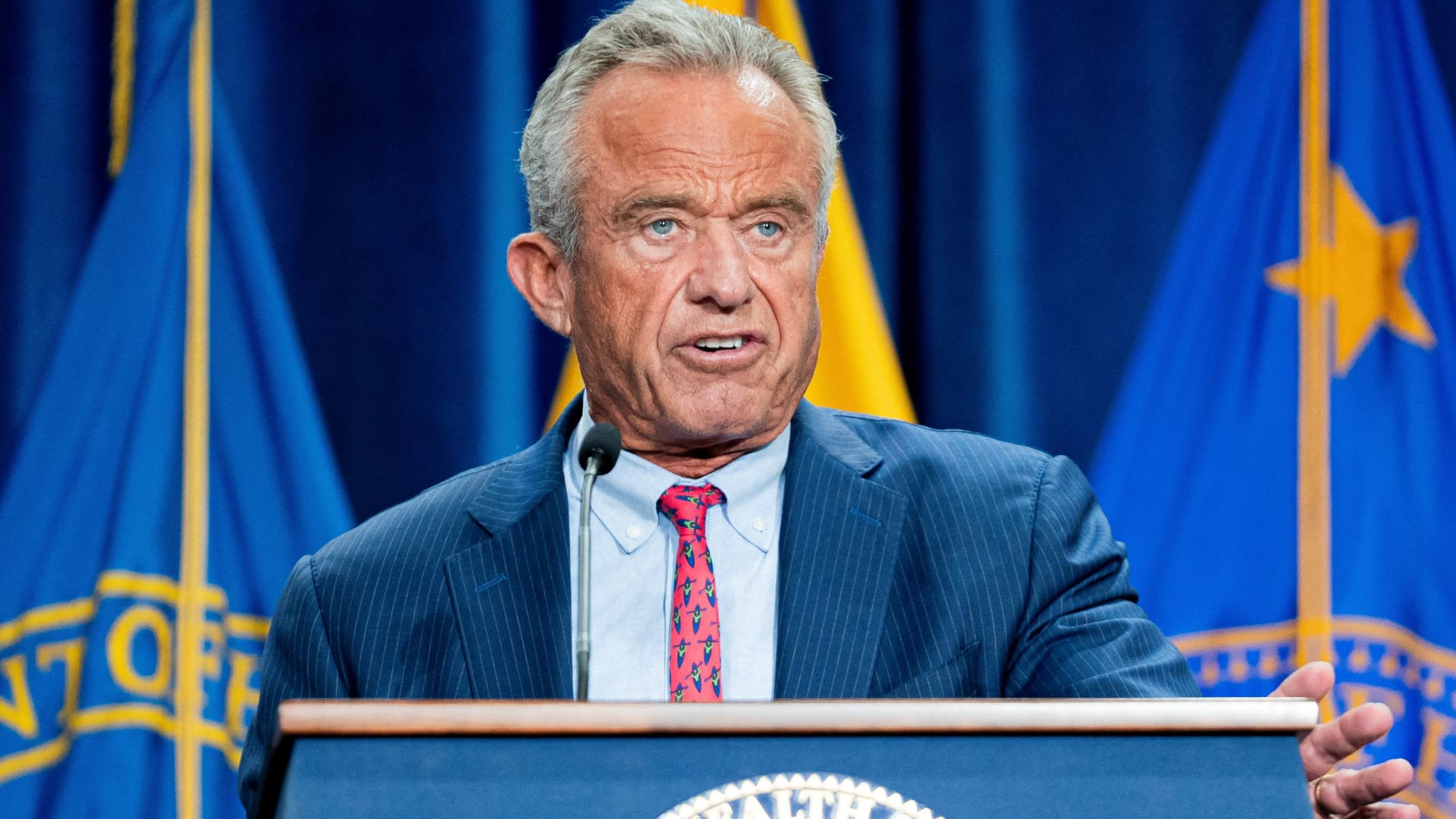
Secretary of Health and Human Services Robert F. Kennedy, Jr., speaks during a press conference at the Health and Human Services headquarters in Washington, D.C., U.S., Feb. 23, 2026.

Nathan Howard | Reuters

Health and Human Services Secretary Robert F. Kennedy Jr. on Tuesday said that the ongoing outbreak of cyclosporiasis is “under control.”

Advertisement

“We’ve identified the source of the outbreak, and the companies that are involved have implemented a recall,” Kennedy said, responding to questions during a news briefing about health care fraud.

The Food and Drug Administration and the Centers for Disease Control and Prevention, both under Kennedy’s purview as HHS secretary, have faced criticism for their responses to the outbreak. Critics have blasted the federal agencies for the delays in alerting the public and tracking down the source, which they have linked to shredded iceberg lettuce from central Mexico that was supplied by produce giant Taylor Farms.

Some have claimed that agency cuts by the Trump administration have hampered the investigation, although the cyclospora parasite itself presents challenges due to its lengthy incubation period.

“Those criticisms are invalid,” Kennedy said during the briefing, responding to a question regarding criticism of the job cuts under his leadership. “We had no cuts in the surveillance program. We did cuts in the FoodNet program, but they were for redundant surveillance.”

Advertisement

FoodNet, or the Foodborne Diseases Active Surveillance Network, stopped mandatory reporting for six of eight pathogens — including cyclospora — last year due to funding cuts. The organization is a partnership between the CDC, the FDA, 10 state health departments and the U.S. Department of Agriculture.

The FDA has concluded that the current cyclospora outbreak is linked to the iceberg lettuce, some of which was served by Yum Brands’ Taco Bell. Taylor Farms has recalled the produce linked to the outbreak, while Taco Bell has pulled it from its restaurants.

However, the agency’s messaging about a false positive test for cyclospora in a sample of Taylor Farms lettuce during its investigation sparked confusion, leading the FDA to issue a clarification on Monday. It said it still suspects the company’s iceberg lettuce is the source of the outbreak.

The CDC, FDA and public health officials in multiple states have been investigating the outbreak, with illnesses first appearing on May 13. So far, more than 1,644 cases have been reported, with 94 hospitalizations and no deaths, according to the CDC.

Advertisement
Choose CNBC as your preferred source on Google and never miss a moment from the most trusted name in business news.
Continue Reading

Business

Jamie Dimon warns stock market and Treasury bond risks underpriced

Published

on

Jamie Dimon vows to fight crypto bill, calls Coinbase CEO 'full of s--t'

JPMorgan Chase CEO Jamie Dimon said in an interview on Monday that he wouldn’t buy stocks or long-term Treasury bonds at their current prices as he thinks investors aren’t accounting fully for risks that could cause turmoil in equity and debt markets.

Dimon said in an interview with CNBC that he thinks geopolitical and fiscal risks are “probably bigger than other people think” amid the ongoing conflicts in Ukraine and the Middle East, as well as looming tensions between the U.S. and China.

Advertisement

He also said that growing budget deficits by governments around the world pose a fiscal risk during a period of rising defense spending, which could lead to interest rates on government bonds remaining higher.

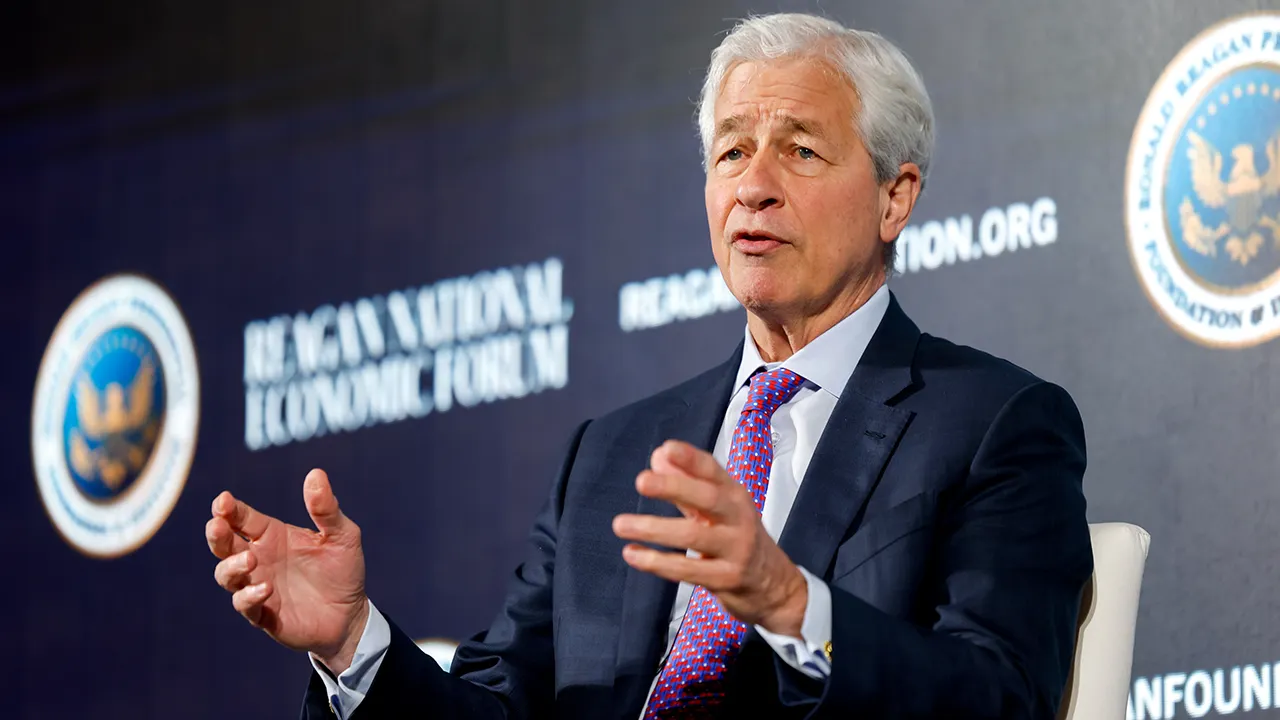
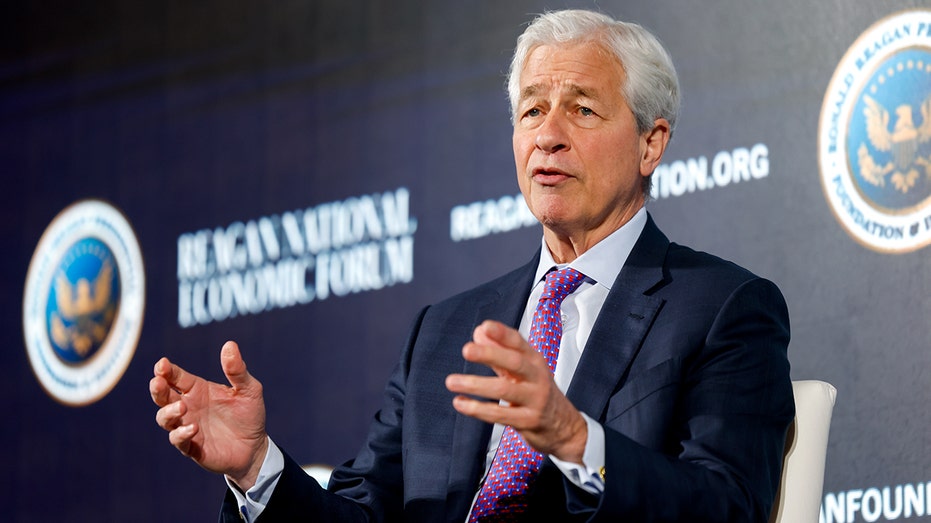
Jamie Dimon speaks on stage

JPMorgan Chase CEO Jamie Dimon said he’s cautious about stock market valuations and wouldn’t buy bonds given current prices and yields. (Caroline Brehman/Bloomberg via Getty Images)

Dimon said he wouldn’t buy long-term Treasurys given the current conditions of the bond market, saying that he thinks interest rates on U.S. bonds will likely remain elevated even if inflation subsides.

DIMON URGES CALM OVER FEAR ABOUT AI’S IMPACT ON JOBS: ‘STOP BEING BREATHLESS OVER IT’

The JPMorgan Chase CEO said he believes “the 10-year bond should probably be at 4% to 4.5%” even if inflation returns to the Federal Reserve’s long-run target of 2%, and said that he personally wouldn’t buy long-term Treasurys and sees little upside for bond prices.

Advertisement

The 10-year Treasury yield is currently about 4.6% and has remained above 4.2% since March after they had trended closer to 4% late last year.

The most recent consumer price index (CPI) data showed inflation was up 3.5% from a year ago – well above the Fed’s 2% target – despite declining month-over-month as gas prices declined as the energy market stabilized during a period of reduced hostilities between the U.S. and Iran.

JAMIE DIMON SAYS HE UNDERSTANDS WHY PEOPLE HAVE GROWN ‘ANTI-RICH’

Ticker Security Last Change Change %
JPM JPMORGAN CHASE & CO. 345.15 +6.24 +1.84%

Stubbornly high inflation prompted the Fed to leave interest rates unchanged at the central bank’s June meeting and Fed Chair Kevin Warsh has signaled that policymakers won’t tolerate elevated inflation.

Advertisement

That has caused the market’s view of the probability of rate cuts to plunge, as the CME FedWatch tool suggests that the federal funds rate will either remain steady or rise before the end of this year.

Dimon also struck a cautious note on the stock market in the interview, saying he wouldn’t invest in the broader market at the high valuations that can currently be found at many leading companies and would instead look at individual companies to find “a great investment.”

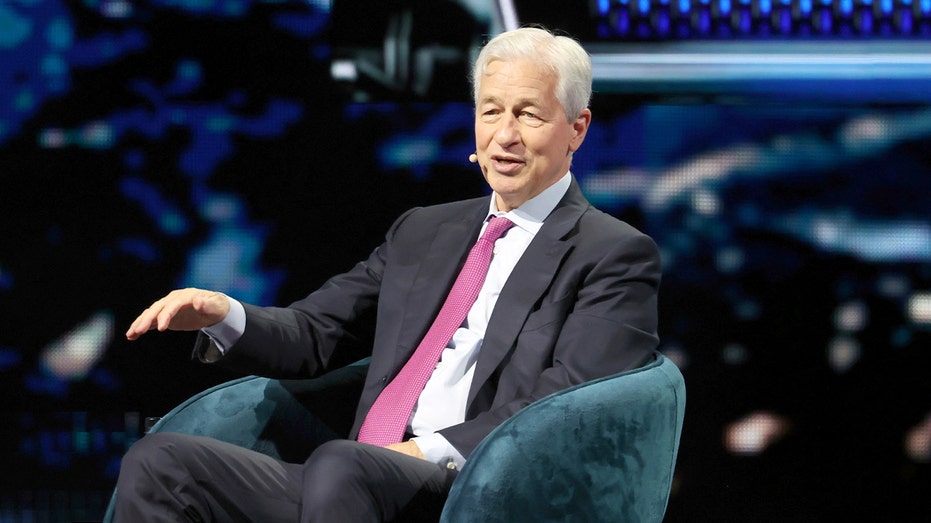
Banking executive addresses an audience from a stage at a large indoor arena.

Dimon likened the surge of investment in AI to the rise of the Internet. (Alexander Tamargo/Getty Images for America Business Forum)

JPMORGAN NAMES 2 NEW CO-PRESIDENTS, SETTING UP RACE TO SUCCEED JAMIE DIMON

He also likened the impact of artificial intelligence (AI) on the market as it reshapes the tech sector and the broader economy to what happened during the initial internet boom, saying that companies are spending a “huge” amount of money that may not quickly lead to the desired results.

Advertisement

“Will it in total pay off? Probably, just like the internet did,” Dimon told CNBC. “Will it pay off the way you expect and the timetable you expect? Definitely not.”

GET FOX BUSINESS ON THE GO BY CLICKING HERE

Continue Reading

Business

Goldman Sachs creates private markets platform to court rich investors

Published

on

Goldman Sachs creates private markets platform to court rich investors

A Spacex Flacon 9 rocket lifts off from Space Launch Complex 40 on June 08, 2026 in Cape Canaveral Space Force Station, Florida.

Joe Raedle | Getty Images

Goldman Sachs has created a new platform to expand its offerings for wealthy clients and family offices who increasingly want direct stakes in fast-growing private companies, CNBC has learned.

Advertisement

The new group, called the alternative investments platform, combines Goldman’s existing alternatives business with two newly established teams, according to a memo seen first by CNBC.

The new teams focus on direct investments in individual private companies, rather than broader private equity funds, and on helping clients buy and sell those stakes, according to the memo.

“There has been a lot of focus on the big growth tech names and getting clients access to those before they debut in the public markets,” Kristin Olson, Goldman Sachs’ global head of alternatives for wealth, told CNBC in an interview.

Goldman’s move reflects two of the biggest trends reshaping Wall Street. The firm has spent years pushing deeper into wealth and asset management because of its perception as providing steadier revenues than investment banking and trading. At the same time, the most successful startups are staying private far longer than they once did, allowing early investors to capture most of the gains before public investors get a chance.

Advertisement

“Companies are going public at a trillion dollars,” Olson said. “If you haven’t participated along the way, you’re clearly missing a big part of the growth cycle.”

AI boom

Goldman has been arranging direct investments in later-stage private companies for wealthy clients for roughly two decades, Olson said, pointing to Facebook before its 2012 IPO and later SpaceX, Stripe and Canva. But growth in demand for the asset class convinced executives to break out the business, she added.

The firm’s goal, Olson said, is to help clients identify promising companies before they become household names.

Rather than targeting early-stage startups, Olson said Goldman generally focuses on later-stage companies that have established products, meaningful revenue and clearer paths toward profitability, seeking what she described as a “sweet spot” between risk and return.

Advertisement

The AI investment boom has only intensified demand. Beyond leading model developers, Goldman is increasingly steering clients toward investments in the infrastructure underpinning AI, including data centers and related projects, Olson said.

Investors are increasing their allocation to growth and venture managers: Goldman's Kristin Olson

The announcement comes days after Goldman reported record quarterly revenue, with executives highlighting AI-driven activity across investment banking, trading and financing businesses. The results reinforced investors’ view that Goldman is positioned to benefit from multiple facets of the AI investment cycle.

The announcement also formalizes Goldman’s growing business helping clients find liquidity for private investments.

Through its new secondary advisory group, the firm plans to expand a marketplace that allows clients to buy and sell private holdings while also advising clients looking to exit investments held outside Goldman.

“We said, let’s break that out and let’s make it very clearly defined as something that we’re leaning into,” Olson said.

Advertisement
Choose CNBC as your preferred source on Google and never miss a moment from the most trusted name in business news.
Continue Reading

Business

Apple Music subscription prices rise due to higher licensing costs

Published

on

Apple to invest $30 billion in US chip manufacturing

Apple is raising prices on Apple Music subscriptions as well as certain Apple One plans as the company faces higher licensing costs.

The tech giant last week hiked prices for Apple Music plans across subscription tiers. Individual plans will rise by $1 a month to $11.99, while student plans will increase by the same amount to $6.99 a month.

Advertisement

Prices for the Apple Music family plan are also rising by $3 per month to a new monthly rate of $19.99.

The company also hiked prices for some tiers of Apple One – the company’s bundle that allows consumers to subscribe simultaneously to Apple TV, Music, iCloud+, Arcade, Fitness+ and News+ or the first four services.

APPLE RAISES IPAD AND MACBOOK PRICES AS MEMORY CHIP COSTS SURGE

Apple Store

Apple raised prices on Apple Music plans as well as some Apple One packages. (CFOTO/Future Publishing via Getty Images)

Prices for the Apple One family tier are set to rise by $2 to a new total of $27.95 per month. Family plans may be shared with up to five people and have up to 200 gigabytes of iCloud storage, though they don’t include News+ or Fitness+ in the package.

Advertisement

The individual Apple One subscription, which includes the same four services but with 50 gigabytes of iCloud storage, is unchanged at $19.95 a month.

Apple One’s Premier package, which includes all six of the company’s subscription services with up to 2 terabytes of storage and may be shared among five people, will rise in price by $2 to $39.95 per month.

APPLE BRIEFLY OVERTAKES NVIDIA AS WORLD’S MOST VALUABLE COMPANY AMID AI INVESTMENT DOUBTS

Ticker Security Last Change Change %
AAPL APPLE INC. 326.59 -7.15 -2.14%

The price increases apply to consumers in the U.S. as well as other countries around the world.

Advertisement

The moves weren’t announced by Apple, which adjusted the prices for the various subscriptions and tiers on its website on Friday. Apple told 9to5Mac, “As a result of rising licensing costs, Apple Music is increasing its subscription price beginning today.”

FOX Business reached out to Apple for comment.

APPLE HIT WITH LAWSUIT CLAIMING ICLOUD+ PRIVACY TOOL COULD EXPOSE USERS’ REAL EMAILS TO WEBSITES

The new MacBook Air connected to monitors

Apple’s subscription price hikes follow higher iPad and MacBook prices. (Apple)

In late June, Apple announced price hikes for its iPad tablets and MacBook laptops amid rising memory chip costs.

Advertisement

The company raised the price of the MacBook Air by $200 to a new total of $1,299, while the budget Neo laptop price rose from $599 to $699. The price of a MacBook Pro with 1 terabyte of storage rose $300 to $1,999, while the iPad Air with 128 gigabytes of storage rose from $599 to $749.

GET FOX BUSINESS ON THE GO BY CLICKING HERE

Apple said at the time that it has “never seen a component price increase this much, this quickly,” adding that it had “shielded our customers from these increases so far, but we have now reached a point where we need to begin raising prices on a number of products.”

Advertisement
Continue Reading

Business

The Every Co.’s OvoPro gains ADM production boost

Published

on

The Every Co.’s OvoPro gains ADM production boost

ADM commercially scaling production of high-protein egg ingredient at Clinton, Iowa, facility.

Continue Reading

Trending

Copyright © 2025