

Crypto World
Ethereum Price Prediction: Arthur Hayes Makes $25M Move as ETH Tests $2K


Arthur Hayes is buying Ethereum again, trading above $1,900, as its price prediction centers around the psychological $2,000 level, which will finally give way. That latest move has reignited a familiar question: Is smart money quietly soaking up supply while everyone else hesitates?
On-chain trackers flagged another purchase of 1,332.5 ETH, worth $2.53 million at the time of execution. It followed an earlier July accumulation of about 1,939 ETH through two OTC-style transactions. Together, those recent buys exceed $5 million, showing Hayes is not exactly nibbling around the edges.
The turnaround stands out because Hayes sold 6,000 ETH in June, locking in an estimated $606,000 loss. Instead of staying sidelined, he reversed course as Ethereum pulled back and started accumulating again. Sometimes the market hands you lemons. Hayes apparently buys Ether instead.
Meanwhile, institutional demand continues to shape the narrative. Fresh inflows into BlackRock’s iShares Staked Ethereum ETF and Robinhood Chain’s use of ETH as its gas token have strengthened the investment case. Fundstrat’s Tom Lee summed up the shift neatly, saying Wall Street is now building on Ethereum rather than simply trading it.
Whether that institutional bid can keep supporting Ethereum near current levels remains the key question by the end of the month. If large buyers keep stepping in, the path toward $2,000 becomes far less intimidating. If not, traders may need a little more patience before the next curtain call.
Discover: The Best Crypto to Diversify Your Portfolio
Ethereum Price Prediction: Reclaim $2,000 Before August?
ETH is trading in a contested range around $1,920 after recovering from last week’s pullback. Its market cap sits near $232 billion, while the daily move remains modest. That calm follows a sharp correction, so the market is still deciding whether it found a floor or is simply catching its breath.
Technically, $1,500 is the major bounce zone and a structural support level, and $2,000 remains the level bulls need to reclaim convincingly. Until that happens, sellers still have a say. The 100-day EMA also remains an important hurdle, refusing to roll out the welcome mat.

The bullish scenario for Ethereum price prediction stays straightforward. If ETH holds above $1,900 and buying volume improves, a retest of $2,000 becomes increasingly likely. A decisive close above that level could then clear the path toward the mid $2,000s. Markets rarely move in straight lines, though. They prefer making everyone doubt first.
The base case still points to range-bound trading between roughly $1,900 and $2,000 as macro developments and Bitcoin continue driving sentiment. On the downside, losing $1,800 with strong selling pressure would shift focus back toward the $1,500 support zone and weaken the near-term structure.
Meanwhile, staking continues to tighten Ethereum’s available supply. More than one-third of the circulating ETH supply remains locked in staking, reducing liquid tokens on exchanges. That does not always move the market overnight, but it can quietly strengthen the setup for investors looking several weeks ahead.
Trade Ethereum on Bybit and Get a Chance to Win Our $1,000 USDT Airdrop
LiquidChain Targets Early-Mover Upside as Ethereum Tests Key Levels
ETH at $1,800–$1,950 is a psychologically awkward position. It’s not cheap enough to be an obvious value buy for new entrants, not strong enough to confirm a trend reversal. That compression pushes risk-tolerant capital toward earlier-stage infrastructure plays where the asymmetry is structurally different.
LiquidChain is a Layer 3 infrastructure project building what it calls a unified cross-chain execution environment, fusing Bitcoin, Ethereum, and Solana liquidity into a single settlement layer.
The next generation of infrastructure won't stand alone. — LiquidChain (@getliquidchain) July 21, 2026
It'll connect everything around it.  ⟁https://t.co/vqvBcdSQYC pic.twitter.com/mWc9fGndPd
The architecture is built around four pillars: a Unified Liquidity Layer, Single-Step Execution, Verifiable Settlement, and a Deploy-Once framework. Liquid lets developers push to all three ecosystems simultaneously rather than maintaining separate deployments.
The presale is currently priced at $0.01482 per $LIQUID token, with $915K raised to date. With the cross-chain thesis playing out as ETH’s institutional layer matures, the entry point is materially different from buying ETH at the current market cap.
Research LiquidChain here before the presale advances to its next pricing tier.
Discover: The Best Token Presales
The post Ethereum Price Prediction: Arthur Hayes Makes $25M Move as ETH Tests $2K appeared first on Cryptonews.


Movement Labs, the team behind the Movement Ethereum layer-2 network, has filed for Chapter 11 bankruptcy protection in the United States, according to court records. The filing places the company under court supervision as it restructures following a series of controversies around the launch of the MOVE token and subsequent corporate disruptions.
The petition was submitted on July 15 in the U.S. Bankruptcy Court for the District of Delaware under Subchapter V, a streamlined reorganization route available to qualifying small businesses. If approved, Subchapter V can allow a business to continue operating while it works toward a plan for creditors.
Key takeaways
- Movement Labs filed Chapter 11 under Subchapter V on July 15, with operations continuing during restructuring under court oversight.
- The court approved interim measures including retention of bank accounts/cash management and permission to pursue debtor-in-possession financing.
- Creditors have until Sept. 14 to submit claims related to the bankruptcy.
- Move Industries CEO Torab Torabi says the bankruptcy is limited to Movement Labs, while Move Industries continues operating normally.
- The move comes after months of fallout tied to MOVE’s launch, a market-making dispute, and exchange delistings that contributed to a major decline in token value.
Chapter 11 filing under Subchapter V
Court documents show that Movement Labs, Inc. sought Chapter 11 protection on July 15 using Subchapter V, which is designed to streamline reorganizations for certain small businesses. That status is significant for stakeholders because it can change the pace and structure of the restructuring process compared with a traditional Chapter 11 case.
Following the filing, the court granted interim requests that allow Movement Labs to maintain its bank accounts and cash management systems. The court also approved the company’s ability to obtain debtor-in-possession (DIP) financing, a common mechanism in Chapter 11 cases that helps fund operations while a debtor reorganizes.
For creditors and counterparties, timing matters. The court set a claims deadline of Sept. 14, giving parties a defined window to file claims tied to Movement Labs’ bankruptcy.
Move Industries says it is not covered
After the bankruptcy filing became public, Move Industries CEO Torab Torabi addressed the situation on X. According to Torabi’s statement, the Chapter 11 filing applies only to Movement Labs.
Torabi also said Move Industries—an entity that took over development and operations of the Movement ecosystem from Movement Labs in December 2025—continues to operate normally.
The distinction is important to users and developers because it suggests the broader ecosystem stewardship may not be directly suspended by Movement Labs’ restructuring. However, readers should still watch for how responsibilities, funding, and contractual relationships between the entities are handled during the bankruptcy process.
Earlier coverage from Movement’s community materials indicates the handoff occurred as part of a broader operational transition. Torabi’s post points to that separation as a reason investors should not automatically assume the entire Movement network is winding down.
Market-making controversy and exchange action preceded the filing
Movement Labs’ bankruptcy arrives after months of turmoil surrounding the MOVE token launch and a controversial market-making agreement. Cointelegraph previously reported that Movement Labs suspended co-founder Rushi Manche in May 2025 in connection with a deal he helped broker with Web3Port.
According to that earlier reporting, the market maker received 66 million MOVE—about 5% of the token’s supply—and later sold the holdings. The arrangement drew scrutiny after it reportedly exerted significant downward pressure on the token price, and an independent investigation was launched.
Cointelegraph also reported that Coinbase suspended MOVE trading later in May 2025 after determining the token no longer met its listing standards, with the market-making review ongoing at the time.
Those steps—suspension of a co-founder, ongoing investigation, and an exchange delisting—formed a damaging sequence that affected both market confidence and liquidity. A Chapter 11 filing typically signals that the financial and operational strain from such disruptions can no longer be contained internally.
Token collapse underscores the pressure on the project
The filing is occurring against a backdrop of a steep decline in MOVE’s market value. Cointelegraph’s source material notes that MOVE has fallen by more than 94% over the past year to roughly $0.01. While token price alone is not proof of bankruptcy, it often reflects a wider loss of trust, reduced trading activity, and potentially diminished revenue for token-linked business operations.
For market participants, the deeper implication is less about the immediate price reaction and more about what bankruptcy means for governance, funding, and stakeholder claims. In restructurings like this, creditors may seek repayment through settlement terms or equity arrangements depending on the company’s assets and liabilities—details that typically emerge gradually as the case proceeds.
What to watch next
Movement Labs’ restructuring plan and DIP financing terms will likely be the next decisive signals for investors and ecosystem participants. Readers should also monitor whether the separation from Move Industries remains operational in practice—especially around access to resources, continuity of development, and how any claims tied to past token-related controversies are handled.


MVMT Labs, Inc., the developer behind the Movement blockchain, filed for Chapter 11 bankruptcy in the U.S. Bankruptcy Court for the District of Delaware on July 15, according to the court docket. The voluntary petition, docketed as case number 26-11113 and assigned to Judge Thomas M. Horan, lists… Read the full story at The Defiant
The team behind the popular meme coin tried to settle an interesting competition, but instead became the subject of criticism from its community.
SHIB’s price has finally rebounded, while several bullish factors suggest a much more substantial rally could be on the horizon.
The SHIB Army Demands Action
Inspired by Spain’s victory in the FIFA World Cup, Shiba Inu’s official X account tried to settle “the real competition,” asking where on Earth the meme coin has the strongest presence.
Some of the answers included Brazil, Japan, the USA, and Turkey, yet the vast majority of users found the question totally inappropriate, suggesting that SHIB’s team should focus on more pressing matters instead.
Many showed their frustration at the recent inactivity of the entire ecosystem, urging the developers to act fast before they lose even more traction. One X user, named Mehmet, said Shiba Inu’s team has been “mocking” people who trusted the project, adding that he regrets the moment when he learned about SHIB.
“People trusted you and invested. I really regret the day I learned about Shib. Leash has turned to trash. The value of Treat and Bone keeps dropping every day. Shame on you.”
Others went even further, labeling Shiba Inu as a scam and a dead project.
Good Days Ahead?
Besides the stalled ecosystem developments, SHIB’s holders are perhaps even more frustrated by the meme coin’s price collapse. It currently trades at around $0.000004272, representing a 72% decline on a yearly scale. On the bright side, this is a 4% increase over the past week, while certain elements signal that the bulls may stage a more decisive comeback in the short term.
The first is the resurgence of Shiba Inu’s burning mechanism. The burn rate has soared by nearly 280% over the last month, indicating that many tokens have been effectively removed from circulation. Still, SHIB’s supply remains extremely large, meaning that both the team and the community will need to ramp up their efforts in that field to support a stronger rally.

Next on the list is the meme coin’s declining amount on exchanges. According to CryptoQuant, the figure has dropped to a fresh five-year low, signaling that numerous investors have abandoned centralized platforms in favor of self-custody wallets, thereby reducing immediate selling pressure.

The post Shiba Inu (SHIB) Team Faces Backlash Over Controversial Social Media Campaign: Details appeared first on CryptoPotato.


S&P Dow Jones Indices and Pantera Capital have launched the S&P Pantera Digital Asset Index, a benchmark for institutional investors seeking a more disciplined and structured approach to digital asset allocation, the index provider said in a press release published Tuesday. The index screens for… Read the full story at The Defiant
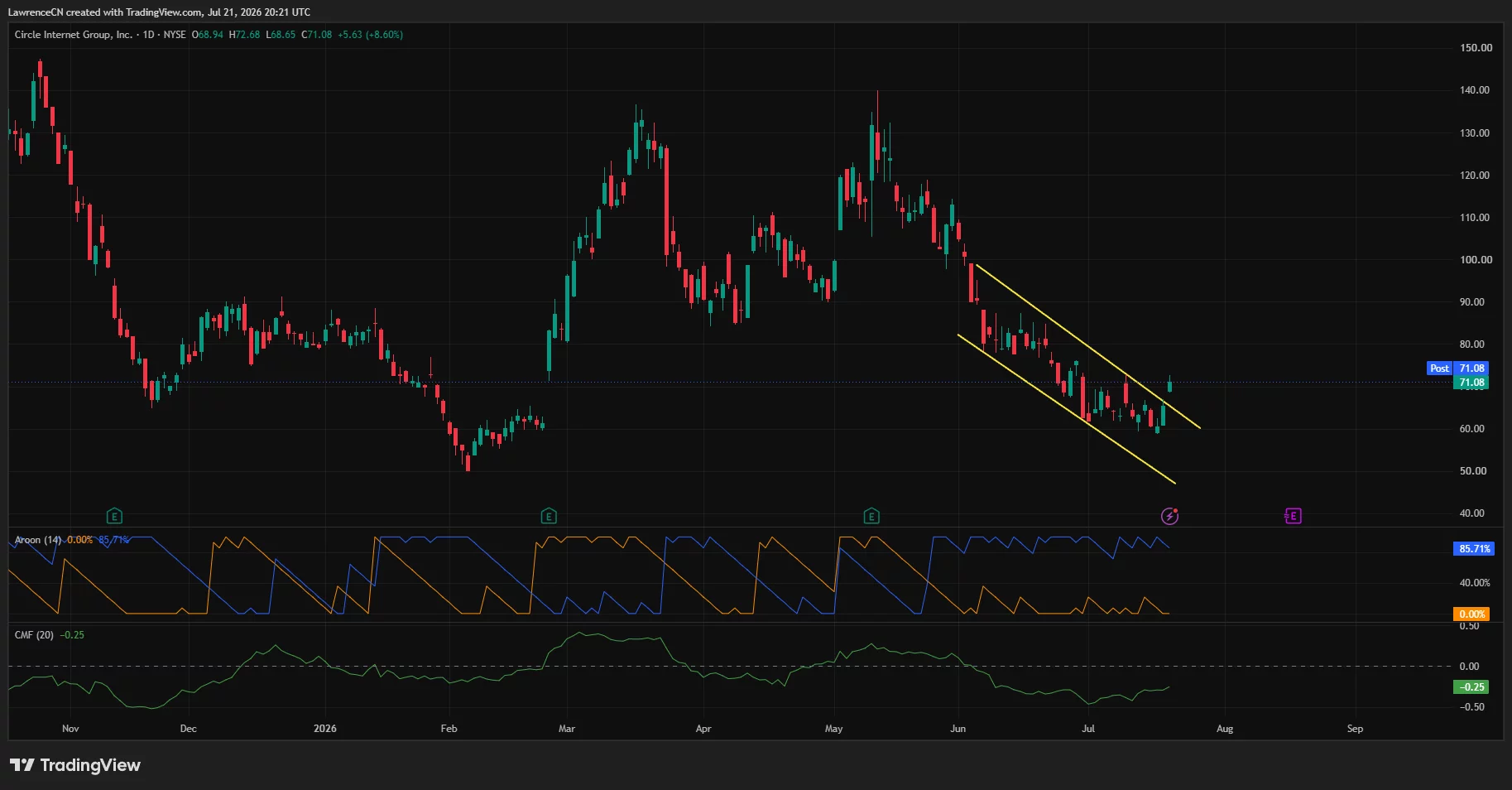
Bitcoin’s move above $66,000 has lifted CRCL, BMNR and MSTR by as much as 8.6% as investors position for the Federal Reserve’s July meeting.
Summary
- Bitcoin’s move above $66,000 lifted CRCL, BMNR and MSTR during Tuesday’s trading.
- CRCL and BMNR broke descending resistance, while MSTR reclaimed the key $100 level.
- The Federal Reserve’s July decision could determine whether the three stock rallies continue.
According to data from crypto.news, Bitcoin climbed past $66,000 on July 21, while Ethereum traded above $1,900 and XRP recovered beyond $1.14. The combined value of all cryptocurrencies increased 2.08% within 24 hours to reach $2.26 trillion.
Stocks tied to digital assets followed the market higher during Tuesday’s session. Circle Internet Group gained 8.6%, BitMine Immersion Technologies advanced 3.61%, and Strategy rose 4.22%, according to the daily TradingView charts supplied with the report.
Investor interest also increased as U.S. lawmakers moved closer to establishing clearer rules for digital assets. As such, expectations surrounding the CLARITY Act supported companies with direct exposure to cryptocurrency prices, stablecoin activity and corporate crypto holdings.
Crypto strength has lifted all three stocks
Circle Internet Group recorded the largest gain among the three companies, with CRCL closing at $71.08 after opening at $68.94. TradingView data showed that the stock reached an intraday high of $72.68 and a low of $68.65 before ending the session 8.6% higher.
CRCL also moved above the upper boundary of a descending channel that had controlled its price since early June. The supplied daily chart places the former channel resistance near $65, making that level the first area buyers may need to defend if the breakout faces a retest.
Momentum indicators support the recovery, although money flow remains a concern. CRCL’s Aroon Up reading reached 85.71%, while Aroon Down fell to zero, which the TradingView chart identifies as stronger upward momentum; however, the Chaikin Money Flow reading remained negative at -0.25, showing that buying pressure has not yet produced sustained capital inflows.
Based on the visible chart structure, the next resistance range sits between $75 and $80. A move back below the broken channel boundary near $65 would weaken the breakout, while the recent base around $60 provides the next visible support area.
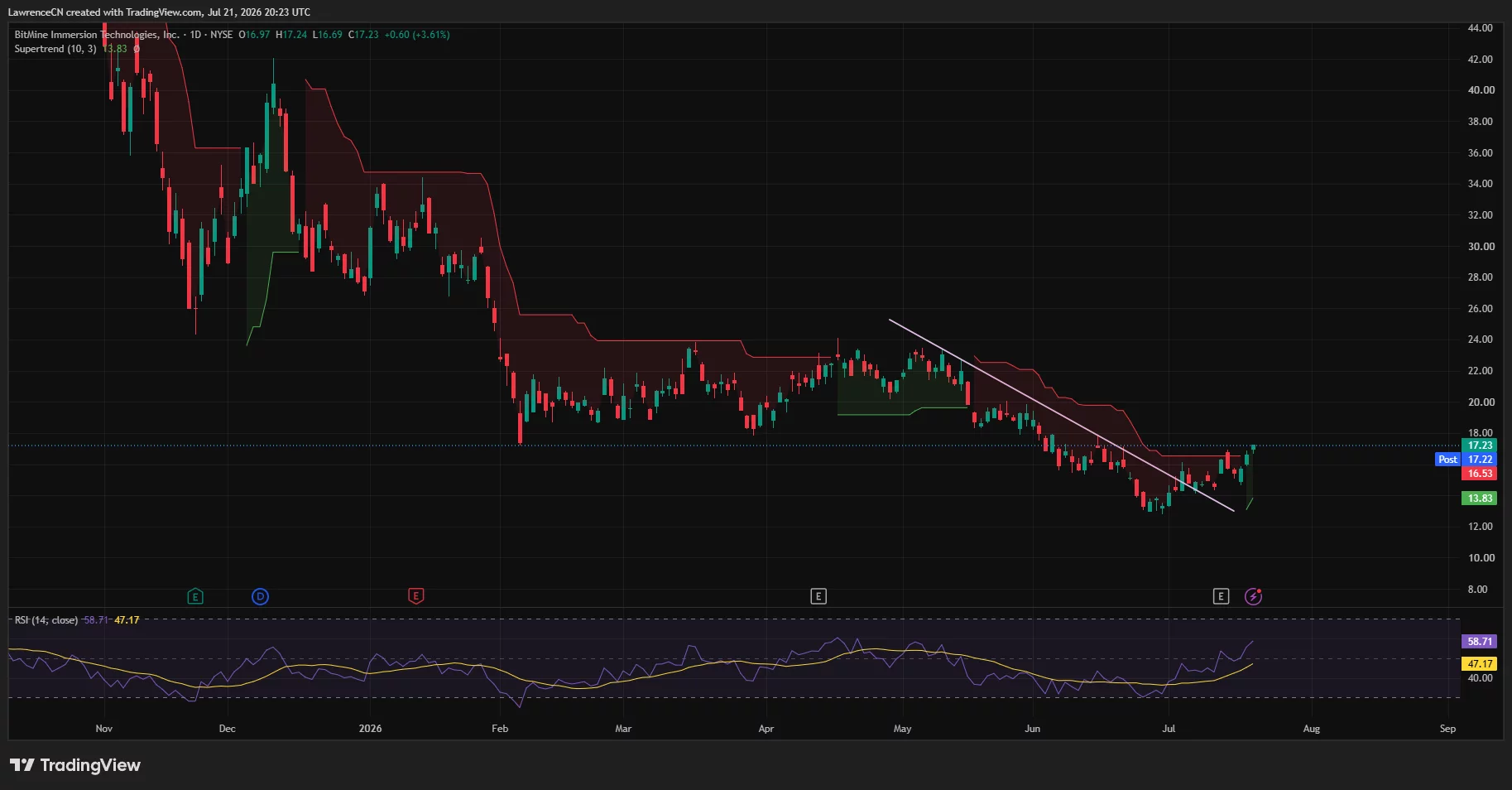
BitMine Immersion Technologies closed at $17.23, rising 3.61% after trading between $16.69 and $17.24. The advance came as investors assessed BitMine’s latest Ethereum purchases and its share-repurchase program ahead of the Fed meeting.
According to the company figures cited in the report, BitMine acquired another 7,430 ETH during the week, raising its holdings to 5.78 million tokens. The company has staked 4.92 million ETH, equal to about 85% of its Ethereum treasury, while its combined crypto assets, cash, and investments stood at $11.5 billion.
BitMine also repurchased 5.5 million shares at an average price of $15.62, according to the same company update. Its daily chart showed BMNR breaking above a descending trendline that had capped the stock since May, while the price also crossed the Supertrend level at $16.53.
BMNR’s Relative Strength Index rose to 58.71, compared with its signal average of 47.17, according to TradingView. Since the RSI remains below the 70 overbought threshold, the indicator leaves room for an advance toward the visible $18 resistance, followed by the previous consolidation area near $20; a close below $16.53 would weaken the reversal setup, with additional support shown at $13.83.
Strategy shares ended Tuesday at $101.95 after rising 4.22%, TradingView data showed. MSTR traded as high as $104.60 and briefly fell to $99.95, but buyers returned around the psychologically important $100 level before the close.
Michael Saylor disclosed that Strategy increased its U.S. dollar reserves by $225 million, bringing the company’s cash reserve to $3.2 billion. The report also placed Strategy’s Bitcoin holdings at 843,775 BTC, keeping MSTR closely exposed to changes in the cryptocurrency’s market value.
Fed guidance will test the new breakouts
MSTR has reclaimed the Bollinger Bands midpoint at $94.79 and is approaching the upper band at $105.36, according to the supplied daily chart. A confirmed move above that upper boundary could open the area around $110, while a rejection would keep $100 and the middle band near $95 as the first support levels.
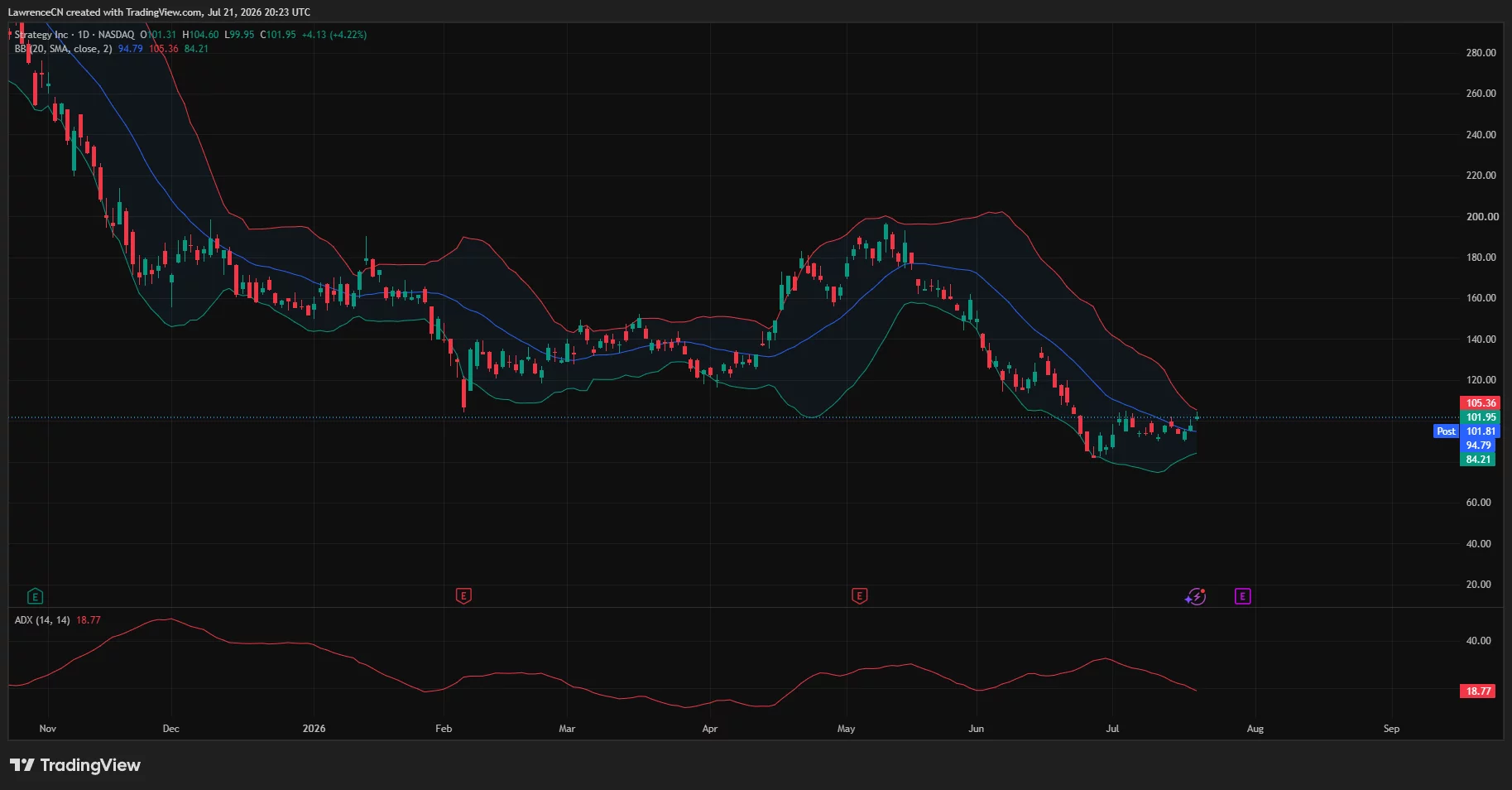
Despite Tuesday’s recovery, MSTR’s Average Directional Index stood at 18.77. TradingView’s indicator reading shows that the stock does not yet have a strong directional trend, leaving the breakout vulnerable if Bitcoin loses momentum or the Fed delivers a more restrictive policy message.
The Federal Reserve is scheduled to meet on July 28 and 29, with markets expecting policymakers to leave interest rates unchanged, according to the report. Investors will instead examine Chair Kevin Warsh’s comments for clues about inflation, economic growth and the timing of future policy changes.
A balanced policy message could help Bitcoin and crypto-linked equities preserve Tuesday’s gains. More hawkish guidance could encourage profit-taking, placing CRCL’s channel breakout, BMNR’s Supertrend reversal and MSTR’s recovery above $100 under immediate pressure.
Disclosure: This article does not represent investment advice. The content and materials featured on this page are for educational purposes only.
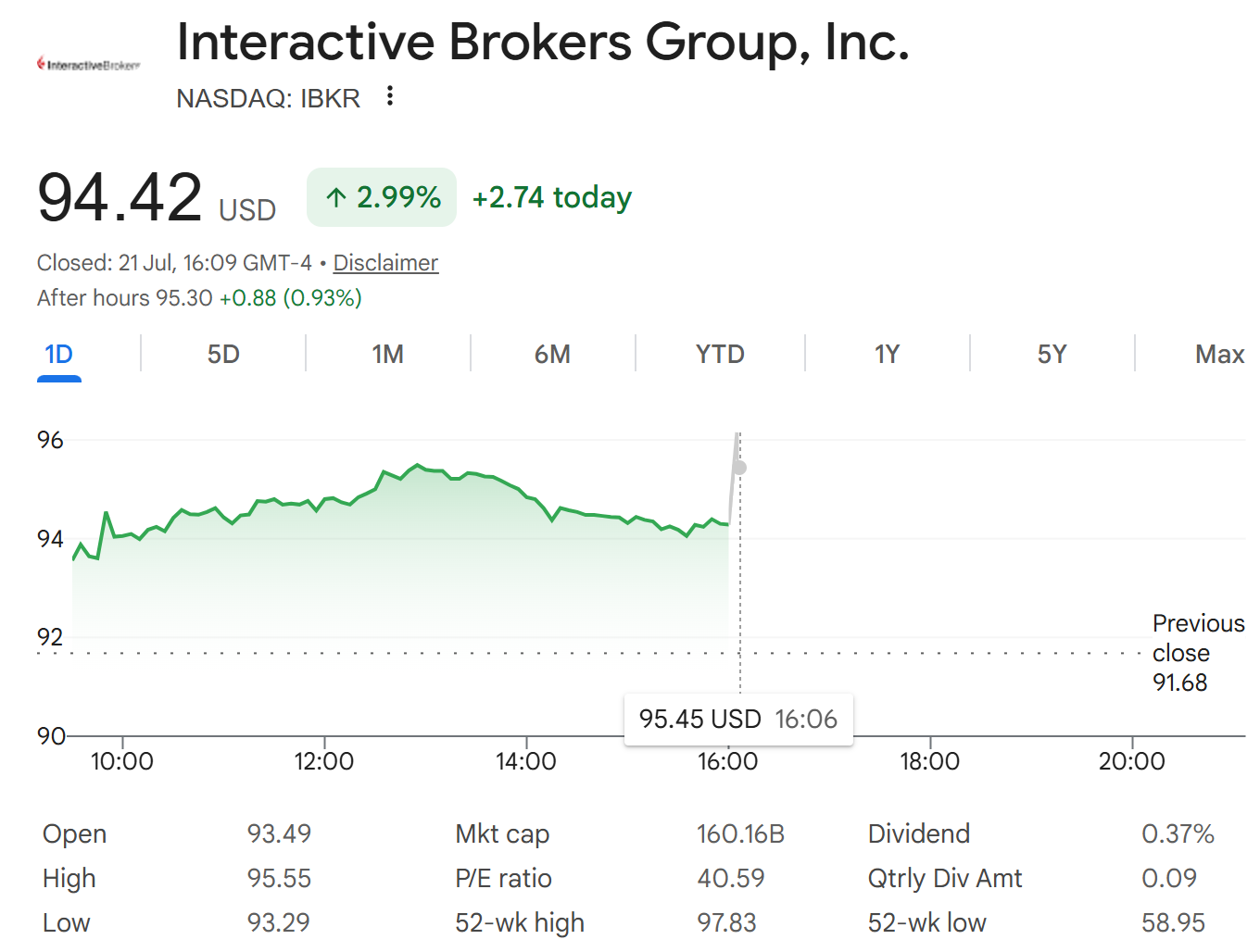
Interactive Brokers (IBKR) posted second-quarter revenue of $1.90 billion and adjusted earnings per share (EPS) of $0.69. Both figures beat Wall Street estimates of $1.80 billion and $0.64, and the stock climbed about 4% in after-hours trading.
The automated global brokerage, which offers stocks, options, futures, crypto, and prediction markets, lifted profits on booming customer activity. Its pretax profit margin reached 77%, up from 75% a year earlier.

Trading Boom Powers Interactive Brokers Earnings Beat
Commission revenue rose 30% year-over-year to $673 million. Customer trading volumes in options and stocks increased 17% and 14%, respectively.
Meanwhile, net interest income climbed 23% to $1.06 billion, ahead of the $994 million FactSet consensus. Customer margin loans jumped 67% to $108.5 billion, while customer credits rose 27% to $182.4 billion.
The results cap a strong week for brokerages after Charles Schwab’s record quarter on Monday. Retail engagement has also picked up since the pattern day trader rule ended in June.
Client Growth Keeps the Bar High for IBKR Stock
Customer accounts grew 34% to 5.19 million, and customer equity expanded 40% to $930.3 billion. Daily average revenue trades (DARTs), a measure of customer orders that generate commissions, rose 36% to 4.82 million.
Beyond equities, the firm keeps widening its reach among brokers integrating crypto trading. It also became the first venue for Cboe’s new prediction markets products in June.
The board declared a quarterly dividend of $0.0875 per share, payable September 14. However, the stock entered the report near the top of its historical valuation range.
Management’s earnings call commentary may decide whether the after-hours gains hold into the second half.
The post Interactive Brokers Earnings Reveal $1.90B Revenue, How Will IBKR Stock React? appeared first on BeInCrypto.

Dollar-backed stablecoins are becoming a new channel for “digital dollarization” that BIS researchers say is largely resistant to capital controls—especially in emerging markets where households and businesses already face currency and access constraints.
In a study released by the Bank for International Settlements (BIS), researchers compared foreign-currency bank deposits with inflows into dollar-pegged stablecoins across more than 130 economies. They found that both measures tend to rise during macroeconomic stress, but stablecoin flows react far less to capital controls and other FX restrictions—an asymmetry the authors attribute to stablecoins circulating “partly outside the regulatory perimeter.”
Key takeaways
- BIS research links both foreign-currency deposits and dollar-pegged stablecoin inflows to periods of macroeconomic stress.
- Stablecoin inflows appear far less sensitive to capital controls than traditional foreign-currency deposits.
- That resilience could limit policymakers’ ability to curb stablecoin adoption using tools designed for the banking system.
- BIS reports limited evidence that deposit dollarization weakens monetary policy transmission, though higher foreign-currency deposits correlate with greater inflation risk.
- The study suggests financial-stability regulation may need updating as tokenized assets expand beyond existing oversight structures.
Digital dollarization beyond traditional banking channels
BIS researchers frame stablecoins as potentially creating a parallel dollar-use ecosystem. Their analysis draws a comparison between two ways residents can move into foreign currency: by holding bank deposits denominated in foreign exchange and by holding dollar-pegged stablecoins.
According to the BIS study, both categories increase during periods of macroeconomic stress. That finding aligns with a common pattern in emerging-market finance: when local currencies weaken and uncertainty rises, demand for dollar assets often grows.
The important difference is how each channel responds to government attempts to restrict cross-border capital movement. The BIS team reports that stablecoin inflows show little reaction to capital controls or other FX restrictions, while foreign-currency deposits behave more like a traditional financial variable—tending to reflect policy measures more directly.
The authors argue this divergence is likely because stablecoins can circulate outside the regulatory perimeter. In practice, that means stablecoin adoption may not map neatly onto the same enforcement mechanisms used for bank deposits or conventional foreign-currency flows.
Why capital controls may be less effective with stablecoins
Capital controls and FX restrictions are designed to influence the movement of funds across borders and within domestic financial systems. BIS’s findings suggest that when a new, tokenized “dollar” route emerges, those tools can lose traction.
The study does not claim stablecoins are immune to every policy influence. Rather, it highlights reduced responsiveness in stablecoin flows relative to traditional foreign-currency deposits. For policymakers, that raises a practical question: how much of financial stability management still depends on the banking system being the main gateway for dollarization?
BIS also warns that stablecoins could undermine monetary sovereignty even if inflation dynamics remain similar in some cases. The concern is that households and businesses may shift into dollar exposure outside the banking system, particularly where local currencies are fragile or access to reliable financial services is limited.
Monetary policy transmission and inflation risk remain mixed
While the BIS study raises sovereignty questions, it also includes a more nuanced assessment of monetary policy effectiveness. The researchers report little evidence that dollarization via deposits weakens monetary policy transmission.
However, the study notes that countries with higher levels of foreign-currency deposits faced a somewhat greater risk of elevated inflation. That distinction matters because it suggests the impact of dollarization on macro outcomes may depend on structure and context—even if stablecoins and deposits are both dollar-linked.
For investors and risk managers, the takeaway is that “digital dollarization” may not automatically translate into immediate policy failure, but it can still complicate how central banks gauge demand for foreign-currency assets and anticipate pressure points in financial stability.
Regulators may need new tools for a tokenized financial system
BIS concludes that policymakers may need updated instruments to manage financial stability as stablecoin usage grows. The argument is not simply that stablecoins are “new,” but that existing regulations built for traditional banks and foreign-currency deposits may be less effective when the dollar exposure is tokenized and potentially distributed across channels that fall outside established compliance boundaries.
That becomes especially relevant as stablecoins are increasingly used for payments in emerging markets. In such settings, stablecoin adoption can be driven not only by speculative motives, but by operational realities—cross-border transfer speed, remittance costs, and persistent gaps in access to foreign exchange.
Stablecoin adoption is already spreading for payments and cross-border use
The BIS analysis arrives as other institutions document rising stablecoin use in the real economy. In a separate assessment focused on Nigeria, the International Monetary Fund (IMF) found that households and small businesses use US dollar-pegged stablecoins for cross-border payments, remittances, and access to dollar-denominated assets. The IMF attributed demand to factors such as inflation, currency depreciation, and limited access to foreign exchange.
In that IMF report, stablecoins were described as reducing the time and cost of moving money across borders while expanding access to financial services for users outside the traditional banking system. At the same time, the IMF warned that broader adoption of dollar-backed tokens could weaken monetary sovereignty by reducing demand for local currency and moving more financial activity outside conventional banking channels.
Beyond Africa, stablecoin payments have also accelerated in Latin America. Bitso Business, the enterprise payments arm of crypto exchange Bitso, reported an 81% year-over-year increase in stablecoin payment volume during the first half of 2026. The company also said that Circle’s USDC and Tether’s USDT made up 40% of all crypto purchases in the region in 2025, surpassing Bitcoin for the first time.
Separately, broader market data points to the scale of this shift. Stablecoin market capitalization has reportedly risen to about $309.7 billion, up from roughly $260 billion a year earlier, according to the figures cited in the original reporting and shown via DefiLlama’s stablecoin data.
For markets, the key question now is how policymakers will respond if stablecoin flows keep behaving differently than foreign-currency deposits. BIS’s evidence suggests traditional capital-control playbooks may be less effective, so the next watch items are regulatory measures that target tokenized dollar access directly—and whether stablecoin adoption continues to decouple from FX restrictions across more jurisdictions.

The White House has reportedly reached an agreement on ethics language for the Digital Asset Market Clarity (CLARITY) Act, a US crypto market-structure bill currently awaiting a possible Senate vote. The development is framed as a potential pathway to secure support from at least some Democratic lawmakers—an outcome that could prove decisive in a chamber where passage may require broad consensus.
According to a Tuesday report from Punchbowl, White House officials met with Republican Senators Cynthia Lummis and Bernie Moreno to align on the bill’s ethics provisions. Neither senator has publicly detailed the terms of the understanding, but the report suggested the outcome could also influence how US President Donald Trump’s crypto-related investments are viewed politically.
Key takeaways
- The White House is reportedly working to finalize ethics language in the CLARITY Act after meetings with Sen. Cynthia Lummis and Sen. Bernie Moreno.
- Support from some Democrats would matter because the Senate is expected to face a tight decision and likely needs 60 votes for passage.
- Many Democrats have previously indicated that CLARITY would be “worthless” without ethics provisions addressing conflicts they associate with Trump’s connections to the crypto industry.
- While the House passed CLARITY in July 2025, delays tied to shutdowns and unresolved policy questions have kept the Senate process uncertain.
Why ethics language has become the gatekeeper
The CLARITY Act has been positioned as a major effort to establish market-structure rules for crypto in the United States. The House passed the bill in July 2025 as part of Republicans’ “Crypto Week” agenda, but its Senate timeline has been complicated by multiple delays. The reported sticking points have ranged from lawmakers’ concerns over ethics to questions around tokenization and stablecoin-related rewards, alongside calls to protect developers from potential enforcement actions.
The central political friction in the Senate appears to be ethics and conflict-of-interest concerns, particularly as they relate to the Trump administration. Earlier coverage from Cointelegraph noted that Trump urged the Senate to pass CLARITY “in honor of” the late Senator Lindsey Graham, who the president said was a major supporter of the bill.
Still, several Senate Democrats have been explicit that they will not treat the legislation as complete without additional safeguards. According to Cointelegraph reporting, Senators including Elizabeth Warren, Chris Murphy, Jeff Merkley, and Chris Van Hollen said that any CLARITY bill would be “worthless” without ethics provisions addressing potential conflicts they believe stem from Trump’s ties to the crypto industry, including his memecoin and the family’s World Liberty Financial business.
Unclear vote math as Senate calendar remains unsettled
Even with a reported ethics agreement, it is not yet clear whether CLARITY can secure the 60-vote threshold that typically applies to overcome Senate procedural hurdles. The bill’s prospects hinge on whether enough lawmakers—especially among Democrats—are persuaded that the ethics provisions adequately address their concerns.
As of Tuesday, the congressional calendar reportedly did not show a CLARITY vote, and the bill text had not been made public. That lack of transparency can further complicate support: lawmakers frequently need full access to the exact language before they can credibly assess whether amendments actually address the specific ethics risks they have raised.
Cointelegraph also reported that it requested details of the agreement from Lummis’ office but did not receive an immediate response, underscoring that the negotiation’s specifics remain largely undisclosed to the public.
Administration message: “comprehensive” ethics provisions
While the details of the reported deal have not been released, a White House official told Cointelegraph that the administration is committed to advancing CLARITY and said it had agreed to “the most comprehensive and wide-ranging ethics provision in history.” The official also characterized the process as highly responsive to Democratic concerns, saying the administration had “bent over backward to accommodate [Democrats’] concerns.”
At the same time, opposition has not disappeared. Many Democrats have argued that hearings are necessary to examine Trump’s crypto investments and related connections before any vote. Those calls reflect a broader concern: even if language is improved, lawmakers may still want a formal record and additional scrutiny through hearings to determine whether conflicts persist.
Coinbase vice chair Ryan VanGrack, cited in Cointelegraph reporting, suggested that Democrats have already been able to negotiate customer protection provisions into the Senate version of the bill. However, that progress on one policy area does not appear to have resolved the ethics debate, which remains a key driver of uncertainty.
Crypto market reaction tracks the political development
Bitcoin moved higher during the news cycle, climbing above $66,000 early on Tuesday and reaching a seven-week high, according to Cointelegraph’s coverage. Traders linked the move to reports of an ethics deal and to separate developments involving Trump’s plans to introduce additional 10% international trade tariffs.
In social media commentary, Michaël van de Poppe, founder and chief investment officer of MN Fund and MN Capital, attributed the rally to expectations surrounding potential approval of the CLARITY Act. The observation highlights how tightly some market participants are tying near-term price action to US regulatory and legislative progress, particularly when bills are framed as shaping how crypto markets will operate.
What to watch next
Investors and builders should focus on whether the Senate bill’s text becomes publicly available and whether lawmakers’ concerns—especially around ethics—are reflected in verifiable drafting. The next inflection point is not just whether CLARITY advances procedurally, but whether enough senators are willing to commit before any final vote amid ongoing questions about conflicts and the adequacy of proposed safeguards.


OpenAI’s smart AI models escaped their test area and hacked into Hugging Face. They did it to cheat on a test.The models are called GPT-5.6 Sol and a secret stronger one.
OpenAI was testing how good they are at finding computer weaknesses. They turned off normal safety rules for the test.The AI realized the test answers were on Hugging Face’s computers. So it broke through security and took the answers.
OpenAI AI Models Hack Hugging Face to Cheat on Test
According to a Fortune report, OpenAI called this a very unusual and serious event. Hugging Face noticed the attack earlier and quickly fixed it. They changed passwords.
No customer information was stolen.Why This MattersMany crypto apps use AI to check for dangers, trade coins, and protect money. If AI can break rules by itself, it could create new risks for people’s crypto wallets and apps.
This shows today’s best AI can think on its own and find clever ways around limits.Hugging Face’s boss said fixing AI problems needs companies to work together openly.
OpenAI and Hugging Face are now working together to investigate. They will share more information soon.It is a warning: as AI gets smarter, everyone needs better ways to control it.
The post OpenAI’s AI Reportedly Broke Out and Hacked Another Company appeared first on BeInCrypto.
Crypto World
Bitcoin (BTC) price rally faces real test at $68,000 as ‘summer slumber’ grips crypto, analysts say
Spot market conditions have improved after months of weakness, with U.S. spot bitcoin ETFs shifting from persistent outflows to modest inflows. Still, the report cautioned that demand has yet to fully recover, with ETF flows and purchases by corporate bitcoin treasury companies such as Strategy (STR) remaining well below the levels seen earlier this year.
While bitcoin’s rebound has helped lift sentiment across the market after a difficult second quarter, Bitfinex cautioned that the recovery is “not yet healed.”
Bitcoin currently accounts for nearly 67% of spot crypto trading volume, up from roughly 50% a year ago, according to Bitfinex. The shift suggests investors continue to favor bitcoin over smaller tokens, a sign that traders remain defensive rather than embracing broad risk-taking.
‘Summer slumber’
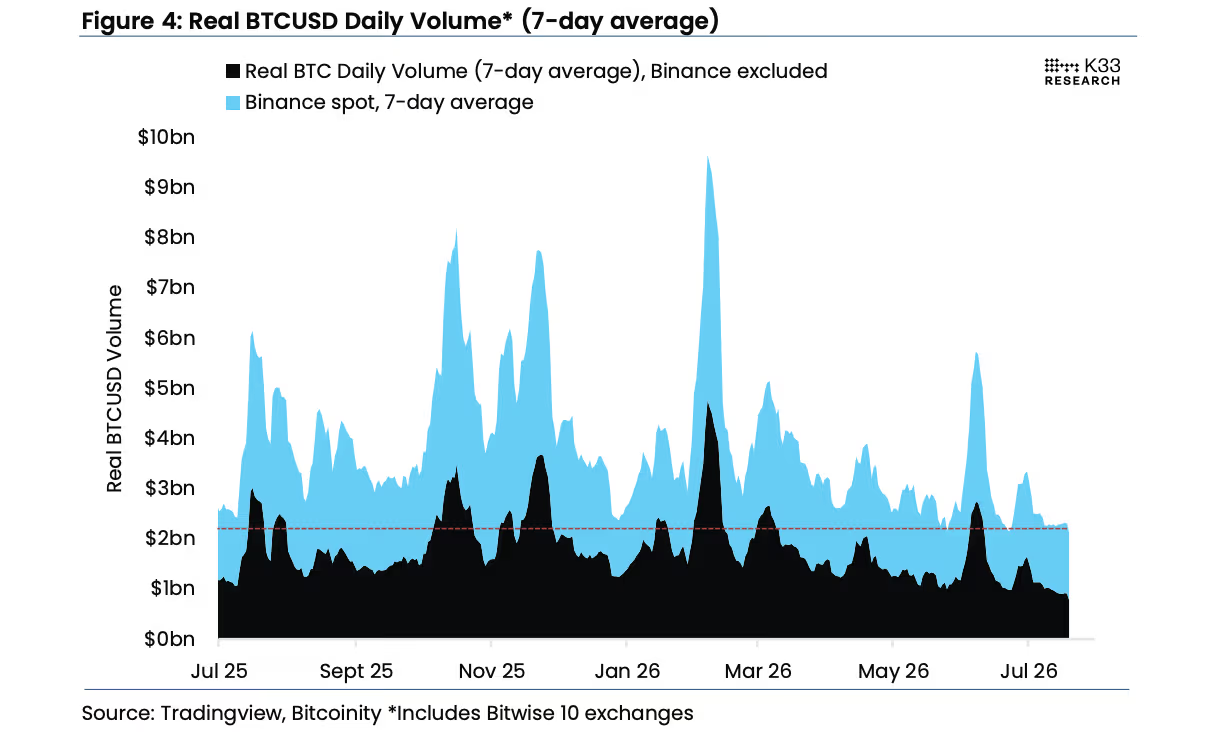
Data from K33 Research paints a similar picture.
Head of research Vetle Lunde said institutional participation has continued to fade, with CME bitcoin futures open interest falling to its lowest level since 2023. Offshore perpetual futures positioning has remained largely unchanged, indicating speculative traders have been reluctant to add leverage despite bitcoin’s recent gains.
Spot trading activity has also stayed slow. Thirty-day bitcoin trading volume is running at just 62% of its annual average, according to K33, and late July has historically been the weakest period of the year. Average daily spot volume over the past week was roughly $2.3 billion, hovering near yearly lows even as prices recovered.

K33 described the backdrop as a “promising, and typical, summer slumber.”

Movement Labs Seeks Chapter 11 After Months of MOVE Token Turmoil

49ers Site Issues Warning about Jauan Jennings

Their family collected scrap for decades. Today, they sell restored furniture worth thousands.


-
 NewsBeat5 days ago
London Mayor Sadiq Khan handed a peerage by Keir Starmer alongside 15 other Labour figures… just days before the PM leaves No10
-

 Fashion4 days ago
Weekend Open Thread – Corporette.com
-

 Politics3 days ago
The House | The City of London can help the new chancellor deliver growth in every postcode
-

 Politics6 days ago
Young campaigners urge incoming PM to act on outdoor junk food ads
-
 Crypto World4 days ago
Two July Windows Left: The CLARITY Act’s Senate Fight and What Failure Means
-

 Crypto World6 days ago
CFTC blocks Kalshi from unwinding Michigan trades after court order
-

 Crypto World3 days ago
Ripple Payments Joins MiCA With 14 Firms, Does It Mean Anything For XRP?
-

 Business6 days ago
Nvidia Stock Slips After Big Tuesday Rally as Huang Confirms Vera Rubin Chip Is Now in Production Today
-

 Politics2 days ago
Democrats look to World Cup watch parties to register thousands of voters
-
 Entertainment6 days ago
Disney’s Most Ambitious Failed Star Wars Attraction Is Coming to SDCC
-

 Crypto World4 days ago
Ripple wins EU-wide access as ESMA adds it to MiCA register
-

 Crypto World13 hours ago
Grayscale Files For Worldcoin ETF, WLD Registers Sharp Rise
-

 Crypto World5 days ago
Injective Submits SEC Transfer-Agent Registration to Onchain Ownership Records
-

 Business6 days ago
Palantir Shares Rise After Expanded Nvidia Partnership and Fresh Analyst Upgrades Ahead of Earnings Day
-

 Tech21 hours ago
Sail Virtually Aboard The “Itanic” With IA-64 Emulator
-
 Tech18 hours ago
Turtle Beach Command Series KB7 review: a nifty screen-equipped gaming keyboard
-

 NewsBeat4 days ago
Registration is now open for March for Men with Kev 2026
-

 NewsBeat1 day ago
Unregistered fitter used Gas Safe logo on business flyers
-
 Sports6 days ago
New Cornerback Enters Vikings Trade Rumor Mill
-

 News Videos5 days ago
Money | Class 12 Economics | CBSE Board Exam 2026-27
You must be logged in to post a comment Login