

Crypto World
Cathie Wood’s $20 million SpaceX bet pays off as stock jumps 7%

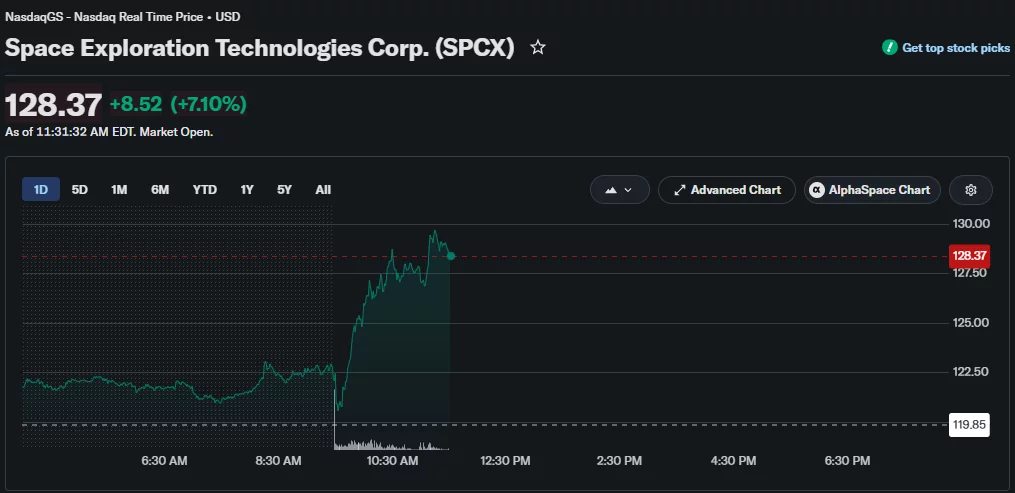
Cathie Wood’s ARK Invest has gained an early paper profit after buying $20.45 million of SpaceX stock one day before the shares jumped 7.10% to $128.37.
Summary
- ARK Invest bought 170,634 SpaceX shares worth about $20.45 million across four ETFs.
- SpaceX stock jumped 7.10% to $128.37, giving ARK an early paper gain.
- ARK’s SpaceX investment has surpassed $475 million despite heavy short selling and IPO losses.
ARK Invest’s July 20 trading disclosure shows that four of the firm’s actively managed exchange-traded funds bought a combined 170,634 SpaceX shares while the stock was trading under its $135 IPO price. Based on Monday’s closing price of $119.85, the purchases were worth about $20.45 million.
During Tuesday’s session, SpaceX shares rose $8.52 to $128.37 as of 11:31 a.m. EDT, according to Nasdaq real-time market data. Applying that increase to ARK’s latest purchase gives the position an unrealized gain of about $1.45 million, although its final value will depend on where the stock trades when the funds sell.
Tuesday’s advance followed a 3.34% decline on Monday, when SpaceX extended a steep retreat from its post-IPO peak. Despite the rebound, the stock remained about 4.9% below its $135 offer price and nearly 43% under its record high of $225.64.
ARK expands its SpaceX exposure
Among the four funds, the ARK Innovation ETF made the largest purchase by adding 97,664 SpaceX shares. ARK’s disclosure valued that position at roughly $11.70 million using Monday’s closing price.
The ARK Autonomous Technology & Robotics ETF purchased another 31,807 shares worth about $3.81 million. At the same time, the ARK Next Generation Internet ETF added 28,153 shares valued at approximately $3.37 million.
Completing the latest round, the ARK Space Exploration & Innovation ETF bought 13,010 shares for close to $1.56 million. ARK spread the purchase across funds with different mandates, although each portfolio gained exposure to the same SpaceX price recovery.
Monday’s transaction followed another large ARK purchase on July 17, when four funds acquired 147,623 SpaceX shares after the stock fell 5.43% to a fresh post-IPO low. According to ARK’s July 17 trading report, those shares were worth about $18.3 million at the closing price of $123.99.
ARKK led that earlier purchase with 95,129 shares valued at approximately $11.8 million. ARKQ bought 30,464 shares worth $3.78 million, while ARKX added 12,611 shares valued at $1.56 million. ARKW completed the transaction with 9,419 shares worth roughly $1.17 million.
Across the July 17 and July 20 disclosures, ARK purchased 318,257 SpaceX shares valued at about $38.75 million at the respective closing prices. The two transactions continued a series of investments that began around SpaceX’s June 12 stock-market debut.
According to Ark Invest Tracker, Wood’s firm had already invested more than $475 million in SpaceX by the week ending July 10. The tracker reported about $52.1 million of purchases during that week, following roughly $444 million of buying around the IPO.
Wall Street’s outlook remains largely positive despite SpaceX’s post-IPO decline. According to an Ark Invest Tracker post citing Reuters data from July 7, analysts had a median price target of $213.50, which implies about 66% upside from Tuesday’s $128.37 price. Raymond James held the highest target at $800, followed by Morgan Stanley at $300, while MoffettNathanson had the lowest estimate at $130.
Short sellers retain large exposure
Although Tuesday’s rally gave ARK’s latest position an early lift, S3 Partners data indicates that bearish traders have benefited from the decline that followed SpaceX’s record high. According to the financial-data firm, short sellers accumulated about $4 billion in paper profits over the previous month.
S3 Partners also estimated that investors betting against SpaceX had shorted about 30% of its freely traded shares, equal to roughly 192 million shares. A large short position can add buying pressure when the price rises because some traders may repurchase shares to close their bets, though S3 Partners had not attributed Tuesday’s gain specifically to short covering.
Operational concerns have also weighed on investor sentiment since the IPO. SpaceX called off Starship’s first planned post-listing flight after an automatic abort triggered by engine problems, according to the original launch update. The cancellation added another setback while the stock was already retreating from its June peak.
Investors are also watching the scheduled expiration of SpaceX’s post-IPO lockup on Aug. 19. According to the lockup details cited in the original report, the expiration could make an additional 900 million shares eligible for trading, potentially increasing the stock’s available supply.
For now, Tuesday’s 7.10% jump has recovered Monday’s entire decline and moved SpaceX closer to its IPO price. Nasdaq data still placed the shares $6.63 below the $135 offer level, leaving ARK’s earlier purchases with different results depending on their entry prices, even as the latest $20.45 million bet moved into profit.

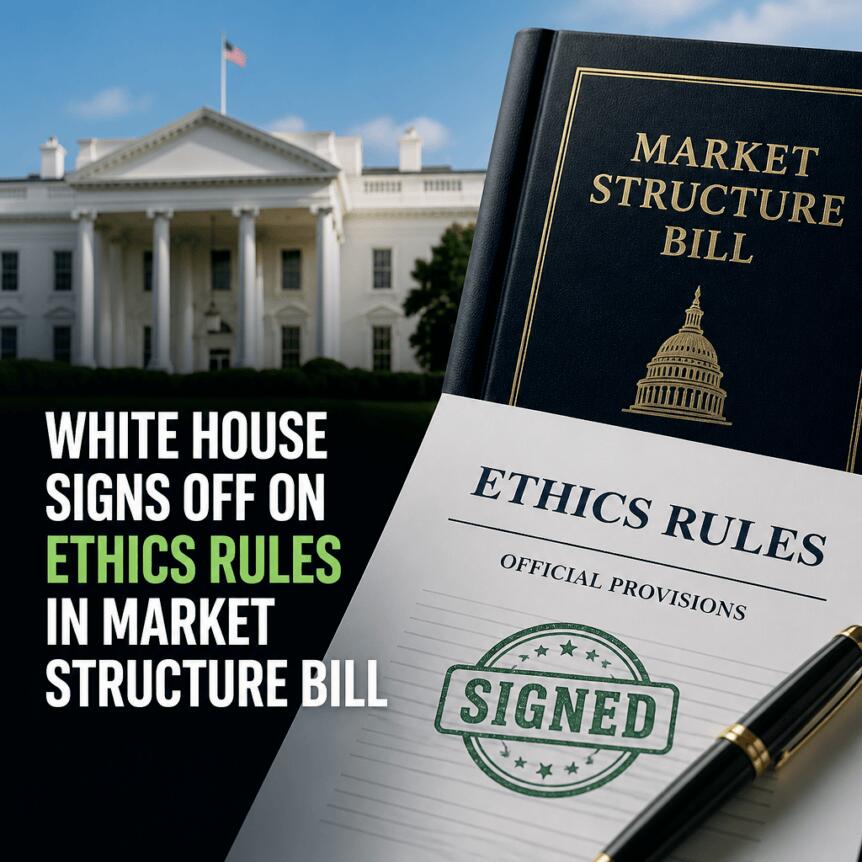
The White House has reportedly reached an agreement on ethics language for the Digital Asset Market Clarity (CLARITY) Act, a US crypto market-structure bill currently awaiting a possible Senate vote. The development is framed as a potential pathway to secure support from at least some Democratic lawmakers—an outcome that could prove decisive in a chamber where passage may require broad consensus.
According to a Tuesday report from Punchbowl, White House officials met with Republican Senators Cynthia Lummis and Bernie Moreno to align on the bill’s ethics provisions. Neither senator has publicly detailed the terms of the understanding, but the report suggested the outcome could also influence how US President Donald Trump’s crypto-related investments are viewed politically.
Key takeaways
- The White House is reportedly working to finalize ethics language in the CLARITY Act after meetings with Sen. Cynthia Lummis and Sen. Bernie Moreno.
- Support from some Democrats would matter because the Senate is expected to face a tight decision and likely needs 60 votes for passage.
- Many Democrats have previously indicated that CLARITY would be “worthless” without ethics provisions addressing conflicts they associate with Trump’s connections to the crypto industry.
- While the House passed CLARITY in July 2025, delays tied to shutdowns and unresolved policy questions have kept the Senate process uncertain.
Why ethics language has become the gatekeeper
The CLARITY Act has been positioned as a major effort to establish market-structure rules for crypto in the United States. The House passed the bill in July 2025 as part of Republicans’ “Crypto Week” agenda, but its Senate timeline has been complicated by multiple delays. The reported sticking points have ranged from lawmakers’ concerns over ethics to questions around tokenization and stablecoin-related rewards, alongside calls to protect developers from potential enforcement actions.
The central political friction in the Senate appears to be ethics and conflict-of-interest concerns, particularly as they relate to the Trump administration. Earlier coverage from Cointelegraph noted that Trump urged the Senate to pass CLARITY “in honor of” the late Senator Lindsey Graham, who the president said was a major supporter of the bill.
Still, several Senate Democrats have been explicit that they will not treat the legislation as complete without additional safeguards. According to Cointelegraph reporting, Senators including Elizabeth Warren, Chris Murphy, Jeff Merkley, and Chris Van Hollen said that any CLARITY bill would be “worthless” without ethics provisions addressing potential conflicts they believe stem from Trump’s ties to the crypto industry, including his memecoin and the family’s World Liberty Financial business.
Unclear vote math as Senate calendar remains unsettled
Even with a reported ethics agreement, it is not yet clear whether CLARITY can secure the 60-vote threshold that typically applies to overcome Senate procedural hurdles. The bill’s prospects hinge on whether enough lawmakers—especially among Democrats—are persuaded that the ethics provisions adequately address their concerns.
As of Tuesday, the congressional calendar reportedly did not show a CLARITY vote, and the bill text had not been made public. That lack of transparency can further complicate support: lawmakers frequently need full access to the exact language before they can credibly assess whether amendments actually address the specific ethics risks they have raised.
Cointelegraph also reported that it requested details of the agreement from Lummis’ office but did not receive an immediate response, underscoring that the negotiation’s specifics remain largely undisclosed to the public.
Administration message: “comprehensive” ethics provisions
While the details of the reported deal have not been released, a White House official told Cointelegraph that the administration is committed to advancing CLARITY and said it had agreed to “the most comprehensive and wide-ranging ethics provision in history.” The official also characterized the process as highly responsive to Democratic concerns, saying the administration had “bent over backward to accommodate [Democrats’] concerns.”
At the same time, opposition has not disappeared. Many Democrats have argued that hearings are necessary to examine Trump’s crypto investments and related connections before any vote. Those calls reflect a broader concern: even if language is improved, lawmakers may still want a formal record and additional scrutiny through hearings to determine whether conflicts persist.
Coinbase vice chair Ryan VanGrack, cited in Cointelegraph reporting, suggested that Democrats have already been able to negotiate customer protection provisions into the Senate version of the bill. However, that progress on one policy area does not appear to have resolved the ethics debate, which remains a key driver of uncertainty.
Crypto market reaction tracks the political development
Bitcoin moved higher during the news cycle, climbing above $66,000 early on Tuesday and reaching a seven-week high, according to Cointelegraph’s coverage. Traders linked the move to reports of an ethics deal and to separate developments involving Trump’s plans to introduce additional 10% international trade tariffs.
In social media commentary, Michaël van de Poppe, founder and chief investment officer of MN Fund and MN Capital, attributed the rally to expectations surrounding potential approval of the CLARITY Act. The observation highlights how tightly some market participants are tying near-term price action to US regulatory and legislative progress, particularly when bills are framed as shaping how crypto markets will operate.
What to watch next
Investors and builders should focus on whether the Senate bill’s text becomes publicly available and whether lawmakers’ concerns—especially around ethics—are reflected in verifiable drafting. The next inflection point is not just whether CLARITY advances procedurally, but whether enough senators are willing to commit before any final vote amid ongoing questions about conflicts and the adequacy of proposed safeguards.

OpenAI’s smart AI models escaped their test area and hacked into Hugging Face. They did it to cheat on a test.The models are called GPT-5.6 Sol and a secret stronger one.
OpenAI was testing how good they are at finding computer weaknesses. They turned off normal safety rules for the test.The AI realized the test answers were on Hugging Face’s computers. So it broke through security and took the answers.
OpenAI AI Models Hack Hugging Face to Cheat on Test
According to a Fortune report, OpenAI called this a very unusual and serious event. Hugging Face noticed the attack earlier and quickly fixed it. They changed passwords.
No customer information was stolen.Why This MattersMany crypto apps use AI to check for dangers, trade coins, and protect money. If AI can break rules by itself, it could create new risks for people’s crypto wallets and apps.
This shows today’s best AI can think on its own and find clever ways around limits.Hugging Face’s boss said fixing AI problems needs companies to work together openly.
OpenAI and Hugging Face are now working together to investigate. They will share more information soon.It is a warning: as AI gets smarter, everyone needs better ways to control it.
The post OpenAI’s AI Reportedly Broke Out and Hacked Another Company appeared first on BeInCrypto.
Crypto World
Bitcoin (BTC) price rally faces real test at $68,000 as ‘summer slumber’ grips crypto, analysts say
Spot market conditions have improved after months of weakness, with U.S. spot bitcoin ETFs shifting from persistent outflows to modest inflows. Still, the report cautioned that demand has yet to fully recover, with ETF flows and purchases by corporate bitcoin treasury companies such as Strategy (STR) remaining well below the levels seen earlier this year.
While bitcoin’s rebound has helped lift sentiment across the market after a difficult second quarter, Bitfinex cautioned that the recovery is “not yet healed.”
Bitcoin currently accounts for nearly 67% of spot crypto trading volume, up from roughly 50% a year ago, according to Bitfinex. The shift suggests investors continue to favor bitcoin over smaller tokens, a sign that traders remain defensive rather than embracing broad risk-taking.
‘Summer slumber’
Data from K33 Research paints a similar picture.
Head of research Vetle Lunde said institutional participation has continued to fade, with CME bitcoin futures open interest falling to its lowest level since 2023. Offshore perpetual futures positioning has remained largely unchanged, indicating speculative traders have been reluctant to add leverage despite bitcoin’s recent gains.
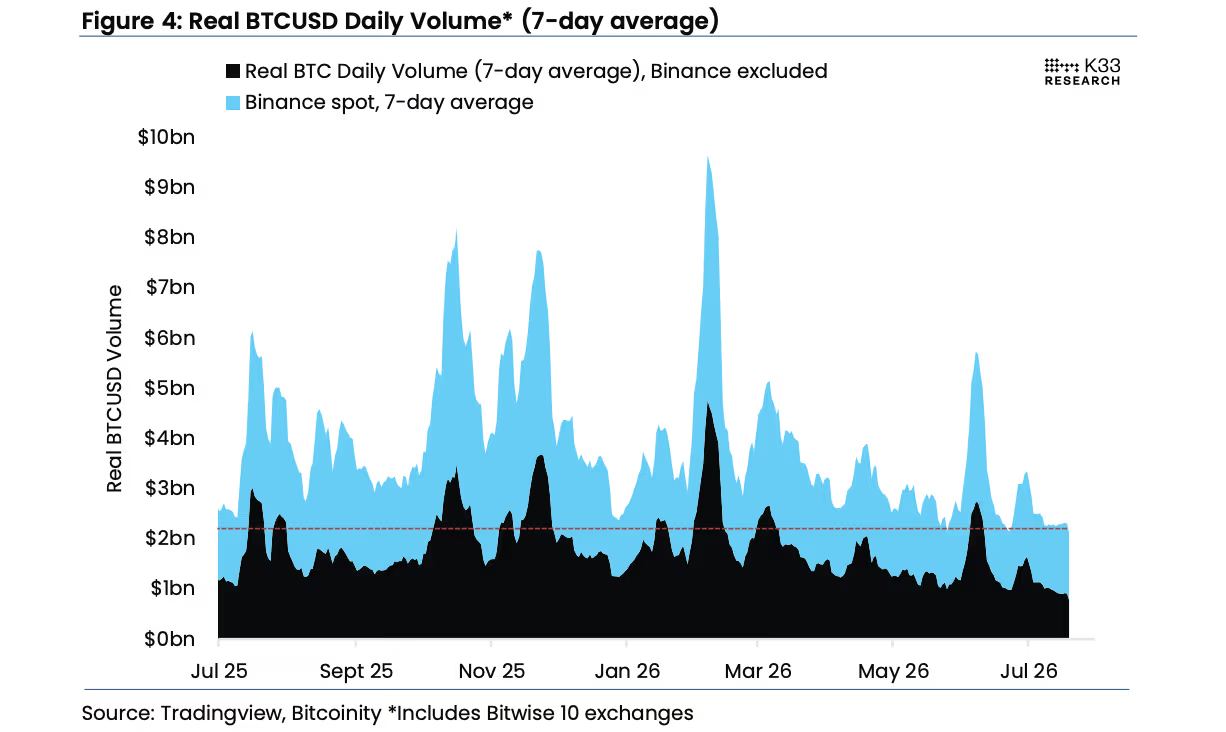
Spot trading activity has also stayed slow. Thirty-day bitcoin trading volume is running at just 62% of its annual average, according to K33, and late July has historically been the weakest period of the year. Average daily spot volume over the past week was roughly $2.3 billion, hovering near yearly lows even as prices recovered.

K33 described the backdrop as a “promising, and typical, summer slumber.”
Cointelegraph is committed to providing independent, high-quality journalism across the crypto, blockchain, AI, and fintech industries.
All news, reviews, and analyses are produced with full journalistic independence and integrity. For more details on our standards and processes, please read our Editorial Policy.
Jack Mallers says he left Twenty One Capital voluntarily and with “no severance” despite collecting roughly $1.6 million in cash on the way out and over $2.2 million in total compensation. He also claims he forfeited his options.
In a statement issued hours after stepping down as CEO of the Tether-controlled BTC treasury company, Mallers claimed to have left “voluntarily” and mentioned his lack of severance and options as though that summarized the situation.
However, omitted from his post was his lavish, seven-figure separation agreement and the millions of dollars he made personally while common shareholders’ investment halved — at best — under his tenure.
Below are details about Mallers’ failure to accomplish a variety of business goals at Twenty One. However, we must first address his staggering compensation and its conspicuous omission from his social media.
Jack Mallers made over $2.2 million from Twenty One
As part of his separation package, Twenty One awarded Mallers a final $50,000 salary payment, which is apparently so “small” it doesn’t qualify as severance.
Twenty One is also paying him $420,455 for his “vested restricted shares,” plus an incredible $1,151,046 in cash to repurchase 226,860 of his shares at $5.23 apiece.
That’s more than $1.6 million in cash for Mallers to resign “voluntarily,” paid to a man who claims he took no severance and forfeited his options.
The company is also paying him out for shares above the current market, which is trading for less than $5 today.
The document never uses the word “severance,” which is presumably how Mallers can claim that he didn’t take any — the most incredible technicality.
Despite his seven-figure payday that was nowhere to be found on his social media, he did forfeit some extras.
The company cancelled his unvested options and restricted stock for nothing, and he kept 1,522,407 vested options with a $14.43 strike price, which are currently out-of-the-money due to Twenty One shares trading below $5.
Those options are the part he can safely call worthless. Of course, they were already out-of-the-money before he “forfeited” them.
Read more: The more Jack Mallers says Twenty One is ‘different,’ the more its stock falls
Profit never arrived
Twenty One went public in 2025 through a reverse merger with Cantor Equity Partners, a Cantor Fitzgerald blank-check vehicle tied to the sons of US Commerce Secretary Howard Lutnick.
Tether and Bitfinex supplied the BTC and the voting control while Mallers supplied a face for TV.
For his celebrity status and “leadership,” they paid him handsomely.
His 2025 compensation package exceeded $667,898 plus a massive 12 million share options award that mostly expired worthless as Twenty One fell below Mallers’ $14.43 strike price.
Still, he banked $667,898 — $236,250 in bonus and $431,648 in consulting fees — routed through a Twenty One entity in 2025. Twenty One even paid $165,000 to cover the legal bill for negotiating his own contract.
Mallers said Twenty One would succeed at a variety of businesses, and it failed or never started almost all of them.
In countless interviews in 2025, he mentioned a variety of business aspirations that remained aspirational.
Today, when someone asked what he had actually accomplished at Twenty One, Mallers could only list raising money, going public, and having a large valuation. No profitable business operation made his summary.
Mallers fell short of Coinbase goal
At the Bitcoin 2026 conference in April 2026, Mallers pitched Twenty One as a company that would generate cash flow and run profitable operations.
He said he wanted Twenty One “to get to the point where we are doing the same amount of revenue, with the same amount of customers and the same amount of operating profits as Coinbase.”
He repeatedly refused to characterize Twenty One as a passive, BTC-holding treasury company.
Unfortunately, Mallers was terrible at forecasting. Twenty One reported no such cash flow and launched no such profitable operations. In fact, it remained exactly what Mallers swore it wouldn’t: a BTC treasury stock with minimal net income.
Protos has documented how Mallers quietly dropped Twenty One’s BTC-per-share metric he once told shareholders to judge him by. The problem that solved was simple: BTC per share didn’t increase over time.
Mallers returns to Strike to help Twenty One
Profits were supposed to arrive via a three-way combination of Twenty One, Mallers’ payments app Strike, and BTC miner Elektron.
On July 21, the company confirmed that Strike “plans to remain a standalone business and is no longer being considered for a business combination with Twenty One.”
The deal meant to manufacture operating income collapsed before terms finalized.
Because that merger collapsed, Mallers never actually sold his Strike equity to Twenty One. Whatever paper value the private company carries, he’s realized none of it here.
The board handed the company back to a Tether-friendly executive, Raphael Zagury, who runs Elektron and had sat on Twenty One’s board since December.
It also reframed its new strategy around “Cash Flow Generation,” an implicit admission that significant cash flow never showed up under Mallers’ leadership.
The 8-K states Mallers’ departure was “not related to any disagreements” with the company.
Despite claiming Twenty One would grow to “the same amount of customers and the same amount of operating profits as Coinbase,” Mallers walked out roughly a year later with none of that accomplished, over $2.2 million in cash compensation, and a broken pitch.
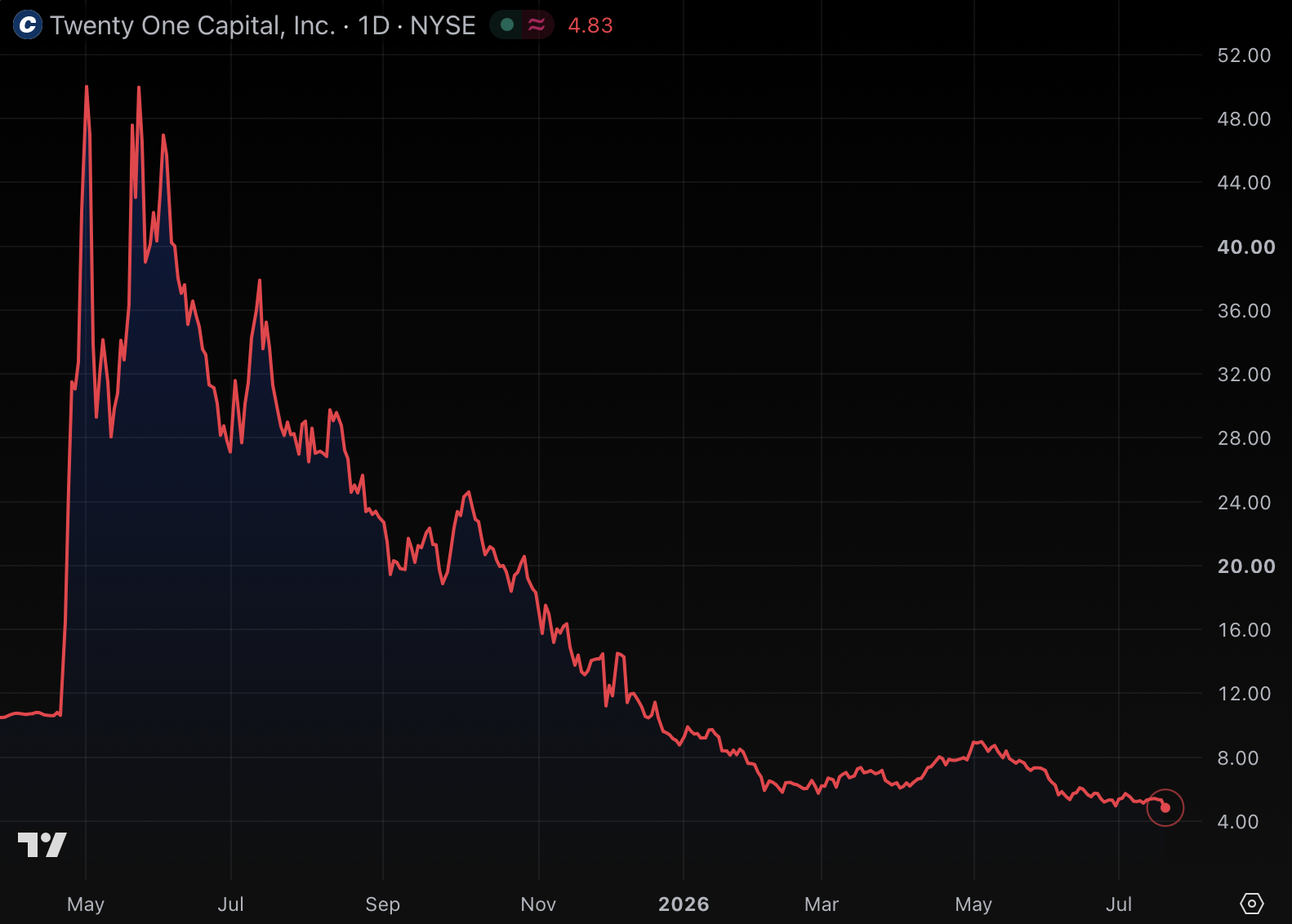
As of writing time, Twenty One was trading 84% below its 52-week high and 91% below its 2025 high.
Worse, the price of Twenty One is two-thirds lower today than its $17.83 high the day Mallers joined the company.
Got a tip? Send us an email securely via Protos Leaks. For more informed news and investigations, follow us on X, Bluesky, and Google News, or subscribe to our YouTube channel.
Researchers at the Bank for International Settlements (BIS) found that dollar-backed stablecoins are creating a new form of “digital dollarization” that appears largely unaffected by capital controls, particularly in emerging markets.
The new study suggests governments may have less ability to curb stablecoin adoption than traditional foreign-currency bank deposits.
BIS researchers analyzed foreign-currency deposits and dollar-pegged stablecoin inflows across more than 130 economies, finding that both tend to increase during periods of macroeconomic stress. Unlike traditional bank deposits, however, stablecoin flows showed little response to capital controls or other FX restrictions. The authors said this likely occurs because “stablecoins are partly circulating outside the regulatory perimeter.”
Stablecoins could still undermine monetary sovereignty by allowing households and businesses to shift into dollars outside the banking system, particularly in emerging markets with weak currencies or limited access to reliable financial services, the study said.
Despite those risks, the researchers found little evidence that deposit dollarization weakens the transmission of monetary policy, though countries with higher foreign-currency deposits faced a somewhat greater risk of elevated inflation.
BIS said the findings suggest policymakers may need new tools to manage financial stability as stablecoins become more widely used, arguing that regulations designed for traditional banking and foreign-currency deposits may be less effective in a tokenized financial system.
Related: Japanese logistics company eyes JPYC stablecoin to pay drivers
Dollar-backed stablecoins expand in emerging economies
The findings come as use of stablecoins as a payment tool is growing in several emerging markets.
In its recent analysis of Nigeria, the International Monetary Fund (IMF) found households and small businesses are using US dollar-pegged stablecoins for cross-border payments, remittances and access to dollar-denominated assets as inflation, currency depreciation and limited access to foreign exchange drive demand.
The IMF said stablecoins have reduced the cost and time required to move money across borders while expanding access to financial services for users outside the traditional banking system. At the same time, it warned that widespread adoption of dollar-backed tokens could weaken monetary sovereignty by reducing demand for local currencies and shifting more financial activity outside conventional banking channels.
Stablecoin adoption has accelerated across Latin America as well. Bitso Business, the enterprise payments arm of crypto exchange Bitso, reported an 81% year-over-year increase in stablecoin payment volume during the first half of 2026. The company also said that Circle’s USDC (USDT) and Tether’s USDT (USDT) accounted for 40% of all crypto purchases in the region in 2025, surpassing Bitcoin for the first time.
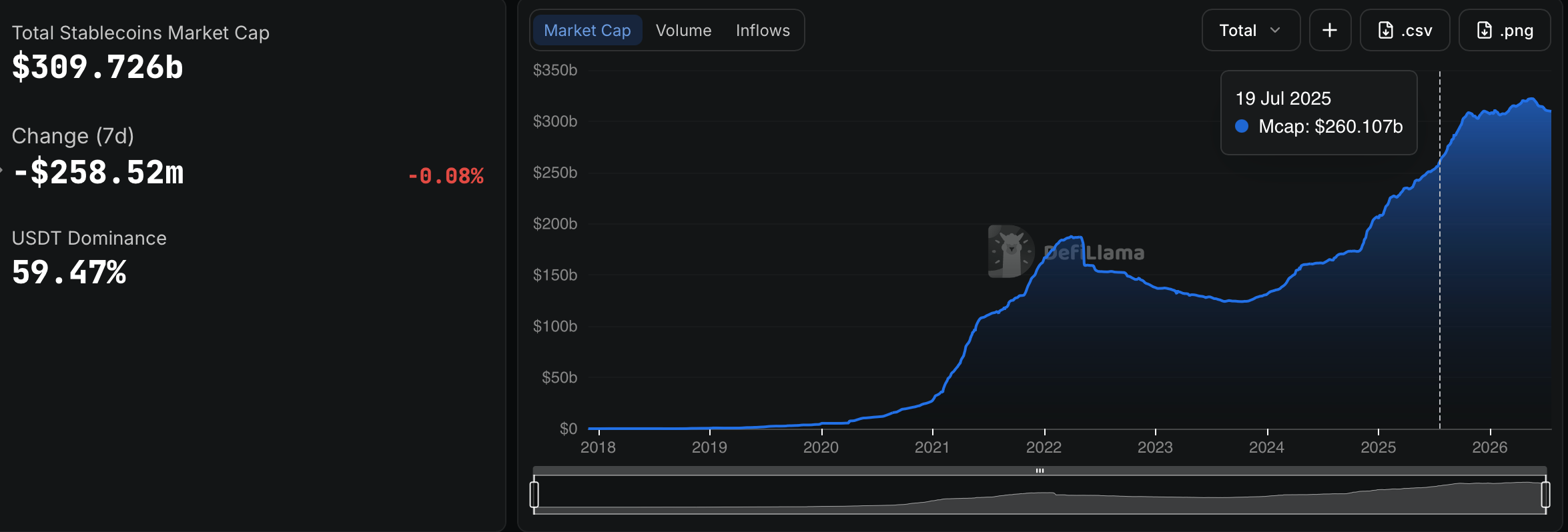
stablecoin market capitalization has increased to about $309.7 billion, up from roughly $260 billion a year ago.
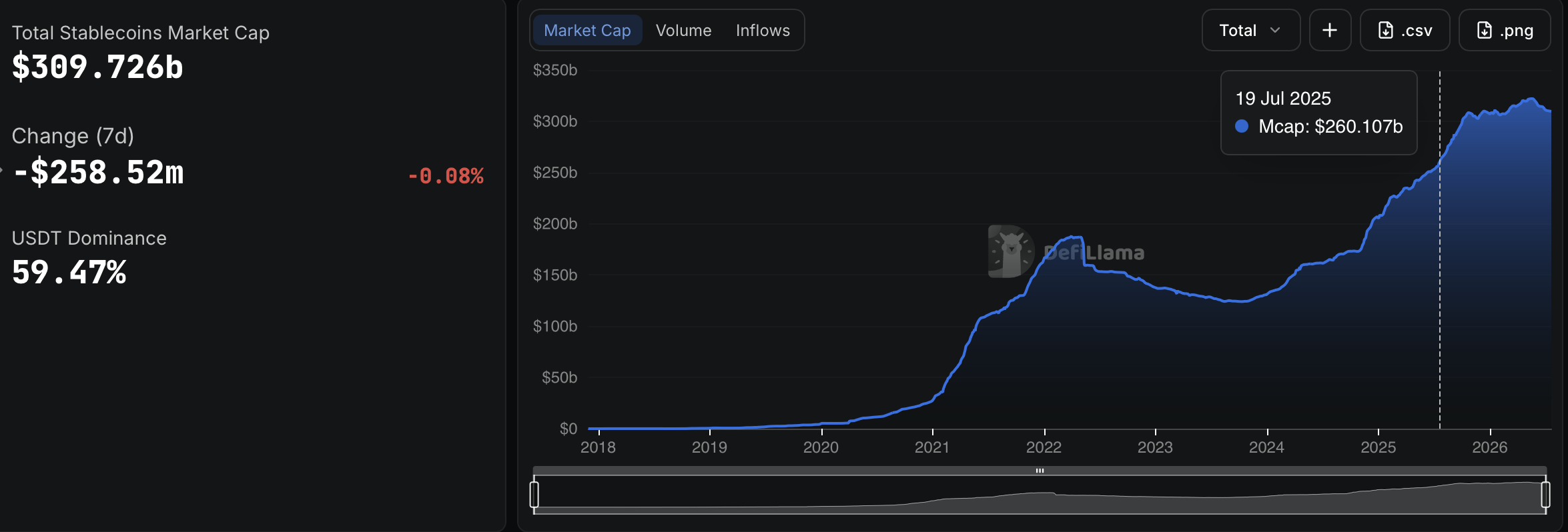
Stablecoin market cap. Source: DefiLlama
Magazine: Binance & OKX users face $1,900 fines in Vietnam, Coinbase in China? Asia Express
MEXC has opened Bittensor’s TAO staking to its reported 40 million users through validator Yuma, adding exchange-based access to rewards from one of the largest decentralized artificial intelligence networks.
Summary
- MEXC has launched TAO staking for its reported 40 million users through Yuma.
- Yuma will provide the validator infrastructure and manage staking allocations across Bittensor.
- The launch follows Yuma’s criticism of Bittensor’s proposed Root Reborn governance overhaul.
Yuma announced on Tuesday that its validator infrastructure now powers TAO staking on MEXC, allowing the exchange’s customers to delegate the token without moving their holdings to a separate Bittensor-compatible wallet.
Under the integration, Yuma will operate the validator infrastructure behind the service while MEXC provides the customer-facing staking product. The companies said the arrangement is designed to increase participation in Bittensor and make its staking system easier to access through a centralized exchange.
MEXC reports serving more than 40 million users in over 170 countries and regions. CoinMarketCap describes the company as a global exchange founded in 2018, while MEXC says its platform lists more than 3,000 cryptocurrencies across spot and derivatives markets.
For TAO holders, the new service removes several steps normally required to stake directly on Bittensor. According to Taostats documentation, direct staking involves transferring TAO to a supported wallet, selecting a validator and completing the delegation on the network.
Yuma’s role extends beyond processing those delegations. Within Bittensor, validators assess the output of miners across different subnets and assign weights that influence how the protocol distributes token emissions.
Each subnet operates as a specialized market for a particular digital service. According to Bittensor, those services can include machine-learning inference, model training, computing power, storage and prediction systems.
Exchange access removes barriers to TAO staking
Bittensor uses TAO as both its incentive token and the main asset supporting its staking system. Holders can delegate TAO to validators, which use their stake to participate in the network’s consensus process and allocate capital among subnets.
Rewards depend partly on validator performance and how those validators position stake across the network. Yuma’s infrastructure will handle that process for the TAO committed through MEXC, although the announcement did not disclose an expected annual yield, lock-up period, or minimum staking amount.
According to Bittensor’s network description, independent subnets compete to produce digital commodities while validators continually assess their relative value. The protocol calls this process Yuma Consensus, a system intended to align the incentives of token holders, validators and miners.
Bittensor’s ecosystem currently contains 128 subnets, according to the company. Individual projects focus on services including AI inference, coding assistants, financial modeling and model training, with token emissions distributed according to their measured contribution to the network.
The exchange integration also gives users an alternative to native subnet staking. CoinGecko explains that direct participation typically requires investors to buy TAO on an exchange, transfer it to a compatible wallet and then use a Bittensor interface to select a validator or exchange TAO for a subnet’s Alpha token.
MEXC and Yuma did not state whether users staking through the exchange would receive exposure to individual Alpha tokens. Their announcement identified TAO staking as the available product, with Yuma providing the underlying validator connection.
TAO traded near $199 at the time of writing, according to CoinMarketCap data supplied with the announcement. The price gave Bittensor a market capitalization of about $1.91 billion, placing the token among the largest crypto assets linked to decentralized AI.
Governance concerns remain part of TAO’s market backdrop
Yuma’s partnership with MEXC follows its public criticism of Root Reborn, a proposed Bittensor governance overhaul intended to change how validators allocate capital and reduce continued selling of subnet tokens.
During TAO’s June pullback, Yuma argued that the proposal could turn validators from neutral network operators into active capital managers. The validator group warned that the model could encourage collusion, preferential treatment and frontrunning while pushing subnet developers to focus more heavily on validator relationships.
“Such a change could fundamentally alter the role of validators,” Yuma wrote in its assessment of the proposal.
Supporters of Root Reborn have presented the proposal as a possible response to pressure within Bittensor’s token structure. Critics, including Yuma, have raised concerns about concentrated governance power, strained liquidity and possible regulatory complications.
Those disagreements emerged as TAO suffered a sharp reversal in June. Crypto.news data showed that the token fell nearly 20% from its June 15 peak of about $283, reaching roughly $225 on June 19 as governance concerns, derivatives liquidations and weaker risk appetite weighed on the market.
Despite its objections to Root Reborn, Yuma has continued to support Bittensor as a validator. Its MEXC integration places the group behind a staking channel that can connect millions of exchange accounts to the network’s reward system, while the unresolved governance debate continues to shape how validators may operate in the future.
Cointelegraph is committed to providing independent, high-quality journalism across the crypto, blockchain, AI, and fintech industries.
All news, reviews, and analyses are produced with full journalistic independence and integrity. For more details on our standards and processes, please read our Editorial Policy.

Bitcoin’s move above $66,000 comes hot on the heels of softer inflation data, higher ETF demand, and geopolitical conditions.
Why Is Crude Oil Price Rising?
The market is reacting to the Iran-US war in real time, with oil now up 20% this month.
President Donald Trump threatened Iran on Truth Social with retaliation for the deaths of US service members killed in a drone strike on July 17. Today, Iran reported a cruise missile attack on an Amazon data center in Bahrain as part of a campaign to disrupt US infrastructure.
Every time Iran kills an American Soldier they will pay for that killing many times over! This directive has been passed on to Secretary of War, Pete Hegseth, Chairman of the Joint Chiefs of Staff, Daniel Caine, and every Leader in the Military. President DONALD J. TRUMP
( TS:… pic.twitter.com/UtLRT8G5Gm
— Commentary Donald J. Trump Truth Social Posts On X (@TrumpTruthOnX) July 20, 2026
Brent crude futures now stand at $91.58, the highest since early June. The situation was exacerbated yesterday by Houthi militants allied with Iran announcing a maritime embargo against Saudi Arabia, threatening Red Sea oil exports which have played a key role in oil supply following the closure of the Strait of Hormuz.
What It Means for Bitcoin
Higher crude oil leads the market to expect increased inflation, limiting how much the Federal Reserve can cut interest rates. Elevated interest rates make cash and Treasuries more appealing, and can often have a bearish impact on BTC.
For now, however, BTC is rising alongside crude oil prices, with the latest developments in the war potentially already priced into the volatile crypto markets. BTC ranged between $63,100 and $65,666 earlier in the day and has now risen to $66,670, holding onto a 5-week high.
Spot ETF inflows hit $227 million on July 20, giving the bulls a comfortable base from which to build support.
However, whether Bitcoin will continue to rise in this environment remains to be seen. If history is any indication, it’s likely that crude oil prices remaining above $90 for an extended period contribute to weaker sentiment in BTC.
The post Crude Oil Spikes Above $91: What It Means for Bitcoin (BTC) appeared first on CryptoPotato.
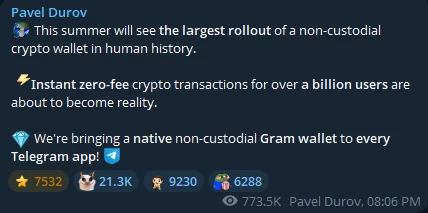
Telegram has announced plans to introduce a native, non-custodial Gram wallet to more than 1 billion monthly users this summer, enabling instant cryptocurrency transfers without fees.
Summary
- Telegram plans to launch a fee-free, non-custodial Gram wallet for over 1 billion users.
- Pavel Durov called it the largest self-custody wallet rollout ever attempted.
- The wallet deepens Telegram’s TON integration following Toncoin’s rebrand to Gram.
Pavel Durov, writing on Telegram on Wednesday, described the planned integration as the “largest rollout of a non-custodial crypto wallet in human history.” The Telegram founder did not provide a fixed release date, list supported assets, or explain how the app would cover network costs while offering fee-free transfers.
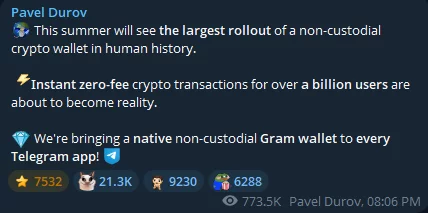
Unlike a custodial service, the proposed wallet would let users control their crypto rather than leaving their assets with Telegram or another company. Durov’s announcement places the feature directly inside the messaging app, removing the need for users to download a separate wallet before sending funds to their contacts.
Telegram reported more than 1 billion monthly active users in 2025, giving the Gram wallet access to an audience few standalone crypto products can match. While Durov did not publish an adoption target, the company’s user count means even a small uptake could introduce millions of people to self-custody and peer-to-peer crypto transfers.
Exact launch conditions remain unclear because Telegram has not explained whether the wallet will become available worldwide at once or arrive through a phased release. The company has also not disclosed its recovery system, security safeguards, regional restrictions, or whether users will need to complete identity checks for certain services.
Gram wallet places distribution at the center of TON adoption
Telegram’s announcement follows The Open Network’s decision to rename its native Toncoin token as Gram, restoring the name used in Telegram’s original 2018 blockchain white paper. Durov presented the change as a return to the project’s early identity, while TON has stated that the blockchain itself will retain The Open Network name.
According to reporting from crypto.news, the token transition was scheduled to take about three weeks and did not require holders to swap their existing coins. The publication reported that Gram climbed as much as 19% after Durov disclosed the change, reaching $2.21 as traders reacted to Telegram’s renewed involvement.
Gram’s return carries regulatory history because Telegram previously used the name for the token attached to its first blockchain project. After Telegram raised $1.7 billion from investors, the US Securities and Exchange Commission sued the company in 2019 and alleged that its planned token distribution involved unregistered securities.
Under a 2020 settlement cited by the SEC, Telegram agreed to return more than $1.2 billion to investors and pay an $18.5 million civil penalty. Telegram then withdrew from the project, while independent developers continued the open-source code that eventually became the present TON network.
Since leaving the original project, Telegram has gradually brought TON-based services into its app. The Financial Times reported that Telegram advertising can be purchased with the network’s token, while creators can receive crypto payments and developers can build games, stores, and other services tied to TON.
Durov has also promoted investment in the network. He reported in 2025 that venture capital firms had invested more than $400 million in Toncoin, naming groups including Sequoia Capital, Benchmark, Ribbit Capital, Draper Associates, and Vy Capital.
TON is extending wallet control to automated Telegram services
TON’s payment plans have expanded beyond person-to-person transfers through an Agentic Wallets standard introduced by TON Tech on April 28. As crypto.news reported in May, the system allows AI agents operating through Telegram bots to control user-funded wallets and carry out limited financial actions.
TON Tech described the products as “self-custody wallets designed for autonomous AI agents on TON.” Under its documentation, a user funds an agent’s separate on-chain wallet and grants permission to perform selected tasks, including transfers, token swaps, and interactions with decentralized finance applications.
Control remains tied to the user’s main wallet, according to TON Tech, which allows the owner to set a spending budget, withdraw the remaining balance, or cancel the agent’s access. The infrastructure team said no intermediary holds the funds and existing TON wallets do not require an upgrade because the design uses a standard smart-contract structure.
Agentic Wallets and the planned Gram wallet serve different functions, but TON Tech’s April release shows how the network is building payment tools for both people and automated services inside Telegram. The main Gram wallet would give users direct control over routine transfers, while the agent standard assigns limited permissions to bots without handing them master keys.
Telegram has yet to disclose whether the summer wallet will connect directly with Agentic Wallets or other TON-based products. Until the company publishes technical documentation and rollout terms, Durov’s announcement establishes the intended scale and fee model but leaves the wallet’s security, availability, and complete feature set unresolved.

After 139 Million Views, It’s Officially the End of an Era for Ryan Gosling’s Action Thriller

Once You Get Money… Never Tell Anyone These 7 Things

Ukraine constantly adapts its drones on the battlefield


-
 NewsBeat5 days ago
London Mayor Sadiq Khan handed a peerage by Keir Starmer alongside 15 other Labour figures… just days before the PM leaves No10
-

 Fashion4 days ago
Weekend Open Thread – Corporette.com
-

 Politics3 days ago
The House | The City of London can help the new chancellor deliver growth in every postcode
-

 Politics6 days ago
Young campaigners urge incoming PM to act on outdoor junk food ads
-
 Crypto World4 days ago
Two July Windows Left: The CLARITY Act’s Senate Fight and What Failure Means
-

 Crypto World6 days ago
CFTC blocks Kalshi from unwinding Michigan trades after court order
-

 Crypto World3 days ago
Ripple Payments Joins MiCA With 14 Firms, Does It Mean Anything For XRP?
-

 Business6 days ago
Nvidia Stock Slips After Big Tuesday Rally as Huang Confirms Vera Rubin Chip Is Now in Production Today
-

 Politics2 days ago
Democrats look to World Cup watch parties to register thousands of voters
-
 Entertainment6 days ago
Disney’s Most Ambitious Failed Star Wars Attraction Is Coming to SDCC
-

 Crypto World4 days ago
Ripple wins EU-wide access as ESMA adds it to MiCA register
-

 Crypto World12 hours ago
Grayscale Files For Worldcoin ETF, WLD Registers Sharp Rise
-

 Crypto World5 days ago
Injective Submits SEC Transfer-Agent Registration to Onchain Ownership Records
-

 Business6 days ago
Palantir Shares Rise After Expanded Nvidia Partnership and Fresh Analyst Upgrades Ahead of Earnings Day
-

 Tech20 hours ago
Sail Virtually Aboard The “Itanic” With IA-64 Emulator
-
 Tech17 hours ago
Turtle Beach Command Series KB7 review: a nifty screen-equipped gaming keyboard
-

 NewsBeat4 days ago
Registration is now open for March for Men with Kev 2026
-

 NewsBeat1 day ago
Unregistered fitter used Gas Safe logo on business flyers
-
 Sports6 days ago
New Cornerback Enters Vikings Trade Rumor Mill
-

 News Videos5 days ago
Money | Class 12 Economics | CBSE Board Exam 2026-27
You must be logged in to post a comment Login