

Crypto World
Analyst With 80% Success Rate Names 3 Energy Stocks to Watch


US oil refiners are booming, and Wall Street’s 10th-ranked analyst just named three energy stocks to watch to play the run. The margin refiners earn by turning crude into fuel hit a record, and none of his three picks are the oil majors everyone knows.
That analyst is Raymond James’ Justin Jenkins, who has an 80% success rate.

He reiterated Buy on three mid-cap refiners, so BeInCrypto checked the money flow behind each to see which call holds up.
Delek US Holdings (NYSE: DK)
Delek is the most refining-focused of the three, with little diversification to steady other energy stocks on the list. That makes it the most direct bet on the record crack spread, the gap between what refiners pay for crude oil and what they earn on gasoline and diesel.

That spread hit a record near $59 a barrel in July, nearly triple where it started the year. So Delek can print cash even if crude goes nowhere.
Jenkins reiterated a Buy with a $70 price target on July 13. One more bank leans bullish. Goldman Sachs lifted its target to $73 on July 17.
JPMorgan, however, raised its number to $62 (already hit) but stayed on Hold. The stock is already up about 127% this year.

Meanwhile, the chart backs the call. Chaikin Money Flow (CMF), a proxy for institutional buying and selling, broke out of a falling channel in late June.
It then pushed above its early-March peak in mid-July. That shows large buyers accumulating just as Jenkins made his call.

Therefore, Delek offers the cleanest setup. Jenkins’ $70 target sits about 4% above the recent price near $67, and Goldman’s $73 is the more bullish case.
The main risk is the crack spread itself, since that’s where refiners make their money. Because Delek leans so heavily on refining, a sharp drop in it would hit the stock harder than the more diversified names, and spreads this wide rarely last.
HF Sinclair (NYSE: DINO)
HF Sinclair is the largest and steadiest of the trio, spanning refining, marketing, and renewables. Yet its bull case looks the most stretched.
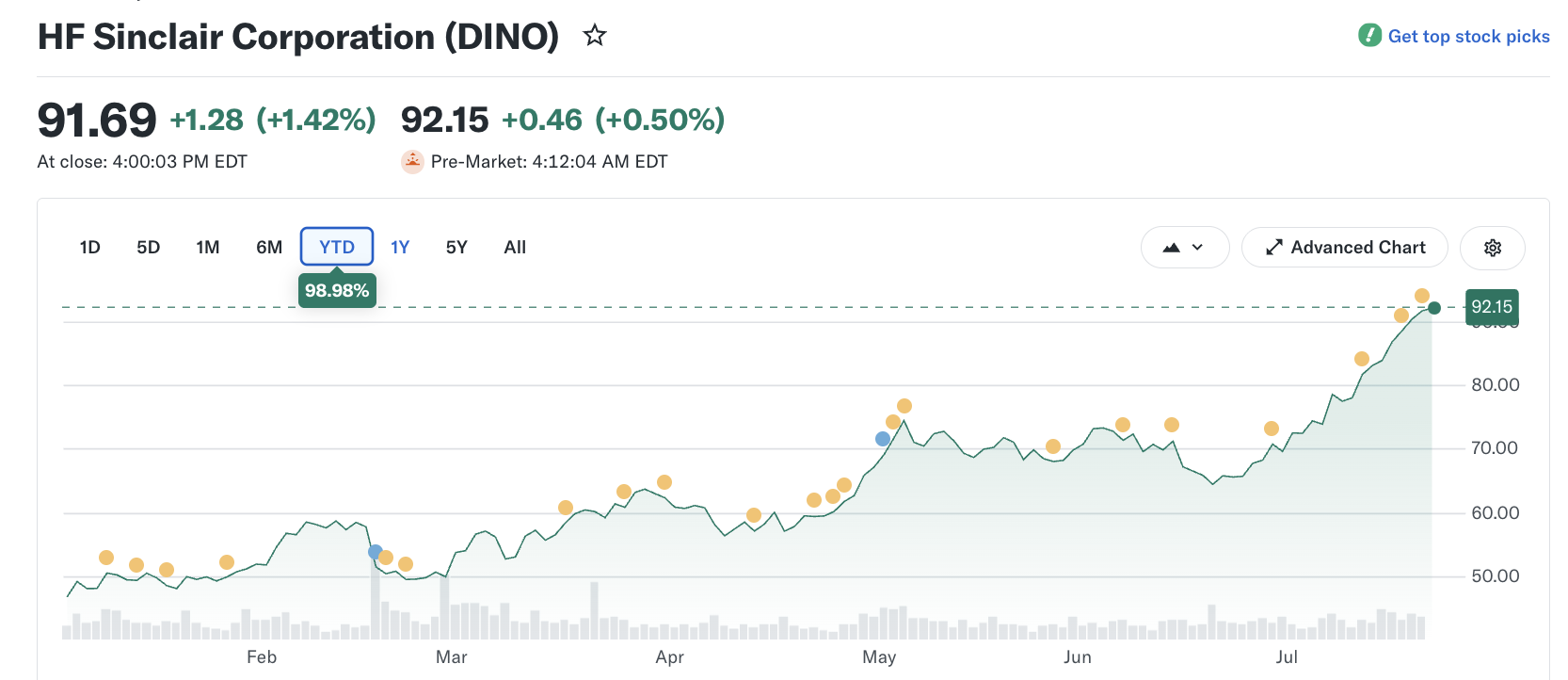
Here, Jenkins is the outlier. He reiterated a Buy and a Street-high $95 target on July 13, while much of Wall Street sat on Hold. Evercore initiated coverage with a Hold rating, while Barclays and JPMorgan maintained neutral ratings.
The stock’s 99% run this year pushed its price past several targets.

However, the chart flashes a warning. CMF peaked in early May. As DINO kept making higher highs into July, money flow failed to follow. This bearish divergence, now below the 0.51 level that capped it in May, suggests the buying is fading.
A close above 0.51 would ease the concern.

Still, not everyone is cautious. Options desks flagged fresh January call buying on the stock.
So the reward looks thin for now. Jenkins’ $95 target implies only about 4% upside from the recent price near $92, and the divergence warns that momentum could stall.
Par Pacific Holdings (NYSE: PARR)
Par Pacific is the best performer, up about 129% this year. Its niche markets in Hawaii, the Pacific Northwest and the Rockies keep its fuel insulated, which helped it ride the same margin wave.

This time, the banks agree on this energy stock to watch. Jenkins lifted his target to $85 on July 13, matching JPMorgan, while Mizuho reiterated Buy at $80 (already hit).
That rare alignment marks $85 as a shared ceiling. It also caps the upside, since the price near $80 already sits close.

Meanwhile, institutional buying still looks strong. CMF recently made a fresh high before easing, holding well above zero. That shows large investors kept accumulating through the July surge, unlike the divergence in HF Sinclair.

The catch is that record margins may already be priced in. Some strategists warn refiners have run too far, too fast.
However, more than half of Russian refining capacity is offline.
That supply squeeze could keep the crack spread high.
That is exactly the bet Jenkins is making across all three, and it is why an analyst with an 80% hit rate is pointing to small refiners rather than Exxon or Chevron.
The post Analyst With 80% Success Rate Names 3 Energy Stocks to Watch appeared first on BeInCrypto.


Convicted fraudster and Nigel Farage backer George Cottrell had $9 million deposited into his Polymarket account by two unknown sources.
That’s according to the Financial Times (FT), which reported that Cottrell’s Polymarket account — which has the username “GCottrell93” — received $8.8 million in October 2024.
It received $7 million across five different transactions from a wallet on crypto exchange OKX, and received another $1.83 million from a wallet on ChangeNOW.
These funds were used almost immediately to bet on whether or not Trump would win the US election. From here, the FT claims $13 million in winnings was sent to an OKX wallet while $282,000 was sent to ChangeNOW.
Cottrell was previously convicted of wire fraud in March 2017 after he was caught agreeing to launder drug trafficking proceeds.
For many years, Cottrell and his relationship with Farage had gone largely under the radar. However, this past year has seen him thrust into the limelight after Farage was discovered to have accepted, without declaring, a £5 million gift from multi-billionaire Tether investor Christopher Harborne.
Cottrell was also revealed to have funded staff, security, and housing for the Reform UK leader before his election in 2024.
None of this was declared, and has since been referred to the UK’s Parliamentary Commissioner for Standards.
Read more: Nigel Farage aide George Cottrell bets US war will last four more months
Cottrell has continued to bet on Polymarket throughout the year. Protos reported in March 2026 that he bet $41,000 that the US war with Iran would last another four months.
One of his larger bets currently involves $71,000 on whether or not Vice President JD Vance will win the Republican nomination for president in 2028.

In addition to the FT’s report, Byline Times also revealed today that Cottrell has in the past used a fraudulent Swiss passport, under the name of “Oscar Drewitt.”
This fraudulent identity was reportedly known by Reform UK’s former Treasurer, Mehrtash A’zami, who hired Cottrell into a City financial network while using this Swiss alias.
Byline Times also discovered that a fellow gambler called Hon Kong Yong introduced Cottrell to this network under the false alias, and that Yong and A’zami have companies registered under the same Montenegro Tivet office, which Harborne and two other former Reform UK officials were linked to.
Got a tip? Send us an email securely via Protos Leaks. For more informed news and investigations, follow us on X, Bluesky, and Google News, or subscribe to our YouTube channel.

Ethereum has climbed by 16% over the past month and is now showing a technical setup that has historically been followed by strong price recoveries, according to crypto analyst Ali Martinez.
He found that ETH’s MVRV ratio is nearing a bullish crossover above its 160-day simple moving average (SMA).
Recovery Hints
The MVRV Momentum measures the relationship between aggregate holder profitability and its medium-term trend line. Martinez explained that when the daily MVRV ratio moves back above the 160-day SMA, it indicates a shift out of capitulation and the beginning of a fresh accumulation phase. Interestingly, this is the first time the setup has emerged in 2026.
Over the past three years, crossovers above this level have consistently marked the end of distribution periods and preceded major rebounds in ETH’s price.
At the same time, large investors continue adding to their holdings. According to Lookonchain, an anonymous whale purchased 27,000 ETH worth $52.03 million through Galaxy Digital’s over-the-counter (OTC) desk after remaining inactive for three months.
Additionally, BSCN reported that BitMEX co-founder Arthur Hayes acquired another 644.34 ETH worth roughly $1.25 million, increasing his total purchases over the past eight days to 3,270 ETH. This follows his earlier $2.53 million ETH buy and comes alongside several other multi-million-dollar Ethereum purchases and staking activity reported earlier this week.
Prediction markets are also leaning bullish. In fact, Whale Insiders said Kalshi traders are forecasting ETH could climb as high as $3,210 this year.
Separate data also showed that investors withdrew around 1 million ETH, worth nearly $2 billion, from centralized exchanges over the past 30 days, which pushed exchange balances to their lowest level in a decade. Declining exchange reserves typically reduce selling pressure and support a bullish outlook.
On the institutional front, spot Ethereum ETFs have recorded consistent net inflows this month, raking in over $380 million during this period.
Alternative Outlook
Not all analysts share the same near-term outlook. Crypto analyst Nonzee, for one, argued that the crypto asset could still see one more rally before a deeper correction. He expects it to test $2,000, with a possible move to $2,200 if Bitcoin climbs to $70,000. However, he believes those levels would mark a bull trap rather than the start of a meaningful breakout.
According to the roadmap, Ethereum could spend seven to ten days in a distribution phase before falling into a final bottom zone between $1,300 and $900, which he considers the ideal accumulation range. Despite his bearish short-term outlook, Nonzee maintained a long-term price target of $7,000 for ETH.
The post Ethereum’s Next Leg Higher? Historic Indicator and Whale Activity Align appeared first on CryptoPotato.

Democratic lawmakers are pushing back against the latest draft of the CLARITY Act over its ethics provisions. The lawmakers believe the provisions do not adequately address President Trump’s crypto interests.
Lawmakers have signalled support for the legislation if stronger provisions are included. However, the bill has found support in the crypto industry, with Coinbase and Ripple backing it.
Democratic Lawmakers Push Back Against Clarity Act Draft
Republican lawmakers released the latest draft of the CLARITY Act on Wednesday (July 22), with several prominent figures from the crypto industry supporting the measure. However, the legislation quickly faced fierce pushback from Democratic lawmakers over weak ethics provisions. The lawmakers argued that the provisions were inadequate to address President Trump’s crypto links. Senator Angela Alsobrooks said the current draft fell short and asked for key provisions to be strengthened, stating, “The Republican-proposed text of the CLARITY Act as it currently stands falls short. Key provisions including those addressing ethics for elected officials, consumer protection, illicit finance, conflicts of interest and market integrity must be strengthened.”
President Trump and his family remain involved in the crypto industry, with interests including a popular memecoin and World Liberty Financial, a decentralized protocol that operates a borrowing-and-lending platform. According to financial disclosures, President Trump received millions tied to WLF.
Incomplete Enforcement Mechanism
The 616-page draft prohibits public officials and their spouses from sponsoring and issuing digital assets. However, it does not prohibit extended family members. The draft also includes a clause stating the restrictions expire in January 2029 and tasks the Justice Department with enforcing the provisions. Senator Ruben Gallego supported the bill in the committee but has ruled out backing it in the Senate unless the ethics language is changed. Besides Alsobrooks and Gallego, Senate Democrats Catherine Cortez Masto and Cory Booker have also opposed the bill in its current form.
Senator Elizabeth Warren took to X, criticizing the bill and stating, “The new draft of the Senate GOP crypto bill does nothing to stop President Trump from making his next $1.4 billion from crypto. It’ll supercharge Trump’s crypto corruption. This bill should be dead on arrival.”
Amanda Fischer, Chief Operating Officer and policy director for Better Markets and former chief of staff for Gary Gensler, believes the draft does not change much for President Trump and his entanglement with crypto.
“The bottom line: Doesn’t change much at all about Trump’s existing crypto grift. No divestment required. Maybe stops new crypto grifts, but it’s up to his personal attorney [Acting U.S. Attorney General] Todd Blanche to enforce. Amnesty kicks in as soon as the new POTUS is inaugurated.”
Support From The Crypto Industry
Unsurprisingly, prominent individuals from the crypto industry threw their weight behind the legislation. Supporters were happy the bill retained software developer protections and added that the legislation would ensure regulatory clarity and elevate the US’ role in the digital asset industry. Ji Hun Kim, CEO of the Crypto Council for Innovation, urged for bipartisan support to get the bill across the line, and Solana Policy Institute CEO Miller Whitehouse-Levine called on Congress to “seize the moment.”
The strongest support for the bill came from Coinbase and Ripple. Coinbase CEO Brian Armstrong said the lack of a clear regulatory framework had hurt the industry, allowing major incidents like the FTX collapse to hurt consumers. Stuart Alderoty, Chief Legal Officer at Ripple, said the bill gives law enforcement agencies the teeth to go after bad actors, while CEO Brad Garlinghouse stated the bill does not have to be perfect to pass.
Supporters of the legislation are urging Congress to vote on the bill before its August recess. However, this depends on whether Democrats and Republicans can agree to a timely compromise.
Disclaimer: This article is provided for informational purposes only. It is not offered or intended to be used as legal, tax, investment, financial, or other advice.
Empery Digital said it invested $20 million in Cardinal Data Power, acquiring an approximately 8% stake in the private developer of powered data center campuses.
The investment was part of Cardinal Data Power’s approximately $70 million Series A financing and will support development of a 750-megawatt data center campus in West Texas. The project is expected to deliver its first power in 2027, expand to about 1 gigawatt by 2029 and eventually exceed 5 gigawatts.
Cardinal develops powered data center campuses for artificial intelligence and high-performance computing workloads. The company said it combines power generation, natural gas supply and electrical infrastructure to accelerate development of large-scale computing sites.
Empery has been moving away from its Bitcoin (BTC) treasury strategy, which it adopted in mid-2025 after pivoting from its former electric powersports business. Earlier this month, the company disclosed it had sold about 1,400 Bitcoin over a two-month period for roughly $87.1 million, using the proceeds to fund AI infrastructure investments and repay debt.
The sale came as Empery faced mounting pressure from shareholder Tice P. Brown, who called on the company to abandon its treasury strategy and sought the resignation of its chief executive officer and board.
The transactions reduced the company’s Bitcoin holdings to 1,514 BTC. Empery had previously held as many as 4,081 BTC before beginning to trim its position in March, according to data from BitcoinTreasuries.NET.
Related: Bernstein says Bitcoin mining deals necessary for AI power crunch
Bitcoin treasury companies take divergent paths
The Bitcoin treasury model is evolving, with some companies doubling down on accumulation while others are pivoting, restructuring or exiting altogether.
Satsuma Technology became one of the first Bitcoin treasury companies to unwind after shareholders voted overwhelmingly on July 20 to sell the company’s Bitcoin holdings, return substantially all of its capital to investors and delist from the London Stock Exchange. More than 90% of votes cast supported both the capital return and the delisting.
Meanwhile, a proposed merger between Tether-backed Twenty One Capital, Strike and Bitcoin miner Elektron Energy was scrapped earlier this week, leaving Strike as a standalone company while discussions between Twenty One and Elektron continue
Despite the change, Twenty One remains one of the world’s largest corporate Bitcoin holders with 43,514 BTC, second only to Strategy among publicly tracked corporate treasuries.
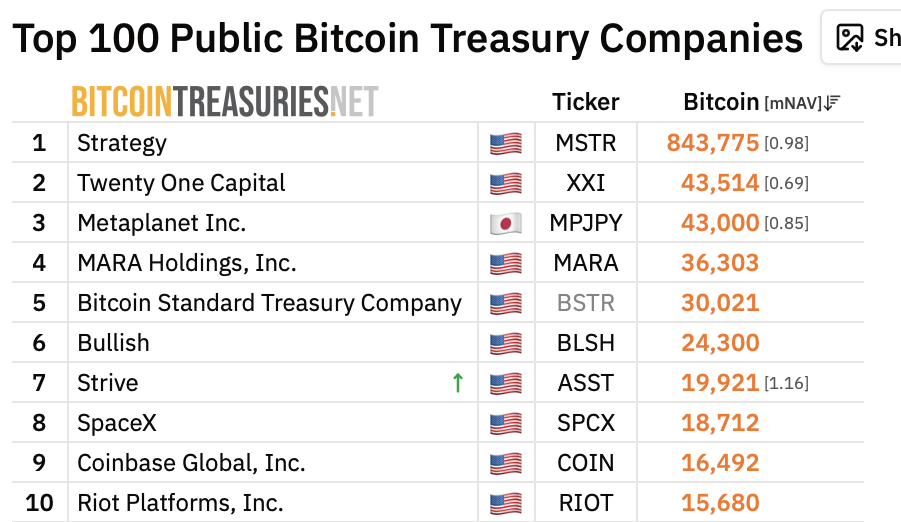
Top 10 Bitcoin treasury companies. Source: BitcoinTreasuries.NET
Other entrepreneurs are taking the Bitcoin treasury concept in a different direction. Last week, Bitcoin analyst Lyn Alden co-founded Orange Juice HODLINGS, a permanent-capital holding company backed by Mexican billionaire Ricardo Salinas that launched with $40 million in initial funding.
Rather than simply accumulating Bitcoin, the company plans to acquire and hold profitable businesses indefinitely while using Bitcoin as its treasury reserve asset, combining long-term business ownership with a Bitcoin-backed balance sheet.
Magazine: Fears of AI-driven DeFi hack epidemic overstated for now — but not for long

Negotiations over the long-awaited US Digital Asset Market Clarity Act—known as the CLARITY Act—have reportedly narrowed to one of the most politically sensitive issues: ethics rules for federal officials and who will enforce them. After months of drafting and bargaining, a dispute over a “code of conduct” element is now threatening to derail a bill that many in the industry view as crucial for regulatory certainty.
Democratic senators say the current version of the proposal does not go far enough, particularly on ethics provisions covering elected officials and related consumer and market-integrity safeguards. Republicans, meanwhile, argue that ethics enforcement should remain within the Department of Justice (DOJ) under a single national framework, rather than being handled by state attorneys general.
Key takeaways
- Seven Democratic senators said the current CLARITY Act text “falls short,” calling for stronger ethics, consumer protection, illicit finance, conflict-of-interest, and market-integrity provisions.
- The latest draft would bar senior federal officials and their spouses from issuing or sponsoring digital assets while in office, alongside limits on crypto platforms listing such assets.
- Democrats want ethics enforcement to allow state attorneys general to step in if DOJ does not enforce the law; Republicans insist DOJ should be the sole enforcement channel.
- Multiple policy and industry stakeholders say lawmakers may still be able to compromise, but uncertainty over ethics is becoming the central bottleneck.
- Even if senior officials are restricted from sponsoring or issuing new tokens, the draft would still allow covered officials to own cryptocurrencies.
What the new CLARITY ethics language would change
According to the latest Senate draft made public Wednesday, the CLARITY Act would prohibit the president, vice president, members of Congress, and other senior federal officials—along with their spouses—from issuing or sponsoring digital assets while they are in office. This would apply to officials covered under the bill’s ethics framework.
The draft also includes a platform-facing restriction: crypto platforms would be prevented from listing assets issued or sponsored by covered officials. As described in coverage of the text, these prohibitions are set to expire in 2029, after President Donald Trump’s current term ends.
Importantly for investors and market participants, the restrictions would focus on “issuing or sponsoring” while in office, not on personal ownership. Covered officials would still be allowed to hold cryptocurrencies even during the restricted period.
Why Democrats say the proposal isn’t strong enough
In a joint statement released Wednesday, seven Democratic senators argued that the bill’s current provisions are inadequate. They said “key provisions,” including those addressing ethics for elected officials, consumer protection, illicit finance, conflicts of interest, and market integrity, must be strengthened.
“Key provisions including those addressing ethics for elected officials, consumer protection, illicit finance, conflicts of interest and market integrity must be strengthened,” the senators said.
Senator Angela Alsobrooks—speaking at a Semafor event on Wednesday—stated that while negotiations may be “fairly close,” the ethics language remains a dealbreaker. She indicated she would not support the legislation on the Senate floor unless it includes stronger ethics provisions.
Alsobrooks’ primary concern is both the substance and the enforcement structure. She said it cannot be taken for granted that DOJ will enforce the law effectively, framing the issue as a credibility problem rather than a purely theoretical one.
Democrats’ stance has been amplified by scrutiny of President Trump’s growing crypto-related business interests, which have reportedly included meme coin activity and a broader portfolio of digital asset exposure. Critics argue that this creates incentives and potential conflicts that stronger ethics and enforcement mechanisms should address.
Senator Elizabeth Warren has also signaled that she views the draft as insufficient, arguing that it would not prevent the president from profiting from new crypto activity in a way that could be economically significant. Separately, former SEC official Amanda Fischer argued that the restrictions could still allow the president to benefit from existing crypto projects, with the proposed limitations aimed at future income streams.
Republicans push for DOJ-only enforcement
Republicans contest the idea that the ethics provisions are too weak, while also objecting to Democratic calls for additional enforcement leverage for state attorneys general. They argue that federal ethics requirements should be enforced through a single national mechanism—DOJ—rather than through a patchwork of state interpretations and political priorities.
Attorney and former Republican Senate candidate John Deaton said the CLARITY Act is federal legislation and that DOJ, not “fifty different state AGs,” is the appropriate body to enforce federal law. In this view, allowing state officials to intervene would risk undermining the uniformity that supporters say the bill is intended to provide.
Other Republican-aligned commentators characterized the ethics language as unprecedented. For example, Senator Bernie Moreno described the current draft as containing “the most powerful ethics language in US history.”
Patrick Witt, a former White House and Senate counsel, suggested the disagreement may be driven by two incompatible Democratic positions: that ethics rules would be meaningless without state AG enforcement, or that the proposal could not be changed in a way that would satisfy concerns about constitutional constraints. Witt argued that endorsing the first position would effectively dismiss the enforceability premise behind existing federal ethics laws, while the second position would be difficult or impossible to meet without violating constitutional principles.
Industry and policy observers see a path—but not an easy one
Despite the ethics dispute, many observers believe the bill can still progress through negotiation. Kristin Smith, former CEO of the Blockchain Association and now president of the Solana Policy Institute, told Cointelegraph that the latest draft reflects meaningful compromise on ethics—an element viewed as necessary for Senate Democrats to come closer to supporting the measure.
Smith also emphasized that ethics is only one component of the broader package. She pointed to additional elements added to the Senate’s work, including a disclosure regime, an illicit finance section, and improved spot market regulation. In her view, rejecting the bill on ethics alone could mean lawmakers lose more than just the ethics language—they could lose the rest of the regulatory structure altogether.
“There is no version of a ‘no’ vote that produces a stronger bill,” Smith said. “A ‘no’ vote produces no bill at all: no disclosure regime, no illicit finance protections, no spot market improvements, no ethics provisions, nothing.”
Vincent Chok, co-founder and CEO of stablecoin issuer First Digital, likewise suggested that narrowing negotiations to ethics rather than the overall structure indicates progress. He framed the question less as whether the US needs a framework and more as how to finalize one that can attract broad support.
Chok argued that no regulatory scheme is likely to be perfect at the start, but businesses can adjust if the market gets clarity. Long periods of uncertainty, he said, make it harder to justify long-term investment and product development.
Other industry figures expressed cautious optimism while still criticizing how far the initial ethics proposal goes. Salman Banaei, head of public policy at Plume, a blockchain network focused on tokenized real-world assets, said compromise may be possible, but cautioned that the White House’s initial ethics proposal was “not a good starting point.”
At the heart of the debate remains the enforcement question: the current draft appears to rely heavily on DOJ for ethics implementation, while Democrats want a mechanism that gives state attorneys general a clearer role if federal enforcement falls short. How lawmakers balance these competing views—without stalling the broader CLARITY framework—may determine whether the bill reaches the next stages.
As negotiations continue, the key variable for readers is whether the parties can agree on an enforcement structure that satisfies Democrats’ concerns about DOJ reliability while preserving Republicans’ push for a single federal enforcement lane. With the bill’s timetable dependent on this remaining sticking point, investors and builders should watch for the next revised ethics draft and any accompanying language changes that clarify whether enforcement authority can shift beyond DOJ.
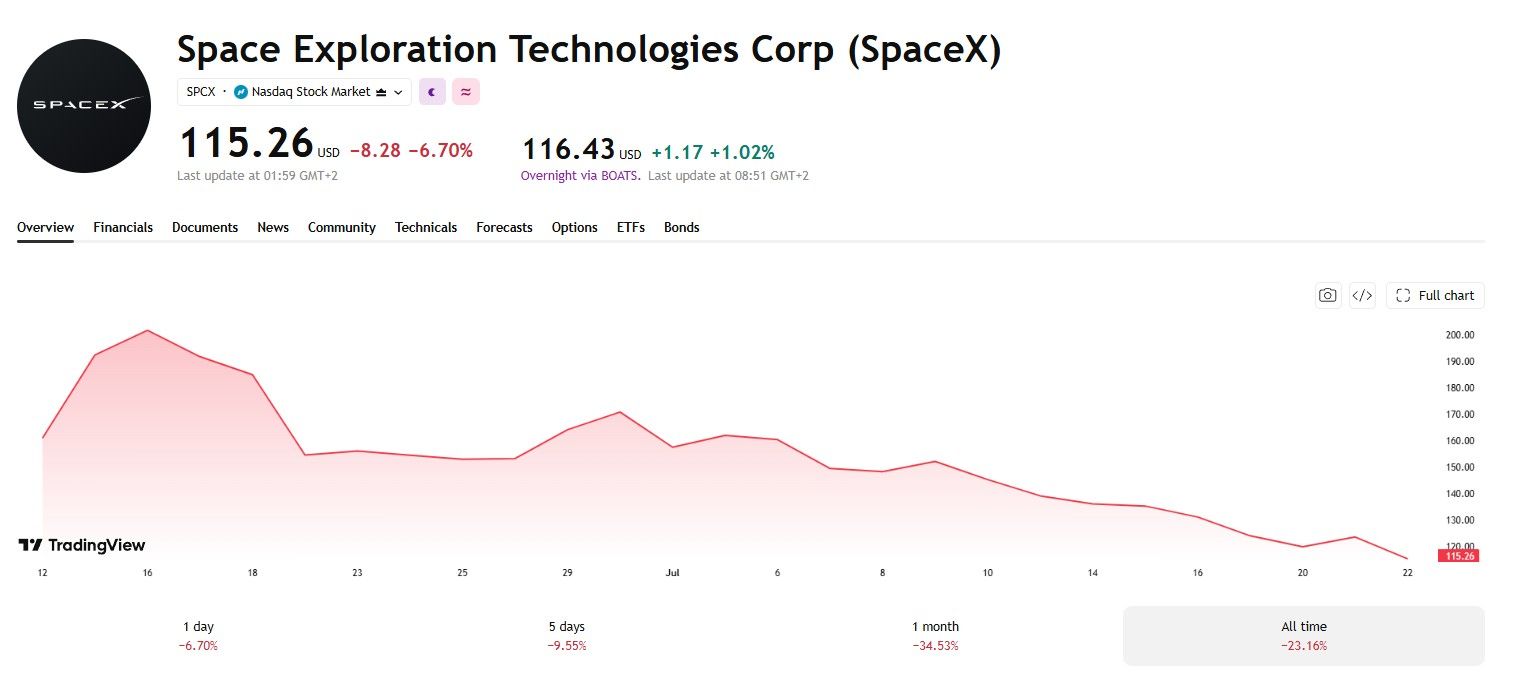
SpaceX stock (SPCX) closed just above $115 on Wednesday, nearly 20% below its June IPO price, while its 2056 bonds sank to a record low below 89.
The dual decline pushed the bonds’ yield to worst to 7.6% and reignited talk of an AI-driven valuation reset across stocks and crypto. SPCX now trades roughly 48% below its June peak of $225.64.
Bond Market Flashes a Warning Signal
SpaceX priced $25 billion in bonds in June across five tranches, with coupons ranging from 5.35% to 6.65%. The longest maturity, due in 2056, has fallen the most and now trades alongside junk-rated debt.
Zerohedge reported the bonds slipping below 89 this week, alongside a broader selloff in hyperscaler debt. The move echoes the market top signal analysts flagged shortly after the IPO priced.
Credit spreads on the 2056 notes have widened from roughly 175 basis points at issuance to more than 230 basis points now.
Meanwhile, the company reported a first-quarter net loss of $4.28 billion on $4.69 billion in revenue, fueling scrutiny of its bond math.
In turn, analysts argue that the gap explains why bondholders, unlike equity buyers, are pricing in more risk.
Schiff Frames SpaceX Selloff as a Broader Signal
Peter Schiff reposted the bond data and separately noted SPCX closed nearly 50% below its high. He called the drop a possible harbinger for other overhyped stocks and cryptocurrencies.
Schiff has issued a prior bond market warning, arguing that credit stress, not Bitcoin, would trigger the next major crash. However, his critics note a long history of bearish calls that have not always come to fruition.
Still, the timing aligns with broader concerns about AI-linked valuations. SpaceX joined the Nasdaq 100 shortly after its debut, and the stock has since dropped roughly 29% from that milestone.
A delayed Starship test flight added to the negative sentiment this month.

Lockup Expiry Adds to the Pressure
SpaceX’s first major share unlock is scheduled for early August, two days after second-quarter earnings. Roughly 911.5 million shares, worth about $123 billion at recent prices, become eligible for sale.
Investors are already watching the stock’s share unlock schedule alongside dilution concerns tied to SpaceX’s reported Cursor AI acquisition. Some traders, however, still see a falling wedge pattern that could support a rebound near current levels.
Whether the stock and bond weakness spreads to crypto markets may become clearer once the lockup and earnings pass in August. Traders will likely watch SPCX bond yields as an early signal before any broader repricing hits digital assets.
The post SpaceX is a Warning For Crypto and Tech Stocks, Peter Schiff Says appeared first on BeInCrypto.
The long-awaited US Digital Asset Market Clarity Act (CLARITY) has hit another snag.
This time, it’s not software developers or the turf war between federal regulators at stake, but the thornier question of ethics — ironic, given many politicians’ demonstrable disdain for them.
After months of negotiations and what Coinbase’s chief executive Brian Armstrong called “thousands of hours of work on both sides,” disagreement over a code of conduct could make or break CLARITY once and for all.
Pretty much everyone agrees the United States needs clearer rules around digital assets. But negotiators are divided over whether the bill’s ethics provisions are strong enough, and, more importantly, who should enforce them.
Democrats worry the current proposal relies too heavily on the Department of Justice, arguing state attorneys general should be able to step in if the DOJ fails to enforce the law.
In a joint statement Wednesday, seven Democratic senators said the Republican proposal “falls short.”
“Key provisions including those addressing ethics for elected officials, consumer protection, illicit finance, conflicts of interest and market integrity must be strengthened,” the senators said.
For their part, Republicans are pushing to keep enforcement of the ethics provisions with the DOJ, arguing that federal rules should be enforced through a single national framework. Attorney and former Republican Senate candidate John Deaton said Wednesday:
“The CLARITY Act is federal legislation… The Department of Justice – not fifty different state AGs with fifty different political incentives and fifty different interpretations – is the appropriate body to enforce federal law.”
Can lawmakers find a middle path before the bill reaches the Senate floor, or has the ethics debate become CLARITY’s biggest obstacle yet?
What the latest ethics proposal actually does
The latest Senate draft made public Wednesday would prohibit the president, vice president, members of Congress and other senior federal officials and their spouses from issuing or sponsoring digital assets while in office.
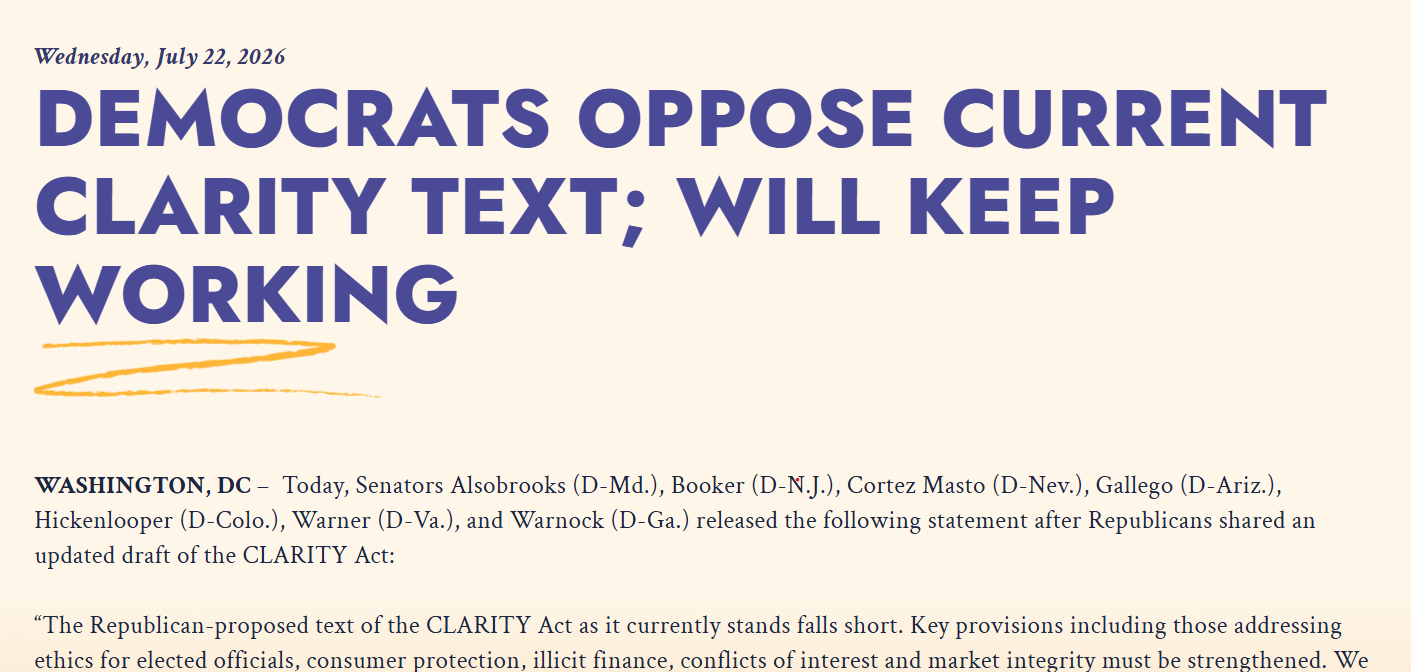
Democrats oppose current CLARITY text. Source: Senator Ruben Gallego
That means future presidential meme coins would be off the table, at least temporarily, with no Trump 2.0 or Melania 2.0-style token launches while the restrictions are in play.
Related: CLARITY Act could help CFTC deal with prediction markets: Lawyer
The proposal would also prevent crypto platforms from listing assets issued or sponsored by covered officials.
Restrictions would expire in 2029, after President Donald Trump’s current term ends, though covered officials would still be permitted to own cryptocurrencies.
Democrats say current proposal falls short
Democrats have made it clear the text needs additional work before gaining their support, but getting CLARITY over the line isn’t doomed; they’ve also signaled a willingness to see the bill through to the end.
“We have been working in good faith with our Republican colleagues for the past year and will continue doing so to get this over the finish line,” the senators said.
Senator Angela Alsobrooks said negotiators were “fairly close” to reaching an agreement during a Semafor event on Wednesday, despite warning the ethics provisions remained a dealbreaker. The Maryland Democrat said:
“Although I have been supportive to this point, I absolutely will not support on the floor any legislation that does not include provisions around ethics.”
Her main concern is not only the substance of the rules, but who would enforce them.
“It’s an absolute that we cannot completely rely on the DOJ, given what we’ve seen of their inability and their unwillingness to enforce the law,” Alsobrooks said.
The debate has been fueled by Trump’s rapidly expanding crypto business interests spanning meme coins, World Liberty Financial and other digital asset holdings.
Related: Trump claims he can ‘future proof’ crypto regulation with CLARITY Act
The President’s crypto ventures have reportedly generated $1.4 billion on paper, prompting Democrats to argue stronger safeguards are needed to address potential conflicts of interest.
Senator Elizabeth Warren has focused on whether the restrictions go far enough, with the Massachusetts Democrat saying that the latest draft “does nothing to stop President Trump from making his next $1.4 billion from crypto.”
Former SEC official Amanda Fischer also argued the draft would still allow Trump to benefit from his existing projects, with limited restrictions on future crypto income streams.
Republicans say proposal already unprecedented
Republicans reject the idea that the ethics provisions are weak. Senator Bernie Moreno described the draft as containing “the most powerful ethics language in US history,” pushing back against Democratic claims that the provisions are insufficient.
The latest CLARITY Act text. Source: US Congress.
Patrick Witt, a former White House and Senate counsel, said Democratic opposition appeared to rest on one of two positions: either that ethics rules without state attorneys general are “meaningless,” or that they fail to penalize President Trump for past crypto activity.
“If you hold position (1), then you are basically saying that ALL current federal ethics laws are meaningless because none of them are enforceable by state AGs,” he said. “If you hold position (2), then there is literally nothing that can be done to appease you because what you are advocating for is blatantly unconstitutional.”
Others argue that, even if the legislation is imperfect, passing it would be preferable to preserving the status quo. Andreessen Horowitz co-founder Chris Dixon said the US has a similar opportunity to the early internet era, when lawmakers established rules that allowed innovation to flourish rather than forcing new technology into outdated regulatory frameworks.
While acknowledging that “no law is perfect,” Dixon argued the CLARITY Act would deliver long-overdue consumer protections and provide regulatory certainty for blockchain innovation in the US.
Can lawmakers find a middle path?
Despite stumbling over the ethics hurdle, most industry and policy observers still believe a deal remains in reach.
Kristin Smith, former chief executive of the Blockchain Association and now president of the Solana Policy Institute, sees that the latest draft is already a meaningful compromise.
“The new text includes a substantive, one-of-a-kind ethics provision, a necessary step to win the support of Senate Democrats,” Smith told Cointelegraph.
“But ethics is far from the only thing at stake. The Senate has added a full disclosure regime, an entire illicit finance section, and improved spot market regulation.”
Smith warned that rejecting the bill in pursuit of stronger ethics language could leave lawmakers stuck with no market structure legislation at all.
“There is no version of a ‘no’ vote that produces a stronger bill,” she said. “A ‘no’ vote produces no bill at all: no disclosure regime, no illicit finance protections, no spot market improvements, no ethics provisions, nothing.”
Vincent Chok, co-founder and chief executive of stablecoin issuer First Digital, said the fact negotiations have narrowed to ethics rather than the broader structure of the bill is itself a sign of progress.
“The core debate is no longer whether digital assets need a regulatory framework, but how to finalize one that commands broad support,” Chok told Cointelegraph.
He said that while no regulatory framework is likely to be perfect from day one, businesses can adapt to clear rules that evolve over time. Prolonged uncertainty makes long-term investment and product development far more difficult, he said.
Salman Banaei, head of public policy at Plume, a blockchain network focused on tokenized real-world assets, also believes a compromise remains possible, although he cautioned that the White House’s initial ethics proposal “is not a good starting point.”
For now, both sides appear to agree on one thing: a compromise is still possible, but exactly what it looks like remains the biggest unanswered question.
Magazine: Will the crypto lobby’s $189M campaign get CLARITY over the line?
Cointelegraph publishes long-form journalism, analysis and narrative reporting produced by Cointelegraph’s in-house editorial team with subject-matter expertise. All articles are edited and reviewed by Cointelegraph editors in line with our editorial standards. Content published in here does not constitute financial, legal or investment advice. Readers should conduct their own research and consult qualified professionals where appropriate. Cointelegraph maintains full editorial independence.


David Solomon, chair and CEO of financial giant Goldman Sachs, has given his support for a “not perfect” cryptocurrency market structure bill under consideration in the US Senate even as many provisions continue to divide lawmakers and his fellow industry leaders.
According to a Thursday Politico report, Solomon said that the Digital Asset Market Clarity (CLARITY) Act was “not perfect” but needed to create a “level playing field to enhance market stability.” Solomon stands out as the head of a major financial company backing the legislation, which many of his peers are opposing by arguing that the bill allows crypto companies to pay users interest or yield on stablecoins outside standard rules for financial institutions.
“The CLARITY Act — like all legislation — is not perfect,” said Solomon, according to Politico. “And there are lots of things that you could debate and argue about. But I think one of the most important things that it does is that it creates a level playing field to enhance market stability and allow these markets to develop appropriately.”
Republican lawmakers released the text of the CLARITY Act on Wednesday ahead of a potential vote in the Senate, including provisions on ethics that have concerned many Democrats due to US President Donald Trump’s crypto investments. As of Thursday, Senate leaders had not scheduled a vote on the bill.
Related: CLARITY Act stablecoin yield rules finalized: ‘Go time’ for crypto bill
Solomon was one of the few leaders in traditional financial companies to support the crypto bill. Jamie Dimon, who heads JPMorgan Chase, said in a May interview that CLARITY allows crypto companies to pay interest on stablecoins “without the protection that they should have,” something that banks would not accept.
Many Democrats say ethics rules in CLARITY don’t go far enough
While the crypto market structure bill is expected to head for a vote in the Senate soon, Republicans there will need some Democratic support to meet the 60-vote threshold. However, many Democrats said that the ethics provisions pushed by Republicans aren’t earn to earn their votes, in part because it leaves enforcement to the US Justice Department instead of state authorities.
”The bill goes even further to protect the President’s crypto profits by barring the next Department of Justice from ever holding Trump accountable,” said Senator Elizabeth Warren on Wednesday. ”On top of all of this, the underlying bill still fails to adequately protect investors, our financial system, and our national security. This bill should be dead on arrival,” the Massachusetts Democrat said.
Magazine: Why the CLARITY Act’s Ethics Fight Could Derail the Market Structure Bill
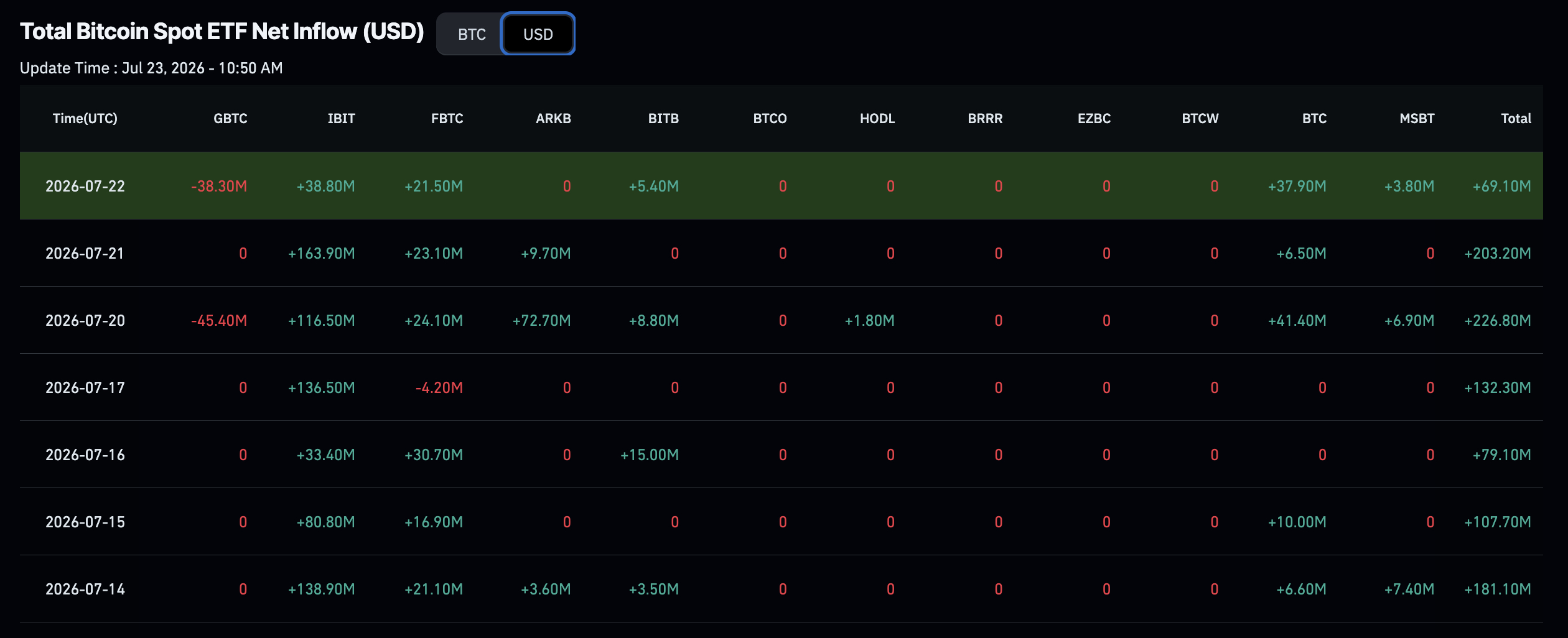
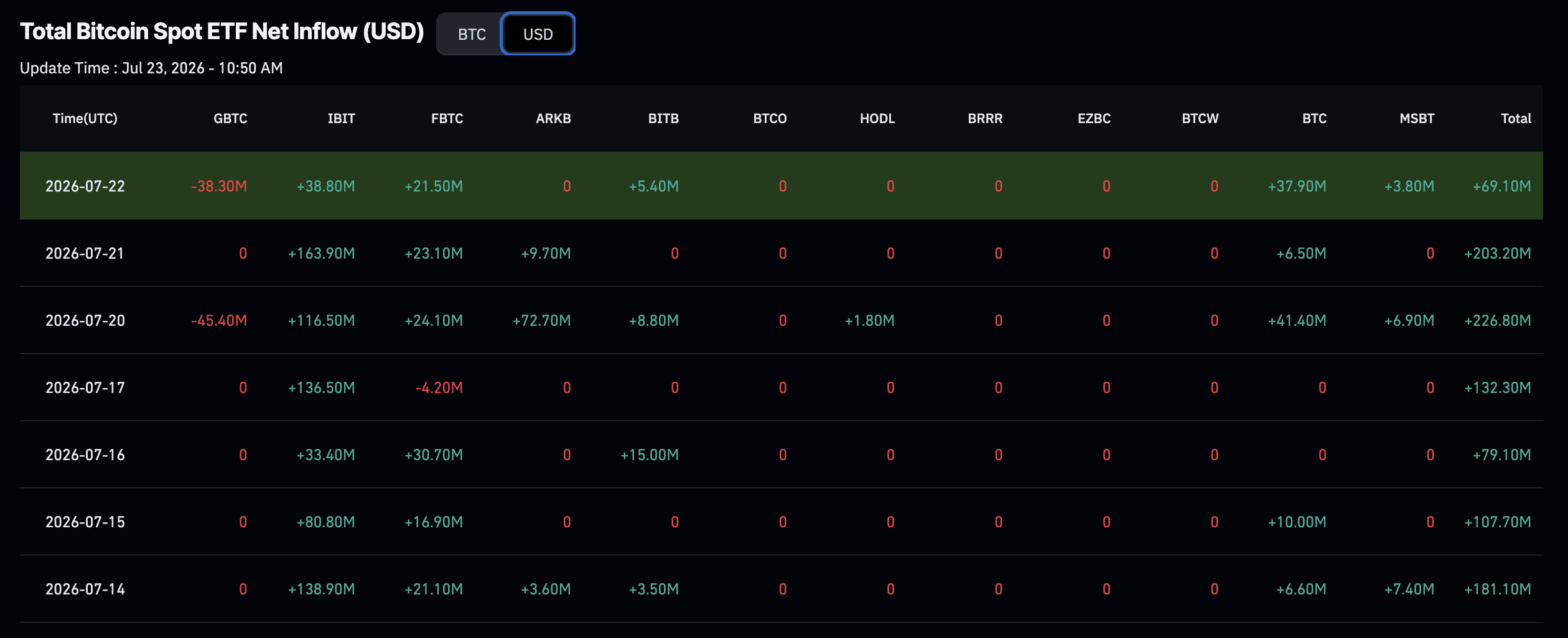
Bitcoin spot ETF have recorded seven consecutive trading days of net inflows since July 14, attracting nearly $1 billion as Bitcoin price traded around $65,500. It marks the longest inflow streak in months and raises a familiar question. Are institutions quietly rebuilding positions, or is this simply a relief rally after heavy selling earlier this summer?
The streak follows a difficult stretch that pushed Bitcoin price below $58,000 before buyers returned. Rather than relying on one massive allocation, the inflows have arrived steadily each day. That pattern usually carries more weight because it suggests sustained demand instead of a short-lived burst driven by market excitement.
Trade Bitcoin on Bybit and Get a Chance to Win Our $1,000 USDT Airdrop
What the October 2025 Comparison Does and Does Not Prove
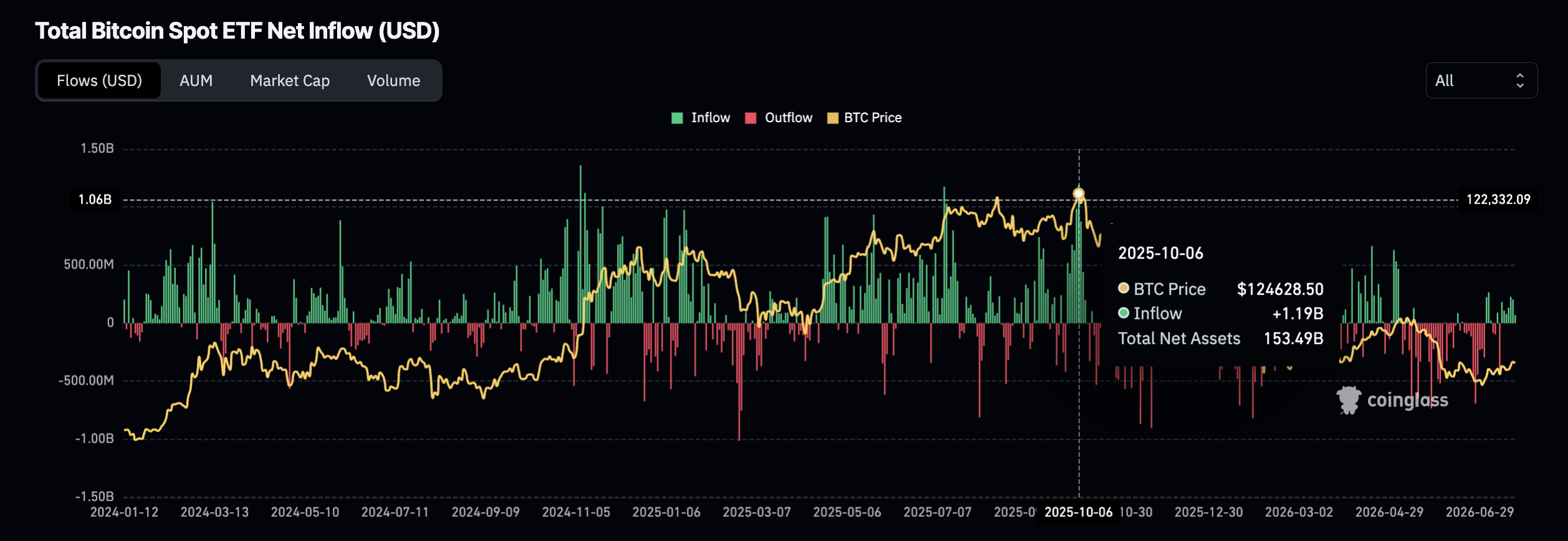
Some analysts have compared the current streak with October 2025, when persistent ETF demand came before Bitcoin rally toward its record high. However, the comparison has limits. The earlier run attracted well over $5 billion in seven trading days, making it far larger than the current streak. That difference makes a direct comparison difficult.
Today’s inflows are roughly one-fifth of that earlier pace. Even so, slower accumulation can still support higher prices without creating the same speculative conditions. Instead of pointing to another explosive rally, the data better fits gradual institutional positioning while leverage across the market remains relatively restrained.
Issuer data also shows where the money is flowing. BlackRock’s IBIT continued leading daily inflows, while ARK’s ARKB and Fidelity’s FBTC also attracted fresh capital. Meanwhile, Grayscale’s GBTC continued recording net outflows, extending a trend that has persisted since spot Bitcoin ETFs launched. That rotation suggests investors still prefer lower-fee products over legacy funds.
Discover: The Best Crypto to Diversify Your Portfolio
The $70K Bitcoin Target Depends on Sustained ETF Demand
A move toward $70,000 remains technically possible if ETF demand continues at a similar pace. However, no historical relationship guarantees that outcome. ETF inflows have often supported the Bitcoin price, yet macroeconomic conditions, derivatives positioning, and profit-taking can quickly outweigh fund flows.
The recent recovery should also be viewed in context. It follows weeks of persistent ETF outflows that pressured the Bitcoin price below $58,000. Seven positive sessions improve sentiment, but they do not confirm a lasting uptrend. Buyers still need to defend current levels before the market can challenge the $70,000 resistance.
One observation deserves attention. Healthy rallies often build through consistent inflows instead of one extraordinary buying day. During previous market peaks, the largest ETF inflow sessions appeared near the top rather than at the beginning of sustained advances. That history suggests investors should watch for signs of overheating.
For now, the current pattern looks more balanced than euphoric. If ETF inflows remain distributed across several sessions, Bitcoin price could continue grinding toward $70,000. However, a sudden surge in one exceptionally large inflow day may signal growing speculation rather than strengthening market fundamentals.
Trade Bitcoin on Bybit and Get a Chance to Win Our $1,000 USDT Airdrop
The post $981M Bitcoin ETF Streak Signals Institutional Re-Entry, $70K in Sight appeared first on Cryptonews.


New European Union sanctions just made crypto harder to use for people in Russia. EU governments agreed the measures on Thursday. They target 11 crypto platforms.
Officials have not named the platforms. Most sit outside Russia. The package also hits 94 Russian banks and the Moscow Exchange. Bitcoin (BTC) and other coins stay legal.
Why the EU Keeps Targeting Russian Crypto
The EU has a problem. Every time it shuts one crypto platform, Russians open a new one.
So its tactics keep shifting. First it named one exchange. Then it banned Russia’s entire crypto sector. Now it targets platforms in other countries.
Take Garantex. The US sanctioned this Russian exchange in 2022. The EU followed in early 2025. In March 2025, police seized its website and froze over $26 million. Within days, its team relaunched it as a near-copy called Grinex.
That is why the EU banned the whole sector in May. The reason is scale. One ruble-linked coin, A7A5, moved over $100 billion in a single year, says analytics firm Elliptic.
The new package goes further. For the first time, the EU can ban crypto services in whole countries outside Europe. Those are often the places Russians turn to next.
Kaja Kallas, EU High Representative for Foreign Affairs and Security Policy, said the sweeping measures target Russia’s financial system, effectively limiting the financial lifelines the country relies on.
Follow us on X to get the latest news as it happens
“How hard this bites depends on how broadly the EU defines ‘crypto operators’,” says Nadezhda Surova of Russian Federation Member of the Expert Council for Digital Economy.
What Changes for Russian Users
First, some good news for holders. Bitcoin and other coins are not banned. You can still own and trade them. Coins in your own wallet stay safe.
The hard part is access. Big exchanges must follow the EU’s crypto rulebook, called MiCA. They check where your money comes from. They block anyone tied to sanctions.
Some users have already felt it. Their accounts were frozen after deposits traced back to A7A5. Expect more of the same. Fees go up. Transfers slow down. Exchanges drop more coins. Earlier rounds already left some Russian crypto assets stuck.
Nikolai Zagvozdkin, product development director for crypto at RBC, expects the same for everyday users.
“Working with crypto will become more expensive, slower, and somewhat less transparent,” Nikolai told BeInCrypto.
Russia is building its own way around this. It now allows crypto for foreign trade. It is setting up licensed exchanges under a new crypto law.
But there is a catch. The more Russia closes off its market, the less it connects to the world. The next question is whether the EU can enforce it all.
Alexey Zyuzin, CEO of the Institute for the Development of the Crypto Industry, expects the market to split in two.
“Two circuits are likely to form. The first is a legal domestic market under the control of the Russian regulator… The second is a cross-border segment, where elevated sanctions and technological risks will persist,” Alexey said in a statement to BeInCrypto.
The post New EU Sanctions Make Crypto Harder for Russian Users appeared first on BeInCrypto.
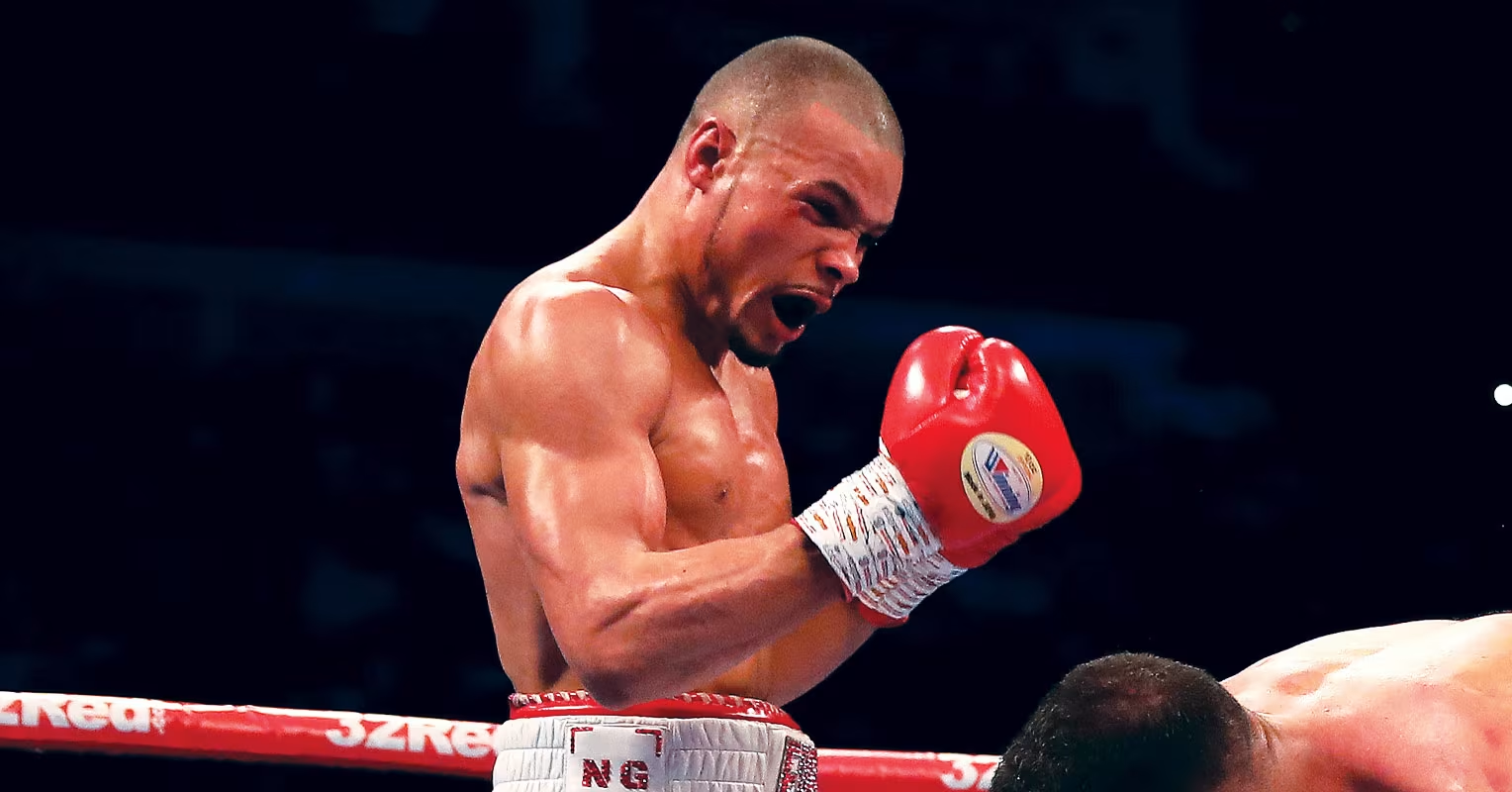
Former world champion who fought Chris Eubank Jr announces comeback after 7 years out the ring

Waaree Renewable shares slide 7% despite 34% YoY surge in Q1 profit. What’s spooking investors?

Nigel Farage aide received $9M on Polymarket account, report


-

 Fashion6 days ago
Weekend Open Thread – Corporette.com
-

 Politics5 days ago
The House | The City of London can help the new chancellor deliver growth in every postcode
-

 Crypto World5 days ago
Ripple Payments Joins MiCA With 14 Firms, Does It Mean Anything For XRP?
-
 Crypto World6 days ago
Two July Windows Left: The CLARITY Act’s Senate Fight and What Failure Means
-

 Politics4 days ago
Democrats look to World Cup watch parties to register thousands of voters
-

 Crypto World6 days ago
Ripple wins EU-wide access as ESMA adds it to MiCA register
-

 Crypto World2 days ago
Grayscale Files For Worldcoin ETF, WLD Registers Sharp Rise
-

 NewsBeat3 days ago
Unregistered fitter used Gas Safe logo on business flyers
-

 Tech3 days ago
Sail Virtually Aboard The “Itanic” With IA-64 Emulator
-

 Crypto World7 days ago
Injective Submits SEC Transfer-Agent Registration to Onchain Ownership Records
-
 Tech3 days ago
Turtle Beach Command Series KB7 review: a nifty screen-equipped gaming keyboard
-

 NewsBeat6 days ago
Registration is now open for March for Men with Kev 2026
-
 Business2 days ago
New Jersey voter registration controversy explained: How 6,600 noncitizens got on the rolls, and what happens next
-

 Crypto World7 days ago
Claude Fable 5 Slips to Second in AI Coding Leaderboard
-

 News Videos6 days ago
Money | Class 12 Economics | CBSE Board Exam 2026-27
-

 Business7 days ago
Banco Bilbao Vizcaya Argentaria, S.A. (BBVA) Discusses Global Macro Environment and Economic Outlook for Core Markets Transcript
-

 Crypto World5 days ago
Kaspersky exposes OkoBot’s 20-module crypto wallet attack
-

 News Videos4 days ago
Big Money Is Entering XRP
-

 Business6 days ago
Airlines warn Sunshine Protection Act could disrupt flight scheduling
-

 NewsBeat6 days ago
Durham County Council to send out electoral registration emails
You must be logged in to post a comment Login