


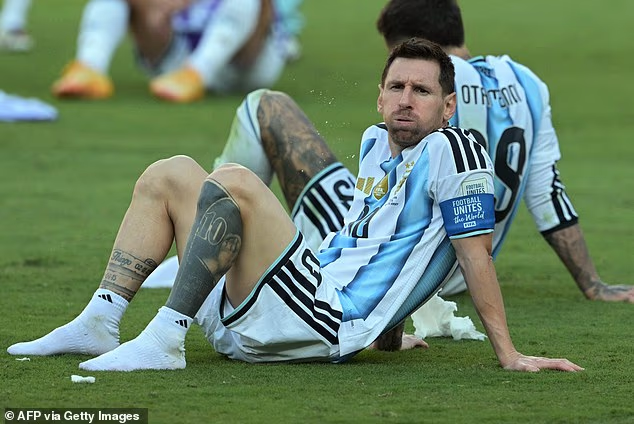
Lionel Messi‘s popularity among British people has plummeted after Argentina’s shameful World Cup antics.
Messi is now viewed unfavourably among almost half of the participants surveyed by YouGov.
It comes after Argentina’s baseless behaviour at the tournament, which ended with them losing 1-0 to Spain in the final and starting fights with the opposition. Enzo Fernandez was sent off in normal time and Leandro Paredes was lambasted for attacking Eric Garcia and Gavi after the match.
Even Messi was dragged into their pathetic antics in the final, attempting to get Marc Cucurella sent off for briefly putting his hand over his mouth.
As per FIFA’s rules for this tournament, if a player holds their hand over their mouth in a confrontational situation, they will be sent off. That was the case with Paraguay’s Miguel Almiron and Ecuador’s Piero Hincapie. However, it didn’t appear that Cucurella was speaking in a confrontational manner and neither the referee nor VAR decided to intervene.
Moreover, many supporters felt throughout the tournament that matches were ‘rigged’ to Argentina’s benefit due to the quantity of refereeing decisions in their favour.
Lionel Messi’s popularity among the British public has plummeted after the World Cup

His attempt to get Marc Cucurella sent off for a minor infraction was viewed as pathetic
And Argentina’s players did not endear themselves to the English public by insisting that the Falkland Islands belong to them in a series of chants and banners.
All of this has had a deleterious effect on Messi’s popularity.
Coming into the World Cup, he was viewed favourably by 55 per cent of the public and unfavourably by just nine per cent.
Now, he is seen favourably by only 29 per cent and unfavourably by 44 per cent.
That means that, according to YouGov’s poll, Messi’s net favourability rating among Britons has fallen from +46 to -15. In short, people don’t like him very much.
His score is far worse than his arch-rival Cristiano Ronaldo, whose net rating is -2.
And he certainly lost his stock with Daily Mail Sport’s veteran columnist Jeff Powell, who bunged Messi out of his top five all-time players for his antics.
In fairness, Messi, who scored eight goals throughout the World Cup, was often a beautiful and refreshing counterpoint to his more thuggish team-mates.

Messi avoided a red card for an apparent stamp during Argentina’s first game vs Algeria
He also rose off the floor to shake Lamine Yamal’s hand after the whistle on Sunday, when other team-mates were picking fights. Argentina also turned their backs on the victors during their trophy celebration.
Spain beat Argentina 1-0 after extra-time thanks to a 106th-minute winner from Ferran Torres.
Any accusations of refereeing favouritism towards Argentina in the final were quelled by the sending-off of their midfielder Enzo Fernandez in the dying minutes of normal time.
But many people found it inexplicable that Spain’s Nico Williams had a goal ruled out for a dubious foul on Nicolas Otamendi in the build-up.
That followed a pattern of questionable decisions made in favour of Argentina throughout the tournament.
Lionel Messi arguably should have been punished for a stamp in Argentina’s first group match against Algeria – but he escaped a card entirely.
Messi, who scored a hat-trick in the match, caught Algeria captain Aissa Mandi on his right calf and Achilles tendon with his studs in a challenge after his first goal.
Algeria were given a free-kick by the referee but the incident was not even reviewed by VAR officials.
Meanwhile, Egypt reacted explosively after a string of critical decisions went against them in their last-16 match against Argentina.

Egypt manager Hossam Hassan furiously accused FIFA of rigging the World Cup after his side were knocked out by Argentina

Switzerland accused referee Joao Pinheiro of giving Argentina ‘every decision’

Lautaro Martinez avoided a booking for jumping into the crowd after scoring his goal against Switzerland
First, forward Mostafa Ziko had a goal ruled out after a VAR review because of an apparent foul by Marwan Attia on Lisandro Martinez. That foul had occurred 18 seconds before at the other end of the pitch. Attia definitely caught Martinez – the debate is over whether not giving anything was a clear and obvious error.
What Egypt were more furious about is the build-up to Argentina’s winning goal. They contend that they should have had a penalty at the other end moments before.
Mohamed Salah was brought down inside the box after having his foot clipped by Julian Alvarez, but VAR did not even seem to check the incident. Argentina had gone the other end and scored, in stoppage-time no less – but Egypt should admit that their defending was shoddy.
Pharaohs manager Hossam Hassan was apoplectic in his post-match interview. ‘We were better, but football is unfair,’ he said.
‘It could be a matter of marketing, they could want to make a World Cup with the champion of the last World Cup, they want Messi to exist (in the tournament).
He added later: ‘Why isn’t there any fairness in sport? In football? I do not want to try to put it nicely here with beautiful wording. We have been treated unfairly today. We have suffered injustice.’
Moreover, Switzerland were incandescent after their quarter-final defeat by Argentina, accusing the referees of being ‘one-sided’ and ‘against’ them.
The major controversy of the match is the dismissal of Breel Donald Embolo with a second yellow card after diving.
Join the discussion
Has this World Cup changed your opinion of Lionel Messi?


Argentina consistently referred to the Falkland Islands throughout the World Cup
Argentina midfielder Leandro Paredes was initially given a yellow card for a foul on Embolo. However, referee Joao Pinheiro was then instructed to review the decision by VAR under a new ‘mistaken identity’ rule.
The review showed that Embolo had initiated the contact with Paredes, leaving his right leg trailing to make contact with the Argentine, before tumbling to his left. The rule allows for a decision to be changed in the event a player has been booked or sent off, but the infringement was actually committed by the opposition.
Embolo was the one at fault for simulation, and so he was shown a second yellow. The striker was in tears after becoming the first player to be caught out by the rule, but it was clearly the right call.
Nevertheless, after the game, multiple figures from the Swiss camp stepped forward to air their grievances.
Granit Xhaka said: ‘If you have to lose because of one decision from the referee, it’s painful but it was his decision. It’s difficult to accept now after a game because the dressing room was very quiet, disappointed. If you are disappointed after the game against this Argentina team, it shows a big mentality.
‘The rules are the rules and we can’t change them but it’s a decision where you kill the game. That’s my opinion. I don’t know what else he can do but just don’t kill the game. We were so good in the game. I believed that at 11 versus 11 we would have had them but it’s very difficult to find the right words after the game.’
Defender Manuel Akanji said: ‘When you have the referee against you, it becomes difficult. Every little thing was called against us. Every dive and every foul by the Argentinians went unpunished. I don’t usually say anything against the officials, but I’ve never experienced such a one-sided game as today.
‘As soon as the game was over, I thought: I’m so proud of our team. What we’ve achieved throughout the entire tournament, and especially today… We played against the world champions, and they didn’t stand a chance.

FIFA have strenuously denied accusations of ‘rigging’ the World Cup in Argentina’s favour
‘I can’t recall a single scoring opportunity from open play where we were lucky. If the game had continued 11 against 11, it would have likely gone in our favour.’
Team-mate Remo Freuler said: ‘We had high hopes and put in a superb performance until the red card. That, of course, disrupted our flow. I still don’t understand how VAR can intervene in such a situation. FIFA needs to explain that to me.’
Manager Yakin added: ‘After the equaliser, we clearly had the momentum on our side. Unfortunately, this was punished by a refereeing error. The referee shouldn’t have given the Argentinian a yellow card in that situation.
‘There’s no reason for it; the incident wasn’t malicious or rough or anything like that. Then he corrects his own mistake and punishes us. That’s incomprehensible and beyond my comprehension.
‘The decision is baffling to me, there was no reason for it. It’s a shame.’
Finally, Argentina have so far avoided punishment from FIFA despite their repeated chants referring to the Falkland Islands.
FIFA’s rules strictly prohibit political chanting, slogans, and banners inside tournament venues. Haiti were forced to remove a small reference to their independence war on their kits just days before the tournament.
After the semi-final against England, Argentina’s players held up a banner saying that ‘Las Malvinas son argentinas’ – The Falklands are Argentine. They may face disciplinary action for this, but didn’t ahead of the final against Spain.
The Argentinians even got support from the US government over that. Andrew Giuliani, the head of the White House FIFA task force, said: ‘We believe in our First Amendment rights here in the United States of America.’
Trust has been low in FIFA for a long time and their decision to suspend USA forward Folarin Balogun’s ban so that he could play against Belgium after a phone call from Donald Trump did not help to restore confidence.





















































You must be logged in to post a comment Login