AMD said it will also invest up to $5bn into Anthropic, marking its first equity investment into the AI giant.
Anthropic is teaming up with AMD for 2GW of its latest-generation chips in a bid to boost AI capacity and meet growing demands. The Wall Street Journal reported that the deal between the companies is worth “tens of billions of dollars”.
The partnership comes as Anthropic competes for enterprise market dominance for its AI tools and preps for a blockbuster initial public offering expected to value the company at more than $1trn.
As per the agreement, Anthropic will deploy up to 2GW of AMD Instinct MI450 Series GPUs in Helios rack-scale solutions. The first gigawatt is expected to be deployed in the first half of 2027.
Advertisement
The deal builds on Anthropic’s existing use of AMD chips and comes as demand for its Claude services sees no signs of stopping, with the company’s tech permeating across industries. For AMD, the deal represents a “major expansion” at the “centre of the global AI infrastructure buildout”, it said.
In addition, the two companies are launching a multi-year engineering collaboration to use Claude for software development at AMD. The chipmaker also announced an equity investment of up to $5bn in Anthropic – its first investment into the AI giant.
“Access to compute is central to keeping Claude at the frontier and meeting demand from our customers,” said Tom Brown, Anthropic’s chief compute officer and one of the company’s co-founders.
“By partnering with AMD across the stack, we are securing the capacity we need and optimising it for training and serving Claude. Running across a diversified range of hardware lets us map the right workloads to the right hardware.”
“We are thrilled to deepen our partnership with Anthropic and deploy AMD Helios at gigawatt scale,” said Dr Lisa Su, the chair and CEO of AMD.
“This collaboration brings together Anthropic’s leadership in frontier AI with the full strength of AMD high-performance computing. Together, we will accelerate AI adoption at scale and establish Helios as a major platform for the next generation of AI infrastructure.”
Earlier this week, Anthropic’s $1.5bn settlement offer to quash a major AI copyright case against the company was approved. The company is set to pay around $3,000 to each of the creators behind some 500,000 individual pieces of work.
Advertisement
Don’t miss out on the knowledge you need to succeed. Sign up for the Daily Brief, Silicon Republic’s digest of need-to-know sci-tech news.
This week Jonathan chats with Michael Meeks about Collabora! What’s the origin story in this consulting company, why do they have an outstanding office suite, and where is the world headed to accomplish digital sovereignty? Watch to find out!
Did you know you can watch the live recording of the show right on our YouTube Channel? Have someone you’d like us to interview? Let us know, or have the guest contact us! Take a look at the schedule here.
Because what could be more appealing to humans than sharing virtual space with AI?
After cutting over 4,000 jobs due to AI, fintech biz Block is back with Buzz, a shared workspace where humans and bots can collaborate in ways that are more auditable, sovereign, and secure than what you can do in chat tools such as Slack.
Block’s human-bot co-op is built upon a turducken of tech jargon: The platform is free and open source. It’s based on the decentralized Nostr protocol, so there’s cryptographic identity. It’s “sovereign,” a naively optimistic term readers of Neal Stephenson’s Snow Crash should recognize, which in this context means self-hostable. And it’s intended as a replacement for Slack, GitHub, and various other communication and collaboration tools.
Advertisement
If “Buzz” sounds familiar, that’s because Google used that name in a social media faceplant more than 15 years ago. For those who missed the first go-around, Google Buzz, a failed social media service, gave rise to Google+, also a failed social media service. Block appears to believe that a decade and a half is sufficient for a brand cleanse.
The project’s GitHub repo offers a more apologetic assessment: “Yes, it’s another AI-adjacent developer tool. We’re sorry. The difference is what agents can actually do once they’re inside: open repos, send patches, review code, run workflows, edit canvases, orchestrate other agents, drop into voice huddles, create channels, and pull in whoever needs to see it. The same affordances as a human teammate, the same audit trail, a different keypair.”
You can already sic software agents on collaborative workspaces. Block’s main insight is that it would be useful to link AI agents with cryptographic identities. Others have already arrived at that conclusion. Hence OWASP’s Agent Name Service, DNS for AI Discovery, Estonia’s digital IDs for agents, and so on. But Buzz’s badging of humans and bots with cryptographic key pairs is bound to tick governance boxes.
“Every company is going to need a place where humans and agents work together,” said Bradley Axen, head of AI capabilities at Block, in a statement. “The question is whether that place is proprietary or open. We built Buzz because we believe it should be open.”
Advertisement
Moat-seeking tech incumbents would probably disagree about the need for openness, even though they’re fond of using the word without applying it. We note that OpenAI sells closed AI. And Anthropic’s decision to disallow third-party tools from using Claude subscriptions highlights the seemingly inevitable path from openness to barriers when revenue is at stake.
What’s more, it’s not obvious that every company will need people and bots in the same space. There’s a strong case for keeping humans and agents apart because they work at different speeds. Git at least was built for handling many distributed code edits, pull requests, and merges. It’s hard to see how people and bots can share a text-based communication space unless the bots are rate-limited or just talk among themselves.
“The bet is that one community can do what teams currently fake with chat, forges, bots, CI dashboards, release tools, search indexes, and a pile of glue code,” Block’s Buzz developers state. “Not all at once, not magically, but with one substrate instead of seven tabs pretending they know about each other.”
If tools for these sorts of things didn’t already exist, and no large tech companies had designs on this space, Buzz might face less daunting odds. But it’s worth a shot. ®
The latest game from Seattle-based developer Harebrained Schemes, and its first since its return to independence in 2023, is a dark sci-fi/horror adventure where the player must constantly change and enhance their body in order to survive.
In GRAFT, players take the role of Tiger, a man with jumbled memories who’s trapped aboard the Arc, a massive, decaying space station. The Arc’s other inhabitants include failed experiments, crazed mutants, bands of human survivors that could be either allies or enemies, and a hostile AI.
To survive, Tiger must salvage new parts from his enemies and graft them into his own body, which gives him new weapons, abilities, and upgrades. However, each new body part comes with its own secondhand memories, which quickly impacts Tiger’s sense of identity.
That leads naturally to a cyberpunk-infused Ship of Theseus situation: how much of yourself can you replace before you’re no longer you?
Harebrained CEO Mike McCain describes GRAFT as a survival horror game, in the spirit of mainstream releases like Resident Evil and Dead Space. In order to succeed, players must ration their available resources, constantly scavenge for supplies, and carefully pick their battles. Sometimes it’s going to be better to simply run away.
Advertisement
GRAFT is being developed in Unreal Engine by a core team of five at Harebrained, plus “key collaborators.” McCain also serves as GRAFT’s project director.
Harebrained Schemes was founded in 2011 by Jordan Weisman and Mitch Gitelman, who’d previously worked together on the Crimson Skies franchise. After releasing two mobile games, Harebrained pivoted to the PC market with a trilogy of crowdfunded strategy RPGs based on the Shadowrun tabletop game.
(Harebrained Schemes press image)
In 2018, Harebrained released a new BattleTech game for PC and Linux via the Swedish publisher Paradox Interactive (Crusader Kings). Paradox subsequently acquired Harebrained for $7.5 million. Shortly afterward, Weisman stepped down as CEO; he would eventually leave the company to found the no-code game development platform Endless Adventures.
5 years later, Paradox announced that it would “part ways” with Harebrained, shortly after the release of Harebrained’s original strategy RPG The Lamplighters League and the Tower at the End of the World. McCain, who’d previously been the director on BattleTech, rejoined the company in early 2024 as Harebrained’s new CEO, while Gitelman stepped back to an advisory role.
Following the separation, Paradox owns and operates most of Harebrained’s previous catalog, including Shadowrun, BattleTech, Lamplighters League, and Harebrained’s 2016 action-RPG Necropolis. With GRAFT, Harebrained is effectively starting from scratch.
Samsung recently updated its foldable lineup of smartphones for 2026, and the highlight of the launch was an entirely new smartphone: The Samsung Galaxy Z Fold 8. Despite inheriting its name from last year’s Samsung Galaxy Z Fold 7, it looks nothing like its namesake predecessor. The Galaxy Z Fold 8 is smaller, stockier, and wider than the standard Galaxy Z Fold. Needless to say, it is a very different proposition from Samsung’s standard Galaxy S26, released earlier in 2026. So, if you are in the market for a new smartphone, you need to know some things before deciding to splurge your hard-earned money on either.
Beginning with the display, it is the S26 here which has a conventional 6.3-inch Dynamic AMOLED 2X display, compared to the dual display setup of the Galaxy Z Fold 8 which includes a 5.5-inch cover display and larger 7.6-inch internal display. Both phones support an adaptive refresh rate of up to 120Hz, but the Fold 8’s ability to transform into a small tablet gives it considerably more display real estate. The S26, meanwhile, remains the more straightforward choice for anyone who simply wants a compact flagship.
Advertisement
There is also a considerable difference in size and weight. The Galaxy S26 measures just 7.2mm thick and weighs 167 grams. The Galaxy Z Fold 8 is only 4.5mm thick when unfolded, but inevitably becomes thicker when folded and weighs 201 grams. Samsung has attempted to address the durability concerns associated with foldables with a redesigned hinge, two titanium layers underneath the folding display, Gorilla Glass Ceramic 3 on the front, and an IP48 rating. The Galaxy S26, however, has the advantage when it comes to protection from the elements thanks to its more robust IP68 rating.
Advertisement
Performance, cameras, and battery
Ruslan Lytvyn/Shutterstock
Despite the massive difference in their form factors, the Galaxy Z Fold 8 and Galaxy S26 have several things in common. In the U.S., both phones are powered by the Qualcomm’s Snapdragon 8 Elite Gen 5 chip. The Samsung Galaxy S26 is offered in 256GB and 512GB storage options, and comes armed with 12GB of RAM. The Fold 8 offers more storage flexibility, with 256GB, 512GB, and 1TB options on offer. The top-of-the-line 1TB variant ships with 16GB of RAM, compared to 12GB on the other two options.
Moving on to the cameras, the Galaxy S26 gets a traditional triple-camera setup consisting of a 50MP main camera, 12MP ultrawide, and a 10MP telephoto with 3x optical zoom. The Fold 8 gets dual 50MP wide and ultrawide cameras, but lacks a dedicated telephoto camera. Samsung only advertises up to 10x digital zoom on the Fold 8, compared with 3x optical and up to 30x digital zoom on the S26. So, if your photography exploits regularly involve long zoom range photos, the S26 is actually the more versatile option.
The Samsung Galaxy Z Fold 8 gets a 4,800mAh battery, which is slightly larger than the S26’s 4,300mAh unit. However, it is worth noting that the Fold 8’s battery needs to power two displays, with the main display being substantially bigger, so the overall battery life may be a lot closer than what you’d expect. Samsung itself rates the Fold 8 for up to 26 hours of video playback, while the S26’s smaller screen and conventional form factor give it an inherent efficiency advantage depending on how the phones are used.
Advertisement
The $1,000 question: Which one should you buy?
The feature-loaded Galaxy S26 launched in the U.S. at $899.99 for the 256GB model, but can be purchased for a lower price from various retailers. The base 256GB variant of the Galaxy Z Fold 8 starts at a whopping $1,899.99 with the same amount of storage, making it exactly $1,000 more expensive before discounts, trade-ins, or carrier offers enter the equation. Opting for the 512GB variant takes the Fold 8 to $2,099.99, while the 1TB version will cost users a staggering $2,499.99.
Clearly, if you’re looking for the best price to performance ratio, the Samsung Galaxy S26 is no slouch. It gets the same Snapdragon 8 Elite Gen 5 processor in the U.S., the same 12GB of RAM, and a more versatile rear camera setup. It’s also 34 grams lighter, has better IP68 dust and water resistance, while costing less than half as much.
That, however, doesn’t invalidate the existence of the Galaxy Z Fold 8. Its form factor is inherently cooler, and will turn a lot of heads. The phone’s internal display makes it much better suited to multitasking, documents, websites, videos, and running multiple apps simultaneously. Samsung has also specifically optimized the Fold 8’s larger display for side-by-side productivity, while retaining features such as Samsung DeX, although S-Pen support is still missing.
Advertisement
In simple words, for most buyers, then, the Galaxy S26 is the more sensible choice. The Galaxy Z Fold 8 does make sense if you specifically want a device that can replace both a conventional smartphone and, to some extent, a small tablet. Whether that transformation is worth an additional $1,000 is ultimately the biggest question buyers will have to answer.
Amazon confirmed Wednesday that it laid off an unspecified number of employees in its artificial general intelligence (AGI) organization, the division working on the company’s advanced AI models.
The move, first reported by Reuters, comes as the company invests heavily in programs to help businesses implement AI effectively, including a $1 billion initiative to embed AWS engineers with customers building agentic AI systems.
It’s part of a larger shift in the industry as tech giants and AI frontier labs look to make sure the enormous sums they’re spending on AI pay off in tools businesses actually use.
In a statement, an Amazon spokesperson said building large AI models remains “one of the most important things we’re working on,” but said the company is also “sharpening our focus on the initiatives that matter most for customers, so we can move faster on what counts.”
“That focus means some difficult decisions, including eliminating some roles within parts of our AGI organization, even as we continue to invest in the areas most important to our customers’ future,” the spokesperson said.
Advertisement
It’s the latest in a series of changes in Amazon’s AGI group, which despite its name has always been focused more on frontier models than on what the industry considers AGI, the still-theoretical systems that would match or surpass human intelligence.
Rohit Prasad, the senior executive who oversaw Amazon’s AGI work, left the company late last year, and AGI Lab head David Luan departed in February. In December, Amazon folded the AGI group into a larger organization led by senior vice president Peter DeSantis that also includes chip development and quantum computing.
The cuts are the latest in a series of smaller reductions since January, when Amazon eliminated 16,000 jobs across the company. Amazon said U.S. employees whose jobs are cut will receive 90 days of pay and benefits, outplacement support and transitional health coverage, along with eligibility for severance.
Paul Hales does not do subtle. Fortunately, the Theory Audio Design founder is equally obsessive about sound quality, robust construction, long-term reliability, and making system integration less painful than the kidney stone currently trying to kill me. I have installed one of Theory’s systems in my own home, so I know the difference.
The new Theory Audio Design DLC-1500.8d and four-model PLC Series loudspeaker controllers add more channels, greater power density, Dante and AES67 networking, and advanced DSP for demanding residential, commercial, and professional audio installations.
Pricing has not been announced, but Theory Audio Design is now shipping five new amplified loudspeaker controllers: the eight-channel DLC-1500.8d and four models in its new Powersoft-based PLC Series.
The expansion gives Theory considerably more horsepower for large home theaters, distributed audio systems, outdoor installations, commercial venues, marine projects, and live sound applications. More watts will not rescue a poorly designed system, but the networking, DSP, power sharing, and deployment tools are arguably the more important parts of this announcement.
DLC-1500.8d Doubles Down Without Consuming More Rack Space
DLC-1500.8d
The new DLC-1500.8d is the larger sibling to the four-channel DLC-1500.4d introduced in 2024. The earlier model delivered a claimed 3,000 watts from a 2U chassis; the new version doubles both the channel count and total rated output while retaining the same 2U footprint.
Theory rates the DLC-1500.8d at 6,000 watts, with up to 1,500 watts into 4 or 8 ohms available from any channel pair. It is also specified to deliver 800 watts into 2 or 4 ohms with all channels driven.
High-current Euroblock outputs accept speaker cables up to 10-gauge, while four channels of Dante and AES67 audio-over-IP digital I/O simplify deployment in larger networked systems.
Theory says one DLC-1500.8d can power up to 32 of its 16-ohm loudspeakers in low-impedance mode or more than 300 loudspeakers directly in high-impedance mode without requiring an internal transformer. That is less about building an unnecessarily loud living room and more about reducing amplifier count in large estates, hospitality spaces, outdoor systems, and commercial installations.
Advertisement
Configuration is handled through an onboard web interface using wired Ethernet or the controller’s integrated Wi-Fi access point. DSP tools include:
Matrix mixing
Priority routing and ducking
Parametric EQ
Delay and gain adjustment
Output limiting
Control modules are available for AMX, Control4, Crestron, Crestron Home, ELAN, Josh.ai, Q-SYS, RTI, and Symetrix.
Advertisement. Scroll to continue reading.
PLC Series Brings Powersoft Inside the Rack
The PLC Series was first previewed at CEDIA Expo 2025, but Theory had not released complete model specifications or pricing at the time. The company has now confirmed four models built around Powersoft amplification and signal-processing technology.
Model
Channels
Rated Output
PLC-4K8
8
500 watts per channel
PLC-8K8
8
1,000 watts per channel
PLC-9K4
4
2,250 watts per channel
PLC-16K4
4
4,000 watts per channel
Theory did not specify the load conditions used for those PLC power ratings in its announcement, so installers should consult the complete technical documentation before designing a system around the headline numbers.
All four models fit into a 1RU chassis and incorporate Powersoft’s Class D amplification, SmartRail energy-management power supplies, Power Factor Correction, advanced DSP, linear-phase FIR filtering, and Active Damping Control.
Advertisement
The PLC platform also includes proprietary Theory loudspeaker presets, native Dante and AES67 networking, all-channel power sharing, three configurable Gigabit Ethernet ports with one PoE connection, USB-based amplifier configuration restoration, and maritime compliance.
Why This Matters for Theory Owners
Theory Audio Design does not treat amplification and DSP as accessories to be selected after the speakers. Its loudspeakers are designed as part of a complete system using Theory’s dedicated amplified controllers and optimized DSP presets.
That approach has already produced some rather convincing results.
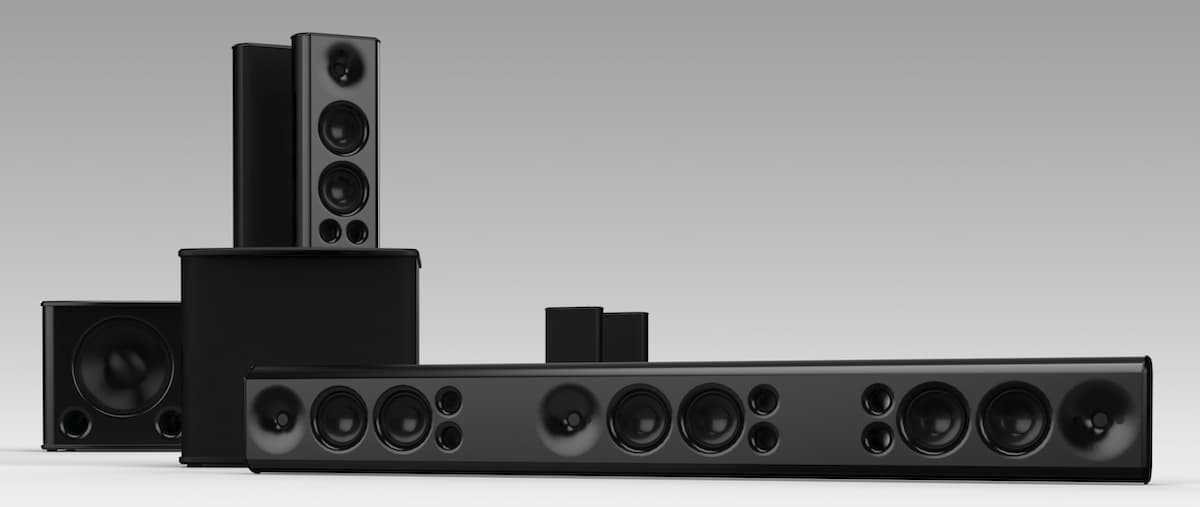
When I reviewed the Theory Audio Design 5.2.2 surround system, it completely reset my expectations for what a soundbar-based home theater could deliver. Its combination of dynamics, scale, dialogue clarity, and control made it unmatched below $20,000 at the time.
Advertisement
Theory continued to impress during our CEDIA Expo 2025 coverage, earning eCoustics Best in Show recognition for both the compact ic5 architectural loudspeaker and the ic6 deployed in its outdoor bollard enclosure. Its 9.2.4 system was also selected for Best Home Theater Sound at AXPONA 2026.
The common thread has been high efficiency, controlled dispersion, strong dynamic performance, and consistent voicing across different installation formats. The new controllers allow integrators to apply that same system-based approach to substantially larger and more complicated projects.
Theory Audio Design Soundbar, Speakers and Subwoofers
CEDIA Expo 2026
Theory Audio Design will demonstrate the DLC-1500.8d and PLC Series in Booth 1300 at CEDIA Expo 2026, which runs September 1 through 4 at the Colorado Convention Center in Denver. eCoustics will be there, and we will have the opportunity to try the new controllers inside a complete Theory system rather than merely admiring the power ratings on a rack sheet.
The Bottom Line
The DLC-1500.8d looks like a logical and useful evolution of Theory’s existing controller platform, doubling the channels and claimed total output of the DLC-1500.4d without demanding additional rack space.
Advertisement
The PLC Series is the larger strategic move. Powersoft technology, substantially greater power density, Dante and AES67 networking, and more scalable system management could make Theory a viable option well beyond dedicated home theaters.
Advertisement. Scroll to continue reading.
Sixteen thousand watts in a 1RU chassis certainly gets attention. Pricing, thermal management, network reliability, noise levels, and ease of deployment will determine whether integrators keep ordering them after the demonstrations are over.
U.S. Lawmakers have written to President Donald Trump, hoping he will do something to help big tech companies being targeted by the E.U.’s Digital Markets Act.
The European Union’s Digital Markets Act has been a thorn in Apple’s side since its introduction. Lawmakers in the United States want something done to fight what they consider to be rules that target U.S. Big Tech firms unfairly.
A letter signed by 25 Republicans, including seven members of the House of Representatives Trade Subcommittee, has been sent to Trump, urging him to open trade investigations against the E.U. The letter, seen byReuters on July 21, focuses chiefly on the Digital Markets Act as a tool that works against U.S. firms.
Describing the rules as “anti-competitive acts, policies, and practices,” the letter accuses the E.U. of using them as tools of “economic extraction and regulatory coercion against American firms.” Trump is urged to take action before Europe “further entrenches this anti-American regime.”
Advertisement
As an example, the letter proposes that the addition of the cloud units of Amazon and Microsoft under the Digital Markets Act would place “unprecedented regulatory burdens” on the companies. Burdens that European and Chinese rivals apparently wouldn’t face.
Apple’s designation as a gatekeeper under DMA rules is also raised, alongside Amazon and Meta’s inclusion. Meanwhile, China giants Temu and AliExpress are not classed as such, partly due to the rules relying on the number of European users who use them.
There’s also the apparent problem of firms in the E.U. having access to the U.S. market with less regulatory oversight than the U.S. firms in the E.U. This access should be limited if the E.U. continues to use discriminatory rules, it continues.
The letter said that the U.S. should use all available tools, including Section 301 of the Trade Act of 1974. This rule would combat perceived unfair trade practices by imposing tariffs, Trump’s favorite international economic weapon.
Advertisement
E.U. “innocence”
While lawmakers are insistent that the transatlantic relationship between the U.S. and Europe is very much one-sided and grossly unfair, the EU thinks otherwise.
Thomas Regnier, European Commission spokesperson, said the European Union has the sovereign right to regulate economic activities taking place within its borders. This also applies to digital regulation, he continued, insisting they are being enforced in a “fair and non-discriminatory manner.”
This enforcement has included continuing to fight Apple over the App Store and iMessages. For the App Store, this has led to the fairly lukewarm creation of third-party app storefronts on the continent.
Apple has also caught the occasional break from regulation, too. When it comes to Apple Maps and Apple Ads, the E.U. doesn’t believe they are large enough to be subject to regulation under the DMA.
Advertisement
The regulations have also led to Apple holding back from launching some products in Europe, because of DMA compliance concerns. While the rest of the world will get to use Siri AI this fall, the EU will miss out.
Reviving retaliation
The letter to President Trump and the reference to Section 301 is a carefully planned request, that effectively is a callback to a warning from September 2025.
At the time, Trump warned Europe that the U.S. would retaliate if the E.U. continued to fine U.S. companies and burden them with regulations. There was the same threat of invoking Section 301 to allow U.S. officials to investigate and respond to unfair foreign trade practices.
Trump insisted that Europe was unfairly targeting American companies, such as Apple. The penalties levied by Europe were deemed to be diverting money away from U.S. investment and jobs.
Advertisement
By spelling out that the lawmakers want Trump to do what he threatened in September, the letter could be enough to nudge the President into following through.
Four classic Xbox games are heading to PC as part of a new program from Microsoft. These older titles, which are currently available on Xbox Game Pass, will now be playable on desktops, laptops and handhelds such as the ROG Xbox Ally and Xbox Ally X.
On Wednesday, the Xbox Backward Compatibility preview went live, allowing owners of four titles first released for the original Xbox — Blinx: The Time Sweeper, Conker: Live and Reloaded, Crimson Skies: High Road to Revenge and Fuzion Frenzy — to play them on their Windows PC and handhelds. Microsoft says it will roll out more features for these games in the future, including Xbox Achievements.
Microsoft
The four games may be more than 20 years old, but Microsoft did add some options to improve the gaming experience. Players can change the graphics settings, including up to 4x resolution upscaling, VSync support, display mode options, anisotropic filtering, enhanced anti-aliasing and more customizations to improve the look of these older titles.
Each game is available for purchase for $10 from the Xbox Store, and once owned on Xbox, the games can be played on PC or handhelds via Xbox Play Anywhere or streamed with Xbox Cloud Gaming. The titles are also available on Xbox Game Pass.
In order to play these games on a desktop, laptop or handheld, it must meet certain hardware specs:
Advertisement
Minimum system requirements:
GPU: Nvidia GTX 950 or AMD Radeon RX 550 or Intel UHD 770 or Intel Arc A310
CPU: Min 4 Cores Intel Core i3-8100 or AMD Ryzen 3 1200 or AMD Ryzen™ Z2 A Processor
RAM: 8GB
OS: Windows 11
Drivers and Versions: Latest Version as of January 2026
Recommended specifications:
GPU: Radeon RX 68005 or Nvidia GTX 1070 Ti or Intel Arc A770
CPU: 6 cores and 12 threads Intel Core i5-10400 or AMD Ryzen 5 3600 or AMD Ryzen AI Z2 Extreme
Drivers and Versions: Latest Version as of January 2026
Microsoft says the Xbox Backward Compatibility program is a form of game preservation, which has become a concern for gamers. With Sony announcing it will phase out physical discs and Nintendo’s Game-Key Cards that don’t contain the actual games, many worry that game ownership will become entirely dependent on publishers rather than having a physical medium to hold onto. There is a growing number of delisted games that are no longer available to those who purchased them, and with the future of gaming looking increasingly uncertain because of the current memory shortage, many fear their digital game collections could simply disappear from their accounts.
Oscar Gonzalez
Contributing writer
Oscar Gonzalez is a Texas native who covered video games, conspiracy theories, misinformation and cryptocurrency.
See full bio
from the this-must-not-happen-in-a-free-society dept
You’d think that watching multiple lawyers get caught red-handed using AI to file briefs full of made-up citations would cause everyone in the legal profession — especially prosecutors — to double-check their own. You would, of course, be wrong. And the latest offender is not just some random lawyer. It’s the DOJ itself, which cited a nonexistent Sixth Circuit case to argue that an ICE detainee shouldn’t be able to challenge a stay that prevented him from posting a bond that had already been granted, thereby leaving him in detention.
This story hits on two different threads we’ve been covering over the last few years separately. Having them collide somehow makes both worse.
We’ve covered plenty of cases where lawyers for one party (or both, or sometimes judges) are misusing AI to do their writing for them, generating fictitious cases in support of whatever argument they’re seeking to make. This is troubling on many levels, because one of the things any lawyer is supposed to do before submitting anything to a court is check the citations. Historically that has been to make sure the cases cited haven’t been overruled. In these cases, not only is that not happening, they’re literally putting in cases that don’t exist, citing precedents that are completely fictitious.
Our other line of stories touched on here is how ICE and the DOJ have been stomping all over detainees’ basic constitutional rights.
Advertisement
This is one of many cases in which lawyers for a detainee have filed a habeas petition — and it’s a clean example of those two threads colliding in practice. I’ll let Judge Hala Y. Jarbou summarize the basics of what happened:
Petitioner, a United States Immigration and Customs Enforcement detainee, initiated this action by filing a petition for a writ of habeas corpus pursuant to 28 U.S.C. § 2241. (Pet., ECF No. 1.) An immigration judge had granted Petitioner a bond of $35,000, but the bond order was stayed pending appeal to the Board of Immigration Appeals pursuant to 8 C.F.R. § 1003.19(i) (2025). Petitioner argued that the 90-day automatic stay provision in § 1003.19(i) violates the Fifth Amendment’s Due Process Clause, and sought an order requiring the Government to allow him to post bond. While this lawsuit was pending, the automatic stay of Petitioner’s bond order expired. The Government now represents that the bond order is back in effect and Petitioner will be released if he posts the $35,000 bond. (Status Report, ECF No. 10.) Accordingly, the Court finds that the habeas petition is moot and dismisses it without prejudice.
Already frustrating enough that the 90-day “automatic stay” that the detainee was challenging ended before the actual case could be decided, making the whole thing moot.
But… there’s something else the judge had on her mind. The DOJ appeared to have a totally fabricated citation in an earlier filing:
There is one additional issue in this case that the Court must address. In the Government’s response to the Court’s initial order to show cause, it stated the following:
More recently, the Sixth Circuit has reiterated that § 1226(e) bars challenges that “ask the court to reweigh the evidence underlying a bond decision or second-guess the Immigration Judge’s discretionary judgment.” See Taylor v. Hott, 724 F. App’x 387, 392 (6th Cir. 2018) (district court lacked jurisdiction to review IJ’s bond denial where petitioner challenged flight-risk determination) . . . .
(Gov’t’s Resp. 9, ECF No. 5.) The cited case, Taylor v. Hott, is not located at the identified page of the Federal Appendix. Indeed, page 387 is contained within a different opinion—Atkins v. CGI Techs. & Sols., Inc., 724 F. App’x 383 (6th Cir. 2018)—which is about commercial arbitration, not immigration bond determinations. In its research, the Court was unable to identify a Sixth Circuit case with the caption Taylor v. Hott, or any federal case containing the quoted language. Thus, it seems this citation was likely produced by generative artificial intelligence (“AI”).
Advertisement
It is already bad enough when you have a fabricated citation in a civil case between two private parties. But here we’re literally talking about a case involving someone’s freedom. And the government is filing AI-generated fake cases?!?
We should be livid. But the judge lets them off with a little slap on the wrist and a “please don’t do this again”:
It should be obvious that any attorney who uses AI must scrupulously review its work product to ensure that the cited cases exist and that the citations accurately and fairly represent the underlying case law. The duty of candor towards this tribunal demands no less.
Although the Court will not presently impose sanctions for this conduct, it goes without saying that the Government must ensure its future filings with this Court do not include nonexistent case law
And, yes, judges tend to be fairly restrained in issuing sanctions, often giving misbehaving lawyers many more chances than they probably deserve before rushing to punishment. But, again, this was someone’s freedom on the line. And the DOJ literally directly — whether intentionally or not — misled the court with a precedent that doesn’t exist. That should never happen.
Advertisement
We all know the DOJ is having trouble staffing lawyers. Over 10,000 lawyers have left the federal government since Donald Trump came back into office. They’re offering large bonuses for jobs that lawyers used to deliberately take massive pay cuts to get on their resume. Pretty much everyone agrees it’s a staffing crisis, to the point that earlier this year an apparently exhausted Assistant US Attorney, Julie Le, asked an angry judge to find her in contempt just so she could get some sleep:
Attorney Julie Le was representing the government at a hearing over ICE’s failure to follow court orders and immediately release people that it had wrongfully detained. When Judge Jerry Blackwell asked why the agency is not complying, Le said that the government was “overwhelmed” by the legal challenges to Operation Metro Surge in Minnesota, and that trying to get ICE to comply with court orders has required nonstop work for an office depleted by resignations.
“I wish you would just hold me in contempt of court so I can get 24 hours of sleep,” Le said. “The system sucks, this job sucks, I am trying with every breath I have to get you what I need.”
Given that kind of work environment, is it really any surprise that the few remaining DOJ lawyers would turn to hallucinating AI tools to “generate” their legal filings?
But if you’re starting to feel any ounce of sympathy for the DOJ here, let’s be clear: fuck that. If the DOJ can’t do their fucking job they shouldn’t be throwing people into jails, detainment centers, concentration camps, or anything of that nature. If they want to go around fighting habeas petitions, maybe don’t lock up so many people without any ounce of due process. And if they want to keep people detained then hire enough lawyers to handle the government’s case load.
Advertisement
And if that’s too difficult because good lawyers have no interest in working for a fascist regime that is stomping all over basic fundamental freedoms in every direction, well, maybe work on that rather than locking innocent people up with no due process. Donald Trump’s administration put this DOJ in this position and there’s simply zero excuse for judges letting the DOJ get away with this sort of absolute bullshit.
Judges should be issuing sanctions left and right. They should be reporting lawyers to ethics committees and the relevant bar associations. They should be demanding that the government actually obey the fucking law, and not deny anyone their rights.
Want to stop the DOJ from locking people up with fictitious cases? Start issuing actual consequences to those lawyers and anyone else at the DOJ who had anything to do with this.
The company is already preparing updates to the MacBook Neo, iMac, MacBook Air and more.
Devindra Hardawar for Engadget
Rumors have been swirling for several months about Apple’s plans to add an OLEDtouchscreen to its MacBook Pro, but Bloomberg reports nearly all the company’s other laptops and desktops are receiving chip upgrades and, in some cases, design changes within the next year.
The highlight of the bunch is a new version of the MacBook Neo, which will reportedly use the A19 Pro chip first introduced on the iPhone 17 Pro, come with more RAM and be available with new colors. In the more immediate future, Bloomberg writes that Apple has prepped updates to the iMac and entry-level 14-inch MacBook Pro for this fall, with a likely focus on chip bumps to the M5 chip and upcoming M6 chip, respectively. Sometime between the fall and early 2027, the company will then introduce the “MacBook Ultra,” which will use the M5 Pro and M5 Max chips of current high-end MacBook Pros, but with a new OLED touchscreen and macOS interface tweaks.
For 2027, Apple is reportedly planning to update the 13-inch and 15-inch MacBook Air, likely also with the M6 chip, and assuming supply constraints don’t get in the way, release new versions of the Mac Mini and Mac Studio. Bloomberg writes Apple is testing versions of the Mac Mini with the M5 Pro and M6 chips, while the in-development Mac Studio currently uses M5 Max or M5 Ultra chips. The company’s plan to completely redesign the 14-inch MacBook Pro is also still in the works, and the new laptop will reportedly debut with an M7 chip.
Advertisement
Beyond those immediate upgrades, it sounds like OLED screens will also be slowly trickling out to the company’s products, starting with the iPad Mini, then coming to the MacBook Pros, the 2028 versions of the MacBook Air and at some point in the future, the iMac. Pro and Max versions of the M7 chip will also be introduced on next year’s MacBook Pros.
Apple only recently raised the prices of its Mac lineup in June 2025, so ideally, some of these upcoming upgrades won’t be paired with further price hikes. Considering that memory is still in high demand due and Apple is rumored to be rolling out a new hardware leasing program, though, don’t be surprised if costs creep even higher.

































































You must be logged in to post a comment Login