

Crypto World
Clarity Act expected to miss its window before Congress’ summer break, leadership says

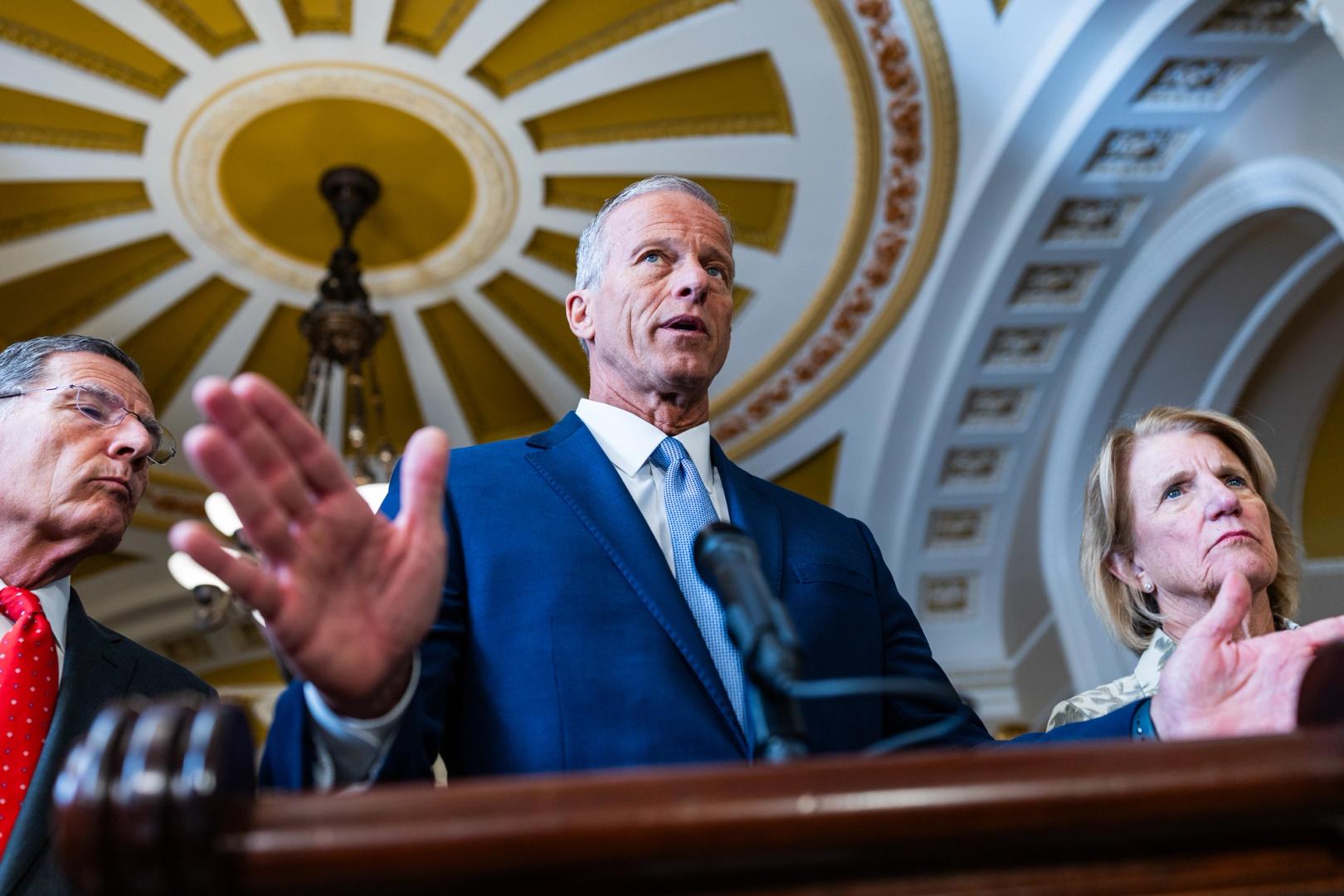

The crypto industry had held out optimism that the Senate could finish the wide-ranging Clarity Act in the next couple of weeks. Dragging it into the later months of the year sharply reduces its odds for passage in 2026.
Clarity — even more than last year’s Guiding and Establishing National Innovation for U.S. Stablecoins (GENIUS) Act — is the crypto industry first priority in crypto policy, with the hope it finally secures a permanent legal foundation for U.S. crypto activity.
The Senate’s floor process is a multi-stage affair that can take a few days or even longer to advance legislation past the 60-vote threshold needed in that chamber. At this stage, the crypto bill is hardly guaranteed to muster even a majority, as some Republican senators have also raised concerns with its treatment of stablecoin yield and the language of the government-ethics provision.
Senator Cynthia Lummis, a Wyoming Republican who has been a lead Clarity Act negotiator, told CoinDesk in a Wednesday interview that the most contentious sections are still open for revision that she said could bring Democrats to support it.
Republicans and industry insiders had hoped that getting the bill to the Senate floor might sharpen its urgency and help drive deals among the lawmakers to iron out the final disagreements. That could still happen if Thune can find some floor time before recess.

Ondo Finance has secured FINRA authorizations covering tokenized NMS stocks, exchange-traded funds, mutual funds, index funds and IPO securities for U.S. investors.
Summary
- Oasis Pro secured FINRA permissions for tokenized stocks, funds and IPO securities in the U.S.
- The framework supports stablecoin settlement and access through brokers, advisers and retirement accounts.
- ONDO faces resistance near $0.42 while holding above all four major moving averages.
Ondo Finance announced on July 23 that its SEC-registered broker-dealer subsidiary, Oasis Pro Markets, had received the permissions needed to launch regulated tokenized securities services under SEC and FINRA oversight.
According to the company, the authorizations cover over-the-counter retail transactions, underwritten primary offerings, private placements and other securities activities. Oasis Pro Markets can also operate a venue where U.S. issuers conduct primary offerings and eligible retail and institutional investors trade the resulting assets in secondary markets.
The approved framework supports settlement in fiat currencies or selected stablecoins, including transfers made directly between blockchain wallets, Ondo said. Supported products include National Market System equities, ETFs, mutual funds, index funds and securities issued through initial public offerings.
Oasis Pro Markets may also use omnibus account structures, allowing broker-dealers and registered investment advisers to connect their existing systems. Ondo said the arrangement could give institutional clients, retail investors and retirement accounts access through their current financial providers, reducing the need to open accounts on a separate platform.
The company cautioned that FINRA membership and SEC registration do not guarantee compliance with every rule. Neither regulator has recommended the products, approved them as investments or verified Ondo’s announcement, according to the disclaimer accompanying the release.
Authorization opens regulated U.S. distribution
Completed in October 2025, Ondo’s acquisition of Oasis Pro brought an SEC-registered broker-dealer, alternative trading system and transfer agent into the group. Oasis Pro Markets has been a FINRA member since 2020 and previously received authorization to settle digital securities using fiat, USDC and DAI, according to Ondo’s acquisition announcement.
Through Oasis Pro TA, the group can manage capitalization tables onchain while administering shareholder rights and transfers. Ondo said the transfer-agent unit also supports movement of collateral across asset types, giving the company regulated infrastructure for both issuing and servicing tokenized securities.
Earlier in July, Ondo introduced tokenized versions of BlackRock’s iShares Core S&P 500 ETF and Micron shares in partnership with Broadridge. Under the structure described by Ondo, the underlying securities remain within the established U.S. custody system while corresponding tokens are issued on Ethereum and held by regulated custodians.
The model follows a third-party custodial structure discussed by the SEC in January 2026. Ondo said each token is backed one-for-one by the underlying shares and carries the same shareholder rights and protections, including voting rights handled through Broadridge.
Before this U.S. rollout, Ondo Stocks mainly served eligible investors outside the country. The platform’s current terms still state that its existing Ondo Stocks tokens cannot be offered to U.S. persons unless they are registered or qualify for an exemption, meaning the new authorizations provide infrastructure for compliant U.S. services rather than automatically removing every product restriction.
Ondo reported in early 2026 that its tokenized products had exceeded $2.5 billion in total value locked, citing RWA.xyz and DefiLlama. At the time, the company said Ondo Stocks had generated more than $7 billion in cumulative trading volume across over 200 tokenized stocks, while its tokenized Treasury products accounted for about $2 billion in value.
Regulatory uncertainty had previously limited Ondo’s U.S. plans. In December 2025, the company reported that the SEC had closed a confidential, multi-year investigation without filing charges, although the closure did not amount to formal approval of Ondo’s products.
ONDO price faces resistance at $0.42
Ondo (ONDO) price traded near $0.40 at the time of analysis after falling roughly 3% over 24 hours, while its 7-day performance remained positive. Its market cap stood near $1.94 billion, based on a circulating supply of about 4.9 billion tokens, with daily volume above $130 million.
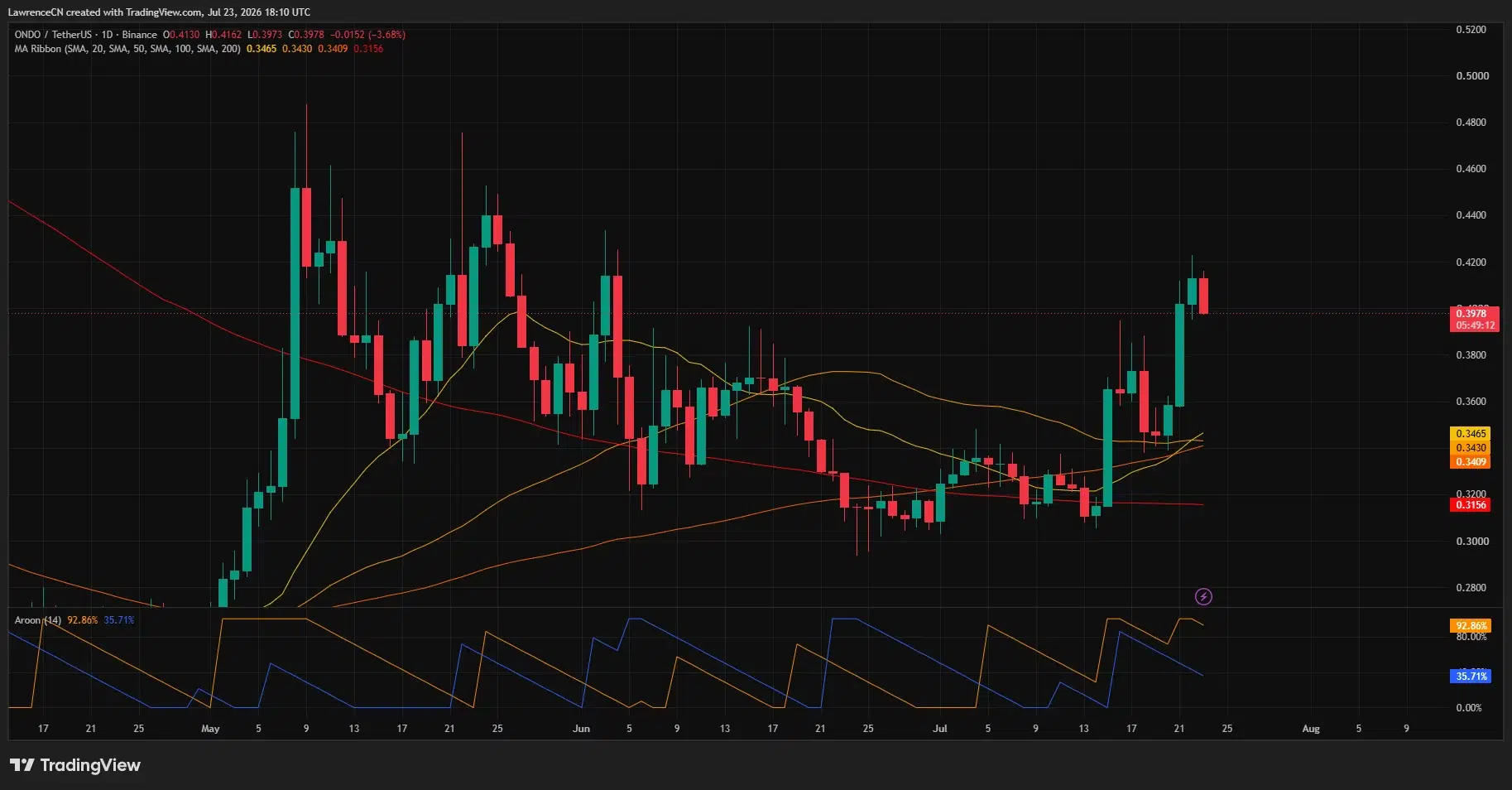
On the supplied Binance daily chart, ONDO rose as high as $0.4162 before retreating to about $0.398. The rejection places initial resistance between $0.416 and $0.42, where sellers interrupted the latest advance.
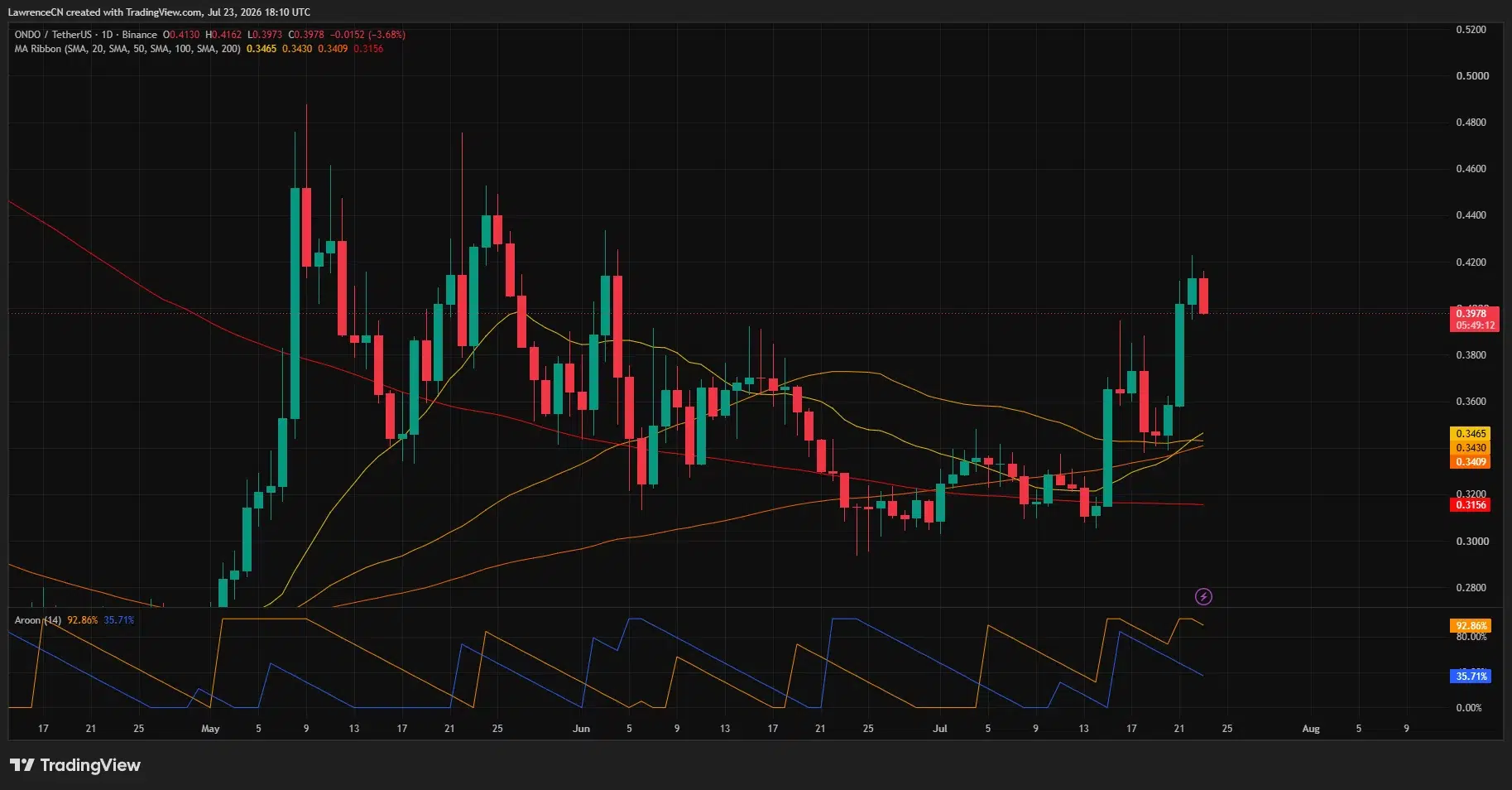
Despite the pullback, the chart shows ONDO trading above its four displayed moving averages. The 20-day average stands near $0.343, followed by the 50-day at $0.3465, the 100-day at $0.3409 and the 200-day at $0.3156.
Aroon readings also favor the recent advance, with Aroon Up at 92.86% compared with Aroon Down at 35.71%. Based on the chart, a daily close above $0.42 would clear the latest swing high, while failure to hold $0.38 could expose the moving-average cluster between $0.341 and $0.347.
Disclosure: This article does not represent investment advice. The content and materials featured on this page are for educational purposes only.


Bitcoin has fallen below $65,000 after the Trump administration announced tariffs of 10% to 12.5% on imports from 60 trading partners covering more than 99% of U.S. trade.
Summary
- Bitcoin fell below $65,000 after Trump announced new tariffs covering 60 major trading partners.
- Strong U.S. jobless claims data and rising Treasury yields added pressure on risk assets.
- Crypto liquidations reached about $162 million as leveraged long traders absorbed most of the losses.
CNBC reported that the duties will take effect at 12:01 a.m. ET on Friday, replacing the temporary 10% global tariff scheduled to expire the same day. The Office of the U.S. Trade Representative has linked the measures to what it described as inadequate enforcement against goods made with forced labor.
Bitcoin traded as low as $64,985 on Thursday, July 23, before briefly recovering above $65,000. crypto.news data showed the asset down about 1.5% over 24 hours, with its market capitalization standing near $1.3 trillion.
Selling resumed after details of the tariff plan emerged, leaving the rebound above $65,000 short-lived. Short-interval charts showed consecutive bearish candles during the decline, while CoinGlass recorded rising liquidations of leveraged long positions as traders faced another risk-off development.
The tariff announcement arrived during a difficult session for risk assets. The Nasdaq Composite fell about 2.2% to a four-week low, while the S&P 500 lost 1.2% and the Dow Jones Industrial Average dropped about 507 points.
Escalating tensions between the United States and Iran had already pressured Bitcoin earlier in the day. Al Jazeera reported that President Donald Trump had threatened an unprecedented “massive attack” on Iran as military exchanges continued across the region.
Strong labor data has added pressure on Bitcoin
Fresh U.S. employment data gave traders another reason to reassess interest-rate expectations. The Labor Department reported that initial jobless claims fell by 22,000 to 187,000 in the week ending July 18, the lowest total since September 1969.
Economists surveyed by Reuters had expected claims to rise to 212,000. Continuing claims also fell by 2,000 to 1.796 million, according to the department, showing that layoffs remained limited despite slower hiring and uncertainty surrounding trade policy.
Stronger labor figures can reduce the urgency for the Federal Reserve to ease monetary policy because they suggest that the economy can withstand restrictive borrowing costs. Interest-rate futures indicated that traders were considering the possibility of a Fed rate increase by September, Reuters reported, as higher oil prices added to inflation concerns.
Treasury yields climbed alongside those expectations, with the 10-year yield reaching about 4.70%, according to Investors Business Daily. Higher bond yields can weigh on cryptocurrencies because they raise the return available from traditional assets that carry less risk than Bitcoin.
Leveraged traders took most of the immediate damage from the decline. CoinGlass data showed that 62,869 crypto traders were liquidated over 24 hours, with total liquidations reaching about $162 million. Separate Coinalyze figures placed Bitcoin liquidations near $28.7 million, including roughly $26.2 million in long positions.
Bitcoin’s fall followed a brief advance toward $67,000 earlier in the week. BTC was approaching a seven-week high on July 21 despite the conflict with Iran and the pending tariff decision, but buyers failed to maintain that move as macroeconomic pressure intensified.
New tariffs have rebuilt Trump’s trade barrier
The administration has imposed the tariffs under Section 301 of the Trade Act of 1974, which allows Washington to respond to trade practices it considers unfair. The legal route differs from the emergency powers used for an earlier set of tariffs that the Supreme Court struck down in February.
A senior administration official described the measures as the most extensive international labor-rights trade action ever taken by any country. According to the administration, the rates depend on how much progress each trading partner has made in restricting imports produced with forced labor.
Countries and territories that have introduced partial restrictions or made related commitments will face a 10% rate. USTR documents show that the group includes Canada, Mexico, the European Union, the United Kingdom, Taiwan, Argentina and several Southeast Asian and Latin American economies.
A 12.5% tariff will apply to partners that the USTR determined had made less progress, including China, India, Japan, South Korea, Vietnam, Australia and New Zealand. U.S. Trade Representative Jamieson Greer has argued that weak enforcement abroad forces American workers to compete against goods linked to abusive labor practices.
Several major product groups will remain outside the new duties. Reuters reported that the exemptions include crude oil, petroleum products, pharmaceuticals, rare-earth materials, aircraft parts and some foods, while goods already covered by Section 232 tariffs will not face an additional charge.
Canadian and Mexican products that comply with the U.S.-Mexico-Canada Agreement will also be exempt. Administration officials said the new steel and aluminum duties would not stack on top of existing national-security tariffs.
The USTR has not published an estimate of how much revenue the tariff package will produce, according to CNBC. Trading partners can potentially secure lower rates by strengthening their forced-labor import rules, although officials said no country currently enforces a complete prohibition.
For Bitcoin, the announcement has added trade uncertainty to a session already shaped by geopolitical tension, rising oil prices, stronger labor data and higher Treasury yields. CoinGecko data placed BTC close to $65,000 at the time of reporting, leaving the level as the immediate test for buyers after the latest decline.
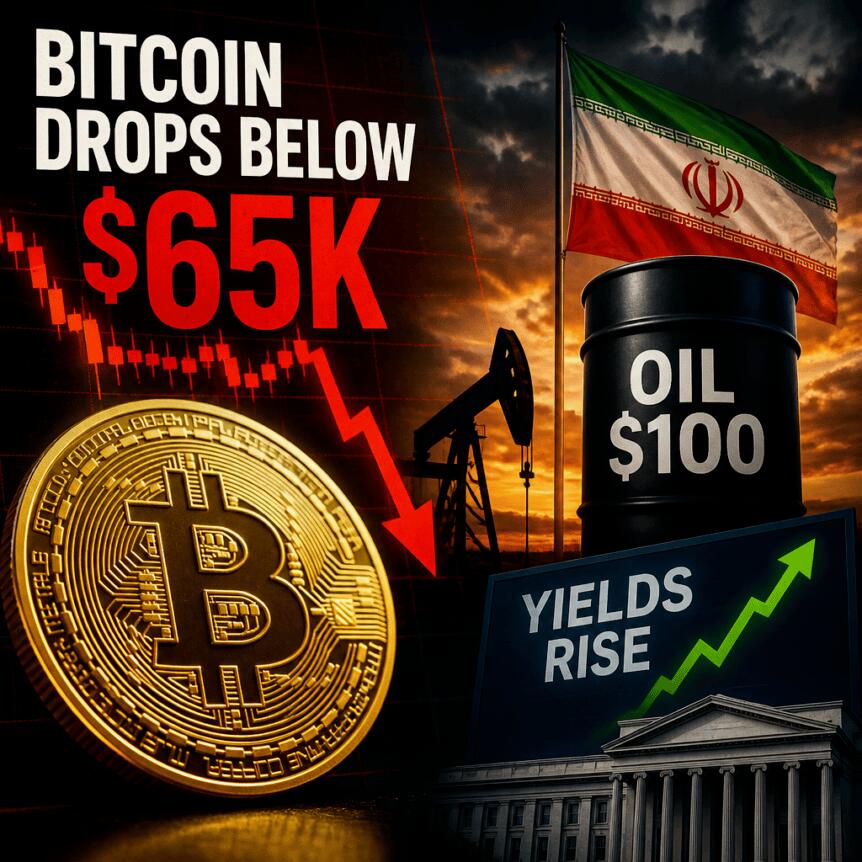
Bitcoin slipped below the $65,000 mark on Thursday, touching a three-day low around $64,799 on Bitstamp, as broader risk markets weakened amid renewed US-Iran tensions. The drop came alongside a selloff in US equities, a rally in oil, and rising expectations that US interest rates could stay higher for longer.
With traders split over whether recent relief will extend—or fade—attention has turned to nearby technical levels, including a widely watched moving-average area that could influence the next leg of momentum.
Key takeaways
- Bitcoin fell to three-day lows near $64,799 on Bitstamp as the S&P 500 and Nasdaq slid on Thursday.
- US-Iran escalation fears fed into risk-off sentiment, lifting oil prices and pushing yields higher.
- Coinciding with the selloff, CME FedWatch odds shifted toward a potential 0.25% hike by the upcoming FOMC, a typical headwind for crypto.
- Traders are watching moving-average support and the $68,000 resistance zone for clues on whether BTC can attempt a bigger breakout.
Geopolitics hits risk assets, and BTC follows
According to TradingView data cited in the report, BTC/USD reached three-day lows of $64,799 on Bitstamp. The move lower was part of a broader pattern: when equities and other high-beta assets struggle, crypto often struggles too.
US market pressure intensified after President Donald Trump warned that he would blame Iran for recent Houthi strikes on Saudi commercial vessels. In a post on Truth Social, Trump said he was “very disappointed” in the Houthis and referenced attacks on US ships from 2025.
By the close of New York trading, the S&P 500 had fallen 1.2%, while the Nasdaq dropped 2.2%. Oil strengthened sharply as well, with Brent crude rising to its highest level since early June and topping $100 per barrel.
That mix—weak equities, higher energy prices, and tightening financial conditions—can be hard for speculative assets. One signal highlighted by The Kobeissi Letter on X was that inflation expectations and interest rates were rising again, reinforcing the sense of renewed macro pressure on risk-taking.
Fed expectations shift: a potential 0.25% hike becomes more likely
Crypto traders often treat changes in Federal Reserve expectations as a direct input into near-term risk appetite. In this case, the report pointed to CME Group’s FedWatch Tool showing an increased chance of a 0.25% hike ahead of the Federal Reserve’s next decision.
Odds neared 40% on Thursday, compared with roughly 12% a week earlier. Historically, expectations for additional rate hikes tend to weigh on assets that typically benefit from easier financial conditions.
The Kobeissi Letter also referenced 18-month highs in US 10-year bond yields, framing the move as evidence of fresh economic stress. Higher yields can tighten liquidity and raise discount rates—conditions that often challenge the multiples and leverage embedded in speculative markets.
BTC traders disagree on the path forward
As price weakened, the market message wasn’t consistent. The report described a split among traders about whether BTC’s relief could continue or whether the recent rally was approaching a turning point.
One commentator, Exitpump, argued on X that the “July rally” may end by late July and that traders should be prepared for downside if price breaks below $65,000. Their view—posted late on Wednesday—was effectively a stop-out narrative for longs: close positions near resistance and turn cautious once the $65K area gives way.
Other traders were more constructive. Crypto trader Jelle suggested BTC was “still making progress,” describing a path in which clearing a local area could open a route toward the $70K region and potentially establish a new trading range. The difference in outlook matters because it determines how quickly traders reposition—whether they treat the current decline as a continuation of bearish momentum or as consolidation before the next attempt higher.
Technical focus: moving averages and the $68,000 hurdle
Beyond macro catalysts, technical levels are currently driving day-to-day decision-making. The report highlighted crypto analyst Michaël van de Poppe’s view that a 21-week simple moving average (SMA) around $64,073 represents key support.
Van de Poppe said, via an X post dated Thursday, that as long as BTC remains above the 21-Day MA, there should be room for a higher valuation in the near term. In the same post, he pointed to the “final hurdle” for a larger breakout: the $68,000 resistance zone, which he noted had been tested once and would now face a second attempt.
He also outlined a bullish target near $73,000 if BTC can break through that resistance area. For traders, this framing matters because it sets up a clear conditional roadmap: support preservation may keep the higher valuation thesis alive, while a sustained failure below key averages could invalidate the breakout scenario.
Heading into the next sessions, traders will likely keep one eye on macro signals—especially Fed expectations and bond yields—and the other on whether BTC can hold the $64K moving-average area and challenge $68,000 again without another sharp slide. The tension between geopolitics-driven risk aversion and the technical bullish targets is likely to define how quickly conviction returns to either side.
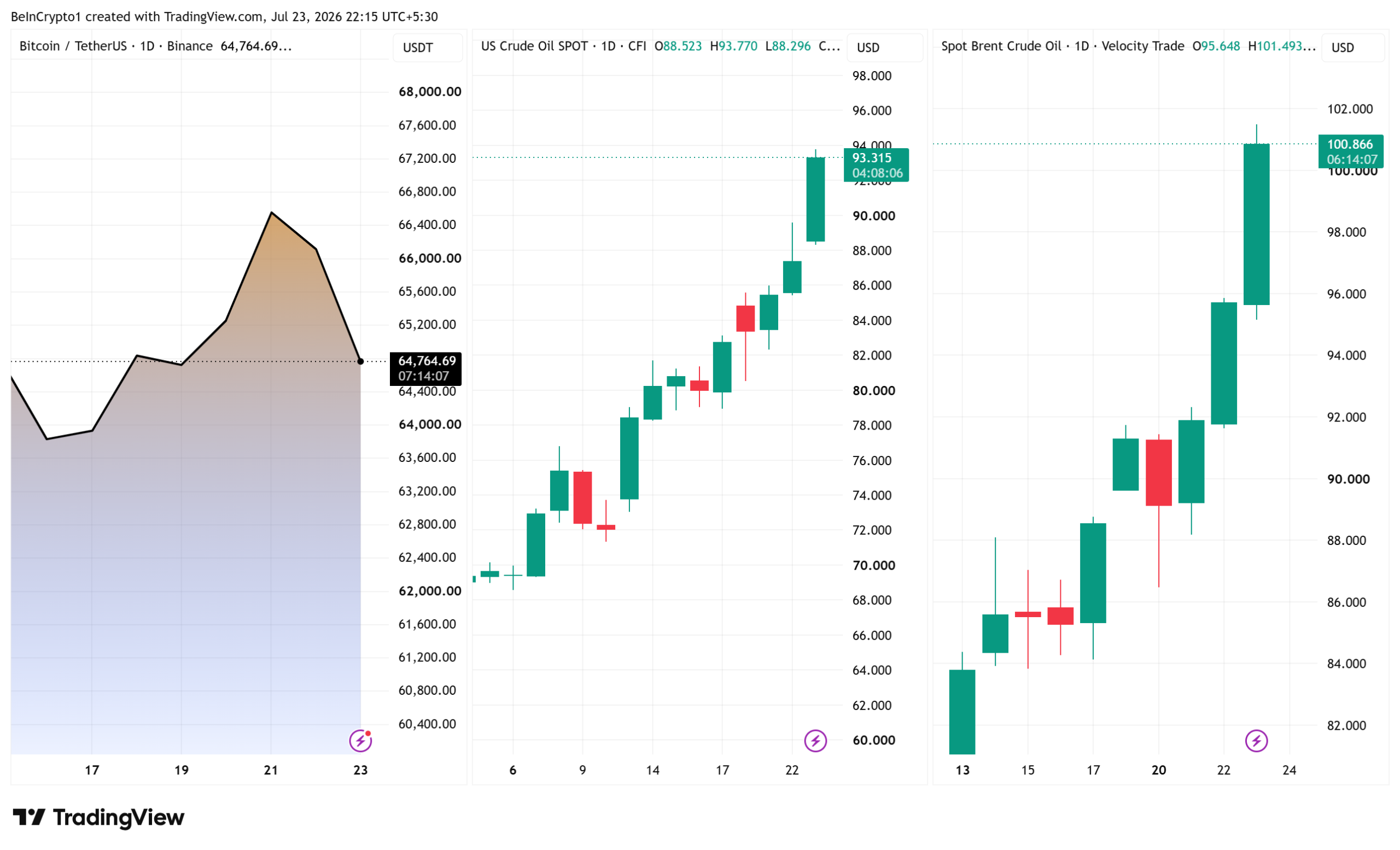
Oil prices jumped on Thursday. Brent crude topped $100 a barrel. The cause was one man. President Donald Trump said he is close to ordering a massive strike on Iran.
Reportedly, he told Axios he has not made a final call. But he says everything is ready. His decision could push oil even higher.

Trump’s Decision Could Push Oil Prices Higher
Trump said any new attack would be bigger than the last one. That earlier US campaign was called Operation Epic Fury. He said a decision is close, but not final.
“I am considering a massive attack. Bigger than ever before. I am close to making a decision. We are all set for it,” Axios reported.
The fight has grown over the past 12 days. The US wants to stop Iran from hitting ships in the Strait of Hormuz. About 20 million barrels of oil pass through that narrow route each day. That is close to a fifth of the world’s supply, the US Energy Information Administration (EIA) says.
The two sides had stopped fighting under a late-June truce. But tensions came back this month. US officials say no strike order has been given yet.
Iran-backed rebels in Yemen, the Houthis, have started hitting Saudi ships in the Red Sea. That puts a second oil route at risk, the Bab el-Mandeb strait. It handles millions of barrels a day too, EIA data show. Trump wrote on Truth Social that he would blame Iran for more attacks.
A bigger strike could block these oil ships and push prices up fast. The same thing happened on July 8. Bitcoin (BTC) fell below $62,000 and oil jumped when Trump ended an earlier deal with Iran.
For now, US crude sits near $93. Brent, the main global price, stays above $100. A full war would be very unpopular in the US.
Bitcoin Falls as Traders Play It Safe
Bitcoin fell about 2% in a day. It now trades near $64,755. It has barely moved over the past week.

The pioneer crypto has been stuck near $65,000 for weeks. However, crypto often falls when oil jumps on Middle East fears. Some traders had shrugged off Iran tensions earlier in July. Thursday’s threat changed that.
Trump set no deadline. So markets are left guessing. His next move will steer both oil and Bitcoin.
The post One Trump Decision Now Stands Between Oil and Its Next Surge As Brent Tops $100 appeared first on BeInCrypto.
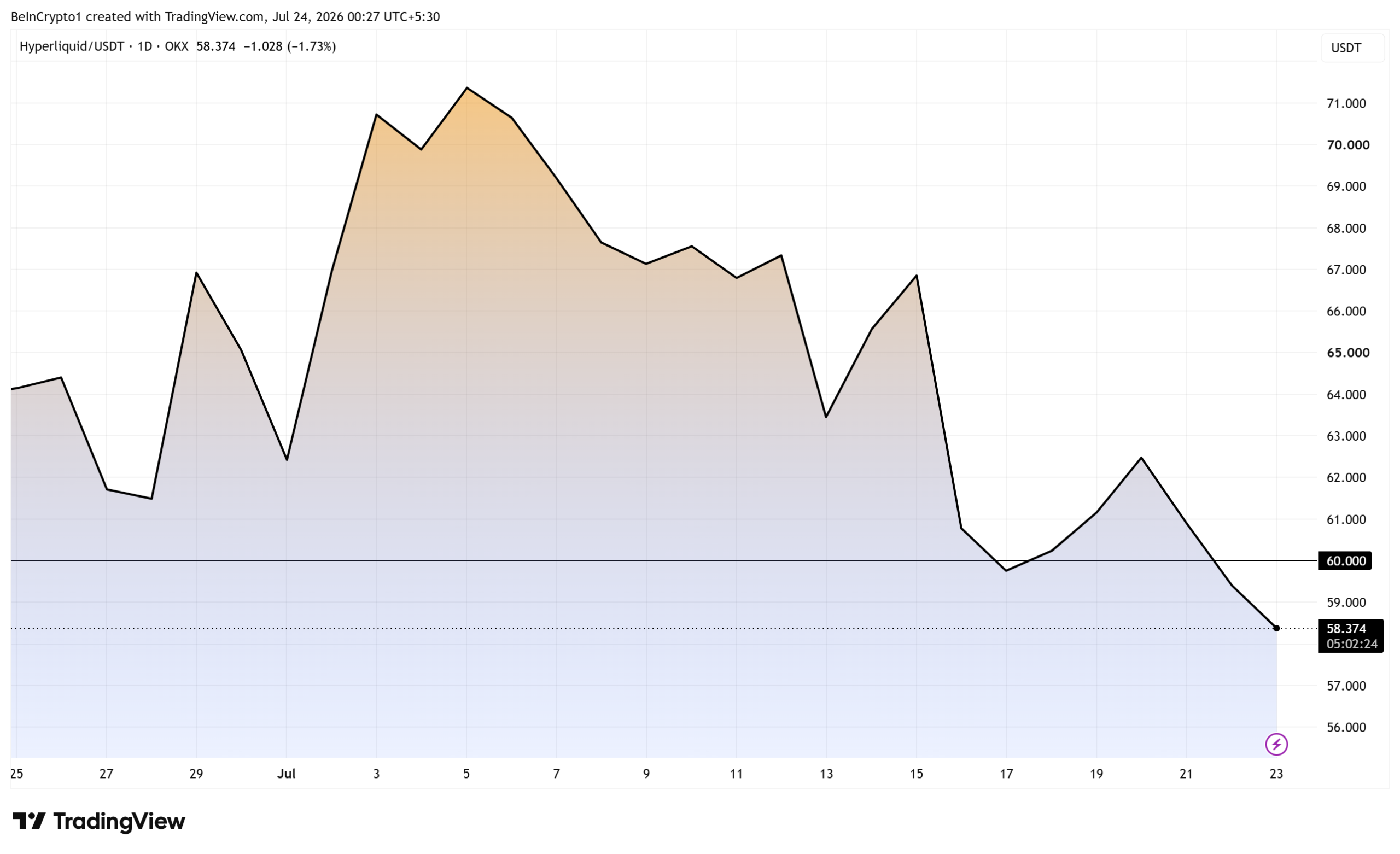
Two of crypto’s biggest funds just unstaked about $291 million of Hyperliquid (HYPE) in days. The token fell below $60, and traders feared a wave of selling.
Unstaking frees locked tokens for sale. But Multicoin says it is not selling, and on-chain data backs that up.
Why HYPE Fell Below $60
Hyperliquid is one of crypto’s busiest trading platforms. HYPE is now a top-10 token. It was trading for $58. That is down about 2% on the day. It sits about 24% below its June record of $76.70.

Multicoin unstaked close to 2 million HYPE, worth about $120 million. On-chain monitoring by MLM reveals that Paradigm unstaked even more. That was 2.92 million HYPE, worth around $171 million. Paradigm has not commented.
Together, that is about $291 million. It equals roughly 85% of HYPE’s daily trading volume. That is huge for a thin market. Lookonchain first spotted the Multicoin transfers. Some coins went to Coinbase Prime, a custody service.
Multicoin Says the HYPE Unstaking is Not a Sale
Multicoin cofounder Tushar Jain pushed back fast. He said the fund unstaked HYPE, but not to sell it.
“Yesterday we unstaked a large slug of HYPE. We did not unstake to sell… Our funds are constantly tracked, forcing regular wallet rotations. Institutions need privacy to operate”
Big funds are watched on-chain all the time. So they rotate wallets to stay private. Jain made the same case in an earlier interview. His firm holds a bullish HYPE forecast for 2028.
Why is every move visible? Hyperliquid took no venture money. It gave HYPE away in a 2024 airdrop. So big holders bought on the open market. Every wallet they use is easy to track.
On-chain account Markets Alpha checked the wallets. Its analysis found four linked wallets. They moved the unstaked HYPE into custody, not onto the market to sell.
One group even sent about 1 million HYPE to Grayscale. That helped fill its new Hyperliquid ETF, HYPG. The fund began trading on Nasdaq in June.
Why Some Traders are not Worried
Not everyone sees a problem. Trader Elon Trades said HYPE usage barely changed. He pointed to its growing derivatives market share and steady revenue.
Still, more coins may soon hit the market. On Hyperliquid, unstaking takes about seven days, per its documentation. Most unlock near the end of July.
What happens next? The funds could restake, hold, or sell. For now, the project’s fundamentals look solid. But the HYPE unstaking still hangs over the price. To recover, HYPE must climb back above $60.
The post Hyperliquid Slips Below $60 as Institutions Unstake $291M: Will Selling Follow? appeared first on BeInCrypto.
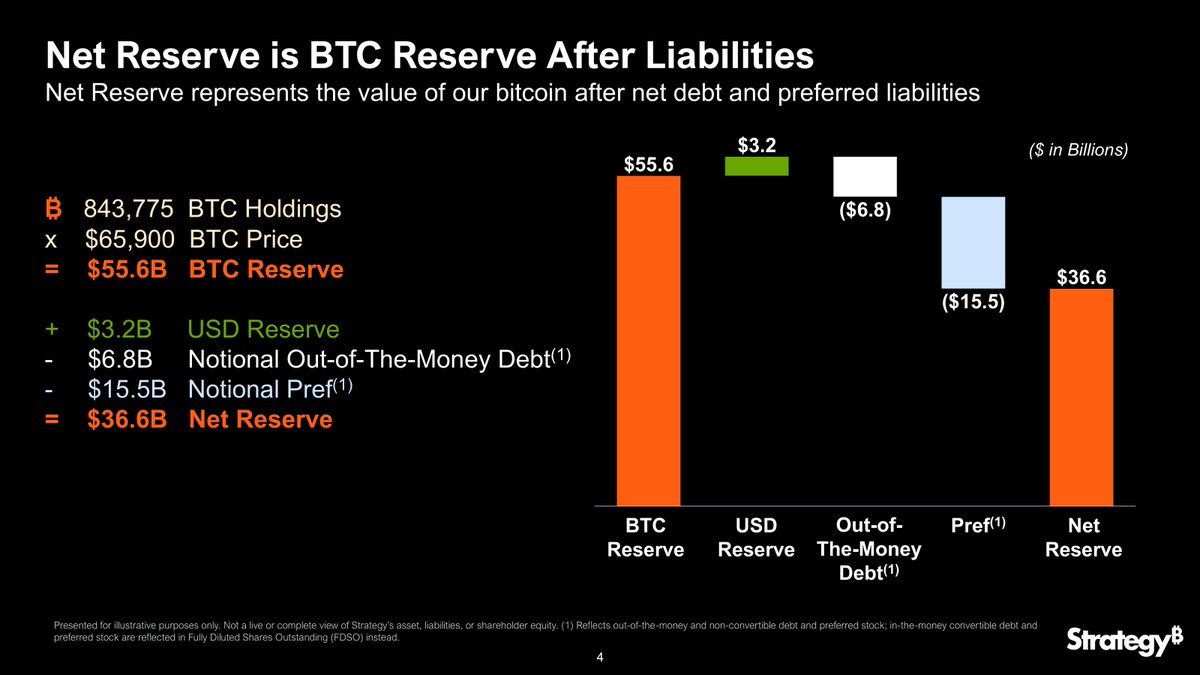
Strategy, formerly MicroStrategy, has overhauled the MSTR metrics it reports, and the new numbers make one thing clear. Much of its huge Bitcoin (BTC) pile is already promised to lenders and preferred investors, not regular shareholders.
The company says the change gives common shareholders a fairer picture. It shows how much Bitcoin is truly theirs after everyone else is paid first.
What the New Metrics Really Show
Strategy holds about 843,775 Bitcoin. That is the largest stash owned by any public company. On paper, its live dashboard values that Bitcoin at around $58 billion. But not all of it belongs to shareholders.
Lenders and preferred investors get paid first. They are owed about $22 billion. Take that out, and roughly $36 billion in Bitcoin is left for common shareholders. Strategy now calls this the net reserve.

The firm took on that debt to buy more Bitcoin. It laid out the approach in its Digital Credit framework this year. It also tested new numbers during an earlier metrics debate in June.
The Real Cost of the Debt
There is a catch. Servicing that debt and preferred stock costs about $1.8 billion a year. Strategy pays it in interest and dividends. It even keeps a cash reserve, set up in December, to cover those bills.
The new metrics also show the risk. A number called amplification, now about 1.53x, measures it. Put simply, shareholders gain more when Bitcoin rises. They also lose more when it falls. The stock proves the point. MSTR has dropped about 77% in a year, far more than Bitcoin’s 45% fall.

MicroStrategy also reworked its main value gauge, known as mNAV. It compares the share price to the Bitcoin left for shareholders, and it now sits at 1.00x. In plain terms, the old premium is gone.
The company admits its older numbers hid this. They left out the investors who get paid first. So Bitcoin bought with borrowed money may never reach common shareholders. Critics have questioned the mNAV model for months.
“Bitcoin Capital Markets require a new financial language,” said, Michael Saylor, the firm’s founder and executive chairman.
Bitcoin traded near $65,136 as of this writing, down about 1.4% on the day. When it falls, shareholders feel it first, which decides who absorbs the losses.
The plan itself has not changed. Strategy still buys Bitcoin, and it still owes its lenders first. But shareholders can now see how much Bitcoin is really theirs.
The post MicroStrategy Changes the MSTR-Bitcoin Link: What Do Shareholders Own? appeared first on BeInCrypto.
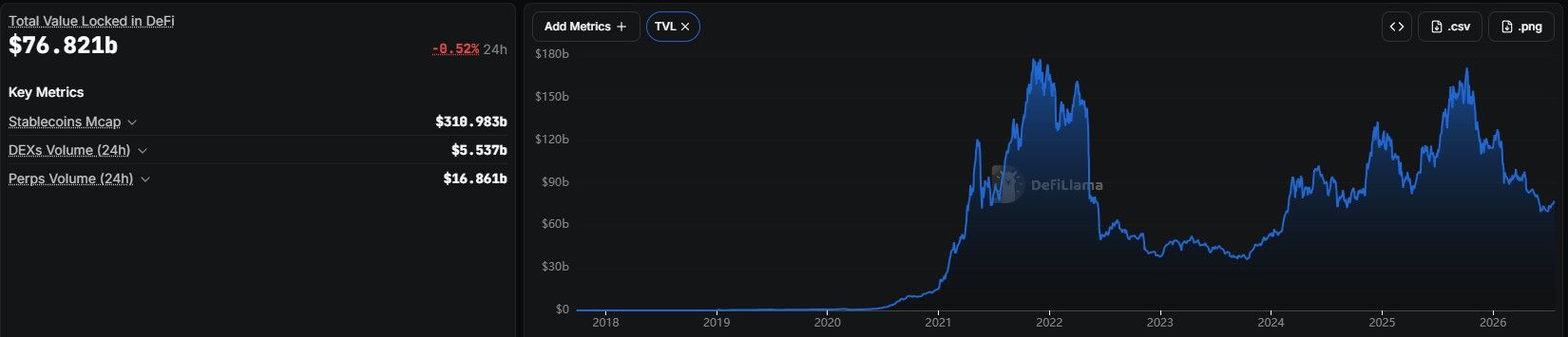
SEC Commissioner Hester Peirce warned on July 22 that moving crypto activity onchain does not erase its securities duties. She cautioned that vaults and lending strategies with active management can trigger registration requirements.
Her statement, titled “Headstands and Summervaults,” builds on an earlier warning that tokenized securities remain securities. Peirce extended that principle to a newer generation of onchain yield tools.
Vaults Risk Investment Company Rules
Vaults let users deposit crypto assets into smart contracts that route funds toward staking or lending. Peirce noted that they range from fully automated allocations to setups in which a manager actively selects strategies.
That spectrum ranges from purely programmatic vaults to those that depend entirely on a manager’s discretion, she wrote.
That distinction matters. A vault could become an investment contract when depositors expect profits mainly from a curator’s efforts. Similarly, that standard mirrors the crypto asset taxonomy the SEC-CFTC joint rule formalized earlier this year.
Some vaults may resemble mutual funds, too, as actively managed vault curator strategies are gaining traction in decentralized finance (DeFi). Active vault managers may trigger investment adviser obligations, a separate compliance layer beyond fund registration.
Lending Platforms Face SEC Note Test
Onchain lending strategies raise separate concerns for regulators. Depositors lend assets to borrowers through smart contracts. Meanwhile, platform operators often set interest rates, loan-to-value limits, and liquidation thresholds.
Those choices can make a loan resemble a security-style note, Peirce wrote, regardless of which asset backs it. Courts have applied a similar note test since the 1990 Reves v. Ernst & Young ruling, she noted.
Her office had flagged similar tensions before this statement. She previously disputed proposed wallet broker rules and limited a tokenized stock exemption she carved out in May. These asset deployment tools could still become mainstream portfolio management options if built carefully, Peirce added.

SEC Invites Compliant Collaboration
Peirce did not mince words about attempts to dodge the rules.
“If you do headstands, backflips, and other gymnastics to read the law so that it does not apply to crypto assets and activities that are well within the scope of the federal securities laws, you will have a painful fall,” said Peirce.
She invited vault operators and lending platforms to contact the agency directly. The invitation comes ahead of her own planned departure from the SEC later this year. The commissioner asked whether existing rules block innovation. She wants SEC adjustments that do not weaken investor protection.
Whether vault designers accept that offer, rather than risk enforcement, may shape onchain yield products through the rest of 2026. Regulators and builders alike have a stake in getting that balance right.
The post SEC Commissioner Hester Peirce Warns Against Crypto Vaults and Lending appeared first on BeInCrypto.
Bitcoin (BTC) briefly surged over $66,800 this week, its strongest level in more than a month, before slipping back. Consecutive ETF inflows have pulled money back into the market after a prolonged period of outflows.
Still, every bounce revives the same question. Is this the low, or another bear-market rally that fades?
Why the Bitcoin Rebound Looks Fragile
The ETF channel bled through May and June as investors pulled out. That trend has now reversed. Roughly $981.2 million in net inflows returned across 7 trading days from July 14, according to Santiment.
The last inflow streak of a similar length occurred ahead of Bitcoin’s October 2025 rally, though such streaks do not guarantee a repeat.
Follow us on X to get the latest news as it happens
The rebound, however, reveals a growing divergence beneath the surface. While spot Bitcoin ETFs are once again absorbing supply, other market indicators point to more cautious positioning among professional traders.
ETF Buyers and Professional Desks Pull Apart
The Coinbase Premium Index has remained negative for more than 900 cumulative hours, the longest stretch in 2 years.
A negative premium suggests relatively weaker demand, or stronger selling pressure, on Coinbase than on Binance, pointing to continued caution among professional market participants.
Analyst Darkfost tied that caution to sticky inflation, rising oil prices, and a less transparent Fed under its new chairman.
“This combination is what’s keeping institutional selling pressure going, as we’re still seeing today,” the analyst noted.
Together, these signals suggest ETF inflows are supporting prices, but the recovery has yet to gain confirmation from broader spot market demand, leaving the rally vulnerable if ETF inflows begin to fade.
Four-Year Cycle or Macro Asset
The divergence feeds a broader debate over what drives Bitcoin today. In a July 22 research note, Grayscale outlined 2 lenses for the bear market.
The four-year cycle view, tied to halving events, points to further downside and a possible bottom in September or October. Grayscale argued instead that Bitcoin has matured into a macro asset.
“The current bear market has also featured a major shift in Fed policy expectations and rising real interest rates. Naturally, if macro factors are in the driver’s seat, Bitcoin’s price could bottom when these macro factors turn around,” Zach Pandl, Grayscale Head of Research, said.
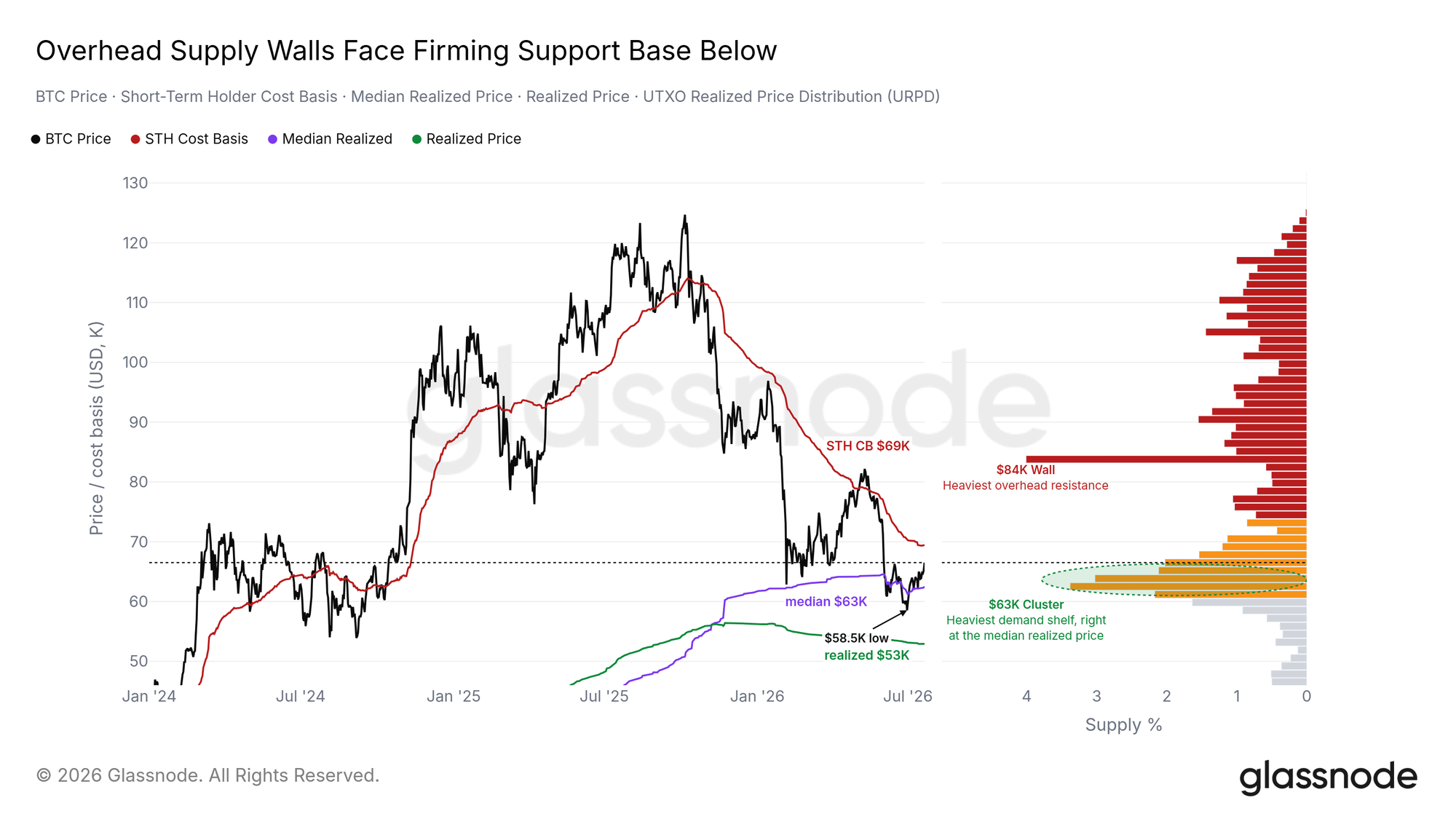
Meanwhile, Glassnode drew the line that settles the near-term argument.
“This is still a bear-market rally until the market proves otherwise, and the proof has an address,” the firm wrote.

Bitcoin trades below the Short-Term Holder Cost Basis near $69,000. A reclaim on steady inflows opens room toward $84,000. Rejection sends the price back toward the $63,000 demand shelf.
The next test is whether ETF buying persists and professional caution eases. Until Bitcoin reclaims $69,000, the burden of proof stays with the bulls.
Subscribe to our YouTube channel to watch leaders and journalists provide expert insights
The post Bitcoin Faces $69,000 Test as ETF Inflows Meet Professional Caution appeared first on BeInCrypto.


With a court set to consider a reversal of a $5 million settlement from the US Commodity Futures Trading Commission’s (CFTC’s) case with cryptocurrency exchange Gemini, the company has sent $10 million in Bitcoin (BTC) to a super political action committee (PAC) supporting President Donald Trump.
According to the MAGA Inc. Super PAC’s July report to the Federal Election Commission (FEC) filed on Monday, the Gemini Trust Company run by co-founders Cameron and Tyler Winklevoss sent two separate contributions of more than $5 million in Bitcoin on June 19.
The donation, which the PAC may use for independent expenditures to support Trump, was recorded about three weeks after the CFTC filed a joint motion with Gemini in federal court in an attempt to reverse a January 2025 settlement over the company allegedly making false or misleading statements. CFTC Chair Michael Selig claimed at the time that the agency under former US President Joe Biden “politically targeted” the Winklevosses through enforcement actions.
In addition to the recent MAGA Inc. contributions, the Winklevoss brothers each donated $1 million to Trump’s 2024 election campaign and supported the then-candidate through social media posts. Following Trump taking office in January 2025, the twins attended the signing ceremony for a stablecoin payments bill, the GENIUS Act, backed his sons’ crypto mining venture American Bitcoin and contributed $21 million in Bitcoin to the Digital Freedom Fund PAC in an effort to “support President Trump and his administration’s efforts” related to crypto policy.
Related: Crypto companies have spent $189M so far on 2026 US election cycle: Report
Since attorneys filed the joint CFTC-Gemini motion with the US District Court for the Southern District of New York in May, there has been no decision posted to the public docket. Cointelegraph reached out to the CFTC and Gemini’s counsel, Avi Perry, for comment on the $10 million contribution but did not receive an immediate response. A CFTC spokesperson told Cointelegraph in June that both sides “agreed that the $5 million penalty will not be returned to Gemini” if granted by the court.
In a June letter to Selig, Senator Elizabeth Warren called the joint motion for reversal and other factors as “concerning signs of a CFTC beholden to political pressures and interests of the wealthy insiders, unbound by the rule of law and failing to protect investors and market integrity.”
As of June 30, MAGA Inc. reported receiving more than $397 million.
Selig remains sole CFTC commissioner with no nominations announced
The CFTC chair, a Republican who was confirmed by the US Senate in December 2025, remains the only member in what is usually a bipartisan group of five commissioners heading the agency.
Many lawmakers have been pressing Trump to announce additional nominations for the financial regulator as Congress considers comprehensive crypto market structure legislation, the Digital Asset Market Clarity (CLARITY) Act. The bill is expected to give the CFTC significant authority in regulating and overseeing digital assets.
As of Thursday, the White House had not announced any nominations for CFTC commissioners, leaving Selig to largely direct the agency’s agenda.
Magazine: Here’s why the CLARITY Act’s ethics deal may be so hard to reach

The debate over when Bitcoin’s bear market will end is largely split between two views. One camp still holds on to the traditional four-year cycle, while the other believes that the bottom may already be in.
Grayscale, for one, favors the latter.
Macro Over Market Cycles
The supporters of the four-year cycle theory see Bitcoin halving events as the main driver of price movements and expect the current downturn to follow the same pattern as previous bear markets. Historically, the crypto asset has reached its bottom around one year after a cyclical peak and roughly two and a half years after a halving event, with cumulative declines averaging about 80%.
Based on that framework, Bitcoin’s price could still fall further and reach a bottom in September or October. Grayscale, however, said it subscribes to an alternative view that BTC has matured as an asset and is now increasingly driven by broader macroeconomic forces, similar to other major asset classes.
The firm noted that previous bear markets have coincided with periods of slowing economic growth and rising real interest rates, and added that this year’s downturn has unfolded alongside shifting expectations for US Federal Reserve policy and higher real interest rates.
Under this macro-driven framework, Grayscale said the asset’s price could find its bottom when those broader economic conditions begin to improve. The firm even added that if the Federal Reserve refrains from further rate hikes and economic growth remains resilient, BTC’s price may have already reached its low, making a further decline unnecessary despite expectations under the four-year cycle model.
Grayscale is not the only one arguing that the cryptocurrency could be approaching a turning point.
More Analysts Back Early Bottom Thesis
Crypto trader Killa also said Bitcoin’s market structure suggests the bottom may already be in, although he remains “50/50” because of the cycle’s timing. The trader explained that BTC has now “swept the dead cat base low” and completed the same five-wave corrective structure seen throughout previous bear markets. However, earlier bear markets took roughly 365 days to reach their final trough, whereas the current cycle would have bottomed in around 260 days.
Despite this, Killa said the “mistake is assuming” cycle lengths never change and believes Bitcoin is more likely to form higher lows than make significant new lows.
Earlier this week, crypto analyst Ali Martinez said the monthly chart is displaying the same combination of technical signals seen near the end of the 2015, 2019, and 2022 bear markets. While Martinez acknowledged that on-chain metrics such as MVRV and CVDD still leave room for a decline toward the $40,000-$50,000 range, he observed the current technical setup has historically identified a dominant accumulation zone with a favorable risk-to-reward profile for spot BTC buyers.
A similar argument was made by crypto analyst Doctor Profit, who warned that investors waiting for a traditional four-year cycle bottom in September or October could end up missing the market’s next move. While Bitcoin could still revisit the $54,000 area, the analyst said he does not expect a drop below $50,000 and believes gradual accumulation already offers an attractive risk-reward profile.
The post Has Bitcoin Already Bottomed? Grayscale Says Macro Signals Matter More appeared first on CryptoPotato.

XRP Whales Just Made Their Biggest Move in Months

Rita Saffioti, Alannah MacTiernan subpoenaed to attend defamation trial

Ondo clears FINRA hurdle as ONDO price tests resistance near $0.42


-

 Fashion6 days ago
Weekend Open Thread – Corporette.com
-

 Politics6 days ago
The House | The City of London can help the new chancellor deliver growth in every postcode
-

 Crypto World6 days ago
Ripple Payments Joins MiCA With 14 Firms, Does It Mean Anything For XRP?
-
 Crypto World7 days ago
Two July Windows Left: The CLARITY Act’s Senate Fight and What Failure Means
-

 Politics4 days ago
Democrats look to World Cup watch parties to register thousands of voters
-

 Crypto World6 days ago
Ripple wins EU-wide access as ESMA adds it to MiCA register
-

 Crypto World3 days ago
Grayscale Files For Worldcoin ETF, WLD Registers Sharp Rise
-

 NewsBeat4 days ago
Unregistered fitter used Gas Safe logo on business flyers
-

 Tech3 days ago
Sail Virtually Aboard The “Itanic” With IA-64 Emulator
-
 Tech3 days ago
Turtle Beach Command Series KB7 review: a nifty screen-equipped gaming keyboard
-

 NewsBeat6 days ago
Registration is now open for March for Men with Kev 2026
-

 News Videos4 days ago
Big Money Is Entering XRP
-
 Business2 days ago
New Jersey voter registration controversy explained: How 6,600 noncitizens got on the rolls, and what happens next
-

 News Videos7 days ago
Money | Class 12 Economics | CBSE Board Exam 2026-27
-

 Business7 days ago
Banco Bilbao Vizcaya Argentaria, S.A. (BBVA) Discusses Global Macro Environment and Economic Outlook for Core Markets Transcript
-

 Crypto World5 days ago
Kaspersky exposes OkoBot’s 20-module crypto wallet attack
-

 Business6 days ago
Airlines warn Sunshine Protection Act could disrupt flight scheduling
-
 Entertainment2 days ago
Johnny Depp’s R-Rated Gothic Cult Classic Gets New Release Ahead of Sydney Sweeney Remake
-

 NewsBeat6 days ago
Durham County Council to send out electoral registration emails
-
Business7 days ago
Nephros, Inc. (NEPH) Discusses Evolving Water Safety Strategies and Expansion Beyond Filtration Transcript
You must be logged in to post a comment Login