

Business
Chris Brown Pleads Guilty to Affray Over 2023 London Nightclub Bottle Attack, Sentencing Set for October


Singer Chris Brown pleaded guilty Friday to a charge of affray stemming from a 2023 altercation at a London nightclub, resolving a case that had originally included far more serious charges of assault and grievous bodily harm before prosecutors agreed to drop them as part of the plea.
Brown, 37, entered his plea at Southwark Crown Court in a hearing that lasted less than five minutes, according to the BBC. His co-defendant, 40-year-old rapper and vocal coach Omololu Akinlolu, who performs under the name HoodyBaby, also pleaded guilty to the same charge.
What happened at the nightclub
Brown was accused of attacking Abraham Diaw, described in some reports as a former friend and music producer, at Tape nightclub in London’s upscale Mayfair neighborhood on Feb. 19, 2023. Prosecutors said the altercation was captured on surveillance camera footage outside the club, which was full of people at the time.
The affray charge accepted by both defendants states that “Chris Brown and Omololu Akinlolu on February 19 2023 used or threatened unlawful violence towards another and their conduct taken together was such as would cause a person of reasonable firmness present at the scene to fear for his personal safety.” According to Diaw’s original 2023 complaint, he was allegedly struck over the head with a bottle of Don Julio 1942 tequila during the confrontation.
Prosecutor’s statement
Claire Campbell, a senior prosecutor with the Crown Prosecution Service, described the incident in stark terms following the guilty plea. “This was a vicious and unprovoked attack by Brown and Akinlolu in a crowded nightclub where Brown used a glass bottle as a weapon to strike the victim’s head twice,” Campbell said. She added, “This kind of violence is entirely unacceptable, and the Crown Prosecution Service will work tirelessly, with the police and partners across the criminal justice system, to pursue cases like this, and prove that no one is above the law.”
Charges dropped as part of the plea
In exchange for the guilty plea to affray, prosecutors agreed to drop the more serious charges Brown and Akinlolu had faced, including assault, attempted grievous bodily harm, and, in Brown’s case, possession of an offensive weapon. Both men had previously pleaded not guilty to those original charges last June, and the case had been headed toward a trial scheduled for October before Friday’s plea deal was reached instead.
Bail and sentencing timeline
Brown was initially arrested by London’s Metropolitan Police at a hotel in Manchester on May 15, 2025, on suspicion of grievous bodily harm connected to the case. He spent several days in custody before being released on bail of £5 million, or roughly $6.7 million to $6.75 million depending on exchange rates cited across reports, on May 21. Those bail conditions allowed Brown to continue performing on the European leg of his Breezy Bowl XX tour, provided he surrendered his passport upon arrival in each country he visited.
Brown was freed on bail again following Friday’s hearing. Both he and Akinlolu are scheduled to be sentenced Oct. 26, with the affray charge carrying a maximum possible sentence of three years in prison.
A warm reception from fans outside court
Despite the criminal proceedings, Brown was greeted enthusiastically by supporters as he left the courthouse. According to Reuters, fans cheered and chanted, “Breezy! Breezy!” as he exited, and Brown stopped to sign autographs. Deadline reported that fans held signs outside the courthouse, with at least one supporter shouting, “I love you Chris,” as the singer walked past. Brown left the court wearing a tan suit, gold-rimmed sunglasses and a St. Louis Cardinals baseball cap, according to multiple outlets.
A separate civil lawsuit
Beyond the criminal case in the U.K., Diaw had also filed a civil lawsuit against Brown in November 2023, alleging in a complaint reviewed by People that Brown used “crushing blows” to strike him in the head. According to court documents from Los Angeles County reviewed by Billboard, Diaw requested last June that the civil suit be dismissed with prejudice, meaning he cannot refile it, though Brown continues to face the separate criminal proceedings in the United Kingdom tied to the same underlying incident.
Part of a broader pattern of legal issues
Brown’s guilty plea comes just weeks after he was ordered to pay nearly $13 million in damages to his former housekeeper, Maria Avila, following a dog attack at his home in 2020. Avila was mauled by a roughly 200-pound Caucasian shepherd named Hades, which Brown had kept for security purposes, and was left permanently disfigured as a result of the attack. Brown had claimed he warned Avila about the dog’s aggressive tendencies, but following a two-week trial in Los Angeles, he and his company, Black Pyramid LLC, were ordered to pay Avila $12.9 million in damages for negligence.
Brown has faced other high-profile legal matters throughout his career, most notably his 2009 guilty plea to felony assault against then-girlfriend Rihanna, a case that drew significant global media attention and led to a period of legal supervision that included subsequent probation violations and jail time in Los Angeles.
A career that has continued despite the controversies
Brown rose to fame as a teenager in 2005 and has continued to find commercial and critical success in the years since, winning his first Grammy Award for best R&B album in 2011 for “F.A.M.E.” and a second Grammy in the same category in 2025 for “11:11 (Deluxe).” His Breezy Bowl XX tour, which began in Europe last year, was permitted to continue under the terms of his U.K. bail conditions even while the criminal case remained pending.
With sentencing now scheduled for Oct. 26, both Brown and Akinlolu face a maximum of three years in prison under the affray charge, though the exact sentence will ultimately be determined by the court based on the specific circumstances of the case. Until then, Brown remains free on bail, and it remains to be seen how the pending sentencing might affect any future touring or professional commitments in the months ahead.

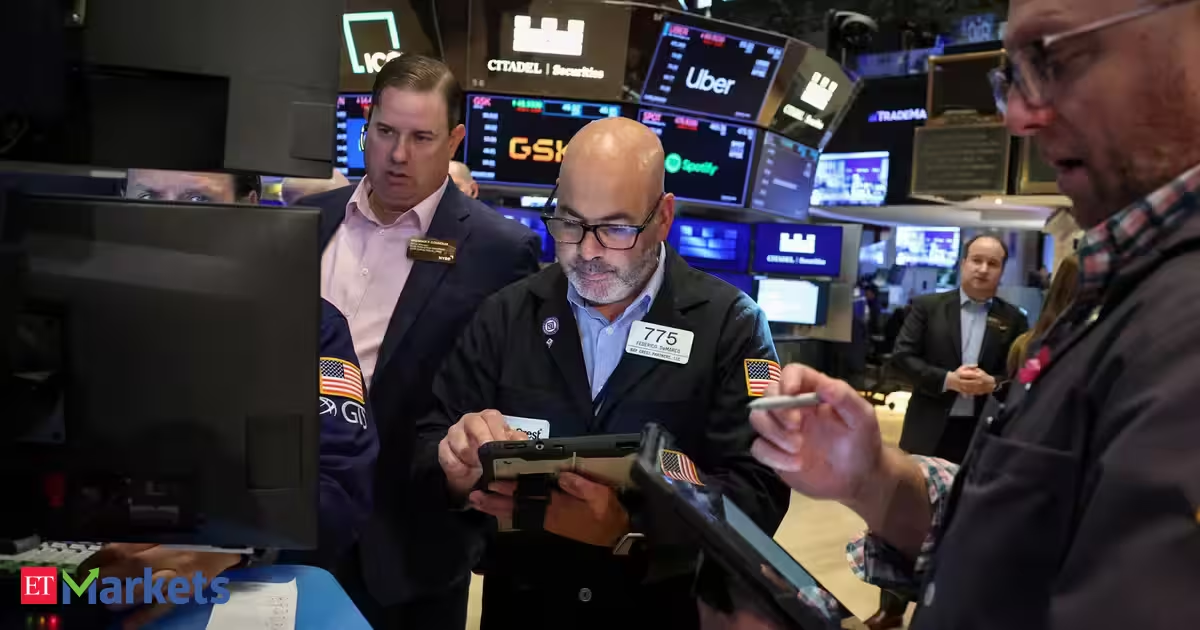
The S&P 500 ended close to flat but its biggest weight came from the S&P 500 technology index, which underperformed the broader market as chip stocks fell.
While investors wait for results from megacaps Microsoft , Amazon.com, Meta and Apple Inc , their enthusiasm was weakened by Alphabet’s announcement, late on Wednesday, of a plan to hike capital spending even as it burns cash.
After piling into technology stocks in recent years, on the promise of growth from AI, investors have become worried about the need for ever-increasing capital outlays for AI, according to Peter Andersen, CEO of Andersen Capital Management.
“People are thinking, how do we make sense of all this spending, and how much more patient do we have to be before we actually see it translate to actual profits?” Andersen said.

“The fear of missing out is becoming more like a fear of massive overbuilding.”
Late on Thursday, Intel forecast quarterly profit and revenue above Wall Street estimates and outlined plans to increase spending over the next two years. Still, the chipmaker’s shares sank on Friday along with the Philadelphia SE Semiconductor index.According to preliminary data, the S&P 500 gained 3.74 points, or 0.07%, to end at 7,413.30 points, while the Nasdaq Composite lost 157.35 points, or 0.63%, to 24,980.34. The Dow Jones Industrial Average rose 235.87 points, or 0.46%, to 51,947.52.
Among the S&P 500’s 11 major industry indexes, real estate outperformed during the session. The sector’s leading gainer was Digital Realty Trust, which rallied after it raised its full-year forecast for funds from operations.
Also providing some relief, crude oil futures fell more than 3% while traders booked profits from a massive rally in the last five sessions and after sources said China was pushing to resume stalled U.S.-Iran peace talks. Still, U.S. missiles struck targets across Iran after President Donald Trump vowed “major military punishment” for Tehran and its Houthi allies in Yemen.
“Whatever the headlines are involving the conflict right now, that drives oil and then oil drives financial markets,” said Andersen, adding that swings in oil prices can impact consumer and corporate spending.
Also, the Trump administration imposed new tariffs of 10% and 12.5% on goods from 60 trading partners, citing lax enforcement of forced-labor bans. The move came as a temporary 10% global tariff expired.
Friday’s data showed that activity in the U.S. services sector accelerated in July, aided in part by spending around the FIFA World Cup and the Independence Day holiday, while the pace of growth in the manufacturing sector eased to the slowest since March.
Among other individual gainers, SLB shares climbed after the oilfield services firm beat expectations for second-quarter profit.

Trump’s Iran War and Tariffs Are Changing Corporate Strategies
Business
Intel Stock Falls 4.18% Friday Despite Strong Earnings Beat, as July’s Sharp Rally Continues to Cool
Shares of Intel fell Friday morning even after the chipmaker delivered a significant second-quarter earnings beat and raised its capital spending plans, as investors continued taking profits following one of the stock’s strongest rallies in company history.
Intel shares traded at $96.04 as of 10:43 a.m. Eastern time, down $4.19, or 4.18%, on the day. The decline extends a sharp pullback that has gripped the stock throughout July, even as Thursday’s earnings report initially sent shares climbing in after-hours trading.
A strong quarter by most measures
Intel reported second-quarter revenue growth of 25%, which the company described as its fastest pace in nearly 15 years. Chief Executive Lip-Bu Tan pointed to surging demand for computing power tied to artificial intelligence as the primary driver behind the results. “AI is driving unprecedented demand for compute,” Tan said in the company’s earnings statement. “As we continue to execute, Intel is well-positioned to capture sustainable growth across our CPU franchise.”
The company’s Data Center and AI division generated $2.5 billion in operating income during the quarter, according to CNBC, while Intel’s foundry business, its effort to manufacture chips for outside customers, posted a $2.1 billion operating loss, reflecting the ongoing costs of that expansion effort even as the segment’s revenue reached $5.8 billion.
Following the report, Intel shares initially jumped roughly 9% in after-hours trading Thursday, climbing above $109 at one point, according to CNN, after the company beat both earnings and revenue expectations and issued stronger-than-expected third-quarter guidance.
Raised spending plans
Alongside its earnings beat, Intel raised its 2026 capital expenditure guidance to more than $20 billion, up from a previous target of $18 billion, with Chief Financial Officer David Zinsner indicating that 2027 spending would rise “significantly above” this year’s levels. Zinsner told CNBC that the company’s newest manufacturing process, known as 18A, was progressing ahead of where earlier technology generations stood at comparable points in their development cycles.
Zinsner also offered a note of caution about near-term demand patterns, telling CNN that PC consumption is expected to be “subseasonal” during the second half of the year, even as wafer demand across the broader business continues to outstrip supply.
For the current quarter, Intel guided toward adjusted earnings per share of 38 cents, alongside revenue guidance in the range of $15.8 billion to $16.8 billion.
A stock riding an extraordinary run, and a sharp pullback
Friday’s decline continues a volatile stretch for Intel shares that has defined much of 2026. The stock surged 278% during the first half of the year, according to Bloomberg, marking the third-best performance among all S&P 500 companies over that period, before climbing to a record closing high of nearly $141 per share on June 22. Since then, shares have fallen roughly 27% to 28%, ranking Intel among the 10 worst-performing stocks in the S&P 500 for the month of July alone, even as the company’s underlying business results have remained strong.
Bloomberg reported that the broader pullback reflects investors rotating away from some of this year’s biggest winners and growing more cautious on semiconductor stocks generally, rather than any specific concern about Intel’s own operational performance. That dynamic was on display again Thursday, when Intel shares slid as much as 2.5% even ahead of the earnings report that would ultimately beat expectations.
A valuation that leaves little room for error
Even with the stock’s steep July pullback, Intel continues to trade at a notably rich valuation relative to its semiconductor peers. Ahead of Thursday’s report, Intel was trading at roughly 94 times forward earnings, according to 24/7 Wall St., a figure considerably higher than faster-growing chip companies including Nvidia, Broadcom, Taiwan Semiconductor and Micron, which have traded between roughly 13 and 33 times expected earnings. That premium reflects strong investor confidence in Intel’s ability to restore its profit margins and reaccelerate growth, a bar that analysts say leaves little room for anything less than a clean earnings beat and confident forward guidance.
Analyst reaction
Despite Friday’s pullback, several analysts described Intel’s underlying turnaround as increasingly credible. According to Barron’s, analysts pointed to the company’s earnings beat and upbeat outlook as evidence that more gains could still be ahead, even amid the stock’s recent volatility. MarketWatch similarly framed the results as a marker of how far the company has come, noting that Intel’s latest quarter demonstrated a dramatic recovery from a period when the company had been widely described as “near-dead.”
Context around Intel’s broader comeback
Intel’s stock performance this year has also been shaped by developments beyond its own earnings reports. The company’s shares soared 84% last year after the U.S. government took a 10% equity stake in Intel as part of a broader effort to support domestic chip manufacturing, a move that has continued to factor into investor sentiment around the company’s long-term strategic positioning within the U.S. semiconductor industry.
With Intel’s 52-week range now spanning from roughly $18.97 to $142.35, according to Robinhood market data, the stock’s next moves are likely to hinge on whether the company’s improving fundamentals, particularly continued momentum in its data center and AI-related server chip sales, can offset the broader wariness currently weighing on semiconductor valuations across the market. Investors will also be watching closely for further updates on Intel’s foundry business and its 18A manufacturing process, both of which remain central to the company’s pitch that its current turnaround marks a durable shift rather than another false start following years of underperformance.

Northeast Community earnings missed by $0.05, revenue fell short of estimates

Check out what’s clicking on FoxBusiness.com.
A South Korean court ordered billionaire SK Group Chairman Chey Tae-won to pay his former wife more than $640 million in a divorce settlement that could force him to sell assets, borrow money or pledge shares as collateral.
The Seoul High Court ruled Friday that Chey must pay Roh Soh-yeong 944 billion won (about $645 million), marking the largest divorce asset award in South Korean history. It’s been dubbed the so-called “divorce of the century.”
The payout is substantially lower than the 1.38 trillion (about $935 million) won awarded by an appeals court in 2024, but the revised judgment has renewed investor scrutiny of Chey’s holdings and how he could finance the payment.

Chey Tae-won, the chairman of SK Group semiconductor and memory chip company SK Hynix. (Angelina Katsanis/Reuters)
Analysts said Chey may need to sell assets or borrow against his shares, though they do not expect the award to threaten his control of SK Group.
RELATIONSHIP EXPERT CHALLENGES ONE OF AMERICA’S ASSUMPTIONS ABOUT DIVORCE
Chey owns a 17.9% stake in SK Inc., the conglomerate’s holding company, and has an estimated fortune of $5.4 billion, according to Forbes.
The court ordered Chey to make the payment in cash rather than transfer stock, citing the importance of his shares to maintaining control of the conglomerate.
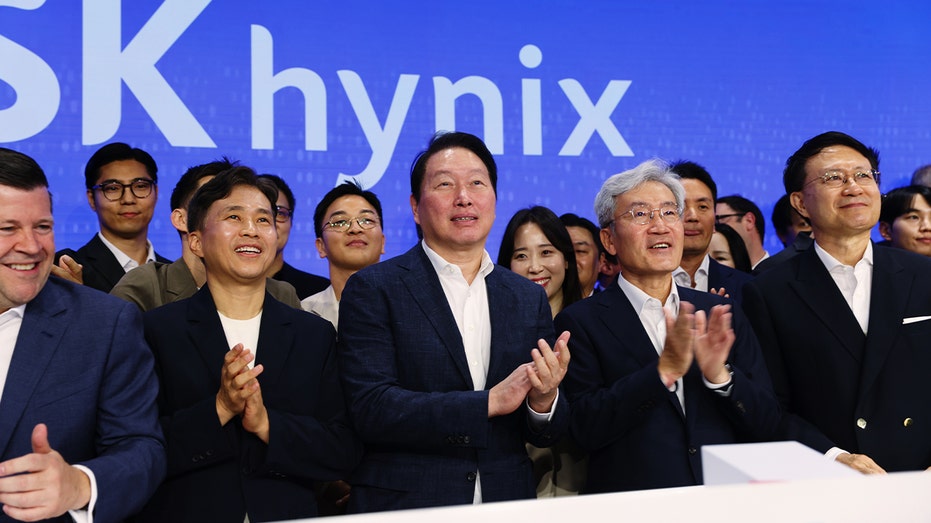
Chey Tae-won, chairman of SK Group, center, and Kwak Noh-jung, president and chief executive officer of SK Hynix Inc., center left, and Koh Seung-beom, chairman of SK Hynix Inc., center right, ring the opening bell during the company’s initial public (Michael Nagle/Bloomberg via Getty Images)
Shares of SK Inc. closed 3.8% lower Friday, while SK Hynix fell 8.3% in Seoul trading following the ruling.
SK Group’s profile has risen sharply during the artificial intelligence boom through SK Hynix, a major supplier of high-bandwidth memory chips used with Nvidia’s AI processors.
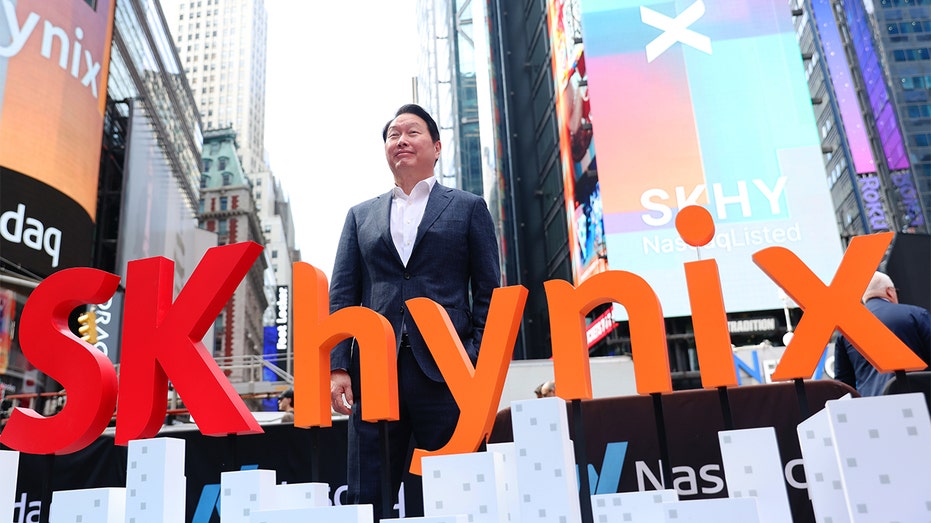
Chey Tae-won, chairman of SK Group, in New York City. (Michael Nagle/Bloomberg via Getty Images)
Judges awarded Roh one-third of the couple’s marital property after finding that she contributed to preserving and increasing the family’s wealth during the marriage.
The ruling followed a South Korean Supreme Court decision rejecting claims that alleged financial support from Roh’s father, former President Roh Tae-woo, should be included in the asset calculation.
CLICK HERE TO GET FOX BUSINESS ON THE GO
Either side may appeal the ruling, potentially sending the property-division dispute back to the Supreme Court.
Reuters contributed to this report.

OpenTheBooks CEO John Hart joins Varney & Co. to discuss long-term Social Security and Medicare deficits as fiscal pressures mount.
Social Security’s looming insolvency in under a decade could be delayed by a change to how the annual cost-of-living adjustment (COLA) is calculated, with a new analysis finding that it could cut the entitlement program’s 75-year fiscal shortfall in half.
The nonpartisan Committee for a Responsible Federal Budget (CRFB) proposed a COLA cap that would limit the dollar amount of the annual increase in Social Security benefits received by those with higher benefit amounts. That proposal was similar to a flat-rate COLA proposed by one of the think tank’s co-chairs, former Rep. Tim Penny, when he was in Congress in 1987.
The flat-rate COLA would pay all Social Security beneficiaries the same COLA, which would be set at the COLA received by a beneficiary at the 20th percentile of the benefit range – a move that effectively combined a COLA cap with a COLA floor at that level.
CRFB asked the Urban Institute’s Karen Smith to estimate how a flat-rate COLA set at the 20th percentile and 30th percentile beneficiary would impact Social Security’s solvency and benefits. The analysis found that a flat-rate COLA at the 20th percentile would close 50% of Social Security’s 75-year shortfall compared to her baseline, while at the 30th percentile it would close about 40%.
SOCIAL SECURITY RECIPIENTS COULD SEE BIGGER COST-OF-LIVING ADJUSTMENT IN 2027, NEW FORECAST SAYS

CRFB and the Urban Institute analyzed the flat-rate COLA proposal, finding it would extend the solvency of Social Security. (Getty Images/stock)
The flat-rate COLA would be relatively progressive – slowing the growth in benefits the most for those with the highest lifetime earnings and with the most income in retirement.
If set at the 20th percentile, the bottom fifth of lifetime earners would see benefits decline by just 3% in 2065, compared with 19% for the top fifth of earners. For a flat-rate COLA at the 30th percentile, it would boost the bottom quintile’s benefit by 1% while the top fifth would see benefits decline 17%.
Both a 20th or 30th percentile flat-rate COLA would boost Social Security benefits for the lowest quintile by 13% to 14%.
TRUMP LOOKING ‘VERY STRONGLY’ AT AUSTRALIA-STYLE RETIREMENT SYSTEM: ‘TAKING THAT, MAKING IT SHARPER’

A flat-rate COLA would curb benefit growth for the highest earners. (Getty Images/iStock)
A flat-rate COLA at the 20th percentile would delay the insolvency of Social Security’s main trust funds by two years – though CRFB noted that if it were combined with other policies, such as its employer compensation tax proposal, it could keep the merged trust funds solvent for 75 years close to it.
Looking back, if Congress had adopted a flat-rate COLA back in 1987 when it was proposed by Penny, CRFB’s estimates suggest it would have achieved 75-year solvency at the time, delaying insolvency to 2071.
It also would’ve covered about three-quarters of the solvency gap through 2100, giving policymakers time to make other gradual reforms to Social Security to address the remaining gap.
NEW BIPARTISAN PLAN SEEKS TO PREVENT SOCIAL SECURITY BENEFIT CUTS BEFORE TRUST FUND DEPLETION

Social Security’s main trust funds are projected to reach insolvency in 2032, when automatic benefit cuts would be triggered under current law. (J. David Ake/Getty Images / Getty Images)
The most recent estimates put the insolvency of Social Security in 2032, when benefits would be subject to an automatic cut of 22% to match incoming tax revenue after trust funds are tapped out. That would amount to a $16,900 cut in annual benefits for a medium-income, dual-earning couple starting in 2033.
The fast-approaching insolvency of the trust funds and the implications for American retirees should compel policymakers to pursue reforms to shore up the program’s finances as soon as possible, CRFB argued.
“One of the biggest takeaways of this particular solution is that it is a stark reminder of the real cost of waiting to save Social Security,” CRFB president Maya MacGuineas told FOX Business.
“Adopting a flat-rate COLA back when Congressman Penny proposed the idea would have achieved solvency through 2071, nearly half a century from now, and would have done so by protecting lower-income beneficiaries and reducing old-age poverty; now, that same plan would only delay insolvency another two years,” she explained.
GET FOX BUSINESS ON THE GO BY CLICKING HERE
“The good news is there are plenty of options out there that, when combined, can save Social Security from abrupt across-the-board cuts in just six years. But taking options off the table and waiting until the last minute leaves fewer and fewer ways to make the math work,” MacGuineas added.

Operator
Hello, everyone. Thank you for joining us, and welcome to WSFS Financial Corporation Second Quarter Earnings Call. [Operator Instructions]
I’d now like to turn the call over to your host for today, Mr. David Burg, Chief Financial Officer. Sir, please go ahead.
David Burg
Executive VP & CFO
Thank you very much, and good afternoon, everyone. Thank you for joining our second quarter 2026 earnings call. Our earnings release and an earnings release supplement, which we’ll refer to on today’s call, can be found in the Investor Relations section of our company website. With me on this call is Rodger Levenson, Chairman, President and CEO.
Prior to reviewing our financial results, I would like to read our safe harbor statement. Our discussion today will include information about our management’s view of our future expectations, plans and prospects that constitute forward-looking statements. Actual results may differ materially from historical results or those indicated by these forward-looking statements due to risks and uncertainties, including, but not limited to, the risk factors in our Annual Report on Form 10-K and our most recent Quarterly Reports on Form 10-Q, as well as other documents we may periodically file with the Securities and Exchange Commission. All comments made during today’s call are subject to the safe harbor statement.
I will now turn to our financial results. During the second quarter, WSFS’s performance
Business
The Siam Cement Public Company Limited (SCVPY) Q2 2026 Earnings Call Prepared Remarks Transcript
Unknown Executive
Good morning, ladies and gentlemen. Welcome to the SCG Analyst Conference for the Second Quarter of 2026. I’m [ Sikachi ] from SCG, Investor Relations Specialist, and I will be the moderator for today’s session. We are pleased to welcome all the guests who joined our session both online and offline. For those who join online, please kindly change your name and your company, I will accept you to the meeting room.
Today, our management are here to provide you the continued earnings momentum for the second quarter as well and the business update, followed by outlook. After the presentation, we will open the floor for the questions.
Today’s presenters comprise of SCG management, led by Khun Thammasak, the CEO of SCG, who will walk you through for the consolidated results and outlook. And SCGC management led by Khun Sakchai, the CEO of SCG Chemicals. Next, Khun Wiroat, President and CEO of SCG Cement – Building Materials will be also presenting for the SCG Decor. And lastly, Khun Chantanida, CFO of SCG, who will present the financial parts and also SCG Packaging.
And now let’s start for today’s presentation, beginning with Khun Thammasak.
Thammasak Sethaudom
President & Director
Good morning, and welcome back to analyst conference discussion today. So I just want to spend a little bit of time to look back at Q2, right? What really happened and what did we do right, probably what did we do wrong that we have to


Now retired, I am an income-oriented investor seeking high yield income to support my lifestyle in retirement.I became deeply interested in the stock market beginning in late 2007 (bad timing for me but worse for my uncle) when I received an unexpected inheritance. Since that time I have done considerable research and vowed to make smarter long-term investing decisions after suffering through the Great Recession with minimal losses to my inherited portfolio, after firing my financial advisor.I look for mostly dividend paying income stocks and funds (BDCs, REITs, CEFs, ETFs) that offer high yield income to increase my retirement income beyond my pension and Social Security. I also enjoy reading investment/financial and business information and following trends in technology and markets. The human psychology of markets is as fascinating and inscrutable to me as the financial side. I am not a financial advisor so please do your own due diligence before making any buy or sell decisions.“The race is not always to the swift, nor the battle to the strong, but that’s the way to bet.” Damon Runyon
Analyst’s Disclosure: I/we have a beneficial long position in the shares of UTF, MEGI, NXG, JRI either through stock ownership, options, or other derivatives. I wrote this article myself, and it expresses my own opinions. I am not receiving compensation for it (other than from Seeking Alpha). I have no business relationship with any company whose stock is mentioned in this article.
Seeking Alpha’s Disclosure: Past performance is no guarantee of future results. No recommendation or advice is being given as to whether any investment is suitable for a particular investor. Any views or opinions expressed above may not reflect those of Seeking Alpha as a whole. Seeking Alpha is not a licensed securities dealer, broker or US investment adviser or investment bank. Our analysts are third party authors that include both professional investors and individual investors who may not be licensed or certified by any institute or regulatory body.

Trump signs executive order related to Smithsonian Institution, White House says

Auckland FC vs Tottenham: Prediction, kick-off time, TV, live stream, team news, h2h results, odds
US stocks today: Nasdaq lags on angst over AI spending ahead of earnings reports

House Passes Bill on Lawmakers Using Insider Information for Stock Trading


-

 Politics6 days ago
The House | The City of London can help the new chancellor deliver growth in every postcode
-

 Crypto World6 days ago
Ripple Payments Joins MiCA With 14 Firms, Does It Mean Anything For XRP?
-

 Politics5 days ago
Democrats look to World Cup watch parties to register thousands of voters
-

 Crypto World7 days ago
Ripple wins EU-wide access as ESMA adds it to MiCA register
-

 Crypto World4 days ago
Grayscale Files For Worldcoin ETF, WLD Registers Sharp Rise
-

 Fashion3 hours ago
Weekend Open Thread: Brooks Brothers
-

 Tech4 days ago
Sail Virtually Aboard The “Itanic” With IA-64 Emulator
-

 NewsBeat4 days ago
Unregistered fitter used Gas Safe logo on business flyers
-
 Tech4 days ago
Turtle Beach Command Series KB7 review: a nifty screen-equipped gaming keyboard
-

 News Videos5 days ago
Big Money Is Entering XRP
-
 Business3 days ago
New Jersey voter registration controversy explained: How 6,600 noncitizens got on the rolls, and what happens next
-

 Crypto World6 days ago
Kaspersky exposes OkoBot’s 20-module crypto wallet attack
-
 Entertainment3 days ago
Johnny Depp’s R-Rated Gothic Cult Classic Gets New Release Ahead of Sydney Sweeney Remake
-

 NewsBeat7 days ago
Durham County Council to send out electoral registration emails
-

 Crypto World2 days ago
Ethics, other provisions in crypto Clarity Act to be further discussed
-

 Crypto World7 days ago
MiCA Licensing Faces Delays as ESMA Adds 14 CASPs to Register
-
 NewsBeat4 days ago
Shanghai science forum photos show China’s AI and robotics advances in rivalry with US
-

 Crypto World6 days ago
Chip Stocks Enter Bear Market After Moonshot Ai Unveils Kimi K3 Model
-

 Tech4 days ago
Watch Flock Safety CEO Garrett Langley discuss the future of surveillance at TechCrunch Disrupt 2026
-

 Tech5 days ago
Subway Sandwich Computers Get a Second Life as Gaming Machines
You must be logged in to post a comment Login