

Crypto World
House Passes Bill to Curb Lawmakers’ Insider Trading via Stocks


The US House of Representatives has passed the Stop Insider Trading Act, a bill aimed at preventing members of Congress and their immediate families from buying publicly traded stocks. The measure cleared the House on Wednesday by a vote of 232–198 and now heads to the Senate for consideration.
Sponsoring Republican Representative Bryan Steil said the legislation is designed to stop lawmakers from profiting from potential insider information and to set penalties for violations. The bill would next be reviewed by the Senate, where key critics argue it still leaves room for conflicts of interest.
Key takeaways
- The House approved the Stop Insider Trading Act in a 232–198 vote, moving the proposal to the Senate.
- Under the bill, Congress members and their spouses and dependent children would be barred from purchasing publicly traded stocks.
- Penalties described by the bill sponsor include a $2,000 fine or 10% of the transaction, plus disgorgement of profits.
- Democratic lawmakers have criticized the bill for allowing members to keep and sell stocks already owned, arguing it does not fully solve the underlying conflict risk.
- Separate from the insider-trading effort, Steil is also linked to legislation addressing prediction market trading by public officials.
House passage and the bill’s penalty structure
According to the House vote results, the legislation advanced on Wednesday after the chamber approved Steil’s bill HB 7008, according to the official Congress.gov record. Steil, speaking on the House floor, framed the measure as a first for the current House on the specific issue and emphasized enforcement.
In describing how violations would be punished, Steil highlighted a penalty that includes a fine of $2,000 or 10% of the transaction, along with disgorgement of profits. He also stated that violators would forfeit gains if they failed to comply with the legislation’s requirements.
The bill’s practical aim is to reduce the possibility that lawmakers could benefit from non-public information gained through their roles. That intention is central to why supporters see the act as a meaningful guardrail against insider trading.
Criticism over “loopholes” and stock ownership rules
Even as the bill cleared the House, criticism emerged quickly from Democrats who argue it does not go far enough to eliminate conflict-of-interest concerns.
Representative and Senate critic Senator Elizabeth Warren said on Thursday that the legislation contains major loopholes because lawmakers could still own and sell stocks. Warren’s concern is that allowing ongoing ownership and sale—rather than an outright ban—may not sufficiently address the risk that creates incentives around insider information.
Steil responded to part of that critique by describing a compliance mechanism for members who already hold stocks. He said the bill would require a seven days’ notice before selling assets that lawmakers already own, arguing the notice requirement would deter trading driven by private information.
It remains to be seen how the Senate will treat these competing positions. In practice, the question will likely be whether the seven-day notice and penalties are viewed as adequate deterrence or whether senators will push for a stricter model—such as extending the restrictions beyond purchases to broader ownership rules.
What’s next in the Senate
After House passage, the Stop Insider Trading Act was received in the Senate for consideration on Thursday. The outcome in the upper chamber may hinge on whether enough senators support the bill’s narrower scope—aimed at members of Congress rather than other senior federal officials.
As described in the source, Steil’s measure is limited to restricting investments for members of Congress and does not cover the president or vice president and their families. That distinction matters for how this proposal fits into a broader debate about public official ethics and whether restrictions should be uniform across top executive and legislative roles.
In contrast, the source notes that a separate Senate proposal—associated with the Digital Asset Market Clarity Act—has included restrictions reaching public officials more broadly, including language that would bar certain officials from issuing or sponsoring tokens until 2029. While that crypto-market structure bill is distinct from the stock-trading measure, it illustrates how ethics and market-related restrictions are being considered across different legislative packages.
Link to prediction market trading legislation
The House action on insider stock trading arrives after Steil sponsored another related effort focused on prediction markets. The source reports that Steil previously backed the Stop Lawmakers from Predicting Act, introduced in June to prevent certain public officials, their spouses, and children from “wagering on public policy issues and political outcomes.”
That proposal drew attention amid real-world incidents highlighted in earlier coverage. The source points to an alleged episode involving a soldier who reportedly placed more than $400,000 betting on Venezuela President Nicolás Maduro on Polymarket, as well as reports that a teleprompter operator for former President Donald Trump allegedly made more than $100,000 betting on Kalshi event contracts connected to words and phrases in speeches.
While these examples are not about Congress members trading on stocks, they reflect the same underlying theme: lawmakers and political insiders face special scrutiny when bets can appear tied to information advantage or influence. In that context, the prediction markets proposal mirrors the stock bill’s penalty framing, including a $2,000 fee or 10% of the value of prohibited bets on the relevant platforms.
Investors and builders in crypto markets may see this as part of a wider regulatory pattern: legislators are increasingly testing whether restrictions should reach political actors using financial rails that operate outside traditional stock exchanges, even when the mechanism is “betting” rather than buying equities.
As the Stop Insider Trading Act moves through the Senate, the key uncertainty is whether senators will accept the bill’s approach—bans on new purchases with notice requirements for existing holdings—or push for stricter rules that would go further on ownership and trading.

Bitfinex has secured a Digital Asset Service Provider licence in El Salvador, completing a local regulatory structure covering spot trading, crypto derivatives and tokenized securities.
Summary
- Bitfinex now holds Salvadoran approvals spanning spot trading, derivatives and regulated tokenized securities services locally.
- CNAD registered two core Bitfinex entities in April, adding them to existing licensed operations there.
- El Salvador remains central to Bitfinex’s Latin American strategy for trading and tokenized capital markets.
The exchange announced the approval on May 12, after the National Commission of Digital Assets registered two Bitfinex-linked operating entities on April 23.
The new approval brings the core Bitfinex trading platform alongside Bitfinex Securities El Salvador and Bitfinex Derivatives El Salvador. Bitfinex said the structure gives the group a regulated presence across its main businesses in the country, although product access will still depend on customer eligibility, location and the platform’s terms.
Core Bitfinex platform joins regulated local entities
El Salvador’s CNAD public registry lists BFXNA El Salvador under registration PSAD-0082 and BFXWW El Salvador under PSAD-0083. Both registrations cover activities that include exchanging digital assets, operating trading platforms, transferring assets, custody, receiving client orders and executing trades in digital asset derivatives.
The registry entries were active before the company’s May public announcement, confirming the approval through CNAD’s database. Bitfinex described the licence as a deeper regulatory base for serving customers across Latin America.
“Holding licences across our spot, derivatives and securities businesses reflects our long-standing commitment to the country and to operating under proper and innovative supervision.” said Bitfinex’s chief technology officer Paolo Ardoino
The licence does not mean every Bitfinex product is available to every customer. The company’s notice states that U.S. persons and other prohibited users cannot open or operate accounts on its main platform. Local rules, onboarding checks and service restrictions also continue to apply.
Securities and derivatives approvals came earlier
Bitfinex Securities became the first platform approved under El Salvador’s Digital Assets Issuance Law. CNAD’s registry lists the securities entity under PSAD-0001, with a registration date of Oct. 24, 2023. The platform supports the issuance and trading of tokenized financial products, including debt, equity and fund-linked instruments.
As previously reported, Bitfinex Securities later launched a regulated tokenized U.S. Treasury product in El Salvador. The offering represented exposure to short-term Treasury bills and traded through the platform’s secondary market. Bitfinex also tested tokenized debt linked to a planned hotel project near the country’s international airport.
Bitfinex Derivatives followed with its own Digital Asset Service Provider approval in January 2025. The licensed entity became the regional base for the group’s derivatives activity. Crypto.news reported at the time that users continuing with the service had to accept revised terms tied to the Salvadoran operation.
El Salvador builds a wider digital asset market
El Salvador adopted its Digital Assets Issuance Law in 2023, creating a framework for token issuance, service providers and regulated trading venues. CNAD oversees the sector and maintains a public registry of approved operators, including exchanges, custodians, issuers and companies offering investment products based on digital assets.
Bitfinex said CNAD had licensed more than 70 digital asset service providers by the time of its May announcement. The registry also includes Binance, Bitget and other international firms. Those approvals cover separate entities and permitted activities, rather than one uniform licence for every crypto service.
The country has also expanded its rules beyond exchanges. El Salvador approved an investment banking framework allowing specialized institutions to offer Bitcoin and other digital asset services. The country has also explored tokenized small-business equity and cross-border regulatory projects.
Bitfinex links licence strategy to tokenized markets
Bitfinex has positioned El Salvador as a base for both trading and tokenized capital markets. Its securities business has worked on products linked to U.S. Treasuries, corporate financing and real-world assets. The group has also partnered with Tether-related infrastructure to study wider distribution and secondary-market liquidity for tokenized investments.
The latest licence gives the core exchange a local authorization alongside those existing businesses. It also allows Bitfinex to present one jurisdiction as covering three distinct lines: spot markets through the main platform, derivatives through its dedicated entity and securities through Bitfinex Securities.
However, the announcement did not provide local customer numbers, trading-volume targets or a timetable for new products. It also did not state whether operations will move from other jurisdictions to El Salvador. The immediate change concerns the regulated status of the core platform and its ability to offer approved services through registered local entities.
Bitfinex’s expansion comes as other crypto companies build operations in El Salvador. Tether announced plans in 2025 to establish its headquarters in the country after securing local approval, while Bitget obtained both Bitcoin and digital asset service licences.
The licence completes Bitfinex’s stated regulatory footprint in El Salvador, but continued operation will depend on CNAD supervision, customer checks and the rules attached to each entity. Future product launches will require separate disclosures and may carry additional eligibility limits.


Thailand’s Securities and Exchange Commission has filed a criminal complaint against crypto exchange Bitkub Online and two of its former directors, alleging they submitted false regulatory reports after a 2021 cyberattack that resulted in the loss of digital assets worth about 1.7 billion baht ($50 million).
Summary
- Thailand’s SEC has filed a criminal complaint against Bitkub and two former directors over alleged false reporting linked to its 2021 cyberattack.
- Bitkub said it delayed disclosing the hack to prevent a bank run and later replaced all stolen digital assets without customer losses.
- The case comes as Thailand continues expanding crypto regulations while increasing enforcement across the digital asset sector.
According to an announcement published by Thailand’s Securities and Exchange Commission (SEC) on Thursday, the complaint targets Bitkub Online, former directors Sakolkorn Sakavee and Thaweesap Rawan over information submitted in the exchange’s daily net liquid capital reports following the May 2021 hack.
The regulator alleged that the reports filed between May 10 and Oct. 30, 2021, did not accurately show the reduction in the exchange’s digital asset holdings after attackers stole 16 different cryptocurrencies. The SEC said the omission created the impression that customer assets remained intact and that the exchange had not suffered losses from the incident.
Authorities said the stolen assets were replaced by Oct. 31, 2021, but argued that the impact of the theft should have been reflected in the reports submitted during the period. The complaint accuses Bitkub and the two former directors of violating multiple provisions of Thailand’s digital asset regulations through the alleged false disclosures.
The SEC said the matter will now move through the country’s criminal investigation process before any decision on prosecution or court proceedings is made.
Bitkub disputes regulator’s allegations
Responding in a post on X, Bitkub said the case concerns decisions about when to disclose the wallet compromise rather than allegations of fraud or customer losses.
The exchange said it intentionally delayed announcing the incident because it wanted to prevent a potential bank run while it worked to recover from the theft. According to the company, its co-founders later purchased an equivalent amount of digital assets to replace the stolen funds, leaving customers and the company without financial losses.
Bitkub also said it has strengthened its governance framework, compliance procedures and security controls since the incident.
Founded in 2018, Bitkub has grown into Thailand’s largest cryptocurrency exchange. CoinGecko ranked the platform first among Thai exchanges by trust score, while its daily trading volume stood at about $712 million at the time of publication.
The complaint also comes as Bitkub continues to explore a public listing. The company confirmed in December 2025 that it was considering an initial public offering, including the possibility of listing in Hong Kong.
Cointelegraph said it contacted Bitkub for additional comment on the SEC complaint and the company’s IPO plans but had not received a response by the time the report was published.
Enforcement comes as Thailand expands crypto regulation
The enforcement action arrives as Thai authorities continue tightening oversight across different parts of the digital asset market.
Earlier this month, local outlet Thansettakij reported that the Bank of Thailand (BOT) and the SEC had begun examining high-value stablecoin transactions after identifying transfers that may have bypassed normal financial reporting requirements. According to the report, BOT Governor Vitai Ratanakorn said authorities were using data analytics tools to review large transactions, particularly involving Tether’s USDT, while assessing whether further regulatory action is required.
Beyond stablecoins, the report said regulators have also increased scrutiny of large cash deposits and withdrawals, gold trading and bank accounts linked to online gambling as part of anti-money laundering efforts.
At the same time, Thailand has continued moving ahead with policies designed to expand its regulated crypto market.
In February, the Thai government approved amendments recognizing cryptocurrencies as eligible underlying assets under the country’s Derivatives Trading Act, allowing regulated futures and options contracts to reference digital assets such as Bitcoin. Following the approval, the SEC was tasked with drafting detailed licensing rules and contract requirements for market participants.
The regulator later proposed easing licensing requirements for digital asset businesses by allowing firms to apply for derivatives licenses under a single corporate entity instead of establishing separate companies.
During the consultation process, SEC Secretary-General Pornanong Budsaratragoon said the proposal would support crypto as an investment asset class while giving investors access to additional regulated products under appropriate supervisory safeguards.
Crypto World
With the World Cup concluded, LONG DeFi cloud mining is now live; earn up to 50,000 USDT equivalent in BTC, XRP daily

Disclosure: This article does not represent investment advice. The content and materials featured on this page are for educational purposes only.
As XRP regains investor attention, cloud mining platforms like LONG DeFi are highlighting simplified access to digital asset participation and computing power.
Summary
- LongDeFi expands cloud mining services as renewed XRP interest drives demand for easier digital asset participation.
- LongDeFi highlights AI-powered cloud mining platform amid recovering crypto market and growing interest in BTC and XRP.
- LongDeFi promotes AI-driven cloud mining with newcomer rewards as XRP regains investor attention after World Cup.
As the World Cup concludes, the cryptocurrency market continues its recovery, with XRP once again becoming a focus of global investor attention.
With continued institutional investment and the ongoing development of the digital asset market, more and more investors are seeking more efficient and diversified asset allocation methods, hoping to capitalize on the long-term growth opportunities presented by mainstream digital assets such as BTC and XRP.

Under this trend, cloud mining computing power is gradually becoming a crucial infrastructure in the digital asset field. Compared to traditional models, it eliminates the need for equipment purchases and professional maintenance, allowing users to easily participate in the digital asset ecosystem and more conveniently plan for the future.
As a leading global cloud mining computing power platform, LongDeFi is committed to providing users with secure, stable, and efficient cloud mining services. The platform currently boasts:
- 150+ global cloud mining data centers
- Service coverage in 180+ countries and regions
- 5 million+ global registered users
- Enterprise-grade computing infrastructure and intelligent operation and maintenance system
LongDeFi utilizes a globally distributed computing network, green energy data centers, and a multi-layered security and risk control system to create a more stable, secure, and efficient cloud mining experience for users.
The new era of the digital economy has arrived, and AI, blockchain, and cloud mining are reshaping the global wealth landscape.
Join LongDeFi now! Register to receive a $17 newcomer reward, and earn up to 5% referral rewards by inviting friends. Join 5 million+ users worldwide to seize new opportunities in BTC and XRP digital assets!
How to get started with LongDeFi
The LongDeFi operation process is relatively simple:
Step 1: Register an Account
Step 2: Deposit Digital Assets
The platform supports mainstream digital assets such as BTC, ETH, USDT, XRP, SOL, DOGE, and LTC.
Step 3: Choose a Cloud Mining Plan
Choose a mining service that suits your needs. The minimum deposit is only $100. Once the system is configured, you can start mining.
Step 4: Automatically Receive Daily Rewards
The platform provides 24/7 intelligent mining services and automatically distributes daily rewards. Users can easily earn passive income without any manual operation.
For example:
Beginner: BTC [Smart Cloud Mining] $100 | Term: 2 days | Daily Earnings: $4 | Total Earnings: $100 + $8
Dogecoin [Digital Smart Cloud Mining System]: $500 | Term: 5 days | Daily Earnings: $6.25 | Total Earnings: $500 + $31.25
BTC [Supercomputing Cloud Mining System] $1000 | Term: 10 days | Daily Earnings: $13.1 | Total Earnings: $1000 + $131
Dogecoin [Hashrate Engine Cloud Mining System] $5000 | Term: 25 days | Daily Earnings: $72 | Total Earnings: $5000 + $1800
Bitcoin [Algorithm-Driven Cloud Mining System] $10000 | Term: 30 days | Daily Earnings: $158 | Total Earnings: $10000 + $4830
For contract details, visit the LONG DeFi website.
As the digital asset market continues to develop, more and more investors are focusing on long-term allocation and diversified participation methods. In addition to traditional cryptocurrency investment, cloud mining services have emerged, and platforms are constantly optimizing to provide users with more opportunities to participate in the digital asset ecosystem. Investing in digital assets has also become an option for some users to explore the digital asset ecosystem.
LongDeFi is committed to providing more convenient and secure cloud mining services and continuously optimizing the platform experience to provide users with better services.
Disclosure: This content is provided by a third party. Neither crypto.news nor the author of this article endorses any product mentioned on this page. Users should conduct their own research before taking any action related to the company.

The U.S. House of Representatives has passed a bill aimed at tightening trading rules for lawmakers by restricting their ability to buy publicly traded stocks. The legislation, dubbed the Stop Insider Trading Act, passed the chamber on a 232-198 vote on Wednesday and now moves to the Senate for consideration.
The sponsor, Republican Representative Bryan Steil of Wisconsin, argues the measure would reduce incentives to profit from nonpublic information. Speaking on the House floor after the vote, Steil said the bill would “ensure no lawmaker can profit off of insider information” and would introduce “strict penalties” for violations.
Key takeaways
- The House approved the Stop Insider Trading Act by a 232-198 vote, sending it to the Senate after Wednesday’s passage.
- Under the bill, members of Congress, along with their spouses and dependent children, would be prohibited from purchasing publicly traded stocks.
- Steil outlined penalties including fines equal to $2,000 or 10% of the transaction value, plus disgorgement of profits.
- Critics— including Senator Elizabeth Warren—argue the bill is insufficient because lawmakers could still keep and sell stocks they already own.
- The vote comes as Senate discussions continue over a separate crypto-focused bill, the Digital Asset Market Clarity Act, which addresses broader restrictions on public officials.
What the Stop Insider Trading Act would change
According to the bill’s sponsor, the Stop Insider Trading Act targets the core conflict that arises when public officials participate in markets while possessing information that is not available to the general public. In Steil’s remarks, he emphasized that the legislation is designed to block new stock purchases by lawmakers and their immediate family members.
Steil also described the enforcement approach for alleged violations. As he stated on the House floor, the bill includes a fine equal to $2,000 or 10% of the transaction, along with disgorgement of profits. He further indicated that violators could forfeit any gain realized if they fail to comply.
One operational feature highlighted by Steil is a notice requirement tied to pre-existing holdings. While the bill would prohibit stock purchases, Steil said members of Congress would have to give seven days’ notice before selling stocks they already own, a rule he presented as a deterrent against insider trading.
Where Democrats say the bill falls short
Even with the House’s approval, some Democrats argue the legislation does not fully solve the problem of conflicts of interest. The main critique is that the measure would not require lawmakers to divest current holdings, potentially leaving room for market-sensitive actions based on nonpublic developments.
Senator Elizabeth Warren said on Thursday that the bill contains “major loopholes.” In her view, because lawmakers could continue owning and selling stocks already held, it “won’t solve the problem,” and she said the approach is unlikely to gain traction in the Senate. Warren’s position, as summarized in her comments, is that members of Congress should not own, buy, or sell stocks at all.
How it compares with broader Senate ethics proposals
The Stop Insider Trading Act is narrower than other policy efforts currently discussed in Congress. Unlike the proposed text for the Digital Asset Market Clarity Act—a Senate consideration focusing on cryptocurrency market structure—Steil’s bill is limited to investment restrictions for members of Congress. It does not extend the same coverage to the president or vice president and their families.
In earlier coverage of the Digital Asset Market Clarity Act, the discussion has included restrictions on public officials’ token activity. As described in connection with that measure, it would bar U.S. public officials from issuing or sponsoring tokens until 2029.
For crypto investors and builders, the difference matters because it reflects how lawmakers are calibrating ethics and restrictions across sectors. While the insider trading bill targets traditional markets and elected officials’ stock activity, the parallel crypto legislation is framed around market structure and digital-asset involvement by officials. Observers will be watching whether ethics-style restrictions expand beyond stocks—or remain compartmentalized by policy area—as the Senate considers each track.
From Congress trading to prediction markets
The House vote on the Stop Insider Trading Act followed Steil’s sponsorship of related legislation aimed at trading behavior on prediction market platforms. As noted in earlier developments, Steil previously backed the Stop Lawmakers from Predicting Act, introduced in June to prevent certain public officials, their spouses, and children from “wagering on public policy issues and political outcomes.”
Prediction markets have drawn renewed attention after high-profile reports of individuals allegedly placing large bets tied to real-world political events. Cointelegraph previously covered an incident involving a soldier accused of placing more than $400,000 in bets on Kalshi and Polymarket outcomes related to Venezuela President Nicolás Maduro, who was removed by U.S. forces in January. Earlier reporting also described claims that Donald Trump’s teleprompter operator made more than $100,000 in bets on Kalshi event contracts connected to phrases used in the president’s speeches.
Steil’s prediction-market legislation proposed a penalty structure similar to the stock trading proposal: violators would pay a $2,000 fee or 10% of the value of prohibited bets placed on the platforms. The similarity suggests a consistent legislative framework in Steil’s approach—using fines and disgorgement mechanics to reduce incentives for wagering or trading based on privileged information.
What happens next in the Senate
With the Stop Insider Trading Act now in the Senate, the immediate question is whether lawmakers will narrow the enforcement focus or widen the restrictions to address the objections raised by critics. For readers following the intersection of governance and markets—whether traditional equities or crypto-related policy—attention should shift to whether the Senate modifies the House bill to limit not only new purchases, but also ownership and sales of existing holdings.
The European Union has placed Justin Sun-linked HTX among 18 crypto companies accused of helping Russian users evade financial sanctions.
Summary
- EU lists Justin Sun-linked HTX among crypto firms accused of helping Russians evade sanctions.
- HTX faces transaction restrictions, but the EU action does not include an asset freeze.
- Separate rules will restrict Belarusian ownership of MiCA-regulated crypto firms from Aug. 25.
According to Reuters, the EU published the list on Friday after adopting its latest restrictions on Thursday, adding another regulatory challenge for one of the world’s largest crypto exchanges.
HTX, formerly known as Huobi, did not immediately respond to Reuters’ request for comment on the EU action. The exchange was founded in China in 2013, while Sun acquired a controlling stake in 2022, although the company describes the Tron founder as an adviser.
EU authorities included the crypto companies in the bloc’s 21st sanctions package against Russia over the war in Ukraine. The measures cover banks, crypto networks, oil traders, energy revenue channels and vessels suspected of operating within Russia’s shadow fleet.
While Reuters reported that 18 companies offering crypto services appeared on the published list, the Council of the European Union separately said it had extended transaction restrictions to 14 crypto-related platforms. Those services operate from Georgia, Panama, the United Arab Emirates, the Marshall Islands, Kyrgyzstan and Belarus.
The difference relates to how the measures count companies and the platforms they operate. According to the Council, the 14 services were targeted because EU authorities linked them to financial channels used by Russia to bypass existing restrictions.
HTX faces transaction limits rather than an EU asset freeze
Unlike a full sanctions designation, the EU measure against HTX does not require the exchange’s assets to be frozen, Reuters reported. The restriction instead places HTX within the group of crypto businesses covered by the package’s transaction controls.
For the first time, the package also gives the EU a mechanism to prohibit dealings with crypto providers in third countries when authorities determine that those services are helping Russia evade sanctions. The Council described the tool as a deterrent for jurisdictions hosting such platforms.
HTX had already faced sanctions in the United Kingdom. On May 26, British authorities targeted Huobi Global S.A., the Panama-based company behind HTX, over alleged financial services involving A7 and Garantex, two entities previously sanctioned over their links to Russia.
The UK Foreign Office alleged that HTX provided services to A7, a payments network backed by Russian state-controlled Promsvyazbank, and Moscow-based crypto exchange Garantex. British restrictions included an asset freeze and barred UK companies from processing payments or maintaining financial relationships with the designated entities.
Responding to the UK action, an HTX spokesperson rejected suggestions that the exchange disregarded regulatory requirements.
“Regulatory compliance remains our absolute top priority at HTX. We proactively monitor and strictly adhere to regulatory frameworks in all jurisdictions where we operate globally, including the UK,” the spokesperson told Reuters.
The exchange has not issued a corresponding response to the EU restrictions. Its earlier statement addressed only the British allegations and did not comment on the findings behind the EU package.
Beyond crypto, the Council imposed asset freezes and funding restrictions on 94 banks and major financial institutions. Transaction bans were also extended to another 33 Russian credit and financial institutions, one Kyrgyz bank connected to Russia’s System for Transfer of Financial Messages and three other non-Russian banks accused of helping circumvent sanctions.
EU crypto controls now reach ownership and management
Adopted on July 23, the package contains 218 individual listings, including 48 people and 170 entities. The Council called it the bloc’s largest batch of new listings in four years, spanning financial services, energy companies, military suppliers and organizations accused of supporting sanctions evasion.
EU High Representative Kaja Kallas stated that the measures cover more than 100 banks and crypto operators, over 40 vessels tied to Russia’s shadow fleet and several refineries in Russia and Belarus. More than 50 listings involve Russia’s military-industrial sector, including businesses connected to long-range drone production, according to Kallas.
Separate restrictions adopted through Council Decision (CFSP) 2026/1847 will also affect Belarusian participation in the EU crypto industry. Beginning Aug. 25, Belarusian nationals and residents will be prohibited from owning, controlling or managing crypto-asset service providers regulated under the Markets in Crypto-Assets framework.
Previous restrictions focused on companies offering crypto wallets, accounts and custody services. The amended rules expand the ban to every service category defined under MiCA, including operating trading platforms, exchanging crypto assets, executing client orders, processing transfers, placing tokens, providing investment advice and managing portfolios.
The Belarus measure entered into force on July 24, one day after its adoption, although the crypto ownership and management provisions have a one-month implementation period. It follows the end of MiCA’s transition window on July 1, after which unauthorized crypto firms were required to stop operating or face enforcement measures.
Together, the two decisions place foreign crypto platforms and ownership roles inside regulated EU firms under separate sanctions controls. HTX now faces transaction restrictions connected to alleged Russian activity, while Belarusian nationals and residents will encounter direct limits on their participation in MiCA-authorized businesses.


Odos Protocol has announced plans to shut down its decentralized exchange aggregator, giving users until July 30 to withdraw assets from the platform.
Summary
- Odos Protocol will shut down its DEX aggregator and has asked users to withdraw assets by July 30.
- The project said the Odos DAO will announce its own plans separately, while the ODOS token will continue to exist onchain.
- The closure follows a sharp decline in protocol trading volume and comes as several crypto platforms have announced shutdowns this year.
According to a Thursday announcement posted on X, the project will discontinue operations and has asked users to remove funds before the deadline. The team did not disclose why it decided to wind down the service.
Users have until July 30 to complete withdrawals before the platform ceases operations. The announcement did not indicate whether any extension would be offered or whether services would remain available after the deadline.
At the same time, the team clarified that the Odos DAO operates independently from the company behind the protocol. It said the DAO will communicate its own plans separately, while adding that the ODOS token will continue to exist onchain despite the shutdown of the operating business.
No changes to the token’s functionality, supply, or governance were announced alongside the closure notice. The statement also did not mention any security incident, regulatory issue, funding challenge, or acquisition connected to the decision.
Trading activity had fallen sharply since late 2024
The shutdown follows a prolonged decline in activity on the protocol over the past two years.
Data from DefiLlama shows Odos recorded approximately $169 million in DEX aggregator trading volume during July 2026. That compares with a monthly peak of roughly $7.8 billion reached in December 2024, when decentralized trading activity across multiple networks was considerably higher.
DefiLlama data also estimates the protocol generates about $2.72 million in annualized revenue. While the figures illustrate how activity has changed over time, the Odos team did not attribute the shutdown to declining trading volume or revenue.
Instead, the project’s public announcement remained limited to operational details, user withdrawal instructions, and clarification regarding the separation between the operating company and the Odos DAO.
Existing users have therefore been encouraged to focus on withdrawing assets before the July 30 deadline. The announcement did not mention any modifications to the withdrawal process or identify assets that would be affected differently during the wind-down.
DAO and token remain separate from the operating company
Although the protocol’s operating business is shutting down, the announcement distinguished it from the decentralized governance structure.
According to the team, the Odos DAO will announce its own next steps independently. No timetable was provided for those announcements, and the DAO has not yet disclosed whether governance activities, treasury management, or future ecosystem initiatives will change after the operating company closes.
Similarly, the ODOS token was not included in the shutdown plans beyond confirmation that it will continue to exist onchain. The announcement did not describe any migration, token swap, redemption program, or governance proposal associated with the closure.
For token holders, that means the shutdown currently applies to the operating company rather than automatically affecting the token itself.
More crypto platforms have announced closures in 2026
Odos joins a growing list of crypto companies and decentralized finance projects that have announced plans to wind down operations this year, although the reasons behind those decisions have varied considerably.
Earlier on Thursday, derivatives exchange BitMEX said it would cease operations after 11 years in business. The exchange outlined a phased shutdown process, with customer services being retired according to a scheduled timeline.
Security incidents have also forced several projects to discontinue operations. For instance, in June, crypto payments platform Pyra announced it would shut down after concluding it could not establish a sustainable path forward following losses tied to the Drift exploit.
The company immediately stopped accepting new customers, canceled all payment cards, and introduced a transition plan that allows existing users to withdraw balances and export private keys through a dedicated web portal until Sept. 15, 2026. Pyra also said it intends to distribute any future Drift recovery tokens to eligible users if those tokens become available.
Meanwhile, in May, Carrot protocol said it would discontinue operations after liquidity providers withdrew significant capital following the Drift exploit. The protocol explained that the resulting collapse in total value locked left it unable to continue operating despite efforts to recover. Users were provided time to withdraw remaining assets before services were fully retired.
Odos has not linked its own decision to either category. The project’s announcement did not identify declining activity, market conditions, funding constraints, security breaches, or technical problems as reasons for discontinuing operations.
For now, the only date provided by the project is July 30, when users are expected to complete withdrawals before the operating platform shuts down. The team has said the DAO will provide separate updates regarding its future plans.
Tether (USDT) walked away from Europe rather than follow its stablecoin rules. Now a top Circle executive has an idea that could bring it back.
The idea is called equivalence. It lets the EU accept the home rules a company already follows, with no separate EU coin needed.
Why Most Stablecoins Skip Europe
MiCA is the EU’s rulebook for crypto. Its stablecoin rules reached their final deadline on July 1.
The rulebook has one big gap. It gives the EU no way to accept a foreign issuer’s home rules.
So any firm that wants EU users must first set up a licensed EU company. Patrick Hansen, Circle’s head of EU policy, calls that the hard way in.
By his estimate, about 99% of stablecoins are made outside the EU. That leaves the rules covering just a sliver of the market.

“Equivalence is emerging as a compelling alternative to the multi-issuance model, currently the only possible regulatory pathway for these global stablecoins under MiCA,” Hansen stated.
Follow us on X to get the latest news as it happens
How this Could Bring Tether Back
Tether is the largest stablecoin. Its live market value is about $184 billion. MiCA tells big issuers to hold at least 60% of their backing in banks. Tether keeps most of its money in US government debt. So it let USDT get dropped by EU exchanges rather than change.
Equivalence would flip that. The EU could accept Tether’s home rules instead. USDT could then return with no separate EU coin.
But whose home rules? Tether is now based in El Salvador. It has not cleared the new US stablecoin law. It even built a separate US coin instead of changing USDT. A quick return looks unlikely.
USD Coin (USDC) took the other path. It won a French license in 2024 and stayed. Circle is already inside MiCA, so the change would help its rivals more than itself.
An Old Tool for a New Problem
Equivalence is not new. The EU already accepts foreign rules in insurance, banking, and other areas.
It cleared the UK’s clearing houses this way in January 2025. It has just never done it for stablecoins.
That would mean changing MiCA. The best chance is the review the EU opened in May 2026.
The politics are hard. Most big stablecoins are tied to the US dollar, and the EU is wary. Its central bank is even testing a digital euro.
For now, the door stays shut. The review will show if the EU wants to open it.
The post Circle Pushes a MiCA Fix That Could Bring Tether Back to Europe appeared first on BeInCrypto.
S&P Global will release the July flash Purchasing Managers’ Indices (PMIs) for the United States (US) on Friday. These surveys of top private-sector executives are seen as an early indicator of the country’s economic health.
Market participants anticipate the S&P Global Services PMI to decline slightly to 51.0 from 51.2 in June, while the S&P Global Manufacturing PMI is expected to edge higher to 54.5 from 53.9, with both prints remaining in the expansion territory above 50. In addition to headline PMI figures, the surveys also include comments on employment and input inflation, which could influence the US Dollar’s (USD) valuation.
What Can We Expect from the Next S&P Global PMI Report?
While PMI surveys are forecast to reaffirm healthy business conditions in the private sector, details surrounding input costs could ramp up market volatility. Although the softer-than-expected June inflation data from the US eased bets for a Federal Reserve (Fed) interest rate hike in July, the recent increase in Oil prices caused investors to refrain from pricing in a prolonged policy hold.
With the US and Iran ramping up military aggression in the Middle East, the barrel of West Texas Intermediate (WTI) is up nearly 30% in July. In the meantime, the CME FedWatch Tool shows that markets are pricing in a nearly 80% probability of an at least 25 basis points (bps) Fed rate hike by September.

Previewing the PMI data, “we expect both the S&P manufacturing and services PMIs to improve in July. Manufacturing is likely to rebound to 54.5, in line with strong regional surveys in the month (Empire and Philly Fed),” TD Securities analysts said.
“Meanwhile, services is likely to continue improving to 51.5. NY Fed services improved in July, and we expect S&P to begin catching up to ISM,” they added.
When will the June Flash US S&P Global PMIs be Released and How Could They Affect EUR/USD?
The S&P Global Manufacturing, Services, and Composite PMIs reports will be released at 13:45 GMT on Friday. As previously noted, they are expected to show that US business activity continued to expand in July.
In case the publication suggests that business owners are facing increasing input costs in July and considering transferring those costs to customers by raising prices, markets could see that as a sign of inflationary pressures resurfacing again in July. In this scenario, the USD could continue to gather strength heading into the weekend and weigh on EUR/USD.
Conversely, an unexpected drop into the contraction territory below 50, in either the headline Manufacturing or the Services PMI, could hurt the USD with the immediate reaction and help EUR/USD hold its ground.
Middle East tensions risk being underplayed in early July PMI signals
Analysts at Rabobank caution that the initial July PMI signals may not fully capture the latest geopolitical and commodity-market developments.
They argue that “this preliminary reading may understate the impact of the escalation in the Middle East,” noting that “the July poll was probably conducted in the past two weeks, so the results may be skewed if many respondents replied early – and therefore could not fully factor in the current situation in the Middle East, or this week’s increase in oil prices.”
Eren Sengezer, European Session Lead Analyst, shares a brief technical outlook for EUR/USD:
“EUR/USD trades below the 20-day Simple Moving Average (SMA) following multiple failed attempts to clear that level earlier in the week. Additionally, the Relative Strength Index (RSI) indicator on the daily chart stays near 40, reaffirming the bearish stance.”

“On the downside, 1.1370-1.1350 (Bollinger Band lower arm, static level) aligns as the first support area ahead of 1.1270 (static level) and 1.1160 (static level). Looking north, the immediate resistance level could be spotted at 1.1420 (20-day SMA), followed by 1.1470 (Bollinger Band upper arm) and 1.1570 (100-day SMA).”
The post US S&P Global PMI expected to show steady business growth in July appeared first on BeInCrypto.


World Foundation has raised $52.5 million through a strategic WLD token sale as it accelerates the rollout of its World ID identity network, with all purchased tokens locked for one year.
Summary
- World Foundation raised $52.5 million through a strategic WLD token sale to expand its World ID identity network, with all purchased tokens locked for one year.
- The nonprofit said the funding will support enterprise adoption of World ID as more than 39 million users have joined the network and over 18 million have completed Orb verification.
- The fundraising comes as World continues to expand globally while facing ongoing regulatory scrutiny and fresh attention on WLD ownership concentration following Grayscale’s ETF filing.
World Foundation announced on Friday that it completed the first close of a strategic WLD token sale, raising $52.5 million from a group of crypto-focused investors to support the expansion of its proof-of-human infrastructure. The nonprofit said every WLD token sold in the transaction will remain locked for one year.
Pantera Capital led the first close of the fundraising, while Bain Capital Crypto, WLD treasury company Eightco Holdings (Nasdaq: ORBS), Selini Capital, Susquehanna Crypto and several other investors also participated. Although the foundation described the fundraising as the “first close,” it did not confirm whether additional rounds are planned. A spokesperson declined to comment when asked whether more token sales would follow.
Unlike an equity financing, the foundation said the WLD purchased in the transaction is intended solely for use within the World Network ecosystem. According to the organization, the tokens do not provide ownership in Tools for Humanity, the company responsible for developing the project’s software and hardware, nor do they grant rights to profits or investment returns.
Fresh capital from the fundraising will be directed toward expanding World ID for enterprises, consumers and AI agents across international markets, the foundation said. The announcement comes as the organization says it is entering a new phase focused on increasing real-world use of its identity network after spending the past three years building the protocol.
World shifts focus toward enterprise adoption
As artificial intelligence systems become more capable, World Foundation said demand is rising for technology that can distinguish real people from automated agents online.
World allows users to verify they are unique humans by completing a one-time Orb scan, which generates a World ID without revealing their identity. According to the foundation, users keep their World ID on their own devices, while the verification process relies on advanced cryptography and anonymized multi-party computation that has been open-sourced to protect privacy.
Pantera Capital General Partner Cosmo Jiang said the acceleration of AI development has increased the need for proof-of-human technology as more businesses look for ways to verify online identities. He added that the investment firm continues to support World’s long-term mission as enterprise adoption grows.
Alongside the fundraising announcement, the foundation pointed to the release of World ID 4.0, which it said is designed for enterprise-scale deployments. The latest version enables developers to build additional identity credentials using zero-knowledge proofs while integrating them into the broader World ID framework.
According to the organization, World ID has already been integrated with services including Zoom, DocuSign, Okta, Vercel and Tinder. The foundation also said more than 39 million people have joined World Network, while over 18 million users have completed Orb verification. Since launch, the network has processed more than 475 million World ID proofs, which are generated whenever users verify their identity while accessing supported applications or services.
The organization also said applications ranging from digital advertising and online dating to voting platforms, creative marketplaces and video communication services could face increasing challenges from AI-generated content, synthetic identities and deepfakes without proof-of-human infrastructure.
Funding extends earlier capital raises
The latest financing follows another major fundraising completed earlier this year.
In May, World Foundation raised $135 million through a strategic WLD sale led by Andreessen Horowitz and Bain Capital Crypto. At the time, the foundation said the proceeds would expand the World ID ecosystem, while investors purchased WLD tokens at market value. Following that announcement, WLD climbed roughly 10% in a day as trading volumes and derivatives activity increased sharply.
Including the latest fundraising, World Foundation and its related entities have now raised approximately $200 million through WLD token sales, according to the organization. Separately, Tools for Humanity has secured around $240 million in venture equity funding. Combined, the World ecosystem has raised roughly $492.5 million to date.
Expansion continues alongside regulatory and governance scrutiny
While the network has continued to grow, regulatory scrutiny has remained a recurring challenge for the project.
Authorities in Spain, Kenya, Brazil, Indonesia, South Korea, Hong Kong and the Philippines have investigated, restricted, suspended or fined parts of World’s biometric identity verification operations over concerns involving privacy, user consent and data protection. The foundation said it continues engaging with regulators as the network expands into additional markets.
At the same time, governance and token ownership have also drawn attention following recent regulatory filings.
A registration statement submitted by Grayscale for its proposed spot Worldcoin ETF disclosed that the 100 largest wallets controlled about 90% of WLD’s circulating supply at the time of filing. The asset manager presented the ownership concentration as a material risk for prospective investors while also stating that governance of the network continues to be substantially influenced by the World Foundation.
Grayscale’s filing also noted that World Chain currently relies on a centralized sequencer, while upgrade authority remains shared among entities associated with the World Foundation, Tools for Humanity and Optimism. The filing further said Orb devices continue to be manufactured and distributed primarily under the direction of Tools for Humanity.
The ETF proposal followed Nasdaq’s filing to list the proposed Grayscale Worldcoin ETF under the ticker GWLD. If approved by U.S. regulators, the trust would hold WLD directly and provide investors with exposure to the token through traditional brokerage accounts instead of requiring direct custody.
Senate Majority Leader John Thune has ruled out passage of the CLARITY Act before the August recess, as Polymarket traders cut its chance of becoming law in 2026 to 33%.
Summary
- John Thune has ruled out CLARITY Act passage before the Senate’s August recess.
- Ron Hammond says election politics is drowning out the bill’s bipartisan support.
- Polymarket traders now give the CLARITY Act a 33% chance of passage in 2026.
Fortune reported on July 24 that Thune does not expect the Senate to approve the crypto market structure bill before lawmakers leave Washington, removing a deadline that industry supporters had viewed as critical to its passage this year.
Attention has now moved to the short period after the November midterm elections, when Congress will return with government funding measures, defense legislation and other unfinished business competing for floor time. Ron Hammond, head of policy and advocacy at Wintermute, told Fortune that the bill still has enough bipartisan support but has become caught in election-year disputes.
Hammond argued that political messaging, rather than an absence of Senate votes, has become the immediate problem. With Democrats preparing to campaign against President Donald Trump and alleged corruption, he expects some lawmakers to avoid supporting a major crypto bill before voters go to the polls.
“The votes are there, but the election politics are louder. The latter will dissipate after November and that’s a narrow but very possible window,” Hammond told Fortune.
Election politics has become the main obstacle
A dispute over Trump’s crypto businesses has complicated negotiations even after Republicans signaled that they would consider limits on digital asset activity by elected officials. Senate Democrats have demanded provisions preventing senior government figures from using public office to profit from crypto ventures.
Under the latest draft, ethics restrictions involving Trump and other federal officials would be enforced through the Department of Justice. Several Democratic lawmakers have rejected that approach because the department operates under the executive branch and, in their view, should not hold sole enforcement power over a sitting president.
Seven Senate Democrats have also opposed the updated text over ethics, consumer protection and enforcement concerns, according to a July 23 crypto.news report. Republicans hold 53 Senate seats and would need support from at least seven Democrats to reach the 60 votes usually required to advance the legislation.
Senate Minority Leader Chuck Schumer has encouraged Democrats to center their midterm message on allegations of corruption involving Trump, Fortune reported. Hammond believes that strategy could make Democratic senators less willing to hand the administration a legislative victory before November, even if they support federal crypto rules in principle.
Banking groups have added another source of resistance by opposing provisions that could allow rewards on stablecoin holdings. Those associations have warned that such products could pull customer deposits away from traditional banks, reducing funds available for lending.
According to Hammond, banks and other opponents used the extended negotiations to push the bill beyond an important deadline. Their campaign has kept disputes over stablecoin rewards, regulatory authority and ethics controls open while the remaining Senate calendar has continued to shrink.
Goldman Sachs CEO David Solomon, however, has separated his position from banking trade groups seeking tougher restrictions. As reported by crypto.news, Solomon was “very supportive” of advancing the legislation because it would establish a U.S. crypto market structure and give digital asset companies clearer operating rules.
While acknowledging that lawmakers could still debate parts of the proposal, Solomon argued that Congress should not abandon the entire framework because it remains imperfect. He believes the legislation could support market stability and place companies under more consistent rules, although he did not specifically endorse the disputed stablecoin reward language.
Passage odds have fallen to 33%
Crypto executives have continued pressing Congress to act despite the shrinking timetable. Ripple CEO Brad Garlinghouse backed comments from the company’s chief legal officer, Stuart Alderoty, who urged lawmakers not to abandon an achievable bill while searching for a perfect compromise.
Coinbase CEO Brian Armstrong has also argued that the bipartisan proposal is ready for Senate consideration after months of negotiations, according to crypto.news. Those appeals have not produced a scheduled vote, while Thune’s assessment indicates that the chamber will enter recess without resolving the remaining disputes.
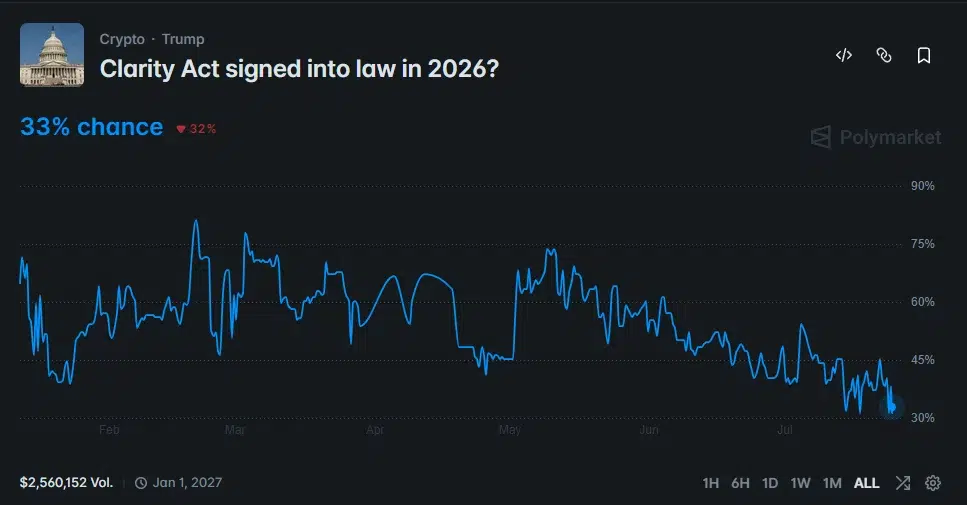
Prediction-market traders have responded by cutting their expectations further. Polymarket now gives the CLARITY Act a 33% chance of becoming law in 2026, with more than $2.56 million wagered on the contract.
Polymarket’s chart shows that the odds climbed above 80% in late February before losing ground over the following months. The probability fell toward 30% in July as ethics disputes, banking opposition, and the approaching recess weakened confidence in passage.
Once lawmakers return after the elections, Hammond expects a narrow opportunity in which campaign pressure may ease enough to restart negotiations. Fortune reported that the effort would still compete with funding deadlines and defense legislation, leaving senators limited time to settle the remaining ethics, banking and enforcement disputes.

How the sacking of two popular coaches at Britain’s smartest tennis club has sparked uproar with allegations of racism and ageism

Was DoorDash Down Today? Here’s What Outage Trackers Are Currently Showing for the Food Delivery App

Bitfinex completes El Salvador licence set across three markets


-

 Crypto World7 days ago
Ripple Payments Joins MiCA With 14 Firms, Does It Mean Anything For XRP?
-

 Politics7 days ago
The House | The City of London can help the new chancellor deliver growth in every postcode
-

 Fashion7 hours ago
Weekend Open Thread: Brooks Brothers
-

 Politics5 days ago
Democrats look to World Cup watch parties to register thousands of voters
-

 Crypto World4 days ago
Grayscale Files For Worldcoin ETF, WLD Registers Sharp Rise
-

 Tech4 days ago
Sail Virtually Aboard The “Itanic” With IA-64 Emulator
-

 NewsBeat5 days ago
Unregistered fitter used Gas Safe logo on business flyers
-
 Tech4 days ago
Turtle Beach Command Series KB7 review: a nifty screen-equipped gaming keyboard
-
 Business3 days ago
New Jersey voter registration controversy explained: How 6,600 noncitizens got on the rolls, and what happens next
-

 News Videos5 days ago
Big Money Is Entering XRP
-

 Crypto World6 days ago
Kaspersky exposes OkoBot’s 20-module crypto wallet attack
-
 Entertainment3 days ago
Johnny Depp’s R-Rated Gothic Cult Classic Gets New Release Ahead of Sydney Sweeney Remake
-

 NewsBeat7 days ago
Durham County Council to send out electoral registration emails
-

 Crypto World7 days ago
MiCA Licensing Faces Delays as ESMA Adds 14 CASPs to Register
-

 Crypto World2 days ago
Ethics, other provisions in crypto Clarity Act to be further discussed
-

 Crypto World7 days ago
Chip Stocks Enter Bear Market After Moonshot Ai Unveils Kimi K3 Model
-
 NewsBeat4 days ago
Shanghai science forum photos show China’s AI and robotics advances in rivalry with US
-

 Tech4 days ago
Watch Flock Safety CEO Garrett Langley discuss the future of surveillance at TechCrunch Disrupt 2026
-

 Crypto World5 days ago
Circle’s President Sold Over 360,000 Shares, The Filings Explain Why
-

 Tech5 days ago
Subway Sandwich Computers Get a Second Life as Gaming Machines
You must be logged in to post a comment Login