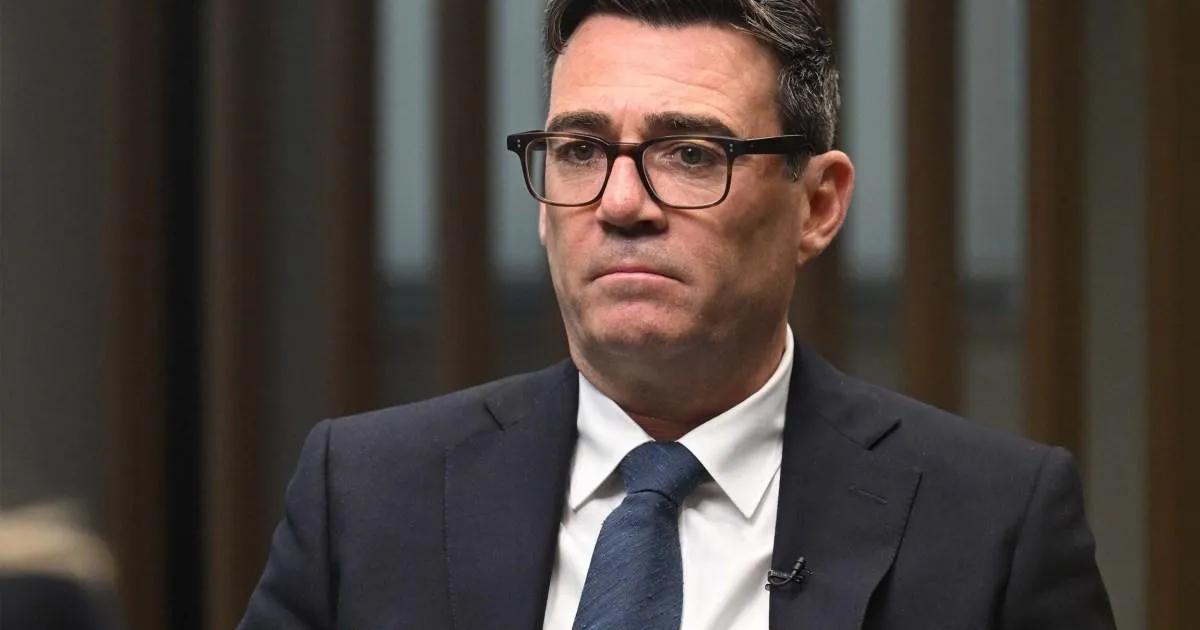
On Thursday, Prime Minister Andy Burnham announced plans to provide rates relief to pubs and music venues in England
20:24, 24 Jul 2026
Belfast pub boss calls for NI to get the same business support as England
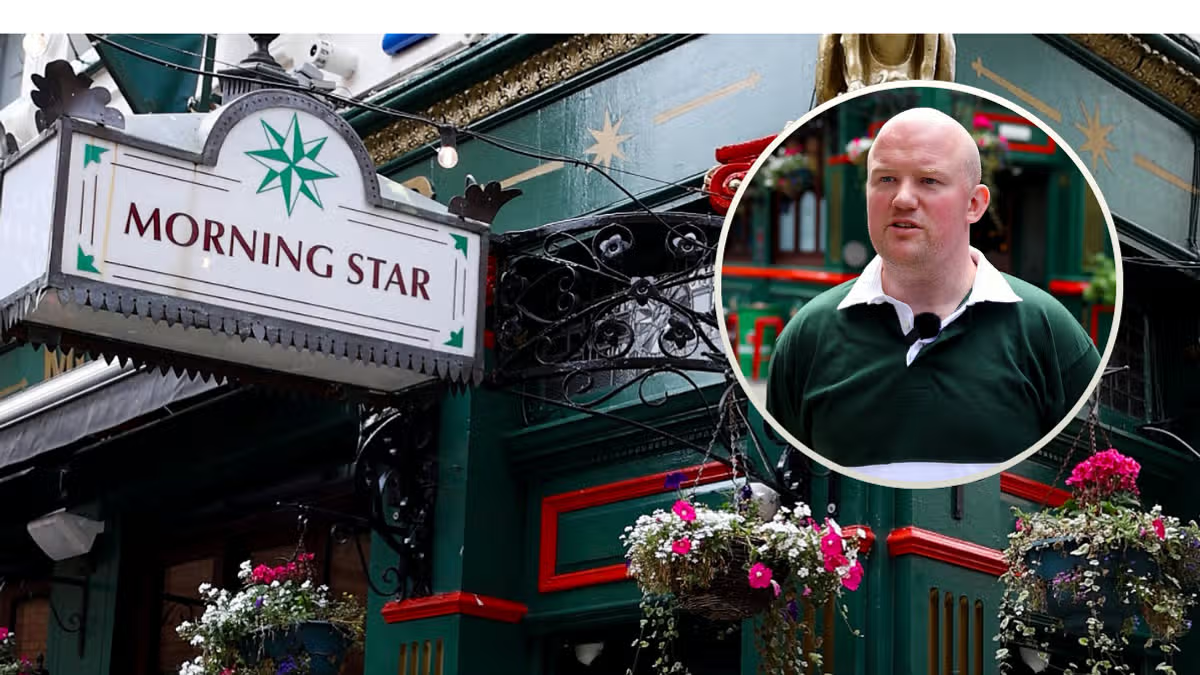
The owner of a Belfast City Centre pub has called for greater support for bricks-and-mortar businesses after the Prime Minister announced new measures to help hospitality venues in England.
James McAlister from The Morning Star pub said businesses in Northern Ireland were being left behind when financial support schemes were introduced elsewhere in the UK.
Advertisement
His comments come after the UK Government announced a 20 per cent business rates relief scheme for pubs and music venues in England.
The move has prompted renewed calls from Northern Ireland politicians for similar support to be extended here, alongside demands for a reduction in hospitality VAT to help businesses compete with those across the border in the Republic of Ireland.
Mr McAlister said announcements made in England often failed to translate into support for businesses in Northern Ireland.
Speaking to Belfast Live, he said: “These things are announced in England, and they don’t seem to be ever passed across, and I don’t think it’s just hospitality.
Advertisement
“I think you have to look at bricks and mortar businesses within any city centre and look at what way government locally and nationally is supporting those.”
The Belfast publican said the challenges facing city centres went beyond individual businesses, pointing to concerns around dereliction and anti-social behaviour.
He added: “You just have to look at the dereliction and the anti-social behaviour that’s going on, and I think any support should be passed on.
“It should really be highlighted in terms of the value that bricks and mortar businesses, city centres offer to the community and to the general public.”
Advertisement
Mr McAlister said businesses were looking for “equity and equality” in how support was delivered.
He said: “You’re looking for a bit of equity and equality across the board.
“Is that a redistribution of taxes and rates and whatever else? There’s definitely answers there, and it’s all well and good me saying it, but whether people listen is another thing.”
Advertisement
He said helping businesses survive would benefit Belfast as a whole by ensuring the city centre remained attractive to visitors.
“[It would be ] great if we get it, but I think it’s across the board because there’s so many great businesses there and if they can develop that, it’d be fabulous for Belfast.
“You just look at the Fleadh and the amount of people coming up and they want to see a thriving city centre, they don’t want to see dereliction, they don’t want to see the anti-social aspects.”
The Department of Finance said Minister John O’Dowd remained committed to supporting businesses but stressed that business rates were devolved to Stormont.
Advertisement
A spokesperson said: “Business rates are fully devolved. Funding arising from the Prime Minister’s announcement has not yet been confirmed and will be for the Executive to allocate in line with local priorities and financial pressures.”
The Department said Mr O’Dowd had raised the issue of Northern Ireland’s finances during a call with the Chancellor, arguing Westminster needed to place funding here on a “fairer and sustainable footing”.
It added that draft Budget proposals included an additional £10 million to expand Small Business Rate Relief, which could see thousands more businesses benefit if approved.
The Finance Minister also recently launched consultations on a Business Growth Accelerator and changes to Non-Domestic Vacant Rating, aimed at encouraging investment and bringing empty premises back into use.
Advertisement
Meanwhile, MPs have continued to call for Northern Ireland to be included in wider hospitality support measures.
South Antrim MP Robin Swann said Northern Ireland businesses faced the same pressures as those in England but without the same support.
He also renewed calls for a pilot reduction in hospitality VAT, highlighting that businesses in the Republic of Ireland currently benefit from a 9 per cent hospitality VAT rate compared to 20 per cent in Northern Ireland.
Lagan Valley MP Sorcha Eastwood has also called for the rate reduction to be extended to Northern Ireland while arguing that a VAT cut for hospitality was needed.
Youngest children are often thought of as the lucky ones – the babies of the family who skated through childhood with fewer rules, more freedom and all the attention.
But therapists who work with youngest siblings hear a very different story.
“The youngest child sits in a fascinating and often painful paradox,” Erin Pash, a licensed marriage and family therapist and founder of Pash Co., told HuffPost. “They grew up surrounded by people who loved them and people who consistently underestimated them.”
Although the youngest sibling may face different challenges compared to the forgotten middle child or the “parentified” eldest, their psychological wounds are no less valid. It’s also important to acknowledge the wide range of experiences that youngest siblings can have.
Advertisement
“The research on birth order and its impact on personality and mental health is pretty limited and quite mixed,” said Caitlyn Oscarson, a licensed marriage and family therapist.
“Birth order is only one piece of someone’s story. The family dynamics, relationships and life experiences, along with genetic dispositions, are likely much more important than simply being the youngest.”
Things like culture, parenting style and sibling age gaps can play an important role as well.
“I encourage people to use birth order as a starting point for curiosity rather than a diagnosis,” said Priya Tahim, a licensed professional counsellor and the founder of Kaur Counseling.
Advertisement
“The question isn’t, ’What does it mean to be the youngest?” but rather, “How did being the youngest shape the beliefs I developed about myself, my relationships, and my place in the world?” When we explore those questions in therapy, we often uncover patterns that no longer serve us and that’s where meaningful growth begins.”
There are some general themes that tend to emerge on that journey as well. Below, therapists share the most common issues youngest children bring up in therapy.
Not being taken seriously
“One of the most common themes I see is the struggle to be taken seriously,” said Altheresa Clark, a licensed clinical social worker and founder of Inspire4Purpose. “Many youngest siblings describe growing up being viewed as ‘the baby’ of the family, even well into adulthood. As a result, they often feel their opinions are dismissed or that they have to work harder to prove they are capable, responsible and independent.”
Advertisement
She added that many youngest children feel underestimated, as though their family can only view them through the lens of who they were as a child.
“If your older siblings changed your diapers and wiped away your spit up, it may be hard for them to truly picture you now as a full-fledged adult,” said Natalie Moore, a licensed marriage and family therapist. “Even if you’re competent in professional and personal areas of your life, your older siblings or parents may still treat you as though you’re ‘still figuring it out’ or that you need extra help – even if you don’t.”
Family patterns and roles are well-established by the time the youngest child arrives.
“Youngest children are often the last to be consulted, the last to be believed and the last to have their emotional experiences validated,” Pash said. “That early experience of not mattering as much becomes a deeply internalised belief that follows them into adulthood, their relationships and their workplaces.”
Advertisement
Chronic comparison to older siblings
“Growing up in the shadow of older siblings creates a relentless internal measuring stick,” Pash said. “Youngest children often spend enormous psychological energy either trying to differentiate themselves from their siblings or quietly wondering if they’ll ever measure up. Both directions are exhausting. Therapy often uncovers how much of their identity was built in reaction to who came before them, rather than from the inside out.”
From academic and career success to relationships and life milestones, older siblings can set a standard of measurement that makes it difficult to chart your own path.
“Many youngest siblings describe feeling pressure to live up to their older siblings’ accomplishments or, conversely, feeling responsible for ‘doing better’ after an older sibling’s disappointments,” Tahim said. “While these comparisons are often unconscious and rarely come from a place of harm, they can still have a lasting emotional impact. Over time, this can contribute to perfectionism, people-pleasing, self-doubt or a persistent feeling that they have something to prove.”
Advertisement
Furthermore, this dynamic of comparison can minimise the satisfaction and joy of personal achievement.
“There will always be someone who got there first – whether it’s a milestone, a graduation or just age itself,” said Chloë Bean, a licensed marriage and family therapist. “When every milestone has already been reached by someone else, youngest children can struggle to feel a sense of ownership over their own accomplishments.”
The myth of the carefree ‘fun one’
“The myth that youngest children are carefree is perhaps the cruelest one because it’s so cheerfully delivered,” Pash said.
Advertisement
“People say it like it’s a gift. What they don’t see is that ‘carefree’ is often the mask that gets assigned when no one is paying close enough attention to the care that’s actually needed. The youngest child learned early that the family’s emotional bandwidth was already stretched, so they adapted. They became easy. They became fun. They made people laugh.”
Underneath that mask, however, there might be a child managing big feelings alone because asking for help felt like too much of an imposition. In this sense, being fun or easygoing is more of a survival strategy than a personality trait.
“Behind the ‘fun one’ label, there can be anxiety, people-pleasing, perfectionism or a fear that if they stop keeping the peace, they’ll disappoint those around them,” Tahim said.
Thus, many youngest siblings opt to “go with the flow” and give off an appearance of “floating through life,” despite the emotional weight they actually carry but don’t necessarily have the skills to identify and communicate.
Advertisement
SDI Productions via Getty Images
A common theme among youngest siblings is wanting to be taken seriously as an adult.
The ‘spoiled’ and ‘favourite’ labels
“The ‘favourite’ label carries its own particular sting,” Pash said. “Many youngest children tell me they felt simultaneously favoured and overlooked, given treats and flexibility while being denied depth and seriousness. Being the favourite doesn’t mean being the most important. It often just means being the most manageable.”
The youngest sibling might experience less strict versions of their parents and have fewer responsibilities, but that comes at a cost.
Advertisement
“The idea that the youngest sibling is always spoiled or the favourite is often much more complicated than people realise,” Clark said. “Many of my clients describe feeling overlooked rather than overindulged. Others explain that while they may have had certain freedoms growing up, those freedoms also came with assumptions that they didn’t need as much guidance or emotional support because their parents were more experienced by that point.”
And don’t forget the burden of an older sibling’s jealousy or resentment – which can create additional pressure to prove your worth and chip away at self-confidence.
“Maybe the older sibling envied the youngest’s freedom, slack and less rules,” Bean said. “The younger sibling grew up resented simply for existing and splitting the parents’ attention. This is common because the youngest sibling had no say in the family structure they were born into, but they absorb the blame for it. Children internalise that kind of resentment as ‘something is wrong with me’ way before they understand where it actually comes from.”
Difficulty setting boundaries
Advertisement
“Because older siblings or parents may have been accustomed to looking after them, youngest siblings sometimes struggle to separate their own identity from family expectations,” Clark said. “This can show up in people-pleasing, avoiding conflict or feeling guilty when making decisions that differ from what their family wants.”
As they get older, youngest children may struggle with taking up space, expressing needs and setting (and enforcing) boundaries.
“Learning that their needs are legitimate – not an inconvenience – is frequently the central work,” Pash said. “The family peacekeeper often becomes an adult who struggles to say no.”
They might feel particularly deferential to older siblings who took on a caretaking role in their childhood.
Advertisement
“You may find that when discussing personal stressors or decisions, that they jump in with advice or opinions even if you didn’t ask for them,” Moore said. “This can cause friction between siblings, where it’s more appropriate to have a peer-to-peer relationship, versus one with a parental-style hierarchy.”
Mabel Yiu, a licensed marriage and family therapist and founder of the Women’s Therapy Institute, pointed to another dynamic that can stem from difficulty setting boundaries and asserting needs.
“Some youngest often feel they don’t have the power to say no or the safety to express anger as a kid, so they develop conflict-avoidant behaviours such as passive aggression as adult,” she explained. “Some behaviours include saying yes but not doing the thing, backhanded comments or sarcasm. In those situations, the work is around building tolerance for discomfort, expressing ‘no’ or anger in a meaningful way and discerning the humor and anger in sarcasm.”
Learned helplessness
“When older siblings, parents and even extended family consistently swoop in to solve your problems, tie your shoes and finish your sentences, you don’t develop the same tolerance for discomfort and struggle that builds confidence,” Pash said.
Advertisement
“Many youngest children arrive in adulthood with a quiet but persistent belief that they can’t fully trust themselves because they were rarely given the chance to find out.”
It’s a kind of learned helplessness that leads to adults who second-guess themselves, defer to others, struggle with confidence in their own judgment and feel extreme anxiety around being wrong.
“When you’re the youngest sibling, your older siblings are likely to be more developmentally advanced in almost every area,” Moore said. “As an adult, this seems obvious – of course an 8-year-old is better at jump rope than a 5-year-old. But young children don’t necessarily understand that it’s not that their older sibling is ‘better’ at everything than them inherently, it’s just that they’ve had more time to develop their skills and talents.”
As a result, they may feel chronically behind and incapable.
Advertisement
“Because early childhood experiences shape our adult lives to a great degree, a youngest sibling could maintain this ‘trying to catch up’ internal blueprint long after it’s no longer relevant,” Moore added.
Feeling overlooked and unseen
While youngest children are often assumed to be the centre of attention, many carry a quieter wound – a feeling of having been overlooked in ways that are hard to articulate.
“By the time they were born, their parents had already raised the older kids, so the youngest one tends to receive less attention, fewer photos, fewer ‘first-times’ that anyone made a fuss over,” Bean said.
Advertisement
“Youngest siblings can also feel left behind, like the caboose of the whole train. The rest of the family shares memories the youngest was never part of, and that shared history is something they can never catch up to. If the household was chaotic as they were growing up, or if the parents were spread thin, the youngest one learned to regulate by staying small, agreeable and low-maintenance.”
Bonfanti Diego via Getty Images
Youngest siblings can struggle to establish a strong sense of self.
Yiu explained that youngest children may feel less important or like they were given the most tired and least structured version of their parents.
“Novelty fades with each child, which shows up as less documentation, not less love,” she noted. “Reframing this as a lack of novelty rather than a lack of importance tends to take the sting out of it. Knowing this intellectually doesn’t always undo the feeling, and part of the work is sitting with the fact that something can be true and still hurt.”
Pash described a related paradox of “invisibility within visibility.”
Advertisement
“The youngest child often walks into therapy half-convinced they don’t have a real reason to be there,” she said. “They weren’t abused, they weren’t neglected in the obvious ways, and someone always thought they were delightful. But delight is not the same as being known. Warmth is not the same as being witnessed and genuinely understood.”
A need for a stronger sense of self
“At the core, most youngest children are working toward the same thing – being taken seriously by others, and eventually by themselves,” Pash said. “More specifically, this often looks like developing a self that belongs to them. So much of the youngest child’s identity was shaped by reaction – to older siblings, to parents’ exhaustion and distraction, to family narratives already in motion before they could speak.”
This leaves the youngest siblings wondering who they really are when they aren’t performing the role they were born into.
Advertisement
“They might want to develop a stronger sense of identity, be taken more seriously and taking themselves more seriously, maybe limiting unsolicited advice from other family members and changing the baby role dynamic with their parents and siblings,” said licensed clinical marriage and family therapist Robin Hamilton.
Learning self-reliance and understanding their own personal values are key goals as well.
“Some younger siblings may struggle with trusting their intuition because they grew up hearing, ‘You don’t really understand’ or ‘You’re too young to know what’s going on,’” Oscarson said.
With time and effort, however, youngest children can cultivate that stronger sense of self and instinct.
Advertisement
“They can work on increasing confidence in their own decisions, communicating boundaries more effectively, trusting their voice and recognising that they do not need external validation to prove their competence,” Clark said. “Many are learning to embrace adulthood without feeling like they have to continually convince others that they are capable.”
Russia’s war against Ukraine is not going according to Vladimir Putin’s original plan. The Russian president’s initial strategy called for the war to be won within ten days, but Ukraine’s spirited defence in the first months of the war robbed Russia of the initiative. Now, four and a half years later, the frontline inside Ukraine has remained largely static for months.
Meanwhile, the human cost continues to mount, particularly for the invaders. British intelligence estimates suggest that the number of Russian soldiers killed during the conflict is approaching half a million since the full-scale invasion began in February 2022. Rumours are growing about a new round of mobilisation.
Ukraine has also intensified drone strikes against Russian energy infrastructure, targeting both occupied Crimea and locations deep inside Russia, including Moscow and St Petersburg.
Fuel shortages and internet outages are now affecting much of the country, and public frustration appears to be growing. The Russian president himself has publicly acknowledged that Russia is facing difficult circumstances.
Advertisement
There has been a great deal of speculation that Putin’s position is increasingly tenuous. The most recent survey by Russia’s state pollster, VCIOM, for June 22-28, found that Putin’s job approval rating fell to 66.9%, down from 70.4% the previous week. The percentage saying they disapprove of his performance rose from 19.7% to 21.3%. His trust rating, meanwhile, fell from 76.7% to 73.3% over the same period.
It’s Putin’s lowest rating since the beginning of the full-scale invasion in 2022. But this still doesn’t indicate that his presidency is in particular peril. The Russian president remains by far the most popular political leader according to the VCIOM poll, and his party, United Russia, sits at the top of the list when it comes to people’s voting intentions.
But there are certainly some indications that Putin himself may feel increasingly vulnerable. His decision to massively scale down the annual Victory Day parade on Moscow’s Red Square on May 9 suggested heightened concerns about the danger of drone attacks from Ukraine. Putin has also become increasingly secretive about his whereabouts. Reports of his use of multiple identical offices, combined with longstanding speculation about body doubles, have reinforced an image of a leader preoccupied with security.
Such precautions may be intended to counter external threats. But they may also reflect anxiety about potential challenges from within the Russian elite.
Advertisement
Recent events have highlighted this possibility. Earlier this month, prominent blogger Ilya Remeslo, once a staunch supporter of the Russian president, was remanded in custody for two months on suspicion of spreading false information against the military. In March 2026, he published a blog post under the headline: “Five reasons why I stopped supporting Vladimir Putin”.
Similarly, on June 25, Aleksandr Lunin, a veteran of the war in Ukraine who has become a prominent “milblogger” – online commentators of military affairs, often, like Lunin, ex-military – posted a video warning of possible mutiny, demanding a televised conversation with Putin about Russia’s military failures. He has also been detained, which effectively ended his public campaign. Nevertheless, the incident revealed signs of discontent in parts of the military and invited comparisons with the time preceding Yevgeny Prigozhin’s mutiny in June 2023.
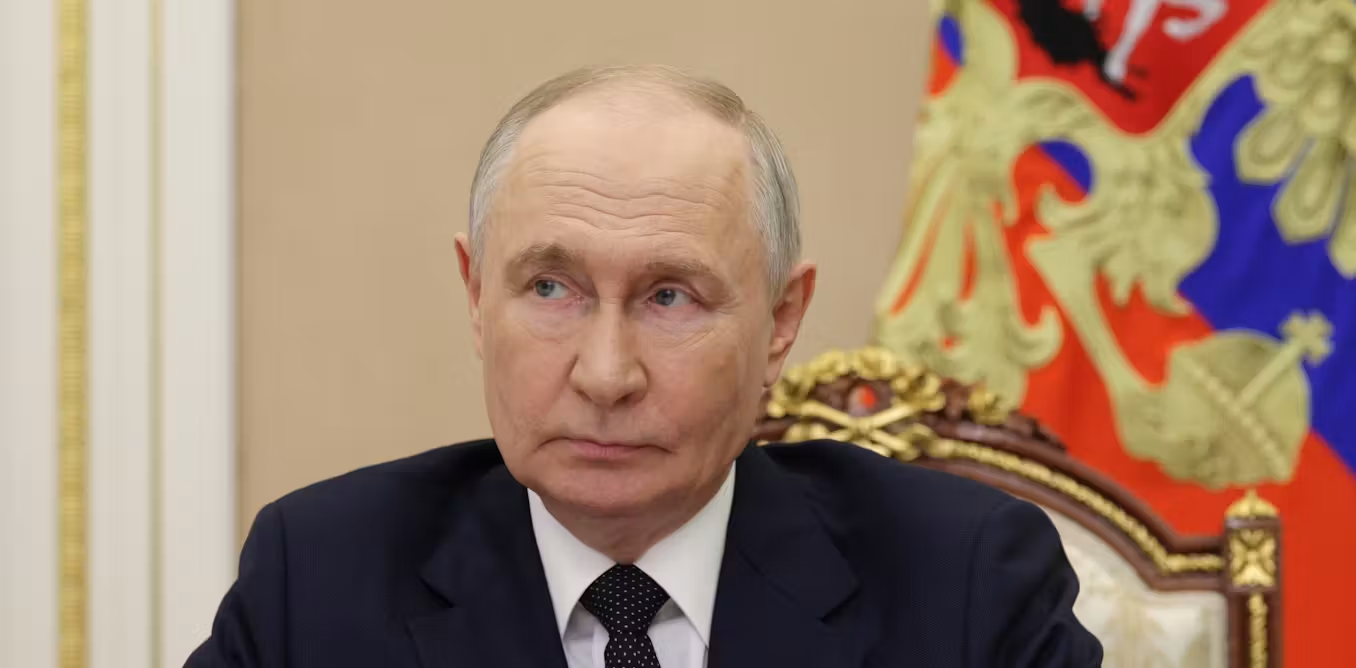
The Russian president, Vladimir Putin, at the funeral of former defence minister Sergei Ivanov, June 2026. EPA/Gavril Grigorov/Sputnik/Kremin pool
Job for life
But history tells us how hard it is to unseat a Russian (or Soviet) leader. Since the revolution in 1917, many have died in office – and the likeliest scenario is still that Putin will follow this pattern. After the constitutional amendments of 2020, there is nothing, save physical health issues, stopping him from remaining in office until the year 2036, at which point he will be 84.
With the exception of the short-term interim leader Georgy Malenkov, who took power after the death of Josef Stalin in 1953, only to be outmanoeuvred and replaced by Nikita Khrushchev within two years, only two leaders have faced outright coup attempts. The only one who was ousted was Nikita Khrushchev. He narrowly escaped a coup attempt already in 1957 but was finally ousted in 1964 .
Advertisement
Then there was Mikhail Gorbachev in 1991. Like Khrushchev, he faced considerable opposition from hardliners in the Soviet power structure and was forced to resign only months after an attempted military coup by conservatives opposed to his programme of reforms, which they believed threatened the cohesion of the Soviet Union.
However, his downfall was inseparable from the dissolution of the Soviet Union itself. The Soviet system collapsed immediately after his resignation on December 25, leaving the way clear for Boris Yeltsin to assume control of an independent Russia.
The ousting of Khrushchev may, therefore, offer more relevant parallels, happening as it did in a period of considerable international tension at the height of the cold war. Krushchev had been badly damaged in the eyes of Kremlin hardliners by the failures of his Berlin policy and during the Cuban missile crisis in 1962.
Regarding the former, he had twice demanded in 1958 and 1961 that western powers leave West Berlin within six months and turn it into a “free city”. Both Dwight D. Eisenhower and his successor, John F. Kennedy, refused to comply. It was a very public embarrassment for the Soviet leader.
Advertisement
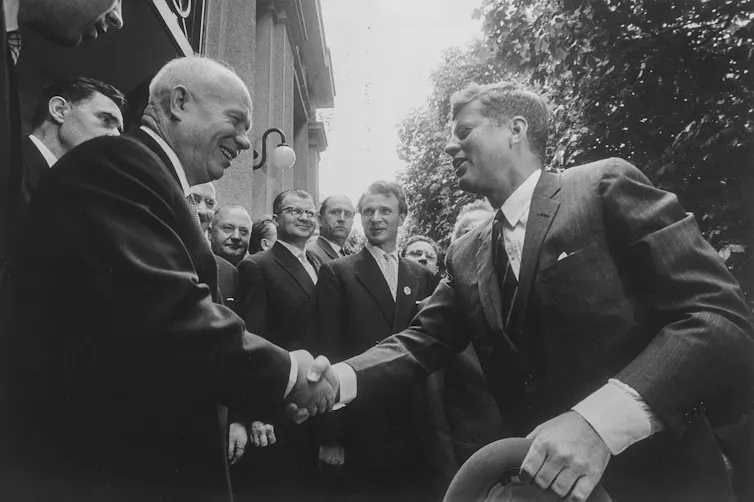
Nikita Krushchev with John F Kennedy in Vienna, 1961. The Soviet leader’s handling of foreign affairs is believed to be one of the factors in his overthrow in 1964. Stanley Tretick/US National Archives and Records Administration
On top of this, the Cuban missile crisis, during which the Soviet Union installed medium-range nuclear missiles on the Caribbean island within 100 miles of the US mainland, only to back down under intense diplomatic pressure, was seen as another huge blow to Soviet prestige.
And here’s a similarity between Khruschev and Putin. Rather than the Russian president coming under pressure from powerful players wanting to end the war in Ukraine, any palace coup in Putin’s Russia would probably come from hardliners dissatisfied with what they see as insufficiently aggressive policies. Any plotting successor emerging from the security establishment would probably be even more committed to continuing the war than Putin himself.
But this remains unlikely. Since coming to power on New Year’s Eve in 1999, the Russian president has entrenched himself in a political system centred on himself as leader. As a result, the strongest historical precedent may be the simplest one: like most Kremlin leaders before him, Vladimir Putin is most likely to die with his boots on.
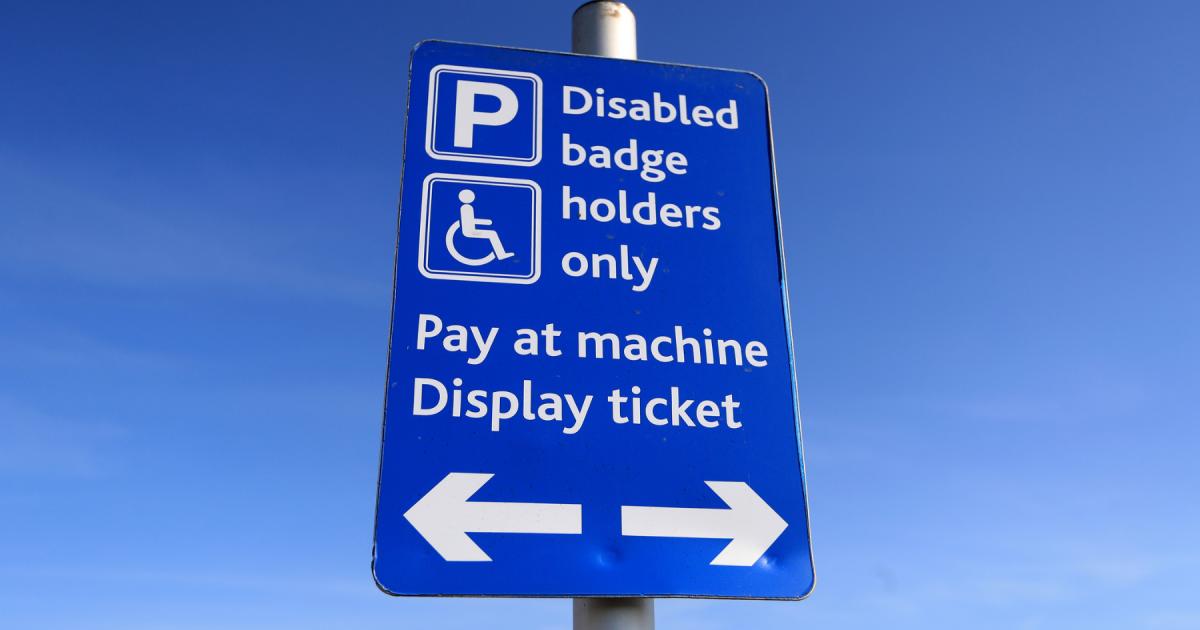
The scheme is designed to help people with disabilities or health conditions park closer to their destination.
Additionally, it allows people to park in specified Blue Badge parking spaces at supermarkets and other places.
The Blue Badge is linked to a person rather than a specific vehicle, so it can be used with any car.
Advertisement
If you’re using a Blue Badge to park on the street, you may need to use a clock alongside it.
When do you need to use a clock for a Blue Badge?
When you park on yellow lines or in other places where there is a time restriction, you need to display the blue parking clock to show your time of arrival.
“The clock should be set to show the quarter hour period during which you arrived,” the Government website shares.
“If you need to use a parking clock, you must display it on the vehicle’s dashboard or facia panel, so that the time can be seen clearly through the front windscreen.
Advertisement
“If there is no dashboard or facia panel in your vehicle, you must still display the clock in a place where it can be clearly read from outside the vehicle.”
If you don’t have the clock displayed, you may receive a parking ticket.
The parking clock is usually sent with the Blue Badge.
If not, you can request one from the same council that issued the badge.
Where can Blue Badge holders park?
A valid Blue Badge can provide a range of parking concessions, including:
Advertisement
Parking in designated disabled bays.
Free parking at many on-street pay-and-display bays – those on public roads administered by the council, not private companies.
Parking on single or double yellow lines for up to three hours where loading restrictions do not apply – although check with your local council as this can vary.
Access to council-operated disabled parking concessions, depending on local rules.
These concessions generally do not automatically extend to private supermarket or retail park car parks.
Recommended reading:
Who can use a Blue Badge?
“The badge is for your use and benefit only,” the Government website shares.
“It must only be displayed if you are travelling in the vehicle as a driver or passenger, or if someone is collecting you or dropping you off and needs to park at the place where you are being collected or dropped.”
Advertisement
It is important you don’t allow other people to use the badge to do something on your behalf, such as shopping or collecting something for you.
Have you used a parking clock alongside a Blue Badge? Let us know in the comments.
The driver and passenger in the car were uninjured
Gráinne Ní Aodha, Press Association
10:22, 26 Jul 2026
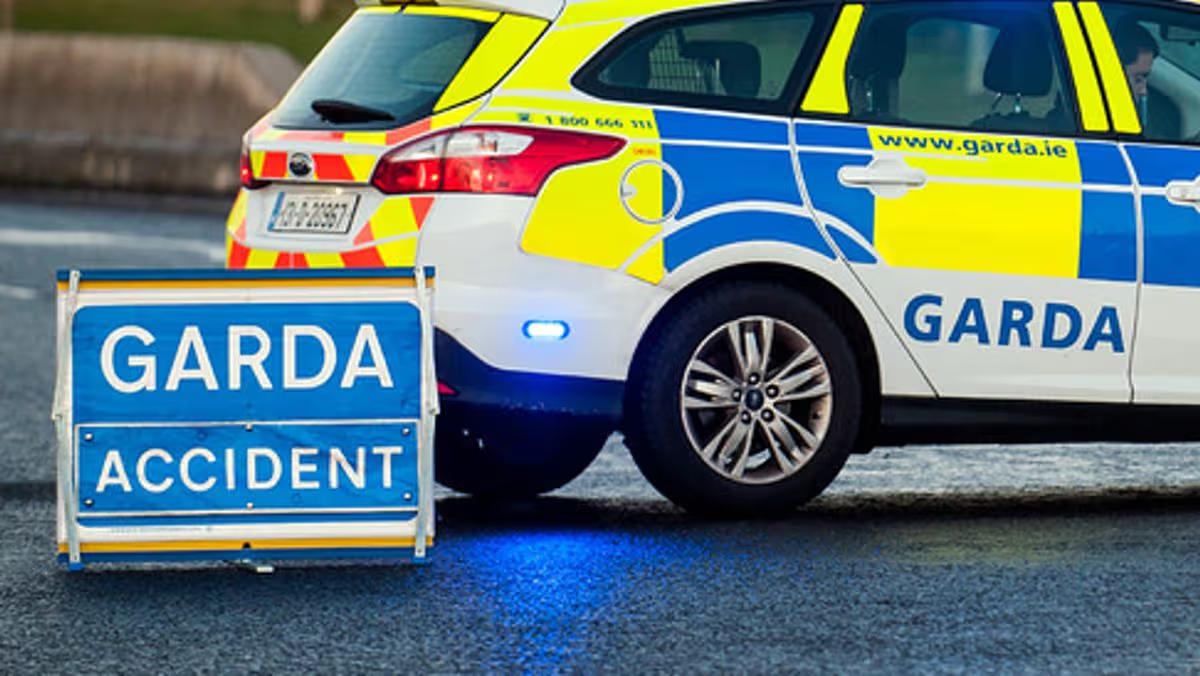
A man has died in a crash involving an e-scooter and a car in Co Meath.
The rider of the e-scooter, an unidentified male, was pronounced dead at the scene on the Kentstown Road in Navan at about 1.45am on Sunday. His body has been taken to the mortuary at Our Lady’s Hospital, Navan.
Advertisement
The driver and passenger in the car, a man in his 60s and a man in his 20s respectively, were both uninjured.
The road was closed for a forensic examination and local diversions are in place.
Gardaí are appealing to any witnesses to come forward.
In a separate incident, a teenage man died in a single-vehicle crash in Co Tipperary in the early hours of Sunday morning.
Advertisement
The incident took place on the L4101 at Lanespark, Ballynonty, Thurles, and gardaí are also appealing for witnesses.
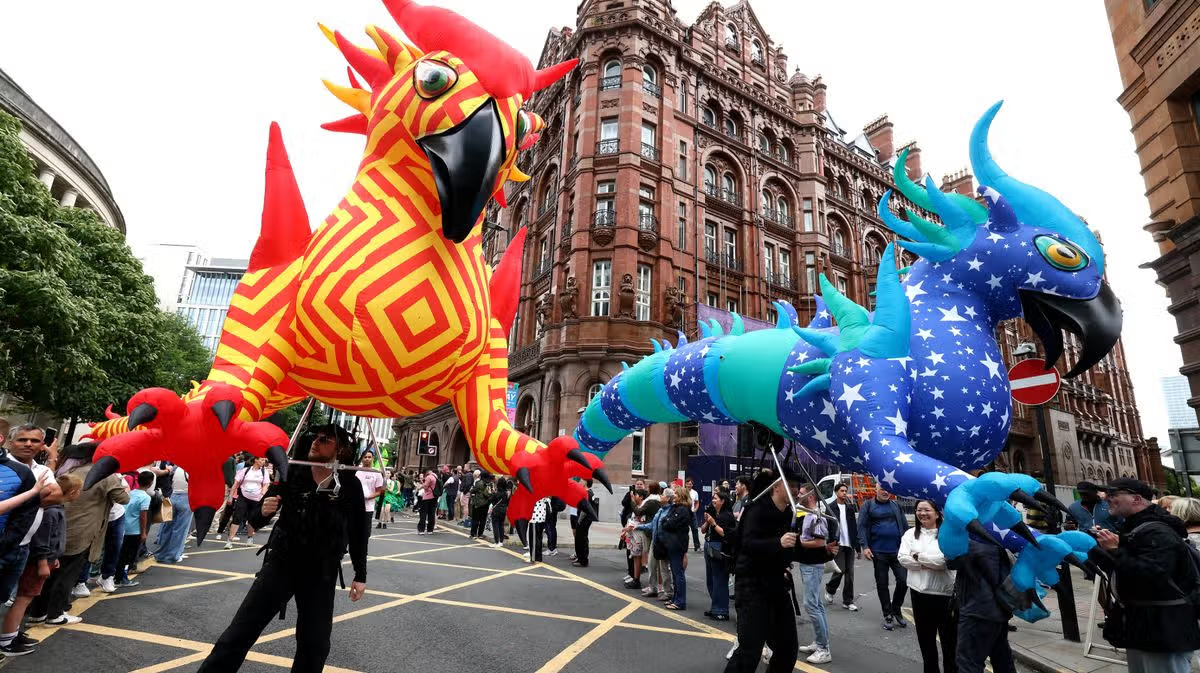
Manchester Day returns today in a colourful celebration of the city with a host of free family-friendly events taking place. Events kick off from 12 noon across Manchester’s civic squares, before the grand parade which will snake through the city centre’s streets from 1pm.
This year there will be a Catalan twist, to celebrate the city’s cultural ties with Barcelona. Manchester Day has become a huge event in the city ever since it was first launched in 2010.
The parade may be the centrepiece of the day, but there’s lots more happening to with roaming performers, musical performances and free activities across Sunday in the city centre. The main focus of activities will be on St Peter’s Square, Albert Square, St Ann’s Square, Exchange Square, Brazennose Street and Lincoln Square.
Advertisement
Click here for the latest on Manchester’s food & drink scene, gigs and more in our CityLife newsletter
Indeed, the event will be the first time Albert Square has been in use for Manchester Day since the Grade I Town Hall was closed for restoration in 2018. The square will also host the all-singing and dancing finale taking place here at 4.35pm to 5pm.
We will be bringing you live updates from the events across the city, including a full live stream of the event’s centrepiece – the grand parade at 1pm.
The parade will include a host of performers from Spain, in a collaboration follows Manchester’s role as guest city at last year’s iconic La Mercè festival in Barcelona, the first-ever English guest city chosen by Barcelona officials to take part in the annual event.
Advertisement
There will be over 550 performers on the parade, which will feature 25 community groups from across the city and beyond all celebrating Manchester’s rich cultural heritage.
Led by Manchester’s giant-sized Queen Bee and Worker Bee, the parade will also include giant puppets – the gegants – on their first ever trip outside of Spain, as well as bold costumes inspired by Catalan tradition.
Inspired also by this year’s National Year of Reading, expect plenty of nods to famous books in the parade too.
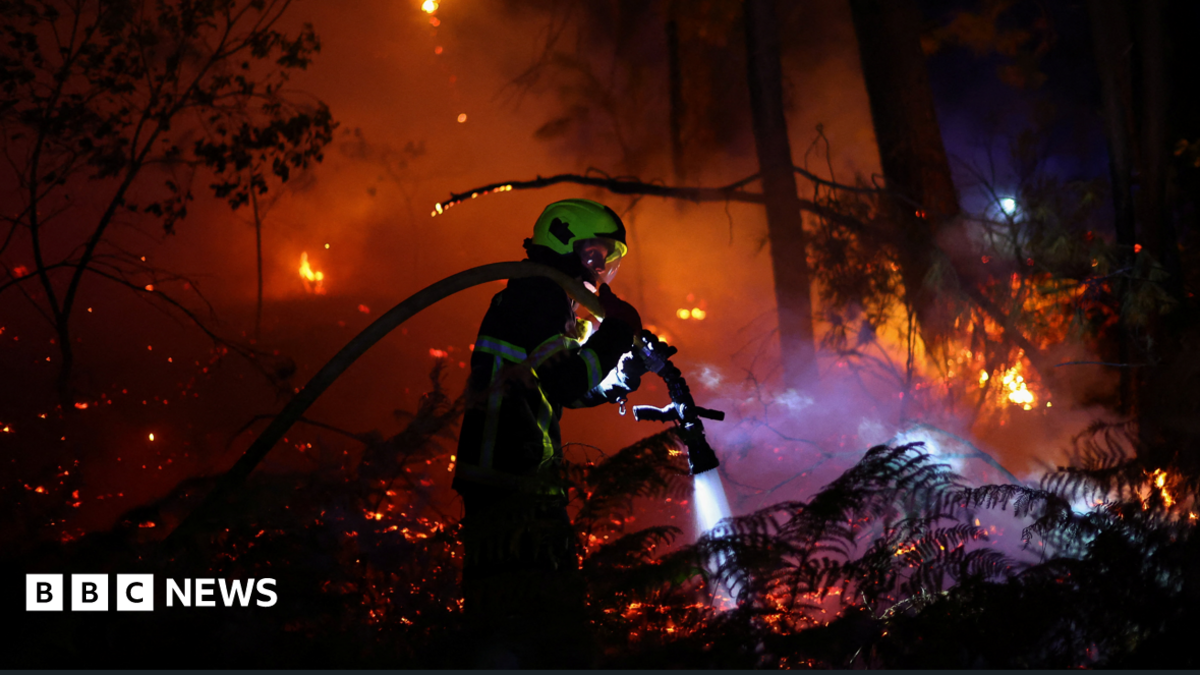
A further 55,000 people have been evacuated from six towns in France, as wildfires which have caused devastation across the country pick up pace.
The most recent evacuations took place in towns to the south of Bordeaux, in the Gironde region.
Wildfires have raged across Europe over the past week, primarily France and Spain, where more than 330,000 people have been evacuated.
France has been worst-affected, with an area of 42,000 hectares burnt, making it one of the largest forest fires since World War Two. About 98,000 hectares have burnt across the country since the start of the year.
Advertisement
Captain Nicolas Braz, one of the leaders of the firefighting operation, said the fire had created “its own winds – complete with whirlwinds”, adding it was “erratic and unmanageable”.
France’s Interior Minister Laurent Nunez said on Sunday the situation in the region remained “very unfavourable” and the wildfire was “moving erratically towards the Bordeaux metropolitan area”.
Dry vegetation and brisk winds are causing the fire to spread, with 60km (37 miles) of the A63 motorway, which leads to Spain, having been closed.
In an interview published on Sunday by La Tribune, Nunez said it “will take a long time to bring under control” and until it is contained “there will be no return” for evacuated residents and tourists.
Advertisement
France has mobilised its military to help with the response and extra reinforcements from the army have been sent to help firefighters by clearing brush and creating fire breaks.
President Emmanuel Macron said France would “rebuild” and his government would “be there for as long as is needed”.
Meanwhile in Spain, fires continue to spread, with more than 90,000 evacuated from the regions around Madrid and Ávila.
Late on Saturday, at least eight municipalities near Toledo were also ordered to evacuate, though it was unclear how many people were involved.
Advertisement
Sunday is expected to bring high temperatures and low humidity, potentially allowing the fire to spread further.
Madrid’s regional president Isabel Díaz Ayuso described the situation as the “worst fire in the history of the region”.
Spanish PM Pedro Sánchez admitted there were “complex times ahead”. Meanwhile, authorities in València confirmed the death of a man in a fire.
They have also confirmed the signing of Christos Tzolis and are set to make a £70million bid for Bruno Guimaraes after agreeing personal terms with the Newcastle captain. Defenders Ezri Konsa, John Stones and Jacobo Ramon are of interest too, amid ongoing links to the likes of Julian Alvarez, Bradley Barcola and Marcus Rashford. Man United have been boosted in their pursuit of Aurelien Tchouameni, with Real Madrid team-mate Eduardo Camavinga also on their midfield radar alongside Carlos Baleba, Manu Kone, Sander Berge, Danilo and Tyler Adams.
Midazolam and morphine, both injectable end-of-life medication, were reported stolen from a property on Charles Street in Redcar on Saturday afternoon, July 25.
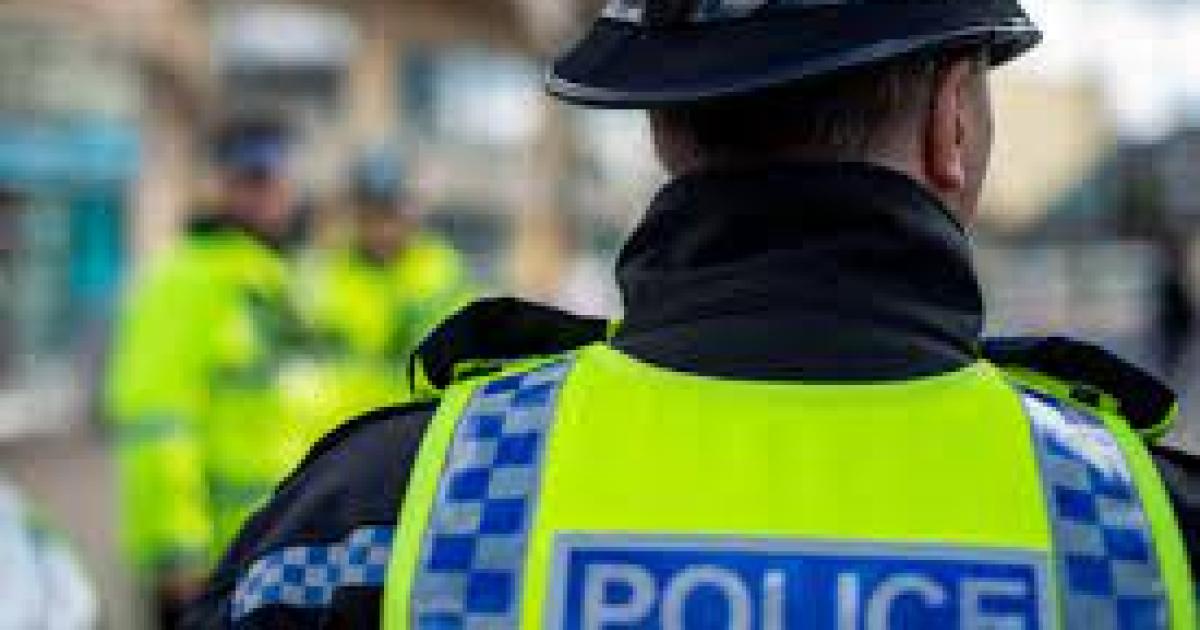
Cleveland Police said the drugs could cause serious harm in the wrong hands and urged anyone who may have taken them to attend A&E immediately.
A spokesperson for Cleveland Police said: “We’re appealing for information after potentially lethal medication was stolen from an address in Redcar.
Advertisement
“The midazolam and morphine, which were reported as stolen from the property on Charles Street in Redcar this afternoon, Saturday, July 25, are both injectable end-of-life medication.
“They could cause serious harm in the wrong hands and anyone who may have taken it should report to A&E immediately.”
Anyone with information about the incident has been asked to call 101, quoting reference SE26147136.
Andy Burnham has ruled out calling an early general election and said he will ‘honour’ Keir Starmer’s manifesto.
Advertisement
The new Prime Minister insisted he ‘faced the public’ in the Makerfield by-election and had a mandate for his sweeping changes to the country.
Burnham was speaking after a busy first week in the top job, during which he pledged to roll out the biggest changes the UK has seen in four years.
He has already announced a nationwide single fare bus cap at £2 and plans to scrap VAT on household electricity bills.
The BBC’s Laura Kuenssberg put it to Burnham that 48 million people in the electorate had not had a say on his ideas.
Advertisement
Burnham was speaking from No 10 North in Manchester (Picture: Jeff Overs/BBC/PA Wire)
Make sense of the mad world of British politics
Get analysis of the latest stories – including Andy Burnham’s rise to Number 10 – direct to your inbox from Metro’s Senior Politics Reporter Craig Munro. Sign up here.
Asked if he would rule out an early general election, the new PM replied: ‘There is no general election.
Advertisement
‘People voted for a manifesto. We are in a parliamentary democracy. That is what people voted for and I will honour that manifesto.
‘I have faced the public in Makerfield. At the time I stood forward in the by-election, people said “oh my goodness, that constituency voted Reform in May, that is a risk.”
‘I went and faced the public and I went out onto those doorsteps. I have done that I have got the support of colleagues in Parliament.’
Asked for a second time if he would rule it out, he said: ‘I am going to rule it out. There’s no early general election. I do not think people want it.
Advertisement
‘Well, the opinion polls might say some people do, some people don’t. What I need to do is get Britain focused on getting the country back where it should be.’
Burnham’s vow means the country should not face a general election until 2029, five years after Keir Starmer swept to power in 2024.
There had been speculation that the new PM would want to go to the polls after he wiped out Reform’s poll leader almost immediately after entering No 10.
Theresa May called a general election in 2017 despite ruling out a poll before 2020 on numerous occasions (PIcture: REUTERS)
However it could now be politically tricky for Burnham to break his promise not to hold an early ballot.
Advertisement
Theresa May repeatedly ruled out an early election after she became leader in 2016, and then faced backlash when she called one a year later.
During his interview, Burnham was also grilled on his relationship with Donald Trump.
He twice refused to answer the question whether he trusted the US president.
Instead, he answered: ‘It’s a changing world isn’t it, and you just obviously have to call things as they develop.’
Advertisement
Burnham added: ‘I can’t at any point say that I won’t take a different opinion from him [Trump], that I will need to voice a different idea that is right for Britain.’
Advertisement
Speaking from No 10 North, Burnham would also not commit to a date when the government would spend 3% of GDP on defence.
His new Chancellor, John Healey, resigned from Starmer’s government over their refusal to hit the benchmark.
Burnham said: ‘I appointed my new chancellor very aware of what he had said about the critical importance of defence spending and the position that he had taken about that.
‘The first challenge facing us both is to ensure that the defence investment plan is fully funded and that’s the thing that’s right in front of us and we need to work that through as we go towards the budget later this year.’
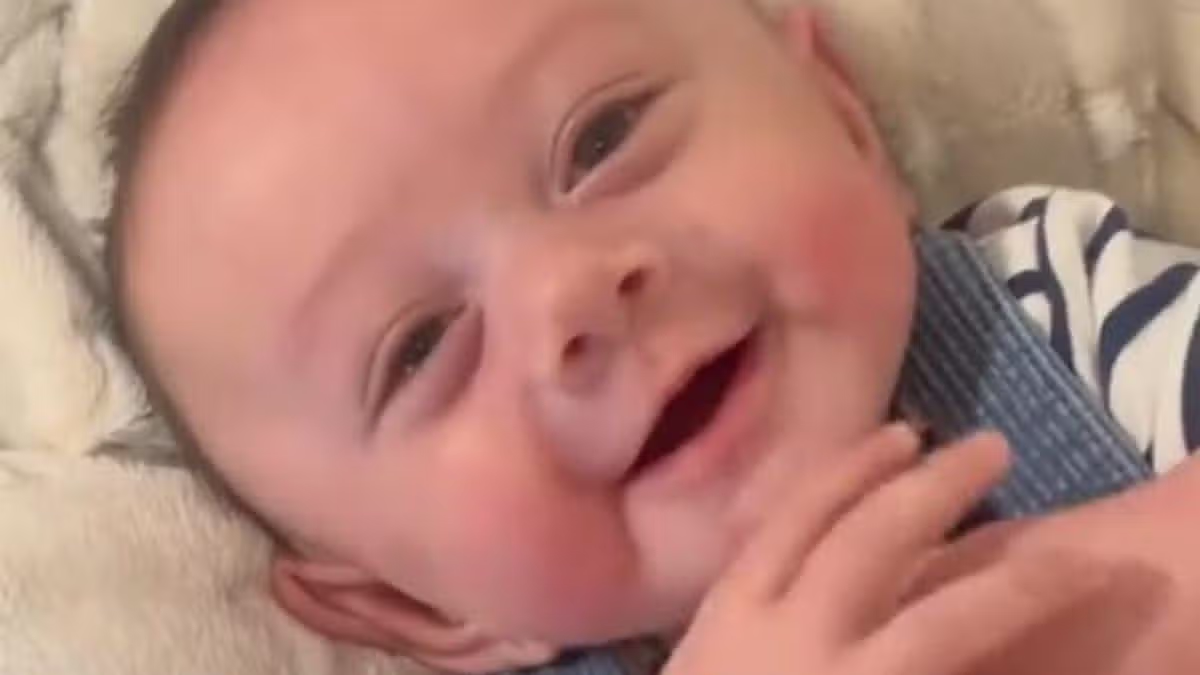
Nina Fallon said her 14-week-old son Enzo-Adane was a ‘perfectly healthy’ baby when he died unexpectedly just a day after a nurse said the infant was ‘thriving’
A mum has described her heartbreak after her baby son died just one day after a nurse said he was “thriving” at a routine check-up.
Advertisement
Nina Fallon said her 14-week-old son Enzo-Adane was a “perfectly healthy” baby when he died unexpectedly from Sudden Infant Death Syndrome (SIDS).
Just a day earlier, the infant had attended his three-month health check where a nurse reassured Nina, 24, that he was developing well. The next morning, Enzo-Adane was tragically found unresponsive by his father, Adane-Joshua, 25.
“The day before he passed away, he had a visit to the nurse for his three month check up and she said he was perfect and thriving,” Nina, a hotel chef from Dublin, said.
“Me and his dad are together but not living with each other at the minute so the last time I saw Enzo-Adane, I dropped him off as usual.
“Everything was normal. He would wake up twice in the night and nap through the day. Adane-Joshua gave him a bottle at 5am and when he checked on him at 8am he was unresponsive.”
She added: “I was having my morning coffee and he called me in hysterics saying that Enzo-Adane wasn’t breathing. I was freaking out and just wanted to get to the hospital as fast as I could.”
Emergency services arranged a police escort to get Nina to her son as quickly as possible. When she arrived, around 15 medics had surrounded the tot and were desperately trying to save his life.
Advertisement
Nina, who is also mum to three-year-old Eden-Asher, said: “Seeing him surrounded by all those doctors was petrifying. He was so fragile and tiny. They worked on him for an hour and I told them to leave him alone.
“I knew he wasn’t coming back after an hour of them trying and his body was so little. I didn’t want them on him pounding anymore. I just wanted him to be left alone.
“They’d done everything they could but he’d been gone for too long. Enzo-Adane wasn’t coming back, I knew that in my heart and I just wanted him to be at peace.”
Advertisement
The mum said she was in “overdrive” as she struggled to come to terms with the child’s death, which came 10 days before he was due to be christened.
“They handed him to me and I held him and kissed him for half an hour,” she said. “It was heartbreaking. I was so confused and I just didn’t understand. Then we had to wait for answers and that was hell.
“He was supposed to be getting christened 10 days after he passed away so I went from arranging his christening to arranging his funeral. I was in overdrive.”
Advertisement
An autopsy carried out after Enzo-Adane’s death in September last year eventually confirmed that he had died from Sudden Infant Death Syndrome.
Nina said: “It was just complete shock. We’d never experienced SIDs in our family. It broke my heart even more when we found out.
“It was hard to accept and even harder that there was no one to point the finger at. I’ll just always have to question why this happened.”
Advertisement
Nina said the reality of losing her son has only recently begun to sink in.
“Life without him is so hard,” she said. “I miss him every day. He was such a happy baby and he loved socialising. He was so advanced – he was laughing at two months old.
“Enzo-Adane was spunky and he completed the family. Only the last couple of months has reality kicked in that he’s no longer here.
“Luckily, Eden-Asher was so young that he didn’t know what was going on, but I let him see Enzo and kiss him goodbye before the funeral.
Advertisement
“He knew in a way – you could tell because kids are smarter than we think. Eden-Asher is the only thing that’s kept me going. If I didn’t have him, I don’t know where I’d be.”
Enzo-Adane was born on June 5, 2025, following a healthy pregnancy with no complications.
Nina said: “Enzo-Adane was a surprise and I was nervous because Eden-Asher was still young and I would have two under two.
Advertisement
“It was a quick, smooth birth that only took an hour and there were no complications or issues. When I held Enzo-Adane for the first time, all the nerves faded away. He was perfect.
“I’d been hoping for a boy for my older son and Eden-Asher was over the moon when he met his little brother,” she said.
Nina hopes her story will raise awareness that SIDS can strike without warning.
“There’s just no warning,” she said. “I was so strict. There were no toys or blankets in the cot and he was always flat on his back.
Advertisement
“You can do everything you’re supposed to do and this can still happen.”













































You must be logged in to post a comment Login