

Crypto World
Pi Network Unveils Major Token Distribution: What Pioneers Need to Know


Pi Network’s team announced earlier today that it has completed the distribution of its second testnet token, called Slice, through the Pi Launchpad.
The statement also outlined how users (known as Pioneers) can take advantage of and explore its functionalities.
SLICE Distributed
Recall that the initiatives around testnet tokens began on PiDay 2026 (March 14), and nearly 480,000 users took part in the Launchpad testing. According to the team, they generated “valuable feedback on the Launchpad mechanism,” which was incorporated into a simpler participation flow, updated mechanics, and an improved user experience.
To build on top of the initial progress, Pi Network launched a second testnet token called Slice in June. Testing began on June 12 and remained open until June 28 (Pi2Day). Although it has been almost a month since then, the team remained quiet on the SLICE front until earlier this morning.
In a post on X, they announced the successful distribution of the testnet token and urged users to explore the “post-launch experience and see how liquidity pools work through the new price tracking feature.” They explained that the Launchpad app in the Pi Browser shows individual allocation details, the launch and effective token prices, access to the SLICE liquidity pool, and a chart tracking changes in the asset’s price relative to test-Pi (the other testnet token).
PI’s Weird Price Moves
The official native token of the project has been quite volatile lately, mostly heading downhill. It plunged to a new all-time low of $0.07 a couple of weeks ago after it lost the coveted $0.10 support. After a few unsuccessful breakout attempts, it finally rocketed by 20% daily last Sunday and challenged the same level but from the downside.
However, the resistance now was too strong, and PI failed in its tracks. Another major leg down came yesterday when it plummeted by over 10% to $0.082 after some warning signs hinted at an upcoming rejection.
Meanwhile, some users have complained online that they have detected strange activity in their Pi Wallets, including missing tokens and countless failed transactions to unknown addresses.
The post Pi Network Unveils Major Token Distribution: What Pioneers Need to Know appeared first on CryptoPotato.


If you spend enough time on Crypto X (formerly Twitter) or Reddit or any other social media with a bias toward cryptocurrencies, as we tend to do, you will notice an interesting pattern regarding XRP and the company behind it.
While Ripple continues to expand with new licenses, partnerships, regulatory approvals, and even acquisitions, the majority of comments are focused on its native token’s price performance. So, do people actually care about Ripple, or is it all about XRP’s next big run?
Ripple Keeps Growing
Before we dive into our findings, let’s first apologize to any XRP Army participants who might not fall under this category. After all, its community is one of the biggest and loudest online, and we don’t want to rattle any cages.
Now, let’s talk about how big Ripple has become in recent years. The company, which was once sued by the SEC and whose execs considered shutting down, launched its own stablecoin less than two years ago, which has now become a $1.6 billion asset.
Ripple has also invested heavily in institutional infrastructure, such as the acquisition of Hidden Road (now called Ripple Prime), acquired other businesses, launched services for tokenized assets, rolled out AI-focused developer tools for the XRP Ledger, and continued pushing cross-border payments.
Unlike previous cycles, the company is no longer known only for payments, as it now operates across stablecoins, custody, tokenization, institutional finance, and even dev tooling. From a business and expansion perspective, 2025 and 2026 have been the firm’s busiest and arguably most successful years to date.
Yet, almost none of those announcements translated into immediate price moves for the underlying asset.
Retail Investors Still Obsessed by XRP Only
Despite all of those developments, XRP rocketed mostly after it became known that Gary Gensler would step down from his role at the SEC, which essentially marked the beginning of the end of the legal spat between the two. It peaked just over a year ago, and it has been mostly downhill since then. Even the ETF launches in November didn’t result in the promised price gains.
To many market participants, Ripple is simply the company behind the token. And, they don’t directly buy shares of that company; they accumulate XRP. If a banking partnership doesn’t increase the demand for the asset immediately, they don’t really care about it. If RLUSD’s expansion doesn’t benefit XRP somehow, they stand aside.
This partly explains why Ripple-related headlines often generate less excitement than XRP price movements, whale accumulations, or technical analysis. We have seen this firsthand.
As such, even though Ripple and XRP will forever remain connected, it still means that the former can generate revenue without affecting the latter, while the token can rally due to factors not related to the company behind it.
Search trends, social media engagement, and trading activity all point in the same direction: traders are consistently attracted to XRP far more than Ripple itself.
The post Do People Interested in XRP Actually Care About Ripple? appeared first on CryptoPotato.

The European Union is tightening crypto-related sanctions tied to Belarus, effectively barring Belarusian nationals and residents from taking controlling roles in certain EU-regulated crypto businesses. The restriction will apply to crypto exchange and custody-related providers that fall under the EU’s Markets in Crypto-Assets (MiCA) framework, starting Aug. 25.
The change is contained in Council Decision (CFSP) 2026/1847, adopted Thursday. According to the text, the decision amends the EU’s existing sanctions structure targeting Belarus over its involvement in Russia’s war against Ukraine, broadening an earlier limitation that had been limited to wallet, account, or custody services.
Key takeaways
- Belarusian nationals and residents will be prohibited from owning, controlling, or managing certain MiCA-regulated EU crypto service providers starting Aug. 25.
- The update in Council Decision (CFSP) 2026/1847 expands the scope beyond prior restrictions that covered only wallet/account/custody services.
- The prohibition includes not only ownership and control, but also holding a role on a company’s governing body.
- MiCA service categories covered by the amendment include trading platforms, exchanges, order execution/transmission, transfers, and investment advice or portfolio management.
What the EU sanctions change covers
The Council Decision states that Belarusian nationals and residents may not own or control an EU-based entity that provides “any other crypto-asset services” as defined by MiCA, nor may they hold positions on that entity’s governing body. This effectively targets governance influence as well as economic control.
MiCA’s scope of “crypto-asset services” is broad. It includes operating trading platforms and exchanging crypto assets, executing and transmitting clients’ orders, placing crypto assets, and providing transfers. The framework also covers advisory and portfolio management activities, meaning the sanctions expansion can reach multiple lines of business beyond straightforward custody.
Although the decision was adopted on Thursday and enters into force immediately, the expanded crypto-related restriction is scheduled to begin on Aug. 25—leaving regulated firms a limited window to assess whether current ownership, management arrangements, or board composition could be impacted.
Timing matters after MiCA’s transition period ended
The EU’s move arrives shortly after the end of MiCA’s transition period on July 1, when crypto companies without the required authorizations were directed to wind down operations or face enforcement action. In that context, the new sanctions restriction adds another compliance dimension for firms working within the post-transition MiCA landscape.
Instead of focusing only on licensing and operational rules, the EU is combining MiCA market regulation with sanctions screening—especially concerning personnel and governance structures. For compliance teams, that means ownership, board seats, and day-to-day control arrangements now need to be reviewed with both MiCA requirements and the sanctions framework in mind.
MiCA licensing is meant to standardize crypto services across the EU, but sanctions can independently restrict who may participate in certain roles regardless of regulatory approval. This creates a dual gate: a firm may be authorized under MiCA rules while still being required to restructure if it falls within the sanctions constraints.
Part of a wider EU effort to limit crypto access tied to Russia
The Belarus update aligns with broader EU actions aimed at crypto platforms and financial networks allegedly used to route around sanctions imposed over Russia’s war in Ukraine. The EU has been expanding its approach through successive sanctions packages and transaction bans covering crypto-related entities.
Earlier this week, the EU, as part of its 21st sanctions package against Russia, extended a transaction ban to 14 crypto-related service platforms outside the bloc. It also introduced a mechanism that would allow the EU to prohibit dealings with any foreign crypto provider that it identifies as being used by Russia to evade sanctions.
The latest package builds on a June 11 proposal that targeted 11 crypto platforms. Taken together, the EU’s direction is clear: rather than focusing solely on traditional banking channels, it is attempting to reach crypto infrastructure that may facilitate sanctioned activity.
Beyond the EU’s own actions, the sanctions tightening has also been influenced by allied measures. The proposal was reported to follow the United Kingdom’s May 26 sanctions against Huobi Global S.A., the Panamanian company behind HTX, over alleged support for Russia-linked financial networks involving sanctioned entities A7 and Garantex. In that case, HTX denied wrongdoing, telling Cointelegraph that regulatory compliance remains a priority and that it adheres to regulatory frameworks in the jurisdictions where it operates.
Implications for operators and boards across the EU
Because the amendment explicitly covers governance, EU-facing crypto firms cannot treat sanctions compliance as purely an onboarding or customer-screening task. The wording targets who can own, control, manage, or sit on governing bodies—meaning internal corporate structure becomes part of sanctions risk management.
For businesses offering MiCA-listed services—ranging from trading and exchange operations to transfer services and portfolio management—this likely requires reviewing shareholder registers, controlling persons, executive roles, and board appointments tied to Belarusian nationality or residency.
It is also notable that the measure expands an existing Belarus-related restriction. By broadening from wallet/account/custody into “any other crypto-asset services” under MiCA, the EU is signalling that it views the crypto sector as a set of connected services rather than isolated product lines. Firms that previously believed they were outside the sanctions line due to service type may need to reassess.
For investors and counterparties, these restrictions also affect operational continuity and due diligence. Business partners may increasingly factor sanctions-driven corporate eligibility into counterparty risk assessments, especially where controlling persons or board members could become restricted under future amendments.
Going forward, the critical watchpoints are the Aug. 25 applicability date and the practical steps firms take to remain compliant—particularly any changes to ownership structures or governance appointments. The EU’s broader pattern of expanding crypto sanctions suggests that additional service categories, geographies, or transaction rules could follow, even as MiCA continues to roll out its licensing and enforcement regime across member states.
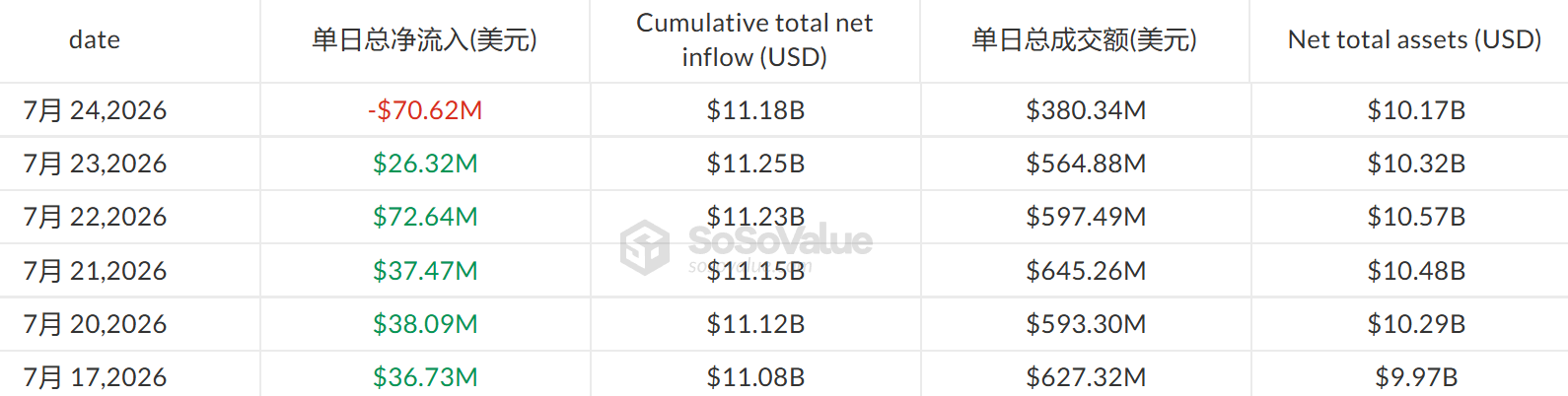
US-listed spot Ethereum exchange-traded funds (ETFs) logged $70.62 million in net outflows on Friday, ending a five-day inflow streak.
Ethereum funds saw $211.25 million in net inflows over the previous five sessions from July 17 to Thursday, according to SoSoValue data. They still posted $103.9 million in net inflows for the week ended Friday.
Despite the outflows, Ethereum ETFs extended their weekly inflow streak to three straight and have attracted $337.74 million in net inflows so far in July.
Spot crypto ETF flows have become one of the market’s most closely watched gauges of demand for Bitcoin (BTC) and Ether (ETH) through traditional investment products.
Although other jurisdictions, including Hong Kong, have launched similar funds, US-listed ETFs account for the vast majority of assets and trading volumes.
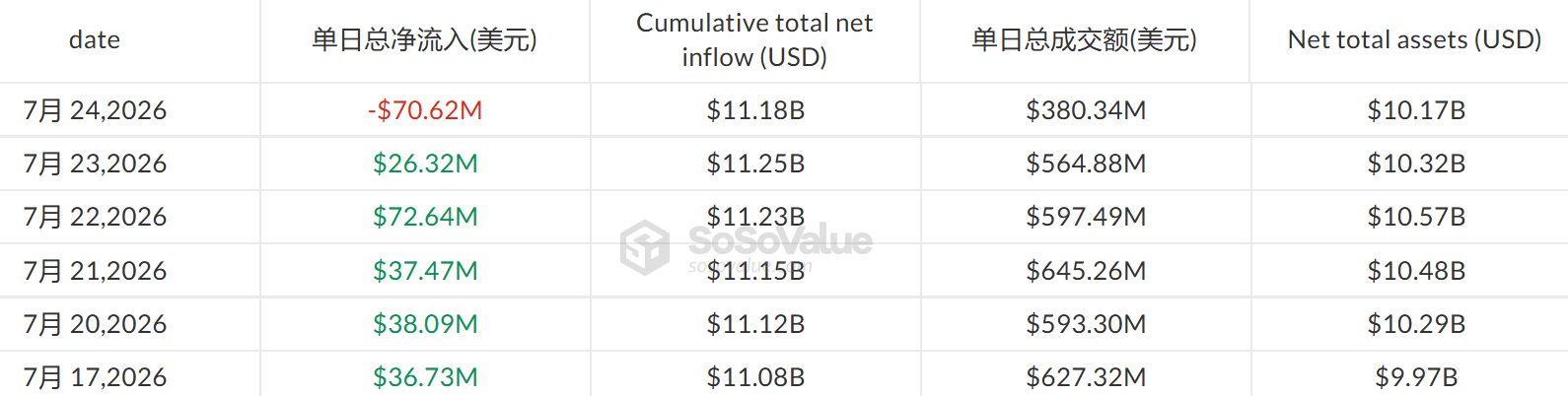
Daily spot Ethereum ETF net flows from July 17 to July 24. Source: SoSoValue
Bitcoin ETFs also end week with outflows
The reversal followed a similar pattern in Bitcoin ETFs, which ended a seven-day inflow streak on Thursday and recorded another $240.08 million in net outflows on Friday.
Bitcoin ETFs also extended their net inflow streak to three consecutive weeks, adding $103.90 million during the week ended Friday and $233.96 million so far in July. They followed a record June, when $4.5 billion flowed out of the funds.
BTC traded just under $64,000 at the time of writing, tumbling from the week’s high of $66,892 on Tuesday, according to CoinGecko. ETH traded at $1,837, down from Wednesday’s weekly high of $1,954.
Related: Bitcoin falls under $64K as surging US bond yields boost Fed rate-hike odds
Japan’s crypto reforms fuel $18.4 billion Bitcoin ETF forecast
Following Japan’s recent overhaul of its crypto regulations, which is widely viewed as laying the groundwork for future spot Bitcoin ETFs, crypto management platform XWIN estimated that a mature Japanese spot Bitcoin ETF market could reach about $18.4 billion, equal to roughly 0.13% of the country’s $14.6 trillion in household financial assets.
In an analysis posted at CryptoQuant, XWIN said the estimate assumes demand from existing crypto holders, new retail investors using brokerage accounts and institutional allocators.
The report pointed to the US market as an example, noting that spot Bitcoin ETFs excluding Grayscale’s GBTC have accumulated roughly 1 million Bitcoin, demonstrating how regulated ETF products can connect traditional finance with digital assets.
“The key is access,” XWIN said, adding that a Japanese spot Bitcoin ETF would allow investors to gain Bitcoin exposure through familiar brokerage and custody systems. It characterized the $18.4 billion figure as “an achievable upper-end market scenario.”
Magazine: A quantum roadmap would push Bitcoin much higher: Charles Edwards


BEAT has gained 32.1% in seven days before an Aug. 1 release that will place the token at the center of $77.07 million in scheduled BEAT, EIGEN and ZETA unlocks.
Summary
- $67.78 million in BEAT will unlock on Aug. 1, equal to 6.87% of circulation.
- EIGEN has fallen 12.6% before a $7.87 million release for investors and contributors.
- ZETA has lost 9% as 44.43 million tokens prepare to enter circulation.
- All three unlocks land Aug. 1, with recipient transfers set to determine immediate selling pressure.
RootData reported that Audiera will release 21.25 million BEAT at 9 a.m. Beijing time, valuing the allocation at approximately $67.78 million. The data platform calculates that the release equals 6.87% of BEAT’s circulating supply.
EigenCloud will unlock 38.35 million EIGEN worth about $7.87 million at 5 a.m. Beijing time, according to RootData. ZetaChain will add 44.43 million ZETA worth $1.42 million at midnight, with RootData placing the releases at 5.18% and 2.94% of circulation, respectively.
BEAT carries Aug. 1’s largest supply shock
BEAT traded near $3.16 after moving between $2.19 and $3.69 during the past week, according to CoinGecko. Although the token remained up 32.1% over seven days, it had retreated about 14% from the weekly high and lost 1% during the latest 24-hour period.
CoinGecko recorded $37.84 million in daily BEAT volume, up 148% from the previous day. RootData’s $67.78 million unlock valuation equals almost 1.8 times that turnover, although reported volume does not measure the amount of buy-side liquidity available to absorb recipient sales.
Using CoinGecko’s 309.27 million circulating-supply figure, the release would raise BEAT’s tradable supply to about 330.52 million if every unlocked token enters circulation. The release also equals roughly 7% of Audiera’s $965.6 million market capitalization at the checked price.
Burns drive BEAT demand before the unlock
Audiera reported 800,530 BEAT in revenue between July 13 and July 20, worth $1.84 million at the project’s stated price. It burned 797,230 BEAT during the same period, taking the cumulative amount removed from supply to 17.04 million.
“Over 17.04M BEAT permanently removed from circulation,” Audiera wrote in its July 20 update.
The August release is about 26.7 times the latest weekly burn and exceeds Audiera’s cumulative reported burns by 4.21 million tokens. At the July 20 pace, one burn would offset only 3.75% of the incoming allocation, leaving more than 20 million newly unlocked BEAT unmatched.
BEAT price faces $3.69 resistance
BEAT’s seven-day range places the first upper barrier at $3.69, where the latest advance stalled. A move above that level would take the token outside its weekly range, while another rejection would keep the recent pullback active.
On the downside, the $2.80 daily low provides the first price reference before the seven-day floor at $2.19. A fall from $3.16 to $2.19 would erase about 31% of BEAT’s value and return the token to the level that preceded its latest advance.
EIGEN has already moved lower ahead of its release.CoinGecko data placed the token near $0.203 after declines of 12.6% over seven days and 7.2% in 24 hours, while its $16.09 million daily volume put the unlock at about 49% of one day’s turnover.
ZETA traded near $0.0319 after losing 9% over seven days and 5.1% in 24 hours. CoinGecko reported approximately $4.07 million in daily volume, making its $1.42 million release equal to about 35% of turnover.
Market watchers warn of a $2.45 break
Commenting on BEAT’s price structure, market research account CrowdWisdom360 placed an additional support level between the daily and weekly lows.
“If BEAT holds above the $2.45 support, a retest of the $2.60 resistance is likely. A break below $2.45 risks a drop toward $2.30,” CrowdWisdom360 wrote.
CoinGecko’s community poll produced a less supportive reading, with 60% of respondents choosing bearish sentiment. The poll does not measure investor positions, but it shows that BEAT’s weekly rally has not removed concern about volatility or the coming supply increase.
U.S. traders see the unlocks on July 31
Beijing’s Aug. 1 schedule places all three releases on July 31 for U.S. traders. ZETA’s midnight event converts to noon EDT, EIGEN’s 5 a.m. release converts to 5 p.m. EDT, and BEAT’s 9 a.m. release follows at 9 p.m. EDT.
The timing puts ZETA and EIGEN into circulation during or shortly after U.S. trading hours, while BEAT arrives later in the evening. Crypto markets trade continuously, but exchange liquidity and recipient transfers during those hours may determine how quickly the new supply reaches order books.
Will BEAT, EIGEN and ZETA recipients sell after Aug. 1?
CoinGecko divides ZETA’s release among core contributors, the protocol treasury, purchasers and advisers, ecosystem growth, user incentives and liquidity incentives. Core contributors receive 13.13 million ZETA, followed by 12.83 million for the treasury and 9.33 million for purchasers and advisers.
CoinGecko lists a slightly smaller 36.82 million EIGEN release, with 19.75 million allocated to investors and 17.07 million to early contributors. RootData counts 38.35 million, while CoinMarketCap’s higher circulating-supply estimate would place that amount at 4.64% of supply rather than RootData’s 5.18%.
None of the available data proves that recipients intend to sell. Exchange deposits after the releases would provide stronger evidence of sell-side activity, while continued custody, staking, or treasury use would limit the amount immediately available to traders.
RootData’s dollar estimates will change with token prices before Aug. 1, but the token counts remain fixed under the reported schedules. CoinGecko’s price and volume data support a FOMO case only for BEAT; EIGEN and ZETA approach the event with falling prices and weaker demand.
BEAT has gained 32.1% in seven days before an Aug. 1 release that will place the token at the center of $77.07 million in scheduled BEAT, EIGEN and ZETA unlocks.
Summary
- $67.78 million in BEAT will unlock on Aug. 1, equal to 6.87% of circulation.
- EIGEN has fallen 12.6% before a $7.87 million release for investors and contributors.
- ZETA has lost 9% as 44.43 million tokens prepare to enter circulation.
- All three unlocks land Aug. 1, with recipient transfers set to determine immediate selling pressure.
RootData reported that Audiera will release 21.25 million BEAT at 9 a.m. Beijing time, valuing the allocation at approximately $67.78 million. The data platform calculates that the release equals 6.87% of BEAT’s circulating supply.
EigenCloud will unlock 38.35 million EIGEN worth about $7.87 million at 5 a.m. Beijing time, according to RootData. ZetaChain will add 44.43 million ZETA worth $1.42 million at midnight, with RootData placing the releases at 5.18% and 2.94% of circulation, respectively.
BEAT carries Aug. 1’s largest supply shock
BEAT traded near $3.16 after moving between $2.19 and $3.69 during the past week, according to CoinGecko. Although the token remained up 32.1% over seven days, it had retreated about 14% from the weekly high and lost 1% during the latest 24-hour period.
CoinGecko recorded $37.84 million in daily BEAT volume, up 148% from the previous day. RootData’s $67.78 million unlock valuation equals almost 1.8 times that turnover, although reported volume does not measure the amount of buy-side liquidity available to absorb recipient sales.
Using CoinGecko’s 309.27 million circulating-supply figure, the release would raise BEAT’s tradable supply to about 330.52 million if every unlocked token enters circulation. The release also equals roughly 7% of Audiera’s $965.6 million market capitalization at the checked price.
Burns drive BEAT demand before the unlock
Audiera reported 800,530 BEAT in revenue between July 13 and July 20, worth $1.84 million at the project’s stated price. It burned 797,230 BEAT during the same period, taking the cumulative amount removed from supply to 17.04 million.
“Over 17.04M BEAT permanently removed from circulation,” Audiera wrote in its July 20 update.
The August release is about 26.7 times the latest weekly burn and exceeds Audiera’s cumulative reported burns by 4.21 million tokens. At the July 20 pace, one burn would offset only 3.75% of the incoming allocation, leaving more than 20 million newly unlocked BEAT unmatched.
BEAT price faces $3.69 resistance
BEAT’s seven-day range places the first upper barrier at $3.69, where the latest advance stalled. A move above that level would take the token outside its weekly range, while another rejection would keep the recent pullback active.
On the downside, the $2.80 daily low provides the first price reference before the seven-day floor at $2.19. A fall from $3.16 to $2.19 would erase about 31% of BEAT’s value and return the token to the level that preceded its latest advance.
EIGEN has already moved lower ahead of its release.CoinGecko data placed the token near $0.203 after declines of 12.6% over seven days and 7.2% in 24 hours, while its $16.09 million daily volume put the unlock at about 49% of one day’s turnover.
ZETA traded near $0.0319 after losing 9% over seven days and 5.1% in 24 hours. CoinGecko reported approximately $4.07 million in daily volume, making its $1.42 million release equal to about 35% of turnover.
Market watchers warn of a $2.45 break
Commenting on BEAT’s price structure, market research account CrowdWisdom360 placed an additional support level between the daily and weekly lows.
“If BEAT holds above the $2.45 support, a retest of the $2.60 resistance is likely. A break below $2.45 risks a drop toward $2.30,” CrowdWisdom360 wrote.
CoinGecko’s community poll produced a less supportive reading, with 60% of respondents choosing bearish sentiment. The poll does not measure investor positions, but it shows that BEAT’s weekly rally has not removed concern about volatility or the coming supply increase.
U.S. traders see the unlocks on July 31
Beijing’s Aug. 1 schedule places all three releases on July 31 for U.S. traders. ZETA’s midnight event converts to noon EDT, EIGEN’s 5 a.m. release converts to 5 p.m. EDT, and BEAT’s 9 a.m. release follows at 9 p.m. EDT.
The timing puts ZETA and EIGEN into circulation during or shortly after U.S. trading hours, while BEAT arrives later in the evening. Crypto markets trade continuously, but exchange liquidity and recipient transfers during those hours may determine how quickly the new supply reaches order books.
Will BEAT, EIGEN and ZETA recipients sell after Aug. 1?
CoinGecko divides ZETA’s release among core contributors, the protocol treasury, purchasers and advisers, ecosystem growth, user incentives and liquidity incentives. Core contributors receive 13.13 million ZETA, followed by 12.83 million for the treasury and 9.33 million for purchasers and advisers.
CoinGecko lists a slightly smaller 36.82 million EIGEN release, with 19.75 million allocated to investors and 17.07 million to early contributors. RootData counts 38.35 million, while CoinMarketCap’s higher circulating-supply estimate would place that amount at 4.64% of supply rather than RootData’s 5.18%.
None of the available data proves that recipients intend to sell. Exchange deposits after the releases would provide stronger evidence of sell-side activity, while continued custody, staking, or treasury use would limit the amount immediately available to traders.
RootData’s dollar estimates will change with token prices before Aug. 1, but the token counts remain fixed under the reported schedules. CoinGecko’s price and volume data support a FOMO case only for BEAT; EIGEN and ZETA approach the event with falling prices and weaker demand.

Poolin, the Singapore-based Bitcoin mining pool operator, and two US affiliates have filed for Chapter 11 bankruptcy in New Jersey, according to a court filing reviewed via PACER Monitor. The move arrives as mining businesses continue to grapple with cost pressures—particularly electricity—while some operators look for new revenue streams beyond block production.
Alongside the restructuring process, Poolin is asking the court for permission to sell two West Texas mining sites to Thor CALAP LLC through a proposed stalking-horse bid valued at $52 million. A court-supervised auction would follow, with a bid deadline set for Sept. 8 under the proposed procedures.
Key takeaways
- Poolin and two US affiliates filed for Chapter 11 bankruptcy in New Jersey, with liabilities estimated between $100 million and $500 million.
- The company is pursuing a $52 million stalking-horse sale of two West Texas mining sites to Thor CALAP LLC.
- Under the proposed terms, $37 million would cover Tarbush assets (including assumed liabilities) and $15 million would cover the Pyote site (including power rights and equipment).
- The filing suggests a highly constrained balance sheet for a once-dominant pool, now operating at a much smaller share of network hashrate.
- The restructuring fits a broader trend: miners seeking survival via liquidation or diversification into AI/data-center infrastructure.
Chapter 11 filing outlines Poolin’s financial position
Poolin’s Chapter 11 court filing, available through PACER Monitor, provides a snapshot of the company’s estimated financial scale. The petition estimates liabilities in the range of $100 million to $500 million, while assets are estimated between $1 million and $10 million. The filing also lists 10,001 to 25,000 creditors.
For investors and industry observers, the wide liability and asset bands underscore the uncertainty that often accompanies mining restructurings—especially for operators with volatile operating expenses, variable energy costs, and exposure to the economics of mining difficulty and Bitcoin prices. While the filing does not provide a definitive balance sheet, the magnitude difference between liabilities and assets signals that creditors may be evaluating a realistic path toward partial recoveries, rather than a straightforward reorganization.
A proposed sale of West Texas capacity is central to the process
Poolin’s bankruptcy filing also centers on a targeted asset sale designed to preserve value while the case proceeds. The company is seeking court approval to sell two mining sites in West Texas to Thor CALAP LLC as a stalking-horse bid totaling $52 million.
The proposed transaction breaks down as follows:
- Tarbush assets: $37 million, including assumed liabilities.
- Pyote site: $15 million, including power rights, equipment, and other assets tied to the mining facilities.
As proposed, the sale would be subject to a court-supervised auction, with a bid deadline of Sept. 8 under the bidding procedures. For parties watching the case, the auction step is crucial: it can reveal whether other bidders are willing to pay more than the stalking-horse floor, particularly for assets that may include power arrangements and installed infrastructure.
From top pool to smaller hashrate share
Poolin was once described as the world’s largest Bitcoin mining pool. In 2019, it held that position, but the filing-era context reflects a significant shift in the industry landscape. According to Hashrate Index, Poolin currently ranks as the 17th largest mining pool operator by hashrate, with a 0.2% market share.
This matters because a pool operator’s economics are closely linked to volume—both in terms of how much hashing power it attracts and the ability to retain miners during periods of margin compression. When network conditions and operating costs become unfavorable, smaller pools can lose market share faster, which in turn can pressure revenue tied to pooled mining participation.
Restructuring and an AI pivot reshape the mining playbook
Poolin’s filing sits within a wider pattern in the Bitcoin mining sector. Rising electricity costs have pressured mining operations, pushing some companies to shut down and others to seek restructuring to reduce obligations or reallocate resources.
Earlier this year, NFN8 Group and two affiliates filed for Chapter 11 bankruptcy in the Western District of Texas in February, according to a separate report linked in the original coverage. That case illustrates how energy expenses and fixed infrastructure commitments can become difficult to sustain—particularly when mining economics deteriorate.
At the same time, some publicly traded miners have attempted a different approach: converting their power, facilities, and data-center experience into AI- and high-performance computing-oriented ventures. The original reporting noted that in November 2025, Bitfarms initiated a full wind-down of its Bitcoin mining operations as it pivoted toward AI and high-performance computing data centers.
More recently, deals tied to AI infrastructure were highlighted across the sector. Hut 8 and IREN announced large-scale AI infrastructure plans, with Hut 8 moving forward on a 15-year lease for an AI data center campus and IREN disclosing $2.8 billion in cloud services contracts with AI developers. Earlier coverage also pointed to MARA Holdings pursuing plans to acquire a Texas site with up to 2 gigawatts of capacity to expand AI and digital infrastructure.
Industry observers have framed these shifts around a key constraint: the challenge of securing compute resources and the infrastructure needed to support them. In the coverage referenced, Bernstein reportedly said that deals with third-party providers—including Bitcoin miners—will be necessary for AI companies seeking to address computing power limits at AI data centers.
What comes next for creditors and miners watching the auction
Poolin’s Chapter 11 process and proposed West Texas sale will likely become a bellwether for how much value is still attached to mining infrastructure, especially when assets are paired with power rights and installed equipment. Readers should watch the court-approved bidding process leading up to the Sept. 8 deadline and look for updates on whether the auction produces competing offers that change the valuation outlook for Poolin’s remaining operations.
After gaining several grand and peaking at $67,000 earlier this week, bitcoin faced an immediate rejection and dipped below $64,000, where it currently struggles.
Most larger-cap alts are also in the red on a daily scale now, with ETH slipping to $1,850, XRP fighting for the $1.10 support, and ZEC dropping by 6%.
BTC Falls to $64K
On the surface, the past week appeared quite positive for the primary cryptocurrency given the overall market sentiment. After dipping to $63,750 on Monday, the asset went on a highly successful run and soared to $67,000 on Tuesday evening for the first time in over a month. Some of the reasons behind this jump included renewed ETF net inflows and new purchases from whales.
However, the fragile market state failed to provide more rally support, and BTC went downhill in the following days. It dropped to $64,750 on Thursday, before it jumped by a grand on Friday morning. However, another rejection followed, which is rather typical for Fridays in the past several weeks, and BTC dipped by $2,000 after US President Trump warned the EU about a new set of tariffs.
Bitcoin has been unable to stage a notable recovery since then and remains struggling at around $64,000 as of press time. Its market capitalization has dipped to $1.285 trillion, while its dominance over the altcoins has rebounded slightly to 56.3%.

WLD Dumps
Worldcoin’s native token is the poorest performer today, plunging by over 10% to $0.34. Interestingly, this major decline comes after the project announced a successful fundraiser for $52.5 million to expand its World ID infrastructure. The other big losers today are ONDO (-7%), LIT (-6.3%), and ZEC (-6%). The privacy coin has dropped further away from the $500 mark.
The larger-cap alts are also in the red, albeit in a 1-2% manner. ETH is below $1,860, XRP is beneath $1.10, SOL is down to $74, while HYPE has slipped to $57. XMR continues to be among the few altcoins charting some gains. A 2.4% jump has pushed it to $365.
The total crypto market cap has lost around $20 billion daily and is down to $2.280 trillion on CG.

The post WLD Plunges 10% Despite $52.5 Funding Round, BTC Struggles at $64K: Weekend Watch appeared first on CryptoPotato.


Chinese courts have sentenced five Sifang payment platform operators to between three and six years in prison over a gambling network that processed more than 2.95 billion yuan, or about $428 million, through USDT, bank cards and third-party payment accounts.
Summary
- Chinese courts sentenced five Sifang operators to between three and six years.
- The network processed about $428 million through USDT, bank cards and payment accounts.
- Investigators used Tether wallet data and OKX records to trace crypto transactions.
The Paper reported that the Intermediate People’s Court of Xilin Gol League in Inner Mongolia upheld Ma’s conviction for illegal business operations on June 26, leaving his four-and-a-half-year prison term and 3 million yuan fine in place.
Ma’s case was the last judgment in a group of prosecutions linked to Sifang, a fourth-party payment operation that supplied payment channels to online gambling businesses. The court also ordered authorities to recover 2.95 million yuan in illegal income from Ma.
Court records cited by The Paper showed that Ma and four other defendants processed illegal payments between May 24, 2022, and Oct. 18, 2023. The operation moved funds through 105 merchant accounts connected to 10 third-party payment companies.
Some defendants received commissions or rebates through USDT wallets, while other payments went through bank cards, according to the records. Prosecutors treated their work as unlicensed payment settlement activity and charged them with illegal business operations.
Zhu received a five-year prison term and an 800,000 yuan fine, while Zhang was sentenced to six years and fined 850,000 yuan. The other defendants received terms ranging from three to six years, The Paper reported.
Sifang linked gambling sites to payment channels
According to the first judgment in the series, Zhu, Zhang, Tang, Du and Ma began building the operation in May 2022 after learning that payment services for gambling platforms could generate large profits.
Court documents said the group commissioned 32 collection and payment platforms, rented servers outside China and contacted people running overseas gambling websites. Those systems connected the gambling businesses with merchant accounts held at established third-party payment companies.
Sifang operated as a fourth-party, or aggregated, payment service rather than a licensed payment provider, according to The Paper. Such platforms combine payment interfaces supplied by banks and third-party processors, allowing merchants to collect funds through several channels from one system.
Investigators said Zhu and Zhang managed payment routes, coordinated with third-party providers, handled complaints and arranged profit distribution. Ma introduced payment channels, supplied merchant registration materials and helped merchants open accounts with third-party payment companies.
Ma also introduced intermediaries and dealt with problems that arose while merchant applications and fund transfers were being processed, according to the court findings.
Prosecutors initially alleged that the group earned 42.85 million yuan by taking a 1.45% commission from merchant transfers linked to overseas gambling websites. However, the courts attributed much smaller final profit amounts to several defendants.
Judicial records showed that one wallet associated with Zhang received 4.146 million USDT through 485 deposits between July 2022 and October 2023. The same records valued those deposits at about 26.95 million yuan.
Another wallet sent out 4.097 million USDT through 497 transfers, while Zhu, Zhang and Du also converted 1.905 million USDT into cash through 11 offline transactions. The court valued those cash conversions at roughly 12.38 million yuan.
For Ma, records obtained from the OKX application showed 152 transfers totaling 719,176.7 USDT into a wallet he supplied. The court valued those tokens at approximately 4.67 million yuan and deducted 1.72 million yuan returned by a co-defendant, leaving Ma with 2.95 million yuan in recognized illegal proceeds.
USDT records test China’s evidence rules
Investigators in Erenhot obtained wallet addresses from Tether and transaction details from OKX while building the case, The Paper reported. Wang Xiaohua, an associate professor at East China University of Political Science and Law, told the publication that linking traceable blockchain transfers to real people remains difficult when tokens do not pass through an exchange with identifying records.
Ma’s lawyer argued that investigators had not established how many payment accounts Ma handled or explained the purpose of more than 100 USDT transfers. The Paper said it sought comment from the Xilin Gol court on the evidence, valuation and cross-border data collection questions but received no response before publication.
The ruling follows calls from Chinese legal scholars and prosecutors for clearer rules on crypto-related money laundering cases. As crypto.news previously reported, a July 13 article in the People’s Procuratorate Daily identified criminal liability, evidence collection and asset recovery as three persistent problems under China’s current framework.
Prosecutors from Xiangtan’s Yuhu District and a Xiangtan University law professor argued that crypto’s anonymous, decentralized and cross-border features have complicated investigations. They also pointed to inconsistencies between China’s revised Anti-Money Laundering Law and Article 191 of its Criminal Law.
China’s Supreme People’s Procuratorate disclosed in June that authorities prosecuted more than 1,200 people for drug-related money laundering between January 2025 and May 2026. In one case, a court sentenced drug trafficker Li Mobo to death after authorities found that he laundered more than $7 million through cryptocurrency, although officials made clear that the combined sentence covered several drug trafficking convictions and was not imposed for money laundering alone.

Ripple has rolled out Ripple Mint, a new institutional platform designed to make it easier for regulated organizations to interact with the company’s US dollar-pegged stablecoin, Ripple USD (RLUSD). The release centers on a single workflow layer for tasks like minting, redeeming, and managing RLUSD—either through a web interface or through direct API integrations.
Ripple Mint was announced on Thursday, with the company presenting the product as a “unified platform” that can support both manual operations and automated connections. The emphasis reflects a broader shift in stablecoin adoption: beyond experimentation, more institutions are seeking stablecoin rails for payments, trading execution, and treasury functions.
Key takeaways
- Ripple Mint is intended to streamline institutional access to RLUSD for minting, redemption, and ongoing management.
- The platform supports access via web workflows as well as API integrations for automation.
- Ripple launched RLUSD in December 2024 with an institutional focus, while later adoption has also included retail usage.
- RLUSD has grown into a major USD-pegged stablecoin by market cap, with CoinGecko data cited by earlier reporting.
A unified workflow for RLUSD
According to Ripple’s announcement, Ripple Mint is built to fit different operational needs within financial institutions. The company says the platform offers flexible access to “digital dollars through the workflows that fit their needs,” allowing organizations to manage RLUSD either by using a web interface or by connecting through APIs.
That distinction matters for how institutions typically deploy blockchain-based infrastructure. Manual workflows can be useful for smaller-scale operations, testing, or internal controls. API-based integration, by contrast, is generally required for high-throughput environments where stablecoin actions need to be connected to broader systems such as trading platforms, payment engines, or treasury management tools.
From RLUSD launch to institutional tooling
RLUSD itself was launched in December 2024, and earlier coverage described the stablecoin as initially geared toward institutional use. Over time, reports also indicated that RLUSD has seen some retail traction, suggesting the product is not limited purely to enterprise channels—even if its infrastructure direction remains institutional.
Market capitalization has followed that scaling narrative. Earlier reporting from Cointelegraph noted RLUSD moving into the ranks of the larger US dollar-backed stablecoins by market cap, and reaching the top 10 less than one year after launch. CoinGecko charts cited in that prior coverage show the token’s market cap growth culminating in a peak on June 1, 2026, when it reportedly surpassed $1.8 billion.
That timing is particularly relevant in the context of Ripple Mint. A stablecoin’s market size can influence the perceived readiness of a given ecosystem for broader institutional deployment. While market cap alone doesn’t determine adoption quality, it can reflect liquidity and accessibility—two factors institutions frequently consider when integrating stablecoins into operational workflows.
What the rollout could change for enterprise adoption
Stablecoin infrastructure for institutions is often defined by friction: onboarding processes, integration complexity, reconciliation requirements, and operational tooling. Ripple Mint’s pitch targets that friction by providing what Ripple describes as a single management layer for RLUSD, with multiple access modes (web and API).
For institutions, this kind of consolidation can reduce time-to-integration by limiting the number of bespoke systems required to mint, redeem, or manage stablecoin balances. It can also support internal compliance workflows by giving teams a consistent interface for operational actions—especially when stablecoin use expands into treasury and trading settlement activities.
At the time of publication, earlier data referenced by Cointelegraph indicated that RLUSD was ranked ninth among USD-pegged stablecoins by market capitalization. Prior coverage also cited a short-lived market cap rise around the Ripple Mint launch window, when RLUSD’s market cap reportedly moved from about $1.54 billion to $1.64 billion before settling closer to $1.59 billion, using CoinGecko figures.
Even if price movements around announcements are not a direct measure of enterprise traction, they can signal market attention. The more meaningful indicator will be whether Ripple Mint translates into new institutional integrations, increased transaction activity, and recurring usage patterns through automated API connections.
Where RLUSD sits in the broader stablecoin landscape
RLUSD is part of the competitive set of USD-pegged stablecoins, where adoption is shaped by trust, liquidity, and the usability of the surrounding infrastructure. Cointelegraph previously reported on RLUSD’s progress into the top tiers by market cap and highlighted its positioning as a US dollar-based stablecoin with an evolving user base.
Ripple Mint adds another layer to that positioning by focusing on the operational side of stablecoin access. Instead of treating stablecoin minting and redemption as separate, fragmented processes, the platform frames RLUSD management as a unified workflow—an approach that may appeal to institutions seeking predictable processes and smoother integration into existing systems.
Importantly, this does not eliminate the need for due diligence. Institutions still need to evaluate issuer and platform controls, counterparty and custody arrangements, and compliance alignment. But tooling that reduces integration overhead is often a prerequisite for stablecoins to move from pilot programs into routine usage.
Going forward, the key question for RLUSD users and potential institutional partners is whether Ripple Mint leads to measurable increases in automated adoption—especially through API-based integrations—and how quickly the platform’s capabilities expand beyond basic mint/redeem management into deeper payment and treasury workflows.
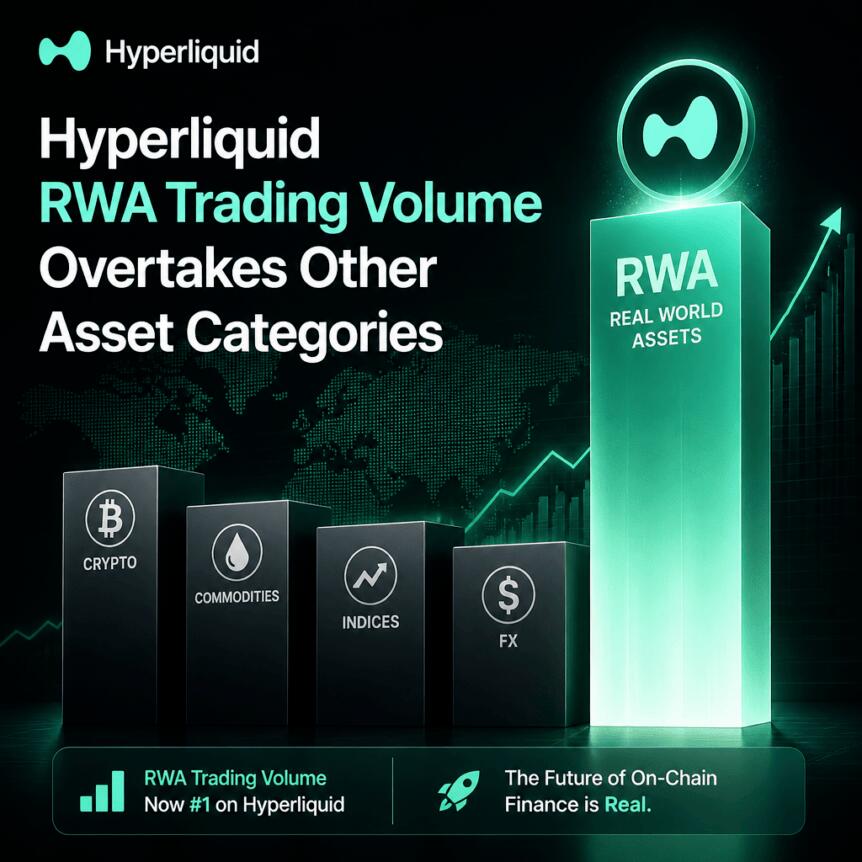
Hyperliquid’s decentralized perpetuals market has hit a notable milestone as trading in tokenized real-world assets (RWAs) started to dominate the platform’s week-over-week activity. According to Blockworks analytics, RWAs generated $25.1 billion in trading volume from July 13 to July 19—first time they have exceeded the combined volume of Hyperliquid’s other asset categories.
That $25.1 billion accounted for 52% of Hyperliquid’s total weekly trading volume of $48.2 billion, based on Blockworks data. ARK Invest research director Lorenzo Valente highlighted the scale in an X post, saying Hyperliquid’s RWA market alone was larger than the combined crypto perpetual volume of every other DEX.
Key takeaways
- RWA trading on Hyperliquid reached $25.1B in a single week (July 13–July 19), surpassing all other asset categories combined on the platform.
- RWAs represented 52% of Hyperliquid’s weekly total volume of $48.2B, per Blockworks.
- RWA adoption appears to be accelerating: RWA holder users rose 32% to 1.25 million, while tokenized RWA value increased to $36.7B (+3.5%) according to RWA.xyz.
- Revenue signals remain strong: Hyperliquid generated $7.6M in weekly revenue, placing it third among crypto apps by that metric (behind Tether and Circle).
- Executives increasingly frame perps on-chain as infrastructure: Circle CEO Jeremy Allaire called the shift a “major structural shift” toward RWA-driven trading.
RWA volume surpasses every other asset category on Hyperliquid
The shift is specific to Hyperliquid’s perpetual exchange (perps) activity, where traders transact continuously rather than relying on dated contract expirations. Blockworks’ weekly figures show that, for July 13–July 19, tokenized RWAs became the largest driver of Hyperliquid’s marketplace by volume—an inflection point for a category that has been steadily gaining attention across crypto.
Valente’s comparison—RWA volume on Hyperliquid exceeding the combined crypto perpetual volume of other DEXs—underscores how concentrated the activity is becoming around tokenized, off-chain-linked instruments on a perps venue. While DEX perps are not new, this particular weighting toward RWAs suggests that capital and liquidity are being pulled toward tokenized claims on real assets rather than limiting trading interest to native crypto commodities.
Adoption metrics point to a broader RWA pull
The volume milestone is occurring alongside growth in the underlying RWA market. RWA.xyz data cited in the report indicates that RWA holders expanded by 32% over the past month to 1.25 million users. Over the same period, the total value of tokenized RWAs rose by 3.5% to $36.7 billion.
For investors and market participants, the key question is whether Hyperliquid’s RWA outperformance reflects a one-week anomaly or a sustained change in liquidity preferences. The combination of weekly trading dominance and month-over-month growth in both holders and total RWA value makes the case for sustained demand—at least in the near term.
Revenue and relative standing among crypto applications
Volume growth often attracts scrutiny, but revenue helps clarify whether activity is translating into sustainable economic impact. DefiLlama data indicates Hyperliquid generated $7.6 million in revenue over the past week.
DefiLlama also places Hyperliquid third among crypto applications by weekly revenue, behind stablecoin issuers Tether and Circle, which generated $112 million and $45 million respectively. That ranking matters because it places an RWA-focused perps venue in direct competition for economic relevance with the dominant parts of the stablecoin ecosystem—segments that many market observers view as foundational to on-chain trading.
In practical terms, the implication is that traders are not just moving around capital for speculation: the perps market is producing measurable platform earnings at a time when RWAs are becoming a majority share of activity.
Industry executives link the trend to a “structural shift”
Beyond raw market statistics, prominent crypto and traditional finance figures are increasingly framing RWA growth on-chain as an ecosystem-level change rather than a niche experiment. Circle co-founder and CEO Jeremy Allaire said growing RWA trading on Hyperliquid marks a “major structural shift” in crypto markets. In a Friday X post, he characterized the move as departing from “speculating on endogenous digital commodities” toward trading linked to external real-world assets.
Other industry commentary supports a similar direction of travel for perpetual futures as an instrument. Earlier in July, Pantera Capital suggested that perpetual futures could become a dominant trading tool beyond crypto. The argument emphasized structural advantages of perps versus traditional derivatives, including 24/7 trading, the absence of contract expiries, simpler position management, and continuous price discovery.
Regulatory and competitive pressure is also emerging. The report references NYSE parent Intercontinental Exchange (ICE) and its chief executive Jeffrey Sprecher urging regulators to establish a “level playing field” for launching 24/7 on-chain perpetual futures contracts. The underlying tension is clear: if on-chain perps continue to attract mainstream liquidity, market participants will want consistent rules across venues that provide continuous trading and automated settlement.
At the same time, broader tokenization efforts are already integrating traditional market infrastructure concepts into blockchain settings. The report notes that in March, the NYSE partnered with tokenization platform Securitize to develop blockchain-based stock trading infrastructure aimed at 24/7 trading and settlement.
While these initiatives are not the same as Hyperliquid’s perps market, together they show a pattern: tokenized assets are moving from “possible future use” toward active trading and infrastructure design across both crypto-native and legacy finance channels.
Traders and builders should watch whether Hyperliquid’s RWA share holds beyond the July 13–July 19 window and whether revenue continues to scale as RWA holders and total tokenized value rise. The sustainability of the shift—and how regulators respond to 24/7 on-chain derivative trading—will likely determine whether this becomes a durable market structure or a temporary liquidity rotation.

Transfer news LIVE: Arsenal FC eye Alvarez swap, Diomande bid; Chelsea signing; Man Utd, Liverpool latest

Liberty Global: Cash Provides The Floor, Ziggo The Upside
Do People Interested in XRP Actually Care About Ripple?


-

 Crypto World7 days ago
Ripple Payments Joins MiCA With 14 Firms, Does It Mean Anything For XRP?
-

 Politics7 days ago
The House | The City of London can help the new chancellor deliver growth in every postcode
-

 Fashion15 hours ago
Weekend Open Thread: Brooks Brothers
-

 Politics6 days ago
Democrats look to World Cup watch parties to register thousands of voters
-

 Crypto World4 days ago
Grayscale Files For Worldcoin ETF, WLD Registers Sharp Rise
-

 Tech4 days ago
Sail Virtually Aboard The “Itanic” With IA-64 Emulator
-

 NewsBeat5 days ago
Unregistered fitter used Gas Safe logo on business flyers
-
 Tech4 days ago
Turtle Beach Command Series KB7 review: a nifty screen-equipped gaming keyboard
-
 Business3 days ago
New Jersey voter registration controversy explained: How 6,600 noncitizens got on the rolls, and what happens next
-

 News Videos6 days ago
Big Money Is Entering XRP
-

 Crypto World7 days ago
Kaspersky exposes OkoBot’s 20-module crypto wallet attack
-
 Entertainment4 days ago
Johnny Depp’s R-Rated Gothic Cult Classic Gets New Release Ahead of Sydney Sweeney Remake
-

 Crypto World2 days ago
Ethics, other provisions in crypto Clarity Act to be further discussed
-

 Tech5 days ago
Watch Flock Safety CEO Garrett Langley discuss the future of surveillance at TechCrunch Disrupt 2026
-
 NewsBeat4 days ago
Shanghai science forum photos show China’s AI and robotics advances in rivalry with US
-

 Crypto World7 days ago
Chip Stocks Enter Bear Market After Moonshot Ai Unveils Kimi K3 Model
-

 Crypto World5 days ago
Circle’s President Sold Over 360,000 Shares, The Filings Explain Why
-

 Tech5 days ago
Subway Sandwich Computers Get a Second Life as Gaming Machines
-

 News Videos2 days ago
The Peugeot Family: How 200 Years of an “Old Money” Dynasty Died in A Boardroom
-

 Tech5 days ago
The 35 Best Board Games for Family Game Night
You must be logged in to post a comment Login