

Crypto World
Ethereum ETFs End 5-Day Inflow Streak With $70.6M Outflows

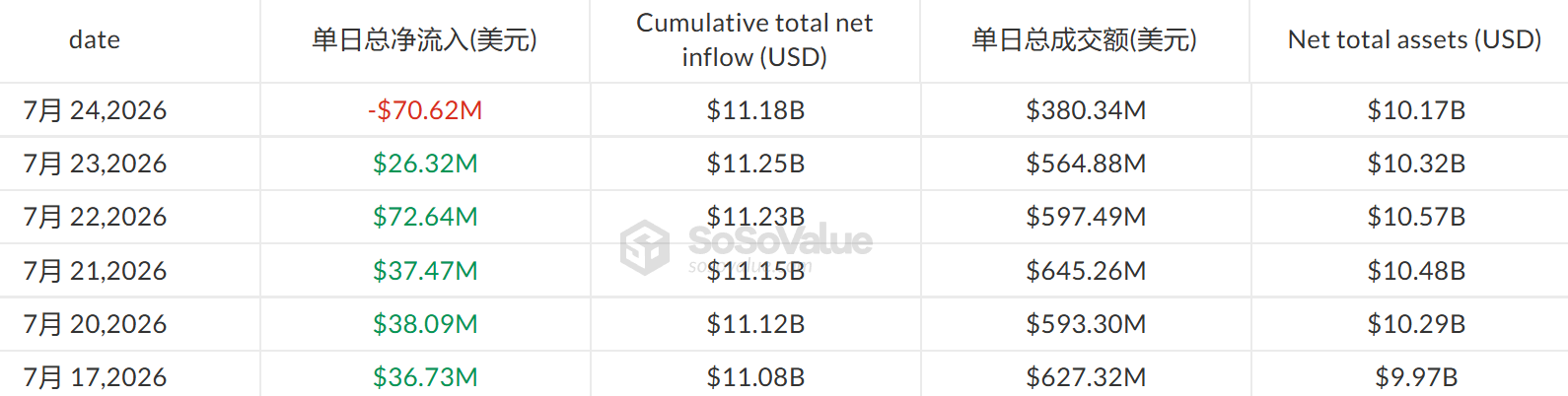
US-listed spot Ethereum exchange-traded funds (ETFs) logged $70.62 million in net outflows on Friday, ending a five-day inflow streak.
Ethereum funds saw $211.25 million in net inflows over the previous five sessions from July 17 to Thursday, according to SoSoValue data. They still posted $103.9 million in net inflows for the week ended Friday.
Despite the outflows, Ethereum ETFs extended their weekly inflow streak to three straight and have attracted $337.74 million in net inflows so far in July.
Spot crypto ETF flows have become one of the market’s most closely watched gauges of demand for Bitcoin (BTC) and Ether (ETH) through traditional investment products.
Although other jurisdictions, including Hong Kong, have launched similar funds, US-listed ETFs account for the vast majority of assets and trading volumes.
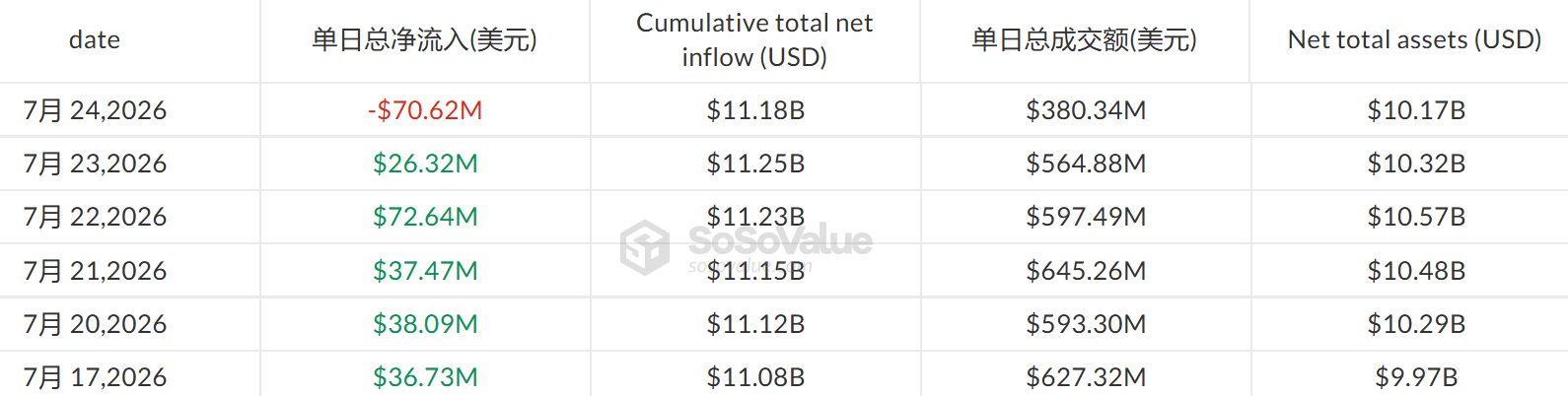
Daily spot Ethereum ETF net flows from July 17 to July 24. Source: SoSoValue
Bitcoin ETFs also end week with outflows
The reversal followed a similar pattern in Bitcoin ETFs, which ended a seven-day inflow streak on Thursday and recorded another $240.08 million in net outflows on Friday.
Bitcoin ETFs also extended their net inflow streak to three consecutive weeks, adding $103.90 million during the week ended Friday and $233.96 million so far in July. They followed a record June, when $4.5 billion flowed out of the funds.
BTC traded just under $64,000 at the time of writing, tumbling from the week’s high of $66,892 on Tuesday, according to CoinGecko. ETH traded at $1,837, down from Wednesday’s weekly high of $1,954.
Related: Bitcoin falls under $64K as surging US bond yields boost Fed rate-hike odds
Japan’s crypto reforms fuel $18.4 billion Bitcoin ETF forecast
Following Japan’s recent overhaul of its crypto regulations, which is widely viewed as laying the groundwork for future spot Bitcoin ETFs, crypto management platform XWIN estimated that a mature Japanese spot Bitcoin ETF market could reach about $18.4 billion, equal to roughly 0.13% of the country’s $14.6 trillion in household financial assets.
In an analysis posted at CryptoQuant, XWIN said the estimate assumes demand from existing crypto holders, new retail investors using brokerage accounts and institutional allocators.
The report pointed to the US market as an example, noting that spot Bitcoin ETFs excluding Grayscale’s GBTC have accumulated roughly 1 million Bitcoin, demonstrating how regulated ETF products can connect traditional finance with digital assets.
“The key is access,” XWIN said, adding that a Japanese spot Bitcoin ETF would allow investors to gain Bitcoin exposure through familiar brokerage and custody systems. It characterized the $18.4 billion figure as “an achievable upper-end market scenario.”
Magazine: A quantum roadmap would push Bitcoin much higher: Charles Edwards

The US and Iran both stopped their strikes, ending 13 consecutive nights of American bombing and leaving crypto traders holding the only liquid read on the pause.
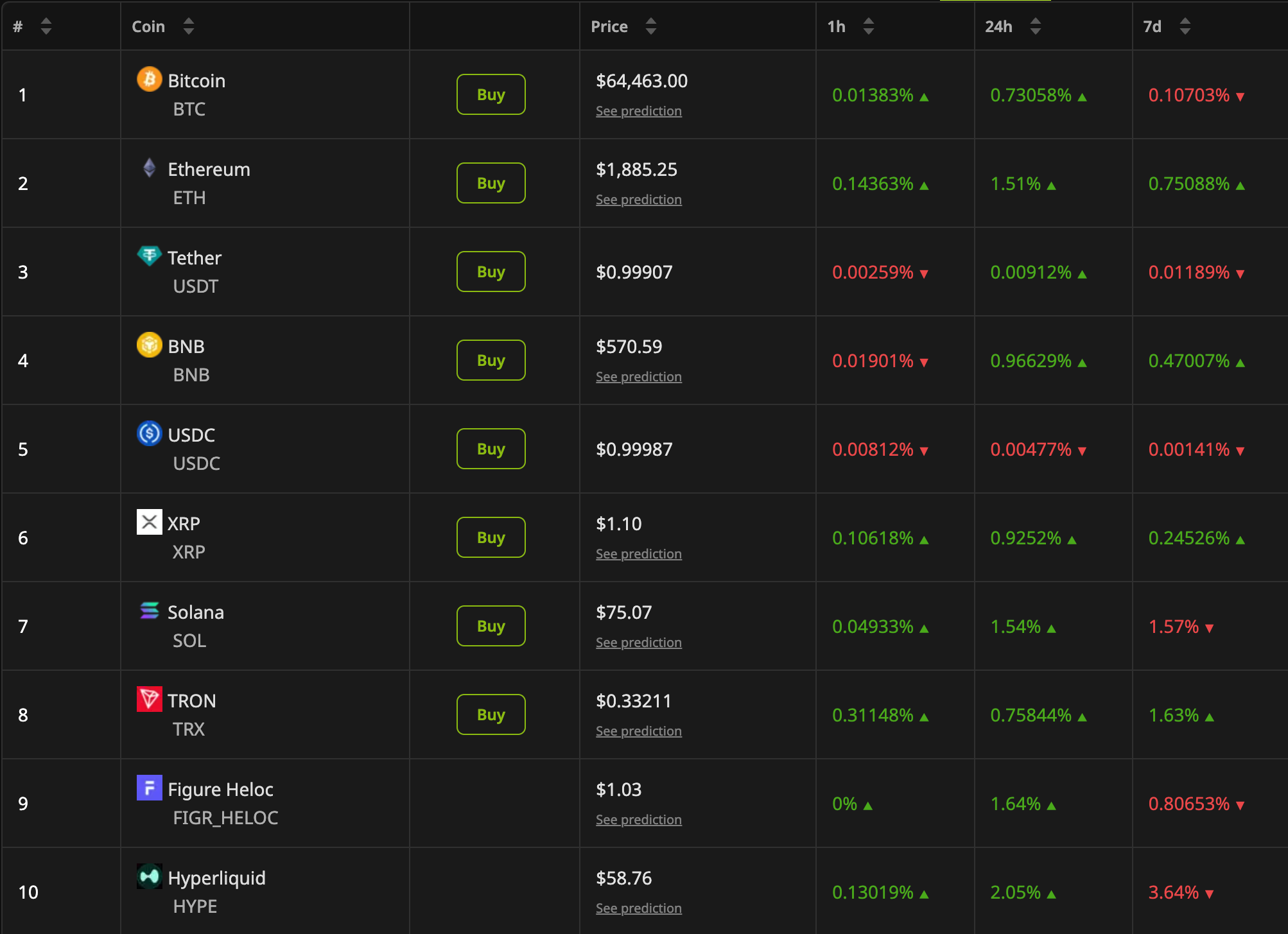
Bitcoin (BTC) traded near $64,463 on Sunday, up 0.7% over the past 24 hours, while the 10 largest digital assets posted modest gains. Oil and equity markets, however, closed before the strikes stopped.
US and Iran Pause Strikes
AP reported that the US paused its airstrikes on Friday after nearly two weeks of intensifying attacks. A US Department of Defense source told CNN that operations were on hold.
Iran has also stated that strikes on Gulf states and US interests in the region would be halted. Army spokesman, Amir Akraminia, confirmed it on Sunday.
“Our strategy has essentially been retaliatory, we have also halted our retaliatory operations,” Akraminia said.
The New York Times reported that Trump shelved plans for a broader campaign due to dwindling US air defense supplies. CNN noted that Gen. Dan Caine flagged concerns about munitions stockpiles.
Despite the de-escalation, it remains a pause rather than a formal ceasefire. US Central Command (CENTCOM) confirmed that its naval blockade of Iranian ports remains in place.
Follow us on X to get the latest news as it happens
Why Monday’s Asian Open Matters
Brent crude fell about 4% Friday to roughly $96.7. The benchmark had closed above $100 on Thursday for the first time since May.
Crypto, therefore, absorbed the weekend headlines alone. Total market capitalization reached $2.29 trillion on Sunday, up 0.84% over 24 hours.

Trading resumes on Monday, and the first prints will carry three days of news. Oil sets the direction for risk assets from there.
Higher crude lifts inflation expectations, which, in turn, shape the Federal Reserve’s policy and appetite for risk.
Analysts have warned against reading too much into a short lull. Michael Singh of the Washington Institute for Near East Policy told AP that duration is what matters.
“If it turns into a multiday pause, that’ll be something significant,” he said.
Houthi attacks in the Red Sea remain a second source of pressure on crude. The June ceasefire has not returned, and traffic through the strait remains halted. Monday’s crude open will show whether traders treat the pause as durable or as an operational gap.
Subscribe to our YouTube channel to watch leaders and journalists provide expert insights
The post US and Iran Pause Strikes as Markets Wait for Monday’s Verdict appeared first on BeInCrypto.


KB Kookmin Bank will launch a blockchain-based cross-border payment service for import and export companies in August 2026.
Summary
- KB Kookmin will initially launch Kinexys-based U.S. dollar payments across ten countries during August 2026.
- The service links blockchain settlement with SWIFT while supporting corporate transfers beyond normal banking hours.
- KB becomes South Korea’s first financial institution using Kinexys for corporate import and export payments.
The South Korean lender will use Kinexys by J.P. Morgan to support U.S. dollar payments across 10 countries.
The service will connect Kinexys with existing SWIFT payment rails. It will support near-real-time transfers and foreign exchange settlement throughout the day. Customers will access the service through KB Kookmin Bank’s domestic branches and its Singapore branch.
KB Kookmin becomes first Korean bank to use Kinexys
KB Kookmin Bank announced the service on July 26 after signing an agreement with J.P. Morgan on blockchain remittance services. According to Yonhap News Agency, it will become the first South Korean financial institution to use Kinexys for payment services aimed at import and export companies. The agreement focuses on faster cross-border remittances for businesses managing overseas trade, supplier payments and foreign exchange settlement needs.
The first phase will prioritise U.S. dollar transfers. The supported markets are South Korea, the U.S., Singapore, Saudi Arabia, India, Thailand, Qatar, the United Arab Emirates, Bahrain and South Africa. The bank has not published customer fees, transaction limits or an exact August launch date.
Kinexys adds blockchain settlement to existing bank rails
J.P. Morgan describes Kinexys as a bank-led blockchain platform for payments, asset tokenisation and near-real-time settlement. The network operates around the clock and lets approved institutions move funds without waiting for traditional banking cut-off times. It was previously known as Onyx.
The KB service will not replace SWIFT. Instead, it will link Kinexys with the existing messaging and correspondent banking system. This model allows banks to use blockchain for faster movement and settlement while retaining established compliance checks, account structures and foreign exchange processes.
J.P. Morgan has expanded Kinexys across several markets. In June, the bank added blockchain deposit accounts in Australian dollars, Hong Kong dollars, Japanese yen, Chinese yuan and Singapore dollars. It said the expansion created support for eight currencies and enabled 24/7 payments, programmable treasury operations and onchain foreign exchange.
Other banks have already used the platform for corporate payments. Qatar National Bank adopted Kinexys for U.S. dollar payments in 2025. The service allowed corporate transfers outside normal banking hours and reduced some settlement times to minutes.
KB expands its institutional blockchain activity
The payment launch follows several blockchain projects across KB Financial Group. In June, KB Kookmin Bank completed a $100 million digital bond sale through HSBC’s Orion platform. The two-year U.S. dollar bond settled in three business days, compared with five days under the earlier process.
KB Kookmin also participates in South Korea’s tokenised deposit work. The Ministry of Economy and Finance selected nine banks for a project linking tokenised deposits with government spending systems. The planned test will use programmable conditions and a shared record of public payments.
Meanwhile, KB Kookmin Card has been developing a payment system that links stablecoins with traditional credit. Crypto.news reported that the project uses Avalanche and OpenAsset infrastructure. The design aims to let users pay from stablecoin wallets while keeping standard card settlement for merchants.
Large banks move blockchain into live payment services
KB Financial Group ranked as South Korea’s largest lender by assets in S&P Global Market Intelligence’s 2026 Asia-Pacific bank review. The group placed 28th in the region with about $552.76 billion in assets. That scale gives the bank an established corporate network for introducing the new service.
The launch also adds to wider bank use of tokenised deposits and blockchain settlement. J.P. Morgan, Mastercard, Ripple and Ondo Finance tested a cross-border Treasury redemption in May. Kinexys handled the payment instructions and U.S. dollar settlement while the tokenised asset moved on the XRP Ledger.
J.P. Morgan has also used Kinexys with companies such as Axis Bank, Mitsubishi Corporation and EBANX. In July, EBANX said the platform reduced some internal cross-border transfers from more than 24 hours to minutes by removing local cut-off restrictions.
For KB Kookmin’s corporate clients, the main change will be access to longer operating hours and faster settlement across selected trade corridors. The bank has not said whether it will add more currencies or countries after the first phase. Its August rollout will show how the service works alongside existing SWIFT processes for commercial payments.


Europe’s crypto market has moved beyond the race to secure a Markets in Crypto-Assets licence.
Summary
- MiCA’s transition ended July 1, leaving unlicensed firms to exit, sell, or transfer European clients.
- U.K. crypto firms face FCA authorisation, prudential controls, governance rules, and client-asset safeguards from 2027.
- Banks already hold compliance systems and networks, making partnerships or acquisitions cheaper than greenfield builds.
The next test is whether authorised firms can afford the staff, capital and controls required to keep operating under the European Union’s full rulebook.
The cost pressure may push smaller crypto companies towards mergers, sales or bank partnerships. The same pattern could develop in the U.K., where the Financial Conduct Authority will open its authorisation gateway on September 30, 2026.
MiCA moves Europe from licensing to long-term compliance
The MiCA transition ended across the EU on July 1, 2026. The European Securities and Markets Authority said any company serving EU clients without authorisation must stop covered crypto services. Unlicensed firms must execute wind-down plans and help customers move assets to an authorised provider or self-hosted wallet.
A licence gives a crypto-asset service provider access to MiCA’s passporting system, but it also brings continuing duties. Firms must maintain governance, capital, market conduct, complaint handling, cybersecurity and anti-money laundering systems. These fixed costs weigh more heavily on smaller exchanges, brokers and custodians.
Notably, more than 3,000 crypto firms held registrations under earlier national systems, while only 194 had obtained MiCA approval by May. ESMA’s register later reached about 300 authorised providers after approvals around the July deadline.
U.K. rules could raise the cost of remaining independent
The U.K. has chosen to place crypto inside its existing financial-services framework rather than build a separate MiCA-style regime. The FCA said trading platforms, custodians, intermediaries, stablecoin issuers and firms arranging staking will need authorisation. Applications will run from September 30, 2026, to February 28, 2027, before the regime starts on October 25, 2027.
Steven Lightstone, a Morgan Lewis partner quoted by CoinDesk, said the FCA keeps “very high standards” where consumers are involved. He said a crypto company would be “treated like any normal traditional financial institution.” Banks already operate many required governance, reporting and financial-crime systems.
The FCA’s final crypto rules also extend client-asset protections to crypto custody. Its CASS 17 framework covers safeguarding duties for authorised custodians. Building key management, reconciliations, segregation and recovery procedures from scratch may cost more than joining a regulated group.
Banks and larger firms gain a route into crypto
Banks can use acquisitions to gain technology, licences and specialist teams without building every service internally. Crypto firms can gain capital, compliance staff, distribution and customer relationships. Partnerships may offer a middle route when neither side wants a full takeover.
Recent European activity shows both models. France’s CACEIS was nearing a deal for MiCA-licensed crypto platform Meria. Portugal’s Bison Bank became a MiCA-authorised provider after integrating its digital-asset subsidiary. Spain’sCecabank also launched regulated crypto custody for financial institutions.
A group of European banks selected Fireblocks to support a planned MiCA-compliant euro stablecoin, while Qivalis expanded its consortium to 37 financial institutions across 15 countries.
Simon Schneider, chief executive of Sygnum Europe, told CoinDesk that fewer than 20% of European banks offer crypto services. Bank executives expect regulatory certainty to move more client assets towards licensed institutions. Banks already have customer networks and compliance frameworks, creating room for partnerships in custody, brokerage, staking and tokenisation.
Scale may become Europe’s next competitive advantage
A BCG and FT Partners report found that fintech M&A value rose from $105 billion in 2023 to $251 billion in 2025. Scaled fintech companies completed 659 acquisitions in 2025, compared with 589 by banks and other established institutions. Digital assets and compliance ranked among the areas attracting buyers.
MiCA may add another reason to pursue deals. A buyer can spread compliance costs across a larger customer base, while an acquired company can avoid maintaining duplicate licences and systems. Regulators will still review ownership, governance, outsourcing and customer protection after any transaction.
Consolidation does not mean banks will replace all crypto-native companies. Specialist providers still supply technology and market knowledge that many banks lack. Self-custody will also remain outside regulated custodians’ business models. The likely change is fewer standalone providers and more groups combining banking distribution with crypto infrastructure.
The final shape will depend on authorisation decisions, operating costs and customer migration. MiCA has separated authorised providers from firms that must leave the EU market. The FCA’s 2027 regime may apply similar pressure in Britain. Smaller companies may need to raise capital, share infrastructure, sell or leave regulated markets. This could make scale more valuable than speed for firms seeking long-term regulated European access.
Unlike the previous major bear market in which numerous cryptocurrency exchanges reduced their staff number, the current cycle turned out to be more violent and requires a different sort of reaction.
The latest to close shop, with an announcement earlier today, was BitMart.
BitMart to Shut Down
The exchange saw the light of day during the 2017 big bull market and expanded its services to over 1,700 cryptocurrencies as of today. However, it followed the recent negative trend, stating that it has begun to “orderly” wind down its trading operations.
New registrations have already been halted, as well as deposits and opening new trading orders. A month later, the exchange will stop all trading services. The official shutdown will be at the end of January at 15:59 UTC, when the platform operations will cease. In contrast, withdrawals will remain available.
The company urged all users to close their trading positions, complete KYC if needed, and transfer out the available funds as soon as possible.
Important Notice
After a careful evaluation of the Company’s operating conditions, market environment, and future strategic direction, BitMart has made the difficult decision to commence an orderly wind-down of its trading platform operations. We deeply regret having to make… pic.twitter.com/KX3zczIrAh
— BitMart (@BitMartExchange) July 26, 2026
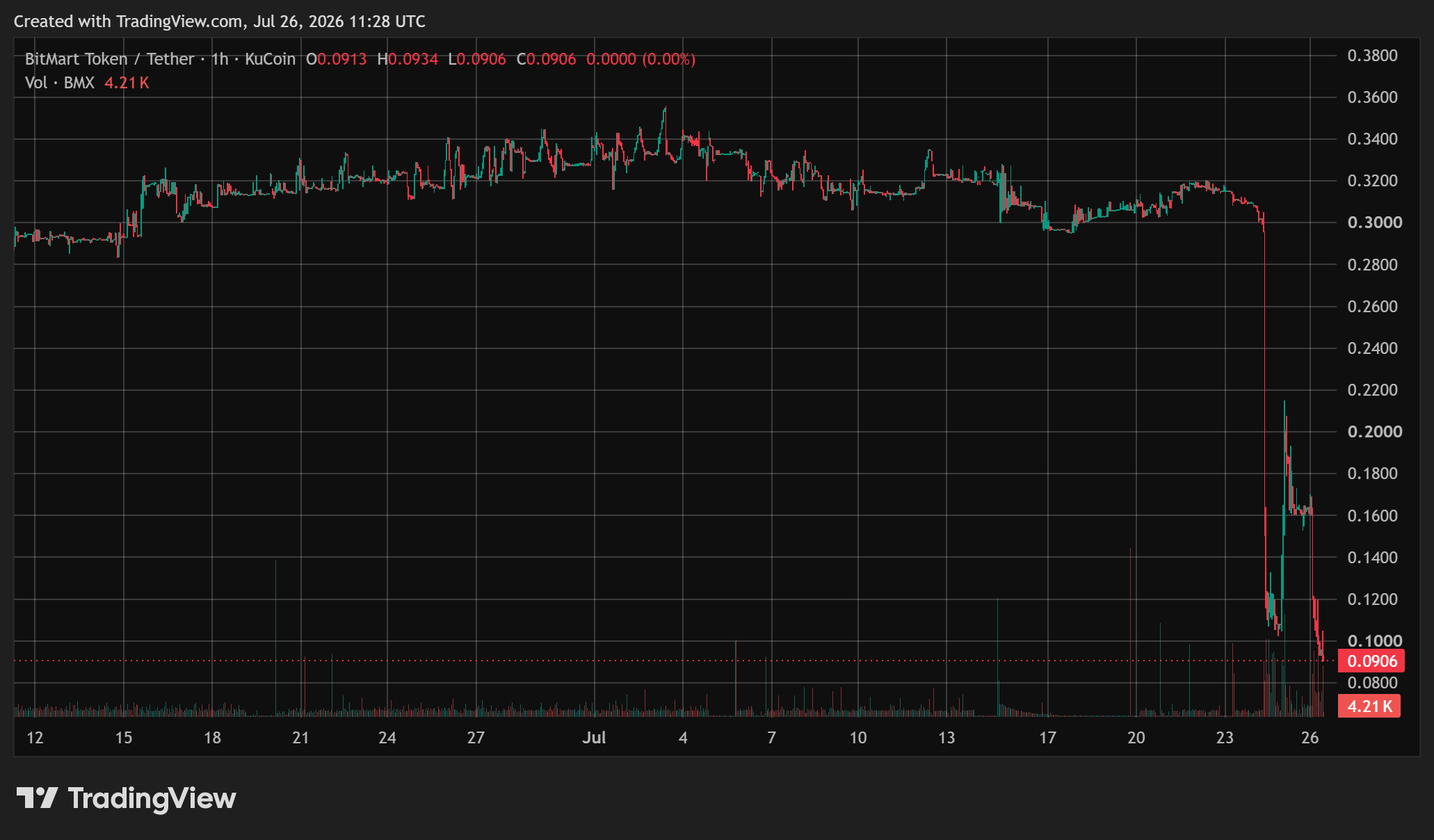
The exchange’s native token reacted with an immediate price drop, plunging by over 60% on a 24-hour scale. BMX traded at $0.32 before the news went live, and dumped to $0.09 as of press time. It also remains 90% away from its all-time high at $0.619 (CoinGecko data) recorded in early 2024.
BitMEX and Who Else?
Just a few days ago, the Arthur Hayes-co-founded cryptocurrency derivatives platform BitMEX said it will shut down on September 23. The creator of the 100x perpetual swap was active for nearly a decade, but it has fallen out of traders’ grace in the past couple of years.
The crypto shutdowns continued with popular DEX aggregator Odos. The project announced on July 24 that it will halt all of its services at the end of July.
One of its competitors, Dango, made a similar statement on the same day. The self-proclaimed ‘Endgame Exchange’ informed that the team has made the difficult decision to wind down its services, outlining “various reasons” without actually specifying them. It will stop trading on July 29, while the Dango L1 blockchain will halt on August 13.
The post Another Major Crypto Exchange Is Shutting Down After BitMEX appeared first on CryptoPotato.


Strategy says its current capital structure could withstand a prolonged Bitcoin decline while continuing to fund interest payments and preferred stock dividends.
Summary
- Strategy says its current structure can fund obligations through 5.8 years of steady Bitcoin declines.
- Company data shows a $3.225 billion cash reserve supporting preferred dividends and debt interest payments.
- The stress test uses Strategy’s internal BTC Rating rather than an independent credit agency assessment.
In a July 24 post on X, the company said Bitcoin could fall 11.4% each year for 5.8 consecutive years without pushing its company-defined BTC Rating below 1.0x.
The claim arrived as Bitcoin traded near $64,463 and Strategy shares closed at $91.67 on July 24. Bitcoin remained below Strategy’s average purchase price, while MSTR had fallen sharply from its previous peak. The exercise describes a steady multi-year decline, not a sudden crash or a guarantee that Strategy could meet every obligation under all market conditions.
What Strategy’s Bitcoin stress test measures
Strategy’s model uses a measure called BTC Floor ARR. The company defines it as the lowest constant annual Bitcoin return that would preserve 1.0x coverage of net debt and preferred stock over the weighted duration of its credit structure. The calculation includes interest and preferred dividend payments. Its current credit metrics dashboard places that floor at negative 11.4% over 5.8 years.
Strategy wrote: “At today’s capital structure, BTC could fall 11.4% annually for 5.8 years” while the company continued funding interest and preferred dividends. A 1.0x BTC Rating means the measured Bitcoin reserve still matches the claims included in Strategy’s formula. The company uses the calculation to describe balance-sheet coverage, not Bitcoin’s likely future price.
The calculation also differs from a traditional credit rating. Strategy developed the metric itself and publishes it for illustrative purposes. The company does not present it as proof that Bitcoin will decline at a steady rate or that its financing structure can withstand every type of market disruption.
Cash reserve and Bitcoin sales support the model
Strategy held 843,775 BTC as of July 19. It acquired the coins for about $63.69 billion at an average price of $75,476. The company also reported a $3.225 billion U.S. dollar reserve after raising $263.5 million through common-stock sales. As crypto.news reported, Strategy did not buy or sell Bitcoin during that week.
The reserve supports preferred dividends and interest on outstanding debt. Strategy’s current figures place annual interest and dividend obligations near $1.7 billion. The cash balance therefore provides less than two years of direct coverage before the company needs new financing, Bitcoin sales or other capital actions.
Strategy created a broader Digital Credit Capital Framework in June. The plan authorises up to $1.25 billion in Bitcoin sales to build or refill the cash reserve. It also permits selected Bitcoin sales to fund dividends, interest and approved security repurchases. Strategy raised the STRC preferred dividend rate to 12% and approved separate $1 billion buyback programmes for common and preferred securities.
Strategy sold 3,588 BTC for about $216 million between June 29 and July 5. It used the proceeds for preferred distributions and reserve replenishment. The sales reduced its holdings from 847,363 BTC to 843,775 BTC.
Strategy warns its BTC Rating is not a credit rating
Strategy’s metric definitions state that BTC Rating is an internal, illustrative measure. No independent credit rating agency issues it. It does not measure liquidity, solvency or reported financial performance. The company also says the calculation does not account for possible cross-defaults under its debt agreements.
The model uses the notional value of preferred stock, although some securities may carry liquidation preferences above that amount. Its dividend coverage measure also assumes Strategy can refinance existing debt on broadly similar terms without repaying principal. Those assumptions may not hold during a severe funding or market shock.
Strategy’s board must also approve preferred dividends. The company can adjust STRC’s variable rate each month, and it does not guarantee cash payments. Strategy may issue shares, sell Bitcoin, lower distributions where permitted or restructure obligations if its funding position weakens. A 1.0x result therefore does not remove refinancing, dilution, execution or market risks.
Bitcoin and MSTR remain under market pressure
Bitcoin traded around $64,463 on July 26, roughly 49% below its October 2025 peak near $126,000. MSTR closed at $91.67 on July 24. Investors continued to track Bitcoin’s price alongside Strategy’s cash requirements, preferred dividend costs and market value relative to its Bitcoin holdings.
The company’s financing model worked best when MSTR traded above the value of its Bitcoin reserve. That premium allowed Strategy to sell shares and increase Bitcoin per share. A lower market premium made new issuance less attractive and pushed the company to build cash rather than buy more Bitcoin.
The company has also shifted from a mainly accumulation-focused model towards active capital management. Its current framework includes share sales, cash reserves, possible Bitcoin sales and repurchase programmes. Crypto.news analysis noted that Strategy’s market premium, or mNAV, remains central because it determines whether common-stock issuance can increase Bitcoin per share.
The stress test presents Strategy’s view of how long its current assets could support its financing structure under a steady decline. It does not predict Bitcoin’s direction or cover every form of market stress. Future results will depend on Bitcoin prices, access to capital, dividend decisions, debt terms and the company’s use of authorised Bitcoin sales.
The Federal Reserve (Fed) and the Bank of Japan (BoJ) both hand down interest rate decisions next week, two days apart. Bitcoin (BTC) enters the pair of events near $64,000.
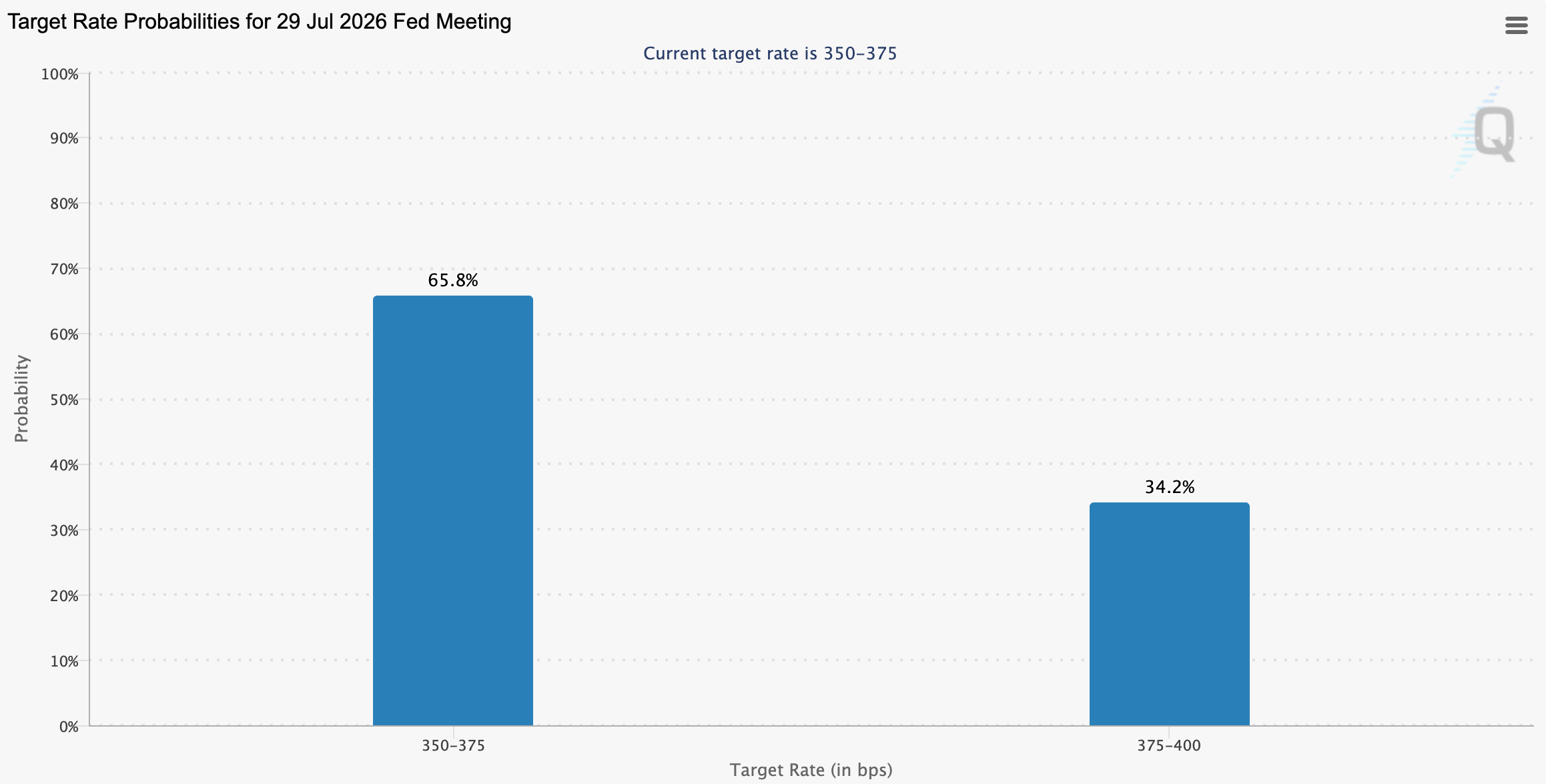
Markets expect a hold in both cases. Doubt is concentrated in Washington, where about a third of pricing still favors a hike.
Fed Hike Odds Climbed as Oil Rebounded
The Fed has held its target range at 3.5% to 3.75% since December 2025. A hold on Wednesday would be the fifth in a row.
Pricing still moved quickly this month. CME FedWatch put the odds of a July hike near 38% on July 23. That figure stood at 12% a week earlier.
Oil drove that move. Brent crude settled above $100 a barrel on July 23, its first close above that level since May.
Odds have since eased to 34.2%. A hold, therefore, remains the majority outcome in futures pricing.
Follow us on X to get the latest news as it happens

June inflation data had pointed the other way. Consumer prices fell 0.4% on the month, cutting the annual rate to 3.5% from 4.2%.
However, that relief may not last. Renewed hostilities and the oil surge could lift July inflation. That reading lands on August 12.
The July meeting includes no Summary of Economic Projections. That leaves the statement and the press conference as the only output from the meeting.
The Yen Is the Larger Variable for Bitcoin
Meanwhile, Nikkei reported that the Bank of Japan will hold its policy rate at 1% on July 31. Still, the currency is the pressure point. The yen slid past 163 per dollar last week, its weakest level in four decades.

Officials have grown vocal. Finance Minister Satsuki Katayama said the government was ready to step into the market if needed.
“Our stance has not changed at all. If there is a need for it, we will take decisive action appropriately at any time,” Katayama told reporters.
A hold on Friday sends no clear directional signal to Bitcoin. Rates stay put, and the cost of yen funding remains unchanged.
The rate risk, therefore, sits later in the calendar. Some 86% of 87 economists polled by Reuters expect a hike to 1.25% by the end of December.
Of those naming a month, 53% chose December and 35% picked October. Kazutaka Maeda of Meiji Yasuda Research Institute, who forecasts an October move, sees room for a faster sequence.
“The pace of rate hikes, which until now has been roughly once every six months, may accelerate somewhat due to the need to counter inflationary and yen-selling pressure,” he said.
This matters because of how Japanese policy affects crypto. The link runs through borrowing costs. Investors borrow yen cheaply and buy higher-yielding assets abroad, including crypto.
A stronger yen breaks that trade. The loan costs more to repay, margin calls follow, and traders sell whatever is liquid first.
Bitcoin sits at that end of the book. It also trades around the clock, so it absorbs the selling before equities open.
“Any hint of aggressive rate hikes or intervention from the BOJ could pump the yen, causing a massive carry trade unwind. Remember August 2024? The next unwind could be even more brutal,” Crypto Rover said.
That is why Friday matters more than the headline rate. The signal sits in the Outlook Report and in how hard Ueda pushes back on the currency.
Subscribe to our YouTube channel to watch leaders and journalists provide expert insights
The post Two Central Banks Decide Interest Rates Next Week: What It Means for Bitcoin appeared first on BeInCrypto.
Crypto World
The Biggest Pi Network (PI) Updates From the Past Month: Everything Pioneers Need to Know

Although it wasn’t the busiest and most eventful month in its history, the past 30 days have still shown some new developments, features, and updates around the broader Pi Network ecosystem.
As usual, though, it wasn’t without some controversy. Let’s dive in.
Late June, Early July
Pi2Day
The second most important day of the year for Pi Network and its vast community is June 28, known within their space as Pi2Day. It usually comes with significant hype about potential token listings or the announcement of new major updates and developments.
The 2026 edition didn’t bring a listing on a big exchange. Instead, the Core Team unveiled one of the most important updates to date for the Pi App Studio. They introduced PiVerify, Pi Sign-In, and SoloHost – tools designed to make it easier for developers to build applications and for users to access them using their Pi identities.
Pi App Studio Backend Upgrade
About a week after the conclusion of Pi2Day, the team expanded the capabilities of the Pi App Studio. The platform now supports persistent storage and improved backend infrastructure, allowing devs to create more sophisticated apps that can securely store user data and operate more reliably.
Although this was not the flashiest of upgrades, it still represents an important step toward making the broader Pi Network ecosystem capable of hosting more advanced, production-ready apps.
Mid- / Late- July
V25 Deadline
The team behind the project announced a new deadline for completing the next Mainnet migration requirements. Eligible validators were reminded to upgrade to the necessary new version by July 22, when the protocol update v25 was supposed to be introduced.
Although the deadline has now passed, there has been no official update from the team that the migration was successfully deployed. It’s worth noting, though, that their confirmations have been slacking in the past few months, and missing the deadline now doesn’t necessarily mean that the upgrade was not completed.
Pi Browser Refreshed Look
Later in July, the team rolled out a redesigned Pi Browser look with a cleaner interface and improved navigation. The changes make it easier for Pioneers to discover ecosystem applications while giving developers better visibility for their projects.
The team said the most significant improvements are for the overall user experience, but added that the redesign is still aimed at making the ecosystem more accessible as the number of available apps continues to grow.
SLICE Token
Just yesterday, the Core Team said they had completed the distribution of the new Testnet token called Slice to nearly 480,000 participants for Pi Launchpad testing. Pioneers can now explore token allocations, liquidity pools, pricing data, and other Launchpad features inside the Pi Browser.
The team emphasized that SLICE remains a Testnet token intended to help developers and the community prepare for future Mainnet token launches.
Controversy
Scam Activity Detected
The first portion of the controversy section will be dedicated to a reported suspicious activity from one Pioneer. According to data shared on X, a user noted that after waiting for a while to have their PI tokens unlocked, they were not available in the Pi Wallet.
Instead, they found countless failed transaction attempts, which highlighted the growing threat of phishing scams targeting wallet passphrases.
PI Token Dump
Despite all the updates and developments listed above, the project’s native token had its worst month to date. It broke below the $0.10 support level a few weeks ago and charted consecutive all-time lows, with the latest coming on July 14 at just over $0.07.
It managed to rebound in the following days and even challenged $0.10 last Sunday, only to be rejected once again. The subsequent retracement pushed it south hard, and the token is currently fighting to stay above $0.08. PI remains down by over 97% since its all-time high at $2.99, marked last February.
The post The Biggest Pi Network (PI) Updates From the Past Month: Everything Pioneers Need to Know appeared first on CryptoPotato.


South Korea’s largest lender will use JPMorgan’s blockchain platform to support US dollar cross-border payments for import and export businesses across 10 countries.

Bitcoin price is trading around $64,500 to $66,000, little changed over the past 24 hours, and Grayscale just made a prediction that’s splitting the trading community. The firm’s head of research argued the bear market may already be behind us, but the condition attached to that view matters more than the headline.
Grayscale’s Zach Pandl outlined two competing frameworks for Bitcoin’s next move. The first is the traditional four-year halving cycle, which historically allows for deep corrections after cycle peaks. Under that model, Bitcoin could still revisit the $50,000 area before forming a lasting bottom.
— Cointelegraph (@Cointelegraph) July 23, 2026
 INSIGHT: Grayscale's Head of Research Zach Pandl says Bitcoin's bottom may already be in if the Fed holds off on rate hikes.
He pushes back on the "four-year cycle" theory, which points to a lower bottom in September or October. pic.twitter.com/gJwaeOEmGH
However, Grayscale favors a different framework. It views the recent decline as a cyclical pullback within a longer-term uptrend. In that scenario, a durable floor has likely formed around $60,000 to $65,000. The key variable remains Federal Reserve policy, as a stable rate outlook supports the bullish case.
Meanwhile, spot Bitcoin ETFs continue attracting institutional interest, reinforcing the constructive outlook. Still, whether that demand survives the next round of macroeconomic data remains the biggest question. For now, Bitcoin is holding within the $64,500 to $66,000 range while traders wait for the next catalyst.
Discover: The Best Crypto to Diversify Your Portfolio
Bitcoin Price Prediction: Break $70,000 and Challenge Six Figures Again?
Bitcoin is trading around $64,500 to $66,000, pressing against resistance near $66,000. A confirmed daily close above that zone could open the path toward $68,500 to $70,000. If momentum strengthens, the $72,000 area becomes the next major hurdle. Meanwhile, support sits around $60,000 to $62,000, and bulls need to defend it.
The technical picture remains mixed but is slowly improving. Bitcoin continues consolidating beneath a descending trendline, while analysts are watching for a breakout above resistance. Grayscale adds a fundamental angle, noting recent buyers have largely returned to breakeven. That suggests the market has absorbed much of the recent selling pressure instead of delaying it.

The bull case calls for Bitcoin to break above $66,000 with strong volume. If that level flips into support, price could climb toward $68,500 to $70,000. Softer macroeconomic data would likely strengthen that move and improve market sentiment.
The base case is continued consolidation between $62,000 and $66,000 as traders wait for clearer Federal Reserve signals. ETF demand could keep providing gradual support. However, a decisive drop below $60,000 would revive the four-year cycle argument and put the $55,000 to $60,000 area back into focus. Historical volatility suggests that lengthy consolidation can still occur during established uptrends.
Trade Bitcoin on Bybit and Get a Chance to Win Our $1,000 USDT Airdrop
Bitcoin Hyper Targets Early Mover Upside as Bitcoin Tests Key Levels
Bitcoin consolidating near all-time-high territory is the kind of setup that makes large-cap BTC positions feel crowded, and the upside math at a multi-trillion-dollar market cap is structurally limited compared to earlier in the cycle. Traders looking for asymmetric exposure within the Bitcoin ecosystem are increasingly looking one layer down.
Bitcoin Hyper ($HYPER) is positioned at that intersection. It is a Bitcoin Layer 2 integrating the Solana Virtual Machine, making it the first BTC L2 to deliver SVM-based smart contract execution. The pitch is direct: Bitcoin’s security and trust model, with sub-second finality and low fees that the base chain structurally cannot offer.
The presale has raised $32.9 million at a current price of $0.0136836, with staking available for early participants. The project’s momentum through the presale phase has drawn attention as regulatory clarity around Bitcoin infrastructure projects comes into sharper focus.
For traders who want exposure to Bitcoin’s ecosystem growth rather than BTC price alone, it warrants a closer look.
The post Bitcoin Price Prediction: Grayscale Believes The Bear Market is Over appeared first on Cryptonews.
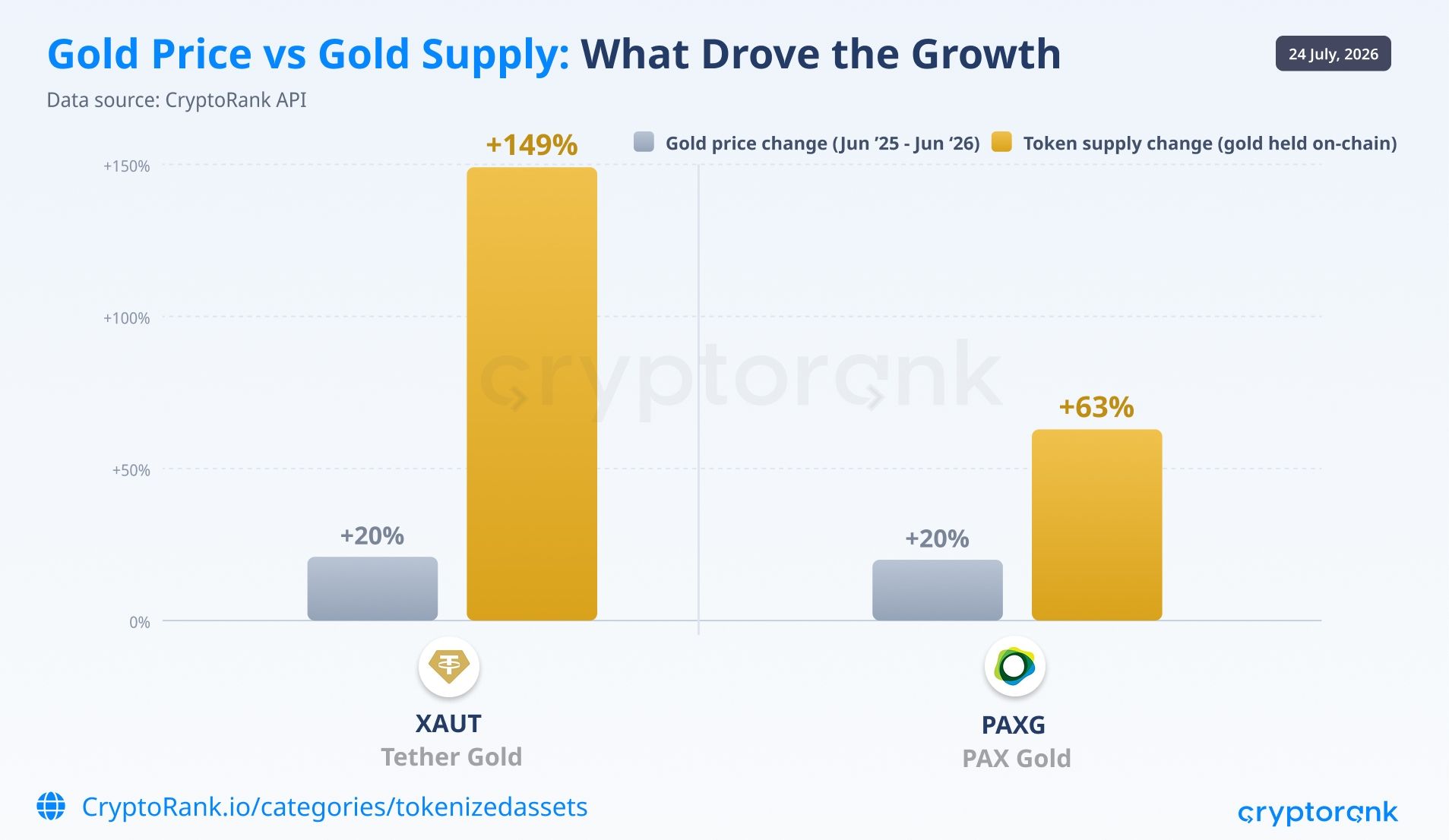
Tokenized assets grew 267% between June 2025 and June 2026, the only crypto sector to add market value, while the rest of the market declined.
The gain came from new issuance rather than rising prices. Gold tokens and equity tokens accounted for almost all of the expansion.
Gold Supply On Chain Doubled While Prices Rose Just 20%
In a recent report, CryptoRank noted that gold prices rose nearly 20% over the period. So, the price rise cannot explain the sector’s growth on its own.
However, the amount of gold held on chain roughly doubled, climbing from 524,000 ounces to more than 1 million. That gap matters.
“The growth came from issuance rather than price,” CryptoRank said.
Follow us on X to get the latest news as it happens

Notably, a year ago, precious metals accounted for nearly 100% of openly traded tokenized assets, according to CryptoRank. Tether Gold (XAUT) and PAX Gold (PAXG) held most of that market capitalization.
By June 2026, however, precious metals had fallen to 68% of the sector. The share dropped as more asset classes entered the market.
Note: BeInCrypto’s latest report, Real State of Tokenization in 2026, tracked nearly $60 billion in tokenized real-world assets across more than 7,000 products and 12 asset classes. It found that the market is growing fast, but actual on-chain activity remains far thinner than the headline numbers suggest.

Equity Tokens Arrived From Zero
Tokenized stocks and exchange-traded funds (ETFs) went from nothing to 23% of the sector in 12 months, as issuers put shares of major companies on-chain. Treasuries and private credit make up most of the remainder.
By token count, rStocks and Ondo issue close to two-thirds of all tokenized stocks. rStocks lists 568 tokens and Ondo more than 400, spanning single names such as NVIDIA and Apple alongside index products.
Exchanges entered the market later but moved quickly. Binance launched bStocks in June 2026, and Gate followed on July 3 with gStocks.
Meanwhile, meme coins, decentralized physical infrastructure networks (DePIN), and blockchain infrastructure posted the steepest declines of any sector over the same year.
CryptoRank also ranked tokenized assets as the most-listed category on centralized exchanges during the first half of 2026. That pipeline suggests issuance, rather than price, will again decide where the sector ends in 2026.
Subscribe to our YouTube channel to watch leaders and journalists provide expert insights
The post Crypto’s Only Growing Sector Runs on Gold and Equities appeared first on BeInCrypto.

Newcastle boss Eddie Howe unsure over Bruno Guimaraes future but shuts down Alexander Isak comparison

What Is The 4/6/8 Rule For Projectors?

‘We’re ready for anything’: Bordeaux braces itself for blazes as wildfires rage across France and Spain – with more than 300,000 evacuated


-

 Fashion2 days ago
Weekend Open Thread: Brooks Brothers
-

 Politics7 days ago
Democrats look to World Cup watch parties to register thousands of voters
-

 News Videos7 days ago
Big Money Is Entering XRP
-

 Tech5 days ago
Sail Virtually Aboard The “Itanic” With IA-64 Emulator
-
 Tech5 days ago
Turtle Beach Command Series KB7 review: a nifty screen-equipped gaming keyboard
-

 Crypto World5 days ago
Grayscale Files For Worldcoin ETF, WLD Registers Sharp Rise
-

 NewsBeat6 days ago
Unregistered fitter used Gas Safe logo on business flyers
-
 Business4 days ago
New Jersey voter registration controversy explained: How 6,600 noncitizens got on the rolls, and what happens next
-
 Entertainment5 days ago
Johnny Depp’s R-Rated Gothic Cult Classic Gets New Release Ahead of Sydney Sweeney Remake
-

 Crypto World4 days ago
Ethics, other provisions in crypto Clarity Act to be further discussed
-

 Tech6 days ago
Watch Flock Safety CEO Garrett Langley discuss the future of surveillance at TechCrunch Disrupt 2026
-
 NewsBeat5 days ago
Shanghai science forum photos show China’s AI and robotics advances in rivalry with US
-
 Crypto World6 days ago
Circle’s President Sold Over 360,000 Shares, The Filings Explain Why
-

 Tech6 days ago
Subway Sandwich Computers Get a Second Life as Gaming Machines
-

 Sports2 days ago
2026 3M Open leaderboard: Scottie Scheffler finds putter in Round 1, sits three back
-

 News Videos3 days ago
The Peugeot Family: How 200 Years of an “Old Money” Dynasty Died in A Boardroom
-

 Fashion2 days ago
16 Dresses for the High Summer Event
-

 Tech7 days ago
How To Use Claude’s Reflect Dashboard And Learn When It’s Time To Touch Grass
-

 Tech6 days ago
The 35 Best Board Games for Family Game Night
-

 Entertainment6 days ago
Stephen Colbert Returns to Social Media After Late Show End
You must be logged in to post a comment Login