

Politics
The House | Continuity has been just as important as change in Burnham’s first week



4 min read
It has been a good first week for Andy Burnham.
There is a clear sense of change. Keir Starmer is gone, along with nine of his most loyal Cabinet supporters. In their place is not a tight clique of Burnham acolytes but a relatively broad swathe of non-factional appointments, epitomized by the hiring of John Healey, who has been trusted on the front bench by every Labour leader stretching back to Tony Blair.
There has also been a raft of broadly popular policy changes. His first commitment – to end rough sleeping – was a statement of his values, as well as a reminder of progress he had made in Manchester. Rough sleeping fell by two-thirds during his first five years (although it has since risen). The £2 cap on bus fares does not apply in London, but in and around the rest of England’s cities, towns and villages it really matters. The cut in energy bills is small, but symbolically, it stands in contrast to the opening moves of Starmer’s government when the Winter Fuel Payment was cut.
There is inevitably a reckoning to come in the Autumn Budget, but whereas Starmer allowed himself to be defined by inescapable economic constraints (the Tory black hole, the Ukraine war, and Iran), Burnham’s first week is defined by his agency and his choices. That feels different.
No 10 North could be gimmicky if it was a different prime minister, but Burnham is committed to pushing investment and control beyond the M25.
Alongside these actions and symbols of change, there are less showy but equally important steps of continuity.
It is notable that some of the really big tough things, like Shabana Mahmood’s progress on immigration, Pat McFadden’s preparation for welfare reform, and Torsten Bell’s major rewrite of pensions policy, will continue with the same leaders in place and broadly in the same direction. The appointment of Miatta Fahnbulleh to Ed Miliband’s old brief, together with Polly Billington (a former Miliband adviser) and climate expert Katie White, suggests there will be no rolling back on climate change. The real tests will be what happens in the North Sea, where some compromise is expected, and whether taking money from the international climate-finance budget (to fund the bus fare cap) proves to be an exception or the beginning of a wider retreat.
At adviser level, there is considerably more continuity than there was between Tony Blair and Gordon Brown. When Tony left Downing Street in June 2007, his advisers gathered with him in the Pillared Room for a glass of champagne before lining the hall to applaud him as he departed. Only two of us from his team remained to applaud Gordon on his arrival and drink coffee while he soberly set out his plans.
This time, the default is that advisers stay rather than leave. The number of “holdovers”, as one adviser described them to me, is much higher. Among most of them, there is a sense that Labour still has unfinished business and has unexpectedly been granted a second and perhaps final chance to complete it.
This is not the easiest Parliamentary Labour Party to manage. There are unhappy casualties of the reshuffle. However, Burnham is an empathetic politician. He remembers people’s names and is more relaxed in the company of Labour MPs than most of his recent predecessors. He is personally well liked by many of them, but he is less familiar to those who entered Parliament after he left Westminster to become Mayor. The enormous 2024 intake, who he knows less well, will be the hard part, which partly explains his decision to appoint one of its members, Anneliese Midgley, as Chief Whip.
It is not yet a full week, but Burnham already looks at home in No 10 and, perhaps more importantly, as though he is enjoying the job. Blair’s honeymoon lasted three years, Brown’s three months, and Starmer’s never began; it is too early to tell how long Burnham’s honeymoon will last, but the public do appear willing to give him a hearing, which is in itself a huge reprieve for Labour.
The real test is how long the positive sense of agency from these first few days survives the tough decisions that are yet to come.
Theo Bertram is director of the Social Market Foundation


17 year old Fadi Hamdallah Al-Nassan has succumbed to his injuries, a week after being shot by the Israel occupation forces (IOF) with an expanding bullet to his thigh, in the West Bank village of Al-Mughayyir.
Israel martyr Fadi al-Nassan
Al-Nassan was martyred as a result of a two day raid on al-Mughayyir, which took place on 10 and 11 July 2026. The occupation’s military stormed the village early on the Friday morning. They shot three Palestinians, and beat others. The army also raided the home of Mohammed Hamed Abu Alia and his family. That particular attack came north east of Al-Mughayyir, with Israel forces beating and injuring those inside, and firing live shots at those trying to help. According to the Palestinian Red Crescent, ‘Israeli’ forces also detained their ambulance crews for around two hours, and confiscated their keys while they were attempting to treat the wounded.
On Saturday 11 July the raids continued, and so did the attacks on the Abu Alia family home, which Israeli settlers, under the protection of the IOF, had attacked. Fadi Al-Nassan was one of those who rushed to help the family. According to his father, Hamdallah al-Nassan, Fadi heard women and girls screaming, and had run towards the scene. But the IOF directed live fire at anyone who tried to defend the house and, as a result, Al- Nassan was injured.
Injury by an illegal expanding bullet
A local doctor, who wanted to remain anonymous, told the Canary:
Multiple injuries were recorded those two days. Fadi was injured with an expanding bullet in his thigh, his femoral artery was shattered. Two others were shot- one had an entry exit gunshot wound to the flank, and another a bullet in the leg. Raed Abu Aliya was hit with a stun grenade at his face. He requires surgery as his upper jaw bone was fractured. The house owner, his brother and two sons were also injured, beaten by the soldiers.
Fadi Al-Nassan suffered severe blood loss, and was evacuated to hospital. The first hospital he reached had no vascular surgeon, so he was transferred to the Palestine Medical Complex in Ramallah, where he remained in a critical condition on life support. According to doctors this delay gravely affected his case.
While in hospital, his condition deteriorated sharply, and there were signs of severe sepsis from the bullet wound. In a desperate attempt to treat the sepsis and save Al-Nassan’s life, doctors amputated his leg. But he passed away just 24 hours later, on 18 July.
Israel terrorises Palestinians in mourning
Before the funeral procession, the IOF set up a checkpoint at the village’s western entrance. This was an attempt at preventing people from attending, but was unsuccessful.
However, the harassment and attacks continued after the funeral, and into the night.
Marzouk Abu Naim is head of Al-Mughayyir Village Council. He tells us:
After the funeral procession of martyr Fadi Nassan, Israeli settlers clashed with local residents, West of the village. A resident, Jihad Jamil, was injured by pepper spray and was transferred to the medical centre in neighbouring Abu Falah. That night, after his funeral, Israeli occupation forces raided the village, entering with military vehicles. They fired tear gas and stun grenades at the condolence gathering, searched several homes, and carried out an arrest campaign that included three teenagers, and four adults.
Fadi Al-Nassan, was an 11th-grade student, and played football for Al-Mughayyir Club. He was also a member of the Palestinian national youth team.
Over 1000 Palestinian athletes murdered
A friend of Al-Nassan says:
Fadi loved everyone and was so passionate about football. His dream was to become a professional football player. But the brutal violence of the Israeli occupation made this dream impossible.

Fadi Al-Nassan was the cousin of Aws Hamdi Al-Nassan. Aws was killed in April when illegal settler Schmuel Wendy opened fire at Al Mughayyir boy’s school.

According to the Palestinian Football Association, Fadi’s passing brings the number of martyrs from the Palestinian sports movement to 1013, since 7 October 2023. 568 of these were footballers.
Al-Nassan has become the seventh martyr in Al Mughayyir since October 2023, with four of these being children. A total of 17 young men have been martyred in the village since 2006. Their deaths are a direct result of attacks by the IOF or settlers. According to Abu Naim, all are young, and include eight under the age of 18.
He says:
Al-Nassan was shot with an expanding bullet. This made treatment much more difficult, and ultimately led to his death.
Special treatment of terrorists must stop
Expanding ammunition is banned globally, since 1899, and its use in any armed conflict is classified as a war crime. The bullets cause horrific injuries, with massive exit wounds. They expand in the body, destroy internal tissue, shatter bone, and rip apart internal organs. These bullets also leave metal fragments in the body that can cause serious infection, and treatment is extremely difficult.
The use of expanding bullets by the Israeli occupation against Palestinians has been documented by doctors and human rights organisations for years. In 2018, a report by Euro-Med Human Rights Monitor claimed their use by the IOF was:
deliberately aimed at complicating casualties and inflicting further harm on protesters leading to long-term pain and health issues amounting to permanent disabilities.
Systematic impunity, shielding from politicians around the world, and internal military investigations all add to the absence of accountability,when it comes to “Israel’s” systematic human rights abuses. This terrorist state will continue inflicting suffering on Palestinians in the occupied territory unless action is taken against it now.
Featured image via the Canary
By Charlie Jaay
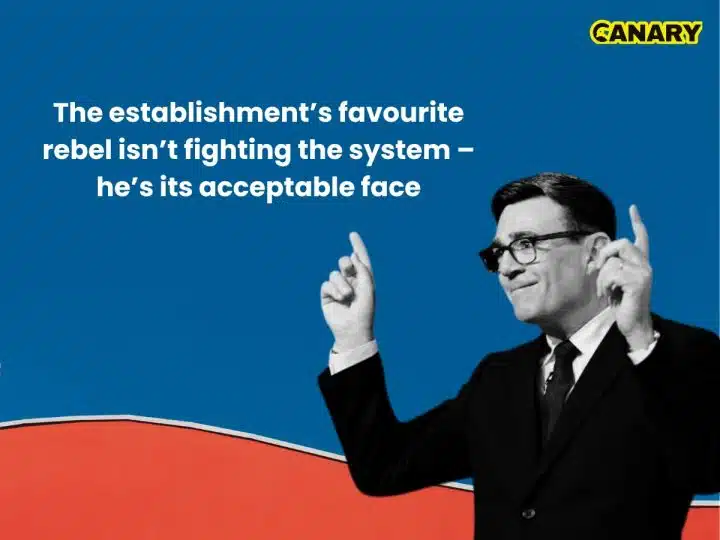
If you’ve ever watched a politician promise you a three-course meal only to hand you a single stale budget-brand biscuit, you will recognise that exact sinking feeling I get whenever Andy Burnham opens his mouth.
Andy Burnham: not sensible
For years now, he’s been held up as Labour’s great sensible left hope – the man who stood up for the north, who’d take on the Westminster machine, who might just drag the party back to its working-class roots without scaring off anyone who owns more than one house.
It’s a great story. It’s also about as believable as a government minister telling you that food banks are actually a nice treat for people who like trying new things.
And when you look at Burnham’s record, and the dead end the national Labour Party has walked into, two uncomfortable truths stare right back.
First, we should expect almost nothing from him, and the only shift that could save the party is one the establishment would rather eat a copy of The Manifesto for Public Ownership than actually allow.
Let’s start with the man himself. Burnham was a loyal sidekick to a regime that privatised everything that wasn’t nailed down, invaded a country on a hunch, and treated the super-rich like favourite nephews while telling the rest of us to tighten our belts.
As Mayor of Greater Manchester, he has delivered top-tier rhetoric. He raged against Tory neglect, called for proper devolution, and even once wore a high-vis jacket, which apparently counts as solidarity in some political circles.
But actions, as they say, speak louder than carefully rehearsed soundbites delivered in a train station.
Words. Words are all he has.
Burnham has spoken out against austerity — these are words. Yet Burnham has presided over vicious cuts to local libraries, youth clubs and care services — these are actions that he justifies as if it is the only ‘realistic option’, rather than doing what any self-respecting mayor would do and tell Westminster where to shove it’s worthless pity crumbs.
When bus workers went on strike for pay that doesn’t force them to choose between heating and eating, he spent more time warning about ‘disruption to commuters’ and urging ‘affordable, sustainable’ deals than standing with them – as if getting people to their underpaid jobs on time is the only thing that matters.
On social care, housing, the cost of living? Lots of “I feel your pain” faces, but zero policies that would make a single millionaire wince.
This isn’t a personal dig – I’m sure he’s very nice to his neighbours, doesn’t have a bonfire when next door have got their smalls drying on the washing line, and he probably remembers to take his recycling out. It’s just that Burnham’s leftism only ever stretches as far as the establishment will let it.
And that brings us to the bigger mess. The Labour Party itself.
For decades it’s drifted right, ditching redistribution, public ownership and solidarity to chase the votes of people who’ll never vote for them anyway, and the approval of CEOs who think a living wage is what they pay their gardener.
Drifters
Under Keir Starmer, that drift has become a panicked sprint down the wrong path. They’ve disowned pledges to nationalise energy, water and rail – apparently it’s a bit too radical to want our own utilities to work for us instead of shareholders in Bermuda.
They’ve backed away from taxing the rich, gone harder on refugees and benefits than some Tories, and spent more time purging socialists from the party than they’ve spent talking about how to fix the NHS.
They will tell you this is “electability”. But this is a myth built on fear and focus groups run by people who’ve never had to decide between filling the fridge or filling the car.
The last time Labour won big in 1997, they were helped along by a booming economy and a Tory government that had spent years tripping over its own feet. Since then, the world has shifted.
When Jeremy Corbyn stood on a left platform in 2017, Labour gained more votes than any opposition since 1945 – more than enough to win if the system wasn’t rigged against them.
Labour won’t win by being Tory-lite with slightly better manners and it certainly It won’t win by offering minor tweaks to a system that’s rigged against most of us.
The only way back is a proper, unapologetic lurch to the left. Bring key industries home, tax wealth not work, scrap the anti-union laws, build social housing faster than landlords can buy it up, and do the Green New Deal properly – the kind that creates jobs and cuts bills, not just gives tax breaks to big oil corporations.
But here’s the catch.
Spoiler alert: Burnham won’t save you
The establishment will never let that happen. The right-wing press would launch a smear campaign so ferocious even the Daily Mail’s headline writers would get cramps.
Big business would threaten to run away to Luxembourg — ignoring the fact most of them never actually do — they just like shouting about it, and Labour’s multi-millionaire donors who bankroll the party would take their chequebooks elsewhere faster than you can scream “corporate tax avoidance”.
We’ve seen it all before. Any leader who tries to put people before profit gets crushed, smeared and frozen out – and Burnham knows this better than anyone. He knows the rules of the game, and he’s chosen to play it safe rather than rewrite the rulebook.
That doesn’t mean we give up, of course. It means we have to stop waiting for politicians to save us. It means we build our own power – in unions, community groups, and even in grassroots football clubs like the Canary-sponsored Great Western FC, where they don’t have to worry about what the shareholders think before they pass the ball.
But right now, there’s no sign Labour is ready to change. No sign Burnham is ready to upset the people who will pay for his Number 10 soirée’s. And until there is, my expectations will stay firmly on the floor – right next to my winter fuel bill and the last time I could get a GP appointment without having to feel like a Squid Game contestant.
Hope is lovely, but I’m done falling for the same old tricks, and I’m most definitely done holding my breath for politicians who’d rather look good than do good.
Featured image via the Canary

Portugal’s Algarve region has earned a reputation as one of Europe’s most attractive travel destinations. With its golden beaches, dramatic cliffs, charming fishing villages, and year-round pleasant climate, the region attracts millions of visitors every year. While the coastline is famous for its stunning scenery, many of its most memorable experiences lie beyond the typical tourist routes. That is why transportation plays such an important role in shaping the overall travel experience.
Many visitors arriving in southern Portugal prefer to hire a car at Faro Airport as soon as they land. Having immediate access to a vehicle allows travelers to begin their holiday without delays, explore destinations at their own pace, and reach places that are often difficult to access by public transportation. Instead of planning each day around train or bus schedules, travelers can focus on enjoying the journey and discovering everything the Algarve has to offer.
Modern travel is no longer just about reaching a destination. It is about having the freedom to create a personalised experience, whether that means visiting hidden beaches, enjoying local restaurants away from busy tourist areas, or taking a scenic coastal drive whenever the weather is perfect.
Discover More Than the Main Tourist Attractions
Although Faro, Lagos, Albufeira, and Portimão are among the Algarve’s most popular destinations, the region offers far more than its well-known attractions. Small villages, peaceful vineyards, historic castles, and breathtaking viewpoints are scattered throughout the countryside, many of which are easier to reach with your own transportation.
A rental vehicle gives travelers complete flexibility to build an itinerary that matches their interests. One day might begin with breakfast overlooking the Atlantic Ocean, continue with a visit to traditional Portuguese markets, and end with dinner in a quiet village where authentic local cuisine takes center stage. These spontaneous experiences are often the moments travelers remember long after returning home.
Families also benefit from the convenience of having a vehicle throughout their stay. Traveling with children, luggage, or sports equipment becomes much simpler when transportation is available whenever it is needed. Likewise, couples can enjoy scenic drives along the coastline without worrying about transportation connections or limited public transport schedules.
Flexible Mobility Supports Business and Leisure Travel
The Algarve is not only a popular holiday destination but also an increasingly attractive location for conferences, remote working, and international business events. Professionals visiting the region often need reliable transportation to attend meetings in different locations while maintaining a flexible schedule.
Rather than depending on taxis or waiting for public transportation, having access to a vehicle allows business travelers to manage their time more efficiently. This flexibility becomes especially valuable when appointments change or unexpected opportunities arise during a visit.
Technology has also made vehicle rental significantly more convenient than it was only a few years ago. Online reservations, digital check-in, mobile applications, and simplified collection procedures allow travelers to arrange transportation before departure, reducing waiting times upon arrival.
At the same time, sustainability continues to influence the mobility industry. Many providers now include hybrid and fully electric vehicles within their fleets, giving environmentally conscious travelers more options while supporting cleaner transportation across Europe. As charging infrastructure continues to expand throughout Portugal, electric vehicles are becoming an increasingly practical choice for both local travel and longer road trips.
Planning Ahead Creates Better Travel Experiences
Successful journeys often begin with thoughtful planning. Choosing transportation before arriving at a destination helps reduce stress and provides greater confidence throughout the trip. Selecting a vehicle that matches travel plans, passenger numbers, and luggage requirements allows visitors to enjoy greater comfort while exploring unfamiliar places.
Understanding local driving regulations, parking rules, toll roads, and regional traffic patterns can also contribute to a smoother travel experience. Portugal’s road network is well maintained, making road travel an enjoyable way to discover coastal landscapes, historic towns, and natural parks throughout the Algarve.
Beyond convenience, flexible mobility encourages travelers to explore destinations that many visitors never experience. A quiet beach discovered by chance, a family-owned restaurant recommended by local residents, or a scenic viewpoint found during an afternoon drive can easily become the highlight of an entire holiday.
As travel continues to evolve, flexibility remains one of the qualities that modern travelers value most. Having the freedom to choose where to go, when to stop, and how to experience a destination creates opportunities that fixed transportation schedules simply cannot provide. Whether visiting Portugal for a relaxing vacation, an extended road trip, or a business journey, reliable mobility helps transform every trip into a richer and more rewarding experience.
Politics
Nine Lorry Loads Stolen Every Day in Britain and the Government Still Won’t Give Freight Crime Its Own Police Code

NaVCIS logged 3424 HGV cargo crime incidents in 2025, nine a day across a network that has no dedicated police crime code for any of it. A driver parks a loaded curtainsider at a layby off the A5 because there is nowhere else to stop, and by morning the load is gone. The loss gets recorded as theft from a vehicle, the same category that covers a smashed car window in a supermarket car park. Mike Dawber, a NaVCIS field intelligence officer, put the direct cost at £65.1 million for the year. He also said the real figure would more likely be about four times that, and some people say seven. Parliament’s own analysis of the wider damage, once you pull in insurance costs, vehicle repairs, delays cascading through supply chains, landed somewhere near £700 million. The Home Office has had those numbers for years and still classifies the whole thing as a statistical rounding error, which is the part I find hardest to explain to anyone outside the freight industry.
The RHA reported £111 million worth of goods stolen from lorries in 2024, up almost two thirds from £68 million in 2023. That jump did not come with a corresponding jump in enforcement resources or political attention. NaVCIS supported 48 police operations last year, and those operations produced 265 arrests, which, against 3424 reported incidents, is not a ratio that suggests the problem is under control. Dawber described freight crime as low risk and high reward, and the NaVCIS position is that probably three quarters if not more, of it is serious and organised crime rather than opportunist theft. The correlation NaVCIS draws is with a reduction in incidents like bank robberies. Armed robbery of a bank branch carries a serious custodial sentence, and the premises have cameras, time locks, and dye packs. A curtainsider in a layby at two in the morning has none of that, and the load inside it might be worth more than whatever sits in a rural branch’s cash drawer. Vehicle tracking data from haulage clients across northern England shows the same regional concentration that NaVCIS reports. The West Midlands, East Yorkshire and Humberside, the Southeast, the East Midlands. Three or four years of data on either side and the geography has barely moved.
Curtain slashing accounted for 26.9 percent of incidents last year, 915 cases, still the most common method because it requires nothing more than a blade and maybe ninety seconds of access to a parked trailer. Of the 3424 incidents, 1831 occurred at what NaVCIS calls independent parking locations, meaning industrial estates, laybys, and roadside pull ins that have no security infrastructure at all. Another 699 happened at motorway service stations. Those two categories together cover about 74 percent of all cargo thefts, and both are locations where drivers park because the alternative is a driving hours violation. The UK needs 11000 additional lorry parking spaces according to the RHA. The secured sites that do exist charge £30 to £50 a night, and a driver who pays that still might end up in a facility where half the perimeter lighting is broken, and the CCTV hasn’t been serviced in months. Nearly 40 percent of thefts occur in unsecured roadside parking or rest areas. Fleet managers I speak to regularly have started treating cargo loss as a line item, something they budget for annually the way they budget for tyre wear on poor surfaces. The difference, obviously, is that tyre wear does not involve organised criminal groups peeling back a curtain at three in the morning and driving off with £200000 worth of consumer electronics before anyone notices.
The crime code issue is the part that should probably generate more anger than it does among fleet operators. Police forces in England and Wales do not have a way to flag a crime as freight related when they record it. So a £200000 electronics theft from an HGV goes into the same generic bucket as shoplifting or someone nicking a bicycle from outside a train station. That data feeds into the models that determine police funding, decide how many officers go where, and shape what the force’s strategic priorities look like for the next budget cycle. Freight crime is not invisible because it is small. It is invisible because the recording system was never built to see it. West Midlands Police is running a trial to tag freight crime separately, and if it works, the idea is that other forces will adopt it. Nobody I have spoken to in the haulage sector expects that rollout to happen quickly.
SMEs make up 90 percent of the logistics sector. A single cargo theft can wipe out a small haulier’s margin for the quarter, sometimes longer. The insurance premiums that follow are often worse than the loss itself because they compound over years and they apply across the fleet, not just the vehicle that was hit. A haulage operator running maybe fifteen trucks out of a yard in the East Midlands told me his insurance went up by about 18 percent after two incidents in the same year, neither of which were his drivers’ fault. The loads were parked where they were parked because there was literally nowhere else to put them within legal driving distance. He considered installing additional tracking and alarm systems on every trailer, but the cost would have run to several thousand pounds per unit, and he was not confident it would bring the premium back down. The government’s response, to the extent that one exists, has been to talk about telematics and technology adoption. Real time tracking, geofenced alerts, door sensors, temperature monitoring on pharmaceutical loads. All of it is available right now, and the operators who can afford to spend on it are already running it. The gap is not a technology gap. It is a parking gap and a policing gap, and those are infrastructure problems that no amount of fleet software will fix on its own. The West Midlands tagging trial is still running. Nobody I have spoken to at NaVCIS or the RHA could tell me when results are expected, or what would need to happen for a second force to pick it up.

Buying matching sleepwear is a standard habit for many families when the winter holidays start. People just want comfortable and durable clothes for chilly mornings and dark evenings. When you decide to buy Christmas pyjamas, you usually look at the fabric quality, the size options, and how easy they are to wash. The market has plenty of choices right now. You can find breathable organic cotton, thick synthetic fleece, and stretchy jersey blends.
This list looks at how well these sets keep you warm, how they are made, and what materials they use. We will just look at the facts for each product without adding unnecessary opinions. This information should help you choose the right set based on what your house needs, any skin issues, and how warm your rooms are. We have grouped the sets to show the different practical options you can buy right now on the market.
Top 20 Cosy Family Pyjama Sets
1. Traditional Tartan Cotton Set
This tartan set fits all age groups. The maker uses 100% brushed cotton to keep you warm during cold winter nights. The top shirt has a button-down collar and a simple chest pocket for small items. The trousers come with an elasticated waistband and a fabric drawstring, which makes adjusting the size very straightforward. It washes well without losing its basic shape.
- Fabric: 100% Brushed Cotton
- Feature: Adjustable waist mechanism
- Climate: Moderate indoor heating
2. Navy Blue Fair Isle Fleece
This fleece set provides high thermal insulation for poorly heated spaces. It uses a thick microfleece made entirely from synthetic polyester fibres. Both the top and the trousers have tight ribbed cuffs at the wrists and ankles to stop cold air from getting in. The fabric does not shrink after you wash it several times. This makes it a very practical choice.
- Fabric: 100% Polyester Fleece
- Feature: Ribbed cuffs for heat retention
- Climate: Cold indoor environments
3. Organic Cotton Reindeer Print
This set uses certified organic cotton, which is good for people with sensitive skin. The fabric is totally unbleached and features a reindeer print made with safe, non-toxic dyes. The long-sleeved shirt has a basic crew neckline that does not rub against your neck. The bottoms use a flat elastic band at the waist to keep them secure. They are easy to wear all night.
- Fabric: 100% Organic Cotton
- Feature: Hypoallergenic unbleached materials
- Climate: Moderate indoor heating
4. Thermal Waffle Knit Solid Red
This waffle knit set uses a textured surface to trap warm air. It comes in a plain, solid red colour with no extra prints or patterns. The fabric is a mix of 60% cotton and 40% polyester. The trousers have a straight-leg cut and do not have tight ankle cuffs. This gives your legs a lot more room to move.
- Fabric: 60% Cotton, 40% Polyester
- Feature: Textured air-trapping weave
- Climate: Variable indoor temperatures
5. Green Pine Tree Jersey Set
Jersey fabric gives you natural stretch without using any synthetic elastane. This dark green set has a very simple white pine tree print on it. The top uses a raglan sleeve cut, which removes the shoulder seam and lets you move your arms more easily. The loose-fitting trousers have two deep side pockets for carrying things around the house. They are very useful for daily wear.
- Fabric: 100% Cotton Jersey
- Feature: Raglan sleeves for upper mobility
- Climate: Warm indoor environments
6. Microfleece Snowflake Pattern
This sleepwear set uses a dense microfleece to make you feel warm as soon as you put it on. The dark blue background looks clear against the white hexagonal snowflake design. The collar sits slightly higher on the neck to block cold draughts. The synthetic fabric dries very quickly after you wash it. This saves a lot of time for large households doing laundry.
- Fabric: 100% Microfleece Polyester
- Feature: Fast-drying synthetic fibres
- Climate: Cold indoor environments
7. Striped Elf Matching Set
This set consists of a solid green top and horizontally striped trousers. The material is a cotton-spandex blend, providing a 5% stretch factor for tight-fitting physical comfort. The ankle and wrist cuffs are extra long, allowing users to fold them back if the sleeves or trouser legs extend too far past the joints.
- Fabric: 95% Cotton, 5% Spandex
- Feature: Foldable extension cuffs
- Climate: Moderate indoor heating
8. Grey Marl Winter Bear Pyjamas
Grey marl fabric consists of different shades of yarn woven to create a textured visual effect. The shirt features a flat printed graphic of a winter bear. The fabric weight is classified as medium, making it a highly versatile option. The trousers have a tapered leg design, narrowing progressively down to the ankle.
- Fabric: 90% Cotton, 10% Viscose
- Feature: Tapered leg construction
- Climate: Moderate indoor heating
9. Bamboo Viscose Festive Green
Bamboo viscose is documented for its advanced temperature-regulating properties. This solid green set actively wicks sweat away from the skin, preventing overheating under heavy winter blankets. The top uses a standard V-neck cut, and the trousers drop straight down from the hips. This specific material is highly resistant to surface pilling after friction.
- Fabric: 95% Bamboo Viscose, 5% Elastane
- Feature: Moisture-wicking capabilities
- Climate: Warm indoor environments
10. Heavyweight Flannel Plaid
Heavyweight flannel provides the maximum level of traditional woven fabric thickness. The plaid pattern utilises intersecting lines of black, red, and white. The shirt functions as a fully openable jacket with a row of hard plastic buttons. The trousers include a concealed button fly and a highly durable woven fabric drawstring mechanism.
- Fabric: 100% Heavyweight Cotton Flannel
- Feature: Full button-front opening
- Climate: Cold indoor environments
11. Monogrammed Navy Silk Blend
This sleepwear set targets consumers looking for a low-friction sleeping experience. The dark navy fabric blends natural silk with synthetic satin for improved washing durability. Manufacturers offer a customisable external chest pocket. The trousers use a minimal-tension elastic band to prevent leaving compression marks on the waist during long periods of horizontal rest.
- Fabric: 60% Satin Polyester, 40% Silk
- Feature: Low-friction smooth surface
- Climate: Warm indoor environments
12. Nordic Pattern Matching Set
The Nordic pattern set features geometric snowflake shapes woven directly into the fabric. This specific jacquard knitting technique ensures the design will not fade over time. The material is a heavy cotton blend designed for maximum long-term durability. The cuffs and collar are finished with a solid colour block trim to reinforce the main seams.
- Fabric: 80% Cotton, 20% Polyester
- Feature: Woven jacquard pattern
- Climate: Cold indoor environments
13. Velour Santa Suit Pyjamas
Velour fabric provides a soft exterior pile with a smooth interior lining layer. This set mimics the visual dimensions of a Santa suit using deep red velour and white trim. The material composition incorporates polyester to effectively maintain the pile structure. The trousers feature a straight cut to correctly balance the heavy fabric weight.
- Fabric: 100% Polyester Velour
- Feature: Plush exterior texture
- Climate: Cold indoor environments
14. Red and White Candy Cane Stripes
This set uses a vertical stripe pattern designed to mimic traditional holiday sweets. The vertical colour lines are dye-sublimated into the fabric to strictly prevent colour bleeding. The top features a standard crew neck with reinforced double-stitched hems. The trousers use a simple pull-on design without drawstrings, significantly reducing total garment weight.
- Fabric: 100% Cotton Jersey
- Feature: Dye-sublimated vertical stripes
- Climate: Moderate indoor heating
15. Midnight Blue Starry Night Set
This starry night design features a dark blue base colour scattered with small stars. The fabric is treated with a non-toxic luminescent coating that allows the pattern to emit light in dark environments. Both garments feature wide hems to prevent the fabric edges from curling upwards. The set requires specific cold washing protocols.
- Fabric: 90% Cotton, 10% Synthetic Blend
- Feature: Luminescent print details
- Climate: Moderate indoor heating
16. Forest Animal Print Jersey
This two-piece set features detailed illustrations of winter forest animals on a light grey background. The fabric is highly breathable, consistently preventing overnight sweat accumulation. The top includes a wide neckline to prevent a feeling of physical restriction. The trousers have elasticated cuffs at the ankles to keep the lower legs securely in place.
- Fabric: 100% Cotton
- Feature: Water-based ink printing
- Climate: Moderate indoor heating
17. Gingerbread Man Cotton Blend
The gingerbread set offers a brown and white colour scheme with repeating graphical elements. The material blend includes synthetic polyester to mathematically increase the tear resistance of the fabric. The top uses a standard long-sleeve block pattern. The trousers feature an internal drawstring, allowing the user to secure the strings inside the waistband.
- Fabric: 50% Cotton, 50% Polyester
- Feature: High tear resistance
- Climate: Variable indoor temperatures
18. Classic White with Red Piping
This minimalist set uses a solid white base fabric outlined with bright red piping. The material is a tightly woven poplin cotton, which registers as crisp against the human skin. The shirt includes four functional buttons and a sharp lapel collar structure. The trousers possess a relaxed fit to compensate for the absolute lack of stretch.
- Fabric: 100% Poplin Cotton
- Feature: Crisp, non-stretch weave
- Climate: Warm indoor environments
19. Festive Dinosaur Print Sleepwear
Targeting specific graphical preferences, this set features green dinosaurs on a standard red background. The fabric is a ribbed cotton, which stretches horizontally without chemical synthetic additives. The external ribbed texture provides minor friction that prevents the garments from twisting. The top features a highly snug fit around the arms and shoulders.
- Fabric: 100% Ribbed Cotton
- Feature: Natural horizontal stretch
- Climate: Moderate indoor heating
20. Winter Cabin Checked Pyjamas
The winter cabin set features a standard large block-check pattern. The fabric undergoes a mechanical double-brushing process during primary manufacturing, softening both the inside and outside of the material. This directly increases the measurable insulation value. The trousers include a fabric-covered elastic band to explicitly prevent the rubber core from contacting the skin.
- Fabric: 100% Double-Brushed Cotton
- Feature: Maximum fabric softness
- Climate: Cold indoor environments
Conclusion
Choosing the right sleepwear for your family means thinking about a few plain, practical things. You need to know how warm your house gets, if anyone has sensitive skin, and how easy the clothes are to wash. The 20 sets in this list show a wide range of designs and materials that you can buy right now. Thick cotton flannels and heavy microfleece will definitely keep you warm if your house is very cold.
Buyers must consistently prioritise factual specifications over basic aesthetic appeal to ensure maximum physical utility and extended product longevity. Analysing the specific ratio of natural to synthetic fibres will clearly indicate the expected durability, stretch resistance, and strict washing requirements of each individual set. By focusing heavily on practical structural elements, such as elasticated ankle cuffs, adjustable waistbands, and functional button closures, families can effectively standardise their winter sleepwear inventory to meet exact functional needs.
Politics
Australia news live: Economic hits driving voters towards One Nation, Labor boss says | Anthony Albanese

Good morning and happy Sunday,
It’s Caitlin Cassidy here to guide you through today’s news.
The prime minister has been accused by the Coalition of wanting to “shut down debate” at Labor’s national conference on issues like Aukus and Israel and Palestine at Labor’s national conference because he wanted to avoid exposing the “deep divisions” with the party. It comes as Ed Husic’s push for Labor to recognise claims of a genocide against Israel failed, prompting the backbencher to criticise the party’s culture under Anthony Albanese.
South Australia has two more suspected cases of deadly H5 bird flu, marking a possible escalation in the disease’s presence in the state. Some 17 cases of H5N1 have now been confirmed nationally, with only one so far in a local bird.
And the energy minister, Chris Bowen, has assured Australians that fuel supply remains “solid and secure” as the drawn out Middle East conflict pushes global crude back above $US100 a barrel.
If you’d like to get in touch, I’m on caitlin.cassidy@theguardian.com.
Let’s get into it!
One Nation’s rise in new heartland a warning to majors
The rise of One Nation has seen heightened activity among local representatives of all political persuasions fighting for the limelight in the populist party’s new regional heartland, AAP reports.
David Farley’s historic win for One Nation at the Farrer by-election in early-May sent shock waves through federal politics, especially the major parties. Observers now see One Nation’s management of the electorate – and the way the major parties respond – as a model on how the next federal election could be fought, amid a surge of support for the Pauline Hanson-led populists in national polls.
Farley’s presence in Farrer’s major centres of Albury and Griffith, and his visits to the regional communities of the once safe Liberal electorate, have been noticed by politicians at a local level, according to Albury City mayor Kevin Mack. He says the increased scrutiny on the region has lit a fire under some local councillors:
I’m seeing politicians going to the opening of envelopes. They seem to be going to things I’m not going to, which I didn’t know existed. They seem to be creating their own opportunities.
The shift in approach from established politicians from major parties was a natural result when threatened by a rise from smaller ones, according to Australian National University political scientist Jill Sheppard.
The great virtue of Australian politics is that we have stability, but the price of stability is the parties tend to get a bit lazy. For a normal voter who is just hoping life can feel a little bit better, that’s not always very satisfying. … I suspect that there will be some kind of ripple effect from Albury.

Dan Jervis-Bardy
Coalition says PM wanted to ‘shut down debate’ at LNP national conference
The Coalition says Anthony Albanese was desperate to shut down debate on contentious issues such as Aukus and Israel and Palestine at Labor’s national conference because he wanted to avoid exposing the “deep divisions” with the party.
The party’s three-day conference ended on Saturday without any major fights after Ed Husic’s push to adopt a harder line on Israel collapsed amid resistance from factional powerbrokers.
A proposed amendment from the party’s anti-war movement to abandon the Aukus pact also failed to reach the conference floor.
The shadow defence minister, James Paterson, said it was “telling” that neither issue was debated at Labor’s peak policy-making forum.
He said:
I think it is very telling that rather than have the debate and win the debate, the prime minister and his government would prefer to shut down the debate. I think that shows what he knows. He knows that deep down there is deep divisions within the Labor Party on core national security interest issues, on core foreign policy issues, and on core defence policy issues.
The prime minister is worried that he would be embarrassed on the floor of the conference if Aukus was allowed to be debated, or if Israel-Palestine was allowed to be debated, or indeed the US alliance was allowed to be debated. I think he shut that down because he was afraid about where it would go.
Senior Labor sources denied actively attempting to block Husic’s resolution, arguing the former minister simply didn’t have any support. The Maritime Union of Australia initially agreed to second Husic’s motion before withdrawing support on Saturday morning, causing it to lapse.
Some delegates who were sympathetic to Husic were reluctant to back the resolution because they didn’t want to potentially overshadow a display of unity arranged for the debate, when MPs Josh Burns, who is Jewish, and Basem Abdo, the son of Palestinian refugees, united in support of the government’s official position.
Labor’s pro-Palestine wing did secure a win on Saturday with the party committing to strong controls and transparency around weapons export permits.

Adeshola Ore
Chris Bowen says Australia’s fuel supply ‘solid and secure’
The federal energy minister, Chris Bowen, has sought to assure Australians that fuel supply remains “solid and secure” as the drawn out Middle East conflict pushes global crude back above $US100 a barrel.
Speaking to reporters on Saturday, Bowen said there was uncertainty about the situation in the Middle East:
But one thing Australians can be certain about is that our fuel supply continues to be solid and secure.
Bowen said as of Saturday, Australia had 42 days’ worth of petrol, 38 days’ worth of diesel and 32 days’ worth of jet fuel. There are 51 ships on route to Australia, with 3.1bn litres of fuel due to arrive in the next four weeks, he said. He said Australia’s fuel stock was 15% more than when the US and Israel first bombed Iran in February.
Australia’s scaled-back extension of the fuel excise reduction is due to end on 2 August. Economists have warned that the end of the excise and higher global prices mean Australians face the prospect of petrol prices above $2 a litre over the coming weeks.

Lisa Cox
Two more local birds with suspected deadly bird flu in South Australia
South Australia has two more suspected cases of deadly H5 bird flu in local terns, marking a possible escalation in the disease’s presence in the state.
On Saturday, the South Australian government said samples would be sent to CSIRO to verify whether the birds had the deadly H5N1 strain. Results are expected in the coming days.
The two birds are greater crested terns, which members of the public found and reported. One was found dead near the Surf Life Saving Club at Semaphore in Adelaide and the other was found unwell at Robe and has since died.
To date 17 cases of H5N1 have been confirmed nationally, with only one so far in a local bird – also a greater crested tern found at Robe Marina earlier this month.
Federal agriculture minister Julie Collins said terns were known to mix with petrels and other migratory subantarctic species that had been found with bird flu.
Collins said there was still no evidence of widespread local transmission of the disease:
We have no evidence of any transmission in Australia in terms of the H5 bird flu at this point in time. We have no mass mortalities being recorded. We have no bird flu in our culture or agriculture systems, and the risk to human health remains low.

Tom McIlroy
Economic hits driving voters to One Nation: Labor boss
Labor’s national secretary, Paul Erickson, says repeated economic hits are pushing voters to consider right wing parties like Pauline Hanson’s One Nation, warning major parties need to address these anxieties.
Erickson is the campaign strategist behind Labor’s wins in 2022 and 2025 and is preparing to fight a reelection campaign for Anthony Albanese in about 18 months time. He told Sky:
When we think about the last decade, one thing that has stood out is that every time workers and businesses felt like through the crisis, the latest crisis, and every time they’re picking themselves up off the floor, another big event comes along, another crisis.
Whether it is war in Europe, war in the Middle East, a global inflation surge, all the way back to the pandemic, and that constant sense of every time you’re picking yourself up off the floor, another knock comes along, I think has led to a sense for people in the community of pessimism that, as progressives and as a centre-left party, we need to tackle and take on.
But I think is at the core of this rise of the populist right all over the world.
Good morning and happy Sunday,
It’s Caitlin Cassidy here to guide you through today’s news.
The prime minister has been accused by the Coalition of wanting to “shut down debate” at Labor’s national conference on issues like Aukus and Israel and Palestine at Labor’s national conference because he wanted to avoid exposing the “deep divisions” with the party. It comes as Ed Husic’s push for Labor to recognise claims of a genocide against Israel failed, prompting the backbencher to criticise the party’s culture under Anthony Albanese.
South Australia has two more suspected cases of deadly H5 bird flu, marking a possible escalation in the disease’s presence in the state. Some 17 cases of H5N1 have now been confirmed nationally, with only one so far in a local bird.
And the energy minister, Chris Bowen, has assured Australians that fuel supply remains “solid and secure” as the drawn out Middle East conflict pushes global crude back above $US100 a barrel.
If you’d like to get in touch, I’m on caitlin.cassidy@theguardian.com.
Let’s get into it!

MCALLEN, Texas — Just miles from the U.S.-Mexico border, Ken Paxton is trying to inherit President Donald Trump’s historic gains with Hispanic voters.
The Texas GOP Senate nominee, speaking to hundreds of supporters last week at his first campaign rally in this region that’s almost entirely Latino, revealed how Republicans believe that’s possible: by touting Trump’s closure of the border and hitting Democrats over the head with the culture war — while ignoring the drag his mass deportations have had on the region.
The GOP faithful, clad in signature MAGA red and a few scattered Trump 2028 hats, gathered at a beer hall outdoors in 100-degree heat to greet the Republican Senate nominee and other candidates. Attendees ate up the Republicans’ constant jabs at Democratic Senate nominee James Talarico. Eric Flores, the challenger to Democratic Rep. Vicente Gonzalez, called Talarico a “gay vegan” and “low T.” Paxton belittled Talarico, a seminarian student and critic of Christian nationalism, for referring to himself as a “Christian who hates Christianity.”
It’s an approach key to Paxton’s strategy, as Republican Senate nominee, to slice into Talarico’s widening polling lead with Hispanic voters, who could prove decisive for who wins the competitive Senate seat and a litany of other races that will determine which party takes power in Washington come November.
“Once this community knows what [Talarico’s] views are on transitioning boys into girls, and girls into boys, and boys and girls sports, they’re not going to support it,” Paxton told reporters after the rally, in response to a question of how he intends to keep Hispanic voters in the fold after they swung toward Trump in 2024.

This has worked before for the Texas GOP. Sen. Ted Cruz blitzed the airways in the 2024 Senate race with attack ads against former Rep. Colin Allred about transgender youth participation in sports. Republicans branded Wendy Davis “abortion Barbie” following her successful protest against an anti-abortion law in the state legislature.
But outside the carefully choreographed event is a community getting pummelled by the president’s increasingly unpopular immigration agenda — a reality that’s given Democrats a strong opening with Latinos as they attempt to end a decades-long losing streak in statewide races. Interviews with local lawmakers, business leaders and voters on both sides of the aisle reveal that Democratic candidates like Talarico and gubernatorial nominee Gina Hinojosa have so far been successful at appealing to Hispanic voters feeling the economic strain under Trump.
Talarico, who appeared in McAllen for an event 16 hours after Paxton’s, kept his pitch focused on the cost of living, handing out hot plates of food and calling for a reversal in health care cuts under the GOP budget bill enacted last year.
“He’s pretty steady and focused on the issues that matter to families,” said Democratic state Sen. Juan Hinojosa, whose district spans Corpus Christi to McAllen.
“Democrats get sidetracked on all these cultural issues, and they need to stay focused on what I call the bread butter issues, issues that impact families directly, the kitchen table issues,” he said. “Democrats need to stay away from biting the hook that’s being put out by Paxton.”
A community being squeezed

The Rio Grande Valley is buckling under the weight of Trump’s policies, and the economic strain is visible in McAllen.
Deportations have dried up workforces in critical industries like construction that drive the local economy, leaving cement slabs half-poured. A traffic chokehold at the border has slowed business in retail and restaurants as Mexicans have been deterred from hopping over to the U.S. for the day.
The entire border is being squeezed. Laredo, located more than 150 miles from McAllen, is one of the nation’s top trade hubs, and its leaders are warning that Trump’s tariffs and his threat to eliminate the USMCA trade agreement stands to devastate international commerce that flows through the city.
“When the U.S. doesn’t provide economic opportunity for the people at the border, it will create this situation,” said Laredo Mayor Victor D. Treviño, a Democrat, in an interview.
The Paxton campaign dismissed concerns of Democrats’ gains with Latinos, especially in the Rio Grande Valley — and once again emphasized the culture war, which Republicans say resonates with socially conservative Latinos.
“Look, Hispanic families aren’t voting for a woke vegan who says God is nonbinary and wants to Latinx our children,” said Alex Alarcon, director of Hispanic outreach for the Paxton campaign, in a statement. “We’re proud of our culture and our faith, and Ken Paxton has spent his career fighting for us: a secure border to protect our families, a cost of living we can actually afford, and the freedom to live by our values.”
Still, the tide seems to be turning toward Democrats.

A dozen residents along the border said in interviews that they are satisfied illegal border crossings have dropped to record lows, a realization of one of Trump’s top campaign promises and one of the reasons he won over Hispanic voters in the region. But they also believe the crackdown has gone too far. More than 60 percent of Hispanics said Trump’s mass deportations campaign — including his widespread deployment of ICE agents across the U.S. — has been too aggressive, according to a July POLITICO Poll.
In McAllen last week, the community was still aghast over a nun who was recently arrested by ICE while walking to church. She was later released after GOP Rep. Monica De La Cruz and Democrat Rep. Henry Cuellar intervened, but interviews with residents revealed they still live in fear: Even U.S. citizens are checking their pockets for ID before venturing out, and they try to steer clear of the border if possible.
Across Texas, one in five Hispanic business owners said they’ve had an employee deported in the past year and 70 percent have been impacted by Trump’s tariffs, according to a June survey commissioned by the U.S. Hispanic Business Council and shared first with POLITICO. Talarico holds a seven-point lead over Paxton among those surveyed — even though a plurality of them self-identified as Republican.
A national Republican close to the race, granted anonymity to speak freely, countered that Paxton stands to benefit from some of the most competitive House races taking place in South Texas — where Republican Tano Tijerina and Flores are trying to oust Reps. Henry Cuellar and Gonzalez, respectively, and Rep. Monica De La Cruz is fending off a challenge from Tejano music star Bobby Pulido. GOP campaigns have stood up multiple field centers in those districts drawn to favor Republicans under a new Congressional map, a ground game that is expected to boost Paxton at the top of the ticket, the person said.
They added that internal message testing shows some of the attacks on Talarico, specifically those regarding his past comments on gender, “is unlike anything we’ve ever seen with Hispanic men, just in terms of the amount that it moves them.”
Daniel Garza, president of the LIBRE Initiative, a grassroots conservative group based in South Texas, said Trump’s closure of the border has affirmed Hispanic’s support for him, and Democrats aren’t offering viable pro-growth economic plans.
“Democrats have failed to give Latino voters something to vote for, and that they’ve only focused solely on something you know for us to vote against. And that’s not good enough,” he said. “[Latinos] want less tax burden, less regulatory burden, more energy production.”
Talarico’s pitch to Hispanics

Talarico was also in McAllen, just one day after Paxon’s rally, to host a fundraising benefit — the final stop on a 750-mile bus tour hitting small towns along the border to deliver a message about lowering costs and creating jobs. In an attempt to cast himself as a tough-on-immigration Democrat, Talarico unveiled a border security plan that includes hiring more Border Patrol agents, a major employer in South Texas, and adding immigration judges to reduce the asylum backlog.
It’s part of his attempt to widen his current edge over Paxton with Hispanics, with a New York Times poll in June showing Talarico is winning the demographic by a 61 percent to 29 percent margin — a significant shift after Trump won 55 percent of Hispanic voters in Texas in 2024.
“You could drive a truck through the margin of error on the Times’ subsample,” Alarcon, Paxton’s Hispanic outreach director, said. “The fact is nobody is winning Hispanic voters by default this cycle. We’ll be in Spanish-language media from the Valley to Dallas, talking about groceries, gas, health care and a secure border.”
Still, Talarico’s lead has given Democratic party leaders hope amid their national tug-of-war with Republicans over Hispanic voters: If Talarico can hold onto Texas’ large Latino population by these margins through November, that would prove gradual gains over the past decade for Republicans were a temporary blip ahead of the 2028 presidential race.

Under the midday sweltering sun in McAllen, Talarico handed out hot plates of food to a line of people who had donated to a local woman struggling to pay for cancer treatment. The Democratic Senate nominee, while speaking to reporters later, dismissed Paxton’s attempts to appeal to Hispanic voters by making personal attacks against him.
Republicans are attempting to divide people, Talarico said, “so we don’t notice that they’re picking our pockets, that they’re closing our public schools, that they’re gutting our health care, that they’re raising taxes on working people while they cut taxes for billionaires. It’s the oldest strategy in the world.”
Talarico’s campaign is leaning hard into its outreach to the Hispanic community, including efforts like running a Spanish-language ad during the World Cup talking about his background as a teacher, plans to defend Medicaid and social security, and push to raise taxes on billionaires. He also ran an ad during the Mexico vs. Panama soccer match and launched a Spanish-language social media channel.
Local Democratic party officials have begun targeted organizing efforts to turn out Hispanic voters throughout the Rio Grande Valley. But the challenge, they say, is convincing Hispanics running away from Republicans to instead run toward Democrats and not stay home in November.
Democrats are heartened by an uptick in primary turnout in the region, which in March saw more than double the number of primary voters than in 2024. Trump carried all four counties in the RGV that year, the first time in history a Republican has won them at the presidential level, but Democrats won at every level down ballot.

“We’re hoping to carry that momentum,” said Hidalgo County Democratic chair Richard Gonzales, referring to the high primary turnout. “Republicans beat us because they made it seem like they could solve the problems. They got in and then they just created more problems.”

This week, the Crown Prosecution Service (CPS) decided to drop the charge against 20-year-old Cody Harper of assaulting an emergency worker.
Harper, a white man, had been arrested and charged after an incident in Birmingham in the early hours of Sunday 21 June. In video footage, which has since gone viral, he is seen being pushed to the ground by a black man, while another black man tries to punch him in the back of the head. Before Harper can properly regain his footing, a female West Midlands Police (WMP) officer slams him up against a shop shutter. Harper then swings his arms and appears to strike the officer in the head – possibly before he realises that the person in front of him is a police officer.
Harper’s arrest occurs seconds after he is assaulted by the two black men. The police officers attending the incident would almost certainly have seen who used physical violence first. However, they appear to let the aggressors walk away while they arrest the victim. For good measure, the arresting officer swears at Harper and calls him a ‘dick’, which isn’t very professional.
If we’re being generous, it could be said that the officers on the scene failed to distinguish between a deliberate assault and a chaotic reaction from a young man who had just been attacked, knocked down and (as Harper possibly saw it) pushed into a shutter by a number of black men. More likely, however, is that the case of Cody Harper is yet another example – as if we needed it – of two-tier policing. The officers saw what happened, yet instinctively chose to arrest the white man rather than the black men.
WMP has since revealed it had identified the two men who attacked Harper, but that neither was charged and were instead given ‘out-of-court’ disposals. This is precisely the kind of disparity that fuels public anger. A young white man at the centre of a confused incident faced the serious prospect of prosecution for assaulting an emergency worker, while others, who appeared to have instigated the violence, and who were black, received much more lenient treatment.
It is now obvious that there is something rotten at the heart of English policing. When the very culture of the institution is permeated with progressive ideology (with the truly appalling quango, the College of Policing, at its heart), is it any surprise that police behave in this way? DEI language slaps trainee officers around the face the moment they cross the training threshold. They then must adhere to this dogma if they have any hope of career advancement or even keeping their job. We saw this at its most disturbing and tragic in the case of Henry Nowak.
Policing has become too inconsistent, too image-conscious and too willing to pursue cases that appear ‘progressive’. They do this at the expense of restoring and maintaining order on the streets – the role that the public overwhelmingly wants them to perform. When the police are applying the law differently depending on a person’s ethnicity, political views or the nature of a protest, it undermines the principle that everyone is equal before the law.
Police officers work in difficult, fast-moving and sometimes dangerous conditions. But difficulty isn’t a blank cheque. The public is entitled to expect discipline, proportion and even-handedness from those entrusted with coercive power. When the police get it wrong, they should say so plainly rather than shelter behind formulaic statements about procedure.
Assaults on police, paramedics and other emergency workers are serious and should be punished where the evidence supports this. But respect for the police is not strengthened when weak or questionable cases are pushed forward because of hard-wired, ideological values. Public trust depends on fairness, sound judgement and – crucially – impartiality.
Paul Birch is a former police officer and counter-terrorism specialist. You can read his Substack here.

The post Too ‘triggered’ to run the country? appeared first on spiked.


4 min read
The new Prime Minister is wise to focus on the cost of living. That is the issue that will define his premiership.
I have seen six prime ministers since I ioined joined Ipsos in 2019. That turnover raises an obvious question: how confident should Andy Burnham be that he will last longer than those who came before him? And can he avoid the mistakes of his predecessor?
First impressions count
For now, the new Prime Minister appears focused on one thing above all else: demonstrating that his government really understands the pressures facing ordinary households. His first week has seen the announcement of a raft of measures aimed at easing the cost of living.
These include plans to scrap VAT on electricity bills, cap bus fares and raise a glass to much-loved pubs with an eye-catching reduction in business rates.
This focus makes sense.
Ipsos polling has consistently shown economic pessimism at historically high levels in recent years. Meanwhile, our new report, Understanding Society: From Walkmans to WiFi to What?, finds that only 53 per cent of Britons are satisfied with their standard of living today, compared with 72 per cent in 1989. At this year’s local elections, the cost of living was also the number one issue on the minds of English voters.
Burnham and his team will know that any PM promising change must persuade voters he “gets it”.
The importance of starting well
Anyone who follows Ipsos long-term trends will be conscious of the need to start well.
Recent Ipsos analysis of Keir Starmer’s premiership showed that his honeymoon period was remarkably short. Starmer began his premiership with a net favourability rating of +7 in July 2024 but by October had fallen to -26.
Early controversies, including the so-called freebies row and the backlash over means-testing winter fuel payments, proved politically damaging and created an impression of a government struggling to connect with public concerns. Burnham will be hoping to avoid a similar fate.
A pessimistic public
Yet he enters office facing a public that is arguably more pessimistic than at any point in recent decades. Our report shows that 83 per cent of people believe Britain is heading in the wrong direction today, compared with 55 per cent in 1989.
When people are asked what is bad about life in Britain, concerns about the cost of living and dissatisfaction with government feature prominently.
That dissatisfaction runs deep. Almost half of the public (47 per cent) now say the system of government in Britain needs a great deal of improvement – more than three times the proportion saying the same in the early 1970s. Trust in traditional politics has weakened significantly, helping to fuel the rise of challenger parties on both the left and right.
The electoral consequences have been profound. For much of the post-war era, more than seven in ten voters backed either Labour or the Conservatives.
Today, support for the two main parties combined is often closer to four in ten. The fragmentation of British politics means governments can no longer assume they will automatically be given the benefit of the doubt.
Meeting the challenge
That is the backdrop against which Burnham begins his premiership.
His instinct to focus on the cost of living appears politically sound. He is meeting the public where they are, with more than 7 in 10 concerned about the cost of living for them personally.
The issue matters to voters and offers a clear opportunity to demonstrate that his government can improve people’s lives. Starmer’s failure to establish a positive narrative early on proved difficult to reverse.
The challenge for Burnham is that he faces a public which is deeply sceptical not just about politicians, but about whether politics itself can deliver meaningful change.
But “the benefit of the doubt” clearly seems to be there for now. Exclusive data for PoliticsHome shows that a significant chunk of voters (42 per cent) has neither a positive nor negative view of him at present. And 54 per cent did not express a view on whether he would do a good job or a bad job on the cost of living specifically.
Whether it still exists in six months will depend on whether voters feel their lives are starting to improve.
That, more than any announcement made during his first week, is likely to determine whether Burnham’s premiership succeeds where Starmer’s ultimately failed.
Keiran Pedley is Director of Politics at Ipsos

Newcastle boss Eddie Howe unsure over Bruno Guimaraes future but shuts down Alexander Isak comparison

What Is The 4/6/8 Rule For Projectors?
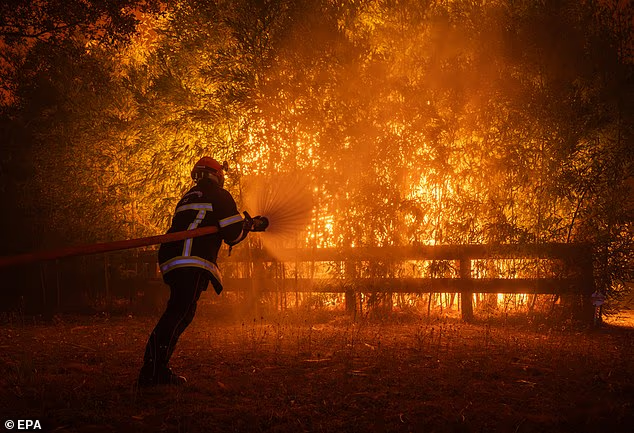
‘We’re ready for anything’: Bordeaux braces itself for blazes as wildfires rage across France and Spain – with more than 300,000 evacuated


-

 Fashion2 days ago
Weekend Open Thread: Brooks Brothers
-

 Politics7 days ago
Democrats look to World Cup watch parties to register thousands of voters
-

 News Videos7 days ago
Big Money Is Entering XRP
-

 Tech5 days ago
Sail Virtually Aboard The “Itanic” With IA-64 Emulator
-
 Tech5 days ago
Turtle Beach Command Series KB7 review: a nifty screen-equipped gaming keyboard
-

 Crypto World5 days ago
Grayscale Files For Worldcoin ETF, WLD Registers Sharp Rise
-

 NewsBeat6 days ago
Unregistered fitter used Gas Safe logo on business flyers
-
 Business4 days ago
New Jersey voter registration controversy explained: How 6,600 noncitizens got on the rolls, and what happens next
-
 Entertainment5 days ago
Johnny Depp’s R-Rated Gothic Cult Classic Gets New Release Ahead of Sydney Sweeney Remake
-

 Crypto World4 days ago
Ethics, other provisions in crypto Clarity Act to be further discussed
-

 Tech6 days ago
Watch Flock Safety CEO Garrett Langley discuss the future of surveillance at TechCrunch Disrupt 2026
-
 NewsBeat5 days ago
Shanghai science forum photos show China’s AI and robotics advances in rivalry with US
-

 Crypto World6 days ago
Circle’s President Sold Over 360,000 Shares, The Filings Explain Why
-

 Tech6 days ago
Subway Sandwich Computers Get a Second Life as Gaming Machines
-

 Sports2 days ago
2026 3M Open leaderboard: Scottie Scheffler finds putter in Round 1, sits three back
-

 News Videos3 days ago
The Peugeot Family: How 200 Years of an “Old Money” Dynasty Died in A Boardroom
-

 Fashion2 days ago
16 Dresses for the High Summer Event
-

 Tech7 days ago
How To Use Claude’s Reflect Dashboard And Learn When It’s Time To Touch Grass
-

 Tech6 days ago
The 35 Best Board Games for Family Game Night
-

 Entertainment6 days ago
Stephen Colbert Returns to Social Media After Late Show End
You must be logged in to post a comment Login