


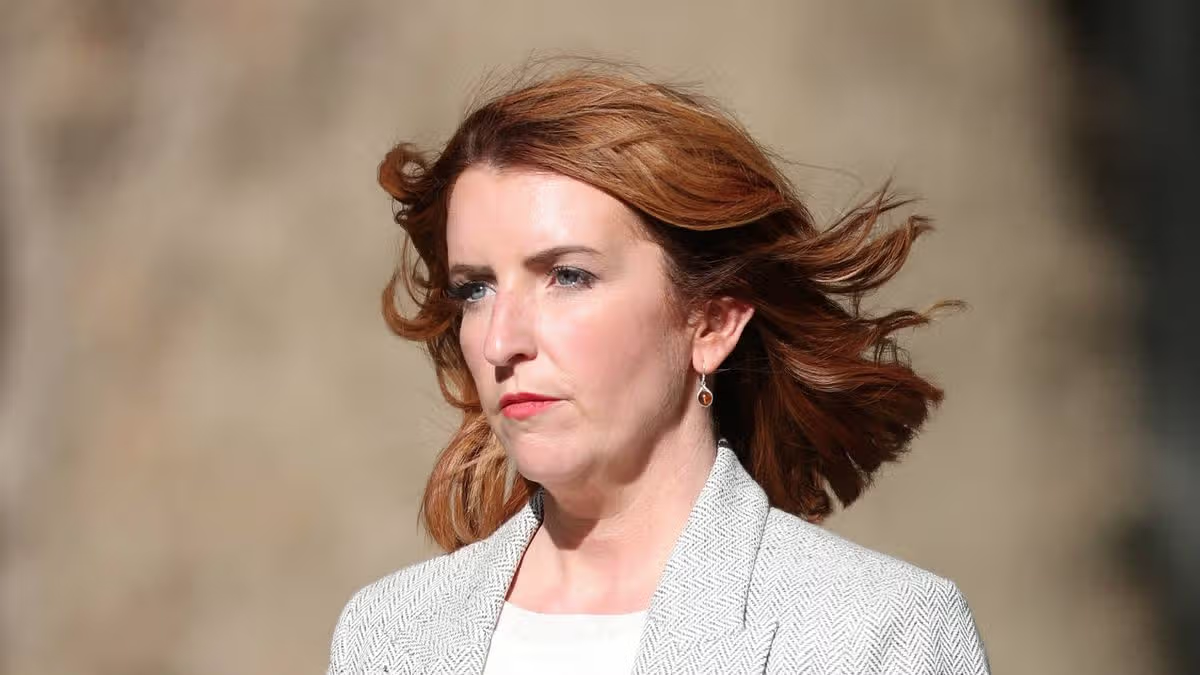
On Friday morning, Louise Haigh arrived at Heron House in Manchester city centre, carrying a bright red folder that stood out against an otherwise understated navy outfit.
Just weeks after Andy Burnham’s victory in the Makerfield by-election, and subsequent coronation as Labour Party leader and new Prime Minister, Miss Haigh now has a big job running the Cabinet Office and the title of First Secretary of State.
She has found herself running one of the defining features of this new Government – shifting power out of Whitehall and into England’s various regions.
Heron House, off Albert Square, is the temporary headquarters of the No 10 North, but is apparently fully operational while work continues on a more permanent base.
Critics have dismissed this as a costly gimmick but Miss Haigh insisted it represented something much bigger – a rewriting of how Britain is governed.
Officers were spotted stationed outside the building, which is also home to GCHQ staff from Wednesday and by Friday morning the entrance had been cordoned off. GMP has confirmed it is using ‘existing resources’ to provide security outside.
“It’s phenomenal, it only took them four days to set it up and it’s fully kitted,” she told the Manchester Evening News. “They’ve done an absolutely brilliant job. It’s an extremely secure site.”
It’s a remarkable return. Miss Haigh was Labour’s youngest MP when she was elected in Sheffield Heeley 2015, and she is still the youngest woman ever to have been appointed to a Cabinet position, at 36.
Less than two years ago, however, Miss Haigh resigned as transport secretary just four months into the role, after it emerged she had pleaded guilty to a fraud offence during her 20s.
Her allies believed she was treated unfairly, as then-Prime Minister, Sir Keir Starmer, had long-known about her conviction.
Instead of retreating, Miss Haigh became one of the architects of Andy Burnham’s leadership campaign. She was seen by his side throughout Makerfield.
Earlier this month, Haigh admitted to the BBC’s Nick Robinson that Mr Burnham had been ‘planning for this moment’ with her and other colleagues ‘for at least the last year’.
Now, as one of his closest allies, the 38-year-old is back at the centre of Government and charged with making one of Burnham’s radical devolution ambitions a reality.
Miss Haigh spoke to the the MEN exclusively and rejected the criticism that No 10 North risks becoming a gimmick, rather than a genuine transfer of power.
“We had a meeting today to discuss how we can rewrite the entire British state to serve the country better,” she said. “No 10 North will be at the heart of that, we’ll be pulling together civil servants across different departments.”
Friday’s gathering brought together senior ministers and cross-party regional mayors – including Steve Rotheram, Ben Houchen, Andrea Jenkins and Tracy Brabin – to put devolution at the heart of Mr Burnham’s government’s mission.
Drawing on Mr Burnham’s experience as Greater Manchester mayor, Miss Haigh argued that Whitehall has spent years ‘hoarding’ power that should have been exercised locally.
“[Mr Burnham] has seen the benefit here. It’s the largest, fastest growing region, it’s seen the biggest drop in deprivation, that’s thanks to the fruits of Andy Burnham’s labour,” she said.
For Haigh, the principle is that ‘every part of the country deserves that now’. However, the challenge will be applying that theory into practice.
Miss Haigh said the new No 10 North would mirror many functions of 10 Downing Street itself, bringing together civil servants from multiple departments under one roof while coordinating devolution across Whitehall.
“There will be two ministers – one for devolution and another for fiscal devolution and growth,” she explained.
Success, she claimed, won’t be measured by the building itself but whether more decisions and investments flow away from London.
She said: “The whole point of devolution is taking decisions to the ground as close as possible. We believe it’s important because decisions will be better. Outcomes for people will be better. We want more investments going in places around the country.”
For now, No 10 North is a work in progress. The permanent headquarters is still some way off – central retail park 2032 – leaving ministers operating from Heron House.
At least seven Greater Manchester Combined Authority employees, including Mr Burnham’s longstanding aide, Kevin Lee, and deputy chief of staff, Caroline Simpson, have moved into Heron House.
The office will be led by Sam Lister, a senior civil servant.
It’s an unassuming building from the outside, and a place where people can register births and weddings. It’s hard to imagine that happening at 10 Downing Street.
But Miss Haigh is relaxed about the temporary arrangement.
“I don’t know yet how long we’ll be based at Heron House. But [it’s] fully operational and this is an excellent state of the art facility. A lot of civil servants will be flocking here.”
Perhaps the biggest test of Burnham’s devolution agenda will be its relationship with the Treasury, which may be reluctant to give away more power willingly. Haigh insists the old rivalries are being dismantled.
“We’re joining up No10 and No 11 closer, we’re sharing expertise in a way that has not been done before,” she said.
She points to the unusual arrangement under which Daniel Tomlinson serves both the Cabinet Office and the Treasury as growth minister, arguing that it reflects the PM’s determination to implement his devolution agenda while using existing budgets.
The Prime Minister also chaired the first meeting of the National Economic Council – a body originally set up by Gordon Brown to deal with the fallout of the 2008 financial crash – where he told regional mayors the committee is ‘here for you, to empower you’.
“We generated a whole host of decisions which will reverberate around the civil service,” said Miss Haigh.
“We’ll be speeding up changes to infrastructure…. Changing how leaders will deal with Whitehall.
“It’s hard to understate the meeting today, and how much the Cabinet is desperate to action their projects.”
Less than two years after leaving Cabinet, Louise Haigh has returned to Government, tasked with helping reshape the British state itself. The First Secretary of State is now determined to prove that power can, at last, move out of Whitehall.
















































You must be logged in to post a comment Login